
Key Indications for Passive Immune Prophylaxis Against SARS-CoV-2 Infection in Malignant Hematological Disorders: An Analytic Hierarchy Process by an Ad Hoc Italian Expert Panel

 ,
,  , ,
, ,  and
and
Abstract
1. Introduction
2. Methods
3. Results
3.1. Review of the Evidence
3.2. Grading of Critical Outcomes
3.3. Indications for PrEP
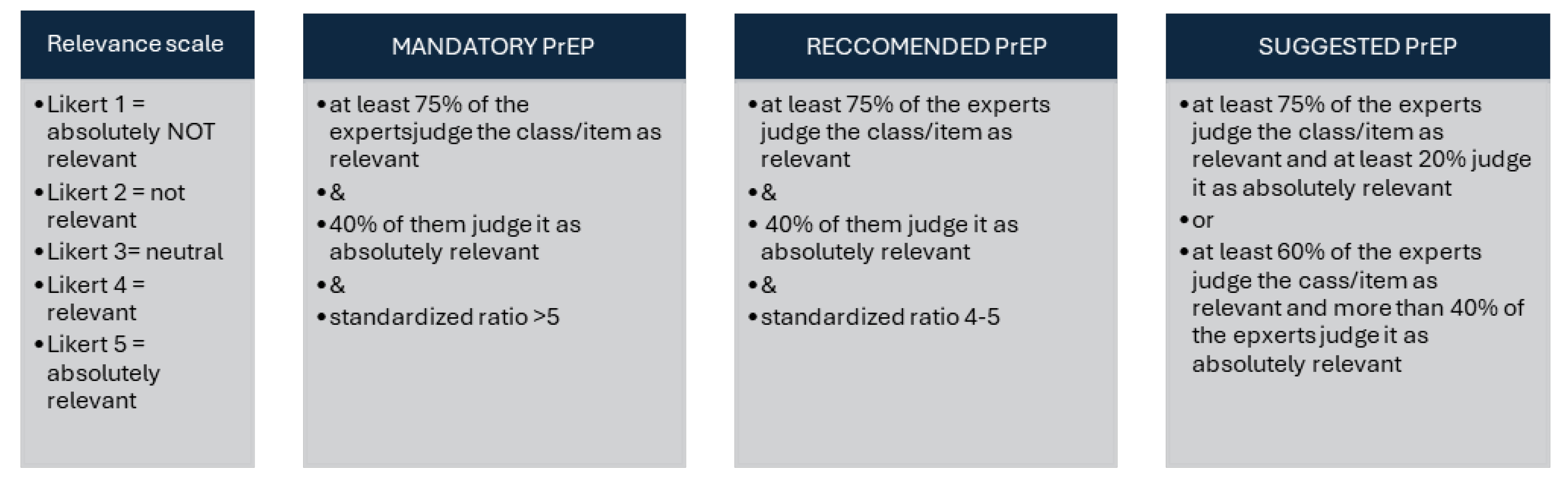
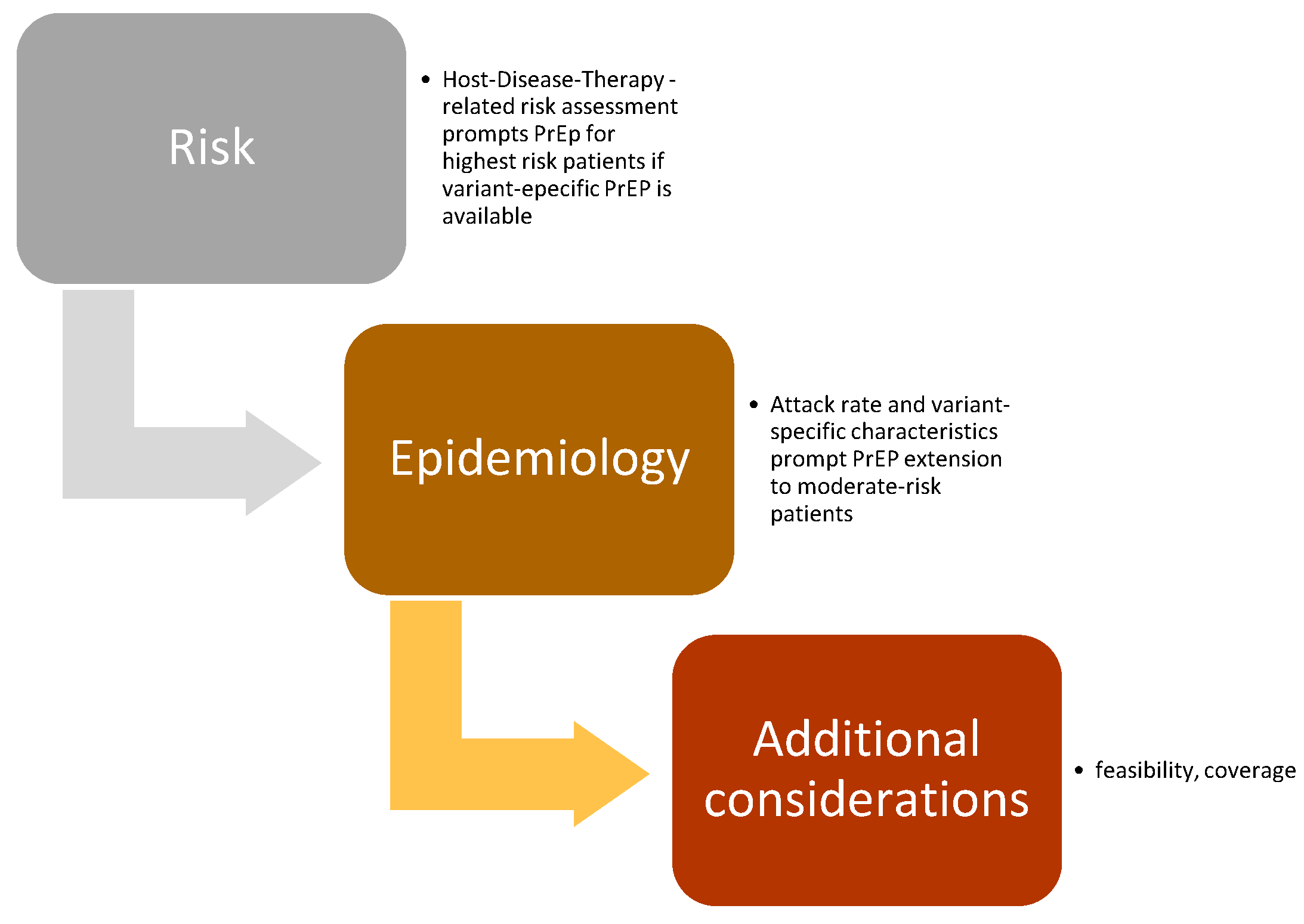
- Due to potential treatment delay due to COVID-19, passive SARS-CoV-2 immunoprophylaxis was strongly recommended (mandatory) for individuals with HM who were candidates for allogeneic HCT within 3 months or for CAR-T therapy. Passive immunoprophylaxis was also considered mandatory for patients with advanced-phase HM eligible for therapy with bispecific antibodies. These recommendations were deemed applicable regardless of the epidemiological spread of the SARS-CoV-2 virus variants.
- Passive immunoprophylaxis was additionally recommended for individuals at elevated risk of developing severe COVID-19 during waves of SARS-CoV-2 driven by more virulent variants. This group includes patients with high-risk myeloid neoplasms, older patients with multiple myeloma undergoing active therapy, and patients with lymphoid neoplasms who have profound humoral or cellular immunosuppression, such as those affected by CLL.
- The panel agreed on recommending that in HM patients the risk of SARS-CoV-2 infection should be periodically re-evaluated to assess the priority level for the need of SARS-CoV-2 passive immunoprophylaxis.
4. Discussion
5. Conclusions
Supplementary Materials
Author Contributions
Funding
Data Availability Statement
Acknowledgments
Conflicts of Interest
References
- World Health Organization. COVID-19 Epidemiological Update: Special Edition. 2024. Available online: https://cdn.who.int/media/docs/default-source/documents/emergencies/20241224_covid-19_epi_update_special-edition.pdf?sfvrsn=b0a6ddaf_1&download=true (accessed on 1 October 2025).
- World Health Organization. COVID-19 Global Risk Assessment. Available online: https://www.who.int/publications/m/item/covid-19-global-risk-assessment (accessed on 1 October 2025).
- World Health Organization Data. WHO COVID-19 dashboard. Available online: https://data.who.int/dashboards/covid19/summary (accessed on 1 October 2025).
- European Centre for Disease Prevention and Control. Available online: www.ecdc.europa.eu/en/news-events/slow-increases-covid-19-observed-across-eueea-new-variant-emerges (accessed on 1 October 2025).
- Alsoubani, M.; Chow, J. Navigating Coronavirus Disease 2019 in Immunocompromised Populations: Evolving Risk Factors, Treatment, and Outcomes. Infect. Dis. Clin. N. Am. 2025, 39, 309–329. [Google Scholar] [CrossRef]
- Langerbeins, P.; Hallek, M. COVID-19 in patients with hematologic malignancy. Risk Factors for Pediatric Critical COVID-19: A Systematic Review and Meta-Analysis. Blood 2022, 140, 236–252. [Google Scholar] [CrossRef]
- Aparicio, C.; Willis, Z.I.; Nakamura, M.M.; Wolf, J.; Little, C.; Maron, G.M.; Sue, P.K.; Anosike, B.I.; Miller, C.; Bio, L.L.; et al. Risk Factors for Pediatric Critical COVID-19: A Systematic Review and Meta-Analysis. J. Pediatr. Infect. Dis. Soc. 2024, 13, 352–362. [Google Scholar] [CrossRef]
- Oliva, A.; Cogliati Dezza, F.; Petrucci, F.; Romani, F.E.; Morviducci, M.; Mirabelli, F.M.; Cancelli, F.; Valeriani, E.; Marcelli, G.; Pugliese, F.; et al. Outcome of COVID-19 patients with haematological malignancies after the introduction of vaccination and monoclonal antibodies: Results from the HM-COV 2.0 study. Clin. Exp. Med. 2023, 23, 2275–2285. [Google Scholar] [CrossRef]
- Pagano, L.; Salmanton-García, J.; Marchesi, F.; López-García, A.; Lamure, S.; Itri, F.; Gomes-Silva, M.; Dragonetti, G.; Falces-Romero, I.; van Doesum, J.; et al. COVID-19 in vaccinated adult patients with hematological malignancies: Preliminary results from EPICOVIDEHA. Blood 2022, 139, 1588–1592. [Google Scholar] [CrossRef] [PubMed]
- Bronstein, Y.; Gat, R.; Levi, S.; Cohen, Y.C.; Luttwak, E.; Benyamini, N.; Shragai, T.; Vitkon, R.; Neaman, M.; Eilaty, N.; et al. COVID-19 in patients with lymphoproliferative diseases during the Omicron variant surge. Cancer Cell 2022, 40, 578–580. [Google Scholar] [CrossRef] [PubMed]
- Choudhri, Y.; Lopes, O.; Vlasschaert, C.; Masloveand, D.M.; Rauh, M.J. Associations of Lineage-Specific Clonal Hematopoiesis with COVID-19 Hospitalization and Mortality. Blood 2024, 144, 1295. [Google Scholar] [CrossRef]
- Hardy, N.; Vegivinti, C.T.R.; Mehta, M.; Thurnham, J.; Mebane, A.; Pederson, J.M.; Tarchand, R.; Shivakumar, J.; Olaniran, P.; Gadodia, R.; et al. Mortality of COVID-19 in patients with hematological malignancies versus solid tumors: A systematic literature review and meta-analysis. Clin. Exp. Med. 2023, 23, 1945–1959. [Google Scholar] [CrossRef]
- Lahmer, T.; Salmanton-García, J.; Marchesi, F.; El-Ashwah, S.; Nucci, M.; Besson, C.; Itri, F.; Jaksic, O.; Čolović, N.; Weinbergerová, B.; et al. Need for ICU and outcome of critically ill patients with COVID-19 and haematological malignancies: Results from the EPICOVIDEHA survey. Infection 2024, 52, 1125–1141. [Google Scholar] [CrossRef] [PubMed]
- Copland, E.; Hirst, J.; Mi, E.; Patone, M.; Chen, D.; Coupland, C.; Hippisley-Cox, J. Effectiveness and safety of COVID-19 vaccination in people with blood cancer. Eur. J. Cancer 2024, 201, 113603. [Google Scholar] [CrossRef]
- Passamonti, F.; Cattaneo, C.; Arcaini, L.; Bruna, R.; Cavo, M.; Merli, F.; Angelucci, E.; Krampera, M.; Cairoli, R.; Della Porta, M.G.; et al. Clinical characteristics and risk factors associated with COVID-19 severity in patients with haematological malignancies in Italy: A retrospective, multicentre, cohort study. Lancet Haematol. 2020, 7, e737–e745. [Google Scholar] [CrossRef]
- Yigenoglu, T.N.; Ata, N.; Altuntas, F.; Bascı, S.; Dal, M.S.; Korkmaz, S.; Namdaroglu, S.; Basturk, A.; Hacıbekiroglu, T.; Dogu, M.H. The outcome of COVID-19 in patients with hematological malignancy. J. Med. Virol. 2021, 93, 1099–1104. [Google Scholar] [PubMed]
- Sanchez-Pina, J.M.; Rodríguez Rodriguez, M.; Castro Quismondo, N.; Gil Manso, R.; Colmenares, R.; Gil Alos, D.; Paciello, M.L.; Zafra, D.; Garcia-Sanchez, C.; Villegas, C. Clinical course and risk factors for mortality from COVID-19 in patients with haematological malignancies. Eur. J. Haematol. 2020, 105, 597–607. [Google Scholar] [PubMed]
- Evans, R.A.; Dube, S.; Lu, Y.; Yates, M.; Arnetorp, S.; Barnes, E.; Bell, S.; Carty, L.; Evans, K.; Graham, S.; et al. Impact of COVID-19 on immunocompromised populations during the Omicron era: Insights from the observational population-based INFORM study. Lancet Reg. Health Eur. 2023, 35, 100747. [Google Scholar] [CrossRef]
- Zhu, X.; Jiang, Q.; Lu, J.; Sun, Y.; Zhao, X.; Yang, S.; Tang, F.; Yu, W.; Zhao, T.; Liu, X.; et al. COVID-19 infection in patients with haematological malignancies: A single-centre survey in the latest Omicron wave in China. Br. J. Haematol. 2023, 202, 31–39. [Google Scholar]
- Falcone, M.; Tiseo, G.; Marchetti, G.; Kalo, J.; Galfo, V.; Occhineri, S.; Almerigogna, F.; Matucci, T.; Riccardi, N.; Suardi, L.R.; et al. Risk of SARS-CoV-2 infection and severe COVID-19 in hematological patients who received or not pre-exposure prophylaxis with tixagevimab/cilgavimab: A target trial emulation. Leuk. Lymphoma 2024, 65, 1474–1481. [Google Scholar]
- Vergori, A.; Cozzi Lepri, A.; Chiuchiarelli, M.; Mazzotta, V.; Metafuni, E.; Matusali, G.; Siciliano, V.; Paulicelli, J.; Alma, E.; Siniscalchi, A.; et al. Risk of SARS-CoV-2 infection in patients with hematologic diseases receiving tixagevimab/cilgavimab as pre-exposure prophylaxis in most recent Omicron sublineages era. Int. J. Infect. Dis. 2024, 144, 107042. [Google Scholar]
- Schmidt, K.; Aumann, I.; Hollander, I.; Damm, K.; von der Schulenburg, J.M. Applying the Analytic Hierarchy Process in healthcare research: A systematic literature review and evaluation of reporting. BMC Med. Inform. Decis. Mak. 2015, 15, 112. [Google Scholar] [CrossRef] [PubMed]
- Uaprasert, N.; Pitakkitnukun, P.; Tangcheewinsirikul, N.; Chiasakul, T.; Rojnuckarin, P. Immunogenicity and risks associated with impaired immune responses following SARS-CoV-2 vaccination and booster in hematologic malignancy patients: An updated meta-analysis. Blood Cancer J. 2022, 12, 173. [Google Scholar]
- Sakuraba, A.; Luna, A.; Micic, D. Serologic response following SARS-CoV-2 vaccination in patients with cancer: A systematic review and meta-analysis. J. Hematol. Oncol. 2022, 15, 15. [Google Scholar] [CrossRef]
- Gagelmann, N.; Passamonti, F.; Wolschke, C.; Massoud, R.; Niederwieser, C.; Adjalle, R.; Mora, B.; Ayuk, F.; Kroeger, N. Antibody response after vaccination against SARSCoV-2 in adults with hematological malignancies: A systematic review and meta-analysis. Haematologica. 2022, 107, 1840–1849. [Google Scholar] [CrossRef]
- Mai, A.S.; Lee, A.R.Y.B.; Tay, R.Y.K.; Shapiro, L.; Thakkar, A.; Halmos, B.; Grinshpun, A.; Herishanu, Y.; Benjamini, O.; Tadmor, T.; et al. Booster doses of COVID-19 vaccines for patients with haematological and solid cancer: A systematic review and individual patient data meta-analysis. Eur. J. Cancer 2022, 172, 65–75. [Google Scholar] [CrossRef]
- Noori, M.; Azizi, S.; Abbasi Varaki, F.; Nejadghaderi, S.A.; Bashash, D. A systematic review and meta-analysis of immune response against first and second doses of SARS-CoV-2 vaccines in adult patients with hematological malignancies. Int. Immunopharmacol. 2022, 110, 109046. [Google Scholar] [CrossRef]
- Bhella, S.D.; Wilkin, A.M.; Hueniken, K.; Vijenthira, A.; Sebag, M.; Wang, P.; Hicks, L.K.; Hay, A.E.; McCurdy, A.; Hosseini-Moghaddam, S.; et al. COVID-19 Humoral Immunity Improves with Third and Subsequent Vaccine Doses in Patients with Plasma Cell Dyscrasias, Particularly in Those Receiving antiCD38 Therapy. Blood 2024, 144, 286. [Google Scholar] [CrossRef]
- Ramaswamy, R.; Fakhoury, L.; Zhao, P.; Wu, N.; Gao, F.; Uy, G.L.; DiPersio, J.F.; Crees, Z.D. Waning Long Term Efficacy of COVID-19 Post-Transplant Vaccination for Prevention of COVID-19 Adverse Events in Transplant and Cellular Therapy (TCT) Patients. Blood 2024, 144, 3532. [Google Scholar] [CrossRef]
- Laracy, J.C.; Yan, J.; Steiger, S.N.; Tan, C.A.; Cohen, N.; Robilotti, E.V.; Fender, J.; Cohen, S.; Korde, N.; Lee-Teh, M.; et al. Predictors of SARS-CoV-2 Omicron breakthrough infection after receipt of AZD7442 (tixagevimab-cilgavimab) for pre-exposure prophylaxis among hematologic malignancy patients. Haematologica 2023, 108, 3058–3067. [Google Scholar] [CrossRef]
- Demel, I.; Skopal, D.; Šafránková, E.; Rozsívalová, P.; Jindra, P.; Šrámek, J.; Turková, A.; Vydra, J.; Labská, K.; Vedrová, J.; et al. Effectiveness of tixagevimab/cilgavimab in patients with hematological malignancies as a pre-exposure prophylaxis to prevent severe COVID-19: A Czech retrospective multicenter study. Ann. Hematol. 2024, 103, 981–992. [Google Scholar] [CrossRef] [PubMed]
- Hall, V.G.; Lim, C.; Saunders, N.R.; Klimevski, E.; Nguyen, T.H.O.; Kedzierski, L.; Seymour, J.F.; Wadhwa, V.; Thursky, K.A.; Yong, M.K.; et al. Breakthrough COVID-19 is mild in vaccinated patients with hematological malignancy receiving tixagevimab-cilgavimab as pre-exposure prophylaxis. Leuk. Lymphoma 2023, 64, 1600–1604. [Google Scholar] [CrossRef] [PubMed]
- US Food Drug Administration FDA. Announces Evusheld Is Not Currently Authorized for Emergency Use in the US. 26 January 2023. Available online: https://www.fda.gov/drugs/drug-safety-and-availability/fda-announces-evusheld-not-currently-authorized-emergency-use-us (accessed on 8 November 2024).
- Haidar, G.; Thomas, S.; Loubet, P.; Baker, R.I.; Benfield, T.; Boonyaratanakornkit, J.; Kiertiburanakul, S.; Kim, A.H.J.; Longbrake, E.E.; Molina, J.M.; et al. Efficacy and safety of sipavibart for prevention of COVID-19 in individuals who are immunocompromised (SUPERNOVA): A randomised, controlled, double-blind, phase 3 trial. Lancet Infect. Dis. 2025, 25, 813–826. [Google Scholar] [CrossRef]
- Focosi, D.; Casadevall, A. Sipavibart: When a success changes into a failure. Lancet Infect. Dis. 2025, 25, 713–714. [Google Scholar] [CrossRef]
- covSPECTRUM. Analyze Single Variant; F456L Lineages in the World. Available online: https://cov-spectrum.org/explore/World/AllSamples/Past1M/variants?aaMutations=S%3AF456L& (accessed on 25 January 2025).
- Bhimraj, A.; Falck-Ytter, Y.; Baden, L.R.; Bedimo, R.; Cawcutt, K.; Cheng, V.C.; Chew, K.W.; Chiotos, K.; Daar, E.S.; Dzierba, A.L.; et al. 2025 Clinical Practice Guideline Update by the Infectious Diseases Society of America on the Treatment and Management of COVID-19: Pemivibart for Pre-exposure Prophylaxis, Vilobelimab for Critical Illness, and Abatacept or Infliximab for Severe or Critical Illness. Clin. Infect. Dis. 2025, ciaf424. [Google Scholar] [CrossRef] [PubMed]
- Invivyd. Invivyd Announces Continued Neutralizing Activity of PEMGARDA® (Pemivibart) and VYD2311 Against Currently Dominant SARS-CoV-2 Variant XFG (“Stratus”). Available online: https://investors.adagiotx.com/news-releases/news-release-details/invivyd-announces-continued-neutralizing-activity-pemgardar/ (accessed on 1 October 2025).
- De Cae, S.; Van Molle, I.; van Schie, L.; Shoemaker, S.R.; Deckers, J.; Debeuf, N.; Lameire, S.; Nerinckx, W.; Roose, K.; Fijalkowska, D.; et al. Ultrapotent SARS coronavirus-neutralizing single-domain antibodies that clamp the spike at its base. Nat. Commun. 2025, 16, 5040. [Google Scholar] [CrossRef] [PubMed]
- López-Aladid, R.; Bueno-Freire, L.; Farriol-Duran, R.; Porta-Pardo, E.; Aguilar, R.; Vidal, M.; Jiménez, A.; Cabrera, R.; Vázquez, N.; López-Gavín, A.; et al. Epitope mapping of SARS-CoV-2 Spike protein using naturally-acquired immune responses to develop monoclonal antibodies. Sci. Rep. 2025, 15, 16269. [Google Scholar] [CrossRef]
- Cerdán, L.; Silva, K.; Rodríguez-Martín, D.; Pérez, P.; Noriega, M.A.; Esteban Martín, A.; Gutiérrez-Adán, A.; Margolles, Y.; Corbera, J.A.; Martín-Acebes, M.A.; et al. Integrating immune library probing with structure-based computational design to develop potent neutralizing nanobodies against emerging SARS-CoV-2 variants. mAbs 2025, 17, 2499595. [Google Scholar]
- Rubio, A.A.; Baharani, V.A.; Dadonaite, B.; Parada, M.; Abernathy, M.E.; Wang, Z.; Lee, Y.E.; Eso, M.R.; Phung, J.; Ramos, I.; et al. Bispecific antibodies targeting the N-terminal and receptor binding domains potently neutralize SARS-CoV-2 variants of concern. Sci. Transl. Med. 2025, 17, eadq5720. [Google Scholar] [CrossRef] [PubMed]



| Outcome | Aruthmetic Average | Geometric Average |
|---|---|---|
| Death | 7.00 | 7.00 |
| ICU admission | 6.75 | 6.74 |
| Hematologic treatment delay | 6.63 | 6.61 |
| Hospital admission | 6.25 | 6.24 |
| Treatment downgrading | 6.13 | 6.07 |
| Virus persistence | 5.13 | 4.88 |
| Infection | 4.75 | 4.48 |
| Severe Adverse Events related to PrEP | 4.25 | 3.87 |
| Therapy- or Disease-Related Risk Factors | Standardized Relevance Score (sr) | Rank Class |
|---|---|---|
| Candidate for allogeneic HSCT | 6.6–9.7 | Class I |
| Candidate for CAR-T (ALL, NHL, MM) | 3.7–6.6 | Class I |
| Candidate for (or ongoing) bispecific antibodies (NHL, MM) | 3.7–4.3 | Class I |
| After CAR-T After allogeneic HSCT | 2.9–3.7 3.5–4.6 | Class II |
| Ongoing anti-CD20 or CD19 Moab | 3.3 | Class II |
| BTKi or BCL2i (CLL, NHL) | 3.2–5.1 | Class II |
| Chemoimmunotherapy (NHL) | 3.2–3.5 | Class II |
| AML (or high-risk MDS) induction therapy | 2.1–3.3 | Class II–III |
| JAK2i, TKI, IMIDs | 1.7–3.2 | Class II |
| Low-risk MDS on therapy | 2.1–2.3 | Class III |
| Multiple myeloma | 2.0–2.2 | Class III |
| CLL (on Igiv prophylaxis) | 2.3 (3.5) | Class III (II) |
| Immune cytopenias (prior splenectomy) | 2.1–2.8 (2.0) | Class III |
| Bone marrow failure syndromes (on complement inhibitor therapy) | 2.3 (2.3) | Class III |
Disclaimer/Publisher’s Note: The statements, opinions and data contained in all publications are solely those of the individual author(s) and contributor(s) and not of MDPI and/or the editor(s). MDPI and/or the editor(s) disclaim responsibility for any injury to people or property resulting from any ideas, methods, instructions or products referred to in the content. |
© 2025 by the authors. Licensee MDPI, Basel, Switzerland. This article is an open access article distributed under the terms and conditions of the Creative Commons Attribution (CC BY) license.
Share and Cite
Marchetti, M.; Barosi, G.; Passamonti, F.; Falcone, M.; Nicastri, E.; Sica, S.; Musto, P.; Mauro, F.R.; Girmenia, C. Key Indications for Passive Immune Prophylaxis Against SARS-CoV-2 Infection in Malignant Hematological Disorders: An Analytic Hierarchy Process by an Ad Hoc Italian Expert Panel. Vaccines 2026, 14, 46. https://doi.org/10.3390/vaccines14010046
Marchetti M, Barosi G, Passamonti F, Falcone M, Nicastri E, Sica S, Musto P, Mauro FR, Girmenia C. Key Indications for Passive Immune Prophylaxis Against SARS-CoV-2 Infection in Malignant Hematological Disorders: An Analytic Hierarchy Process by an Ad Hoc Italian Expert Panel. Vaccines. 2026; 14(1):46. https://doi.org/10.3390/vaccines14010046
Chicago/Turabian StyleMarchetti, Monia, Giovanni Barosi, Francesco Passamonti, Marco Falcone, Emanuele Nicastri, Simona Sica, Pellegrino Musto, Francesca Romana Mauro, and Corrado Girmenia. 2026. "Key Indications for Passive Immune Prophylaxis Against SARS-CoV-2 Infection in Malignant Hematological Disorders: An Analytic Hierarchy Process by an Ad Hoc Italian Expert Panel" Vaccines 14, no. 1: 46. https://doi.org/10.3390/vaccines14010046
APA StyleMarchetti, M., Barosi, G., Passamonti, F., Falcone, M., Nicastri, E., Sica, S., Musto, P., Mauro, F. R., & Girmenia, C. (2026). Key Indications for Passive Immune Prophylaxis Against SARS-CoV-2 Infection in Malignant Hematological Disorders: An Analytic Hierarchy Process by an Ad Hoc Italian Expert Panel. Vaccines, 14(1), 46. https://doi.org/10.3390/vaccines14010046