
Article

Serology Assays Used in SARS-CoV-2 Seroprevalence Surveys Worldwide: A Systematic Review and Meta-Analysis of Assay Features, Testing Algorithms, and Performance

1
Cumming School of Medicine, University of Calgary, Calgary, AB T2N 4N1, Canada
2
Institute of Health Policy Management and Evaluation, University of Toronto, Toronto, ON M5T 3M6, Canada
3
Wyss Institute for Biologically Inspired Engineering, University of California Berkeley, Berkeley, CA 02115, USA
4
Faculty of Science, University of Calgary, Calgary, AB T2N 1N4, Canada
5
Temerty Faculty of Medicine, University of Toronto, Toronto, ON M5S 1A8, Canada
6
COVID-19 Immunity Task Force, McGill University, Montreal, QC H3A 0G4, Canada
7
Department of Epidemiology & Center for Global Health, Colorado School of Public Health, Aurora, CO 80045, USA
8
Institute of Biomedical Engineering, University of Oxford, Oxford OX3 7DQ, UK
9
World Health Organization, 1211 Geneva, Switzerland
10
Department of Critical Care Medicine, University of Calgary, Calgary, AB T2N 4N1, Canada
*
Author to whom correspondence should be addressed.
Vaccines 2022, 10(12), 2000; https://doi.org/10.3390/vaccines10122000

Submission received: 28 September 2022 / Revised: 21 November 2022 / Accepted: 21 November 2022 / Published: 24 November 2022
(This article belongs to the Topic Global Analysis of SARS-CoV-2 Serology, Part 2)

Abstract

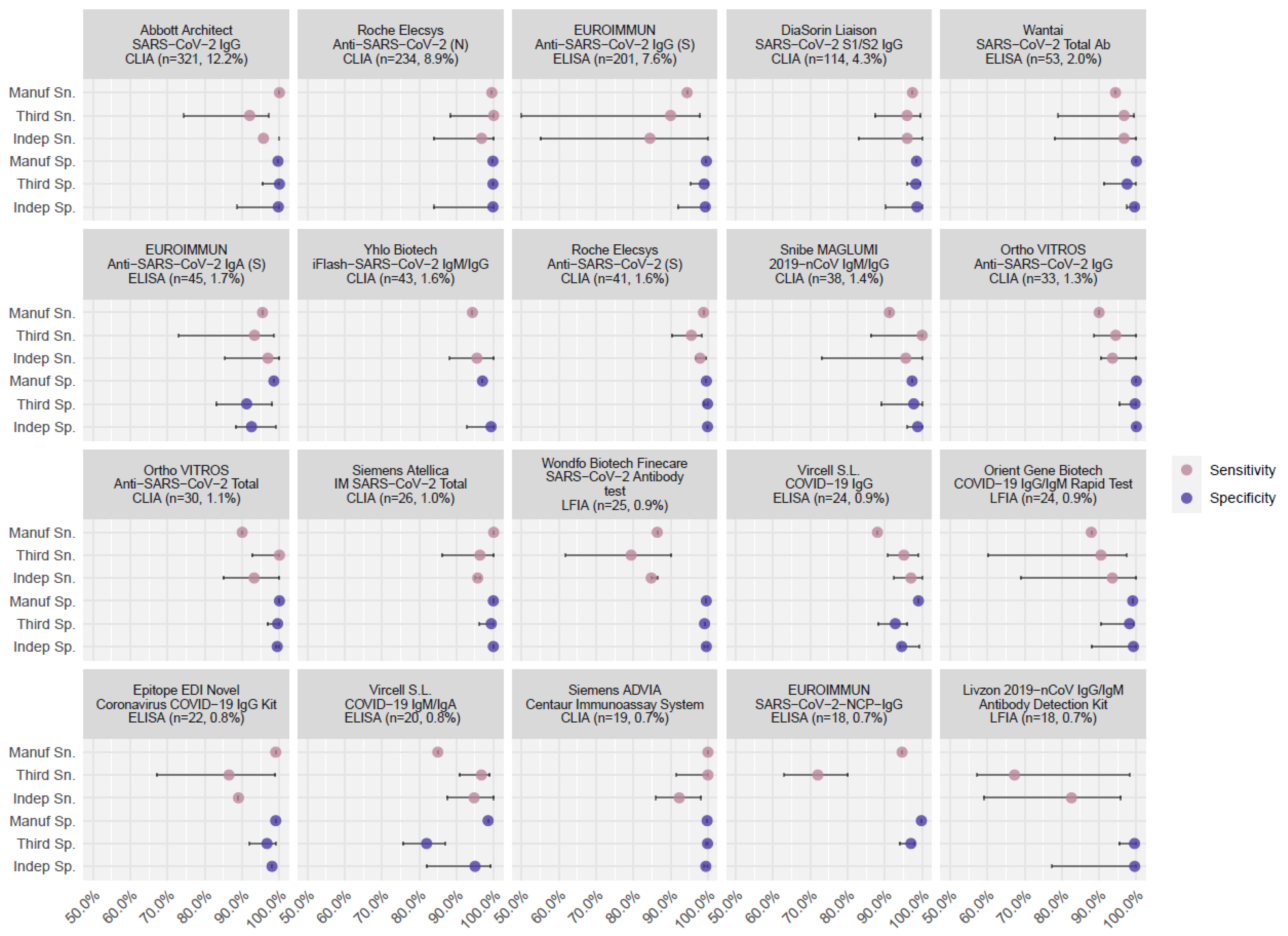
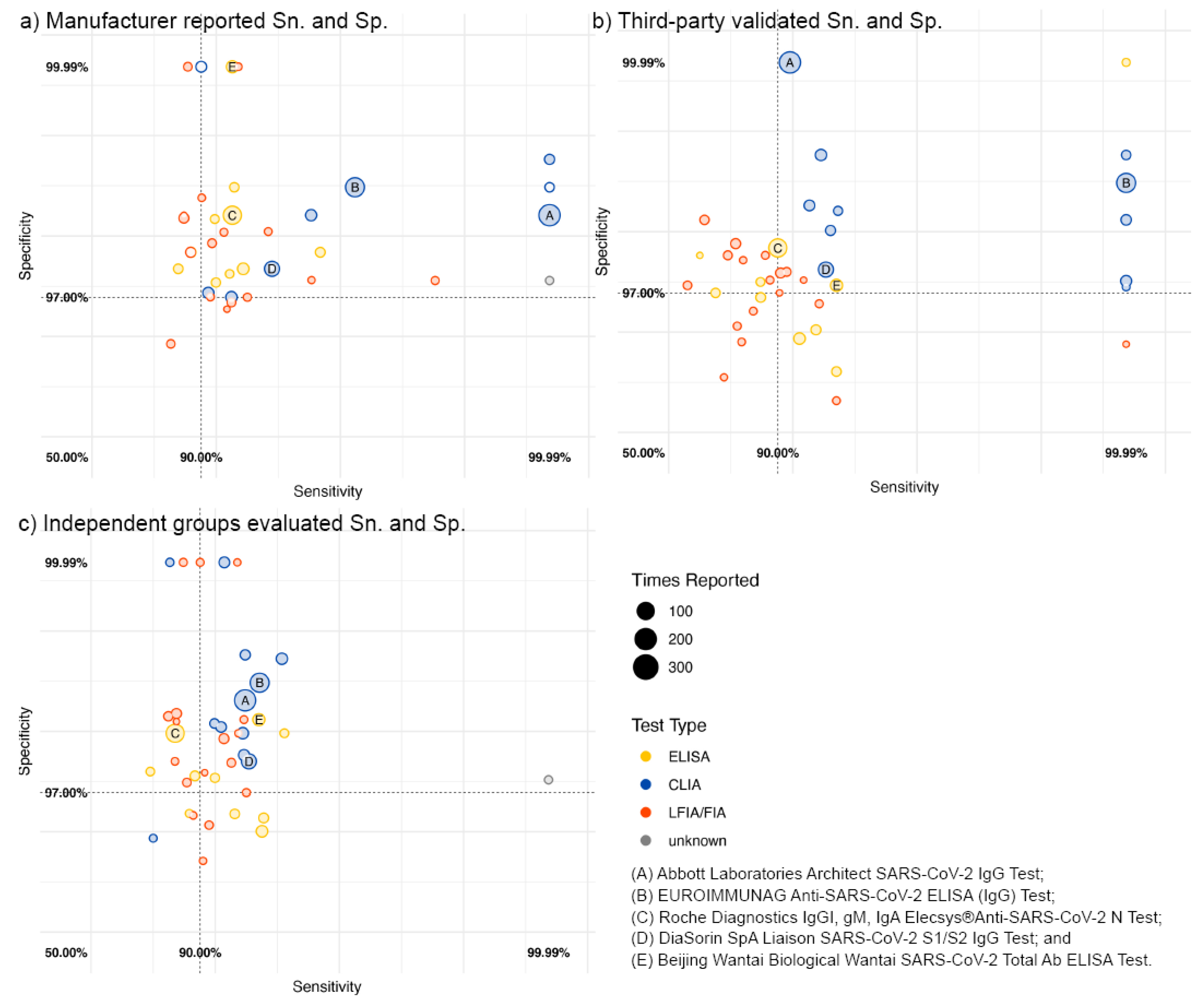
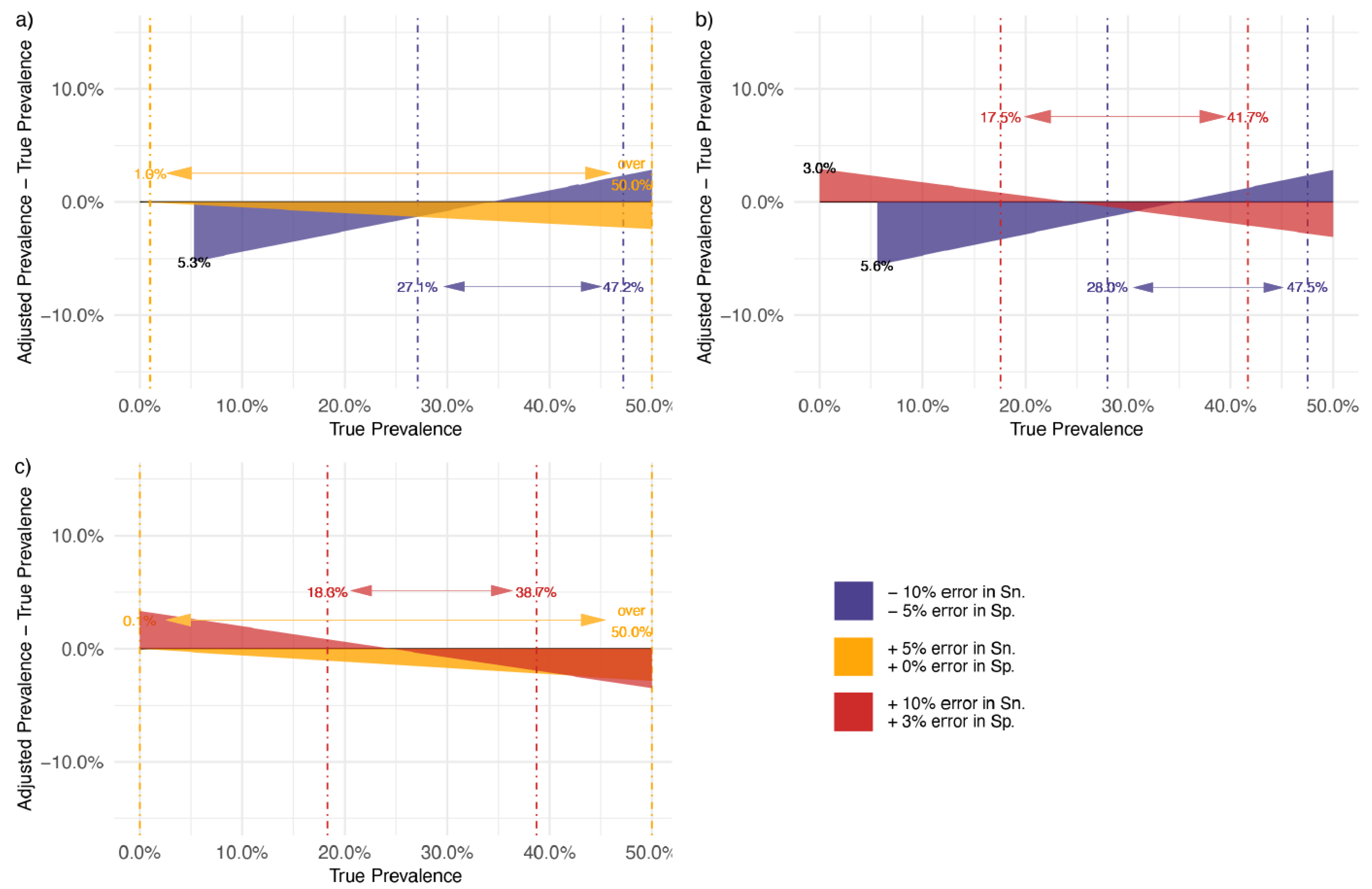
Background: Many serological assays to detect SARS-CoV-2 antibodies were developed during the COVID-19 pandemic. Differences in the detection mechanism of SARS-CoV-2 serological assays limited the comparability of seroprevalence estimates for populations being tested. Methods: We conducted a systematic review and meta-analysis of serological assays used in SARS-CoV-2 population seroprevalence surveys, searching for published articles, preprints, institutional sources, and grey literature between 1 January 2020, and 19 November 2021. We described features of all identified assays and mapped performance metrics by the manufacturers, third-party head-to-head, and independent group evaluations. We compared the reported assay performance by evaluation source with a mixed-effect beta regression model. A simulation was run to quantify how biased assay performance affects population seroprevalence estimates with test adjustment. Results: Among 1807 included serosurveys, 192 distinctive commercial assays and 380 self-developed assays were identified. According to manufacturers, 28.6% of all commercial assays met WHO criteria for emergency use (sensitivity [Sn.] >= 90.0%, specificity [Sp.] >= 97.0%). However, manufacturers overstated the absolute values of Sn. of commercial assays by 1.0% [0.1, 1.4%] and 3.3% [2.7, 3.4%], and Sp. by 0.9% [0.9, 0.9%] and 0.2% [−0.1, 0.4%] compared to third-party and independent evaluations, respectively. Reported performance data was not sufficient to support a similar analysis for self-developed assays. Simulations indicate that inaccurate Sn. and Sp. can bias seroprevalence estimates adjusted for assay performance; the error level changes with the background seroprevalence. Conclusions: The Sn. and Sp. of the serological assay are not fixed properties, but varying features depending on the testing population. To achieve precise population estimates and to ensure the comparability of seroprevalence, serosurveys should select assays with high performance validated not only by their manufacturers and adjust seroprevalence estimates based on assured performance data. More investigation should be directed to consolidating the performance of self-developed assays.
Keywords: serological assay; seroprevalence; performance; sensitivity; specificity; evaluation; validation serological assay; seroprevalence; performance; sensitivity; specificity; evaluation; validation