Review

Research Progress on the Anti-Inflammatory and Antioxidant Effects of Daidzein: Its Mechanisms of Action in Related Diseases, and Related Nanoformulations to Enhance Its Bioavailability


1
School of Pharmacy, Heilongjiang University of Chinese Medicine, Harbin 150040, China
2
Key Laboratory of Basic and Application Research of Beiyao, Ministry of Education, Heilongjiang University of Chinese Medicine, Harbin 150040, China
*
Authors to whom correspondence should be addressed.
Antioxidants 2026, 15(6), 775; https://doi.org/10.3390/antiox15060775 (registering DOI)
Submission received: 11 May 2026 / Revised: 19 June 2026 / Accepted: 19 June 2026 / Published: 22 June 2026
(This article belongs to the Section Health Outcomes of Antioxidants and Oxidative Stress)

Abstract

Daidzein is a naturally occurring isoflavone phytoestrogen, mainly found in leguminous plants. This component exerts anti-inflammatory effects by regulating inflammatory cells via multiple targets, blocking core inflammatory pathways, and inhibiting the release of inflammatory factors. It also scavenges reactive oxygen species, activates the antioxidant enzyme system, and regulates antioxidant signaling pathways to achieve antioxidant effects. By regulating these two core pathological processes, it exerts protective effects in diseases such as cancer, cardiovascular disease, and acute kidney injury, based on preclinical evidence. The development of nanodelivery systems has effectively improved the physicochemical properties of daidzein, enhanced its bioavailability, and enabled disease-targeted delivery. Most previous reviews have either focused exclusively on daidzein or broadly covered the pharmacological activities of isoflavones, yet have largely overlooked the dual anti-inflammatory and antioxidant mechanisms specific to daidzein. This review summarizes these mechanisms and their preclinical effects on various diseases, including cancer, cardiovascular diseases, and acute kidney injury. It also reviews the pharmacokinetic limitations of daidzein and recent progress in nanodelivery strategies aimed at enhancing its bioavailability and bioactivity. Overall, this review serves as a reference for the future standardized comparison of nanocarriers, targeted therapies, and clinical applications.

1. Introduction

Oxidative stress and chronic inflammation are two closely related core pathological processes that are central to the occurrence and development of various human diseases. They mutually reinforce each other, forming a vicious cycle that exacerbates cellular damage and tissue dysfunction [1]. Excessive reactive oxygen species (ROS) generation triggered by oxidative stress activates inflammatory signaling pathways, and the ensuing inflammatory response further induces ROS production. Inflammation and oxidative stress, as interwoven core pathological processes, cause cell damage, dysfunction, and even tissue fibrosis by regulating key signaling pathways such as nuclear factor kappa-B (NF-κB), mitogen-activated protein kinase (MAPK), and nuclear factor erythroid 2-related factor 2 (Nrf2) [2]. Inflammation and oxidative stress are also involved in the pathological mechanisms of major diseases such as cancer, cardiovascular disease (CVD), and acute kidney injury (AKI) [3]. In recent years, natural plant-derived active ingredients have received extensive attention in the field of disease prevention and treatment due to their advantages such as multi-targeted regulation, low toxicity, and few side effects, thus they have become important research subjects for the development of novel therapeutic drugs and functional food additives [4]. Phytoestrogens are a class of natural compounds widely present in plants that possess estrogen-like activity. They exert significant regulatory effects on oxidative stress and inflammatory responses, and their potential therapeutic value in various chronic diseases is increasingly recognized [5].
Daidzein is a typical isoflavone phytoestrogen and a characteristic active constituent of leguminous plants [6]. It possesses multiple biological activities, including anti-inflammatory, antioxidant, and metabolic regulatory effects, and has low toxicity and wide availability, thus attracting considerable attention from the academic community [7]. Daidzein’s unique C6-C3-C6 carbon skeleton and hydroxyl functional groups at specific positions confer high affinity and diverse biological activities with estrogen receptor β (ERβ) [8]. As a common dietary active ingredient, daidzein is mainly consumed by humans from soybeans and their products. Due to differences in dietary structure, the intake in the Asian population can reach 50 mg/d, which is much higher than that in the Western population [9]. In recent years, numerous in vivo and in vitro studies have confirmed that daidzein can precisely regulate the functions of inflammatory cells, block core inflammatory pathways such as NF-κB and MAPK, and simultaneously activate antioxidant signaling pathways such as the Nrf2/HO-1 axis, thereby exerting a wide range of pharmacological effects, including antioxidant [10], anti-inflammatory [11], and anti-tumor effects [12]. However, daidzein is plagued by inherent pharmacokinetic deficiencies, such as poor aqueous solubility, low oral bioavailability, and dependence on intestinal enzymatic activation, thereby greatly hindering its clinical translation and industrial application [13]. To overcome these inherent pharmacokinetic bottlenecks of natural active ingredients, nanodelivery systems have emerged as a promising strategy for practical application [14]. Accordingly, researchers have developed a variety of nanodelivery systems through formulation optimization, effectively enhancing their solubility, stability, and targeted delivery efficiency, and significantly boosting their biological activity [15,16].
This review summarizes the structural origin of daidzein, its anti-inflammatory and antioxidant molecular mechanisms, its regulatory effects on related diseases, as well as its pharmacokinetic limitations and recent advances in nanodelivery systems. Together, these aspects provide a scientific foundation for future research on daidzein and offer new insights into the development of novel natural drugs targeting diseases associated with oxidative stress and inflammation.

2. Methodology

This review encompasses relevant literature retrieved from databases including PubMed, Web of Science, and Google Scholar using keywords such as daidzein, antioxidants, anti-inflammatory effects, and nanodelivery systems, and covering mainly articles published in the past two decades. Conference abstracts, patents, and review articles lacking original data were excluded. The review summarizes the anti-inflammatory and antioxidant properties of daidzein, its effects in diseases including cancer, cardiovascular diseases, and acute kidney injury, as well as the improved bioavailability and related activities of its nanoformulations.

3. Chemical Structure and Main Sources of Daidzein

3.1. Chemical Structure and Chemical Information

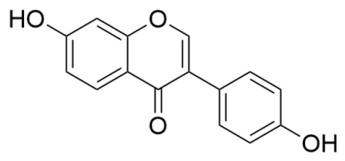
Daidzein, also known as 7,4′-dihydroxyisoflavone, is a naturally occurring plant estrogen belonging to the non-steroidal estrogen category [17]. It has a basic carbon skeleton of C6-C3-C6, with a molecular formula of C15H10O4 and a molecular weight of 254.24. Pure daidzein is a pale yellow crystal with a melting point in the range of 315–323 °C. It is insoluble in water but readily soluble in organic solvents such as methanol and ethanol. Due to its poor water solubility, the oral bioavailability of daidzein is only 20–30% [18]. This figure is calculated as the ratio of total plasma isoflavones (both bound and free forms) to the intake dose. The data are mostly derived from studies on pure aglycone preparations or specific processed foods [19]. The hydroxyl groups at C7 of ring A and position 4′ of ring B are the core functional groups, which enable daidzein to preferentially bind to ERβ and confer its phytoestrogenic activity [20].
In leguminous plants, daidzein predominantly presents in glycosylated forms. The glycosidic group needs to be hydrolyzed by intestinal enzymes to generate free aglycone, which is responsible for the biological and physiological functions of daidzein [21]. In plants, daidzein is synthesized via the phenylpropanoid pathway, and its biosynthesis is tightly regulated by specific enzymes, cofactors, and related regulatory genes. The phenolic hydroxyl groups of daidzein are susceptible to chemical modifications, including esterification, sulfonation, and methylation. Certain daidzein derivatives possess stronger biological activities than the parent molecule. Moreover, thermal treatment and fermentation can modify its chemical form and abundance, thus elevating the ratio of free aglycones [22]. Its structure is shown in Figure 1.

3.2. Primary Sources

Daidzein is a characteristic isoflavone component of leguminous plants, with natural sources including Glycine max (L.) Merr., Trifolium pratense L., Medicago sativa L., and Pueraria lobata [18]. Soybeans are the primary and richest natural dietary source of daidzein. However, the reported content of daidzein varies significantly, mainly influenced by factors such as the variety, processing methods, fermentation process, and analytical methods [23].
Specifically, the content of soybean glycosides can vary by several times among different varieties [24]. In terms of processing, heat treatment can cause some soybean glycosides to dissolve or degrade [25]. During the fermentation process, with the help of microbial β-glucosidase, the glycosides are converted into more active aglycone forms, thereby increasing the bioavailability of daidzein [26]. Additionally, differences in analytical methods and sample pretreatment procedures can also lead to variations in quantitative results [27].
When daidzein is consumed as a daily dietary component, it is mainly obtained from beans and their sprouted products, with a daily dosage ranging from a few to tens of milligrams. It helps maintain health over the long-term but does not produce acute pharmacological effects [28]. When used as a medicinal component, it involves the use of purified extracts or dietary supplements at high doses of more than 50 mg per day for specific therapeutic purposes such as alleviating menopausal symptoms and promoting bone health. However, high doses may cause side effects, including reproductive toxicity [26].
Traditionally, daidzein was considered present only in leguminous vegetables and grains [29,30]. However, recent studies have detected daidzein in non-leguminous plants such as Iris L., Chenopodium L., and Pistacia L. [31,32]. These findings have challenged the traditional perception that its source is mainly restricted to the legume family. Nevertheless, studies have also shown that the content of daidzein in these non-leguminous plants is much lower than that in leguminous plants. Currently, related fermented products and dietary supplements on the market still use leguminous soybeans as the core ingredient [33]. The main sources of daidzein are summarized in Table 1.

4. Anti-Inflammatory and Antioxidant Mechanisms of Daidzein

4.1. Anti-Inflammatory Mechanism

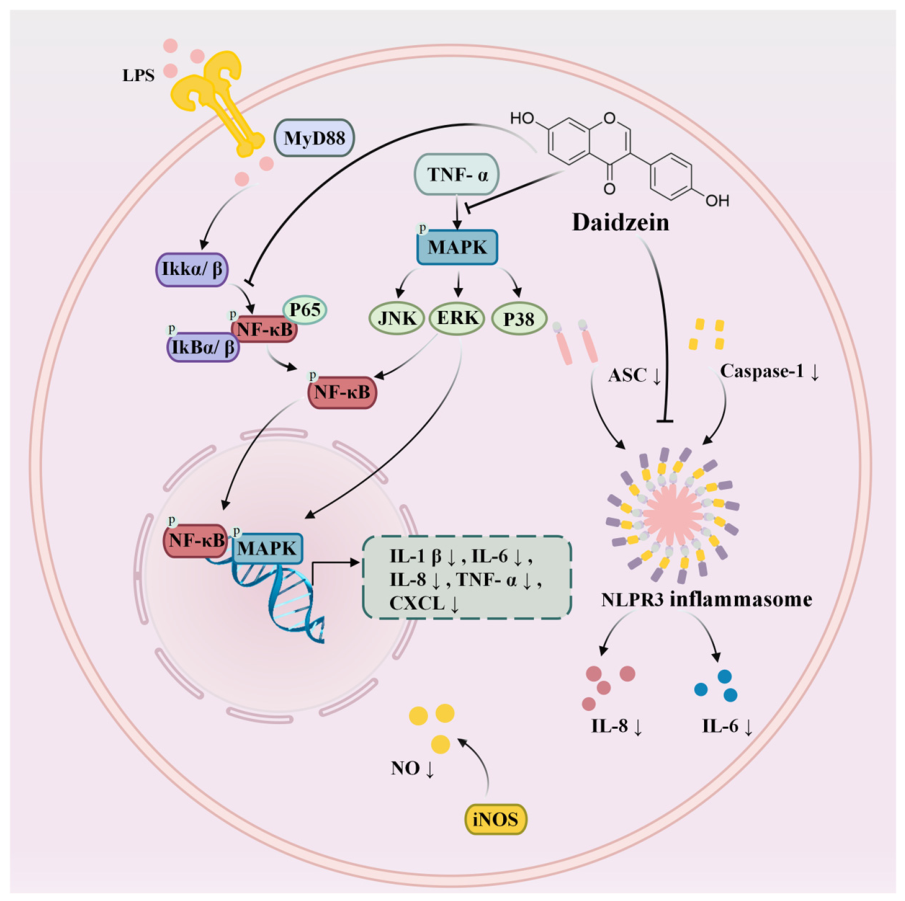
Daidzein regulates the initiation, amplification, and persistence of the inflammatory response via multiple targets and mechanisms. The core mechanism involves the regulation of inflammatory cell functions and the blockade of key signaling pathways. The anti-inflammatory mechanism of daidzein is illustrated in Figure 2.

4.1.1. Daidzein Regulates the Function of Inflammatory Cells

Daidzein can effectively inhibit the polarization of macrophages toward a pro-inflammatory phenotype and reprogram them to an anti-inflammatory state. The core mechanism lies in the regulation of the NOD-like receptor thermal protein domain associated protein 3 (NLRP3) inflammasome signaling pathway. In RAW264.7 cells induced by lipopolysaccharide (LPS) at 1 μg/mL, treatment with 10–40 μmol/L daidzein for 48 h in the presence of high glucose (30 mmol/L) or additional LPS significantly downregulated the expression of the M1 polarization markers inducible nitric oxide synthase (iNOS), cluster of differentiation 80 (CD80), and cluster of differentiation 86 (CD86) [43]. It also significantly reduced the protein expression levels of Toll-like receptor 4 (TLR4) and myeloid differentiation primary response 88 (MyD88) in macrophages, thereby inhibiting the activation of downstream NF-κB. Additionally, daidzein downregulated the expression of NLRP3 inflammasome, ASC, and pro-caspase-1, as well as the production of ROS. Another study using 10–100 μmol/L daidzein or its aglycone to pre-treat cells for 4 h, followed by LPS stimulation for 12 h (with 5 μmol/L dexamethasone as a positive control), confirmed the regulatory effect on this pathway [44]. Through these mechanisms, daidzein ultimately reduced the secretion of tumor necrosis factor-α (TNF-α), interleukin-1β (IL-1β), and interleukin-18 (IL-18), and alleviated macrophage-mediated inflammatory damage.
Daidzein can effectively inhibit the maturation and function of dendritic cells (DCs), thereby exerting immunosuppressive effects at the interface between innate and adaptive immunity. A study using bone marrow-derived DCs from C57BL/6 mice as a model found that treatment with 1–20 μmol/L daidzein in the presence of 10 ng/mL lipopolysaccharide (LPS) for 20 h significantly suppressed the expression of multiple maturation markers on DCs, including cluster of differentiation 40 (CD40), CD80, CD86, and major histocompatibility complex class II (MHC class II) molecules. Additionally, after 4 h of treatment, daidzein markedly reduced the ability of DCs to produce IL-12p40, interleukin-6 (IL-6), and TNF-α while restoring the endocytic activity of DCs and attenuating their ability to stimulate the proliferation of allogeneic CD4+ T cells [45].
Daidzein can regulate microglial cells to alleviate inflammatory damage. In LPS-induced BV2 microglial cell models, pretreatment with 10–50 μmol/L daidzein for 12 h before stimulation with 1 μg/mL LPS significantly reduced the production of pro-inflammatory mediators such as nitric oxide (NO), prostaglandin E2 (PGE2), IL-6, and IL-1β [46]. By inhibiting microglial activation, daidzein reduces oxidative stress and the release of inflammatory factors, thereby blocking the neuroinflammatory cascade and exerting an indirect neuroprotective effect that alleviates neuroinflammatory damage.

4.1.2. Daidzein Blocks the Core Inflammatory Signaling Pathways

NF-κB is the core transcription factor of the inflammatory response, and daidzein exerts regulatory effects at multiple key levels of the NF-κB pathway, thereby inhibiting the release of inflammatory mediators, regulating immune cell activation, and exerting broad anti-inflammatory activity. Daidzein significantly inhibits IKKα/β phosphorylation and blocks the upstream activation signal of the NF-κB pathway [47]. By inhibiting inhibitor of kappa B kinase (IKK) activity, it prevents the phosphorylation and degradation of IκBα, allowing IκBα to continuously bind and inhibit NF-κB [44]. Meanwhile, daidzein suppresses p65 phosphorylation and nuclear translocation [48], which further inhibits NF-κB transcriptional activity and downregulates downstream inflammatory gene expression. Moreover, it targets upstream TLR4/MyD88 and modulates the ERK1/2 and other MAPK signaling cascades, thereby synergistically strengthening anti-inflammatory responses [49,50].
Based on the hierarchical regulatory effects of the NF-κB pathway described above, daidzein can further downregulate the transcription, translation, and secretion of key pro-inflammatory factors and inflammatory mediators mediated by NF-κB, thereby blocking the amplification of the inflammatory cascade at its terminal stage. Studies have confirmed that daidzein can significantly inhibit the expression and release of core pro-inflammatory cytokines such as TNF-α, IL-1β, IL-6, and interleukin-8 (IL-8) [51,52]. These factors are key effector molecules that drive inflammatory responses and recruit immune cells following activation of the NF-κB pathway. Additionally, daidzein reduces the activity and expression of inflammation-related enzymes, including iNOS and cyclooxygenase-2 (COX-2), decreases the production of inflammatory mediators such as NO and PGE2, and alleviates inflammatory pathological manifestations such as local tissue redness, swelling, and tissue damage [53,54].
The MAPK pathway is another key inflammatory signaling pathway, and daidzein can simultaneously inhibit the activation of its three major branches. In an oral squamous cell carcinoma (OSCC) cell model, daidzein treatment significantly reduced the phosphorylation levels of p38 and ERK [55]. In mouse abdominal aortic aneurysm models, daidzein inhibits TNF-α and IL-1β by regulating pathways such as p38 and transforming growth factor-β (TGF-β1), and modulates the expression of related molecules including COX-2 and matrix metallopeptidase 2 (MMP-2), thereby reducing vascular inflammation and aneurysm dilation [56]. The activation of p38, ERK1/2 and JNK is closely related to the production of inflammatory factors and cellular stress responses. Daidzein inhibits the activation of these three pathways, which synergizes with the inhibition of NF-κB to reduce the production of pro-inflammatory mediators and amplify the anti-inflammatory effect.
The activation of the Nrf2/HO-1 pathway represents a key mechanism underlying the anti-inflammatory effects of daidzein. Studies have shown that daidzein treatment significantly increases the protein levels of Nrf2 downstream target genes, including heme oxygenase-1 (HO-1) and NAD(P)H dehydrogenase quinone 1 (NQO1) [57]. HO-1 can break down pro-oxidative heme and produce metabolites with anti-inflammatory effects, whereas NQO1 detoxifies quinone substances and reduces oxidative damage. Daidzein upregulates Nrf2 expression and promotes its nuclear translocation, thereby upregulating the expression of downstream antioxidant proteins and enhancing antioxidant enzyme activity via the Akt/GSK-3β/Nrf2 signaling pathway [58]. By enhancing antioxidant defense, daidzein facilitates the clearance of ROS [59], thereby reducing oxidative stress-induced activation of inflammatory pathways at its source. This action complements and acts synergistically with the direct inhibition of NF-κB and MAPK, leading to more comprehensive control of inflammation.
Daidzein downregulates the expression of chemokines, thereby reducing local immune cell infiltration and inflammatory amplification. In TNF-α-induced mouse lung inflammation models, daidzein antagonizes TNF-α-induced Cxcl2 expression and activity, decreases NF-κB transcriptional activity, inhibits poly(ADP-ribose) polymerase-1 (PARP-1) enzyme activity, suppresses neutrophil infiltration into lung tissue, and alleviates local inflammation [60].

4.2. Antioxidant Mechanisms of Daidzein

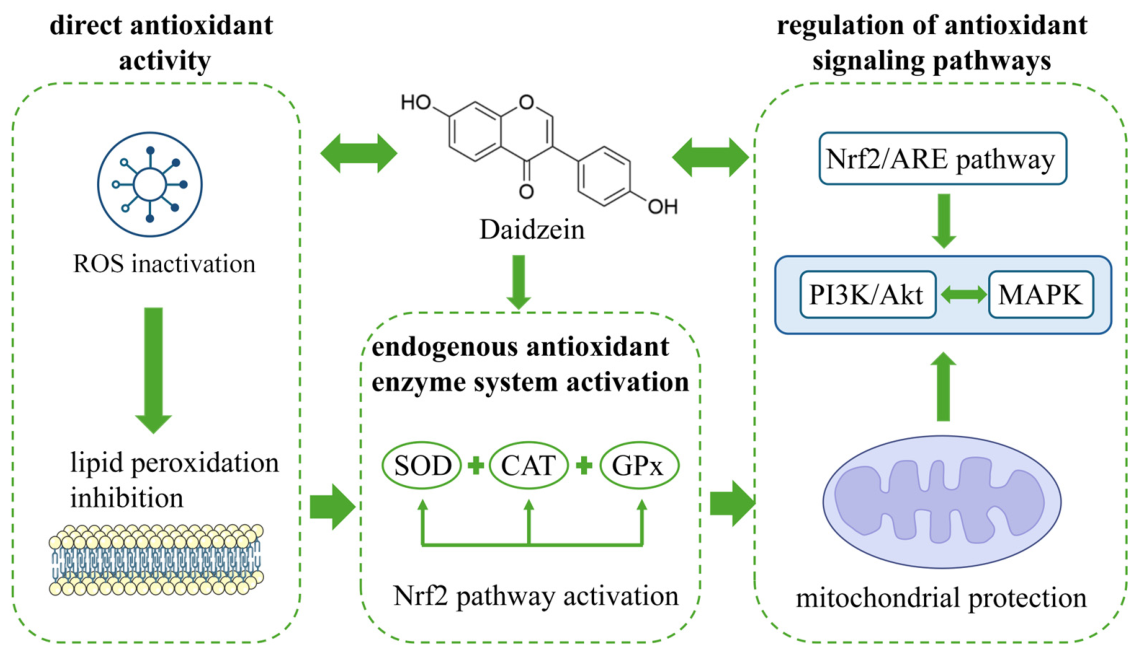
Daidzein maintains oxidative balance via a triple mechanism, including direct ROS scavenging, activation of antioxidant enzyme systems, and regulation of signaling pathways, thereby protecting against ROS-mediated cellular damage. Recent studies have further demonstrated the enhanced bioactivity of its metabolites and their tissue-specific antioxidant properties. The antioxidant mechanism of daidzein is illustrated in Figure 3.

4.2.1. ROS Inactivation

Daidzein promotes the scavenging of ROS by enhancing the endogenous antioxidant system. In the pig intestinal epithelial cell model [61], daidzein upregulates the expression of antioxidant enzymes such as SOD and CAT, thereby reducing the intracellular ROS level induced by H2O2 and decreasing the production of the lipid peroxidation product MDA. In the mouse testicular cell model [62], although ROS levels were not directly measured, daidzein significantly restored the SOD activity and GSH content inhibited by A1254, thereby enhancing the cells’ ability to remove superoxide anions; it also reduced the MDA level and alleviated cell damage.
However, it is critical to emphasize that daidzein exhibits bidirectional antioxidant/pro-oxidant activity, which is highly relevant for cancer biology and safety assessment. In multiple cancer cell models, daidzein increases ROS levels through pro-oxidation, regulates β-cell lymphoma 2 (Bcl-2) family proteins, activates related caspase proteases, and induces decreased mitochondrial membrane potential, DNA damage, and cell cycle arrest, ultimately leading to tumor cell apoptosis [63,64,65]. In normal cells, daidzein exerts antioxidant effects by directly scavenging ROS. In cancer cells, however, it functions as a pro-oxidant, selectively enhancing oxidative stress. This dual activity is context-dependent, varying with dosage, cell type, estrogen receptor status, and the microenvironment. From a safety perspective, this duality warrants caution, as high doses or specific conditions may trigger pro-oxidative toxicity.

4.2.2. Daidzein Activates the Endogenous Antioxidant Enzyme System

Daidzein not only directly eliminates ROS but also enhances the long-term antioxidant defense of cells by upregulating the expression of endogenous antioxidant enzymes [66]. In various animal models and cell experiments, daidzein treatment has been shown to significantly increase the activity or expression levels of key antioxidant enzymes, thereby forming a multi-level enzymatic antioxidant network.
From one perspective, it activates antioxidant enzymes such as SOD, catalase (CAT), glutathione peroxidase (GPx), enhances the function of the glutathione system, and reduces oxidative damage products such as MDA. For example, in myocardial and spinal cord ischemia-reperfusion injury models, this compound upregulates the activities of SOD, CAT, and GPx and reduces MDA accumulation [67,68]. Moreover, it enhances GSH content and CAT activity in glycerol-induced AKI in a dose-dependent fashion [69].
In contrast, the Nrf2 pathway is activated in both porcine small intestinal epithelial cells and traumatic brain injury models, accompanied by the upregulated expression of phase II detoxifying enzymes including HO-1 and NQO1 [61,70]. These endogenous antioxidant enzymes act synergistically to markedly reduce cellular ROS levels and mitigate lipid peroxidation as well as oxidative damage to proteins and DNA. For example, daidzein protects antioxidant enzyme activity in human skin cells [71], enhances SOD and GSH activity, and reduces lipid peroxidation in glioblastoma experiments [72]. Through these actions, it effectively reduces oxidative stress and protects tissue and organ function in various pathological conditions, including nephrotoxicity, ischemia-reperfusion injury, and brain injury.

4.2.3. Daidzein Regulates Antioxidant Signaling Pathways

The core antioxidant mechanism of daidzein resides in the establishment of a multi-level antioxidant regulatory network that operates from gene expression to organelle function by modulating cellular signaling pathways, Specifically, it activates the Nrf2/ARE pathway and enhances its activity at the upstream kinase level, while also exerting a protective effect at the mitochondrial level.
Firstly, daidzein has been reported to activate the Nrf2 pathway, leading to Nrf2 dissociation from Kelch-like ECH-associated protein 1 (Keap1) and nuclear translocation, thereby initiating the expression of antioxidant enzymes such as HO-1 and SOD. In a glycerol-induced AKI rat model, daidzein activates the Nrf2/HO-1 pathway in the kidney and dose-dependently increases the SOD, CAT, and GSH levels. Molecular docking has suggested a potential interaction between daidzein and the Keap1-Nrf2 complex [69]. However, direct evidence such as cysteine modification assays or mutagenesis studies is still needed to verify whether daidzein directly modifies Keap1 cysteine residues. Additionally, in mouse models of traumatic brain injury, daidzein upregulates Nrf2 and HO-1 expression in brain tissue, downregulates Keap1, and inhibits neuroinflammation and apoptosis [70]. Dietary supplementation with daidzein in pregnant sows also activates the ovarian Nrf2/HO-1 pathway, reduces oxidative stress and inflammatory cytokines, and improves reproductive performance [57]. Together, these studies support that the Nrf2/ARE pathway is a key mediator of the sustained antioxidant effects of daidzein, although the exact molecular details of how daidzein interacts with Keap1 remain to be clarified.
Secondly, daidzein enhances Nrf2 activity by regulating upstream kinases such as phosphatidylinositol 3-kinase/protein kinase B (PI3K/Akt) and MAPK. In LPS-induced intestinal epithelial barrier injury models, daidzein inhibits NF-κB signaling by suppressing excessive activation of the PI3K/Akt and p38 signaling pathways, thereby reducing TNF-α and IL-6 release and maintaining the expression of tight junction proteins (ZO-1, occludin, and claudin-1) as well as intestinal epithelial barrier function [73]. In ovarian cancer cells, daidzein induces cell cycle arrest and apoptosis by inhibiting the focal adhesion kinase (FAK) and PI3K/Akt/GSK pathways [74].
In addition, daidzein directly acts on mitochondria, stabilizing membrane potential, reducing ROS leakage, and upregulating SOD2 expression. In human breast cancer (MCF-7) cells, daidzein-induced mitochondrial membrane potential decline and apoptosis are significantly inhibited by the antioxidant N-acetylcysteine (NAC), confirming that daidzein influences cell fate by regulating the mitochondrial redox state [63]. Furthermore, in human liver cancer BEL-7402 cells, daidzein was shown to trigger endogenous apoptosis by increasing ROS levels and reducing mitochondrial membrane potential, further confirming its regulatory effect on mitochondrial function [65].
In summary, daidzein establishes a multi-level, multi-target antioxidant signaling network by activating the core Nrf2/ARE pathway, regulating upstream kinases such as PI3K/Akt and MAPK, and maintaining mitochondrial homeostasis.

5. The Role of Daidzein in Diseases via Regulating Inflammation and Oxidative Stress

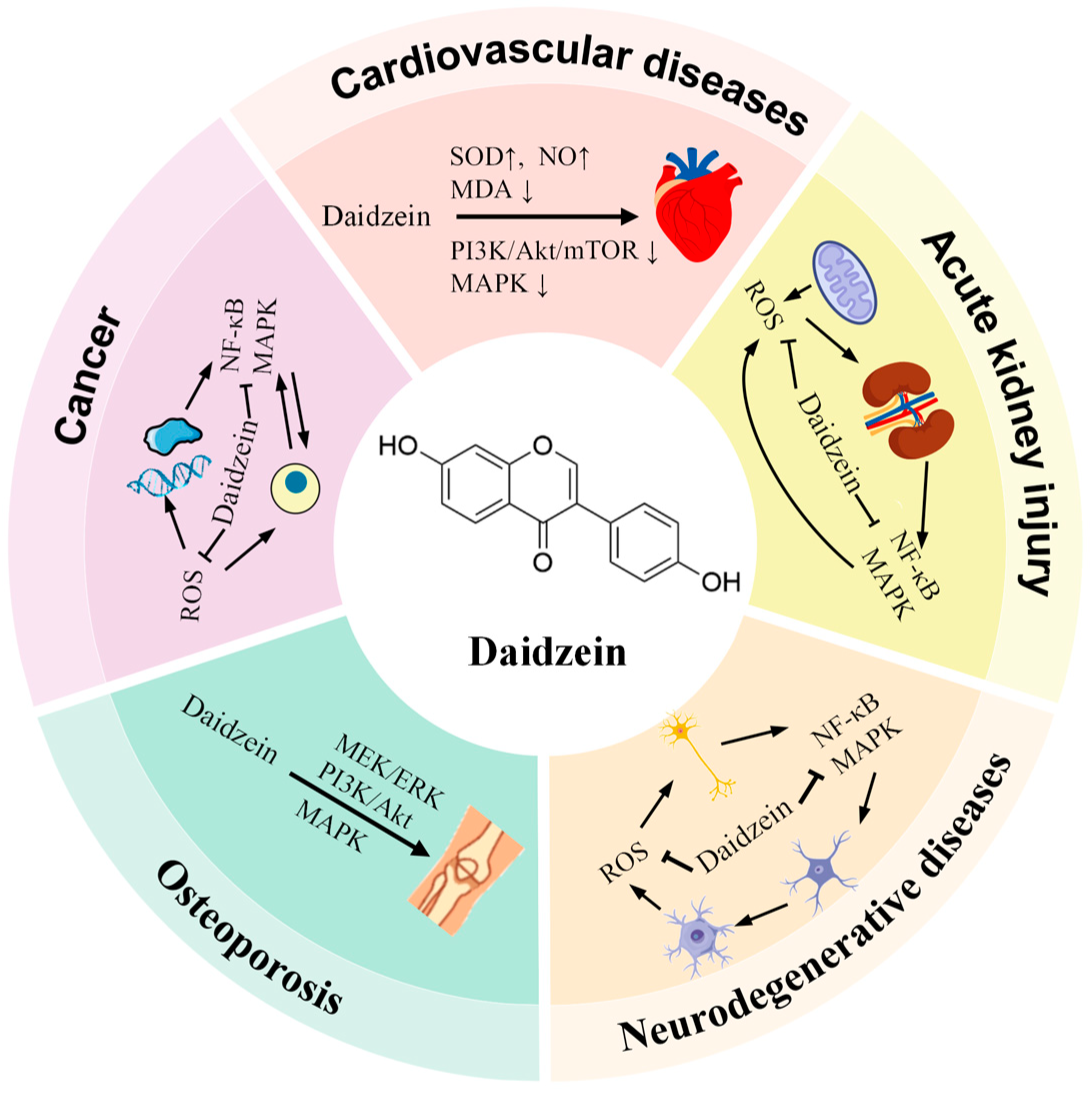
Daidzein, as a multi-target active phytoestrogen, exhibits broad intervention potential in the pathological processes of various diseases by modulating inflammation, oxidative stress, and related cellular signaling pathways. Its mechanism of action involves three aspects: fine regulation of specific cellular functions, inhibition or activation of core signaling pathways, and systematic regulation of downstream effector molecules, collectively contributing to protective or beneficial outcomes in different disease models. This section elaborates on the biological effects and molecular mechanisms of daidzein in multiple disorders, including cancer, cardiovascular disease (CVD), and kidney injury. The mechanisms underlying the disease-ameliorating effects of daidzein via anti-inflammatory and antioxidant actions are presented in Figure 4.

5.1. Cancer

Oxidative stress and chronic inflammation promote each other, creating a vicious cycle that drives cancer development. Excessive accumulation of ROS in the body triggers oxidative stress, leading to DNA damage, gene mutations, and oxidative modifications of proteins and lipids. It also activates the NF-κB pathway, promoting the release of inflammatory factors and sustaining a chronic inflammatory state [75]. Immune cells within the inflammatory microenvironment further produce high levels of ROS and inflammatory mediators, thereby exacerbating oxidative damage and inflammatory responses. Consequently, this promotes tumor cell proliferation, anti-apoptotic effects, angiogenesis, invasion, and metastasis [76]. Daidzein exerts anti-cancer effects by inhibiting tumor growth, invasion, and metastasis, and by inducing cancer cell apoptosis via antioxidation, anti-inflammatory mechanisms, and the modulation of multiple signaling pathways.
Daidzein exhibits both chemopreventive and direct antitumor effects, which should be distinguished as separate biological claims. In terms of chemoprevention, animal studies have demonstrated that it elevates the activities of antioxidant enzymes, including SOD and CAT, in liver and breast tissues, reduces lipid peroxidation and oxidative stress, and decreases the incidence of chemically-induced breast tumors by 10% and tumor multiplicity by 37.4%, thereby exerting early anticancer effects [77]. However, these results are from rodent models with small sample sizes, and the doses used are much higher than human dietary exposure, limiting direct translation. Thus, while statistically significant, this chemopreventive efficacy should not be equated with protection against human breast carcinogenesis through dietary daidzein consumption.
At the therapeutic level, daidzein inhibits the progression of various tumors via multiple targets and pathways, with caspase-3/8/9 activation being the key execution mechanism. In osteosarcoma, daidzein exerts its anti-osteosarcoma effect by directly binding to and inhibiting Src kinase activity, thereby downregulating phosphorylation of the downstream ERK signaling pathway. It induces S-phase arrest and activates caspase-3/9 to trigger mitochondrial intrinsic apoptosis [78]. In prostate cancer, daidzein inhibits the NF-κB pathway, enhances the activities of antioxidant enzymes including SOD and GPx, and downregulates the expression of genes such as vascular endothelial growth factor (VEGF) and MMP-2/9. Through these effects, it modulates cell cycle progression, induces cell death via extrinsic apoptosis (caspase-3/8 activation), suppresses angiogenesis and metastasis, and exerts antioxidant effects, indicating its considerable potential in the prevention and adjuvant treatment of prostate cancer [79]. In oral squamous cell carcinoma, daidzein inhibits the MMP2/9-MAPK-EMT axis to reduce invasiveness and induces caspase-3-dependent apoptosis; however, its combination with cisplatin is dose-dependent and requires an appropriate daidzein-to-cisplatin ratio [55]. Of note, the effective concentrations applied in these cell-line and xenograft models are often orders of magnitude above the physiologically attainable plasma levels via diet, meaning that these pro-apoptotic and cell-cycle modulating effects represent pharmacological, not nutritional, actions.
Beyond direct cytotoxicity, daidzein has a clear anti-metastatic effect that is mechanistically distinct from its pro-apoptotic action. In prostate and oral squamous cell carcinomas, daidzein reduces cell migration and invasion by downregulating MMP-2/9, inhibiting MAPK signaling (ERK1/2 and p38 phosphorylation), and reversing epithelial–mesenchymal transition (EMT) [55,79]. Although anti-metastatic activity itself does not directly rely on caspase-mediated apoptosis, metastatic cells ultimately need to be eliminated by apoptosis, and daidzein may synergistically enhance caspase activity in this process.
In addition, daidzein shows strong potential for combination therapy, where activation of caspase-3/8/9 is a core mechanism. When combined with anti-estrogenic drugs, it targets and induces mitochondrial apoptosis in breast cancer cells, inhibits the PI3K/Akt/mTOR pathway, and promotes the expression of the pro-apoptotic protein Bcl-2-associated X protein (Bax) while inhibiting the anti-apoptotic protein B-cell lymphoma-extra large (Bcl-Xl), and significantly activates caspase-3/7/9, thereby exerting synergistic anti-cancer effects [80]. In combination with gefitinib, daidzein increases ROS levels in lung cancer cells, activates apoptotic pathways, and inhibits signal transducer and activator of transcription (STAT), protein kinase B (AKT), and ERK signaling downstream of epidermal growth factor receptor (EGFR). These effects ultimately lead to G0/G1 phase cell cycle arrest, induction of endogenous and exogenous apoptosis, enhanced chemosensitivity, reduced toxicity, and improved chemotherapeutic efficacy [81]. A note of caution: when combined with cisplatin in oral squamous cell carcinoma, low-dose cisplatin shows synergistic cytotoxicity (accompanied by caspase-3 activation), whereas high-dose cisplatin may produce antagonism, indicating the need for optimization of the dosing regimen [55]. Importantly, although these synergistic chemosensitizing effects are promising, they have only been validated under supra-pharmacological conditions in vitro.
Although daidzein has shown anticancer potential in various tumor models, the existing evidence mainly comes from small-sample rodent or in vitro studies, with dosages far exceeding the dietary exposure levels in humans, thus lacking physiological relevance. As a phytoestrogen, its effects may vary depending on tumor type, estrogen receptor status, and microenvironment. Moreover, there is a lack of long-term safety and pharmacokinetic data. Future studies need to be conducted using doses and models that are closer to those in humans for validation.

5.2. Acute Kidney Injury

AKI is a clinical syndrome caused by multiple factors and characterized by a rapid decline in renal function within a short period of time. Its core features include a sharp decrease in glomerular filtration rate, retention of nitrogen-containing metabolites, and disruption of water, electrolytes, and acid–base balance [82]. Its pathogenesis is associated with oxidative stress. Extensive accumulation of ROS triggers oxidative stress, directly damaging renal tissue and activating inflammatory pathways. In turn, inflammation-derived factors further exacerbate oxidative stress, forming a vicious cycle that continuously aggravates tubular damage and promotes the rapid deterioration of renal function [83].
Daidzein, with its antioxidant and anti-inflammatory capabilities, breaks the vicious cycle of oxidative stress–inflammation–apoptosis/fibrosis. In a variety of experimental models of kidney injury, daidzein has demonstrated clear protective effects and consistent pathways of action. In a glycerol-induced AKI rat model, pretreatment with daidzein at doses of 25–100 mg/kg given orally for two weeks before glycerol injection significantly improved renal function by reducing the levels of urea, creatinine, and kidney injury molecule 1 (KIM-1); enhances antioxidant capacity by strengthening the Nrf2/HO-1 pathway; and inhibits the NF-κB pathway and inflammatory factors such as IL-1β and TNF-α. Furthermore, while regulating apoptosis-related proteins (reducing Bax/caspase-3 and increasing Bcl-2), it alleviates renal histopathological damage through multiple pathways [69]. In gentamicin-induced nephrotoxicity models (MDCK cells and adult zebrafish), daidzein at concentrations of 25–100 μM exerts a dose-dependent protective effect by increasing SOD and GSH activity, reducing the production of lipid peroxides, NO, and ROS to suppress oxidative stress, and downregulating the expression of cytokines such as COX-2, TNF-α, and IL-1β to reduce inflammation, thereby reversing renal pathological damage [84].
Although kidney damage can be alleviated through dietary adjustments and lifestyle improvements, the problem of cisplatin-induced nephrotoxicity is still difficult to avoid [51]. Multiple studies have confirmed that daidzein has protective effects against cisplatin chemotherapy-induced damage. In one study, daidzein, administered at a pharmacological dose of 200 mg/kg body weight 1 h after cisplatin injection, significantly improved the renal function indicators, attenuated oxidative stress and inflammatory responses in renal tissue, and inhibited tubular apoptosis [66]. Furthermore, it effectively ameliorated cisplatin-induced abnormalities in hematological parameters, enhanced hepatic antioxidant capacity, and reduced liver tissue injury. Collectively, these protective effects are mainly attributed to its multifaceted mechanisms, including anti-oxidation, anti-inflammation, and anti-apoptosis, acting in a dose-dependent manner [85]. However, a critical concern is whether daidzein could compromise the antitumor efficacy of cisplatin. Recent evidence in oral squamous cell carcinoma revealed a dose-dependent interaction: daidzein synergizes with low-dose cisplatin yet antagonizes high-dose cisplatin by protecting tumor cells via its antioxidant activity [55]. This biphasic effect implies that daidzein might inadvertently protect malignant cells under specific contexts, suggesting that its application as a protective adjuvant warrants further validation in tumor-bearing models, alongside the careful optimization of dosing schedules.
The current evidence mainly comes from preclinical studies and requires clinical validation. Most of the existing experiments administer daidzein preventively before the injury occurs, while there is insufficient research on therapeutic administration. Furthermore, the long-term safety of daidzein has not been evaluated, nor has its potential impact on the anti-tumor efficacy of cisplatin been assessed.

5.3. Cardiovascular Diseases

CVD is one of the leading causes of death, and its onset is closely related to vascular endothelial dysfunction, myocardial injury, and thrombosis [86]. Daidzein exerts multilevel cardiovascular protection by improving vascular reactivity, protecting cardiomyocytes, and inhibiting platelet activation.
Vascular endothelial injury caused by diabetes is an early key pathological basis for the occurrence and development of CVD [87]. Studies have shown that in streptozotocin-induced diabetic rat models, daily intragastric administration of daidzein for 7 weeks enhanced the NO and prostaglandin pathways, reduced MDA content in aortic tissue, and increased SOD activity. It also significantly enhanced the endothelium-dependent vasodilation response of the aortic ring to acetylcholine and reduced the excessive contraction response of the vessel to phenylephrine, thereby alleviating vascular endothelial injury and pre-atherosclerotic lesions induced by metabolic diseases such as diabetes [88].
In doxorubicin-induced cardiotoxicity models, daidzein pretreatment improves cardiac function decline, reduces pathological damage such as myocardial fibrosis disorder, apoptosis, and over-activation of autophagy, and prevents progression to heart failure and cardiomyopathy. It acts by inhibiting the PI3K/Akt/mTOR pathway, downregulating phosphorylated Akt, cleaved caspase-3, and LC3-II while upregulating Bcl2 and cyclin D1 [89]. In terms of antithrombotic effects, daidzein inhibits collagen-induced platelet activation, granule release, and clot contraction; reduces thromboxane A2 (TXA2) production by lowering cytosolic phospholipase A2 (cPLA2) phosphorylation; and increases cyclic adenosine monophosphate (cAMP). It inhibits platelet aggregation by modulating the PI3K/Akt/GSK3α/β and MAPK signaling pathways and exerts synergistic effects with low-dose aspirin. These actions provide promising preventive and therapeutic strategies for ischemic cardiovascular diseases including atherosclerosis, coronary heart disease, and cerebral infarction [90].
These preclinical results suggest that daidzein can alleviate vascular lesions in metabolic diseases, protect the myocardium from drug damage, and intervene in the process of thrombosis, providing a new natural compound option for further investigation in the prevention and treatment of cardiovascular diseases.

5.4. Neurodegenerative Disease

Neurodegeneration refers to a class of pathological processes in which neurons undergo progressive and irreversible damage and death, resulting in the gradual decline of corresponding functions. It is the core pathological feature of many neurological disorders such as Parkinson’s disease (PD), Alzheimer’s disease (AD), and amyotrophic lateral sclerosis [91]. The core mechanism involves protein misfolding and aggregation, accompanied by mitochondrial dysfunction, neuroinflammation, oxidative stress, and other cellular cascade reactions, ultimately resulting in neuronal energy depletion and death [92].
PD, as a common neurodegenerative disease, is pathologically characterized by loss of dopaminergic neurons in the substantia nigra and aggregation of α-synuclein, presenting with motor and non-motor symptoms [93]. Oxidative stress and neuroinflammation are the core mechanisms, and they promote each other to form a vicious cycle. Abnormalities in mitochondrial and dopamine metabolism produce a large amount of ROS, damaging neurons and promoting abnormal aggregation of α-synuclein. Aggregated proteins activate microglia to release pro-inflammatory factors such as TNF-α and IL-1β, further damaging neurons and intensifying oxidative stress, thereby promoting disease progression [94]. 1-Methyl-4-phenyl-1,2,3,6-tetrahydropyridine (MPTP), a commonly used neurotoxin for inducing Parkinson’s disease models in mice, is widely used in Parkinson’s disease research. In an in vivo MPTP-induced C57BL/6 mouse PD model and an in vitro LPS-induced BV2 microglial cell model, treatment with daidzein at 10, 25, and 50 µM in vitro or orally at 50 or 75 mg/kg for 30 days in vivo improved motor function, restored dopamine levels, reduced inflammation, and corrected abnormal brain tissue structure in PD mice. In vitro experiments showed that daidzein was non-cytotoxic and dose-dependently reduced levels of NO, ROS, PGE2, IL-6, and IL-1β [46].
AD is a neurodegenerative disease centered on progressive cognitive decline. Its typical pathology is the deposition of beta-amyloid (Aβ) plaques in the brain, and hyperphosphorylation of tau protein to form neurofibrillary tangles, ultimately leading to massive neuronal death [95]. Metal elements such as iron, zinc, and copper promote Aβ aggregation, and Aβ significantly increases ROS production, seriously affecting neuronal metabolism [96]. In an AD-related Aβ oligomer injury model, daidzein at 0.5 µM with 2-h pretreatment significantly improved Aβ-induced decline in cell viability, reduced ROS and MDA production, maintained mitochondrial membrane potential, inhibited neuroinflammation and MAPK pathways, and downregulated COX-2, IL-1β, NF-κB, and their phosphorylation levels. It also alleviated neuronal and glial cell damage, suggesting a potential therapeutic approach for Aβ-related neurodegenerative diseases in vitro such as Alzheimer’s disease [97].
These experiments indicate that research on the neuroprotective effects of daidzein mediated through anti-inflammatory and antioxidant mechanisms is still at an early stage. Further rigorous in vivo verification, long-term safety assessment, and mechanism analysis are required before considering its clinical application.

5.5. Type 2 Diabetes Mellitus

Type 2 diabetes mellitus is a chronic metabolic disorder characterized mainly by insulin resistance and progressive decline of pancreatic β-cell function, often accompanied by chronic low-grade inflammation, oxidative stress, dyslipidemia, and mitochondrial dysfunction [98]. Given the significantly higher fracture risk in diabetic patients, elucidating how diabetic milieu affects bone is clinically crucial. In this regard, high glucose-induced oxidative stress, advanced glycation end products, and chronic inflammation interfere with key pathways, including receptor activator of NF-κB ligand/osteoprotegerin (RANKL/OPG), insulin signaling, and peroxisome proliferator-activated receptor γ (PPARγ). This interference shifts the balance toward osteoclastic resorption at the expense of osteoblastic formation, thereby directly linking diabetic dysregulation to skeletal impairment [99]. Among the various natural products, daidzein—a major isoflavone derived from soybeans—has garnered considerable attention for its potential in type 2 diabetes intervention due to its pleiotropic regulation of glucose and lipid metabolism, as well as its anti-inflammatory and antioxidant properties [100].
Researchers used a streptozotocin-induced diabetic rat model and administered 25, 50, and 100 mg/kg daidzein orally for 4 consecutive weeks, finding that it significantly inhibited the expression of nicotinamide adenine dinucleotide phosphate (NADPH) oxidase subtype NADPH oxidase 4 (NOX-4) in the myocardium of diabetic rats [101]. Similar results were observed in the sciatic nerve tissue, where the same dose of daidzein significantly inhibited NOX-4 expression, with an effect comparable to that of the positive control drug pregabalin at 30 mg/kg [102]. Daidzein reduced the generation of superoxide radicals, increased the activity of endogenous antioxidant enzymes, and lowered the level of the lipid peroxidation product malondialdehyde, thereby effectively alleviating oxidative stress damage caused by high glucose.
Regarding anti-inflammatory effects, in an obese mouse model induced by a high-fat and high-sucrose diet, feeding mice with 0.1% daidzein for 12 weeks reduced lymphocyte infiltration, fibrosis, and abnormal vascular proliferation in cardiac tissue. It also decreased TNF-α, IL-6, and monocyte chemoattractant protein-1 (MCP-1) levels in adipose tissue and serum while upregulating the anti-inflammatory factor adiponectin [103]. However, this study used only one dose and did not assess long-term safety.
In cell experiments, daidzein at concentrations of 6.25 to 25 μM, commonly 25 μM, activated peroxisome proliferator-activated receptor α (PPARα) and PPARγ, inhibited JNK phosphorylation, and thereby downregulated the transcription of pro-inflammatory factors [104]. Additionally, daidzein directly inhibited PARP-1 enzyme activity, reduced the PARylation modification of the NF-κB subunit RelA/p65, and blocked NF-κB-mediated expression of pro-inflammatory chemokines [60]. However, in this mechanistic study, the in vitro concentration was 10 μmol/L, which is much higher than the physiological concentrations in humans, and the study focused on only a single chemokine.
In conclusion, daidzein exhibits clear protective effects against type 2 diabetes, mediated by its anti-inflammatory and antioxidant properties. However, common limitations include short experimental duration, high doses of daidzein, and a lack of clinical validation. Given that diabetes adversely impacts bone turnover, evaluating daidzein’s skeletal effects in addition to its metabolic regulation is warranted. The following subsection thus details its mechanisms in osteoporosis.

5.6. Osteoporosis

Osteoporosis is characterized by an imbalance between osteoclast bone resorption and osteoblast bone formation, reduced bone mass, destruction of bone microstructure, and an increased risk of fractures [105]. Key pathogenic mechanisms include estrogen deficiency, oxidative stress, inflammatory response, cellular senescence, and abnormal epigenetic regulation [106]. ROS and pro-inflammatory factors promote osteoclast generation and inhibit osteoblast function through pathways such as MAPK, and miRNAs have reciprocal regulatory effects with oxidative stress and inflammation [107].
Daidzein, as a selective estrogen receptor modulator, mimics the beneficial effects of estrogen on bone metabolism by promoting both bone formation and inhibiting excessive bone resorption. In human osteogenic MG-63 cells, daidzein treatment at concentrations ranging from 0.01 to 10 μmol/L with an optimal effect at 0.1 μmol/L promotes cell proliferation, enhances alkaline phosphatase activity, increases type I collagen secretion and mineralized nodule formation, and inhibits cisplatin-induced apoptosis. These effects promote osteoblast proliferation, differentiation, and the inhibition of apoptosis through ER-dependent MEK/ERK, PI3K/Akt pathways [108]. In terms of inhibiting bone resorption and regulating bone metabolism, daidzein upregulates bone sialoprotein (BSP) mRNA expression via the nuclear factor Y (NF-Y) transcription factor and specific sequences on the BSP promoter. The study suggests that daidzein can promote bone formation and inhibit tumor bone metastasis through specific transcriptional regulatory mechanisms [109].

5.7. Other Diseases

Daidzein also exerts beneficial effects against multiple other diseases. It activates the ERK1/2 pathway to reduce oxidative stress and promote neural plasticity, thereby producing antidepressant and neuroprotective effects [110]. Daidzein also downregulates transient receptor potential vanilloid 1 (TRPV1) and P2Y receptors, activates the Nrf2/HO-1 pathway, inhibits pain signaling, displays antioxidant and anti-inflammatory activities, and repairs nerve injury [111]. Moreover, it suppresses inflammatory factors including TNF-α and IL-6, downregulates atrophy-related genes and proteins such as Fbxo32, Trim63, Foxo1, and MuRF1, and ultimately improves obesity, glycolipid metabolism, and muscle atrophy [112]. The anti-inflammatory and antioxidant potential of daidzein in diseases has also been widely documented, as summarized in Table 2.

6. Pharmacokinetic Limitations and Examples of Nanoformulation-Based Delivery Systems

6.1. Pharmacokinetic Limitations of Daidzein

Daidzein, a dietary isoflavone mainly derived from soybeans and soy products, exhibits multiple biological activities, including antioxidant, anti-inflammatory, antibacterial, and anti-cancer effects. However, its limited oral bioavailability significantly restricts its application potential. This limitation stems from its complex absorption and metabolism characteristics. In its natural state, daidzein exists mostly as poorly water-soluble glycosides and requires hydrolysis by intestinal mucosal β-glucosidase or intestinal flora to be absorbed via passive diffusion [113]. Following absorption, the compound rapidly undergoes phase II metabolism in the liver, including glucuronidation and sulfation [114], resulting in more water-soluble conjugates (75% glucuronic acid conjugates and 24% sulfate conjugates in plasma), while less than 1% of free aglycones enter the colon. This implies that the biological effects of daidzein may primarily depend on its circulating metabolites rather than the parent compound itself.
Approximately 90% of the components are not absorbed by the small intestine and need to be further converted by the microbiota into metabolites such as dihydrodaidzein, O-demethylangolensin, and equol [115]. Among these, equol has attracted particular attention due to its high estrogen receptor affinity and antioxidant activity. The production of equol shows significant individual differences, with Asian populations generally having a higher proportion of producers than Western populations [116]. Specifically, equol production depends on whether the gut microbiota contains specific strains capable of converting daidzein to equol [117], and globally, only a portion of the population possess this ability [118].
Dietary patterns, soybean processing methods, and the composition of the gut microbiota all further affect its absorption efficiency. For example, co-ingestion of glucose or other glycoside substrates may competitively inhibit β-glucosidase activity, reducing the release rate of aglycones. Researchers have found that when consuming soy milk containing glucoside conjugates, daidzein absorption is faster than from solid soy foods, with a difference of up to 2 h [119]. Another study reported that insoluble fiber, such as inulin, may increase daidzein absorption [120]. Furthermore, sex and hormonal status play an important regulatory role in daidzein metabolism. Estrogen levels can affect phase II metabolic enzyme activity and gut microbiota composition. Premenopausal women or individuals receiving estrogen replacement therapy tend to have higher equol-producing capacity and total isoflavone absorption rates than men or postmenopausal women [121].

6.2. Examples of Nanoformulation-Based Delivery Systems

Recently, nanodelivery systems have become a promising approach to surmount the inherent limitations of daidzein. A variety of nanocarriers have been developed for daidzein delivery, including polymeric nanoparticles [122], nanosuspensions [123], and solid lipid nanoparticles [124]. These formulations markedly improve daidzein solubility, stability, and freeze-drying redispersibility while achieving sustained release in the gastrointestinal tract and targeted delivery to lesion sites in preclinical settings [15]. The engineered daidzein-loaded nanocarriers have demonstrated potent antioxidant and anti-inflammatory properties in vitro and in animal models. They have also been shown to combat drug-resistant bacterial infections [125], exert anti-tumor effects [14], and alleviate osteoporosis [126] in these models. This section focuses on the dual antioxidant and anti-inflammatory actions of nanodelivered daidzein and reviews recent progress in nanotechnology-based bioavailability enhancement. However, improved solubility does not necessarily translate into better systemic exposure or in vivo bioavailability, because most studies only report enhanced in vitro activity and provide limited direct in vivo evidence. Further investigation is required to confirm whether solubility enhancement genuinely improves systemic exposure.
In terms of improving basic physicochemical properties, some researchers have prepared inclusion complexes of daidzein with poly(amidoamine) (PAMAM) and poly(propylene imine) (PPI) dendrimers, which increased the solubility of daidzein by 186-fold and 650-fold, respectively, at a concentration of 0.36 mM. Among them, the PAMAM inclusion complex showed better stability (94% recovery rate after 30 days) and lower cytotoxicity while maintaining its antioxidant activity [127]. Other researchers used an ultrasonic-assisted anti-solvent precipitation method to construct corn zein nanoparticles with carrageenan and sodium alginate as double-layer stabilizers. Under optimal conditions, the encapsulation efficiency reached 90.36%, significantly improving the stability and freeze-dried redispersibility of daidzein under different pH and ionic strength conditions, achieving sustained release in the gastrointestinal tract, and markedly enhancing DPPH and ABTS radical scavenging capacity [128].
Researchers developed daidzein-loaded nanoliposomes with a particle size of 293.0 ± 46.5 nm, which showed dose-dependent improvement of symptoms in a diabetic mouse model. These nanoliposomes functioned by enhancing antioxidant enzyme activity, inhibiting the expression of inflammation-related genes, and regulating the expression of glucose transporters. At a dose of 100 mg/kg, the effect was comparable to that of metformin, and no obvious toxic side effects were observed [129]. Another research team synthesized daidzein-modified gold nanoparticles through a one-pot green method, with an average particle size of 25.78 nm. The minimum inhibitory concentration against 15 clinical carbapenem-resistant Enterobacteriaceae strains was 8–16 μg/mL. These nanoparticles exerted a synergistic antibacterial effect through multiple mechanisms, including disruption of cell membranes, induction of ROS, and interference with metabolism. In vivo administration achieved a 72-h survival rate of 100% in infected mice, and the nanoparticles showed good biocompatibility [130].
Additionally, scholars developed chitosan-chondroitin sulfate-daidzein nanocomplexes, which cumulatively released 79.66% of daidzein within 96 h under physiological conditions. They effectively improved glucocorticoid-induced osteoporosis by downregulating ROS levels and regulating the expression of bone metabolism-related genes [131]. Furthermore, another study constructed solid lipid nanoparticles loaded with irinotecan and daidzein, which were surface-modified with hyaluronic acid and bovine serum albumin and coated with chitosan. With a particle size of 215.6 nm and an encapsulation efficiency of 82%, these nanoparticles targeted colon cancer cells via receptor-mediated endocytosis, induced cell cycle arrest and apoptosis, and achieved a synergistic anticancer effect [132].
In summary, nanocarrier technology overcomes the poor water solubility, low stability, and low bioavailability of daidzein via particle size regulation, crystal transformation, intermolecular interactions, and targeted modification, thereby improving its bioavailability. However, as stated above, solubility improvement alone does not guarantee enhanced systemic exposure. Rigorous pharmacokinetic studies are required to confirm in vivo bioavailability gains. Various nanoformulations are tailored to different applications, offering a reference for transforming daidzein into clinical formulations and functional foods, and for developing other hydrophobic bioactive compounds. An overview of its nano-based delivery systems is presented in Table 3.

7. Conclusions and Prospects

In summary, daidzein is a natural isoflavone plant estrogen with anti-inflammatory and antioxidant activities. By synergistically regulating signaling pathways such as NF-κB/MAPK and Nrf2/HO-1, it demonstrates therapeutic potential in various models including cancer, cardiovascular diseases, kidney damage, and bone diseases. However, its poor water solubility, low oral bioavailability, rapid phase II metabolism in the liver, and individual differences in intestinal flora metabolism severely restrict its clinical translation.
Existing evidence indicates that nanodelivery systems can significantly enhance the solubility, stability, and targeting ability of daidzein. Various disease models have confirmed that nanoformulations can significantly improve therapeutic efficacy, effectively overcoming the pharmacokinetic bottleneck of the drug and providing a feasible path for the development of clinical formulations and functional foods. However, current research still has key limitations: the majority of evidence comes from preclinical models, lacking clinical research support; there are significant individual differences in in vivo metabolism, affected by intestinal flora and phase II metabolic enzymes; the long-term safety of nanoformulations has not been systematically evaluated; and there is a lack of standardized characterization, pharmacokinetic, and toxicological protocols, which limits data comparability.
Oxidative stress and inflammation are a common pathological basis of various diseases. Daidzein has broad prospects in the prevention and treatment of related diseases. Future research should prioritize the comparison of different nanocarriers under standardized conditions, develop active targeting preparations, establish scalable and compliant processes, and conduct in-depth toxicological, pharmacokinetic, and exploratory clinical trials to promote its development from a natural component to a clinical drug and functional food.

Author Contributions

Conceptualization, X.C.; investigation, H.D. and G.W.; writing—original draft preparation, H.D.; writing—review and editing, Y.W. and F.G. All authors have read and agreed to the published version of the manuscript.

Funding

This research was funded by the Heilongjiang Touyan Innovation Team Program, China, grant number: [2019] No. 5.

Data Availability Statement

No data were used for the research described in the article.

Acknowledgments

All contributors who provided help during the research have been listed.

Conflicts of Interest

The authors declare no conflicts of interest.

Abbreviations

The following abbreviations are used in this manuscript:
ADAlzheimer’s disease
AKIAcute kidney injury
AKTProtein kinase B
ASCApoptosis-associated speck-like protein containing a CARD
AUCArea under the curve
Beta-amyloid
BaxBcl-2-associated X protein
Bcl-xLβ-cell lymphoma-extra large
Bcl-2β-cell lymphoma 2
BSPBone sialoprotein
cAMPCyclic adenosine monophosphate
CATCatalase
Caspase-1Cysteine-aspartic acid protease 1
CD40Cluster of differentiation 40
CD80Cluster of differentiation 80
CD86Cluster of differentiation 86
CICombination index
CmaxMaximum plasma concentration;
COX-2Cyclooxygenase-2
cPLA2Cytosolic phospholipase A2
CRECarbapenem-resistant Enterobacteriaceae;
CVDCardiovascular disease
CXCLC-X-C Motif chemokine ligand
DCsDendritic cells
DLDrug loading
DWDry weight
EEEncapsulation efficiency
EGFREpidermal growth factor receptor
EMTEpithelial–mesenchymal transition
ERK1/2Extracellular signal-regulated kinase 1/2
ERβEstrogen receptor β
ETCElectron transport chain
FAKFocal adhesion kinase
GPxGlutathione peroxidase
GSHGlutathione
HO-1Heme oxygenase-1
i.g.Intragastric gavage
IKKInhibitor of kappa B kinase
IkBα/βInhibitor of kappa B α/β
IL-6Interleukin-6
IL-8Interleukin-8
IL-18Interleukin-18
IL-1βInterleukin-1β
iNOSInducible nitric oxide synthase
i.p.Intraperitoneal injection
i.v.Intravenous injection
JNKc-Jun N-terminal kinase
Keap1Kelch-like ECH-associated protein 1
KIM-1Kidney injury molecule 1
LPSLipopolysaccharide
MAPKMitogen-activated protein kinase
MCP-1Monocyte chemoattractant protein-1
MDAMalondialdehyde
MHC class IIMajor histocompatibility complex class II
MMP-2Matrix metallopeptidase 2
MPTP1-Methyl-4-phenyl-1,2,3,6-tetrahydropyridine
MyD88Myeloid differentiation primary response 88
N/ANot applicable
NACN-Acetylcysteine
NADPHNicotinamide adenine dinucleotide phosphate
NF-YNuclear factor Y
NF-κBNuclear factor kappa-B
NF-κB P65Nuclear factor kappa-light-chain-enhancer of activated B cells p65 subunit
NLRP3NOD-like receptor thermal protein domain associated protein 3
NONitric oxide
NOX-4NADPH oxidase 4
NQO1NAD(P)H dehydrogenase quinone 1
Nrf2Nuclear factor erythroid 2-related factor 2
OSCCOral squamous cell carcinoma
PAMAMPoly(amidoamine)
PARP-1Poly(ADP-ribose) polymerase-1
PDParkinson’s disease
PDIPolydispersity index
PGE2Prostaglandin E2
PI3K/AktPhosphatidylinositol 3-kinase/protein kinase B
PKPharmacokinetics
p.o.Oral administration
PPARαPeroxisome proliferator-activated receptor α
PPARγPeroxisome proliferator-activated receptor γ
PPIPoly(propylene imine)
PRPPlatelet-rich plasma
RANKL/OPGReceptor activator of NF-κb ligand/osteoprotegerin
ROSReactive oxygen species
s.c.Subcutaneous injection
SODSuperoxide dismutase
STATSignal transducer and activator of transcription
TGF-β1Transforming growth factor-β
TLR4Toll-like receptor 4
TNF-αTumor necrosis factor-α
TRPV1Transient receptor potential vanilloid 1
TXA2Thromboxane A2
VEGFVascular endothelial growth factor

References

  1. Scarpa, E.-S.; Antonelli, A.; Balercia, G.; Sabatelli, S.; Maggi, F.; Caprioli, G.; Giacchetti, G.; Micucci, M. Antioxidant, Anti-Inflammatory, Anti-Diabetic, and Pro-Osteogenic Activities of Polyphenols for the Treatment of Two Different Chronic Diseases: Type 2 Diabetes Mellitus and Osteoporosis. Biomolecules 2024, 14, 836. [Google Scholar] [CrossRef] [PubMed]
  2. Hussain, T.; Tan, B.; Yin, Y.; Blachier, F.; Tossou, M.C.B.; Rahu, N.; Rupasinghe, V. Oxidative Stress and Inflammation: What Polyphenols Can Do for Us? Oxidative Med. Cell. Longev. 2016, 2016, 7432797. [Google Scholar] [CrossRef] [PubMed]
  3. Arulselvan, P.; Fard, M.T.; Tan, W.S.; Gothai, S.; Fakurazi, S.; Norhaizan, M.E.; Kumar, S.S.; Ojha, S. Role of Antioxidants and Natural Products in Inflammation. Oxidative Med. Cell. Longev. 2016, 2016, 5276130. [Google Scholar] [CrossRef] [PubMed]
  4. Wang, H.; Liu, Y.M.; Qi, Z.M.; Wang, S.Y.; Liu, S.X.; Li, X.; Wang, H.J.; Xia, X.C. An overview on natural polysaccharides with antioxidant properties. Curr. Med. Chem. 2013, 20, 2899–2913. [Google Scholar] [CrossRef] [PubMed]
  5. Patra, S.; Gorai, S.; Pal, S.; Ghosh, K.; Pradhan, S.; Chakrabarti, S. A review on phytoestrogens: Current status and future direction. Phytother. Res. 2023, 37, 3097–3120. [Google Scholar] [CrossRef] [PubMed]
  6. Křížová, L.; Dadáková, K.; Kašparovská, J.; Kašparovský, T. Isoflavones. Molecules 2019, 24, 1076. [Google Scholar] [CrossRef] [PubMed]
  7. Mazur, W. Phytoestrogen content in foods. Baillieres Clin. Endocrinol. Metab. 1998, 12, 729–742. [Google Scholar] [CrossRef] [PubMed]
  8. Liu, C.J.; Dixon, R.A. Elicitor-induced association of isoflavone O-methyltransferase with endomembranes prevents the formation and 7-O-methylation of daidzein during isoflavonoid phytoalexin biosynthesis. Plant Cell 2001, 13, 2643–2658. [Google Scholar] [CrossRef] [PubMed]
  9. Alshehri, M.M.; Sharifi-Rad, J.; Herrera-Bravo, J.; Jara, E.L.; Salazar, L.A.; Kregiel, D.; Uprety, Y.; Akram, M.; Iqbal, M.; Martorell, M.; et al. Therapeutic Potential of Isoflavones with an Emphasis on Daidzein. Oxid. Med. Cell. Longev. 2021, 2021, 6331630. [Google Scholar] [CrossRef] [PubMed]
  10. Li, Y.; He, G.; Chen, D.; Yu, B.; Yu, J.; Zheng, P.; Huang, Z.; Luo, Y.; Luo, J.; Mao, X.; et al. Supplementing daidzein in diets improves the reproductive performance, endocrine hormones and antioxidant capacity of multiparous sows. Anim. Nutr. 2021, 7, 1052–1060. [Google Scholar] [CrossRef] [PubMed]
  11. Wójciak, M.; Drozdowski, P.; Skalska-Kamińska, A.; Zagórska-Dziok, M.; Ziemlewska, A.; Nizioł-Łukaszewska, Z.; Latalska, M. Protective, Anti-Inflammatory, and Anti-Aging Effects of Soy Isoflavones on Skin Cells: An Overview of In Vitro and In Vivo Studies. Molecules 2024, 29, 5790. [Google Scholar] [CrossRef] [PubMed]
  12. Gautam, N.; Sharma, P.; Chaudhary, A.; Sahu, S.; Vohora, D.; Mishra, M.; Dutta, D.; Singh, M.; Talegaonkar, S. Investigating the osteogenic potential of bone-targeted daidzein loaded hydroxyapatite nanoparticles for postmenopausal osteoporosis: Pharmacodynamic, biochemical, and genotoxicity evaluations. J. Drug Target. 2025, 33, 1575–1590. [Google Scholar] [CrossRef] [PubMed]
  13. Praisthy Lj, C.; Kushwah, R.; Dubey, S.; Kumar, V.; Jain, S. Pharmacotherapeutic potential of daidzein: Insights into mechanisms and clinical relevance. Inflammopharmacology 2025, 33, 5145–5171. [Google Scholar] [CrossRef] [PubMed]
  14. Morozova, E.; Koval, V.; Revtovich, S.; Lyfenko, A.; Minakov, A.; Chernov, A.; Telegin, G.; Kirilenko, D.; Chobanian, A.; Anufrieva, N.; et al. Phytoestrogens decorated nanocapsules for therapeutic methionine γ-lyase targeted delivery. Biochimie 2023, 209, 1–9. [Google Scholar] [CrossRef] [PubMed]
  15. Zou, T.; Gu, L. TPGS emulsified zein nanoparticles enhanced oral bioavailability of daidzin: In vitro characteristics and in vivo performance. Mol. Pharm. 2013, 10, 2062–2070. [Google Scholar] [CrossRef] [PubMed]
  16. Inoue, Y.; Yoshida, M.; Ezawa, T.; Tanikawa, T.; Arce, F., Jr.; See, G.L.; Tomita, J.; Suzuki, M.; Oguchi, T. Inclusion Complexes of Daidzein with Cyclodextrin-Based Metal-Organic Framework-1 Enhance Its Solubility and Antioxidant Capacity. AAPS PharmSciTech 2021, 23, 2. [Google Scholar] [CrossRef]
  17. Cassidy, A. Potential risks and benefits of phytoestrogen-rich diets. Int. J. Vitam. Nutr. Res. 2003, 73, 120–126. [Google Scholar] [CrossRef] [PubMed]
  18. Intharuksa, A.; Arunotayanun, W.; Na Takuathung, M.; Chaichit, S.; Prasansuklab, A.; Chaikhong, K.; Sirichanchuen, B.; Chupradit, S.; Koonrungsesomboon, N. Daidzein and Genistein: Natural Phytoestrogens with Potential Applications in Hormone Replacement Therapy. Int. J. Mol. Sci. 2025, 26, 6973. [Google Scholar] [CrossRef] [PubMed]
  19. Nielsen, I.L.; Williamson, G. Review of the factors affecting bioavailability of soy isoflavones in humans. Nutr. Cancer 2007, 57, 1–10. [Google Scholar] [CrossRef] [PubMed]
  20. Ko, K.P. Isoflavones: Chemistry, analysis, functions and effects on health and cancer. Asian Pac. J. Cancer Prev. 2014, 15, 7001–7010. [Google Scholar] [CrossRef] [PubMed]
  21. Gupta, G.; Chellappan, D.K.; Agarwal, M.; Ashwathanarayana, M.; Nammi, S.; Pabreja, K.; Dua, K. Pharmacological Evaluation of the Recuperative Effect of Morusin Against Aluminium Trichloride (AlCl3)-Induced Memory Impairment in Rats. Cent. Nerv. Syst. Agents Med. Chem. 2017, 17, 196–200. [Google Scholar] [CrossRef] [PubMed]
  22. Deng, H.; Gao, S.; Zhang, W.; Zhang, T.; Li, N.; Zhou, J. High Titer of (S)-Equol Synthesis from Daidzein in Escherichia coli. ACS Synth. Biol. 2022, 11, 4043–4053. [Google Scholar] [CrossRef] [PubMed]
  23. Singla, N.; Gupta, G.; Kulshrestha, R.; Sharma, K.; Bhat, A.A.; Mishra, R.; Patel, N.; Thapa, R.; Ali, H.; Mishra, A.; et al. Daidzein in traditional Chinese medicine: A deep dive into its Ethnomedicinal and therapeutic applications. Pharmacol. Res.-Mod. Chin. Med. 2024, 12, 100460. [Google Scholar] [CrossRef]
  24. Akitha Devi, M.K.; Sravan Kumar, S.; Giridhar, P. LC-ESI-MS based characterisation of isoflavones in soybean (Glycine max (L.) Merr.) from India. J. Food Sci. Technol. 2018, 55, 5045–5054. [Google Scholar] [CrossRef] [PubMed]
  25. Liggins, J.; Mulligan, A.; Runswick, S.; Bingham, S.A. Daidzein and genistein content of cereals. Eur. J. Clin. Nutr. 2002, 56, 961–966. [Google Scholar] [CrossRef] [PubMed]
  26. Ahmad, S.; Ahsan, F.; Ansari, J.A.; Mahmood, T.; Shamim, A.; Bano, S.; Tiwari, R.; Ansari, V.A.; Shafiurrahman; Kesari, M. A review on daidzein as food supplement: Exploring its phytopharmacological and preclinical status. eFood 2024, 5, e70008. [Google Scholar] [CrossRef]
  27. Hussain, S.S.; Kumar, A.P.; Ghosh, R. Food-based natural products for cancer management: Is the whole greater than the sum of the parts? Semin. Cancer Biol. 2016, 40–41, 233–246. [Google Scholar] [CrossRef]
  28. Kaufman, P.B.; Duke, J.A.; Brielmann, H.; Boik, J.; Hoyt, J.E. A comparative survey of leguminous plants as sources of the isoflavones, genistein and daidzein: Implications for human nutrition and health. J. Altern. Complement. Med. 1997, 3, 7–12. [Google Scholar] [CrossRef] [PubMed]
  29. Liggins, J.; Bluck, L.J.; Runswick, S.; Atkinson, C.; Coward, W.A.; Bingham, S.A. Daidzein and genistein contents of vegetables. Br. J. Nutr. 2000, 84, 717–725. [Google Scholar] [CrossRef]
  30. Liggins, J.; Bluck, L.J.; Runswick, S.; Atkinson, C.; Coward, W.A.; Bingham, S.A. Daidzein and genistein content of fruits and nuts. J. Nutr. Biochem. 2000, 11, 326–331. [Google Scholar] [CrossRef] [PubMed]
  31. Gentile, C.; Tesoriere, L.; Butera, D.; Fazzari, M.; Monastero, M.; Allegra, M.; Livrea, M.A. Antioxidant activity of Sicilian pistachio (Pistacia vera L. var. Bronte) nut extract and its bioactive components. J. Agric. Food Chem. 2007, 55, 643–648. [Google Scholar] [CrossRef] [PubMed]
  32. Lutz, M.; Martínez, A.; Martínez, E.A. Daidzein and Genistein contents in seeds of quinoa (Chenopodium quinoa Willd.) from local ecotypes grown in arid Chile. Ind. Crops Prod. 2013, 49, 117–121. [Google Scholar] [CrossRef]
  33. Sun, M.-Y.; Ye, Y.; Xiao, L.; Rahman, K.; Xia, W.; Zhang, H. Daidzein: A review of pharmacological effects. Afr. J. Tradit. Complement. Altern. Med. 2016, 13, 117–132. [Google Scholar] [CrossRef]
  34. Kumar, M.; Suhag, R.; Hasan, M.; Dhumal, S.; Radha; Pandiselvam, R.; Senapathy, M.; Sampathrajan, V.; Punia, S.; Sayed, A.A.S.; et al. Black soybean (Glycine max (L.) Merr.): Paving the way toward new nutraceutical. Crit. Rev. Food Sci. Nutr. 2023, 63, 6208–6234. [Google Scholar] [CrossRef] [PubMed]
  35. Butkutė, B.; Lemežiene, B.; Dabkevičienė, G.; Jakštas, V.; Vilčinskas, E.; Janulis, V. Source of variation of isoflavone concentrations in perennial clover species. Pharmacogn. Mag. 2014, 10, s181–s188. [Google Scholar] [CrossRef] [PubMed]
  36. Joolaei Ahranjani, P.; Rashidi Nodeh, H.; Esfandiari, Z.; Ferrentino, G. Advances in extracting bioactive constituents from Medicago sativa L. (Alfalfa): A systematic approach of green and conventional techniques. Appl. Food Res. 2026, 6, 101696. [Google Scholar] [CrossRef]
  37. Xuan, T.; Liu, Y.; Liu, R.; Liu, S.; Han, J.; Bai, X.; Wu, J.; Fan, R. Advances in Extraction, Purification, and Analysis Techniques of the Main Components of Kudzu Root: A Comprehensive Review. Molecules 2023, 28, 6577. [Google Scholar] [CrossRef] [PubMed]
  38. Jiraungkoorskul, W.; Rungruangmaitree, R. Pea, Pisum sativum, and its anticancer activity. Pharmacogn. Rev. 2017, 11, 39–42. [Google Scholar] [CrossRef] [PubMed]
  39. Šibul, F.; Orčić, D.; Vasić, M.; Anačkov, G.; Nađpal, J.; Savić, A.; Mimica-Dukić, N. Phenolic profile, antioxidant and anti-inflammatory potential of herb and root extracts of seven selected legumes. Ind. Crops Prod. 2016, 83, 641–653. [Google Scholar] [CrossRef]
  40. Alam, F.; Khan, G.N.; Asad, M.H.H.B. Psoralea corylifolia L: Ethnobotanical, biological, and chemical aspects: A review. Phytother. Res. 2017, 32, 597–615. [Google Scholar] [CrossRef] [PubMed]
  41. Eumkeb, G.; Tanphonkrang, S.; Sirichaiwetchakoon, K.; Hengpratom, T.; Naknarong, W. The synergy effect of daidzein and genistein isolated from Butea superba Roxb. on the reproductive system of male mice. Nat. Product. Res. 2016, 31, 672–675. [Google Scholar] [CrossRef] [PubMed]
  42. Mykchailenko, O.O.; Kovalyov, M.V. Phenolic compounds of the genus Iris plants (Iridaceae). Ceska Slov. Farm. 2016, 65, 70–77. [Google Scholar] [CrossRef]
  43. Liu, Y.H.; Chang, S.Y.; Zhu, H.Y.; Li, Y.T.; You, Y. Daidzein attenuates high glucose-induced inflammatory injury in macrophages by regulating NLRP3 inflammasome signaling pathway. Zhongguo Zhong Yao Za Zhi 2024, 49, 4734–4743. [Google Scholar] [CrossRef] [PubMed]
  44. Tan, Y.; Zhang, X.; Cheang, W.S. Isoflavones daidzin and daidzein inhibit lipopolysaccharide-induced inflammation in RAW264.7 macrophages. Chin. Med. 2022, 17, 95. [Google Scholar] [CrossRef] [PubMed]
  45. Yum, M.K.; Jung, M.Y.; Cho, D.; Kim, T.S. Suppression of dendritic cells’ maturation and functions by daidzein, a phytoestrogen. Toxicol. Appl. Pharmacol. 2011, 257, 174–181. [Google Scholar] [CrossRef] [PubMed]
  46. Wu, Q.; Wang, M.; Chen, W.; Wang, K.; Wang, Y. Daidzein exerts neuroprotective activity against MPTP-induced Parkinson’s disease in experimental mice and lipopolysaccharide-induced BV2 microglial cells. J. Biochem. Mol. Toxicol. 2022, 36, e22949. [Google Scholar] [CrossRef] [PubMed]
  47. Shen, J.; Li, N.; Zhang, X. Daidzein Ameliorates Dextran Sulfate Sodium-Induced Experimental Colitis in Mice by Regulating NF-κB Signaling. J. Environ. Pathol. Toxicol. Oncol. 2019, 38, 29–39. [Google Scholar] [CrossRef] [PubMed]
  48. Guo, S.; Wang, Y.; Li, Y.; Li, Y.; Feng, C.; Li, Z. Daidzein-rich isoflavones aglycone inhibits lung cancer growth through inhibition of NF-κB signaling pathway. Immunol. Lett. 2020, 222, 67–72. [Google Scholar] [CrossRef] [PubMed]
  49. Feng, G.; Sun, B.; Li, T.Z. Daidzein attenuates lipopolysaccharide-induced acute lung injury via toll-like receptor 4/NF-kappaB pathway. Int. Immunopharmacol. 2015, 26, 392–400. [Google Scholar] [CrossRef] [PubMed]
  50. Yu, Z.; Yang, L.; Deng, S.; Liang, M. Daidzein ameliorates LPS-induced hepatocyte injury by inhibiting inflammation and oxidative stress. Eur. J. Pharmacol. 2020, 885, 173399. [Google Scholar] [CrossRef] [PubMed]
  51. Tomar, A.; Kaushik, S.; Khan, S.I.; Bisht, K.; Nag, T.C.; Arya, D.S.; Bhatia, J. The dietary isoflavone daidzein mitigates oxidative stress, apoptosis, and inflammation in CDDP-induced kidney injury in rats: Impact of the MAPK signaling pathway. J. Biochem. Mol. Toxicol. 2020, 34, e22431. [Google Scholar] [CrossRef] [PubMed]
  52. Gundogdu, G.; Demirkaya Miloglu, F.; Gundogdu, K.; Tasci, S.Y.; Albayrak, M.; Demirci, T.; Cetin, M. Investigation of the efficacy of daidzein in experimental knee osteoarthritis-induced with monosodium iodoacetate in rats. Clin. Rheumatol. 2020, 39, 2399–2408. [Google Scholar] [CrossRef] [PubMed]
  53. Khan, A.Q.; Khan, R.; Rehman, M.U.; Lateef, A.; Tahir, M.; Ali, F.; Sultana, S. Soy isoflavones (daidzein & genistein) inhibit 12-O-tetradecanoylphorbol-13-acetate (TPA)-induced cutaneous inflammation via modulation of COX-2 and NF-κB in Swiss albino mice. Toxicology 2012, 302, 266–274. [Google Scholar] [CrossRef] [PubMed]
  54. Márquez-Flores, Y.K.; Martínez-Galero, E.; Correa-Basurto, J.; Sixto-López, Y.; Villegas, I.; Rosillo, M.; Cárdeno, A.; Alarcón-de-la-Lastra, C. Daidzein and Equol: Ex Vivo and In Silico Approaches Targeting COX-2, iNOS, and the Canonical Inflammasome Signaling Pathway. Pharmaceuticals 2024, 17, 647. [Google Scholar] [CrossRef] [PubMed]
  55. Kang, C.J.; Tan, J.X.; Chang, C.K.; Chen, S.H.; Yu, C.C.; Hsieh, C.W. Daidzein enhances cisplatin sensitivity and inhibits migration of oral squamous cell carcinoma through modulating mitogen-activated protein kinase signaling pathway. J. Dent. Sci. 2025, 20, 1460–1469. [Google Scholar] [CrossRef] [PubMed]
  56. Liu, Y.F.; Bai, Y.Q.; Qi, M. Daidzein attenuates abdominal aortic aneurysm through NF-κB, p38MAPK and TGF-β1 pathways. Mol. Med. Rep. 2016, 14, 955–962. [Google Scholar] [CrossRef] [PubMed]
  57. Xie, K.; Li, Y.; He, G.; Zhao, X.; Chen, D.; Yu, B.; Luo, Y.; Mao, X.; Huang, Z.; Yu, J.; et al. Daidzein supplementation improved fecundity in sows via modulation of ovarian oxidative stress and inflammation. J. Nutr. Biochem. 2022, 110, 109145. [Google Scholar] [CrossRef] [PubMed]
  58. Li, S.L.; Cao, R.; Hu, X.F.; Xiong, P.; Zhao, G.Y.; Xie, Y.N.; Wang, Z.M.; Li, Y.K.; Yang, B.; Yang, J. Daidzein ameliorated concanavalin A-induced liver injury through the Akt/GSK-3β/Nrf2 pathway in mice. Ann. Transl. Med. 2021, 9, 1228. [Google Scholar] [CrossRef] [PubMed]
  59. El Safadi, M.; Shah, T.A.; Zahara, S.S.; Bin Jardan, Y.A.; Bourhia, M. Regulation of TGF-β1, PI3K/PIP3/Akt, Nrf-2/Keap-1 and NF-κB signaling pathways to avert bifenthrin induced hepatic injury: A palliative role of daidzein. Tissue Cell 2025, 93, 102733. [Google Scholar] [CrossRef] [PubMed]
  60. Li, H.Y.; Pan, L.; Ke, Y.S.; Batnasan, E.; Jin, X.Q.; Liu, Z.Y.; Ba, X.Q. Daidzein suppresses pro-inflammatory chemokine Cxcl2 transcription in TNF-α-stimulated murine lung epithelial cells via depressing PARP-1 activity. Acta Pharmacol. Sin. 2014, 35, 496–503. [Google Scholar] [CrossRef] [PubMed]
  61. Li, Y.; Jiang, X.; Cai, L.; Zhang, Y.; Ding, H.; Yin, J.; Li, X. Effects of daidzein on antioxidant capacity in weaned pigs and IPEC-J2 cells. Anim. Nutr. 2022, 11, 48–59. [Google Scholar] [CrossRef] [PubMed]
  62. Zhang, D.L.; Mi, Y.L.; Wang, K.M.; Zeng, W.D.; Zhang, C.Q. Attenuating effect of daidzein on polychlorinated biphenyls-induced oxidative toxicity in mouse testicular cells. J. Zhejiang Univ. Sci. B 2008, 9, 567–571. [Google Scholar] [CrossRef] [PubMed]
  63. Kumar, V.; Chauhan, S.S. Daidzein Induces Intrinsic Pathway of Apoptosis along with ER α/β Ratio Alteration and ROS Production. Asian Pac. J. Cancer Prev. 2021, 22, 603–610. [Google Scholar] [CrossRef] [PubMed]
  64. Jin, S.; Zhang, Q.Y.; Kang, X.M.; Wang, J.X.; Zhao, W.H. Daidzein induces MCF-7 breast cancer cell apoptosis via the mitochondrial pathway. Ann. Oncol. 2010, 21, 263–268. [Google Scholar] [CrossRef] [PubMed]
  65. Han, B.J.; Li, W.; Jiang, G.B.; Lai, S.H.; Zhang, C.; Zeng, C.C.; Liu, Y.J. Effects of daidzein in regards to cytotoxicity in vitro, apoptosis, reactive oxygen species level, cell cycle arrest and the expression of caspase and Bcl-2 family proteins. Oncol. Rep. 2015, 34, 1115–1120. [Google Scholar] [CrossRef] [PubMed]
  66. Meng, H.; Fu, G.; Shen, J.; Shen, K.; Xu, Z.; Wang, Y.; Jin, B.; Pan, H. Ameliorative Effect of Daidzein on Cisplatin-Induced Nephrotoxicity in Mice via Modulation of Inflammation, Oxidative Stress, and Cell Death. Oxid. Med. Cell Longev. 2017, 2017, 3140680. [Google Scholar] [CrossRef] [PubMed]
  67. Kim, J.W.; Jin, Y.C.; Kim, Y.M.; Rhie, S.; Kim, H.J.; Seo, H.G.; Lee, J.H.; Ha, Y.L.; Chang, K.C. Daidzein administration in vivo reduces myocardial injury in a rat ischemia/reperfusion model by inhibiting NF-kappaB activation. Life Sci. 2009, 84, 227–234. [Google Scholar] [CrossRef] [PubMed]
  68. Zhang, F.; Ru, N.; Shang, Z.H.; Chen, J.F.; Yan, C.; Li, Y.; Liang, J. Daidzein ameliorates spinal cord ischemia/reperfusion injury-induced neurological function deficits in Sprague-Dawley rats through PI3K/Akt signaling pathway. Exp. Ther. Med. 2017, 14, 4878–4886. [Google Scholar] [CrossRef] [PubMed]
  69. Kassab, R.B.; Elhenawy, A.A.; AbdulrahmanTheyab; Hawsawi, Y.M.; Al-Amer, O.M.; Oyouni, A.A.A.; Habotta, O.A.; Althagafi, H.A.; Alharthi, F.; Lokman, M.S.; et al. Modulation of inflammatory, oxidative, and apoptotic stresses mediates the renoprotective effect of daidzein against glycerol-induced acute kidney injury in rats. Environ. Sci. Pollut. Res. Int. 2023, 30, 119016–119033. [Google Scholar] [CrossRef] [PubMed]
  70. Haider, T.; Khan, S.; Bibi, T.; Zahra, S.A.; Ali, H.; Din, F.U.; Shah, F.A.; Youn, I.; Seo, E.K. Daidzein ameliorates experimental traumatic brain injury-induced neurological symptoms by suppressing oxidative stress and apoptosis. J. Biochem. Mol. Toxicol. 2024, 38, e70019. [Google Scholar] [CrossRef] [PubMed]
  71. Wójciak, M.; Drozdowski, P.; Ziemlewska, A.; Zagórska-Dziok, M.; Nizioł-Łukaszewska, Z.; Kubrak, T.; Sowa, I. ROS Scavenging Effect of Selected Isoflavones in Provoked Oxidative Stress Conditions in Human Skin Fibroblasts and Keratinocytes. Molecules 2024, 29, 955. [Google Scholar] [CrossRef] [PubMed]
  72. Praisthy, L.J.C.; Kushwah, R.; Dubey, S.; Labhade, S.; Karwa, P.; Jain, S. Daidzein targets PI3K-Akt signaling and oxidative stress in glioblastoma: An Integrated pharmacological and in vitro study. Brain Res. 2025, 1863, 149840. [Google Scholar] [CrossRef] [PubMed]
  73. Zhang, B.; Wei, X.; Ding, M.; Luo, Z.; Tan, X.; Zheng, Z. Daidzein Protects Caco-2 Cells against Lipopolysaccharide-Induced Intestinal Epithelial Barrier Injury by Suppressing PI3K/AKT and P38 Pathways. Molecules 2022, 27, 8928. [Google Scholar] [CrossRef] [PubMed]
  74. Chan, K.K.L.; Siu, M.K.Y.; Jiang, Y.X.; Wang, J.J.; Leung, T.H.Y.; Ngan, H.Y.S. Estrogen receptor modulators genistein, daidzein and ERB-041 inhibit cell migration, invasion, proliferation and sphere formation via modulation of FAK and PI3K/AKT signaling in ovarian cancer. Cancer Cell Int. 2018, 18, 65. [Google Scholar] [CrossRef] [PubMed]
  75. Jelic, M.D.; Mandic, A.D.; Maricic, S.M.; Srdjenovic, B.U. Oxidative stress and its role in cancer. J. Cancer Res. Ther. 2021, 17, 22–28. [Google Scholar] [CrossRef] [PubMed]
  76. Singh, N.; Baby, D.; Rajguru, J.P.; Patil, P.B.; Thakkannavar, S.S.; Pujari, V.B. Inflammation and cancer. Ann. Afr. Med. 2019, 18, 121–126. [Google Scholar] [CrossRef] [PubMed]
  77. Mishra, P.; Kar, A.; Kale, R.K. Prevention of chemically induced mammary tumorigenesis by daidzein in pre-pubertal rats: The role of peroxidative damage and antioxidative enzymes. Mol. Cell. Biochem. 2009, 325, 149–157. [Google Scholar] [CrossRef] [PubMed]
  78. Zhu, Y.; Yang, Z.; Xie, Y.; Yang, M.; Zhang, Y.; Deng, Z.; Cai, L. Investigation of inhibition effect of daidzein on osteosarcoma cells based on experimental validation and systematic pharmacology analysis. PeerJ 2021, 9, e12072. [Google Scholar] [CrossRef] [PubMed]
  79. Adjakly, M.; Ngollo, M.; Boiteux, J.P.; Bignon, Y.J.; Guy, L.; Bernard-Gallon, D. Genistein and daidzein: Different molecular effects on prostate cancer. Anticancer Res. 2013, 33, 39–44. [Google Scholar] [PubMed]
  80. Kaushik, S.; Shyam, H.; Sharma, R.; Balapure, A.K. Dietary isoflavone daidzein synergizes centchroman action via induction of apoptosis and inhibition of PI3K/Akt pathway in MCF-7/MDA MB-231 human breast cancer cells. Phytomedicine 2018, 40, 116–124. [Google Scholar] [CrossRef] [PubMed]
  81. Mhone, T.G.; Chen, M.-C.; Kuo, C.-H.; Shih, T.-C.; Yeh, C.-M.; Wang, T.-F.; Chen, R.-J.; Chang, Y.-C.; Kuo, W.-W.; Huang, C.-Y. Daidzein Synergizes with Gefitinib to Induce ROS/JNK/c-Jun Activation and Inhibit EGFR-STAT/AKT/ERK Pathways to enhance Lung Adenocarcinoma cells chemosensitivity. Int. J. Biol. Sci. 2022, 18, 3636–3652. [Google Scholar] [CrossRef] [PubMed]
  82. Ostermann, M.; Lumlertgul, N.; Jeong, R.; See, E.; Joannidis, M.; James, M. Acute kidney injury. Lancet 2025, 405, 241–256. [Google Scholar] [CrossRef] [PubMed]
  83. Zhao, M.; Wang, Y.; Li, L.; Liu, S.; Wang, C.; Yuan, Y.; Yang, G.; Chen, Y.; Cheng, J.; Lu, Y.; et al. Mitochondrial ROS promote mitochondrial dysfunction and inflammation in ischemic acute kidney injury by disrupting TFAM-mediated mtDNA maintenance. Theranostics 2021, 11, 1845–1863. [Google Scholar] [CrossRef] [PubMed]
  84. Guru, A.; Sudhakaran, G.; Velayutham, M.; Murugan, R.; Pachaiappan, R.; Mothana, R.A.; Noman, O.M.; Juliet, A.; Arockiaraj, J. Daidzein normalized gentamicin-induced nephrotoxicity and associated pro-inflammatory cytokines in MDCK and zebrafish: Possible mechanism of nephroprotection. Comp. Biochem. Physiol. Part C Toxicol. Pharmacol. 2022, 258, 109364. [Google Scholar] [CrossRef]
  85. Karale, S.; Kamath, J.V. Effect of daidzein on cisplatin-induced hematotoxicity and hepatotoxicity in experimental rats. Indian J. Pharmacol. 2017, 49, 49–54. [Google Scholar] [CrossRef] [PubMed]
  86. Siasos, G.; Bletsa, E.; Stampouloglou, P.K.; Oikonomou, E.; Tsigkou, V.; Paschou, S.A.; Vlasis, K.; Marinos, G.; Vavuranakis, M.; Stefanadis, C.; et al. MicroRNAs in cardiovascular disease. Hell. J. Cardiol. 2020, 61, 165–173. [Google Scholar] [CrossRef] [PubMed]
  87. Cai, Y.; Liu, J.; Wang, Q.; Ren, X.; Xie, J.; Yu, J.; Xiao, Y.; Zhang, Y.; Chen, X.; Hong, A. Mechanisms of vascular endothelial cell injury triggered by blood glucose changes in gestational diabetes mellitus. Diabetes Obes. Metab. 2025, 27, 4203–4219. [Google Scholar] [CrossRef] [PubMed]
  88. Roghani, M.; Vaez Mahdavi, M.R.; Jalali-Nadoushan, M.R.; Baluchnejadmojarad, T.; Naderi, G.; Roghani-Dehkordi, F.; Taghi Joghataei, M.; Kord, M. Chronic administration of daidzein, a soybean isoflavone, improves endothelial dysfunction and attenuates oxidative stress in streptozotocin-induced diabetic rats. Phytother. Res. 2013, 27, 112–117. [Google Scholar] [CrossRef] [PubMed]
  89. Wu, J.; Li, K.; Liu, Y.; Feng, A.; Liu, C.; Adu-Amankwaah, J.; Ji, M.; Ma, Y.; Hao, Y.; Bu, H.; et al. Daidzein ameliorates doxorubicin-induced cardiac injury by inhibiting autophagy and apoptosis in rats. Food Funct. 2023, 14, 934–945. [Google Scholar] [CrossRef] [PubMed]
  90. Hong, H.J.; Nam, G.S.; Nam, K.S. Daidzein Inhibits Human Platelet Activation by Downregulating Thromboxane A(2) Production and Granule Release, Regardless of COX-1 Activity. Int. J. Mol. Sci. 2023, 24, 11985. [Google Scholar] [CrossRef] [PubMed]
  91. Kwon, H.S.; Koh, S.H. Neuroinflammation in neurodegenerative disorders: The roles of microglia and astrocytes. Transl. Neurodegener. 2020, 9, 42. [Google Scholar] [CrossRef] [PubMed]
  92. Kousparou, C.; Fyrilla, M.; Stephanou, A.; Patrikios, I. DHA/EPA (Omega-3) and LA/GLA (Omega-6) as Bioactive Molecules in Neurodegenerative Diseases. Int. J. Mol. Sci. 2023, 24, 10717. [Google Scholar] [CrossRef] [PubMed]
  93. Liu, T.W.; Chen, C.M.; Chang, K.H. Biomarker of Neuroinflammation in Parkinson’s Disease. Int. J. Mol. Sci. 2022, 23, 4148. [Google Scholar] [CrossRef] [PubMed]
  94. Salim, S.; Ahmad, F.; Banu, A.; Mohammad, F. Gut microbiome and Parkinson’s disease: Perspective on pathogenesis and treatment. J. Adv. Res. 2023, 50, 83–105. [Google Scholar] [CrossRef] [PubMed]
  95. Zheng, Q.; Wang, X. Alzheimer’s disease: Insights into pathology, molecular mechanisms, and therapy. Protein Cell 2025, 16, 83–120. [Google Scholar] [CrossRef] [PubMed]
  96. Ma, C.; Hong, F.; Yang, S. Amyloidosis in Alzheimer’s Disease: Pathogeny, Etiology, and Related Therapeutic Directions. Molecules 2022, 27, 1210. [Google Scholar] [CrossRef] [PubMed]
  97. Özdemir, A.Y.; Çetin, E.A.; Novotný, J.; Rudajev, V. Daidzein effectively mitigates amyloid-β-induced damage in SH-SY5Y neuroblastoma cells and C6 glioma cells. Biomed. Pharmacother. 2025, 187, 118157. [Google Scholar] [CrossRef] [PubMed]
  98. Krause, M.; De Vito, G. Type 1 and Type 2 Diabetes Mellitus: Commonalities, Differences and the Importance of Exercise and Nutrition. Nutrients 2023, 15, 4279. [Google Scholar] [CrossRef] [PubMed]
  99. Ala, M.; Jafari, R.M.; Dehpour, A.R. Diabetes Mellitus and Osteoporosis Correlation: Challenges and Hopes. Curr. Diabetes Rev. 2020, 16, 984–1001. [Google Scholar] [CrossRef] [PubMed]
  100. Das, D.; Sarkar, S.; Bordoloi, J.; Wann, S.B.; Kalita, J.; Manna, P. Daidzein, its effects on impaired glucose and lipid metabolism and vascular inflammation associated with type 2 diabetes. Biofactors 2018, 44, 407–417. [Google Scholar] [CrossRef] [PubMed]
  101. Laddha, A.P.; Kulkarni, Y.A. Daidzein mitigates myocardial injury in streptozotocin-induced diabetes in rats. Life Sci. 2021, 284, 119664. [Google Scholar] [CrossRef] [PubMed]
  102. Laddha, A.P.; Kulkarni, Y.A. Daidzein ameliorates peripheral neuropathy in Sprague Dawley rats. Front. Pharmacol. 2024, 15, 1385419. [Google Scholar] [CrossRef] [PubMed]
  103. Sakamoto, Y.; Naka, A.; Ohara, N.; Kondo, K.; Iida, K. Daidzein regulates proinflammatory adipokines thereby improving obesity-related inflammation through PPARγ. Mol. Nutr. Food Res. 2014, 58, 718–726. [Google Scholar] [CrossRef] [PubMed]
  104. Sakamoto, Y.; Kanatsu, J.; Toh, M.; Naka, A.; Kondo, K.; Iida, K. The Dietary Isoflavone Daidzein Reduces Expression of Pro-Inflammatory Genes through PPARα/γ and JNK Pathways in Adipocyte and Macrophage Co-Cultures. PLoS ONE 2016, 11, e0149676. [Google Scholar] [CrossRef] [PubMed]
  105. Khoury, M.I. Osteoporosis and inflammation: Cause to effect or comorbidity? Int. J. Rheum. Dis. 2024, 27, e15357. [Google Scholar] [CrossRef] [PubMed]
  106. Zhivodernikov, I.V.; Kirichenko, T.V.; Markina, Y.V.; Postnov, A.Y.; Markin, A.M. Molecular and Cellular Mechanisms of Osteoporosis. Int. J. Mol. Sci. 2023, 24, 15772. [Google Scholar] [CrossRef] [PubMed]
  107. Iantomasi, T.; Romagnoli, C.; Palmini, G.; Donati, S.; Falsetti, I.; Miglietta, F.; Aurilia, C.; Marini, F.; Giusti, F.; Brandi, M.L. Oxidative Stress and Inflammation in Osteoporosis: Molecular Mechanisms Involved and the Relationship with microRNAs. Int. J. Mol. Sci. 2023, 24, 3772. [Google Scholar] [CrossRef] [PubMed]
  108. Jin, X.; Sun, J.; Yu, B.; Wang, Y.; Sun, W.J.; Yang, J.; Huang, S.H.; Xie, W.L. Daidzein stimulates osteogenesis facilitating proliferation, differentiation, and antiapoptosis in human osteoblast-like MG-63 cells via estrogen receptor–dependent MEK/ERK and PI3K/Akt activation. Nutr. Res. 2017, 42, 20–30. [Google Scholar] [CrossRef] [PubMed]
  109. Shimizu, E.; Ogata, Y. Activation of bone sialoprotein gene transcription by flavonoids is mediated through an inverted CCAAT box in ROS 17/2.8 cells. J. Cell Biochem. 2002, 86, 35–44. [Google Scholar] [CrossRef] [PubMed]
  110. Nisha; Paramanik, V. Neuroprotective Roles of Daidzein Through Extracellular Signal-Regulated Kinases Dependent Pathway In Chronic Unpredictable Mild Stress Mouse Model. Mol. Neurobiol. 2024, 62, 4899–4921. [Google Scholar] [CrossRef] [PubMed]
  111. Zafar, S.; Luo, Y.; Zhang, L.; Li, C.H.; Khan, A.; Khan, M.I.; Shah, K.; Seo, E.K.; Wang, F.; Khan, S. Daidzein attenuated paclitaxel-induced neuropathic pain via the down-regulation of TRPV1/P2Y and up-regulation of Nrf2/HO-1 signaling. Inflammopharmacology 2023, 31, 1977–1992. [Google Scholar] [CrossRef] [PubMed]
  112. Munekawa, C.; Okamura, T.; Majima, S.; River, B.; Kawai, S.; Kobayashi, A.; Nakajima, H.; Kitagawa, N.; Okada, H.; Senmaru, T.; et al. Daidzein Inhibits Muscle Atrophy by Suppressing Inflammatory Cytokine- and Muscle Atrophy-Related Gene Expression. Nutrients 2024, 16, 3084. [Google Scholar] [CrossRef] [PubMed]
  113. Cos, P.; De Bruyne, T.; Apers, S.; Vanden Berghe, D.; Pieters, L.; Vlietinck, A.J. Phytoestrogens: Recent developments. Planta Med. 2003, 69, 589–599. [Google Scholar] [CrossRef] [PubMed]
  114. Sirotkin, A.V.; Alwasel, S.H.; Harrath, A.H. The Influence of Plant Isoflavones Daidzein and Equol on Female Reproductive Processes. Pharmaceuticals 2021, 14, 373. [Google Scholar] [CrossRef] [PubMed]
  115. Atkinson, C.; Frankenfeld, C.L.; Lampe, J.W. Gut bacterial metabolism of the soy isoflavone daidzein: Exploring the relevance to human health. Exp. Biol. Med. 2005, 230, 155–170. [Google Scholar] [CrossRef] [PubMed]
  116. Luca, S.V.; Macovei, I.; Bujor, A.; Miron, A.; Skalicka-Woźniak, K.; Aprotosoaie, A.C.; Trifan, A. Bioactivity of dietary polyphenols: The role of metabolites. Crit. Rev. Food Sci. Nutr. 2020, 60, 626–659. [Google Scholar] [CrossRef] [PubMed]
  117. Rafii, F. The role of colonic bacteria in the metabolism of the natural isoflavone daidzin to equol. Metabolites 2015, 5, 56–73. [Google Scholar] [CrossRef] [PubMed]
  118. Qin, Y.; Shu, F.; Zeng, Y.; Meng, X.; Wang, B.; Diao, L.; Wang, L.; Wan, J.; Zhu, J.; Wang, J.; et al. Daidzein supplementation decreases serum triglyceride and uric acid concentrations in hypercholesterolemic adults with the effect on triglycerides being greater in those with the GA compared with the GG genotype of ESR-β RsaI. J. Nutr. 2014, 144, 49–54. [Google Scholar] [CrossRef] [PubMed]
  119. Cassidy, A.; Brown, J.E.; Hawdon, A.; Faughnan, M.S.; King, L.J.; Millward, J.; Zimmer-Nechemias, L.; Wolfe, B.; Setchell, K.D. Factors affecting the bioavailability of soy isoflavones in humans after ingestion of physiologically relevant levels from different soy foods. J. Nutr. 2006, 136, 45–51. [Google Scholar] [CrossRef] [PubMed]
  120. Piazza, C.; Privitera, M.G.; Melilli, B.; Incognito, T.; Marano, M.R.; Leggio, G.M.; Roxas, M.A.; Drago, F. Influence of inulin on plasma isoflavone concentrations in healthy postmenopausal women. Am. J. Clin. Nutr. 2007, 86, 775–780. [Google Scholar] [CrossRef] [PubMed]
  121. Ko, T.F.; Tsai, H.S.; Lin, S.M.; Liu, C.D.; Learn, S.P.; Chiou, R.Y. GC-MS determined distribution of urinary equol producers as affected by age, gender, and repeated ingestions of soymilk. J. Food Sci. 2010, 75, H306–H310. [Google Scholar] [CrossRef] [PubMed]
  122. Ma, Y.; Zhao, X.; Li, J.; Shen, Q. The comparison of different daidzein-PLGA nanoparticles in increasing its oral bioavailability. Int. J. Nanomed. 2012, 7, 559–570. [Google Scholar] [CrossRef] [PubMed]
  123. Salerno, S.; Morelli, S.; Vardè, A.; De Santo, M.; Longobucco, C.; Spadafora, A.; Dell’olio, G.; Giordano, F.; Morelli, C.; Leggio, A.; et al. Mesoporous Silica-Loaded PCL-CHT Hybrid Membranes for Skin Regeneration. ACS Appl. Mater. Interfaces 2025, 17, 46651–46666. [Google Scholar] [CrossRef] [PubMed]
  124. Gao, Y.; Gu, W.; Chen, L.; Xu, Z.; Li, Y. The role of daidzein-loaded sterically stabilized solid lipid nanoparticles in therapy for cardio-cerebrovascular diseases. Biomaterials 2008, 29, 4129–4136. [Google Scholar] [CrossRef] [PubMed]
  125. Mashraqi, A. Induction role of chitosan nanoparticles to Anethum graveolens extract against food-borne bacteria, oxidant, and diabetic activities in vitro. Front. Microbiol. 2023, 14, 1209524. [Google Scholar] [CrossRef] [PubMed]
  126. Gautam, N.; Dutta, D.; Mittal, S.; Alam, P.; Emad, N.A.; Al-Sabri, M.H.; Verma, S.P.; Talegaonkar, S. QbD-Driven preparation, characterization, and pharmacokinetic investigation of daidzein-l oaded nano-cargos of hydroxyapatite. Sci. Rep. 2025, 15, 2967. [Google Scholar] [CrossRef] [PubMed]
  127. Zhao, C.; Wang, Y.; Su, Y.; Zhang, H.; Ding, L.; Yan, X.; Zhao, D.; Shao, N.; Ye, X.; Cheng, Y. Inclusion complexes of isoflavones with two commercially available dendrimers: Solubility, stability, structures, release behaviors, cytotoxicity, and anti-oxidant activities. Int. J. Pharm. 2011, 421, 301–309. [Google Scholar] [CrossRef] [PubMed]
  128. Yang, X.; Lv, Z.; Han, C.; Zhang, J.; Duan, Y.; Guo, Q. Stability and encapsulation properties of daidzein in zein/carrageenan/sodium alginate nanoparticles with ultrasound treatment. Int. J. Biol. Macromol. 2024, 262, 130070. [Google Scholar] [CrossRef] [PubMed]
  129. Rad, N.C.; Karimi, E.; Akherat, H.M.; Oskoueian, E.; Zareian, M. Assessment of nanoliposomes loaded with daidzein for ameliorating diabetes in alloxan-induced mice: A promising nutraceutical approach. J. Funct. Foods 2023, 110, 105848. [Google Scholar] [CrossRef]
  130. Pan, J.; Zhang, J.; Hu, P.; Yao, Z.; Zhang, X.; Zhou, T.; Shen, M. Daidzein-Decorated Gold Nanoparticles as a Novel Antimicrobial Strategy Against Carbapenem-Resistant Enterobacteriaceae. Int. J. Nanomed. 2025, 20, 7811–7827. [Google Scholar] [CrossRef] [PubMed]
  131. Snega Priya, P.; Surisetti, R.; Gopi, S.; Pachaiappan, R.; Pasupuleti, M.; Rajagopal, R.; Alfarhan, A.; Guru, A.; Arockiaraj, J. Chitosan-chondroitin sulfate-daidzein nanoconjugate ameliorates glucocorticoid induced osteoporosis in vivo. Int. J. Biol. Macromol. 2024, 280, 135662. [Google Scholar] [CrossRef] [PubMed]
  132. Ahmed, S.S.; Baba, M.Z.; Wahedi, U.; Koppula, J.; Reddy, M.V.; Selvaraj, D.; Venkatachalam, S.; Selvaraj, J.; Sankar, V.; Natarajan, J. Oral delivery of solid lipid nanoparticles surface decorated with hyaluronic acid and bovine serum albumin: A novel approach to treat colon cancer through active targeting. Int. J. Biol. Macromol. 2024, 279, 135487. [Google Scholar] [CrossRef] [PubMed]
Figure 1. Chemical structure of daidzein.
Antioxidants 15 00775 g001
Figure 2. Mechanisms involved in the anti-inflammatory effects of daidzein. Note: ASC, apoptosis-associated speck-like protein containing a CARD; caspase-1, cysteine-aspartic acid protease 1; CXCL, C-X-C motif chemokine ligand; ERK, extracellular signal-regulated kinase; IkBα/β, inhibitor of kappa B α/β; IKKα/β, inhibitor of kappa B kinase α/β; iNOS, inducible nitric oxide synthase; IL-1β, interleukin-1β; IL-6, interleukin-6; IL-8, interleukin-8; JNK, c-Jun N-terminal kinase; LPS, lipopolysaccharide; MAPK, mitogen-activated protein kinase; MyD88, myeloid differentiation primary response 88; NF-κB P65, nuclear factor kappa-light-chain-enhancer of activated B cells p65 subunit; NLPR3, NOD-like receptor thermal protein domain associated protein 3; NO, nitric oxide; TNF-α, tumor necrosis factor-α.
Antioxidants 15 00775 g002
Figure 3. Antioxidant mechanism of daidzein. Note: CAT, catalase; GPx, glutathione peroxidase; MAPK, mitogen-activated protein kinase; Nrf2, nuclear factor erythroid 2-related factor 2; PI3K/Akt, phosphatidylinositol 3-kinase/protein kinase B; ROS, reactive oxygen species; SOD, superoxide dismutase.
Antioxidants 15 00775 g003
Figure 4. Mechanisms of daidzein against diseases via anti-inflammation and antioxidation. Note: Akt, protein kinase B; ERK, extracellular signal-regulated kinase; MAPK, mitogen-activated protein kinase; MEK, mitogen-activated protein kinase kinase; MDA, malondialdehyde; mTOR, mechanistic target of rapamycin kinase; NF-κB, nuclear factor kappa-B; NO, nitric oxide; PI3K, phosphatidylinositol 3-kinase; ROS, reactive oxygen species; SOD, superoxide dismutase.
Antioxidants 15 00775 g004
Table 1. Main plant sources of daidzein.
FamilyGenusPlantMedicinal PartDry Weight (mg·kg−1)Reported Bioactivities of the PlantRef.
FabaceaeGlycineGlycine max (L.) Merr.Seeds1.7–23.5Antioxidant, anti-tumor, anti-diabetic, anti-obesity, anti-inflammatory, cardio and neuroprotective activities[34]
TrifoliumTrifolium pratense L.Leaves720–1910Relieve menopausal symptoms, prevent osteoporosis and cardiovascular diseases[35]
MedicagoMedicago sativa L.Flower<2300Antioxidant, antibacterial, anti-inflammatory, neuroprotective[36]
Pueraria Pueraria lobataRoot251.7–355.2Antioxidant, anti-inflammatory, anti-tumor, neuroprotective and cardiovascular protective[37]
PisumPisum sativum L.Seeds1.7–2.7Anti-tumor, antibacterial, anti-inflammatory, and antioxidant[38]
ViciaVicia faba L.Seeds5.0Anti-tumor, antioxidant, lowering blood pressure, lowering blood sugar[28]
PhaseolusPhaseolus vulgaris L.Root340–1020Anti-tumor, anti-inflammatory, antioxidant[39]
PsoraleaPsoralea corylifolia L.Seeds61.2–134.3 Antibacterial, antiviral, anti-inflammatory, antioxidant, anti-tumor, anti-osteoporosis, neuroprotective[40]
ButeaButea superba Roxb.RootN/AEnhance the developmental maturation of reproductive organs, antioxidant[41]
IridaceaeIrisIris pseudacorus L.RootN/AAntioxidant, anti-inflammatory, and anti-tumor[42]
AnacardiaceaePistaciaPistacia vera L.Nut kernel37 Cardioprotective and anti-tumor [31]
AmaranthaceaeChenopodiumChenopodium quinoa Willd.Seeds11.5 Breast cancer, cardiovascular diseases[32]
Note: N/A, not applicable.
Table 2. Mechanisms of daidzein in related diseases via anti-inflammatory and antioxidant effects.
DiseaseModelStudy DesignDoseDurationRouteMechanismRef.
CancerOsteosarcomaBALB/c nude miceIn vivo20 mg/kg9 di.v.↓Src, ↓Phosphorylation of ERK[78]
143B and U2OS osteosarcoma cellsIn vitro0–500 µM72 hN/A
Oral squamous cell carcinomaCa9-22, SAS, SG cell linesIn vitro25–200 µM24 hN/A↓MMP-2/9, ↓Phosphorylation of ERK1/2 and p38[55]
Breast cancerMCF-7, and MDA MB-231 cellsIn vitro10–200 µM48 hN/A↓PI3K/Akt/mTOR pathway, ↓Phosphorylation of Akt and Mtor, ↑Bax, ↓Bcl-xL[80]
Lung adenocarcinomaA549, BEAS-2B, H9C2, Clone 9 cells, H1975 and LoVo cancer cellsIn vitro100–300 µM24 hN/A↑ROS, ↑ASK1/JNK/c-Jun pathway, ↓STAT, ↓AKT, ↓ERK[81]
AKIAcute kidney injuryWistar albino ratsIn vivo25–100 mg/kg14 di.g.↑SOD, ↑CAT, ↑GSH, ↓IL-1β, ↓TNF-α, ↓NF-κB, ↓MPO, ↑Nrf2/HO-1 pathway[69]
Renal toxicityZebrafishIn vivo25–100 µM72 hi.p.↑SOD, ↑GSH, ↓LPO, ↓NO, ↓ROS, ↓COX-2, ↓TNF-α, ↓IL-1β[84]
MDCK cellsIn vitro25–100 µM24 hN/A
Kidney injurySwiss albino ratsIn vivo25–100 mg/kg10 di.p.↓MDA, ↑GSH, ↑SOD, ↓TNF-α, ↓IL-6
↓MAPK pathway
[51]
Kidney injuryC57BL/6 miceIn vivo200 mg/kg2 di.p.↓ROS, ↓NOX2, ↑GSH, ↑SOD, ↑GPx, ↓TNF-α, ↓IL-18, ↓MCP-1, [66]
CVDDiabetesAlbino Wistar ratsIn vivo5, 10 mg/kg49 di.g.↑NO, ↓MDA, ↑SOD[88]
Cardiac injurySD ratsIn vivo20, 40 mg/kg42 ds.c.↓PI3K/Akt/mTOR and PI3K/Akt pathway, ↓Phosphorylation of Akt[89]
ThrombusPlateletIn vitro12.5–50 µM2 minN/A↑cAMP, ↓PI3K/Akt/GSK3αβ and MAPK pathway[90]
Neurodegenerative diseasesPDC57BL/6 miceIn vivo50, 75 mg/kg30 di.g.↓NO, ↓ROS, ↓PGE2, ↓IL-6, ↓IL-1β[46]
BV2 microglial cellsIn vitro10–50 µM12 hN/A↓ROS, ↓MDA, ↓COX2, ↓IL-1β, ↓NF-κB, ↓NO, ↓MAPK pathway
ADSH-SY5Y and C6 cellsIn vitro0.5 µM2 hN/A[97]
Type 2 diabetes mellitusDiabetesSD ratsIn vivo25–100 mg/kg28 di.g.↓NOX-4, ↓MDA, ↑GSH, ↑SOD, ↑CAT, ↑AMPK[101]
DiabetesSD ratsIn vivo25–100 mg/kg28 di.g.↓NOX-4, ↓MDA, ↑GSH, ↑SOD, ↑CAT[102]
DiabetesC57BL/6J miceIn vivo1000 mg/kg84 dp.o.↑PPARγ, ↓MCP-1, ↓TNF-α[103]
Diabetes3T3 L1 adipocytes + RAW264 macrophagesIn vitro25 µM24 hN/A↓PPARα/γ, p-JNK[104]
DiabetesMLE-12 mouse lung epithelial cellsIn vitro10 µM6 hN/A↓PARP-1, ↓RelA/p65 PARylation, ↓NF-κB, ↓Cxcl2[60]
OsteoporosisPostmenopausal osteoporosisHuman osteoblast-
like MG-63 cells
In vitro0.01–10 µM6 dN/A↑MEK/ERK and PI3K/Akt pathway[108]
Note: i.g., oral gavage; i.p., intraperitoneal injection; i.v., intravenous injection; N/A, not applicable; p.o., oral administration; s.c., subcutaneous injection.
Table 3. Nanocarrier formulations for enhancing the solubility and bioavailability of daidzein.
TypeSize (nm)PDIZeta
Potential (mV)
EE/DL (%)Release CurveStabilityEvidence LevelToxicity Key OutcomesRef.
Nano drug delivery liquid formulation N/AN/AN/ASolubility enhancement: 186-fold (PAMAM), 650-fold (PPI)PAMAM: 6 h release 27.0%, 12 h release 33.4%
PPI: 6 h release 9.3%, 12 h release 15.6%
30-d recovery: 94% (PAMAM), 84% (PPI)In vitro activity only (no PK, no animal study)PAMAM has no significant toxicity; PPI has high cytotoxicity.Improved solubility; sustained release; PPI highly cytotoxic, PAMAM safer[127]
Biopolymer composite nanodelivery formulation 165.70.268<–30 (abs)90.36%Simulated GI digestion: 47.6% after 2 h in gastric; 73.8% after 4 h in intestinalpH 4–8 stable; 4 °C: size 165.7→177.2 nm over 20 dIn vitro activity only (ABTS/DPPH and simulated digestion, no PK)N/AEnhanced antioxidant activity and sustained release in simulated GI tract[128]
Nanoparticle liposome delivery formulation 293.00.270–27.22Drug loading only: 389 mg/g DWN/AOnly zeta potential reported, no long-term stability data In vivo pharmacodynamics, no PK (measured glucose/lipids, no AUC/Cmax)No obvious damage to liver and pancreas (histopathology)Reduced blood glucose, improved lipid profile, and antioxidant status in diabetic mice[129]
Antibacterial green synthesized metal nanomaterials 25.780.433−18.5N/A (surface-modified, not encapsulated)N/AElectrostatic stabilityIn vivo pharmacodynamics, no PK (survival rate, no drug concentration–time data)No hemolysis, no cytotoxicity100% survival in CRE-infected mice; membrane disruption and ROS induction[130]
Polymer nanoparticle delivery formulation401.20.147+43.55Approx. 85.6% (calculated from R%, but EE not explicitly given)96 h release 79.66%N/AIn vivo pharmacodynamics, no PK (zebrafish osteoporosis model, no PK)Low toxicity and good biocompatibilityReduced oxidative stress, restored bone mineralization, upregulated OPG/downregulated RANKL in zebrafish[131]
Composite solid lipid nanoparticles 215.60.178–20.590% (total for both drugs)Released 23% in the first 2 h, followed by continuous release; it conforms to the Higuchi model (R2 = 0.9743)6-month stable at 4 °C/25 °CIn vivo pharmacodynamics, no PK (rat colon cancer model, no AUC/Cmax)Safe and effectiveSynergistic anticancer effect (CI = 0.5); restored colon architecture; downregulated CEA and Ki-67[132]
Note: AUC, area under the curve; CI, combination index; Cmax, maximum plasma concentration; CRE, carbapenem-resistant Enterobacteriaceae; DL, drug loading; DW, dry weight, EE, encapsulation efficiency; OPG, osteoprotegerin; N/A: not applicable; PDI: polydispersity index. PK, pharmacokinetics; RANKL, receptor activator of nuclear factor-κB ligand; ROS, reactive oxygen species.
Disclaimer/Publisher’s Note: The statements, opinions and data contained in all publications are solely those of the individual author(s) and contributor(s) and not of MDPI and/or the editor(s). MDPI and/or the editor(s) disclaim responsibility for any injury to people or property resulting from any ideas, methods, instructions or products referred to in the content.