The Pathophysiological Interrelationship Between Metabolic Dysfunction-Associated Steatotic Liver Disease and Cardiovascular Disease

 ,
,  , , ,
, , , 
Abstract
1. Introduction
2. Molecular Drivers of Chronic Low-Grade Inflammation
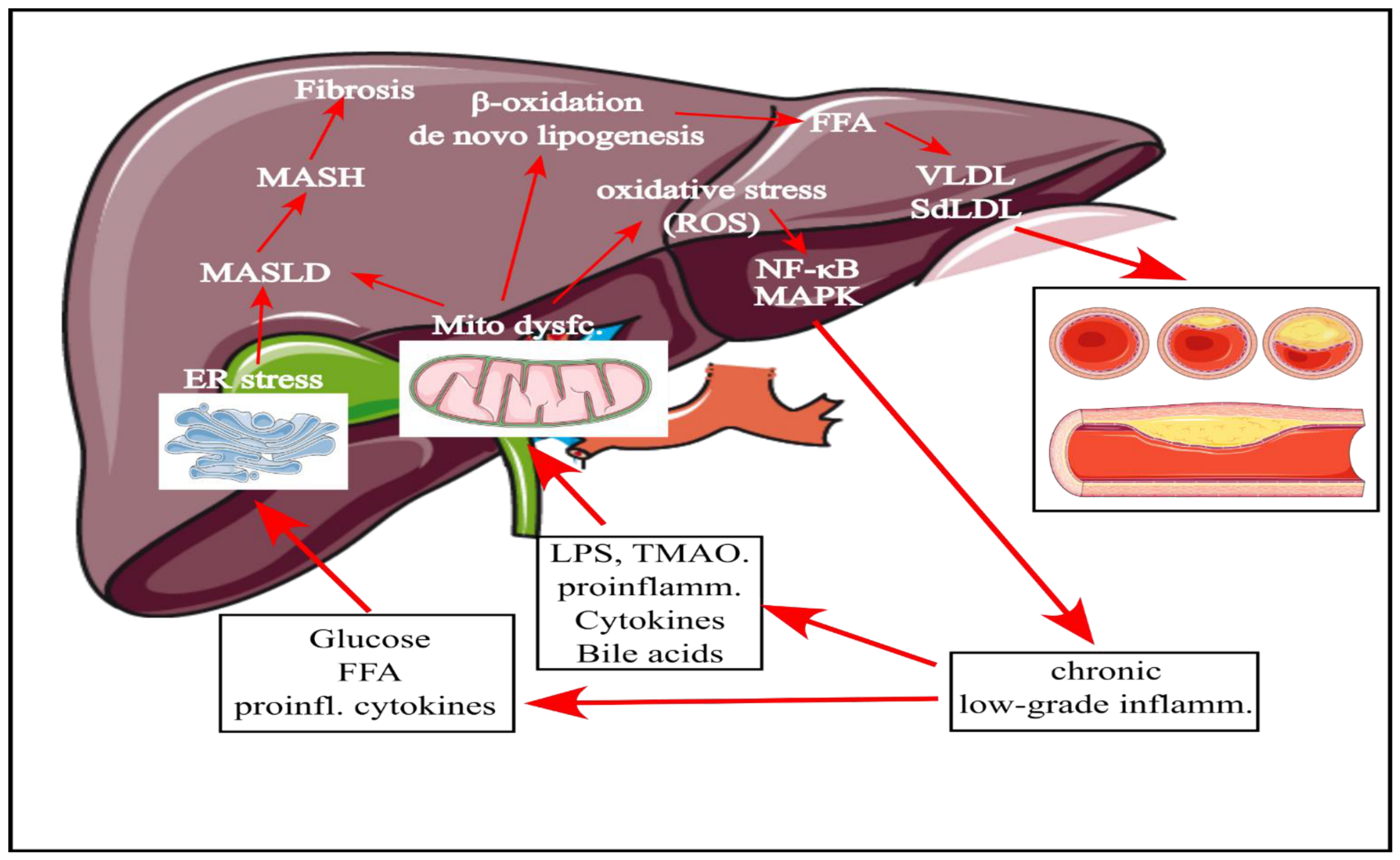
2.1. The Lipotoxic–Oxidative Axis: From Organelle Stress to Systemic Inflammation
2.1.1. Ectopic Fat and the Pathogenesis of Atherogenic Dyslipidemia
2.1.2. The TLR–NLRP3 Signaling Axis and Vascular Immune Activation
2.1.3. Subcellular Crisis: ER Stress and Mitochondrial Dysfunction
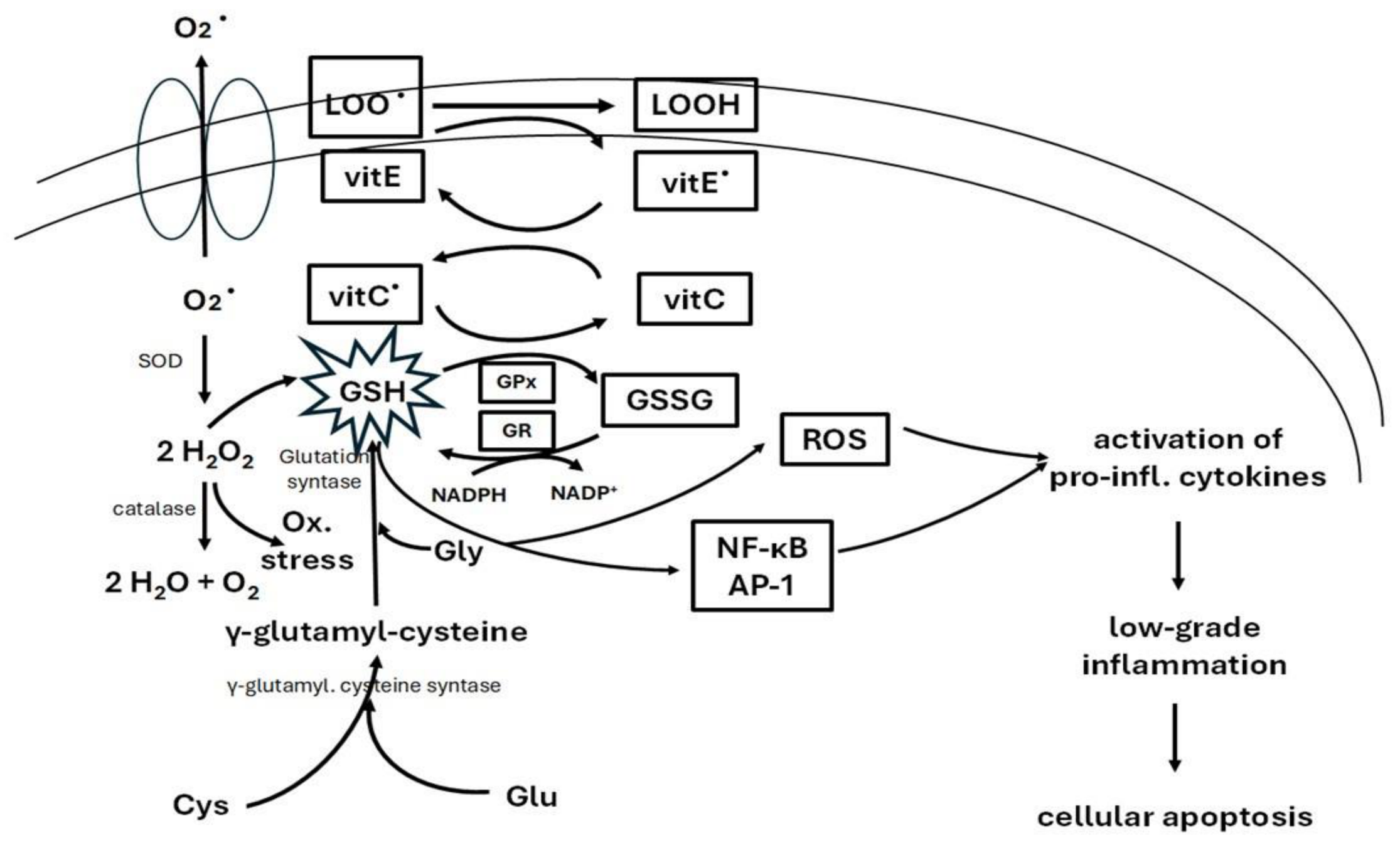
2.1.4. Redox Imbalance and the Glutathione Bridge
2.1.5. The Glucose–Insulin–Lipid Axis and Selective Insulin Resistance
2.1.6. Systemic Consequences and Dietary Drivers
2.2. The Adipokine–Liver Axis: Endocrine Mediators of Cardiometabolic Dysfunction

| Adipokine | Type | Primary Biological Function | Impact on MASLD | Impact on CVD |
|---|---|---|---|---|
| Adiponectin | Peptide hormone | • ↑ Insulin sensitivity • ↑ Fatty acid oxidation • Anti-inflammatory effects | • ↓ Serum adiponectin: associated with ↑ risk of MASLD [116] • ↓ Circulating adiponectin: correlates with ↑ risk of MASLD development [123] • Serum adiponectin: ↓↓ in MASH vs. ↓ in MASLD [124] | • ↓ Plasma adiponectin: associated with ↑ CAD risk [125] • ↓ Plasma adiponectin: associated with ↑ risk of myocardial infarction in men without prior CVD [126] |
| Leptin | Peptide hormone | • Regulation of long-term energy balance, appetite, and satiety | • ↑ Serum leptin in MASLD [124] • ↑ Serum leptin in high-altitude MASLD patients (independent of obesity) [123] | • ↑ Serum leptin in advanced chronic heart failure [127] • ↑ Plasma leptin: associated with ↑ risk of heart failure in men without pre-existing CAD [128] • ↑ Serum leptin in the general population: predicts ↑ risk of incident heart failure [129] |
| Resistin | Cysteine-rich peptide hormone | • Promotes insulin resistance • ↑ Pro-inflammatory cytokine synthesis • Modulates macrophage activation | • Serum resistin: ↑ in MASLD vs. controls; ↓ in MASH vs. controls [130] | • ↑ Serum resistin: independently predicts ↑ risk of myocardial infarction in the general population [131] • ↑ Serum resistin in the general population: predicts ↑ risk of cardiac death, and incident heart failure [129] • Serum resistin: ↑ in heart failure vs. controls; correlates with disease severity and ↑ risk of adverse events (cardiac death or re-hospitalization for worsening heart failure) [132] |
| Visfatin | Dual-function pleiotropic protein (extracellular enzyme/cytokine) | • ↑ Glucose uptake in adipocytes • ↓ Hepatic glucose release • Pre-adipocytes: ↑ triglyceride synthesis and intracellular accumulation • Regulates rate-limiting intracellular NAD+ biosynthesis | • ↓ Serum visfatin: associated with ↑ risk of MASLD [116] • Serum visfatin: similar in MASLD vs. controls [133] | • Serum visfatin: ↑ in myocardial infarction vs. controls; associated with ↑ incidence of adverse events (cardiac death, nonfatal recurrent myocardial infarction, or hospitalization for heart failure) [134] |
| Adipsin | Enzyme (serine protease) | • Rate-limiting catalyst of the alternative complement pathway • Generates C3a → activates pancreatic β-cell C3aR to ↑ glucose-dependent insulin secretion [135] | • ↑ Serum adipsin: associated with ↑ risk of MASLD [116] • Serum adipsin: similar in MASLD vs. controls [136] • ↑ Serum adipsin in MASLD [137] | • ↑ Serum adipsin in CAD: ↑ risk of all-cause mortality, rehospitalization, and fatal myocardial infarction [138] • ↑ Serum adipsin in the general population: predicts ↑ risk of all-cause mortality, cardiac death, and incident heart failure [129] |
| Omentin | Carbohydrate-binding protein | • ↑ Insulin-mediated glucose uptake • Microbial clearance | • ↑ Serum omentin in MASLD • ↑ Serum omentin: independently predicts hepatocyte ballooning [118] | • ↑ Serum omentin-1 vs. heart failure risk: modified by pre-existing CAD: - without CAD: linear association - with CAD: U-shaped association [139] • ↑ Serum omentin-1: predicts ↑ risk of cardiovascular events [140] |
| Vaspin | Glycoprotein class A member of serine protease inhibitor (serpin) family | • ↑ Insulin sensitivity • ↑ Anti-inflammatory activity | • Serum vaspin: similar in MASLD vs. controls [141] | • ↓ Serum vaspin: independently predicts ↑ risk of adverse cardiac events following myocardial infarction [142] |
Key Hepatokines and Their Physiological/Pathophysiological Roles
- ➢
- Fibroblast growth factor 21 (FGF-21): A key metabolic regulator involved in glycemic control, energy expenditure, and body weight homeostasis. Experimental data suggest that FGF-21 can attenuate hepatic steatosis and exert cardioprotective effects via blood pressure reduction and mitigation of oxidative stress. Notably, FGF-21 is also produced by cardiomyocytes in response to oxidative stress, supporting bidirectional heart–liver cross-talk. In MASLD, circulating FGF-21 levels are elevated, reflecting hepatic stress and correlating with insulin resistance and subclinical atherosclerosis [145,146].
- ➢
- Fetuin-A (α2HS-glycoprotein): A hepatokine that inhibits transforming growth factor (TGF)-β1 signaling. In MASLD, increased fetuin-A levels contribute to insulin resistance by impairing insulin receptor signaling. In addition, fetuin-A promotes vascular calcification, thereby linking MASLD to CVD progression [145,147].
- ➢
- Selenoprotein P and Angiopoietin-like protein 8 (ANGPTL8): Secreted primarily by hepatocytes, these proteins are central to the regulation of lipid metabolism. Their elevation in MASLD is closely linked to endothelial dysfunction and impaired lipid clearance, further predisposing patients to atherogenic progression [148].
2.3. Gut Dysbiosis
3. Cardiovascular Pathophysiological Manifestations and the Liver–Heart Axis in MASLD
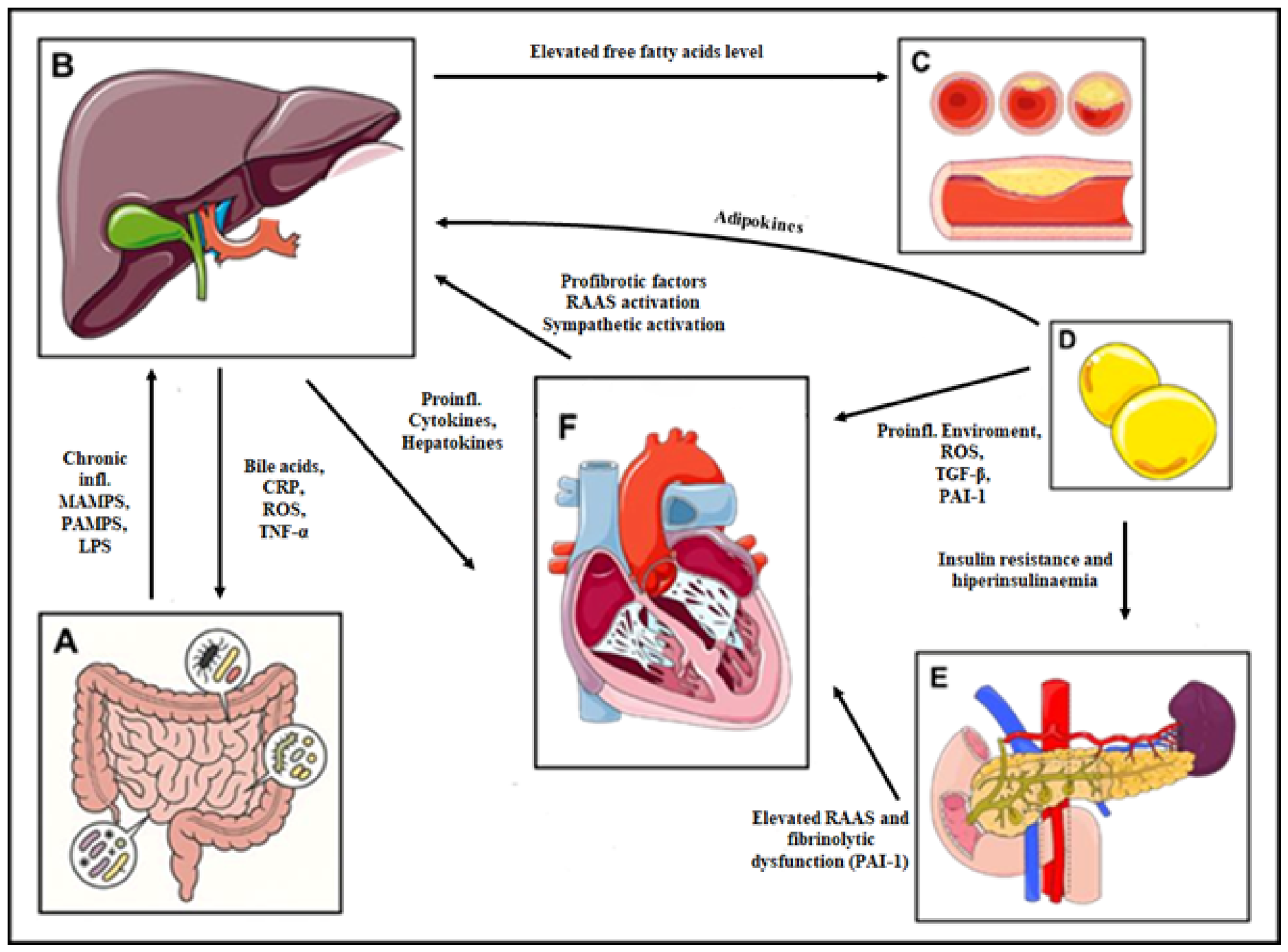
3.1. MASLD as a Systemic Multisystem Disease and Cardiovascular Risk Amplifier
3.2. Endothelial Dysfunction and Prothrombotic Imbalance
3.3. Epicardial and Pericardial Adipose Tissue: A Local Mediator of Cardiac Injury
3.4. Mechanistic Pathways Linking MASLD to Heart Failure
3.4.1. Metabolic Dysfunction and Insulin Resistance
3.4.2. Chronic Inflammation and Adipose Tissue Dysfunction
3.4.3. Hemodynamic Alterations and Hepatic–Cardiac Cross-Talk
3.4.4. Arterial Dysfunction and Increased Afterload
4. Screening and Diagnostic Strategies: A Multidisciplinary Approach to MASLD and CVD Risk
- (a.)
- Identifying the presence of liver steatosis using radiology techniques or performing a liver biopsy.
- (b.)
- Presence of ≥1 of 5 of the following cardiometabolic criteria:
- Body mass index ≥ 25 kg/m2 (23 kg/m2 in Asians) or waist circumference ≥ 94 cm (for males) or ≥80 cm (for females);
- Fasting glucose ≥ 100 mg/dL (5.6 mmol/L) or 2-h post-load glucose level ≥ 140 mg/dL (7.8 mmol/L) or Hba1c ≥ 5.7% (39 mmol/L) or type 2 diabetes or glucose-lowering treatment;
- Blood pressure (BP) ≥ 130/85 mm Hg or BP-lowering treatment;
- Plasma triglyceride ≥ 150 mg/dL (1.7 mmol/L) or lipid-lowering treatment;
- Plasma high-density lipoprotein cholesterol < 40 mg/dL [1.0 mmol/L] (for males) and <50 mg/dL [1.3 mmol/L] (for females) or lipid [204].
- -
- Low cardiometabolic risk + FIB-4 < 1.3: advanced fibrosis can be reliably excluded.
- -
- Intermediate risk + FIB-4 ≥ 1.3: further VCTE assessment is indicated.
- -
- Assessments recommended for individuals with diagnosed MASLD by cardiology clinicians [203].
- -
- Use widely available validated serum (eg, FIB-4) and imaging-based noninvasive tests with high negative predictive value to risk-stratify for hepatic fibrosis in individuals with MASLD.
- -
- FIB-4 ≥ 2.67 indicates a high probability of advanced fibrosis, which warrants secondary assessment and/or hepatology referral.
- -
- Combining ≥2 noninvasive tests, using either serum or imaging-based tests, may be considered in patients at intermediate or high risk of hepatic fibrosis.
- -
- Patients stratified as high risk for advanced fibrosis or cirrhosis should be referred to a hepatologist.
- Recommendation for systematic cardiovascular screening in all MASLD patients linked to risk-based clinical scenarios [203].
- -
- It is recommended to screen for CVD in all individuals with MASLD, regardless of the presence of traditional atherosclerotic risk factors, with detailed risk-factor evaluation at a minimum.
- -
- Cardiovascular risk assessment should be performed using standard atherosclerotic cardiovascular disease prediction tools.
- -
- Patients with MASLD should be screened annually for type 2 diabetes, hypertension, hyperlipidemia, and overweight/obesity.
- -
- MASLD should be considered a risk-enhancing factor for atherosclerotic CVD.
5. Integrated Pharmacological Management of the MASLD–CVD Continuum
5.1. Metabolic Dysfunction-Related Pharmacotherapies
5.2. Liver-Related Pharmacotherapies
5.3. Cardiovascular-Related Pharmacotherapies
5.4. Combination of Liver-Related and Cardiovascular-Related Pharmacotherapies
- ➢
- ➢
- GLP-1 receptor agonists + THR-β agonists: Used together, these treatments should work synergistically, by targeting both intra- and extra-hepatic factors, although clinical trial evidence is not yet available.
- ➢
- GLP-1 receptor agonists + FXR agonists + ACC inhibitors: Phase 2 trial showed a greater reduction in hepatic fat content, as proven by MRI proton density fat fraction. Despite the similar weight loss being noticed across all drug therapy groups, the combination therapy significantly improved liver biochemistry and non-invasive fibrosis markers [246].
- ➢
- GLP-1 receptor agonists + SGLT2 inhibitors: AMPLITUDE-O trial showed that efpeglenatide significantly reduced the risk of adverse CVD outcomes compared to placebo, regardless of concurrent SGLT2 inhibitor use. The cardiovascular and renal benefits of these agents are well established, but there is a need for further clinical studies to evaluate synergistic effects on liver histological features and long-term liver-related events [247].
- ➢
- PPAR agonists + SGLT2 inhibitors: In the Phase 2 LEGEND trial, after 24 weeks of treatment, HbA1c was significantly reduced by lanifibranor alone, and in combination therapy, significantly improved liver fat, inflammation, fibrosis biomarkers, and maintained stable bodyweight. There was a reduction in the visceral-to-subcutaneous fat ratio [248].
| Clinical Trial | Clinical Diagnosis | Hepatic Outcomes | Cardiovascular Outcomes | Reference |
|---|---|---|---|---|
| PIVENS (Pioglitazone, PPAR-γ agonist) | MASH without diabetes | MASH improvement + fibrosis improvement | Direct cardiovascular outcomes not available | [249] |
| ESSENCE (Semaglutide, GLP-1 receptor agonist) | MASH + F2-F3 fibrosis | MASH improvement without fibrosis worsening Fibrosis improvement without MASH worsening | Direct cardiovascular outcomes not available | [250] |
| SUSTAIN 6 (Semaglutide, GLP-1 receptor agonist) | Type 2 diabetes + high CV risk | Direct hepatic outcomes not available | ↓ risk of MACE (CV death, non-fatal myocardial infarction, or non-fatal stroke) ↓ risk of non-fatal stroke ↓ risk of non-fatal myocardial infarction | [251] |
| SELECT (Semaglutide, GLP-1 receptor agonist) | Overweight or obesity (no diabetes) | Direct hepatic outcomes not available | ↓ risk of MACE (CV death, non-fatal myocardial infarction, or non-fatal stroke) | [252] |
| STEP-HFpEF (Semaglutide, GLP-1 receptor agonist) | Obesity-related HFpEF | Direct hepatic outcomes not available | Improved heart failure-related symptoms and physical limitations (KCCQ-CSS improvement) Weight loss | [253] |
| STEP-HFpEF DM (Semaglutide, GLP-1 receptor agonist) | Obesity-related HFpEF + type 2 diabetes | Direct hepatic outcomes not available | Improved heart failure-related symptoms and physical limitations (KCCQ-CSS improvement) Weight loss | [254] |
| FLOW (Semaglutide, GLP-1 receptor agonist) | Type 2 diabetes + CKD | Direct hepatic outcomes not available | ↓ risk of MACE (CV death or heart failure events) ↓ risk of CKD progression | [255] |
| SOUL (Semaglutide [per os], GLP-1 receptor agonist) | Type 2 diabetes + CVD or CKD | Direct hepatic outcomes not available | ↓ risk of MACE (CV death, non-fatal myocardial infarction, or non-fatal stroke) | [256] |
| LEADER (Liraglutide, GLP-1 receptor agonist) | Type 2 diabetes + high CV risk | Direct hepatic outcomes not available | ↓ risk of MACE (CV death, non-fatal myocardial infarction, or non-fatal stroke) ↓ risk of CV death | [257] |
| NCT02637973 (Empagliflozin, SGLT2 inhibitor) | Well-controlled type 2 diabetes | Liver fat content reduction | Direct cardiovascular outcomes not available | [258] |
| EMPA-REG OUTCOME (Empagliflozin, SGLT2 inhibitor) | Type 2 diabetes + high CV risk | Direct hepatic outcomes not available | ↓ risk of MACE (CV death, non-fatal myocardial infarction, or non-fatal stroke) ↓ risk of CV death ↓ risk of hospitalization for heart failure | [259] |
| CANVAS (Canagliflozin, SGLT2 inhibitor) | Type 2 diabetes + high CV risk | Direct hepatic outcomes not available | ↓ risk of MACE (CV death, non-fatal myocardial infarction, or non-fatal stroke) ↓ risk of hospitalization for heart failure | [260] |
| DECLARE-TIMI 58 (Dapagliflozin, SGLT2 inhibitor) | Type 2 diabetes + high CV risk or multiple risk factors | Direct hepatic outcomes not available | ↓ risk of MACE (CV death, non-fatal myocardial infarction, or non-fatal stroke) ↓ risk of hospitalization for heart failure | [261] |
| DAPA-HF (Dapagliflozin, SGLT2 inhibitor) | HFrEF (with or without type 2 diabetes) | Direct hepatic outcomes not available | ↓ risk of worsening heart failure events ↓ risk of CV death | [262] |
| EMPEROR-Reduced (Empagliflozin, SGLT2 inhibitor) | HFrEF (with or without type 2 diabetes) | Direct hepatic outcomes not available | ↓ risk of CV death or hospitalization for heart failure | [263] |
| EMPEROR-Preserved (Empagliflozin, SGLT2 inhibitor) | HFpEF (with or without type 2 diabetes) | Direct hepatic outcomes not available | ↓ risk of CV death or hospitalization for heart failure | [264] |
| DELIVER (Dapagliflozin, SGLT2 inhibitor) | HFpEF (with or without type 2 diabetes) | Direct hepatic outcomes not available | ↓ risk of CV death or hospitalization for heart failure | [265] |
| REGENERATE (Obeticholic acid, FXR agonist) | MASH + F2-F3 fibrosis | Fibrosis improvement (≥1 stage) without worsening of MASH | Direct cardiovascular outcomes not available | [266,267] |
| MAESTRO-NASH (Resmetiron, THR-β agonist) | MASH + F1-F3 fibrosis | MASH resolution without fibrosis worsening Fibrosis improvement without MASH worsening | Direct cardiovascular outcomes not available | [268] |
| SUMMIT (Tirzepatide, GIP/GLP-1 receptor agonist) | Obesity-related HFpEF | Direct hepatic outcomes not available | ↓ risk of CV death or worsening heart failure events | [269] |
| SURPASS-CVOT (Tirzepatide, GIP/GLP-1 receptor agonist) | Type 2 diabetes + atherosclerotic CVD | Direct hepatic outcomes not available | Noninferior to dulaglutide for MACE (CV death, non-fatal myocardial infarction, or non-fatal stroke) | [270] |
6. Conclusions and Perspectives
Author Contributions
Funding
Institutional Review Board Statement
Informed Consent Statement
Data Availability Statement
Acknowledgments
Conflicts of Interest
Abbreviations
| MASLD | Metabolic dysfunction-associated steatotic liver disease |
| MRI | Magnetic resonance imaging |
| MetS | Metabolic syndrome |
| NAFLD | Non-alcoholic fatty liver disease |
| ROS | Reactive oxygen species |
| sdLDL | Small dense low-density lipoprotein |
| TNF-α | Tumor necrosis factor-α |
| IL-6 | Interleukin-6 |
| CRP | C-reactive protein |
| MACE | Major adverse cardiovascular events |
| VLDL | Very low-density lipoprotein |
| HDL | High-density lipoprotein |
| IDL | intermediate-density lipoprotein |
| DAMPs | Damage-associated molecular patterns |
| TLRs | Toll-like receptors |
| ApoC3 | Apolipoprotein C3 |
| NOD | Nucleotide-binding oligomerization domain-like receptors |
| NLRP3 | NOD-like receptor family, pyrin domain-containing protein 3 |
| PAMPs | Pathogen-associated molecular patterns |
| SREBP-1C | Sterol regulatory element-binding protein 1c |
| ChREBP | Carbohydrate-responsive element-binding protein |
| PAI-1 | Plasminogen activator inhibitor-1 |
| NF-κB | Nuclear factor κB |
| NADPH | Nicotinamide adenine dinucleotide phosphate |
| FGF 21 | Fibroblast growth factor 21 |
| PPAR-γ | Peroxisome proliferator-activated receptor gamma |
| AMP | adenosine monophosphate |
| PCG | Polycomb group |
| JAK | Janus kinase |
| STAT | Signal transductor and activator of transcription |
| PI3K | Phosphoinozitol 3 kinase |
| Akt | AKT serine/threonine kinase, also called protein kinase B (PKB) |
| HOMA-IR | Homeostasis model assessment method for insulin resistance |
| ADMA | Asymmetric dimethyl arginine |
| VEGF | Vascular endothelial growth factor |
| MAMPs | Microbe-associated molecular patterns |
| LPS | Lipopolysaccharide |
| NASH | Non-alcoholic steatohepatitis |
| TMAO | Trimethylamine N-oxide |
| GLP-1 | Glucagon-like peptide-1 |
| HNE | 4-hydroxy-2-nonenal |
| 8-OHdG | 8-hydroxydeoxyguanosine |
| DNA | Deoxyribonucleic acid |
| IFN-γ | Interferon-γ |
| NK | Natural killer |
| KEAP1 | Kelch-like ECH-associated protein 1 |
| Nerf2 | nuclear factor erythroid 2-related factor |
| MCJ | Methylation-controlled J protein |
| siRNA | Small interference ribonucleic acid |
| FXR | Farnesoid X receptor |
| PARP1 | poly-(ADP ribose) polymerase 1 |
| ER | endoplasmic reticulum |
| PERK | Protein kinase R-like endoplasmic reticulum kinase |
| eIFα | Eukaryotic initiation factor α |
| ATF4 | Activating transcription factor 4 |
| IRE1 | Inositol-requiring enzyme 1 |
| XBP 1 | X-box binding protein 1 |
| FOXA3 | Forkhead box A3 |
| 4-PBA | 4-phenylbutiryc acid |
| mRNA | Messenger ribonucleic acid |
| Ant 2 | Adenine nucleotide translocase 2 |
| SAM | Sorting and assembly machinery |
| ATP | Adenosine triphosphate |
| SIRT1 | Sirtuin 1 |
| FFA | Free fatty acids |
| TG | Triglyceride |
| MASH | Metabolic dysfunction-associated steatohepatitis |
| IRS-1 | Insulin receptor substrate-1 |
| eNOS | Endogen nitric oxide synthase |
| HFpEF | Heart failure with preserved ejection fraction |
| TGF-β | Transforming growth factor-β |
| CVD | Cardiovascular disease |
| SCFAs | Short-chain fatty acids |
| MAPK | Mitogen-activated protein kinase |
| PKC | Protein kinase C |
| ASAT | Aspartate-aminotransferase |
| ALAT | Alanine-aminotransferase |
| γ-GT | γ-glutamyl transferase |
| AASLD | American Association for the Study of Liver Disease |
| NAS | NAFLD activity score |
| NIT | Non-invasive test |
| APRI | Aspartate transaminase to platelet ratio index |
| ELF | Enhanced Liver Fibrosis |
| VCTE | Vibration-controlled transient elastography |
| MRE | Magnetic resonance elastography |
References
- Tailleux, A.; Wouters, K.; Staels, B. Roles of PPARs in NAFLD: Potential therapeutic targets. Biochim. Biophys. Acta 2012, 1821, 809–818. [Google Scholar] [CrossRef] [PubMed]
- Azzu, V.; Vacca, M.; Virtue, S.; Allison, M.; Vidal-Puig, A. Adipose Tissue-Liver Cross Talk in the Control of Whole Body Metabolism: Implications in Nonalcoholic Fatty Liver Disease. Gastroenterology 2020, 158, 1899–1912. [Google Scholar] [CrossRef] [PubMed]
- Schuster, S.; Cabrera, D.; Arrese, M.; Feldstein, A.E. Triggering and resolution of inflammation in NASH. Nat. Rev. Gastroenterol. Hepatol. 2018, 15, 349–364. [Google Scholar] [CrossRef]
- European Association for the Study of the Liver (EASL); European Association for the Study of Diabetes (EASD); European Association for the Study of Obesity (EASO). Guidelines on the management of metabolic dysfunction-associated steatotic liver disease (MASLD). J. Hepatol. 2024, 81, 492–542. [Google Scholar] [CrossRef]
- Katsiki, N.; Kolovou, G.; Vrablik, M. Metabolic Dysfunction Associated-Steatotic Liver Disease (MASLD) and Cardiovascular Risk: Embrace All Facets of the Disease. Curr. Cardiol. Rep. 2025, 27, 19. [Google Scholar] [CrossRef]
- Kaya, E.; Zedginidze, A.; Bechmann, L.; Canbay, A. Metabolic dysfunction-associated fatty liver disease (MAFLD) and nonalcoholic fatty liver disease (NAFLD): Distinct fatty liver entities with different clinical outcomes? Hepatobiliary Surg. Nutr. 2022, 11, 299–301. [Google Scholar] [CrossRef]
- Calzadilla Bertot, L.; Adams, L. The natural course of nonalcoholic fatty liver disease. Int. J. Mol. Sci. 2016, 17, 774. [Google Scholar] [CrossRef]
- Loomba, R.; Adams, L. The 20% rule of NASH progression: The natural history of advanced fibrosis cirrhosis caused by NASH. Hepatology 2019, 70, 1885–1888. [Google Scholar] [CrossRef]
- Lechner, K.; McKenzie, A.; Kränkel, N.; von Schacky, C.; Worm, N.; Nixdorff, U.; Lechner, B.; Scherr, J.; Weingärtner, O.; Krauss, M.R. High-risk atherosclerosis and metabolic phenotype: The roles of ectopic adiposity, atherogenic dyslipidemia, and inflammation. Metab. Syndr. Relat. Disord. 2020, 18, 176–185. [Google Scholar] [CrossRef]
- Worm, N. Beyond body weight-loss: Dietary strategies targeting intrahepatic fat in NAFLD. Nutrients 2020, 12, 1316. [Google Scholar] [CrossRef] [PubMed]
- Shafiq, A.; Rashid, A.M.; Shah, S.R.; Chew, N.W.; Haverkamp, W. MASLD and cardiovascular disease: A state-of-the-art review. Glob. Cardiol. 2026, 4, 1–8. [Google Scholar] [CrossRef]
- Zheng, H.; Sechi, L.A.; Navarese, E.P.; Casu, G.; Vidili, G. Metabolic dysfunction-associated steatotic liver disease and cardiovascular risk: A comprehensive review. Cardiovasc. Diabetol. 2024, 23, 346. [Google Scholar] [CrossRef]
- Mantovani, A.; Byrne, C.D.; Benfari, G.; Bonapace, S.; Simon, T.G.; Targher, G. Risk of Heart Failure in Patients with Nonalco-holic Fatty Liver Disease. J. Am. Coll. Cardiol. 2022, 79, 180–191. [Google Scholar] [CrossRef] [PubMed]
- Bansal, B.; Lajeunesse-Trempe, F.; Keshvani, N.; Lavie, C.J.; Pandey, A. Impact of Metabolic Dysfunction associated Steatotic Liver Disease on Cardiovascular Structure, Function, and the Risk of Heart Failure. Can. J. Cardiol. 2025, 41, 1777–1793. [Google Scholar] [CrossRef]
- Caussy, C.; Vergès, B.; Leleu, D.; Duvillard, L.; Subtil, F.; Abichou-Klich, A.; Hervieu, V.; Milot, L.; Ségrestin, B.; Bin, S.; et al. Screening for metabolic dysfunction-associated steatotic liver disease-related advanced fibrosis in diabetology: A prospective multicenter study. Diabetes Care 2025, 48, 877–886. [Google Scholar] [CrossRef]
- Ekstedt, M.; Hagström, H.; Nasr, P.; Fredrikson, M.; Stål, P.; Kechagias, S.; Hultcrantz, R. Fibrosis stage is the strongest predictor for disease-specific mortality in NAFLD after up to 33 years of follow-up. Hepatology 2015, 61, 1547–1554. [Google Scholar] [CrossRef] [PubMed]
- Chew, N.W.S.; Ng, C.H.; Chan, K.E.; Chee, D.; Syn, N.; Tamaki, N.; Muthiah, M.; Noureddin, M. FIB-4 predicts MACE and cardiovascular mortality in patients with nonalcoholic fatty liver disease. Can. J. Cardiol. 2022, 38, 1779–1780. [Google Scholar] [CrossRef] [PubMed]
- Rinella, M.E.; Jeffrey, V.L.; Ratziu, V.; Francque, S.M.; Sanyal, A.J.; Kanwal, F.; Romero, D.; Abdelmalek, M.F.; Anstee, Q.M.; NAFLD Nomenclature Consensus Group; et al. A multisociety Delphi consensus statement on new fatty liver disease nomenclature. J. Hepatol. 2023, 78, 1542–1556. [Google Scholar] [CrossRef]
- Tilg, H.; Moschen, A.R. Evolution of inflammation in nonalcoholic fatty liver disease: The multiple parallel hits hypothesis. Hepatology 2010, 52, 1836–1846. [Google Scholar] [CrossRef]
- Buzzetti, E.; Pinzani, M.; Tsochatzis, E.A. The multiple-hit pathogenesis of nonalcoholic fatty liver disease (NAFLD). Metabolism 2016, 65, 1038–1048. [Google Scholar] [CrossRef]
- Santos, R.D.; Valenti, L.; Romeo, S. Does nonalcoholic fatty liver disease cause cardiovascular disease? Current knowledge and gaps. Atherosclerosis 2019, 282, 110–120. [Google Scholar] [CrossRef] [PubMed]
- Deprince, A.; Haas, J.T.; Staels, B. Dysregulated lipid metabolism links NAFLD to cardiovascular disease. Mol. Metab. 2020, 42, 101092. [Google Scholar] [CrossRef]
- Goh, G.B.B.; Mc Cullough, A.J. Natural History of Nonalcoholic Fatty Liver Disease. Dig. Dis. Sci. 2016, 61, 1226–1233. [Google Scholar] [CrossRef] [PubMed]
- Byrne, C.D.; Targher, G. NAFLD: A multisystem disease. J. Hepatol. 2015, 62, S47–S74. [Google Scholar] [CrossRef]
- GBD 2017 Causes of Death Collaborators. Global, regional, and national age-sex-specific mortality for 282 causes of death in 195 countries and territories, 1980–2017: A systematic analysis for the Global Burden of Disease Study 2017. Lancet 2018, 392, 1736–1788. [CrossRef]
- McCullough, A.J. The clinical features, diagnosis and natural history of nonalcoholic fatty liver disease. Clin. Liver Dis. 2004, 8, 521–533. [Google Scholar] [CrossRef]
- Targher, G.; Byrne, C.D.; Tilg, H. NAFLD and increased risk of cardiovascular disease: Clinical associations, pathophysio-logical mechanisms and pharmacological implications. Gut 2020, 69, 1691–1705. [Google Scholar] [CrossRef]
- Zhou, Y.Y.; Zhou, X.D.; Wu, S.J.; Fan, D.H.; Van Poucke, S.; Chen, Y.P.; Fu, S.W.; Zheng, M.H. Nonalcoholic fatty liver disease contributes to subclinical atherosclerosis: A systematic review and meta-analysis. Hepatol. Commun. 2018, 2, 376–392. [Google Scholar] [CrossRef]
- Wong, M.Y.Z.; Yap, J.J.L.; Sultana, R.; Cheah, M.; Goh, G.B.B.; Yeo, K.K. Association between non-alcoholic fatty liver disease and subclinical atherosclerosis in Western and Asian cohorts: An updated meta-analysis. Open Heart 2021, 8, e001850. [Google Scholar] [CrossRef]
- Targher, G.; Bertolini, L.; Rodella, S.; Tessari, R.; Zenari, L.; Lippi, G.; Arcaro, G. Nonalcoholic fatty liver disease is independently associated with an increased incidence of cardiovascular events in type 2 diabetic patients. Diabetes Care 2007, 30, 2119–2121. [Google Scholar] [CrossRef] [PubMed]
- Hamaguchi, M.; Kojima, T.; Takeda, N.; Nagata, C.; Takeda, J.; Sarui, H.; Kawahito, Y.; Yoshida, N.; Suetsugu, A.; Kato, T.; et al. Nonalcoholic fatty liver disease is a novel predictor of cardiovascular disease. World J. Gastroenterol. 2007, 13, 1579–1584. [Google Scholar] [CrossRef]
- Sinn, D.H.; Kang, D.; Chang, Y.; Ryu, S.; Cho, S.J.; Paik, S.W.; Song, Y.B.; Pastor-Barriuso, R.; Guallar, E.; Cho, J.; et al. Non-alcoholic fatty liver disease and the incidence of myocardial infarction: A cohort study. J. Gastroenterol. Hepatol. 2020, 35, 833–839. [Google Scholar] [CrossRef]
- Cusi, K. Role of obesity and lipotoxicity in the development of nonalcoholic steatohepatitis: Pathophysiology and clinical implications. Gastroenterology 2012, 142, 711–725. [Google Scholar] [CrossRef]
- Lechner, K.; Lorenz, E.; Drezner, J. The ‘heart’ of preventive cardiology: Lifestyle medicine for the treatment of cardiometabolic diseases. Eur. J. Prev. Cardiol. 2020, 27, 2069–2070. [Google Scholar] [CrossRef]
- Gepner, Y.; Shelef, I.; Schwarzfuchs, D.; Zelicha, H.; Tene, L.; Meir, Y.A.; Tsaban, G.; Cohen, N.; Bril, N.; Rein, M.; et al. Effect of distinct lifestyle interventions on mobilization of fat storage pools: CENTRAL magnetic resonance imaging randomized controlled trial. Circulation 2018, 137, 1143–1157. [Google Scholar] [CrossRef]
- Kasper, P.; Martin, A.; Lang, S.; Kütting, F.; Goeser, T.; Demir, M.; Steffen, H.M. NAFLD and cardiovascular diseases: A clinical review. Clin. Res. Cardiol. 2021, 110, 921–937. [Google Scholar] [CrossRef] [PubMed]
- Ipsen, D.; Lykkesfeldt, J.; Tveden-Nyborg, P. Molecular mechanisms of hepatic lipid accumulation in non-alcoholic fatty liver disease. Cell Mol. Life Sci. 2018, 75, 3313–3327. [Google Scholar] [CrossRef] [PubMed]
- Adiels, M.; Olofsson, S.; Taskinen, M.; Borén, J. Overproduction of very low-density lipoproteins is the hallmark of the dyslipidemia in the metabolic syndrome. Arter. Thromb. Vasc. Biol. 2008, 28, 1225–1236. [Google Scholar] [CrossRef]
- Borén, J.; Chapman, M.; Krauss, R.M.; Packard, C.P.; Bentzon, J.F.; Binder, C.B.; Daemen, M.J.; Demer, L.; Hegele, R.A.; Nicholls, S.J.; et al. Low-density lipoproteins cause atherosclerotic cardiovascular disease: Pathophysiological genetic therapeutic insights: A consensus statement from the European Atherosclerosis Society Consensus Panel. Eur. Heart J. 2020, 41, 2313–2330. [Google Scholar]
- Zewinger, S.; Reiser, J.; Jankowski, V.; Alansary, D.; Hahm, E.; Triem, S.; Klug, M.; Schunk, S.J.; Schmit, D.; Kramann, R.; et al. Apolipoprotein C3 induces inflammation and organ damage by alternative inflammasome activation. Nat. Immunol. 2020, 21, 30–41. [Google Scholar] [CrossRef] [PubMed]
- Goulopoulou, S.; McCarthy, C.; Webb, R. Toll-like receptors in the vascular system: Sensing the dangers within. Pharmacol. Rev. 2016, 68, 142–167. [Google Scholar] [CrossRef]
- Libby, P.; Everett, B. Novel antiatherosclerotic therapies. Arter. Thromb. Vasc. Biol. 2019, 39, 538–545. [Google Scholar] [CrossRef]
- Al-Mrabeh, A.; Zhyzhneuskaya, S.; Peters, C.; Barnes, A.C.; Melhem, S.; Jesuthasan, A.; Aribisala, B.; Hollingsworth, K.G.; Lietz, G.; Mathers, J.C.; et al. Hepatic lipoprotein export and remission of human type 2 diabetes after weight loss. Cell Metab. 2020, 31, 233–249. [Google Scholar] [CrossRef] [PubMed]
- Hwang, D.H.; Kim, J.A.; Lee, J.Y. Mechanisms for the activation of toll-like receptor 2/4 by saturated fatty acids inhibition by docosahexaenoic acid. Eur. J. Pharmacol. 2016, 785, 24–35. [Google Scholar] [CrossRef] [PubMed]
- Volk, B.; Kunces, L.; Freidenreich, D.; Kupchak, B.R.; Saenz, C.; Artistizabal, J.C.; Fernandez, M.L.; Bruno, R.S.; Maresh, C.M.; Kraemer, W.J.; et al. Effects of stepwise increases in dietary carbohydrate on circulating saturated fatty acids and palmitoleic acid in adults with metabolic syndrome. PLoS ONE 2014, 9, e113605. [Google Scholar] [CrossRef] [PubMed]
- Lee, J.; Lambert, J.; Hovhannisyan, Y.; Ramos-Roman, M.A.; Trombold, J.R.; Wagner, D.A.; Parks, E.J. Palmitoleic acid is elevated in fatty liver disease reflects hepatic lipogenesis. Am. J. Clin. Nutr. 2015, 101, 34–43. [Google Scholar] [CrossRef]
- Liu, C.; Zhou, B.; Meng, M.; Zhao, W.; Wang, D.; Yuan, Y.; Zheng, Y.; Qiu, J.; Li, Y.; Li, G.; et al. FOXA3 induction under endoplasmic reticulum stress contributes to non-alcoholic fatty liver disease. J. Hepatol. 2021, 75, 150–162. [Google Scholar] [CrossRef]
- Ajaz, S.; McPhail, M.J.; Gnudi, L.; Trovato, F.M.; Mujib, S.; Napoli, S.; Carey, I.; Agarwal, K. Mitochondrial dysfunction as a mechanistic biomarker in patients with non-alcoholic fatty liver disease (NAFLD). Mitochondrion 2021, 57, 119–130. [Google Scholar] [CrossRef] [PubMed]
- Petrescu, M.; Vlaicu, S.I.; Ciumarnean, L.; Milaciu, M.V.; Marginean, C.; Florea, M.; Vesa, S.C.; Popa, M. Chronic Inflammation—A Link between Nonalcoholic Fatty Liver Disease (NAFLD) and Dysfunctional Adipose Tissue. Medicina 2022, 58, 641. [Google Scholar] [CrossRef]
- Barbier-Torres, L.; Fortner, K.A.; Iruzubieta, P.; Delgado, T.C.; Giddings, E.; Chen, Y.; Champagne, D.; Fernández Ramos, D.; Mestre, D.; Gomez-Santos, B.; et al. Silencing hepatic MCJ attenuates non-alcoholic fatty liver disease (NAFLD) by increasing mitochondrial fatty acid oxidation. Nat. Commun. 2020, 11, 3360. [Google Scholar] [CrossRef]
- Huh, J.Y.; Reilly, S.M.; Abu-Odeh, M.; Murphy, A.N.; Mahata, S.K.; Zhang, J.; Cho, Y.; Seo, B.J.; Hung, C.W.; Green, C.R.; et al. TANK-Binding Kinase 1 Regulates the Localization of Acyl-CoA Synthetase ACSL1 to Control Hepatic Fatty Acid Oxidation. Cell Metab. 2020, 32, 1012–1027. [Google Scholar] [CrossRef] [PubMed]
- Pant, A.; Rondini, E.A.; Kocarek, T.A. Farnesol induces fatty acid oxidation and decreases triglyceride accumulation in steatotic HepaRG cells. Toxicol. Appl. Pharmacol. 2019, 365, 61–70. [Google Scholar] [CrossRef]
- Mirea, A.M.; Stienstra, R.; Kanneganti, T.D.; Tack, C.J.; Chavakis, T.; Toonen, E.J.M.; Joosten, L.A. Mice Deficient in the IL-1β Activation Genes Prtn3, Elane and Casp1 Are Protected Against the Development of Obesity-Induced NAFLD. Inflammation 2020, 43, 1054–1064. [Google Scholar] [CrossRef]
- Yang, X.; Fu, Y.; Hu, F.; Luo, X.; Hu, J.; Wang, G. PIK3R3 regulates PPAR expression to stimulate fatty acid-oxidation and decrease hepatosteatosis. Exp. Mol. Med. 2018, 50, e431. [Google Scholar] [CrossRef]
- Huang, K.; Du, M.; Tan, X.; Yang, L.; Li, X.; Jiang, Y.; Wang, C.; Zhang, F.; Zhu, F.; Cheng, M.; et al. PARP1-mediates PPAR poly (ADP-ribosyl) ation supresses fatty acid oxidaion in non-alcoholic fatty liver disease. J. Hepatol. 2017, 66, 962–977. [Google Scholar] [CrossRef]
- Yan, F.J.; Wang, Y.J.; Yan, S.R.; Lu, J.; Zheng, Y.L. ZNF300 stimulates fatty acid oxidation and alleviates hepatosteatosis through regulating PPARα. Biochem. J. 2019, 476, 385–404. [Google Scholar] [CrossRef]
- Yang, L.; Roh, Y.S.; Song, J.; Zhang, B.; Liu, C.; Loomba, R.; Seki, E. Transforming growth factor beta signaling in hepatocytes participates in steatohepatitis through regulation of cell death and lipid metabolism in mice. Hepatology 2014, 59, 483–495. [Google Scholar] [CrossRef]
- Zhao, T.; Wu, K.; Hogstrand, C.; Xu, Y.H.; Chen, G.H.; Wei, C.C.; Luo, Z. Lipophagy mediated carbohydrate-induced changes of lipid metabolism via oxidative stress, endoplasmic reticulum (ER) stress and ChREBP/PPARγ pathways. Cell. Mol. Life Sci. 2020, 77, 1987–2003. [Google Scholar] [CrossRef] [PubMed]
- Cho, J.; Zhang, Y.; Park, S.Y.; Joseph, A.M.; Han, C.; Park, H.J.; Kalavalapalli, S.; Chun, S.K.; Morgan, D.; Kim, J.S.; et al. Mitochondrial ATP transporter depletion protects mice against liver steatosis and insulin resistance. Nat. Commun. 2017, 8, 14477. [Google Scholar] [CrossRef]
- Gallardo-Montejano, V.I.; Yang, C.; Hahner, C.; McAfee, J.L.; Johnson, J.A.; Holland, W.L.; Fernandez-Valdivia, R.; Bickel, P. Perilipin 5 links mitochondrial uncoupled respiration in brown fat to healthy white remodeling and systemic glucose tolerance. Nat. Commun. 2021, 12, 3320. [Google Scholar] [CrossRef] [PubMed]
- Li, Z.; Shen, W.; Wu, G.; Qin, C.; Zhang, Y.; Wang, Y.; Song, G.; Xiao, C.; Zhang, X.; Deng, G.; et al. The role of SAMM50 in nonalcoholic fatty liver disease: From genetics to mechanisms. FEBS Open Bio 2021, 11, 1893–1906. [Google Scholar] [CrossRef]
- Zou, Y.X.; Shen, W.Z.; Liao, S.T.; Liu, F.; Zheng, S.Q.; Blumberg, J.B.; Chen, C.Y.O. Mulberry leaf phenolics ameliorate hyperglycemia-induced oxidative stress and stabilize mitochondrial membrane potential in HepG2 cells. Int. J. Food Sci. Nutr. 2014, 65, 960–966. [Google Scholar] [CrossRef]
- Sangineto, M.; Bukke, V.N.; Bellanti, F.; Tamborra, R.; Moola, A.; Duda, L.; Villani, R.; Romano, A.D.; Serviddio, G. A novel nutraceuticals mixture improves liver steatosis by preventing oxidative stress and mitochondrial dysfunction in a nafld model. Nutrients 2021, 13, 652. [Google Scholar] [CrossRef]
- Rafiei, H.; Omidian, K.; Bandy, B. Dietary polyphenols protect against oleic acid-induced steatosis in an in vitro model of NAFLD by modulating lipid metabolism and improving mitochondrial function. Nutrients 2019, 11, 541. [Google Scholar] [CrossRef]
- Wu, L.; Mo, W.; Feng, J.; Li, J.; Yu, Q.; Li, S.; Zhang, J.; Chen, K.; Ji, J.; Dai, W.; et al. Astaxanthin attenuates hepatic damage and mitochondrial dysfunction in non-alcoholic fatty liver disease by up-regulating the FGF21/PGC-1α pathway. Br. J. Pharmacol. 2020, 177, 3760–3777. [Google Scholar] [CrossRef] [PubMed]
- Du, J.; Zhang, X.; Han, J.; Man, K.; Zhang, Y.; Chu, E.S.; Nan, Y.; Yu, J. Pro-inflammatory CXCR3 impairs mitochondrial function in experimental non-alcoholic steatohepatitis. Theranostics 2017, 7, 4192–4203. [Google Scholar] [CrossRef] [PubMed]
- Rector, R.S.; Thyfault, J.P.; Uptergrove, G.M.; Morris, E.M.; Naples, S.P.; Borengasser, S.J.; Mikus, C.R.; Laye, M.J.; Laughlin, M.H.; Booth, F.W.; et al. Mitochondrial dysfunction precedes insulin resistance and hepatic steatosis and contributes to the natural history of non-alcoholic fatty liver disease in an obese rodent model. J. Hepatol. 2010, 52, 727–736. [Google Scholar] [CrossRef] [PubMed]
- Ou, R.; Liu, J.; Lv, M.; Wang, J.; Wang, J.; Zhu, L.; Zhao, L.; Xu, Y. Neutrophil depletion improves diet-induced nonalcoholic fatty liver disease in mice. Endocrine 2017, 57, 72–82. [Google Scholar] [CrossRef]
- Ma, Y.; Lee, G.; Heo, S.Y.; Roh, Y.S. Oxidative stress is a key modulator in the development of nonalcoholic fatty liver disease. Antioxidants 2021, 11, 91. [Google Scholar] [CrossRef]
- Seki, S.; Kitada, T.; Sakaguchi, H. Clinicopathological significance of oxidative cellular damage in non-alcoholic fatty liver diseases. Hepatol. Res. 2005, 33, 132–134. [Google Scholar] [CrossRef]
- Batty, M.; Bennett, M.R.; Yu, E. The role of oxidative stress in atherosclerosis. Cells 2022, 11, 3843. [Google Scholar] [CrossRef]
- Munzel, T.; Camici, G.G.; Maack, C.; Bonetti, N.R.; Fuster, V.; Kovacic, J.C. Impact of oxidative stress on the heart and vasculature: Part 2 of a 3-Part series. J. Am. Coll. Cardiol. 2017, 70, 212–229. [Google Scholar] [CrossRef]
- Liu, B.; Deng, X.; Jiang, Q.; Li, G.; Zhang, J.; Zhang, N.; Xin, S.; Xu, K. Scoparone alleviates inflammation, apoptosis and fibrosis of non-alcoholic steatohepatitis by suppressing the TLR4/NF-κB signaling pathway in mice. Int. Immunopharmacol. 2019, 75, 105797. [Google Scholar] [CrossRef] [PubMed]
- Wang, Q.; Ou, Y.; Hu, G.; Wen, C.; Yue, S.; Chen, C.; Xu, L.; Xie, J.; Dai, H.; Xiao, H.; et al. Naringenin attenuates nonalcoholic fatty liver disease by down-regulating the NLRP3/NF-κB pathway in mice. Br. J. Pharmacol. 2020, 177, 1806–1821. [Google Scholar] [CrossRef] [PubMed]
- Tomita, K.; Kabashima, A.; Freeman, B.L.; Bronk, S.F.; Hirsova, P.; Ibrahim, S.H. Mixed lineage kinase 3 mediates the induction of CXCL10 by a STAT1-dependent mechanism during hepatocyte lipotoxicity. J. Cell. Biochem. 2017, 118, 3249–3259. [Google Scholar] [CrossRef]
- Kado, A.; Tsutsumi, T.; Enooku, K.; Fujinaga, H.; Ikeuchi, K.; Okushin, K.; Moriya, K.; Yotsuyanagi, H.; Koike, K. Noninvasive diagnostic criteria for nonalcoholic steatohepatitis based on gene expression levels in peripheral blood mononuclear cells. J. Gastroenterol. 2019, 54, 730–741. [Google Scholar] [CrossRef] [PubMed]
- Wehr, A.; Baeck, C.; Heymann, F.; Niemietz, P.M.; Hammerich, L.; Martin, C.; Zimmermann, H.W.; Pack, O.; Gassler, N.; Hittatiya, K.; et al. Chemokine Receptor CXCR6-Dependent Hepatic NK T Cell Accumulation Promotes Inflammation and Liver Fibrosis. J. Immunol. 2013, 190, 5226–5236. [Google Scholar] [CrossRef]
- Chen, T.H.; Wang, H.C.; Chang, C.J.; Lee, S.Y. Mitochondrial glutathione in cellular redox homeostasis and disease manifestation. Int. J. Mol. Sci. 2024, 25, 1314. [Google Scholar] [CrossRef]
- Videla, L.A.; Rodrigo, R.; Orellana, M.; Fernandez, V.; Tapia, G.; Quiñones, L.; Varela, N.; Contreras, J.; Lazarte, R.; Csendes, A.; et al. Oxidative stress-related parameters in the liver of non-alcoholic fatty liver disease patients. Clin. Sci. 2004, 106, 261–268. [Google Scholar] [CrossRef]
- Köroğlu, E.; Canbakan, B.; Atay, K.; Hatemi, I.; Tuncer, M.; Dobrucali, A.; Sonsuz, A.; Gültepe, I.; Senturk, H. Role of oxidative stress and insulin resistance in disease severity of non-alcoholic fatty liver disease. Turk. J. Gastroenterol. 2016, 27, 361–366. [Google Scholar] [CrossRef]
- Vairetti, M.; Di Pasqua, L.G.; Cagna, M.; Richelmi, P.; Ferrigno, A.; Berardo, C. Changes in glutathione content in liver diseases: An update. Antioxidants 2021, 10, 364. [Google Scholar] [CrossRef] [PubMed]
- Santacroce, G.; Gentile, A.; Soriano, S.; Novelli, A.; Lenti, M.V.; Di Sabatino, A. Glutathione: Pharmacological aspects and implications for clinical use in nonalcoholic fatty liver disease. Front. Med. Sec. Gastroenterol. 2023, 10, 1124275. [Google Scholar] [CrossRef]
- Lee, D.S.; Evans, J.C.; Robins, S.J.; Wilson, P.W.; Albano, I.; Fox, C.S.; Wang, T.J.; Benjamin, E.J.; D’Agostino, R.B.; Vasan, R.S. Gamma glutamyl transferase and metabolic syndrome, cardiovascular disease, and mortality risk: The Framingham heart study. Arterioscler. Thromb. Vasc. Biol. 2007, 27, 127–133. [Google Scholar] [CrossRef]
- Zhao, X.J.; Yu, H.W.; Yang, Y.Z.; Wu, W.Y.; Chen, T.Y.; Jia, K.K.; Kang, L.L.; Jiao, R.Q.; Kong, L.D. Polydatin prevents fruc-toseinduced liver inflammation and lipid deposition through increasing miR-200a to regulate Keap1/Nrf2 pathway. Redox Biol. 2018, 18, 124–137. [Google Scholar] [CrossRef]
- Minetti, E.T.; Hamburg, N.M.; Matsui, R. Drivers of cardiovascular disease in metabolic dysfunction-associated steatotic liver disease: The threats of oxidative stress. Front. Cardiovasc. Med. 2024, 11, 1469492. [Google Scholar] [CrossRef]
- Chen, Z.; Tian, R.; She, Z.; Cai, J.; Li, H. Role of oxidative stress in the pathogenesis of nonalcoholic fatty liver disease. Free Radic. Biol. Med. 2020, 152, 116–141. [Google Scholar] [CrossRef]
- Sharma, R.S.; Harrison, D.J.; Kisielewski, D.; Cassidy, D.M.; McNeilly, A.D.; Gallagher, J.R.; Walsh, S.V.; Honda, T.; McCrimmon, R.J.; Dinkova-Kostova, A.T.; et al. Experimental nonalcoholic steatohepatitis and liver fibrosis are ameliorated by pharmacologic activation of Nrf2 (NF-E2 p45-related factor 2). Cell. Mol. Gastroenterol. Hepatol. 2017, 5, 367–398. [Google Scholar] [CrossRef]
- Bathish, B.; Robertson, H.; Dillon, J.F.; Dinkova-Kostova, A.T.; Hayes, J.D. Nonalcoholic steatohepatitis and mechanisms by which it is ameliorated by activation of the CNC-bZIP transcription factor Nrf2. Free Radic. Biol. Med. 2022, 188, 221–261. [Google Scholar] [CrossRef] [PubMed]
- Stahl, E.; Dhindsa, D.; Lee, S.; Sandesara, P.B.; Chalassani, N.P.; Sperling, L.S. Nonalcoholic fatty liver disease the heart: JACC state of the art review. J. Am. Coll. Cardiol. 2019, 73, 948–963. [Google Scholar] [CrossRef] [PubMed]
- Francque, S.; van der Graaff, D.; Kwanten, W. Non-alcoholic fatty liver disease and cardiovascular risk: Pathophysiological mechanisms and implications. J. Hepatol. 2016, 65, 425–443. [Google Scholar] [CrossRef]
- Shulman, G. Ectopic fat in insulin resistance, dyslipidemia, and cardiometabolic disease. N. Engl. J. Med. 2014, 371, 1131–1141. [Google Scholar] [CrossRef]
- Petersen, M.; Shulman, G. Mechanisms of insulin action and insulin resistance. Physiol. Rev. 2018, 98, 2133–2223. [Google Scholar] [CrossRef]
- White, M.; Shaw, J.; Taylor, R. Type 2 diabetes: The pathologic basis of reversible β-cell dysfunction. Diabetes Care 2016, 39, 2080–2088. [Google Scholar] [CrossRef] [PubMed]
- Low Wang, C.; Hess, C.; Hiatt, W.; Goldfine, A. Clinical update: Cardiovascular disease in diabetes mellitus: Atherosclerotic cardiovascular disease and heart failure in type 2 diabetes mellitus—Mechanisms, management, and clinical considerations. Circulation 2016, 133, 2459–2502. [Google Scholar] [CrossRef]
- Agarwal, S.; Norby, F.; Whitsel, E.; Soliman, E.Z.; Chen, L.Y.; Loehr, L.R.; Fuster, V.; Gerardo Heiss, G.; Coresh, J.; Alonso, A. Cardiac autonomic dysfunction incidence of atrial fibrillation in a large population-based cohort. J. Am. Coll. Cardiol. 2017, 69, 291–299. [Google Scholar] [CrossRef]
- Anand, S.; Yi, Q.; Gerstein, H.; Lonn, E.; Jacobs, R.; Vuksan, V.; Teo, K.; Davis, B.; Yusuf, S. Study of Health Assessment and Risk in Ethnic groups (SHARE) and Study of Health Assessment and Risk Evaluation in Aboriginal Peoples (SHARE-AP) Investigators. Relationship of metabolic syndrome and fibrinolytic dysfunction to cardiovascular disease. Circulation 2003, 108, 420–425. [Google Scholar] [CrossRef]
- Laakso, M.; Kuusisto, J. Insulin resistance and hyperglycaemia in cardiovascular disease development. Nat. Rev. Endocrinol. 2014, 10, 293–302. [Google Scholar] [CrossRef]
- Vitto, M.F.; Luz, G.; Luciano, T.F.; Marques, S.O.; Souza, D.R.; Pinho, R.A.; Lira, F.S.; Cintra, D.E.; De Souza, C.T. Reversion of steatosis by SREBP-1c antisense oligonucleotide did not improve hepatic insulin action in diet-induced obesity mice. Horm. Metab. Res. 2012, 44, 885–890. [Google Scholar] [CrossRef][Green Version]
- Dentin, R.; Benhamed, F.; Hainault, I.; Fauveau, V.; Foufelle, F.; Dyck, J.R.B.; Girard, J.; Postic, C. Liver-specific inhibition of ChREBP improves hepatic steatosis and insulin resistance in ob/ob mice. Diabetes 2006, 55, 2159–2170. [Google Scholar] [CrossRef] [PubMed]
- Benhamed, F.; Denechaud, P.D.; Lemoine, M.; Robichon, C.; Moldes, M.; Bertrand-Michel, J.; Ratziu, V.; Serfaty, L.; Housset, C.; Capeau, J.; et al. The lipogenic transcription factor ChREBP dissociates hepatic steatosis from insulin resistance in mice and humans. J. Clin. Investig. 2012, 122, 2176–2194. [Google Scholar] [CrossRef] [PubMed]
- Feng, R.B.; Fan, C.L.; Liu, Q.; Liu, Z.; Zhang, W.; Li, Y.L.; Tang, W.; Wang, Y.; Li, M.-M.; Ye, W.-C. Crude triterpenoid saponins from Ilex latifolia (Da Ye Dong Qing) ameliorate lipid accumulation by inhibiting SREBP expression via activation of AMPK in a non-alcoholic fatty liver disease model. Chin. Med. 2015, 10, 23. [Google Scholar] [CrossRef]
- Yang, Y.Z.; Liu, Z.H.; Wang, S.C.; Zhang, X.Q.; Xu, H.J.; Yang, L.; Kong, L.-D. Magnesium isoglycyrrhizinate alleviates fructose induced liver oxidative stress and inflammatory injury through suppressing NOXs. Eur. J. Pharmacol. 2020, 883, 173314. [Google Scholar] [CrossRef]
- Luo, W.; Xu, Q.; Wang, Q.; Wu, H.; Hua, J. Effect of modulation of PPAR-γ activity on Kupffer cells M1/M2 polarization in the development of non-alcoholic fatty liver disease. Sci. Rep. 2017, 7, 44612. [Google Scholar] [CrossRef]
- Federico, A.; Dallio, M.; Caprio, G.G.; Gravina, A.G.; Picascia, D.; Masarone, M.; Persico, M.; Loguercio, C. Qualitative and quantitative evaluation of dietary intake in patients with non-alcoholic steatohepatitis. Nutrients 2017, 9, 1074. [Google Scholar] [CrossRef]
- Liu, X.; Guo, Y.; Li, Z.; Gong, Y. The role of acylated ghrelin and unacylated ghrelin in the blood and hypothalamus and their interaction with nonalcoholic fatty liver disease. Iran. J. Basic Med. Sci. 2020, 23, 1191–1196. [Google Scholar]
- Lyu, K.; Zhang, Y.; Zhang, D.; Kahn, M.; Horst, K.W.; Marcos, R.S.; Gaspar, R.C.; Hirabara, S.M.; Luukkonem, P.K.; Lee, S.; et al. A Membrane-Bound Diacylglycerol species induces PKC-mediated hepatic insulin resistance. Cell Metab. 2020, 32, 654–664. [Google Scholar] [CrossRef]
- Ijaz, M.U.; Ahmed, M.I.; Zou, X.; Hussain, M.; Zhang, M.; Zhao, F.; Xu, X.; Zhou, G.; Li, C. Beef, casein, and soy Proteins differentially affect lipid metabolism, triglycerides accumulation and gut microbiota of high-fat-diet-fed C57BL/6J mice. Front. Microbiol. 2018, 9, 2200. [Google Scholar] [CrossRef]
- Neschen, S.; Morino, K.; Hammond, L.E.; Zhang, D.; Liu, Z.X.; Romanelli, A.J.; Cline, G.W.; Pongratz, R.L.; Zhang, X.-M.; Choi, C.S.; et al. Prevention of hepatic steatosis and hepatic insulin resistance in mitochondrial acyl-CoA: Glycerol-sn-3-phosphate acyltransferase 1 knockout mice. Cell Metab. 2005, 2, 55–65. [Google Scholar] [CrossRef]
- Martin-Rodriguez, J.L.; Gonzalez-Cantero, J.; Gonzalez-Cantero, A.; Martí-Bonmatí, L.; Alberich-Bayarri, Á.; Gonzalez-Cejudo, T.; Gonzales-Calvin, J. Insulin resistance and NAFLD: Relationship with intrahepatic iron and serum TNF-α using 1H MR spectroscopy and MRI. Diabetes Metab. 2019, 45, 473–479. [Google Scholar] [CrossRef]
- MacHado, M.V.; Coutinho, J.; Carepa, F.; Costa, A.; Proença, H.; Cortez-Pinto, H. How adiponectin, leptin, and ghrelin orchestrate together and correlate with the severity of nonalcoholic fatty liver disease. Eur. J. Gastroenterol. Hepatol. 2012, 24, 1166–1172. [Google Scholar] [CrossRef]
- Bungau, S.; Behl, T.; Tit, D.; Banica, F.; Bratu, O.; Diaonu, C.; Nistor-Cseppento, C.; Bustea, C.; Corb Aron, R.A.; Vesa, C.M. Interactions between leptin and insulin resistance in patients with prediabetes, with and without NAFLD. Exp. Ther. Med. 2020, 20, 197. [Google Scholar] [CrossRef]
- Wen, F.; Shi, Z.; Liu, X.; Tan, Y.; Wei, L.; Zhu, X.; Zhang, H.; Zhu, X.; Meng, X.; Ji, W.; et al. Acute Elevated Resistin Exacerbates Mitochondrial Damage and Aggravates Liver Steatosis through AMPK/PGC-1α Signaling Pathway in Male NAFLD Mice. Horm. Metab. Res. 2021, 53, 132–144. [Google Scholar] [CrossRef] [PubMed]
- Heo, Y.J.; Choi, S.E.; Jeon, J.Y.; Han, S.J.; Kim, D.J.; Kang, Y.; Lee, K.W.; Kim, H.J. Visfatin Induces Inflammation and Insulin Resistance via the NF-κB and STAT3 Signaling Pathways in Hepatocytes. J. Diabetes Res. 2019, 2019, 4021623. [Google Scholar] [CrossRef] [PubMed]
- Johannsen, K.; Flechtner-Mors, M.; Kratzer, W.; Koenig, W.; Boehm, B.O.; Schmidberger, J. Association Between Visfatin and Hepatic Steatosis in the General Population During Long-Term Follow-Up. Horm. Metab. Res. 2019, 51, 602–607. [Google Scholar] [CrossRef]
- Gu, Y.; Luo, J.; Chen, Q.; Qiu, Y.; Zhou, Y.; Wang, X.; Qian, X.; Liu, Y.; Xie, J.; Xu, Z.; et al. Inverse Association of Serum Adipsin with the Remission of Nonalcoholic Fatty-Liver Disease: A 3-Year Community-Based Cohort Study. Ann. Nutr. Metab. 2022, 78, 21–32. [Google Scholar] [CrossRef]
- Qiu, Y.; Wang, S.F.; Yu, C.; Chen, Q.; Jiang, R.; Pei, L.; Huang, Y.-L.; Pang, N.-Z.; Zhang, Z.; Ling, W.; et al. Association of circulating adipsin, visfatin, and adiponectin with nonalcoholic fatty liver disease in adults: A case-control study. Ann. Nutr. Metab. 2019, 74, 44–52. [Google Scholar] [CrossRef]
- Yu, Q.; Liu, Y.; Wu, Y.; Chen, Y. Dihydrocurcumin ameliorates the lipid accumulation, oxidative stress and insulin resistance in oleic acid-induced L02 and HepG2 cells. Biomed. Pharmacother. 2018, 103, 1327–1336. [Google Scholar] [CrossRef]
- Yilmaz, Y.; Yonal, O.; Kurt, R.; Alahdab, Y.O.; Eren, F.; Ozdogan, O.; Celikel, C.A.; Imeryuz, N.; Kalayci, C.; Avsar, E. Serum levels of omentin, chemerin and adipsin in patients with biopsy-proven nonalcoholic fatty liver disease. Scand. J. Gastroenterol. 2011, 46, 91–97. [Google Scholar] [CrossRef]
- Aliasghari, F.; Izadi, A.; Jabbari, M.; Imani, B.; Garari, B.P.; Asjodi, F.; Ebrahmi, S. Are Vaspin and Omentin-1 Related to Insulin Resistance, Blood Pressure and Inflammation in NAFLD Patients? J. Med. Biochem. 2018, 37, 470–475. [Google Scholar] [CrossRef]
- Bremer, A.A.; Jialal, I. Adipose tissue dysfunction in nascent metabolic syndrome. J. Obes. 2013, 2013, 393192. [Google Scholar] [CrossRef] [PubMed]
- Fajkić, A.; Jahić, R.; Hadžović-Džuvo, A.; Lepara, O. Adipocytokines as predictors of metabolic dysfunction-associated steatotic liver disease (MASLD) development in type 2 diabetes mellitus patients. Cureus 2024, 16, e55673. [Google Scholar] [CrossRef]
- Huang, F.; Xiong, X.; Wang, H.; You, S.; Zeng, H. Leptin-induced vascular smooth muscle cell proliferation via regulating cell cycle, activating ERK1/2 and NF-κB. Acta Biochim. Biophys. Sin. 2010, 42, 325–331. [Google Scholar] [CrossRef]
- Yang, J.; Liu, J.; Yang, S.; Che, Z.; Qian, Y.; Zhang, X.; Yin, J. Association between adipokine and metabolic dysfunction-related fatty liver disease in plateau-dwelling populations. iScience 2026, 29, 115138. [Google Scholar] [CrossRef] [PubMed]
- Marques, V.; Afonso, M.B.; Bierig, N.; Duarte-Ramos, F.; Santos-Laso, Á.; Jimenez-Agüero, R.; Eizaguirre, E.; Bujanda, L.; Pareja, M.J.; Luís, R.; et al. Adiponectin, leptin, and IGF-1 are useful diagnostic and stratification biomarkers of NAFLD. Front. Med. 2021, 8, 683250. [Google Scholar] [CrossRef] [PubMed]
- Hotta, K.; Funahashi, T.; Arita, Y.; Takahashi, M.; Matsuda, M.; Okamoto, Y.; Iwahashi, H.; Kuriyama, H.; Ouchi, N.; Maeda, K.; et al. Plasma concentrations of a novel, adipose-specific protein, adiponectin, in type 2 diabetic patients. Arterioscler. Thromb. Vasc. Biol. 2000, 20, 1595–1599. [Google Scholar] [CrossRef]
- Pischon, T.; Girman, C.J.; Hotamisligil, G.S.; Rifai, N.; Hu, F.B.; Rimm, E.B. Plasma adiponectin levels and risk of myocardial infarction in men. JAMA 2004, 291, 1730–1737. [Google Scholar] [CrossRef]
- Schulze, P.C.; Kratzsch, J.; Linke, A.; Schoene, N.; Adams, V.; Gielen, S.; Erbs, S.; Moebius-Winkler, S.; Schuler, G. Elevated Serum Levels of Leptin and Soluble Leptin Receptor in Patients with Advanced Chronic Heart Failure. Eur. J. Heart Fail. 2003, 5, 33–40. [Google Scholar] [CrossRef] [PubMed]
- Wannamethee, S.G.; Shaper, A.G.; Whincup, P.H.; Lennon, L.; Sattar, N. Obesity and risk of incident heart failure in older men with and without pre-existing coronary heart disease: Does leptin have a role? J. Am. Coll. Cardiol. 2011, 58, 1870–1877. [Google Scholar] [CrossRef]
- Ho, J.E.; Lyass, A.; Courchesne, P.; Chen, G.; Liu, C.; Yin, X.; Hwang, S.J.; Massaro, J.M.; Larson, M.G.; Levy, D. Protein biomarkers of cardiovascular disease and mortality in the community. J. Am. Heart Assoc. 2018, 7, e008108. [Google Scholar] [CrossRef]
- Han, D.; Chen, J.; Liu, S.; Zhang, Z.; Zhao, Z.; Jin, W.; Xin, Y. Serum Resistin Levels in Adult Patients with Nonalcoholic Fatty Liver Disease: A Systematic Review and Meta-analysis. J. Clin. Transl. Hepatol. 2021, 9, 484–493. [Google Scholar] [CrossRef]
- Cabrera de León, A.; Almeida González, D.; González Hernández, A.; Juan Alemán Sánchez, J.; Brito Díaz, B.; Domínguez Coello, S.; Marcelino Rodríguez, I.; Gregorio Oliva García, J.; Aguirre Jaime, A.; Rodríguez Pérez Mdel, C. The association of resistin with coronary disease in the general population. J. Atheroscler. Thromb. 2014, 21, 273–281. [Google Scholar] [CrossRef] [PubMed]
- Takeishi, Y.; Niizeki, T.; Arimoto, T.; Nozaki, N.; Hirono, O.; Nitobe, J.; Watanabe, T.; Takabatake, N.; Kubota, I. Serum resistin is associated with high risk in patients with congestive heart failure a novel link between metabolic signals and heart failure. Circ. J. 2007, 71, 460–464. [Google Scholar] [CrossRef] [PubMed]
- Chen, S.; Wu, K.; Ke, Y.; Chen, S.; He, R.; Zhang, Q.; Shen, C.; Li, Q.; Ruan, Y.; Zhu, Y.; et al. Association of circulating visfatin level and metabolic fatty liver disease: An updated meta-analysis and systematic review. Medicine 2024, 103, e39613. [Google Scholar] [CrossRef]
- Zheng, M.; Lu, N.; Ren, M.; Chen, H. Visfatin associated with major adverse cardiovascular events in patients with acute myocardial infarction. BMC Cardiovasc. Disord. 2020, 20, 271. [Google Scholar] [CrossRef]
- Dare, A.; Chen, S.Y. Adipsin in the pathogenesis of cardiovascular diseases. Vasc. Pharmacol. 2024, 154, 107270. [Google Scholar] [CrossRef]
- Zhao, J.; Wu, Y.; Lu, P.; Wu, X.; Han, J.; Shi, Y.; Liu, Y.; Cheng, Y.; Gao, L.; Zhao, J.; et al. Association of complement components with the risk and severity of NAFLD: A systematic review and meta-analysis. Front. Immunol. 2022, 13, 1054159. [Google Scholar] [CrossRef]
- Pan, J.; Li, Q.; Sun, Y.; Gu, Y.; Ding, Y.; Pang, N.; Zhou, Y.; Pei, L.; Gao, M.; Ma, S.; et al. Increased Serum Adipsin Correlates with MAFLD and Metabolic Risk Abnormalities. Diabetes Metab. Syndr. Obes. 2023, 16, 187–200. [Google Scholar] [CrossRef]
- Ohtsuki, T.; Satoh, K.; Shimizu, T.; Ikeda, S.; Kikuchi, N.; Satoh, T.; Kurosawa, R.; Nogi, M.; Sunamura, S.; Yaoita, N.; et al. Identification of Adipsin as a Novel Prognostic Biomarker in Patients with Coronary Artery Disease. J. Am. Heart Assoc. 2019, 8, e013716. [Google Scholar] [CrossRef] [PubMed]
- Menzel, J.; di Giuseppe, R.; Biemann, R.; Wittenbecher, C.; Aleksandrova, K.; Eichelmann, F.; Fritsche, A.; Schulze, M.B.; Boeing, H.; Isermann, B.; et al. Association between chemerin, omentin-1 and risk of heart failure in the population-based EPIC-Potsdam study. Sci. Rep. 2017, 7, 14171. [Google Scholar] [CrossRef]
- Saely, C.H.; Leiherer, A.; Muendlein, A.; Vonbank, A.; Rein, P.; Geiger, K.; Malin, C.; Drexel, H. High plasma omentin predicts cardiovascular events independently from the presence and extent of angiographically determined atherosclerosis. Atherosclerosis 2016, 244, 38–43. [Google Scholar] [CrossRef]
- Zhu, Y.; Ke, Y.; Hu, Y.; Wu, K.; Liu, S.; Hu, J. Association of circulating vaspin levels and patients with metabolic-associated fatty liver disease: A systematic review and meta-analysis. Lipids Health Dis. 2022, 21, 57. [Google Scholar] [CrossRef]
- Zhou, X.; Chen, Y.; Tao, Y.; Zhang, W.; Xu, W.; Lu, X. Serum Vaspin as a Predictor of Adverse Cardiac Events in Acute Myocardial Infarction. J. Am. Heart Assoc. 2019, 8, e010934. [Google Scholar] [CrossRef]
- Seo, D.Y.; Park, S.H.; Marquez, J.; Kwak, H.B.; Kim, T.N.; Bae, J.H.; Koh, J.H.; Han, J. Hepatokines as a molecular transducer of exercise. J. Clin. Med. 2021, 10, 385. [Google Scholar] [CrossRef]
- Møller, S.; Kimer, N.; Dahlgaard Hove, J.; Barløse, M.; Gluud, L.L. Cardiovascular disease and metabolic dysfunction-associated steatotic liver disease: Pathophysiology and diagnostic aspects. Eur. J. Prev. Cardiol. 2024, zwae306. [Google Scholar] [CrossRef] [PubMed]
- Bourebaba, L.; Marycz, K. Pathophysiological implication of fetuin-A glycoprotein in the development of metabolic disorders: A concise review. J. Clin. Med. 2019, 8, 2033. [Google Scholar] [CrossRef]
- Pandhi, P.; Ter Maaten, J.M.; Anker, S.D.; Ng, L.L.; Metra, M.; Samani, N.J.; Lang, C.C.; Dickstein, K.; de Boer, R.A.; van Veldhuisen, D.J.; et al. Pathophysiologic processes and novel biomarkers associated with congestion in heart failure. JACC Heart Fail. 2022, 10, 623–632. [Google Scholar] [CrossRef]
- Badmus, O.O.; Hinds, T.D., Jr.; Stec, D.E. Mechanisms linking metabolic-associated fatty liver disease (MAFLD) to cardiovascular disease. Curr. Hypertens. Rep. 2023, 25, 151–162. [Google Scholar] [CrossRef]
- Yu, R.; Wang, Z.; Ma, M.; Xu, P.; Liu, L.; Tinkov, A.A.; Lei, X.G.; Zhou, J.-C. Associations between circulating SELENOP level and disorders of glucose and lipid metabolism: A meta-analysis. Antioxidants 2022, 11, 1263. [Google Scholar] [CrossRef]
- Belkaid, Y.; Hand, T.W. Role of the microbiota in immunity and inflammation. Cell 2014, 157, 121–141. [Google Scholar] [CrossRef] [PubMed]
- Aron-Wisnewsky, J.; Vigliotti, C.; Witjes, J.; Le, P.; Holleboom, A.G.; Verheji, J.; Nieuwdorp, M.; Clément, K. Gut microbiota and human NAFLD: Disentangling microbial signatures from metabolic disorders. Nat. Rev. Gastroenterol. Hepatol. 2020, 17, 279–297. [Google Scholar] [CrossRef] [PubMed]
- Demir, M.; Lang, S.; Martin, A.; Farowski, F.; Wisplinghoff, H.; Vehreschild, M.J.G.T.; Krawczyk, M.; Nowag, A.; Scholz, C.J.; Kretzschmar, A.; et al. Phenotyping non-alcoholic fatty liver disease by the gut microbiota: Ready for prime time? J. Gastroenterol. Hepatol. 2020, 35, 1969–1977. [Google Scholar] [CrossRef] [PubMed]
- Mouries, J.; Brescia, P.; Silvestri, A.; Spadoni, I.; Sorribas, M.; Wiest, R.; Mileti, E.; Galbiati, M.; Invernizzi, P.; Adorini, L.; et al. Microbiota-driven gut vascular barrier disruption is a prerequisite for nonalcoholic steatohepatitis development. J. Hepatol. 2019, 71, 1216–1228. [Google Scholar] [PubMed]
- Carpino, G.; Del Ben, M.; Pastori, D.; Carnevale, R.; Baratta, F.; Overi, D.; Francis, H.; Cardinale, V.; Onori, P.; Safarikia, S.; et al. Increased liver localization of lipopolysaccharides in human and experimental NAFLD. Hepatology 2020, 72, 470–485. [Google Scholar]
- Canyelles, M.; Borràs, C.; Rotllan, N.; Tondo, M.; Escolà-Gil, J.C.; Blanco-Vaca, F. Gut microbiota derived TMAO: A causal factor promoting atherosclerotic cardiovascular disease? Int. J. Mol. Sci. 2023, 24, 1940. [Google Scholar] [CrossRef]
- Koren, O.; Spor, A.; Felin, J.; Fåk, F.; Stombaugh, J.; Tremaroli, V.; Behre, C.J.; Knight, R.; Fagerberg, B.; Ley, R.E.; et al. Human oral, gut, and plaque microbiota in patients with atherosclerosis. Proc. Natl. Acad. Sci. USA 2011, 108, 4592–4598. [Google Scholar] [CrossRef] [PubMed]
- Violi, F.; Cammisotto, V.; Bartimoccia, S.; Pignatelli, P.; Carnevale, R.; Nocella, C. Gut-derived lowgrade endotoxaemia, atherothrombosis and cardiovascular disease. Nat. Rev. Cardiol. 2023, 20, 24–37. [Google Scholar] [CrossRef]
- den Besten, G.; van Eunen, K.; Groen, A.K.; Venema, K.; Reijngoud, D.-J.; Bakker, B.M. The role of short-chain fatty acids in the interplay between diet, gut microbiota, and host energy metabolism. J. Lipid Res. 2013, 54, 2325–2340. [Google Scholar] [CrossRef]
- Zhao, L.; Zhang, F.; Ding, X.; Wu, G.; Lam, Y.Y.; Wang, X.; Fu, H.; Xue, X.; Lu, C.; Ma, J.; et al. Gut bacteria selectively promoted by dietary fibers alleviate type 2 diabetes. Science 2018, 359, 1151–1156. [Google Scholar] [CrossRef]
- Packer, M. Epicardial adipose tissue may mediate deleterious effects of obesity and inflammation on the myocardium. J. Am. Coll. Cardiol. 2018, 71, 2360–2372. [Google Scholar]
- Mariani, S.; Fiore, D.; Barbaro, G.; Basciani, S.; Saponara, M.; D’Arcangelo, E.; Ulisse, E.; Moretti, C.; Fabbri, A.; Gnessi, L. Association of epicardial fat thickness with the severity of obstructive sleep apnea in obese patients. Int. J. Cardiol. 2013, 167, 2244–2249. [Google Scholar] [CrossRef] [PubMed]
- Targher, G.; Tilg, H.; Byrne, C.D. Non-alcoholic fatty liver disease: A multisystem disease requiring a multidisciplinary and holistic approach. Lancet Gastroenterol. Hepatol. 2021, 6, 578–588. [Google Scholar] [CrossRef]
- Anstee, Q.M.; Mantovani, A.; Tilg, H.; Targher, G. Risk of cardiomyopathy and cardiac arrhythmias in patients with nonalcoholic fatty liver disease. Nat. Rev. Gastroenterol. Hepatol. 2018, 15, 425–439. [Google Scholar] [CrossRef]
- Savarese, G.; Becher, P.M.; Lund, L.H.; Seferovic, P.; Rosano, G.M.C.; Coats, A.J.S. Global burden of heart failure: A comprehensive and updated review of epidemiology. Cardiovasc. Res. 2023, 118, 3272–3287. [Google Scholar] [CrossRef]
- Tsao, C.W.; Lyass, A.; Enserro, D.; Larson, M.G.; Ho, J.E.; Kizer, J.R.; Gottdiener, J.S.; Psaty, B.M.; Vasan, R.S. Temporal trends in the incidence of and mortality associated with heart failure with preserved and reduced ejection fraction. JACC Heart Fail. 2018, 6, 678–685. [Google Scholar] [CrossRef]
- Peikert, A.; Vaduganathan, M.; Claggett, B.L.; Kulac, I.J.; Litwin, S.; Zile, M.; Desai, A.S.; Jhund, P.S.; Butt, J.H.; Lam, C.S.P.; et al. Near-universal prevalence of central adiposity in heart failure with preserved ejection fraction: The PARAGON-HF trial. Eur. Heart J. 2025, 46, 2372–2390. [Google Scholar] [CrossRef]
- Schiattarella, G.G.; Rodolico, D.; Hill, J.A. Metabolic inflammation in heart failure with preserved ejection fraction. Cardiovasc. Res. 2021, 117, 423–434. [Google Scholar]
- Aggarwal, R.; Ostrominski, J.W.; Vaduganathan, M. Prevalence of cardiovascular-kidney-metabolic syndrome stages in US adults, 2011-2020. JAMA 2024, 331, 1858–1860. [Google Scholar]
- Yoneda, M.; Yamamoto, T.; Honda, Y.; Imajo, K.; Ogawa, Y.; Kessoku, T.; Kobayashi, T.; Nogami, A.; Higurashi, T.; Kato, S.; et al. Risk of cardiovascular disease in patients with fatty liver disease as defined from the metabolic dysfunction associated fatty liver disease or nonalcoholic fatty liver disease point of view: A retrospective nationwide claims database study in Japan. J. Gastroenterol. 2021, 56, 1022–1032. [Google Scholar] [CrossRef]
- Villanova, N.; Moscatiello, S.; Ramilli, S.; Bugianesi, E.; Magalotti, D.; Vanni, E.; Zoli, M.; Marchesini, G. Endothelial dysfunction and cardiovascular risk profile in nonalcoholic fatty liver disease. Hepatology 2005, 42, 473–480. [Google Scholar] [CrossRef]
- Scholz, G.; Hanefeld, M. Metabolic vascular syndrome: New insights into a multidimensional network of risk factors and diseases. Visc. Med. 2016, 32, 319–326. [Google Scholar] [CrossRef]
- Tripodi, A.; Fracanzani, A.; Primignani, M.; Chantarangkul, V.; Clerici, M.; Mannucci, P.M.; Peyvandi, F.; Bertelli, C.; Valenti, L.; Fargion, S. Procoagulant imbalance in patients with non-alcoholic fatty liver disease. J. Hepatol. 2014, 61, 148–154. [Google Scholar] [CrossRef]
- Coulon, S.; Francque, S.; Colle, I.; Verrijken, A.; Blomme, B.; Heindryckx, F.; De Munter, S.; Prawitt, J.; Caron, S.; Staels, B.; et al. Evaluation of inflammatory and angiogenic factors in patients with nonalcoholic fatty liver disease. Cytokine 2012, 59, 442–449. [Google Scholar] [CrossRef]
- Després, J. Body fat distribution and risk of cardiovasculardisease: An update. Circulation 2012, 126, 1301–1313. [Google Scholar] [CrossRef]
- Tsaban, G.; Wolak, A.; Avni-Hassid, H.; Gepner, Y.; Shelef, I.; Henkin, Y.; Schwarzfuchs, D.; Cohen, N.; Bril, N.; Rein, M.; et al. Dynamics of intrapericardial and extrapericardial fat tissues during long-term dietary-induced moderate weight loss. Am. J. Clin. Nutr. 2017, 106, 984–995. [Google Scholar] [CrossRef]
- Gruzdeva, O.; Uchasova, E.; Dyleva, Y.; Borodkina, D.; Akbasheva, O.; Antonova, L.; Matveeva, V.; Belik, E.; Ivanov, S.; Sotnikov, A.; et al. Adipocytes directly affect coronary artery disease pathogenesis via induction of adipokine and cytokine imbalances. Front. Immunol. 2019, 10, 2163. [Google Scholar] [CrossRef]
- Gaborit, B.; Sengenes, C.; Ancel, P.; Jacquier, A.; Dutour, A. Role of epicardial adipose tissue in health and disease: A matter of fat? Compr. Physiol. 2017, 7, 1051–1082. [Google Scholar] [CrossRef]
- Monfort, A.; Inamo, J.; Fagour, C.; Banydeen, R.; Enette, L.; Rene-Corail, P.; Rivkine, E.; Neviere, R. Epicardial fat accumulation is an independent marker of impaired heart rate recovery in obese patients with obstructive sleep apnea. Clin. Res. Cardiol. 2019, 108, 1226–1233. [Google Scholar] [CrossRef]
- Fracanzani, A.; Pisano, G.; Consonni, D.; Tiraboschi, S.; Baragetti, A.; Bertelli, C.; Norata, G.D.; Dongiovanni, P.; Valenti, L.; Grigore, L.; et al. Epicardial adipose tissue (eat) thickness is associated with cardiovascular and liver damage in nonalcoholic fatty liver disease. PLoS ONE 2016, 11, e0162473. [Google Scholar] [CrossRef]
- Kim, H.Y.; Rosenthal, S.B.; Liu, X.; Miciano, C.; Hou, X.; Miller, M.; Buchanan, J.; Poirion, O.B.; Chilin-Fuentes, D.; Han, C.; et al. Multi-modal analysis of human hepatic stellate cells identifies novel therapeutic targets for metabolic dysfunction-associated steatotic liver disease. J. Hepatol. 2025, 82, 882–897. [Google Scholar] [CrossRef]
- Zhao, J.; Liu, L.; Cao, Y.Y.; Targher, G.; Byrne, C.D.; Sun, D.Q.; Zheng, M.H. MAFLD as part of systemic metabolic dysregulation. Hepatol. Int. 2024, 18, 834–847. [Google Scholar] [CrossRef]
- Sletten, A.C.; Peterson, L.R.; Schaffer, J.E. Manifestations and mechanisms of myocardial lipotoxicity in obesity. J. Intern Med. 2018, 284, 478–491. [Google Scholar] [CrossRef]
- De Jong, K.A.; Lopaschuk, G.D. Complex energy metabolic changes in heart failure with preserved ejection fraction and heart, failure with reduced ejection fraction. Can. J. Cardiol. 2017, 33, 860–871. [Google Scholar] [CrossRef]
- Karwi, Q.G.; Uddin, G.M.; Ho, K.L.; Lopaschuk, G.D. Loss of metabolic flexibility in the failing heart. Front. Cardiovasc. Med. 2018, 5, 68. [Google Scholar] [CrossRef] [PubMed]
- Wende, A.R.; O’Neill, B.T.; Bugger, H.; Riehle, C.; Tuinei, J.; Buchanan, J.; Tsushima, K.; Wang, L.; Caro, P.; Guo, A.; et al. Enhanced cardiac Akt/protein kinase B signaling contributes to pathological cardiac hypertrophy in part by impairing mitochondrial function via transcriptional repression of mitochondrion-targeted nuclear genes. Mol. Cell. Biol. 2015, 35, 831–846. [Google Scholar] [CrossRef]
- Lee, H.; Lee, Y.H.; Kim, S.U.; Kim, H.C. Metabolic dysfunction-associated fatty liver disease and incident cardiovascular disease risk: A nationwide cohort study. Clin. Gastroenterol. Hepatol. 2021, 19, 2138–2147. [Google Scholar] [CrossRef]
- Tchernof, A.; Després, J.P. Pathophysiology of human visceral obesity: An update. Physiol. Rev. 2013, 93, 359–404. [Google Scholar] [CrossRef]
- Kenchaiah, S.; Ding, J.; Carr, J.J.; Allison, M.A.; Budoff, M.J.; Tracy, R.P.; Burke, G.L.; McClelland, R.L.; Arai, A.E.; Bluemke, D.A. Pericardial fat and the risk of heart failure. J. Am. Coll. Cardiol. 2021, 77, 2638–2652. [Google Scholar] [CrossRef] [PubMed]
- Kolb, H. Obese visceral fat tissue inflammation: From protective to detrimental? BMC Med. 2022, 20, 494. [Google Scholar] [CrossRef] [PubMed]
- Burger, K.; Jung, F.; Baumann, A.; Brandt, A.; Staltner, R.; Sánchez, V.; Bergheim, I. TNFα is a key trigger of inflammation in diet-induced non-obese MASLD in mice. Redox Biol. 2023, 66, 102870. [Google Scholar] [CrossRef]
- Uchida, Y.; Takeshita, K.; Yamamoto, K.; Kikuchi, R.; Nakayama, T.; Nomura, M.; Cheng, X.W.; Egashira, K.; Matsushita, T.; Nakamura, H.; et al. Stress augments insulin resistance and prothrombotic state: Role of visceral adipose-derived monocyte chemoattractant protein-1. Diabetes 2012, 61, 1552–1561. [Google Scholar] [CrossRef]
- Strocchi, S.; Liu, L.; Wang, R.; Häseli, S.P.; Capone, F.; Bode, D.; Nambiar, N.; Eroglu, T.; Padilla, L.S.; Farrelly, C.; et al. Systems biology approach uncovers candidates for liver-heart interorgan crosstalk in HFpEF. Circ. Res. 2024, 135, 873–876. [Google Scholar] [CrossRef]
- Nakanishi, K.; Fukuda, S.; Tanaka, A.; Otsuka, K.; Taguchi, H.; Shimada, K. Relationships between periventricular epicardial adipose tissue accumulation, coronary microcirculation, and left ventricular diastolic dysfunction. Can. J. Cardiol. 2017, 33, 1489–1497. [Google Scholar] [CrossRef]
- Verhagen, S.N.; Visseren, F.L. Perivascular adipose tissue as a cause of atherosclerosis. Atherosclerosis 2011, 214, 3–10. [Google Scholar] [CrossRef]
- Hirooka, M.; Koizumi, Y.; Miyake, T.; Ochi, H.; Tokumoto, Y.; Tada, F.; Matsuura, B.; Abe, M.; Hiasa, Y. Nonalcoholic fatty liver disease: Portal hypertension due to outflow block in patients without cirrhosis. Radiology 2015, 274, 597–604. [Google Scholar] [CrossRef] [PubMed]
- Raevens, S.; Geerts, A.; Van Steenkiste, C.; Verhelst, X.; Van Vlierberghe, H.; Colle, I. Hepatopulmonary syndrome and portopulmonary hypertension: Recent knowledge in pathogenesis and overview of clinical assessment. Liver Int. 2015, 35, 1646–1660. [Google Scholar] [CrossRef]
- Fudim, M.; Sobotka, P.A.; Dunlap, M.E. Extracardiac abnormalities of preload reserve: Mechanisms underlying exercise limitation in heart failure with preserved ejection fraction, autonomic dysfunction, and liver disease. Circ. Heart Fail. 2021, 14, e007308. [Google Scholar] [CrossRef]
- Austin, P.; Gerber, L.; Paik, J.M.; Price, J.K.; Escheik, C.; Younossi, Z.M. Aerobic capacity and exercise performance in nonalcoholic fatty liver disease. J. Sports Med. Phys. Fit. 2019, 59, 1376–1388. [Google Scholar] [CrossRef]
- Hu, Y.; Tang, W.; Liu, Y.; Zhang, N.; Zhu, X.; Tang, D.; Zhang, Y.; Xu, H.; Zhuoma, D.; Yang, T.; et al. Temporal relationship between hepatic steatosis and blood pressure elevation and the mediation effect in the development of cardiovascular disease. Hypertens. Res. 2024, 47, 1811–1821. [Google Scholar] [CrossRef]
- Aneni, E.C.; Oni, E.T.; Martin, S.S.; Blaha, M.J.; Agatston, A.S.; Feldman, T.; Veledar, E.; Conçeicao, R.D.; Carvalho, J.A.M.; Santos, R.D.; et al. Blood pressure is associated with the presence and severity of nonalcoholic fatty liver disease across the spectrum of cardiometabolic risk. J. Hypertens. 2015, 33, 1207–1214. [Google Scholar] [CrossRef] [PubMed]
- Ng, C.H.; Wong, Z.Y.; Chew, N.W.S.; Chan, K.E.; Xiao, J.; Sayed, N.; Lim, W.H.; Tan, D.J.H.; Loke, R.W.K.; Tay, P.W.L.; et al. Hypertension is prevalent in non-alcoholic fatty liver disease and increases all-cause and cardiovascular mortality. Front. Cardiovasc. Med. 2022, 9, 942753. [Google Scholar] [CrossRef] [PubMed]
- Messerli, F.H.; Rimoldi, S.F.; Bangalore, S. The transition from hypertension to heart failure: Contemporary update. JACC Heart Fail. 2017, 5, 543–551. [Google Scholar] [CrossRef]
- Chahal, N.S.; Lim, T.K.; Jain, P.; Chambers, J.C.; Kooner, J.S.; Senior, R. New insights into the relationship of left ventricular geometry and left ventricular mass with cardiac function: A population study of hypertensive subjects. Eur. Heart J. 2010, 31, 588–594. [Google Scholar] [CrossRef]
- Chew, N.W.S.; Mehta, A.; Goh, R.S.J.; Zhang, A.; Chen, Y.; Chong, B.; Chew, H.S.J.; Shabbir, A.; Brown, A.; Dimitriadis, G.K.; et al. Cardiovascular-Liver-Metabolic Health: Recommendations in Screening, Diagnosis, and Management of Metabolic Dysfunction-Associated Steatotic Liver Disease in Cardiovascular Dis-ease via Modified Delphi Approach. Circulation 2025, 151, 98–119. [Google Scholar] [CrossRef]
- Rinella, M.E.; Neuschwander-Tetri, B.A.; Siddiqui, M.S.; Abdelmalek, M.F.; Caldwell, S.; Barb, D.; Kleiner, D.E.; Loomba, R. AASLD practice guidance on the clinical assessment and management of nonalcoholic fatty liver disease. Hepatology 2023, 77, 1797–1835. [Google Scholar] [CrossRef]
- Hernaez, R.; Lazo, M.; Bonekamp, S.; Kamel, I.; Brancati, F.L.; Guallar, E.; Clark, J.M. Diagnostic accuracy and reliability of ultrasonography for the detection of fatty liver: A meta-analysis. Hepatology 2011, 54, 1082–1090. [Google Scholar] [CrossRef] [PubMed]
- Pirmoazen, A.M.; Khurana, A.; El Kaffas, A.; Kamaya, A. Quantitative ultrasound approaches for diagnosis and monitoring hepatic steatosis in nonalcoholic fatty liver disease. Theranostics 2020, 10, 4277–4289. [Google Scholar] [CrossRef]
- Wattacheril, J.J.; Abdelmalek, M.F.; Lim, J.K.; Sanyal, A.J. AGA Clinical Practice Update on the role of noninvasive biomarkers in the evaluation and management of nonalcoholic fatty liver disease: Expert review. Gastroenterology 2023, 165, 1080–1088. [Google Scholar] [CrossRef]
- Patel, K.; Sebastiani, G. Limitations of non-invasive tests for assessment of liver fibrosis. JHEP Rep. 2020, 2, 100067. [Google Scholar] [CrossRef] [PubMed]
- Noureddin, M.; Mena, E.; Vuppalanchi, R.; Samala, N.; Wong, M.; Pacheco, F.; Polanco, P.; Sakkal, C.; Antaramian, A.; Chang, D.; et al. Increased accuracy in identifying NAFLD with advanced fibrosis and cirrhosis: Independent validation of the Agile 3+ and 4 scores. Hepatol. Commun. 2023, 7, e0055. [Google Scholar] [CrossRef] [PubMed]
- McPherson, S.; Hardy, T.; Dufour, J.F.; Petta, S.; Romero-Gomez, M.; Allison, M.; Oliveira, C.P.; Francque, S.; Van Gaal, L.; Schattenberg, J.M.; et al. Age as a confounding factor for the accurate non-invasive diagnosis of advanced NAFLD fibrosis. Am. J. Gastroenterol. 2017, 112, 740–751. [Google Scholar] [CrossRef]
- Pouwels, S.; Sakran, N.; Graham, Y.; Leal, A.; Pintar, T.; Yang, W.; Kassir, R.; Singhal, R.; Mahawar, K.; Ramnarain, D. Nonalcoholic fatty liver disease (NAFLD): A review of pathophysiology, clinical management and effects of weight loss. BMC Endocr. Disord. 2022, 22, 63. [Google Scholar] [CrossRef]
- Zhou, X.-D.; Lazarus, J.V.; Krittanawong, C.; Targher, G.; Byrne, C.D.; Younossi, Z.M.; Tacke, F.; Chen, Q.-F.; Mantzoros, C.S.; Tilg, H.; et al. Pharmacotherapy for metabolic dysfunction-associated steatohepatitis: Heart–liver co-management. Lancet Gastroenterol. Hepatol. 2026, 11, 521–537. [Google Scholar] [CrossRef]
- Long, M.T.; Noureddin, M.; Lim, J.K. AGA clinical practice update: Diagnosis and management of nonalcoholic fatty liver disease in lean individuals: Expert review. Gastroenterology 2022, 163, 764–774. [Google Scholar] [CrossRef]
- Kanwal, F.; Neuschwander-Tetri, B.A.; Loomba, R.; Rinella, M.E. Metabolic dysfunction–associated steatotic liver disease: Update and impact of new nomenclature on the American Association for the Study of Liver Diseases practice guidance on nonalcoholic fatty liver disease. Hepatology 2024, 79, 1212–1219. [Google Scholar] [CrossRef]
- Gries, J.J.; Lazarus, J.V.; Brennan, P.N.; Siddiqui, M.S.; Targher, G.; Lang, C.C.; Virani, S.S.; Lavie, C.J.; Isaacs, S.; Arab, J.P.; et al. Interdisciplinary perspectives on the co-management of metabolic dysfunction associated steatotic liver disease and coronary artery disease. Lancet Gastroenterol. Hepatol. 2025, 10, 82–94. [Google Scholar] [CrossRef] [PubMed]
- Newsome, P.N.; Ambery, P. Incretins (GLP-1 receptor agonists and dual/triple agonists) and the liver. J. Hepatol. 2023, 79, 1557–1565. [Google Scholar] [CrossRef]
- Harrison, S.A.; Rolph, T.; Knott, M.; Dubourg, J. FGF21 agonists: An emerging therapeutic for metabolic dysfunction-associated steatohepatitis and beyond. J. Hepatol. 2024, 81, 562–576. [Google Scholar] [CrossRef] [PubMed]
- Byrne, C.D.; Targher, G.; Tilg, H. Thyroid hormone receptor-beta agonists: New MASLD therapies on the horizon. Gut 2024, 73, 573–581. [Google Scholar] [CrossRef] [PubMed]
- Zhou, X.D.; Liu, W.Y.; Targher, G.; Byrne, C.D.; Zheng, M.H. Letter: Drug interaction in resmetirom times. Aliment. Pharmacol. Ther. 2024, 60, 533–534. [Google Scholar] [CrossRef]
- Francque, S.; Szabo, G.; Abdelmalek, M.F.; Byrne, C.D.; Cusi, K.; Dufour, J.-F.; Roden, M.; Sacks, F.; Tacke, F. Nonalcoholic steatohepatitis: The role of peroxisome proliferator-activated receptors. Nat. Rev. Gastroenterol. Hepatol. 2021, 18, 24–39. [Google Scholar] [CrossRef]
- American Diabetes Association Professional Practice Committee. 4. Comprehensive medical evaluation and assessment of comorbidities: Standards of care in diabetes—2025. Diabetes Care 2025, 48, S59–S85. [Google Scholar] [CrossRef]
- Mannucci, E.; Gallo, M.; Giaccari, A.; Candido, R.; Pintaudi, B.; Targher, G.; Monami, M.; on behalf of the SID-AMD joint panel for Italian Guidelines on Treatment of Type 2 Diabetes. Effects of glucose-lowering agents on cardiovascular and renal outcomes in subjects with type 2 diabetes: An updated meta-analysis of randomized controlled trials with external adjudication of events. Diabetes Obes. Metab. 2023, 25, 444–453. [Google Scholar]
- Barb, D.; Kalavalapalli, S.; Godinez Leiva, E.; Bril, F.; Huot-Marchand, P.; Dzen, L.; Rosenberg, J.T.; Junien, J.-L.; Broqua, P.; Rocha, A.O.; et al. Pan-PPAR agonist lanifibranor improves insulin resistance and hepatic steatosis in patients with T2D and MASLD. J. Hepatol. 2025, 82, 979–991. [Google Scholar] [CrossRef]
- Siddiqui, M.S.; Parmar, D.; Sheikh, F.; Sarin, S.K.; Cisneros, L.; Gawrieh, S.; Momin, T.; Duseja, A.; Sanyal, A.J. Saroglitazar, a dual PPAR α/γ agonist, improves atherogenic dyslipidemia in patients with non-cirrhotic nonalcoholic fatty liver disease: A pooled analysis. Clin. Gastroenterol. Hepatol. 2023, 21, 2597–2605. [Google Scholar] [CrossRef]
- Loomba, R.; Bedossa, P.; Grimmer, K.; Kemble, G.; Martins, E.B.; McCulloch, W.; O’Farrell, M.; Tsai, W.-W.; Cobiella, J.; Lawitz, E.; et al. Denifanstat for the treatment of metabolic dysfunction-associated steatohepatitis: A multicentre, double-blind, randomised, placebo-controlled, phase 2b trial. Lancet Gastroenterol. Hepatol. 2024, 9, 1090–1100. [Google Scholar] [CrossRef]
- Wang, K.; Zhang, Y.; Wang, G.; Hao, H.; Wang, H. FXR agonists for MASH therapy: Lessons and perspectives from obeticholic acid. Med. Res. Rev. 2024, 44, 568–586. [Google Scholar] [CrossRef] [PubMed]
- Pérez-Díaz, A.J.; Núñez-Sánchez, M.Á.; Ramos-Molina, B. Revisiting liver metabolism through acetyl-CoA carboxylase inhibition. Trends Endocrinol. Metab. 2024, 35, 563–565. [Google Scholar] [CrossRef] [PubMed]
- Calle, R.A.; Amin, N.B.; Carvajal-Gonzalez, S.; Ross, T.T.; Bergman, A.; Aggarwal, S.; Crowley, C.; Rinaldi, A.; Mancuso, J.; Aggarwal, N.; et al. ACC inhibitor alone or co-administered with a DGAT2 inhibitor in patients with non-alcoholic fatty liver disease: Two parallel, placebocontrolled, randomized phase 2a trials. Nat. Med. 2021, 27, 1836–1848. [Google Scholar] [CrossRef] [PubMed]
- Heidenreich, P.A.; Bozkurt, B.; Aguilar, D.; Allen, L.A.; Byun, J.J.; Colvin, M.M.; Deswal, A.; Drazner, M.H.; Dunlay, S.M.; Evers, L.R.; et al. 2022 AHA/ACC/HFSA Guideline for the Management of Heart Failure: A Report of the American College of Cardiology/American Heart Association Joint Committee on Clinical Practice Guidelines. Circulation 2022, 79, e263–e421. [Google Scholar] [CrossRef]
- McDonagh, T.A.; Metra, M.; Adamo, M.; Gardner, R.S.; Baumbach, A.; Böhm, M.; Burri, H.; Butler, J.; Čelutkienė, J.; ESC Scientific Document Group; et al. 2023 Focused Update of the 2021 ESC Guidelines for the diagnosis and treatment of acute and chronic heart failure Developed by the task force for the diagnosis and treatment of acute and chronic heart failure of the European Society of Cardiology (ESC) with the special contribution of the Heart Failure Association (HFA) of the ESC. Eur. Heart J. 2023, 44, 3627–3639. [Google Scholar]
- Salim, S.V.; Newby, L.K.; Arnold, S.V.; Bittner, V.; Brewer, L.C.; Demeter, S.H.; Dixon, D.L.; Fearon, W.F.; Hess, B.; Johnson, H.M.; et al. 2023 AHA/ACC/ACCP/ASPC/NLA/PCNA Guideline for the Management of Patients with Chronic Coronary Disease: A Report of the American Heart Association/American College of Cardiology Joint Committee on Clinical Practice Guidelines. J. Am. Coll. Cardiol. 2023, 82, 833–955. [Google Scholar]
- Vrints, C.; Andreotti, F.; Koskinas, K.C.; Rossello, X.; Adamo, M.; Ainslie, J.; Banning, A.P.; Budaj, A.; Buechel, R.R.; ESC Scientific Document Group; et al. 2024 ESC Guidelines for the management of chronic coronary syndromes Developed by the task force for the management of chronic coronary syndromes of the European Society of Cardiology (ESC) Endorsed by the European Association for Cardio-Thoracic Surgery (EACTS). Eur. Heart J. 2024, 45, 3415–3537. [Google Scholar]
- Byrne, R.A.; Rossello, X.; Coughlan, J.J.; Barbato, E.; Berry, C.; Chieffo, A.; Claeys, M.J.; Dan, G.-A.; Dweck, M.R.; ESC Scientific Document Group; et al. 2023 ESC Guidelines for the management of acute coronary syndromes Developed by the task force on the management of acute coronary syndromes of the European Society of Cardiology (ESC). Eur. Heart J. 2023, 44, 3720–3826. [Google Scholar] [CrossRef]
- Sunil, V.R.; O’Donoghue, M.L.; Ruel, M.; Rab, T.; Tamis-Holland, J.E.; Alexander, J.H.; Baber, U.; Baker, H.; Cohen, M.G.; Cruz-Ruiz, M.; et al. 2025 ACC/AHA/ACEP/NAEMSP/SCAI Guideline for the Management of Patients with Acute Coronary Syndromes: A Report of the American College of Cardiology/American Heart Association Joint Committee on Clinical Practice Guidelines. Circulation 2025, 151, e771–e862. [Google Scholar]
- Chou, R.; Dana, T.; Blazina, I.; Daeges, M.; Jeanne, T.L. Statins for prevention of cardiovascular disease in adults: Evidence report and systematic review for the US Preventive Services Task Force. JAMA 2016, 316, 2008–2024. [Google Scholar] [CrossRef]
- Zhou, X.D.; Wong, V.W.S.; Zheng, M.H. Reconsidering statins in MASLD: Beyond cardiovascular protection to multisystem benefit. Gut 2026, 75, 192. [Google Scholar] [CrossRef]
- Zhou, X.D.; Kim, S.U.; Yip, T.C.F.; Petta, S.; Nakajima, A.; Tsochatzis, E.; Boursier, J.; Bugianesi, E.; Hagström, H.; chan, W.K.; et al. The VCTE-Prognosis Study Group; Long-term liver-related outcomes and liver stiffness progression of statin usage in steatotic liver disease. Gut 2024, 73, 1883–1892. [Google Scholar] [CrossRef]
- Siafarikas, C.; Kapelios, C.J.; Papatheodoridi, M.; Vlachogiannakos, J.; Tentolouris, N.; Papatheodoridis, G. Sodium-glucose linked transporter 2 inhibitors in liver cirrhosis: Beyond their antidiabetic use. Liver Int. 2024, 44, 884–893. [Google Scholar] [CrossRef]
- Kuchay, M.S.; Krishan, S.; Mishra, S.K.; Farooqui, K.J.; Singh, M.K.; Wasir, J.S.; Bansal, B.; Kaur, P.; Jevalikar, G.; Gill, H.K.; et al. Effect of empagliflozin on liver fat in patients with type 2 diabetes and nonalcoholic fatty liver disease: A randomized controlled trial (E-LIFT Trial). Diabetes Care 2018, 41, 1801–1808. [Google Scholar] [CrossRef]
- Jiang, Y.; Zhao, L.; Liu, Y.; Fu, B.; Zhi, F.; Zhao, B.; Liu, Y.; Luo, S.; Wang, J.; Liu, X.; et al. An integrated multi-omics analysis reveals the protective mechanism of aspirin on metabolic dysfunction-associated steatotic liver disease. FASEB J. 2025, 39, e70726. [Google Scholar] [CrossRef]
- Paschos, P.; Tziomalos, K. Nonalcoholic fatty liver disease and the renin-angiotensin system: Implications for treatment. World J. Hepatol. 2012, 4, 327–331. [Google Scholar] [CrossRef] [PubMed]
- Pizarro, M.; Solís, N.; Quintero, P.; Barrera, F.; Cabrera, D.; Rojas-de Santiago, P.; Arab, J.P.; Padilla, O.; Roa, J.C.; Moshage, H.; et al. Beneficial effects of mineralocorticoid receptor blockade in experimental non-alcoholic steatohepatitis. Liver Int. 2015, 35, 2129–2138. [Google Scholar] [CrossRef]
- Polyzos, S.A.; Kountouras, J.; Mantzoros, C.S.; Polymerou, V.; Katsinelos, P. Effects of combined low-dose spironolactone plus vitamin E vs vitamin E monotherapy on insulin resistance, non-invasive indices of steatosis and fibrosis, and adipokine levels in non-alcoholic fatty liver disease: A randomized controlled trial. Diabetes Obes. Metab. 2017, 19, 1805–1809. [Google Scholar] [CrossRef]
- Harrison, S.A.; Frias, J.P.; Lucas, K.J.; Behling, C.; Bedossa, P.; Dubourg, J.; Chan, D.; Burch, M.; Fong, E.; de Temple, B.; et al. Safety and efficacy of efruxifermin in combination with a GLP-1 receptor agonist in patients with NASH/MASH and type 2 diabetes in a randomized phase 2 study. Clin. Gastroenterol. Hepatol. 2025, 23, 103–113. [Google Scholar] [CrossRef]
- Xiang, L.; Wang, G.; Zhuang, Y.; Luo, L.; Yan, J.; Zhang, H.; Li, X.; Xie, C.; He, Q.; Peng, Y.; et al. Safety and efficacy of GLP-1/FGF21 dual agonist HEC88473 in MASLD and T2DM: A randomized, double-blind, placebo-controlled study. J. Hepatol. 2025, 82, 967–978. [Google Scholar] [CrossRef]
- Alkhouri, N.; Herring, R.; Kabler, H.; Kayali, Z.; Hassanein, T.; Kohli, A.; Huss, R.S.; Zhu, Y.; Billin, A.N.; Damgaard, L.H.; et al. Safety and efficacy of combination therapy with semaglutide, cilofexor and firsocostat in patients with non-alcoholic steatohepatitis: A randomised, open-label phase II trial. J. Hepatol. 2022, 77, 607–618. [Google Scholar] [CrossRef]
- Lam, C.S.P.; Ramasundarahettige, C.; Branch, K.R.H.; Sattar, N.; Rosenstock, J.; Pratley, R.; Del Prato, S.; Lopes, R.D.; Niemoeller, E.; Khurmi, N.S.; et al. Efpeglenatide and clinical outcomes with and without concomitant sodiumglucose cotransporter-2 inhibition use in type 2 diabetes: Exploratory analysis of the AMPLITUDE-O trial. Circulation 2022, 145, 565–574. [Google Scholar] [CrossRef]
- GlobeNewswire. Inventiva Announces Positive Results from the Phase II, LEGEND, Proof-of-Concept Study Combining Lanifibranor with Empagliflozin in Patients with MASH/NASH and T2D 18 March 2024. Available online: https://inventivapharma.com/wp-content/uploads/inventiva-documents/Inventiva-PR-Results-LEGEND-EN-03-18-2024.pdf (accessed on 22 May 2026).
- Sanyal, A.J.; Chalasani, N.; Kowdley, K.V.; McCullough, A.; Diehl, A.M.; Bass, N.M.; Neuschwander-Tetri, B.A.; Lavine, J.E.; Tonascia, J.; Unalp, A.; et al. Pioglitazone, vitamin E, or placebo for nonalcoholic steatohepatitis. N. Engl. J. Med. 2010, 362, 1675–1685. [Google Scholar] [CrossRef]
- Sanyal, A.J.; Newsome, P.N.; Kliers, I.; Østergaard, L.H.; Long, M.T.; Kjær, S.; Cali, A.M.G.; Bugianesi, E.; Rinella, M.E.; Roden, M.; et al. for the ESSENCE Study Group; Phase 3 trial of semaglutide in metabolic dysfunction associated steatohepatitis. N. Engl. J. Med. 2025, 392, 2089–2099. [Google Scholar] [CrossRef] [PubMed]
- Marso, S.P.; Bain, S.C.; Consoli, A.; Eliaschewitz, F.G.; Jódar, E.; Leiter, L.A.; Lingvay, I.; Rosenstock, J.; Seufert, J.; Warren, M.L.; et al. for the SUSTAIN-6 Investigators; Semaglutide cardiovascular outcomes in patients with type 2 diabetes. N. Engl. J. Med. 2016, 375, 1834–1844. [Google Scholar] [CrossRef] [PubMed]
- Lincoff, A.M.; Brown-Frandsen, K.; Colhoun, H.M.; the SELECT Trial Investigators. Semaglutide cardiovascular outcomes in obesity without diabetes. N. Engl. J. Med. 2023, 389, 2221–2232. [Google Scholar] [CrossRef]
- Kosiborod, M.N.; Abildstrøm, S.Z.; Borlaug, B.A.; Butler, J.; Rasmussen, S.; Davies, M.; Hovingh, G.K.; Kitzman, D.W.; Lindegaard, M.L.; Møller, D.V.; et al. Semaglutide in patients with heart failure with preserved ejection fraction obesity. N. Engl. J. Med. 2023, 389, 1069–1084. [Google Scholar] [CrossRef] [PubMed]
- Kosiborod, M.N.; Petrie, M.C.; Borlaug, B.A.; Butler, J.; Davies, M.J.; Hovingh, G.K.; Kitzman, D.W.; Møller, D.V.; Treppendahl, M.B.; Verma, S.; et al. Semaglutide in patients with obesity-related heart failure type 2 diabetes. N. Engl. J. Med. 2024, 390, 1394–1407. [Google Scholar] [CrossRef]
- Pratley, R.E.; Tuttle, K.R.; Rossing, P.; Rasmussen, S.; Perkovic, V.; Nielsen, O.W.; Mann, J.F.E.; MacIsaac, R.J.; Kosiborod, M.N.; Kamenov, Z.; et al. Effects of semaglutide on heart failure outcomes in diabetes chronic kidney disease in the FLOWtrial. J. Am. Coll. Cardiol. 2024, 84, 1615–1628. [Google Scholar] [CrossRef]
- McGuire, D.K.; Marx, N.; Mulvagh, S.L.; Deanfield, J.E.; Inzucchi, S.E.; Pop-Busui, R.; Mann, J.F.E.; Emerson, S.S.; Poulter, N.R.; Engelmann, M.D.M.; et al. Oral semaglutide cardiovascular outcomes in high-risk type 2 diabetes. N. Engl. J. Med. 2025, 392, 2001–2012. [Google Scholar] [CrossRef]
- Marso, S.P.; Daniels, G.H.; Brown-Frandsen, K.; Kristensen, P.; Mann, J.F.E.; Nauck, M.A.; Nissen, S.E.; Pocock, S.; Poulter, N.R.; Ravn, L.S.; et al. Liraglutide cardiovascular outcomes in type 2 diabetes. N. Engl. J. Med. 2016, 375, 311–322. [Google Scholar] [CrossRef] [PubMed]
- Kahl, S.; Gancheva, S.; Straßburger, K.; Herder, C.; Machann, J.; Katsuyama, H.; Kabisch, S.; Henkel, E.; Kopf, S.; Lagerpusch, M.; et al. Empagliflozin effectively lowers liver fat content in well-controlled type 2 diabetes: A randomized, double-blind, phase 4, placebo-controlled trial. Diabetes Care 2020, 43, 298–305. [Google Scholar] [CrossRef] [PubMed]
- Zinman, B.; Wanner, C.; Lachin, J.M.; Fitchett, D.; Bluhmki, E.; Hantel, S.; Mattheus, M.; Devins, T.; Johansen, O.E.; EMPA-REGOUTCOME Investigators; et al. Empagliflozin Cardiovascular Outcomes Mortality in Type 2 Diabetes. N. Engl. J. Med. 2015, 373, 2117–2128. [Google Scholar] [CrossRef]
- Neal, B.; Perkovic, V.; Mahaffey, K.W.; de Zeeuw, D.; Fulcher, G.; Erondu, N.; Shaw, W.; Law, G.; Desai, M.; CANVAS Program Collaborative Group; et al. Canagliflozin Cardiovascular Renal Events in Type 2 Diabetes. N. Engl. J. Med. 2017, 377, 644–657. [Google Scholar] [CrossRef]
- Wiviott, S.D.; Raz, I.; Bonaca, M.P.; Mosenzon, O.; Kato, E.T.; Cahn, A.; Silverman, M.G.; Zelniker, T.A.; Kuder, J.F.; DECLARE–TIMI58 Investigators; et al. Dapagliflozin Cardiovascular Outcomes in Type 2 Diabetes. N. Engl. J. Med. 2019, 380, 347–357. [Google Scholar] [CrossRef]
- McMurray, J.J.V.; Solomon, S.D.; Inzucchi, S.E.; Køber, L.; Kosiborod, M.N.; Martinez, F.A.; Ponikowski, P.; Sabatine, M.S.; Anand, I.S.; DAPA-HF Trial Committees Investigators; et al. Dapagliflozin in Patients with Heart Failure Reduced Ejection Fraction. N. Engl. J. Med. 2019, 381, 1995–2008. [Google Scholar] [CrossRef] [PubMed]
- Packer, M.; Anker, S.D.; Butler, J.; Filippatos, G.; Pocock, S.J.; Carson, P.; Januzzi, J.; Verma, S.; Tsutsui, H.; EMPEROR-Reduced Trial Investigators; et al. Cardiovascular Renal Outcomes with Empagliflozin in Heart Failure. N. Engl. J. Med. 2020, 383, 1413–1424. [Google Scholar] [CrossRef] [PubMed]
- Anker, S.D.; Butler, J.; Filippatos, G.; Ferreira, J.P.; Bocchi, E.; Böhm, M.; Brunner-La Rocca, H.P.; Choi, D.J.; Chopra, V.; EMPEROR-Preserved Trial Investigators; et al. Empagliflozin in Heart Failure with a Preserved Ejection Fraction. N. Engl. J. Med. 2021, 385, 1451–1461. [Google Scholar] [CrossRef]
- Solomon, S.D.; McMurray, J.J.V.; Claggett, B.; de Boer, R.A.; DeMets, D.; Hernandez, A.F.; Inzucchi, S.E.; Kosiborod, M.N.; Lam, C.S.P.; DELIVER Trial Committees Investigators; et al. Dapagliflozin in Heart Failure with Mildly Reduced or Preserved Ejection Fraction. N. Engl. J. Med. 2022, 387, 1089–1098. [Google Scholar] [CrossRef]
- Younossi, Z.M.; Ratziu, V.; Loomba, R.; Rinella, M.; Anstee, Q.M.; Goodman, Z.; Bedossa, P.; Geier, A.; Beckebaum, S.; Newsome, P.N.; et al. Obeticholic acid for the treatment of nonalcoholic steatohepatitis: Interim analysis from a multicentre, randomised, placebo-controlled phase 3 trial. Lancet 2019, 394, 2184–2196. [Google Scholar] [CrossRef]
- Sanyal, A.J.; Ratziu, V.; Loomba, R.; Anstee, Q.M.; Kowdley, K.V.; Rinella, M.E.; Sheikh, M.Y.; Trotter, J.F.; Knapple, W.; Lawitz, E.J.; et al. Results from a new efficacy and safety analysis of the REGENERATE trial of obeticholic acid for treatment of pre-cirrhotic fibrosis due to non-alcoholic steatohepatitis. J. Hepatol. 2023, 79, 1110–1120. [Google Scholar] [CrossRef]
- Harrison, S.A.; Bedossa, P.; Guy, C.D.; Schattenberg, J.M.; Loomba, R.; Taub, R.; Labriola, D.; Moussa, S.E.; Neff, G.W.; Rinella, M.E.; et al. A Phase 3.; randomized controlled trial of resmetirom in NASH with liver fibrosis. N. Engl. J. Med. 2024, 390, 497–509. [Google Scholar] [CrossRef] [PubMed]
- Packer, M.; Zile, M.R.; Kramer, C.M.; Baum, S.J.; Litwin, S.E.; Menon, V.; Ge, J.; Weerakkody, G.J.; Ou, Y.; Bunck, M.C.; et al. Tirzepatide for heart failure with preserved ejection fraction obesity. N. Engl. J. Med. 2025, 392, 427–437. [Google Scholar] [CrossRef]
- Nicholls, S.J.; Bhatt, D.L.; Buse, J.B.; Del Prato, S.; Kahn, S.E.; Lincoff, A.M.; McGuire, D.K.; Nauck, M.A.; Nissen, S.E.; Sattar, N.; et al. Comparison of tirzepatide dulaglutide on major adverse cardiovascular events in participants with type 2 diabetes atherosclerotic cardiovascular disease: SURPASS-CVOTdesign baseline characteristics. Am. Heart J. 2024, 267, 1–11. [Google Scholar] [CrossRef]


| Fatty Acid Oxidation-Related Experiment | Key Findings |
|---|---|
| in vivo: siRNA-mediated depletion of Methylation-Controlled J (MCJ) protein—transmembrane inner mitochondrial membrane protein | reduces liver steatosis and fibrosis → increased β-oxidation [49,50,51] |
| in vitro: Farnesol (key element in cholesterin biosynthetic pathway) is dephosphorylated and transforms into non-sterol isoprenoid farnesol (FOH) | modulates fatty acid oxidation reduces expression of fatty acid synthesis genes via farnesoid X receptor (FXR) and PPAR [52] |
| in vivo: caspase 1 and neutrophil elastase inhibition | beneficial roles on fatty acid oxidation [53] |
in vivo: PPARα activity modulation via:
| fatty acid oxidation reduction [54,55,56] |
| in vivo: SMAD signaling | regulates the expression of β genes, which are involved in the induction of lipid accumulation [57] |
| ER stress-related experiment | Key findings |
in vivo: FOXA3 protein coding gene (Forkhead box A3 = member of FOXA family):
| interferes with the modulation of FOXA3 activity, increases Ca2+ influx, and upregulates ER stress markers [47]. This process can be reversed by 4-PBA (4-phenylbutyric acid) → reduced mRNA expression of lipogenic genes and increased lipolytic gene expression [58] |
| Mitochondrial dysfunction-related experiment | Key findings |
| in vivo: Ant 2 protein (inner mitochondria membrane protein) | experimentally inhibited → improvement in hepatic steatosis and insulin resistance, but no influence on inflammation [59] |
| in vivo: Perilipin 5 (lipid droplet coat protein) | high expression in brown adipose tissue improves insulin sensitivity and overall mitochondrial function [60] |
| human: Sam 50 protein (outer mitochondria membrane protein) modulated by sorting and assembly machinery (SAM) complex protein (SAMM50) | Sam 50 protein has a role in:
|
| in vitro: mitochondrial membrane potential role in hyperglycemic status | hyperglycemia led to:
|
| in vivo: mixture of nutraceuticals (vit.E, vit.D, olive dry extract, cinnamon dry extract) | increased respiratory chain activity + mitochondrial ATP production [49,63] |
| in vitro: role of polyphenols | improves mitochondrial function by promoting SIRT1 (sirtuin 1) activity and deacetylation of PPAR-γ coactivator-1α (PGC-1) [49,64] |
| in vivo: Astaxanthin | improves mitochondrial function [49,65] |
| in vitro+ in vivo: Chemokine receptor CXCR3 | inhibition of CXCR3 led to:
|
| in vivo: neutrophil activity | experimental depletion restores the function and number of mitochondria [49,68] |
| Medication Group | Mechanisms | Liver Benefits | Fibrosis Outcome | Cardiac Benefits |
|---|---|---|---|---|
| PPAR agonists (TZDs) | ↓ hepatic and peripheral insulin resistance | ↓ liver fat content | ↓ fibrosis progression | ↓ risk of atherosclerosis (↑ risk of heart failure) |
| GLP-1 receptor agonists | ↑ insulin secretion ↓ appetite | weight loss ↓ liver fat content ↑ hepatocyte regeneration | ↓ fibrosis | ↓ risk of MACE (CV death, non-fatal myocardial infarction, or non-fatal stroke) |
| SGLT-2 inhibitors | ↓ renal glucose absorption ↑ glucosuria | weight loss ↓ blood glucose ↓ liver fat content | ↓ fibrosis | ↓ risk of CV death ↓ the risk of heart failure improves cardiac function |
| FXR agonist (OCA) | improved bile acid metabolism | ↓ liver fat content | ↓ fibrosis progression | no available information |
| THR-β agonist (Resmetiron) | improved lipid metabolism | ↓ liver fat content ↓ inflammation markers | ↓ fibrosis | cardiovascular protective effects, by lowering circulating plasma lipid levels (MAESTRO trial): ↓ MACE |
| Dual GLP-1 and GIP receptor agonist (Survotide/Tirzepatide) | weight loss | ↓ liver fat content weight loss | ↓ liver fibrosis | ↓ CVD risk |
Disclaimer/Publisher’s Note: The statements, opinions and data contained in all publications are solely those of the individual author(s) and contributor(s) and not of MDPI and/or the editor(s). MDPI and/or the editor(s) disclaim responsibility for any injury to people or property resulting from any ideas, methods, instructions or products referred to in the content. |
© 2026 by the authors. Licensee MDPI, Basel, Switzerland. This article is an open access article distributed under the terms and conditions of the Creative Commons Attribution (CC BY) license.
Share and Cite
Gál, A.R.; Szokodi, I.; Vizvári, Z.; Győrfi, N.; Vereczkei, A.; Petykó, Z.; Karádi, Z.; Tóth, A. The Pathophysiological Interrelationship Between Metabolic Dysfunction-Associated Steatotic Liver Disease and Cardiovascular Disease. Antioxidants 2026, 15, 710. https://doi.org/10.3390/antiox15060710
Gál AR, Szokodi I, Vizvári Z, Győrfi N, Vereczkei A, Petykó Z, Karádi Z, Tóth A. The Pathophysiological Interrelationship Between Metabolic Dysfunction-Associated Steatotic Liver Disease and Cardiovascular Disease. Antioxidants. 2026; 15(6):710. https://doi.org/10.3390/antiox15060710
Chicago/Turabian StyleGál, Adrián Róbert, István Szokodi, Zoltán Vizvári, Nina Győrfi, András Vereczkei, Zoltán Petykó, Zoltán Karádi, and Attila Tóth. 2026. "The Pathophysiological Interrelationship Between Metabolic Dysfunction-Associated Steatotic Liver Disease and Cardiovascular Disease" Antioxidants 15, no. 6: 710. https://doi.org/10.3390/antiox15060710
APA StyleGál, A. R., Szokodi, I., Vizvári, Z., Győrfi, N., Vereczkei, A., Petykó, Z., Karádi, Z., & Tóth, A. (2026). The Pathophysiological Interrelationship Between Metabolic Dysfunction-Associated Steatotic Liver Disease and Cardiovascular Disease. Antioxidants, 15(6), 710. https://doi.org/10.3390/antiox15060710