Antioxidants in Menopausal Transition and Male Late-Onset Hypogonadism for the Prevention of Diabetes



Abstract
1. Introduction
2. Physiological Redox Signaling vs. Oxidative Damage: Balance vs. Imbalance
3. Oxidative Stress as a Causal Mechanism of Insulin Resistance and Diabetes
4. Female Reproductive System, Oxidative Stress, and the Menopausal Transition
4.1. Ovarian Steroidogenesis
- Theca cells, producing androgens;
- Granulosa cells, producing estrogens;
- Primary oocyte containing genetic material.
4.2. Folliculogenesis and Ovarian Aging
- The follicular phase characterized by the growth of the dominant follicle and ovulation;
- The luteal phase following ovulation, which includes the formation of the corpus luteum and the secretion of progesterone.
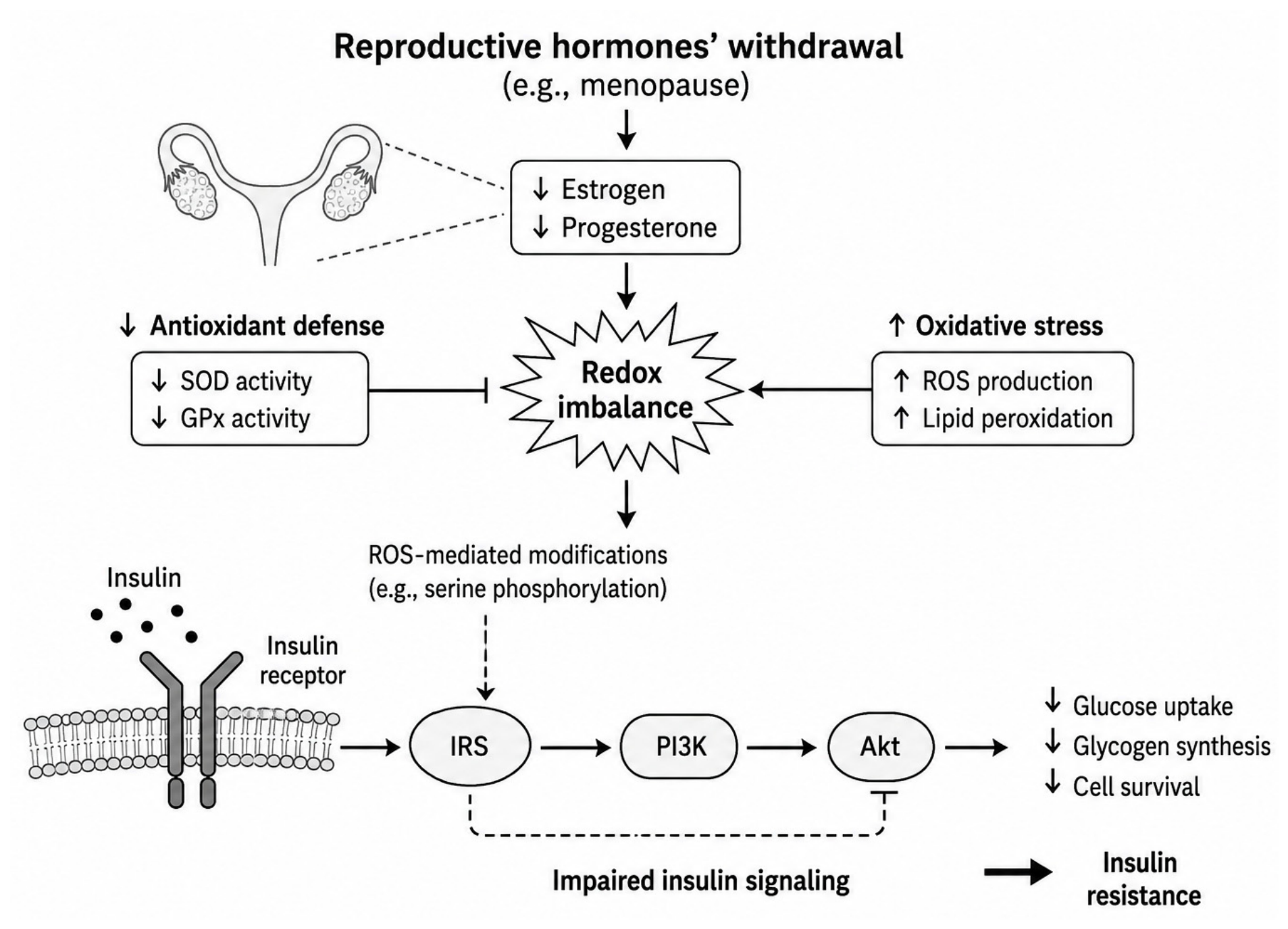
4.3. Hormonal Withdrawal, Oxidative Stress and Subsequent Metabolic Consequences in Menopausal Transition
5. Male Reproductive System, Oxidative Stress, and Late-Onset Hypogonadism
5.1. Testicular Steroidogenesis and Spermatogenesis and Oxidative Stress
5.2. Hormonal Withdrawal, Oxidative Stress and Subsequent Metabolic Syndrome in Male Late-Onset Hypogonadism
6. The Role of Antioxidants in Obesity and Diabetes
7. The Role of Antioxidants in Females Undergoing Menopause and in Males Undergoing Late-Onset Hypogonadism
8. Antioxidant Paradox
9. Discussion
10. Conclusions
Author Contributions
Funding
Institutional Review Board Statement
Informed Consent Statement
Data Availability Statement
Conflicts of Interest
Abbreviations
| ABP | Androgen-binding protein |
| Akt | Protein kinase B |
| BMI | Body mass index |
| BW | Body weight |
| CRP | C-reactive protein |
| FM | Fat mass |
| FSH | Follicle-stimulating hormone |
| GH | Growth hormone |
| GLP-1 | Glucagon-like peptide-1 |
| GLUT-4 | Glucose transporter-4 |
| GnRH | Gonadotropin-releasing hormone |
| GPx | Glutathione peroxidase |
| hCG | Human chorionic gonadotropin |
| HDL | High-density lipoprotein |
| HOMA-IR | Homeostatic Model Assessment of Insulin Resistance |
| HPT | Hypothalamus–pituitary–testicular |
| IGF-1 | Insulin-like growth factor-1 |
| IL-1β | Interleukin-1 beta |
| IL-6 | Interleukin-6 |
| IRS | Insulin receptor substrate |
| JNK | c-Jun N-terminal kinase |
| LDL | Low-density lipoprotein |
| LH | Luteinizing hormone |
| LOH | Late-onset hypogonadism |
| MA | Meta-analysis |
| MAPK | Mitogen-Activated Protein Kinase |
| MDA | Malondialdehyde |
| NAC | N-acetylcysteine |
| NAFLD | Nonalcoholic fatty liver disease |
| NO | Nitric oxide |
| NOS | Nitric oxide synthase |
| PI3K | Phosphatidylinositol 3-kinase |
| RNS | Reactive nitrogen species |
| ROS | Reactive oxygen species |
| SBP | Systolic blood pressure |
| SOD | Superoxide dismutase |
| SR | Systematic review |
| StAR | Steroidogenic acute regulatory protein |
| T2DM | Type 2 diabetes mellitus |
| TC | Total cholesterol |
| TG | Triglyceride |
| TNF-α | Tumor necrosis factor-alpha |
| TRT | Testosterone replacement therapy |
| WC | Waist circumference |
References
- Nappi, R.E.; Chedraui, P.; Lambrinoudaki, I.; Simoncini, T. Menopause: A cardiometabolic transition. Lancet Diabetes Endocrinol. 2022, 10, 442–456. [Google Scholar] [CrossRef]
- Karaflou, M.; Goulis, D.G. Body composition analysis: A snapshot across the perimenopause. Maturitas 2024, 180, 107898. [Google Scholar] [CrossRef] [PubMed]
- Sies, H.; Jones, D.P. Reactive oxygen species (ROS) as pleiotropic physiological signalling agents. Nat. Rev. Mol. Cell Biol. 2020, 21, 363–383. [Google Scholar] [CrossRef]
- Hurrle, S.; Hsu, W.H. The etiology of oxidative stress in insulin resistance. Biomed. J. 2017, 40, 257–262. [Google Scholar] [CrossRef]
- Newsholme, P.; Cruzat, V.F.; Keane, K.N.; Carlessi, R.; de Bittencourt, P.I., Jr. Molecular mechanisms of ROS production and oxidative stress in diabetes. Biochem. J. 2016, 473, 4527–4550. [Google Scholar] [CrossRef] [PubMed]
- Steyn, M.; Zitouni, K.; Kelly, F.J.; Cook, P.; Earle, K.A. Sex Differences in Glutathione Peroxidase Activity and Central Obesity in Patients with Type 2 Diabetes at High Risk of Cardio-Renal Disease. Antioxidants 2019, 8, 629. [Google Scholar] [CrossRef]
- Zitouni, K.; Steyn, M.; Lewis, J.; Kelly, F.J.; Cook, P.; Earle, K.A. Variation in Arterial Stiffness and Markers of Oxidative Stress in Patients with Type 2 Diabetes Mellitus from Different Ethnic Groups. Antioxidants 2025, 14, 858. [Google Scholar] [CrossRef]
- Goodman, R.L.; Herbison, A.E.; Lehman, M.N.; Navarro, V.M. Neuroendocrine control of gonadotropin-releasing hormone: Pulsatile and surge modes of secretion. J. Neuroendocrinol. 2022, 34, e13094. [Google Scholar] [CrossRef]
- Moore, A.M.; Coolen, L.M.; Lehman, M.N. In vivo imaging of the GnRH pulse generator reveals a temporal order of neuronal activation and synchronization during each pulse. Proc. Natl. Acad. Sci. USA 2022, 119, e2117767119. [Google Scholar] [CrossRef] [PubMed]
- Soman, M.; Huang, L.C.; Cai, W.H.; Xu, J.B.; Chen, J.Y.; He, R.K.; Ruan, H.C.; Xu, X.R.; Qian, Z.D.; Zhu, X.M. Serum androgen profiles in women with premature ovarian insufficiency: A systematic review and meta-analysis. Menopause 2019, 26, 78–93. [Google Scholar] [CrossRef]
- Garzia, E.; Galiano, V.; Guarnerio, P.P.; Marconi, A.M. Diagnostic pitfalls in ovarian androgen-secreting tumors in postmenopausal women with rapidly progressed severe hyperandrogenism. Post. Reprod. Health 2025, 31, 45–49. [Google Scholar] [CrossRef]
- Luque-Ramirez, M.; Nattero-Chavez, L.; Rodriguez-Rubio Corona, C.; Ortiz-Flores, A.E.; Garcia-Cano, A.M.; Rosillo Coronado, M.; Perez Mies, B.; Ruz Caracuel, I.; Escobar-Morreale, H.F. Postmenopausal onset of androgen excess: A diagnostic and therapeutic algorithm based on extensive clinical experience. J. Endocrinol. Investig. 2024, 47, 2007–2020. [Google Scholar] [CrossRef]
- Hirschberg, A.L. Approach to Investigation of Hyperandrogenism in a Postmenopausal Woman. J. Clin. Endocrinol. Metab. 2023, 108, 1243–1253. [Google Scholar] [CrossRef] [PubMed]
- Deng, J.; Luo, C.; Xie, C.; Duan, H. Thymol Mitigates Oxidative Stress-Induced Ovarian Aging and Restores Steroidogenesis via the JAK1-STAT3 Pathway. Curr. Issues Mol. Biol. 2025, 47, 910. [Google Scholar] [CrossRef] [PubMed]
- Zaidi, S.K.; Shen, W.J.; Cortez, Y.; Bittner, S.; Bittner, A.; Arshad, S.; Huang, T.T.; Kraemer, F.B.; Azhar, S. SOD2 deficiency-induced oxidative stress attenuates steroidogenesis in mouse ovarian granulosa cells. Mol. Cell Endocrinol. 2021, 519, 110888. [Google Scholar] [CrossRef] [PubMed]
- Santoro, N.; Roeca, C.; Peters, B.A.; Neal-Perry, G. The Menopause Transition: Signs, Symptoms, and Management Options. J. Clin. Endocrinol. Metab. 2021, 106, 1–15. [Google Scholar] [CrossRef]
- Ishikawa, A.; Matsushita, H.; Shimizu, S.; Morita, N.; Hanai, R.; Sugiyama, S.; Watanabe, K.; Wakatsuki, A. Impact of Menopause and the Menstrual Cycle on Oxidative Stress in Japanese Women. J. Clin. Med. 2023, 12, 829. [Google Scholar] [CrossRef]
- Sanchez-Rodriguez, M.A.; Zacarias-Flores, M.; Arronte-Rosales, A.; Correa-Munoz, E.; Mendoza-Nunez, V.M. Menopause as risk factor for oxidative stress. Menopause 2012, 19, 361–367. [Google Scholar] [CrossRef]
- Sanchez-Rodriguez, M.A.; Zacarias-Flores, M.; Arronte-Rosales, A.; Mendoza-Nunez, V.M. Association between hot flashes severity and oxidative stress among Mexican postmenopausal women: A cross-sectional study. PLoS ONE 2019, 14, e0214264. [Google Scholar] [CrossRef]
- Unfer, T.C.; Figueiredo, C.G.; Zanchi, M.M.; Maurer, L.H.; Kemerich, D.M.; Duarte, M.M.; Konopka, C.K.; Emanuelli, T. Estrogen plus progestin increase superoxide dismutase and total antioxidant capacity in postmenopausal women. Climacteric 2015, 18, 379–388. [Google Scholar] [CrossRef]
- Marlatt, K.L.; Pitynski-Miller, D.R.; Gavin, K.M.; Moreau, K.L.; Melanson, E.L.; Santoro, N.; Kohrt, W.M. Body composition and cardiometabolic health across the menopause transition. Obesity 2022, 30, 14–27. [Google Scholar] [CrossRef]
- Marlatt, K.L.; Redman, L.M.; Beyl, R.A.; Smith, S.R.; Champagne, C.M.; Yi, F.; Lovejoy, J.C. Racial differences in body composition and cardiometabolic risk during the menopause transition: A prospective, observational cohort study. Am. J. Obstet. Gynecol. 2020, 222, 365.e1–365.e18. [Google Scholar] [CrossRef]
- Yang, R.; Kuang, M.; Qiu, J.; Yu, C.; Sheng, G.; Zou, Y. Assessing the usefulness of a newly proposed metabolic score for visceral fat in predicting future diabetes: Results from the NAGALA cohort study. Front. Endocrinol. 2023, 14, 1172323. [Google Scholar] [CrossRef]
- Liu, P.; Ji, Y.; Yuen, T.; Rendina-Ruedy, E.; DeMambro, V.E.; Dhawan, S.; Abu-Amer, W.; Izadmehr, S.; Zhou, B.; Shin, A.C.; et al. Blocking FSH induces thermogenic adipose tissue and reduces body fat. Nature 2017, 546, 107–112. [Google Scholar] [CrossRef]
- Kanakis, G.A.; Pofi, R.; Goulis, D.G.; Isidori, A.M.; Armeni, E.; Erel, C.T.; Fistonic, I.; Hillard, T.; Hirschberg, A.L.; Meczekalski, B.; et al. EMAS position statement: Testosterone replacement therapy in older men. Maturitas 2023, 178, 107854. [Google Scholar] [CrossRef]
- Darbandi, M.; Darbandi, S.; Agarwal, A.; Sengupta, P.; Durairajanayagam, D.; Henkel, R.; Sadeghi, M.R. Reactive oxygen species and male reproductive hormones. Reprod. Biol. Endocrinol. 2018, 16, 87. [Google Scholar] [CrossRef]
- Roychoudhury, S.; Chakraborty, S.; Choudhury, A.P.; Das, A.; Jha, N.K.; Slama, P.; Nath, M.; Massanyi, P.; Ruokolainen, J.; Kesari, K.K. Environmental Factors-Induced Oxidative Stress: Hormonal and Molecular Pathway Disruptions in Hypogonadism and Erectile Dysfunction. Antioxidants 2021, 10, 837. [Google Scholar] [CrossRef]
- Li, M.W.; Mruk, D.D.; Cheng, C.Y. Gap junctions and blood-tissue barriers. Adv. Exp. Med. Biol. 2012, 763, 260–280. [Google Scholar] [CrossRef]
- Magon, N.; Singh, S.; Saxena, A.; Sahay, R. Growth hormone in male infertility. Indian J. Endocrinol. Metab. 2011, 15, S248–S249. [Google Scholar] [CrossRef]
- Gangwar, P.K.; Sankhwar, S.N.; Pant, S.; Krishna, A.; Singh, B.P.; Mahdi, A.A.; Singh, R. Increased Gonadotropins and prolactin are linked to infertility in males. Bioinformation 2020, 16, 176–182. [Google Scholar] [CrossRef]
- Lu, C.; Yang, W.; Chen, M.; Liu, T.; Yang, J.; Tan, P.; Li, L.; Hu, X.; Fan, C.; Hu, Z.; et al. Inhibin A inhibits follicle-stimulating hormone (FSH) action by suppressing its receptor expression in cultured rat granulosa cells. Mol. Cell Endocrinol. 2009, 298, 48–56. [Google Scholar] [CrossRef]
- Svechnikov, K.; Izzo, G.; Landreh, L.; Weisser, J.; Soder, O. Endocrine disruptors and Leydig cell function. J. Biomed. Biotechnol. 2010, 2010, 684504. [Google Scholar] [CrossRef]
- Jones, R.W.; Rees, R.W.; Minhas, S.; Ralph, D.; Persad, R.A.; Jeremy, J.Y. Oxygen free radicals and the penis. Expert. Opin. Pharmacother. 2002, 3, 889–897. [Google Scholar] [CrossRef]
- Zitzmann, M.; Soave, A.; Bier, S. Functional testosterone deficiency in aging men: Clinical impact, diagnostic pathways, and treatment strategies. Maturitas 2026, 207, 108870. [Google Scholar] [CrossRef]
- Mancini, A.; Leone, E.; Festa, R.; Grande, G.; Silvestrini, A.; de Marinis, L.; Pontecorvi, A.; Maira, G.; Littarru, G.P.; Meucci, E. Effects of testosterone on antioxidant systems in male secondary hypogonadism. J. Androl. 2008, 29, 622–629. [Google Scholar] [CrossRef]
- Miller, C.; Madden-Doyle, L.; Jayasena, C.; McIlroy, M.; Sherlock, M.; O’Reilly, M.W. Mechanisms in endocrinology: Hypogonadism and metabolic health in men-novel insights into pathophysiology. Eur. J. Endocrinol. 2024, 191, R1–R17. [Google Scholar] [CrossRef]
- Dhindsa, S.; Ghanim, H.; Batra, M.; Kuhadiya, N.D.; Abuaysheh, S.; Sandhu, S.; Green, K.; Makdissi, A.; Hejna, J.; Chaudhuri, A.; et al. Insulin Resistance and Inflammation in Hypogonadotropic Hypogonadism and Their Reduction After Testosterone Replacement in Men With Type 2 Diabetes. Diabetes Care 2016, 39, 82–91. [Google Scholar] [CrossRef]
- Fan, H.Q.; Wang, Y.C.; He, W.; Zhou, H.W.; Yang, T. Changes in levels of testosterone, insulin sensitivity and metabolic profiles during GnRH therapy: Reciprocity between insulin sensitivity and pituitary responsiveness to GnRH in teenage and young male patients with congenital hypogonadotropic hypogonadism. Clin. Endocrinol. 2022, 97, 783–791. [Google Scholar] [CrossRef]
- Ermetici, F.; Donadio, F.; Iorio, L.; Malavazos, A.E.; Dolci, A.; Peverelli, E.; Barbieri, A.M.; Morricone, L.; Chiodini, I.; Arosio, M.; et al. Peripheral insulin-like factor 3 concentrations are reduced in men with type 2 diabetes mellitus: Effect of glycemic control and visceral adiposity on Leydig cell function. Eur. J. Endocrinol. 2009, 161, 853–859. [Google Scholar] [CrossRef]
- Pitteloud, N.; Hardin, M.; Dwyer, A.A.; Valassi, E.; Yialamas, M.; Elahi, D.; Hayes, F.J. Increasing insulin resistance is associated with a decrease in Leydig cell testosterone secretion in men. J. Clin. Endocrinol. Metab. 2005, 90, 2636–2641. [Google Scholar] [CrossRef] [PubMed]
- Lotti, F.; Maggi, M. Effects of diabetes mellitus on sperm quality and fertility outcomes: Clinical evidence. Andrology 2023, 11, 399–416. [Google Scholar] [CrossRef]
- Khripun, I.; Vorobyev, S.; Belousov, I.; Kogan, M.; Zitzmann, M. Influence of testosterone substitution on glycemic control and endothelial markers in men with newly diagnosed functional hypogonadism and type 2 diabetes mellitus: A randomized controlled trial. Aging Male 2019, 22, 241–249. [Google Scholar] [CrossRef]
- Kim, S.H.; Park, J.J.; Kim, K.H.; Yang, H.J.; Kim, D.S.; Lee, C.H.; Jeon, Y.S.; Shim, S.R.; Kim, J.H. Efficacy of testosterone replacement therapy for treating metabolic disturbances in late-onset hypogonadism: A systematic review and meta-analysis. Int. Urol. Nephrol. 2021, 53, 1733–1746. [Google Scholar] [CrossRef]
- Zhang, J.; Yang, B.; Xiao, W.; Li, X.; Li, H. Effects of testosterone supplement treatment in hypogonadal adult males with T2DM: A meta-analysis and systematic review. World J. Urol. 2018, 36, 1315–1326. [Google Scholar] [CrossRef]
- Barnouin, Y.; Armamento-Villareal, R.; Celli, A.; Jiang, B.; Paudyal, A.; Nambi, V.; Bryant, M.S.; Marcelli, M.; Garcia, J.M.; Qualls, C.; et al. Testosterone Replacement Therapy Added to Intensive Lifestyle Intervention in Older Men With Obesity and Hypogonadism. J. Clin. Endocrinol. Metab. 2021, 106, e1096–e1110. [Google Scholar] [CrossRef]
- Robledo, K.P.; Marschner, I.C.; Handelsman, D.J.; Bracken, K.; Stuckey, B.G.A.; Yeap, B.B.; Inder, W.; Grossmann, M.; Jesudason, D.; Allan, C.A.; et al. Mediation analysis of the testosterone treatment effect to prevent type 2 diabetes in the Testosterone for Prevention of Type 2 Diabetes Mellitus trial. Eur. J. Endocrinol. 2023, 188, 613–620. [Google Scholar] [CrossRef]
- Jones, T.H.; Arver, S.; Behre, H.M.; Buvat, J.; Meuleman, E.; Moncada, I.; Morales, A.M.; Volterrani, M.; Yellowlees, A.; Howell, J.D.; et al. Testosterone replacement in hypogonadal men with type 2 diabetes and/or metabolic syndrome (the TIMES2 study). Diabetes Care 2011, 34, 828–837. [Google Scholar] [CrossRef]
- Gianatti, E.J.; Dupuis, P.; Hoermann, R.; Strauss, B.J.; Wentworth, J.M.; Zajac, J.D.; Grossmann, M. Effect of testosterone treatment on glucose metabolism in men with type 2 diabetes: A randomized controlled trial. Diabetes Care 2014, 37, 2098–2107. [Google Scholar] [CrossRef]
- Grossmann, M.; Hoermann, R.; Wittert, G.; Yeap, B.B. Effects of testosterone treatment on glucose metabolism and symptoms in men with type 2 diabetes and the metabolic syndrome: A systematic review and meta-analysis of randomized controlled clinical trials. Clin. Endocrinol. 2015, 83, 344–351. [Google Scholar] [CrossRef]
- Wittert, G.; Bracken, K.; Robledo, K.P.; Grossmann, M.; Yeap, B.B.; Handelsman, D.J.; Stuckey, B.; Conway, A.; Inder, W.; McLachlan, R.; et al. Testosterone treatment to prevent or revert type 2 diabetes in men enrolled in a lifestyle programme (T4DM): A randomised, double-blind, placebo-controlled, 2-year, phase 3b trial. Lancet Diabetes Endocrinol. 2021, 9, 32–45. [Google Scholar] [CrossRef]
- Lincoff, A.M.; Bhasin, S.; Flevaris, P.; Mitchell, L.M.; Basaria, S.; Boden, W.E.; Cunningham, G.R.; Granger, C.B.; Khera, M.; Thompson, I.M., Jr.; et al. Cardiovascular Safety of Testosterone-Replacement Therapy. N. Engl. J. Med. 2023, 389, 107–117. [Google Scholar] [CrossRef]
- Mousavi, S.M.; Milajerdi, A.; Sheikhi, A.; Kord-Varkaneh, H.; Feinle-Bisset, C.; Larijani, B.; Esmaillzadeh, A. Resveratrol supplementation significantly influences obesity measures: A systematic review and dose-response meta-analysis of randomized controlled trials. Obes. Rev. 2019, 20, 487–498. [Google Scholar] [CrossRef]
- Setayesh, A.; Arzhang, P.; Baniasadi, M.M.; Lahouti, M.; Azadbakht, L. The effect of resveratrol supplementation on anthropometric indices, adiponectin and leptin levels in individuals with overweight and obesity: A graded, systematic review and meta-analysis of randomized controlled trials. Int. J. Obes. 2026, 50, 492–506. [Google Scholar] [CrossRef]
- Garcia-Martinez, B.I.; Ruiz-Ramos, M.; Pedraza-Chaverri, J.; Santiago-Osorio, E.; Mendoza-Nunez, V.M. Influence of Age and Dose on the Effect of Resveratrol for Glycemic Control in Type 2 Diabetes Mellitus: Systematic Review and Meta-Analysis. Molecules 2022, 27, 5232. [Google Scholar] [CrossRef]
- Zhu, P.; Jin, Y.; Sun, J.; Zhou, X. The efficacy of resveratrol supplementation on inflammation and oxidative stress in type-2 diabetes mellitus patients: Randomized double-blind placebo meta-analysis. Front. Endocrinol. 2024, 15, 1463027. [Google Scholar] [CrossRef]
- Karimi, M.; Alipour, S.; Pirzad, S.; Ahmadizad, S.; Bassami, M.; Asbaghi, O. Effect of Vitamin E on Serum Adiponectin and Leptin in Adults: A Systematic Review and Meta-analysis. J. Diet. Suppl. 2025, 22, 939–957. [Google Scholar] [CrossRef]
- Mason, S.A.; Keske, M.A.; Wadley, G.D. Effects of Vitamin C Supplementation on Glycemic Control and Cardiovascular Risk Factors in People with Type 2 Diabetes: A GRADE-Assessed Systematic Review and Meta-analysis of Randomized Controlled Trials. Diabetes Care 2021, 44, 618–630. [Google Scholar] [CrossRef]
- Aragon-Vela, J.; Huertas, J.R.; Casuso, R.A. Effects of Vitamin C and/or E Supplementation on Glycemic Control and Cardiovascular Risk Factors in Type 2 Diabetes: A Systematic Review and Subgroup Meta-analysis. Nutr. Rev. 2026, 84, 235–245. [Google Scholar] [CrossRef]
- Namazi, N.; Larijani, B.; Azadbakht, L. Alpha-lipoic acid supplement in obesity treatment: A systematic review and meta-analysis of clinical trials. Clin. Nutr. 2018, 37, 419–428. [Google Scholar] [CrossRef]
- Vajdi, M.; Abbasalizad Farhangi, M. Alpha-lipoic acid supplementation significantly reduces the risk of obesity in an updated systematic review and dose response meta-analysis of randomised placebo-controlled clinical trials. Int. J. Clin. Pract. 2020, 74, e13493. [Google Scholar] [CrossRef]
- Luo, Y.; Zhang, J.; Guo, H. Alpha-lipoic acid on intermediate disease markers in overweight or obese adults: A systematic review and meta-analysis. BMJ Open 2025, 15, e088363. [Google Scholar] [CrossRef]
- Salinas, A.V.; Caroca, T.M.; Santibanez, F.P.; Gonzalez, J.R.; Lopez-Chaparro, M.; Barahona-Vasquez, M.; Loaiza-Giraldo, J.P.; Gomez-Valdovinos, C.; Valenzuela-Fuenzalida, J.J.; Nova-Baeza, P.; et al. Effectiveness of alpha lipoic acid supplementation on biochemical, clinical, and inflammatory parameters in patients with diabetic polyneuropathy: A systematic review and meta-analysis. Diabetes Metab. Syndr. 2026, 20, 103374. [Google Scholar] [CrossRef] [PubMed]
- Adamo, A.M.; Supasai, S.; Salvador, G.A.; Liu, X.; Mackenzie, G.G.; Oteiza, P.I. Zinc, redox regulation and brain development. Free Radic. Biol. Med. 2026, 251, 137–154. [Google Scholar] [CrossRef]
- Deluao, J.C.; Winstanley, Y.; Robker, R.L.; Pacella-Ince, L.; Gonzalez, M.B.; McPherson, N.O. Oxidative stress and reproductive function: Reactive oxygen species in the mammalian pre-implantation embryo. Reproduction 2022, 164, F95–F108. [Google Scholar] [CrossRef]
- Ma, Y.; Huang, S.; Liang, Y.; Zhu, Y.; Huang, H.; Zhang, B.; Shi, L. All-trans Retinoic Acid regulates cellular senescence of mouse embryonic palatal mesenchyme (MEPM) cells in developing cleft palates. Reprod. Toxicol. 2025, 137, 109030. [Google Scholar] [CrossRef] [PubMed]
- Alizadeh, F.; Javadi, M.; Karami, A.A.; Gholaminejad, F.; Kavianpour, M.; Haghighian, H.K. Curcumin nanomicelle improves semen parameters, oxidative stress, inflammatory biomarkers, and reproductive hormones in infertile men: A randomized clinical trial. Phytother. Res. 2018, 32, 514–521. [Google Scholar] [CrossRef]
- Leisegang, K.; Roychoudhury, S.; Slama, P.; Finelli, R. The Mechanisms and Management of Age-Related Oxidative Stress in Male Hypogonadism Associated with Non-communicable Chronic Disease. Antioxidants 2021, 10, 1834. [Google Scholar] [CrossRef]
- Vrankova, S.; Cebova, M.; Klimentova, J.; Pechanova, O. Redox Paradox of Polyphenols: Bioavailability, Hormesis, and Safety Concerns. Phytother. Res. 2026, 40, 2437–2455. [Google Scholar] [CrossRef]
- Verhagen, P.C. Words of wisdom. Re: Vitamin E and the risk of prostate cancer. The Selenium and Vitamin E Cancer Prevention Trial (SELECT). Eur. Urol. 2012, 62, 565–566. [Google Scholar] [CrossRef] [PubMed]
- Lippman, S.M.; Klein, E.A.; Goodman, P.J.; Lucia, M.S.; Thompson, I.M.; Ford, L.G.; Parnes, H.L.; Minasian, L.M.; Gaziano, J.M.; Hartline, J.A.; et al. Effect of selenium and vitamin E on risk of prostate cancer and other cancers: The Selenium and Vitamin E Cancer Prevention Trial (SELECT). JAMA 2009, 301, 39–51. [Google Scholar] [CrossRef]
- Omenn, G.S.; Goodman, G.E.; Thornquist, M.D.; Balmes, J.; Cullen, M.R.; Glass, A.; Keogh, J.P.; Meyskens, F.L.; Valanis, B.; Williams, J.H.; et al. Effects of a combination of beta carotene and vitamin A on lung cancer and cardiovascular disease. N. Engl. J. Med. 1996, 334, 1150–1155. [Google Scholar] [CrossRef]
- The Alpha-Tocopherol Beta Carotene Cancer Prevention Study Group. The effect of vitamin E and beta carotene on the incidence of lung cancer and other cancers in male smokers. N. Engl. J. Med. 1994, 330, 1029–1035. [CrossRef]
- Lavin-Perez, A.M.; Collado-Mateo, D.; Villafaina, S.; Calle-Guisado, V. The Role of Exercise to Reduce the Impact of Diabetes in the Seminal Quality: A Systematic Review. Medicina 2021, 57, 159. [Google Scholar] [CrossRef]
- Powers, S.K.; Deminice, R.; Ozdemir, M.; Yoshihara, T.; Bomkamp, M.P.; Hyatt, H. Exercise-induced oxidative stress: Friend or foe? J. Sport. Health Sci. 2020, 9, 415–425. [Google Scholar] [CrossRef]
- Belladelli, F.; Basran, S.; Eisenberg, M.L. Male Fertility and Physical Exercise. World J. Men’s Health 2023, 41, 482–488. [Google Scholar] [CrossRef]
- Dena, S.M.; Adeleye, A.O.; Mohlala, K.; Langa, B.C.; Opuwari, C.S. The Impact of Diabetes Mellitus-Related Oxidative Stress on Male Fertility: A Review. J. Diabetes 2025, 17, e70157. [Google Scholar] [CrossRef]
- Mohammadi, A.; Shabani, R.; Bashiri, Z.; Rafiei, S.; Asgari, H.; Koruji, M. Therapeutic potential of exosomes in spermatogenesis regulation and male infertility. Biol. Cell 2024, 116, e2300127. [Google Scholar] [CrossRef]
- Cabre, H.E.; Woolf, E.K.; Redman, L.M. Precision Nutrition for Management of Cardiovascular Disease Risk during Menopause. Lifestyle Genom. 2024, 17, 93–101. [Google Scholar] [CrossRef]


| Antioxidant | Study (Year) | Study Type | No. of Studies | Key Findings |
|---|---|---|---|---|
| Resveratrol | Mousavi et al. (2019) [52] | SR/MA | 28 | Reduce BW, BMI and WC, but not FM |
| Resveratrol | Setayesh et al. (2026) [53] | SR/MA | 23 | Not significantly improve BW, BMI, FM, adiponectin and leptin levels. Modest reduction in WC. |
| Resveratrol | García-Martínez et al. (2022) [54] | SR/MA | 15 | Dose- and age- dependent decrease of glucose concentrations, HbA1c, and insulin levels |
| Resveratrol | Zhu et al. (2024) [55] | MA | 6 | Reduced oxidative stress and inflammation in T2DM patients to a certain degree |
| Vitamin E | Karimi et al. (2025) [56] | SR/MA | 10 | No overall effect; subgroup benefits in NAFLD |
| Vitamin C | Mason et al. (2021) [57] | SR/MA | 28 | Improve glycemic control and BP with moderate to very low evidence certainty |
| Vitamin C + E | Aragón-Vela et al. (2025) [58] | SR/MA | 52 | Reduction in SBP with vitamin C and vitamins C + E. HDL improved with combination |
| Alpha-lipoic acid | Namazi et al. (2018) [59] | SR/MA | 12 | Small reductions in weight and BMI |
| Alpha-lipoic acid | Vajdi et al. (2020) [60] | SR/MA | 18/21/8 * | Reduced BW and BMI; WC dependent on duration |
| Alpha-lipoic acid | Luo et al. (2025) [61] | SR/MA | 11 | No significant associations with TG, TC, HDL-C, LDL-C, HOMA-IR and FBS levels |
| Alpha-lipoic acid | Salinas et al. (2026) [62] | SR/MA | 15 | Improved neuropathic symptoms; no glycemic effect |
Disclaimer/Publisher’s Note: The statements, opinions and data contained in all publications are solely those of the individual author(s) and contributor(s) and not of MDPI and/or the editor(s). MDPI and/or the editor(s) disclaim responsibility for any injury to people or property resulting from any ideas, methods, instructions or products referred to in the content. |
© 2026 by the authors. Licensee MDPI, Basel, Switzerland. This article is an open access article distributed under the terms and conditions of the Creative Commons Attribution (CC BY) license.
Share and Cite
Karaflou, M.; Kaprara, A.; Goulis, D.G. Antioxidants in Menopausal Transition and Male Late-Onset Hypogonadism for the Prevention of Diabetes. Antioxidants 2026, 15, 659. https://doi.org/10.3390/antiox15060659
Karaflou M, Kaprara A, Goulis DG. Antioxidants in Menopausal Transition and Male Late-Onset Hypogonadism for the Prevention of Diabetes. Antioxidants. 2026; 15(6):659. https://doi.org/10.3390/antiox15060659
Chicago/Turabian StyleKaraflou, Maria, Athina Kaprara, and Dimitrios G. Goulis. 2026. "Antioxidants in Menopausal Transition and Male Late-Onset Hypogonadism for the Prevention of Diabetes" Antioxidants 15, no. 6: 659. https://doi.org/10.3390/antiox15060659
APA StyleKaraflou, M., Kaprara, A., & Goulis, D. G. (2026). Antioxidants in Menopausal Transition and Male Late-Onset Hypogonadism for the Prevention of Diabetes. Antioxidants, 15(6), 659. https://doi.org/10.3390/antiox15060659