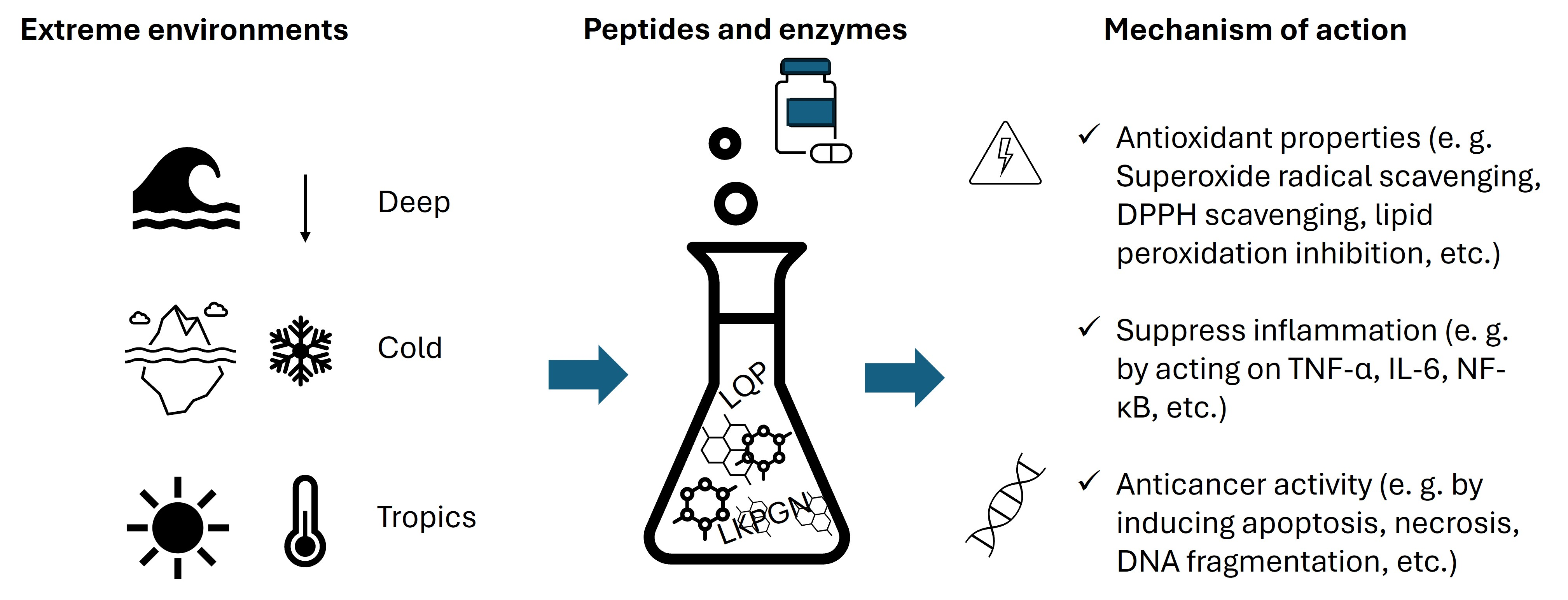
Antioxidant, Anti-Inflammatory and Anticancer Peptides from Extreme Marine Environments

 ,
,  ,
,  ,
, 
Abstract
1. Introduction
1.1. Antioxidants
1.2. Anti-Inflammatory Compounds
1.3. Anticancer Compounds
2. Peptides from the Deep Ocean Environments

| Protein Name/Peptide Sequence | Anticancer Activity | Active Concentration | In Vitro/In Vivo | Mechanism of Action | Reference |
|---|---|---|---|---|---|
| Fraction 5 and rhodoheptin mixture | Human A375 melanoma cells. | 500 µg/mL | In vitro | - | [84] |
| Methoxyneihumicin | Human breast cancer cells MCF-7; Human glioblastoma cells SF-268 | IC50: 4.6 µM; IC50: 12.7 µM | In vitro | - | [77] |
| XR334 | Human breast cancer cells MCF-7; Human glioblastoma cells SF-268 | IC50: 22.0 µM; IC50: 22.6 µM | In vitro | - | [77] |
| Marthiapeptide A | Human glioblastoma cells SF-268; human breast cancer cells MCF-7; typotriploid human cells NCI-H460; Human hepatocellular carcinoma cells HepG2 | IC50: 0.38 µM; IC50: 0.43 µM; IC50: 0.47 µM; IC50: 0.52 µM | In vitro | - | [79] |
| Microsclerodermins N | Human breast cancer cells MDA-MB-231; Hypotriploid human cells NCI-H460; Human glioblastoma cells SF-268 | IC50: 0.54 µM; IC50: 0.67 µM; IC50: 0.72 µM | In vitro | - | [80] |
| Microsclerodermins O | Human breast cancer cells MDA-MB-231; Hypotriploid human cells NCI-H460; Human glioblastoma cells SF-268 | IC50: 1.2 µM; IC50: 1.8 µM; IC50: 2.3 µM | In vitro | - | [80] |
| Sungsanpin (1), 15-amino-acid peptide | Human adenocarcinoma cells A549 | 5 and 50 µM | In vitro | Inhibition of cell invasion | [81] |
3. Peptides from the Polar Environments
3.1. Antioxidants
| Peptide Sequence | Activity | Active Concentration | In Vitro/In Vivo | Mechanism of Action | Reference |
|---|---|---|---|---|---|
| Cyclo-(L-Pro-L-Tyr) and L-Tyr-L-Val-L-Pro-L-Leu | Antioxidant activity evaluated by a DPPH free radical scavenging assay | 10 mmol–1 mmol | In vitro | - | [85] |
| SLPY, QYPPMQY, and EYEA | ACE-inhibitory with protection of HUVECs against oxidative damage | SLPY: IC50 0.3715 mg/mL, QYPPMQY: IC50 0.2903 mg/mL and EYEA: IC50 0.3375 mg/mL | In vitro | Keap1/Nrf2 pathway in HUVECs by significantly up-regulating Nrf2 protein expression and its nuclear level | [87] |
| LKPGN and LQP | Protection of Chang liver cells from H2O2-induced oxidative stress | - | In vitro | Increase in antioxidant enzyme activities (SOD, GPX), reduction in ROS, increasing mitochondrial membrane potential and lowering lipid peroxidation and DNA damage. | [89] |
| Antarctic krill peptide SSDAFFPFR | Pheochromocytoma PC12 cells | - | In vitro | Suppression of the decrease in SOD activity and decreased ROS content induced by scopolamine, as well as inhibition of the expression of Bax, Caspase-3 and p53 and promotion of the expression of BCL-XL | [90] |
| FPF from an antioxidant-rich Antarctic krill peptide SSDAFFPFR | Mouse hippocampal neuronal HT22 cells; mice | In vitro; in vivo | Reduced ROS and MDA levels, and increased SOD activity and unsaturated lipid levels in mice, decreased the expression level of Caspase-3 in mice and improved energy metabolism in HT22 cells | [91] |
3.2. Anti-Inflammatory Activity
| Peptide Sequence | Activity | Mechanism of Action | Reference |
|---|---|---|---|
| Serine dipeptide lipopeptide Lipid 430 | Modulate innate immune signaling, serves as a ligand of Toll-like receptor 2 (TLR2) | - | [93] |
| HFOPs-AK (Oligopeptides) | Improve liver and kidney histology, educe serum markers of hepatocellular damage (ALT, AST), correct alcohol-induced dyslipidemia | Suppress inflammation by decreasing TNF-α and IL-6 levels, up-regulating IκBα, and inhibiting NF-κB activation, suppress CYP2E1 activity, and regulate lipid metabolism through AMPK/Nrf2/IκBα signaling pathways | [94] |
3.3. Anticancer Activity
| Peptide | Activity | Active Concentration | In Vitro/In Vivo | Mechanism of Action | Reference |
|---|---|---|---|---|---|
| Diketopiperazine, cyclo-(L-Pro-L-Met) | Anti-angiogenic activity in human umbilical vein endothelial cells (HUVECs) | 10 µM | In vitro | Inhibition of TNF-α-induced tube formation and invasion | [95] |
| Mixirins A, B and C | Inhibition of the growth of human colon tumor cells HCT-116 | IC50 0.68, 1.6, 1.3 mg/mL | In vitro | - | [97] |
| Polypeptide PBN11-8 | Cytotoxicity towards human hepatocellular carcinoma cell line BEL-7402, human renal clear cell adenocarcinoma cell line 786-0, human hepatocellular carcinoma cell line HepG2, and human pancreatic cancer cell line Panc-28 | IC50 1.56, 1.80, 1.57, and 1.73 mg/mL | In vitro | Suppression of focal adhesion kinase (FAK)-mediated adhesion, migration, and invasion by disrupting FAK/extracellular signal-regulated kinase (ERK) signaling and down-regulating matrix metalloproteinases MMP-2 and MMP-9 in BEL-7402 cells | [96] |
| NKL-WT (KLKSKLMVVCNKIGLLKSLCRKFVKS) and NKL-MUT (KLKSKLMVVANKIGLLKSLARKFVKSH) | Cytotoxicity and pro-apoptotic activity to melanoma cell line (B16F10) | 40 and 80 µM | DNA fragmentation and apoptosis and secondary necrosis | [98] |
4. Peptides from the Tropical Environment
4.1. Antioxidants
| Protein/Peptide Sequence/Fractions | Activity | Percentage Activity/Active Concentration | In Vitro/In Vivo | Reference |
|---|---|---|---|---|
| Trypsin hydrolysate; Fraction II | Lipid peroxidation inhibition | ~64% | In vitro | [100] |
| Trypsin hydrolysate; Fraction III | Lipid peroxidation inhibition | ~65.8% | In vitro | [100] |
| α-chymotrypsin hydrolysate | DPPH radical scavenging | 24.18 ± 0.33%; 1.5 mg/mL | In vitro | [101] |
| α-chymotrypsin hydrolysate | Superoxide radical scavenging | 32.47 ± 0.68%; 250 µg/mL | In vitro | [101] |
| Collagen hydrolysate (Alcalase, ≤3 kDa; HCA) | DPPH radical scavenging | ~40%; 3.2 mg/mL | In vitro | [103] |
| Collagen hydrolysate (Papain, ≤3 kDa; HCP) | DPPH radical scavenging | ~30%; 3.2 mg/mL | In vitro | [92] |
4.2. Anti-Inflammatory Peptides
| Protein/Peptide Sequence | Anti-Inflammatory Activity | Active Concentration | In Vitro/In Vivo | Mechanism of Action | Reference |
|---|---|---|---|---|---|
| Acrepeptin A | LPS-induced microglial BV-2 | IC50: 12 μM | In vitro | Inhibition of nitric oxide production | [114] |
| Acrepeptin C | IC50: 10.6 μM | ||||
| Aspochracin-type cyclic tripeptide sclerotiotide L | LPS-induced THP-1 | 10 μM | In vitro | Reduction in LPS-induced expression of IL-10 | [113] |
| Bouillomides A and B | Elastase | IC50: 1.9 μM | In vitro | Inhibition of serine protease elastase | [119] |
| Collagen peptides (CP1 and CP2) | Human umbilical vein endothelial HUVECs | 6.25 μg/mL | In vitro | CP1 and CP2 enhanced HUVEC migration by 75.49% and 73.65% | [124] |
| Mouse wounds | 0.9 g/kg | In vivo (mouse) | Increased signs of re-epithelialization, regeneration and collagen deposition | ||
| Didemnin A | Macrophages RAW264.7 cells | IC50: 0.2 µM | In vitro | Oxidative stress reduction | [120] |
| Chondrosarcoma SW1353 cells | IC50: 0.002 µM | Reduction in inflammatory enzymes expression | |||
| Didemnin B | Macrophages RAW264.7 cells | IC50: 0.2 µM | Oxidative stress reduction | ||
| Chondrosarcoma SW1353 cells | IC50: 0.03 µM | Reduction in inflammatory enzymes expression | |||
| Cyclo(L-Pro-D-Val) Cyclo(L-Pro-L-Tyr) Cyclo(L-Pro-D-Leu) | human umbilical vein endothelial HUVECs | 10 μM stimulated with 100 ng/mL of LPS | In vitro | Inhibited LPS-induced TGFBIp release and mRNA expression | [112] |
| Mouse serum | 10 μM | In vivo (mouse) | Reduced TGFBIp release, vascular permeability and leukocyte migration | ||
| Compound 3 (Diketopiperazine dimer) | LPS-induced THP-1 | 10 μM | In vitro | Reduction in LPS-induced expression of Interleukin-10 | [113] |
| DKP 1 | Murine macrophage-like cell line J774A.1 | 5 μg/mL | In vitro | Stimulation of Interleukin-10 and inhibition of TNF-α | [68] |
| DKP 5 | |||||
| Grassystatin A | - | IC50: 26.5 nM | - | Inhibition of cathepsin D | [117] |
| - | IC50: 886 pM | - | Inhibition of cathepsin E | ||
| Grassystatin B | - | IC50: 7.27 nM | - | Inhibition of cathepsin D | |
| - | IC50: 354 pM | - | Inhibition of cathepsin E | ||
| HAC | Carrageenan solution | 10 mg/kg | In vivo (mouse and rats) | Reduced carrageenan-induced paw edema and inhibited neutrophil migration | [104] |
| Hc-CATH | LPS-induced MPMs | 4 μg/mL | In vitro | Neutralized LPS by binding, blocking its interaction with the Toll-like receptor4/MD2 complex and inhibition of genes that encode inflammatory mediators | [126] |
| Kempopeptin A | - | IC50: 0.32 μM | In vitro | Elastase inhibition | [109] |
| Largazole | RA synovial fibroblasts | 5 μM | In vitro | Inhibition of tissue destruction and inflammatory pathway | [116] |
| L-G-L-G-A-A-V-L | LPS-induced RAW264.7 macrophages | 50–200 μg/mL | In vitro | Reduction in expression of cyclooxygenase-2-2 | [125] |
| Lyngbyastatins 5–7 | Porcine pancreatic elastase | IC50: 3–10 nM | In vitro | Elastase inhibition | [105] |
| Lyngbyastatins 8–10 | IC50: 123 nM, 210 nM, 120 nM | Inhibition of porcine pancreatic elastase | [108] | ||
| Molassamide | Elastase | IC50: 0.032 μM | In vitro | Protease inhibition | [118] |
| Perthamide C | Carrageenan solution injection | 300 μg/kg | In vivo (mouse) | Reduction in carrageenan-induced paw edema | [121] |
| Perthamide J | [122] | ||||
| SEP | Copper sulfate-Induced transgenic zebrafish | 500 μg/mL | In vivo | Reduction in the aggregation of neutrophil granulocytes | [127] |
| DSS-induced UC in mice | SASP + SEP at 3 g/100 mL | In vivo | Reduction in pro-inflammatory cytokines and increase in anti-inflammatory cytokines | ||
| Somamide B | Porcine pancreatic elastase | IC50: 3–10 nM | In vitro | Elastase inhibition | [105] |
| Stylissatin A | LPS-induced RAW264.7 macrophages | 87 μM | In vitro | Inhibition of nitric oxide production | [123] |
| Thalassospiramide B | Interleukin-5 production inhibition assay | IC50: 5 μM | In vitro | Interleukin-5 production inhibition | [111] |
4.3. Anticancer
| Peptide Sequence | Anticancer Activity | Active Concentration | In Vitro/In Vivo | Mechanism of Action | Reference |
|---|---|---|---|---|---|
| AtMP2 (TGIATSGLAT FTLHTGSLAPAT) | Breast cancer (MCF7 and MDA-MB-231) | IC50: 5.89 ± 0.14 μg/mL for MCF7; IC50: 6.97 ± 0.24 μg/mL FOR MDA-MB-231 | In vitro | Cell cycle arrest and apoptosis/caspase activation | [128] |
| Callyaerin G | Murine lymphoma L5178Y cell line | ED50: 0.53 μg/mL | In vitro | - | [129] |
| Callyaerins E and H | Murine lymphoma L5178Y cell line | ED50: 0.39; ED50: 0.48 μM | In vitro | - | [130] |
| Sansalvamide A | Pancreatic cancer cell AsPC-1 and CD18 cell lines | Lowest effective concentration of 20–50 μM | In vitro | G0/G1 cell cycle arrest in cells, reduced cyclin D1, cdk4 and 6, and elevated p21 protein expression, and up-regulated cyclin-dependent kinase inhibitors | [131] |
| Arenamides A and B | Colon carcinoma HCT-116 cells | IC50: 13.2; IC50: 19.2 μg/mL | In vitro | - | [132] |
| Lucentamycins A and B | Colon carcinoma HCT-116 cells | IC50: 0.20; IC50: 11 μM | In vitro | - | [133] |
| Mechercharmycin A | Cytotoxicity against lung adenocarcinoma A549 and Jurkat leukemia cells | IC50: 0.04 μM | In vitro | - | [134] |
| Thiocoraline | Murine leukemia P388, lung adenocarcinoma A549, and melanoma MEL288 cells | IC50: 0.002 μM | In vitro | Induced G1 phase arrest and slowed S phase progression through DNA bisintercalation and DNA polymerase α inhibition | [135,136] |
| Salinosporamide A | Central nervous system (CNS) SF-539, non-small cell lung NCI-H226, melanoma SK-MEL-28 and breast cancer cells MDA-MB-435 | LC50 less than 10 nM | In vitro | - | [137] |
| Similanamide | Breast adenocarcinoma MCF-7, non-small-cell lung cancer NCI-H460, and melanoma cell lines | GI50: 115–125 μg/mL | In vitro | - | [138] |
| Bistratamides H and J | Colon carcinoma HCT-116 cells | IC50: from 1.7 and 1 μg/mL. | In vitro | - | [139] |
| Microcionamides A and B | Substantial cytotoxicity effects towards human breast cancer cell lines (MCF-7 and SKBR-3) | - | In vitro | - | [140] |
| Bouillonamide | Neuron 2a mouse neuroblastoma cells | IC50: 6.0 μM | In vitro | - | [141] |
| KT2 and RT2 | Adenocarcinoma HeLa cells and epidermoid carcinoma CaSki cells | IC50: 28.7–53.4 μM; IC50: 17.3–30.8 μM | In vitro | Induced apoptotic cell death | [142] |
| Dolastatin 11 | Lung carcinoma NCI-H460 cells, adenocarcinoma OVCAR-3 cells, glioblastoma SF-295 cells, and colon adenocarcinoma KM20L2 cells | nM range | In vitro | Microfilament disruption | [143] |
| Dolastatins 10 | Adenocarcinoma OVCAR-3 cells, glioblastoma SF-295 cell, kidney carcinoma A498 cells, Lung carcinoma NCI-H460 cells, colon ad KM20L2 cells, and melanoma SK-MEL-5 cells | GI50: 9.5 × 10⁻⁷ µg/mL; GI50: 7.6 × 10⁻⁶ µg/mL; GI50: 2.6 × 10⁻⁵ µg/mL; GI50: 3.4 × 10⁻⁶ µg/mL; GI50: 4.7 × 10⁻⁶ µg/mL; GI50: 7.4 × 10⁻⁶ µg/mL | In vitro | - | [144] |
| Largazole | Mammary epithelial MDA-MB-231 cells | GI50: 7.7 nM | In vitro | - | [145] |
| Kalkitoxin | Breast ductal carcinoma T47D cells | low nanomolar range | In vitro | Inhibition of mitochondrial oxygen consumption at electron transport chain (ETC) complex 1 (NADH-ubiquinone oxidoreductase), preventing the secretion of hypoxia-induced VEGF protein | [146] |
| Apratoxin A | Colorectal adenocarcinoma LoVo cells and papilloma KB cancer cells | IC50:0.36 nM; IC50: 0.52 nM | In vitro | Cell cycle arrest, apoptosis, inhibition of phosphorylation of transcription factor STAT3 | [147] |
| Linear polypeptide (PG155) | Human umbilical vein endothelial HUVECs | 20 µg/mL | In vitro | Inhibition of VEGF mediated migration and tubulogenesis of HUVECs | [148] |
| Pardaxin | Human fibrosarcoma HT-1080 cells | IC50: 14.52 ± 0.18 μg/mL | In vitro | Apoptosis, by virtue of increase in externalization of plasma membrane phosphatidylserine and chromatin condensation, elevated caspase-3/7 activities, disrupted mitochondrial membrane and pile-up of ROS | [147] |
| Kahalalide F | Prostate carcinoma DU145 cells, cervical adenocarcinoma HeLa cells, colorectal adenocarcinoma (HT29) cells, and head and neck HN30 cancer cells | - | In vitro | Suppressed the advancement cell cycle to G1 from G0 phase | [149] |
| Kahalalide F | Hormone-independent prostate tumors, along with neu+ (HER2-overexpressing) breast cancer tumors and neuroblastoma | Maximum tolerated dose in animal models was 300 μg/kg (corresponding to 1800 μg/m2) | In vivo | - | [150,151] |
| Jaspamide or Jasplakinolide | Human prostate carcinoma DU-145 cells, adenocarcinoma PC-3 cells, and Lewis lung carcinoma LNCaP cells | Destroying 1 log of cells with 0.8, 0.3 and 0.07 µM | In vitro | Growth inhibition | [152] |
| Geodiamolides A, B, H, and I | Breast cancer T47D, MCF-7 and Hs578T cell lines | - | In vitro | Alterations in actin cytoskeleton, Geodiamolide H triggers significant phenotypic changes, reduced cellular migration and invasion in Hs578T cells | [153,154] |
| Cytotoxic peptide (SBP) | Human carcinoma BEL-7402, human colon carcinoma RKO, human lung carcinoma A549, human glioma U251 and human breast cancer MCF-7 cells. | IC50: 7.15 µM; IC50: 10.45 µM; IC50: 8.41 µM; IC50: 6.49 µM; IC50: 3.38 µM | In vitro | - | [155] |
| Microcolins A, B, C, D, E, F, G, H, I, J, K, M, 3,4-dihydromicrocolins A and B, 3,4-dihydromicrocolin D | Human lung cancer H-460 cells | IC50: from 6 nM to 5.0 μM. | In vitro | - | [156] |
| Lyngbyabellin G, O, and P | Human breast carcinoma MCF-7 cells | IC50: 120, >160, IC50: 9 μM, respectively | In vitro | - | [157] |
| Lyngbyabellin H and 27-deoxylyngbyabellin | human breast carcinoma MCF-7 cells | IC50: 0.07; IC50: 0.31 μM | In vitro | - | [157] |
5. Bioinformatic Tools for Peptide Discovery
6. Conclusions
Author Contributions
Funding
Institutional Review Board Statement
Informed Consent Statement
Data Availability Statement
Acknowledgments
Conflicts of Interest
References
- Aneiros, A.; Garateix, A. Bioactive Peptides from Marine Sources: Pharmacological Properties and Isolation Procedures. J. Chromatogr. B 2004, 803, 41–53. [Google Scholar] [CrossRef]
- Snelgrove, P.V.R. An Ocean of Discovery: Biodiversity Beyond the Census of Marine Life. Planta Med. 2016, 82, 790–799. [Google Scholar] [CrossRef]
- MarinLit—A Database of the Marine Natural Products Literature. Available online: https://marinlit.rsc.org/ (accessed on 18 April 2026).
- Zhang, Q.; Lv, L.; Wang, W.; Wei, M.; Gu, Y.; Shao, C. Recent Advances of Bioactive Marine Natural Products in Drug Discovery. J. Ocean. Univ. China 2024, 23, 1297–1318. [Google Scholar] [CrossRef]
- Jaspars, M.; Pascale, D.D.; Andersen, J.H.; Reyes, F.; Crawford, A.D.; Ianora, A. The Marine Biodiscovery Pipeline and Ocean Medicines of Tomorrow. J. Mar. Biol. Ass. 2016, 96, 151–158. [Google Scholar] [CrossRef]
- Edwards, K.J.; Becker, K.; Colwell, F. The Deep, Dark Energy Biosphere: Intraterrestrial Life on Earth. Annu. Rev. Earth Planet. Sci. 2012, 40, 551–568. [Google Scholar] [CrossRef]
- Giordano, D. Bioactive Molecules from Extreme Environments. Mar. Drugs 2020, 18, 640. [Google Scholar] [CrossRef]
- Zakariya, M.; Lincoln, O.J.; D’Ambra, I.; Lauritano, C. Anthozoan Chemical Defenses: Integrating Compounds, Enzymatic Activities, and Omics-Based Discoveries. Int. J. Mol. Sci. 2025, 26, 6109. [Google Scholar] [CrossRef]
- Approved Marine Drugs. Available online: https://www.marinepharmacology.org/approved (accessed on 17 April 2026).
- Varrella, S.; Tangherlini, M.; Corinaldesi, C. Deep Hypersaline Anoxic Basins as Untapped Reservoir of Polyextremophilic Prokaryotes of Biotechnological Interest. Mar. Drugs 2020, 18, 91. [Google Scholar] [CrossRef]
- Ziemert, N.; Alanjary, M.; Weber, T. The Evolution of Genome Mining in Microbes—A Review. Nat. Prod. Rep. 2016, 33, 988–1005. [Google Scholar] [CrossRef]
- Roussel, E.G.; Bonavita, M.-A.C.; Querellou, J.; Cragg, B.A.; Webster, G.; Prieur, D.; Parkes, R.J. Extending the Sub-Sea-Floor Biosphere. Science 2008, 320, 1046. [Google Scholar] [CrossRef]
- Eakins, B.W.; Sharman, G.F. Volumes of the World’s Oceans From ETOPO1; American Geophysical Union: Boulder, CO, USA, 2010. [Google Scholar]
- Polyak, L.; Alley, R.; Andrews, J.; Brigham-Grette, J.; Cronin, T.; Darby, D.; Dyke, A.; Fitzpatrick, J.; Funder, S.; Holland, M.; et al. History of Sea Ice in the Arctic. Quat. Sci. Rev. 2010, 29, 1757–1778. [Google Scholar] [CrossRef]
- Núñez-Pons, L.; Avila, C.; Romano, G.; Verde, C.; Giordano, D. UV-Protective Compounds in Marine Organisms from the Southern Ocean. Mar. Drugs 2018, 16, 336. [Google Scholar] [CrossRef]
- Maier, R.M.; Neilson, J.W. Extreme Environments. In Environmental Microbiology; Elsevier Inc.: Amsterdam, The Netherlands, 2015; pp. 139–153. [Google Scholar]
- Sarmiento, F.; Peralta, R.; Blamey, J.M. Cold and Hot Extremozymes: Industrial Relevance and Current Trends. Front. Bioeng. Biotechnol. 2015, 3, 148. [Google Scholar] [CrossRef]
- Brown, J.H. Why Are There so Many Species in the Tropics? J. Biogeogr. 2014, 41, 8–22. [Google Scholar] [CrossRef]
- Macedo, M.W.F.S.; da Cunha, N.B.; Carneiro, J.A.; da Costa, R.A.; de Alencar, S.A.; Cardoso, M.H.; Franco, O.L.; Dias, S.C. Marine Organisms as a Rich Source of Biologically Active Peptides. Front. Mar. Sci. 2021, 8, 667764. [Google Scholar] [CrossRef]
- Sable, R.; Parajuli, P.; Jois, S. Peptides, Peptidomimetics, and Polypeptides from Marine Sources: A Wealth of Natural Sources for Pharmaceutical Applications. Mar. Drugs 2017, 15, 124. [Google Scholar] [CrossRef]
- Donato, P.D.; Buono, A.; Poli, A.; Finore, I.; Abbamondi, G.R.; Nicolaus, B.; Lama, L. Exploring Marine Environments for the Identification of Extremophiles and Their Enzymes for Sustainable and Green Bioprocesses. Sustainability 2018, 11, 149. [Google Scholar] [CrossRef]
- Dalmaso, G.; Ferreira, D.; Vermelho, A. Marine Extremophiles: A Source of Hydrolases for Biotechnological Applications. Mar. Drugs 2015, 13, 1925–1965. [Google Scholar] [CrossRef]
- Bruno, S.; Coppola, D.; di Prisco, G.; Giordano, D.; Verde, C. Enzymes from Marine Polar Regions and Their Biotechnological Applications. Mar. Drugs 2019, 17, 544. [Google Scholar] [CrossRef]
- Littlechild, J.A. Enzymes from Extreme Environments and Their Industrial Applications. Front. Bioeng. Biotechnol. 2015, 3, 161. [Google Scholar] [CrossRef]
- Kochhar, N.; Kavya, I.K.; Shrivastava, S.; Ghosh, A.; Rawat, V.S.; Sodhi, K.K.; Kumar, M. Perspectives on the Microorganism of Extreme Environments and Their Applications. Curr. Res. Microb. Sci. 2022, 3, 100134. [Google Scholar] [CrossRef]
- Shahidi, F.; Saeid, A. Bioactivity of Marine-Derived Peptides and Proteins: A Review. Mar. Drugs 2025, 23, 157. [Google Scholar] [CrossRef]
- Giordano, D.; Costantini, M.; Coppola, D.; Lauritano, C.; Núñez Pons, L.; Ruocco, N.; Di Prisco, G.; Ianora, A.; Verde, C. Biotechnological Applications of Bioactive Peptides From Marine Sources. In Advances in Microbial Physiology; Elsevier: Amsterdam, The Netherlands, 2018; Volume 73, pp. 171–220. [Google Scholar]
- Qu, C.; Li, N.; Liu, T.; He, Y.; Miao, J. Preparation of CPD Photolyase Nanoliposomes Derived from Antarctic Microalgae and Their Effect on UVB-Induced Skin Damage in Mice. Int. J. Mol. Sci. 2022, 23, 15148. [Google Scholar] [CrossRef]
- Flores, G.A.N.; Robayo, M.I.G.; Rosa, L.H.; Ruiz, J.L.M.; Passarini, M.R.Z. Antitumor Potential of Glutaminase- and Urease-Free L-Asparaginase from Antarctic Fungus Mortierella turficola. Extremophiles 2025, 29, 45. [Google Scholar] [CrossRef]
- Camacho, K.F.; de Melo Carlos, L.; Bernal, S.P.F.; de Oliveira, V.M.; Ruiz, J.L.M.; Ottoni, J.R.; Vieira, R.; Neto, A.; Rosa, L.H.; Passarini, M.R.Z. Antarctic Marine Sediment as a Source of Filamentous Fungi-Derived Antimicrobial and Antitumor Compounds of Pharmaceutical Interest. Extremophiles 2024, 28, 21. [Google Scholar] [CrossRef]
- Gu, X.; Zhao, L.; Tan, J.; Zhang, Q.; Fu, L.; Li, J. Characterization of a Novel β-Agarase from Antarctic Macroalgae-Associated Bacteria Metagenomic Library and Anti-Inflammatory Activity of the Enzymatic Hydrolysates. Front. Microbiol. 2022, 13, 972272. [Google Scholar] [CrossRef]
- Nediani, C.; Ruzzolini, J.; Dinu, M. Oxidative Stress and Inflammation as Targets for Novel Preventive and Therapeutic Approaches in Non-Communicable Diseases III. Antioxidants 2024, 13, 1404. [Google Scholar] [CrossRef]
- Forman, H.J.; Zhang, H. Targeting oxidative stress in disease: Promise and limitations of antioxidant therapy. Nat. Rev. Drug Discov. 2021, 20, 689–709. [Google Scholar] [CrossRef]
- Khezerlou, A.; Akhlaghi, A.P.; Alizadeh, A.M.; Dehghan, P.; Maleki, P. Alarming Impact of the Excessive Use of Tert-Butylhydroquinone in Food Products: A Narrative Review. Toxicol. Rep. 2022, 9, 1066–1075. [Google Scholar] [CrossRef]
- Turley, A.E.; Zagorski, J.W.; Rockwell, C.E. The Nrf2 Activator tBHQ Inhibits T Cell Activation of Primary Human CD4 T Cells. Cytokine 2015, 71, 289–295. [Google Scholar] [CrossRef]
- Li, S.; Li, J.; Shen, C.; Zhang, X.; Sun, S.; Cho, M.; Sun, C.; Song, Z. Tert-Butylhydroquinone (tBHQ) Protects Hepatocytes against Lipotoxicity via Inducing Autophagy Independently of Nrf2 Activation. Biochim. Biophys. Acta (BBA) Mol. Cell Biol. Lipids 2014, 1841, 22–33. [Google Scholar] [CrossRef]
- Ramadan, A.M.A.; Suzuki, T. Detection of Genotoxicity of Phenolic Antioxidants, Butylated Hydroxyanisole and Tert-Butylhydroquinonein Multiple Mouse Organs by the Alkaline Comet Assay. Life Sci. J. 2012, 9, 177–183. [Google Scholar]
- Astill, B.D.; Terhaar, C.J.; Krasavage, W.J.; Wolf, G.L.; Roudabush, R.L.; Fassett, D.W.; Morgareidge, K. Safety Evaluation and Biochemical Behavior of Monotertiarybutylhydroquinone. J. Am. Oil Chem. Soc. 1975, 52, 53–58. [Google Scholar] [CrossRef]
- NIH ODS. Available online: https://ods.od.nih.gov/factsheets/VitaminC-HealthProfessional (accessed on 5 May 2026).
- National Academies (DRI). Available online: https://nap.nationalacademies.org/catalog/9810/dietary-reference-intakes-for-vitamin-c-vitamin-e-selenium-and-carotenoids (accessed on 5 May 2026).
- EFSA DRV (AI). Accessible online: https://www.efsa.europa.eu/en/press/news/150709 (accessed on 5 May 2026).
- EFSA UL Summary Report. Accessible online: https://www.efsa.europa.eu/sites/default/files/2024-05/ul-summary-report.pdf (accessed on 5 May 2026).
- EFSA SCF Compendium. Accessible online: https://www.efsa.europa.eu/sites/default/files/efsa_rep/blobserver_assets/ndatolerableuil.pdf (accessed on 5 May 2026).
- NIH ODS. Accessible online: https://ods.od.nih.gov/factsheets/VitaminE-HealthProfessional/ (accessed on 5 May 2026).
- FDA. Available online: https://www.accessdata.fda.gov/drugsatfda_docs/label/2017/207916s003lbl.pdf (accessed on 5 May 2026).
- ECHA Dossier (LD50). Available online: https://echa.europa.eu/registration-dossier/-/registered-dossier/14571/7/3/1 (accessed on 5 May 2026).
- FDA/DailyMed. Available online: https://dailymed.nlm.nih.gov/dailymed/getFile.cfm?name=472f158a-5ab9-4308-8e49-1116e6ea3d39&setid=472f158a-5ab9-4308-8e49-1116e6ea3d39 (accessed on 5 May 2026).
- FDA (Compounding Safety Alert). Available online: https://www.fda.gov/drugs/human-drug-compounding/fda-highlights-concerns-using-dietary-ingredient-glutathione-compound-sterile-injectables (accessed on 5 May 2026).
- EFSA Scientific Opinion. Available online: https://efsa.onlinelibrary.wiley.com/doi/pdf/10.2903/j.efsa.2016.4368 (accessed on 5 May 2026).
- EU Commission Decision. Available online: https://eur-lex.europa.eu/eli/dec_impl/2016/1190/oj/eng/pdf (accessed on 5 May 2026).
- Ferry, D.R.; Smith, A.; Malkhandi, J.; Fyfe, D.W.; deTakats, P.G.; Anderson, D.; Baker, J.; Kerr, D.J. Phase I clinical trial of the flavonoid quercetin: Pharmacokinetics and evidence for in vivo tyrosine kinase inhibition. Clin. Cancer Res. 1996, 2, 659–668. [Google Scholar] [PubMed]
- EMA Circadin SmPC. Available online: https://www.ema.europa.eu/en/documents/product-information/circadin-epar-product-information_en.pdf (accessed on 5 May 2026).
- EMA Slenyto SmPC. Available online: https://www.ema.europa.eu/en/documents/product-information/slenyto-epar-product-information_en.pdf (accessed on 5 May 2026).
- Najafian, L.; Babji, A.S. Production of Bioactive Peptides Using Enzymatic Hydrolysis and Identification Antioxidative Peptides from Patin (Pangasius Sutchi) Sarcoplasmic Protein Hydolysate. J. Funct. Foods 2014, 9, 280–289. [Google Scholar] [CrossRef]
- Rajapakse, N.; Mendis, E.; Byun, H.-G.; Kim, S.-K. Purification and in Vitro Antioxidative Effects of Giant Squid Muscle Peptides on Free Radical-Mediated Oxidative Systems. J. Nutr. Biochem. 2005, 16, 562–569. [Google Scholar] [CrossRef]
- Sarmadi, B.H.; Ismail, A. Antioxidative Peptides from Food Proteins: A Review. Peptides 2010, 31, 1949–1956. [Google Scholar] [CrossRef]
- Ahmed, A.U. An Overview of Inflammation: Mechanism and Consequences. Front. Biol. 2011, 6, 274–281. [Google Scholar] [CrossRef]
- Deng, L.; He, S.; Guo, N.; Tian, W.; Zhang, W.; Luo, L. Molecular Mechanisms of Ferroptosis and Relevance to Inflammation. Inflamm. Res. 2022, 72, 281–299. [Google Scholar] [CrossRef]
- Yang, G.; Lin, M.; Kaliaperumal, K.; Lu, Y.; Qi, X.; Jiang, X.; Xu, X.; Gao, C.; Liu, Y.; Luo, X. Recent Advances in Anti-Inflammatory Compounds from Marine Microorganisms. Mar. Drugs 2024, 22, 424. [Google Scholar] [CrossRef]
- Kyriakis, J.M. Activation of the AP-1 Transcription Factor by Inflammatory Cytokines of the TNF Family. Gene Expr. 2018, 7, 217–231. [Google Scholar]
- Ghosh, S.; Hayden, M.S. New Regulators of NF-κB in Inflammation. Nat. Rev. Immunol. 2008, 8, 837–848. [Google Scholar] [CrossRef]
- Ali, K.A.; Maity, A.; Roy, S.D.; Das Pramanik, S.; Pratim Das, P.; Shaharyar, M.d.A. Insight into the Mechanism of Steroidal and Non-Steroidal Anti-Inflammatory Drugs. In How Synthetic Drugs Work; Elsevier: Amsterdam, The Netherlands, 2023; pp. 61–94. [Google Scholar]
- Ahmadi, M.; Bekeschus, S.; Weltmann, K.-D.; von Woedtke, T.; Wende, K. Non-Steroidal Anti-Inflammatory Drugs: Recent Advances in the Use of Synthetic COX-2 Inhibitors. RSC Med. Chem. 2022, 13, 471–496. [Google Scholar] [CrossRef]
- Burayk, S.; Oh-hashi, K.; Kandeel, M. Drug Discovery of New Anti-Inflammatory Compounds by Targeting Cyclooxygenases. Pharmaceuticals 2022, 15, 282. [Google Scholar] [CrossRef]
- Mayer, A.M.S.; Mayer, V.A.; Swanson-Mungerson, M.; Pierce, M.L.; Rodríguez, A.D.; Nakamura, F.; Taglialatela-Scafati, O. Marine Pharmacology in 2019–2021: Marine Compounds with Antibacterial, Antidiabetic, Antifungal, Anti-Inflammatory, Antiprotozoal, Antituberculosis and Antiviral Activities; Affecting the Immune and Nervous Systems, and Other Miscellaneous Mechanisms of Action. Mar. Drugs 2024, 22, 309. [Google Scholar] [CrossRef]
- Qiu, Y.; Chen, S.; Yu, M.; Shi, J.; Liu, J.; Li, X.; Chen, J.; Sun, X.; Huang, G.; Zheng, C. Natural Products from Marine-Derived Fungi with Anti-Inflammatory Activity. Mar. Drugs 2024, 22, 433. [Google Scholar] [CrossRef]
- Ibrar, M.; Ullah, M.W.; Manan, S.; Farooq, U.; Rafiq, M.; Hasan, F. Fungi from the Extremes of Life: An Untapped Treasure for Bioactive Compounds. Appl. Microbiol. Biotechnol. 2020, 104, 2777–2801. [Google Scholar] [CrossRef] [PubMed]
- Chen, J.-H.; Lan, X.-P.; Liu, Y.; Jia, A.-Q. The Effects of Diketopiperazines from Callyspongia Sp. on Release of Cytokines and Chemokines in Cultured J774A.1 Macrophages. Bioorganic Med. Chem. Lett. 2012, 22, 3177–3180. [Google Scholar] [CrossRef]
- Cancer. Available online: https://www.who.int/news-room/fact-sheets/detail/cancer (accessed on 19 April 2026).
- Martins, M.B.; Carvalho, I. Diketopiperazines: Biological Activity and Synthesis. Tetrahedron 2007, 63, 9923–9932. [Google Scholar] [CrossRef]
- Kang, H.K.; Choi, M.-C.; Seo, C.H.; Park, Y. Therapeutic Properties and Biological Benefits of Marine-Derived Anticancer Peptides. Int. J. Mol. Sci. 2018, 19, 919. [Google Scholar] [CrossRef]
- Zhang, Q.-T.; Liu, Z.-D.; Wang, Z.; Wang, T.; Wang, N.; Wang, N.; Zhang, B.; Zhao, Y.-F. Recent Advances in Small Peptides of Marine Origin in Cancer Therapy. Mar. Drugs 2021, 19, 115. [Google Scholar] [CrossRef]
- Sánchez, A.G.; Gabrielli, A.; Keszenman, D.J. Impact of Ecological UV Radiation on the Photochemistry of Nuclear DNA. Biophys. Rev. 2025, 17, 537–545. [Google Scholar] [CrossRef]
- Song, Z.; Hou, Y.; Yang, Q.; Li, X.; Wu, S. Structures and Biological Activities of Diketopiperazines from Marine Organisms: A Review. Mar. Drugs 2021, 19, 403. [Google Scholar] [CrossRef]
- Nicholson, B.; Lloyd, G.K.; Miller, B.R.; Palladino, M.A.; Kiso, Y.; Hayashi, Y.; Neuteboom, S.T.C. NPI-2358 Is a Tubulin-Depolymerizing Agent: In-Vitro Evidence for Activity as a Tumor Vascular-Disrupting Agent. Anti-Cancer Drugs 2006, 17, 25–31. [Google Scholar] [CrossRef]
- van der Merwe, E.; Huang, D.; Peterson, D.; Kilian, G.; Milne, P.J.; Van de Venter, M.; Frost, C. The Synthesis and Anticancer Activity of Selected Diketopiperazines. Peptides 2008, 29, 1305–1311. [Google Scholar] [CrossRef]
- Zhang, Q.; Li, S.; Chen, Y.; Tian, X.; Zhang, H.; Zhang, G.; Zhu, Y.; Zhang, S.; Zhang, W.; Zhang, C. New Diketopiperazine Derivatives from a Deep-Sea-Derived Nocardiopsis alba SCSIO 03039. J. Antibiot. 2013, 66, 31–36. [Google Scholar] [CrossRef] [PubMed]
- Santos, J.D.; Vitorino, I.; de la Cruz, M.; Díaz, C.; Cautain, B.; Annang, F.; Pérez-Moreno, G.; Gonzalez, I.; Tormo, J.R.; Martin, J.; et al. Diketopiperazines and Other Bioactive Compounds from Bacterial Symbionts of Marine Sponges. Antonie Leeuwenhoek 2020, 113, 875–887. [Google Scholar] [CrossRef]
- Zhou, X.; Huang, H.; Chen, Y.; Tan, J.; Song, Y.; Zou, J.; Tian, X.; Hua, Y.; Ju, J. Marthiapeptide A, an Anti-Infective and Cytotoxic Polythiazole Cyclopeptide from a 60 L Scale Fermentation of the Deep Sea-Derived Marinactinospora thermotolerans SCSIO 00652. J. Nat. Prod. 2012, 75, 2251–2255. [Google Scholar] [CrossRef]
- Tian, T.; Takada, K.; Ise, Y.; Ohtsuka, S.; Okada, S.; Matsunaga, S. Microsclerodermins N and O, Cytotoxic Cyclic Peptides Containing a p-Ethoxyphenyl Moiety from a Deep-Sea Marine Sponge Pachastrella sp. Tetrahedron 2020, 76, 130997. [Google Scholar] [CrossRef]
- Um, S.; Kim, Y.-J.; Kwon, H.; Wen, H.; Kim, S.-H.; Kwon, H.C.; Park, S.; Shin, J.; Oh, D.-C. Sungsanpin, a Lasso Peptide from a Deep-Sea Streptomycete. J. Nat. Prod. 2013, 76, 873–879. [Google Scholar] [CrossRef]
- Teshima, T.; Sadahiro, Y.; Hitora, Y.; Nagano, Y.; Tsukamoto, S. Isolation of Four New Secondary Metabolites from the Cold Seep Chemosynthetic Ecosystem-Derived Fungus Arachnomyces bostrychodes. Chem. Pharm. Bull. 2025, 73, 1139–1145. [Google Scholar] [CrossRef]
- Huang, X.; Wu, J.; Zhou, L.; Wang, Z.; Che, Q.; Chen, L.; Wang, W.; Zhu, T.; Li, D. OSMAC-Driven Discovery of Six New Alkaloids from the Cold-Seep-Derived Fungus Talaromyces amestolkiae HDN21-0307. Mar. Drugs 2025, 23, 337. [Google Scholar] [CrossRef]
- Ragozzino, C.; Palma Esposito, F.; Buonocore, C.; Tedesco, P.; Coppola, D.; Paccagnella, D.; Ziemert, N.; Della Sala, G.; de de Pascale, D. Integrated Genome and Metabolome Mining Unveiled Structure and Biosynthesis of Novel Lipopeptides from a Deep-Sea Rhodococcus. Microb. Biotechnol. 2024, 17, e70011. [Google Scholar] [CrossRef]
- Mitova, M.; Tutino, M.L.; Infusini, G.; Marino, G.; De Rosa, S. Exocellular Peptides from Antarctic Psychrophile Pseudoalteromonas haloplanktis. Mar. Biotechnol. 2005, 7, 523–531. [Google Scholar] [CrossRef] [PubMed]
- Zhang, S.-Y.; Zhao, G.-X.; Suo, S.-K.; Wang, Y.-M.; Chi, C.-F.; Wang, B. Purification, Identification, Activity Evaluation, and Stability of Antioxidant Peptides from Alcalase Hydrolysate of Antarctic Krill (Euphausia superba) Proteins. Mar. Drugs 2021, 19, 347. [Google Scholar] [CrossRef] [PubMed]
- Zhu, W.-Y.; Wang, Y.-M.; Dong, X.-M.; Zhao, G.-X.; Chi, C.-F.; Wang, B. Antioxidant Peptides from Antarctic Krill (Euphausia superba) Hydrolysate: Stability, ACE Inhibitory Activity, and Endothelial Cells Protection by Regulating Keap1/Nrf2 Pathway. J. Agric. Food Res. 2025, 20, 101745. [Google Scholar] [CrossRef]
- Lv, S.; Hu, B.; Ran, S.-Z.; Zhang, M.; Chi, C.-F.; Wang, B. Antioxidant Peptides from Hizikia fusiformis: A Study of the Preparation, Identification, Molecular Docking, and Cytoprotective Function of H2O2-Damaged A549 Cells by Regulating the Keap1/Nrf2 Pathway. Foods 2025, 14, 400. [Google Scholar] [CrossRef]
- Wang, Y.-Z.; Zhao, Y.-Q.; Wang, Y.-M.; Zhao, W.-H.; Wang, P.; Chi, C.-F.; Wang, B. Antioxidant Peptides from Antarctic Krill (Euphausia superba) Hydrolysate: Preparation, Identification and Cytoprotection on H2O2-Induced Oxidative Stress. J. Funct. Foods 2021, 86, 104701. [Google Scholar] [CrossRef]
- Zheng, J.; Li, M.; Wang, C.; Sun, N.; Lin, S. A Novel Nonapeptide SSDAFFPFR from Antarctic Krill Exerts a Protective Effect on PC12 Cells through the BCL-XL/Bax/Caspase-3/P53 Signaling Pathway. Food Biosci. 2021, 43, 101345. [Google Scholar] [CrossRef]
- Yang, J.; Zhu, B.; Lin, S. Investigation of the Antarctic Krill Tripeptide Phe-Pro-Phe (FPF) for Its Antioxidant Properties and Mechanism. Food Biosci. 2024, 60, 104348. [Google Scholar] [CrossRef]
- Raksha, N.; Halenova, T.; Vovk, T.; Kostyuk, O.; Synelnyk, T.; Andriichuk, T.; Maievska, T.; Savchuk, O.; Ostapchenko, L. Anti-Obesity Effect of Collagen Peptides Obtained from Diplulmaris antarctica, a Jellyfish of the Antarctic Region. Croat. Med. J. 2023, 64, 21–28. [Google Scholar] [CrossRef]
- Schneider, Y.K.-H.; Hansen, K.Ø.; Isaksson, J.; Ullsten, S.; Hansen, E.H.; Andersen, J.H. Anti-Bacterial Effect and Cytotoxicity Assessment of Lipid 430 Isolated from Algibacter sp. Molecules 2019, 24, 3991. [Google Scholar] [CrossRef]
- Dong, X.-M.; Suo, S.-K.; Wang, Y.-M.; Zeng, Y.-H.; Chi, C.-F.; Wang, B. High Fischer Ratio Oligopeptides from Antarctic Krill: Ameliorating Function and Mechanism to Alcoholic Liver Injury through Regulating AMPK/Nrf2/IκBα Pathways. J. Funct. Foods 2024, 122, 106537. [Google Scholar] [CrossRef]
- Shin, H.J.; Mondol, M.A.M.; Yu, T.K.; Lee, H.-S.; Lee, Y.-J.; Jung, H.J.; Kim, J.H.; Kwon, H.J. An Angiogenesis Inhibitor Isolated from a Marine-Derived Actinomycete, Nocardiopsis Sp. 03N67. Phytochem. Lett. 2010, 3, 194–197. [Google Scholar] [CrossRef]
- Zheng, L.; Zhu, X.; Yang, K.; Zhu, M.; Farooqi, A.A.; Kang, D.; Sun, M.; Xu, Y.; Lin, X.; Feng, Y.; et al. PBN11-8, a Cytotoxic Polypeptide Purified from Marine Bacillus, Suppresses Invasion and Migration of Human Hepatocellular Carcinoma Cells by Targeting Focal Adhesion Kinase Pathways. Polymers 2018, 10, 1043. [Google Scholar] [CrossRef]
- Zhang, H.L.; Hua, H.M.; Pei, Y.H.; Yao, X.S. Three New Cytotoxic Cyclic Acylpeptides from Marine Bacillus sp. Chem. Pharm. Bull. 2004, 52, 1029–1030. [Google Scholar] [CrossRef]
- Buonocore, F.; Saraceni, P.R.; Taddei, A.R.; Miccoli, A.; Porcelli, F.; Borocci, S.; Gerdol, M.; Bugli, F.; Sanguinetti, M.; Fausto, A.M.; et al. Antibacterial and Anticancer Activity of Two NK-Lysin-Derived Peptides from the Antarctic Teleost Trematomus bernacchii. Fish. Shellfish. Immunol. 2023, 142, 109099. [Google Scholar] [CrossRef]
- Oke, O.E.; Akosile, O.A.; Uyanga, V.A.; Oke, F.O.; Oni, A.I.; Tona, K.; Onagbesan, O.M. Climate Change and Broiler Production. Vet. Med. Sci. 2024, 10, e1416. [Google Scholar] [CrossRef] [PubMed]
- Naqash, S.Y.; Nazeer, R.A. Antioxidant Activity of Hydrolysates and Peptide Fractions of Nemipterus japonicus and Exocoetus volitans Muscle. J. Aquat. Food Prod. Technol. 2010, 19, 180–192. [Google Scholar] [CrossRef]
- Sudhakar, S.; Nazeer, R.A. Structural Characterization of an Indian Squid Antioxidant Peptide and Its Protective Effect against Cellular Reactive Oxygen Species. J. Funct. Foods 2015, 14, 502–512. [Google Scholar] [CrossRef]
- Olivera-Castillo, L.; Grant, G.; Medina-Contreras, O.; Cruz-López, H.; Carrillo-Cocom, L.; Cruz-Córdova, A.; Segura-Cadiz, F.; Fernández-Velasco, D.A.; Rodríguez-Morales, S.; Cauich-Rodríguez, J.V.; et al. Sea Cucumber (Isostichopus badionotus): Bioactivity and Wound Healing Capacity In Vitro of Small Peptide Isolates from Digests of Whole-Body Wall or Purified Collagen. Mar. Drugs 2025, 23, 411. [Google Scholar] [CrossRef]
- Cruz-López, H.; Rodríguez-Morales, S.; Enríquez-Paredes, L.M.; Villarreal-Gómez, L.J.; True, C.; Olivera-Castillo, L.; Fernández-Velasco, D.A.; López, L.M. Swim Bladder of Farmed Totoaba macdonaldi: A Source of Value-Added Collagen. Mar. Drugs 2023, 21, 173. [Google Scholar] [CrossRef]
- Bitencourt, F.d.S.; Figueiredo, J.G.; Mota, M.R.L.; Bezerra, C.C.R.; Silvestre, P.P.; Vale, M.R.; Nascimento, K.S.; Sampaio, A.H.; Nagano, C.S.; Saker-Sampaio, S.; et al. Antinociceptive and Anti-Inflammatory Effects of a Mucin-Binding Agglutinin Isolated from the Red Marine Alga Hypnea cervicornis. Naunyn-Schmiedebergs Arch. Pharmacol. 2008, 377, 139–148. [Google Scholar] [CrossRef] [PubMed]
- Taori, K.; Matthew, S.; Rocca, J.R.; Paul, V.J.; Luesch, H. Lyngbyastatins 5–7, Potent Elastase Inhibitors from Floridian Marine Cyanobacteria, Lyngbya spp. J. Nat. Prod. 2007, 70, 1593–1600. [Google Scholar] [CrossRef] [PubMed]
- Braga, P.C.; Dal Sasso, M.; Culici, M.; Bianchi, T.; Bordoni, L.; Marabini, L. Anti-Inflammatory Activity of Thymol: Inhibitory Effect on the Release of Human Neutrophil Elastase. Pharmacology 2006, 77, 130–136. [Google Scholar] [CrossRef]
- Matthew, S.; Ross, C.; Rocca, J.R.; Paul, V.J.; Luesch, H. Lyngbyastatin 4, a Dolastatin 13 Analogue with Elastase and Chymotrypsin Inhibitory Activity from the Marine Cyanobacterium Lyngbya confervoides. J. Nat. Prod. 2007, 70, 124–127. [Google Scholar] [CrossRef]
- Kwan, J.C.; Taori, K.; Paul, V.J.; Luesch, H. Lyngbyastatins 8–10, Elastase Inhibitors with Cyclic Depsipeptide Scaffolds Isolated from the Marine Cyanobacterium Lyngbya semiplena. Mar. Drugs 2009, 7, 528–538. [Google Scholar] [CrossRef]
- Taori, K.; Paul, V.J.; Luesch, H. Kempopeptins A and B, Serine Protease Inhibitors with Different Selectivity Profiles from a Marine Cyanobacterium, Lyngbya sp. J. Nat. Prod. 2008, 71, 1625–1629. [Google Scholar] [CrossRef]
- Foster, P.S.; Hogan, S.P.; Ramsay, A.J.; Matthaei, K.I.; Young, I.G. Interleukin 5 Deficiency Abolishes Eosinophilia, Airways Hyperreactivity, and Lung Damage in a Mouse Asthma Model. J. Exp. Med. 1996, 183, 195–201. [Google Scholar] [CrossRef]
- Oh, D.-C.; Strangman, W.K.; Kauffman, C.A.; Jensen, P.R.; Fenical, W. Thalassospiramides A and B, Immunosuppressive Peptides from the Marine Bacterium Thalassospira sp. Org. Lett. 2007, 9, 1525–1528. [Google Scholar] [CrossRef] [PubMed]
- Jung, B.; Ku, S.-K.; Gao, M.; Kim, K.-M.; Han, M.-S.; Choi, H.; Bae, J.-S. Suppressive Effects of Three Diketopiperazines from Marine-Derived Bacteria on TGFBIp-Mediated Septic Responses in Human Endothelial Cells and Mice. Arch. Pharm. Res. 2016, 39, 843–854. [Google Scholar] [CrossRef]
- Liu, J.; Gu, B.; Yang, L.; Yang, F.; Lin, H. Frontiers | New Anti-Inflammatory Cyclopeptides from a Sponge-Derived Fungus Aspergillus violaceofuscus. Front. Chem. 2018, 6, 226. [Google Scholar] [CrossRef] [PubMed]
- Hsiao, G.; Wang, S.-W.; Chiang, Y.-R.; Chi, W.-C.; Kuo, Y.-H.; Phong, D.A.; Chen, C.-Y.; Lee, T.-H. Anti-Inflammatory Effects of Peptides from a Marine Algicolous Fungus Acremonium Sp. NTU492 in BV-2 Microglial Cells. J. Food Drug Anal. 2020, 28, 283–291. [Google Scholar] [CrossRef]
- Bhansali, P.; Hanigan, C.L.; Casero, R.A., Jr.; Tillekeratne, L.M.V. Largazole and Analogues with Modified Metal-Binding Motifs Targeting Histone Deacetylases: Synthesis and Biological Evaluation. J. Med. Chem. 2011, 54, 7453–7463. [Google Scholar] [CrossRef]
- Ahmed, S.; Riegsecker, S.; Beamer, M.; Rahman, A.; Bellini, J.V.; Bhansali, P.; Tillekeratne, L.M.V. Largazole, a Class I Histone Deacetylase Inhibitor, Enhances TNF-α-Induced ICAM-1 and VCAM-1 Expression in Rheumatoid Arthritis Synovial Fibroblasts. Toxicol. Appl. Pharmacol. 2013, 270, 87–96. [Google Scholar] [CrossRef]
- Kwan, J.C.; Eksioglu, E.A.; Liu, C.; Paul, V.J.; Luesch, H. Grassystatins A−C from Marine Cyanobacteria, Potent Cathepsin E Inhibitors That Reduce Antigen Presentation. J. Med. Chem. 2009, 52, 5732–5747. [Google Scholar] [CrossRef]
- Gunasekera, S.P.; Miller, M.W.; Kwan, J.C.; Luesch, H.; Paul, V.J. Molassamide, a Depsipeptide Serine Protease Inhibitor from the Marine Cyanobacterium Dichothrix utahensis. J. Nat. Prod. 2010, 73, 459–462. [Google Scholar] [CrossRef]
- Rubio, B.K.; Parrish, S.M.; Yoshida, W.; Schupp, P.J.; Schils, T.; Williams, P.G. Depsipeptides from a Guamanian Marine Cyanobacterium, Lyngbya bouillonii, with Selective Inhibition of Serine Proteases. Tetrahedron Lett. 2010, 51, 6718–6721. [Google Scholar] [CrossRef]
- Ankisetty, S.; Khan, S.I.; Avula, B.; Gochfeld, D.; Khan, I.A.; Slattery, M. Chlorinated Didemnins from the Tunicate Trididemnum solidum. Mar. Drugs 2013, 11, 4478–4486. [Google Scholar] [CrossRef] [PubMed]
- Festa, C.; De Marino, S.; Sepe, V.; Monti, M.C.; Luciano, P.; D’Auria, M.V.; Débitus, C.; Bucci, M.; Vellecco, V.; Zampella, A. Perthamides C and D, Two New Potent Anti-Inflammatory Cyclopeptides from a Solomon Lithistid Sponge Theonella swinhoei. Tetrahedron 2009, 65, 10424–10429. [Google Scholar] [CrossRef]
- Festa, C.; De Marino, S.; D’Auria, M.V.; Monti, M.C.; Bucci, M.; Vellecco, V.; Debitus, C.; Zampella, A. Anti-Inflammatory Cyclopeptides from the Marine Sponge Theonella swinhoei. Tetrahedron 2012, 68, 2851–2857. [Google Scholar] [CrossRef]
- Kita, M.; Gise, B.; Kawamura, A.; Kigoshi, H. ChemInform Abstract: Stylissatin A, a Cyclic Peptide That Inhibits Nitric Oxide Production from the Marine Sponge Stylissa massa. ChemInform 2014, 45, 17205. [Google Scholar] [CrossRef]
- Felician, F.F.; Yu, R.-H.; Li, M.-Z.; Li, C.-J.; Chen, H.-Q.; Jiang, Y.; Tang, T.; Qi, W.-Y.; Xu, H.-M. The Wound Healing Potential of Collagen Peptides Derived from the Jellyfish Rhopilema esculentum. Chin. J. Traumatol. 2019, 22, 12–20. [Google Scholar] [CrossRef]
- Narayanasamy, A.; Balde, A.; Raghavender, P.; Shashanth, D.; Abraham, J.; Joshi, I.; Nazeer, R.A. Isolation of Marine Crab (Charybdis natator) Leg Muscle Peptide and Its Anti-Inflammatory Effects on Macrophage Cells. Biocatal. Agric. Biotechnol. 2020, 25, 101577. [Google Scholar] [CrossRef]
- Wei, L.; Gao, J.; Zhang, S.; Wu, S.; Xie, Z.; Ling, G.; Kuang, Y.-Q.; Yang, Y.; Yu, H.; Wang, Y. I Identification and Characterization of the First Cathelicidin from Sea Snakes with Potent Antimicrobial and Anti-Inflammatory Activity and Special Mechanism. J. Biol. Chem. 2015, 290, 16633–16652. [Google Scholar] [CrossRef]
- Wang, Z.; Ying, X.; Gao, P.; Wang, C.; Wang, Y.; Yu, X.; Chen, J.; Wang, B.; Luo, H. Anti-Inflammatory Activity of a Peptide from Skipjack (Katsuwonus pelamis). Mar. Drugs 2019, 17, 582. [Google Scholar] [CrossRef] [PubMed]
- Najm, A.A.K.; Azfaralariff, A.; Dyari, H.R.E.; Othman, B.A.; Shahid, M.; Khalili, N.; Law, D.; Syed Alwi, S.S.; Fazry, S. Anti-Breast Cancer Synthetic Peptides Derived from the Anabas testudineus Skin Mucus Fractions. Sci. Rep. 2021, 11, 23182. [Google Scholar] [CrossRef]
- Ibrahim, S.R.M.; Edrada-Ebel, R.; Mohamed, G.A.; Youssef, D.T.A.; Wray, V.; Proksch, P. Callyaerin G, a New Cytotoxic Cyclic Peptide from the Marine Sponge Callyspongia aerizusa. Arkivoc 2008, 2008, 164–171. [Google Scholar] [CrossRef]
- Ibrahim, S.R.M.; Min, C.C.; Teuscher, F.; Ebel, R.; Kakoschke, C.; Lin, W.; Wray, V.; Edrada-Ebel, R.; Proksch, P. Callyaerins A–F and H, New Cytotoxic Cyclic Peptides from the Indonesian Marine Sponge Callyspongia aerizusa. Bioorganic Med. Chem. 2010, 18, 4947–4956. [Google Scholar] [CrossRef] [PubMed]
- Heiferman, M.J.; Salabat, M.R.; Ujiki, M.B.; Strouch, M.J.; Cheon, E.C.; Silverman, R.B.; Bentrem, D.J. Sansalvamide Induces Pancreatic Cancer Growth Arrest through Changes in the Cell Cycle. Anticancer. Res. 2010, 30, 73–78. [Google Scholar]
- Asolkar, R.N.; Freel, K.C.; Jensen, P.R.; Fenical, W.; Kondratyuk, T.P.; Park, E.-J.; Pezzuto, J.M. Arenamides A−C, Cytotoxic NFκB Inhibitors from the Marine Actinomycete Salinispora arenicola. J. Nat. Prod. 2009, 72, 396–402. [Google Scholar] [CrossRef]
- Cho, J.Y.; Williams, P.G.; Kwon, H.C.; Jensen, P.R.; Fenical, W. Lucentamycins A−D, Cytotoxic Peptides from the Marine-Derived Actinomycete Nocardiopsis lucentensis. J. Nat. Prod. 2007, 70, 1321–1328. [Google Scholar] [CrossRef]
- Kanoh, K.; Matsuo, Y.; Adachi, K.; Imagawa, H.; Nishizawa, M.; Shizuri, Y. Mechercharmycins A and B, Cytotoxic Substances from Marine-Derived Thermoactinomyces sp. YM3-251. J. Antibiot. 2005, 58, 289–292. [Google Scholar] [CrossRef]
- Romero, F.; Espliego, F.; Baz, J.P.; Quesada, T.G.D.; Grávalos, D.; Calle, F.D.L.; Fernández-Puentes, J.L. Thiocoraline, a New Depsipeptide with Antitumor Activity Produced by a Marine Micromonospora. I. Taxonomy, Fermentation, Isolation, and Biological Activities. J. Antibiot. 1997, 50, 734–737. [Google Scholar] [CrossRef]
- Erba, E.; Bergamaschi, D.; Ronzoni, S.; Faretta, M.; Taverna, S.; Bonfanti, M.; Catapano, C.V.; Faircloth, G.; Jimeno, J.; D’Incalci, M. Mode of Action of Thiocoraline, a Natural Marine Compound with Anti-Tumour Activity. Br. J. Cancer 1999, 80, 971–980. [Google Scholar] [CrossRef] [PubMed]
- Feling, R.H.; Buchanan, G.O.; Mincer, T.J.; Kauffman, C.A.; Jensen, P.R.; Fenical, W. Salinosporamide A: A Highly Cytotoxic Proteasome Inhibitor from a Novel Microbial Source, a Marine Bacterium of the New Genus Salinospora. Angew. Chem. Int. Ed. 2003, 42, 355–357. [Google Scholar] [CrossRef] [PubMed]
- Prompanya, C.; Fernandes, C.; Cravo, S.; Pinto, M.M.M.; Dethoup, T.; Silva, A.M.S.; Kijjoa, A.A. New Cyclic Hexapeptide and a New Isocoumarin Derivative from the Marine Sponge-Associated Fungus Aspergillus similanensis KUFA 0013. Mar. Drugs 2015, 13, 1432–1450. [Google Scholar] [CrossRef] [PubMed]
- Perez, L.J.; Faulkner, D.J. Bistratamides E−J, Modified Cyclic Hexapeptides from the Philippines Ascidian Lissoclinum bistratum. J. Nat. Prod. 2003, 66, 247–250. [Google Scholar] [CrossRef]
- Davis, R.A.; Mangalindan, G.C.; Bojo, Z.P.; Antemano, R.R.; Rodriguez, N.O.; Concepcion, G.P.; Samson, S.C.; de Guzman, D.; Cruz, L.J.; Tasdemir, D.; et al. Microcionamides A and B, Bioactive Peptides from the Philippine Sponge Clathria (Thalysias) Abietina. J. Org. Chem. 2004, 69, 4170–4176. [Google Scholar] [CrossRef]
- Tan, L.T.; Okino, T.; Gerwick, W.H. Bouillonamide: A Mixed Polyketide–Peptide Cytotoxin from the Marine Cyanobacterium Moorea bouillonii. Mar. Drugs 2013, 11, 3015–3024. [Google Scholar] [CrossRef]
- Theansungnoen, T.; Maijaroen, S.; Jangpromma, N.; Yaraksa, N.; Daduang, S.; Temsiripong, T.; Daduang, J.; Klaynongsruang, S. Cationic Antimicrobial Peptides Derived from Crocodylus siamensis Leukocyte Extract, Revealing Anticancer Activity and Apoptotic Induction on Human Cervical Cancer Cells. Protein J. 2016, 35, 202–211. [Google Scholar] [CrossRef]
- Ali, M.d.A.; Bates, R.B.; Crane, Z.D.; Dicus, C.W.; Gramme, M.R.; Hamel, E.; Marcischak, J.; Martinez, D.S.; McClure, K.J.; Nakkiew, P.; et al. Dolastatin 11 Conformations, Analogues and Pharmacophore. Bioorg. Med. Chem. 2005, 13, 4138–4152. [Google Scholar] [CrossRef]
- Tan, L.T.; Gupta, D.K. Molecular Targets of Anticancer Agents from Filamentous Marine Cyanobacteria. In Handbook of Anticancer Drugs from Marine Origin; Kim, S.-K., Ed.; Springer International Publishing: Cham, Switzerland, 2015; pp. 571–592. [Google Scholar]
- Taori, K.; Paul, V.J.; Luesch, H. Structure and Activity of Largazole, a Potent Antiproliferative Agent from the Floridian Marine Cyanobacterium Symploca sp. J. Am. Chem. Soc. 2008, 130, 1806–1807. [Google Scholar] [CrossRef]
- Morgan, J.B.; Liu, Y.; Coothankandaswamy, V.; Mahdi, F.; Jekabsons, M.B.; Gerwick, W.H.; Valeriote, F.A.; Zhou, Y.-D.; Nagle, D.G. Kalkitoxin Inhibits Angiogenesis, Disrupts Cellular Hypoxic Signaling, and Blocks Mitochondrial Electron Transport in Tumor Cells. Mar. Drugs 2015, 13, 1552–1568. [Google Scholar] [CrossRef]
- Luesch, H.; Chanda, S.K.; Raya, R.M.; DeJesus, P.D.; Orth, A.P.; Walker, J.R.; Izpisúa Belmonte, J.C.; Schultz, P.G. A Functional Genomics Approach to the Mode of Action of Apratoxin A. Nat. Chem. Biol. 2006, 2, 158–167. [Google Scholar] [CrossRef] [PubMed]
- Zheng, L.; Ling, P.; Wang, Z.; Niu, R.; Hu, C.; Zhang, T.; Lin, X. A Novel Polypeptide from Shark Cartilage with Potent Anti-Angiogenic Activity. Cancer Biol. Ther. 2007, 6, 775–780. [Google Scholar] [CrossRef]
- Rademaker-Lakhai, J.M.; Horenblas, S.; Meinhardt, W.; Stokvis, E.; de Reijke, T.M.; Jimeno, J.M.; Lopez-Lazaro, L.; Lopez Martin, J.A.; Beijnen, J.H.; Schellens, J.H.M. Phase I Clinical and Pharmacokinetic Study of Kahalalide F in Patients with Advanced Androgen Refractory Prostate Cancer. Clin. Cancer Res. 2005, 11, 1854–1862. [Google Scholar] [CrossRef] [PubMed]
- Pardo, B.; Paz-Ares, L.; Tabernero, J.; Ciruelos, E.; García, M.; Salazar, R.; López, A.; Blanco, M.; Nieto, A.; Jimeno, J.; et al. Phase I Clinical and Pharmacokinetic Study of Kahalalide F Administered Weekly as a 1-Hour Infusion to Patients with Advanced Solid Tumors. Clin. Cancer Res. 2008, 14, 1116–1123. [Google Scholar] [CrossRef]
- Dalisay, D.S.; Tenebro, C.P.; Sabido, E.M.; Suarez, A.F.L.; Paderog, M.J.V.; Reyes-Salarda, R.; Saludes, J.P. Marine-Derived Anticancer Agents Targeting Apoptotic Pathways: Exploring the Depths for Novel Cancer Therapies. Mar. Drugs 2024, 22, 114. [Google Scholar] [CrossRef] [PubMed]
- Takeuchi, H.; Ara, G.; Sausville, E.A.; Teicher, B. Jasplakinolide: Interaction with Radiation and Hyperthermia in Human Prostate Carcinoma and Lewis Lung Carcinoma. Cancer Chemother. Pharmacol. 1998, 42, 491–496. [Google Scholar] [CrossRef]
- Rangel, M.; Prado, M.P.; Konno, K.; Naoki, H.; Freitas, J.C.; Machado-Santelli, G.M. Cytoskeleton Alterations Induced by Geodia corticostylifera Depsipeptides in Breast Cancer Cells. Peptides 2006, 27, 2047–2057. [Google Scholar] [CrossRef]
- Freitas, V.M.; Rangel, M.; Bisson, L.F.; Jaeger, R.G.; Machado-Santelli, G.M. The Geodiamolide H, Derived from Brazilian Sponge Geodia corticostylifera, Regulates Actin Cytoskeleton, Migration and Invasion of Breast Cancer Cells Cultured in Three-Dimensional Environment. J. Cell. Physiol. 2008, 216, 583–594. [Google Scholar] [CrossRef]
- Zheng, L.; Yi, Y.; Liu, J.; Lin, X.; Yang, K.; Lv, M.; Zhou, X.; Hao, J.; Liu, J.; Zheng, Y.; et al. Isolation and Characterization of Marine Brevibacillus Sp. S-1 Collected from South China Sea and a Novel Antitumor Peptide Produced by the Strain. PLoS ONE 2014, 9, e111270. [Google Scholar] [CrossRef]
- Yu, H.-B.; Glukhov, E.; Li, Y.; Iwasaki, A.; Gerwick, L.; Dorrestein, P.C.; Jiao, B.-H.; Gerwick, W.H. Cytotoxic Microcolin Lipopeptides from the Marine Cyanobacterium Moorea producens. J. Nat. Prod. 2019, 82, 2608–2619. [Google Scholar] [CrossRef] [PubMed]
- Fathoni, I.; Petitbois, J.G.; Alarif, W.M.; Abdel-Lateff, A.; Al-Lihaibi, S.S.; Yoshimura, E.; Nogata, Y.; Vairappan, C.S.; Sholikhah, E.N.; Okino, T. Bioactivities of Lyngbyabellins from Cyanobacteria of Moorea and Okeania Genera. Molecules 2020, 25, 3986. [Google Scholar] [CrossRef]
- Zanjurne, N.R.; Devade, O.A.; Purane, L.M.; Redasani, V.K. An Overview on Anticancer Drug Extracted from Marine Sources. Res. J. Pharm. Pharm. Deliery 2024, 16, 306–314. [Google Scholar] [CrossRef]
- Jensen, P.R.; Mafnas, C. Biogeography of the Marine Actinomycete Salinispora. Environ. Microbiol. 2006, 8, 1881–1888. [Google Scholar] [CrossRef]
- Baz, J.P.; Cañedo, L.M.; Puentes, J.L.F.; Elipe, M.V.S. Thiocoraline, a Novel Depsipeptide with Antitumor Activity Produced by a Marine Micromonospora. II. Physico-Chemical Properties and Structure Determination. J. Antibiot. 1997, 50, 738–741. [Google Scholar] [CrossRef] [PubMed]
- Gulder, T.A.M.; Moore, B.S. Salinosporamide Natural Products: Potent 20 S Proteasome Inhibitors as Promising Cancer Chemotherapeutics. Angew. Chem. Int. Ed. 2010, 49, 9346–9367. [Google Scholar] [CrossRef]
- Jensen, P.R.; Williams, P.G.; Oh, D.-C.; Zeigler, L.; Fenical, W. Species-Specific Secondary Metabolite Production in Marine Actinomycetes of the Genus Salinispora. Appl. Environ. Microbiol. 2007, 73, 1146–1152. [Google Scholar] [CrossRef] [PubMed]
- Prompanya, C.; Dethoup, T.; Bessa, L.J.; Pinto, M.M.M.; Gales, L.; Costa, P.M.; Silva, A.M.S.; Kijjoa, A. New Isocoumarin Derivatives and Meroterpenoids from the Marine Sponge-Associated Fungus Aspergillus similanensis Sp. Nov. KUFA 0013. Mar. Drugs 2014, 12, 5160–5173. [Google Scholar] [CrossRef] [PubMed]
- Foster, M.P.; Concepcion, G.P.; Caraan, G.B.; Ireland, C.M. Bistratamides C and D. Two New Oxazole-Containing Cyclic Hexapeptides Isolated from a Philippine Lissoclinum bistratum Ascidian. J. Org. Chem. 1992, 57, 6671–6675. [Google Scholar] [CrossRef]
- Tan, L.T. Bioactive Natural Products from Marine Cyanobacteria for Drug Discovery. Phytochemistry 2007, 68, 954–979. [Google Scholar] [CrossRef]
- Simmons, T.L.; Andrianasolo, E.; McPhail, K.; Flatt, P.; Gerwick, W.H. Marine Natural Products as Anticancer Drugs. Mol. Cancer Ther. 2005, 4, 333–342. [Google Scholar] [CrossRef]
- Tan, L.T. Filamentous Tropical Marine Cyanobacteria: A Rich Source of Natural Products for Anticancer Drug Discovery. J. Appl. Phycol. 2010, 22, 659–676. [Google Scholar] [CrossRef]
- Luesch, H.; Harrigan, G.; Goetz, G.; Horgen, F. The Cyanobacterial Origin of Potent Anticancer Agents Originally Isolated from Sea Hares. Curr. Med. Chem. 2002, 9, 1791–1806. [Google Scholar] [CrossRef]
- Watanabe, J.; Endo, Y.; Shimada, N.; Natsume, T.; Sasaki, T.; Kobayashi, M. Antiangiogenic Activity of TZT-1027 (Soblidotin) on Chick Chorioallantoic Membrane and Human Umbilical Vein Endothelial Cells. In Vivo 2007, 21, 297–304. [Google Scholar]
- Watanabe, J.; Natsume, T.; Kobayashi, M. Comparison of the Antivascular and Cytotoxic Activities of TZT-1027 (Soblidotin) with Those of Other Anticancer Agents. Anti-Cancer Drugs 2007, 18, 905–911. [Google Scholar] [CrossRef]
- Bai, R.; Verdier-Pinard, P.; Gangwar, S.; Stessman, C.C.; McClure, K.J.; Sausville, E.A.; Pettit, G.R.; Bates, R.B.; Hamel, E. Dolastatin 11, a Marine Depsipeptide, Arrests Cells at Cytokinesis and Induces Hyperpolymerization of Purified Actin. Mol. Pharmacol. 2001, 59, 462–469. [Google Scholar] [CrossRef]
- Bai, R.; Friedman, S.J.; Pettit, G.R.; Hamel, E. Dolastatin 15, a Potent Antimitotic Depsipeptide Derived from Dolabella auricularia. Biochem. Pharmacol. 1992, 43, 2637–2645. [Google Scholar] [CrossRef]
- Lopus, M. Mechanism of Mitotic Arrest Induced by Dolastatin 15 Involves Loss of Tension across Kinetochore Pairs. Mol. Cell. Biochem. 2013, 382, 93–102. [Google Scholar] [CrossRef]
- Ratnayake, R.; Gunasekera, S.P.; Ma, J.J.; Dang, L.H.; Carney, T.J.; Paul, V.J.; Luesch, H. Dolastatin 15 from a Marine Cyanobacterium Suppresses HIF-1α Mediated Cancer Cell Viability and Vascularization. ChemBioChem 2020, 21, 2356–2366. [Google Scholar] [CrossRef]
- Berman, F.W.; Gerwick, W.H.; Murray, T.F. Antillatoxin and Kalkitoxin, Ichthyotoxins from the Tropical Cyanobacterium Lyngbya majuscula, Induce Distinct Temporal Patterns of NMDA Receptor-Mediated Neurotoxicity. Toxicon 1999, 37, 1645–1648. [Google Scholar] [CrossRef]
- Luesch, H.; Yoshida, W.Y.; Moore, R.E.; Paul, V.J.; Corbett, T.H. Total Structure Determination of Apratoxin A, a Potent Novel Cytotoxin from the Marine Cyanobacterium Lyngbya majuscula. J. Am. Chem. Soc. 2001, 123, 5418–5423. [Google Scholar] [CrossRef] [PubMed]
- Huang, K.-C.; Chen, Z.; Jiang, Y.; Akare, S.; Kolber-Simonds, D.; Condon, K.; Agoulnik, S.; Tendyke, K.; Shen, Y.; Wu, K.-M.; et al. Apratoxin A Shows Novel Pancreas-Targeting Activity through the Binding of Sec 61. Mol. Cancer Ther. 2016, 15, 1208–1216. [Google Scholar] [CrossRef]
- Huang, T.-C.; Lee, J.-F.; Chen, J.-Y. Pardaxin, an Antimicrobial Peptide, Triggers Caspase-Dependent and ROS-Mediated Apoptosis in HT-1080 Cells. Mar. Drugs 2011, 9, 1995–2009. [Google Scholar] [CrossRef]
- Davis, J.; Fricke, W.F.; Hamann, M.T.; Esquenazi, E.; Dorrestein, P.C.; Hill, R.T. Characterization of the Bacterial Community of the Chemically Defended Hawaiian Sacoglossan Elysia rufescens. Appl. Environ. Microbiol. 2013, 79, 7073–7081. [Google Scholar] [CrossRef]
- Wyer, S.; Townsend, D.M.; Ye, Z.; Kourtidis, A.; Choo, Y.-M.; de Barros, A.L.B.; Donia, M.S.; Hamann, M.T. Recent Advances and Limitations in the Application of Kahalalides for the Control of Cancer. Biomed. Pharmacother. 2022, 148, 112676. [Google Scholar] [CrossRef] [PubMed]
- Zan, J.; Li, Z.; Tianero, M.a.D.; Davis, J.; Hill, R.T.; Donia, M.S. A Microbial Factory for Defensive Kahalalides in a Tripartite Marine Symbiosis. Science 2019, 364, eaaw6732. [Google Scholar] [CrossRef] [PubMed]
- Brown, A.P.; Morrissey, R.L.; Faircloth, G.T.; Levine, B.S. Preclinical Toxicity Studies of Kahalalide F, a New Anticancer Agent: Single and Multiple Dosing Regimens in the Rat. Cancer Chemother. Pharmacol. 2002, 50, 333–340. [Google Scholar] [CrossRef]
- Sewell, J.M.; Mayer, I.; Langdon, S.P.; Smyth, J.F.; Jodrell, D.I.; Guichard, S.M. The Mechanism of Action of Kahalalide F: Variable Cell Permeability in Human Hepatoma Cell Lines. Eur. J. Cancer 2005, 41, 1637–1644. [Google Scholar] [CrossRef]
- Janmaat, M.L.; Kruyt, F.A.; Jimeno, J.M.; Rodriguez, J.A.; Giaccone, G. Kahalalide F (KF) Induces Caspase-Independent Cytotoxicity That Correlates with HER2/Neu and/or HER3 Expression Levels and Is Accompanied by down-Regulation of Akt Signalling. Cancer Res. 2004, 64, 1229. [Google Scholar]
- Crews, P.; Manes, L.V.; Boehler, M. Jasplakinolide, a Cyclodepsipeptide from the Marine Sponge, SP. Tetrahedron Lett. 1986, 27, 2797–2800. [Google Scholar] [CrossRef]
- Robinson, S.J.; Morinaka, B.I.; Amagata, T.; Tenney, K.; Bray, W.M.; Gassner, N.C.; Lokey, R.S.; Crews, P. New Structures and Bioactivity Properties of Jasplakinolide (Jaspamide) Analogues from Marine Sponges. J. Med. Chem. 2010, 53, 1651–1661. [Google Scholar] [CrossRef]
- Talpir, R.; Benayahu, Y.; Kashman, Y.; Pannell, L.; Schleyer, M. Hemiasterlin and Geodiamolide TA; Two New Cytotoxic Peptides from the Marine Sponge Hemiasterella minor (Kirkpatrick). Tetrahedron Lett. 1994, 35, 4453–4456. [Google Scholar] [CrossRef]
- Anderson, H.J.; Coleman, J.E.; Andersen, R.J.; Roberge, M. Cytotoxic Peptides Hemiasterlin, Hemiasterlin A and Hemiasterlin B Induce Mitotic Arrest and Abnormal Spindle Formation. Cancer Chemother. Pharmacol. 1996, 39, 223–226. [Google Scholar] [CrossRef] [PubMed]
- Loganzo, F.; Discafani, C.M.; Annable, T.; Beyer, C.; Musto, S.; Hari, M.; Tan, X.; Hardy, C.; Hernandez, R.; Baxter, M.; et al. HTI-286, a Synthetic Analogue of the Tripeptide Hemiasterlin, Is a Potent Antimicrotubule Agent That Circumvents P-Glycoprotein-Mediated Resistance in Vitro and in Vivo1. Cancer Res. 2003, 63, 1838–1845. [Google Scholar] [PubMed]
- Hadaschik, B.A.; Ettinger, S.; Sowery, R.D.; Zoubeidi, A.; Andersen, R.J.; Roberge, M.; Gleave, M.E. Targeting Prostate Cancer with HTI-286, a Synthetic Analog of the Marine Sponge Product Hemiasterlin. Int. J. Cancer 2008, 122, 2368–2376. [Google Scholar] [CrossRef]
- Vervoort, H.; Fenical, W.; Epifanio, R.d.A. Tamandarins A and B: New Cytotoxic Depsipeptides from a Brazilian Ascidian of the Family Didemnidae. J. Org. Chem. 2000, 65, 782–792. [Google Scholar] [CrossRef]
- Lauritano, C.; Montuori, E.; Falco, G.D.; Carrella, S. In Silico Methodologies to Improve Antioxidants’ Characterization from Marine Organisms. Antioxidants 2023, 12, 710. [Google Scholar] [CrossRef]
- Artificial Intelligence-Guided Discovery of Anticancer Compounds from Marine Plants: A Focus on Sargassum SPP|Request PDF. Available online: https://www.researchgate.net/publication/382254634_Artificial_Intelligence-Guided_Discovery_of_Anticancer_Compounds_from_Marine_Plants_A_Focus_on_Sargassum_SPP (accessed on 23 March 2026).
- Devita, L.; Lioe, H.N.; Nurilmala, M.; Suhartono, M.T. The Bioactivity Prediction of Peptides from Tuna Skin Collagen Using Integrated Method Combining In Vitro and In Silico. Foods 2021, 10, 2739. [Google Scholar] [CrossRef]
- Minkiewicz, P.; Iwaniak, A.; Darewicz, M. BIOPEP-UWM Database of Bioactive Peptides: Current Opportunities. Int. J. Mol. Sci. 2019, 20, 5978. [Google Scholar] [CrossRef]
- Bioware.Ucd.Ie. Available online: http://bioware.ucd.ie/~compass/biowareweb/ (accessed on 19 April 2026).
- Pal, G.K.; Suresh, P.V. Physico-Chemical Characteristics and Fibril-Forming Capacity of Carp Swim Bladder Collagens and Exploration of Their Potential Bioactive Peptides by in Silico Approaches. Int. J. Biol. Macromol. 2017, 101, 304–313. [Google Scholar] [CrossRef]
- Senadheera, T.R.L.; Hossain, A.; Dave, D.; Shahidi, F. In Silico Analysis of Bioactive Peptides Produced from Underutilized Sea Cucumber By-Products—A Bioinformatics Approach. Mar. Drugs 2022, 20, 610. [Google Scholar] [CrossRef]
- Perera, N.C.N.; Godahewa, G.I.; Lee, J. Copper-Zinc-Superoxide Dismutase (CuZnSOD), an Antioxidant Gene from Seahorse (Hippocampus abdominalis); Molecular Cloning, Sequence Characterization, Antioxidant Activity and Potential Peroxidation Function of Its Recombinant Protein. Fish. Shellfish Immunol. 2016, 57, 386–399. [Google Scholar] [CrossRef]
- Job Dispatcher | EMBL-EBI. Available online: https://www.ebi.ac.uk/jdispatcher/ (accessed on 20 April 2026).
- Sigrist, C.J.A.; Cuche, B.A.; de Castro, E.; Coudert, E.; Redaschi, N.; Bridge, A. The PROSITE Database for Protein Families, Domains, and Sites. Nucleic Acids Res. 2026, 54, D451–D458. [Google Scholar] [CrossRef] [PubMed]
- MyHits. Available online: https://bio.tools/myhits (accessed on 20 April 2026).
- I-TASSER. Available online: https://bio.tools/i-tasser (accessed on 20 April 2026).
- Ragozzino, C.; Casella, V.; Coppola, A.; Scarpato, S.; Buonocore, C.; Consiglio, A.; Palma Esposito, F.; Galasso, C.; Tedesco, P.; Della Sala, G.; et al. Last Decade Insights in Exploiting Marine Microorganisms as Sources of New Bioactive Natural Products. Mar. Drugs 2025, 23, 116. [Google Scholar] [CrossRef] [PubMed]
- Liu, Z.; Zhao, Y.; Huang, C.; Luo, Y. Recent Advances in Silent Gene Cluster Activation in Streptomyces. Front. Bioeng. Biotechnol. 2021, 9, 632230. [Google Scholar] [CrossRef]
- antiSMASH Bacterial Version. Available online: https://antismash.secondarymetabolites.org/#!/start (accessed on 20 April 2026).
- Mohimani, H.; Liu, W.-T.; Kersten, R.D.; Moore, B.S.; Dorrestein, P.C.; Pevzner, P.A. NRPquest: Coupling Mass Spectrometry and Genome Mining for Nonribosomal Peptide Discovery. J. Nat. Prod. 2014, 77, 1902–1909. [Google Scholar] [CrossRef] [PubMed]
- Pep2Path: Automated Mass Spectrometry-Guided Genome Mining of Peptidic Natural Products. Available online: https://pep2path.sourceforge.net/ (accessed on 20 April 2026).
- Casella, V.; Della Sala, G.; Scarpato, S.; Buonocore, C.; Ragozzino, C.; Tedesco, P.; Coppola, D.; Vitale, G.A.; De Pascale, D.; Palma Esposito, F. Novel Insights into the Nobilamide Family from a Deep-Sea Bacillus: Chemical Diversity, Biosynthesis and Antimicrobial Activity Towards Multidrug-Resistant Bacteria. Mar. Drugs 2025, 23, 41. [Google Scholar] [CrossRef]
- Alonso-Álvarez, S.; Pardal, E.; Sánchez-Nieto, D.; Navarro, M.; Caballero, M.D.; Mateos, M.V.; Martin, A. Plitidepsin: Design, Development, and Potential Place in Therapy. Drug Des. Devel. Ther. 2017, 11, 253–264. [Google Scholar] [CrossRef] [PubMed]
- Losada, A.; Muñoz-Alonso, M.J.; García, C.; Sánchez-Murcia, P.A.; Martínez-Leal, J.F.; Domínguez, J.M.; Lillo, M.P.; Gago, F.; Galmarini, C.M. Translation Elongation Factor eEF1A2 Is a Novel Anticancer Target for the Marine Natural Product Plitidepsin. Sci. Rep. 2016, 6, 35100. [Google Scholar] [CrossRef] [PubMed]
| Compound | Dose with the Strongest Safety Basis | Risk of Toxicity | References |
|---|---|---|---|
| Vitamin C | Adults: 75–90 mg/day recommended intake; smokers: +35 mg/day. Adult UL: 2000 mg/day. | Above 2000 mg/day: mainly diarrhea, nausea, and abdominal cramps; high-dose IV administration represents a distinct pharmacological exposure and is not comparable to supplementation. | NIH ODS; FNB/DRI [39,40] |
| Vitamin E | EFSA AI: 13 mg/day (men), 11 mg/day (women). EFSA UL: 300 mg/day α-tocopherol; U.S. FNB UL: 1000 mg/day. | Primary signal: bleeding/altered coagulation. In the EU, 300 mg/day represents a prudent upper boundary; the U.S. formal limit remains higher. | EFSA 2015/2024; NIH ODS [41,42,43,44] |
| N -acetylcysteine (NAC) | Standardized medicinal regimens: oral 140 mg/kg loading dose, then 70 mg/kg every 4 h × 17 doses; IV total 300 mg/kg over 20–21 h. | No clear oral toxic dose from supplementation. Main clinical risk is IV: acute hypersensitivity reactions (~17% loading; ~8% adults; ~10% pediatric) and dosing errors may be fatal; animal oral LD50 (rat) > 2500 mg/kg. | DailyMed (ACETADOTE; CETYLEV); ECHA [45,46,47] |
| Glutathione | Oral: 250–1000 mg/day for up to 6 months; a single 3 g oral dose does not significantly increase plasma levels. | No defined human toxic threshold. Main regulatory concern relates to endotoxin-contaminated IV compounded products rather than intrinsic toxicity; 7 patients reported reactions after 1400 mg IV. | FDA compounding alert [48] |
| Resveratrol | Most robust regulatory reference: 150 mg/day (EFSA/EU novel food context). | In humans, 2.5–5 g/day for 29 days caused mild-to-moderate gastrointestinal symptoms; no single defined human toxic dose. | EFSA 2016; EU Decision 2016/1190 [49,50] |
| Quercetin | Common oral doses: 500–1000 mg/day; in 12-week studies, no adverse symptoms or clinically relevant laboratory changes reported. | Clear toxicity signal from IV oncology: dose-limiting nephrotoxicity at 1700 mg/m2; renal toxicity observed in 2/10 patients at 1400 mg/m2. No formal oral UL identified. | [51] |
| Melatonin | EMA-approved: Circadin 2 mg (prolonged-release, adults ≥55 years); Slenyto 2–10 mg in pediatric use. | No defined human toxic threshold. The literature reports doses up to 300 mg/day without clinically significant adverse effects; overdose mainly causes somnolence. | EMA (Circadin; Slenyto) [52,53] |
| Tert-butylhydroquinone (TBHQ) | 1–50 µM in vitro and 16.7–25 mg/kg in vivo TBHQ has significant protective effects including the activation of the nuclear factor erythroid 2-related factor 2 (Nrf2) antioxidant pathway, reduction in neuroinflammation following traumatic brain injury and protection of hepatocytes against lipotoxicity | By assessing genotoxicity, TBHQ at 400 mg/kg on mice organs showed DNA damage in stomach cells at 24 h exposure and increased DNA migration in liver and kidney cells due to the formation of ROS [37]. More specifically, acute oral and intraperitoneal lethal doses (LD50) of TBHQ in rats have been documented as 700–1000 and 300–400 mg/kg, respectively [38]. | [34,35,36,37,38] |
Disclaimer/Publisher’s Note: The statements, opinions and data contained in all publications are solely those of the individual author(s) and contributor(s) and not of MDPI and/or the editor(s). MDPI and/or the editor(s) disclaim responsibility for any injury to people or property resulting from any ideas, methods, instructions or products referred to in the content. |
© 2026 by the authors. Licensee MDPI, Basel, Switzerland. This article is an open access article distributed under the terms and conditions of the Creative Commons Attribution (CC BY) license.
Share and Cite
Zakariya, M.; Montuori, E.; Kopp, G.; Coppola, A.; Giordano, D.; Bruno, S.; Lauritano, C. Antioxidant, Anti-Inflammatory and Anticancer Peptides from Extreme Marine Environments. Antioxidants 2026, 15, 615. https://doi.org/10.3390/antiox15050615
Zakariya M, Montuori E, Kopp G, Coppola A, Giordano D, Bruno S, Lauritano C. Antioxidant, Anti-Inflammatory and Anticancer Peptides from Extreme Marine Environments. Antioxidants. 2026; 15(5):615. https://doi.org/10.3390/antiox15050615
Chicago/Turabian StyleZakariya, Muhammad, Eleonora Montuori, Gwendoline Kopp, Alessandro Coppola, Daniela Giordano, Stefano Bruno, and Chiara Lauritano. 2026. "Antioxidant, Anti-Inflammatory and Anticancer Peptides from Extreme Marine Environments" Antioxidants 15, no. 5: 615. https://doi.org/10.3390/antiox15050615
APA StyleZakariya, M., Montuori, E., Kopp, G., Coppola, A., Giordano, D., Bruno, S., & Lauritano, C. (2026). Antioxidant, Anti-Inflammatory and Anticancer Peptides from Extreme Marine Environments. Antioxidants, 15(5), 615. https://doi.org/10.3390/antiox15050615