Endothelial Nitric Oxide Synthase-Dependent Mechanism of Hydroxyurea-Induced S-Phase Arrest in Erythroid Cells

 , ,
, ,  ,
,  , , , ,
  ,
,  , and
, and
Abstract
1. Introduction
2. Materials and Methods
2.1. Cell Culture
2.2. Western Blot
2.3. Immunocytochemistry
2.4. In Vitro Enzymatic Assay
2.5. Citrulline and NO Measurement
2.6. Molecular Docking Simulation and Molecular Dynamics
2.7. Animal Experiments
2.8. Genotyping of Nos3-/- Mice
2.9. Immunomagnetic Separation of mERPs
2.10. Cell Cycle Analysis
2.11. Annexin V/PI Apoptotic Assay
2.12. Biotin Switch Assay
2.13. Colony Formation Assay
2.14. Data Analysis
3. Results
3.1. Hydroxyurea Induces NOS3 Expression and Activity in HEL92.1.7 Cells
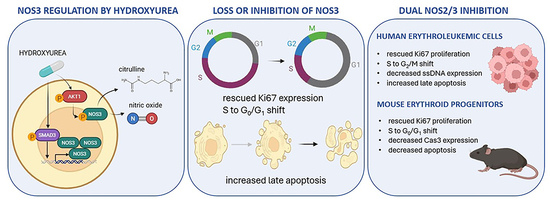
3.2. NOS3 Depletion or Inhibition Shifts Cells from S to G0/G1 Phase and Regulates Apoptosis Under HU Treatment
3.3. NOS3 Deficiency Impairs HU-Induced Protein Nitrosylation and Alters Hematopoietic Lineage Commitment In Vivo
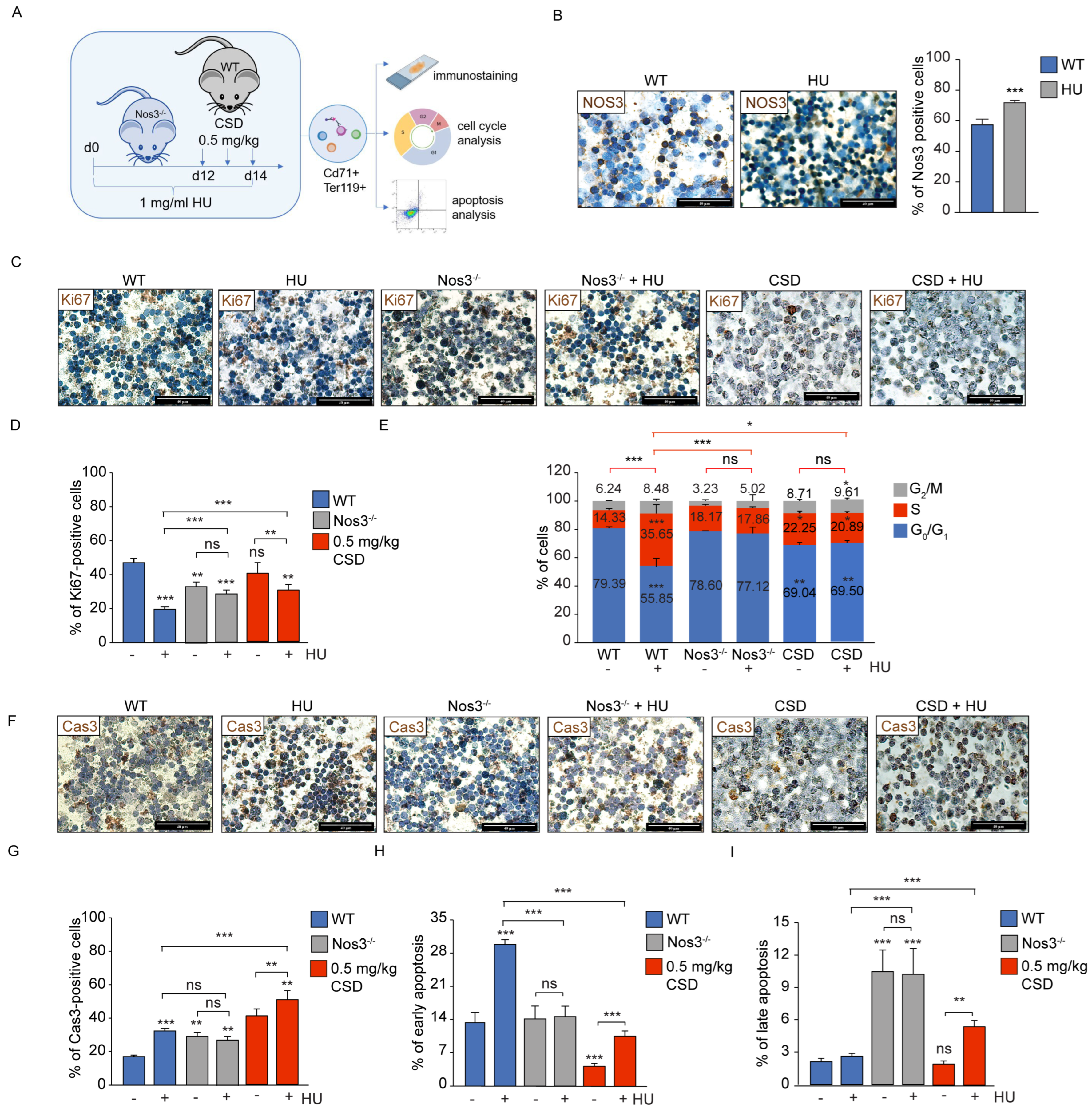
3.4. In Vivo NOS3 Depletion or Inhibition Impairs HU-Mediated S-Phase Arrest and Alters Apoptosis
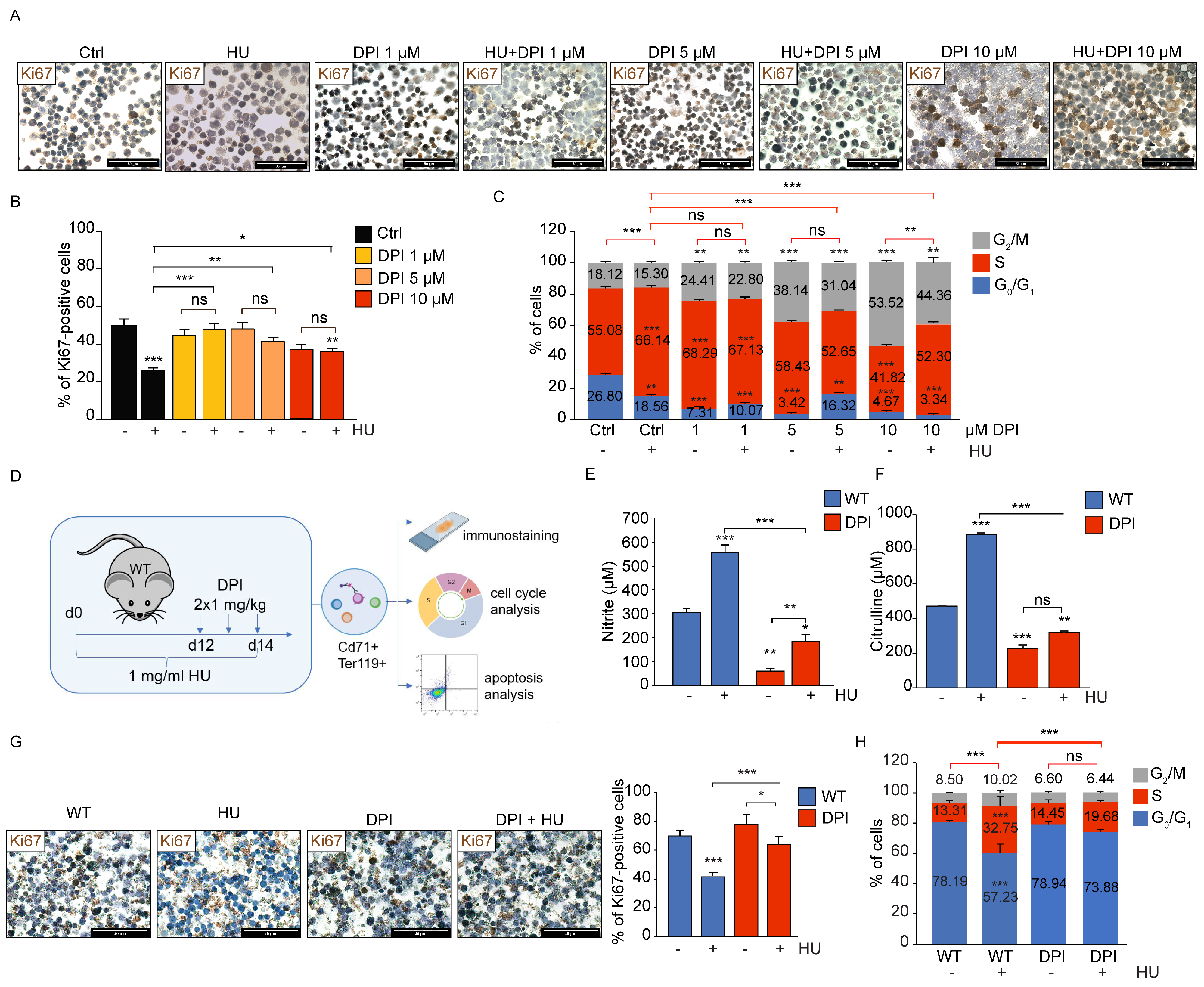
3.5. Dual NOS2/NOS3 Inhibition Impairs HU-Induced Proliferation Block in Erythroid Cells
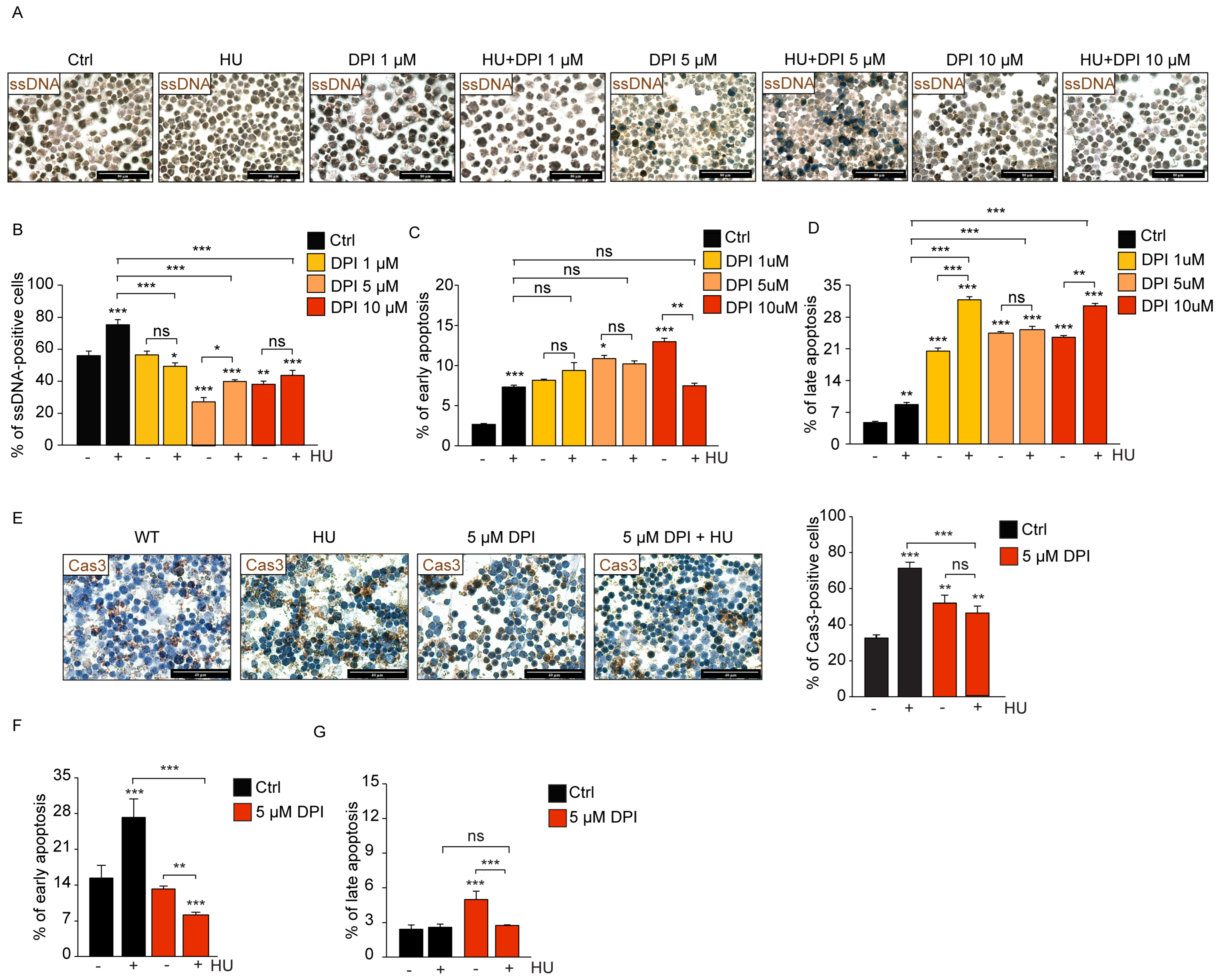
3.6. Dual NOS2/NOS3 Inhibition Impairs HU-Induced Apoptosis of Erythroid Cells in a Context-Dependent Manner
4. Discussion
5. Conclusions
Supplementary Materials
Author Contributions
Funding
Institutional Review Board Statement
Data Availability Statement
Acknowledgments
Conflicts of Interest
Abbreviations
| AKT | RAC-alpha serine/threonine protein kinase |
| BFU-E | Burst-forming unit—erythroid |
| Cas3 | Caspase 3 |
| CD71 | Cluster of Differentiation 71 |
| CFU-E | Colony-forming unit—erythroid |
| CFU-GM | Colony-forming unit—granulocyte/macrophage progenitors |
| CSD | Caveolin-1 scaffolding domain peptide |
| DPI | Diphenyleneiodonium chloride |
| FACS | Fluorescence-activated cell sorting |
| GFP | Green fluorescent protein |
| HU | Hydroxyurea |
| Ki | Inhibition constant |
| Ki67 | Antigen Kiel 67 |
| L-NAME | NG-nitro-L-arginine-methyl ester |
| L-NMMA | N(G)-monomethyl-L-arginine |
| L-NNA | NG-nitro-L-arginine |
| mERPs | Mouse erythroid progenitors |
| NFκB | Nuclear factor kappa-light-chain-enhancer of activated B cells |
| NO | Nitric oxide |
| NOS | Nitric oxide synthase |
| NOS1 | Neuronal NOS |
| NOS2 | Inducible NOS |
| Nos3-/- | Nos3 knockout mice, Nos3 null mice |
| NOS3 | Endothelial NOS |
| NOS3kd | NOS3 knockdown |
| NOx | Nitrite and nitrate |
| NOX | (NADPH oxidase) |
| NOSIP | Nitric oxide-interacting protein |
| PAI | Proliferation to apoptosis index |
| PBS | Phosphate-buffered saline |
| PI | Propidium iodide |
| PKA | cAMP-dependent protein kinase |
| RBCs | Red blood cells |
| ROS | Reactive oxygen species |
| Rg | Radius of gyration |
| RMSD | Root Mean Square Deviation |
| RMSF | Root Mean Square Fluctuation |
| SEM | Standard error of mean |
| shRNA | Short hairpin RNA |
| ssDNA | Single-stranded DNA |
| Ter119 | Surface protein associated with glycophorin-A |
| UPS | Uprosertib |
| WT | Wild type |
| ΔEelec | Energy of electrostatic interactions |
| ΔGbinding | Gibbs free binding energy |
| ΔGnonpolar | Non-electrostatic nonpolar free energy |
References
- Riley, C.; Kraft, W.K.; Miller, R. Hydroxyurea in the Sickle Cell Disease Modern Era. Expert Rev. Clin. Pharmacol. 2024, 17, 777–791. [Google Scholar] [CrossRef]
- Tremblay, D.; Kremyanskaya, M.; Mascarenhas, J.; Hoffman, R. Diagnosis and Treatment of Polycythemia Vera: A Review. JAMA 2025, 333, 153–160. [Google Scholar] [CrossRef]
- Nader, E.; Grau, M.; Fort, R.; Collins, B.; Cannas, G.; Gauthier, A.; Walpurgis, K.; Martin, C.; Bloch, W.; Poutrel, S.; et al. Hydroxyurea Therapy Modulates Sickle Cell Anemia Red Blood Cell Physiology: Impact on Rbc Deformability, Oxidative Stress, Nitrite Levels and Nitric Oxide Synthase Signalling Pathway. Nitric Oxide 2018, 81, 28–35. [Google Scholar] [CrossRef]
- Cella, G.; Marchetti, M.; Vianello, F.; Panova-Noeva, M.; Vignoli, A.; Russo, L.; Barbui, T.; Falanga, A. Nitric Oxide Derivatives and Soluble Plasma Selectins in Patients with Myeloproliferative Neoplasms. Thromb. Haemost. 2010, 104, 151–156. [Google Scholar] [CrossRef] [PubMed]
- Iyamu, E.W.; Cecil, R.; Parkin, L.; Woods, G.; Ohene-Frempong, K.; Asakura, T. Modulation of Erythrocyte Arginase Activity in Sickle Cell Disease Patients During Hydroxyurea Therapy. Br. J. Haematol. 2005, 131, 389–394. [Google Scholar] [CrossRef] [PubMed]
- Nahavandi, M.; Tavakkoli, F.; Millis, R.M.; Q.-Wyche, M.; Habib, M.J.; Tavakoli, N. Effects of Hydroxyurea and L-Arginine on the Production of Nitric Oxide Metabolites in Cultures of Normal and Sickle Erythrocytes. Hematology 2006, 11, 291–294. [Google Scholar] [CrossRef] [PubMed]
- Lou, T.F.; Singh, M.; Mackie, A.; Li, W.; Pace, B.S. Hydroxyurea Generates Nitric Oxide in Human Erythroid Cells: Mechanisms for Gamma-Globin Gene Activation. Exp. Biol. Med. 2009, 234, 1374–1382. [Google Scholar] [CrossRef]
- Taylor, C.M.; Kasztan, M.; Sedaka, R.; Molina, P.A.; Dunaway, L.S.; Pollock, J.S.; Pollock, D.M. Hydroxyurea Improves Nitric Oxide Bioavailability in Humanized Sickle Cell Mice. Am. J. Physiol. Integr. Comp. Physiol. 2021, 320, R630–R640. [Google Scholar] [CrossRef]
- da Guarda, C.C.; Santiago, R.P.; Pitanga, T.N.; Santana, S.S.; Zanette, D.L.; Borges, V.M.; Goncalves, M.S. Heme Changes Hif-A, Enos and Nitrite Production in Huvecs after Simvastatin, Hu, and Ascorbic Acid Therapies. Microvasc. Res. 2016, 106, 128–136. [Google Scholar] [CrossRef]
- Navarra, P.; Tringali, G.; Preziosi, P. The Effects of Inhibitors of Cyclo-Oxygenase, Lipoxygenase and Nitric Oxide Synthase Pathways on the Toxicity of Hydroxyurea in Adrenalectomized Rats. Toxicol. Lett. 1996, 86, 13–18. [Google Scholar] [CrossRef]
- Lockwood, S.Y.; Erkal, J.L.; Spence, D.M. Endothelium-Derived Nitric Oxide Production Is Increased by Atp Released from Red Blood Cells Incubated with Hydroxyurea. Nitric Oxide 2014, 38, 1–7. [Google Scholar] [CrossRef]
- Cokic, V.P.; Beleslin-Cokic, B.B.; Tomic, M.; Stojilkovic, S.S.; Noguchi, C.T.; Schechter, A.N. Hydroxyurea Induces the Enos-Cgmp Pathway in Endothelial Cells. Blood 2006, 108, 184–191. [Google Scholar] [CrossRef]
- Cokic, V.P.; Beleslin-Cokic, B.B.; Noguchi, C.T.; Schechter, A.N. Hydroxyurea Increases Enos Protein Levels through Inhibition of Proteasome Activity. Nitric Oxide 2007, 16, 371–378. [Google Scholar] [CrossRef]
- Raththagala, M.; Karunarathne, W.; Kryziniak, M.; McCracken, J.; Spence, D.M. Hydroxyurea Stimulates the Release of Atp from Rabbit Erythrocytes through an Increase in Calcium and Nitric Oxide Production. Eur. J. Pharmacol. 2010, 645, 32–38. [Google Scholar] [CrossRef][Green Version]
- Subotički, T.; Ajtić, O.M.; Đikić, D.; Santibanez, J.F.; Tošić, M.; Čokić, V.P. Nitric Oxide Synthase Dependency in Hydroxyurea Inhibition of Erythroid Progenitor Growth. Genes 2021, 12, 1145. [Google Scholar] [CrossRef]
- Víteček, J.; Lojek, A.; Valacchi, G.; Kubala, L. Arginine-Based Inhibitors of Nitric Oxide Synthase: Therapeutic Potential and Challenges. Mediat. Inflamm. 2012, 2012, 318087. [Google Scholar] [CrossRef]
- Dragojević, T.; Živković, E.; Diklić, M.; Ajtić, O.M.; Lazarević, M.; Subotički, T.; Đikić, D.; Santibanez, J.F.; Milenković, D.; Marković, J.D.; et al. Hydroxyurea Inhibits Proliferation and Stimulates Apoptosis through Inducible Nitric Oxide Synthase in Erythroid Cells. Biomed. Pharmacother. 2024, 181, 117723. [Google Scholar] [CrossRef]
- Bernatchez, P.; Sharma, A.; Bauer, P.M.; Marin, E.; Sessa, W.C. A Noninhibitory Mutant of the Caveolin-1 Scaffolding Domain Enhances Enos-Derived No Synthesis and Vasodilation in Mice. J. Clin. Investig. 2011, 121, 3747–3755. [Google Scholar] [CrossRef] [PubMed]
- Mendes, A.F.; Carvalho, A.P.; Caramona, M.M.; Lopes, M.C. Diphenyleneiodonium Inhibits Nf-Kappab Activation and Inos Expression Induced by Il-1beta: Involvement of Reactive Oxygen Species. Mediat. Inflamm. 2001, 10, 209–215. [Google Scholar] [CrossRef] [PubMed]
- Li, H.; Jamal, J.; Plaza, C.; Pineda, S.; Chreifi, G.; Jing, Q.; Cinelli, M.A.; Silverman, R.; Poulos, T.L. Structures of Human Constitutive Nitric Oxide Synthases. Acta Crystallogr. Sect. D Struct. Biol. 2014, 70, 2667–2674. [Google Scholar] [CrossRef] [PubMed]
- Morris, G.M.; Huey, R.; Lindstrom, W.; Sanner, M.F.; Belew, R.K.; Goodsell, D.S.; Olson, A.J. Autodock4 and Autodocktools4: Automated Docking with Selective Receptor Flexibility. J. Comput. Chem. 2009, 30, 2785–2791. [Google Scholar] [CrossRef]
- Shesely, E.G.; Maeda, N.; Kim, H.-S.; Desai, K.M.; Krege, J.H.; Laubach, V.E.; Sherman, P.A.; Sessa, W.C.; Smithies, O. Elevated Blood Pressures in Mice Lacking Endothelial Nitric Oxide Synthase. Proc. Natl. Acad. Sci. USA 1996, 93, 13176–13181. [Google Scholar] [CrossRef]
- Morihara, N.; Hino, A.; Miki, S.; Takashima, M.; Suzuki, J. Aged Garlic Extract Suppresses Inflammation in Apolipoprotein E-Knockout Mice. Mol. Nutr. Food Res. 2017, 61, 1700308. [Google Scholar] [CrossRef]
- Valdés-Tresanco, M.S.; Valdés-Tresanco, M.E.; Valiente, P.A.; Moreno, E. Gmx_Mmpbsa: A New Tool to Perform End-State Free Energy Calculations with Gromacs. J. Chem. Theory Comput. 2021, 17, 6281–6291. [Google Scholar] [CrossRef]
- Lee, M.Y.; Luciano, A.K.; Ackah, E.; Rodriguez-Vita, J.; Bancroft, T.A.; Eichmann, A.; Simons, M.; Kyriakides, T.R.; Morales-Ruiz, M.; Sessa, W.C. Endothelial Akt1 Mediates Angiogenesis by Phosphorylating Multiple Angiogenic Substrates. Proc. Natl. Acad. Sci. USA 2014, 111, 12865–12870. [Google Scholar] [CrossRef]
- Miller, I.; Min, M.; Yang, C.; Tian, C.; Gookin, S.; Carter, D.; Spencer, S.L. Ki67 Is a Graded Rather Than a Binary Marker of Proliferation Versus Quiescence. Cell Rep. 2018, 24, 1105–1112.e5. [Google Scholar] [CrossRef]
- Borel, F.; Lacroix, F.B.; Margolis, R.L. Prolonged Arrest of Mammalian Cells at the G1/S Boundary Results in Permanent S Phase Stasis. J. Cell Sci. 2002, 115, 2829–2838. [Google Scholar] [CrossRef]
- Vasilopoulos, S.N.; Tremi, I.; Kotta-Loizou, I.; Gkikoudi, A.; Tsitsilonis, O.E.; Havaki, S.; Georgakilas, A.G. Replication Stress in Cancer: Mechanistic Insights and Therapeutic Opportunities for Radiosensitization. Curr. Issues Mol. Biol. 2026, 48, 67. [Google Scholar] [CrossRef] [PubMed]
- Baliga, B.S.; Haynes, J.; Obiako, B.; Mishra, N. Combined Effects of Arginine and Hydroxyurea on Bfu-E Derived Colony Growth and Hbf Synthesis in Erythroid Progenitors Isolated from Sickle Cell Blood. Cell. Mol. Biol. 2010, 56, 1290–1298. [Google Scholar]
- Ruan, B.; Chen, Y.; Trimidal, S.; Koo, I.; Qian, F.; Cai, J.; Mcguigan, J.; Hall, M.A.; Patterson, A.D.; Prabhu, K.S.; et al. Nitric oxide regulates metabolism in murine stress erythroid progenitors to promote recovery during inflammatory anemia. bioRxiv 2023. [Google Scholar] [CrossRef] [PubMed]
- Lee, J.; Dey, S.; Rajvanshi, P.K.; Merling, R.K.; Teng, R.; Rogers, H.M.; Noguchi, C.T. Neuronal nitric oxide synthase is required for erythropoietin stimulated erythropoiesis in mice. Front. Cell Dev. Biol. 2023, 11, 1144110. [Google Scholar] [CrossRef] [PubMed]
- Sadaf, S.; Singh, A.K.; Awasthi, D.; Nagarkoti, S.; Agrahari, A.K.; Srivastava, R.N.; Jagavelu, K.; Kumar, S.; Barthwal, M.K.; Dikshit, M. Augmentation of iNOS expression in myeloid progenitor cells expedites neutrophil differentiation. J. Leukoc. Biol. 2019, 106, 397–412. [Google Scholar] [CrossRef]
- Sadaf, S.; Nagarkoti, S.; Awasthi, D.; Singh, A.K.; Srivastava, R.N.; Kumar, S.; Barthwal, M.K.; Dikshit, M. nNOS induction and NOSIP interaction impact granulopoiesis and neutrophil differentiation by modulating nitric oxide generation. Biochim. Biophys. Acta (BBA)-Mol. Cell Res. 2021, 1868, 119018. [Google Scholar] [CrossRef]
- Suliman, H.B.; Babiker, A.; Withers, C.M.; Sweeney, T.E.; Carraway, M.S.; Tatro, L.G.; Bartz, R.R.; Welty-Wolf, K.E.; Piantadosi, C.A. Nitric Oxide Synthase-2 Regulates Mitochondrial Hsp60 Chaperone Function During Bacterial Peritonitis in Mice. Free Radic. Biol. Med. 2010, 48, 736–746. [Google Scholar] [CrossRef]
- Kelleher, Z.T.; Matsumoto, A.; Stamler, J.S.; Marshall, H.E. Nos2 Regulation of Nf-Kappab by S-Nitrosylation of P65. J. Biol. Chem. 2007, 282, 30667–30672. [Google Scholar] [CrossRef]
- García-Ortiz, A.; Martín-Cofreces, N.B.; Ibiza, S.; Ortega, Á.; Izquierdo-Álvarez, A.; Trullo, A.; Victor, V.M.; Calvo, E.; Sot, B.; Martínez-Ruiz, A.; et al. Enos S-Nitrosylates Β-Actin on Cys374 and Regulates Pkc-Θ at the Immune Synapse by Impairing Actin Binding to Profilin-1. PLoS Biol. 2017, 15, e2000653. [Google Scholar] [CrossRef]
- Seth, D.; Stomberski, C.T.; McLaughlin, P.J.; Premont, R.T.; Lundberg, K.; Stamler, J.S. Comparison of the Nitric Oxide Synthase Interactomes and S-Nitroso-Proteomes: Furthering the Case for Enzymatic S-Nitrosylation. Antioxid. Redox Signal. 2003, 39, 621–634. [Google Scholar] [CrossRef]
- Weng, P.; Zhang, X.-T.; Sheng, Q.; Tian, W.F.; Chen, J.L.; Yuan, J.J.; Zhang, J.R.; Pang, Q.F. Caveolin-1 Scaffolding Domain Peptides Enhance Anti-Inflammatory Effect of Heme Oxygenase-1 through Interrupting Its Interact with Caveolin-1. Oncotarget 2017, 8, 40104–40114. [Google Scholar] [CrossRef]
- Wu, F.; Tyml, K.; Wilson, J.X. Inos Expression Requires Nadph Oxidase-Dependent Redox Signaling in Microvascular Endothelial Cells. J. Cell. Physiol. 2008, 217, 207–214. [Google Scholar] [CrossRef] [PubMed]
- Garvey, E.P.; Oplinger, J.A.; Furfine, E.S.; Kiff, R.J.; Laszlo, F.; Whittle, B.J.; Knowles, R.G. 1400W is a slow, tight binding, and highly selective inhibitor of inducible nitric-oxide synthase in vitro and in vivo. J. Biol. Chem. 1997, 272, 4959–4963. [Google Scholar] [CrossRef] [PubMed]
- Pigott, B.; Bartus, K.; Garthwaite, J. On the selectivity of neuronal NOS inhibitors. Br. J. Pharmacol. 2013, 168, 1255–1265. [Google Scholar] [CrossRef] [PubMed]
- Palumbo, P.; Lombardi, F.; Augello, F.R.; Giusti, I.; Luzzi, S.; Dolo, V.; Cifone, M.G.; Cinque, B. NOS2 inhibitor 1400W Induces Autophagic Flux and Influences Extracellular Vesicle Profile in Human Glioblastoma U87MG Cell Line. Int. J. Mol. Sci. 2019, 20, 3010. [Google Scholar] [CrossRef]
- Edin, N.J.; Sandvik, J.A.; Vollan, H.S.; Reger, K.; Görlach, A.; Pettersen, E.O. The role of nitric oxide radicals in removal of hyper-radiosensitivity by priming irradiation. J. Radiat. Res. 2013, 54, 1015–1028. [Google Scholar] [CrossRef] [PubMed]
- Dodd-o, J.M.; Zheng, G.; Silverman, H.S.; Lakatta, E.G.; Ziegelstein, R.C. Endothelium-independent relaxation of aortic rings by the nitric oxide synthase inhibitor diphenyleneiodonium. Br. J. Pharmacol. 1997, 120, 857–864. [Google Scholar] [CrossRef] [PubMed]
- Putra, M.; Sharma, S.; Gage, M.; Gasser, G.; Hinojo-Perez, A.; Olson, A.; Gregory-Flores, A.; Puttachary, S.; Wang, C.; Anantharam, V.; et al. Inducible nitric oxide synthase inhibitor, 1400W, mitigates DFP-induced long-term neurotoxicity in the rat model. Neurobiol. Dis. 2020, 133, 104443. [Google Scholar] [CrossRef] [PubMed]
- Sato, Y.; Sagami, I.; Shimizu, T. Identification of caveolin-1-interacting sites in neuronal nitric-oxide synthase. Molecular mechanism for inhibition of NO formation. J. Biol. Chem. 2004, 279, 8827–8836. [Google Scholar] [CrossRef]
- Trane, A.E.; Pavlov, D.; Sharma, A.; Saqib, U.; Lau, K.; van Petegem, F.; Minshall, R.D.; Roman, L.J.; Bernatchez, P.N. Deciphering the binding of caveolin-1 to client protein endothelial nitric-oxide synthase (eNOS): Scaffolding subdomain identification, interaction modeling, and biological significance. J. Biol. Chem. 2014, 289, 13273–13283. [Google Scholar] [CrossRef]
- Stuehr, D.J.; Fasehun, O.A.; Kwon, N.S.; Gross, S.S.; Gonzalez, J.A.; Levi, R.; Nathan, C.F. Inhibition of macrophage and endothelial cell nitric oxide synthase by diphenyleneiodonium and its analogs. FASEB J. 1991, 5, 98–103. [Google Scholar] [CrossRef]
- Nemec, A.; Pavlica, Z.; Petelin, M.; Crossley, D.A.; Šentjurc, M.; Jerin, A.; Eržen, D.; Zdovc, I.; Hitti, T.; Skalerič, U. Systemic use of selective iNOS inhibitor 1400W or non-selective NOS inhibitor l-NAME differently affects systemic nitric oxide formation after oral Porphyromonas gingivalis inoculation in mice. Arch. Oral Biol. 2010, 55, 509–514. [Google Scholar] [CrossRef]


Disclaimer/Publisher’s Note: The statements, opinions and data contained in all publications are solely those of the individual author(s) and contributor(s) and not of MDPI and/or the editor(s). MDPI and/or the editor(s) disclaim responsibility for any injury to people or property resulting from any ideas, methods, instructions or products referred to in the content. |
© 2026 by the authors. Licensee MDPI, Basel, Switzerland. This article is an open access article distributed under the terms and conditions of the Creative Commons Attribution (CC BY) license.
Share and Cite
Dragojević, T.; Đikić, D.; Mojsilović, S.; Lazarević, M.; Milenković, D.; Ajtić, O.M.; Živković, E.; Diklić, M.; Subotički, T.; Santibanez, J.F.; et al. Endothelial Nitric Oxide Synthase-Dependent Mechanism of Hydroxyurea-Induced S-Phase Arrest in Erythroid Cells. Antioxidants 2026, 15, 435. https://doi.org/10.3390/antiox15040435
Dragojević T, Đikić D, Mojsilović S, Lazarević M, Milenković D, Ajtić OM, Živković E, Diklić M, Subotički T, Santibanez JF, et al. Endothelial Nitric Oxide Synthase-Dependent Mechanism of Hydroxyurea-Induced S-Phase Arrest in Erythroid Cells. Antioxidants. 2026; 15(4):435. https://doi.org/10.3390/antiox15040435
Chicago/Turabian StyleDragojević, Teodora, Dragoslava Đikić, Slavko Mojsilović, Miloš Lazarević, Dejan Milenković, Olivera Mitrović Ajtić, Emilija Živković, Miloš Diklić, Tijana Subotički, Juan F. Santibanez, and et al. 2026. "Endothelial Nitric Oxide Synthase-Dependent Mechanism of Hydroxyurea-Induced S-Phase Arrest in Erythroid Cells" Antioxidants 15, no. 4: 435. https://doi.org/10.3390/antiox15040435
APA StyleDragojević, T., Đikić, D., Mojsilović, S., Lazarević, M., Milenković, D., Ajtić, O. M., Živković, E., Diklić, M., Subotički, T., Santibanez, J. F., Čokić, V. P., & Vukotić, M. (2026). Endothelial Nitric Oxide Synthase-Dependent Mechanism of Hydroxyurea-Induced S-Phase Arrest in Erythroid Cells. Antioxidants, 15(4), 435. https://doi.org/10.3390/antiox15040435