Copper Dyshomeostasis, Redox Buffering and Immune Aging Converge on Cuproptosis in Age-Related Diseases

Abstract
1. Introduction
2. Physiological Functions, Mechanism of Cuproptosis and Its Regulation in Aging
2.1. Physiological Functions and Homeostasis Regulation of Copper
2.2. Discovery and Distinction of Cuproptosis
2.3. Core Molecular Mechanisms and Regulation
2.4. Regulation and Alterations of Cuproptosis During Aging
3. Age-Related Immune Changes
3.1. Immunosenescence
3.1.1. The Concept and Main Characteristics of Immunosenescence
3.1.2. Molecular and Cellular Underpinnings
3.2. Inflammaging
3.2.1. Concept and Drivers
3.2.2. Molecular Mechanisms of Inflammaging and the Associated Tissue and Cellular Damage
3.3. System-Level Consequences and Disease Susceptibility
4. Organ-Specific Pathological Manifestations of Cuproptosis in Aging
4.1. Neurodegenerative Diseases
4.2. Cardiovascular Diseases
4.3. Metabolic Diseases
4.4. Age-Related Musculoskeletal Disorders
4.5. Inherited Disorders of Copper Handling
4.6. Geriatric Oncology
5. Therapeutic Strategies Targeting Cuproptosis in Age-Related Diseases
6. Future Perspectives and Challenges
7. Conclusions
Author Contributions
Funding
Institutional Review Board Statement
Informed Consent Statement
Data Availability Statement
Acknowledgments
Conflicts of Interest
Abbreviations
| AD | Alzheimer’s disease |
| ALS | amyotrophic lateral sclerosis |
| CcO | cytochrome c oxidase |
| CTR1 | copper transporter 1 |
| DAMPs | damage-associated molecular patterns |
| Fe-S | iron–sulfur |
| GPX4 | glutathione peroxidase 4 |
| GSH | glutathione |
| HD | Huntington’s disease |
| IL-6 | interleukin-6 |
| MAPK | mitogen-activated protein kinase |
| mTOR | mechanistic target of rapamycin |
| NF-κB | nuclear factor kappa B |
| NLRP3 | NLR family pyrin domain containing 3 |
| Nrf2 | nuclear factor erythroid 2-related factor 2 |
| OXPHOS | oxidative phosphorylation |
| PD | Parkinson’s disease |
| PD-1 | programmed cell death protein 1 |
| PD-L1 | programmed death-ligand 1 |
| RCD | regulated cell death |
| ROS | reactive oxygen species |
| SASP | senescence-associated secretory phenotype |
| TCA | tricarboxylic acid |
| TCR | T cell receptor |
| TLR4 | Toll-like receptor 4 |
| TNF-α | tumor necrosis factor-α |
| TTM | tetrathiomolybdate |
References
- Nguyen, T.Q.T.; Cho, K.A. Targeting immunosenescence and inflammaging: Advancing longevity research. Exp. Mol. Med. 2025, 57, 1881–1892. [Google Scholar] [CrossRef]
- Jin, J.; Xu, Q.; Zhang, X.; Zhu, A.; Xia, W.; Moog, C.; Chan, A.S.W.; Zhang, T.; Su, B. HIV infection and immunosenescence: Challenges and intervention strategies. BMC Med. 2025, 24, 8. [Google Scholar] [CrossRef]
- Li, X.; Li, C.; Zhang, W.; Wang, Y.; Qian, P.; Huang, H. Inflammation and aging: Signaling pathways and intervention therapies. Signal Transduct. Target. Ther. 2023, 8, 239. [Google Scholar] [CrossRef]
- Shan, D.; Song, J.; Ren, Y.; Zhang, Y.; Ba, Y.; Luo, P.; Cheng, Q.; Xu, H.; Weng, S.; Zuo, A.; et al. Copper in cancer: Friend or foe? Metabolism, dysregulation, and therapeutic opportunities. Cancer Commun. 2025, 45, 577–607. [Google Scholar] [CrossRef]
- Li, P.; Li, Y.; Meng, Q.; Wang, J.; Wang, K.; Yang, S. Copper dyshomeostasis and cardiovascular disease: Molecular mechanisms and new strategies for targeted intervention with cuproptosis (Review). Int. J. Mol. Med. 2026, 57, 19. [Google Scholar] [CrossRef] [PubMed]
- Chen, L.; Wu, Q.; Lin, C.; Song, Z.; Su, Y.; Ge, C.; Wang, X.; Luo, H.; Wang, R.; Wang, Y.; et al. Integrative analysis of copper dysregulation and cuproptosis in postnatal hematopoiesis. Sci. Bull. 2025, 70, 2658–2675. [Google Scholar] [CrossRef]
- Lu, K.; Wijaya, C.S.; Yao, Q.; Jin, H.; Feng, L. Cuproplasia and cuproptosis, two sides of the coin. Cancer Commun. 2025, 45, 505–524. [Google Scholar] [CrossRef]
- Tsui, K.H.; Hsiao, J.H.; Lin, L.T.; Tsang, Y.L.; Shao, A.N.; Kuo, C.H.; Chang, R.; Wen, Z.H.; Li, C.J. The Cross-Communication of Cuproptosis and Regulated Cell Death in Human Pathophysiology. Int. J. Biol. Sci. 2024, 20, 218–230. [Google Scholar] [CrossRef] [PubMed]
- Chen, X.; Li, K.; Xiao, Y.; Wu, W.; Lin, H.; Qing, X.; Tian, S.; Liu, S.; Feng, S.; Wang, B.; et al. SP1/CTR1-mediated oxidative stress-induced cuproptosis in intervertebral disc degeneration. Biofactors 2024, 50, 1009–1023. [Google Scholar] [CrossRef]
- Zhang, C.; Huang, T.; Li, L. Targeting cuproptosis for cancer therapy: Mechanistic insights and clinical perspectives. J. Hematol. Oncol. 2024, 17, 68. [Google Scholar] [CrossRef] [PubMed]
- Cong, Y.; Li, N.; Zhang, Z.; Shang, Y.; Zhao, H. Cuproptosis: Molecular mechanisms, cancer prognosis, and therapeutic applications. J. Transl. Med. 2025, 23, 104. [Google Scholar] [CrossRef] [PubMed]
- Xie, J.; Yang, Y.; Gao, Y.; He, J. Cuproptosis: Mechanisms and links with cancers. Mol. Cancer 2023, 22, 46. [Google Scholar] [CrossRef]
- Chen, L.; Min, J.; Wang, F. Copper homeostasis and cuproptosis in health and disease. Signal Transduct. Target. Ther. 2022, 7, 378. [Google Scholar] [CrossRef]
- Luo, C.; Wu, X.; Zhang, S.; Tan, J.; Huo, Y.; Zhang, X.; Ning, B.; Ye, Y.; Wang, F. Cuproptosis: A novel therapeutic mechanism in lung cancer. Cancer Cell Int. 2025, 25, 231. [Google Scholar] [CrossRef]
- Liu, Y.; Fleishman, J.S.; Wang, H.; Huo, L. Pharmacologically Targeting Ferroptosis and Cuproptosis in Neuroblastoma. Mol. Neurobiol. 2025, 62, 3863–3876. [Google Scholar] [CrossRef]
- Lin, Y.; Yuan, M.; Wang, G. Copper homeostasis and cuproptosis in gynecological disorders: Pathogenic insights and therapeutic implications. J. Trace Elem. Med. Biol. 2024, 84, 127436. [Google Scholar] [CrossRef] [PubMed]
- Yang, Q.; Liu, X.; Tang, H.; Chen, Y.; Bai, L. Emerging roles of cuproptosis in liver diseases. Dig. Liver Dis. 2025, 57, 1541–1549. [Google Scholar] [CrossRef]
- Luo, J.; Zhang, X.; Bharati, L.; Hua, Z.; Chen, S.; Dong, Z. Cuproptosis involvement in neonatal ischemic-hypoxic encephalopathy through the COMMD1/ATP7A signaling axis. Biochem. Pharmacol. 2025, 239, 117054. [Google Scholar] [CrossRef]
- Park, W.; Wei, S.; Kim, B.S.; Kim, B.; Bae, S.J.; Chae, Y.C.; Ryu, D.; Ha, K.T. Diversity and complexity of cell death: A historical review. Exp. Mol. Med. 2023, 55, 1573–1594. [Google Scholar] [CrossRef] [PubMed]
- Lutsenko, S.; Roy, S.; Tsvetkov, P. Mammalian copper homeostasis: Physiological roles and molecular mechanisms. Physiol. Rev. 2025, 105, 441–491. [Google Scholar] [CrossRef]
- Fan, H.; Wang, K.; Zhao, X.; Song, B.; Yao, T.; Liu, T.; Gao, G.; Lu, W.; Liu, C. Emerging insights into cuproptosis and copper metabolism: Implications for age-related diseases and potential therapeutic strategies. Front. Aging Neurosci. 2024, 16, 1335122. [Google Scholar] [CrossRef]
- Chen, Z.; Li, Y.Y.; Liu, X. Copper homeostasis and copper-induced cell death: Novel targeting for intervention in the pathogenesis of vascular aging. Biomed. Pharmacother. 2023, 169, 115839. [Google Scholar] [CrossRef]
- Guan, M.; Yu, Q.; Zhou, G.; Wang, Y.; Yu, J.; Yang, W.; Li, Z. Mechanisms of chondrocyte cell death in osteoarthritis: Implications for disease progression and treatment. J. Orthop. Surg. Res. 2024, 19, 550. [Google Scholar] [CrossRef]
- Li, Z.; Wang, L.; Wu, X.; Huang, R.; Yuan, Y. Crosstalk Between Ferroptosis and Cuproptosis in Intervertebral Disc Degeneration: Mechanisms, Therapeutic Targets, and Future Directions. JOR Spine 2025, 8, e70080. [Google Scholar] [CrossRef]
- Guo, D.; Liu, Z.; Zhou, J.; Ke, C.; Li, D. Significance of Programmed Cell Death Pathways in Neurodegenerative Diseases. Int. J. Mol. Sci. 2024, 25, 9947. [Google Scholar] [CrossRef] [PubMed]
- Huang, J.; Zhang, J.; Wang, F.; Zhang, B.; Tang, X. Comprehensive analysis of cuproptosis-related genes in immune infiltration and diagnosis in ulcerative colitis. Front. Immunol. 2022, 13, 1008146. [Google Scholar] [CrossRef]
- Ouyang, G.; Wu, Z.; Liu, Z.; Pan, G.; Wang, Y.; Liu, J.; Guo, J.; Liu, T.; Huang, G.; Zeng, Y.; et al. Identification and validation of potential diagnostic signature and immune cell infiltration for NAFLD based on cuproptosis-related genes by bioinformatics analysis and machine learning. Front. Immunol. 2023, 14, 1251750. [Google Scholar] [CrossRef] [PubMed]
- Yan, C.; Niu, Y.; Ma, L.; Tian, L.; Ma, J. System analysis based on the cuproptosis-related genes identifies LIPT1 as a novel therapy target for liver hepatocellular carcinoma. J. Transl. Med. 2022, 20, 452. [Google Scholar] [CrossRef] [PubMed]
- Liu, D.; Qin, H.; Gao, Y.; Sun, M.; Wang, M. Cardiovascular disease: Mitochondrial dynamics and mitophagy crosstalk mechanisms with novel programmed cell death and macrophage polarisation. Pharmacol. Res. 2024, 206, 107258. [Google Scholar] [CrossRef]
- Fulop, T.; Larbi, A.; Hirokawa, K.; Cohen, A.A.; Witkowski, J.M. Immunosenescence is both functional/adaptive and dysfunctional/maladaptive. Semin. Immunopathol. 2020, 42, 521–536. [Google Scholar] [CrossRef]
- Santoro, A.; Bientinesi, E.; Monti, D. Immunosenescence and inflammaging in the aging process: Age-related diseases or longevity? Ageing Res. Rev. 2021, 71, 101422. [Google Scholar] [CrossRef]
- Liu, Z.; Liang, Q.; Ren, Y.; Guo, C.; Ge, X.; Wang, L.; Cheng, Q.; Luo, P.; Zhang, Y.; Han, X. Immunosenescence: Molecular mechanisms and diseases. Signal Transduct. Target. Ther. 2023, 8, 200. [Google Scholar] [CrossRef] [PubMed]
- Frasca, D.; Diaz, A.; Romero, M.; Garcia, D.; Blomberg, B.B. B Cell Immunosenescence. Annu. Rev. Cell Dev. Biol. 2020, 36, 551–574. [Google Scholar] [CrossRef] [PubMed]
- Lian, J.; Yue, Y.; Yu, W.; Zhang, Y. Immunosenescence: A key player in cancer development. J. Hematol. Oncol. 2020, 13, 151. [Google Scholar] [CrossRef]
- Wang, Y.; Dong, C.; Han, Y.; Gu, Z.; Sun, C. Immunosenescence, aging and successful aging. Front. Immunol. 2022, 13, 942796. [Google Scholar] [CrossRef] [PubMed]
- Ajoolabady, A.; Pratico, D.; Tang, D.; Zhou, S.; Franceschi, C.; Ren, J. Immunosenescence and inflammaging: Mechanisms and role in diseases. Ageing Res. Rev. 2024, 101, 102540. [Google Scholar] [CrossRef]
- Barbé-Tuana, F.; Funchal, G.; Schmitz, C.R.R.; Maurmann, R.M.; Bauer, M.E. The interplay between immunosenescence and age-related diseases. Semin. Immunopathol. 2020, 42, 545–557. [Google Scholar] [CrossRef]
- Antuña, E.; Cachán-Vega, C.; Bermejo-Millo, J.C.; Potes, Y.; Caballero, B.; Vega-Naredo, I.; Coto-Montes, A.; Garcia-Gonzalez, C. Inflammaging: Implications in Sarcopenia. Int. J. Mol. Sci. 2022, 23, 15039. [Google Scholar] [CrossRef]
- Pająk, J.; Nowicka, D.; Szepietowski, J.C. Inflammaging and Immunosenescence as Part of Skin Aging—A Narrative Review. Int. J. Mol. Sci. 2023, 24, 7784. [Google Scholar] [CrossRef]
- Di Giosia, P.; Stamerra, C.A.; Giorgini, P.; Jamialahamdi, T.; Butler, A.E.; Sahebkar, A. The role of nutrition in inflammaging. Ageing Res. Rev. 2022, 77, 101596. [Google Scholar] [CrossRef]
- Dugan, B.; Conway, J.; Duggal, N.A. Inflammaging as a target for healthy ageing. Age Ageing 2023, 52, afac328. [Google Scholar] [CrossRef]
- Baban, B.; Khodadadi, H.; Salles, É.L.; Costigliola, V.; Morgan, J.C.; Hess, D.C.; Vaibhav, K.; Dhandapani, K.M.; Yu, J.C. Inflammaging and Cannabinoids. Ageing Res. Rev. 2021, 72, 101487. [Google Scholar] [CrossRef]
- Poon, I.K.H.; Ravichandran, K.S. Targeting Efferocytosis in Inflammaging. Annu. Rev. Pharmacol. Toxicol. 2024, 64, 339–357. [Google Scholar] [CrossRef]
- Santoro, A.; Martucci, M.; Conte, M.; Capri, M.; Franceschi, C.; Salvioli, S. Inflammaging, hormesis and the rationale for anti-aging strategies. Ageing Res. Rev. 2020, 64, 101142. [Google Scholar] [CrossRef]
- Rodrigues, L.P.; Teixeira, V.R.; Alencar-Silva, T.; Simonassi-Paiva, B.; Pereira, R.W.; Pogue, R.; Carvalho, J.L. Hallmarks of aging and immunosenescence: Connecting the dots. Cytokine Growth Factor Rev. 2021, 59, 9–21. [Google Scholar] [CrossRef]
- Saint-Criq, V.; Lugo-Villarino, G.; Thomas, M. Dysbiosis, malnutrition and enhanced gut-lung axis contribute to age-related respiratory diseases. Ageing Res. Rev. 2021, 66, 101235. [Google Scholar] [CrossRef]
- Borgoni, S.; Kudryashova, K.S.; Burka, K.; de Magalhães, J.P. Targeting immune dysfunction in aging. Ageing Res. Rev. 2021, 70, 101410. [Google Scholar] [CrossRef] [PubMed]
- Calder, P.C.; Ortega, E.F.; Meydani, S.N.; Adkins, Y.; Stephensen, C.B.; Thompson, B.; Zwickey, H. Nutrition, Immunosenescence, and Infectious Disease: An Overview of the Scientific Evidence on Micronutrients and on Modulation of the Gut Microbiota. Adv. Nutr. 2022, 13, S1–S26. [Google Scholar] [CrossRef] [PubMed]
- Solier, S.; Müller, S.; Cañeque, T.; Versini, A.; Mansart, A.; Sindikubwabo, F.; Baron, L.; Emam, L.; Gestraud, P.; Pantoș, G.D.; et al. A druggable copper-signalling pathway that drives inflammation. Nature 2023, 617, 386–394. [Google Scholar] [CrossRef]
- Lu, J.; Liu, X.; Li, X.; Li, H.; Shi, L.; Xia, X.; He, B.L.; Meyer, T.F.; Li, X.; Sun, H.; et al. Copper regulates the host innate immune response against bacterial infection via activation of ALPK1 kinase. Proc. Natl. Acad. Sci. USA 2024, 121, e2311630121. [Google Scholar] [CrossRef] [PubMed]
- Zhang, L.; Tsai, I.C.; Ni, Z.; Chen, B.; Zhang, S.; Cai, L.; Xu, Q. Copper Chelation Therapy Attenuates Periodontitis Inflammation through the Cuproptosis/Autophagy/Lysosome Axis. Int. J. Mol. Sci. 2024, 25, 5890. [Google Scholar] [CrossRef]
- Peng, G.; Huang, Y.; Xie, G.; Tang, J. Exploring Copper’s role in stroke: Progress and treatment approaches. Front. Pharmacol. 2024, 15, 1409317. [Google Scholar] [CrossRef]
- Moos, W.H.; Faller, D.V.; Glavas, I.P.; Kanara, I.; Kodukula, K.; Pernokas, J.; Pernokas, M.; Pinkert, C.A.; Powers, W.R.; Sampani, K.; et al. Epilepsy: Mitochondrial connections to the ‘Sacred’ disease. Mitochondrion 2023, 72, 84–101. [Google Scholar] [CrossRef] [PubMed]
- Chen, L.L.; Fan, Y.G.; Zhao, L.X.; Zhang, Q.; Wang, Z.Y. The metal ion hypothesis of Alzheimer’s disease and the anti-neuroinflammatory effect of metal chelators. Bioorganic Chem. 2023, 131, 106301. [Google Scholar] [CrossRef]
- Li, Y.; Han, Y.; Shu, Q.; Kan, Y.K.; Wang, Z. Cuproptosis and copper as potential mechanisms and intervention targets in Alzheimer’s disease. Biomed. Pharmacother. 2025, 183, 117814. [Google Scholar] [CrossRef] [PubMed]
- Huang, M.; Zhang, Y.; Liu, X. The mechanism of cuproptosis in Parkinson’s disease. Ageing Res. Rev. 2024, 95, 102214. [Google Scholar] [CrossRef]
- Yang, Y.; Wu, J.; Wang, L.; Ji, G.; Dang, Y. Copper homeostasis and cuproptosis in health and disease. MedComm 2024, 5, e724. [Google Scholar] [CrossRef]
- Wang, S.; Qin, M.; Fan, X.; Jiang, C.; Hou, Q.; Ye, Z.; Zhang, X.; Yang, Y.; Xiao, J.; Wallace, K.; et al. The role of metal ions in stroke: Current evidence and future perspectives. Ageing Res. Rev. 2024, 101, 102498. [Google Scholar] [CrossRef]
- Yang, L.; Yang, P.; Lip, G.Y.H.; Ren, J. Copper homeostasis and cuproptosis in cardiovascular disease therapeutics. Trends Pharmacol. Sci. 2023, 44, 573–585. [Google Scholar] [CrossRef]
- Yang, M.; Wang, Y.; He, L.; Shi, X.; Huang, S. Comprehensive bioinformatics analysis reveals the role of cupropto-sis-related gene Ube2d3 in myocardial infarction. Front. Immunol. 2024, 15, 1353111. [Google Scholar] [CrossRef]
- Yang, Y.; Feng, Q.; Luan, Y.; Liu, H.; Jiao, Y.; Hao, H.; Yu, B.; Luan, Y.; Ren, K. Exploring cuproptosis as a mechanism and potential intervention target in cardiovascular diseases. Front. Pharmacol. 2023, 14, 1229297. [Google Scholar] [CrossRef]
- Huo, S.; Wang, Q.; Shi, W.; Peng, L.; Jiang, Y.; Zhu, M.; Guo, J.; Peng, D.; Wang, M.; Men, L.; et al. ATF3/SPI1/SLC31A1 Signaling Promotes Cuproptosis Induced by Advanced Glycosylation End Products in Diabetic Myocardial Injury. Int. J. Mol. Sci. 2023, 24, 1667. [Google Scholar] [CrossRef]
- Chen, N.; Guo, L.; Wang, L.; Dai, S.; Zhu, X.; Wang, E. Sleep fragmentation exacerbates myocardial ischemia‒reperfusion injury by promoting copper overload in cardiomyocytes. Nat. Commun. 2024, 15, 3834. [Google Scholar] [CrossRef]
- Chen, X.; Cai, Q.; Liang, R.; Zhang, D.; Liu, X.; Zhang, M.; Xiong, Y.; Xu, M.; Liu, Q.; Li, P.; et al. Copper homeostasis and copper-induced cell death in the pathogenesis of cardiovascular disease and therapeutic strategies. Cell Death Dis. 2023, 14, 105. [Google Scholar] [CrossRef]
- Wang, D.; Tian, Z.; Zhang, P.; Zhen, L.; Meng, Q.; Sun, B.; Xu, X.; Jia, T.; Li, S. The molecular mechanisms of cupropto-sis and its relevance to cardiovascular disease. Biomed. Pharmacother. 2023, 163, 114830. [Google Scholar] [CrossRef]
- Liu, Y.; Gengxiao, Y.; Wu, Y.; Li, Y.; Hu, X.; Bie, J. Comprehensive analysis of cuproptosis and m6A-Target gene signatures for diagnostic significance and immune microenvironment characterization in polycystic ovary syndrome. Sci. Rep. 2025, 15, 19996. [Google Scholar] [CrossRef] [PubMed]
- Pham, V.N.; Chang, C.J. Metalloallostery and Transition Metal Signaling: Bioinorganic Copper Chemistry Beyond Active Sites. Angew. Chem. Int. Ed. Engl. 2023, 62, e202213644. [Google Scholar] [CrossRef] [PubMed]
- Chen, T.H.; Lin, S.H.; Lee, M.Y.; Wang, H.C.; Tsai, K.F.; Chou, C.K. Mitochondrial alterations and signatures in hepatocellular carcinoma. Cancer Metastasis Rev. 2025, 44, 34. [Google Scholar] [CrossRef]
- Li, C.; Gong, H.; Shi, P.; Liu, S.; Zhang, Q. Different Forms of Regulated Cell Death in Type-2-Diabetes-Mellitus-Related Osteoporosis: A Focus on Mechanisms and Therapeutic Strategies. Int. J. Mol. Sci. 2025, 26, 4417. [Google Scholar] [CrossRef]
- Qu, J.; Wang, Y.; Wang, Q. Cuproptosis: Potential new direction in diabetes research and treatment. Front. Endocrinol. 2024, 15, 1344729. [Google Scholar] [CrossRef]
- Hu, J.; Li, Q.; Jiang, S.; Deng, Y.; Yang, L.; Du, M.; He, S.; Xu, F.; Yan, C.; Gao, W.; et al. Peripheral mitochondrial transplantation alleviates diabetes-associated cognitive dysfunction by suppressing cuproptosis. Brain Res. Bull. 2025, 222, 111245. [Google Scholar] [CrossRef]
- Li, Y.; Qi, P.; Song, S.Y.; Wang, Y.; Wang, H.; Cao, P.; Liu, Y.; Wang, Y. Elucidating cuproptosis in metabolic dys-function-associated steatotic liver disease. Biomed. Pharmacother. 2024, 174, 116585. [Google Scholar] [CrossRef]
- Su, Z.; Su, W.; Li, C.; Ding, P.; Wang, Y. Identification and immune features of cuproptosis-related molecular clusters in polycystic ovary syndrome. Sci. Rep. 2023, 13, 980. [Google Scholar] [CrossRef]
- Luo, Y.; Liu, L.; Zhang, C. Identification and analysis of diverse cell death patterns in diabetic kidney disease using microarray-based transcriptome profiling and single-nucleus RNA sequencing. Comput. Biol. Med. 2024, 169, 107780. [Google Scholar] [CrossRef]
- Nong, J.; Lu, G.; Huang, Y.; Liu, J.; Chen, L.; Pan, H.; Xiong, B. Identification of cuproptosis-related subtypes, characterization of immune microenvironment infiltration, and development of a prognosis model for osteoarthritis. Front. Immunol. 2023, 14, 1178794. [Google Scholar] [CrossRef] [PubMed]
- Jiang, Z.; Li, J.; Shi, M.; Li, Y.; Sun, N.; Xi, K.; Li, X.; Zhao, D.; Leng, X.; Zhou, Z.; et al. Hypoxia, cuproptosis, and osteoarthritis: Unraveling the molecular crosstalk. Redox Biol. 2025, 85, 103757. [Google Scholar] [CrossRef] [PubMed]
- Li, B.; Jiang, T.; Wang, J.; Ge, H.; Zhang, Y.; Li, T.; Wang, C.; Wang, W. Cuprorivaite microspheres inhibit cuproptosis and oxidative stress in osteoarthritis via Wnt/β-catenin pathway. Mater. Today Bio 2024, 29, 101300. [Google Scholar] [CrossRef]
- Sun, Y.; Chen, P.; Zhao, B. Role of extracellular vesicles associated with microRNAs and their interplay with cuproptosis in osteoporosis. Noncoding RNA Res. 2024, 9, 715–719. [Google Scholar] [CrossRef]
- Xiang, Z.; Mei, H.; Wang, H.; Yao, X.; Rao, J.; Zhang, W.; Xu, A.; Lu, L. Cuproptosis and Its Potential Role in Musculoskeletal Disease. Front. Cell Dev. Biol. 2025, 13, 1570131. [Google Scholar] [CrossRef]
- Hao, D.; Luo, W.; Yan, Y.; Zhou, J. Focus on cuproptosis: Exploring new mechanisms and therapeutic application prospects of cuproptosis regulation. Biomed. Pharmacother. 2024, 178, 117182. [Google Scholar] [CrossRef] [PubMed]
- Petruzzelli, R.; Polishchuk, E.; Polishchuk, R. Copper in Human Health and Disease: Insights from Inherited Disorders. Physiology 2025. [Google Scholar] [CrossRef]
- Teschke, R.; Eickhoff, A. Wilson Disease: Copper-Mediated Cuproptosis, Iron-Related Ferroptosis, and Clinical High-lights, with Comprehensive and Critical Analysis Update. Int. J. Mol. Sci. 2024, 25, 4753. [Google Scholar] [CrossRef]
- Zhou, S.; Liu, J.; Wan, A.; Zhang, Y.; Qi, X. Epigenetic regulation of diverse cell death modalities in cancer: A focus on pyroptosis, ferroptosis, cuproptosis, and disulfidptosis. J. Hematol. Oncol. 2024, 17, 22. [Google Scholar] [CrossRef]
- Li, L.; Zhou, H.; Zhang, C. Cuproptosis in cancer: Biological implications and therapeutic opportunities. Cell. Mol. Biol. Lett. 2024, 29, 91. [Google Scholar] [CrossRef]
- Feng, Y.; Yang, Z.; Wang, J.; Zhao, H. Cuproptosis: Unveiling a new frontier in cancer biology and therapeutics. Cell Commun. Signal. 2024, 22, 249. [Google Scholar] [CrossRef] [PubMed]
- Shabaneh, S.; Berry, E.M.; Imam, A.; Suki, M.; Salhab, A.; Khalaileh, A.; Safadi, R. Hepatic Copper Accumulation Predicts Fibrosis Progression and Mortality in Patients with Metabolic Dysfunction-Associated Steatotic Liver Disease (MASLD). Nutrients 2025, 17, 2923. [Google Scholar] [CrossRef] [PubMed]
- Muñoz-Bravo, C.; Soler-Iborte, E.; Lozano-Lorca, M.; Kouiti, M.; González-Palacios Torres, C.; Barrios-Rodríguez, R.; Jiménez-Moleón, J.J. Serum Copper Levels and Risk of Major Adverse Cardiovascular Events: A Systematic Review and Meta-Analysis. Front. Cardiovasc. Med. 2023, 10, 1217748. [Google Scholar] [CrossRef]
- Shetty, S.; Suvarna, R.; Awasthi, A.; Bhojaraja, M.V.; Pappachan, J.M. Emerging Biomarkers and Innovative Therapeutic Strategies in Diabetic Kidney Disease: A Pathway to Precision Medicine. Diagnostics 2025, 15, 973. [Google Scholar] [CrossRef]
- Johnson, E.C.B.; Carter, E.K.; Dammer, E.B.; Duong, D.M.; Gerasimov, E.S.; Liu, Y.; Liu, J.; Betarbet, R.; Ping, L.; Yin, L.; et al. Large-Scale Deep Multi-Layer Analysis of Alzheimer’s Disease Brain Reveals Strong Proteomic Disease-Related Changes Not Observed at the RNA Level. Nat. Neurosci. 2022, 25, 213–225. [Google Scholar] [CrossRef] [PubMed]
- Wu, Z.; Li, S. Research Progress of Copper in Diabetes and Diabetic Kidney Disease: A Narrative Review. Front. Endocrinol. 2025, 16, 1584084. [Google Scholar] [CrossRef]
- Jiang, Q.; Zhang, F.; Han, L.; Zhu, B.; Liu, X. Serum Copper Level and Polycystic Ovarian Syndrome: A Meta-Analysis. Gynecol. Obstet. Investig. 2021, 86, 239–246. [Google Scholar] [CrossRef]
- Shi, H.; Wang, H.; Yu, M.; Su, J.; Zhao, Z.; Gao, T.; Zhang, Q.; Wei, Y. Serum Trace Elements and Osteoarthritis: A Meta-Analysis and Mendelian Randomization Study. J. Trace Elem. Med. Biol. 2024, 86, 127520. [Google Scholar] [CrossRef]
- Yuan, M.; Shi, L.; Liu, Y.; Xiang, K.; Zhang, Y.; Zhou, Y.; Wang, J.; Ji, M.; Hou, P. Disulfiram/copper triggers cGAS-STING innate immunity pathway via ROS-induced DNA damage that potentiates antitumor response to PD-1 checkpoint blockade. Int. J. Biol. Sci. 2025, 21, 1730–1748. [Google Scholar] [CrossRef] [PubMed]
- Zhao, R.; Sukocheva, O.; Tse, E.; Neganova, M.; Aleksandrova, Y.; Zheng, Y.; Gu, H.; Zhao, D.; Madhunapantula, S.V.; Zhu, X.; et al. Cuproptosis, the novel type of oxidation-induced cell death in thoracic cancers: Can it enhance the success of immunotherapy? Cell Commun. Signal. 2024, 22, 379. [Google Scholar] [CrossRef] [PubMed]
- Budimir, N.; Thomas, G.D.; Dolina, J.S.; Salek-Ardakani, S. Reversing T-cell Exhaustion in Cancer: Lessons Learned from PD-1/PD-L1 Immune Checkpoint Blockade. Cancer Immunol. Res. 2022, 10, 146–153. [Google Scholar] [CrossRef]
- Topalian, S.L.; Drake, C.G.; Pardoll, D.M. Immune checkpoint blockade: A common denominator approach to cancer therapy. Cancer Cell 2015, 27, 450–461. [Google Scholar] [CrossRef]
- Li, P.; Sun, Q.; Bai, S.; Wang, H.; Zhao, L. Combination of the cuproptosis inducer disulfiram and anti-PD-L1 abolishes NSCLC resistance by ATP7B to regulate the HIF-1 signaling pathway. Int. J. Mol. Med. 2024, 53, 19. [Google Scholar] [CrossRef] [PubMed]
- Munk, D.E.; Laursen, T.L.; Kirk, F.T.; Vilstrup, H.; Ala, A.; Gormsen, L.C.; Ott, P.; Sandahl, T.D. Effect of oral zinc regimens on human hepatic copper content: A randomized intervention study. Sci. Rep. 2022, 12, 14714. [Google Scholar] [CrossRef]
- Luo, X.; Linghu, M.; Zhou, X.; Ru, Y.; Huang, Q.; Liu, D.; Ji, S.; Ma, Y.; Luo, Y.; Huang, Y. Merestinib inhibits cuproptosis by targeting NRF2 to alleviate acute liver injury. Free. Radic. Biol. Med. 2025, 229, 68–81. [Google Scholar] [CrossRef]
- Perks, P.; Huynh, E.; Kaluza, K.; Boullata, J.I. Advances in Trace Element Supplementation for Parenteral Nutrition. Nutrients 2022, 14, 1770. [Google Scholar] [CrossRef]
- Faubert, B.; Solmonson, A.; DeBerardinis, R.J. Metabolic reprogramming and cancer progression. Science 2020, 368, eaaw5473. [Google Scholar] [CrossRef]
- Wang, Z.H.; Peng, W.B.; Zhang, P.; Yang, X.P.; Zhou, Q. Lactate in the tumour microenvironment: From immune modulation to therapy. eBioMedicine 2021, 73, 103627. [Google Scholar] [CrossRef]
- Bager, C.L.; Willumsen, N.; Ramchandani, D.; Kornhauser, N.; Ling, L.; Cobham, M.; Andreopoulou, E.; Cigler, T.; Moore, A.; LaPolla, D.; et al. Tetrathiomolybdate (TM)-associated copper depletion influences collagen remod-eling and immune response in the pre-metastatic niche of breast cancer. npj Breast Cancer 2021, 7, 108. [Google Scholar] [CrossRef]
- Xiang, X.; Wang, J.; Lu, D.; Xu, X. Targeting tumor-associated macrophages to synergize tumor immunotherapy. Signal Transduct. Target. Ther. 2021, 6, 75. [Google Scholar] [CrossRef] [PubMed]
- Wang, X.; Zhou, M.; Liu, Y.; Si, Z. Cope with copper: From copper linked mechanisms to copper-based clinical cancer therapies. Cancer Lett. 2023, 561, 216157. [Google Scholar] [CrossRef]
- Yang, S.; Song, Y.; Hu, Y.; Chen, H.; Yang, D.; Song, X. Multifaceted Roles of Copper Ions in Anticancer Nanomedicine. Adv. Healthc. Mater. 2023, 12, e2300410. [Google Scholar] [CrossRef] [PubMed]
- Wang, J.; Luo, C.; Shan, C.; You, Q.; Lu, J.; Elf, S.; Zhou, Y.; Wen, Y.; Vinkenborg, J.L.; Fan, J.; et al. Inhibition of human copper trafficking by a small molecule significantly attenuates cancer cell proliferation. Nat. Chem. 2015, 7, 968–979. [Google Scholar] [CrossRef] [PubMed]
- Guo, B.; Yang, F.; Zhang, L.; Zhao, Q.; Wang, W.; Yin, L.; Chen, D.; Wang, M.; Han, S.; Xiao, H.; et al. Cuproptosis Induced by ROS Responsive Nanoparticles with Elesclomol and Copper Combined with αPD-L1 for Enhanced Cancer Immunotherapy. Adv. Mater. 2023, 35, e2212267. [Google Scholar] [CrossRef]
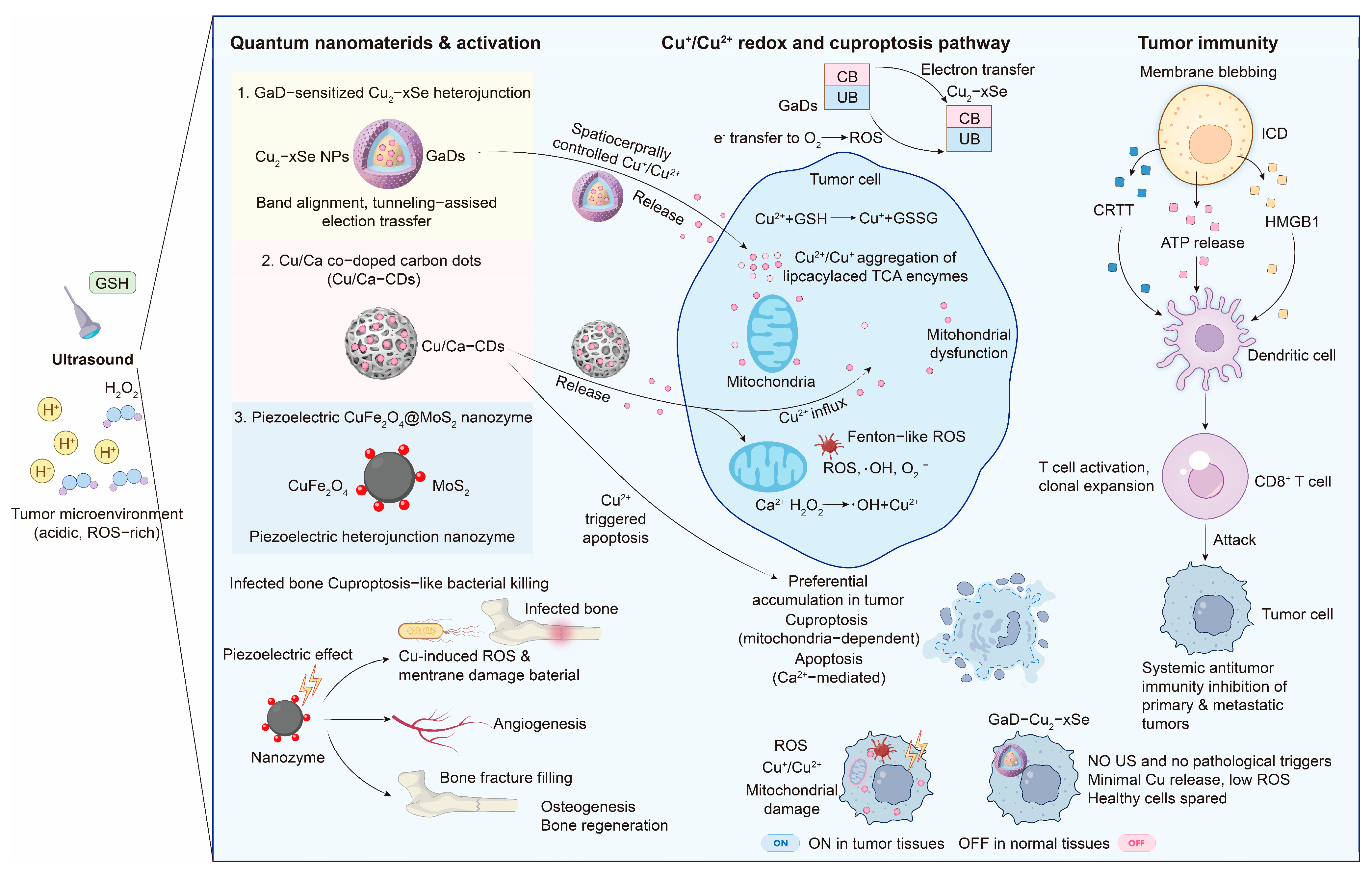
- Wang, Y.; Yan, T.; Cai, J.; Dou, H.; Zhu, Y.; Geng, B.; Pan, D.; Shen, L. A heterojunction-engineering nanodrug with tumor microenvironment responsiveness for tumor-specific cuproptosis and chemotherapy amplified sono-immunotherapy. Biomaterials 2025, 321, 123319. [Google Scholar] [CrossRef]
- Zheng, W.; Liu, Y.; Liu, J.; Zhao, Y.; Wang, P.; Wang, Y.; Wang, Y.; Lu, Z.; Liu, X.; Shi, Y.; et al. Copper/calcium co-doped carbon dots for targeted cancer therapy with dual-mode imaging and synergistic induction of cuproptosis and calcium-mediated apoptosis. J. Colloid. Interface Sci. 2025, 690, 137337. [Google Scholar] [CrossRef]
- Qiu, L.; Ma, S.; Yang, R.; Zheng, D.; Huang, Y.; Zhu, Z.; Peng, S.; Li, M.; Zhong, H.; Peng, F. Ultrasound-activated piezoelectric heterojunction drives nanozyme catalysis to induce bacterial cuproptosis-like death and promote bone vascularization and osseointegration. Biomaterials 2025, 320, 123249. [Google Scholar] [CrossRef] [PubMed]
- Lu, J.; Miao, Y.; Li, Y. Cuproptosis: Advances in Stimulus-Responsive Nanomaterials for Cancer Therapy. Adv. Healthc. Mater. 2024, 13, e2400652. [Google Scholar] [CrossRef]



| Factor | Regulatory Role | Main Mechanism of Action |
|---|---|---|
| Ferredoxin 1 (FDX1) | Positive | Reduces Cu2+ to Cu+ and promotes protein lipoylation [19] |
| Lipoic acid synthetase (LIAS) | Positive | Catalyzes protein lipoylation [16] |
| Lipoyltransferase 1 (LIPT1) | Positive | Transfers lipoic acid to target proteins [12] |
| Dihydrolipoamide dehydrogenase (DLD) | Positive | Supports TCA cycle and protein lipoylation [11] |
| Dihydrolipoamide S-acetyltransferase (DLAT) | Positive | Lipoylated target for copper-induced aggregation [10] |
| Pyruvate dehydrogenase E1 subunit alpha 1 (PDHA1) | Positive | Supports TCA cycle and protein lipoylation [11] |
| Pyruvate dehydrogenase E1 subunit beta (PDHB) | Positive | Maintains PDH complex activity [10] |
| Solute carrier family 31 member 1 (SLC31A1; CTR1) | Positive | Imports copper into cells [20] |
| Cytochrome c oxidase copper chaperone (COX17) | Positive | Delivers copper to mitochondria [14] |
| Metal regulatory transcription factor 1 (MTF1) | Negative | Enhances metal detoxification response [11] |
| Glutaminase (GLS) | Negative | Alters glutamine metabolism to reduce cuproptosis sensitivity [11] |
| Cyclin-dependent kinase inhibitor 2A (CDKN2A) | Negative | Modulates cell cycle and stress response [12] |
| ATPase copper transporting alpha (ATP7A) | Negative | Mediates copper excretion [17] |
| ATPase copper transporting beta (ATP7B) | Negative | Mediates copper excretion [17] |
| COMM domain-containing protein 1 (COMMD1) | Negative | Promotes copper efflux via ATP7A [18] |
| Glutathione (GSH) | Negative | Chelates copper to reduce toxicity [10] |
| Disease | Disease-Specific Mechanisms |
|---|---|
| Alzheimer’s Disease (AD) | Amyloid-β (Aβ)/Cu complex-induced Aβ deposition [54] Tau hyperphosphorylation/aggregation [55] Cu-activated microglial NF-κB signaling [54] |
| Parkinson’s Disease (PD) | Cu-induced α-synuclein aggregation and Lewy body formation [55] Reduced nigral copper increases dopaminergic neuron vulnerability [55] |
| Amyotrophic Lateral Sclerosis (ALS) | Superoxide dismutase 1 (SOD1) mutation impairs Cu binding, causes motor neuron degeneration [13] |
| Huntington’s Disease (HD) | Cu promotes mutant huntingtin (HTT) aggregation [56] |
| Stroke Menkes disease | Post-stroke copper accumulation triggers cuproptosis via TCA acylated proteins [52] ATP7A loss-of-function disrupts copper distribution and causes brain copper deficiency [80] Mitochondrial respiratory dysfunction contributes to neurodegeneration [81] |
| Primary Mechanism | FDA-Approved Drug/Product | Use Context | One-Line Mechanism | Chemical Structures |
|---|---|---|---|---|
| Copper replacement | Copper histidinate injection (Zycubo) | Pediatric Menkes disease | Subcutaneous copper replacement to restore bioavailable copper in a genetically copper-deficient state | Copper(II)–histidine complex |
| Block intestinal copper absorption | Zinc acetate (Galzin) | Wilson’s disease maintenance | Induces intestinal metallothionein to trap dietary copper and reduce systemic copper input [98] | Zinc acetate |
| Intravenous copper supplementation | Cupric chloride injection | Parenteral nutrition (PN/TPN) copper supplementation | Provides intravenous copper to prevent or correct copper deficiency during PN [99,100] | Cupric chloride (CuCl2) |
| Copper-containing parenteral trace-element products | Tralement | PN for adults and pediatric patients ≥ 10 kg | Fixed-dose multi-trace formulation supplying copper and other trace elements for PN requirements [100] | Multi-ingredient product |
| Copper-containing parenteral trace-element products | Multrys | PN for neonates and pediatric patients < 10 kg | Fixed-dose multi-trace formulation with lower copper content tailored to small pediatric PN [100] | Multi-ingredient product |
Disclaimer/Publisher’s Note: The statements, opinions and data contained in all publications are solely those of the individual author(s) and contributor(s) and not of MDPI and/or the editor(s). MDPI and/or the editor(s) disclaim responsibility for any injury to people or property resulting from any ideas, methods, instructions or products referred to in the content. |
© 2026 by the authors. Licensee MDPI, Basel, Switzerland. This article is an open access article distributed under the terms and conditions of the Creative Commons Attribution (CC BY) license.
Share and Cite
Jin, Y.; Lu, K.; Yang, Y. Copper Dyshomeostasis, Redox Buffering and Immune Aging Converge on Cuproptosis in Age-Related Diseases. Antioxidants 2026, 15, 353. https://doi.org/10.3390/antiox15030353
Jin Y, Lu K, Yang Y. Copper Dyshomeostasis, Redox Buffering and Immune Aging Converge on Cuproptosis in Age-Related Diseases. Antioxidants. 2026; 15(3):353. https://doi.org/10.3390/antiox15030353
Chicago/Turabian StyleJin, Yubin, Keyu Lu, and Yang Yang. 2026. "Copper Dyshomeostasis, Redox Buffering and Immune Aging Converge on Cuproptosis in Age-Related Diseases" Antioxidants 15, no. 3: 353. https://doi.org/10.3390/antiox15030353
APA StyleJin, Y., Lu, K., & Yang, Y. (2026). Copper Dyshomeostasis, Redox Buffering and Immune Aging Converge on Cuproptosis in Age-Related Diseases. Antioxidants, 15(3), 353. https://doi.org/10.3390/antiox15030353