1. Introduction
Reactive oxygen species (ROS) are generated during normal physiological metabolism and immune defense. They accumulate from exogenous sources, including radiation, environmental pollutants, cigarette smoke, iron salts, and toxins. Intracellular ROS are produced through multiple enzymatic pathways, including NADPH oxidase (NOX) complexes, xanthine oxidases, amine oxidases, nitric oxide synthases, myeloperoxidase, peroxisomes, and arachidonic acid metabolism by lipoxygenases and cyclooxygenases [
1,
2], and the subcellular localization of these enzymes, antioxidants, and redox targets is tightly regulated within cells. In addition, physiological processes such as oxidative protein folding in the endoplasmic reticulum and fatty acid β-oxidation in peroxisomes contribute to intracellular ROS generation [
3]. Together, antioxidant systems and redox-sensitive mechanisms maintain ROS homeostasis and prevent excessive oxidative stress.
Megakaryopoiesis is the developmental process of platelet biogenesis, which produces approximately 100 billion platelets per day, corresponding to an average output of ~3000 platelets per megakaryocyte (MK). During differentiation, MKs migrate from relatively low-oxygen regions of the bone marrow toward higher oxygen areas. Concurrently, mitochondrial biogenesis increases during early megakaryopoiesis, resulting in elevated levels of mitochondrial ROS (mtROS). Despite these observations, the precise mechanisms by which intracellular ROS levels and oxidative stress responses regulate MK maturation remain incompletely understood [
4].
Recently, several countries have faced shortages of platelet transfusions owing to aging populations, low birth rates, and pandemics [
5]. Substantial efforts, therefore, have been directed toward overcoming donor-dependent platelet transfusion therapy and developing in vitro platelet production processes from human stem cells [
6,
7,
8]. This approach became more feasible after Megakaryon Corporation, building on the pioneering work of Koji Eto’s group at Kyoto University, successfully produced more than 10
11 platelets for autologous transfusion and reported the results of a phase 1 clinical trial (iPLAT1) [
9]. Although platelet biogenesis from induced pluripotent stem cells (iPSCs) and cord blood (CB)-derived hematopoietic stem cells (HSCs) can be recapitulated in vitro, MKs have not yet been studied at physiological levels [
10,
11]. Current estimates indicate that in vitro systems yield only 10–100 platelets per MK, and it remains unclear whether rare “super MKs” producing ~3000 platelets exist in vivo or whether most CD41
+CD42b
+ MK-like cells generate only 10–100 platelets per MK. Therefore, understanding the in vivo microenvironment and its effect on MKs is essential for improving the yield of in vitro platelet production.
In this review, we discuss redox-sensitive signaling pathways and their functional consequences during megakaryopoiesis. Furthermore, we summarize the current understanding of ROS regulation in cell therapy development processes, with the goal of elucidating the role of ROS in megakaryopoiesis in vitro.
2. Context-Dependent Roles of ROS in Megakaryopoiesis
2.1. ROS Biology: Types, Sources, and Regulatory Mechanisms
Major cellular ROS include the superoxide anion (O
2•−, often abbreviated as O
2−), hydrogen peroxide (H
2O
2), hydroxyl radical (•OH), and reactive nitrogen species (RNS). O
2− is generated primarily through electron leakage to molecular oxygen, mainly at electron transport chain (ETC) complexes I and III during oxidative phosphorylation. In addition to mitochondrial sources, O
2− can arise as secondary byproducts of cellular metabolism or from specialized enzymes such as NOX, which are localized in the plasma membrane or endomembranes and play key roles in immune defense and cellular signaling. The NOX family includes NOX1-5, DUOX1, and DUOX2, all of which transport electrons across membranes to generate O
2− and downstream ROS [
1,
12]. NOX1, NOX2, and NOX4, together with their regulatory subunits, have been detected in human stem and progenitor cells isolated from peripheral blood [
13,
14]. Studies in MKs and platelets have demonstrated expression of NOX1, NOX2, and NOX4 in both humans and mice, with NOX1 and NOX4 being particularly abundant in primary murine MKs, and NOX2 also detected in the human MEG-01 megakaryocytic cell line [
15].
The mitochondrial ETC is a central component of ATP production. During oxidative phosphorylation, ATP synthesis is accompanied by ROS generation through electron leakage and oxygen reduction, producing O
2− or H
2O
2 [
16,
17]. H
2O
2—generated through the activity of mitochondrial or cytosolic superoxide dismutases (SODs)—is relatively stable and diffusible and functions as a signaling molecule by oxidizing specific cysteine residues in target proteins. In the presence of ferrous iron (Fe
2+), H
2O
2 generates •OH via the Fenton reaction. These radicals are highly reactive and interact with biomolecules, including DNA, lipids, and proteins. Excessive lipid peroxidation leads to ferroptosis, which is inhibited by glutathione peroxidase 4 (GPx4), which detoxifies lipid ROS using cellular glutathione (GSH) [
18,
19,
20,
21]. Recent studies have shown that GPx4 expression protects differentiating MKs with iron overload–induced ferroptosis and supports effective platelet recovery. In platelets, mitochondrial SOD2 reduces mtROS-driven phosphatidylserine exposure, thrombin generation, and age-related arterial thrombosis; therefore, SOD2 serves as a key antioxidant enzyme for maintaining platelet redox homeostasis [
22,
23].
The nuclear factor erythroid-derived 2-like 2 (NRF2) pathway acts as a master regulator of antioxidant gene expression. Under basal conditions, NRF2 is bound by Kelch-like ECH-associated protein 1 (KEAP1) and undergoes ubiquitination and proteasomal degradation. Elevated ROS levels modify cysteine residues on KEAP1, enabling NRF2 translocation to the nucleus and binding to antioxidant response elements (AREs) [
24,
25]. In MK, NRF2 both cooperates and competes with the platelet transcription factor NF-E2 p45 to regulate the expression of cytoprotective genes. As MKs mature, NRF2 activity declines, leading to reduced antioxidant gene expression, increased ROS accumulation, and enhanced expression of platelet-specific genes, thereby promoting megakaryocytic maturation [
26]. The transcription factors FOXO1 and FOXO3 are redox-sensitive and promote antioxidant gene expression. FOXO3 plays a critical role in maintaining ROS balance in HSCs and protecting against oxidative DNA damage through regulation of base excision repair mechanisms. Additionally, in MK progenitors, FOXO3a and its downstream target p27(Kip1) contribute to thrombopoietin (TPO)-induced proliferation, linking FOXO signaling to the early stages of megakaryopoiesis [
27,
28,
29].
2.2. Pro-Differentiation Roles of ROS in MK Development
ROS promote megakaryopoiesis through extrinsic (microenvironmental) and intrinsic (cell-autonomous) pathways. Within the bone marrow, elevated oxygen levels enhance MK maturation and platelet production. This effect is shaped by the physiological oxygen gradient, in which the low O
2 levels in the osteoblastic niche help to maintain HSC quiescence, whereas the high oxygen tension near the sinusoidal regions promotes MK maturation and progression toward thrombopoiesis [
30,
31,
32].
Consistent with this microenvironmental influence, studies using leukemia cell lines (K562 and Dami) treated with phorbol 12-myristate 13-acetate (PMA) or endocannabinoids have demonstrated that intracellular ROS accumulation correlates with MK differentiation. In K562 cells, PMA-induced differentiation is accompanied by increased ROS levels, upregulation of MK-specific markers (CD41, CD42a, and CD61), enhanced endomitosis leading to polyploidization, and increased cell size. In these models, pharmacological inhibition of NOX significantly reduces ROS generation and attenuates PMA-induced MK features, indicating that ROS produced following NOX activity is a major upstream link between PMA stimulation and megakaryocytic differentiation in K562 cells [
33,
34].
At the intracellular level, NOX enzymes are the major source of ROS during megakaryopoiesis, particularly p22
phox-dependent NOX enzymes. RNA interference studies have shown that p22
phox-dependent NOX activity directly drives ROS production in differentiating MKs. Accordingly, inhibition of ROS generation using antioxidants such as N-acetyl-L-cysteine (NAC), Trolox, and quercetin or the NOX inhibitor diphenyliodonium (DPI) significantly suppresses MK differentiation [
2]. In mouse bone marrow cultures, NOX1 and NOX4 are upregulated following TPO treatment. Furthermore, inhibition of NOX activity results in impaired endomitosis, leading to an accumulation of immature, low-ploidy MKs and a marked decrease in polyploid MK populations. Purified NOX-inhibited MKs exhibit reduced levels of G1-phase cyclin E, a key regulator of polyploidy; restoration of cyclin E expression rescues the polyploidy suppressed by NOX inhibition, underscoring the critical role of NOX-derived ROS in endomitosis and early MK maturation [
15,
35].
Beyond NOX-dependent cytosolic ROS, mtROS generated downstream of TPO signaling function as metabolic signals that promote progenitor differentiation toward the megakaryocytic lineage, particularly during the late stages of megakaryopoiesis. Upon binding to its receptor, MPL, TPO not only activates canonical kinase pathways but also induces rapid metabolic reprogramming in HSCs and MK progenitors, shifting the ATP production mechanism from glycolytic metabolism toward oxidative phosphorylation. This transition increases mitochondrial ETC activity and mtROS generation, which enhances megakaryocytic differentiation potential in vitro and myeloid/MK-biased reconstitution in vivo, indicating that TPO-activated mtROS act as positive signals for MK fate decisions [
36]. These metabolically derived mtROS are rapidly dismutated by SOD2 to H
2O
2, which can diffuse to the cytosol and modulate the activity of redox-sensitive transcription factors and signaling intermediates, such as GATA1, NF-E2, MAPK, and PI3K/AKT, thereby promoting MK-specific gene expression programs [
2,
32,
37].
The natural peroxisome proliferator-activated receptor gamma (PPARγ) ligand 15-deoxy-Δ
12,14-prostaglandin J
2 (15d-PGJ
2) enhances platelet release from MKs while concomitantly increasing intracellular ROS levels. Inhibition of the antioxidant gene heme oxygenase-1 (HO-1) using protoporphyrin IX (SnPPIX) further potentiates the effect of 15d-PGJ2 on MK differentiation by amplifying ROS accumulation. These observations support the concept that elevated ROS levels positively regulate platelet biogenesis during the late stages of megakaryopoiesis [
38,
39]. Clinically, HO-1 deficiency in humans is associated with elevated platelet counts and increased systemic oxidative injury, reinforcing the physiological importance of redox homeostasis in platelet production and vascular integrity [
40,
41]. Specifically, terminal MK maturation, particularly proplatelet formation, is accompanied by a marked increase in mtROS, which function as signaling mediators to fine-tune redox-dependent pathways during MK differentiation. During late megakaryopoiesis, mitochondrial remodeling events—particularly mitochondrial fission—are associated with enhanced mtROS production, which promotes cytoskeletal reorganization and proplatelet elongation [
4].
Together, these findings establish a clear stage-specific distinction in ROS function during megakaryopoiesis: NOX-dependent ROS act primarily during early MK lineage commitment and polyploidization, whereas mtROS serve as the physiological triggers for terminal morphological reorganization and cytoplasmic fragmentation that culminate in platelet release. This stage-dependent separation highlights the necessity for precise spatial and temporal control of distinct ROS to achieve complete and efficient megakaryopoiesis.
2.3. Inhibitory Effects of Excessive ROS Accumulation on Megakaryocyte Differentiation
Excessive ROS accumulation disrupts mitochondrial homeostasis and redox balance, thereby impairing MK differentiation and platelet production. In autophagy-deficient MKs, elevated ROS levels block differentiation and cause defective thrombopoiesis, thus necessitating intact redox control mechanisms during MK maturation [
42]. Interestingly, in certain contexts, reducing intracellular ROS levels instead enhances MK differentiation. This suggests a complex biphasic relationship in which both insufficient and excessive ROS negatively affect megakaryopoiesis. Consistent with this model, treatment with docosahexaenoic acid (DHA) or arachidonic acid (AA) reduces ROS production and apoptosis in CB-derived CD34
+ cells, thereby increasing platelet yield in vitro. These polyunsaturated fatty acids promote MK proliferation and differentiation, as evidenced by significantly increased expression of CD41, CD61, and CD42b. Moreover, DHA-treated hematopoietic precursors display improved engraftment in NOD/SCID mice, accompanied by increased human CD61 levels, suggesting that lower ROS levels are particularly beneficial during the early stages of MK differentiation from HSCs [
43,
44]. Similarly, pharmacological or phytochemical agents that attenuate oxidative stress, such as the NF-κB inhibitor parthenolide, enhance MK maturation and platelet generation [
45].
Multiple in vitro studies further demonstrate that maintaining redox balance is essential for efficient MK maturation and platelet formation. In immortalized megakaryocyte progenitor cell lines (imMKCLs) and CB-derived MKs, excessive ROS accumulation disrupts mitochondrial homeostasis and reduces platelet yield, whereas pharmacological suppression of ROS restores differentiation efficiency. In parallel, genetic or pharmacological modulation of KCNN4, a calcium-activated potassium channel involved in mitochondrial function, alters intracellular ROS levels and MK maturation, reinforcing the importance of tightly controlled oxidative signaling during thrombopoiesis [
46,
47]. In the bone marrow microenvironment, excessive ROS accumulation in endothelial progenitor cells (EPCs) impairs MK differentiation following allogeneic HSC transplantation. Prolonged isolated thrombocytopenia (PT), a frequent post-transplant complication, is characterized by dysfunctional EPCs exhibiting elevated ROS levels, increased apoptosis, and reduced angiogenic activity. Treatment with the ROS scavenger NAC restores EPC function, enhances megakaryopoiesis, and improves graft recovery [
48]. Consistently, clinical trials have shown that prophylactic oral NAC administration safely and effectively prevents poor graft function and PT by promoting dynamic reconstitution of bone marrow ECs and HSCs [
49]. In addition, leukemic stem cells exhibit aberrantly high ROS levels that disrupt normal differentiation programs, further reinforcing that excessive oxidative stress within the hematopoietic niche hinders effective thrombopoiesis [
50].
Collectively, these findings indicate that while physiological ROS levels are required for early lineage commitment, excessive oxidative stress impairs MK maturation. Partial attenuation of ROS, therefore, restores proper differentiation and platelet formation, emphasizing the necessity for balanced redox control during megakaryopoiesis [
51].
3. Redox Signaling Pathways Governing Megakaryocyte Fate Decisions
3.1. ROS as Signaling Mediators in Megakaryopoiesis
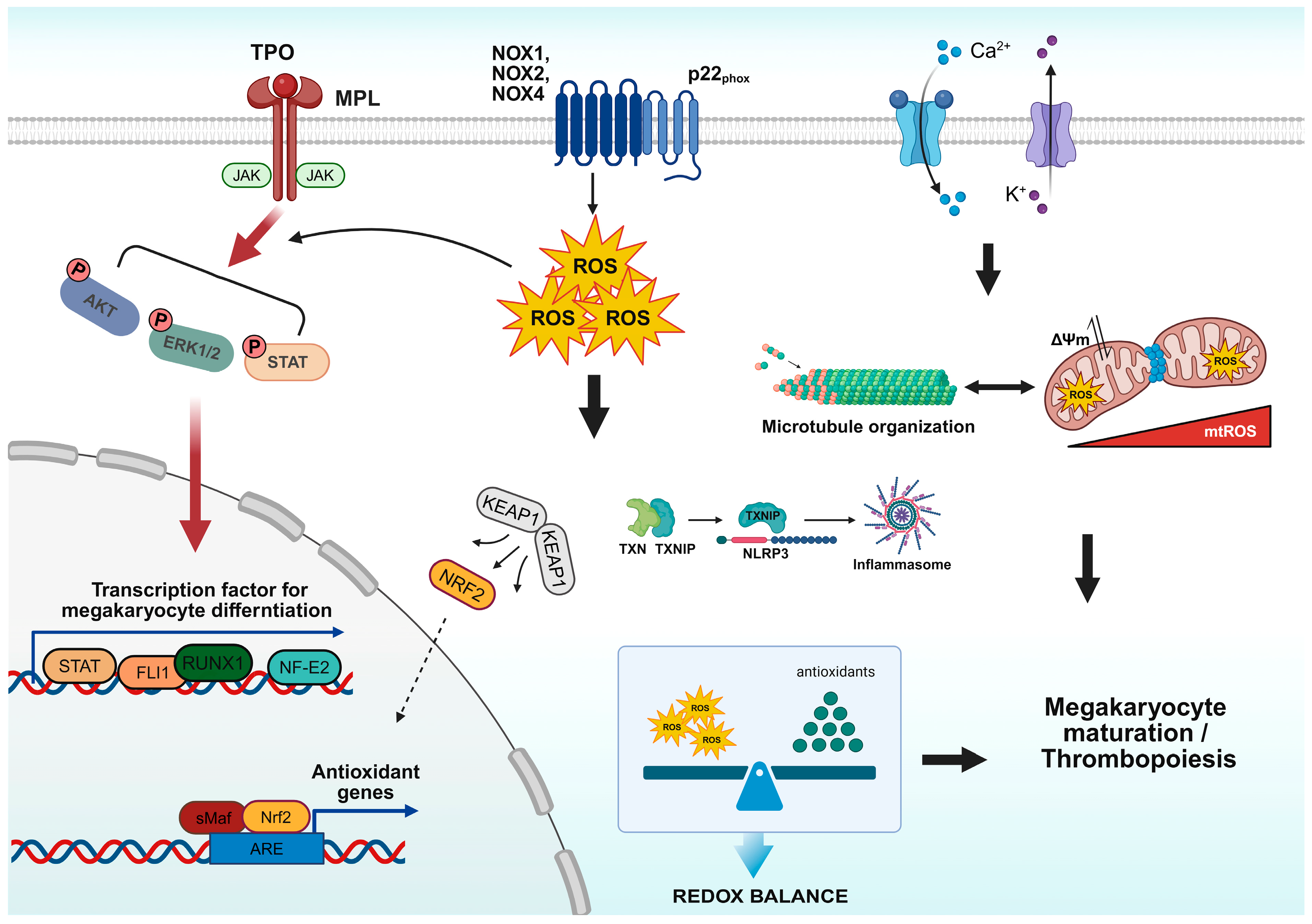
Understanding ROS dynamics is critical for defining MK differentiation fate. During megakaryopoiesis, intracellular ROS levels must be coordinated in a stage-specific manner, making it essential to consider not only overall ROS levels but also their sources, species, and signaling mechanisms. In this section, we describe how ROS function as signaling mediators during megakaryocytic lineage differentiation from hematopoietic progenitor cells (
Figure 1).
3.1.1. Redox Control of Transcription Factor Networks in Megakaryocytes
Fetal liver–derived primary MKs exhibit ROS-dependent regulation of platelet gene expression, coordinated primarily by the transcription factors NF-E2 p45 and Nrf2 [
26]. Comparative analysis of CD41
+DCFDA
low and CD41
+DCFDA
high populations revealed that increased ROS accumulation enhances the expression of platelet-associated genes, including thromboxane synthase (Txas), glycoprotein VI (Gp6), P-selectin (Selp), and Slamf1. During megakaryopoiesis, upregulation of NF-E2 p45 increases intracellular ROS levels, which, in turn, promote platelet gene expression while concomitantly suppressing Nrf2 target genes, thereby sustaining ROS accumulation in maturing MKs. In contrast, p45-null mice exhibit severe thrombocytopenia and impaired terminal MK differentiation, accompanied by dysregulated stress-responsive gene expression [
52,
53]. NAD(P)H:quinone oxidoreductase 1 (NQO1), an Nrf2-induced antioxidant enzyme involved in ROS detoxification, is dynamically required during megakaryopoiesis. The balance between NF-E2 p45 and Nrf2 activity, therefore, determines intracellular ROS levels in MKs. As MKs mature, p45 predominates over Nrf2, suppressing cytoprotective gene expression and permitting the ROS accumulation required for platelet gene expression and release [
54,
55].
ROS-induced MK differentiation is further coordinated by the transcription factor FLI-1 [
56]—an ETS transcription factor—that directly interacts with RUNX-1 and synergistically activates MK-specific gene expression, including that of TPO receptor MPL. The interaction between RUNX-1 and FLI-1 is differentiation-dependent and regulated by dephosphorylation of FLI-1 at serine 10. This phosphorylation-dependent control of FLI-1 activity plays a critical role in terminal MK maturation [
57]. Together, these findings indicate that ROS tune MK gene expression largely by shifting the balance among NF-E2, NRF2, and FLI-1/RUNX-1, thereby coupling redox status to lineage-specific transcriptional programs.
3.1.2. ROS-Regulated Signaling Pathways in Megakaryopoiesis
At the molecular level, ROS activate multiple redox-sensitive signaling pathways that are essential for MK proliferation and differentiation. Upon stimulation of human hematopoietic cells with growth factors such as TPO, intracellular ROS levels rapidly increase, initiating a cascade of downstream signaling events [
51]. H
2O
2 stimulation enhances tyrosine phosphorylation of several signaling proteins, including the common βc subunit, STAT5, c-KIT, SHC adapter protein, and the protein tyrosine phosphatase SHP-1 in the MO7e MK cell line [
58]. A key mechanism by which ROS propagate intracellular signaling is through inhibition of protein phosphatases such as PP1α, resulting in sustained activation of the PI3K/AKT pathway in leukemic cells [
32]. In parallel, the MEK–ERK1/2 pathway represents a critical ROS-responsive signaling axis during MK differentiation. PMA-induced ERK activation in K562 and HEL cells is abolished by ROS inhibition, and pharmacological blockade of MEK–ERK1/2 signaling using U0126 or PD186141 leads to increased CD34 expression, reduced GPIb expression, and a leftward shift in ploidy distribution. These findings highlight the requirement for ERK signaling in MK polyploidization and maturation [
59]. ROS also regulate stress-related kinase pathways in MKs. Dopamine stimulation elevates intracellular ROS levels, leading to activation of p38 MAPK and c-Jun NH2-terminal kinase (JNK), both of which are essential for MK proliferation and differentiation [
60]. In addition, ROS modulates inflammatory signaling by activating transcription factors such as NF-κB. H
2O
2 directly activates NF-κB, thereby regulating genes involved in cell survival and differentiation. Upstream receptors—including toll-like receptors, tumor necrosis factor receptors, and interleukin (IL) receptors—converge on NF-κB during megakaryopoiesis. Notably, activity of the IkappaB kinase complex (IKK) is elevated during early differentiation stages and declines as MKs progress to thrombopoiesis, facilitating controlled cell death and platelet release [
61]. Thus, by integrating growth factor, stress, and inflammatory signaling through interconnected kinase and phosphatase pathways, ROS function as a central regulatory signal to MK cell differentiation and maturation.
3.1.3. Redox Regulation of Microtubule Organization in Thrombopoiesis
Proplatelet formation from mature MKs requires extensive remodeling of the microtubule cytoskeleton, which provides the structural basis for elongation and platelet release. Tubulin, the major microtubule component, contains multiple cysteine residues (12 in α-tubulin and 8 in β-tubulin) that are highly sensitive to oxidative modification. Physiological levels of ROS promote tubulin polymerization and dynamic turnover, whereas excessive ROS oxidize these cysteines, induce disulfide cross-linking, and destabilize the microtubule lattice, leading to defective proplatelet formation [
62,
63,
64,
65]. The influence of ROS on microtubule dynamics extends directly to proplatelet initiation, which is coordinated by potassium channel signaling and mitochondrial function. The KCNN4 channel, selectively upregulated at the onset of platelet biogenesis, maintains intracellular potassium homeostasis by promoting K
+ efflux during late MK maturation. KCNN4 activity preserves mitochondrial membrane potential (ΔΨm) and ROS balance; conversely, inhibition or knockdown of KCNN4 leads to excessive ROS accumulation and profound disruption of microtubule organization, thereby preventing the symmetry-breaking events required for proplatelet outgrowth. Microscopic analysis demonstrates that KCNN4 dysfunction causes asymmetric tubulin distribution and disorganized microtubule arrays, a phenotype recapitulated by direct ROS elevation using tert-butyl hydroperoxide (TBHP), confirming a causal role of ROS dysregulation in suppressing microtubule organization [
47].
Beyond potassium homeostasis, calcium signaling acts in parallel with ROS to fine-tune the cytoskeletal organization during proplatelet formation. Calcium mobilization from intracellular stores and extracellular influx via store-operated calcium entry (SOCE) channels activate downstream pathways that promote MK adhesion, contractility, and proplatelet elongation [
66]. Intracellular Ca
2+ flux is closely coupled to mitochondrial activity and ROS production, forming a dynamic feedback loop that stabilizes microtubule organization. Inhibition of key Ca
2+ signaling regulators, such as casein kinase 2β (CK2β) or N-methyl-D-aspartate (NMDA) receptor subunits, disrupts tubulin polymerization and impairs proplatelet formation, underscoring the interdependence of Ca
2+ homeostasis, mtROS, and microtubule integrity [
67,
68].
Collectively, these studies demonstrate that redox signaling integrates ionic homeostasis with cytoskeletal remodeling during megakaryopoiesis. Coordinated regulation of potassium efflux through KCNN4 and calcium influx via SOCE channels maintains ΔΨm and ROS balance, thereby preserving the redox-sensitive microtubule cytoskeleton required for proplatelet formation. This controlled K+–Ca2+–ROS interplay not only preserves cytoskeletal integrity but also orchestrates the spatial polarization and dynamic rearrangements essential for efficient proplatelet formation and subsequent platelet biogenesis.
3.1.4. Thioredoxin-Based Redox Systems in Megakaryocyte Development
The thioredoxin-1 (TXN1) system plays a critical role in maintaining redox hematopoiesis and megakaryopoiesis. TXN1 is essential for normal blood cell production in adult mice, as conditional deletion of TXN1 results in lethality within 30 days of tamoxifen induction, accompanied by severe weight loss and pancytopenia [
69]. Thioredoxin-interacting protein (TXNIP) further regulates cellular and mitochondrial redox balance by interacting with TXN and other redox-sensitive proteins. TXNIP-deficient mice (Txnip
−/−) develop progressive thrombocytopenia beginning at 4–5 months of age, which worsens with aging. During ex vivo megakaryopoiesis, Txnip
−/− megakaryocyte precursors (MKPs) remain small and display reduced expression of MK-specific markers, indicating impaired differentiation. Notably, Txnip
−/− MKPs exhibit reduced mtROS levels associated with altered AKT signaling. This redox imbalance is accompanied by a metabolic shift toward elevated glycolysis and increased glucose uptake to sustain ATP production. Transcriptomic analysis revealed enrichment of oxidative stress- and apoptosis-related gene signatures among differentially expressed genes in Txnip
−/− MKPs compared with wild-type controls [
70].
In addition to its role in redox–metabolic coupling, TXNIP has been proposed to act as an oxidative stress sensor that links TXN redox control to NOD, LRR-, and pyrin domain-containing protein 3 (NLRP3) inflammasome signaling. Upon ROS-dependent dissociation from TXN, TXNIP can bind NLRP3 and facilitate inflammasome activation with downstream IL-1β maturation [
71]. A recent study reported that the ginsenoside metabolite compound K promoted megakaryocytic differentiation in K562 (and MEG-01) cells while concomitantly upregulating an NLRP3 inflammasome gene program, suggesting that inflammasome tuning can intersect with MK differentiation and apoptosis-linked platelet release [
72].
Collectively, these observations indicate that the loss of TXNIP disrupts redox-metabolic coupling. TXNIP loss may also rewire ROS-sensitive TXNIP–NLRP3 inflammasome signaling in MK precursors, leading to age-dependent exhaustion of megakaryopoiesis and a reduced pool of terminally mature MKs capable of responding to thrombocytopenic challenge [
70]. Therefore, the TXN/TXNIP axis represents a critical redox checkpoint linking metabolic homeostasis to MK differentiation and platelet biogenesis.
3.2. Insights from Animal Models: Redox Dysregulation in Pathophysiological Megakaryopoiesis
3.2.1. NOX1,2 Deficiency Reveals Redox Control of Platelet Biogenesis and Function
The NOX isoforms NOX1 and NOX2 play distinct and context-dependent roles in platelet redox signaling. NOX2 is the catalytic core of the NOX2 complex and is best known for its role in oxidative stress and intracellular signaling. Genetic deficiency in NOX2 causes chronic granulomatous disease (CGD), a condition characterized by impaired ROS generation and dysregulated immune responses. Early studies reported that platelets from patients with CGD exhibit defective ROS production, secretion, and activation, including reduced thrombin-induced phosphorylation of Syk and PLCγ, suggesting a functional role in platelet signaling [
73,
74]. In contrast, NOX1 is primarily engaged downstream of G protein–coupled receptor (GPCR) agonists such as thrombin and thromboxane A
2, where it mediates rapid ROS production that amplifies platelet secretion and integrin activation. Delaney et al. further demonstrated that NOX2 plays a dominant role downstream of adhesion receptors, particularly immunoreceptor tyrosine-based activation motif (ITAM)–containing receptors such as GPVI, contributing to thrombus formation at sites of vascular injury under high shear conditions [
75]. However, Walsh et al. reported that NOX1, rather than NOX2, is the primary source of GPVI-dependent ROS generation and that neither isoform is strictly required for GPVI-induced platelet aggregation. Instead, both NOX1 and NOX2 contribute to collagen-induced thrombus formation under arterial shear stress. In this model, NOX1 deficiency reduces ROS and thromboxane A
2 production following collagen-related peptide (CRP) stimulation, resulting in delayed thrombus formation in vivo, while tail bleeding times remain normal in both models, suggesting that NOX1 drives collagen-dependent thrombotic responses, whereas NOX2 fine-tunes ROS output under mechanical stress [
75,
76].
Despite these distinctions, the precise contribution of NOX2 in platelet function remains unclear. Sonkar et al. showed that NOX2-deficient mice display normal platelet aggregation, secretion, adhesion, and arterial thrombosis, concluding that NOX2 is largely dispensable for platelet activation and thrombus formation, with redox compensation likely mediated by NOX1 or mitochondrial oxidases [
77]. Consistently, Xu et al. demonstrated that NOX2 activation is driven by outside-in integrin signaling and shear forces, enhancing thrombus growth under arterial flow while remaining non-essential for physiological hemostasis [
78].
Collectively, these findings support a stimulus- and context-dependent model in which NOX1 primarily mediates GPCR-driven, soluble agonist–dependent platelet activation, whereas NOX2 contributes to collagen- and shear-dependent thrombotic signaling with partial redundancy. This functional division reconciles discrepancies among experimental models and highlights how receptor engagement and vascular mechanics determine NOX isoform utilization. Notably, systemic oxidative stress also influences megakaryopoiesis, as stress-induced NOX1 activation in bone marrow MKs increases platelet output—an effect reversed by the NOX inhibitor apocynin [
79].
Together, these observations demonstrate that NOX-dependent redox signaling spans multiple stages of thrombopoiesis, linking MK differentiation to platelet activation within both local and systemic redox environments.
3.2.2. Aging-Associated Redox Imbalance and Altered Megakaryopoiesis
Physiological aging is associated with elevated intracellular ROS levels in HSCs, driven by increased oxidative phosphorylation, reduced antioxidant enzyme expression, and cumulative oxidative damage [
80]. Aging is accompanied by progressive HSC dysfunction and altered lineage output, a process known as hematopoietic aging. During aging, a hallmark change in the HSC compartment is a shift toward myeloid-biased HSCs with concomitant reduction in lymphoid-biased output. Within this broader myeloid skewing, platelet/MK-primed subsets (often operationally defined as CD41
+ HSCs or p-HSCs) also expand with age [
81,
82,
83]. Notably, CD41
+ HSCs increase in response to cellular stressors such as age-associated elevated ROS [
84]. Mechanistic insights into this process—linking redox dysregulation to increased CD41
+ HSCs during aging—have emerged from studies in TXNIP-deficient mice. Global transcriptomic profiling of Txnip
−/− MKPs revealed enrichment of oxidative stress- and apoptosis-associated gene signatures [
70]. CD41
+ HSCs exhibit a MK/platelet-biased transcriptional program and are primed toward accelerated differentiation [
83]. Elevated ROS levels and chronic inflammation during aging expand this biased HSC subset and reinforce lineage commitment through redox-sensitive pathways, including p38 MAPK and ERK–ETS1. Emerging evidence further suggests that increased IL-27 receptor α (IL27Rα) signaling in aged HSCs may synergize with redox imbalance to exacerbate myeloid and megakaryocytic bias. Although IL27Rα induction is primarily inflammation-driven rather than ROS-dependent, its convergence with oxidative stress likely contributes to the exaggerated platelet production and HSC exhaustion during aging [
85,
86].
3.2.3. Superoxide Dismutase Dysregulation and Age-Related Thrombotic Risk
SODs provide critical protection against oxidative damage in platelets that express cytosolic SOD1 and mitochondrial SOD2, which together limit O
2- accumulation. In young platelets, mtROS production remains low and SOD2 activity is relatively dispensable. In contrast, aged platelets exhibit markedly elevated mitochondrial O
2- levels and increased mitochondrial pro-oxidants, accompanied by decreased activity of other antioxidant systems, including glutathione peroxidase (GPx-1), peroxiredoxin (Prdx-6), and catalase. Recent studies demonstrate that mtROS contribute to age-associated thrombosis and that endogenous SOD2 protects against platelet-dependent thrombin generation and arterial thrombosis during aging. Treatment with avasopasem manganese (GC4419), a pharmacological SOD mimetic, reduces mitochondrial and cellular ROS levels, suppresses procoagulant platelet formation, and attenuates arterial thrombosis in aged mice [
87,
88].
3.2.4. Mitochondrial Transfer Within the Bone Marrow Niche: Redox Implications
Recent research revealed that healthy MKs can transfer mitochondria to mesenchymal stem cells (MSCs) via connexin 43 (Cx43)–dependent gap junctions. This unidirectional mitochondrial transfer contributes to the generation of platelets with a low-energy, resting phenotype characterized by enhanced LYN activation. In contrast, MSCs exhibit limited capacity to donate mitochondria back to MKs. Experiments using MSCs from conditional Cx43-deficient mice demonstrate that Cx43 gap junctions are required for mitochondrial transfer from MKs to MSCs. In pathological settings such as sickle cell disease, dysfunctional MSCs display markedly reduced Cx43 expression and fail to accept mitochondria from MKs. Consequently, sickle cell disease–derived MKs retain excess mitochondria, leading to elevated ROS production and a shift toward hyperactivated, procoagulant platelet phenotypes [
89,
90]. Emerging evidence from mitochondrial transfer studies suggests that intercellular mitochondrial exchange not only alters metabolic and bioenergetic profiles in recipient cells but also modulates ROS dynamics [
91]. In several models, transferred mitochondria have been reported to either alleviate oxidative stress by enhancing antioxidant capacity or influence redox signaling pathways in recipient cells, indicating that mitochondrial transfer may reshape the redox landscape within the bone marrow niche and thereby potentially influence megakaryopoiesis.
3.2.5. Organellar Sources of ROS in Megakaryocyte Differentiation
Alterations in organelles contribute to ROS dysregulation and thereby influence hematopoiesis. Peroxisomes play key roles in free-radical detoxification, bile acid synthesis, and long-chain fatty acid catabolism. In a peroxisome-deficient mouse model (PEX1-Gly844Asp knock-in), elevated ROS levels were observed in hematopoietic stem and progenitor cells (HSPCs) and MSCs, accompanied by increased stem cell factor (SCF) production from MSCs. This model exhibits expanded HSPC, lymphocyte, neutrophil, and platelet populations, indicating that oxidative stress can bias hematopoietic lineage output toward thrombopoiesis [
92].
Mitochondrial complex II dysfunction further illustrates the impact of organellar ROS on hematopoiesis. In mice harboring a missense mutation in succinate dehydrogenase complex subunit C (
SdhcV69E), HSCs display increased ROS levels, DNA damage, myeloid skewing, leukopenia, macrocytic anemia, and thrombocytosis. As complex II functions at the intersection of the TCA cycle and ETC, its dysfunction leads to succinate accumulation and excessive mtROS production, thereby regulating hematopoietic homeostasis [
93].
4. Stepwise Regulation of Redox Signaling During In Vitro Platelet Production
In modern cell therapy manufacturing, redox regulation has emerged as a critical strategy for improving the yield, functionality, and stability of differentiated cellular products, including platelets. In vitro production of platelets from stem cells is a promising approach for transfusion medicine and regenerative applications, yet achieving clinically relevant yields and consistent functional quality remains challenging. As megakaryopoiesis and platelet biogenesis are tightly regulated by ROS and redox signaling in vivo, redox biology offers a useful framework for optimizing platelet production in vitro. Accordingly, culture strategies that modulate intracellular ROS levels, such as controlled oxygen tension and defined antioxidant buffering, are being increasingly explored to preserve physiological cell function and support scalable production. In this section, we discuss current limitations in in vitro platelet production, review redox-related principles regulating stem and progenitor cell maintenance, and highlight emerging redox-based design strategies for improving platelet biogenesis.
4.1. Current Strategies and Limitations of Stem Cell-Derived Platelet Biomanufacturing
In vitro megakaryopoiesis and platelet production have been achieved using embryonic stem cells (ESCs), iPSCs, and adult HSCs. Human pluripotent stem cells (hPSCs) are particularly attractive because they can be genetically modified to enhance self-renewal and serve as expandable precursors for MKs. A notable example is the imMKCL, which expresses doxycycline (DOX)-inducible c-MYC, BMI1, and BCL-XL [
94]. imMKCLs can be robustly expanded in culture for more than five months, including after cryopreservation. Suppression of c-MYC, BMI1, and BCL-XL expression triggers terminal differentiation and the production of CD42b
+ platelets. Based on this platform, a turbulence-controllable bioreactor was developed to enable clinical-scale platelet generation, which achieved production volumes of up to 8 L [
95]. This advancement enabled the first phase I clinical trial of stem cell-derived platelet transfusions (iPLAT1). The transfusion was well tolerated, with no major adverse events, although no significant post-infusion increase in platelet count was observed [
9].
In parallel, several groups have focused on generating expandable MK progenitors capable of terminal differentiation through transcription factor modulation. Ghevaert and colleagues demonstrated that overexpression of GATA1, TAL1, and FLI1 in ESCs biases differentiation toward the megakaryocytic lineage, generating so-called forward-programmed MKs (fopMKs) [
96]. These reprogrammed MKs could proliferate in culture for over 90 days while maintaining MK purity, marker expression (CD41/CD42a), and platelet production. Starting from 1 × 10
6 iPSCs, this approach yielded approximately 2 × 10
11 MKs and an estimated total of 1 × 10
12 platelets. GATA1 is a central transcription factor governing erythroid and MK differentiation, and loss-of-function mutations or reduced GATA1 expression in humans and mice result in the accumulation of immature MKPs [
97]. This finding led to the development of the GATA1-null MK–erythroid progenitor cell line (G1ME2), generated by incorporating a DOX-inducible Gata1 knockdown system into mouse ESCs. G1ME2-derived MKs produce approximately 40 platelets per MK, approximating physiological output [
98].
Despite these technological advances, both platelet yield and functional quality remain suboptimal. Each platelet typically carries five to eight mitochondria, and intact mitochondrial function with appropriate ΔΨm is essential for normal platelet activation and responsiveness [
99,
100]. Moreover, megakaryopoiesis from CB-derived CD34
+ HSPCs exhibits dynamic changes in mitochondrial fission and function, suggesting that ROS production and redox signaling are tightly regulated during differentiation [
4]. Current strategies to improve platelet yield—including genetic manipulation, bioreactor optimization, and cell line engineering—are likely to perturb intracellular redox states. In addition, redox signaling in vitro differs substantially from that within the native bone marrow microenvironment. To date, the specific impact of redox modulation on stem cell–derived platelet production, including effects on platelet yield, mitochondrial integrity, and functional quality, has not been systematically investigated. Understanding and deliberately controlling redox signaling during in vitro megakaryopoiesis, therefore, represents an underexplored yet potentially transformative avenue for advancing platelet cell therapies.
4.2. Redox Requirements for Stem Cell Maintenance and Hematopoietic Differentiation
In scalable in vitro platelet production, genetically engineered PSCs and their derived expandable hematopoietic progenitors serve as renewable starting materials [
94]. Establishing such systems requires stable genetic modification, long-term expansion, and maintenance of differentiation potential through multiple culture transitions before terminal MK maturation and platelet release. As redox state influences cell cycle control, stress adaptation, and lineage commitment during these stages, ROS regulation should be considered a critical process. Accordingly, this section discusses redox-related principles governing PSC maintenance and differentiation (
Section 4.2.1) and hematopoietic cell systems (
Section 4.2.2). These examples provide a conceptual framework for considering how redox regulation may support MKP expansion and stable cell line establishment in scalable platelet manufacturing.
4.2.1. Metabolic and Redox Regulation in Pluripotent Stem Cells (PSCs) During Expansion and Engineering
PSCs are predominantly glycolytic, possess functionally active mitochondria, and exhibit marked metabolic plasticity [
101,
102]. Physiological hypoxia (∼3–5% O
2) is frequently used to maintain an undifferentiated state, although reported effects on growth and pluripotency markers vary across studies [
103]. Importantly, under in vitro conditions, ROS levels are not uniformly low in PSCs: when ROS readouts are normalized (e.g., per cell volume or protein), overall ROS levels can be comparable between PSCs and differentiated cells [
104]. Consistent with this metabolic flexibility, iPSC reprogramming involves metabolic rewiring with suppression of oxidative phosphorylation, which can reshape mitochondrial ROS tone [
105]. Moreover, in hPSCs, ROS varies across the cell cycle, and antioxidant-driven ROS lowering impairs S-phase initiation/progression with reduced accumulation of cyclin A and geminin [
106]. Taken together, these findings support treating oxygen tension and antioxidant dosing as tunable process variables—avoiding both chronic oxidative stress and ROS over-quenching—during long-term PSC maintenance and upstream expandable progenitor stages [
107,
108,
109].
Three-dimensional organoid/aggregate systems better approximate in vivo niches by generating oxygen gradients that stabilize hypoxia-inducible factor 1-alpha (HIF-1α) and activate hypoxia-responsive programs (e.g., Vascular Endothelial Growth Factor (VEGF) and growth/inflammatory signaling) [
110,
111]. For instance, in retinal and other organoid models, early hypoxia supports progenitor proliferation and preserves immature transcriptional programs, whereas later phases require adequate oxygen to sustain mitochondrial metabolism, ROS signaling, and terminal maturation [
112,
113,
114]. Consistent with observation, stirred-tank bioreactor expansion of hiPSC-derived cardiomyocytes under controlled mild hypoxia reduces intracellular ROS generation while increasing proliferative capacity and genomic stability, illustrating how 3D hydrodynamics plus oxygen control can improve scalable cell manufacturing [
115,
116]. In PSC-to-hematopoietic differentiation toward MKs, 3D (e.g., embryoid body-based) formats can prolong CD34
+ progenitor maintenance, delay MK differentiation kinetics, and expand MKP/mature MK pools that yield functional platelets [
117]. Bone marrow organoids further demonstrate that niche-level oxygen/redox cues shape MK states in both physiology and disease contexts such as myelofibrosis [
118].
4.2.2. Redox Regulation in Suspension-Based Hematopoietic Culture Systems
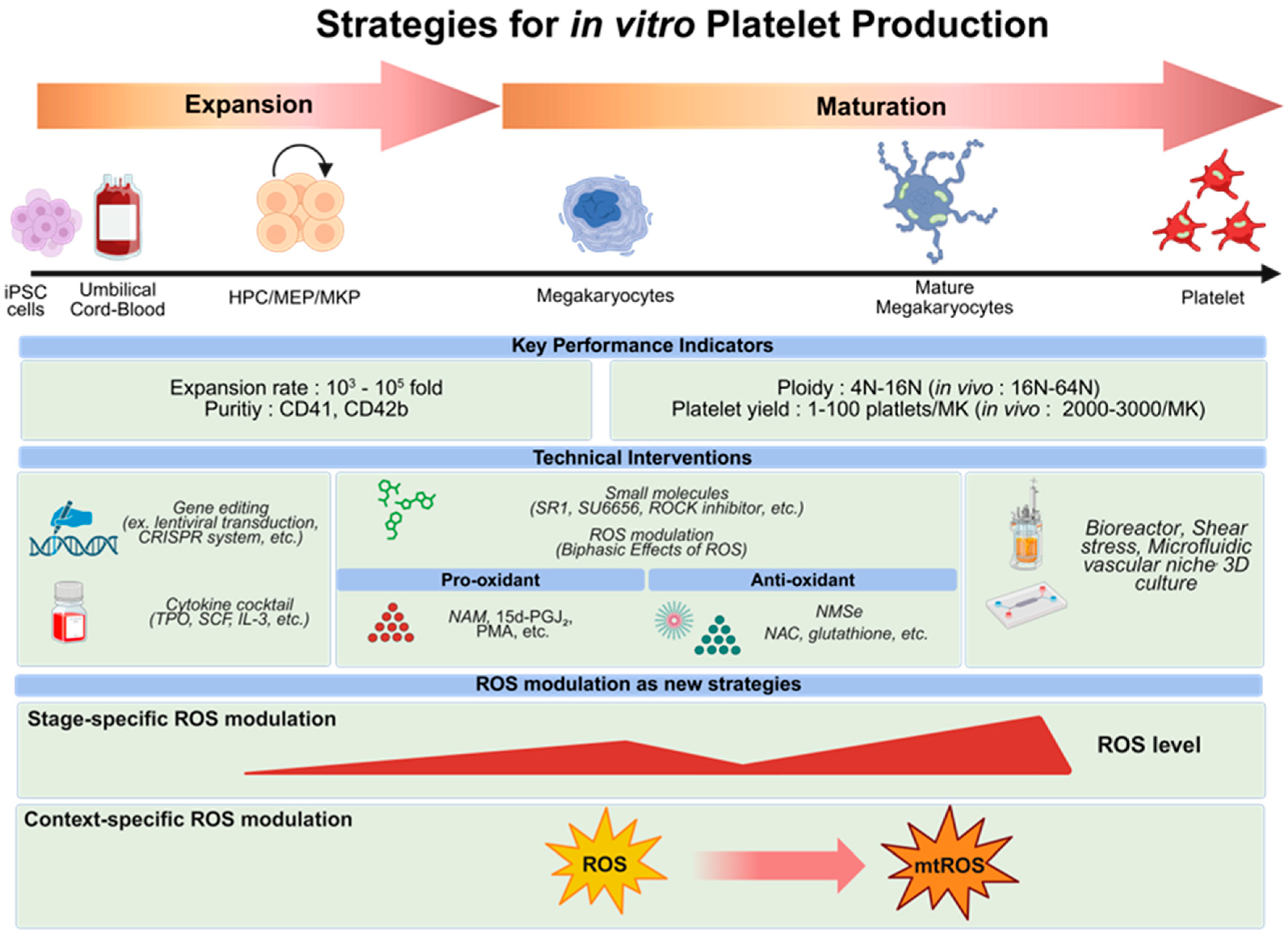
In vitro platelet generation from stem cells proceeds through a stepwise procedure from hematopoietic progenitor cells (HPCs) to MK–erythroid progenitors (MEPs), MKPs, mature MKs, and finally platelets (
Figure 2). As this process passes through intermediate progenitor states, the quality of early populations is a major determinant of downstream MK maturation and platelet output. Such stages are often defined primarily by surface markers; however, cell quality attributes—particularly redox status—have been less emphasized. Although ROS generation is an unavoidable consequence of cellular respiration, its magnitude varies by metabolic pathway: anaerobic glycolysis produces minimal ROS, whereas mitochondrial respiration generates substantially higher levels. Excessive ROS accumulation disrupts redox homeostasis, leading to loss of quiescence and diminished self-renewal of HSCs [
119]. HSCs are multipotent adult stem cells that maintain low intracellular ROS levels to preserve self-renewal capacity and quiescence. ROS can influence cell fate through oxidative post-translational modifications, particularly via oxidation of cysteine residues in redox-sensitive proteins. In HSCs, quiescence is tightly regulated through redox-dependent control of signaling pathways involving p53, NF-κB, and intracellular thiol balance [
120,
121].
As oxygen tension is a major upstream driver of redox state in HSC culture, HIF-1α serves as a central regulator linking hypoxia signaling to metabolic programming and ROS control in the bone marrow niche. By supporting hypoxic/glycolytic programs, HIF-1α can limit mtROS accumulation and is stabilized in HSCs under steady-state niche conditions, where it supports long-term repopulating capacity and protects against senescence and cell death. Conversely, loss of HIF-1α is associated with elevated oxidative stress, impaired quiescence, and reduced long-term regenerative potential [
122,
123].
From a manufacturing perspective, once early progenitors are generated, they must be expanded without the loss of their differentiation competence, a challenge conceptually mirrored in clinically approved, ex vivo–expanded chimeric antigen receptor (CAR)-T cell therapies. In CAR-T cells, chronic stimulation during expansion can induce mitochondrial dysfunction and mtROS-associated exhaustion, compromising proliferative capacity and persistence. In a chronic stimulation model, NAC supplementation during culture reduced ROS generation and improved bioenergetic fitness, shifting transcriptional programs away from terminal exhaustion toward progenitor-like/self-renewal states [
124,
125]. Clinical trials have also explored NAC supplementation to improve CAR-T persistence, although this targets the post-infusion milieu rather than the ex vivo expansion phase [
126].
4.3. Redox Modulation as a Design Principle for Megakaryopoiesis and Platelet Biogenesis
In scalable platelet manufacturing, achieving high yield alone is not sufficient. As platelets are anucleate and highly sensitive to environmental stress, preventing hyperactivation while preserving functional stability is important. In this context, ROS regulation emerges as a key factor linking cellular expansion, differentiation, and functional integrity. In this section, we focus on studies related to MK maturation and platelet biogenesis in which redox modulation has been examined. Although relatively few studies have examined ROS as a primary engineering variable, they provide useful insights on how cell culture systems may influence platelet yield and quality. Together, these examples suggest that redox control can be considered as a practical design element in stepwise in vitro thrombopoiesis (
Figure 2).
Figure 2.
In vitro platelet production: stage-specific interventions and ROS-based optimization. Schematic overview of in vitro platelet production from human stem cells, such as iPSC or UCB-derived HSCs, highlights currently used performance indicators and emerging ROS-modulating strategies. During the expansion phase, hematopoietic progenitors (HPC/MEP/MKP) undergo extensive proliferation (>10
3–10
5 fold) under cytokine cocktails (e.g., TPO, SCF, and IL-3) and gene editing or immortalization systems (e.g., lentiviral transduction [
94], CRISPR system [
127]). In the differentiation phase, megakaryocytes (MKs) increase in size and polyploidy (4N–16N, versus 16N–64N in vivo) and generate limited platelet yields (1–100 platelets per MK). Small-molecule modulators such as SR1 [
128], SU6656 [
129], and ROCK inhibitors [
130], together with stage-specific ROS modulation—including pro-oxidant cues (e.g., NAM [
4], 15d-PGJ
2 [
38,
39], PMA [
33,
34]) and antioxidant buffering (e.g., NMSe [
131], NAC [
125], glutathione [
132])—can further enhance MK maturation efficiency. Advanced bioreactors [
95], microfluidic systems mimicking vascular shear stress [
133] and 3D culture [
117] improve proplatelet formation and platelet release. The lower section illustrates a conceptual framework in which stage-specific and context-dependent ROS modulation serves as a potential strategy for optimizing MK differentiation. Controlled redox tuning—maintaining mild ROS fluctuations during early expansion and promoting transient mitochondrial ROS accumulation at later maturation stages—may represent a promising approach to recapitulating physiological thrombopoiesis in vitro. The graphical abstract was created using BioRender.com. Abbreviation: MK: Megakaryocyte; ROS: Reactive oxygen species; HPC: Hematopoietic progenitor cell; MEP: Megakaryocyte-erythroid progenitor; MKP: Megakaryocyte progenitor; iPSC: induced pluripotent stem cells; UCB: Umbilical cord blood; TPO: Thrombopoietin; SCF: Stem cell factor; IL: Interleukin; ROCK: Rho-associated coiled-coil protein kinase; NAM: Nicotinamide; PMA: Phorbol 12-myristate 13-acetate; NMSe: Selenium-containing nanomicelles; NAC: N-acetyl-L-cysteine.
Figure 2.
In vitro platelet production: stage-specific interventions and ROS-based optimization. Schematic overview of in vitro platelet production from human stem cells, such as iPSC or UCB-derived HSCs, highlights currently used performance indicators and emerging ROS-modulating strategies. During the expansion phase, hematopoietic progenitors (HPC/MEP/MKP) undergo extensive proliferation (>10
3–10
5 fold) under cytokine cocktails (e.g., TPO, SCF, and IL-3) and gene editing or immortalization systems (e.g., lentiviral transduction [
94], CRISPR system [
127]). In the differentiation phase, megakaryocytes (MKs) increase in size and polyploidy (4N–16N, versus 16N–64N in vivo) and generate limited platelet yields (1–100 platelets per MK). Small-molecule modulators such as SR1 [
128], SU6656 [
129], and ROCK inhibitors [
130], together with stage-specific ROS modulation—including pro-oxidant cues (e.g., NAM [
4], 15d-PGJ
2 [
38,
39], PMA [
33,
34]) and antioxidant buffering (e.g., NMSe [
131], NAC [
125], glutathione [
132])—can further enhance MK maturation efficiency. Advanced bioreactors [
95], microfluidic systems mimicking vascular shear stress [
133] and 3D culture [
117] improve proplatelet formation and platelet release. The lower section illustrates a conceptual framework in which stage-specific and context-dependent ROS modulation serves as a potential strategy for optimizing MK differentiation. Controlled redox tuning—maintaining mild ROS fluctuations during early expansion and promoting transient mitochondrial ROS accumulation at later maturation stages—may represent a promising approach to recapitulating physiological thrombopoiesis in vitro. The graphical abstract was created using BioRender.com. Abbreviation: MK: Megakaryocyte; ROS: Reactive oxygen species; HPC: Hematopoietic progenitor cell; MEP: Megakaryocyte-erythroid progenitor; MKP: Megakaryocyte progenitor; iPSC: induced pluripotent stem cells; UCB: Umbilical cord blood; TPO: Thrombopoietin; SCF: Stem cell factor; IL: Interleukin; ROCK: Rho-associated coiled-coil protein kinase; NAM: Nicotinamide; PMA: Phorbol 12-myristate 13-acetate; NMSe: Selenium-containing nanomicelles; NAC: N-acetyl-L-cysteine.

4.3.1. Antioxidant and Pro-Oxidant Modulation
Several antioxidant compounds including vitamins C and E, α-tocopherol, trolox, β-carotene, selenium, resveratrol, flavonoids, NAC, and glutathione have been evaluated for their effects on platelet generation. Among these, resveratrol has been consistently shown to suppress aberrant platelet activation while preserving physiological platelet function. Specifically, resveratrol reduced in vitro thrombus formation, platelet adhesion, aggregation, and TXA
2 production in both healthy individuals and patients with diabetes mellitus. Mechanistically, resveratrol attenuates platelet activation by inhibiting glucose metabolism and reducing the activity of key metabolic enzymes, including hexokinase, G-6-P-dehydrogenase, aconitase, and isocitrate dehydrogenase, thereby limiting cellular energy production. In parallel, resveratrol decreases thiobarbituric acid-reactive substance (TBARS) levels, confirming its efficacy in reducing lipid peroxidation [
134].
In contrast, mild pro-oxidant stimulation, such as treatment with nicotinamide or phenethyl isothiocyanate, can enhance proplatelet formation, highlighting the dual and context-dependent roles of ROS signaling. Consistent with this concept, mitochondria-targeted ROS scavengers, including mitoTEMPO, markedly reduce proplatelet formation, indicating that mtROS, rather than cytosolic ROS, function as positive regulators of cytoskeletal remodeling and platelet release. Yoshihara et al. demonstrated that mtROS levels are dynamically regulated during MK maturation. Early-stage round MKs exhibit low mtROS levels and a highly tubular mitochondrial network, despite detectable mitochondrial recruitment of the fission mediator dynamin-related protein 1 (DRP1). As MKs enter the intermediate stage at the onset of thrombopoiesis, mtROS levels rise sharply and mitochondria become markedly fragmented, indicating that DRP1-dependent fission becomes functionally engaged at this stage to drive proplatelet formation. Pharmacological inhibition of mitochondrial fission using the DRP1 inhibitor Mdivi-1 reduces intermediate-stage MKs and impairs proplatelet formation, whereas expression of a phosphomimetic DRP1 mutant (S616D) enhances mitochondrial fission and promotes platelet release. Similarly, overexpression of a deacetylase-inactive SIRT3 mutant, which limits MnSOD-dependent detoxification and elevates mtROS levels, augments proplatelet formation. Conversely, inhibition of cytosolic ROS generation using NOX inhibitors (apocynin or VAS2870) does not affect platelet release, reinforcing that mtROS, rather than NOX-derived ROS, provide the critical local signal that initiates thrombopoiesis [
4].
Collectively, these findings indicate that precise redox tuning—rather than global ROS suppression—is required to balance MK differentiation and proplatelet formation. Pharmacological modulators, such as NOX inhibitors (e.g., setanaxib), glutathione synthesis inhibitors (buthionine sulfoximine), and thioredoxin reductase inhibitors, can reshape redox signaling and influence lineage commitment [
104,
135].
4.3.2. Genetic and Pharmacological Modulation for Enhanced Megakaryocyte Progenitor Production
A recent study demonstrated that a VGM cocktail—comprising HES7 overexpression, the HDAC inhibitor MC1568, and a GABA agonist [
136]—increased MKP production efficiency by nearly 90%, accompanied by marked increases in polyploidization (8N–32N) and expression of mature MK markers (CD41
+/CD42b
+). This high-efficiency MKP induction has been validated across HSPCs from multiple donors. The resulting MKPs exhibit enhanced proliferative capacity, remain viable for up to 51 days in prolonged culture, and show improved maturation into MKs. Transcriptomic analyses revealed activation of NF-κB, MAPK, cGMP-PKG, and PI3K-AKT pathways, with JAK2-STAT3 signaling identified as a central mediator, many of which are closely associated with redox regulation [
136,
137]. Importantly, transfusion of VGM-induced MKPs into thrombocytopenic mice resulted in detectable platelet release into the circulation. Together, these findings indicate that the VGM cocktail promotes platelet production by efficiently expanding MKP populations, offering a promising strategy for in vitro platelet regeneration in clinical applications.
4.3.3. Bioreactor Systems and Turbulent Flow
Bioreactor systems that recapitulate vascular shear forces and oxygen gradients markedly enhance platelet biogenesis. The recognition of turbulence as a physiological regulator of thrombopoiesis in vivo has enabled its translation into turbulence-controllable bioreactors. By identifying turbulent energy as a determining parameter, platelet production has been successfully scaled to 8 L, yielding ~100 billion platelets from hiPSC-derived imMKCLs, satisfying clinical requirements. hiPSC platelets exhibit hallmarks of bona fide human platelets, including circulation competence and hemostatic function following transfusion in animal models [
95].
Consistent with these findings, Taylor–Couette (TC) bioreactor systems that apply controlled shear via inner cylinder rotation (~1500 rpm) achieve substantially higher platelet yields than static cultures. This improvement likely reflects shear-induced physiological signaling, including enhanced mtROS generation in regions of elevated oxygen tension. However, recent studies indicate that platelet production efficiency depends not only on achieving sufficient shear stress or turbulent kinetic energy, but also on the uniformity of their impact across the MK population. Systems in which individual MK experience highly variable flow conditions are less efficient, even when overall turbulence parameters are comparable [
138].
Computational fluid dynamics analyses further demonstrate that uniform, periodic exposure of individual MK to turbulent forces—often achieved through circular flow trajectories—is critical for efficient platelet release. These configurations ensure consistent mechanical and redox cues at the single-cell level over time, thereby promoting platelet production [
139]. Collectively, these findings underscore that successful large-scale bioreactor design must integrate fluid dynamics, mechanical stress distribution, and redox microenvironment control to optimize both the yield and functional quality of stem cell–derived platelets.
5. Conclusions
Redox regulation has emerged as a central determinant of megakaryopoiesis and platelet biogenesis. Distinct ROS sources—primarily NOX-derived cytosolic ROS and mitochondria-derived mtROS—govern MK lineage commitment, polyploidization, proplatelet formation, and ultimately platelet function in a stage- and context-dependent manner. In this review, we explored how NOX activity promotes G1–S cell-cycle progression during the early endomitotic stages of megakaryopoiesis, and how mtROS accumulation, coupled to TPO-induced metabolic reprogramming, biases cells toward enlarged and mature MKs. However, the precise interplay between NOX-derived cytosolic ROS and mtROS during megakaryopoiesis, as well as the quantitative thresholds at which each source effectively promotes differentiation, remains incompletely understood. Current evidence indicates that increases in both ROS sources within a physiological range are required for efficient MK development, whereas excessive or chronically dysregulated ROS accumulation triggers oxidative stress–mediated dysfunction and impaired maturation.
Notably, terminal megakaryopoiesis, encompassing proplatelet formation and platelet release, appears to be regulated by substantially different redox dynamics. Emerging evidence indicates that elevated ROS levels during late-stage maturation can disrupt microtubule organization, impair cytoskeletal remodeling, and reduce platelet yield. These observations suggest that compartmentalized and/or transient attenuation of ROS signaling may be required for efficient terminal differentiation. Consequently, the rational design of in vitro platelet production systems will require stage-specific redox programming rather than uniform antioxidant application throughout differentiation.
Despite substantial advances in the understanding of ROS-regulation-mediated differentiation, the existing literature has some limitations. Most of the available data were derived from mouse or immortalized MK models, whereas ROS regulation of primary MKs in humans remains poorly characterized. Moreover, the lack of compartment-specific probes, redox biosensors and quantitative standards for “physiological” ROS levels limited our ability to define the optimal redox range for each developmental stage. Furthermore, although mtROS elevation accompanies human MK maturation in vitro, the threshold at which it promotes differentiation instead of impairing it remains undefined. Additionally, robust real-time assays to assess redox competency in developing MKs are not yet available. Ultimately, these questions can be resolved by combining MK studies with functional platelet production and testing how regulating redox affects yield and platelet quality under scalable culture conditions.
In summary, understanding the temporal and localization contexts in which ROS act during MK differentiation needs to be addressed in the future. Integrating precise redox control into platelet manufacturing—through temporally regulated oxygen gradients, metabolic reprogramming, and source-specific ROS modulation—is a promising approach for future studies. Defining quantitative redox thresholds and applying them in scalable stem cell-derived platelet production will be key steps toward translating redox biology into clinically relevant, high-yield, and functionally robust platelet manufacturing platforms.
Author Contributions
Conceptualization, H.C. and J.-Y.N.; writing, H.C. and J.-Y.N.; review and editing, H.C., E.S., T.P., H.J. (Hanseul Jeong), H.J. (Haiyoung Jung), O.-N.B. and J.-Y.N.; visualization, H.C.; supervision, E.S., H.J. (Haiyoung Jung), O.-N.B. and J.-Y.N.; project administration, H.C., E.S., T.P., H.J. (Hanseul Jeong) and J.-Y.N. All authors have read and agreed to the published version of the manuscript.
Funding
This work was supported by the National Research Council of Science & Technology (NST) Aging Convergence Research Center (CRC22014-300), the Korea Research Institute of Bioscience and Biotechnology (KRIBB) Research Initiative Program (KGM1232612), a grant from the Ministry of Food and Drug Safety in 2025 (RS-2024-00332647), and a grant from the Manufacturing Human Cell-based Artificial Blood and Platform Technology Development for Transfusion funded by the Multi-Ministerial Research Project (RS-2023-KH140699).
Institutional Review Board Statement
Not applicable.
Informed Consent Statement
Not applicable.
Data Availability Statement
No new data were created or analyzed in this study.
Acknowledgments
We thank all the authors and the reviewers who contributed to this article. The graphical abstract was created in BioRender:
https://BioRender.com/ofrq636 (accessed on 29 January 2026).
Conflicts of Interest
The authors declare no conflicts of interest.
Abbreviations
The following abbreviations are used in this manuscript:
| •OH | Hydroxyl radical |
| 15d-PGJ2 | 15-deoxy-Δ12,14-prostaglandin J2 |
| AA | Arachidonic acid |
| AREs | Antioxidant response elements |
| CAR | Chimeric antigen receptor |
| CGD | Chronic granulomatous disease |
| CK2β | Casein kinase 2β |
| CRP | Collagen-related peptide |
| Cx43 | Connexin 43 |
| DHA | Docosahexaenoic acid |
| DOX | Doxycycline |
| DPI | Diphenyliodonium |
| DRP1 | Dynamin-related protein 1 |
| EBs | Embryoid bodies |
| EPCs | Endothelial progenitor cells |
| ESCs | Embryonic stem cells |
| ETC | Electron transport chain |
| FLI1 | Friend leukemia integration 1 transcription factor |
| fopMKs | Forward-programmed megakaryocytes |
| G1ME2 | GATA1-null megakaryocyte–erythroid progenitor cell line |
| GLUT | Glucose transporter |
| GP6 | Glycoprotein VI |
| GPCR | G protein–coupled receptor |
| GPx4 | Glutathione peroxidase 4 |
| GSH | Glutathione |
| H2O2 | Hydrogen peroxide |
| HIF1α | Hypoxia-inducible factor-1α |
| HO-1 | Heme oxygenase-1 |
| hPSCs | Human pluripotent stem cells |
| HSCs | Hematopoietic stem cells |
| IKK | IkappaB kinase complex |
| IL | Interleukin |
| imMKCLs | immortalized megakaryocyte progenitor cell lines |
| iPSCs | induced pluripotent stem cells |
| ITAM | Immunoreceptor tyrosine-based activation motif |
| JNK | c-Jun NH2-terminal kinase |
| KEAP1 | Kelch-like ECH-associated protein 1 |
| MK | Megakaryocyte |
| MKPs | Megakaryocyte precursors |
| MPL | Myeloproliferative leukemia protein |
| MSCs | Mesenchymal stem cells |
| mtROS | Mitochondrial ROS |
| NAC | N-acetyl-L-cysteine |
| NLRP3 | NOD, LRR-, and pyrin domain-containing protein 3 |
| NMDA | N-methyl-D-aspartate |
| NMSe | Selenium-containing Nanomicelles |
| NOX | NADPH oxidases |
| NQO1 | NAD(P)H:quinone oxidoreductase 1 |
| NRF2 | Nuclear factor erythroid-derived 2-like 2 |
| O2− | superoxide anion |
| PDK | Pyruvate dehydrogenase kinase |
| PMA | Phorbol 12-myristate 13-acetate |
| PPARγ | Peroxisome proliferator-activated receptor gamma |
| PPIX | Protoporphyrin IX |
| PRDX | Peroxiredoxin |
| PSCs | Pluripotent stem cells |
| PT | Prolonged isolated thrombocytopenia |
| ROS | Reactive oxygen species |
| RUNX1 | Runt-related transcription factor 1 |
| SCF | Stem cell factor |
| SOCE | Store-operated calcium entry |
| SOD | Superoxide dismutase |
| STB | Stirred-tank bioreactor |
| TBARS | Thiobarbituric acid-reactive substance |
| TBHP | Tert-butyl hydroperoxide |
| TPO | Thrombopoietin |
| TXAS | Thromboxane synthase |
| TXN1 | Thioredoxin-1 |
| TXNIP | Thioredoxin-interacting protein |
| ΔΨm | Mitochondrial membrane potential |
References
- Bedard, K.; Krause, K.-H. The NOX family of ROS-generating NADPH oxidases: Physiology and pathophysiology. Physiol. Rev. 2007, 87, 245–313. [Google Scholar] [CrossRef] [PubMed]
- Eliades, A.; Matsuura, S.; Ravid, K. Oxidases and reactive oxygen species during hematopoiesis: A focus on megakaryocytes. J. Cell. Physiol. 2012, 227, 3355–3362. [Google Scholar] [CrossRef]
- Boonstra, J.; Post, J.A. Molecular events associated with reactive oxygen species and cell cycle progression in mammalian cells. Gene 2004, 337, 1–13. [Google Scholar] [CrossRef]
- Poirault-Chassac, S.; Nivet-Antoine, V.; Houvert, A.; Kauskot, A.; Lauret, E.; Lai-Kuen, R.; Dusanter-Fourt, I.; Baruch, D. Mitochondrial dynamics and reactive oxygen species initiate thrombopoiesis from mature megakaryocytes. Blood Adv. 2021, 5, 1706–1718. [Google Scholar] [CrossRef]
- Jones, J.M.; Sapiano, M.R.P.; Mowla, S.; Bota, D.; Berger, J.J.; Basavaraju, S.V. Has the trend of declining blood transfusions in the United States ended? Findings of the 2019 National Blood Collection and Utilization Survey. Transfusion 2021, 61, S1–S10. [Google Scholar] [CrossRef] [PubMed]
- Sugimoto, N.; Eto, K. Generation and manipulation of human iPSC-derived platelets. Cell. Mol. Life Sci. 2021, 78, 3385–3401. [Google Scholar] [CrossRef] [PubMed]
- Guan, X.; Wang, L.; Wang, H.; Wang, H.; Dai, W.; Jiang, Y. Good manufacturing practice-grade of megakaryocytes produced by a novel ex vivo culturing platform. Clin. Transl. Sci. 2020, 13, 1115–1126. [Google Scholar] [CrossRef]
- Mookerjee, S.; Foster, H.R.; Waller, A.K.; Ghevaert, C.J. In vitro-derived platelets: The challenges we will have to face to assess quality and safety. Platelets 2020, 31, 724–730. [Google Scholar] [CrossRef] [PubMed]
- Sugimoto, N.; Kanda, J.; Nakamura, S.; Kitano, T.; Hishizawa, M.; Kondo, T.; Shimizu, S.; Shigemasa, A.; Hirai, H.; Arai, Y.; et al. iPLAT1: The first-in-human clinical trial of iPSC-derived platelets as a phase 1 autologous transfusion study. Blood 2022, 140, 2398–2402. [Google Scholar] [CrossRef]
- Kim, K.M.; Albaira, K.I.; Kang, J.; Cho, Y.G.; Kwon, S.S.; Lee, J.; Ko, D.-H.; Kim, S.; Lee, S.Y. Cell based artificial platelet production: Historical milestones, emerging trends, and future directions. Blood Res. 2025, 60, 32. [Google Scholar] [CrossRef]
- Izady, E.; Saltanatpour, Z.; Liu, L.P.; Alizadeh, A.; Hamidieh, A.A. Toward in Vitro Production of Platelet from Induced Pluripotent Stem Cells. Stem Cell Rev. Rep. 2022, 18, 2376–2387. [Google Scholar] [CrossRef]
- Cachat, J.; Deffert, C.; Hugues, S.; Krause, K.-H. Phagocyte NADPH oxidase and specific immunity. Clin. Sci. 2015, 128, 635–648. [Google Scholar] [CrossRef]
- Piccoli, C.; D’Aprile, A.; Ripoli, M.; Scrima, R.; Lecce, L.; Boffoli, D.; Tabilio, A.; Capitanio, N. Bone-marrow derived hematopoietic stem/progenitor cells express multiple isoforms of NADPH oxidase and produce constitutively reactive oxygen species. Biochem. Biophys. Res. Commun. 2007, 353, 965–972. [Google Scholar] [CrossRef]
- Piccoli, C.; Ria, R.; Scrima, R.; Cela, O.; D’Aprile, A.; Boffoli, D.; Falzetti, F.; Tabilio, A.; Capitanio, N. Characterization of mitochondrial and extra-mitochondrial oxygen consuming reactions in human hematopoietic stem cells: Novel evidence of the occurrence of NAD (P) H oxidase activity. J. Biol. Chem. 2005, 280, 26467–26476. [Google Scholar] [CrossRef] [PubMed]
- McCrann, D.J.; Eliades, A.; Makitalo, M.; Matsuno, K.; Ravid, K. Differential expression of NADPH oxidases in megakaryocytes and their role in polyploidy. Blood J. Am. Soc. Hematol. 2009, 114, 1243–1249. [Google Scholar] [CrossRef] [PubMed]
- Turrens, J.F. Mitochondrial formation of reactive oxygen species. J. Physiol. 2003, 552, 335–344. [Google Scholar] [CrossRef]
- Cadenas, E.; Davies, K.J. Mitochondrial free radical generation, oxidative stress, and aging. Free Radic. Biol. Med. 2000, 29, 222–230. [Google Scholar] [CrossRef] [PubMed]
- Anthonymuthu, T.S.; Tyurina, Y.Y.; Sun, W.-Y.; Mikulska-Ruminska, K.; Shrivastava, I.H.; Tyurin, V.A.; Cinemre, F.B.; Dar, H.H.; VanDemark, A.P.; Holman, T.R. Resolving the paradox of ferroptotic cell death: Ferrostatin-1 binds to 15LOX/PEBP1 complex, suppresses generation of peroxidized ETE-PE, and protects against ferroptosis. Redox Biol. 2021, 38, 101744. [Google Scholar] [CrossRef]
- Li, J.; Cao, F.; Yin, H.-L.; Huang, Z.-J.; Lin, Z.-T.; Mao, N.; Sun, B.; Wang, G. Ferroptosis: Past, present and future. Cell Death Dis. 2020, 11, 88. [Google Scholar] [CrossRef]
- Ursini, F.; Maiorino, M. Lipid peroxidation and ferroptosis: The role of GSH and GPx4. Free Radic. Biol. Med. 2020, 152, 175–185. [Google Scholar] [CrossRef] [PubMed]
- Pigeolet, E.; Corbisier, P.; Houbion, A.; Lambert, D.; Michiels, C.; Raes, M.; Zachary, M.-D.; Remacle, J. Glutathione peroxidase, superoxide dismutase, and catalase inactivation by peroxides and oxygen derived free radicals. Mech. Ageing Dev. 1990, 51, 283–297. [Google Scholar] [CrossRef]
- Song, B.; Miao, W.; Cui, Q.; Shi, B.; Zhang, J.; Qiu, H.; Zhang, L.; Han, Y. Inhibition of ferroptosis promotes megakaryocyte differentiation and platelet production. J. Cell. Mol. Med. 2022, 26, 3582–3585. [Google Scholar] [CrossRef]
- Dionisio, L.M.; Zheng, Y.; Cancelas, J.A. Redox Control in Platelet Activity and Therapy. Antioxidants 2025, 14, 1286. [Google Scholar] [CrossRef] [PubMed]
- Ngo, V.; Duennwald, M.L. Nrf2 and oxidative stress: A general overview of mechanisms and implications in human disease. Antioxidants 2022, 11, 2345. [Google Scholar] [CrossRef]
- Steel, R.; Cowan, J.; Payerne, E.; O’Connell, M.A.; Searcey, M. Anti-inflammatory effect of a cell-penetrating peptide targeting the Nrf2/Keap1 interaction. ACS Med. Chem. Lett. 2012, 3, 47–410. [Google Scholar] [CrossRef]
- Motohashi, H.; Kimura, M.; Fujita, R.; Inoue, A.; Pan, X.; Takayama, M.; Katsuoka, F.; Aburatani, H.; Bresnick, E.H.; Yamamoto, M. NF-E2 domination over Nrf2 promotes ROS accumulation and megakaryocytic maturation. Blood 2010, 115, 677–686. [Google Scholar] [CrossRef]
- Tothova, Z.; Kollipara, R.; Huntly, B.J.; Lee, B.H.; Castrillon, D.H.; Cullen, D.E.; McDowell, E.P.; Lazo-Kallanian, S.; Williams, I.R.; Sears, C. FoxOs are critical mediators of hematopoietic stem cell resistance to physiologic oxidative stress. Cell 2007, 128, 325–339. [Google Scholar] [CrossRef] [PubMed]
- Menon, V.; Ghaffari, S. Transcription factors FOXO in the regulation of homeostatic hematopoiesis. Curr. Opin. Hematol. 2018, 25, 290–298. [Google Scholar] [CrossRef] [PubMed]
- Nakao, T.; Geddis, A.E.; Fox, N.E.; Kaushansky, K. PI3K/Akt/FOXO3a pathway contributes to thrombopoietin-induced proliferation of primary megakaryocytes in vitro and in vivo via modulation of p27(Kip1). Cell Cycle 2008, 7, 257–266. [Google Scholar] [CrossRef]
- Parmar, K.; Mauch, P.; Vergilio, J.-A.; Sackstein, R.; Down, J.D. Distribution of hematopoietic stem cells in the bone marrow according to regional hypoxia. Proc. Natl. Acad. Sci. USA 2007, 104, 5431–5436. [Google Scholar] [CrossRef]
- Ivanović, Z.; Sbarba, P.D.; Trimoreau, F.; Faucher, J.L.; Praloran, V. Primitive human HPCs are better maintained and expanded in vitro at 1 percent oxygen than at 20 percent. Transfusion 2000, 40, 1482–1488. [Google Scholar] [CrossRef] [PubMed]
- Chen, S.; Su, Y.; Wang, J. ROS-mediated platelet generation: A microenvironment-dependent manner for megakaryocyte proliferation, differentiation, and maturation. Cell Death Dis. 2013, 4, e722. [Google Scholar] [CrossRef] [PubMed]
- Huang, R.; Zhao, L.; Chen, H.; Yin, R.-H.; Li, C.-Y.; Zhan, Y.-Q.; Zhang, J.-H.; Ge, C.-H.; Yu, M.; Yang, X.-M. Megakaryocytic differentiation of K562 cells induced by PMA reduced the activity of respiratory chain complex IV. PLoS ONE 2014, 9, e96246. [Google Scholar] [CrossRef]
- Hirose, K.; Monzen, S.; Sato, H.; Sato, M.; Aoki, M.; Hatayama, Y.; Kawaguchi, H.; Narita, Y.; Takai, Y.; Kashiwakura, I. Megakaryocytic differentiation in human chronic myelogenous leukemia K562 cells induced by ionizing radiation in combination with phorbol 12-myristate 13-acetate. J. Radiat. Res. 2013, 54, 438–446. [Google Scholar] [CrossRef]
- Eliades, A.; Papadantonakis, N.; Ravid, K. New roles for cyclin E in megakaryocytic polyploidization. J. Biol. Chem. 2010, 285, 18909–18917. [Google Scholar] [CrossRef] [PubMed]
- Nakamura-Ishizu, A.; Matsumura, T.; Stumpf, P.S.; Umemoto, T.; Takizawa, H.; Takihara, Y.; O’Neil, A.; Majeed, A.; MacArthur, B.D.; Suda, T. Thrombopoietin Metabolically Primes Hematopoietic Stem Cells to Megakaryocyte-Lineage Differentiation. Cell Rep. 2018, 25, 1772–1785.e6. [Google Scholar] [CrossRef] [PubMed]
- Hamanaka, R.B.; Chandel, N.S. Mitochondrial reactive oxygen species regulate cellular signaling and dictate biological outcomes. Trends Biochem. Sci. 2010, 35, 505–513. [Google Scholar] [CrossRef] [PubMed]
- O’Brien, J.J.; Baglole, C.J.; Garcia-Bates, T.M.; Blumberg, N.; Francis, C.W.; Phipps, R.P. 15-deoxy-Delta12,14 prostaglandin J2-induced heme oxygenase-1 in megakaryocytes regulates thrombopoiesis. J. Thromb. Haemost. 2009, 7, 182–189. [Google Scholar] [CrossRef]
- O’Brien, J.J.; Spinelli, S.L.; Tober, J.; Blumberg, N.; Francis, C.W.; Taubman, M.B.; Palis, J.; Seweryniak, K.E.; Gertz, J.M.; Phipps, R.P. 15-deoxy-delta12,14-PGJ2 enhances platelet production from megakaryocytes. Blood 2008, 112, 4051–4060. [Google Scholar] [CrossRef] [PubMed]
- Kawashima, A.; Oda, Y.; Yachie, A.; Koizumi, S.; Nakanishi, I. Heme oxygenase-1 deficiency: The first autopsy case. Hum. Pathol. 2002, 33, 125–130. [Google Scholar] [CrossRef]
- Yachie, A.; Niida, Y.; Wada, T.; Igarashi, N.; Kaneda, H.; Toma, T.; Ohta, K.; Kasahara, Y.; Koizumi, S. Oxidative stress causes enhanced endothelial cell injury in human heme oxygenase-1 deficiency. J. Clin. Investig. 1999, 103, 129–135. [Google Scholar] [CrossRef] [PubMed]
- Cao, Y.; Cai, J.; Li, X.; Fang, Y.; Zhang, S.; Yuan, N.; Mao, X.; Wang, J. Loss of Autophagy Leads to Megakaryocytes Differentiation Failure and Defective Platelets Function. Blood 2014, 124, 4148. [Google Scholar] [CrossRef]
- Siddiqui, N.F.A.; Shabrani, N.C.; Kale, V.P.; Limaye, L.S. Enhanced generation of megakaryocytes from umbilical cord blood-derived Cd34+ cells expanded in the presence of two nutraceuticals, docosahexanoic acid and arachidonic acid, as supplements to the cytokine-containing medium. Cytotherapy 2011, 13, 114–128. [Google Scholar] [CrossRef] [PubMed]
- Dhenge, A.; Limbkar, K.; Melinkeri, S.; Kale, V.P.; Limaye, L. Arachidonic acid and docosahexanoic acid enhance platelet formation from human apheresis-derived CD34+ cells. Cell Cycle 2017, 16, 979–990. [Google Scholar] [CrossRef]
- Sahler, J.; Bernard, J.J.; Spinelli, S.L.; Blumberg, N.; Phipps, R.P. The Feverfew plant-derived compound, parthenolide enhances platelet production and attenuates platelet activation through NF-κB inhibition. Thromb. Res. 2011, 127, 426–434. [Google Scholar] [CrossRef]
- Zorov, D.B.; Juhaszova, M.; Sollott, S.J. Mitochondrial reactive oxygen species (ROS) and ROS-induced ROS release. Physiol. Rev. 2014, 94, 909–950. [Google Scholar] [CrossRef] [PubMed]
- Chen, Q.; Nakamura, S.; Yamamoto, T.; Takayama, N.; Sugimoto, N.; Eto, K. KCNN4-mediated potassium ion efflux maintains mitochondrial functions leading to platelet biogenesis. J. Thromb. Haemost. 2025, 23, 2926–2943. [Google Scholar] [CrossRef]
- Kong, Y.; Shi, M.M.; Zhang, Y.Y.; Cao, X.N.; Wang, Y.; Zhang, X.H.; Xu, L.P.; Huang, X.J. N-acetyl-L-cysteine improves bone marrow endothelial progenitor cells in prolonged isolated thrombocytopenia patients post allogeneic hematopoietic stem cell transplantation. Am. J. Hematol. 2018, 93, 931–942. [Google Scholar] [CrossRef] [PubMed]
- Kong, Y.; Wang, Y.; Zhang, Y.-Y.; Shi, M.-M.; Mo, X.-D.; Sun, Y.-Q.; Chang, Y.-J.; Xu, L.-P.; Zhang, X.-H.; Liu, K.-Y. Prophylactic oral NAC reduced poor hematopoietic reconstitution by improving endothelial cells after haploidentical transplantation. Blood Adv. 2019, 3, 1303–1317. [Google Scholar] [CrossRef] [PubMed]
- Lagadinou, E.D.; Sach, A.; Callahan, K.; Rossi, R.M.; Neering, S.J.; Minhajuddin, M.; Ashton, J.M.; Pei, S.; Grose, V.; O’Dwyer, K.M. BCL-2 inhibition targets oxidative phosphorylation and selectively eradicates quiescent human leukemia stem cells. Cell Stem Cell 2013, 12, 329–341. [Google Scholar] [CrossRef]
- Liao, R.; Wang, L.; Zeng, J.; Tang, X.; Huang, M.; Kantawong, F.; Huang, Q.; Mei, Q.; Huang, F.; Yang, Y.; et al. Reactive oxygen species: Orchestrating the delicate dance of platelet life and death. Redox Biol. 2025, 80, 103489. [Google Scholar] [CrossRef] [PubMed]
- Levin, J.; Peng, J.P.; Baker, G.R.; Villeval, J.L.; Lecine, P.; Burstein, S.A.; Shivdasani, R.A. Pathophysiology of thrombocytopenia and anemia in mice lacking transcription factor NF-E2. Blood 1999, 94, 3037–3047. [Google Scholar] [CrossRef] [PubMed]
- Kacena, M.A.; Gundberg, C.M.; Nelson, T.; Horowitz, M.C. Loss of the transcription factor p45 NF-E2 results in a developmental arrest of megakaryocyte differentiation and the onset of a high bone mass phenotype. Bone 2005, 36, 215–223. [Google Scholar] [CrossRef] [PubMed]
- Chen, Z.; Hu, M.; Shivdasani, R.A. Expression analysis of primary mouse megakaryocyte differentiation and its application in identifying stage-specific molecular markers and a novel transcriptional target of NF-E2. Blood 2007, 109, 1451–1459. [Google Scholar] [CrossRef]
- Deveaux, S.; Cohen-Kaminsky, S.; Shivdasani, R.A.; Andrews, N.C.; Filipe, A.; Kuzniak, I.; Orkin, S.H.; Roméo, P.H.; Mignotte, V. p45 NF-E2 regulates expression of thromboxane synthase in megakaryocytes. EMBO J. 1997, 16, 5654–5661. [Google Scholar] [CrossRef][Green Version]
- Ho, Y.H.; Yao, C.L.; Lin, K.H.; Hou, F.H.; Chen, W.M.; Chiang, C.L.; Lin, Y.N.; Li, M.W.; Lin, S.H.; Yang, Y.J.; et al. Opposing regulation of megakaryopoiesis by LPA receptors 2 and 3 in K562 human erythroleukemia cells. Biochim. Biophys. Acta 2015, 1851, 172–183. [Google Scholar] [CrossRef]
- Huang, H.; Yu, M.; Akie, T.E.; Moran, T.B.; Woo, A.J.; Tu, N.; Waldon, Z.; Lin, Y.Y.; Steen, H.; Cantor, A.B. Differentiation-dependent interactions between RUNX-1 and FLI-1 during megakaryocyte development. Mol. Cell. Biol. 2009, 29, 4103–4115. [Google Scholar] [CrossRef]
- Sattler, M.; Winkler, T.; Verma, S.; Byrne, C.H.; Shrikhande, G.; Salgia, R.; Griffin, J.D. Hematopoietic growth factors signal through the formation of reactive oxygen species. Blood 1999, 93, 2928–2935. [Google Scholar] [CrossRef] [PubMed]
- Mazharian, A.; Watson, S.P.; Séverin, S. Critical role for ERK1/2 in bone marrow and fetal liver-derived primary megakaryocyte differentiation, motility, and proplatelet formation. Exp. Hematol. 2009, 37, 1238–1249.e5. [Google Scholar] [CrossRef]
- Chen, S.; Hu, M.; Shen, M.; Xu, Y.; Wang, C.; Wang, X.; Li, F.; Zeng, D.; Chen, F.; Zhao, G.; et al. Dopamine induces platelet production from megakaryocytes via oxidative stress-mediated signaling pathways. Platelets 2018, 29, 702–708. [Google Scholar] [CrossRef] [PubMed]
- Mussbacher, M.; Salzmann, M.; Brostjan, C.; Hoesel, B.; Schoergenhofer, C.; Datler, H.; Hohensinner, P.; Basílio, J.; Petzelbauer, P.; Assinger, A.; et al. Cell Type-Specific Roles of NF-κB Linking Inflammation and Thrombosis. Front. Immunol. 2019, 10, 85. [Google Scholar] [CrossRef]
- Clark, H.M.; Hagedorn, T.D.; Landino, L.M. Hypothiocyanous acid oxidation of tubulin cysteines inhibits microtubule polymerization. Arch. Biochem. Biophys. 2014, 541, 67–73. [Google Scholar] [CrossRef] [PubMed]
- Patel, S.R.; Richardson, J.L.; Schulze, H.; Kahle, E.; Galjart, N.; Drabek, K.; Shivdasani, R.A.; Hartwig, J.H.; Italiano, J.E., Jr. Differential roles of microtubule assembly and sliding in proplatelet formation by megakaryocytes. Blood 2005, 106, 4076–4085. [Google Scholar] [CrossRef]
- Goldblum, R.R.; McClellan, M.; White, K.; Gonzalez, S.J.; Thompson, B.R.; Vang, H.X.; Cohen, H.; Higgins, L.; Markowski, T.W.; Yang, T.Y.; et al. Oxidative stress pathogenically remodels the cardiac myocyte cytoskeleton via structural alterations to the microtubule lattice. Dev. Cell 2021, 56, 2252–2266.e6. [Google Scholar] [CrossRef] [PubMed]
- Wilson, C.; González-Billault, C. Regulation of cytoskeletal dynamics by redox signaling and oxidative stress: Implications for neuronal development and trafficking. Front. Cell. Neurosci. 2015, 9, 381. [Google Scholar] [CrossRef] [PubMed]
- Christian Andrea Di, B.; Francesco, M.; Monica, B.; Luigi De, M.; Mario, M.; Remigio, M.; Franco, T.; Alessandra, B. The importance of calcium in the regulation of megakaryocyte function. Haematologica 2014, 99, 769–778. [Google Scholar] [CrossRef] [PubMed]
- Münzer, P.; Walker-Allgaier, B.; Geue, S.; Langhauser, F.; Geuss, E.; Stegner, D.; Aurbach, K.; Semeniak, D.; Chatterjee, M.; Gonzalez Menendez, I.; et al. CK2β regulates thrombopoiesis and Ca2+-triggered platelet activation in arterial thrombosis. Blood 2017, 130, 2774–2785. [Google Scholar] [CrossRef] [PubMed]
- Hearn, J.I.; Green, T.N.; Hisey, C.L.; Bender, M.; Josefsson, E.C.; Knowlton, N.; Baumann, J.; Poulsen, R.C.; Bohlander, S.K.; Kalev-Zylinska, M.L. Deletion of Grin1 in mouse megakaryocytes reveals NMDA receptor role in platelet function and proplatelet formation. Blood 2022, 139, 2673–2690. [Google Scholar] [CrossRef]
- Jabbar, S.; Mathews, P.; Wang, X.; Sundaramoorthy, P.; Chu, E.; Piryani, S.O.; Ding, S.; Shen, X.; Doan, P.L.; Kang, Y. Thioredoxin-1 regulates self-renewal and differentiation of murine hematopoietic stem cells through p53 tumor suppressor. Exp. Hematol. Oncol. 2022, 11, 83. [Google Scholar] [CrossRef] [PubMed]
- Shin, E.; Park, C.; Park, T.; Chung, H.; Hwang, H.; Bak, S.H.; Chung, K.S.; Yoon, S.R.; Kim, T.D.; Choi, I.; et al. Deficiency of thioredoxin-interacting protein results in age-related thrombocytopenia due to megakaryocyte oxidative stress. J. Thromb. Haemost. 2024, 22, 834–850. [Google Scholar] [CrossRef] [PubMed]
- Aguree, S. Iron–Inflammasome Crosstalk in Adipose Tissue: Unresolved Roles of NLRP3 and IL-1β in Metabolic Inflammation. Int. J. Mol. Sci. 2025, 26, 8304. [Google Scholar] [CrossRef]
- Hwang, S.; Park, M.S.; Koo, A.J.; Yoo, E.; Song, S.H.; Kim, H.K.; Park, M.H.; Kang, J.S. Compound K Promotes Megakaryocytic Differentiation by NLRP3 Inflammasome Activation. Biomolecules 2024, 14, 1257. [Google Scholar] [CrossRef]
- Pignatelli, P.; Sanguigni, V.; Lenti, L.; Ferro, D.; Finocchi, A.; Rossi, P.; Violi, F. gp91phox-dependent expression of platelet CD40 ligand. Circulation 2004, 110, 1326–1329. [Google Scholar] [CrossRef]
- Qiao, J.; Arthur, J.F.; Gardiner, E.E.; Andrews, R.K.; Zeng, L.; Xu, K. Regulation of platelet activation and thrombus formation by reactive oxygen species. Redox Biol. 2018, 14, 126–130. [Google Scholar] [CrossRef] [PubMed]
- Delaney, M.K.; Kim, K.; Estevez, B.; Xu, Z.; Stojanovic-Terpo, A.; Shen, B.; Ushio-Fukai, M.; Cho, J.; Du, X. Differential Roles of the NADPH-Oxidase 1 and 2 in Platelet Activation and Thrombosis. Arterioscler. Thromb. Vasc. Biol. 2016, 36, 846–854. [Google Scholar] [CrossRef] [PubMed]
- Walsh, T.G.; Berndt, M.C.; Carrim, N.; Cowman, J.; Kenny, D.; Metharom, P. The role of Nox1 and Nox2 in GPVI-dependent platelet activation and thrombus formation. Redox Biol. 2014, 2, 178–186. [Google Scholar] [CrossRef] [PubMed]
- Sonkar, V.K.; Kumar, R.; Jensen, M.; Wagner, B.A.; Sharathkumar, A.A.; Miller, F.J., Jr.; Fasano, M.; Lentz, S.R.; Buettner, G.R.; Dayal, S. Nox2 NADPH oxidase is dispensable for platelet activation or arterial thrombosis in mice. Blood Adv. 2019, 3, 1272–1284. [Google Scholar] [CrossRef] [PubMed]
- Xu, Z.; Liang, Y.; Delaney, M.K.; Zhang, Y.; Kim, K.; Li, J.; Bai, Y.; Cho, J.; Ushio-Fukai, M.; Cheng, N.; et al. Shear and Integrin Outside-In Signaling Activate NADPH-Oxidase 2 to Promote Platelet Activation. Arterioscler. Thromb. Vasc. Biol. 2021, 41, 1638–1653. [Google Scholar] [CrossRef]
- Sandrini, L.; Ieraci, A.; Amadio, P.; Popoli, M.; Tremoli, E.; Barbieri, S.S. Apocynin prevents abnormal megakaryopoiesis and platelet activation induced by chronic stress. Oxidative Med. Cell. Longev. 2017, 2017, 9258937. [Google Scholar] [CrossRef]
- Shao, L.; Li, H.; Pazhanisamy, S.K.; Meng, A.; Wang, Y.; Zhou, D. Reactive oxygen species and hematopoietic stem cell senescence. Int. J. Hematol. 2011, 94, 24–32. [Google Scholar] [CrossRef]
- Su, T.-Y.; Hauenstein, J.; Somuncular, E.; Dumral, Ö.; Leonard, E.; Gustafsson, C.; Tzortzis, E.; Forlani, A.; Johansson, A.-S.; Qian, H.; et al. Aging is associated with functional and molecular changes in distinct hematopoietic stem cell subsets. Nat. Commun. 2024, 15, 7966. [Google Scholar] [CrossRef] [PubMed]
- Pang, W.W.; Price, E.A.; Sahoo, D.; Beerman, I.; Maloney, W.J.; Rossi, D.J.; Schrier, S.L.; Weissman, I.L. Human bone marrow hematopoietic stem cells are increased in frequency and myeloid-biased with age. Proc. Natl. Acad. Sci. USA 2011, 108, 20012–20017. [Google Scholar] [CrossRef]
- Gekas, C.; Graf, T. CD41 expression marks myeloid-biased adult hematopoietic stem cells and increases with age. Blood 2013, 121, 4463–4472. [Google Scholar] [CrossRef] [PubMed]
- Rao, T.N.; Hansen, N.; Stetka, J.; Luque Paz, D.; Kalmer, M.; Hilfiker, J.; Endele, M.; Ahmed, N.; Kubovcakova, L.; Rybarikova, M.; et al. JAK2-V617F and interferon-α induce megakaryocyte-biased stem cells characterized by decreased long-term functionality. Blood 2021, 137, 2139–2151. [Google Scholar] [CrossRef] [PubMed]
- Bousounis, P.; Bergo, V.; Trompouki, E. Inflammation, Aging and Hematopoiesis: A Complex Relationship. Cells 2021, 10, 1386. [Google Scholar] [CrossRef] [PubMed]
- He, H.; Xu, P.; Zhang, X.; Liao, M.; Dong, Q.; Cong, T.; Tang, B.; Yang, X.; Ye, M.; Chang, Y.; et al. Aging-induced IL27Ra signaling impairs hematopoietic stem cells. Blood 2020, 136, 183–198. [Google Scholar] [CrossRef] [PubMed]
- Gu, S.X.; Dayal, S. Redox Mechanisms of Platelet Activation in Aging. Antioxidants 2022, 11, 995. [Google Scholar] [CrossRef] [PubMed]
- Sonkar, V.K.; Eustes, A.S.; Ahmed, A.; Jensen, M.; Solanki, M.V.; Swamy, J.; Kumar, R.; Fidler, T.P.; Houtman, J.C.D.; Allen, B.G.; et al. Endogenous SOD2 (Superoxide Dismutase) Regulates Platelet-Dependent Thrombin Generation and Thrombosis During Aging. Arterioscler. Thromb. Vasc. Biol. 2023, 43, 79–91. [Google Scholar] [CrossRef] [PubMed]
- Annarapu, G.K.; Nolfi-Donegan, D.; Reynolds, M.; Wang, Y.; Shiva, S. Mitochondrial reactive oxygen species scavenging attenuates thrombus formation in a murine model of sickle cell disease. J. Thromb. Haemost. 2021, 19, 2256–2262. [Google Scholar] [CrossRef]
- Gao, C.; Dai, Y.; Spezza, P.A.; Boasiako, P.; Tang, A.; Rasquinha, G.; Zhong, H.; Shao, B.; Liu, Y.; Shi, P.A.; et al. Megakaryocytes transfer mitochondria to bone marrow mesenchymal stromal cells to lower platelet activation. J. Clin. Investig. 2025, 135, e189801. [Google Scholar] [CrossRef] [PubMed]
- Golan, K.; Singh, A.K.; Kollet, O.; Bertagna, M.; Althoff, M.J.; Khatib-Massalha, E.; Petrovich-Kopitman, E.; Wellendorf, A.M.; Massalha, H.; Levin-Zaidman, S.; et al. Bone marrow regeneration requires mitochondrial transfer from donor Cx43-expressing hematopoietic progenitors to stroma. Blood 2020, 136, 2607–2619. [Google Scholar] [CrossRef]
- Schindhelm, E.A.; Blake, A.; Constans, M.M.; Braaten, K.; Thorn, A.L.; Durose, W.; Lorentson, M.; Gupta, A.O.; Orchard, P.J.; Braverman, N.; et al. Loss of peroxisome function promotes oxidative stress-induced hematopoiesis. Stem Cells 2025, 43, sxaf054. [Google Scholar] [CrossRef]
- Harada, K.; Yahata, T.; Onizuka, M.; Ishii, T.; Aziz Ibrahim, A.; Kikkawa, E.; Gondo, Y.; Ando, K. Mitochondrial electron transport chain complex II dysfunction causes premature aging of hematopoietic stem cells. Stem Cells 2023, 41, 39–49. [Google Scholar] [CrossRef]
- Nakamura, S.; Takayama, N.; Hirata, S.; Seo, H.; Endo, H.; Ochi, K.; Fujita, K.; Koike, T.; Harimoto, K.; Dohda, T.; et al. Expandable megakaryocyte cell lines enable clinically applicable generation of platelets from human induced pluripotent stem cells. Cell Stem Cell 2014, 14, 535–548. [Google Scholar] [CrossRef] [PubMed]
- Ito, Y.; Nakamura, S.; Sugimoto, N.; Shigemori, T.; Kato, Y.; Ohno, M.; Sakuma, S.; Ito, K.; Kumon, H.; Hirose, H.; et al. Turbulence Activates Platelet Biogenesis to Enable Clinical Scale Ex Vivo Production. Cell 2018, 174, 636–648.e18. [Google Scholar] [CrossRef]
- Moreau, T.; Evans, A.L.; Vasquez, L.; Tijssen, M.R.; Yan, Y.; Trotter, M.W.; Howard, D.; Colzani, M.; Arumugam, M.; Wu, W.H.; et al. Large-scale production of megakaryocytes from human pluripotent stem cells by chemically defined forward programming. Nat. Commun. 2016, 7, 11208. [Google Scholar] [CrossRef] [PubMed]
- Orkin, S.H.; Shivdasani, R.A.; Fujiwara, Y.; McDevitt, M.A. Transcription factor GATA-1 in megakaryocyte development. Stem Cells 1998, 16, 79–83. [Google Scholar] [CrossRef] [PubMed]
- Noh, J.Y.; Gandre-Babbe, S.; Wang, Y.; Hayes, V.; Yao, Y.; Gadue, P.; Sullivan, S.K.; Chou, S.T.; Machlus, K.R.; Italiano, J.E., Jr.; et al. Inducible Gata1 suppression expands megakaryocyte-erythroid progenitors from embryonic stem cells. J. Clin. Investig. 2015, 125, 2369–2374. [Google Scholar] [CrossRef]
- Melchinger, H.; Jain, K.; Tyagi, T.; Hwa, J. Role of Platelet Mitochondria: Life in a Nucleus-Free Zone. Front. Cardiovasc. Med. 2019, 6, 153. [Google Scholar] [CrossRef]
- Lonobile, C.; Di Nubila, A.; Simone, R.; Hushi, M.; Barbieri, S.S. The Mitochondrial Permeability Transition Pore in Platelets: Mechanisms, Physiological Roles, and Therapeutic Perspectives. Antioxidants 2025, 14, 923. [Google Scholar] [CrossRef]
- Kondoh, H.; Lleonart, M.E.; Nakashima, Y.; Yokode, M.; Tanaka, M.; Bernard, D.; Gil, J.; Beach, D. A high glycolytic flux supports the proliferative potential of murine embryonic stem cells. Antioxid. Redox Signal. 2007, 9, 293–299. [Google Scholar] [CrossRef] [PubMed]
- Varum, S.; Rodrigues, A.S.; Moura, M.B.; Momcilovic, O.; Easley, C.A.T.; Ramalho-Santos, J.; Van Houten, B.; Schatten, G. Energy metabolism in human pluripotent stem cells and their differentiated counterparts. PLoS ONE 2011, 6, e20914. [Google Scholar] [CrossRef] [PubMed]
- Nit, K.; Tyszka-Czochara, M.; Bobis-Wozowicz, S. Oxygen as a Master Regulator of Human Pluripotent Stem Cell Function and Metabolism. J. Pers. Med. 2021, 11, 905. [Google Scholar] [CrossRef] [PubMed]
- Ivanova, J.S.; Lyublinskaya, O.G. Redox Homeostasis and Regulation in Pluripotent Stem Cells: Uniqueness or Versatility? Int. J. Mol. Sci. 2021, 22, 10946. [Google Scholar] [CrossRef] [PubMed]
- Zhang, C.; Skamagki, M.; Liu, Z.; Ananthanarayanan, A.; Zhao, R.; Li, H.; Kim, K. Biological Significance of the Suppression of Oxidative Phosphorylation in Induced Pluripotent Stem Cells. Cell Rep. 2017, 21, 2058–2065. [Google Scholar] [CrossRef]
- Ivanova, J.S.; Pugovkina, N.A.; Neganova, I.E.; Kozhukharova, I.V.; Nikolsky, N.N.; Lyublinskaya, O.G. Cell cycle-coupled changes in the level of reactive oxygen species support the proliferation of human pluripotent stem cells. Stem Cells 2021, 39, 1671–1687. [Google Scholar] [CrossRef]
- Havens, C.G.; Ho, A.; Yoshioka, N.; Dowdy, S.F. Regulation of late G1/S phase transition and APC Cdh1 by reactive oxygen species. Mol. Cell. Biol. 2006, 26, 4701–4711. [Google Scholar] [CrossRef]
- Paul, M.K.; Bisht, B.; Darmawan, D.O.; Chiou, R.; Ha, V.L.; Wallace, W.D.; Chon, A.T.; Hegab, A.E.; Grogan, T.; Elashoff, D.A.; et al. Dynamic changes in intracellular ROS levels regulate airway basal stem cell homeostasis through Nrf2-dependent Notch signaling. Cell Stem Cell 2014, 15, 199–214. [Google Scholar] [CrossRef] [PubMed]
- Lyublinskaya, O.G.; Borisov, Y.G.; Pugovkina, N.A.; Smirnova, I.S.; Obidina, J.V.; Ivanova, J.S.; Zenin, V.V.; Shatrova, A.N.; Borodkina, A.V.; Aksenov, N.D.; et al. Reactive Oxygen Species Are Required for Human Mesenchymal Stem Cells to Initiate Proliferation after the Quiescence Exit. Oxid. Med. Cell. Longev. 2015, 2015, 502105. [Google Scholar] [CrossRef] [PubMed]
- Ehab, S.; Gaser, O.A.; Dayem, A.A. Hypoxia and Multilineage Communication in 3D Organoids for Human Disease Modeling. Biomimetics 2025, 10, 624. [Google Scholar] [CrossRef]
- Aggarwal, V.; Miranda, O.; Johnston, P.A.; Sant, S. Three dimensional engineered models to study hypoxia biology in breast cancer. Cancer Lett. 2020, 490, 124–142. [Google Scholar] [CrossRef]
- Chen, H.Y.; Kaya, K.D.; Dong, L.; Swaroop, A. Three-dimensional retinal organoids from mouse pluripotent stem cells mimic in vivo development with enhanced stratification and rod photoreceptor differentiation. Mol. Vis. 2016, 22, 1077–1094. [Google Scholar] [PubMed]
- Chen, H.Y.; Kelley, R.A.; Swaroop, A. HIPRO: A High-Efficiency, Hypoxia-Induced Protocol for Generation of Photoreceptors in Retinal Organoids from Mouse Pluripotent Stem Cells. STAR Protoc. 2020, 1, 100018. [Google Scholar] [CrossRef] [PubMed]
- DiStefano, T.; Chen, H.Y.; Panebianco, C.; Kaya, K.D.; Brooks, M.J.; Gieser, L.; Morgan, N.Y.; Pohida, T.; Swaroop, A. Accelerated and Improved Differentiation of Retinal Organoids from Pluripotent Stem Cells in Rotating-Wall Vessel Bioreactors. Stem Cell Rep. 2018, 10, 300–313. [Google Scholar] [CrossRef] [PubMed]
- Du, J.L.; Gao, L.X.; Wang, T.; Ye, Z.; Li, H.Y.; Li, W.; Zeng, Q.; Xi, J.F.; Yue, W.; Li, Z.H. Influence of hypoxia on retinal progenitor and ganglion cells in human induced pluripotent stem cell-derived retinal organoids. Int. J. Ophthalmol. 2023, 16, 1574–1581. [Google Scholar] [CrossRef]
- Correia, C.; Serra, M.; Espinha, N.; Sousa, M.; Brito, C.; Burkert, K.; Zheng, Y.; Hescheler, J.; Carrondo, M.J.; Sarić, T.; et al. Combining hypoxia and bioreactor hydrodynamics boosts induced pluripotent stem cell differentiation towards cardiomyocytes. Stem Cell Rev. Rep. 2014, 10, 786–801. [Google Scholar] [CrossRef] [PubMed]
- Pietrzyk-Nivau, A.; Poirault-Chassac, S.; Gandrille, S.; Derkaoui, S.-M.; Kauskot, A.; Letourneur, D.; Le Visage, C.; Baruch, D. Three-Dimensional Environment Sustains Hematopoietic Stem Cell Differentiation into Platelet-Producing Megakaryocytes. PLoS ONE 2015, 10, e0136652. [Google Scholar] [CrossRef] [PubMed]
- Khan, A.O.; Rodriguez-Romera, A.; Reyat, J.S.; Olijnik, A.A.; Colombo, M.; Wang, G.; Wen, W.X.; Sousos, N.; Murphy, L.C.; Grygielska, B.; et al. Human Bone Marrow Organoids for Disease Modeling, Discovery, and Validation of Therapeutic Targets in Hematologic Malignancies. Cancer Discov. 2023, 13, 364–385. [Google Scholar] [CrossRef]
- Chen, Z.; Guo, Q.; Song, G.; Hou, Y. Molecular regulation of hematopoietic stem cell quiescence. Cell. Mol. Life Sci. 2022, 79, 218. [Google Scholar] [CrossRef] [PubMed]
- Liu, Y.; Elf, S.E.; Miyata, Y.; Sashida, G.; Liu, Y.; Huang, G.; Di Giandomenico, S.; Lee, J.M.; Deblasio, A.; Menendez, S.; et al. p53 regulates hematopoietic stem cell quiescence. Cell Stem Cell 2009, 4, 37–48. [Google Scholar] [CrossRef] [PubMed]
- Nakagawa, M.M.; Chen, H.; Rathinam, C.V. Constitutive Activation of NF-κB Pathway in Hematopoietic Stem Cells Causes Loss of Quiescence and Deregulated Transcription Factor Networks. Front. Cell Dev. Biol. 2018, 6, 143. [Google Scholar] [CrossRef]
- Takubo, K.; Goda, N.; Yamada, W.; Iriuchishima, H.; Ikeda, E.; Kubota, Y.; Shima, H.; Johnson, R.S.; Hirao, A.; Suematsu, M.; et al. Regulation of the HIF-1alpha level is essential for hematopoietic stem cells. Cell Stem Cell 2010, 7, 391–402. [Google Scholar] [CrossRef] [PubMed]
- Ludin, A.; Gur-Cohen, S.; Golan, K.; Kaufmann, K.B.; Itkin, T.; Medaglia, C.; Lu, X.J.; Ledergor, G.; Kollet, O.; Lapidot, T. Reactive oxygen species regulate hematopoietic stem cell self-renewal, migration and development, as well as their bone marrow microenvironment. Antioxid. Redox Signal. 2014, 21, 1605–1619. [Google Scholar] [CrossRef]
- Vardhana, S.A.; Hwee, M.A.; Berisa, M.; Wells, D.K.; Yost, K.E.; King, B.; Smith, M.; Herrera, P.S.; Chang, H.Y.; Satpathy, A.T.; et al. Impaired mitochondrial oxidative phosphorylation limits the self-renewal of T cells exposed to persistent antigen. Nat. Immunol. 2020, 21, 1022–1033. [Google Scholar] [CrossRef]
- Yang, M.Q.; Zhang, S.L.; Sun, L.; Huang, L.T.; Yu, J.; Zhang, J.H.; Tian, Y.; Han, C.B.; Ma, J.T. Targeting mitochondria: Restoring the antitumor efficacy of exhausted T cells. Mol. Cancer 2024, 23, 260. [Google Scholar] [CrossRef]
- Shah, G.L.; Brosoff, A.; Baldino, J.; Ullah, T.; Yu, A.; Roszak, E.; Morgan, J.; Hafeez, M.; Bernal, Y.; Moskowitz, A.; et al. Infusional N-Acetylcysteine Enhances CAR T Cell Persistence in Patients with Aggressive B-Cell Lymphomas. Transplant. Cell. Ther. Off. Publ. Am. Soc. Transplant. Cell. Ther. 2025, 31, S238–S239. [Google Scholar] [CrossRef]
- Moroi, A.J.; Newman, P.J. Conditional CRISPR-mediated deletion of Lyn kinase enhances differentiation and function of iPSC-derived megakaryocytes. J. Thromb. Haemost. 2022, 20, 182–195. [Google Scholar] [CrossRef] [PubMed]
- Strassel, C.; Brouard, N.; Mallo, L.; Receveur, N.; Mangin, P.; Eckly, A.; Bieche, I.; Tarte, K.; Gachet, C.; Lanza, F. Aryl hydrocarbon receptor-dependent enrichment of a megakaryocytic precursor with a high potential to produce proplatelets. Blood 2016, 127, 2231–2240. [Google Scholar] [CrossRef] [PubMed]
- Jarocha, D.; Vo, K.K.; Lyde, R.B.; Hayes, V.; Camire, R.M.; Poncz, M. Enhancing functional platelet release in vivo from in vitro-grown megakaryocytes using small molecule inhibitors. Blood Adv. 2018, 2, 597–606. [Google Scholar] [CrossRef] [PubMed]
- Zou, X.; Qu, M.; Fang, F.; Fan, Z.; Chen, L.; Yue, W.; Xie, X.; Pei, X. Small Molecule Supplements Improve Cultured Megakaryocyte Polyploidization by Modulating Multiple Cell Cycle Regulators. BioMed Res. Int. 2017, 2017, 2320519. [Google Scholar] [CrossRef]
- He, Z.; Xie, F.; Sun, C.; Wang, X.; Zhang, F.; Zhang, Y.; Liu, C.; Yuan, Y. Selenium-Containing Nano-Micelles Delay the Cellular Senescence of BMSCs Under Oxidative Environment and Maintain Their Regenerative Capacity. Bioengineering 2025, 12, 920. [Google Scholar] [CrossRef]
- Hu, Q.; Zhang, Y.; Lou, H.; Ou, Z.; Liu, J.; Duan, W.; Wang, H.; Ge, Y.; Min, J.; Wang, F.; et al. GPX4 and vitamin E cooperatively protect hematopoietic stem and progenitor cells from lipid peroxidation and ferroptosis. Cell Death Dis. 2021, 12, 706. [Google Scholar] [CrossRef] [PubMed]
- Blin, A.; Le Goff, A.; Magniez, A.; Poirault-Chassac, S.; Teste, B.; Sicot, G.; Nguyen, K.A.; Hamdi, F.S.; Reyssat, M.; Baruch, D. Microfluidic model of the platelet-generating organ: Beyond bone marrow biomimetics. Sci. Rep. 2016, 6, 21700. [Google Scholar] [CrossRef] [PubMed]
- Michno, A.; Grużewska, K.; Ronowska, A.; Gul-Hinc, S.; Zyśk, M.; Jankowska-Kulawy, A. Resveratrol Inhibits Metabolism and Affects Blood Platelet Function in Type 2 Diabetes. Nutrients 2022, 14, 1633. [Google Scholar] [CrossRef] [PubMed]
- Li, B.; Ming, H.; Qin, S.; Nice, E.C.; Dong, J.; Du, Z.; Huang, C. Redox regulation: Mechanisms, biology and therapeutic targets in diseases. Signal Transduct. Target. Ther. 2025, 10, 72. [Google Scholar] [CrossRef] [PubMed]
- Liu, H.; Wang, L.; Liu, J.; Yuan, H.; Zhang, K.; Qiu, Y.; Zhu, F. Efficient Generation of Megakaryocyte Progenitors and Platelets From HSPCs via JAK2/STAT3 Signaling. Adv. Sci. 2025, 12, e2500612. [Google Scholar] [CrossRef]
- Averill-Bates, D. Reactive oxygen species and cell signaling. Review. Biochim. Biophys. Acta (BBA)-Mol. Cell Res. 2024, 1871, 119573. [Google Scholar] [CrossRef]
- Garzon Dasgupta, A.K.; Pongérard, A.; Mallo, L.; Eckly, A.; Lanza, F.; Boiron, O.; Knapp, Y.; Strassel, C. Uniform impact on individual megakaryocytes is essential for efficient in vitro platelet production. Sci. Rep. 2025, 15, 1809. [Google Scholar] [CrossRef] [PubMed]
- Okamoto, H.; Fujio, K.; Nakamura, S.; Harada, Y.; Hayashi, H.; Higashi, N.; Ninomiya, A.; Tanaka, R.; Sugimoto, N.; Takayama, N.; et al. Defective flow space limits the scaling up of turbulence bioreactors for platelet generation. Commun. Eng. 2024, 3, 77. [Google Scholar] [CrossRef]
| Disclaimer/Publisher’s Note: The statements, opinions and data contained in all publications are solely those of the individual author(s) and contributor(s) and not of MDPI and/or the editor(s). MDPI and/or the editor(s) disclaim responsibility for any injury to people or property resulting from any ideas, methods, instructions or products referred to in the content. |





 ,
,