Plant-Derived Vesicle-like Nanoparticles for Cancer Therapy: From Drug Delivery to Combined Immunotherapy

Abstract
1. Introduction
2. Basic Properties of PDVLNs
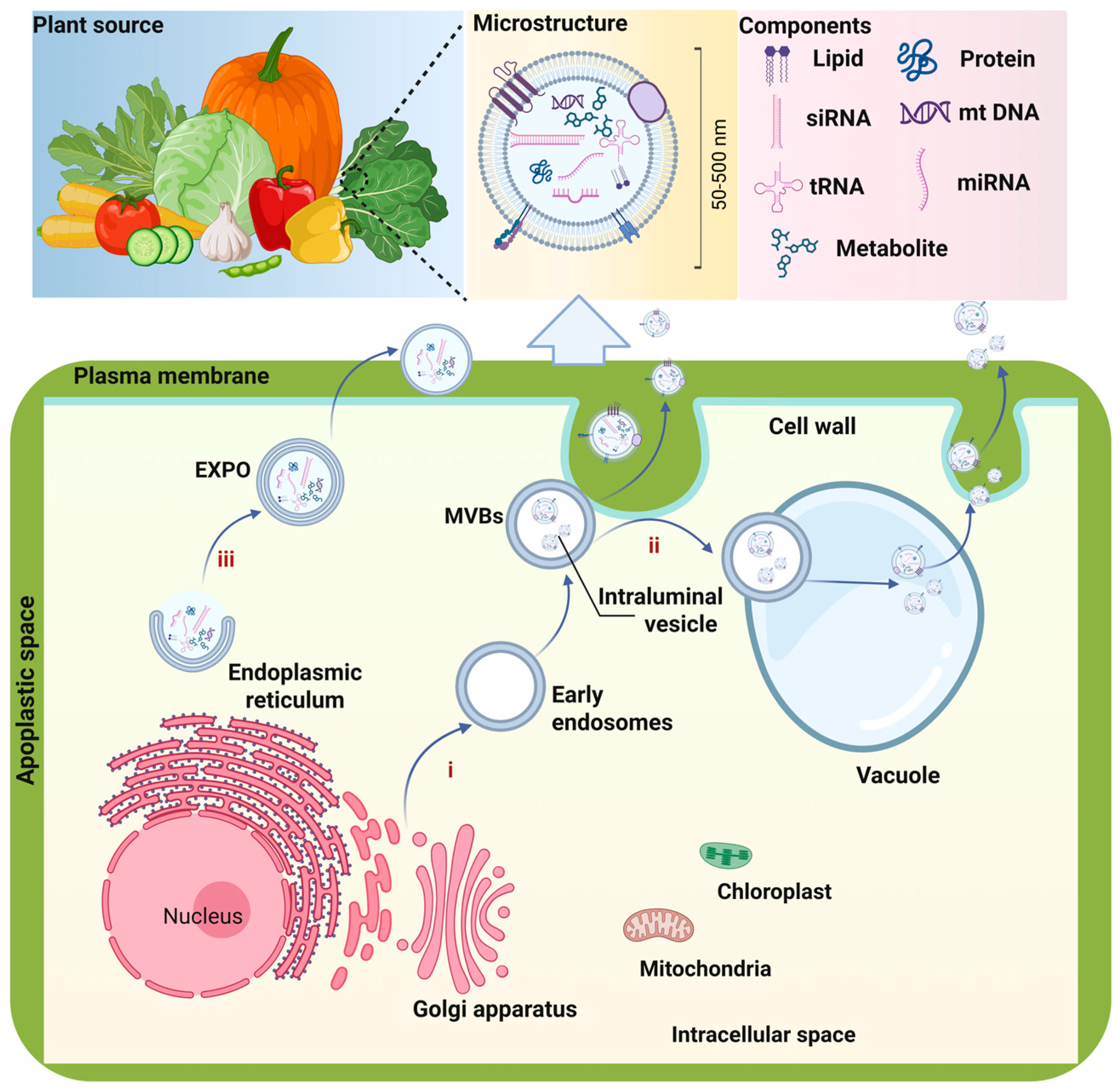
2.1. Biogenesis of PDVLNs
2.2. The Preparation of PDVLNs
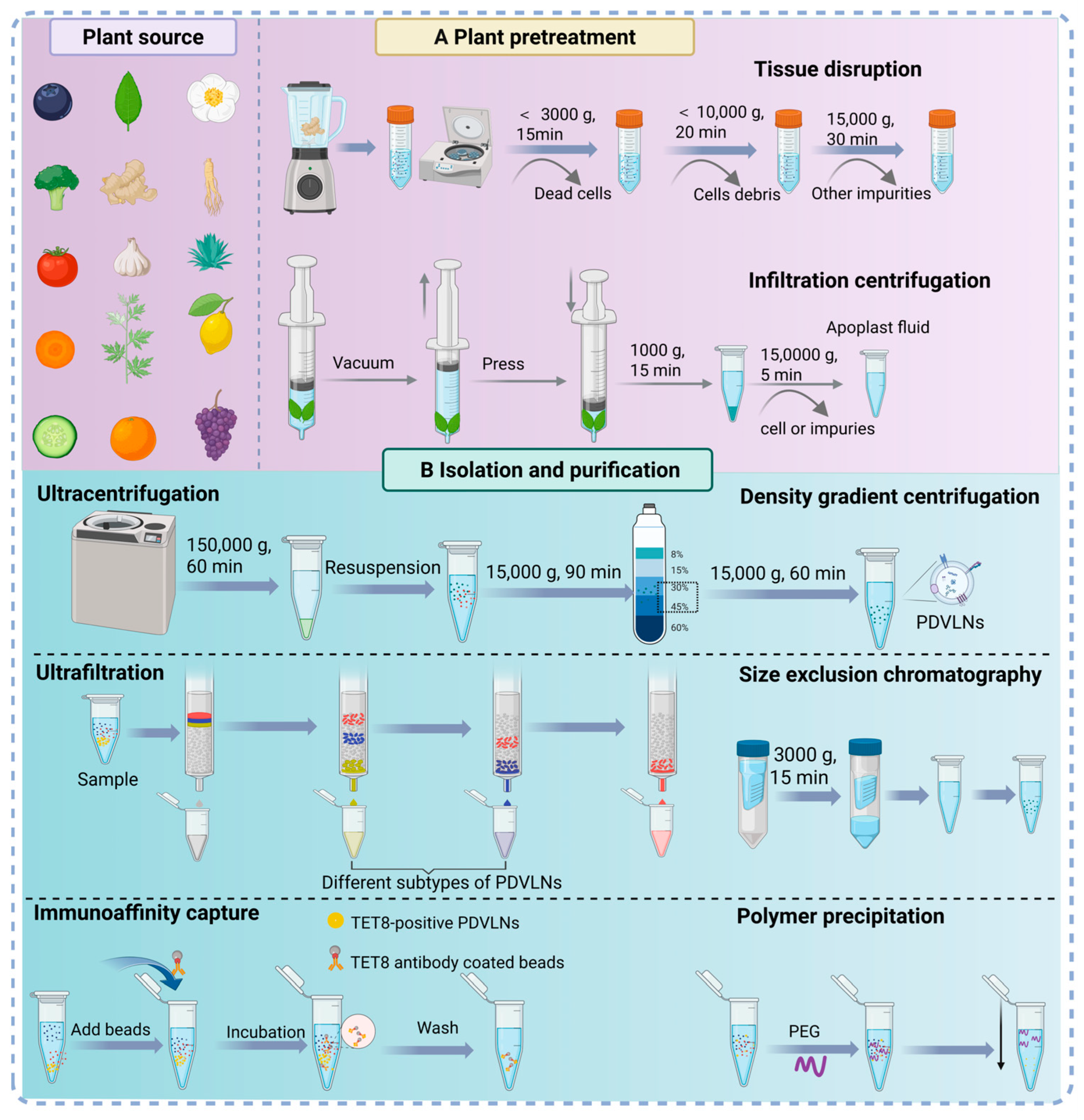
2.2.1. Plant Sample Pretreatment
2.2.2. Isolation Methods of PDVLNs


| Preparation Techniques | Principles | Advantages | Disadvantages | Refs |
|---|---|---|---|---|
| Differential ultracentrifugation | Difference in density | Simple operation; low cost; high sample processing capacity; excellent yield | (i) Lengthy duration (ii) Low purity (iii) Special equipment required | [46] |
| Density gradient centrifugation | Precipitation velocity and density | High purity, minimal contamination; separation of a subpopulation of exosomes | (i) Time and labor-consuming (ii) High equipment requirement (iii) Complicated operation steps | [47] |
| Ultrafiltration | Particle size | High efficiency; great portability | (i) Highly complex procedure; (ii) Destruction of PDVLN structure (iii) Possibility of clogging | [48] |
| Size-exclusion chromatography | Particle size and molecular weight | High purification; suitable for separation of large diluted samples; great reproducibility | (i) Lengthy duration (ii) Lack of specificity (iii) Complex equipment required | [39] |
| Immunoaffinity capture | Specific binding of PDVLNs to affinity magnetic beads | High purity (≥99%) and selectivity; convenient operation and great enrichment | (i) Longer processing time; higher cost (ii) Low yield (iii) High requirements for reagents | [49] |
| Polymer precipitation | Reduce the solubility of PDVLNs to cause precipitation | Simple operation; shorter processing time; preservation of PDVLN integrity | (i) Retention and contamination of the polymer | [50] |
2.3. Key Active Components of PDVLNs
2.3.1. Lipids
2.3.2. Proteins
2.3.3. Nucleic Acids
2.3.4. Unique Metabolite of Certain PDVLNs
| Plant | Part | Pretreatment | Extraction | Physical Property | Chemical Components | Refs. | |||
|---|---|---|---|---|---|---|---|---|---|
| Morphology | Particle Size | Concentration or Yield | Surface Charge | ||||||
| Dioscorea japonica | Root | Juicing | DUC + DGC | Round | 168 nm and 328 nm | 15 × 109 particles/mL | - | RNA, proteins, and lipids | [80] |
| Taraxacum mongolicum Hand.-Mazz. | Whole plant | Squeezing | DUC + UF | Sphere-shaped | 187 nm | 5.75 × 10¹¹ particles/mL | - | Proteins, lipids, and RNA | [81] |
| Rhizoma Drynariae | Root | Blending | DUC | Cup-shaped | 75.7 ± 15.8 nm | 4.17 × 10¹¹ particles/mg | −43.2 ± 0.04 mV | RNAs, proteins, lipids, naringin, narirutin, and naringenin | [74,82] |
| Pueraria lobata | Root | Soaking | DUC | Round | 119 to 163 nm | 6 × 10⁹ particles/mL | - | - | [83] |
| Pueraria lobata | Root | Grinding | DUC + UF | Round | 40 to 150 nm | 1.0 × 10¹¹ particles/mL | - | [84] | |
| Morinda Officinalis | Root | Juicing | DUC | Round- or cup-shaped | 61.24 ± 12.74 nm | 2.25 × 10¹² particles/mL | - | Nucleic acids, proteins, and lipids | [75] |
| Rehmanniae Radix | Root | Juicing | DUC + DGC | - | 118 nm | 2.6 × 10⁶ particles/mg | - | miRNAs | [82] |
| Atractylodes macrocephala | Root | Juicing | DUC | Round- or cup-shaped | 90.61 ± 19.66 nm | 6.27 × 10¹¹ particles/mL | - | Nucleic acids, lipids, and metabolites | [85] |
| Coptis chinensis | Root | Juicing | DUC | Cup-shaped | 55 to 120 nm | 8.45 × 10¹⁰ particles/mL | - | - | [86] |
| Platycodon grandiflorum | Root | Juicing | DUC + DGC | Circular or elliptical | 90 nm | 1.4 × 10⁸ particles/mL | −23.5 mV | Proteins | [87] |
| Lycium barbarum L. | Fruit | Juicing | DUC + DGC | Round | 171.0 nm | 9.48 × 10¹⁰ ± 1.86 × 10⁹ particles/mL | - | Lipids, terpenoids, alkaloids, amino acids and derivatives, saccharides, and alcohol compounds | [88] |
| Robinia pseudoacacia L. | Flower | Grinding | Enzymolysis | Round | 176.3 nm | 4.92 × 10¹⁴ particles/kg | 83.4 mV | Fatty acyls, glycerophospholipids, glycerolipids, sphingolipids, sterol lipids, prenol lipids, and polyketides | [89] |
| Houttuynia cordata | Leaf and flower | Juicing | DUC | Round | 169.5 and 166.2 nm | 6.67 × 10¹⁰ particles/g and 1.5 × 10¹⁰ particles/g | −23.04 ± 1.22 and −28.73 ± 0.87 mV | 326 miRNAs | [57] |
| Camellia sinensis | Leaf | Juicing | Enzymolysis + DUC | Round | 123.2 nm | 1.16 × 10¹⁰ particles/g | −25 mV and −95 mV | Diacylglycerol, lysophosphatidyl choline, and N-arachidonylglycine | [90] |
| Carthamus tinctorius L. | Flower | Homogenating | DUC + DGC | Saucer- or cup-shaped | 142.6 ± 0.7 nm | (11.49 ± 6.84) × 109 particles/g | −22.64 ± 0.52 mV | CD63 and TSG101, miR166a-3p, miR159a, and miR170-5p | [91] |
| Solanum lycopersicum | Fruit | Juicing | DUC + DGC | Circular | 120 to 140 nm | 2.2 × 10¹⁰ particles/mL | −20 to −30 mV | - | [92] |
| Aloe vera L. | Peel | Soaking | DUC | Round shaped | 145 ± 14 nm, 132 ±13 nm | 6.5 ± 5.7 × 10⁸ particles/g | - | Carbohydrates and flavonoids | [93] |
3. Intrinsic Anti-Cancer Activity of PDVLNs
3.1. Administration Route and In Vivo Distribution in Tumor Model
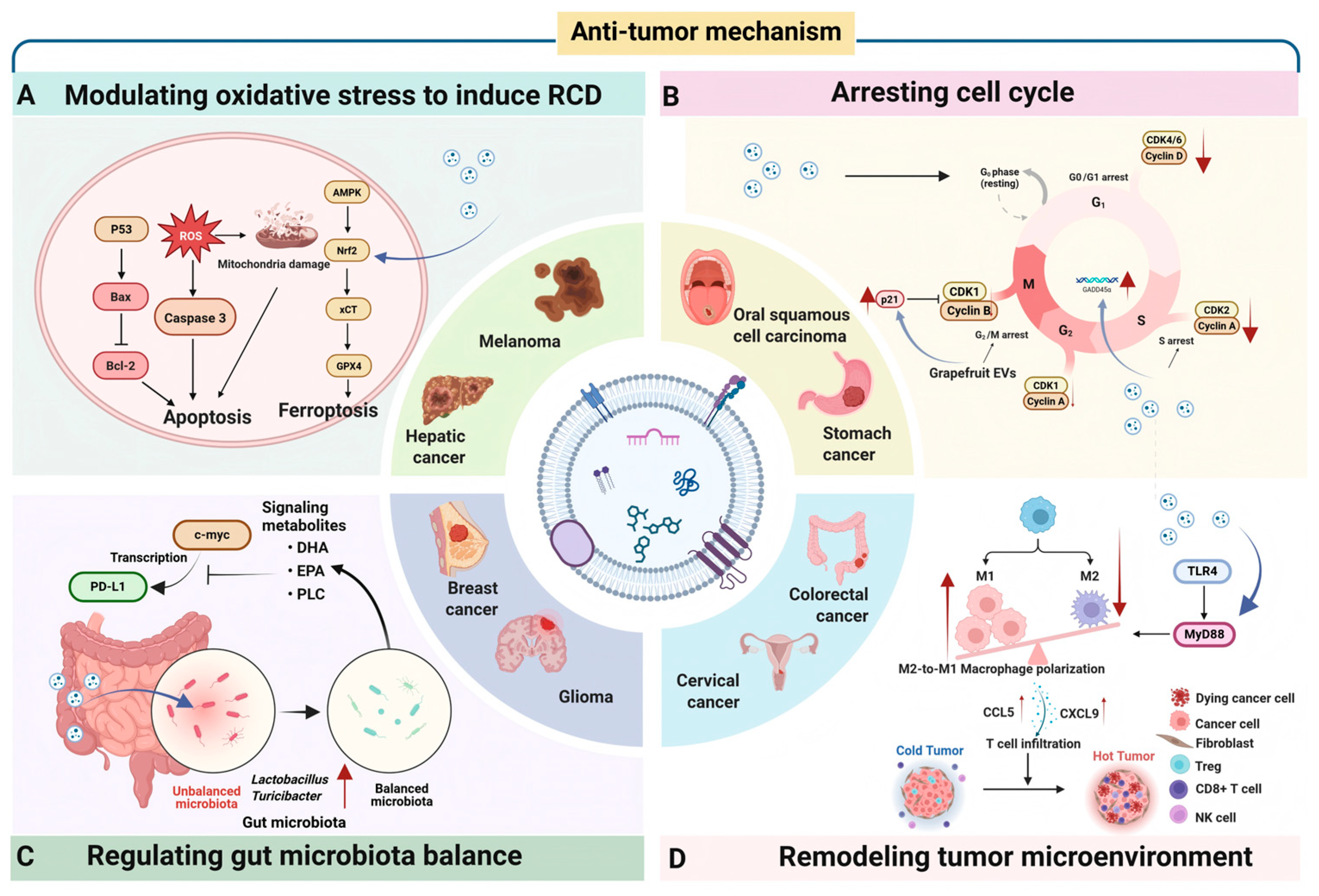
3.2. The Therapeutic Mechanism in Different Cancers
3.2.1. Modulating Oxidative Stress to Induce RCD
3.2.2. Arresting the Cell Cycle
3.2.3. Regulating Gut Microbiota
3.2.4. Reversing Immunosuppressive TME
| Plant Source | Cancer | Mechanism and Pathway of Action | Active Ingredient | Refs. |
|---|---|---|---|---|
| Allium sativum L. | A498 and A549 | (i) Inhibit cancer cell proliferation (ii) Induce caspase-mediated apoptosis | - | [109] |
| Citrus limon L. | A549, SW480 and LAMA84 cells | (i) Induce TRAIL-mediated cell apoptosis | - | [110] |
| Dendropanax morbifera | B16BL6 mouse melanoma cell | (i) Reduce melanin content and tyrosinase, and tyrosinase-related proteins | [111] | |
| Camellia sinensis [L.] O. Kuntze | Breast cancer | (i) ROS accumulation and microbiota modulation | - | [100] |
| Camellia sinensis | Breast cancer | (i) Pro-apoptosis via an increase in the accumulation of intracellular ROS and microbiota modulation | - | [112] |
| Brassica oleracea var. italica | Caco-2 | (i) Toxic effects on cancer cells and apoptosis induction | ath-miR159a, ath-miR162a-3p, ath-miR166b-3p, and ath-miR396b-5p | [113] |
| Momordica charantia L. | Cervical cancer | (i) Activate the Bcl-2/Bax/p-Akt pathway (ii) Induce ferroptosis by upregulating GPX4 | - | [102] |
| Zingiber officinale Roscoe | Colon cancer | (i) Decrease pro-inflammatory cytokines (ii) Trigger apoptosis | 6-gingerol and 6-shogaol | [76] |
| Zea mays L. | Colon cancer | (i) Inhibit the proliferation of cancer cells (ii) Induce tumor necrosis factor-α release from RAW264.7 cells | - | [114] |
| Citrus limon L. | Gastric cancer | (i) Cause the gastric cancer cell cycle S-phase arrest (ii) Cell apoptosis | - | [103] |
| Momordica charantia | Glioma | (i) Inhibit glioma growth through PI3K/AKT pathway (ii) Prevent metastasis by reducing MMP9 | - | [115] |
| Asparagus cochinchinensis | Hep G2, Hep 3B and SMMC-7721 | (i) Increase vesicle circulation time and accumulation in tumor sites (i) Apoptosis-inducing effect | - | [15] |
| Morus nigra L. | Hepatocellular carcinoma | (i) Increase intracellular ROS and trigger mitochondrial damage (ii) Intestinal microbiota modulation | - | [55] |
| Salvia chinensis Benth | Hepatocellular carcinoma | (i) Induced ferroptosis by the AMPK/Nrf2/xCT axis | - | [101] |
| Cannabis sativa L. | Hepatocellular carcinoma | (i) Arrest the G0/G1 phase; induce cell death by activating mitochondrial-dependent apoptosis | D-9-tetrahydrocannabinol and cannabidiol | [116] |
| Centella Asiatica | HepG2 | (i) Increase in ROS levels, mitochondrial damage (ii) Cell cycle arrest at the G1 phase (iii) Induce apoptosis | Rich miRNAs | [117] |
| Boesenbergia rotunda (L.) Mansf. | HT-29 and HCT116 | (i) Induction of apoptosis | - | [118] |
| Hedyotis diffusa Willd. | Huh-7 cells | (i) Suppress the proliferation (ii) Induce apoptosis | miR-451, miR-486, miR-144, let-7, and miR-30 | [119] |
| Brassica oleracea var. italica. | Human embryonic kidney 293 T cells | (i) Induce apoptosis in cancer cells by targeting IRS1 | miR167a | [70] |
| Artemisia annua | Lung cancer | (i) Remold tumor-associated macrophages for tumor regression by cGAS-STING pathway | Mitochondrial DNA | [120] |
| Zingiber officinale Roscoe | Melanoma | (i) Induce cell cycle by mediating p53 signaling pathways (ii) Cause cancer cell apoptosis. | Gingerols and shogaols | [77] |
| Zingiber officinale Roscoe | Melanoma | (i) Elevate the DHA level to inhibit c-Myc-mediated transcription of PD-L1 | AlymiR159a-3p | [105] |
| Panax ginseng C. A. Mey. | Melanoma | (i) Alter M2 polarized macrophages dependent on TLR4 and MyD88 signaling | - | [56] |
| Panax ginseng C. A. Mey. | Melanoma | (i) Promote T cell infiltration into tumors; alter “cold” tumor into “hot” tumor status | - | [107] |
| Panax ginseng C. A. Mey. | Melanoma | (i) Ameliorate T cell exhaustion by reprogramming macrophages via the mTOR-T-bet axis, | - | [108] |
| Citrus paradisi Macfad. | Melanoma | (i) Trigger cell cycle arrest at G2/M (ii) Upregulate cell cycle inhibitor p21 | - | [68] |
| Cucumis sativus L. | Non-small-cell lung cancer | (i) Inhibit the vitality of tumor cells by suppressing STAT3 phosphorylation (ii) Induce cell cycle arrest in G2/M phase | Cucurbitacin B | [78] |
| Momordica charantia L. | Oral squamous cell carcinoma | (i) Induce S phase cell cycle arrest and apoptosis (ii) Reduce the drug resistance of cancer cells to chemotherapeutic agents | - | [121] |
| Fallopia multiflora (Thunb.) Haraldson | SMMC-7721 | (i) Modulate signal pathways associated with the cell cycle | - | [122] |
| Platycodon grandiflorum | Triple-negative breast cancer | (i) Facilitate ROS and the polarization of tumor-associated macrophages toward the M1 phenotype (ii) Modulate the gut microbiota | - | [123] |
| Brucea javanica | Triple-negative breast cancer | (i) Retard tumor growth and metastasis via PI3K/Akt/mTOR pathway (ii) Promote ROS/caspase-mediated apoptosis | Ten active miRNAs | [67] |
4. PDVLNs as Drug Delivery Carriers
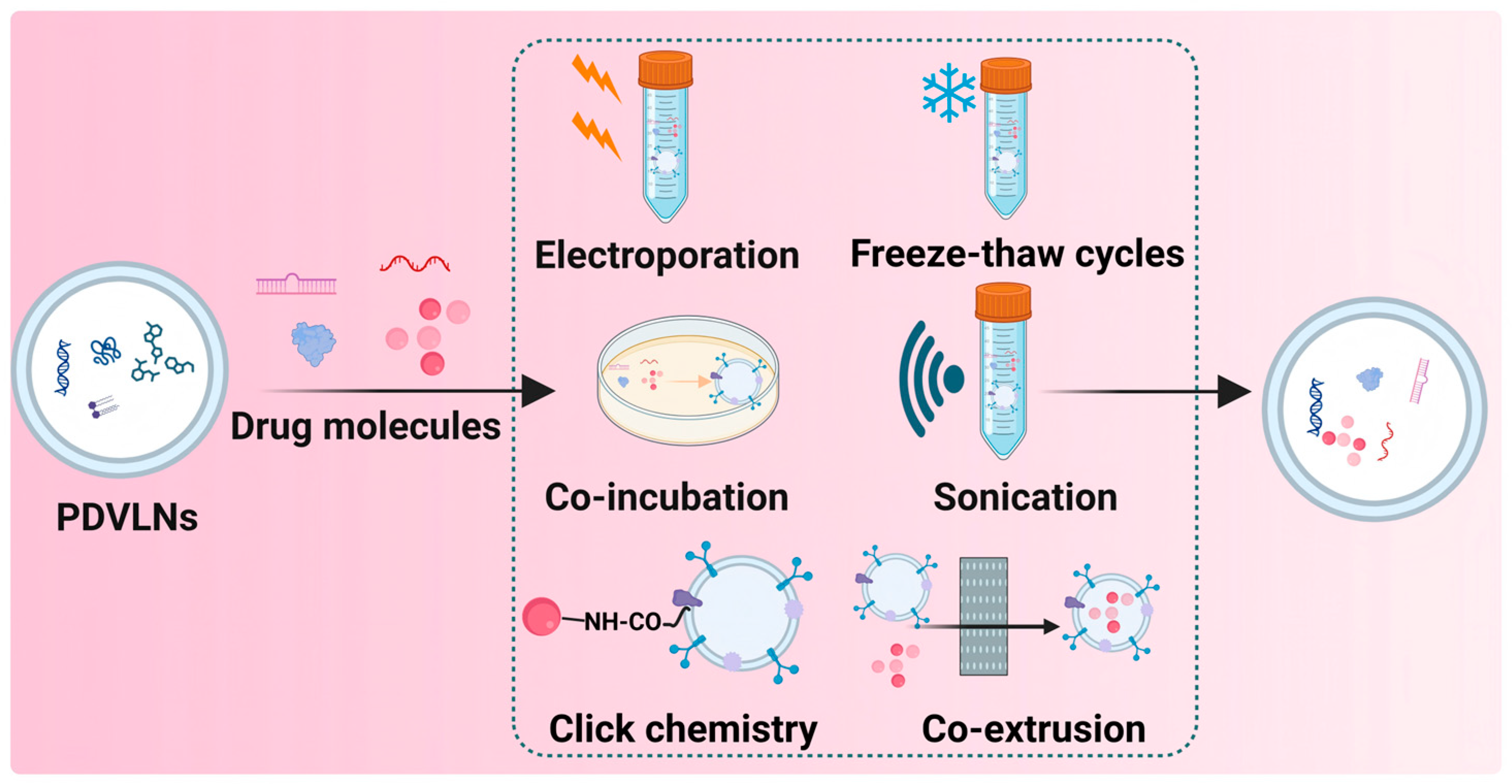
4.1. Drug Loading Methods
4.1.1. Electroporation
4.1.2. Sonication
4.1.3. Other Methods
4.2. PDVLNs as Natural Delivery Vehicles for Anti-Tumor Drugs

| Loading Strategy | Drug Loading Type | Merit | Limitation | Refs. |
|---|---|---|---|---|
| Electroporation | Hydrophilic drug, such as nucleic acid | (i) High efficiency (ii) Simple operation | (i) Easy to cause the accumulation and agglomeration | [140,141] |
| Co-incubation | Small-molecule hydrophobic drug molecules | (i) Simple operation (ii) Mild drug loading process | (i) External force is needed | [142] |
| Sonication | Hydrophilic drug | (i) High loading efficiency (ii) Uniform particle size | (i) Disrupt the structure of PDVLNs | [143] |
| Freezing and thawing method | Chemical compounds | (i) High drug loading efficiency | (i) Time-consuming (ii) Lead to protein inactivation (iii) PDVLNs aggregation | [128] |
| Osmotic shock method | Hydrophilic drugs | (i) High drug loading efficiency (ii) Easy operation (iii) Maintain the activity of PDVLNs | (i) The structure of the PDVLNs may be damaged (ii) Suitable to load only one drug | [134] |
| Co-extrusion | Fat-soluble and hydrophilic drugs | (i) High drug loading efficiency (ii) Simple operation (iii) Uniform particle size | (i) The integrity of PDVLNs is easily damaged | [143,144] |
| Click chemistry | Chemical compounds | (i) High efficiency | (i) The drug loading process is impacted by the environment | [135] |
4.3. Engineering Strategies of PDVLNs for Cancer Therapy
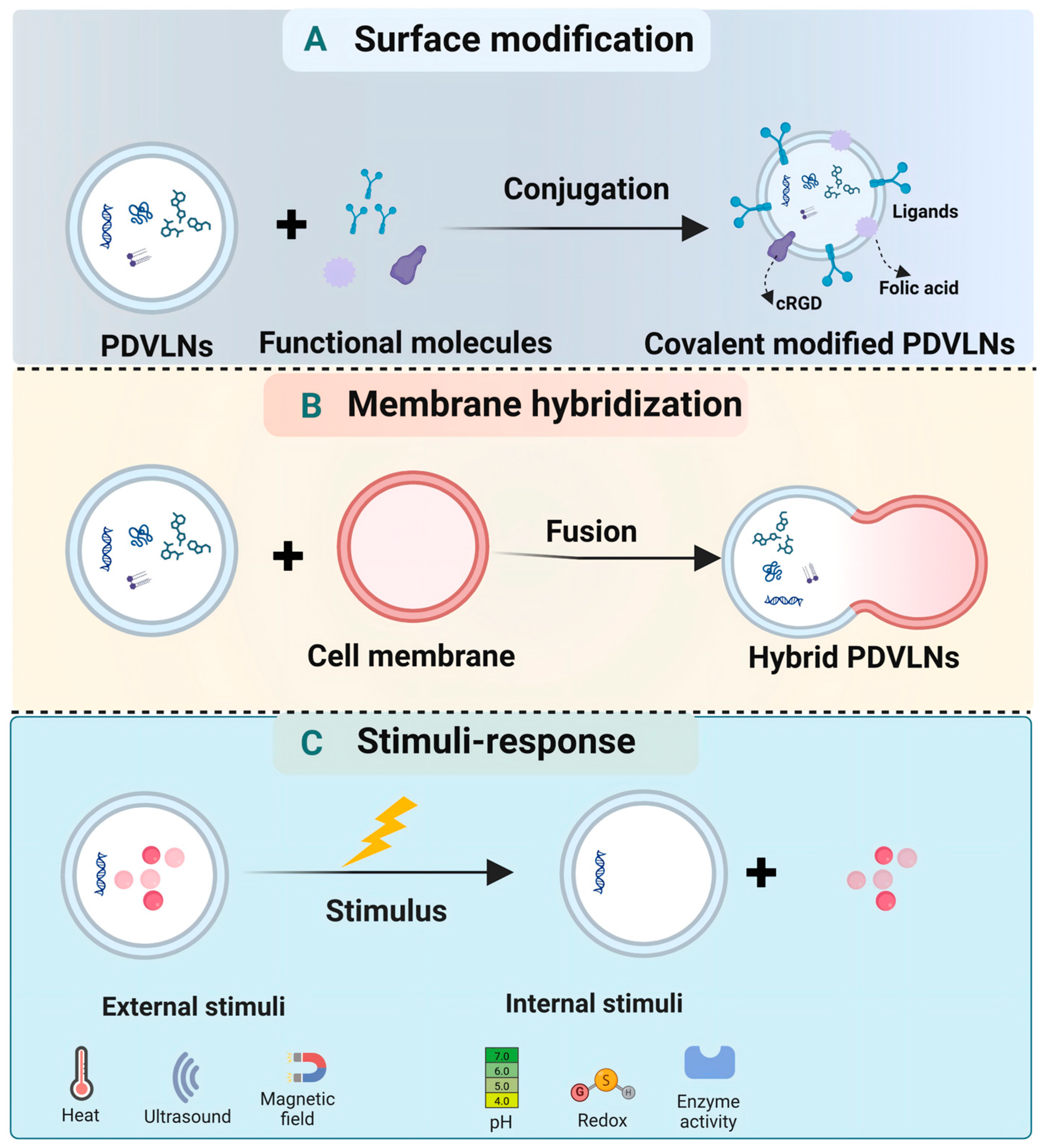
4.3.1. Surface Modification
4.3.2. Membrane Hybridization
4.3.3. Stimuli-Responsive PDVLNs
| Plant Source | Loading Method | Modification Process | Cancer | Advantage | Refs. |
|---|---|---|---|---|---|
| Grapefruit | Co-incubation | Coated with the plasma membrane of leukocytes and deliver curcumin and Dox | Breast cancer and colon cancer | (i) Enhanced the homing ability to inflammatory tumor tissues | [69] |
| Grapefruit | Sonication | Coated with FA and polyethylenimine | Glioma | (i) Increase drug loading (ii) Targeting capacity, and alleviating the toxicity of the polyethylenimine | [150] |
| Aloe vera | Co-incubation | Deliver indocyanine green for phototherapy | Melanoma | (i) Promote the accumulation of drugs at the tumor site (ii) Enhance the anti-cancer efficacy | [73] |
| Ginger | Co-incubation | Coated with FA and siRNA | Human oral epidermoid carcinoma cells | (i) Increase the specific delivery of siRNA to tumors | [148] |
| Ginger | Sonication | Carry FA and Dox | Colon cancer | (i) Mediate targeted delivery of Dox to tumor cells (ii) Enhance the chemotherapeutic inhibition of tumor growth | [157] |
| Cabbage | Co-incubation | Deliver Dox and miR184 | Colon cancer | (i) Improve the targeting effect of the drug | [42] |
| Spinach | Freeze-thaw cycle | Combine with outer membrane vesicles from Escherichia coli MG1655 | Colon cancer | (i) Improve targeting accuracy (ii) Strengthen specific immune responses | [158] |
| Lemon | Co-extrusion | Fuse with 4T1 cancer cell membrane fragments | Breast cancer | (i) Target the homologous tumor | [159] |
5. PDVLNs for Combination with Cancer Immunotherapy
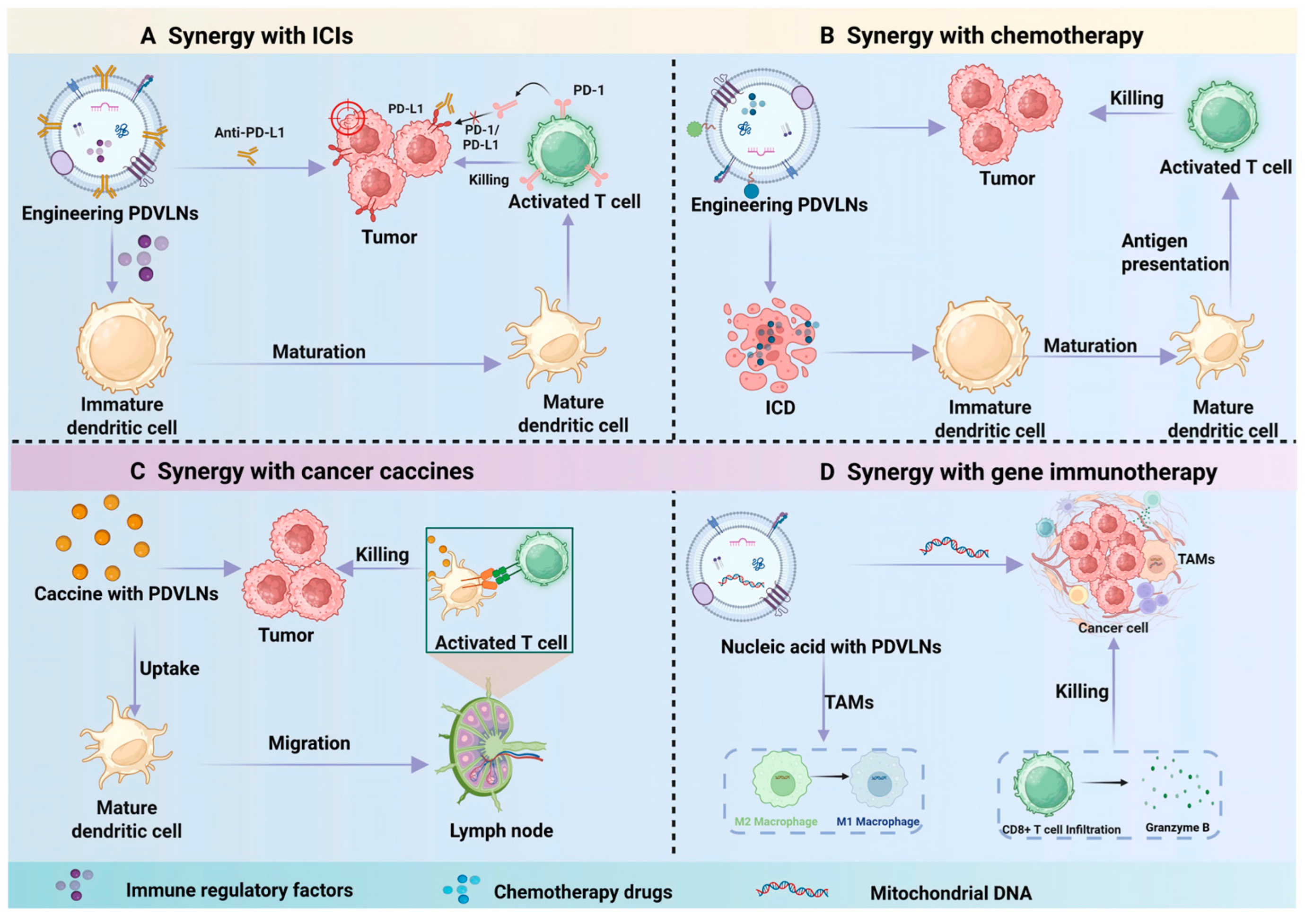
5.1. Combination with Immune Checkpoint Inhibitors
5.2. Combination with Chemotherapy
5.3. Combination with Cancer Vaccines
5.4. Combination with Gene Immunotherapy

| Combination Therapy | Source | Application | Refs. |
|---|---|---|---|
| Immune checkpoint inhibitors | Wild Glycyrrhiza uralensis Fisch roots | (i) Co-deliver immune checkpoint inhibitors; (ii) Activate T cells and promote the maturation of dendritic cells | [123] |
| Garlic | (i) Promoting immune checkpoint blockade therapy | [164] | |
| Chemotherapy | Ginseng | (i) Co-deliver autologous tumor antigens and immune adjuvants; (ii) Contribute to immune regulation | [154] |
| Citrus fruit | (i) Contain anti-tumor bioactive components; (ii) Load chemotherapy drugs and immune adjuvants; (iii) Combine chemotherapy and immunotherapy | [174] | |
| Turmeric | (i) Co-deliver chemotherapy drugs and antibodies; (ii) Combine chemotherapy and immunotherapy | [169] | |
| Ginger | (i) Enhance tumor targeting; (ii) Amplify drug sensitivity | [7] | |
| Cancer vaccines | Ginseng | (i) Co-deliver autologous tumor antigens; (ii) Promote the maturation of dendritic cells | [170] |
| Cannabis sativa Roots | (i) Promote the maturation of dendritic cells; (ii) Reinforce immune cell responses | [175] | |
| Ginseng and spinach | (i) Promote the maturation of dendritic cells and activation of T cells; (ii) Triggering a strong anti-tumor immune response | [171] | |
| Gene immunotherapy | Artemisia annua | (i) Deliver autologous miRNA for cancer therapy | [120] |
| Brucea javanica | (i) Deliver autologous mitochondrial DNA for cancer therapy | [67] |
6. Clinical Transformation of PDVLNs
7. Challenges and Future Perspectives
8. Conclusions
Author Contributions
Funding
Data Availability Statement
Conflicts of Interest
Abbreviations
| MDVs | Mammalian-derived extracellular vesicles |
| TME | Tumor microenvironment |
| PDVLNs | Plant-derived vesicle-like nanoparticles |
| VLNs | Vesicle-like nanoparticles |
| EVs | Extracellular vesicles |
| RCD | Regulated cell death |
| MVBs | Multivesicular bodies |
| TEM | Transmission electron microscope |
| EXPO | Exocyst-positive organelle |
| LEs | Late endosomes |
| ILVs | Intraluminal vesicles |
| PM | Plasma membrane |
| UC | Ultracentrifugation |
| DGC | Density gradient centrifugation |
| UF | Ultrafiltration |
| UCG | Ultrafiltration centrifugation |
| SEC | Size exclusion chromatography |
| PEG | Golyethylene glycol |
| GVLNs | Ginger-derived vesicle-like nanoparticles |
| GDNPs | ginseng-derived nanoparticles |
| PA | Phosphatidic acid |
| MGDG | Monogalactosyldiacylglycerol |
| miRNAs | microRNAs |
| MLVLNs | Morus nigra L. leaves-derived vesicle-like nanoparticles |
| PD-L1 | Programmed death-ligand 1 |
| PD-1/PD-L1 | Programmed death-1/programmed death-ligand 1 |
| DOX | Doxorubicin |
| DCs | Dendritic cells |
| OXA | oxaliplatin |
| ICD | immunogenic cell death |
References
- Wang, D.; Mei, Z.; Zhao, T.; Tian, H.; Peng, Z.; Kang, X.; Zhang, Y.; Qi, X. The roles of plant-derived nanovesicles in malignant tumours: A bibliometric analysis. Int. J. Biol. Macromol. 2025, 305, 141112. [Google Scholar] [CrossRef]
- Schwartz, S.M. Epidemiology of Cancer. Clin. Chem. 2024, 70, 140. [Google Scholar] [CrossRef]
- Ly, N.P.; Han, H.S.; Kim, M.; Park, J.H.; Choi, K.Y. Plant-derived nanovesicles: Current understanding and applications for cancer therapy. Bioact. Mater. 2023, 22, 365. [Google Scholar] [CrossRef] [PubMed]
- Li, Y.; Zhang, H.; Merkher, Y.; Chen, L.; Liu, N.; Leonov, S.; Chen, Y. Recent advances in therapeutic strategies for triple-negative breast cancer. J. Hematol. Oncol. 2022, 15, 121. [Google Scholar] [CrossRef]
- Fan, D.; Cao, Y.; Cao, M.; Wang, Y.; Cao, Y.; Gong, T. Nanomedicine in cancer therapy. Signal Transduct Target Ther. 2023, 8, 293. [Google Scholar] [CrossRef]
- Sun, L.; Liu, H.; Ye, Y.; Lei, Y.; Islam, R.; Tan, S.; Tong, R.; Miao, Y.B.; Cai, L. Smart nanoparticles for cancer therapy. Signal Transduct Target Ther. 2023, 8, 418. [Google Scholar] [CrossRef]
- Xu, H.; Hu, D.; Liu, S.; Yang, L.; Li, J.; Bai, Y.; Zhao, G.; Tang, W.; Jiang, L. Folic Acid-Modified Ginger-Derived Exosome-Like Nanoparticles Co-Delivering Sunitinib Suppress Renal Cell Carcinoma via PI3K-Akt Pathway Inhibition, P-gp Downregulation, and Macrophage Reprogramming. Adv. Sci. 2025, 13, e12563. [Google Scholar] [CrossRef] [PubMed]
- Dad, H.A.; Gu, T.W.; Zhu, A.Q.; Huang, L.Q.; Peng, L.H. Plant Exosome-like Nanovesicles: Emerging Therapeutics and Drug Delivery Nanoplatforms. Mol. Ther. 2021, 29, 13. [Google Scholar] [CrossRef] [PubMed]
- Kim, J.; Li, S.; Zhang, S.; Wang, J. Plant-derived exosome-like nanoparticles and their therapeutic activities. Asian J. Pharm. Sci. 2022, 17, 53. [Google Scholar] [CrossRef]
- Wang, S.; Zhang, Y.; Zeng, Y.; Luo, X.; Chen, J.; Deng, Q.; Xiao, P.; Lin, R.; Chen, X.; Ding, X.; et al. Plant-derived vesicle-like nanoparticles for immunomodulation: Mechanisms and applications. Bioact. Mater. 2026, 55, 171. [Google Scholar] [CrossRef]
- Cai, Q.; Halilovic, L.; Shi, T.; Chen, A.; He, B.; Wu, H.; Jin, H. Extracellular vesicles: Cross-organismal RNA trafficking in plants, microbes, and mammalian cells. Extracell. Vesicles Circ. Nucl. Acids 2023, 4, 262. [Google Scholar] [CrossRef] [PubMed]
- Wang, Y.; Wang, J.; Ma, J.; Zhou, Y.; Lu, R. Focusing on Future Applications and Current Challenges of Plant Derived Extracellular Vesicles. Pharmaceuticals 2022, 15, 708. [Google Scholar] [CrossRef]
- Kalluri, R.; Lebleu, V.S. The biology, function, and biomedical applications of exosomes. Science 2020, 367, eaau6977. [Google Scholar] [CrossRef] [PubMed]
- Mu, J.; Zhuang, X.; Wang, Q.; Jiang, H.; Deng, Z.B.; Wang, B.; Zhang, L.; Kakar, S.; Jun, Y.; Miller, D.; et al. Interspecies communication between plant and mouse gut host cells through edible plant derived exosome-like nanoparticles. Mol. Nutr. Food Res. 2014, 58, 1561. [Google Scholar] [CrossRef]
- Zhang, L.; He, F.; Gao, L.; Cong, M.; Sun, J.; Xu, J.; Wang, Y.; Hu, Y.; Asghar, S.; Hu, L.; et al. Engineering Exosome-Like Nanovesicles Derived from Asparagus cochinchinensis Can Inhibit the Proliferation of Hepatocellular Carcinoma Cells with Better Safety Profile. Int. J. Nanomed. 2021, 16, 1575. [Google Scholar] [CrossRef]
- Teng, Y.; Ren, Y.; Sayed, M.; Hu, X.; Lei, C.; Kumar, A.; Hutchins, E.; Mu, J.; Deng, Z.; Luo, C.; et al. Plant-Derived Exosomal MicroRNAs Shape the Gut Microbiota. Cell Host Microbe 2018, 24, 637. [Google Scholar] [CrossRef]
- Hoshino, A.; Kim, H.S.; Bojmar, L.; Gyan, K.E.; Cioffi, M.; Hernandez, J.; Zambirinis, C.P.; Rodrigues, G.; Molina, H.; Heissel, S.; et al. Extracellular Vesicle and Particle Biomarkers Define Multiple Human Cancers. Cell 2020, 182, 1044. [Google Scholar] [CrossRef]
- Chen, F.; Bao, R.; Yang, W.; Lu, Y.; Guo, J.; Chen, W.; Li, J.; Feng, K.; Zhang, W.; Di, L.; et al. Engineered plant extracellular vesicles: Emerging nanoplatforms for combinational cancer immunotherapy. Acta Pharm. Sin. B 2025, 15, 5663. [Google Scholar] [CrossRef]
- Chen, X.; Ji, S.; Yan, Y.; Lin, S.; He, L.; Huang, X.; Chang, L.; Zheng, D.; Lu, Y. Engineered Plant-Derived Nanovesicles Facilitate Tumor Therapy: Natural Bioactivity Plus Drug Controlled Release Platform. Int. J. Nanomed. 2023, 18, 4779. [Google Scholar] [CrossRef] [PubMed]
- Sang, W.; Zhang, Z.; Dai, Y.; Chen, X. Recent advances in nanomaterial-based synergistic combination cancer immunotherapy. Chem. Soc. Rev. 2019, 48, 3771. [Google Scholar] [CrossRef]
- Mao, X.; Li, T.; Qi, W.; Miao, Z.; Zhu, L.; Zhang, C.; Jin, H.; Pan, H.; Wang, D. Advances in the study of plant-derived extracellular vesicles in the skeletal muscle system. Pharmacol. Res. 2024, 204, 107202. [Google Scholar] [CrossRef]
- Cui, Y.; Gao, J.; He, Y.; Jiang, L. Plant extracellular vesicles. Protoplasma 2020, 257, 3. [Google Scholar] [CrossRef]
- An, Q.; Hückelhoven, R.; Kogel, K.H.; van Bel, A.J. Multivesicular bodies participate in a cell wall-associated defence response in barley leaves attacked by the pathogenic powdery mildew fungus. Cell Microbiol. 2006, 8, 1009. [Google Scholar] [CrossRef] [PubMed]
- Wang, J.; Ding, Y.; Wang, J.; Hillmer, S.; Miao, Y.; Lo, S.W.; Wang, X.; Robinson, D.G.; Jiang, L. EXPO, an exocyst-positive organelle distinct from multivesicular endosomes and autophagosomes, mediates cytosol to cell wall exocytosis in Arabidopsis and tobacco cells. Plant Cell. 2010, 22, 4009. [Google Scholar] [CrossRef] [PubMed]
- Wang, X.; Chung, K.P.; Lin, W.; Jiang, L. Protein secretion in plants: Conventional and unconventional pathways and new techniques. J. Exp. Bot. 2017, 69, 21. [Google Scholar] [CrossRef]
- Pérez-bermúdez, P.; Blesa, J.; Soriano, J.M.; Marcilla, A. Extracellular vesicles in food: Experimental evidence of their secretion in grape fruits. Eur. J. Pharm. Sci. 2017, 98, 40. [Google Scholar] [CrossRef]
- Cui, Y.; Cao, W.; He, Y.; Zhao, Q.; Wakazaki, M.; Zhuang, X.; Gao, J.; Zeng, Y.; Gao, C.; Ding, Y.; et al. A whole-cell electron tomography model of vacuole biogenesis in Arabidopsis root cells. Nat. Plants 2019, 5, 95. [Google Scholar] [CrossRef]
- Manjithaya, R.; Subramani, S. Autophagy: A broad role in unconventional protein secretion? Trends Cell Biol. 2011, 21, 67. [Google Scholar] [CrossRef]
- Feng, J.; Xiu, Q.; Huang, Y.; Troyer, Z.; Li, B.; Zheng, L. Plant-Derived Vesicle-Like Nanoparticles as Promising Biotherapeutic Tools: Present and Future. Adv. Mater. 2023, 35, e2207826. [Google Scholar] [CrossRef]
- Liu, Y.; Wu, S.; Koo, Y.; Yang, A.; Dai, Y.; Khant, H.; Osman, S.R.; Chowdhury, M.; Wei, H.; Li, Y.; et al. Characterization of and isolation methods for plant leaf nanovesicles and small extracellular vesicles. Nanomedicine 2020, 29, 102271. [Google Scholar] [CrossRef]
- Rutter, B.D.; Innes, R.W. Extracellular Vesicles Isolated from the Leaf Apoplast Carry Stress-Response Proteins. Plant Physiol. 2017, 173, 728. [Google Scholar] [CrossRef] [PubMed]
- Regente, M.; Corti-Monzón, G.; Maldonado, A.M.; Pinedo, M.; Jorrín, J.; de la Canal, L. Vesicular fractions of sunflower apoplastic fluids are associated with potential exosome marker proteins. FEBS Lett. 2009, 583, 3363. [Google Scholar] [CrossRef]
- O’leary, B.M.; Rico, A.; Mccraw, S.; Fones, H.N.; Preston, G.M. The infiltration-centrifugation technique for extraction of apoplastic fluid from plant leaves using Phaseolus vulgaris as an example. J. Vis. Exp. 2014, 19, 52113. [Google Scholar]
- Bai, C.; Liu, J.; Zhang, X.; Li, Y.; Qin, Q.; Song, H.; Yuan, C.; Huang, Z. Research status and challenges of plant-derived exosome-like nanoparticles. Biomed Pharmacother. 2024, 174, 116543. [Google Scholar] [CrossRef] [PubMed]
- Cong, M.; Tan, S.; Li, S.; Gao, L.; Huang, L.; Zhang, H.G.; Qiao, H. Technology insight: Plant-derived vesicles-How far from the clinical biotherapeutics and therapeutic drug carriers? Adv. Drug Deliv. Rev. 2022, 182, 114108. [Google Scholar] [CrossRef]
- Hopiavuori, B.R.; Masser, D.R.; Wilkerson, J.L.; Brush, R.S.; Mandal, N.A.; Anderson, R.E.; Freeman, W.M. Isolation of Neuronal Synaptic Membranes by Sucrose Gradient Centrifugation. Methods Mol. Biol. 2017, 1609, 33. [Google Scholar]
- Jang, J.; Jeong, H.; Jang, E.; Kim, E.; Yoon, Y.; Jang, S.; Jeong, H.S.; Jang, G. Isolation of high-purity and high-stability exosomes from ginseng. Front. Plant Sci. 2022, 13, 1064412. [Google Scholar] [CrossRef]
- Monguió-Tortajada, M.; Morón-Font, M.; Gámez-Valero, A.; Carreras-Planella, L.; Borràs, F.E.; Franquesa, M. Extracellular-Vesicle Isolation from Different Biological Fluids by Size-Exclusion Chromatography. Curr. Protoc. Stem Cell Biol. 2019, 49, e82. [Google Scholar] [CrossRef]
- Sidhom, K.; Obi, P.O.; Saleem, A. A Review of Exosomal Isolation Methods: Is Size Exclusion Chromatography the Best Option? Int. J. Mol. Sci. 2020, 21, 6466. [Google Scholar] [CrossRef]
- Grenhas, M.; Lopes, R.; Ferreira, B.V.; Barahona, F.; João, C.; Carneiro, E.A. Size-Exclusion Chromatography: A Path to Higher Yield and Reproducibility Compared to Sucrose Cushion Ultracentrifugation for Extracellular Vesicle Isolation in Multiple Myeloma. Int. J. Mol. Sci. 2024, 25, 8496. [Google Scholar] [CrossRef]
- Guo, J.; Wu, C.; Lin, X.; Zhou, J.; Zhang, J.; Zheng, W.; Wang, T.; Cui, Y. Establishment of a simplified dichotomic size-exclusion chromatography for isolating extracellular vesicles toward clinical applications. J. Extracell. Vesicles 2021, 10, e12145. [Google Scholar] [CrossRef] [PubMed]
- You, J.Y.; Kang, S.J.; Rhee, W.J. Isolation of cabbage exosome-like nanovesicles and investigation of their biological activities in human cells. Bioact. Mater. 2021, 6, 4321. [Google Scholar] [CrossRef]
- Liangsupree, T.; Multia, E.; Riekkola, M.L. Modern isolation and separation techniques for extracellular vesicles. J. Chromatogr. A 2021, 1636, 461773. [Google Scholar] [CrossRef]
- Yu, J.; Huang, D.; Liu, H.; Cai, H. Optimizing Conditions of Polyethylene Glycol Precipitation for Exosomes Isolation From MSCs Culture Media for Regenerative Treatment. Biotechnol. J. 2024, 19, e202400374. [Google Scholar] [CrossRef]
- Liu, Z.; Guo, Y.; Deng, Y.; Shao, J.; Huang, X.; Cao, Z. The potential of plant-derived vesicles in treating periodontitis and associated systemic diseases: Current advances and future directions. J. Nanobiotechnol. 2025, 23, 568. [Google Scholar] [CrossRef] [PubMed]
- Théry, C.; Amigorena, S.; Raposo, G.; Clayton, A. Isolation and characterization of exosomes from cell culture supernatants and biological fluids. Curr. Protoc. Cell Biol. 2006, 3, Unit 3.22. [Google Scholar] [CrossRef] [PubMed]
- Yang, D.; Zhang, W.; Zhang, H.; Zhang, F.; Chen, L.; Ma, L.; Larcher, L.M.; Chen, S.; Liu, N.; Zhao, Q.; et al. Progress, opportunity, and perspective on exosome isolation—Efforts for efficient exosome-based theranostics. Theranostics 2020, 10, 3684. [Google Scholar] [CrossRef]
- Zhang, J.; Nguyen, L.T.H.; Hickey, R.; Walters, N.; Wang, X.; Kwak, K.J.; Lee, L.J.; Palmer, A.F.; Reátegui, E. Immunomagnetic sequential ultrafiltration (iSUF) platform for enrichment and purification of extracellular vesicles from biofluids. Sci. Rep. 2021, 11, 8034. [Google Scholar] [CrossRef]
- Sundaram, P.M.; Casadei, L.; Lopez, G.; Braggio, D.; Balakirsky, G.; Pollock, R.; Prakash, S. Multi-Layer Micro-Nanofluidic Device for Isolation and Capture of Extracellular Vesicles Derived from Liposarcoma Cell Conditioned Media. J. Microelectromech Syst. 2020, 29, 776. [Google Scholar] [CrossRef]
- Jia, L.; Li, B.; Fang, C.; Liang, X.; Xie, Y.; Sun, X.; Wang, W.; Zheng, L.; Wang, D. Extracellular Vesicles of Mesenchymal Stem Cells Are More Effectively Accessed through Polyethylene Glycol-Based Precipitation than by Ultracentrifugation. Stem Cells Int. 2022, 2022, 3577015. [Google Scholar] [CrossRef]
- Liu, B.; Li, X.; Yu, H.; Shi, X.; Zhou, Y.; Alvarez, S.; Naldrett, M.J.; Kachman, S.D.; Ro, S.H.; Sun, X.; et al. Therapeutic potential of garlic chive-derived vesicle-like nanoparticles in NLRP3 inflammasome-mediated inflammatory diseases. Theranostics 2021, 11, 9311. [Google Scholar] [CrossRef]
- Fyfe, J.; Casari, I.; Manfredi, M.; Falasca, M. Role of lipid signalling in extracellular vesicles-mediated cell-to-cell communication. Cytokine Growth Factor Rev. 2023, 73, 20. [Google Scholar] [CrossRef]
- Li, Y.; Shao, S.; Zhou, Y.; Wang, Y.; Zheng, W.; Wang, H.; Wang, M.; Jin, K.; Zou, H.; Mou, X. Oral administration of Folium Artemisiae Argyi-derived exosome-like nanovesicles can improve ulcerative colitis by regulating intestinal microorganisms. Phytomedicine 2025, 137, 156376. [Google Scholar] [CrossRef]
- Sundaram, K.; Miller, D.P.; Kumar, A.; Teng, Y.; Sayed, M.; Mu, J.; Lei, C.; Sriwastva, M.K.; Zhang, L.; Yan, J.; et al. Plant-Derived Exosomal Nanoparticles Inhibit Pathogenicity of Porphyromonas gingivalis. iScience 2020, 23, 100869. [Google Scholar] [CrossRef]
- Gao, Q.; Chen, N.; Li, B.; Zu, M.; Ma, Y.; Xu, H.; Zhu, Z.; Reis, R.L.; Kundu, S.C.; Xiao, B. Natural lipid nanoparticles extracted from Morus nigra L. leaves for targeted treatment of hepatocellular carcinoma via the oral route. J. Nanobiotechnol. 2024, 22, 4. [Google Scholar] [CrossRef]
- Cao, M.; Yan, H.; Han, X.; Weng, L.; Wei, Q.; Sun, X.; Lu, W.; Wei, Q.; Ye, J.; Cai, X.; et al. Ginseng-derived nanoparticles alter macrophage polarization to inhibit melanoma growth. J. Immunother. Cancer 2019, 7, 326. [Google Scholar] [CrossRef]
- Ou, X.; Wang, H.; Tie, H.; Liao, J.; Luo, Y.; Huang, W.; Yu, R.; Song, L.; Zhu, J. Novel plant-derived exosome-like nanovesicles from Catharanthus roseus: Preparation, characterization, and immunostimulatory effect via TNF-α/NF-κB/PU.1 axis. J. Nanobiotechnol. 2023, 21, 160. [Google Scholar] [CrossRef] [PubMed]
- Stanly, C.; Moubarak, M.; Fiume, I.; Turiák, L.; Pocsfalvi, G. Membrane Transporters in Citrus clementina Fruit Juice-Derived Nanovesicles. Int. J. Mol. Sci. 2019, 20, 6205. [Google Scholar] [CrossRef] [PubMed]
- Martínez-Ballesta, M.D.C.; García-Gomez, P.; Yepes-Molina, L.; Guarnizo, A.L.; Teruel, J.A.; Carvajal, M. Plasma membrane aquaporins mediates vesicle stability in broccoli. PLoS ONE 2018, 13, e0192422. [Google Scholar] [CrossRef]
- Song, H.; Canup, B.S.B.; Ngo, V.L.; Denning, T.L.; Garg, P.; Laroui, H. Internalization of Garlic-Derived Nanovesicles on Liver Cells is Triggered by Interaction With CD98. ACS Omega 2020, 5, 23118. [Google Scholar] [CrossRef] [PubMed]
- Shevtsov, M.; Huile, G.; Multhoff, G. Membrane heat shock protein 70, a theranostic target for cancer therapy. Philos. Trans. R. Soc. B Biol. Sci. 2018, 373, 20160526. [Google Scholar] [CrossRef]
- Ruf, A.; Oberkofler, L.; Robatzek, S.; Weiberg, A. Spotlight on plant RNA-containing extracellular vesicles. Curr. Opin. Plant Biol. 2022, 69, 102272. [Google Scholar] [CrossRef]
- Tembo, K.M.; Wang, X.; Bolideei, M.; Liu, Q.; Baboni, F.; Mehran, M.J.; Sun, F.; Wang, C.Y. Exploring the bioactivity of MicroRNAs Originated from Plant-derived Exosome-like Nanoparticles (PELNs): Current perspectives. J. Nanobiotechnol. 2025, 23, 563. [Google Scholar] [CrossRef] [PubMed]
- Lv, Q.; Yang, H.; Xie, Y.; Huang, X.; Yan, Z.; Lv, Y.; Cui, Y.; Hu, L.; Qiao, H. Prunus mume derived extracellular vesicle-like particles alleviate experimental colitis via disrupting NEK7-NLRP3 interaction and inflammasome activation. J. Nanobiotechnol. 2025, 23, 532. [Google Scholar] [CrossRef] [PubMed]
- Liu, Y.; Tao, S.; Zhang, Z.; Li, T.; Wang, H.; Mu, J.; Wu, Y.; He, Z.; Zhang, C.; Lunter, D.J.; et al. Perilla frutescens Leaf-Derived Extracellular Vesicle-Like Particles Carry Pab-miR-396a-5p to Alleviate Psoriasis by Modulating IL-17 Signaling. Research 2025, 8, 0675. [Google Scholar] [CrossRef] [PubMed]
- Zhu, H.; Chang, M.; Wang, Q.; Chen, J.; Liu, D.; He, W. Identifying the Potential of miRNAs in Houttuynia cordata-Derived Exosome-Like Nanoparticles Against Respiratory RNA Viruses. Int. J. Nanomed. 2023, 18, 5983. [Google Scholar] [CrossRef]
- Yan, G.; Xiao, Q.; Zhao, J.; Chen, H.; Xu, Y.; Tan, M.; Peng, L. Brucea javanica derived exosome-like nanovesicles deliver miRNAs for cancer therapy. J. Control. Release 2024, 367, 425. [Google Scholar] [CrossRef]
- Stanly, C.; Alfieri, M.; Ambrosone, A.; Leone, A.; Fiume, I.; Pocsfalvi, G. Grapefruit-Derived Micro and Nanovesicles Show Distinct Metabolome Profiles and Anticancer Activities in the A375 Human Melanoma Cell Line. Cells 2020, 9, 2722. [Google Scholar] [CrossRef]
- Teng, Y.; Mu, J.; Hu, X.; Samykutty, A.; Zhuang, X.; Deng, Z.; Zhang, L.; Cao, P.; Yan, J.; Miller, D.; et al. Grapefruit-derived nanovectors deliver miR-18a for treatment of liver metastasis of colon cancer by induction of M1 macrophages. Oncotarget 2016, 7, 25683. [Google Scholar] [CrossRef]
- Wang, X.; Wu, B.; Sun, G.; He, W.; Gao, J.; Huang, T.; Liu, J.; Zhou, Q.; He, X.; Zhang, S.; et al. Selenium Biofortification Enhanced miR167a Expression in Broccoli Extracellular Vesicles Inducing Apoptosis in Human Pancreatic Cancer Cells by Targeting IRS1. Int. J. Nanomed. 2023, 18, 2431. [Google Scholar] [CrossRef]
- Woith, E.; Guerriero, G.; Hausman, J.F.; Renaut, J.; Leclercq, C.C.; Weise, C.; Legay, S.; Weng, A.; Melzig, M.F. Plant Extracellular Vesicles and Nanovesicles: Focus on Secondary Metabolites, Proteins and Lipids with Perspectives on Their Potential and Sources. Int. J. Mol. Sci. 2021, 22, 3719. [Google Scholar] [CrossRef] [PubMed]
- Devi, G.; Harikrishnan, R.; Paray, B.A.; Al-Sadoon, M.K.; Hoseinifar, S.H.; Balasundaram, C. Effects of aloe-emodin on innate immunity, antioxidant and immune cytokines mechanisms in the head kidney leucocytes of Labeo rohita against Aphanomyces invadans. Fish Shellfish Immunol. 2019, 87, 669. [Google Scholar] [CrossRef]
- Zeng, L.; Wang, H.; Shi, W.; Chen, L.; Chen, T.; Chen, G.; Wang, W.; Lan, J.; Huang, Z.; Zhang, J.; et al. Aloe derived nanovesicle as a functional carrier for indocyanine green encapsulation and phototherapy. J. Nanobiotechnol. 2021, 19, 439. [Google Scholar] [CrossRef]
- Shen, J.; Chen, Y.; Pan, M.; Zhou, S.; Xu, Y.; Liu, F.; Qiu, T.; Li, D.; Zhao, Q.; Zhao, K. Rhizoma Drynariae-derived EV-like particles alleviate osteoporosis by promoting osteogenic differentiation in BMSCs through the activation of the hsa_circ_0001275/miR-422a pathway. Bone 2025, 196, 117489. [Google Scholar] [CrossRef]
- Cao, Y.; Tan, X.; Shen, J.; Liu, F.; Xu, Y.; Chen, Y.; Zhou, S.; Qiu, T.; Li, D.; Zhao, Q.; et al. Morinda Officinalis-derived extracellular vesicle-like particles: Anti-osteoporosis effect by regulating MAPK signaling pathway. Phytomedicine 2024, 129, 155628. [Google Scholar] [CrossRef]
- Zhang, M.; Viennois, E.; Prasad, M.; Zhang, Y.; Wang, L.; Zhang, Z.; Han, M.K.; Xiao, B.; Xu, C.; Srinivasan, S.; et al. Edible ginger-derived nanoparticles: A novel therapeutic approach for the prevention and treatment of inflammatory bowel disease and colitis-associated cancer. Biomaterials 2016, 101, 321. [Google Scholar] [CrossRef]
- Wang, F.; Li, L.; Deng, J.; Ai, J.; Mo, S.; Ding, D.; Xiao, Y.; Hu, S.; Zhu, D.; Li, Q.; et al. Lipidomic analysis of plant-derived extracellular vesicles for guidance of potential anti-cancer therapy. Bioact. Mater. 2025, 46, 82. [Google Scholar] [CrossRef] [PubMed]
- Chen, T.; Ma, B.; Lu, S.; Zeng, L.; Wang, H.; Shi, W.; Zhou, L.; Xia, Y.; Zhang, X.; Zhang, J.; et al. Cucumber-Derived Nanovesicles Containing Cucurbitacin B for Non-Small Cell Lung Cancer Therapy. Int. J. Nanomed. 2022, 17, 3583. [Google Scholar] [CrossRef] [PubMed]
- Cui, L.; Perini, G.; Palmieri, V.; de Spirito, M.; Papi, M. Plant-Derived Extracellular Vesicles as a Novel Frontier in Cancer Therapeutics. Nanomaterials 2024, 14, 1331. [Google Scholar] [CrossRef]
- Hwang, J.H.; Park, Y.S.; Kim, H.S.; Kim, D.H.; Lee, S.H.; Lee, C.H.; Lee, S.H.; Kim, J.E.; Lee, S.; Kim, H.M.; et al. Yam-derived exosome-like nanovesicles stimulate osteoblast formation and prevent osteoporosis in mice. J. Control. Release 2023, 355, 184. [Google Scholar] [CrossRef]
- Tan, S.; Liu, Z.; Cong, M.; Zhong, X.; Mao, Y.; Fan, M.; Jiao, F.; Qiao, H. Dandelion-derived vesicles-laden hydrogel dressings capable of neutralizing Staphylococcus aureus exotoxins for the care of invasive wounds. J. Control. Release 2024, 368, 355. [Google Scholar] [CrossRef]
- Qiu, F.S.; Wang, J.F.; Guo, M.Y.; Li, X.J.; Shi, C.Y.; Wu, F.; Zhang, H.H.; Ying, H.Z.; Yu, C.H. Rgl-exomiR-7972, a novel plant exosomal microRNA derived from fresh Rehmanniae Radix, ameliorated lipopolysaccharide-induced acute lung injury and gut dysbiosis. Biomed. Pharmacother. 2023, 165, 115007. [Google Scholar] [CrossRef] [PubMed]
- Zhan, W.; Deng, M.; Huang, X.; Xie, D.; Gao, X.; Chen, J.; Shi, Z.; Lu, J.; Lin, H.; Li, P. Pueraria lobata-derived exosome-like nanovesicles alleviate osteoporosis by enhacning autophagy. J. Control. Release 2023, 364, 644. [Google Scholar] [CrossRef]
- Wu, J.; Ma, X.; Lu, Y.; Zhang, T.; Du, Z.; Xu, J.; You, J.; Chen, N.; Deng, X.; Wu, J. Edible Pueraria lobata-Derived Exosomes Promote M2 Macrophage Polarization. Molecules 2022, 27, 8184. [Google Scholar] [CrossRef]
- Tan, X.; Gao, B.; Xu, Y.; Zhao, Q.; Jiang, J.; Sun, D.; Zhang, Y.; Zhou, S.; Fan, J.B.; Zhang, M.; et al. Atractylodes macrocephala-derived extracellular vesicles-like particles enhance the recovery of ulcerative colitis by remodeling intestinal microecological balance. J. Nanobiotechnol. 2025, 23, 433. [Google Scholar] [CrossRef]
- Yang, Y.; Yang, L.; Deng, H.; Liu, Y.; Wu, J.; Yang, Y.; Su, J.; Su, S.; Xu, J.; Wei, J.; et al. Coptis chinensis-derived extracellular vesicle-like nanoparticles delivered miRNA-5106 suppresses NETs by restoring zinc homeostasis to alleviate colitis. J. Nanobiotechnol. 2025, 23, 444. [Google Scholar] [CrossRef]
- Fu, J.; Liu, Z.; Feng, Z.; Huang, J.; Shi, J.; Wang, K.; Jiang, X.; Yang, J.; Ning, Y.; Lu, F.; et al. Platycodon grandiflorum exosome-like nanoparticles: The material basis of fresh platycodon grandiflorum optimality and its mechanism in regulating acute lung injury. J. Nanobiotechnol. 2025, 23, 270. [Google Scholar] [CrossRef] [PubMed]
- Xu, S.; Zhang, Z.; Zhou, X.; Liao, Y.; Peng, Z.; Meng, Z.; Nüssler, A.K.; Ma, L.; Xia, H.; Liu, L.; et al. Gouqi-derived Nanovesicles (GqDNVs) promoted MC3T3-E1 cells proliferation and improve fracture healing. Phytomedicine 2025, 142, 156755. [Google Scholar] [CrossRef]
- Wang, D.; Zhang, H.; Liao, X.; Li, J.; Zeng, J.; Wang, Y.; Zhang, M.; Ma, X.; Wang, X.; Ren, F.; et al. Oral administration of Robinia pseudoacacia L. flower exosome-like nanoparticles attenuates gastric and small intestinal mucosal ferroptosis caused by hypoxia through inhibiting HIF-1α- and HIF-2α-mediated lipid peroxidation. J. Nanobiotechnol. 2024, 22, 479. [Google Scholar] [CrossRef] [PubMed]
- Lin, F.; Wang, T.; Ai, J.; Wang, J.; Huang, C.; Tian, W.; Lan, T.; Fu, L.; Chen, X. Topical application of Tea leaf-derived nanovesicles reduce melanogenesis by modulating the miR-828b/MYB4 axis: Better permeability and therapeutic efficacy than conventional tea extracts. Mater. Today Bio 2025, 34, 102108. [Google Scholar] [CrossRef]
- Yang, R.; Lin, F.; Wang, W.; Dai, G.; Ke, X.; Wu, G. Investigating the therapeutic effects and mechanisms of Carthamus tinctorius L.-derived nanovesicles in atherosclerosis treatment. Cell Commun. Signal. 2024, 22, 178. [Google Scholar] [CrossRef]
- Shen, H.; Zhang, M.; Liu, D.; Liang, X.; Chang, Y.; Hu, X.; Gao, W. Solanum lycopersicum derived exosome-like nanovesicles alleviate restenosis after vascular injury through the Keap1/Nrf2 pathway. Food Funct. 2025, 16, 539. [Google Scholar] [CrossRef]
- Ramírez, O.; Pomareda, F.; Olivares, B.; Huang, Y.L.; Zavala, G.; Carrasco-Rojas, J.; Álvarez, S.; Leiva-Sabadini, C.; Hidalgo, V.; Romo, P.; et al. Aloe vera peel-derived nanovesicles display anti-inflammatory properties and prevent myofibroblast differentiation. Phytomedicine 2024, 122, 155108. [Google Scholar] [CrossRef]
- Lim, J.W.; Chee, S.X.; Wong, W.J.; He, Q.L.; Lau, T.C. Traditional Chinese medicine: Herb-drug interactions with aspirin. Singap. Med. J. 2018, 59, 230. [Google Scholar] [CrossRef] [PubMed]
- Yang, M.; Guo, J.; Li, J.; Wang, S.; Sun, Y.; Liu, Y.; Peng, Y. Platycodon grandiflorum-derived extracellular vesicles suppress triple-negative breast cancer growth by reversing the immunosuppressive tumor microenvironment and modulating the gut microbiota. J. Nanobiotechnol. 2025, 23, 92. [Google Scholar] [CrossRef] [PubMed] [PubMed Central]
- Mi, X.; Ruan, X.; Lin, R.; Huang, S.; Cai, P.; Chen, X.; Liao, J.; Dai, X. Intranasal administration of Ganoderma lucidum-derived exosome-like nanovesicles ameliorates cognitive impairment by reducing inflammation in a mouse model of Alzheimer’s disease. Front. Pharmacol. 2025, 16, 1572771. [Google Scholar] [CrossRef]
- Wang, J.; Liu, H.; Ding, X.; Liu, T.; Li, Q.; Li, R.; Yuan, Y.; Yan, X.; Su, J. Ginseng Nanosizing: The Second Spring of Ginseng Therapeutic Applications. Antioxidants 2025, 14, 961. [Google Scholar] [CrossRef] [PubMed]
- Li, S.X.; Wei, S.Y.; Li, C.; Sheng, Y.L.; Liu, Y.; Xu, N. Mesenchymal stem cell-derived small extracellular vesicles loaded with miRNA-4488 alleviate chemotherapy-induced premature ovarian insufficiency via mitigation of apoptosis and oxidative stress. Biomater. Adv. 2026, 181, 214656. [Google Scholar] [CrossRef]
- Jin, X.; Jin, W.; Tong, L.; Zhao, J.; Zhang, L.; Lin, N. Therapeutic strategies of targeting non-apoptotic regulated cell death (RCD) with small-molecule compounds in cancer. Acta Pharm. Sin. B 2024, 14, 2815. [Google Scholar] [CrossRef] [PubMed]
- Chen, Q.; Li, Q.; Liang, Y.; Zu, M.; Chen, N.; Canup, B.S.B.; Luo, L.; Wang, C.; Zeng, L.; Xiao, B. Natural exosome-like nanovesicles from edible tea flowers suppress metastatic breast cancer via ROS generation and microbiota modulation. Acta Pharm. Sin. B 2022, 12, 907. [Google Scholar] [CrossRef]
- Liang, Z.; Fang, X.; Zhang, Z.; Tao, M.; Gong, W.; Jian, H.; Tan, X.; Zeng, P. Natural exosome-like nanovesicles from Salvia chinensis Benth induce ferroptosis to suppress hepatocellular carcinoma progression via AMPK/Nrf2/xCT axis. Cell Signal 2025, 134, 111928. [Google Scholar] [CrossRef]
- Yin, Q.; Sun, B.; Qi, X.; Wu, C.; Li, M.; Wang, B.; Xu, Y.; Li, S.; Huang, L.; Chen, B.; et al. Anticancer activity of Momordica charantia-derived extracellular vesicle-like particle against cervical cancer. Tissue Cell 2025, 95, 102897. [Google Scholar] [CrossRef] [PubMed]
- Yang, M.; Liu, X.; Luo, Q.; Xu, L.; Chen, F. An efficient method to isolate lemon derived extracellular vesicles for gastric cancer therapy. J. Nanobiotechnol. 2020, 18, 100. [Google Scholar] [CrossRef]
- Manzaneque-López, M.C.; Sánchez-López, C.M.; Pérez-Bermúdez, P.; Soler, C.; Marcilla, A. Dietary-Derived Exosome-like Nanoparticles as Bacterial Modulators: Beyond MicroRNAs. Nutrients 2023, 15, 1265. [Google Scholar] [CrossRef]
- Teng, Y.; Luo, C.; Qiu, X.; Mu, J.; Sriwastva, M.K.; Xu, Q.; Liu, M.; Hu, X.; Xu, F.; Zhang, L.; et al. Plant-nanoparticles enhance anti-PD-L1 efficacy by shaping human commensal microbiota metabolites. Nat. Commun. 2025, 16, 1295. [Google Scholar] [CrossRef] [PubMed]
- de Visser, K.E.; Joyce, J.A. The evolving tumor microenvironment: From cancer initiation to metastatic outgrowth. Cancer Cell 2023, 41, 374. [Google Scholar] [CrossRef]
- Han, X.; Wei, Q.; Lv, Y.; Weng, L.; Huang, H.; Wei, Q.; Li, M.; Mao, Y.; Hua, D.; Cai, X.; et al. Ginseng-derived nanoparticles potentiate immune checkpoint antibody efficacy by reprogramming the cold tumor microenvironment. Mol. Ther. 2022, 30, 327. [Google Scholar] [CrossRef] [PubMed]
- Lv, Y.; Li, M.; Weng, L.; Huang, H.; Mao, Y.; Yang, D.A.; Wei, Q.; Zhao, M.; Wei, Q.; Rui, K.; et al. Ginseng-derived nanoparticles reprogram macrophages to regulate arginase-1 release for ameliorating T cell exhaustion in tumor microenvironment. J. Exp. Clin. Cancer Res. 2023, 42, 322. [Google Scholar] [CrossRef]
- Özkan, İ.; Koçak, P.; Yildirim, M.; Ünsal, N.; Yilmaz, H.; Telci, D.; Şahin, F. Garlic (Allium sativum)-derived SEVs inhibit cancer cell proliferation and induce caspase mediated apoptosis. Sci. Rep. 2021, 11, 14773. [Google Scholar] [CrossRef]
- Raimondo, S.; Naselli, F.; Fontana, S.; Monteleone, F.; Lo Dico, A.; Saieva, L.; Zito, G.; Flugy, A.; Manno, M.; Di Bella, M.A.; et al. Citrus limon-derived nanovesicles inhibit cancer cell proliferation and suppress CML xenograft growth by inducing TRAIL-mediated cell death. Oncotarget 2015, 6, 19514. [Google Scholar] [CrossRef]
- Lee, R.; Ko, H.J.; Kim, K.; Sohn, Y.; Min, S.Y.; Kim, J.A.; Na, D.; Yeon, J.H. Anti-melanogenic effects of extracellular vesicles derived from plant leaves and stems in mouse melanoma cells and human healthy skin. J. Extracell. Vesicles 2020, 9, 1703480. [Google Scholar] [CrossRef]
- Chen, Q.; Zu, M.; Gong, H.; Ma, Y.; Sun, J.; Ran, S.; Shi, X.; Zhang, J.; Xiao, B. Tea leaf-derived exosome-like nanotherapeutics retard breast tumor growth by pro-apoptosis and microbiota modulation. J. Nanobiotechnol. 2023, 21, 6. [Google Scholar] [CrossRef] [PubMed]
- López de las hazas, M.C.; Tomé-Carneiro, J.; del Pozo-Acebo, L.; del Saz-Lara, A.; Chapado, L.A.; Balaguer, L.; Rojo, E.; Espín, J.C.; Crespo, C.; Moreno, D.A.; et al. Therapeutic potential of plant-derived extracellular vesicles as nanocarriers for exogenous miRNAs. Pharmacol. Res. 2023, 198, 106999. [Google Scholar] [CrossRef]
- Sasaki, D.; Kusamori, K.; Takayama, Y.; Itakura, S.; Todo, H.; Nishikawa, M. Development of nanoparticles derived from corn as mass producible bionanoparticles with anticancer activity. Sci. Rep. 2021, 11, 22818. [Google Scholar] [CrossRef]
- Wang, B.; Guo, X.J.; Cai, H.; Zhu, Y.H.; Huang, L.Y.; Wang, W.; Luo, L.; Qi, S.H. Momordica charantia-derived extracellular vesicles-like nanovesicles inhibited glioma proliferation, migration, and invasion by regulating the PI3K/AKT signaling pathway. J. Funct. Foods 2022, 90, 104968. [Google Scholar] [CrossRef]
- Tajik, T.; Baghaei, K.; Moghadam, V.E.; Farrokhi, N.; Salami, S.A. Extracellular vesicles of cannabis with high CBD content induce anticancer signaling in human hepatocellular carcinoma. Biomed Pharmacother. 2022, 152, 113209. [Google Scholar] [CrossRef]
- Huang, J.; Cao, X.; Wu, W.; Han, L.; Wang, F. Investigating the proliferative inhibition of HepG2 cells by exosome-like nanovesicles derived from Centella asiatica extract through metabolomics. Biomed Pharmacother. 2024, 176, 116855. [Google Scholar] [CrossRef] [PubMed]
- Wongkaewkhiaw, S.; Wongrakpanich, A.; Krobthong, S.; Saengsawang, W.; Chairoungdua, A.; Boonmuen, N. Induction of apoptosis in human colorectal cancer cells by nanovesicles from fingerroot (Boesenbergia rotunda (L.) Mansf.). PLoS ONE 2022, 17, e0266044. [Google Scholar] [CrossRef]
- Cheng, Q.; Zhang, D.; Zhao, X.; Zhu, L.; Tao, J.; Xiao, J.; Wang, R.; Leng, J. Composition analysis of extracellular vesicle-like particles derived from Hedyotis diffusa Willd and their effects on apoptosis in hepatocellular carcinoma Huh-7 cells. Int. J. Biol. Macromol. 2025, 321, 146395. [Google Scholar] [CrossRef] [PubMed]
- Liu, J.; Xiang, J.; Jin, C.; Ye, L.; Wang, L.; Gao, Y.; Lv, N.; Zhang, J.; You, F.; Qiao, H.; et al. Medicinal plant-derived mtDNA via nanovesicles induces the cGAS-STING pathway to remold tumor-associated macrophages for tumor regression. J. Nanobiotechnol. 2023, 21, 78. [Google Scholar] [CrossRef]
- Yang, M.; Luo, Q.; Chen, X.; Chen, F. Bitter melon derived extracellular vesicles enhance the therapeutic effects and reduce the drug resistance of 5-fluorouracil on oral squamous cell carcinoma. J. Nanobiotechnol. 2021, 19, 259. [Google Scholar] [CrossRef]
- Yang, M.; Xu, L.; Wang, W. Molecular anti-tumorigenic mechanism of Radix Polygoni Multiflori-derived exosome-like nanoparticles. Heliyon 2025, 11, e41918. [Google Scholar] [CrossRef]
- Xu, Z.; Yang, X.; Lu, X.; Su, D.; Wang, Y.; Wu, H.; Zhang, Z.; Long, C.; Su, L.; Wang, Y.; et al. PD-L1 antibody-modified plant-derived nanovesicles carrying a STING agonist for the combinational immunotherapy of melanoma. Biomaterials 2025, 322, 123396. [Google Scholar] [CrossRef]
- Yuan, S.; Ma, T.; Zhang, Y.N.; Wang, N.; Baloch, Z.; Ma, K. Novel drug delivery strategies for antidepressant active ingredients from natural medicinal plants: The state of the art. J. Nanobiotechnol. 2023, 21, 391. [Google Scholar] [CrossRef] [PubMed]
- Vergaro, V.; Scarlino, F.; Bellomo, C.; Rinaldi, R.; Vergara, D.; Maffia, M.; Baldassarre, F.; Giannelli, G.; Zhang, X.; Lvov, Y.M.; et al. Drug-loaded polyelectrolyte microcapsules for sustained targeting of cancer cells. Adv. Drug Deliv. Rev. 2011, 63, 847. [Google Scholar] [CrossRef]
- Gao, D.; Chen, T.; Chen, S.; Ren, X.; Han, Y.; Li, Y.; Wang, Y.; Guo, X.; Wang, H.; Chen, X.; et al. Targeting Hypoxic Tumors with Hybrid Nanobullets for Oxygen-Independent Synergistic Photothermal and Thermodynamic Therapy. Nanomicro Lett. 2021, 13, 99. [Google Scholar] [CrossRef]
- Cao, M.; Diao, N.; Cai, X.; Chen, X.; Xiao, Y.; Guo, C.; Chen, D.; Zhang, X. Plant exosome nanovesicles (PENs): Green delivery platforms. Mater. Horiz. 2023, 10, 3879. [Google Scholar] [CrossRef] [PubMed]
- Lai, J.J.; Chau, Z.L.; Chen, S.Y.; Hill, J.J.; Korpany, K.V.; Liang, N.W.; Lin, L.H.; Lin, Y.H.; Liu, J.K.; Liu, Y.C.; et al. Exosome Processing and Characterization Approaches for Research and Technology Development. Adv. Sci. 2022, 9, e2103222. [Google Scholar] [CrossRef]
- Lopez-Cantu, D.O.; Wang, X.; Carrasco-Magallanes, H.; Afewerki, S.; Zhang, X.; Bonventre, J.V.; Ruiz-Esparza, G.U. From Bench to the Clinic: The Path to Translation of Nanotechnology-Enabled mRNA SARS-CoV-2 Vaccines. Nanomicro Lett. 2022, 14, 41. [Google Scholar] [CrossRef] [PubMed]
- Zhang, Y.F.; Shi, J.B.; Li, C. Small extracellular vesicle loading systems in cancer therapy: Current status and the way forward. Cytotherapy 2019, 21, 1122. [Google Scholar] [CrossRef]
- Liao, W.; Du, Y.; Zhang, C.; Pan, F.; Yao, Y.; Zhang, T.; Peng, Q. Exosomes: The next generation of endogenous nanomaterials for advanced drug delivery and therapy. Acta Biomater. 2019, 86, 1. [Google Scholar] [CrossRef]
- Du, J.; Wan, Z.; Wang, C.; Lu, F.; Wei, M.; Wang, D.; Hao, Q. Designer exosomes for targeted and efficient ferroptosis induction in cancer via chemo-photodynamic therapy. Theranostics 2021, 11, 8185. [Google Scholar] [CrossRef] [PubMed]
- Kimiz-Gebologlu, I.; Oncel, S.S. Exosomes: Large-scale production, isolation, drug loading efficiency, and biodistribution and uptake. J. Control. Release 2022, 347, 533. [Google Scholar] [CrossRef]
- Hettich, B.F.; Bader, J.J.; Leroux, J.C. Encapsulation of Hydrophilic Compounds in Small Extracellular Vesicles: Loading Capacity and Impact on Vesicle Functions. Adv. Healthc. Mater. 2022, 11, e2100047. [Google Scholar] [CrossRef]
- Tavares Luiz, M.; Santos Rosa Viegas, J.; Palma Abriata, J.; Viegas, F.; Testa Moura de Carvalho Vicentini, F.; Lopes Badra Bentley, M.V.; Chorilli, M.; Maldonado Marchetti, J.; Tapia-Blácido, D.R. Design of experiments (DoE) to develop and to optimize nanoparticles as drug delivery systems. Eur. J. Pharm. Biopharm. 2021, 165, 127. [Google Scholar] [CrossRef]
- Donoso-Quezada, J.; Ayala-Mar, S.; González-Valdez, J. State-of-the-art exosome loading and functionalization techniques for enhanced therapeutics: A review. Crit. Rev. Biotechnol. 2020, 40, 804. [Google Scholar] [CrossRef]
- Ko, H.; Kim, C.H.; Son, S.; Shin, J.M.; Park, J.H. Unlocking the therapeutic potential of tumor-derived small extracellular vesicles in cancer immunotherapy: A multifaceted approach. Biomaterials 2026, 327, 123733. [Google Scholar] [CrossRef]
- Wang, Q.; Zhuang, X.; Mu, J.; Deng, Z.B.; Jiang, H.; Zhang, L.; Xiang, X.; Wang, B.; Yan, J.; Miller, D.; et al. Delivery of therapeutic agents by nanoparticles made of grapefruit-derived lipids. Nat. Commun. 2013, 4, 1867. [Google Scholar] [CrossRef]
- Huang, H.; Yi, X.; Wei, Q.; Li, M.; Cai, X.; Lv, Y.; Weng, L.; Mao, Y.; Fan, W.; Zhao, M.; et al. Edible and cation-free kiwi fruit derived vesicles mediated EGFR-targeted siRNA delivery to inhibit multidrug resistant lung cancer. J. Nanobiotechnol. 2023, 21, 41. [Google Scholar] [CrossRef] [PubMed]
- Zhang, Y.; Liu, Q.; Zhang, X.; Huang, H.; Tang, S.; Chai, Y.; Xu, Z.; Li, M.; Chen, X.; Liu, J.; et al. Recent advances in exosome-mediated nucleic acid delivery for cancer therapy. J. Nanobiotechnol. 2022, 20, 279. [Google Scholar] [CrossRef] [PubMed]
- Yang, Z.; Shi, J.; Xie, J.; Wang, Y.; Sun, J.; Liu, T.; Zhao, Y.; Zhao, X.; Wang, X.; Ma, Y.; et al. Large-scale generation of functional mRNA-encapsulating exosomes via cellular nanoporation. Nat. Biomed. Eng. 2020, 4, 69. [Google Scholar] [CrossRef]
- Chen, C.; Sun, M.; Wang, J.; Su, L.; Lin, J.; Yan, X. Active cargo loading into extracellular vesicles: Highlights the heterogeneous encapsulation behaviour. J. Extracell. Vesicles 2021, 10, e12163. [Google Scholar] [CrossRef] [PubMed]
- Fuhrmann, G.; Serio, A.; Mazo, M.; Nair, R.; Stevens, M.M. Active loading into extracellular vesicles significantly improves the cellular uptake and photodynamic effect of porphyrins. J. Control. Release 2015, 205, 35. [Google Scholar] [CrossRef] [PubMed]
- Di, Y.; Wang, W.; Wang, Y.; Wang, J. Recent engineering advances of EVs for compounds, nucleic acids, and TCM delivery. Eur. J. Pharm. Sci. 2023, 190, 106584. [Google Scholar] [CrossRef]
- Mishra, A.; Singh, P.; Qayoom, I.; Prasad, A.; Kumar, A. Current strategies in tailoring methods for engineered exosomes and future avenues in biomedical applications. J. Mater. Chem. B. 2021, 9, 6281. [Google Scholar] [CrossRef]
- Niu, W.; Xiao, Q.; Wang, X.; Zhu, J.; Li, J.; Liang, X.; Peng, Y.; Wu, C.; Lu, R.; Pan, Y.; et al. A Biomimetic Drug Delivery System by Integrating Grapefruit Extracellular Vesicles and Doxorubicin-Loaded Heparin-Based Nanoparticles for Glioma Therapy. Nano Lett. 2021, 21, 1484. [Google Scholar] [CrossRef]
- Xiao, Q.; Zhao, W.; Wu, C.; Wang, X.; Chen, J.; Shi, X.; Sha, S.; Li, J.; Liang, X.; Yang, Y.; et al. Lemon-Derived Extracellular Vesicles Nanodrugs Enable to Efficiently Overcome Cancer Multidrug Resistance by Endocytosis-Triggered Energy Dissipation and Energy Production Reduction. Adv. Sci. 2022, 9, e2105274. [Google Scholar] [CrossRef]
- Li, Z.; Wang, H.; Yin, H.; Bennett, C.; Zhang, H.G.; Guo, P. Arrowtail RNA for Ligand Display on Ginger Exosome-like Nanovesicles to Systemic Deliver siRNA for Cancer Suppression. Sci. Rep. 2018, 8, 14644. [Google Scholar] [CrossRef]
- Zhang, M.; Yang, C.; Yan, X.; Sung, J.; Garg, P.; Merlin, D. Highly Biocompatible Functionalized Layer-by-Layer Ginger Lipid Nano Vectors Targeting P-selectin for Delivery of Doxorubicin to Treat Colon Cancer. Adv. Ther. 2019, 2, 1900129. [Google Scholar] [CrossRef]
- Zhuang, X.; Teng, Y.; Samykutty, A.; Mu, J.; Deng, Z.; Zhang, L.; Cao, P.; Rong, Y.; Yan, J.; Miller, D.; et al. Grapefruit-derived Nanovectors Delivering Therapeutic miR17 Through an Intranasal Route Inhibit Brain Tumor Progression. Mol. Ther. 2016, 24, 96. [Google Scholar] [CrossRef]
- Li, S.; Xu, J.; Qian, J.; Gao, X. Engineering extracellular vesicles for cancer therapy: Recent advances and challenges in clinical translation. Biomater. Sci. 2020, 8, 6978. [Google Scholar] [CrossRef] [PubMed]
- Huang, R.; Jia, B.; Su, D.; Li, M.; Xu, Z.; He, C.; Huang, Y.; Fan, H.; Chen, H.; Cheng, F. Plant exosomes fused with engineered mesenchymal stem cell-derived nanovesicles for synergistic therapy of autoimmune skin disorders. J. Extracell. Vesicles 2023, 12, e12361. [Google Scholar] [CrossRef] [PubMed]
- Sun, M.; Yang, J.; Fan, Y.; Zhang, Y.; Sun, J.; Hu, M.; Sun, K.; Zhang, J. Beyond Extracellular Vesicles: Hybrid Membrane Nanovesicles as Emerging Advanced Tools for Biomedical Applications. Adv. Sci. 2023, 10, e2303617. [Google Scholar] [CrossRef]
- Wang, H.R.; Mu, J.K.; Chen, Y.X.; Liu, Y.L.; Li, X.H.; Li, H.; Cao, P. Hybrid Ginseng-derived Extracellular Vesicles-Like Particles with Autologous Tumor Cell Membrane for Personalized Vaccination to Inhibit Tumor Recurrence and Metastasis. Adv. Sci. 2024, 11, e2308235. [Google Scholar] [CrossRef]
- Lu, X.; Xu, Z.; Shu, F.; Wang, Y.; Han, Y.; Yang, X.; Shi, P.; Fan, C.; Wang, L.; Yu, F.; et al. Reactive Oxygen Species Responsive Multifunctional Fusion Extracellular Nanovesicles: Prospective Treatments for Acute Heart Transplant Rejection. Adv. Mater. 2024, 36, e2406758. [Google Scholar] [CrossRef]
- Jayasinghe, M.K.; Tan, M.; Peng, B.; Yang, Y.; Sethi, G.; Pirisinu, M.; Le, M.T.N. New approaches in extracellular vesicle engineering for improving the efficacy of anti-cancer therapies. Semin. Cancer Biol. 2021, 74, 62. [Google Scholar] [CrossRef]
- Zhang, M.; Xiao, B.; Wang, H.; Han, M.K.; Zhang, Z.; Viennois, E.; Xu, C.; Merlin, D. Edible Ginger-derived Nano-lipids Loaded with Doxorubicin as a Novel Drug-delivery Approach for Colon Cancer Therapy. Mol. Ther. 2016, 24, 1783. [Google Scholar] [CrossRef]
- Zhuang, W.R.; Wang, Y.; Lei, Y.; Zuo, L.; Jiang, A.; Wu, G.; Nie, W.; Huang, L.L.; Xie, H.Y. Phytochemical Engineered Bacterial Outer Membrane Vesicles for Photodynamic Effects Promoted Immunotherapy. Nano Lett. 2022, 22, 4491. [Google Scholar] [CrossRef]
- Yang, L.Y.; Liang, G.W.; Cai, B.J.; Xu, K.M.; Zhao, Y.J.; Xie, X.T.; Zhang, Y.L.; Li, C.Q.; Zhang, G.J. Enhanced tumor self-targeting of lemon-derived extracellular vesicles by embedding homotypic cancer cell membranes for efficient drug delivery. J. Nanobiotechnol. 2025, 23, 74. [Google Scholar] [CrossRef] [PubMed]
- Galluzzi, L.; Chan, T.A.; Kroemer, G.; Wolchok, J.D.; López-Soto, A. The hallmarks of successful anticancer immunotherapy. Sci. Transl. Med. 2018, 10, eaat7807. [Google Scholar] [CrossRef] [PubMed]
- Wei, X.; Song, M.; Jiang, G.; Liang, M.; Chen, C.; Yang, Z.; Zou, L. Progress in advanced nanotherapeutics for enhanced photodynamic immunotherapy of tumor. Theranostics 2022, 12, 5272. [Google Scholar] [CrossRef]
- del Prete, A.; Salvi, V.; Soriani, A.; Laffranchi, M.; Sozio, F.; Bosisio, D.; Sozzani, S. Dendritic cell subsets in cancer immunity and tumor antigen sensing. Cell Mol. Immunol. 2023, 20, 432. [Google Scholar] [CrossRef]
- Li, Q.; Liu, X.; Yan, C.; Zhao, B.; Zhao, Y.; Yang, L.; Shi, M.; Yu, H.; Li, X.; Luo, K. Polysaccharide-Based Stimulus-Responsive Nanomedicines for Combination Cancer Immunotherapy. Small 2023, 19, e2206211. [Google Scholar] [CrossRef] [PubMed]
- Xu, J.; Yu, Y.; Zhang, Y.; Dai, H.; Yang, Q.; Wang, B.; Ma, Q.; Chen, Y.; Xu, F.; Shi, X.; et al. Oral administration of garlic-derived nanoparticles improves cancer immunotherapy by inducing intestinal IFNγ-producing γδ T cells. Nat. Nanotechnol. 2024, 19, 1569. [Google Scholar] [CrossRef]
- Liang, J.L.; Luo, G.F.; Chen, W.H.; Zhang, X.Z. Recent Advances in Engineered Materials for Immunotherapy-Involved Combination Cancer Therapy. Adv. Mater. 2021, 33, e2007630. [Google Scholar] [CrossRef]
- Zhang, Z.; Hu, Y.; Ding, Y.; Zhang, X.; Dong, X.; Xie, L.; Yang, Z.; Hu, Z.W. Dual-Enzyme-Instructed Peptide Self-Assembly to Boost Immunogenic Cell Death by Coordinating Intracellular Calcium Overload and Chemotherapy. ACS Nano 2025, 19, 488. [Google Scholar] [CrossRef]
- Zhai, J.; Gu, X.; Liu, Y.; Hu, Y.; Jiang, Y.; Zhang, Z. Chemotherapeutic and targeted drugs-induced immunogenic cell death in cancer models and antitumor therapy: An update review. Front. Pharmacol. 2023, 14, 1152934. [Google Scholar] [CrossRef]
- Qiu, X.; Qu, Y.; Guo, B.; Zheng, H.; Meng, F.; Zhong, Z. Micellar paclitaxel boosts ICD and chemo-immunotherapy of metastatic triple negative breast cancer. J Control. Release 2022, 341, 498. [Google Scholar] [CrossRef]
- Guo, Z.; Zhang, Y.; Gong, Y.; Li, G.; Pan, J.; Dou, D.; Ma, K.; Cui, C.; Liu, Y.; Zhu, X. Antibody functionalized curcuma-derived extracellular vesicles loaded with doxorubicin overcome therapy-induced senescence and enhance chemotherapy. J. Control. Release 2025, 379, 377. [Google Scholar] [CrossRef]
- Mu, J.K.; Wei, Z.L.; Chen, Z.Y.; Wang, P.; Wang, H.R.; Cao, P. Lymph node-targeted delivery of cancer vaccine with natural plant derivatives potentiates antitumor efficacy through improved antigen presentation. Chem. Eng. J. 2025, 522, 167320. [Google Scholar] [CrossRef]
- Yang, L.T.; Zhang, D.; Lu, D.L.; Shi, Y.Y.; Jia, G.Q.; Wang, S.M.; Zhang, K.X.; Zhao, K.; Luan, Y.X. Plant-Derived Exosome-Like Nanovesicles-Created injectable hydrogel for augmented cancer immunotherapy. Chem. Eng. J. 2024, 491, 152032. [Google Scholar] [CrossRef]
- Gao, J.; Luo, T.; Wang, J. Gene interfered-ferroptosis therapy for cancers. Nat. Commun. 2021, 12, 5311. [Google Scholar] [CrossRef]
- Wang, Y.; Sun, G.; Gong, Y.; Zhang, Y.; Liang, X.; Yang, L. Functionalized Folate-Modified Graphene Oxide/PEI siRNA Nanocomplexes for Targeted Ovarian Cancer Gene Therapy. Nanoscale Res. Lett. 2020, 15, 57. [Google Scholar] [CrossRef]
- Li, J.H.; Wang, X.J.; Guo, H.Y.; Zhou, H.W.; Sha, S.N.; Yang, Y.L.; Chen, J.P.; Hao, X.R.; Pan, J.H.; Wang, Y.; et al. Immunostimulant citrus fruit-derived extracellular vesicle nanodrugs for malignant glioma immunochemotherapy. Chem. Eng. J. 2024, 484, 149463. [Google Scholar] [CrossRef]
- Park, S.H.; Choi, H.G.; Li, Z.; Kim, Y.H.; Lee, H.J.; Shin, K.W.; Kim, H.J.; Kwon, H.J.; Seo, G.; Jeong, J.C.; et al. Dual-Function Plant-Derived Nanovesicles From Regenerated Cannabis sativa Roots for Immunotherapy and Vaccine Delivery. J. Extracell. Vesicles 2025, 14, e70206. [Google Scholar] [CrossRef]
- Chen, Y.S.; Lin, E.Y.; Chiou, T.W.; Harn, H.J. Exosomes in clinical trial and their production in compliance with good manufacturing practice. Tzu Chi. Med. J. 2020, 32, 113. [Google Scholar] [CrossRef]
- Wu, K.; Xing, F.; Wu, S.Y.; Watabe, K. Extracellular vesicles as emerging targets in cancer: Recent development from bench to bedside. Biochim. Biophys. Acta Rev. Cancer 2017, 1868, 538. [Google Scholar] [CrossRef]
- Rezaie, J.; Feghhi, M.; Etemadi, T. A review on exosomes application in clinical trials: Perspective, questions, and challenges. Cell Commun. Signal. 2022, 20, 145. [Google Scholar] [CrossRef] [PubMed]
- Filippov, S.K.; Khusnutdinov, R.; Murmiliuk, A.; Inam, W.; Zakharova, L.Y.; Zhang, H.; Khutoryanskiy, V.V. Dynamic light scattering and transmission electron microscopy in drug delivery: A roadmap for correct characterization of nanoparticles and interpretation of results. Mater. Horiz. 2023, 10, 5354. [Google Scholar] [CrossRef]
- Andreu, Z.; Yáñez-Mó, M. Tetraspanins in extracellular vesicle formation and function. Front. Immunol. 2014, 5, 442. [Google Scholar] [CrossRef]
- Liu, H.; Dong, T.; Dong, C.; Yang, F.; Zhou, Q.; Guan, C.; Wang, W. Plant-derived exosome-like nanovesicles: A novel therapeutic perspective for skin diseases. J. Nanobiotechnol. 2025, 23, 640. [Google Scholar] [CrossRef] [PubMed]
- Li, Y.J.; Wu, J.Y.; Liu, J.; Xu, W.; Qiu, X.; Huang, S.; Hu, X.B.; Xiang, D.X. Artificial exosomes for translational nanomedicine. J. Nanobiotechnol. 2021, 19, 242. [Google Scholar] [CrossRef] [PubMed]


| Plant Source | Applications | Phase | Recruitment Status | Cargo | Last Update Posted | NCT Number |
|---|---|---|---|---|---|---|
| Grape | Colon cancer | I | Recruiting | Curcumin | 20 December 2023 | NCT01294072 |
| Grape | Head and neck cancer/oral mucositis | I | Completed | / | 9 August 2022 | NCT01668849 |
| Ginger | Irritable bowel disease | Not applicable | Completed | Curcumin | 3 November 2022 | NCT04879810 |
| Ginger and Aloe | Polycystic ovary syndrome | Not applicable | Withdrawn | / | 16 March 2021 | NCT03493984 |
| Lemon | Healthy volunteers/metabolic syndrome | Not applicable | Unknown | / | / | NCT04698447 |
Disclaimer/Publisher’s Note: The statements, opinions and data contained in all publications are solely those of the individual author(s) and contributor(s) and not of MDPI and/or the editor(s). MDPI and/or the editor(s) disclaim responsibility for any injury to people or property resulting from any ideas, methods, instructions or products referred to in the content. |
© 2026 by the authors. Licensee MDPI, Basel, Switzerland. This article is an open access article distributed under the terms and conditions of the Creative Commons Attribution (CC BY) license.
Share and Cite
Zhang, J.; Zuo, Y.; Sun, B.; Wang, X.; Tian, S.; Miao, M. Plant-Derived Vesicle-like Nanoparticles for Cancer Therapy: From Drug Delivery to Combined Immunotherapy. Antioxidants 2026, 15, 311. https://doi.org/10.3390/antiox15030311
Zhang J, Zuo Y, Sun B, Wang X, Tian S, Miao M. Plant-Derived Vesicle-like Nanoparticles for Cancer Therapy: From Drug Delivery to Combined Immunotherapy. Antioxidants. 2026; 15(3):311. https://doi.org/10.3390/antiox15030311
Chicago/Turabian StyleZhang, Jinying, Yuan Zuo, Bo Sun, Xinxin Wang, Shuo Tian, and Mingsan Miao. 2026. "Plant-Derived Vesicle-like Nanoparticles for Cancer Therapy: From Drug Delivery to Combined Immunotherapy" Antioxidants 15, no. 3: 311. https://doi.org/10.3390/antiox15030311
APA StyleZhang, J., Zuo, Y., Sun, B., Wang, X., Tian, S., & Miao, M. (2026). Plant-Derived Vesicle-like Nanoparticles for Cancer Therapy: From Drug Delivery to Combined Immunotherapy. Antioxidants, 15(3), 311. https://doi.org/10.3390/antiox15030311