Anthocyanins and Metabolic Disease: A New Frontier in Precision Nutrition


 ,
,  ,
,  and
and 
Abstract
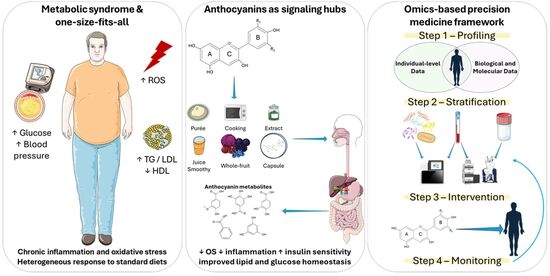
1. Introduction
2. Materials and Methods
3. The Dual Challenge of Metabolic Disease and One-Size-Fits-All Nutrition
4. Anthocyanins: From Dietary Pigments to Bioactive Compounds
5. Anthocyanins as Signaling Hubs in Metabolic Health
5.1. Orchestrating Inflammation and Oxidative Stress
5.2. Regulating Glucose and Lipid Metabolism
5.3. Modulating Cellular Communication
6. The Framework for Precision Nutrition: A Multifactorial Perspective on Individual Responses to Anthocyanins
6.1. Genetic Polymorphisms in Anthocyanin Absorption and Pre-Systemic Metabolism
6.1.1. Pharmacogenetics of Anthocyanin Absorption, Distribution, Metabolism, and Excretion
6.1.2. Interindividual Variability in Intestinal Deglycosylation Enzymes
6.2. Genetic Polymorphisms in Post-Absorption Phase II Metabolism
6.3. The Microbial Mediator: The Gut Microbiome’s Central Role in Anthocyanin Metabolism and Efficacy
6.3.1. Microbial Biotransformation: The Anthocyanin Bioactivation Engine
6.3.2. The Prebiotic Effect: Anthocyanins as Modulators of the Gut Ecosystem
6.4. Influence of the Food Matrix and Processing on Anthocyanin Bioavailability
Impact of Food Processing
6.5. Leveraging Metabolomics to Determine Metabolic Signature for True Personalization
Metabolomics for Objective Biomarker Discovery
6.6. Integrating Lifestyle Factors into the Precision Nutrition Framework to Achieve a Holistic View
6.7. Towards an Integrated Model of Precision Nutrition
7. Clinical Evidence and Therapeutic Potential in Metabolic Medicine
7.1. Model and Population Selection
7.2. Intervention Delivery, Duration, and Dosage
7.3. Multi-Level Convergence of Physiological Results
7.3.1. Immunomodulatory and Antioxidant Effects
7.3.2. Cardiovascular Health and Vascular Protection
7.3.3. Metabolic Regulation and Glycemic Control
7.3.4. Lipid Metabolism, Body Composition, and the Gut–Liver Axis
7.3.5. Specialized Hepatic and Endocrine Mechanisms
8. Conclusions
Author Contributions
Funding
Institutional Review Board Statement
Data Availability Statement
Acknowledgments
Conflicts of Interest
Abbreviations
| AACE | Association of Clinical Endocrinologists |
| ACN | Anthocyanin |
| ADA | American Diabetes Association |
| ADME | Absorption, Distribution, Metabolism, and Excretion |
| AGEs | Advanced Glycation End Products |
| AHA | American Heart Association |
| AIx | Augmentation Index |
| AMPK | AMP-Activated Protein Kinase |
| AP-1 | Activator Protein 1 |
| APO | Apolipoprotein |
| AUC | Area Under the Curve |
| BMI | Body Mass Index |
| C/EBPα | CCAAT/Enhancer-Binding Protein α |
| C3G | Cyanidin-3-O-Glucoside |
| CAT | Catalase |
| COMT | Catechol-O-methyltransferase |
| COX2 | Cyclooxygenase-2 |
| DASH | Dietary Approach to Stop Hypertension |
| DGA | Dietary Guidelines for Americans |
| eNOS | Endothelial Nitric Oxide Synthase |
| ERK | Extracellular signal-Regulated Kinase |
| FMD | Flow-Mediated Dilation |
| GLUT | Glucose Transporter |
| GPx | Glutathione Peroxidase |
| GSH | Glutathione |
| GSSG | Glutathione Disulfide |
| HAT | Hydrogen atom transfer |
| HbA1c | Hemoglobin A1c |
| HDL | High-Density Lipoprotein |
| HFD | High-Fat Diet |
| HOMA | Homeostasis Model Assessment—Insulin Resistance |
| ICAM-1 | Intercellular Cell Adhesion Molecule |
| IFN-γ | Interferon γ |
| IKK | IκB kinase |
| IL | Interleukin |
| iNOS | Inducible Nitric Oxide Synthase |
| IR | Insulin Resistance |
| IRS-1 | Insulin Receptor Substrate-1 |
| IS | Insulin Sensitivity |
| LDL | Low-Density Lipoprotein |
| LPH | Lactase-Phlorizin Hydrolase |
| LXRα | Liver X Receptor α |
| MAPK | Mitogen-Activated Protein Kinase |
| MetS | Metabolic Syndrome |
| MNT | Medical Nutrition Therapy |
| NF-κB | Nuclear Factor-κB |
| NHLBI | National Heart, Lung, and Blood Institute |
| NO | Nitric Oxide |
| Nrf2 | Nuclear Factor Erythroid 2-Related Factor 2 |
| O2•− | Superoxide |
| OATP2B1 | Organic Anion Transporting Polypeptide 2B1 |
| OS | Oxidative Stress |
| PCA | Protocatechuic Acid |
| PI3K | Phosphoinositide 3-Kinase |
| PKB or Akt | Protein kinase B |
| PPARγ | Peroxisome Proliferator-Activated Receptor γ |
| RFA | Red-Fleshed Apples |
| RHI | Reactive Hyperemia Index |
| RNS | Reactive Nitrogen Species |
| ROS | Reactive Oxygen Species |
| SCD | Standard Chow Diet |
| SCFAs | Short-Chain Fatty Acids |
| SET | Single-Electron Transfer |
| SFAs | Saturated Fatty Acids |
| SGLT1 | Sodium–Glucose Cotransporter 1 |
| SNPs | Single-Nucleotide Polymorphisms |
| SOD | Superoxide Dismutase |
| SREBP-1c | Sterol Regulatory Element-Binding Protein-1c |
| SULTs | Sulfotransferases |
| T2DM | Type 2 Diabetes Mellitus |
| TC | Total Cholesterol |
| TG | Triglycerides |
| TMA | Trimethylamine |
| TMAO | Trimethylamine N-Oxide |
| TNF-α | Tumor Necrosis Factor α |
| UGTs | UDP-Glycosyltransferases |
| UPLC-MS | Ultra-Performance Liquid Chromatography–Mass Spectrometry |
| VCAM-1 | Vascular Cell Adhesion Molecule |
| WFA | White-Fleshed Apples |
| WHO | World Health Organization |
| WT | Wild-Type |
References
- Alberti, K.G.; Zimmet, P.Z. Definition, diagnosis and classification of diabetes mellitus and its complications. Part 1: Diagnosis and classification of diabetes mellitus provisional report of a WHO consultation. Diabet. Med. 1998, 15, 539–553. [Google Scholar] [CrossRef] [Scilit]
- Samson, S.L.; Garber, A.J. Metabolic syndrome. Endocrinol. Metab. Clin. N. Am. 2014, 43, 1–23. [Google Scholar] [CrossRef] [Scilit]
- Pramanik, P.; Chatterjee, S. Effects of yoga on metabolic syndrome. In Yoga for Cardiovascular Disease and Rehabilitation; Elsevier: Amsterdam, The Netherlands, 2024; pp. 249–265. [Google Scholar]
- Estruch, R.; Ros, E.; Salas-Salvadó, J.; Covas, M.-I.; Pharm, D.; Corella, D.; Borau, F.; Gómez-Gracia, E.; Ruiz-Gutierrez, V.; Fiol, M.; et al. Primary Prevention of Cardiovascular Disease with a Mediterranean Diet. N. Engl. J. Med. 2013, 368, 1279–1290, Retraction in N. Engl. J. Med. 2014, 370, 886. [Google Scholar] [CrossRef] [Scilit]
- Ferreira, C.R.; Rahman, S.; Keller, M.; Zschocke, J. An international classification of inherited metabolic disorders (ICIMD). J. Inherit. Metab. Dis. 2021, 44, 164–177. [Google Scholar] [CrossRef] [Scilit]
- Eichler, F.; Ratai, E.; Carroll, J.J.; Masdeu, J.C. Chapter 29-Inherited or acquired metabolic disorders. In Handbook of Clinical Neurology; Masdeu, J.C., González, R.G., Eds.; Elsevier: Amsterdam, The Netherlands, 2016; Volume 135, pp. 603–636. [Google Scholar]
- Ioannou, G.N.; Bryson, C.L.; Boyko, E.J. Prevalence and trends of insulin resistance, impaired fasting glucose, and diabetes. J. Diabetes Complicat. 2007, 21, 363–370. [Google Scholar] [CrossRef] [Scilit]
- Kocełak, P.; Chudek, J.; Olszanecka-Glinianowicz, M. Prevalence of metabolic syndrome and insulin resistance in overweight and obese women according to the different diagnostic criteria. Minerva Endocrinol. 2012, 37, 247–254. [Google Scholar]
- Alves, J. Obesity relationship, metabolic syndrome and insulin resistance: A systematic review. Health Soc. 2024, 4, 206–216. [Google Scholar] [CrossRef] [Scilit]
- Abdelazeem, A.H.; Abuelsaad, A.S.A.; Abdel-Moniem, A.; Abdel-Gabbar, M. Association of metabolic syndrome components with alterations in oxidative stress and cytokines expression. J. Taibah Univ. Sci. 2021, 15, 928–940. [Google Scholar] [CrossRef] [Scilit]
- Monserrat-Mesquida, M.; Quetglas-Llabrés, M.; Capó, X.; Bouzas, C.; Mateos, D.; Pons, A.; Tur, J.A.; Sureda, A. Metabolic Syndrome is Associated with Oxidative Stress and Proinflammatory State. Antioxidants 2020, 9, 236. [Google Scholar] [CrossRef] [Scilit] [PubMed]
- Beckman, J.S.; Koppenol, W.H. Nitric oxide, superoxide, and peroxynitrite: The good, the bad, and ugly. Am. J. Physiol. 1996, 271, C1424–C1437. [Google Scholar] [CrossRef] [Scilit]
- Holvoet, P. Relations between metabolic syndrome, oxidative stress and inflammation and cardiovascular disease. Verh. K Acad. Geneeskd. Belg. 2008, 70, 193–219. [Google Scholar]
- Marques de Mattos, A.; Marino, L.V.; Ovidio, P.P.; Jordão, A.A.; Almeida, C.C.; Chiarello, P.G. Protein Oxidative Stress and Dyslipidemia in Dialysis Patients. Ther. Apher. Dial. 2012, 16, 68–74. [Google Scholar] [CrossRef] [Scilit]
- Rani, V.; Deep, G.; Singh, R.K.; Palle, K.; Yadav, U.C. Oxidative stress and metabolic disorders: Pathogenesis and therapeutic strategies. Life Sci. 2016, 148, 183–193. [Google Scholar] [CrossRef] [Scilit]
- Murphy, M.P. How mitochondria produce reactive oxygen species. Biochem. J. 2009, 417, 1–13. [Google Scholar] [CrossRef] [Scilit]
- Balaban, R.S.; Nemoto, S.; Finkel, T. Mitochondria, oxidants, and aging. Cell 2005, 120, 483–495. [Google Scholar] [CrossRef] [Scilit]
- Kumar, B.; Koul, S.; Khandrika, L.; Meacham, R.B.; Koul, H.K. Oxidative stress is inherent in prostate cancer cells and is required for aggressive phenotype. Cancer Res. 2008, 68, 1777–1785. [Google Scholar] [CrossRef] [Scilit]
- Alim Al-Bari, A.; Ito, Y.; Thomes, P.G.; Menon, M.B.; García-Macia, M.; Fadel, R.; Stadlin, A.; Peake, N.; Faris, M.E.; Eid, N.; et al. Emerging mechanistic insights of selective autophagy in hepatic diseases. Front. Pharmacol. 2023, 14, 1149809. [Google Scholar] [CrossRef] [Scilit] [PubMed]
- Bhatnagar, P.; El-Akabawy, G.; Faris, M.E.; Menon, M.B.; Wahab, M.A.; Hussan, F.; Zulkaflee, M.H.B.; Eid, N. Intermittent fasting-induced autophagy normalization confers hepatic protection in metabolic dysfunction-associated fatty liver disease: Mechanistic insights and implications. Histol. Histopathol. 2025, 40, 18986. [Google Scholar] [CrossRef] [Scilit]
- Rask Larsen, J.; Dima, L.; Correll, C.U.; Manu, P. The pharmacological management of metabolic syndrome. Expert. Rev. Clin. Pharmacol. 2018, 11, 397–410. [Google Scholar] [CrossRef] [Scilit] [PubMed]
- Oliveira, P.S.; Chaves, V.C.; Bona, N.P.; Soares, M.S.P.; Cardoso, J.S.; Vasconcellos, F.A.; Tavares, R.G.; Vizzotto, M.; Silva, L.; Grecco, F.B.; et al. Eugenia uniflora fruit (red type) standardized extract: A potential pharmacological tool to diet-induced metabolic syndrome damage management. Biomed. Pharmacother. 2017, 92, 935–941. [Google Scholar] [CrossRef] [Scilit] [PubMed]
- Perez-Martinez, P.; Garcia-Rios, A.; Delgado-Lista, J.; Perez-Jimenez, F.; Lopez-Miranda, J. Metabolic syndrome: Evidences for a personalized nutrition. Mol. Nutr. Food Res. 2012, 56, 67–76. [Google Scholar] [CrossRef] [Scilit]
- Garvey, W.T.; Mechanick, J.I.; Brett, E.M.; Garber, A.J.; Hurley, D.L.; Jastreboff, A.M.; Nadolsky, K.; Pessah-Pollack, R.; Plodkowski, R. American association of clinical endocrinologists and american college of endocrinology comprehensive clinical practice guidelines for medical care of patients with obesity. Endocr. Pract. 2016, 22, 1–203. [Google Scholar] [CrossRef] [Scilit]
- Mechanick, J.I.; Camacho, P.M.; Cobin, R.H.; Garber, A.J.; Garber, J.R.; Gharib, H.; Petak, S.M.; Rodbard, H.W.; Trence, D.L. American Association of Clinical Endocrinologists Protocol for Standardized Production of Clinical Practice Guidelines—2010 update. Endocr. Pract. 2010, 16, 270–283. [Google Scholar] [CrossRef] [Scilit]
- Yumuk, V.; Tsigos, C.; Fried, M.; Schindler, K.; Busetto, L.; Micic, D.; Toplak, H. European Guidelines for Obesity Management in Adults. Obes. Facts 2015, 8, 402–424. [Google Scholar] [CrossRef] [Scilit]
- Grundy, S.M.; Cleeman, J.I.; Daniels, S.R.; Donato, K.A.; Eckel, R.H.; Franklin, B.A.; Gordon, D.J.; Krauss, R.M.; Savage, P.J.; Smith, S.C., Jr.; et al. Diagnosis and management of the metabolic syndrome: An American Heart Association/National Heart, Lung, and Blood Institute Scientific Statement. Circulation 2005, 112, 2735–2752. [Google Scholar] [CrossRef] [Scilit] [PubMed]
- Hooper, L.; Martin, N.; Jimoh, O.F.; Kirk, C.; Foster, E.; Abdelhamid, A.S. Reduction in saturated fat intake for cardiovascular disease. Cochrane Database Syst. Rev. 2020, 8, CD011737. [Google Scholar] [CrossRef] [Scilit]
- Perez, E.A.; Gonzalez, M.P.; Martinez-Espinosa, R.M.; Vila, M.D.M.; Reig Garcia-Galbis, M. Practical Guidance for Interventions in Adults with Metabolic Syndrome: Diet and Exercise vs. Changes in Body Composition. Int. J. Environ. Res. Public Health 2019, 16, 3481. [Google Scholar] [CrossRef] [Scilit]
- Department of Health and Human Services. Dietary Guidelines for Americans 2015–2020; Department of Health and Human Services: Washington, DC, USA, 2015; p. 122.
- Mensink, R.P.; Katan, M.B. Effect of dietary fatty acids on serum lipids and lipoproteins. A meta-analysis of 27 trials. Arter. Thromb. 1992, 12, 911–919. [Google Scholar] [CrossRef] [Scilit] [PubMed]
- Saraf-Bank, S.; Haghighatdoost, F.; Esmaillzadeh, A.; Larijani, B.; Azadbakht, L. Adherence to Healthy Eating Index-2010 is inversely associated with metabolic syndrome and its features among Iranian adult women. Eur. J. Clin. Nutr. 2017, 71, 425–430. [Google Scholar] [CrossRef] [Scilit] [PubMed]
- Esposito, K.; Kastorini, C.M.; Panagiotakos, D.B.; Giugliano, D. Mediterranean diet and weight loss: Meta-analysis of randomized controlled trials. Metab. Syndr. Relat. Disord. 2011, 9, 1–12. [Google Scholar] [CrossRef] [Scilit]
- Richard, C.; Couture, P.; Desroches, S.; Charest, A.; Lamarche, B. Effect of the Mediterranean diet with and without weight loss on cardiovascular risk factors in men with the metabolic syndrome. Nutr. Metab. Cardiovasc. Dis. 2011, 21, 628–635. [Google Scholar] [CrossRef] [Scilit] [PubMed]
- Babio, N.; Toledo, E.; Estruch, R.; Ros, E.; Martinez-Gonzalez, M.A.; Castaner, O.; Bullo, M.; Corella, D.; Aros, F.; Gomez-Gracia, E.; et al. Mediterranean diets and metabolic syndrome status in the PREDIMED randomized trial. CMAJ 2014, 186, E649–E657. [Google Scholar] [CrossRef] [Scilit] [PubMed]
- Mayneris-Perxachs, J.; Sala-Vila, A.; Chisaguano, M.; Castellote, A.I.; Estruch, R.; Covas, M.I.; Fito, M.; Salas-Salvado, J.; Martinez-Gonzalez, M.A.; Lamuela-Raventos, R.; et al. Effects of 1-year intervention with a Mediterranean diet on plasma fatty acid composition and metabolic syndrome in a population at high cardiovascular risk. PLoS ONE 2014, 9, e85202. [Google Scholar] [CrossRef] [Scilit]
- Kang, S.H.; Cho, K.H.; Do, J.Y. Association Between the Modified Dietary Approaches to Stop Hypertension and Metabolic Syndrome in Postmenopausal Women Without Diabetes. Metab. Syndr. Relat. Disord. 2018, 16, 282–289. [Google Scholar] [CrossRef] [Scilit] [PubMed]
- Saneei, P.; Fallahi, E.; Barak, F.; Ghasemifard, N.; Keshteli, A.H.; Yazdannik, A.R.; Esmaillzadeh, A. Adherence to the DASH diet and prevalence of the metabolic syndrome among Iranian women. Eur. J. Nutr. 2015, 54, 421–428. [Google Scholar] [CrossRef] [Scilit] [PubMed]
- Siervo, M.; Lara, J.; Chowdhury, S.; Ashor, A.; Oggioni, C.; Mathers, J.C. Effects of the Dietary Approach to Stop Hypertension (DASH) diet on cardiovascular risk factors: A systematic review and meta-analysis. Br. J. Nutr. 2015, 113, 1–15. [Google Scholar] [CrossRef] [Scilit]
- Wickman, B.E.; Enkhmaa, B.; Ridberg, R.; Romero, E.; Cadeiras, M.; Meyers, F.; Steinberg, F. Dietary Management of Heart Failure: DASH Diet and Precision Nutrition Perspectives. Nutrients 2021, 13, 4424. [Google Scholar] [CrossRef] [Scilit]
- Wang, Y.; Hodge, R.A.; Stevens, V.L.; Hartman, T.J.; McCullough, M.L. Identification and Reproducibility of Plasma Metabolomic Biomarkers of Habitual Food Intake in a US Diet Validation Study. Metabolites 2020, 10, 382. [Google Scholar] [CrossRef] [Scilit]
- Maruvada, P.; Lampe, J.W.; Wishart, D.S.; Barupal, D.; Chester, D.N.; Dodd, D.; Djoumbou-Feunang, Y.; Dorrestein, P.C.; Dragsted, L.O.; Draper, J.; et al. Perspective: Dietary Biomarkers of Intake and Exposure-Exploration with Omics Approaches. Adv. Nutr. 2020, 11, 200–215. [Google Scholar] [CrossRef] [Scilit]
- Corella, D.; Ordovas, J.M. Biomarkers: Background, classification and guidelines for applications in nutritional epidemiology. Nutr. Hosp. 2015, 31, 177–188. [Google Scholar] [CrossRef] [Scilit]
- Scalbert, A.; Brennan, L.; Manach, C.; Andres-Lacueva, C.; Dragsted, L.O.; Draper, J.; Rappaport, S.M.; van der Hooft, J.J.; Wishart, D.S. The food metabolome: A window over dietary exposure. Am. J. Clin. Nutr. 2014, 99, 1286–1308. [Google Scholar] [CrossRef] [Scilit]
- Remigante, A.; Spinelli, S.; Patane, G.T.; Barreca, D.; Straface, E.; Gambardella, L.; Bozzuto, G.; Caruso, D.; Falliti, G.; Dossena, S.; et al. AAPH-induced oxidative damage reduced anion exchanger 1 (SLC4A1/AE1) activity in human red blood cells: Protective effect of an anthocyanin-rich extract. Front. Physiol. 2023, 14, 1303815. [Google Scholar] [CrossRef] [Scilit] [PubMed]
- Smeriglio, A.; Barreca, D.; Bellocco, E.; Trombetta, D. Chemistry, Pharmacology and Health Benefits of Anthocyanins. Phytother. Res. 2016, 30, 1265–1286. [Google Scholar] [CrossRef] [Scilit]
- Calderaro, A.; Barreca, D.; Bellocco, E.; Smeriglio, A.; Trombetta, D.; Laganà, G. Chapter Eight-Colored phytonutrients: Role and applications in the functional foods of anthocyanins. In Phytonutrients in Food; Nabavi, S.M., Suntar, I., Barreca, D., Khan, H., Eds.; Woodhead Publishing: Duxford, UK, 2020; pp. 177–195. [Google Scholar]
- Wlodarczyk, M.; Nowicka, G. Obesity, DNA Damage, and Development of Obesity-Related Diseases. Int. J. Mol. Sci. 2019, 20, 1146. [Google Scholar] [CrossRef] [Scilit] [PubMed]
- Houstis, N.; Rosen, E.D.; Lander, E.S. Reactive oxygen species have a causal role in multiple forms of insulin resistance. Nature 2006, 440, 944–948. [Google Scholar] [CrossRef] [Scilit] [PubMed]
- de la Iglesia, R.; Loria-Kohen, V.; Zulet, M.A.; Martinez, J.A.; Reglero, G.; Ramirez de Molina, A. Dietary Strategies Implicated in the Prevention and Treatment of Metabolic Syndrome. Int. J. Mol. Sci. 2016, 17, 1877. [Google Scholar] [CrossRef] [Scilit]
- Naseri, R.; Farzaei, F.; Haratipour, P.; Nabavi, S.F.; Habtemariam, S.; Farzaei, M.H.; Khodarahmi, R.; Tewari, D.; Momtaz, S. Anthocyanins in the Management of Metabolic Syndrome: A Pharmacological and Biopharmaceutical Review. Front. Pharmacol. 2018, 9, 1310. [Google Scholar] [CrossRef] [Scilit]
- Jiang, T.; Shuai, X.; Li, J.; Yang, N.; Deng, L.; Li, S.; He, Y.; Guo, H.; Li, Y.; He, J. Protein-Bound Anthocyanin Compounds of Purple Sweet Potato Ameliorate Hyperglycemia by Regulating Hepatic Glucose Metabolism in High-Fat Diet/Streptozotocin-Induced Diabetic Mice. J. Agric. Food Chem. 2020, 68, 1596–1608. [Google Scholar] [CrossRef] [Scilit]
- Tsuda, T. Regulation of adipocyte function by anthocyanins; possibility of preventing the metabolic syndrome. J. Agric. Food Chem. 2008, 56, 642–646. [Google Scholar] [CrossRef] [Scilit]
- Jiang, X.; Li, X.; Zhu, C.; Sun, J.; Tian, L.; Chen, W.; Bai, W. The target cells of anthocyanins in metabolic syndrome. Crit. Rev. Food Sci. Nutr. 2019, 59, 921–946. [Google Scholar] [CrossRef] [Scilit]
- He, F.; Mu, L.; Yan, G.L.; Liang, N.N.; Pan, Q.H.; Wang, J.; Reeves, M.J.; Duan, C.Q. Biosynthesis of anthocyanins and their regulation in colored grapes. Molecules 2010, 15, 9057–9091. [Google Scholar] [CrossRef] [Scilit]
- Burton-Freeman, B.; Brzeziński, M.; Park, E.; Sandhu, A.; Xiao, D.; Edirisinghe, I. A Selective Role of Dietary Anthocyanins and Flavan-3-ols in Reducing the Risk of Type 2 Diabetes Mellitus: A Review of Recent Evidence. Nutrients 2019, 11, 841. [Google Scholar] [CrossRef] [Scilit]
- Zhou, L.; Xie, M.; Yang, F.; Liu, J. Antioxidant activity of high purity blueberry anthocyanins and the effects on human intestinal microbiota. LWT 2020, 117, 108621. [Google Scholar] [CrossRef] [Scilit]
- Zhang, Q.; Chen, W.; Zhao, J.; Xi, W. Functional constituents and antioxidant activities of eight Chinese native goji genotypes. Food Chem. 2016, 200, 230–236. [Google Scholar] [CrossRef] [Scilit]
- Castañeda-Ovando, A.; Pacheco-Hernández, M.d.L.; Páez-Hernández, M.E.; Rodríguez, J.A.; Galán-Vidal, C.A. Chemical studies of anthocyanins: A review. Food Chem. 2009, 113, 859–871. [Google Scholar] [CrossRef] [Scilit]
- Manolescu, B.N.; Oprea, E.; Mititelu, M.; Ruta, L.L.; Farcasanu, I.C. Dietary Anthocyanins and Stroke: A Review of Pharmacokinetic and Pharmacodynamic Studies. Nutrients 2019, 11, 1479. [Google Scholar] [CrossRef] [Scilit] [PubMed]
- Igwe, E.O.; Charlton, K.E.; Probst, Y.C. Usual dietary anthocyanin intake, sources and their association with blood pressure in a representative sample of Australian adults. J. Hum. Nutr. Diet. 2019, 32, 578–590. [Google Scholar] [CrossRef] [Scilit] [PubMed]
- Mattioli, R.; Francioso, A.; Mosca, L.; Silva, P. Anthocyanins: A Comprehensive Review of Their Chemical Properties and Health Effects on Cardiovascular and Neurodegenerative Diseases. Molecules 2020, 25, 3809. [Google Scholar] [CrossRef] [Scilit] [PubMed]
- Czank, C.; Cassidy, A.; Zhang, Q.; Morrison, D.J.; Preston, T.; Kroon, P.A.; Botting, N.P.; Kay, C.D. Human metabolism and elimination of the anthocyanin, cyanidin-3-glucoside: A (13)C-tracer study. Am. J. Clin. Nutr. 2013, 97, 995–1003. [Google Scholar] [CrossRef] [Scilit]
- Lila, M.A.; Burton-Freeman, B.; Grace, M.; Kalt, W. Unraveling Anthocyanin Bioavailability for Human Health. Annu. Rev. Food Sci. Technol. 2016, 7, 375–393. [Google Scholar] [CrossRef] [Scilit]
- Fang, J. Bioavailability of anthocyanins. Drug Metab. Rev. 2014, 46, 508–520. [Google Scholar] [CrossRef] [Scilit] [PubMed]
- de Ferrars, R.M.; Czank, C.; Zhang, Q.; Botting, N.P.; Kroon, P.A.; Cassidy, A.; Kay, C.D. The pharmacokinetics of anthocyanins and their metabolites in humans. Br. J. Pharmacol. 2014, 171, 3268–3282. [Google Scholar] [CrossRef] [Scilit]
- Passamonti, S.; Vrhovsek, U.; Mattivi, F. The interaction of anthocyanins with bilitranslocase. Biochem. Biophys. Res. Commun. 2002, 296, 631–636. [Google Scholar] [CrossRef] [Scilit] [PubMed]
- Sandoval-Ramírez, B.A.e.; Catalan, U.; Fernandez-Castillejo, S.; Rubio, L.; Macia, A.; Sola, R. Anthocyanin tissue bioavailability in animals: Possible implications for human health. A systematic review. J. Agric. Food Chem. 2018, 66, 11531–11543. [Google Scholar] [CrossRef] [Scilit] [PubMed]
- de Ferrars, R.M.; Cassidy, A.; Curtis, P.; Kay, C.D. Phenolic metabolites of anthocyanins following a dietary intervention study in post-menopausal women. Mol. Nutr. Food Res. 2014, 58, 490–502. [Google Scholar] [CrossRef] [Scilit]
- Myöhänen, T.T.; Schendzielorz, N.; Männistö, P.T. Distribution of catechol-O-methyltransferase (COMT) proteins and enzymatic activities in wild-type and soluble COMT deficient mice. J. Neurochem. 2010, 113, 1632–1643. [Google Scholar] [CrossRef] [Scilit]
- Kay, C.D. Aspects of anthocyanin absorption, metabolism and pharmacokinetics in humans. Nutr. Res. Rev. 2006, 19, 137–146. [Google Scholar] [CrossRef] [Scilit]
- Sak, K. Could flavonoid aglycones prevent the absorption of flavonoid glycosides by inhibiting sodium-dependent glucose transporter-1 in the small intestine? Explor. Drug Sci. 2023, 1, 287–291. [Google Scholar] [CrossRef] [Scilit]
- Hahm, T.H.; Tanaka, M.; Matsui, T. Current knowledge on intestinal absorption of anthocyanins. J. Agric. Food Chem. 2022, 70, 2501–2509. [Google Scholar] [CrossRef] [Scilit]
- Németh, K.; Plumb, G.W.; Berrin, J.-G.; Juge, N.; Jacob, R.; Naim, H.Y.; Williamson, G.; Swallow, D.M.; Kroon, P.A. Deglycosylation by small intestinal epithelial cell β-glucosidases is a critical step in the absorption and metabolism of dietary flavonoid glycosides in humans. Eur. J. Nutr. 2003, 42, 29–42. [Google Scholar] [CrossRef] [Scilit]
- Vernocchi, P.; Del Chierico, F.; Putignani, L. Gut Microbiota Metabolism and Interaction with Food Components. Int. J. Mol. Sci. 2020, 21, 3688. [Google Scholar] [CrossRef] [Scilit] [PubMed]
- Lemieux, M.; Bouchard, F.; Gosselin, P.; Paquin, J.; Mateescu, M.A. The NCI-N87 cell line as a gastric epithelial barrier model for drug permeability assay. Biochem. Biophys. Res. Commun. 2011, 412, 429–434. [Google Scholar] [CrossRef] [Scilit] [PubMed]
- Kavvada, K.M.; Murray, J.G.; Moore, V.A.; Coombes, A.G.; Hanson, P.J. A collagen IV matrix is required for guinea pig gastric epithelial cell monolayers to provide an optimal model of the stomach surface for biopharmaceutical screening. J. Biomol. Screen. 2005, 10, 495–507. [Google Scholar] [CrossRef] [Scilit]
- Fernandes, I.; Faria, A.; de Freitas, V.; Calhau, C.; Mateus, N. Multiple-approach studies to assess anthocyanin bioavailability. Phytochem. Rev. 2015, 14, 899–919. [Google Scholar] [CrossRef] [Scilit]
- Hanske, L.; Engst, W.; Loh, G.; Sczesny, S.; Blaut, M.; Braune, A. Contribution of gut bacteria to the metabolism of cyanidin 3-glucoside in human microbiota-associated rats. Br. J. Nutr. 2013, 109, 1433–1441. [Google Scholar] [CrossRef] [Scilit] [PubMed]
- Fleschhut, J.; Kratzer, F.; Rechkemmer, G.; Kulling, S.E. Stability and biotransformation of various dietary anthocyanins in vitro. Eur. J. Nutr. 2006, 45, 7–18. [Google Scholar] [CrossRef] [Scilit]
- Gonzalez-Barrio, R.; Edwards, C.A.; Crozier, A. Colonic catabolism of ellagitannins, ellagic acid, and raspberry anthocyanins: In vivo and in vitro studies. Drug Metab. Dispos. 2011, 39, 1680–1688. [Google Scholar] [CrossRef] [Scilit]
- Isvoran, A.; Peng, Y.; Ceauranu, S.; Schmidt, L.; Nicot, A.B.; Miteva, M.A. Pharmacogenetics of human sulfotransferases and impact of amino acid exchange on Phase II drug metabolism. Drug Discov. Today 2022, 27, 103349. [Google Scholar] [CrossRef] [Scilit]
- Eker, M.E.; Aaby, K.; Budic-Leto, I.; Rimac Brnčić, S.; El, S.N.; Karakaya, S.; Simsek, S.; Manach, C.; Wiczkowski, W.; de Pascual-Teresa, S. A review of factors affecting anthocyanin bioavailability: Possible implications for the inter-individual variability. Foods 2019, 9, 2. [Google Scholar] [CrossRef] [Scilit]
- Randeni, N.; Luo, J.; Xu, B. Critical Review on Anti-Obesity Effects of Anthocyanins Through PI3K/Akt Signaling Pathways. Nutrients 2025, 17, 1126. [Google Scholar] [CrossRef] [Scilit]
- Jiang, N.; Chen, X.L.; Yang, H.W.; Ma, Y.R. Effects of nuclear factor κB expression on retinal neovascularization and apoptosis in a diabetic retinopathy rat model. Int. J. Ophthalmol. 2015, 8, 448–452. [Google Scholar] [CrossRef] [Scilit]
- Oeckinghaus, A.; Ghosh, S. The NF-kappaB family of transcription factors and its regulation. Cold Spring Harb. Perspect. Biol. 2009, 1, a000034. [Google Scholar] [CrossRef] [Scilit] [PubMed]
- Karin, M.; Delhase, M. The I kappa B kinase (IKK) and NF-kappa B: Key elements of proinflammatory signalling. Semin. Immunol. 2000, 12, 85–98. [Google Scholar] [CrossRef] [Scilit] [PubMed]
- Lawrence, T. The nuclear factor NF-kappaB pathway in inflammation. Cold Spring Harb. Perspect. Biol. 2009, 1, a001651. [Google Scholar] [CrossRef] [Scilit] [PubMed]
- Aboonabi, A.; Aboonabi, A. Anthocyanins reduce inflammation and improve glucose and lipid metabolism associated with inhibiting nuclear factor-kappaB activation and increasing PPAR-γ gene expression in metabolic syndrome subjects. Free Radic. Biol. Med. 2020, 150, 30–39. [Google Scholar] [CrossRef] [Scilit]
- Molonia, M.S.; Occhiuto, C.; Muscarà, C.; Speciale, A.; Bashllari, R.; Villarroya, F.; Saija, A.; Cimino, F.; Cristani, M. Cyanidin-3-O-glucoside restores insulin signaling and reduces inflammation in hypertrophic adipocytes. Arch. Biochem. Biophys. 2020, 691, 108488. [Google Scholar] [CrossRef] [Scilit]
- Wongwichai, T.; Teeyakasem, P.; Pruksakorn, D.; Kongtawelert, P.; Pothacharoen, P. Anthocyanins and metabolites from purple rice inhibit IL-1β-induced matrix metalloproteinases expression in human articular chondrocytes through the NF-κB and ERK/MAPK pathway. Biomed. Pharmacother. 2019, 112, 108610. [Google Scholar] [CrossRef] [Scilit]
- Duarte, L.J.; Chaves, V.C.; Nascimento, M.; Calvete, E.; Li, M.; Ciraolo, E.; Ghigo, A.; Hirsch, E.; Simões, C.M.O.; Reginatto, F.H.; et al. Molecular mechanism of action of Pelargonidin-3-O-glucoside, the main anthocyanin responsible for the anti-inflammatory effect of strawberry fruits. Food Chem. 2018, 247, 56–65. [Google Scholar] [CrossRef] [Scilit]
- Lee, H.H.; Lee, S.G.; Shin, J.S.; Lee, H.Y.; Yoon, K.; Ji, Y.W.; Jang, D.S.; Lee, K.T. p-Coumaroyl Anthocyanin Mixture Isolated from Tuber Epidermis of Solanum tuberosum Attenuates Reactive Oxygen Species and Pro-inflammatory Mediators by Suppressing NF-κB and STAT1/3 Signaling in LPS-Induced RAW264.7 Macrophages. Biol. Pharm. Bull. 2017, 40, 1894–1902. [Google Scholar] [CrossRef] [Scilit]
- Roth, S.; Spalinger, M.R.; Gottier, C.; Biedermann, L.; Zeitz, J.; Lang, S.; Weber, A.; Rogler, G.; Scharl, M. Bilberry-Derived Anthocyanins Modulate Cytokine Expression in the Intestine of Patients with Ulcerative Colitis. PLoS ONE 2016, 11, e0154817. [Google Scholar] [CrossRef] [Scilit]
- Ouyang, W.; O’Garra, A. IL-10 Family Cytokines IL-10 and IL-22: From Basic Science to Clinical Translation. Immunity 2019, 50, 871–891. [Google Scholar] [CrossRef] [Scilit]
- Jung, S.K.; Lim, T.-G.; Seo, S.G.; Lee, H.J.; Hwang, Y.-S.; Choung, M.-G.; Lee, K.W. Cyanidin-3-O-(2″-xylosyl)-glucoside, an anthocyanin from Siberian ginseng (Acanthopanax senticosus) fruits, inhibits UVB-induced COX-2 expression and AP-1 transactivation. Food Sci. Biotechnol. 2013, 22, 507–513. [Google Scholar] [CrossRef] [Scilit]
- Li, L.; Wang, L.; Wu, Z.; Yao, L.; Wu, Y.; Huang, L.; Liu, K.; Zhou, X.; Gou, D. Anthocyanin-rich fractions from red raspberries attenuate inflammation in both RAW264.7 macrophages and a mouse model of colitis. Sci. Rep. 2014, 4, 6234. [Google Scholar] [CrossRef] [Scilit]
- Thummayot, S.; Tocharus, C.; Jumnongprakhon, P.; Suksamrarn, A.; Tocharus, J. Cyanidin attenuates Aβ(25-35)-induced neuroinflammation by suppressing NF-κB activity downstream of TLR4/NOX4 in human neuroblastoma cells. Acta Pharmacol. Sin. 2018, 39, 1439–1452. [Google Scholar] [CrossRef] [Scilit] [PubMed]
- Li, K.; Zhang, M.; Chen, H.; Peng, J.; Jiang, F.; Shi, X.; Bai, Y.; Jian, M.; Jia, Y. Anthocyanins from black peanut skin protect against UV-B induced keratinocyte cell and skin oxidative damage through activating Nrf 2 signaling. Food Funct. 2019, 10, 6815–6828. [Google Scholar] [CrossRef] [Scilit] [PubMed]
- Gupta, K.; Sirohi, V.K.; Kumari, S.; Shukla, V.; Manohar, M.; Popli, P.; Dwivedi, A. Sorcin is involved during embryo implantation via activating VEGF/PI3K/Akt pathway in mice. J. Mol. Endocrinol. 2018, 60, 119–132. [Google Scholar] [CrossRef] [Scilit] [PubMed]
- Huang, W.; Yan, Z.; Li, D.; Ma, Y.; Zhou, J.; Sui, Z. Antioxidant and Anti-Inflammatory Effects of Blueberry Anthocyanins on High Glucose-Induced Human Retinal Capillary Endothelial Cells. Oxid. Med. Cell Longev. 2018, 2018, 1862462. [Google Scholar] [CrossRef] [Scilit]
- Nizamutdinova, I.T.; Kim, Y.M.; Chung, J.I.; Shin, S.C.; Jeong, Y.K.; Seo, H.G.; Lee, J.H.; Chang, K.C.; Kim, H.J. Anthocyanins from black soybean seed coats stimulate wound healing in fibroblasts and keratinocytes and prevent inflammation in endothelial cells. Food Chem. Toxicol. 2009, 47, 2806–2812. [Google Scholar] [CrossRef] [Scilit]
- Winter, A.N.; Brenner, M.C.; Punessen, N.; Snodgrass, M.; Byars, C.; Arora, Y.; Linseman, D.A. Comparison of the Neuroprotective and Anti-Inflammatory Effects of the Anthocyanin Metabolites, Protocatechuic Acid and 4-Hydroxybenzoic Acid. Oxid. Med. Cell Longev. 2017, 2017, 6297080. [Google Scholar] [CrossRef] [Scilit]
- Wu, L.; Parekh, V.V.; Gabriel, C.L.; Bracy, D.P.; Marks-Shulman, P.A.; Tamboli, R.A.; Kim, S.; Mendez-Fernandez, Y.V.; Besra, G.S.; Lomenick, J.P.; et al. Activation of invariant natural killer T cells by lipid excess promotes tissue inflammation, insulin resistance, and hepatic steatosis in obese mice. Proc. Natl. Acad. Sci. USA 2012, 109, E1143–E1152. [Google Scholar] [CrossRef] [Scilit]
- Winer, D.A.; Winer, S.; Shen, L.; Wadia, P.P.; Yantha, J.; Paltser, G.; Tsui, H.; Wu, P.; Davidson, M.G.; Alonso, M.N.; et al. B cells promote insulin resistance through modulation of T cells and production of pathogenic IgG antibodies. Nat. Med. 2011, 17, 610–617. [Google Scholar] [CrossRef] [Scilit]
- Lee, B.C.; Kim, M.S.; Pae, M.; Yamamoto, Y.; Eberlé, D.; Shimada, T.; Kamei, N.; Park, H.S.; Sasorith, S.; Woo, J.R.; et al. Adipose Natural Killer Cells Regulate Adipose Tissue Macrophages to Promote Insulin Resistance in Obesity. Cell Metab. 2016, 23, 685–698. [Google Scholar] [CrossRef] [Scilit]
- O’Rourke, R.W.; Meyer, K.A.; Neeley, C.K.; Gaston, G.D.; Sekhri, P.; Szumowski, M.; Zamarron, B.; Lumeng, C.N.; Marks, D.L. Systemic NK cell ablation attenuates intra-abdominal adipose tissue macrophage infiltration in murine obesity. Obesity 2014, 22, 2109–2114. [Google Scholar] [CrossRef] [Scilit] [PubMed]
- Boulenouar, S.; Michelet, X.; Duquette, D.; Alvarez, D.; Hogan, A.E.; Dold, C.; O’Connor, D.; Stutte, S.; Tavakkoli, A.; Winters, D.; et al. Adipose Type One Innate Lymphoid Cells Regulate Macrophage Homeostasis through Targeted Cytotoxicity. Immunity 2017, 46, 273–286. [Google Scholar] [CrossRef] [Scilit] [PubMed]
- Wu, H.; Ballantyne, C.M. Skeletal muscle inflammation and insulin resistance in obesity. J. Clin. Investig. 2017, 127, 43–54. [Google Scholar] [CrossRef] [Scilit] [PubMed]
- Azevedo, J.; Fernandes, I.; Faria, A.; Oliveira, J.; Fernandes, A.; Freitas, V.d.; Mateus, N. Antioxidant properties of anthocyanidins, anthocyanidin-3-glucosides and respective portisins. Food Chem. 2010, 119, 518–523. [Google Scholar] [CrossRef] [Scilit]
- Ali, H.M.; Almagribi, W.; Al-Rashidi, M.N. Antiradical and reductant activities of anthocyanidins and anthocyanins, structure-activity relationship and synthesis. Food Chem. 2016, 194, 1275–1282. [Google Scholar] [CrossRef] [Scilit]
- Vo, Q.V.; Hoa, N.T.; Thong, N.M.; Mechler, A. The hydroperoxyl and superoxide anion radical scavenging activity of anthocyanidins in physiological environments: Theoretical insights into mechanisms and kinetics. Phytochemistry 2021, 192, 112968. [Google Scholar] [CrossRef] [Scilit]
- Gonçalves, A.C.; Falcão, A.; Alves, G.; Silva, L.R.; Flores-Félix, J.D. Antioxidant activity of the main phenolics found in red fruits: An in vitro and in silico study. Food Chem. 2024, 452, 139459. [Google Scholar] [CrossRef] [Scilit]
- Bi, X.; Zhang, J.; Chen, C.; Zhang, D.; Li, P.; Ma, F. Anthocyanin contributes more to hydrogen peroxide scavenging than other phenolics in apple peel. Food Chem. 2014, 152, 205–209. [Google Scholar] [CrossRef] [Scilit]
- Jiang, Y.; Dai, M.; Nie, W.J.; Yang, X.R.; Zeng, X.C. Effects of the ethanol extract of black mulberry (Morus nigra L.) fruit on experimental atherosclerosis in rats. J. Ethnopharmacol. 2017, 200, 228–235. [Google Scholar] [CrossRef] [Scilit] [PubMed]
- Wu, T.; Yang, L.; Guo, X.; Zhang, M.; Liu, R.; Sui, W. Raspberry anthocyanin consumption prevents diet-induced obesity by alleviating oxidative stress and modulating hepatic lipid metabolism. Food Funct. 2018, 9, 2112–2120. [Google Scholar] [CrossRef] [Scilit]
- Rugină, D.; Diaconeasa, Z.; Coman, C.; Bunea, A.; Socaciu, C.; Pintea, A. Chokeberry Anthocyanin Extract as Pancreatic β-Cell Protectors in Two Models of Induced Oxidative Stress. Oxid. Med. Cell Longev. 2015, 2015, 429075. [Google Scholar] [CrossRef] [Scilit]
- Garcia, C.; Blesso, C.N. Antioxidant properties of anthocyanins and their mechanism of action in atherosclerosis. Free Radic. Biol. Med. 2021, 172, 152–166. [Google Scholar] [CrossRef] [Scilit]
- Bellezza, I.; Giambanco, I.; Minelli, A.; Donato, R. Nrf2-Keap1 signaling in oxidative and reductive stress. Biochim. Biophys. Acta Mol. Cell Res. 2018, 1865, 721–733. [Google Scholar] [CrossRef] [Scilit]
- Juszczak, F.; Caron, N.; Mathew, A.V.; Declèves, A.E. Critical Role for AMPK in Metabolic Disease-Induced Chronic Kidney Disease. Int. J. Mol. Sci. 2020, 21, 7994. [Google Scholar] [CrossRef] [Scilit]
- Dorenbos, E.; Drummen, M.; Rijks, J.; Adam, T.; Stouthart, P.; Alfredo Martínez, J.; Navas-Carretero, S.; Stratton, G.; Swindell, N.; Fogelholm, M.; et al. PREVIEW (Prevention of Diabetes Through Lifestyle Intervention and Population Studies in Europe and Around the World) study in children aged 10 to 17 years: Design, methods and baseline results. Diabetes Obes. Metab. 2018, 20, 1096–1101. [Google Scholar] [CrossRef] [Scilit]
- Fogelholm, M.; Larsen, T.M.; Westerterp-Plantenga, M.; Macdonald, I.; Martinez, J.A.; Boyadjieva, N.; Poppitt, S.; Schlicht, W.; Stratton, G.; Sundvall, J.; et al. PREVIEW: Prevention of Diabetes through Lifestyle Intervention and Population Studies in Europe and around the World. Design, Methods, and Baseline Participant Description of an Adult Cohort Enrolled into a Three-Year Randomised Clinical Trial. Nutrients 2017, 9, 632. [Google Scholar] [CrossRef] [Scilit]
- Na, R.S.; Ma, C.; Liu, Q.R.; Wu, L.M.; Zheng, X.L.; Liu, Z.W. Itraconazole attenuates hepatic gluconeogenesis and promotes glucose uptake by regulating AMPK pathway. Exp. Ther. Med. 2018, 15, 2165–2171. [Google Scholar] [CrossRef] [Scilit] [PubMed]
- Wu, S.B.; Wei, Y.H. AMPK-mediated increase of glycolysis as an adaptive response to oxidative stress in human cells: Implication of the cell survival in mitochondrial diseases. Biochim. Biophys. Acta 2012, 1822, 233–247. [Google Scholar] [CrossRef] [Scilit] [PubMed]
- Janzen, N.R.; Whitfield, J.; Hoffman, N.J. Interactive Roles for AMPK and Glycogen from Cellular Energy Sensing to Exercise Metabolism. Int. J. Mol. Sci. 2018, 19, 3344. [Google Scholar] [CrossRef] [Scilit]
- Hardie, D.G.; Pan, D.A. Regulation of fatty acid synthesis and oxidation by the AMP-activated protein kinase. Biochem. Soc. Trans. 2002, 30, 1064–1070. [Google Scholar] [CrossRef] [Scilit]
- Sambandam, N.; Lopaschuk, G.D. AMP-activated protein kinase (AMPK) control of fatty acid and glucose metabolism in the ischemic heart. Prog. Lipid Res. 2003, 42, 238–256. [Google Scholar] [CrossRef] [Scilit] [PubMed]
- Gaussin, V.; Skarlas, P.; Ching, Y.P.; Hardie, D.G.; Hue, L. Distinct type-2A protein phosphatases activate HMGCoA reductase and acetyl-CoA carboxylase in liver. FEBS Lett. 1997, 413, 115–118. [Google Scholar] [CrossRef] [Scilit]
- Salminen, A.; Kaarniranta, K. AMP-activated protein kinase (AMPK) controls the aging process via an integrated signaling network. Ageing Res. Rev. 2012, 11, 230–241. [Google Scholar] [CrossRef] [Scilit]
- Sozio, M.S.; Lu, C.; Zeng, Y.; Liangpunsakul, S.; Crabb, D.W. Activated AMPK inhibits PPAR-α and PPAR-γ transcriptional activity in hepatoma cells. Am. J. Physiol. Gastrointest. Liver Physiol. 2011, 301, G739–G747. [Google Scholar] [CrossRef] [Scilit]
- Leclerc, G.M.; Leclerc, G.J.; Fu, G.; Barredo, J.C. AMPK-induced activation of Akt by AICAR is mediated by IGF-1R dependent and independent mechanisms in acute lymphoblastic leukemia. J. Mol. Signal 2010, 5, 15. [Google Scholar] [CrossRef] [Scilit] [PubMed]
- Simone, S.; Gorin, Y.; Velagapudi, C.; Abboud, H.E.; Habib, S.L. Mechanism of oxidative DNA damage in diabetes: Tuberin inactivation and downregulation of DNA repair enzyme 8-oxo-7,8-dihydro-2′-deoxyguanosine-DNA glycosylase. Diabetes 2008, 57, 2626–2636. [Google Scholar] [CrossRef] [Scilit] [PubMed]
- Cao, Y.; Kamioka, Y.; Yokoi, N.; Kobayashi, T.; Hino, O.; Onodera, M.; Mochizuki, N.; Nakae, J. Interaction of FoxO1 and TSC2 induces insulin resistance through activation of the mammalian target of rapamycin/p70 S6K pathway. J. Biol. Chem. 2006, 281, 40242–40251. [Google Scholar] [CrossRef] [Scilit] [PubMed]
- Zhao, Y.; Hu, X.; Liu, Y.; Dong, S.; Wen, Z.; He, W.; Zhang, S.; Huang, Q.; Shi, M. ROS signaling under metabolic stress: Cross-talk between AMPK and AKT pathway. Mol. Cancer 2017, 16, 79. [Google Scholar] [CrossRef] [Scilit]
- Sukumaran, A.; Choi, K.; Dasgupta, B. Insight on Transcriptional Regulation of the Energy Sensing AMPK and Biosynthetic mTOR Pathway Genes. Front. Cell Dev. Biol. 2020, 8, 671. [Google Scholar] [CrossRef] [Scilit]
- Fang, C.; Pan, J.; Qu, N.; Lei, Y.; Han, J.; Zhang, J.; Han, D. The AMPK pathway in fatty liver disease. Front. Physiol. 2022, 13, 970292. [Google Scholar] [CrossRef] [Scilit] [PubMed]
- Feng, S.Y.; Wu, S.J.; Chang, Y.C.; Ng, L.T.; Chang, S.J. Stimulation of GLUT4 Glucose Uptake by Anthocyanin-Rich Extract from Black Rice (Oryza sativa L.) via PI3K/Akt and AMPK/p38 MAPK Signaling in C2C12 Cells. Metabolites 2022, 12, 856. [Google Scholar] [CrossRef] [Scilit]
- Celis-Morales, C.; Livingstone, K.M.; Marsaux, C.F.; Macready, A.L.; Fallaize, R.; O’Donovan, C.B.; Woolhead, C.; Forster, H.; Walsh, M.C.; Navas-Carretero, S. Effect of personalized nutrition on health-related behaviour change: Evidence from the Food4Me European randomized controlled trial. Int. J. Epidemiol. 2017, 46, 578–588. [Google Scholar] [CrossRef] [Scilit]
- Livingstone, K.M.; Celis-Morales, C.; Navas-Carretero, S.; San-Cristobal, R.; Forster, H.; Woolhead, C.; O’Donovan, C.B.; Moschonis, G.; Manios, Y.; Traczyk, I. Personalised nutrition advice reduces intake of discretionary foods and beverages: Findings from the Food4Me randomised controlled trial. Int. J. Behav. Nutr. Phys. Act. 2021, 18, 70. [Google Scholar] [CrossRef] [Scilit]
- King, A.; Glaister, M.; Lawrence, K.; Nixon, J.; Pilic, L.; Mavrommatis, Y. A randomised controlled trial to determine the effect of genotype-based personalised diet and physical activity advice for FTO genotype (rs9939609) delivered via email on healthy eating motivation in young adults. Nutr. Bull. 2024, 49, 526–537. [Google Scholar] [CrossRef] [Scilit]
- Xu, H.; Liu, M.; Liu, H.; Zhao, B.; Zheng, M.; Liu, J. Anthocyanins from purple corn ameliorated obesity in high fat diet-induced obese mice through activating hepatic AMPK. J. Funct. Foods 2021, 84, 104582. [Google Scholar] [CrossRef] [Scilit]
- Luna-Vital, D.; Luzardo-Ocampo, I.; Cuellar-Nuñez, M.L.; Loarca-Piña, G.; Gonzalez de Mejia, E. Maize extract rich in ferulic acid and anthocyanins prevents high-fat-induced obesity in mice by modulating SIRT1, AMPK and IL-6 associated metabolic and inflammatory pathways. J. Nutr. Biochem. 2020, 79, 108343. [Google Scholar] [CrossRef] [Scilit]
- Hwang, Y.P.; Choi, J.H.; Han, E.H.; Kim, H.G.; Wee, J.-H.; Jung, K.O.; Jung, K.H.; Kwon, K.-i.; Jeong, T.C.; Chung, Y.C.; et al. Purple sweet potato anthocyanins attenuate hepatic lipid accumulation through activating adenosine monophosphate–activated protein kinase in human HepG2 cells and obese mice. Nutr. Res. 2011, 31, 896–906. [Google Scholar] [CrossRef] [Scilit] [PubMed]
- Guo, H.; Liu, G.; Zhong, R.; Wang, Y.; Wang, D.; Xia, M. Cyanidin-3-O-β-glucoside regulates fatty acid metabolism via an AMP-activated protein kinase-dependent signaling pathway in human HepG2 cells. Lipids Health Dis. 2012, 11, 10. [Google Scholar] [CrossRef] [Scilit]
- Jäger, S.; Handschin, C.; St-Pierre, J.; Spiegelman, B.M. AMP-activated protein kinase (AMPK) action in skeletal muscle via direct phosphorylation of PGC-1alpha. Proc. Natl. Acad. Sci. USA 2007, 104, 12017–12022. [Google Scholar] [CrossRef] [Scilit]
- O’Neill, H.M.; Maarbjerg, S.J.; Crane, J.D.; Jeppesen, J.; Jørgensen, S.B.; Schertzer, J.D.; Shyroka, O.; Kiens, B.; van Denderen, B.J.; Tarnopolsky, M.A.; et al. AMP-activated protein kinase (AMPK) beta1beta2 muscle null mice reveal an essential role for AMPK in maintaining mitochondrial content and glucose uptake during exercise. Proc. Natl. Acad. Sci. USA 2011, 108, 16092–16097. [Google Scholar] [CrossRef] [Scilit] [PubMed]
- Penna, C.; Pagliaro, P. Endothelial Dysfunction: Redox Imbalance, NLRP3 Inflammasome, and Inflammatory Responses in Cardiovascular Diseases. Antioxidants 2025, 14, 256. [Google Scholar] [CrossRef] [Scilit] [PubMed]
- Wang, Z.; Nakayama, T. Inflammation, a link between obesity and cardiovascular disease. Mediat. Inflamm. 2010, 2010, 535918. [Google Scholar] [CrossRef] [Scilit]
- Belin de Chantemèle, E.J.; Ali, M.I.; Mintz, J.; Stepp, D.W. Obesity induced-insulin resistance causes endothelial dysfunction without reducing the vascular response to hindlimb ischemia. Basic. Res. Cardiol. 2009, 104, 707–717. [Google Scholar] [CrossRef] [PubMed]
- Gavazzoni, M.; Gorga, E.; Derosa, G.; Maffioli, P.; Metra, M.; Raddino, R. High-dose atorvastatin versus moderate dose on early vascular protection after ST-elevation myocardial infarction. Drug Des. Devel Ther. 2017, 11, 3425–3434. [Google Scholar] [CrossRef] [Scilit]
- Bhowmick, S.; Drew, K. The good, the bad and the ugly of nitric oxide, superoxide and peroxynitrite signaling during oxygen-glucose deprivation in rat and arctic ground squirrel. FASEB J. 2017, 31, lb213. [Google Scholar] [CrossRef] [Scilit]
- Wang, D.; Wei, X.; Yan, X.; Jin, T.; Ling, W. Protocatechuic acid, a metabolite of anthocyanins, inhibits monocyte adhesion and reduces atherosclerosis in apolipoprotein E-deficient mice. J. Agric. Food Chem. 2010, 58, 12722–12728. [Google Scholar] [CrossRef] [Scilit]
- Krga, I.; Tamaian, R.; Mercier, S.; Boby, C.; Monfoulet, L.E.; Glibetic, M.; Morand, C.; Milenkovic, D. Anthocyanins and their gut metabolites attenuate monocyte adhesion and transendothelial migration through nutrigenomic mechanisms regulating endothelial cell permeability. Free Radic. Biol. Med. 2018, 124, 364–379. [Google Scholar] [CrossRef] [Scilit]
- Ortmann, J.; Nett, P.C.; Celeiro, J.; Traupe, T.; Tornillo, L.; Hofmann-Lehmann, R.; Haas, E.; Frank, B.; Terraciano, L.M.; Barton, M. Endothelin inhibition delays onset of hyperglycemia and associated vascular injury in type I diabetes: Evidence for endothelin release by pancreatic islet beta-cells. Biochem. Biophys. Res. Commun. 2005, 334, 689–695. [Google Scholar] [CrossRef] [Scilit]
- Zeisel, S.H.; Warrier, M. Trimethylamine N-Oxide, the Microbiome, and Heart and Kidney Disease. Annu. Rev. Nutr. 2017, 37, 157–181. [Google Scholar] [CrossRef] [Scilit] [PubMed]
- Du, L.; Ding, X.; Tian, Y.; Chen, J.; Li, W. Effect of anthocyanins on metabolic syndrome through interacting with gut microbiota. Pharmacol. Res. 2024, 210, 107511. [Google Scholar] [CrossRef] [Scilit]
- Lim, T.; Ryu, J.; Lee, K.; Park, S.Y.; Hwang, K.T. Protective Effects of Black Raspberry (Rubus occidentalis) Extract against Hypercholesterolemia and Hepatic Inflammation in Rats Fed High-Fat and High-Choline Diets. Nutrients 2020, 12, 2448. [Google Scholar] [CrossRef] [Scilit] [PubMed]
- Marques, C.; Fernandes, I.; Meireles, M.; Faria, A.; Spencer, J.P.E.; Mateus, N.; Calhau, C. Gut microbiota modulation accounts for the neuroprotective properties of anthocyanins. Sci. Rep. 2018, 8, 11341. [Google Scholar] [CrossRef] [Scilit] [PubMed]
- NIH. Nutrition Research Task Force2020–2030 Strategic Plan for NIH Nutrition Research; NIH: Bethesda, MD, USA, 2020; pp. 6–10.
- Poosri, S.; Boonyuen, U.; Chupeerach, C.; Soonthornworasiri, N.; Kwanbunjan, K.; Prangthip, P. Association of FTO variants rs9939609 and rs1421085 with elevated sugar and fat consumption in adult obesity. Sci. Rep. 2024, 14, 25618. [Google Scholar] [CrossRef] [Scilit]
- Tanofsky-Kraff, M.; Han, J.C.; Anandalingam, K.; Shomaker, L.B.; Columbo, K.M.; Wolkoff, L.E.; Kozlosky, M.; Elliott, C.; Ranzenhofer, L.M.; Roza, C.A. The FTO gene rs9939609 obesity-risk allele and loss of control over eating. Am. J. Clin. Nutr. 2009, 90, 1483–1488. [Google Scholar] [CrossRef] [Scilit] [PubMed]
- Bride, L.; Naslavsky, M.; Yamamoto, G.L.; Scliar, M.; Pimassoni, L.H.; Aguiar, P.S.; de Paula, F.; Wang, J.; Duarte, Y.; Passos-Bueno, M.R. TCF7L2 rs7903146 polymorphism association with diabetes and obesity in an elderly cohort from Brazil. PeerJ 2021, 9, e11349. [Google Scholar] [CrossRef] [Scilit]
- Al-Odinan, M.S.; Aljefree, N.M.; Almoraie, N.M.; Bakarman, M.A.; Alhadrami, H.A.; Shatwan, I.M. Interaction between the TCF7L2 gene and dietary intake on metabolic syndrome risk factors among Saudi Arabian adults. Front. Nutr. 2025, 12, 1513088. [Google Scholar] [CrossRef] [Scilit]
- Haupt, A.; Thamer, C.; Heni, M.; Ketterer, C.; Machann, J.; Schick, F.; Machicao, F.; Stefan, N.; Claussen, C.D.; Häring, H.-U. Gene variants of TCF7L2 influence weight loss and body composition during lifestyle intervention in a population at risk for type 2 diabetes. Diabetes 2010, 59, 747–750. [Google Scholar] [CrossRef] [Scilit]
- Galal, A.A.; Abd Elmajeed, A.A.; Elbaz, R.A.; Wafa, A.M.; Elshazli, R.M. Association of Apolipoprotein E gene polymorphism with the risk of T2DM and obesity among Egyptian subjects. Gene 2021, 769, 145223. [Google Scholar] [CrossRef] [Scilit]
- Yu, K.; Li, L.; Zhang, L.; Guo, L.; Wang, C. Association between MC4R rs17782313 genotype and obesity: A meta-analysis. Gene 2020, 733, 144372. [Google Scholar] [CrossRef] [Scilit]
- Li, S.; He, C.; Nie, H.; Pang, Q.; Wang, R.; Zeng, Z.; Song, Y. G allele of the rs1801282 polymorphism in PPARγ gene confers an increased risk of obesity and hypercholesterolemia, While T allele of the rs3856806 polymorphism displays a protective role against dyslipidemia: A systematic review and meta-analysis. Front. Endocrinol. 2022, 13, 919087. [Google Scholar] [CrossRef] [Scilit]
- Gu, S.-J.; Chen, D.-H.; Guo, Z.-R.; Zhou, Z.-Y.; Hu, X.-S.; Wu, M. Effect of obesity on the association between common variations in the PPAR gene and C-reactive protein level in Chinese Han population. Endocrine 2015, 48, 195–202. [Google Scholar] [CrossRef] [Scilit]
- Dos Santos, M.A.; Bortolin, R.H.; Cerda, A.; de Oliveira, R.; Stefani, T.I.M.; Fajardo, C.M.; Dorea, E.L.; Bernik, M.M.S.; Damasceno, N.R.T.; Hirata, M.H. Variants in GHRL, RETN, and PLIN1 are associated with obesity, diabetes, and metabolic syndrome, and influence food consumption in adults with obesity. Nutr. Res. 2025, 134, 13–23. [Google Scholar] [CrossRef] [Scilit]
- Nisar, T.; Arshad, K.; Abbas, Z.; Khan, M.A.; Safdar, S.; Shaikh, R.S.; Saeed, A. Prevalence of GCKR rs1260326 Variant in Subjects with Obesity Associated NAFLD and T2DM: A Case-Control Study in South Punjab, Pakistan. J. Obes. 2023, 2023, 6661858. [Google Scholar] [CrossRef] [Scilit] [PubMed]
- Shestopalov, A.V.; Davydov, V.V.; Tumanyan, G.T.; Teplyakova, E.D.; Shkurat, T.P.; Mashkina, E.V.; Shkurat, M.A.; Gaponov, A.M.; Sadova, A.A.; Borisenko, O.V. The association of Adipokines and Myokines in the blood of obese children and adolescents with Lipoprotein lipase rs328 gene variants. J. Obes. 2023, 2023, 7392513. [Google Scholar] [CrossRef] [Scilit] [PubMed]
- Goni, L.; Cuervo, M.; Milagro, F.I.; Martínez, J.A. A genetic risk tool for obesity predisposition assessment and personalized nutrition implementation based on macronutrient intake. Genes. Nutr. 2015, 10, 445. [Google Scholar] [CrossRef] [Scilit]
- Rieg, T.; Vallon, V. Development of SGLT1 and SGLT2 inhibitors. Diabetologia 2018, 61, 2079–2086. [Google Scholar] [CrossRef] [Scilit] [PubMed]
- Sun, B.; Chen, H.; Xue, J.; Li, P.; Fu, X. The role of GLUT2 in glucose metabolism in multiple organs and tissues. Mol. Biol. Rep. 2023, 50, 6963–6974. [Google Scholar] [CrossRef] [Scilit]
- Sinokki, A.; Miinalainen, A.; Kivioja, S.; Kiander, W.; Vellonen, K.-S.; Bhattacharya, M.; Gynther, M.; Huttunen, K.M.; Auriola, S.; Niemi, M. In vitro characterization of SLCO2B1 genetic variants. J. Pharm. Sci. 2025, 114, 103772. [Google Scholar] [CrossRef] [Scilit]
- Lam, J.T.; Martín, M.n.G.; Turk, E.; Hirayama, B.A.; Bosshard, N.U.; Steinmann, B.; Wright, E.M. Missense mutations in SGLT1 cause glucose–galactose malabsorption by trafficking defects. Biochim. Biophys. Acta (BBA)-Mol. Basis Dis. 1999, 1453, 297–303. [Google Scholar] [CrossRef] [Scilit]
- Martín, M.G.; Turk, E.; Lostao, M.P.; Kerner, C.; Wright, E.M. Defects in Na+/glucose cotransporter (SGLT1) trafficking and function cause glucose-galactose malabsorption. Nat. Genet. 1996, 12, 216–220. [Google Scholar] [CrossRef] [Scilit]
- Zhang, H.; Hassan, Y.I.; Liu, R.; Mats, L.; Yang, C.; Liu, C.; Tsao, R. Molecular mechanisms underlying the absorption of aglycone and glycosidic flavonoids in a Caco-2 BBe1 cell model. ACS Omega 2020, 5, 10782–10793. [Google Scholar] [CrossRef] [Scilit] [PubMed]
- Sharari, S.; Abou-Alloul, M.; Hussain, K.; Ahmad Khan, F. Fanconi–bickel syndrome: A review of the mechanisms that lead to dysglycaemia. Int. J. Mol. Sci. 2020, 21, 6286. [Google Scholar] [CrossRef] [Scilit]
- Laukkanen, O.; Lindstrom, J.; Eriksson, J.; Valle, T.T.; Hamalainen, H.; Ilanne-Parikka, P.; Keinänen-Kiukaanniemi, S.; Tuomilehto, J.; Uusitupa, M.; Laakso, M. Polymorphisms in the SLC2A2 (GLUT2) gene are associated with the conversion from impaired glucose tolerance to type 2 diabetes: The Finnish Diabetes Prevention Study. Diabetes 2005, 54, 2256–2260. [Google Scholar] [CrossRef] [Scilit]
- Medwid, S.; Price, H.R.; Taylor, D.P.; Mailloux, J.; Schwarz, U.I.; Kim, R.B.; Tirona, R.G. Organic anion transporting polypeptide 2B1 (OATP2B1) genetic variants: In vitro functional characterization and association with circulating concentrations of endogenous substrates. Front. Pharmacol. 2021, 12, 713567. [Google Scholar] [CrossRef] [Scilit]
- Norén, O.; Sjöström, H. Structure, biosynthesis and regulation of lactase-phlorizin hydrolase. Näringsforskning 2001, 45, 156–160. [Google Scholar] [CrossRef] [Scilit]
- Schwanck, B.; Behrendt, M.; Naim, H.; Blaschek, W. Deglycosylation of individual flavonoids and flavonoid containing plant extracts by purified human intestinal lactase-phlorizin hydrolase (LPH). Planta Medica 2011, 77, PA22. [Google Scholar] [CrossRef] [Scilit]
- Day, A.J.; Cañada, F.J.; Díaz, J.C.; Kroon, P.A.; Mclauchlan, R.; Faulds, C.B.; Plumb, G.W.; Morgan, M.R.; Williamson, G. Dietary flavonoid and isoflavone glycosides are hydrolysed by the lactase site of lactase phlorizin hydrolase. FEBS Lett. 2000, 468, 166–170. [Google Scholar] [CrossRef] [Scilit] [PubMed]
- Cohen, C.E.; Swallow, D.M.; Walker, C. The molecular basis of lactase persistence: Linking genetics and epigenetics. Ann. Hum. Genet. 2025, 89, 321–332. [Google Scholar] [CrossRef] [Scilit]
- Kowalówka, M.; Kosewski, G.; Lipiński, D.; Przysławski, J. A Comprehensive Look at the-13910 C>T LCT Gene Polymorphism as a Molecular Marker for Vitamin D and Calcium Levels in Young Adults in Central and Eastern Europe: A Preliminary Study. Int. J. Mol. Sci. 2023, 24, 10191. [Google Scholar] [CrossRef] [Scilit]
- Järvelä, I.; Torniainen, S.; Kolho, K.-L. Molecular genetics of human lactase deficiencies. Ann. Med. 2009, 41, 568–575. [Google Scholar] [CrossRef] [Scilit] [PubMed]
- Kuokkanen, M.; Enattah, N.S.; Oksanen, A.; Savilahti, E.; Orpana, A.; Järvelä, I. Transcriptional regulation of the lactase-phlorizin hydrolase gene by polymorphisms associated with adult-type hypolactasia. Gut 2003, 52, 647–652. [Google Scholar] [CrossRef] [Scilit] [PubMed]
- Anguita-Ruiz, A.; Aguilera, C.M.; Gil, Á. Genetics of lactose intolerance: An updated review and online interactive world maps of phenotype and genotype frequencies. Nutrients 2020, 12, 2689. [Google Scholar] [CrossRef] [Scilit]
- Lopes-Marques, M.; Serrano, C.; Cardoso, A.R.; Salazar, R.; Seixas, S.; Amorim, A.; Azevedo, L.; Prata, M.J. GBA3: A polymorphic pseudogene in humans that experienced repeated gene loss during mammalian evolution. Sci. Rep. 2020, 10, 11565. [Google Scholar] [CrossRef] [Scilit]
- Dekker, N.; Voorn-Brouwer, T.; Verhoek, M.; Wennekes, T.; Narayan, R.S.; Speijer, D.; Hollak, C.E.; Overkleeft, H.S.; Boot, R.G.; Aerts, J.M. The cytosolic β-glucosidase GBA3 does not influence type 1 Gaucher disease manifestation. Blood Cells Mol. Dis. 2011, 46, 19–26. [Google Scholar] [CrossRef] [Scilit]
- Stingl, J.C.; Bartels, H.; Viviani, R.; Lehmann, M.; Brockmöller, J. Relevance of UDP-glucuronosyltransferase polymorphisms for drug dosing: A quantitative systematic review. Pharmacol. Ther. 2014, 141, 92–116. [Google Scholar] [CrossRef] [Scilit] [PubMed]
- Shield, A.; Thomae, B.; Eckloff, B.; Wieben, E.; Weinshilboum, R. Human catechol O-methyltransferase genetic variation: Gene resequencing and functional characterization of variant allozymes. Mol. Psychiatry 2004, 9, 151–160. [Google Scholar] [CrossRef] [Scilit]
- Mei, X.; Gohal, S.A.; Alatwi, E.S.; Hui, Y.; Yang, C.; Song, Y.; Zhou, C.; Liu, M.-C. Sulfation of quercitrin, epicatechin and rutin by human cytosolic sulfotransferases (sults): Differential effects of SULT genetic polymorphisms. Planta Medica 2021, 87, 498–506. [Google Scholar] [CrossRef] [Scilit]
- Clifford, M. Diet-derived phenols in plasma and tissues and their implications for health. Planta Medica 2004, 70, 1103–1114. [Google Scholar] [CrossRef] [Scilit]
- Valencia, S.; Zuluaga, M.; Florian Pérez, M.C.; Montoya-Quintero, K.F.; Candamil-Cortés, M.S.; Robledo, S. Human Gut Microbiome: A Connecting Organ Between Nutrition, Metabolism, and Health. Int. J. Mol. Sci. 2025, 26, 4112. [Google Scholar] [CrossRef] [Scilit] [PubMed]
- Wilson, K.; Situ, C. Systematic review on effects of diet on gut microbiota in relation to metabolic syndromes. J. Clin. Nutr. Metab. 2017, 1, 12. [Google Scholar]
- Igwe, E.O.; Charlton, K.E.; Probst, Y.; Kent, K.; Netzel, M. A systematic literature review of the effect of anthocyanins on gut microbiota populations. J. Hum. Nutr. Diet. 2019, 32, 53–62. [Google Scholar] [CrossRef] [Scilit]
- Aura, A.-M.; Martin-Lopez, P.; O’Leary, K.A.; Williamson, G.; Oksman-Caldentey, K.-M.; Poutanen, K.; Santos-Buelga, C. In vitro metabolism of anthocyanins by human gut microflora. Eur. J. Nutr. 2005, 44, 133–142. [Google Scholar] [CrossRef] [Scilit]
- Aura, A.-M.; O’leary, K.; Williamson, G.; Ojala, M.; Bailey, M.; Puupponen-Pimiä, R.; Nuutila, A.-M.; Oksman-Caldentey, K.-M.; Poutanen, K. Quercetin derivatives are deconjugated and converted to hydroxyphenylacetic acids but not methylated by human fecal flora in vitro. J. Agric. Food Chem. 2002, 50, 1725–1730. [Google Scholar] [CrossRef] [Scilit] [PubMed]
- Zhu, Y.; Sun, H.; He, S.; Lou, Q.; Yu, M.; Tang, M.; Tu, L. Metabolism and prebiotics activity of anthocyanins from black rice (Oryza sativa L.) in vitro. PLoS ONE 2018, 13, e0195754. [Google Scholar] [CrossRef] [Scilit] [PubMed]
- Shehata, E.; Day-Walsh, P.; Kellingray, L.; Narbad, A.; Kroon, P.A. Spontaneous and Microbiota-Driven Degradation of Anthocyanins in an In Vitro Human Colon Model. Mol. Nutr. Food Res. 2023, 67, 2300036. [Google Scholar] [CrossRef] [Scilit]
- Chen, Y.; Li, Q.; Zhao, T.; Zhang, Z.; Mao, G.; Feng, W.; Wu, X.; Yang, L. Biotransformation and metabolism of three mulberry anthocyanin monomers by rat gut microflora. Food Chem. 2017, 237, 887–894. [Google Scholar] [CrossRef] [Scilit]
- Barbosa, P.; Araujo, P.; Oliveira, J.; Fraga, I.; Pissarra, J.; Amaral, C. Metabolic pathways of degradation of malvidin-3-O-monoglucoside by Candida oleophila. Int. Biodeterior. Biodegrad. 2019, 144, 104768. [Google Scholar] [CrossRef] [Scilit]
- Xu, Y.; Li, Y.; Xie, J.; Xie, L.; Mo, J.; Chen, W. Bioavailability, absorption, and metabolism of pelargonidin-based anthocyanins using sprague–dawley rats and Caco-2 cell monolayers. J. Agric. Food Chem. 2021, 69, 7841–7850. [Google Scholar] [CrossRef] [Scilit]
- Mueller, D.; Jung, K.; Winter, M.; Rogoll, D.; Melcher, R.; Richling, E. Human intervention study to investigate the intestinal accessibility and bioavailability of anthocyanins from bilberries. Food Chem. 2017, 231, 275–286. [Google Scholar] [CrossRef] [Scilit]
- Amin, H.P.; Czank, C.; Raheem, S.; Zhang, Q.; Botting, N.P.; Cassidy, A.; Kay, C.D. Anthocyanins and their physiologically relevant metabolites alter the expression of IL-6 and VCAM-1 in CD40L and oxidized LDL challenged vascular endothelial cells. Mol. Nutr. Food Res. 2015, 59, 1095–1106. [Google Scholar] [CrossRef] [Scilit] [PubMed]
- Festa, J.; Hussain, A.; Al-Hareth, Z.; Singh, H.; Da Boit, M. Anthocyanins and vascular health: A matter of metabolites. Foods 2023, 12, 1796. [Google Scholar] [CrossRef] [Scilit]
- Esposito, D.; Damsud, T.; Wilson, M.; Grace, M.H.; Strauch, R.; Li, X.; Lila, M.A.; Komarnytsky, S. Black currant anthocyanins attenuate weight gain and improve glucose metabolism in diet-induced obese mice with intact, but not disrupted, gut microbiome. J. Agric. Food Chem. 2015, 63, 6172–6180. [Google Scholar] [CrossRef] [Scilit]
- González-Gómez, Á.; Cantone, M.; García-Muñoz, A.M.; Victoria-Montesinos, D.; Lucas-Abellán, C.; Serrano-Martínez, A.; Muñoz-Morillas, A.M.; Morillas-Ruiz, J.M. Effect of Polyphenol-Rich Interventions on Gut Microbiota and Inflammatory or Oxidative Stress Markers in Adults Who Are Overweight or Obese: A Systematic Review and Meta-Analysis. Nutrients 2025, 17, 2468. [Google Scholar] [CrossRef] [Scilit]
- Zheng, Y.; Zhang, Z.; Tang, P.; Wu, Y.; Zhang, A.; Li, D.; Wang, C.-Z.; Wan, J.-Y.; Yao, H.; Yuan, C.-S. Probiotics fortify intestinal barrier function: A systematic review and meta-analysis of randomized trials. Front. Immunol. 2023, 14, 1143548. [Google Scholar] [CrossRef] [Scilit]
- Kapoor, P.; Tiwari, A.; Sharma, S.; Tiwari, V.; Sheoran, B.; Ali, U.; Garg, M. Effect of anthocyanins on gut health markers, Firmicutes-Bacteroidetes ratio and short-chain fatty acids: A systematic review via meta-analysis. Sci. Rep. 2023, 13, 1729. [Google Scholar] [CrossRef] [Scilit] [PubMed]
- Cifuentes, M.P.; Chapman, J.A.; Stewart, C.J. Gut microbiome derived short chain fatty acids: Promising strategies in necrotising enterocolitis. Curr. Res. Microb. Sci. 2024, 6, 100219. [Google Scholar] [CrossRef] [Scilit] [PubMed]
- Michels, N.; Zouiouich, S.; Vanderbauwhede, B.; Vanacker, J.; Indave Ruiz, B.I.; Huybrechts, I. Human microbiome and metabolic health: An overview of systematic reviews. Obes. Rev. 2022, 23, e13409. [Google Scholar] [CrossRef] [Scilit]
- Qin, J.; Li, Y.; Cai, Z.; Li, S.; Zhu, J.; Zhang, F.; Liang, S.; Zhang, W.; Guan, Y.; Shen, D. A metagenome-wide association study of gut microbiota in type 2 diabetes. Nature 2012, 490, 55–60. [Google Scholar] [CrossRef] [Scilit]
- Cani, P.D.; Amar, J.; Iglesias, M.A.; Poggi, M.; Knauf, C.; Bastelica, D.; Neyrinck, A.M.; Fava, F.; Tuohy, K.M.; Chabo, C. Metabolic endotoxemia initiates obesity and insulin resistance. Diabetes 2007, 56, 1761–1772. [Google Scholar] [CrossRef] [Scilit]
- Hjorth, M.; Roager, H.; Larsen, T.; Poulsen, S.; Licht, T.; Bahl, M.; Zohar, Y.; Astrup, A. Erratum: Pre-treatment microbial Prevotella-to-Bacteroides ratio, determines body fat loss success during a 6-month randomized controlled diet intervention. Int. J. Obes. 2018, 42, 284. [Google Scholar] [CrossRef] [Scilit]
- Favari, C.; de Alvarenga, J.F.R.; Sánchez-Martínez, L.; Tosi, N.; Mignogna, C.; Cremonini, E.; Manach, C.; Bresciani, L.; Del Rio, D.; Mena, P. Factors driving the inter-individual variability in the metabolism and bioavailability of (poly) phenolic metabolites: A systematic review of human studies. Redox Biol. 2024, 71, 103095. [Google Scholar] [CrossRef] [Scilit] [PubMed]
- Kumkum, R.; Aston-Mourney, K.; McNeill, B.A.; Hernández, D.; Rivera, L.R. Bioavailability of anthocyanins: Whole foods versus extracts. Nutrients 2024, 16, 1403. [Google Scholar] [CrossRef] [Scilit] [PubMed]
- Oliveira, H.; Perez-Gregorio, R.; de Freitas, V.; Mateus, N.; Fernandes, I. Comparison of the in vitro gastrointestinal bioavailability of acylated and non-acylated anthocyanins: Purple-fleshed sweet potato vs red wine. Food Chem. 2019, 276, 410–418. [Google Scholar] [CrossRef] [Scilit] [PubMed]
- Tomas, M.; Toydemir, G.; Boyacioglu, D.; Hall, R.; Beekwilder, J.; Capanoglu, E. The effects of juice processing on black mulberry antioxidants. Food Chem. 2015, 186, 277–284. [Google Scholar] [CrossRef] [Scilit] [PubMed]
- Fracassetti, D.; Del Bo’, C.; Simonetti, P.; Gardana, C.; Klimis-Zacas, D.; Ciappellano, S. Effect of time and storage temperature on anthocyanin decay and antioxidant activity in wild blueberry (Vaccinium angustifolium) powder. J. Agric. Food Chem. 2013, 61, 2999–3005. [Google Scholar] [CrossRef] [Scilit]
- Del Bo’, C.; Riso, P.; Brambilla, A.; Gardana, C.; Rizzolo, A.; Simonetti, P.; Bertolo, G.; Klimis-Zacas, D.; Porrini, M. Blanching improves anthocyanin absorption from highbush blueberry (Vaccinium corymbosum L.) purée in healthy human volunteers: A Pilot study. J. Agric. Food Chem. 2012, 60, 9298–9304. [Google Scholar] [CrossRef] [Scilit]
- Wiczkowski, W.; Szawara-Nowak, D.; Romaszko, J. The impact of red cabbage fermentation on bioavailability of anthocyanins and antioxidant capacity of human plasma. Food Chem. 2016, 190, 730–740. [Google Scholar] [CrossRef] [Scilit]
- Jin, Z.; Na, J.; Lin, X.; Jiao, R.; Liu, X.; Huang, Y. Plant-derived exosome-like nanovesicles: A novel nanotool for disease therapy. Heliyon 2024, 10, e30630. [Google Scholar] [CrossRef] [Scilit]
- Abreo Medina, A.d.P.; Shi, M.; Wang, Y.; Wang, Z.; Huang, K.; Liu, Y. Exploring Extracellular Vesicles: A Novel Approach in Nonalcoholic Fatty Liver Disease. J. Agric. Food Chem. 2025, 73, 2717–2731. [Google Scholar] [CrossRef] [Scilit] [PubMed]
- O’Gorman, A.; Gibbons, H.; Brennan, L. Metabolomics in the identification of biomarkers of dietary intake. Comput. Struct. Biotechnol. J. 2013, 4, e201301004. [Google Scholar] [CrossRef] [Scilit] [PubMed]
- Mostafa, H.; Merono, T.; Minarro, A.; Sanchez-Pla, A.; Lanuza, F.; Zamora-Ros, R.; Rostgaard-Hansen, A.L.; Estanyol-Torres, N.; Cubedo-Cullere, M.; Tjønneland, A. Dietary sources of anthocyanins and their association with metabolome biomarkers and cardiometabolic risk factors in an observational study. Nutrients 2023, 15, 1208. [Google Scholar] [CrossRef] [Scilit]
- Heinzmann, S.S.; Holmes, E.; Kochhar, S.; Nicholson, J.K.; Schmitt-Kopplin, P. 2-Furoylglycine as a candidate biomarker of coffee consumption. J. Agric. Food Chem. 2015, 63, 8615–8621. [Google Scholar] [CrossRef] [Scilit] [PubMed]
- McKeown, N.M.; Marklund, M.; Ma, J.; Ross, A.B.; Lichtenstein, A.H.; Livingston, K.A.; Jacques, P.F.; Rasmussen, H.M.; Blumberg, J.B.; Chen, C.-Y.O. Comparison of plasma alkylresorcinols (AR) and urinary AR metabolites as biomarkers of compliance in a short-term, whole-grain intervention study. Eur. J. Nutr. 2016, 55, 1235–1244. [Google Scholar] [CrossRef] [Scilit] [PubMed]
- Zamora-Ros, R.; Urpi-Sarda, M.; Lamuela-Raventós, R.M.; Estruch, R.; Martínez-González, M.Á.; Bulló, M.; Arós, F.; Cherubini, A.; Andres-Lacueva, C. Resveratrol metabolites in urine as a biomarker of wine intake in free-living subjects: The PREDIMED Study. Free Radic. Biol. Med. 2009, 46, 1562–1566. [Google Scholar] [CrossRef] [Scilit]
- Chen, K.; Wei, X.; Zhang, J.; Kortesniemi, M.; Zhang, Y.; Yang, B. Effect of Acylated and Nonacylated Anthocyanins on Urine Metabolic Profile during the Development of Type 2 Diabetes in Zucker Diabetic Fatty Rats. J. Agric. Food Chem. 2022, 70, 15143–15156. [Google Scholar] [CrossRef] [Scilit]
- Tebani, A.; Bekri, S. Paving the way to precision nutrition through metabolomics. Front. Nutr. 2019, 6, 41. [Google Scholar] [CrossRef] [Scilit]
- Kim, Y.J.; Huh, I.; Kim, J.Y.; Park, S.; Ryu, S.H.; Kim, K.-B.; Kim, S.; Park, T.; Kwon, O. Integration of traditional and metabolomics biomarkers identifies prognostic metabolites for predicting responsiveness to nutritional intervention against oxidative stress and inflammation. Nutrients 2017, 9, 233. [Google Scholar] [CrossRef] [Scilit]
- Murren, C.J. The integrated phenotype. Integr. Comp. Biol. 2012, 52, 64–76. [Google Scholar] [CrossRef] [Scilit]
- Min, L.; Ablitip, A.; Wang, R.; Luciana, T.; Wei, M.; Ma, X. Effects of exercise on gut microbiota of adults: A systematic review and meta-analysis. Nutrients 2024, 16, 1070. [Google Scholar] [CrossRef] [Scilit]
- Yan, J.; Wang, Z.; Bao, G.; Xue, C.; Zheng, W.; Fu, R.; Zhang, M.; Ding, J.; Yang, F.; Sun, B. Causal effect between gut microbiota and metabolic syndrome in European population: A bidirectional mendelian randomization study. Cell Biosci. 2024, 14, 67. [Google Scholar] [CrossRef] [Scilit] [PubMed]
- Kessler, K.; Pivovarova-Ramich, O. Meal timing, aging, and metabolic health. Int. J. Mol. Sci. 2019, 20, 1911. [Google Scholar] [CrossRef] [Scilit] [PubMed]
- Jung, H.; Dan, H.; Pang, Y.; Kim, B.; Jeong, H.; Lee, J.E.; Kim, O. Association between dietary habits, shift work, and the metabolic syndrome: The Korea nurses’ health study. Int. J. Environ. Res. Public Health 2020, 17, 7697. [Google Scholar] [CrossRef] [Scilit]
- Catalán, Ú.; Pedret, A.; Yuste, S.; Rubió, L.; Piñol, C.; Sandoval-Ramírez, B.A.; Companys, J.; Foguet, E.; Herrero, P.; Canela, N. Red-Fleshed Apples Rich in Anthocyanins and White-Fleshed Apples Modulate the Aorta and Heart Proteome in Hypercholesterolaemic Rats: The AppleCOR Study. Nutrients 2022, 14, 1047. [Google Scholar] [CrossRef] [Scilit]
- Xu, P.; He, Y.; Wang, J.; Sheng, Y.; Wang, J. Blueberry Anthocyanins Ameliorate Hepatic Dysfunction in High-Fat Diet-Fed Mice: Association with Altered Gut Microbiota and Bile Acid Metabolism. Foods 2025, 14, 3121. [Google Scholar] [CrossRef] [Scilit] [PubMed]
- Wu, T.; Gao, Y.; Guo, X.; Zhang, M.; Gong, L. Blackberry and blueberry anthocyanin supplementation counteract high-fat-diet-induced obesity by alleviating oxidative stress and inflammation and accelerating energy expenditure. Oxidative Med. Cell. Longev. 2018, 2018, 4051232. [Google Scholar] [CrossRef] [Scilit]
- Du, L.; Ding, X.; Zhang, W.; Huang, L.; Lü, H.; Jian, T.; Li, J.; Gai, Y.; Meng, X.; Niu, G. Anthocyanins from blueberry and blackberry ameliorate metabolic syndrome by Prevotella histicola and acetic acid. npj Sci. Food 2025, 9, 158. [Google Scholar] [CrossRef] [Scilit]
- Danielewski, M.; Kucharska, A.Z.; Matuszewska, A.; Rapak, A.; Gomułkiewicz, A.; Dzimira, S.; Dzięgiel, P.; Nowak, B.; Trocha, M.; Magdalan, J. Cornelian cherry (Cornus mas L.) iridoid and anthocyanin extract enhances PPAR-α, PPAR-γ expression and reduces I/M ratio in aorta, increases LXR-α expression and alters adipokines and triglycerides levels in cholesterol-rich diet rabbit model. Nutrients 2021, 13, 3621. [Google Scholar] [CrossRef] [Scilit]
- Pedret, A.; Companys, J.; Calderón-Pérez, L.; Llauradó, E.; Pla-Pagà, L.; Salamanca, P.; Sandoval-Ramírez, B.-A.; Catalán, Ú.; Fernández-Castillejo, S.; Yuste, S. A red-fleshed apple rich in anthocyanins improves endothelial function, reduces inflammation, and modulates the immune system in hypercholesterolemic subjects: The AppleCOR study. Food Funct. 2024, 15, 5825–5841. [Google Scholar] [CrossRef] [Scilit]
- Koutsos, A.; Riccadonna, S.; Ulaszewska, M.M.; Franceschi, P.; Trošt, K.; Galvin, A.; Braune, T.; Fava, F.; Perenzoni, D.; Mattivi, F. Two apples a day lower serum cholesterol and improve cardiometabolic biomarkers in mildly hypercholesterolemic adults: A randomized, controlled, crossover trial. Am. J. Clin. Nutr. 2020, 111, 307–318. [Google Scholar] [CrossRef] [Scilit] [PubMed]
- Stull, A.J.; Cash, K.C.; Champagne, C.M.; Gupta, A.K.; Boston, R.; Beyl, R.A.; Johnson, W.D.; Cefalu, W.T. Blueberries improve endothelial function, but not blood pressure, in adults with metabolic syndrome: A randomized, double-blind, placebo-controlled clinical trial. Nutrients 2015, 7, 4107–4123. [Google Scholar] [CrossRef] [Scilit]
- Curtis, P.J.; Van Der Velpen, V.; Berends, L.; Jennings, A.; Feelisch, M.; Umpleby, A.M.; Evans, M.; Fernandez, B.O.; Meiss, M.S.; Minnion, M. Blueberries improve biomarkers of cardiometabolic function in participants with metabolic syndrome—Results from a 6-month, double-blind, randomized controlled trial. Am. J. Clin. Nutr. 2019, 109, 1535–1545. [Google Scholar] [CrossRef] [Scilit]
- Curtis, P.J.; Berends, L.; van der Velpen, V.; Jennings, A.; Haag, L.; Chandra, P.; Kay, C.D.; Rimm, E.B.; Cassidy, A. Blueberry anthocyanin intake attenuates the postprandial cardiometabolic effect of an energy-dense food challenge: Results from a double blind, randomized controlled trial in metabolic syndrome participants. Clin. Nutr. 2022, 41, 165–176. [Google Scholar] [CrossRef] [Scilit]
- Solverson, P.M.; Rumpler, W.V.; Leger, J.L.; Redan, B.W.; Ferruzzi, M.G.; Baer, D.J.; Castonguay, T.W.; Novotny, J.A. Blackberry feeding increases fat oxidation and improves insulin sensitivity in overweight and obese males. Nutrients 2018, 10, 1048. [Google Scholar] [CrossRef] [Scilit] [PubMed]
- Basu, A.; Izuora, K.; Hooyman, A.; Scofield, H.R.; Ebersole, J.L. Dietary strawberries improve serum metabolites of cardiometabolic risks in adults with features of the metabolic syndrome in a randomized controlled crossover trial. Int. J. Mol. Sci. 2023, 24, 2051. [Google Scholar] [CrossRef] [Scilit]
- Edirisinghe, I.; Banaszewski, K.; Cappozzo, J.; Sandhya, K.; Ellis, C.L.; Tadapaneni, R.; Kappagoda, C.T.; Burton-Freeman, B.M. Strawberry anthocyanin and its association with postprandial inflammation and insulin. Br. J. Nutr. 2011, 106, 913–922. [Google Scholar] [CrossRef] [Scilit] [PubMed]
- Celık, Z.M.; Sargin, M.; Tamer, H.G.; Gunes, F.E. The effect of lyophilized dried cornelian cherry (Cornus mas L.) intake on anthropometric and biochemical parameters in women with insulin resistance: A randomized controlled trial. Food Sci. Nutr. 2023, 11, 8060–8071. [Google Scholar] [CrossRef] [Scilit] [PubMed]



| Target Disease | Study Design | Main Findings |
|---|---|---|
| Apple ACNs | ||
| Hypercholesterolemia | Pre-clinical: Animal model: Wistar rats (n = 36 (3 females, 3 males/group). Duration: 9 wks (3 wks HFD induction + 6 wks intervention). Intervention details: SCD, HFD, HFD + RFA, HFD + WFA, HFD + aronia extract, HFD + atorvastatin (human equivalent of 70 mg/day ACN content) [240]. | Inflammation and OS: ↓ complement system proteins [240]. Vascular Findings: direct changes in aortic tissue proteins [240]. Matrix Effects: RFA and WFA showed cardiovascular benefits despite different ACN content. RFA showed better anti-inflammatory effects than aronia. Whole apples with minimal ACNs still provided significant cardiovascular benefits [240]. |
| Blueberry ACNs | ||
| MetS | Pre-clinical: Animal model: C57BL/6J mice (n = 27 (13 females and 14 males, 8/group). Duration: 8 wks. Intervention details: SCD (oral gavage of saline) vs. HFD (oral gavage of saline) vs. HFD + blueberry ACN extract (oral gavage of 100 mg/kg every other day) [241] | Vascular Function: Not directly assessed (liver/gut focus); vascular benefit inferred from ↑ metabolic/liver profile [241]. Lipid Metabolism: ↓ serum cholesterol, ↓ hepatic TG, lipid-lowering in HFD [241]. Glucose and Insulin Homeostasis: ↓ fasting glucose; ↓ fasting insulin; ↓ HOMA-IR [241]. Liver Function: hepatoprotection (↓ ALT/AST, steatosis, ↑ liver histology) [241] Inflammation & OS: ↓ hepatic TNF-α, ↓ IL-6, ↓ OS markers [241]. Gut Microbiota and Bile Acids: clear microbiota shifts (↑ Akkermansia, ↓ obesogenic taxa); bile acid pools altered (↑ beneficial bile acids activating FXR/TGR5) [241]. |
| Blackberry ACNs | ||
| Obesity | Pre-clinical: Animal model: male C57BL/6J mice (n = 60 (12/group)). Duration: 12 wks. Intervention details: LFD vs. HFD vs. HFD + orlistat vs. HFD + Blackberry ACN vs. HFD + Blueberry ACN (ACN content results in human equivalent of ~2 mg/kg of body weight) [242]. Pre-clinical: Animal model: male C57BL/6J mice (n =32, 8 SCD, 24 HFD). Duration: 17 wks total (1 wk acclimation, 8 wks HFD induction, 8 wks intervention). Intervention details: SCD or HFD for 8 wks, after that, mice divided in 3 groups: HFD (gavaged with water) vs. HFD + ACN (gavaged with 100 mg/kg mixture of blueberry and blackberry acns vs. HFD + Metformin (gavaged with 100 mg/kg metformin) [243]. | Obesity and Weight Control: both fruits prevented HFD-induced weight gain [242,243]; shift in fat depots (↓ WAT, ↑ BAT) [243]. Lipid Metabolism: ↓ TC, TG, LDL-cholesterol, ↑ HDL-cholesterol [242,243]. Glucose and Insulin: ↑ insulin signaling [242]; ↓ glucose, insulin, HOMA-IR, HbA1c, ↑ tolerance tests (even > metformin) [243]. Inflammation & OS: ↓ TNF-α, IL-6/IL-1β, NF-κB; ↑ SOD, GPx; ↓ MDA [242,243]. Gut Microbiota and Metabolites: ↑ SCFAs (acetate, propionate, butyrate) [242]; selective ↑ acetic acid, ↑ Prevotella histicola; FMT confirmed causality [243]. Energy Metabolism: Hepatic metabolomics → ↑ glycerophospholipid, GSH, insulin signaling [242], ↑ BAT mass, ↑ gut–liver metabolic cross-talk [243]. |
| Cherry ACNs | ||
| Dyslipidemia | Pre-clinical: Animal model: male New Zealand rabbits (n = 50 (10/group)). Duration: 4 wk adaptation period, 60 intervention days. Intervention details: SCD vs. SCD + 1% cholesterol vs. SCD + 1% cholesterol + cherry extract (10 mg/kg of bodyweight) vs. SCD + 1% cholesterol + cherry extract (50 mg/kg of bodyweight) vs. SCD + 1% cholesterol + simvastatin (5 mg/kg of bodyweight) [244]. | Metabolic Health and IS: Extract supplementation ↓ HOMA-IR, glucose and insulin; ↑ adiponectin, ↓ leptin and resistin [244]. Lipid and Adipokine Modulation: Cherry ↓TG and attenuated cholesterol-induced hyperlipidemia and ↑ PPARα and PPARγ in the aorta and LXRα in the liver [244]. Vascular Protection: Cherry ↓ the aortic intima/media ratio- ↓ vascular wall thickening and early atherosclerosis; effects comparable to simvastatin in magnitude [244]. |
| Target Disease | Study Design | Main Findings |
|---|---|---|
| Apple ACNs | ||
| Hypercholesterolemia | RCT: Population characteristics: adults with LDL-cholesterol ≥ 115 mg/dL (n = 121, 41 WFA (68% female, age: 49.8 ± 13.6 y, BMI: 24.6 ± 3.2 kg/m2), 40 aronia infusion (50% female, age: 49.6 ± 13.3 y, BMI: 26.3 ± 4.5 kg/m2), RFA (54% female, age: 46.7 ± 16.3 y, BMI: 26.3 ± 3.8 kg/m2); Duration: 6 wks. Intervention details: daily RFA (34.5 mg ACNs) vs. daily WFA (0 mg ACNs) vs. daily aronia infusion (37.4 mg ACNs) [245]. | Inflammation & OS: in blood: ↓ CRP, IL-6, ICAM-1 [245,246]. Vascular Findings: ↑ endothelial function (measured by ischemic reactive hyperemia); ↑ microvascular vasodilation; ↓ adhesion molecules [245,246]. Matrix Effects: RFA and WFA showed cardiovascular benefits despite different ACN content. RFA showed better anti-inflammatory effects than aronia. Whole apples with minimal ACNs still provided significant cardiovascular benefits [245,246]. |
| RCT (crossover): Population Characteristics: healthy adults with mild hypercholesterolemia (n = 40, 58% female, age: 51 ± 11 y, BMI: 25.3 ± 3.7 kg/m2). Duration: 20 wks total (8 wks per intervention, 4 wks washout period). Intervention details: whole apples (ACNs as 1–3% of total polyphenols) vs. sugar-matched control beverage [246]. | ||
| Blueberry ACNs | ||
| MetS | RCT: Population characteristics: adults with MetS (n = 44, 23 blueberries (52% female, age: 55 ± 2 y, BMI 35.2 ± 0.8 kg/m2), 21 placebo (76% female, age: 59 ± 2 y, BMI: 36.0 ± 1.1 kg/m2)). Duration: 6 wks. Intervention details: twice daily smoothie (290.3 g ACNs) vs. placebo smoothie (0 mg ACNs) [247]. | Vascular Function:↑ endothelial function (↑ FMD, RHI); ↑ vascular signaling (↑ cGMP); ↓ arterial stiffness (↓ AIx); no consistent BP changes [247,248]. Lipid Metabolism: ↑ HDL, ↑ ApoA-I, ↑ HDL particles [248]; HDL-cholesterol + ApoA-I preserved postprandially [249]. Glucose and Insulin Homeostasis: no improvements chronically [247,248]; blunted glucose/insulin spikes post-meal [249]. |
| RCT: Population characteristics: adults with MetS (n = 45, 34% female, age: 63.4 ± 7.4 y, BMI: 31.4 ± 3.1 kg/m2). Duration: 24 h (acute, postprandial). Intervention details: energy-dense drink with blueberry powder (364 mg ACN) vs. placebo powder (0 mg ACNs) [249]. | ||
| RCT: Population characteristics: overweight/obese (BMI ≥ 25 kg/m2) adults with MetS (n = 115, 32% female, age: 63 ± 7 y, BMI: 31.2 ± 3.0 kg/m2). Duration: 6 months. Intervention details: daily consumption of 1 cup (364 mg ACN) vs. 1/2 cup (182 mg ACN) vs. placebo (0 mg ACN) [248]. | ||
| Blackberry ACNs | ||
| Obesity | RCT (crossover): Population Characteristics: Overweight/obese men (BMI > 25 kg/m2) (n = 27, 24 included in glucose metabolism analysis (age: 57.8 ± 2.1 y, BMI: 30.6 ± 0.8 kg/m2), 17 in calorimetry analysis (age: 61 ± 1.9 y, BMI: 30.7 ± 1 kg/m2). Duration: 3 wks total (1 wk per intervention, 2 interventions, 1 wk washout period). Intervention details: HFD + whole blackberries (~361 mg ACNs) vs. HFD + calorically matched gelatin [250]. | Obesity and Weight Control: no weight loss in 7 days, but ↑ fat oxidation suggests potential long-term weight control effect [250]. Glucose and Insulin: no glucose effect, ↓ insulin AUC, ↓ HOMA-IR [250]. Inflammation and OS: not measured, but reduced insulin suggests improved metabolic inflammation [250]. Energy Metabolism: ↑ fat oxidation (↓ RQ) [250]. |
| Strawberry ACNs | ||
| MetS &Obesity | RCT (crossover): Population characteristics: adults with MetS (n = 33, 94% female, age 53 ± 13 y, BMI 33 ± 3 kg/m). Duration: 14 wks (4 wks per intervention, 3 interventions, 1 wk washout period). Intervention details: Control powder (calorically equivalent, 0 mg ACNs) vs. high-dose strawberry (~92 mg ACNs) vs. low-dose ACNs (~38 mg ACNs) [251]. | Insulin Regulation: Both interventions ↑ IS [251,252]; either by ↓ postprandial insulin peaks [252], or ↓ fasting insulin/HOMA-IR [251]. Anti-inflammatory and Antioxidant Effects: Both show suppression of inflammatory stress; either by immediate ↓ cytokine [252] or by showing metabolomic signatures consistent with ↓ inflammation [251]. ACN-Driven Mechanisms: Pelargonidin-based ACNs act as primary bioactives—evidence of microbial and systemic metabolism in both studies. Cardiometabolic Target: Both improve early and established markers of metabolic dysfunction (postprandial stress and MetS). |
| RCT (crossover): Population Characteristics: Overweight/obese adults (n = 24, 59% female, age: 50.9 ± 15.0 y, BMI: 29.2 ± 2.3 kg/m2). Duration: 6 h postprandial trial, 2 test days, 3–5 days apart. Intervention details: high carbohydrate, moderate fat meal + strawberry beverage 81.6 ± 5.6 mg ACNs) vs. high carbohydrate, moderate fat meal + placebo beverage (0 mg ACNs) [252]. | ||
| Cherry ACNs | ||
| IR | RCT: Population characteristics: women with IR (n = 84, median age: 35 y). Duration: 12 wks. Intervention details: MNT vs. Cherry powder (237.55 mg ACNs) vs. MNT + Cherry powder vs. Control [253] | Metabolic Health and IS: Cherry intake ↓ fasting glucose, insulin, C-peptide, HOMA-IR; MNT + cherry yielded ~2× greater ↑ than diet therapy alone and normalized HOMA-IR (<2.5) [253]. Lipid and Adipokine Modulation: Cherry intake ↑ metabolic profile, ↓ in body weight, waist circumference [253]. |
Disclaimer/Publisher’s Note: The statements, opinions and data contained in all publications are solely those of the individual author(s) and contributor(s) and not of MDPI and/or the editor(s). MDPI and/or the editor(s) disclaim responsibility for any injury to people or property resulting from any ideas, methods, instructions or products referred to in the content. |
© 2026 by the authors. Licensee MDPI, Basel, Switzerland. This article is an open access article distributed under the terms and conditions of the Creative Commons Attribution (CC BY) license.
Share and Cite
Patanè, G.T.; Moreira, R.J.; Almeida-Santos, M.d.; Putaggio, S.; Barreca, D.; Oliveira, P.F.; Alves, M.G. Anthocyanins and Metabolic Disease: A New Frontier in Precision Nutrition. Antioxidants 2026, 15, 61. https://doi.org/10.3390/antiox15010061
Patanè GT, Moreira RJ, Almeida-Santos Md, Putaggio S, Barreca D, Oliveira PF, Alves MG. Anthocyanins and Metabolic Disease: A New Frontier in Precision Nutrition. Antioxidants. 2026; 15(1):61. https://doi.org/10.3390/antiox15010061
Chicago/Turabian StylePatanè, Giuseppe T., Ruben J. Moreira, Maria de Almeida-Santos, Stefano Putaggio, Davide Barreca, Pedro F. Oliveira, and Marco G. Alves. 2026. "Anthocyanins and Metabolic Disease: A New Frontier in Precision Nutrition" Antioxidants 15, no. 1: 61. https://doi.org/10.3390/antiox15010061
APA StylePatanè, G. T., Moreira, R. J., Almeida-Santos, M. d., Putaggio, S., Barreca, D., Oliveira, P. F., & Alves, M. G. (2026). Anthocyanins and Metabolic Disease: A New Frontier in Precision Nutrition. Antioxidants, 15(1), 61. https://doi.org/10.3390/antiox15010061