


Comparative Chromatographic Analysis of Polyphenolic Compounds in Comfrey Leaf and Root with Determination of Their In Vitro Antioxidant and Anti-Inflammatory Activity
 , , , ,
Abstract
1. Introduction
2. Materials and Methods
2.1. Chemicals
2.2. Plant Material
2.3. Extraction of the Analyzed Plant Raw Materials
2.3.1. Extraction of Comfrey Leaves
- Method I: dried comfrey leaves (5 g) were powdered and extracted in a Soxhlet apparatus, first with chloroform (100 mL) to remove ballast compounds, and then with methanol (100 mL). The extracts obtained were filtered and diluted with methanol to a volume of 50 mL. Samples were stored at 4 °C until chromatographic analysis.
- Method II: dried comfrey leaves (20 g) were ground and macerated for 48 h with methanol (600 mL), and then the solvent was evaporated. The residue was dissolved in water (25 mL) and extracted with ethyl acetate (3 × 15 mL). The organic layer containing polyphenols was filtered and evaporated to dryness, and then dry residue was dissolved in 10 mL of methanol and stored at 4 °C until chromatographic analysis.
2.3.2. Extraction of Comfrey Roots
2.4. HPLC-DAD-ESI-MS Analysis of the Obtained Extracts from Comfrey Leaves and Roots
2.5. HPLC-UV/Vis Quantitative Analysis of Phenolic Compounds in Extracts from Leaves and Roots of Comfrey
Method Validation
2.6. TLC Analysis of the Obtained Extracts from Comfrey Leaves and Roots
TLC-Bioautography Assay with DPPH Reagent
2.7. Isolation and Identification of Globoidnan A by a Use of Automated Solid-Phase Extraction (SPE)
2.8. Determination of Antioxidant Activity Using Spectrophotometric Methods
- •
- Comfrey roots—dilutions with methanol 1:10 (DPPH) and 1:20 (FRAP, ABTS)
- •
- Comfrey leaves (method I)—dilution with methanol 1:50 (DPPH, FRAP, ABTS).
2.8.1. Stable 2,2-Diphenyl-1-picrylhydrazyl (DPPH•) Radical Test
2.8.2. Determination of the Ability to Reduce Iron (III) Ions—FRAP Test
- •
- Using a 300 mM acetate buffer solution, pH 3.6,
- •
- A 10 mM solution of 2,4,6-tris(2-pyridyl)-1,3,5-triazine (TPTZ) in 40 mM hydrochloric acid (HCl),
- •
- A 20 mM FeCl3 × 6H2O solution in water against a standard curve prepared from six dilutions of Trolox in water at the following concentrations: 0.02; 0.03; 0.06; 0.12; 0.36; 0.48 mM. In the given concentration range, the method was linear. The Trolox regression equations and R2 values: R2 = 0.99993; y = 2.0901x + 0.1568.
2.8.3. Determination of Antioxidant Activity Using 2,2′-Azobis(3-ethylbenzothiazoline-6-sulfonate) Diammonium Salt—ABTS Test
- •
- A measured 2 mL of 7 mM solution of 2,2′-azobis(3-ethylbenzothiazoline-6-sulfonate) diammonium salt (ABTS),
- •
- A measure of 0.35 mL of 140 mM potassium persulphate.
2.9. Assessment of Cyclooxygenase-1 and -2 Inhibition
- •
- Comfrey roots—dilutions 1:10, 1:20, 1:50;
- •
- Comfrey leaves—dilutions 1:10, 1:20, 1:50, 1:100, 1:200.
2.10. Statistical Analysis
3. Results
3.1. Optimization of Extraction Methods
3.2. HPLC-DAD-ESI-MS Analysis of Extracts from Comfrey Roots
3.3. Isolation of Unknown Compound 5R from the Comfrey Root Extract (HR1) Using an Automated Solid Phase Extraction (SPE) System
3.4. HPLC-DAD-ESI-MS Analysis of Extracts from Comfrey Leaves
3.5. Quantitative Analysis of Biologically Active Compounds in Extracts from Comfrey Roots and Leaves by HPLC-UV/Vis
3.5.1. Comfrey Root
3.5.2. Comfrey Leaves
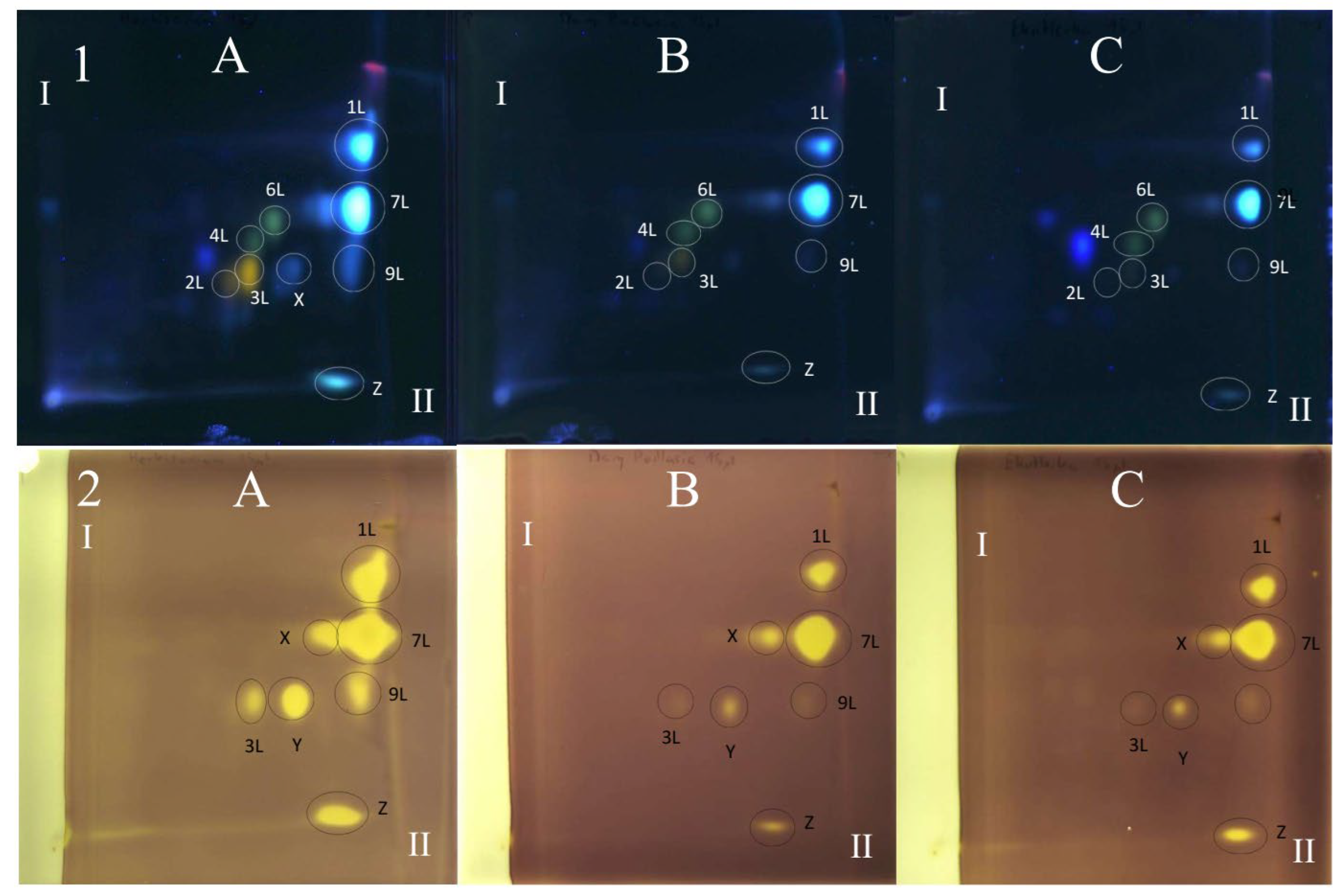
3.6. TLC-DB with DPPH Radical for Determination of Antioxidant Activity of Extracts from Comfrey Leaves
3.7. Determination of Antioxidant Activity Using UV/Vis Spectroscopy Techniques
3.7.1. Correlations
3.7.2. Kruskal–Wallis Test
3.7.3. Post Hoc Dunn’s Test
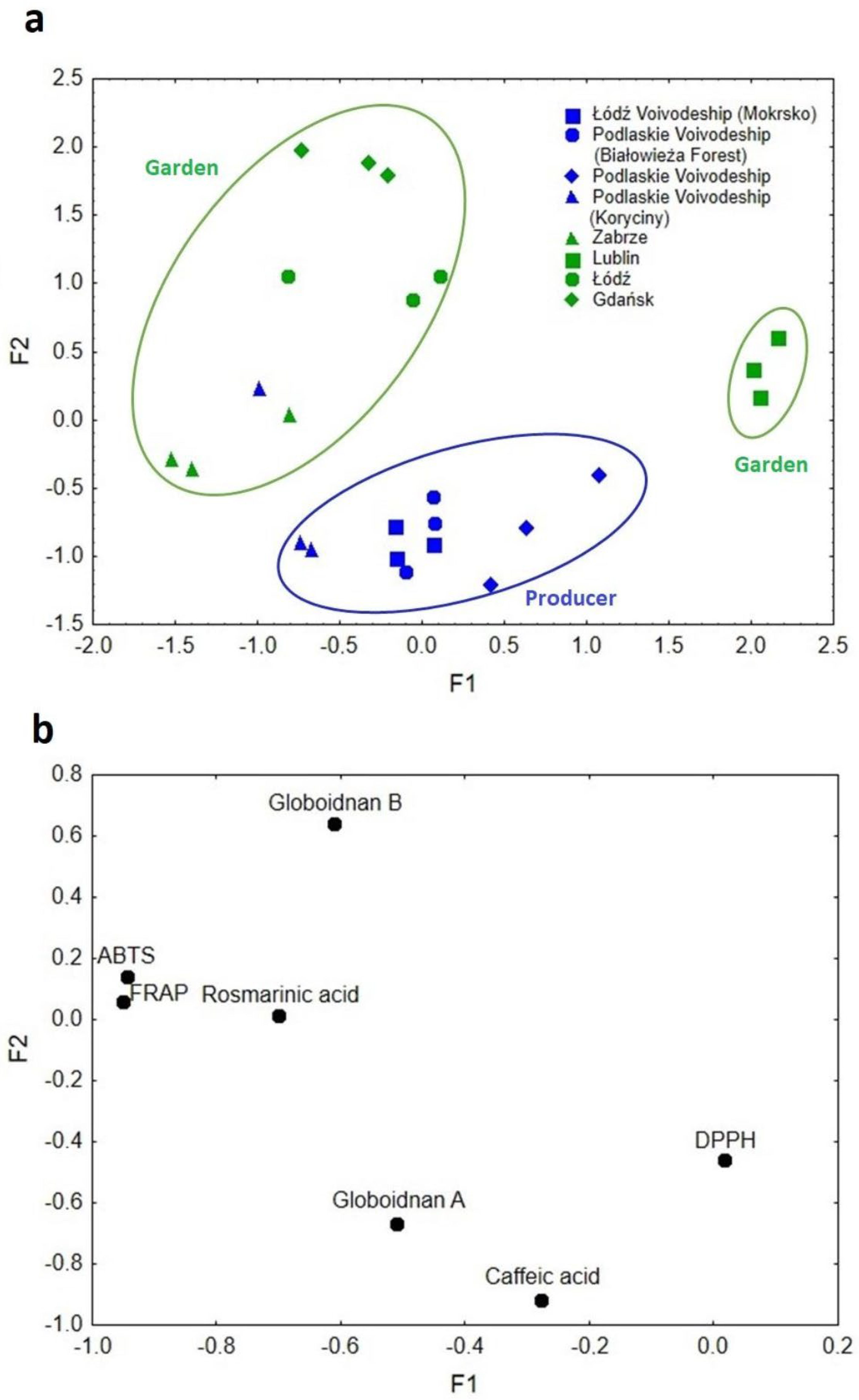
3.7.4. Factor Analysis
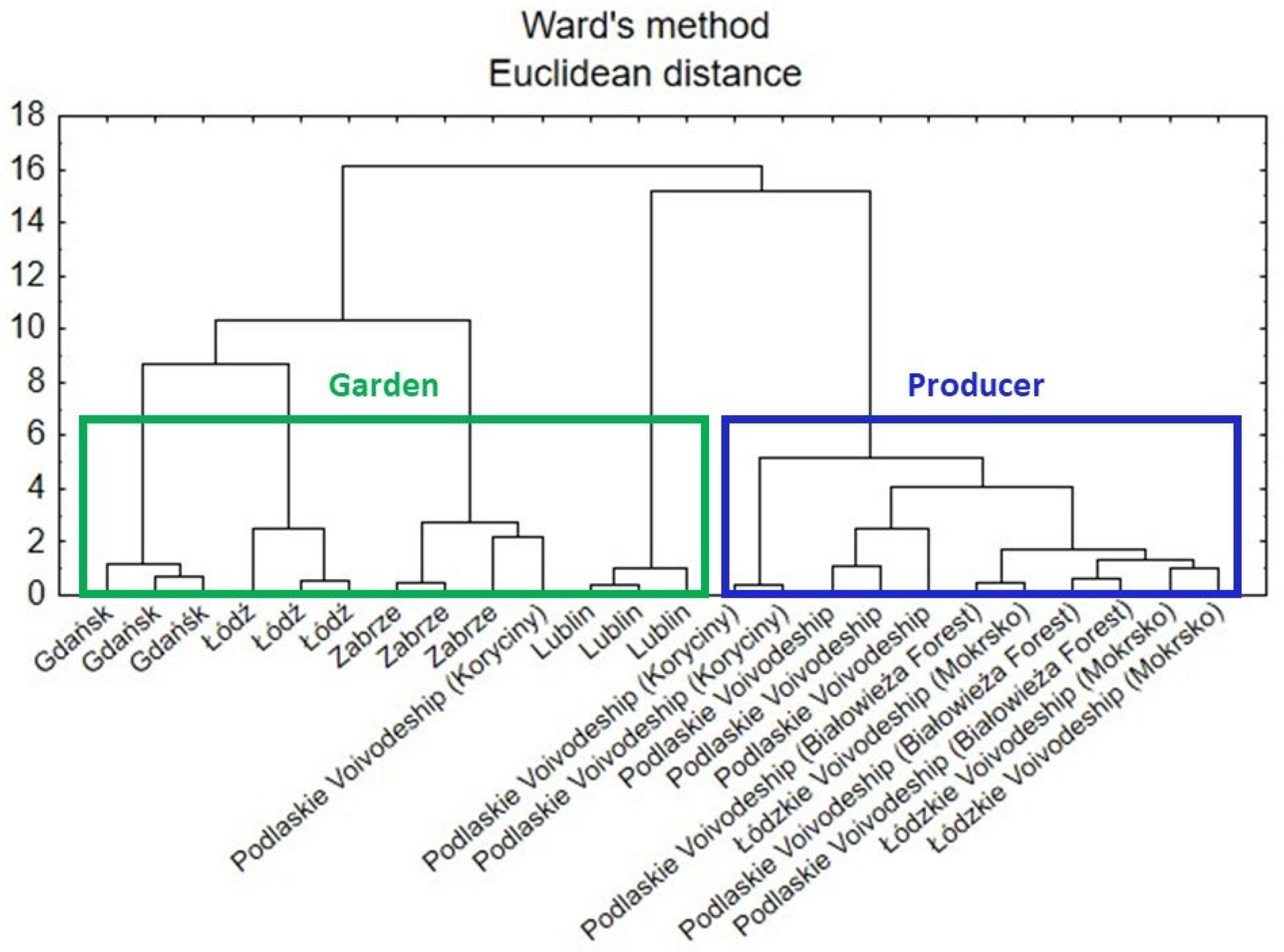
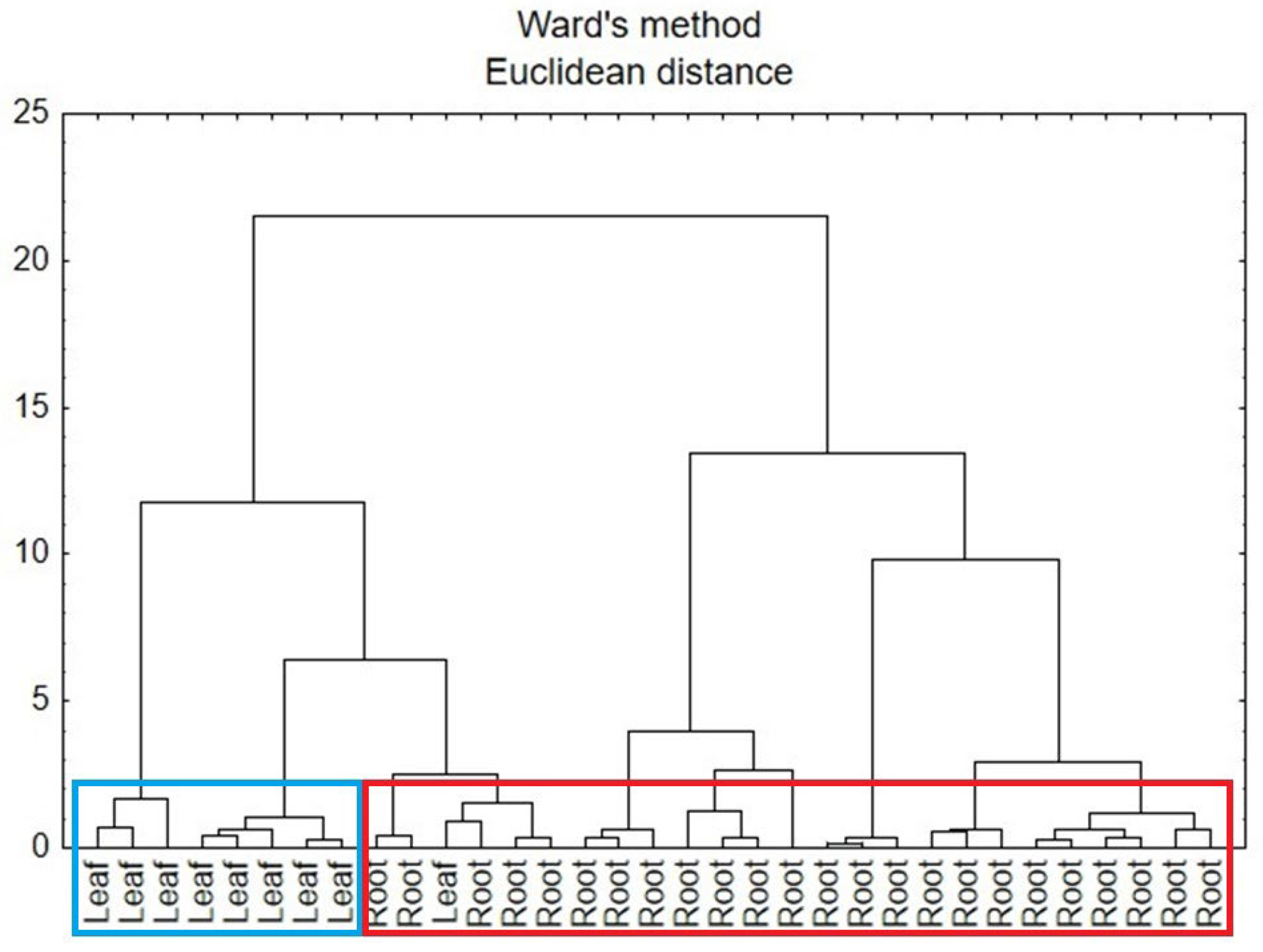
3.7.5. Cluster Analysis
3.8. Results of the Determination of the Anti-Inflammatory Activity of Rosmarinic Acid and Selected Extracts of Comfrey Roots and Leaves as Cyclooxygenase-1 and -2 Inhibitory Activity
4. Discussion
5. Conclusions
Author Contributions
Funding
Institutional Review Board Statement
Informed Consent Statement
Data Availability Statement
Acknowledgments
Conflicts of Interest
References
- Trifan, A.; Wolfram, E.; Skalicka-Woźniak, K.; Luca, S.V. Symphytum genus—From traditional medicine to modern uses: An update on phytochemistry, pharmacological activity, and safety. Phytochem. Rev. 2024, 24, 2329–2386. [Google Scholar] [CrossRef]
- Staiger, C. Comfrey: A clinical overview. Phytother. Res. 2012, 26, 1441–1448. [Google Scholar] [CrossRef] [PubMed]
- Frost, R.; MacPherson, H.; O’Meara, S. A critical scoping review of external uses of comfrey (Symphytum spp.). Complement. Ther. Med. 2013, 21, 724–745. [Google Scholar] [CrossRef] [PubMed]
- Trifan, A.; Opitz, S.E.W.; Josuran, R.; Grubelnik, A.; Esslinger, N.; Peter, S.; Bräm, S.; Meier, N.; Wolfram, E. Is comfrey root more than toxic pyrrolizidine alkaloids? Salvianolic acids among antioxidant polyphenols in comfrey (Symphytum officinale L.). roots. Food Chem. Toxicol. 2018, 112, 178–187. [Google Scholar] [CrossRef]
- Nastić, N.; Borrás-Linares, I.; Lozano-Sánchez, J.; Švarc-Gajić, J.; Segura-Carretero, A. Comparative Assessment of Phytochemical Profiles of Comfrey (Symphytum officinale L.) Root Extracts Obtained by Different Extraction Techniques. Molecules 2020, 25, 837. [Google Scholar] [CrossRef]
- Trifan, A.; Zengin, G.; Sinan, K.I.; Wolfram, E.; Skalicka-Woźniak, K.; Luca, S.V. LC-HRMS/MS phytochemical profiling of Symphytum officinale L. and Anchusa ochroleuca M. Bieb. (Boraginaceae): Unveiling their multi-biological potential via an integrated approach. J. Pharm. Biomed. Anal. 2021, 204, 114283. [Google Scholar] [CrossRef]
- D’urso, G.; Masullo, M.; Seigner, J.; Holper-Schichl, Y.M.; Martin, R.; Plaza, A.; Piacente, S. LC–ESI–FT–MSn metabolite profiling of symphytum officinale l. Roots leads to isolation of comfreyn a, an unusual arylnaphthalene lignan. Int. J. Mol. Sci. 2020, 21, 4671. [Google Scholar] [CrossRef]
- González, D.L.N.; Pérez, Y.V.T.; Núñez, W.E.R. Determination of polyphenols and antioxidant activity of polar extracts of comfrey (Symphytum officinale L). Rev. Cuba. Plantas Med. 2016, 21, 125–132. [Google Scholar]
- Puertas-Mejía, M.A.; Zuleta-Montoya, J.F.; Rivera-Echeverry, F. In vitro antioxidant capacity of comfrey (Symphytum officinale L.). Rev. Cuba. Plantas Med. 2012, 17, 30–36. [Google Scholar]
- Lou, K.H.; Tsai, M.S.; Wu, J.Y. Investigating the Microwave-Assisted Extraction Conditions and Antioxidative and Anti-Inflammatory Capacities of Symphytum officinale WL Leaves. Processes 2023, 11, 2750. [Google Scholar] [CrossRef]
- Kimel, K.; Godlewska, S.; Gleńsk, M.; Gobis, K.; Ośko, J.; Grembecka, M.; Krauze-Baranowska, M. LC-MS/MS Evaluation of Pyrrolizidine Alkaloids Profile in Relation to Safety of Comfrey Roots and Leaves from Polish Sources. Molecules 2023, 28, 6171. [Google Scholar] [CrossRef]
- Trifan, A.; Czerwińska, M.E.; Zengin, G.; Esslinger, N.; Grubelnik, A.; Wolfram, E.; Skalicka-Woźniak, K.; Luca, S.V. Influence of pyrrolizidine alkaloids depletion upon the biological activity of Symphytum officinale L. extracts. J. Ethnopharmacol. 2023, 303, 116010. [Google Scholar] [CrossRef] [PubMed]
- Salehi, B.; Sharopov, F.; Boyunegmez Tumer, T.; Ozleyen, A.; Rodríguez-Pérez, C.; Ezzat, S.M.; Azzini, E.; Hosseinabadi, T.; Butnariu, M.; Sarac, I.; et al. Symphytum Species: A Comprehensive Review on Chemical Composition, Food Applications and Phytopharmacology. Molecules 2019, 24, 2272. [Google Scholar] [CrossRef] [PubMed]
- European Directorate for the Quality of Medicines & Healthcare, Council of Europe. European Pharmacopoeia 8.0: Published in Accordance with the Convention on the elaboration of a European Pharmacopoeia; European Directorate for the Quality of Medicines & Healthcare, Council of Europe: Strasbourg, France, 2013. [Google Scholar]
- Kucera, M.; Barna, M.; Horácek, O.; Kálal, J.; Kucera, A.; Hladíkova, M. Topical Symphytum herb concentrate cream against myalgia: A randomized controlled double-blind clinical study. Adv. Ther. 2005, 22, 681–692. [Google Scholar] [CrossRef] [PubMed]
- Kučera, M.; Barna, M.; Horáček, O.; Kováriková, J.; Kučera, A. Efficacy and safety of topically applied Symphytum herb extract cream in the treatment of ankle distortion: Results of a randomized controlled clinical double blind study. Wien. Med. Wochenschr 2004, 154, 498–507. [Google Scholar] [CrossRef]
- Barna, M.; Kucera, A.; Hladíkova, M.; Kucera, M. Randomized double-blind study: Wound-healing effects of a Symphytum herb extract cream (Symphytum×uplandicum Nyman) in children. Arzneim. -Forsch. Drug Res. 2012, 62, 285–289. [Google Scholar] [CrossRef]
- Kimel, K.; Zienkiewicz, M.; Sparzak-Stefanowska, B.; Krauze-Baranowska, M. TLC-densitometric analysis of allantoin in Symphytum officinale L. roots. Acta Pharm. 2019, 70, 101–110. [Google Scholar] [CrossRef]
- Tahirovic, I.; Rimpapa, Z.; Cavar, S.; Huseinovic, S.; Muradic, S.; Salihovic, M.; Sofic, E. Content of some phenolic acids and rutin in the leaves and roots of Symphytum officinale L. Planta Med. 2010, 76, P293. [Google Scholar] [CrossRef]
- Sowa, I.; Paduch, R.; Strzemski, M.; Zielińska, S.; Rydzik-Strzemska, E.; Sawicki, J.; Kocjan, R.; Polkowski, J.; Matkowski, A.; Latalski, M.; et al. Proliferative and antioxidant activity of Symphytum officinale root extract. Nat. Prod. Res. 2018, 32, 605–609. [Google Scholar] [CrossRef]
- Pobłocka-Olech, L.; Krauze-Baranowska, M.; Godlewska, S.; Kimel, K. HPLC-DAD-ESI/MS and 2D-TLC Analyses of Secondary Metabolites from Selected Poplar Leaves and an Evaluation of Their Antioxidant Potential. Int. J. Mol. Sci. 2025, 26, 6189. [Google Scholar] [CrossRef]
- International Conference on Harmonization of Technical Requirements for Registration of Pharmaceuticals for Human Use, ICH Harmonized Tripartite Guideline, Validation of Analytical Procedures: Text and Methodology Q2(R1); ICH Secretariat, Geneva, Switzerland, 2005. Available online: https://www.gmp-compliance.org/files/guidemgr/Q2(R1).pdf (accessed on 20 August 2023).
- Jesionek, A.; Poblocka-Olech, L.; Zabiegala, B.; Bucinski, A.; Krauze-Baranowska, M.; Luczkiewicz, M. Validated HPTLC method for determination of ledol and alloaromadendrene in the essential oil fractions of Rhododendron tomentosum plants and in vitro cultures and bioautography for their activity screening. J. Chromatogr. B Anal. Technol. Biomed. Life Sci. 2018, 1086, 63–72. [Google Scholar] [CrossRef] [PubMed]
- Bram, S.; Wolfram, E. Recent Advances in Effect-directed Enzyme Assays based on Thin-layer Chromatography. Phytochem. Anal. 2017, 28, 74–86. [Google Scholar] [CrossRef] [PubMed]
- Trifan, A.; Skalicka-Woźniak, K.; Granica, S.; Czerwińska, M.E.; Kruk, A.; Marcourt, L.; Wolfender, J.L.; Wolfram, E.; Esslinger, N.; Grubelnik, A.; et al. Symphytum officinale L.: Liquid-liquid chromatography isolation of caffeic acid oligomers and evaluation of their influence on pro-inflammatory cytokine release in LPS-stimulated neutrophils. J. Ethnopharmacol. 2020, 262, 113169. [Google Scholar] [CrossRef] [PubMed]
- Ovenden, S.P.B.; Yu, J.; San Wan, S.; Sberna, G.; Murray Tait, R.; Rhodes, D.; Cox, S.; Coates, J.; Walsh, N.G.; Meurer-Grimes, B.M. Globoidnan A: A lignan from Eucalyptus globoidea inhibits HIV integrase. Phytochemistry 2004, 65, 3255–3259. [Google Scholar] [CrossRef]
- COX (Ovine/Human) Inhibitor Screening Assay Kit Booklet; Cayman Chemical: Ann Arbor, MI, USA, 2023; Available online: https://cdn.caymanchem.com/cdn/insert/560131.pdf (accessed on 10 October 2023).
- Okamura, K.M.; Hibi, K.; Nakamura, H. A Calculation Method of Correspoding Mobile Phase Composition for Obtaining the Same Retention with Different Binary Organic/Aqueous Solvent Systems in Reversed Phase Liquid Chromatography. Anal. Sci. 1990, 6, 857–861. [Google Scholar] [CrossRef]
- Markham, K.R. Techniques of Flavonoids Identification; Academic Press: London, UK, 1982. [Google Scholar]
- Shekarchi, M.; Hajimehdipoor, H.; Saeidnia, S.; Gohari, A.R.; Hamedani, M.P. Comparative study of rosmarinic acid content in some plants of Labiatae family. Pharmacogn. Mag. 2012, 8, 37–41. [Google Scholar] [CrossRef]
- Tufa, T.; Damianakos, H.; Zengin, G.; Graikou, K.; Chinou, I. Antioxidant and enzyme inhibitory activities of disodium rabdosiin isolated from Alkanna sfikasiana Tan, Vold and Strid. S. Afr. J. Bot. 2019, 120, 157–162. [Google Scholar] [CrossRef]
- Krzyżanowska-Kowalczyk, J.; Kowalczyk, M.; Ponczek, M.B.; Pecio, Ł.; Nowak, P.; Kolodziejczyk-Czepas, J. Pulmonaria obscura and pulmonaria officinalis extracts as mitigators of peroxynitrite-induced oxidative stress and cyclooxygenase-2 inhibitors–in vitro and in silico studies. Molecules 2021, 26, 631. [Google Scholar] [CrossRef]
- Choma, I.M.; Nikolaichuk, H. TLC bioprofiling—A tool for quality evaluation of medicinal plants. In Evidence-Based Validation of Herbal Medicine: Translational Research on Botanicals; Elsevier: Amsterdam, The Netherlands, 2022; pp. 407–422. [Google Scholar]
- Nikolaichuk, H.; Studziński, M.; Choma, I.M. Effect directed detection of Rhodiola rosea L. root and rhizome extract. J. Liq. Chromatogr. Relat. Technol. 2020, 43, 361–366. [Google Scholar] [CrossRef]
- Ciesla, Ł.M.; Waksmundzka-Hajnos, M.; Wojtunik, K.A.; Hajnos, M. Thin-layer chromatography coupled with biological detection to screen natural mixtures for potential drug leads. Phytochem. Lett. 2015, 11, 445–454. [Google Scholar] [CrossRef]
- Vuolo, M.M.; Lima, V.S.; Maróstica Junior, M.R. Chapter 2—Phenolic Compounds: Structure, Classification, and Antioxidant Power. In Bioactive Compounds; Campos, M.R.S., Ed.; Woodhead Publishing: Cambridge, UK, 2019; pp. 33–50. [Google Scholar]
- Fujimoto, A.; Masuda, T. Antioxidation mechanism of rosmarinic acid, identification of an unstable quinone derivative by the addition of odourless thiol. Food Chem. 2012, 132, 901–906. [Google Scholar] [CrossRef]
- Colica, C.; Di Renzo, L.; Aiello, V.; De Lorenzo, A.; Abenavoli, L. Rosmarinic acid as potential anti-inflammatory agent. Rev. Recent Clin. Trials 2018, 13, 240–242. [Google Scholar] [CrossRef] [PubMed]
- Kim, G.D.; Park, Y.S.; Jin, Y.H.; Park, C.S. Production and applications of rosmarinic acid and structurally related compounds. Appl. Microbiol. Biotechnol. 2015, 99, 2083–2092. [Google Scholar] [CrossRef] [PubMed]
- Bulgakov, V.P.; Inyushkina, Y.V.; Fedoreyev, S.A. Rosmarinic acid and its derivatives: Biotechnology and applications. Crit. Rev. Biotechnol. 2012, 32, 203–217. [Google Scholar] [CrossRef]
- Mahmoudzadeh, E.; Nazemiyeh, H.; Hamedeyazdan, S. Anti-inflammatory Properties of the Genus Symphytum L.: A Review. Iran. J. Pharm. Res. 2022, 21, e123949. [Google Scholar] [CrossRef]
- Alizadeh, P.; Rahimi, M.; Amjadi, S.; Bayati, M.; Nejad Ebrahimi, S. Enrichment of rosmarinic acid from comfrey (Symphytum officinale L.) root extract by macroporous adsorption resins and molecular docking studies. Ind. Crops Prod. 2024, 214, 118541. [Google Scholar] [CrossRef]
- Savić, V.L.; Savić, S.R.; Nikolić, V.D.; Nikolić, L.B.; Najman, S.J.; Lazarević, J.S.; Đorđević, A.S. The identification and quantification of bioactive compounds from the aqueous extract of comfrey root by UHPLC–DAD–HESI–MS method and its microbial activity. Hem. Ind. 2015, 69, 1–8. [Google Scholar] [CrossRef]
- Trifan, A.; Wolfram, E.; Esslinger, N.; Grubelnik, A.; Skalicka-Woźniak, K.; Minceva, M.; Luca, S.V. Globoidnan A, rabdosiin and globoidnan B as new phenolic markers in European-sourced comfrey (Symphytum officinale L.) root samples. Phytochem. Anal. 2021, 32, 482–494. [Google Scholar] [CrossRef]
- Trifan, A.; Zengin, G.; Sinan, K.I.; Esslinger, N.; Grubelnik, A.; Wolfram, E.; Skalicka-woźniak, K.; Minceva, M.; Luca, S.V. Influence of the post-harvest storage time on the multi-biological potential, phenolic and pyrrolizidine alkaloid content of comfrey (Symphytum officinale L.) roots collected from different european regions. Plants 2021, 10, 1825. [Google Scholar] [CrossRef]
- Neagu, E.; Paun, G.; Albu, C.; Eremia, S.A.; Radu, G.L. Artemisia abrotanum and Symphytum officinale Polyphenolic Compounds-Rich Extracts with Potential Application in Diabetes Management. Metabolites 2023, 13, 354. [Google Scholar] [CrossRef]
- Paun, G.; Neagu, E.; Litescu, S.C.; Rotinberg, P.; Radu, G.L. Application of membrane processes for the concentration of Symphytum officinale and Geranium robertianum extracts to obtain compounds with high anti-oxidative activity. J. Serbian Chem. Soc. 2012, 77, 1191–1203. [Google Scholar] [CrossRef]
- Luca, S.V.; Zengin, G.; Kulinowski, Ł.; Sinan, K.I.; Skalicka-Woźniak, K.; Trifan, A. Phytochemical profiling and bioactivity assessment of underutilized Symphytum species in comparison with Symphytum officinale. J. Sci. Food Agric. 2024, 104, 3971–3981. [Google Scholar] [CrossRef] [PubMed]
- Varvouni, E.-F.; Zengin, G.; Graikou, K.; Ganos, C.; Mroczek, T.; Chinou, I. Phytochemical analysis and biological evaluation of the aerial parts from Symphytum anatolicum Boiss. and Cynoglottis barrelieri (All.) Vural & Kit Tan (Boraginaceae). Biochem. Syst. Ecol. 2020, 92, 104128. [Google Scholar] [CrossRef]
- Michalska, A.; Wojdyło, A.; Brzezowska, J.; Majerska, J.; Ciska, E. The influence of inulin on the retention of polyphenolic compounds during the drying of blackcurrant juice. Molecules 2019, 24, 4167. [Google Scholar] [CrossRef]
- Shen, N.; Wang, T.; Gan, Q.; Liu, S.; Wang, L.; Jin, B. Plant flavonoids: Classification, distribution, biosynthesis, and antioxidant activity. Food Chem. 2022, 383, 132531. [Google Scholar] [CrossRef]
- Yang, B.; Liu, H.; Yang, J.; Gupta, V.K.; Jiang, Y. New insights on bioactivities and biosynthesis of flavonoid glycosides. Trends Food Sci. Technol. 2018, 79, 116–124. [Google Scholar] [CrossRef]
- Gorzkiewicz, M.; Janaszewska, A.; Ficker, M.; Svenningsen, S.W.; Christensen, J.B.; Klajnert-Maculewicz, B. Pyrrolidone-modified PAMAM dendrimers enhance anti-inflammatory potential of indomethacin in vitro. Colloids Surf. B Biointerfaces 2019, 181, 959–962. [Google Scholar] [CrossRef]
- Fernandes, C.; Palmeira, A.; Ramos, I.I.; Carneiro, C.; Afonso, C.; Tiritan, M.E.; Cidade, H.; Pinto, P.C.A.G.; Saraiva, M.L.M.F.S.; Reis, S.; et al. Chiral derivatives of xanthones: Investigation of the effect of enantioselectivity on inhibition of cyclooxygenases (COX-1 and COX-2) and binding interaction with human serum albumin. Pharmaceuticals 2017, 10, 50. [Google Scholar] [CrossRef]
- Killari, K.N.; Thuan, N.H.; Prasanth, D.; Panda, S.P.; Pasala, P.K.; Ketha, A.; Tatipamula, V.B. Bioassay Guided Isolation of Anti-Inflammatory Compounds from Bauhinia variegata L.: A Key Ingredient in Herbo-Mineral Formulation, Gandmala Kandan Ras. Indian J. Pharm. Sci. 2023, 85, 227–232. [Google Scholar]
- Nguyen, H.T.; Vu, T.Y.; Chandi, V.; Polimati, H.; Tatipamula, V.B. Dual COX and 5-LOX inhibition by clerodane diterpenes from seeds of Polyalthia longifolia (Sonn.) Thwaites. Sci. Rep. 2020, 10, 15965. [Google Scholar] [CrossRef]
- Seigner, J.; Junker-Samek, M.; Plaza, A.; D’Urso, G.; Masullo, M.; Piacente, S.; Holper-Schichl, Y.M.; De Martin, R. A symphytum officinale root extract exerts anti-inflammatory properties by affecting two distinct steps of NF-κB signaling. Front. Pharmacol. 2019, 10, 289. [Google Scholar] [CrossRef] [PubMed]
- Marchev, A.S.; Vasileva, L.V.; Amirova, K.M.; Savova, M.S.; Koycheva, I.K.; Balcheva-Sivenova, Z.P.; Vasileva, S.M.; Georgiev, M.I. Rosmarinic acid—From bench to valuable applications in food industry. Trends Food Sci. Technol. 2021, 117, 182–193. [Google Scholar] [CrossRef]
- Chockalingam, N.; Muruhan, S. Anti-inflammatory properties of rosmarinic acid—A review. Int. J. Res. Pharm. Sci. 2017, 8, 656–662. [Google Scholar]
- Luo, C.; Zou, L.; Sun, H.; Peng, J.; Gao, C.; Bao, L.; Ji, R.; Jin, Y.; Sun, S. A Review of the Anti-Inflammatory Effects of Rosmarinic Acid on Inflammatory Diseases. Front. Pharmacol. 2020, 11, 153. [Google Scholar] [CrossRef]
- Lee, G.B.; Kim, Y.; Lee, K.E.; Vinayagam, R.; Singh, M.; Kang, S.G. Anti-Inflammatory Effects of Quercetin, Rutin, and Troxerutin Result From the Inhibition of NO Production and the Reduction of COX-2 Levels in RAW 264.7 Cells Treated with LPS. Appl. Biochem. Biotechnol. 2024, 196, 8431–8452. [Google Scholar] [CrossRef]
- Devi, K.P.; Malar, D.S.; Nabavi, S.F.; Sureda, A.; Xiao, J.; Nabavi, S.M.; Daglia, M. Kaempferol and inflammation: From chemistry to medicine. Pharmacol. Res. 2015, 99, 1–10. [Google Scholar] [CrossRef]
- Li, Y.; Ma, Y.; Yao, Y.; Ru, G.; Lan, C.; Li, L.; Huang, T. Protective effect of isoquercitrin on UVB-induced injury in HaCaT cells and mice skin through anti-inflammatory, antioxidant, and regulation of MAPK and JAK2-STAT3 pathways. Photochem. Photobiol. 2024, 100, 1507–1518. [Google Scholar] [CrossRef]
- Lee, E.H.; Park, H.J.; Jung, H.Y.; Kang, I.K.; Kim, B.O.; Cho, Y.J. Isoquercitrin isolated from newly bred Green ball apple peel in lipopolysaccharide-stimulated macrophage regulates NF-κB inflammatory pathways and cytokines. 3 Biotech 2022, 12, 100. [Google Scholar] [CrossRef]
- Xu, Y.; Wang, C.; Wu, L.; Li, Z.; Chen, M.; Wang, Y.; Li, F.; Luo, C. Comparison of inhibitory effects of nine flavonoids on prostaglandin E 2 production and COX-2 expression in LPS-stimulated RAW264.7 macrophages. In Proceedings of the 2012 International Conference on Biomedical Engineering and Biotechnology, iCBEB 2012, Macau, China, 28–30 May 2012; pp. 981–984. [Google Scholar]
- Riaz, A.; Rasul, A.; Hussain, G.; Zahoor, M.K.; Jabeen, F.; Subhani, Z.; Younis, T.; Ali, M.; Sarfraz, I.; Selamoglu, Z. Astragalin: A Bioactive Phytochemical with Potential Therapeutic Activities. Adv. Pharmacol. Sci. 2018, 2018, 9794625. [Google Scholar] [CrossRef]
- Rakotondrabe, T.F.; Fan, M.; Guo, M. Exploring potential antidiabetic and anti-inflammatory flavonoids from Euphorbia humifusa with an integrated strategy. Front. Pharmacol. 2022, 13, 980945. [Google Scholar] [CrossRef]
- Ma, Z.; Piao, T.; Wang, Y.; Liu, J. Astragalin inhibits IL-1β-induced inflammatory mediators production in human osteoarthritis chondrocyte by inhibiting NF-κB and MAPK activation. Int. Immunopharmacol. 2015, 25, 83–87. [Google Scholar] [CrossRef]
- Li, X.; Liu, Z.; Zhang, X.F.; Wang, L.J.; Zheng, Y.N.; Yuan, C.C.; Sun, G.Z. Isolation and characterization of phenolic compounds from the leaves of Salix matsudana. Molecules 2008, 13, 1530–1537. [Google Scholar] [CrossRef]
- Vareed, S.K.; Schutzki, R.E.; Nair, M.G. Lipid peroxidation, cyclooxygenase enzyme and tumor cell proliferation inhibitory compounds in Cornus kousa fruits. Phytomedicine 2007, 14, 706–709. [Google Scholar] [CrossRef]



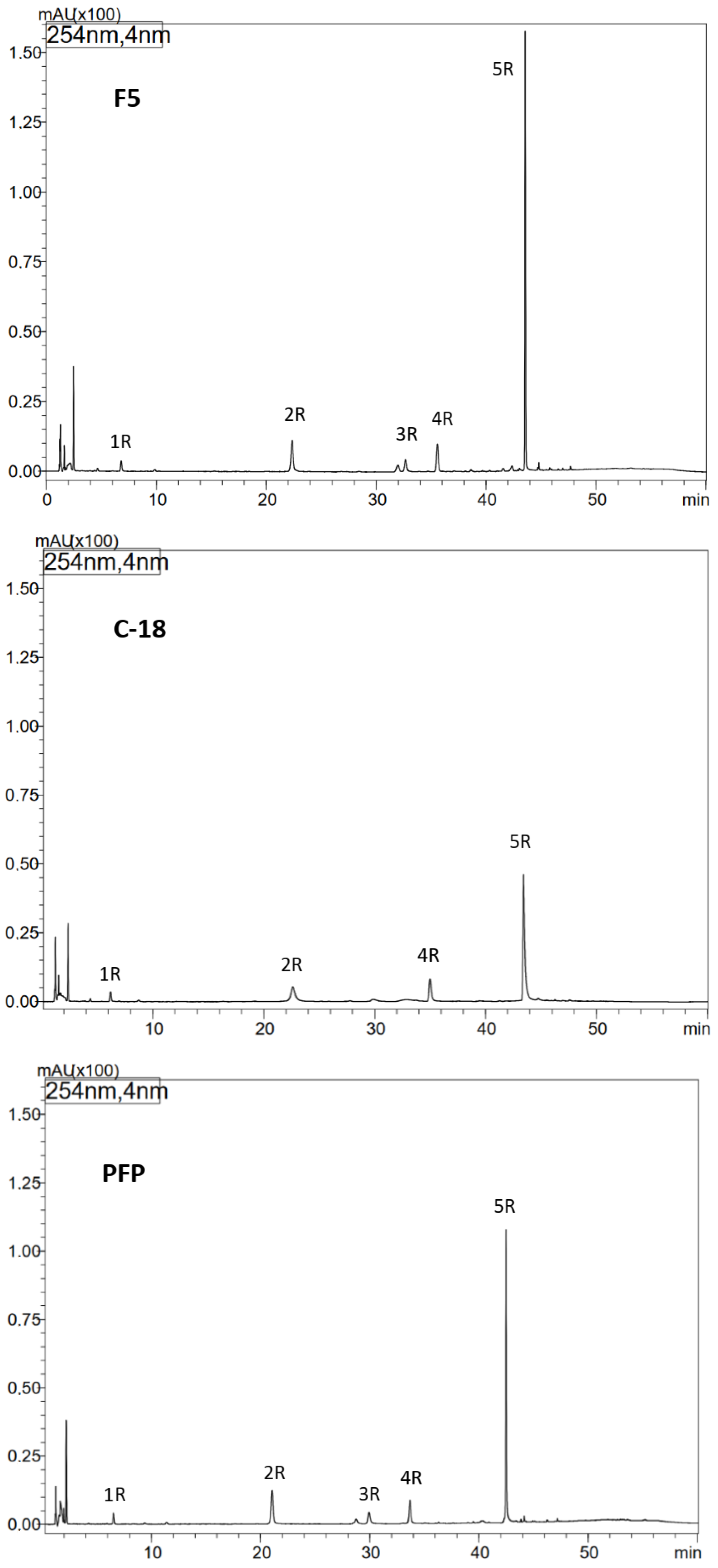
| No. | tR (min) | Compound | [M + H]+/[M − H]− [m/z] | UV λmax [nm] |
|---|---|---|---|---|
| 1R | 9.85 | Caffeic acid * | 179− | 239, 323 |
| 2R | 22.36 | Globoidnan B | 539+/537− | 220sh, 251, 282, 315sh, 344 |
| 3R | 32.67 | Rabdosiin | 719+/717− | 255sh, 282, 316sh, 344nw |
| 4R | 35.57 | Rosmarinic acid * | 361+/359− | 289sh, 328 |
| 5R | 43.57 | Globoidnan A * | 493+, 983+/491− | 215, 261, 318 |
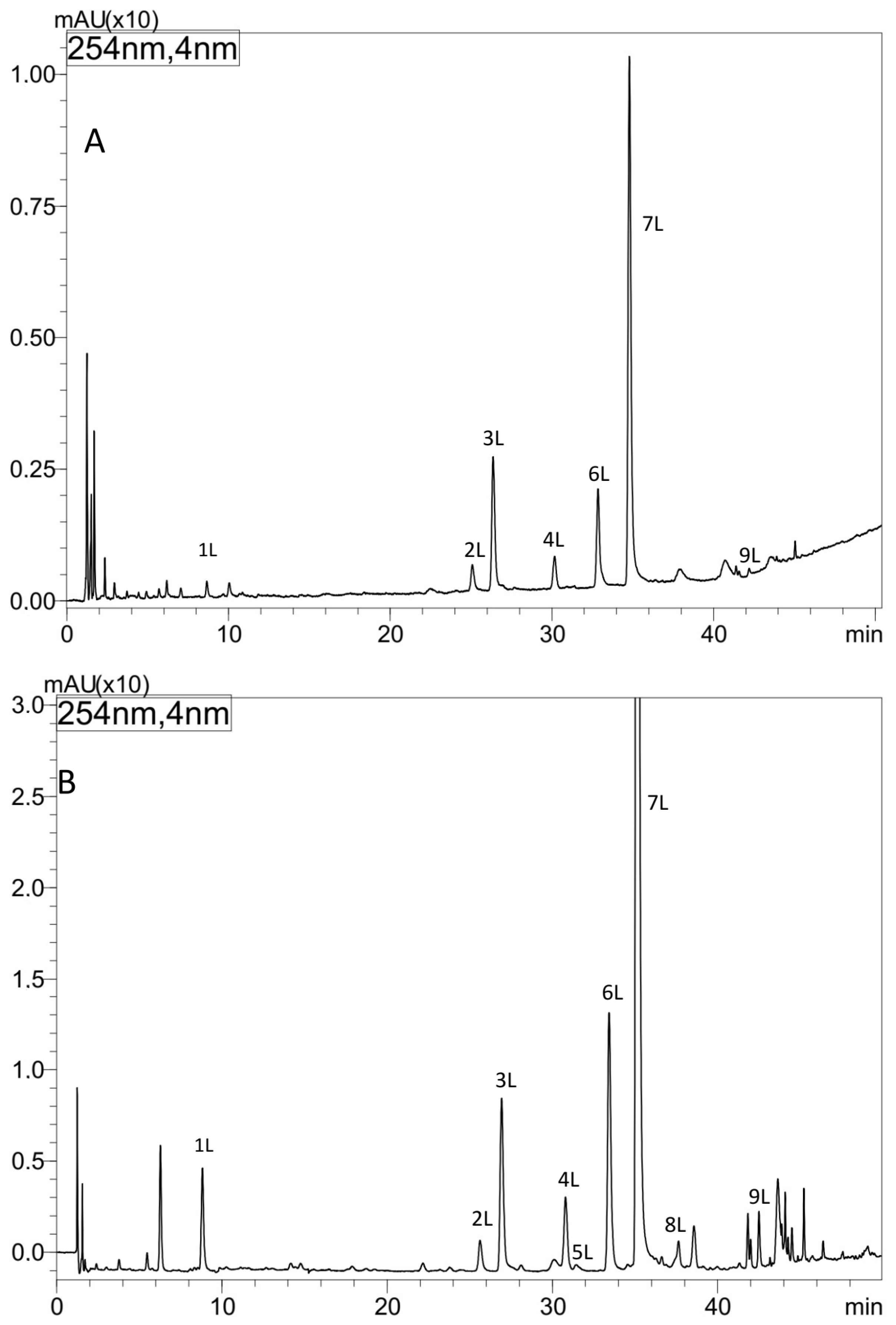
| No. | Compound Name | tR [min] | UV λmax [nm] | [M + H]+/[M − H]− | Mass [Da] |
|---|---|---|---|---|---|
| 1L | Caffeic acid | 8.82 | 295sh, 321 | 179− | 180 |
| 2L | Quercetin 3-O-galactoside | 25.61 | 254, 266sh, 300sh, 353 | 465+/463− | 464 |
| 3L | Quercetin 3-O-glucoside | 26.92 | 256, 266sh, 300sh, 349 | 465+/463− | 464 |
| 4L | Kaempferol 3-O-galactoside | 30.79 | 262, 295sh, 349 | 449+/447− | 448 |
| 5L | Quercetin 3-O-(6″-malonyl-glucoside) | 31.44 | 254, 266sh, 300sh, 348 | 551+ | 550 |
| 6L | Kaempferol 3O-glucoside | 33.43 | 263, 296sh, 347 | 449+/447− | 448 |
| 7L | Rosmarinic acid | 35.11 | 288sh, 328 | 361+/359− | 360 |
| 8L | Kaempferol 3-O-(6″-malonyl-glucoside) | 37.63 | 264, 294sh, 341 | 535+, 533− | 534 |
| 9L | Globoidnan A | 42.33 | 261, 317 | 491− | 492 |
| Comfrey Roots | Caffeic Acid (mg/g d.w. ± SD) | Globoidnan B * (mg/g d.w. ± SD) | Rosmarinic Acid (mg/g d.w. ± SD) | Globoidnan A * (mg/g d.w. ± SD) |
|---|---|---|---|---|
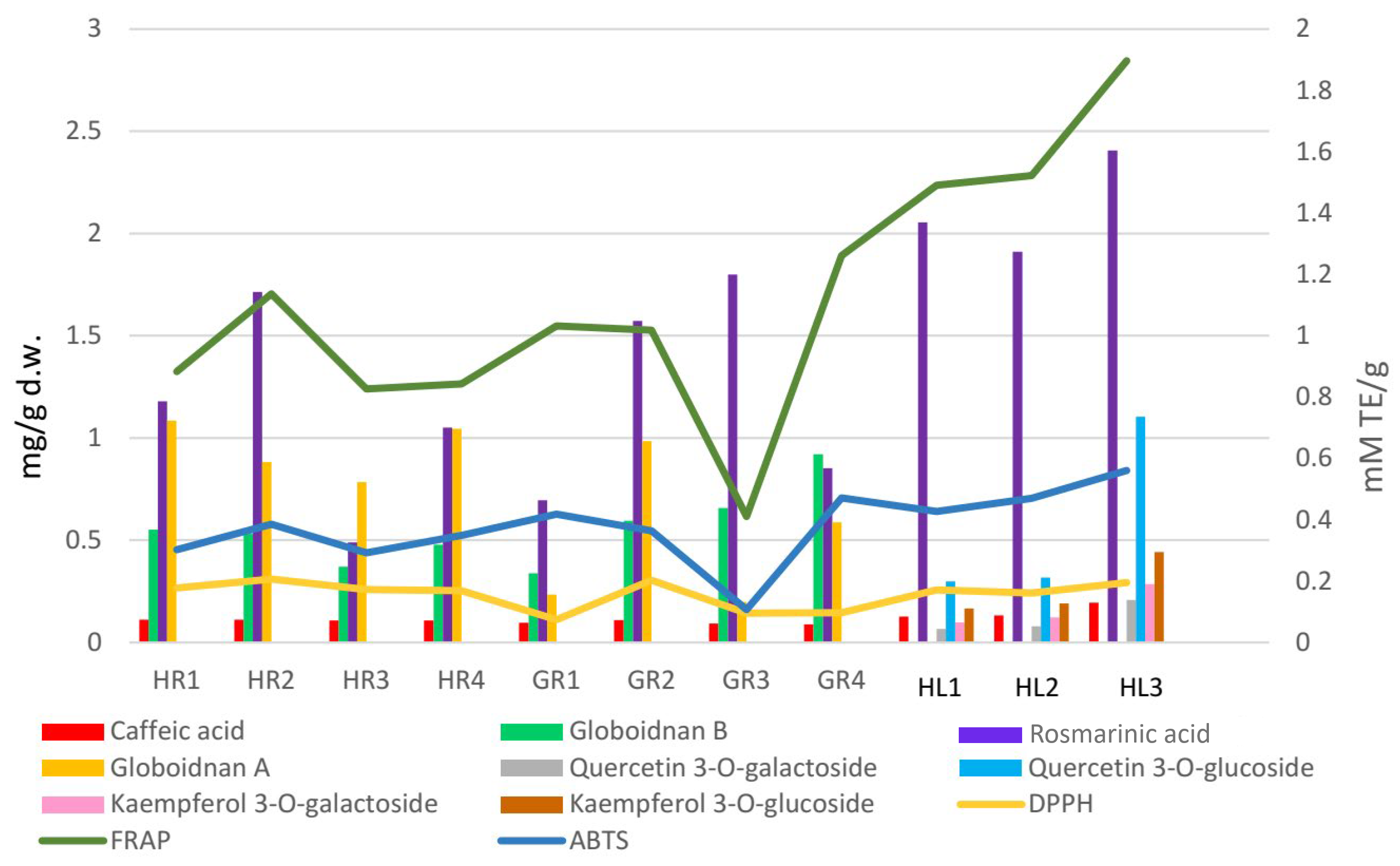
| HR1 a | 0.11 ± 0.004 egh | 0.55 ± 0.023 ceh | 1.18 ± 0.021 bcefg | 1.08 ± 0.019 egh |
| HR2 b | 0.11 ± 0.003 egh | 0.53 ± 0.028 eh | 1.71 ± 0.062 acdeh | 0.88 ± 0.030 eg |
| HR3 c | 0.11 ± 0.007 gh | 0.37 ± 0.101 afgh | 0.49 ± 0.140 abdfg | 0.79 ± 0.316 eg |
| HR4 d | 0.11 ± 0.007 gh | 0.48 ± 0.021 gh | 1.05 ± 0.030 bcfg | 1.05 ± 0.005 egh |
| GR1 e | 0.10 ± 0.005 abf | 0.34 ± 0.020 abfgh | 0.70 ± 0.023 abfg | 0.24 ± 0.006 abcdf |
| GR2 f | 0.11 ± 0.003 egh | 0.60 ± 0.100 eh | 1.57 ± 0.330 acdeh | 0.99 ± 0.240 eg |
| GR3 g | 0.09 ± 0.001 abcdf | 0.66 ± 0.017 cde | 1.80 ± 0.061 acdeh | 0.20 ± 0.015 abcdf |
| GR4 h | 0.09 ± 0.002 abcdf | 0.92 ± 0.093 abcdefg | 0.85 ± 0.086 bfg | 0.59 ± 0.066 ad |
| Comfrey Leaves | Caffeic Acid (mg/g d.w. ± SD) | Rosmarinic Acid (mg/g d.w. ± SD) | Quercetin 3-O-Galactoside μg/g d.w. ± SD) | Quercetin 3-O-Glucoside (μg/g d.w. ± SD) | Kaempferol 3-O-Galactoside * (μg/g d.w. ± SD) | Kaempferol 3-O-Glucoside (μg/g d.w. ± SD) |
|---|---|---|---|---|---|---|
| HL1 a | 0.13 ± 0.01 c | 2.05 ± 0.16 c | 110.22 ± 1.59 c | 259.62 ± 0.81 ac | 100.65 ± 6.58 ac | 166.99 ± 3.40 c |
| HL2 b | 0.14 ± 0.01 c | 1.91 ± 0.03 c | 95.62 ± 2.06 c | 250.58 ± 3.80 bc | 85.07 ± 0.75 bc | 148.24 ± 3.39 c |
| HL3 c | 0.19 ± 0.02 ab | 2.41 ± 0.16 ab | 210.09 ± 1.30 ab | 959.14 ± 1.50 bc | 234.98 ± 11.33 ab | 385.94 ± 12.43 ab |
| Validation Parameter | Caffeic Acid | Rosmarinic Acid | Quercetin 3-O-Glucoside | Kaempferol 3-O-Glucoside | Quercetin 3-O-Galactoside | |
|---|---|---|---|---|---|---|
| Linear regression equation | y = 1641.8x − 12,817 | y = 3191.4x − 12,526 | y = 1596x − 1198.1 | y = 1524.2x − 61.522 | y = 1969.5x − 2568.1 | |
| Regression coefficient | 0.9999 | 0.9999 | 0.9995 | 0.9998 | 0.9950 | |
| LOD [μg/mL] | 0.122 | 0.3789 | 0.700 | 0.469 | – | |
| LOQ [μg/mL] | 0.366 | 1.136 | 2.332 | 1.563 | – | |
| Recovery CV [%] | 50% | – | 103.56 | – | – | – |
| 100% | – | 107.25 | – | – | – | |
| 150% | – | 107.82 | – | – | – | |
| Precision [CV%] | Intra-day | 1.038 | 1.086 | 0.686 | – | – |
| Inter-day | 5.12 | 6.82 | 1.030 | – | – | |
| Plant Material | DPPH (mmol TE/g ± SD) | FRAP (mmol TE/g ± SD) | ABTS (mmol TE/g ± SD) |
|---|---|---|---|
| Comfrey roots | |||
| HR1 a | 0.178 ± 0.018 efh | 0.884 ± 0.110 befijk | 0.302 ± 0.024 efhijk |
| HR2 b | 0.207 ± 0.002 defhj | 1.137 ± 0.027 acdeijk | 0.386 ± 0.039 ek |
| HR3 c | 0.172 ± 0.007 efh | 0.827 ± 0.056 befijk | 0.292 ± 0.17 efhijk |
| HR4 d | 0.168 ± 0.005 befh | 0.843 ± 0.016 befijk | 0.348 ± 0.014 efjk |
| GR1 e | 0.096 ± 0.003 abcdgijk | 0.412 ± 0.006 abcdeghijk | 0.108 ± 0.003 abcdfghijk |
| GR2 f | 0.097 ± 0.012 abcdgijk | 1.260 ± 0.037 acdejk | 0.471 ± 0.018 acdeg |
| GR3 g | 0.203 ± 0.013 efhj | 1.018 ± 0.210 eijk | 0.364 ± 0.083 efjk |
| GR4 h | 0.075 ± 0.009 abcdgijk | 1.031 ± 0.054 eijk | 0.418 ± 0.031 acek |
| Comfrey leaves | |||
| HL1 i | 0.171 ± 0.019 efh | 1.490 ± 0.058 abcdeghk | 0.427 ± 0.014 acek |
| HL2 j | 0.162 ± 0.006 befgh | 1.520 ± 0.069 abcdefghk | 0.469 ± 0.025 acdeg |
| HL3 k | 0.195 ± 0.025 efh | 1.900 ± 0.082 abcdefghij | 0.561 ± 0.034 abcdeghi |
| Compound | Concentration [μM] | COX-1 [% Inhibition ± SD] | COX-2 [% Inhibition ± SD] |
|---|---|---|---|
| Rosmarinic acid | 10 | 33.86 ± 7.96 | 23.16 ± 15.31 |
| 100 | 42.09 ± 26.87 | 31.77 ± 3.63 | |
| 500 | 59.57 ± 4.49 | 36.79 ± 19.67 | |
| IC50 [μM]: | 300.36 | 1040.52 |
| Analyzed Methanol Extract | Concentration [mg d.w./mL] | COX-1 [% Inhibition ± SD] | COX-2 [% Inhibition ± SD] | |
|---|---|---|---|---|
| Comfrey root | HR2 | 4 | 65.25 ± 7.01 | 19.63 ± 1.02 |
| HR3 | 4 | 55.7 ± 9.7 | - | |
| 8 | * | 28.86 ± 14.69 | ||
| Comfrey leaf | HL3 | 2 | - | 70.93 ± 5.09 |
| 10 | 33.62 ± 3.88 | * | ||
Disclaimer/Publisher’s Note: The statements, opinions and data contained in all publications are solely those of the individual author(s) and contributor(s) and not of MDPI and/or the editor(s). MDPI and/or the editor(s) disclaim responsibility for any injury to people or property resulting from any ideas, methods, instructions or products referred to in the content. |
© 2025 by the authors. Licensee MDPI, Basel, Switzerland. This article is an open access article distributed under the terms and conditions of the Creative Commons Attribution (CC BY) license.
Share and Cite
Kimel, K.; Krauze-Baranowska, M.; Ośko, J.; Grembecka, M.; Sparzak-Stefanowska, B.; Godlewska, S. Comparative Chromatographic Analysis of Polyphenolic Compounds in Comfrey Leaf and Root with Determination of Their In Vitro Antioxidant and Anti-Inflammatory Activity. Antioxidants 2026, 15, 46. https://doi.org/10.3390/antiox15010046
Kimel K, Krauze-Baranowska M, Ośko J, Grembecka M, Sparzak-Stefanowska B, Godlewska S. Comparative Chromatographic Analysis of Polyphenolic Compounds in Comfrey Leaf and Root with Determination of Their In Vitro Antioxidant and Anti-Inflammatory Activity. Antioxidants. 2026; 15(1):46. https://doi.org/10.3390/antiox15010046
Chicago/Turabian StyleKimel, Katarzyna, Mirosława Krauze-Baranowska, Justyna Ośko, Małgorzata Grembecka, Barbara Sparzak-Stefanowska, and Sylwia Godlewska. 2026. "Comparative Chromatographic Analysis of Polyphenolic Compounds in Comfrey Leaf and Root with Determination of Their In Vitro Antioxidant and Anti-Inflammatory Activity" Antioxidants 15, no. 1: 46. https://doi.org/10.3390/antiox15010046
APA StyleKimel, K., Krauze-Baranowska, M., Ośko, J., Grembecka, M., Sparzak-Stefanowska, B., & Godlewska, S. (2026). Comparative Chromatographic Analysis of Polyphenolic Compounds in Comfrey Leaf and Root with Determination of Their In Vitro Antioxidant and Anti-Inflammatory Activity. Antioxidants, 15(1), 46. https://doi.org/10.3390/antiox15010046