Reprogramming the Mitochondrion in Atherosclerosis: Targets for Vascular Protection
 ,
,  , , , ,
  and
and 
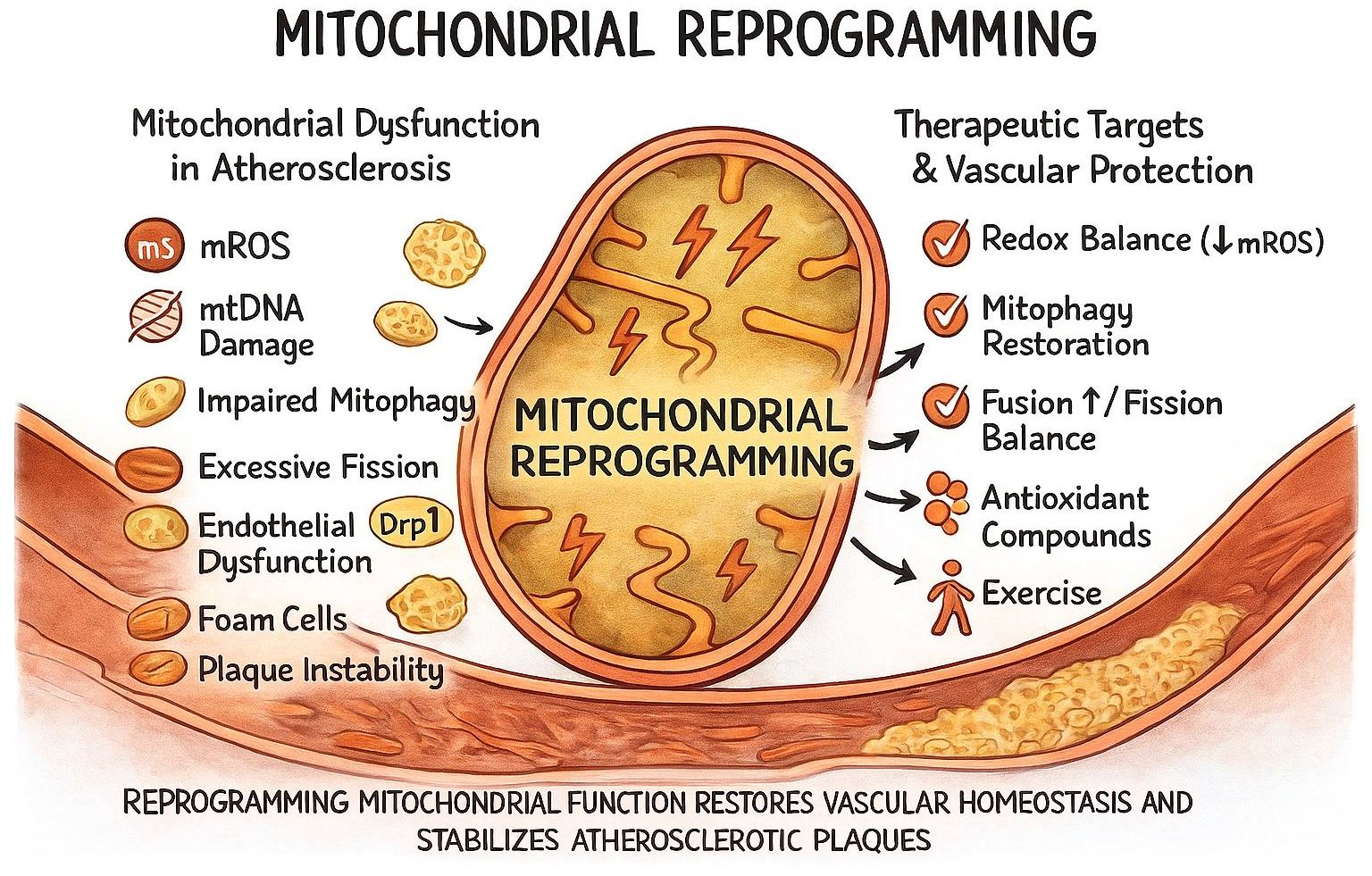
Abstract
1. From Residual Risk to Mitochondrial Reprogramming: A New Chapter in Atherosclerosis (AS)
2. Mitochondrial Dysfunction in Atherosclerosis: From Oxidative Stress to Metabolic Failure
2.1. Mitochondrial Dysregulation in the Endothelium: Fueling Oxidative Stress, Inflammation, and Atherosclerosis

| Cell Type | Mitochondrial Alteration | Key Cellular Mechanisms | Pathological Consequences Atherosclerosis | References |
|---|---|---|---|---|
| Endothelial Cells (ECs) |
|
|
| [8,20,21,22,23,24,25,26,27,28,29,30] |
| Vascular Smooth Muscle Cells (VSMCs) |
|
|
| [31,32,33,34,35,36,37] |
| Macrophages |
|
|
| [38,39,40,41] |
| Shared Pathways Across Cell Types |
|
|
| [21,22,24,26,27,28,29,34,35,39,40] |
2.2. Mitochondrial Reprogramming of VSMCs: From Contractile Guardians to Drivers of Plaque Instability
2.3. Mitochondrial Determinants of Macrophage Function: Inflammatory Signaling and Foam Cell Transformation
3. Molecular Pathways Involved in Mitochondrial Reprogramming
3.1. The SIRT1–PGC-1α Pathway in VSMC Mitochondrial Function and Vascular Remodeling
3.2. Mitochondrial Fusion and Fission Dynamics in Vascular Cells
3.3. Selective Mitochondrial Clearance: Mitophagy in Atherosclerosis and Vascular Homeostasis
4. Therapeutic Strategies Targeting Mitochondrial Dysfunction in Atherosclerosis
4.1. Antioxidants and Pharmacological Compounds
4.2. Gene-Based Interventions
4.3. Nanotechnologies for Mitochondrial-Targeted Drug Delivery
4.4. Mitochondria-Targeted Redox Therapeutics as Emerging Stabilizers of the Atherosclerotic Plaque
| Category | Agent/Approach | Molecular Mechanism | Evidence | Therapeutic Outcome | References |
|---|---|---|---|---|---|
| Antioxidants/Pharmacological Compounds | MitoQ |
|
| Endothelial protection, preservation of mitochondrial integrity, attenuation of oxidative stress | [80,81,82,83] |
| Resveratrol |
| In vitro (25–50 μM): ↓ intra-/extracellular mROS, no cytotoxicity | Cytoprotection, improved redox balance, attenuation of oxidative stress | [84,85,86,87,88] | |
| Metformin | AMPK activation; inhibition of mitochondrial fragmentation; anti-apoptotic and anti-inflammatory; modulation of mitochondrial dynamics |
| Cardiovascular protection in T2DM, anti-atherogenic effects | [89,90,91] | |
| Fish oil | AMPK activation; ↑ MFN2, ↓ Fis1; modulation of mitochondrial dynamics | ApoE−/− mice on high-fat diet: ↓ plaque burden | Improved mitochondrial dynamics, reduced lesion progression | [92] | |
| Mito-TEMPO | SOD mimetic; scavenging of superoxide and alkyl radicals; selective mitochondrial accumulation |
| Reduction in mROS, protection against mitochondrial oxidative damage | [93,94,95,96,97] | |
| CoQ10 | activation of AMPK; upregulation of OPA1, preserving mitochondrial membrane potential and ATP synthesis; restoration of energy homeostasis in endothelial cells; modulation of mevalonate pathway, ↑ LDL receptors, ↓ PCSK9, normalization of SREBP-2 feedback; ↑ endogenous antioxidants (glutathione, SOD); inhibition of inflammasome activation |
| Restoration of endothelial bioenergetics, improved lipid metabolism, redox homeostasis, attenuation of inflammasome-driven inflammation | [98,99,100] | |
| Gene-based Interventions | CRISPR/Cas9 | Removal/correction of mtDNA mutations (e.g., MT-CYB m.15059G>A); restoration of mitophagy and lipid metabolism | Preclinical: macrophages/monocytes | Attenuation of plaque formation, improved mitochondrial function | [101] |
| circHIPK3 silencing | Inhibition of DRP1-mediated fission; ↓ mitochondrial fragmentation; ↓ mROS; prevention of VSMC necroptosis | ApoE−/− mice: ↓ plaque progression | Vascular protection, preservation of fibrous cap integrity | [102] | |
| CTRP9–USP22–SIRT1 axis | USP22-mediated stabilization of SIRT1; ↑ autophagic flux; ↓ lipid accumulation in macrophages | In vitro: human macrophages + oxLDL | Preservation of macrophage reparative function under atherogenic stress | [103] | |
| Nanotechnologies/Mitochondria-targeted Delivery | Mitochondrial biomarkers (IFI6, FSCN1, SGCA) | Shared DEGs in AS and systemic sclerosis; diagnostic potential | Multi-cohort transcriptomics, AUC ≈ 0.90 | Highly sensitive and specific molecular diagnosis for early detection of mitochondrial dysfunction in AS | [104] |
| SS-peptides (Elamipretide/SS-31) | >1000× mitochondrial accumulation; cardiolipin stabilization; ↑ OXPHOS; ↓ mROS; improved Ca2+ handling; protection of mtDNA | Preclinical and clinical: heart failure, ischemia–reperfusion models | Restoration of mitochondrial bioenergetics, cardioprotection, plaque stabilization | [107,108,109] | |
| TPP-conjugates (e.g., MitoQ) | Lipophilic cation-driven mitochondrial targeting; conjugation of antioxidants; reduces lipid peroxidation | Widely tested with antioxidant cargo | Targeted mitochondrial delivery, reduction in mROS-mediated injury | [110,111] | |
| MTS + CPP constructs | Dual mitochondrial targeting; enhanced cell permeability; efficient mitochondrial delivery | In vitro: ↑ cellular uptake, efficient mitochondrial import | Enhanced delivery of therapeutic proteins/peptides, improved mitochondrial repair | [112,113] | |
| Mitochondrial-derived peptides (MOTS-c, SHLPs, Humanin) | Antioxidant, anti-apoptotic, anti-inflammatory; restoration of proteostasis | Association studies with cardiovascular outcomes | Cardioprotection, modulation of CVD risk factors | [114] | |
| PLGA nanoparticles (Mdivi1, quercetin, CsA, pitavastatin) | Controlled drug release; inhibition of mitochondrial fission (Mdivi1); ↓ mROS; protection of mitochondrial membrane integrity; modulation of mitochondrial permeability transition | Preclinical I/R models: ↓ infarct size > 30%; dual-drug delivery: additional ↓ 10–15% cell death | Reduction in oxidative stress, improved mitochondrial function, anti-inflammatory effects | [115,116,117] | |
| Emerging Mitochondria-Targeted Redox Therapies | Cardiolipin-stabilizing peptides | Preservation of inner membrane architecture; improved ETC efficiency; ↓ mROS amplification | Preclinical: models of ischemia–reperfusion, heart failure | Restoration of mitochondrial bioenergetics, protection against oxidative stress | [122] |
| mtDNA protection strategies (TFAM-based, engineered mtDNA) | Prevention of mtDNA release; maintenance of mitochondrial transcription/translation; suppression of cGAS/STING-mediated inflammation | Preclinical models of atherosclerosis | Reduction in vascular inflammation, preservation of mitochondrial function | [123,124] | |
| Lipid peroxidation blockers (radical-trapping antioxidants) | Inhibition of PUFA-phospholipid oxidation; prevention of ferroptosis and lipid-driven cell death | Preclinical: atherosclerosis models | Protection of vascular cells, reduced necrotic core formation | [125,126] | |
| Proteostasis-targeting interventions | Reduction in protein carbonylation; enhancement of selective autophagy and proteasomal clearance | Preclinical: endothelial and VSMC models | Restoration of functional proteomes, attenuation of maladaptive phenotype switching | [127] |
5. Clinical Implications and Future Directions
5.1. Precision Therapeutics: High-Resolution Molecular Imaging, Omics Based Approach
5.2. Lifestyle-Based Mitochondrial Reprogramming: Foundational and Synergistic Strategies
6. Conclusions
Author Contributions
Funding
Institutional Review Board Statement
Informed Consent Statement
Data Availability Statement
Acknowledgments
Conflicts of Interest
Abbreviations
| CVDs | Cardiovascular diseases |
| AS | Atherosclerosis |
| ATP | Adenosine triphosphate |
| mROS | Mitochondrial reactive oxygen species |
| mtDNA | Mitochondrial DNA |
| OXPHOS | Oxidative phosphorylation |
| ETC | Electron transport chain |
| VSMCs | Vascular smooth muscle cells |
| MitoQ | Mitoquinone |
| AMPK | AMP-activated protein kinase |
References
- GBD 2023 Causes of Death Collaborators. Global burden of 292 causes of death in 204 countries and territories and 660 sub-national locations, 1990–2023: A systematic analysis for the Global Burden of Disease Study 2023. Lancet 2025, 406, 1811–1872. [Google Scholar] [CrossRef] [PubMed]
- Ajoolabady, A.; Pratico, D.; Lin, L.; Mantzoros, C.S.; Bahijri, S.; Tuomilehto, J.; Ren, J. Inflammation in atherosclerosis: Pathophysiology and mechanisms. Cell Death Dis. 2024, 15, 817. [Google Scholar] [CrossRef]
- Maligłówka, M.; Dec, A.; Bułdak, Ł.; Okopień, B. The effects of inclisiran on the subclinical inflammatory markers of atherosclerotic cardiovascular disease in patients at high cardiovascular risk. Pharmaceuticals 2025, 18, 832. [Google Scholar] [CrossRef] [PubMed]
- Yang, H.M. Mitochondrial dysfunction in cardiovascular diseases. Int. J. Mol. Sci. 2025, 26, 1917. [Google Scholar] [CrossRef] [PubMed]
- Hom, J.; Sheu, S.S. Morphological dynamics of mitochondria—A special emphasis on cardiac muscle cells. J. Mol. Cell. Cardiol. 2009, 46, 811–820. [Google Scholar] [CrossRef]
- Larsen, S.; Nielsen, J.; Hansen, C.N.; Nielsen, L.B.; Wibrand, F.; Stride, N.; Schroder, H.D.; Boushel, R.; Helge, J.W.; Dela, F.; et al. Biomarkers of mitochondrial content in skeletal muscle of healthy young human subjects. J. Physiol. 2012, 590, 3349–3360. [Google Scholar] [CrossRef]
- Čulić, O.; Gruwel, M.L.; Schrader, J. Energy turnover of vascular endothelial cells. Am. J. Physiol. Cell Physiol. 1997, 273, C205–C213. [Google Scholar] [CrossRef]
- Kirkman, D.L.; Robinson, A.T.; Rossman, M.J.; Seals, D.R.; Edwards, D.G. Mitochondrial contributions to vascular endothelial dysfunction, arterial stiffness, and cardiovascular diseases. Am. J. Physiol. Heart Circ. Physiol. 2021, 320, H2080–H2100. [Google Scholar] [CrossRef]
- Qiu, Y.; Chang, S.; Zeng, Y.; Wang, X. Advances in Mitochondrial Dysfunction and Its Role in Cardiovascular Diseases. Cells 2025, 14, 1621. [Google Scholar] [CrossRef]
- Xia, Y.; Zhang, X.; An, P.; Luo, J.; Luo, Y. Mitochondrial homeostasis in VSMCs as a central hub in vascular remodeling. Int. J. Mol. Sci. 2023, 24, 3483. [Google Scholar] [CrossRef]
- Zhou, B.; Tian, R. Mitochondrial Dysfunction in the Pathophysiology of Heart Failure. J. Clin. Investig. 2018, 128, 3716–3726. [Google Scholar] [CrossRef]
- Zong, Y.; Li, H.; Liao, P.; Chen, L.; Pan, Y.; Zheng, Y.; Zhang, C.; Liu, D.; Zheng, M.; Gao, J. Mitochondrial dysfunction: Mechanisms and advances in therapy. Signal Transduct. Target. Ther. 2024, 9, 124. [Google Scholar] [CrossRef] [PubMed]
- Xu, X.; Pang, Y.; Fan, X. Mitochondria in Oxidative Stress, Inflammation and Aging: From Mechanisms to Therapeutic Advances. Signal Transduct. Target. Ther. 2025, 10, 190. [Google Scholar] [CrossRef] [PubMed]
- Kim, J.S.; Park, J.Y. Effects of resveratrol on laminar shear stress–induced mitochondrial biogenesis in human vascular endothelial cells. J. Exerc. Nutr. Biochem. 2019, 23, 7–12. [Google Scholar] [CrossRef]
- Park, S.Y.; Pekas, E.J.; Anderson, C.P.; Kambis, T.N.; Mishra, P.K.; Schieber, M.N.; Wooden, T.K.; Thompson, J.R.; Kim, K.S.; Pipinos, I.I. Acute mitochondrial antioxidant intake improves endothelial function, antioxidant enzyme activity, and exercise tolerance in patients with peripheral artery disease. Am. J. Physiol. Heart Circ. Physiol. 2020, 319, H456–H467. [Google Scholar] [CrossRef] [PubMed]
- Li, J.; He, P.; Zhang, Y.; Zhao, R.; Shen, C.; Li, C.; Liu, W.; Liu, Z.; Long, X.; Wang, Y.; et al. The role and mechanism of PGC-1α in oxLDL-induced ferroptosis of vascular endothelial cells. Atheroscler. Plus 2025, 61, 1–11. [Google Scholar] [CrossRef]
- Dvořáková, M. Perspective of mitochondrial nanomedicine. In Translational Mitochondrial Medicine; Gvozdjáková, A., López Lluch, G., Eds.; Springer: Cham, Switzerland, 2024; Volume 32, pp. 353–375. [Google Scholar] [CrossRef]
- Nevoit, G.; Jarusevicius, G.; Potyazhenko, M.; Mintser, O.; Bumblyte, I.A.; Vainoras, A. Mitochondrial dysfunction and atherosclerosis: The problem and the search for its solution. Biomedicines 2025, 13, 963. [Google Scholar] [CrossRef]
- Pepin, M.E.; Gupta, R.M. The role of endothelial cells in atherosclerosis: Insights from genetic association studies. Am. J. Pathol. 2024, 194, 499–509. [Google Scholar] [CrossRef]
- Wilson, C.; Lee, M.D.; Buckley, C.; Zhang, X.; McCarron, J.G. Mitochondrial ATP production is required for endothelial cell control of vascular tone. Function 2023, 4, zqac063. [Google Scholar] [CrossRef]
- Liaudet, L.; Vassalli, G.; Pacher, P. Role of peroxynitrite in the redox regulation of cell signal transduction pathways. Front. Biosci. 2009, 14, 4809–4814. [Google Scholar] [CrossRef]
- Guan, X.; Li, H.; Zhang, L.; Zhi, H. Mechanisms of mitochondrial damage-associated molecular patterns associated with inflammatory response in cardiovascular diseases. Inflamm. Res. 2025, 74, 18. [Google Scholar] [CrossRef] [PubMed]
- Garg, M.; Johri, S.; Chakraborty, K. Immunomodulatory role of mitochondrial DAMPs: A missing link in pathology? FEBS J. 2023, 290, 4395–4418. [Google Scholar] [CrossRef] [PubMed]
- Zhang, Q.; Raoof, M.; Chen, Y.; Sumi, Y.; Sursal, T.; Junger, W.; Brohi, K.; Itagaki, K.; Hauser, C.J. Circulating mitochondrial DAMPs cause inflammatory responses to injury. Nature 2010, 464, 104–107. [Google Scholar] [CrossRef] [PubMed]
- An, C.; Sun, F.; Liu, C.; Huang, S.; Xu, T.; Zhang, C.; Ge, S. IQGAP1 promotes mitochondrial damage and activation of the mtDNA sensor cGAS–STING pathway to induce endothelial cell pyroptosis leading to atherosclerosis. Int. Immunopharmacol. 2023, 123, 110795. [Google Scholar] [CrossRef]
- Zacharioudakis, E.; Agianian, B.; Kumar Mv, V.; Biris, N.; Garner, T.P.; Rabinovich-Nikitin, I.; Ouchida, A.T.; Margulets, V.; Nordstrøm, L.U.; Riley, J.S.; et al. Modulating mitofusins to control mitochondrial function and signaling. Nat. Commun. 2022, 13, 3775. [Google Scholar] [CrossRef]
- Piao, L.; Fang, Y.H.; Fisher, M.; Hamanaka, R.B.; Ousta, A.; Wu, R.; Mutlu, G.M.; Garcia, A.J., 3rd; Archer, S.L.; Sharp, W.W. Dynamin-related protein 1 is a critical regulator of mitochondrial calcium homeostasis during myocardial ischemia/reperfusion injury. FASEB J. 2024, 38, e23379. [Google Scholar] [CrossRef]
- Brooks, C.; Cho, S.G.; Wang, C.Y.; Yang, T.; Dong, Z. Fragmented mitochondria are sensitized to Bax insertion and activation during apoptosis. Am. J. Physiol. Cell Physiol. 2011, 300, C447–C455. [Google Scholar] [CrossRef]
- Iorio, R.; Celenza, G.; Petricca, S. Mitophagy: Molecular Mechanisms, New Concepts on Parkin Activation and the Emerging Role of AMPK/ULK1 Axis. Cells 2022, 11, 30. [Google Scholar] [CrossRef]
- Pliouta, L.; Lampsas, S.; Kountouri, A.; Korakas, E.; Thymis, J.; Kassi, E.; Oikonomou, E.; Ikonomidis, I.; Lambadiari, V. Mitochondrial dysfunction in the development and progression of cardiometabolic diseases: A narrative review. J. Clin. Med. 2025, 14, 3706. [Google Scholar] [CrossRef]
- Elmarasi, M.; Elmakaty, I.; Elsayed, B.; Elsayed, A.; Zein, J.A.; Boudaka, A.; Eid, A.H. Phenotypic switching of vascular smooth muscle cells in atherosclerosis, hypertension, and aortic dissection. J. Cell. Physiol. 2024, 239, e31200. [Google Scholar] [CrossRef]
- Pearce, W.J. Mitochondrial influences on smooth muscle phenotype. Am. J. Physiol. Cell Physiol. 2024, 326, C442–C448. [Google Scholar] [CrossRef] [PubMed]
- Vaupel, P.; Multhoff, G. Revisiting the Warburg effect: Historical dogma versus current understanding. J. Physiol. 2021, 599, 1745–1757. [Google Scholar] [CrossRef] [PubMed]
- Ebrahimian, T.; Li, M.W.; Lemarié, C.A.; Simeone, S.M.; Pagano, P.J.; Gaestel, M.; Paradis, P.; Wassmann, S.; Schiffrin, E.L. Mitogen-activated protein kinase–activated protein kinase 2 in angiotensin II–induced inflammation and hypertension: Regulation of oxidative stress. Hypertension 2011, 57, 245–254. [Google Scholar] [CrossRef] [PubMed]
- Bourcier, T.; Sukhova, G.; Libby, P. The nuclear factor kappa-B signaling pathway participates in dysregulation of vascular smooth muscle cells in vitro and in human atherosclerosis. J. Biol. Chem. 1997, 272, 15817–15824. [Google Scholar] [CrossRef]
- Sun, J.; Shao, Y.; Pei, L.; Zhu, Q.; Yu, X.; Yao, W. AKAP1 alleviates VSMC phenotypic modulation and neointima formation by inhibiting Drp1-dependent mitochondrial fission. Biomed. Pharmacother. 2024, 176, 116858. [Google Scholar] [CrossRef]
- Nahapetyan, H.; Moulis, M.; Grousset, E.; Faccini, J.; Grazide, M.H.; Mucher, E.; Elbaz, M.; Martinet, W.; Vindis, C. Altered mitochondrial quality control in Atg7-deficient VSMCs promotes enhanced apoptosis and is linked to unstable atherosclerotic plaque phenotype. Cell Death Dis. 2019, 10, 119. [Google Scholar] [CrossRef]
- Yang, B.; Hang, S.; Xu, S.; Gao, Y.; Yu, W.; Zang, G.; Zhang, L.; Wang, Z. Macrophage polarisation and inflammatory mechanisms in atherosclerosis: Implications for prevention and treatment. Heliyon 2024, 10, e32073. [Google Scholar] [CrossRef]
- Saha, S.; Shalova, I.N.; Biswas, S.K. Metabolic regulation of macrophage phenotype and function. Immunol. Rev. 2017, 280, 102–111. [Google Scholar] [CrossRef]
- Grazioli, S.; Pugin, J. Mitochondrial Damage-Associated Molecular Patterns: From Inflammatory Signaling to Human Diseases. Front. Immunol. 2018, 9, 832. [Google Scholar] [CrossRef]
- Li, J.; Yang, D.; Li, Z.; Zhao, M.; Wang, D.; Sun, Z.; Wen, P.; Dai, Y.; Gou, F.; Ji, Y.; et al. PINK1/Parkin-mediated mitophagy in neurodegenerative diseases. Ageing Res. Rev. 2023, 84, 101817. [Google Scholar] [CrossRef]
- Aquilano, K.; Baldelli, S.; Pagliei, B.; Ciriolo, M.R. Extranuclear localization of SIRT1 and PGC-1α: An insight into possible roles in diseases associated with mitochondrial dysfunction. Curr. Mol. Med. 2013, 13, 140–154. [Google Scholar] [CrossRef]
- Aquilano, K.; Vigilanza, P.; Baldelli, S.; Pagliei, B.; Rotilio, G.; Ciriolo, M.R. Peroxisome proliferator-activated receptor gamma co-activator 1α (PGC-1α) and sirtuin 1 (SIRT1) reside in mitochondria: Possible direct function in mitochondrial biogenesis. J. Biol. Chem. 2010, 285, 21590–21599. [Google Scholar] [CrossRef] [PubMed]
- Zhang, T.; Chi, Y.; Kang, Y.; Lu, H.; Niu, H.; Liu, W.; Li, Y. Resveratrol ameliorates podocyte damage in diabetic mice via SIRT1/PGC-1α-mediated attenuation of mitochondrial oxidative stress. J. Cell. Physiol. 2019, 234, 5033–5043. [Google Scholar] [CrossRef] [PubMed]
- Zhang, M.J.; Zhou, Y.; Chen, L.; Wang, X.; Long, C.Y.; Pi, Y.; Gao, C.Y.; Li, J.C.; Zhang, L.L. SIRT1 improves VSMC functions in atherosclerosis. Prog. Biophys. Mol. Biol. 2016, 121, 11–15. [Google Scholar] [CrossRef] [PubMed]
- Gao, P.; Xu, T.T.; Lu, J.; Li, L.; Xu, J.; Hao, D.L.; Chen, H.Z.; Liu, D.P. Overexpression of SIRT1 in vascular smooth muscle cells attenuates angiotensin II–induced vascular remodeling and hypertension in mice. J. Mol. Med. 2014, 92, 347–357. [Google Scholar] [CrossRef]
- Li, L.; Zhang, H.N.; Chen, H.Z.; Gao, P.; Zhu, L.H.; Li, H.L.; Lv, X.; Zhang, Q.J.; Zhang, R.; Wang, Z.; et al. SIRT1 acts as a modulator of neointima formation following vascular injury in mice. Circ. Res. 2011, 108, 1180–1189. [Google Scholar] [CrossRef]
- Li, L.; Gao, P.; Chen, H.Z.; Zhang, Z.Q.; Xu, T.T.; Jia, Y.Y.; Zhang, H.N.; Du, G.H.; Liu, D.P. Up-regulation of Fas ligand expression by sirtuin 1 in both flow-restricted vessels and serum-stimulated vascular smooth muscle cells. Chin. Med. Sci. J. 2013, 28, 65–71. [Google Scholar] [CrossRef]
- Gössl, M.; Herrmann, J.; Tang, H.; Versari, D.; Galili, O.; Mannheim, D.; Rajkumar, S.V.; Lerman, L.O.; Lerman, A. Prevention of vasa vasorum neovascularization attenuates early neointima formation in experimental hypercholesterolemia. Basic Res. Cardiol. 2009, 104, 695–706. [Google Scholar] [CrossRef]
- Lim, J.H.; Lee, Y.M.; Chun, Y.S.; Chen, J.; Kim, J.E.; Park, J.W. Sirtuin 1 modulates cellular responses to hypoxia by deacetylating HIF-1α. Mol. Cell 2010, 38, 864–878. [Google Scholar] [CrossRef]
- Bae, J.U.; Lee, S.J.; Seo, K.W.; Kim, Y.H.; Park, S.Y.; Bae, S.S.; Kim, C.D. SIRT1 attenuates neointima formation by inhibiting HIF-1α expression in neointimal lesion of a murine wire-injured femoral artery. Int. J. Cardiol. 2013, 168, 4393–4396. [Google Scholar] [CrossRef]
- Quiles, J.M.; Gustafsson, Å.B. The role of mitochondrial fission in cardiovascular health and disease. Nat. Rev. Cardiol. 2022, 19, 723–736. [Google Scholar] [CrossRef]
- Pitts, K.R.; McNiven, M.A.; Yoon, Y. Mitochondria-specific function of the dynamin family protein DLP1 is mediated by its C-terminal domains. J. Biol. Chem. 2004, 279, 50286–50294. [Google Scholar] [CrossRef]
- Yoon, Y.; Pitts, K.R.; McNiven, M.A. Mammalian dynamin-like protein DLP1 tubulates membranes. Mol. Biol. Cell 2001, 12, 2894–2905. [Google Scholar] [CrossRef] [PubMed]
- Chang, C.R.; Manlandro, C.M.; Arnoult, D.; Stadler, J.; Posey, A.E.; Hill, R.B.; Blackstone, C. A lethal de novo mutation in the middle domain of the dynamin-related GTPase Drp1 impairs higher order assembly and mitochondrial division. J. Biol. Chem. 2010, 285, 32494–32503. [Google Scholar] [CrossRef] [PubMed]
- Ramachandran, R.; Surka, M.; Chappie, J.S.; Fowler, D.M.; Foss, T.R.; Song, B.D.; Schmid, S.L. The dynamin middle domain is critical for tetramerization and higher-order self-assembly. EMBO J. 2007, 26, 559–566. [Google Scholar] [CrossRef] [PubMed]
- Liesa, M.; Palacín, M.; Zorzano, A. Mitochondrial dynamics in mammalian health and disease. Physiol. Rev. 2009, 89, 799–845. [Google Scholar] [CrossRef]
- Rojo, M.; Legros, F.; Chateau, D.; Lombès, A. Membrane topology and mitochondrial targeting of mitofusins, ubiquitous mammalian homologs of the transmembrane GTPase Fzo. J. Cell Sci. 2002, 115, 1663–1674. [Google Scholar] [CrossRef]
- de Brito, O.M.; Scorrano, L. Mitofusin 2 tethers endoplasmic reticulum to mitochondria. Nature 2008, 456, 605–610. [Google Scholar] [CrossRef]
- Archer, S.L. Mitochondrial dynamics—Mitochondrial fission and fusion in human diseases. N. Engl. J. Med. 2013, 369, 2236–2251. [Google Scholar] [CrossRef]
- Zorzano, A.; Liesa, M.; Sebastián, D.; Segalés, J.; Palacín, M. Mitochondrial fusion proteins: Dual regulators of morphology and metabolism. Semin. Cell Dev. Biol. 2010, 21, 566–574. [Google Scholar] [CrossRef]
- Yang, C.Y.; Frohman, M.A. Mitochondria: Signaling with phosphatidic acid. Int. J. Biochem. Cell Biol. 2012, 44, 1346–1350. [Google Scholar] [CrossRef] [PubMed]
- Disatnik, M.H.; Ferreira, J.C.; Campos, J.C.; Gomes, K.S.; Dourado, P.M.; Qi, X.; Mochly-Rosen, D. Acute inhibition of excessive mitochondrial fission after myocardial infarction prevents long-term cardiac dysfunction. J. Am. Heart Assoc. 2013, 2, e000461. [Google Scholar] [CrossRef] [PubMed]
- Narendra, D.; Tanaka, A.; Suen, D.F.; Youle, R.J. Parkin is recruited selectively to impaired mitochondria and promotes their autophagy. J. Cell Biol. 2008, 183, 795–803. [Google Scholar] [CrossRef] [PubMed]
- Trempe, J.F.; Gehring, K. Structural mechanisms of mitochondrial quality control mediated by PINK1 and Parkin. J. Mol. Biol. 2023, 435, 168090. [Google Scholar] [CrossRef]
- Valente, E.M.; Abou-Sleiman, P.M.; Caputo, V.; Muqit, M.M.; Harvey, K.; Gispert, S.; Ali, Z.; Del Turco, D.; Bentivoglio, A.R.; Healy, D.G.; et al. Hereditary early-onset Parkinson’s disease caused by mutations in PINK1. Science 2004, 304, 1158–1160. [Google Scholar] [CrossRef]
- Lacombe, A.; Scorrano, L. The interplay between mitochondrial dynamics and autophagy: From a key homeostatic mechanism to a driver of pathology. Semin. Cell Dev. Biol. 2024, 161–162, 1–19. [Google Scholar] [CrossRef]
- Imberechts, D.; Kinnart, I.; Wauters, F.; Terbeek, J.; Manders, L.; Wierda, K.; Eggermont, K.; Madeiro, R.F.; Sue, C.; Verfaillie, C.; et al. DJ-1 is an essential downstream mediator in PINK1/parkin-dependent mitophagy. Brain 2022, 145, 4368–4384. [Google Scholar] [CrossRef]
- Lazarou, M.; Sliter, D.A.; Kane, L.A.; Sarraf, S.A.; Wang, C.; Burman, J.L.; Sideris, D.P.; Fogel, A.I.; Youle, R.J. The ubiquitin kinase PINK1 recruits autophagy receptors to induce mitophagy. Nature 2015, 524, 309–314. [Google Scholar] [CrossRef]
- Galluzzi, L.; Baehrecke, E.H.; Ballabio, A.; Boya, P.; Bravo-San Pedro, J.M.; Cecconi, F.; Choi, A.M.; Chu, C.T.; Codogno, P.; Colombo, M.I.; et al. Molecular definitions of autophagy and related processes. EMBO J. 2017, 36, 1811–1836. [Google Scholar] [CrossRef]
- Bai, X.; Zhang, Z.; Li, X.; Yang, Y.; Ding, S. FUNDC1: An emerging mitochondrial and MAMs protein for mitochondrial quality control in heart diseases. Int. J. Mol. Sci. 2023, 24, 9151. [Google Scholar] [CrossRef]
- Dayan, F.; Roux, D.; Brahimi-Horn, M.C.; Pouysségur, J.; Mazure, N.M. The oxygen sensor FIH-1 controls expression of distinct genes through the bifunctional transcriptional character of HIF-1α. Cancer Res. 2006, 66, 3688–3698. [Google Scholar] [CrossRef] [PubMed]
- Zhang, J.; Ney, P.A. Role of BNIP3 and NIX in cell death, autophagy, and mitophagy. Cell Death Differ. 2009, 16, 939–946. [Google Scholar] [CrossRef] [PubMed]
- Gao, F.; Chen, D.; Si, J.; Hu, Q.; Qin, Z.; Fang, M.; Wang, G. The mitochondrial protein BNIP3L is the substrate of PARK2 and mediates mitophagy in PINK1/PARK2 pathway. Hum. Mol. Genet. 2015, 24, 2528–2538. [Google Scholar] [CrossRef] [PubMed]
- Qu, K.; Yan, F.; Qin, X.; Zhang, K.; He, W.; Dong, M.; Wu, G. Mitochondrial dysfunction in vascular endothelial cells and its role in atherosclerosis. Front. Physiol. 2022, 13, 1084604. [Google Scholar] [CrossRef]
- Swiader, A.; Nahapetyan, H.; Faccini, J.; D’Angelo, R.; Mucher, E.; Elbaz, M.; Boya, P.; Vindis, C. Mitophagy acts as a safeguard mechanism against human vascular smooth muscle cell apoptosis induced by atherogenic lipids. Oncotarget 2016, 7, 28821–28835. [Google Scholar] [CrossRef]
- Peng, X.; Chen, H.; Li, Y.; Huang, D.; Huang, B.; Sun, D. Effects of NIX-mediated mitophagy on ox-LDL-induced macrophage pyroptosis in atherosclerosis. Cell Biol. Int. 2020, 44, 1481–1490. [Google Scholar] [CrossRef]
- Shemiakova, T.; Ivanova, E.; Wu, W.K.; Kirichenko, T.V.; Starodubova, A.V.; Orekhov, A.N. Atherosclerosis as mitochondriopathy: Repositioning the disease to help finding new therapies. Front. Cardiovasc. Med. 2021, 8, 660473. [Google Scholar] [CrossRef]
- Xiong, Z.; Liao, Y.; Zhang, Z.; Wan, Z.; Liang, S.; Guo, J. Molecular insights into oxidative-stress-mediated cardiomyopathy and potential therapeutic strategies. Biomolecules 2025, 15, 670. [Google Scholar] [CrossRef]
- Murphy, M.P.; Smith, R.A. Targeting antioxidants to mitochondria by conjugation to lipophilic cations. Annu. Rev. Pharmacol. Toxicol. 2007, 47, 629–656. [Google Scholar] [CrossRef]
- Gioscia-Ryan, R.A.; LaRocca, T.J.; Sindler, A.L.; Zigler, M.C.; Murphy, M.P.; Seals, D.R. Mitochondria-targeted antioxidant (MitoQ) ameliorates age-related arterial endothelial dysfunction in mice. J. Physiol. 2014, 592, 2549–2561. [Google Scholar] [CrossRef]
- Rossman, M.J.; Santos-Parker, J.R.; Steward, C.A.C.; Bispham, N.Z.; Cuevas, L.M.; Rosenberg, H.L.; Woodward, K.A.; Chonchol, M.; Gioscia-Ryan, R.A.; Murphy, M.P.; et al. Chronic supplementation with a mitochondrial antioxidant (MitoQ) improves vascular function in healthy older adults. Hypertension 2018, 71, 1056–1063. [Google Scholar] [CrossRef] [PubMed]
- Xiao, L.; Xu, X.; Zhang, F.; Wang, M.; Xu, Y.; Tang, D.; Wang, J.; Qin, Y.; Liu, Y.; Tang, C.; et al. The mitochondria-targeted antioxidant MitoQ ameliorated tubular injury mediated by mitophagy in diabetic kidney disease via Nrf2/PINK1. Redox Biol. 2017, 11, 297–311. [Google Scholar] [CrossRef] [PubMed]
- Conte, A.; Pellegrini, S.; Tagliazucchi, D. Synergistic protection of PC12 cells from β-amyloid toxicity by resveratrol and catechin. Brain Res. Bull. 2003, 62, 29–38. [Google Scholar] [CrossRef] [PubMed]
- Jang, J.H.; Surh, Y.J. Protective effects of resveratrol on hydrogen peroxide–induced apoptosis in rat pheochromocytoma (PC12) cells. Mutat. Res. 2001, 496, 181–190. [Google Scholar] [CrossRef]
- Zini, R.; Morin, C.; Bertelli, A.; Bertelli, A.A.; Tillement, J.P. Effects of resveratrol on the rat brain respiratory chain. Drugs Exp. Clin. Res. 1999, 25, 87–97. [Google Scholar]
- Savaskan, E.; Olivieri, G.; Meier, F.; Seifritz, E.; Wirz-Justice, A.; Müller-Spahn, F. Red wine ingredient resveratrol protects from β-amyloid neurotoxicity. Gerontology 2003, 49, 380–383. [Google Scholar] [CrossRef]
- Cao, Z.; Zhu, H.; Zhang, L.; Zhao, X.; Zweier, J.L.; Li, Y. Antioxidants and phase 2 enzymes in cardiomyocytes: Chemical inducibility and chemoprotection against oxidant and simulated ischemia-reperfusion injury. Exp. Biol. Med. 2006, 231, 1353–1364. [Google Scholar] [CrossRef]
- Hong, J.; Zhang, Y.; Lai, S.; Lv, A.; Su, Q.; Dong, Y.; Zhou, Z.; Tang, W.; Zhao, J.; Cui, L.; et al. Effects of metformin versus glipizide on cardiovascular outcomes in patients with type 2 diabetes and coronary artery disease. Diabetes Care 2013, 36, 1304–1311. [Google Scholar] [CrossRef]
- Chen, Y.; Li, H.; Ye, Z.; Găman, M.A.; Tan, S.C.; Zhu, F. The effect of metformin on carotid intima-media thickness (CIMT): A systematic review and meta-analysis of randomized clinical trials. Eur. J. Pharmacol. 2020, 886, 173458. [Google Scholar] [CrossRef]
- Li, A.; Zhang, S.; Li, J.; Liu, K.; Huang, F.; Liu, B. Metformin and resveratrol inhibit Drp1-mediated mitochondrial fission and prevent ER stress–associated NLRP3 inflammasome activation in adipose tissue of diabetic mice. Mol. Cell. Endocrinol. 2016, 434, 36–47. [Google Scholar] [CrossRef]
- Sun, R.; Wang, X.; Liu, Y.; Xia, M. Dietary fish oil alters proteins governing mitochondrial dynamics and prevents high-fat-diet–induced endothelial dysfunction. Br. J. Nutr. 2014, 112, 145–153. [Google Scholar] [CrossRef]
- Ni, R.; Cao, T.; Xiong, S.; Ma, J.; Fan, G.C.; Lacefield, J.C.; Lu, Y.; Le Tissier, S.; Peng, T. Therapeutic inhibition of mitochondrial reactive oxygen species with mito-TEMPO reduces diabetic cardiomyopathy. Free Radic. Biol. Med. 2016, 90, 12–23. [Google Scholar] [CrossRef] [PubMed]
- Huang, Z.; Zhou, Z.; Ma, Y.; Hu, Y.-M. Mito-Tempo alleviates ox-LDL-provoked foam cell formation by regulating Nrf2/NLRP3 signaling. Biosci. Biotechnol. Biochem. 2024, 88, 759–767. [Google Scholar] [CrossRef]
- Lee, Y.; Kubli, D.A.; Hanna, R.A.; Cortez, M.Q.; Lee, H.Y.; Miyamoto, S.; Gustafsson, Å.B. Cellular Redox Status Determines Sensitivity to BNIP3-Mediated Cell Death in Cardiac Myocytes. Am. J. Physiol. Cell Physiol. 2015, 308, C983–C992. [Google Scholar] [CrossRef] [PubMed]
- Hoshino, A.; Okawa, Y.; Ariyoshi, M.; Kaimoto, S.; Uchihashi, M.; Fukai, K.; Matoba, S. Oxidative Post-Translational Modifications Develop LONP1 Dysfunction in Pressure Overload Heart Failure. Circ. Heart Fail. 2014, 7, 500–509. [Google Scholar] [CrossRef] [PubMed]
- Luo, M.; Guan, X.; Luczak, E.D.; Lang, D.; Kutschke, W.; Gao, Z.; Anderson, M.E. Diabetes Increases Mortality after Myocardial Infarction by Oxidizing CaMKII. J. Clin. Investig. 2013, 123, 1262–1274. [Google Scholar] [CrossRef]
- Xie, T.; Wang, C.; Jin, Y.; Meng, Q.; Liu, Q.; Wu, J.; Sun, H. CoenzymeQ10-Induced Activation of AMPK-YAP-OPA1 Pathway Alleviates Atherosclerosis by Improving Mitochondrial Function, Inhibiting Oxidative Stress and Promoting Energy Metabolism. Front. Pharmacol. 2020, 11, 1034. [Google Scholar] [CrossRef]
- Suárez-Rivero, J.M.; Pastor-Maldonado, C.J.; de la Mata, M.; Villanueva-Paz, M.; Povea-Cabello, S.; Álvarez-Córdoba, M.; Villalón-García, I.; Suárez-Carrillo, A.; Talaverón-Rey, M.; Munuera, M.; et al. Atherosclerosis and Coenzyme Q10. Int. J. Mol. Sci. 2019, 20, 5195. [Google Scholar] [CrossRef]
- Pervin, M.; de Haan, J.B. Dysregulated Redox Signaling and Its Impact on Inflammatory Pathways, Mitochondrial Dysfunction, Autophagy and Cardiovascular Diseases. Antioxidants 2025, 14, 1278. [Google Scholar] [CrossRef]
- Sukhorukov, V.N.; Khotina, V.A.; Kalmykov, V.A.; Zhuravlev, A.D.; Sinyov, V.V.; Popov, D.Y.; Vinokurov, A.Y.; Sobenin, I.A.; Orekhov, A.N. Mitochondrial genome editing: Exploring the possible relationship of the atherosclerosis-associated mutation m.15059G>A with defective mitophagy. J. Lipid Atheroscler. 2024, 13, 166–183. [Google Scholar] [CrossRef]
- Li, X.; Yang, Y.; Wang, Z.; Lin, X.; Fu, X.; He, X.; Liu, M.; Wang, J.X.; Yu, T.; Sun, P. CircHIPK3 targets DRP1 to mediate H2O2-induced necroptosis of vascular smooth muscle cells and atherosclerotic vulnerable plaque formation. J. Adv. Res. 2025, 69, 329–341. [Google Scholar] [CrossRef] [PubMed]
- Zeng, M.; Yang, Y.; Wang, Z.; Zhao, X.; Zhu, D.; Wang, M.; Chen, Y.; Wei, X. CTRP9 prevents atherosclerosis progression by changing macrophage autophagy via USP22-mediated de-ubiquitination of Sirt1 in vitro. Mol. Cell. Endocrinol. 2024, 584, 112161. [Google Scholar] [CrossRef] [PubMed]
- Wang, F.; Lyu, X.Y.; Qin, Y.M.; Xie, M.J. Relationships between systemic sclerosis and atherosclerosis: Screening for mitochondria-related biomarkers. Front. Genet. 2024, 15, 1375331. [Google Scholar] [CrossRef] [PubMed]
- Chenthamara, D.; Subramaniam, S.; Ramakrishnan, S.G.; Krishnaswamy, S.; Essa, M.M.; Lin, F.H.; Qoronfleh, M.W. Therapeutic efficacy of nanoparticles and routes of administration. Biomater. Res. 2019, 23, 20. [Google Scholar] [CrossRef]
- Liu, Y.; Liang, Y.; Yuhong, J.; Xin, P.; Han, J.L.; Du, Y.; Yu, X.; Zhu, R.; Zhang, M.; Chen, W.; et al. Advances in nanotechnology for enhancing the solubility and bioavailability of poorly soluble drugs. Drug Des. Devel. Ther. 2024, 18, 1469–1495. [Google Scholar] [CrossRef]
- Luo, Z.; Gao, Y.; Duan, Z.; Yi, Y.; Wang, H. Mitochondria-targeted self-assembly of peptide-based nanomaterials. Front. Bioeng. Biotechnol. 2021, 9, 782234. [Google Scholar] [CrossRef]
- Zhao, K.; Zhao, G.M.; Wu, D.; Soong, Y.; Birk, A.V.; Schiller, P.W.; Szeto, H.H. Cell-permeable peptide antioxidants targeted to inner mitochondrial membrane inhibit mitochondrial swelling, oxidative cell death, and reperfusion injury. J. Biol. Chem. 2004, 279, 34682–34690. [Google Scholar] [CrossRef]
- Mitchell, W.; Ng, E.A.; Tamucci, J.D.; Boyd, K.J.; Sathappa, M.; Coscia, A.; Pan, M.; Han, X.; Eddy, N.A.; May, E.R.; et al. The mitochondria-targeted peptide SS-31 binds lipid bilayers and modulates surface electrostatics as a key component of its mechanism of action. J. Biol. Chem. 2020, 295, 7452–7469. [Google Scholar] [CrossRef]
- Murphy, M.P.; Hartley, R.C. Mitochondria as a therapeutic target for common pathologies. Nat. Rev. Drug Discov. 2018, 17, 865–886. [Google Scholar] [CrossRef]
- Kelso, G.F.; Porteous, C.M.; Coulter, C.V.; Hughes, G.; Porteous, W.K.; Ledgerwood, E.C.; Smith, R.A.; Murphy, M.P. Selective targeting of a redox-active ubiquinone to mitochondria within cells. J. Biol. Chem. 2001, 276, 4588–4596. [Google Scholar] [CrossRef]
- von Heijne, G. Mitochondrial targeting sequences may form amphiphilic helices. EMBO J. 1986, 5, 1335–1342. [Google Scholar] [CrossRef] [PubMed]
- Karslake, C.; Piotto, M.E.; Pak, Y.K.; Weiner, H.; Gorenstein, D.G. 2D NMR and structural model for a mitochondrial signal peptide bound to a micelle. Biochemistry 1990, 29, 9872–9879. [Google Scholar] [CrossRef] [PubMed]
- Dabravolski, S.A.; Nikiforov, N.G.; Starodubova, A.V.; Popkova, T.V.; Orekhov, A.N. The role of mitochondria-derived peptides in cardiovascular diseases and their potential as therapeutic targets. Int. J. Mol. Sci. 2021, 22, 8770. [Google Scholar] [CrossRef] [PubMed]
- Forini, F.; Nicolini, G.; Kusmic, C.; Iervasi, G. Protective effects of euthyroidism restoration on mitochondria function and quality control in cardiac pathophysiology. Int. J. Mol. Sci. 2019, 20, 3377. [Google Scholar] [CrossRef]
- Ishikita, A.; Matoba, T.; Ikeda, G.; Koga, J.; Mao, Y.; Nakano, K.; Takeuchi, O.; Sadoshima, J.; Egashira, K. Nanoparticle-Mediated Delivery of Mitochondrial Division Inhibitor 1 to the Myocardium Protects the Heart From Ischemia-Reperfusion Injury Through Inhibition of Mitochondria Outer Membrane Permeabilization: A New Therapeutic Modality for Acute Myocardial Infarction. J. Am. Heart Assoc. 2016, 5, e003872. [Google Scholar] [CrossRef]
- Ikeda, G.; Matoba, T.; Ishikita, A.; Nagaoka, K.; Nakano, K.; Koga, J.I.; Tsutsui, H.; Egashira, K. Nanoparticle-mediated simultaneous targeting of mitochondrial injury and inflammation attenuates myocardial ischemia-reperfusion injury. J. Am. Heart Assoc. 2021, 10, e019521. [Google Scholar] [CrossRef]
- Napolitano, G.; Fasciolo, G.; Venditti, P. Mitochondrial Management of Reactive Oxygen Species. Antioxidants 2021, 10, 1824. [Google Scholar] [CrossRef]
- Krylatov, A.V.; Maslov, L.N.; Voronkov, N.S.; Boshchenko, A.A.; Popov, S.V.; Gomez, L.; Wang, H.; Jaggi, A.S.; Downey, J.M. Reactive Oxygen Species as Intracellular Signaling Molecules in the Cardiovascular System. Curr. Cardiol. Rev. 2018, 14, 290–300. [Google Scholar] [CrossRef]
- Waypa, G.B.; Marks, J.D.; Guzy, R.; Mungai, P.T.; Schriewer, J.; Dokic, D.; Schumacker, P.T. Hypoxia Triggers Subcellular Compartmental Redox Signaling in Vascular Smooth Muscle Cells. Circ. Res. 2010, 106, 526–535. [Google Scholar] [CrossRef]
- Yu, E.P.K.; Reinhold, J.; Yu, H.; Starks, L.; Uryga, A.K.; Foote, K.; Finigan, A.; Figg, N.; Pung, Y.F.; Logan, A.; et al. Mitochondrial Respiration Is Reduced in Atherosclerosis, Promoting Necrotic Core Formation and Reducing Relative Fibrous Cap Thickness. Arterioscler. Thromb. Vasc. Biol. 2017, 37, 2322–2332. [Google Scholar] [CrossRef]
- Tung, C.; Varzideh, F.; Farroni, E.; Mone, P.; Kansakar, U.; Jankauskas, S.S.; Santulli, G. Elamipretide: A Review of Its Structure, Mechanism of Action, and Therapeutic Potential. Int. J. Mol. Sci. 2025, 26, 944. [Google Scholar] [CrossRef] [PubMed]
- Song, Y.; Wang, W.; Wang, B.; Shi, Q. The Protective Mechanism of TFAM on Mitochondrial DNA and its Role in Neurodegenerative Diseases. Mol. Neurobiol. 2024, 61, 4381–4390. [Google Scholar] [CrossRef] [PubMed]
- Zhang, R.; Jiang, Y.; Zhang, G.; Zeng, W.; Suo, Y.; Zhang, F.; Jiang, X. Mitochondrial DNA in atherosclerosis: Mechanisms, biomarker potential, and therapeutic perspectives. Int. Immunopharmacol. 2025, 152, 114449. [Google Scholar] [CrossRef] [PubMed]
- Zilka, O.; Shah, R.; Li, B.; Friedmann Angeli, J.P.; Griesser, M.; Conrad, M.; Pratt, D.A. On the Mechanism of Cytoprotection by Ferrostatin-1 and Liproxstatin-1 and the Role of Lipid Peroxidation in Ferroptotic Cell Death. ACS Cent. Sci. 2017, 3, 232–243. [Google Scholar] [CrossRef]
- Bocan, T.M.; Rosebury, W.S.; Mueller, S.B.; Kuchera, S.; Welch, K.; Daugherty, A.; Cornicelli, J.A. A specific 15-lipoxygenase inhibitor limits the progression and monocyte-macrophage enrichment of hypercholesterolemia-induced atherosclerosis in the rabbit. Atherosclerosis 1998, 136, 203–216. [Google Scholar] [CrossRef]
- Curtis, J.M.; Hahn, W.S.; Long, E.K.; Burrill, J.S.; Arriaga, E.A.; Bernlohr, D.A. Protein carbonylation and metabolic control systems. Trends Endocrinol. Metab. 2012, 23, 399–406. [Google Scholar] [CrossRef]
- Karakasis, P.; Theofilis, P.; Vlachakis, P.K.; Grigoriou, K.; Patoulias, D.; Antoniadis, A.P.; Fragakis, N. Reprogramming atherosclerosis: Precision drug delivery, nanomedicine, and immune-targeted therapies for cardiovascular risk reduction. Pharmaceutics 2025, 17, 1028. [Google Scholar] [CrossRef]
- Gallagher, E.; Hou, C.; Zhu, Y.; Hsieh, C.J.; Lee, H.; Li, S.; Xu, K.; Henderson, P.; Chroneos, R.; Sheldon, M.; et al. PET with [18F]ROStrace reveals progressive elevations in oxidative stress in a mouse model of α-synucleinopathy. Int. J. Mol. Sci. 2024, 25, 4943. [Google Scholar] [CrossRef]
- Wu, J.; Han, Y.; Liu, R.; Yang, W.; Gu, Z.; Tang, Z. A novel mitochondria-targeted near-infrared metal-free fluorescence probe for detecting carbon monoxide in atherosclerosis. Bioorg. Chem. 2025, 157, 108276. [Google Scholar] [CrossRef]
- Wang, F.; Wang, I.Z.; Ellis, S.; Archacki, S.; Barnard, J.; Hubbard, C.; Topol, E.J.; Chen, Q.; Wang, Q.K. Analysis of causal effect of APOA5 variants on premature coronary artery disease. Ann. Hum. Genet. 2018, 82, 437–447. [Google Scholar] [CrossRef]
- You, Y.; Wu, Y.H.; Zhang, Y.; Zhang, L.; Song, Y.; Bai, W.; Li, Y.; Yu, Y.; Kou, C. Effects of APOA5 polymorphisms on plasma triglycerides and CHD risk in Jilin, northeast China: A case–control study. BMJ Open 2018, 8, e020016. [Google Scholar] [CrossRef] [PubMed]
- Nordestgaard, L.T.; Christoffersen, M.; Lauridsen, B.K.; Afzal, S.; Nordestgaard, B.G.; Frikke-Schmidt, R.; Tybjærg-Hansen, A. Long-term benefits and harms associated with genetic CETP deficiency in the general population. JAMA Cardiol. 2022, 7, 55–64. [Google Scholar] [CrossRef] [PubMed]
- Zafar, A.; Pong Ng, H.; Diamond-Zaluski, R.; Kim, G.D.; Ricky Chan, E.; Dunwoodie, S.L.; Smith, J.D.; Mahabeleshwar, G.H. CITED2 inhibits STAT1-IRF1 signaling and atherogenesis. FASEB J. 2021, 35, e21833. [Google Scholar] [CrossRef] [PubMed]
- Lee, L.Y.; Oldham, W.M.; He, H.; Wang, R.; Mulhern, R.; Handy, D.E.; Loscalzo, J. IFN-γ impairs human coronary artery endothelial glucose metabolism and activates fatty acid oxidation. Circulation 2021, 144, 1612–1628. [Google Scholar] [CrossRef]
- Zhang, J.; Friedman, M.H. Adaptive response of vascular endothelial cells to an acute increase in shear stress magnitude. Am. J. Physiol. Heart Circ. Physiol. 2012, 302, H983–H991. [Google Scholar] [CrossRef]
- Li, B.; Zhang, T.; Liu, M.; Cui, Z.; Zhang, Y.; Liu, M.; Liu, Y.; Sun, Y.; Li, M.; Tian, Y.; et al. RNA N6-methyladenosine modulates endothelial atherogenic responses to disturbed flow in mice. eLife 2022, 11, e69906. [Google Scholar] [CrossRef]
- Mattaliano, M.D.; Wooters, J.; Shih, H.H.; Paulsen, J.E. ROCK2 associates with LOX-1 and mediates oxLDL-induced IL-8 production. Am. J. Physiol. Cell Physiol. 2010, 298, C1180–C1187. [Google Scholar] [CrossRef][Green Version]
- Goettsch, C.; Kliemt, S.; Sinningen, K.; von Bergen, M.; Hofbauer, L.C.; Kalkhof, S. Quantitative proteomics reveals novel functions of OSCar in STAT signaling and cell adhesion in human endothelial cells. J. Mol. Cell. Cardiol. 2012, 53, 829–837. [Google Scholar] [CrossRef]
- Gavina, C.; Araújo, F.; Teixeira, C.; Ruivo, J.A.; Corte-Real, A.L.; Luz-Duarte, L.; Canelas-Pais, M.; Taveira-Gomes, T. Sex Differences in LDL-C Control in a Primary Care Population: The PORTRAIT-DYS Study. Atherosclerosis 2023, 384, 117148. [Google Scholar] [CrossRef]
- Holven, K.B.; Roeters van Lennep, J. Sex Differences in Lipids: A Life Course Approach. Atherosclerosis 2023, 384, 117270. [Google Scholar] [CrossRef]
- Roeters van Lennep, J.E.; Tokgözoğlu, L.S.; Badimon, L.; Dumanski, S.M.; Gulati, M.; Hess, C.N.; Holven, K.B.; Kavousi, M.; Kayıkçıoğlu, M.; Lutgens, E.; et al. Women, Lipids, and Atherosclerotic Cardiovascular Disease: A Call to Action from the European Atherosclerosis Society. Eur. Heart J. 2023, 44, 4157–4173. [Google Scholar] [CrossRef]
- Banach, M.; Fogacci, F.; Atanasov, A.G.; Stoian, A.P.; Jóźwiak, J.; Bytyçi, I.; Pećin, I.; Katsiki, N.; Mazidi, M.; Gouni-Berthold, I.; et al. A 360° Perspective on Cardiovascular Prevention: The International Lipid Expert Panel SiMple tIps for the heaLthy hEart (ILEP-SMILE). Arch. Med. Sci. 2025, 21, 711–718. [Google Scholar] [CrossRef] [PubMed]
- Metsovitis, T.; Bernardi, M.; Bruckert, E.; Fogacci, F.; Cicero, A.; Garcia-Zamora, S.; Spadafora, L.; Angoulvant, D.; Biondi-Zoccai, G.; Sabouret, P. Role of Nutrition and Healthy Lifestyle for Individuals in Primary Prevention: Recent Data, Gaps in Evidence and Future Directions. Arch. Med. Sci. 2024, 20, 1385–1399. [Google Scholar] [CrossRef] [PubMed]
- Zhang, Y.; Oliveira, A.N.; Hood, D.A. The intersection of exercise and aging on mitochondrial protein quality control. Exp. Gerontol. 2020, 131, 110824. [Google Scholar] [CrossRef] [PubMed]
- Lee, D.C.; Sui, X.; Artero, E.G.; Lee, I.M.; Church, T.S.; McAuley, P.A.; Stanford, F.C.; Kohl, H.W., 3rd; Blair, S.N. Long-term effects of changes in CRF and BMI on all-cause and CVD mortality in men. Circulation 2011, 124, 2483–2490. [Google Scholar] [CrossRef]
- Wagner, J.; Knaier, R.; Königstein, K.; Klenk, C.; Carrard, J.; Lichtenstein, E.; Scharnagl, H.; März, W.; Hanssen, H.; Hinrichs, T.; et al. Composite measures of physical fitness to discriminate between healthy aging and heart failure: The COmPLETE study. Front. Physiol. 2020, 11, 596240. [Google Scholar] [CrossRef]
- Green, D.J.; O’Driscoll, G.; Joyner, M.J.; Cable, N.T. Exercise and cardiovascular risk reduction: Time to update the rationale for exercise? J. Appl. Physiol. 2008, 105, 766–768. [Google Scholar] [CrossRef]
- Miyachi, M.; Tanaka, H.; Yamamoto, K.; Yoshioka, A.; Takahashi, K.; Onodera, S. Effects of one-legged endurance training on femoral arterial and venous size in healthy humans. J. Appl. Physiol. 2001, 90, 2439–2444. [Google Scholar] [CrossRef]
- Germano-Soares, A.H.; Andrade-Lima, A.; Menêses, A.L.; Correia, M.A.; Parmenter, B.J.; Tassitano, R.M.; Cucato, G.G.; Ritti-Dias, R.M. Physical activity, sedentary behavior and carotid-femoral pulse wave velocity: A systematic review and meta-analysis. Atherosclerosis 2018, 269, 211–218. [Google Scholar] [CrossRef]
- García-Hermoso, A.; González-Ruiz, K.; Triana-Reina, H.R.; Olloquequi, J.; Ramírez-Vélez, R. Effects of exercise on carotid intima-media thickness in obese pediatric populations: A meta-analysis of RCTs. Child Obes. 2017, 13, 138–145. [Google Scholar] [CrossRef]
- Campbell, A.; Grace, F.; Ritchie, L.; Beaumont, A.; Sculthorpe, N. Long-term aerobic exercise improves vascular function into old age: A systematic review, meta-analysis and meta-regression. Front. Physiol. 2019, 10, 31. [Google Scholar] [CrossRef]
- Rauramaa, R.; Halonen, P.; Väisänen, S.B.; Lakka, T.A.; Schmidt-Trucksäss, A.; Berg, A.; Penttilä, I.M.; Rankinen, T.; Bouchard, C. Effects of aerobic exercise on inflammation and atherosclerosis in men: The DNASCO study. Ann. Intern. Med. 2004, 140, 1007–1014. [Google Scholar] [CrossRef]
- Anderson, E.; Durstine, J.L. Physical activity, exercise, and chronic diseases: A brief review. Sports Med. Health Sci. 2019, 1, 3–10. [Google Scholar] [CrossRef]
- Ried-Larsen, M.; Grøntved, A.; Kristensen, P.L.; Froberg, K.; Andersen, L.B. MVPA from adolescence to adulthood and subclinical atherosclerosis: The European Youth Heart Study. Br. J. Sports Med. 2015, 49, 107–112. [Google Scholar] [CrossRef]
- Spinelli, A.; Buoncristiano, M.; Nardone, P.; Starc, G.; Hejgaard, T.; Júlíusson, P.B.; Fismen, A.S.; Weghuber, D.; Musić Milanović, S.; García-Solano, M.; et al. Thinness, overweight and obesity in 6- to 9-year-old children from 36 countries: WHO COSI 2015–2017. Obes. Rev. 2021, 22 (Suppl. 6). [Google Scholar] [CrossRef]
- DeSouza, C.A.; Shapiro, L.F.; Clevenger, C.M.; Dinenno, F.A.; Monahan, K.D.; Tanaka, H.; Seals, D.R. Regular aerobic exercise prevents and restores age-related declines in endothelium-dependent vasodilation in healthy men. Circulation 2000, 102, 1351–1357. [Google Scholar] [CrossRef]
- Park, S.Y.; Rossman, M.J.; Gifford, J.R.; Bharath, L.P.; Bauersachs, J.; Richardson, R.S.; Abel, E.D.; Symons, J.D.; Riehle, C. Exercise training improves vascular mitochondrial function. Am. J. Physiol. Heart Circ. Physiol. 2016, 310, H821–H829. [Google Scholar] [CrossRef]

Disclaimer/Publisher’s Note: The statements, opinions and data contained in all publications are solely those of the individual author(s) and contributor(s) and not of MDPI and/or the editor(s). MDPI and/or the editor(s) disclaim responsibility for any injury to people or property resulting from any ideas, methods, instructions or products referred to in the content. |
© 2025 by the authors. Licensee MDPI, Basel, Switzerland. This article is an open access article distributed under the terms and conditions of the Creative Commons Attribution (CC BY) license (https://creativecommons.org/licenses/by/4.0/).
Share and Cite
Glogowski, P.A.; Fogacci, F.; Algieri, C.; Cugliari, A.; Trombetti, F.; Nesci, S.; Cicero, A.F.G. Reprogramming the Mitochondrion in Atherosclerosis: Targets for Vascular Protection. Antioxidants 2025, 14, 1462. https://doi.org/10.3390/antiox14121462
Glogowski PA, Fogacci F, Algieri C, Cugliari A, Trombetti F, Nesci S, Cicero AFG. Reprogramming the Mitochondrion in Atherosclerosis: Targets for Vascular Protection. Antioxidants. 2025; 14(12):1462. https://doi.org/10.3390/antiox14121462
Chicago/Turabian StyleGlogowski, Patrycja Anna, Federica Fogacci, Cristina Algieri, Antonia Cugliari, Fabiana Trombetti, Salvatore Nesci, and Arrigo Francesco Giuseppe Cicero. 2025. "Reprogramming the Mitochondrion in Atherosclerosis: Targets for Vascular Protection" Antioxidants 14, no. 12: 1462. https://doi.org/10.3390/antiox14121462
APA StyleGlogowski, P. A., Fogacci, F., Algieri, C., Cugliari, A., Trombetti, F., Nesci, S., & Cicero, A. F. G. (2025). Reprogramming the Mitochondrion in Atherosclerosis: Targets for Vascular Protection. Antioxidants, 14(12), 1462. https://doi.org/10.3390/antiox14121462