Article

A Comprehensive Study of Reactive Oxygen Species Explicit Dosimetry for Pleural Photodynamic Therapy

by
Hongjing Sun
1,2,
Yihong Ong
1,
Michele M. Kim
1,
Andreea Dimofte
1,
Sunil Singhal
3,
Keith A. Cengel
1,
Arjun G. Yodh
4 and
Timothy C. Zhu
1,*
1
Department of Radiation Oncology, University of Pennsylvania, Philadelphia, PA 19104, USA
2
Department of Bioengineering, University of Pennsylvania, Philadelphia, PA 19104, USA
3
Department of Surgery, University of Pennsylvania, Philadelphia, PA 19104, USA
4
Department of Physics and Astronomy, University of Pennsylvania, Philadelphia, PA 19104, USA
*
Author to whom correspondence should be addressed.
Antioxidants 2024, 13(12), 1436; https://doi.org/10.3390/antiox13121436

Submission received: 22 October 2024 / Revised: 15 November 2024 / Accepted: 16 November 2024 / Published: 22 November 2024

Abstract

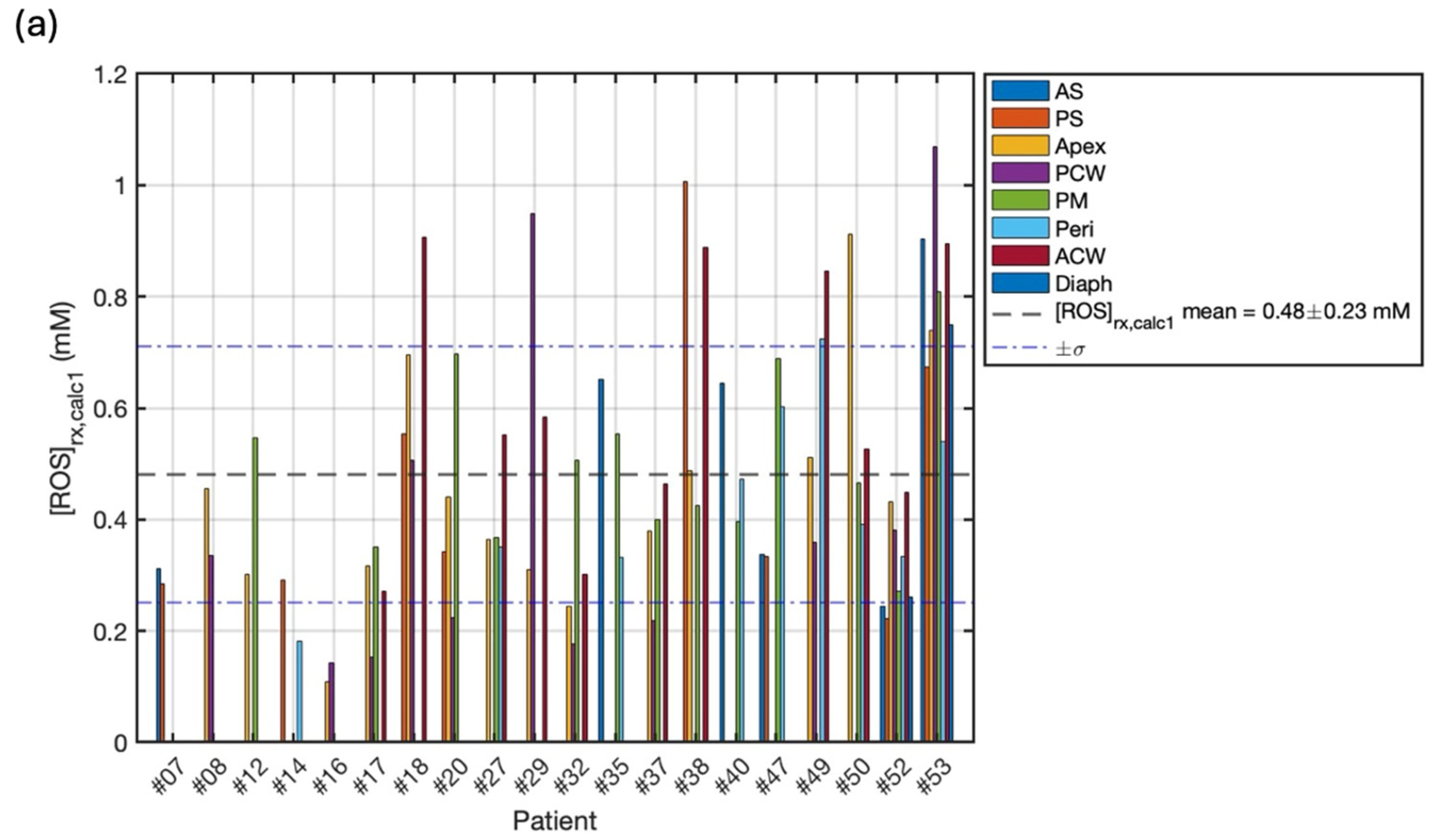
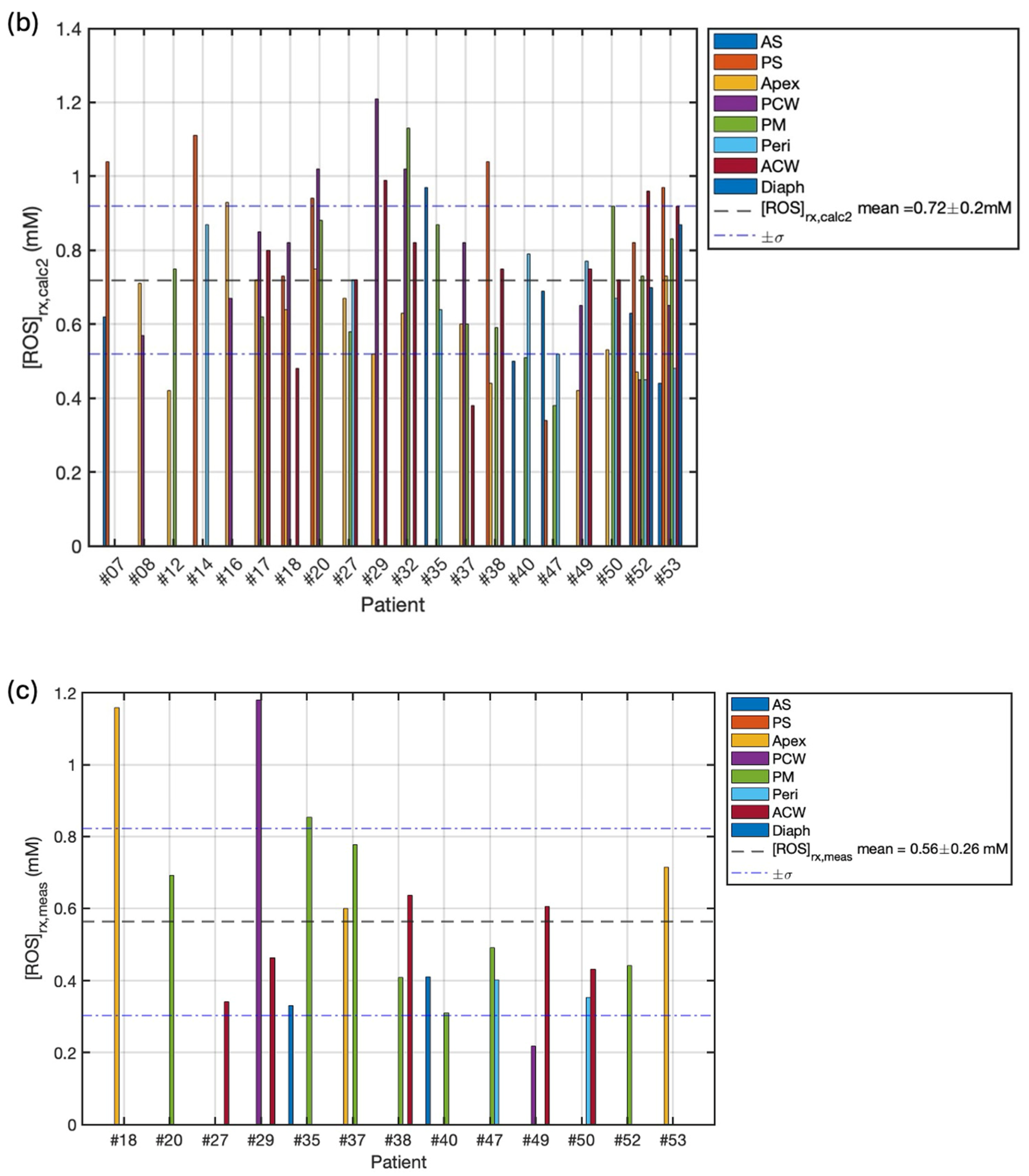
Photodynamic therapy (PDT) relies on the interactions between light, photosensitizers, and tissue oxygen to produce cytotoxic reactive oxygen species (ROS), primarily singlet oxygen (1O2) through Type II photochemical reactions, along with superoxide anion radicals (O2•−), hydrogen peroxide (H2O2), and hydroxyl radicals (OH) through Type I mechanisms. Accurate dosimetry, accounting for all three components, is crucial for predicting and optimizing PDT outcomes. Conventional dosimetry tracks only light fluence rate and photosensitizer concentration, neglecting the role of tissue oxygenation. Reactive oxygen species explicit dosimetry (ROSED) quantifies the reacted oxygen species concentration ([ROS]rx) by explicit measurements of light fluence (rate), photosensitizer concentration, and tissue oxygen concentration. Here we determine tissue oxygenation from non-invasive diffuse correlation spectroscopy (DCS) measurement of tumor blood flow using a conversion factor established preclinically. In this study, we have enrolled 24 pleural PDT patients into the study. Of these patients, we are able to obtain data on 20. Explicit dosimetry of light fluence, Photofrin concentration, and tissue oxygenation concentrations were integrated into the ROSED model to calculate [ROS]rx across multiple sites inside the pleural cavity and among different patients. Large inter- and intra-patient heterogeneities in [ROS]rx were observed, despite identical 60 J/cm2 light doses, with mean [ROS]rx,meas of 0.56 ± 0.26 mM for 13 patients with 21 sites, and [ROS]rx,calc1 of 0.48 ± 0.23 mM for 20 patients with 76 sites. This study presented the first comprehensive analysis of clinical ROSED in pleural mesothelioma patients, providing valuable data on future ROSED based pleural PDT that can potentially produce uniform ROS and thus improve the PDT efficacy for Photofrin-mediated pleural PDT.
Keywords: Reactive oxygen species (ROS); photodynamic therapy dosimetry; diffuse correlation spectroscopy Reactive oxygen species (ROS); photodynamic therapy dosimetry; diffuse correlation spectroscopy