Review

The Prognostic Value of Derivatives-Reactive Oxygen Metabolites (d-ROMs) for Cardiovascular Disease Events and Mortality: A Review


1
MEMO Research, Division of Molecular and Clinical Medicine, University of Dundee, Dundee DD2 1GZ, UK
2
Division of Molecular and Clinical Medicine, Ninewells Hospital and Medical School, University of Dundee, Dundee DD2 1GZ, UK
3
Research and Development Department, H&D S.r.l., 43124 Parma, Italy
4
German Center for Diabetes Research (DZD), 40225 Neuherberg, Germany
5
Metabolic Physiology, Institute for Diabetes and Cancer (IDC), Helmholtz Diabetes Center, Helmholtz Zentrum München, 85764 Neuherberg, Germany
6
CardioMetabol Unit, Department of Laboratory Medicine and Department of Medicine, Karolinska Institutet, 17177 Huddinge, Sweden
7
Medicine Unit Endocrinology, Theme Inflammation and Ageing, Karolinska University Hospital, 17177 Stockholm, Sweden
8
Division of Population Health and Genomics, Ninewells Hospital and Medical School, University of Dundee, Dundee DD2 1GZ, UK
9
Department of Food and Drugs, University of Parma, 43121 Parma, Italy
10
Research and Development Department, Cor.Con. International S.r.l., 43124 Parma, Italy
11
Division of Clinical Chemistry, Department of Laboratory Medicine, Karolinska Institutet, 17177 Stockholm, Sweden
12
Clinical Chemistry, Karolinska University Laboratory, Karolinska University Hospital, 17177 Stockholm, Sweden
*
Authors to whom correspondence should be addressed.
These authors contributed equally to this work.
Antioxidants 2022, 11(8), 1541; https://doi.org/10.3390/antiox11081541

Submission received: 15 June 2022 / Revised: 2 August 2022 / Accepted: 3 August 2022 / Published: 9 August 2022
(This article belongs to the Special Issue Antioxidants, Oxidative Stress and Non-communicable Diseases)

Abstract

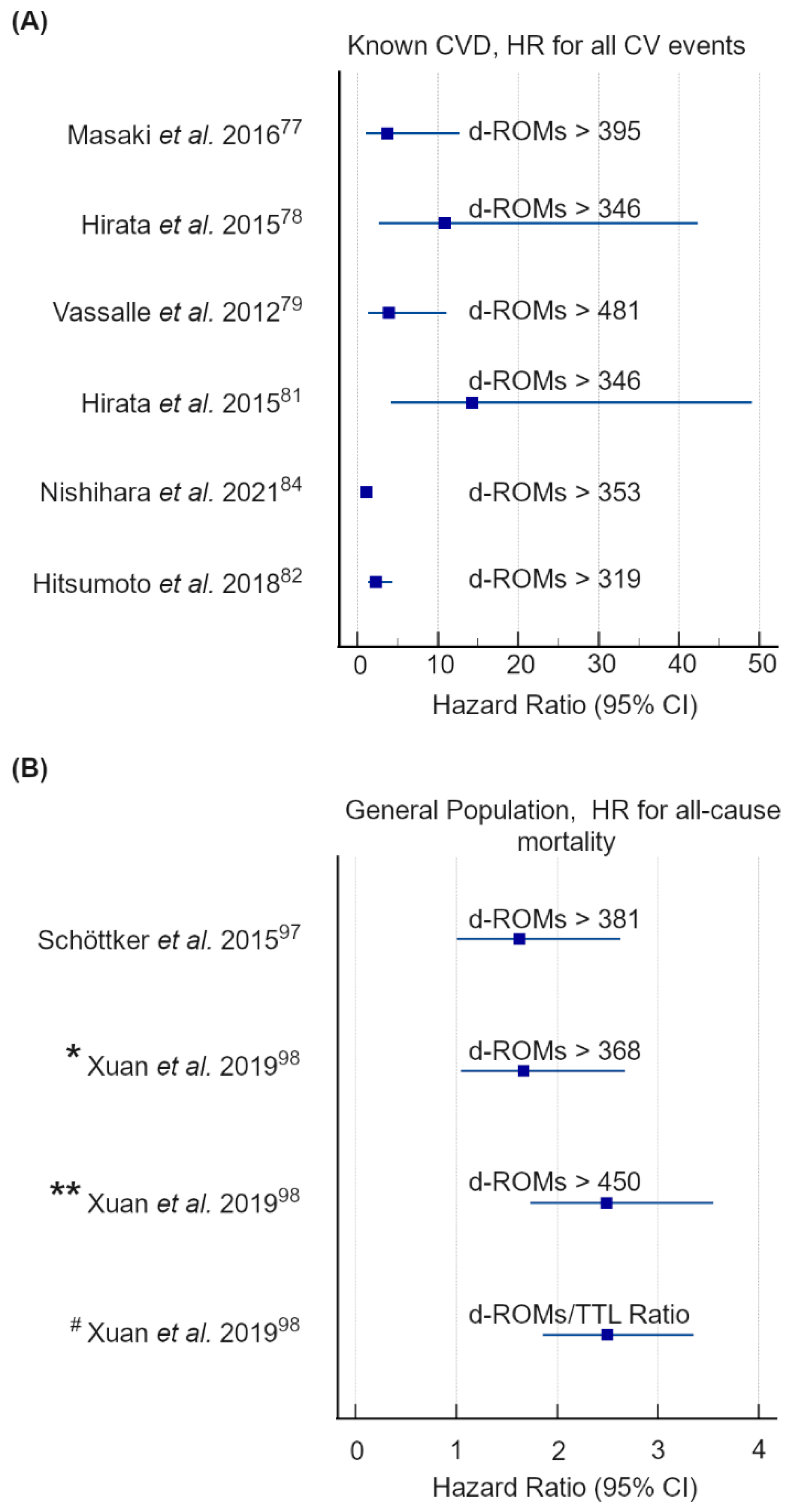
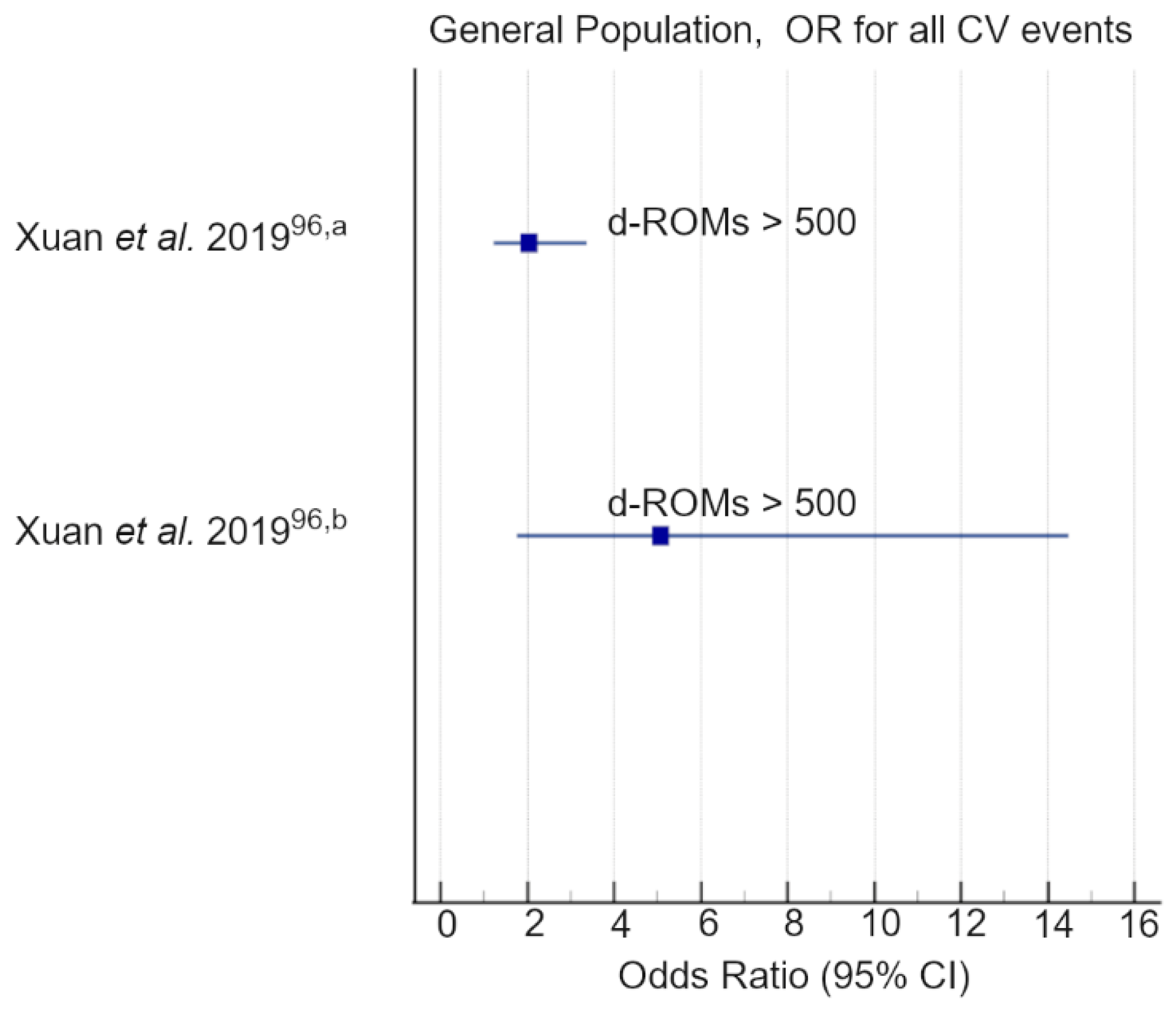
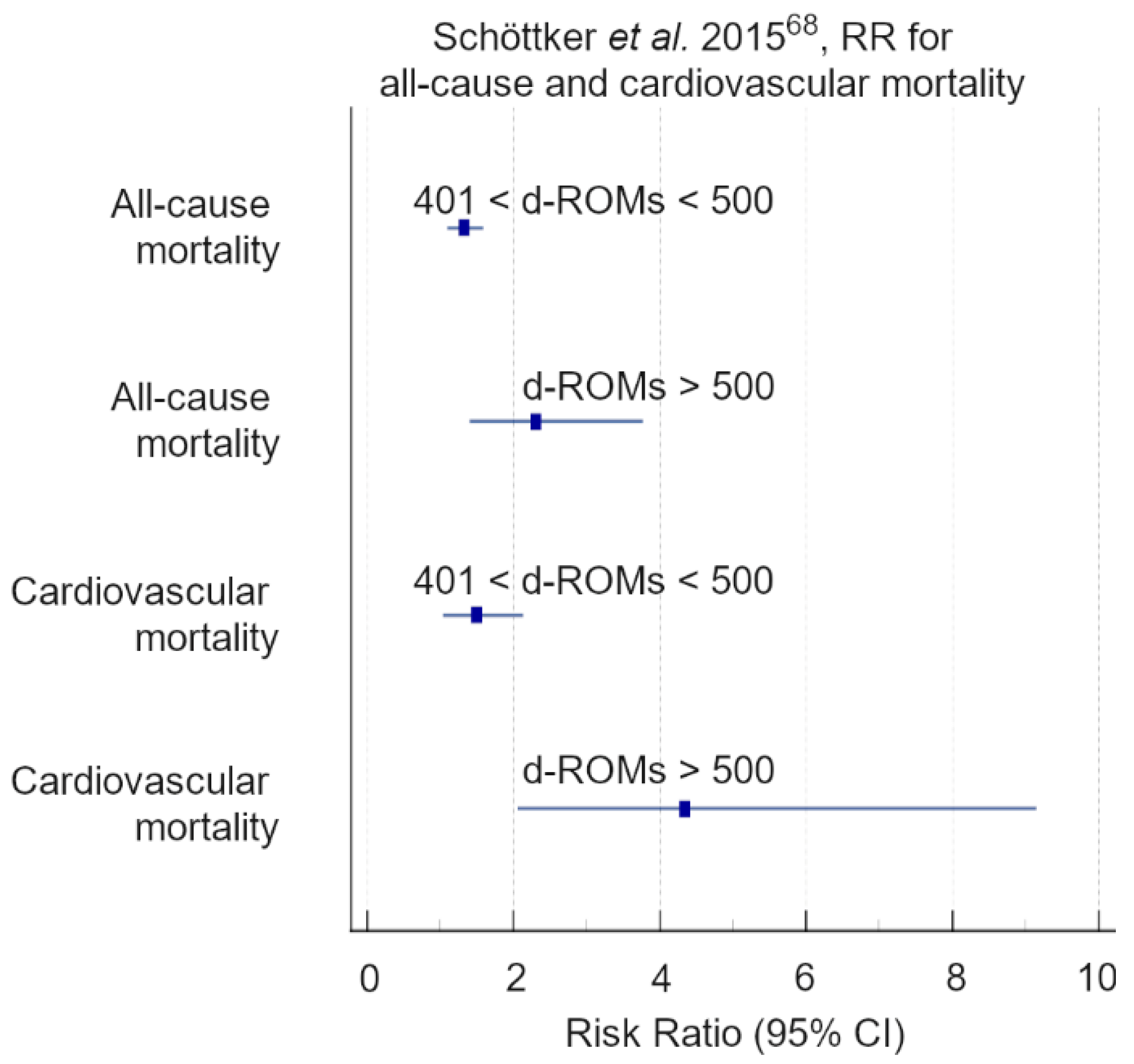
Oxidative stress participates in the development and exacerbation of cardiovascular diseases (CVD). The ability to promptly quantify an imbalance in an individual reductive-oxidative (RedOx) state could improve cardiovascular risk assessment and management. Derivatives-reactive oxygen metabolites (d-ROMs) are an emerging biomarker of oxidative stress quantifiable in minutes through standard biochemical analysers or by a bedside point-of-care test. The current review evaluates available data on the prognostic value of d-ROMs for CVD events and mortality in individuals with known and unknown CVD. Outcome studies involving small and large cohorts were analysed and hazard ratio, risk ratio, odds ratio, and mean differences were used as measures of effect. High d-ROM plasma levels were found to be an independent predictor of CVD events and mortality. Risk begins increasing at d-ROM levels higher than 340 UCARR and rises considerably above 400 UCARR. Conversely, low d-ROM plasma levels are a good negative predictor for CVD events in patients with coronary artery disease and heart failure. Moreover, combining d-ROMs with other relevant biomarkers routinely used in clinical practice might support a more precise cardiovascular risk assessment. We conclude that d-ROMs represent an emerging oxidative-stress-related biomarker with the potential for better risk stratification both in primary and secondary cardiovascular prevention.
Keywords: oxidative stress; blood biomarkers; d-ROMs; prognostic value; cardiovascular diseases; mortality oxidative stress; blood biomarkers; d-ROMs; prognostic value; cardiovascular diseases; mortality