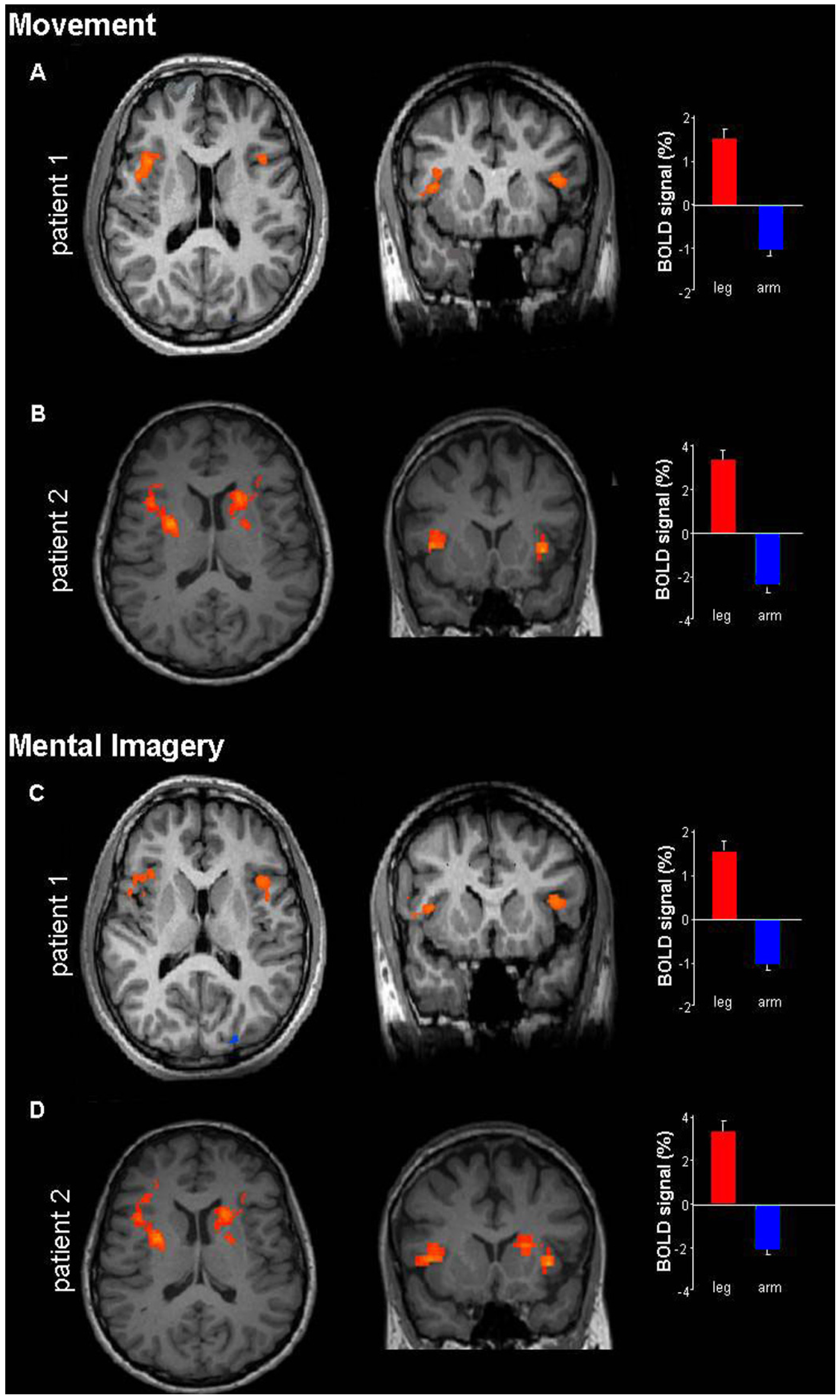
Disturbed Mental Imagery of Affected Body-Parts in Patients with Hysterical Conversion Paraplegia Correlates with Pathological Limbic Activity


Abstract
1. Introduction
2. Patients
3. Methods
4. Results

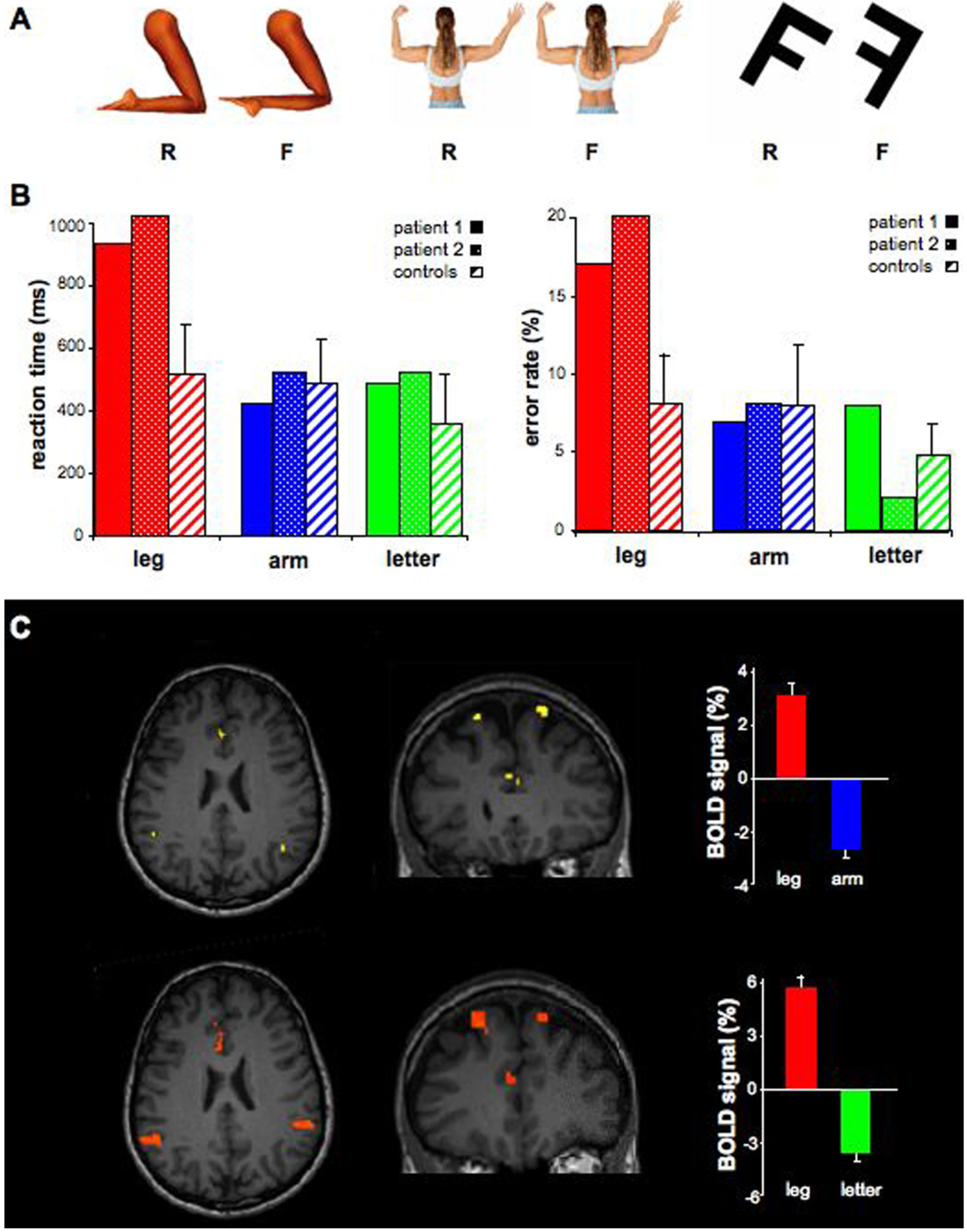
5. Discussion
6. Conclusion
Supplementary Files
Acknowledgments
Conflicts of Interest
References
- Vuilleumier, P. Hysterical conversion and brain function. Prog. Brain Res. 2005, 150, 309–329. [Google Scholar] [CrossRef]
- Charcot, J.M. Clinical Lectures on the Diseases of the Nervous System; Routledge: London, UK, 1990. [Google Scholar]
- Janet, P. The Major Symptoms of Hysteria; Fifteen Lectures Given in the Medical School of Harvard University, 2nd ed.; The Macmillan Company: New York, NY, USA, 1920. [Google Scholar]
- Breuer, J.; Freud, S. Studies in Hysteria; Penguin: London, UK, 2004. [Google Scholar]
- Flor-Henry, P.; Fromm-Auch, D.; Tapper, M.; Schopflocher, D. A neuropsychological study of the stable syndrome of hysteria. Biol. Psychiatry 1981, 16, 601–626. [Google Scholar]
- Black, D.N.; Seritan, A.L.; Taber, K.H.; Hurley, R.A. Conversion hysteria: Lessons from functional imaging. J. Neuropsychiatry Clin. Neurosci. 2004, 16, 245–251. [Google Scholar] [CrossRef]
- Mailis-Gagnon, A.; Giannoylis, I.; Downar, J.; Kwan, C.L.; Mikulis, D.J.; Crawley, A.P.; Nicholson, K.; Davis, K.D. Altered central somatosensory processing in chronic pain patients with “hysterical” anesthesia. Neurology 2003, 60, 1501–1507. [Google Scholar] [CrossRef]
- Tiihonen, J.; Kuikka, J.; Viinamaki, H.; Lehtonen, J.; Partanen, J. Altered cerebral blood flow during hysterical paresthesia. Biol. Psychiatry 1995, 37, 134–135. [Google Scholar] [CrossRef]
- Vuilleumier, P. Hysterical conversion and brain function. Prog. Brain Res. 2005, 150, 309–329. [Google Scholar] [CrossRef]
- Yazici, K.M.; Kostakoglu, L. Cerebral blood flow changes in patients with conversion disorder. Psychiatry Res. 1998, 83, 163–168. [Google Scholar] [CrossRef]
- Hoechstetter, K.; Meinck, H.M.; Henningsen, P.; Scherg, M.; Rupp, A. Psychogenic sensory loss: Magnetic source imaging reveals normal tactile evoked activity of the human primary and secondary somatosensory cortex. Neurosci. Lett. 2002, 323, 137–140. [Google Scholar] [CrossRef]
- Ghaffar, O.; Staines, W.R.; Feinstein, A. Unexplained neurologic symptoms: An fMRI study of sensory conversion disorder. Neurology 2006, 67, 2036–2038. [Google Scholar]
- Marshall, J.C.; Halligan, P.W.; Fink, G.R.; Wade, D.T.; Frackowiak, R.S. The functional anatomy of a hysterical paralysis. Cognition 1997, 64, B1–B8. [Google Scholar] [CrossRef]
- Spence, S.A.; Crimlisk, H.L.; Cope, H.; Ron, M.A.; Grasby, P.M. Discrete neurophysiological correlates in prefrontal cortex during hysterical and feigned disorder of movement. Lancet 2000, 355, 1243–1244. [Google Scholar] [CrossRef]
- Stone, J.; Zeman, A.; Simonotto, E.; Meyer, M.; Azuma, R.; Flett, S.; Sharpe, M. FMRI in patients with motor conversion symptoms and controls with simulated weakness. Psychosom. Med. 2007, 69, 961–969. [Google Scholar] [CrossRef]
- De Lange, F.P.; Roelofs, K.; Toni, I. Increased self-monitoring during imagined movements in conversion paralysis. Neuropsychologia 2007, 45, 2051–2058. [Google Scholar] [CrossRef]
- Arzy, S.; Overney, L.S.; Landis, T.; Blanke, O. Neural mechanisms of embodiment: Asomatognosia due to premotor cortex damage. Arch. Neurol. 2006, 63, 1022–1025. [Google Scholar] [CrossRef]
- Roelofs, K.; van Galen, G.P.; Keijsers, G.P.J.; Hoogduin, C.A.L. Motor initiation and execution in patients with conversion paralysis. Acta Psychol. 2002, 110, 21–34. [Google Scholar] [CrossRef]
- Zeharia, N.; Hertz, U.; Flash, T.; Amedi, A. Negative blood oxygenation level dependent homunculus and somatotopic information in primary motor cortex and supplementary motor area. Proc. Natl. Acad. Sci. USA 2012, 109, 18565–18570. [Google Scholar] [CrossRef]
- Halligan, P.W.; Athwal, B.S.; Oakley, D.A.; Frackowiak, R.S. Imaging hypnotic paralysis: Implications for conversion hysteria. Lancet 2000, 355, 986–987. [Google Scholar] [CrossRef]
- Saj, A.; Arzy, S.; Vuilleumier, P. Functional brain imaging in a woman with spatial neglect due to conversion disorder. JAMA 2009, 302, 2552–2554. [Google Scholar]
- Augustine, J.R. Circuitry and functional aspects of the insular lobe in primates including humans. Brain Res. Brain Res. Rev. 1996, 22, 229–244. [Google Scholar] [CrossRef]
- Nagai, M.; Kishi, K.; Kato, S. Insular cortex and neuropsychiatric disorders: A review of recent literature. Eur. Psychiatry 2007, 22, 387–394. [Google Scholar] [CrossRef]
- Aybek, S.; Kanaan, R.A.; David, A.S. The neuropsychiatry of conversion disorder. Curr. Opin. Psychiatry 2008, 21, 275–280. [Google Scholar] [CrossRef]
- Liepert, J.; Hassa, T.; Tüscher, O.; Schmidt, R. Electrophysiological correlates of motor conversion disorder. Mov. Disord. 2008, 23, 2171–2176. [Google Scholar] [CrossRef]
- Maruff, P.; Velakoulis, D. The voluntary control of motor imagery. Imagined movements in individuals with feigned motor impairment and conversion disorder. Neuropsychologia 2000, 38, 1251–1260. [Google Scholar] [CrossRef]
- Cojan, Y.; Waber, L.; Carruzzo, A.; Vuilleumier, P. Motor inhibition in hysterical conversion paralysis. Neuroimage 2009, 47, 1026–1037. [Google Scholar] [CrossRef]
- Harris, S.; Kaplan, J.T.; Curiel, A.; Bookheimer, S.Y.; Iacoboni, M.; Cohen, M.S. The neural correlates of religious and nonreligious belief. PLoS One 2009, 4, e0007272. [Google Scholar]
- Kapogiannis, D.; Barbey, A.K.; Su, M.; Zamboni, G.; Krueger, F.; Grafman, J. Cognitive and neural foundations of religious belief. Proc. Natl. Acad. Sci. USA 2009, 106, 4876–4881. [Google Scholar]
© 2014 by the authors; licensee MDPI, Basel, Switzerland. This article is an open access article distributed under the terms and conditions of the Creative Commons Attribution license (http://creativecommons.org/licenses/by/3.0/).
Share and Cite
Saj, A.; Raz, N.; Levin, N.; Ben-Hur, T.; Arzy, S. Disturbed Mental Imagery of Affected Body-Parts in Patients with Hysterical Conversion Paraplegia Correlates with Pathological Limbic Activity. Brain Sci. 2014, 4, 396-404. https://doi.org/10.3390/brainsci4020396
Saj A, Raz N, Levin N, Ben-Hur T, Arzy S. Disturbed Mental Imagery of Affected Body-Parts in Patients with Hysterical Conversion Paraplegia Correlates with Pathological Limbic Activity. Brain Sciences. 2014; 4(2):396-404. https://doi.org/10.3390/brainsci4020396
Chicago/Turabian StyleSaj, Arnaud, Noa Raz, Netta Levin, Tamir Ben-Hur, and Shahar Arzy. 2014. "Disturbed Mental Imagery of Affected Body-Parts in Patients with Hysterical Conversion Paraplegia Correlates with Pathological Limbic Activity" Brain Sciences 4, no. 2: 396-404. https://doi.org/10.3390/brainsci4020396
APA StyleSaj, A., Raz, N., Levin, N., Ben-Hur, T., & Arzy, S. (2014). Disturbed Mental Imagery of Affected Body-Parts in Patients with Hysterical Conversion Paraplegia Correlates with Pathological Limbic Activity. Brain Sciences, 4(2), 396-404. https://doi.org/10.3390/brainsci4020396