Sexual Dysregulation After Traumatic Brain Injury and Stroke: A Critical Narrative Review of Neurobiology, Clinical Phenotypes, and Management

 ,
,  , ,
, , 
Highlights
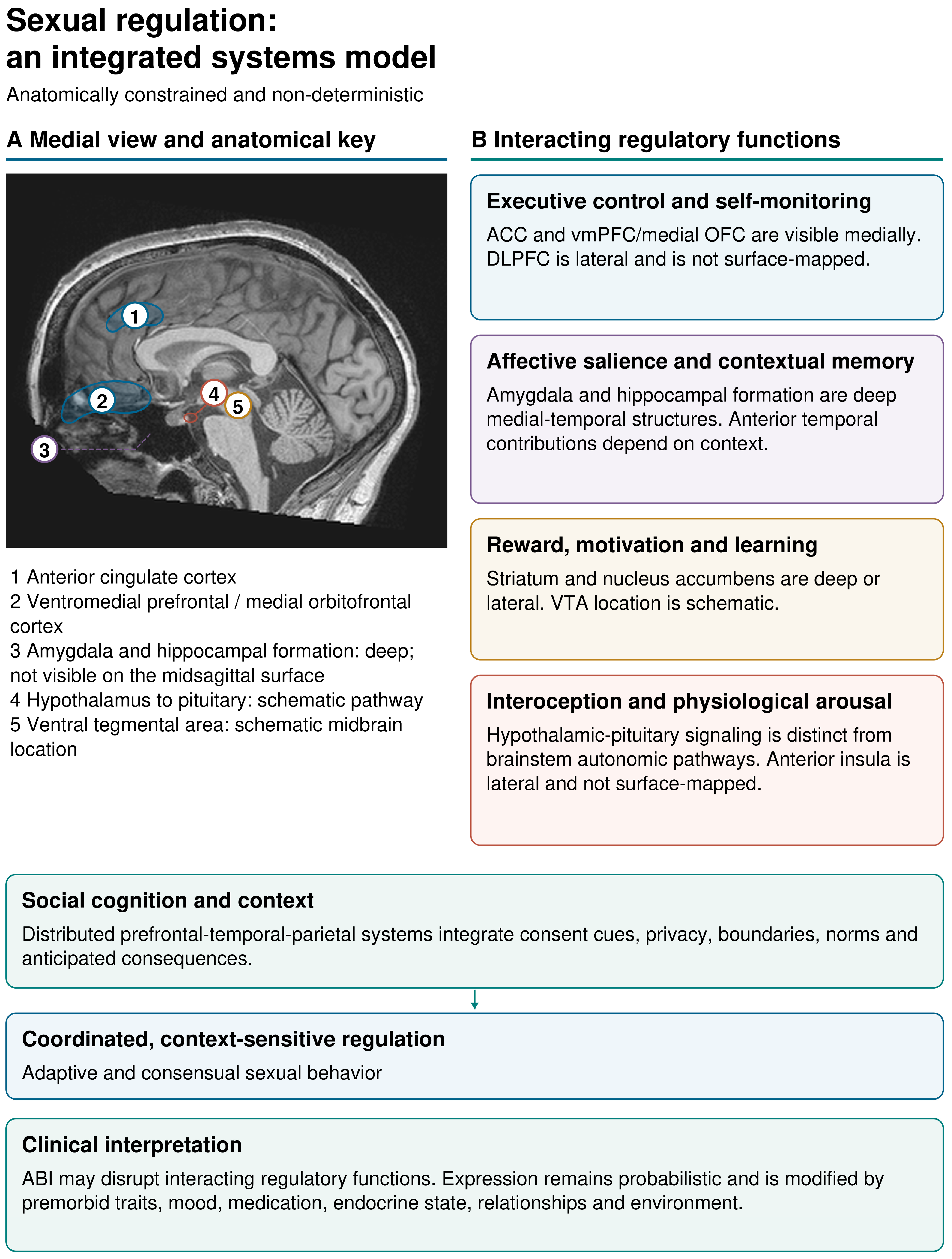
- Human sexual regulation emerges from the coordinated, context-sensitive interaction of executive-control, salience, reward, interoceptive, memory, endocrine–autonomic, and social–cognitive systems; no single brain region constitutes a deterministic “sexual center.”
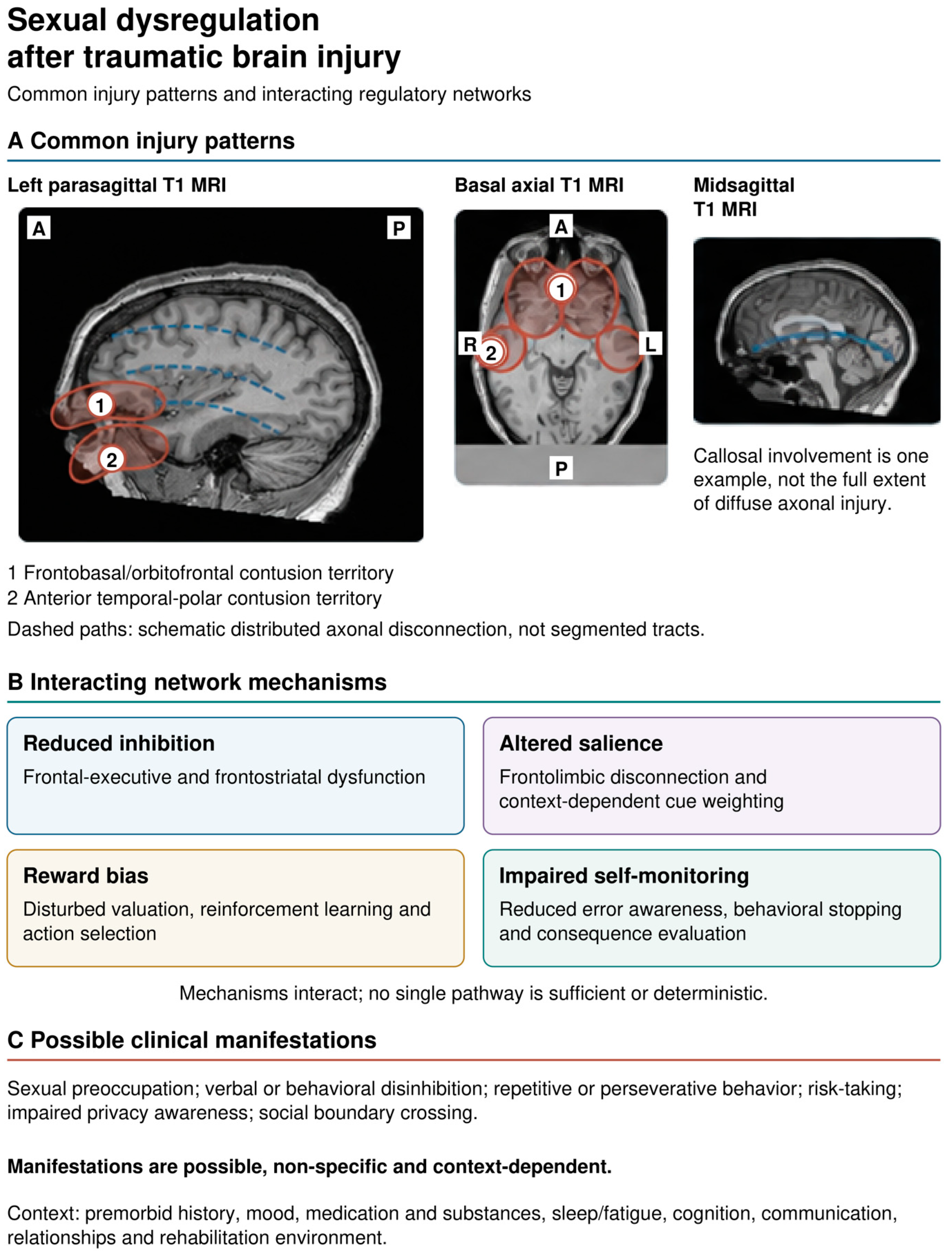
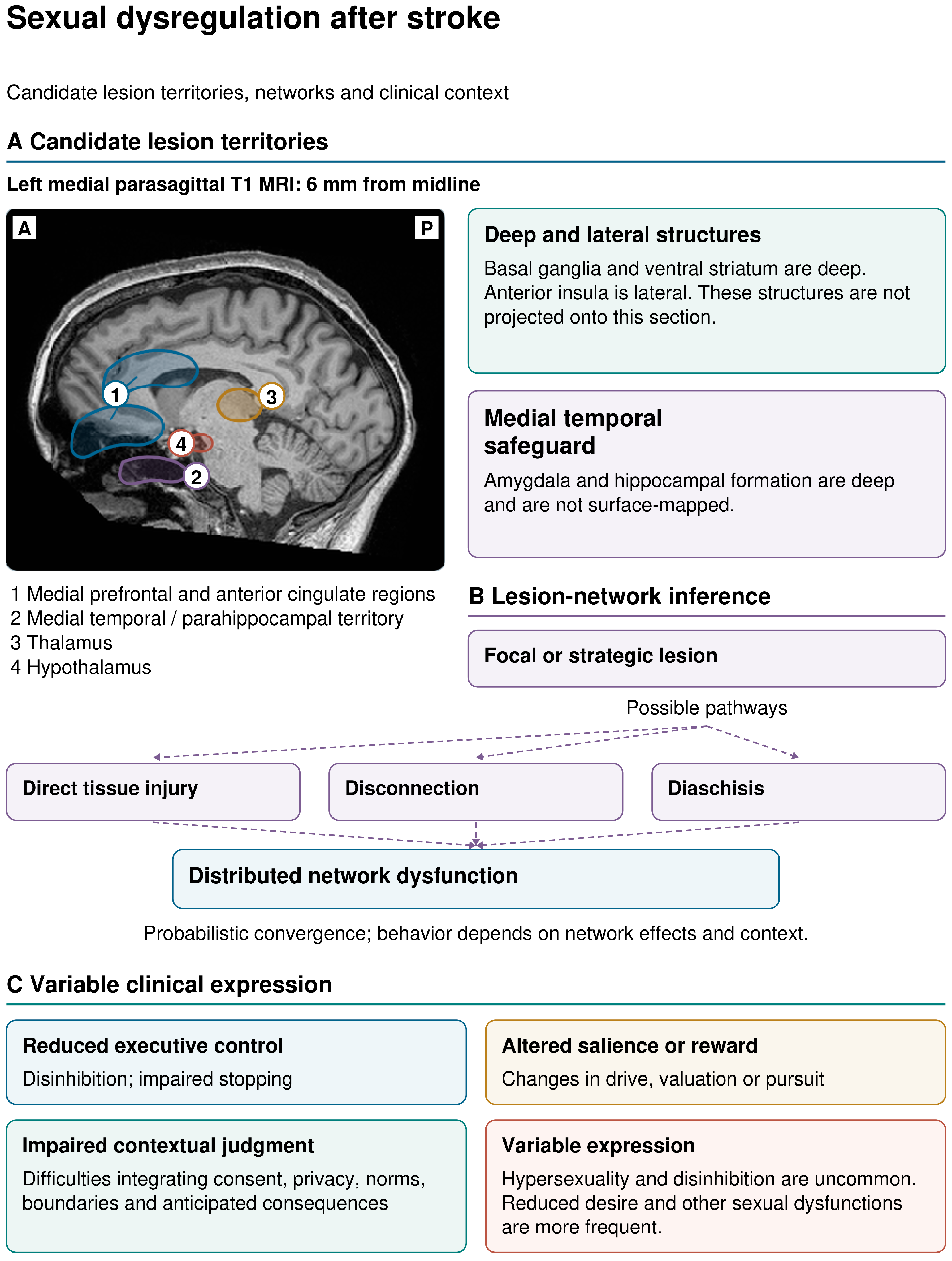
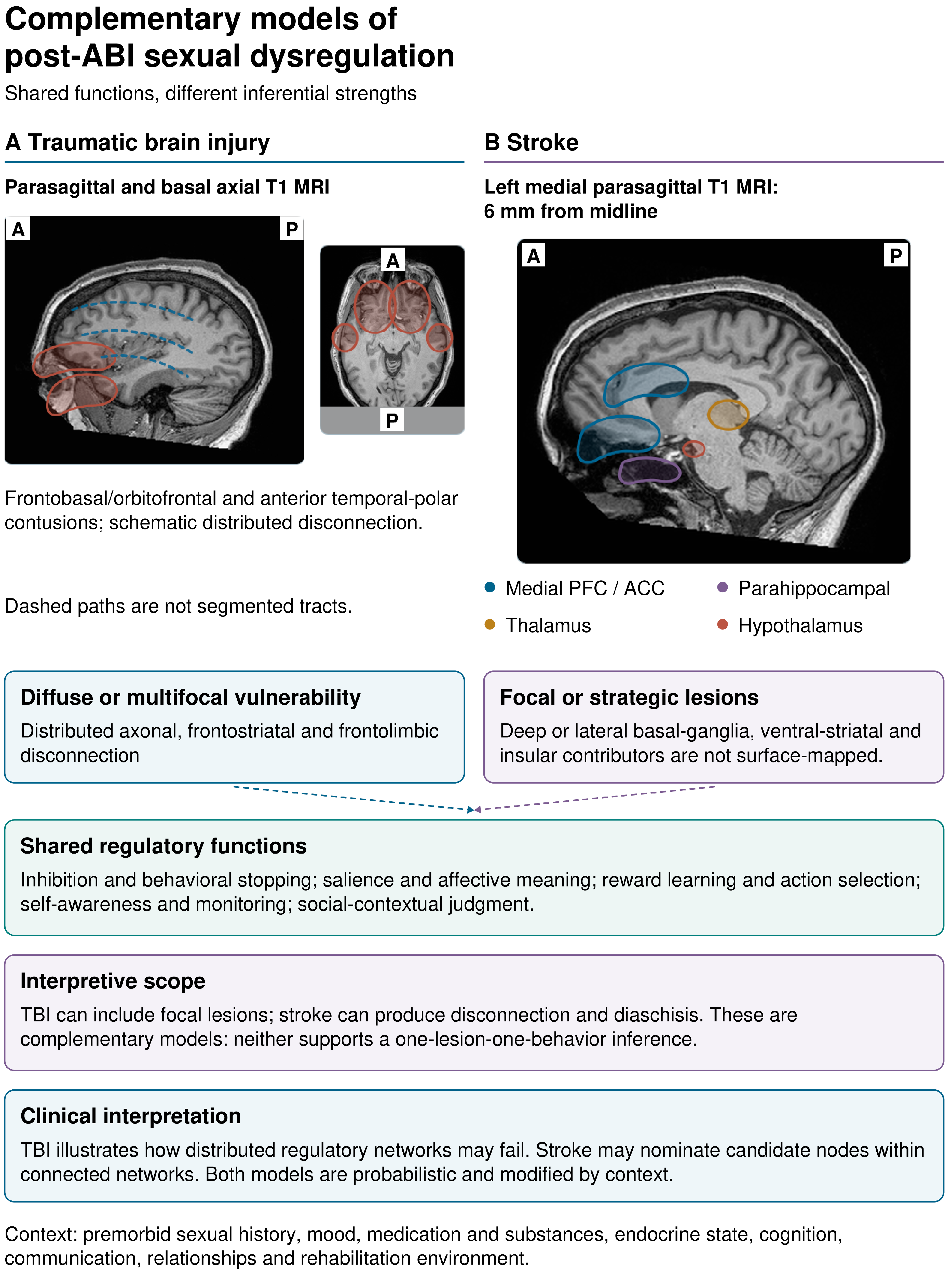
- Traumatic brain injury and stroke provide complementary mechanistic models: TBI highlights diffuse or multifocal regulatory-network vulnerability, whereas stroke can nominate strategic lesion-connected nodes. In both conditions, clinical expression remains heterogeneous, probabilistic, and context-dependent.
- Assessment should begin with precise behavioral phenotyping and differential formulation, followed by evaluation of decision-specific capacity, consent, collateral information, safeguarding, and interdisciplinary neurorehabilitation.
- Management should use the least restrictive targeted strategy, with explicit monitoring of benefit and harm and predefined de-escalation criteria. Future studies should combine standardized phenotypes, prospective multicenter cohorts, lesion-network and connectivity methods, and neuropsychological and ecological outcomes.
Abstract
1. Introduction
Methods
2. Functional Neurobiology of Sexual Regulation
2.1. Distributed Functional Systems
2.2. Neurochemical, Cognitive, and Contextual Modifiers
3. Sexual Dysregulation After Traumatic Brain Injury
3.1. Diffuse Network Injury and Executive-Control Vulnerability
3.2. Clinical Phenotypes, Differential Formulation, and Rehabilitation Risk
4. Sexual Dysregulation After Stroke
4.1. Strategic Lesions and Regulatory Network Nodes
4.2. Heterogeneous Phenotypes, Confounders, and Anatomical Caution
5. Rare Acquired Paraphilic Manifestations
5.1. Diagnostic Boundaries and Phenotypic Ambiguity
5.2. Fronto-Temporal Mechanisms, Forensic Caution, and Safeguarding
6. Cross-Etiology Synthesis: What TBI and Stroke Can and Cannot Show
6.1. Complementary Inferential Strengths
6.2. Evidence Quality, Terminology, and Reporting Bias
7. Clinical Assessment, Risk Formulation, and Management Pathways
7.1. Descriptive Assessment and Mechanism-Based Formulation
7.1.1. Behavioral Phenotyping
7.1.2. Medical and Pharmacological Exclusion
7.1.3. Capacity Evaluation
7.1.4. Environmental Risk Assessment
7.2. Safeguarding, Treatment Options, and Preservation of Intimacy

| Clinical Domain or Intervention | Clinical Use or Target | Best Direct Post-ABI Evidence (OCEBM) | Indirect Evidence and Directness | Safeguards and Interpretation |
|---|---|---|---|---|
| Behavioral description | Define phenotype, onset, setting, triggers, redirectability, affected persons, and consequences. | Not a treatment question. | Not applicable. | Use observable language; avoid stigmatizing labels and premature diagnosis. Sources: [71,139,159,160] |
| Neuropsychological and contextual assessment | Assess inhibition, awareness, social cognition, communication, decision-making, and behavior across settings. | Not a treatment question. | Not applicable. | Structured tests may miss boundary problems during personal care or unstructured interaction. Sources: [140,153,154,155] |
| Treatment of an active contributing syndrome | Treat mania, psychosis, delirium, seizures, severe agitation, pain, sleep disturbance, or substance-related states, then reassess. | Level 4–5 for sexual outcomes: case-based or mechanism-based. | Evidence primarily concerns the underlying syndrome rather than post-ABI sexual dysregulation. | Do not infer lesion-specific sexual efficacy from improvement after syndrome treatment. Sources: [99,114,115,140,168,169,170] |
| Medication and endocrine review | Identify dopaminergic, stimulant, sedative, antidepressant, antiepileptic, hormonal, or pituitary contributors. | Not a treatment-effect question. | Mechanistic evidence is indirect; post-TBI endocrine prevalence estimates support assessment of clinically compatible symptoms [65]. | Record medication dose and timing [31,53,54,55,168,169,170]. Assess fatigue, libido, mood, arousal, menstrual or erectile symptoms, and pituitary function when indicated [58,65]. |
| Psychoeducation and caregiver/staff training | Improve shared terminology, consistent responses, privacy planning, communication, and early recognition of risk. | Level 3 for implementation/service outcomes; Level 5 for direct sexual-dysregulation efficacy. | A TBI guideline is predominantly consensus-based; one mixed-method implementation study supports service delivery rather than dysregulation-treatment efficacy [21,22]. | Provide early individualized education, written materials, relationship support, and trained clinical champions; include patient goals and avoid treating collateral reports as neutral. Sources: [21,22,70,105,106,107,108,135,152,156] |
| Consent, capacity, and safeguarding | Assess decision-specific understanding, appreciation, reasoning, voluntariness, communication, vulnerability, and risk. | Not a treatment-effect question. | Capacity and ethics literature informs practice indirectly. | Protect vulnerable persons while preserving dignity and lawful intimacy. Sources: [157,158] |
| Behavioral and environmental management | Modify antecedents, privacy, routines, cues, reinforcement, supervision, and staff responses. | Level 4–5: selected case-based observations plus mechanism-based reasoning. | Broader ABI behavioral intervention evidence is indirect for sexual outcomes. | Adapt to cognitive profile; define a target and monitor burden and restriction. Sources: [159,160,161] |
| Selective serotonin reuptake inhibitors | Target intrusive sexual thoughts, compulsive features, depression, anxiety, or selected impulsive symptoms. | No direct comparative post-ABI evidence identified in the cited sources. | The cited sexual-symptom treatment studies concern non-ABI populations; post-ABI use is an extrapolation. | Monitor sexual dysfunction, agitation, and rare activation or hypomania. Sources: [31,163,164,165,166,167] |
| Interdisciplinary rehabilitation and intimacy support | Integrate neurology, psychiatry, psychology, nursing, rehabilitation, social work, sexual health, ethics, and caregivers. | Level 3 for implementation/service outcomes; Level 5 for direct sexual-dysregulation efficacy. | Guideline and co-design evidence supports organized sexuality care, but direct efficacy for hypersexuality or disinhibition remains untested [21,22]. | Use trained champions and referral pathways; risk management should not become blanket suppression of sexuality or partnership goals. Sources: [11,12,21,22,70,105,107,152,156] |
| Psychotherapy and collaborative coping | Address distressing urges, shame, adjustment, communication, coping, relapse planning, and preserved intimacy when insight permits. | Level 5: no direct controlled post-ABI sexual-dysregulation evidence identified. | Psychological evidence is extrapolated from adjacent conditions and ABI adjustment literature. | Adapt to awareness, memory, communication, and capacity. Sources: [152,153,154,155,156] |
| Mood stabilizers or antipsychotics | Target mania, psychosis, severe agitation, or impulsive-aggressive dyscontrol, not sexual behavior in isolation. | Level 4–5 for sexual outcomes: syndrome-specific cases or mechanism-based reasoning. | ABI agitation and psychiatric evidence is indirect for sexual outcomes. | Monitor cognition, sedation, metabolic effects, and participation. Sources: [115,168,169,170] |
| Antiandrogenic or hormonal treatment | Consider only exceptional, persistent, high-risk behavior after interdisciplinary review. | Level 4: direct ABI case-report evidence; no controlled ABI evidence. | Most guidance derives from non-ABI paraphilic-disorder literature. | Require capacity/consent review, endocrine input, bone and metabolic monitoring, and ethical safeguards. Sources: [15,166,167,171,172,173,174,175] |
| Naltrexone | Possible specialist option for selected reward-driven or compulsive patterns. | No direct post-ABI evidence identified. | Level 4 indirect evidence from non-ABI case reports. | Use only with an explicit target, contraindication review, and outcome monitoring. Sources: [32,33] |
8. Discussion, Novelty, and Research Priorities
8.1. Novelty and Practical Contribution
8.2. Clinical Interpretation and Patient-Centered Care
8.3. Research Priorities and Limitations
9. Conclusions
Supplementary Materials
Author Contributions
Funding
Institutional Review Board Statement
Informed Consent Statement
Data Availability Statement
Acknowledgments
Conflicts of Interest
References
- Bechara, A.; Damasio, A.R.; Damasio, H.; Anderson, S.W. Insensitivity to future consequences following damage to human prefrontal cortex. Cognition 1994, 50, 7–15. [Google Scholar] [CrossRef] [Scilit]
- Damasio, A.R. The somatic marker hypothesis and the possible functions of the prefrontal cortex. Philos. Trans. R. Soc. Lond. B Biol. Sci. 1996, 351, 1413–1420. [Google Scholar] [CrossRef] [Scilit] [PubMed]
- Stoléru, S.; Fonteille, V.; Cornélis, C.; Joyal, C.; Moulier, V. Functional neuroimaging studies of sexual arousal and orgasm in healthy men and women: A review and meta-analysis. Neurosci. Biobehav. Rev. 2012, 36, 1481–1509. [Google Scholar] [CrossRef] [Scilit] [PubMed]
- Georgiadis, J.R.; Kringelbach, M.L. The human sexual response cycle: Brain imaging evidence linking sex to other pleasures. Prog. Neurobiol. 2012, 98, 49–81. [Google Scholar] [CrossRef] [Scilit] [PubMed]
- Voon, V.; Mole, T.B.; Banca, P.; Porter, L.; Morris, L.; Mitchell, S.; Lapa, T.R.; Karr, J.; Harrison, N.A.; Potenza, M.N.; et al. Neural correlates of sexual cue reactivity in individuals with and without compulsive sexual behaviours. PLoS ONE 2014, 9, e102419. [Google Scholar] [CrossRef] [Scilit] [PubMed]
- Mallas, E.J.; De Simoni, S.; Jenkins, P.O.; David, M.C.B.; Bourke, N.J.; Sharp, D.J. Methylphenidate differentially alters corticostriatal connectivity after traumatic brain injury. Brain 2025, 148, 1360–1373. [Google Scholar] [CrossRef] [Scilit] [PubMed]
- Wise, N.J.; Frangos, E.; Komisaruk, B.R. Brain Activity Unique to Orgasm in Women: An fMRI Analysis. J. Sex. Med. 2017, 14, 1380–1391. [Google Scholar] [CrossRef] [Scilit] [PubMed]
- Redouté, J.; Stoléru, S.; Grégoire, M.C.; Costes, N.; Cinotti, L.; Lavenne, F.; Le Bars, D.; Forest, M.G.; Pujol, J.F. Brain processing of visual sexual stimuli in human males. Hum. Brain Mapp. 2000, 11, 162–177. [Google Scholar] [CrossRef] [Scilit]
- Karama, S.; Lecours, A.R.; Leroux, J.M.; Bourgouin, P.; Beaudoin, G.; Joubert, S.; Beauregard, M. Areas of brain activation in males and females during viewing of erotic film excerpts. Hum. Brain Mapp. 2002, 16, 1–13. [Google Scholar] [CrossRef] [PubMed]
- Hamann, S.; Herman, R.A.; Nolan, C.L.; Wallen, K. Men and women differ in amygdala response to visual sexual stimuli. Nat. Neurosci. 2004, 7, 411–416. [Google Scholar] [CrossRef] [Scilit] [PubMed]
- Moreno, J.A.; Arango Lasprilla, J.C.; Gan, C.; McKerral, M. Sexuality after traumatic brain injury: A critical review. NeuroRehabilitation 2013, 32, 69–85. [Google Scholar] [CrossRef] [Scilit] [PubMed]
- Korpelainen, J.T.; Nieminen, P.; Myllylä, V.V. Sexual functioning among stroke patients and their spouses. Stroke 1999, 30, 715–719. [Google Scholar] [CrossRef] [Scilit] [PubMed]
- Ozkan, H.; Ambler, G.; Esmail, T.; Banerjee, G.; Simister, R.J.; Werring, D.J. Prevalence, trajectory, and factors associated with patient-reported nonmotor outcomes after stroke: A systematic review and meta-analysis. JAMA Netw. Open 2025, 8, e2457447. [Google Scholar] [CrossRef] [Scilit] [PubMed]
- Miller, B.L.; Cummings, J.L.; McIntyre, H.; Ebers, G.; Grode, M. Hypersexuality or altered sexual preference following brain injury. J. Neurol. Neurosurg. Psychiatry 1986, 49, 867–873. [Google Scholar] [CrossRef] [Scilit] [PubMed]
- Britton, K.R. Medroxyprogesterone in the treatment of aggressive hypersexual behavior in traumatic brain injury. Brain Inj. 1998, 12, 703–707. [Google Scholar] [CrossRef] [Scilit] [PubMed]
- Simpson, G.; Blaszczynski, A.; Hodgkinson, A. Sex offending as a psychosocial sequela of traumatic brain injury. J. Head Trauma Rehabil. 1999, 14, 567–580. [Google Scholar] [CrossRef] [Scilit] [PubMed]
- Spinella, M. Hypersexuality and dysexecutive syndrome after a thalamic infarct. Int. J. Neurosci. 2004, 114, 1581–1590. [Google Scholar] [CrossRef] [Scilit] [PubMed]
- Simpson, G.K.; Sabaz, M.; Daher, M. Prevalence, clinical features, and correlates of inappropriate sexual behavior after traumatic brain injury: A multicenter study. J. Head Trauma Rehabil. 2013, 28, 202–210. [Google Scholar] [CrossRef] [Scilit] [PubMed]
- Alnemari, A.M.; Mansour, T.R.; Buehler, M.; Gaudin, D. Neural basis of pedophilia: Altered sexual preference following traumatic brain injury. Int. J. Surg. Case Rep. 2016, 25, 221–224. [Google Scholar] [CrossRef] [Scilit] [PubMed]
- Burns, J.M.; Swerdlow, R.H. Right orbitofrontal tumor with pedophilia symptom and constructional apraxia sign. Arch. Neurol. 2003, 60, 437–440. [Google Scholar] [CrossRef] [Scilit] [PubMed]
- Patsakos, E.M.; Backhaus, S.; Farris, K.; King, M.; Moreno, J.A.; Neumann, D.; Sander, A.; Bayley, M.T. INTIMASY-TBI Guideline: Optimization of INTIMAcy, SexualitY, and relationships among adults with traumatic brain injury. J. Head Trauma Rehabil. 2024, 39, 395–407. [Google Scholar] [CrossRef] [Scilit] [PubMed]
- Hwang, J.H.A.; Downing, M.G.; Ponsford, J.L. Evaluating a co-design and implementation project to improve sexuality support following traumatic brain injury in a multi-disciplinary rehabilitation unit: A mixed-method study. Disabil. Rehabil. 2026, 48, 2521–2537. [Google Scholar] [CrossRef] [Scilit] [PubMed]
- Green, B.N.; Johnson, C.D.; Adams, A. Writing narrative literature reviews for peer-reviewed journals: Secrets of the trade. J. Chiropr. Med. 2006, 5, 101–117. [Google Scholar] [CrossRef] [Scilit] [PubMed]
- Baethge, C.; Goldbeck-Wood, S.; Mertens, S. SANRA-a scale for the quality assessment of narrative review articles. Res. Integr. Peer Rev. 2019, 4, 5. [Google Scholar] [CrossRef] [Scilit] [PubMed]
- Byrne, J.A. Improving the peer review of narrative literature reviews. Res. Integr. Peer Rev. 2016, 1, 12. [Google Scholar] [CrossRef] [Scilit] [PubMed]
- Eghwrudjakpor, P.O.; Essien, A.A. Hypersexual behavior following craniocerebral trauma an experience with five cases. Libyan J. Med. 2008, 3, 192–194. [Google Scholar] [CrossRef] [Scilit] [PubMed]
- Lilly, R.; Cummings, J.L.; Benson, D.F.; Frankel, M. The human Klüver-Bucy syndrome. Neurology 1983, 33, 1141–1145. [Google Scholar] [CrossRef] [Scilit] [PubMed]
- Caro, M.A.; Jimenez, X.F. Mesiotemporal Disconnection and Hypoactivity in Klüver-Bucy Syndrome: Case Series and Literature Review. J. Clin. Psychiatry 2016, 77, e982–e988. [Google Scholar] [CrossRef] [Scilit] [PubMed]
- Mutarelli, E.G.; Omuro, A.M.P.; Adoni, T. Hypersexuality following bilateral thalamic infarction: Case report. Arq. Neuropsiquiatr. 2006, 64, 146–148. [Google Scholar] [CrossRef] [Scilit] [PubMed]
- Sartori, G.; Scarpazza, C.; Codognotto, S.; Pietrini, P. An unusual case of acquired pedophilic behavior following compression of orbitofrontal cortex and hypothalamus by a Clivus Chordoma. J. Neurol. 2016, 263, 1454–1455. [Google Scholar] [CrossRef] [Scilit] [PubMed]
- Mendhekar, D.N.; Gupta, D.; Girotra, V. Sertraline-induced hypomania: A genuine side-effect. Acta Psychiatr. Scand. 2003, 108, 70–72. [Google Scholar] [CrossRef] [Scilit] [PubMed]
- Raymond, N.C.; Grant, J.E.; Kim, S.W.; Coleman, E. Treatment of compulsive sexual behaviour with naltrexone and serotonin reuptake inhibitors: Two case studies. Int. Clin. Psychopharmacol. 2002, 17, 201–205. [Google Scholar] [CrossRef] [Scilit] [PubMed]
- Bostwick, J.M.; Bucci, J.A. Internet sex addiction treated with naltrexone. Mayo Clin. Proc. 2008, 83, 226–230. [Google Scholar] [CrossRef] [Scilit] [PubMed]
- OCEBM Levels of Evidence Working Group. The Oxford Levels of Evidence 2. Oxford Centre for Evidence-Based Medicine. 2011. Available online: https://www.cebm.ox.ac.uk/resources/levels-of-evidence/ocebm-levels-of-evidence (accessed on 27 July 2026).
- Komisaruk, B.R.; Rodriguez Del Cerro, M.C. Human sexual behavior related to pathology and activity of the brain. In Handbook of Clinical Neurology; Elsevier: Amsterdam, The Netherlands, 2015; Volume 130, pp. 109–119. [Google Scholar] [CrossRef] [Scilit] [PubMed]
- Subramanian, S.; Reneau, T.R.; Perry, D.; Chacko, R.; Laumann, T.O.; Flavin, K.; Horan, C.; Schweiger, J.; Metcalf, N.; Lenze, E.J.; et al. Psilocybin’s acute and persistent brain effects: A precision imaging drug trial. Sci. Data 2025, 12, 941, Erratum in Sci. Data 2025, 12, 1029. https://doi.org/10.1038/s41597-025-05397-8. [Google Scholar] [CrossRef] [Scilit] [PubMed]
- Sescousse, G.; Caldú, X.; Segura, B.; Dreher, J.C. Processing of primary and secondary rewards: A quantitative meta-analysis and review of human functional neuroimaging studies. Neurosci. Biobehav. Rev. 2013, 37, 681–696. [Google Scholar] [CrossRef] [Scilit] [PubMed]
- Berridge, K.C.; Kringelbach, M.L. Pleasure systems in the brain. Neuron 2015, 86, 646–664. [Google Scholar] [CrossRef] [Scilit] [PubMed]
- Rolls, E.T. The orbitofrontal cortex and reward. Cereb. Cortex 2000, 10, 284–294. [Google Scholar] [CrossRef] [Scilit] [PubMed]
- Rolls, E.T. The orbitofrontal cortex and emotion in health and disease, including depression. Neuropsychologia 2019, 128, 14–43. [Google Scholar] [CrossRef] [Scilit] [PubMed]
- Bechara, A.; Damasio, H.; Damasio, A.R. Emotion, decision making and the orbitofrontal cortex. Cereb. Cortex 2000, 10, 295–307. [Google Scholar] [CrossRef] [Scilit] [PubMed]
- Shackman, A.J.; Salomons, T.V.; Slagter, H.A.; Fox, A.S.; Winter, J.J.; Davidson, R.J. The integration of negative affect, pain and cognitive control in the cingulate cortex. Nat. Rev. Neurosci. 2011, 12, 154–167. [Google Scholar] [CrossRef] [Scilit] [PubMed]
- Craig, A.D. How do you feel–now? The anterior insula and human awareness. Nat. Rev. Neurosci. 2009, 10, 59–70. [Google Scholar] [CrossRef] [Scilit] [PubMed]
- Pessoa, L. Emotion and cognition and the amygdala: From “what is it?” to “what’s to be done?”. Neuropsychologia 2010, 48, 3416–3429. [Google Scholar] [CrossRef] [Scilit] [PubMed]
- Phelps, E.A.; LeDoux, J.E. Contributions of the amygdala to emotion processing: From animal models to human behavior. Neuron 2005, 48, 175–187. [Google Scholar] [CrossRef] [Scilit] [PubMed]
- Saper, C.B.; Lowell, B.B. The hypothalamus. Curr. Biol. 2014, 24, R1111–R1116. [Google Scholar] [CrossRef] [Scilit] [PubMed]
- Koob, G.F.; Volkow, N.D. Neurobiology of addiction: A neurocircuitry analysis. Lancet Psychiatry 2016, 3, 760–773. [Google Scholar] [CrossRef] [Scilit] [PubMed]
- Berridge, K.C.; Robinson, T.E. Liking, wanting, and the incentive-sensitization theory of addiction. Am. Psychol. 2016, 71, 670–679. [Google Scholar] [CrossRef] [Scilit] [PubMed]
- Paredes, R.G.; Agmo, A. Has dopamine a physiological role in the control of sexual behavior? A critical review of the evidence. Prog. Neurobiol. 2004, 73, 179–226. [Google Scholar] [CrossRef] [Scilit] [PubMed]
- Wise, R.A. Dopamine, learning and motivation. Nat. Rev. Neurosci. 2004, 5, 483–494. [Google Scholar] [CrossRef] [Scilit] [PubMed]
- Cools, R.; Roberts, A.C.; Robbins, T.W. Serotoninergic regulation of emotional and behavioural control processes. Trends Cogn. Sci. 2008, 12, 31–40. [Google Scholar] [CrossRef] [Scilit] [PubMed]
- Dagostin Ferraz, S.; Kuyunga, L.; Rech, P.; Rodrigues Uggioni, M.L.; Rodrigues Candido, A.C.; Dagostin, V.S.; Silva, F.R.; Colonetti, T.; Grande, A.J.; da Rosa, M.I. Sexual dysfunction associated with selective serotonin reuptake inhibitors in adults with depression: A systematic review and meta-analysis. Eur. J. Clin. Pharmacol. 2026, 82, 82. [Google Scholar] [CrossRef] [Scilit] [PubMed]
- Androvicova, R.; Horacek, J.; Tintera, J.; Hlinka, J.; Rydlo, J.; Jezova, D.; Balikova, M.; Hlozek, T.; Miksatkova, P.; Kuchar, M.; et al. Individual prolactin reactivity modulates response of nucleus accumbens to erotic stimuli during acute cannabis intoxication: An fMRI pilot study. Psychopharmacology 2017, 234, 1933–1943. [Google Scholar] [CrossRef] [Scilit] [PubMed]
- Volkow, N.D.; Wang, G.J.; Fowler, J.S.; Telang, F.; Jayne, M.; Wong, C. Stimulant-induced enhanced sexual desire as a potential contributing factor in HIV transmission. Am. J. Psychiatry 2007, 164, 157–160. [Google Scholar] [CrossRef] [PubMed]
- George, W.H.; Davis, K.C.; Norris, J.; Heiman, J.R.; Stoner, S.A.; Schacht, R.L.; Hendershot, C.S.; Kajumulo, K.F. Indirect effects of acute alcohol intoxication on sexual risk-taking: The roles of subjective and physiological sexual arousal. Arch. Sex. Behav. 2009, 38, 498–513. [Google Scholar] [CrossRef] [Scilit] [PubMed]
- Aston-Jones, G.; Cohen, J.D. An integrative theory of locus coeruleus-norepinephrine function: Adaptive gain and optimal performance. Annu. Rev. Neurosci. 2005, 28, 403–450. [Google Scholar] [CrossRef] [Scilit] [PubMed]
- Bartz, J.A.; Zaki, J.; Bolger, N.; Ochsner, K.N. Social effects of oxytocin in humans: Context and person matter. Trends Cogn. Sci. 2011, 15, 301–309. [Google Scholar] [CrossRef] [Scilit] [PubMed]
- Corona, G.; Rastrelli, G.; Maseroli, E.; Forti, G.; Maggi, M. Sexual function of the ageing male. Best Pract. Res. Clin. Endocrinol. Metab. 2013, 27, 581–601. [Google Scholar] [CrossRef] [Scilit] [PubMed]
- Miller, E.K.; Cohen, J.D. An integrative theory of prefrontal cortex function. Annu. Rev. Neurosci. 2001, 24, 167–202. [Google Scholar] [CrossRef] [Scilit] [PubMed]
- Aron, A.R.; Robbins, T.W.; Poldrack, R.A. Inhibition and the right inferior frontal cortex. Trends Cogn. Sci. 2004, 8, 170–177. [Google Scholar] [CrossRef] [Scilit] [PubMed]
- Dalley, J.W.; Everitt, B.J.; Robbins, T.W. Impulsivity, compulsivity, and top-down cognitive control. Neuron 2011, 69, 680–694. [Google Scholar] [CrossRef] [Scilit] [PubMed]
- Adolphs, R. The social brain: Neural basis of social knowledge. Annu. Rev. Psychol. 2009, 60, 693–716. [Google Scholar] [CrossRef] [Scilit] [PubMed]
- Frith, C.D.; Frith, U. Mechanisms of social cognition. Annu. Rev. Psychol. 2012, 63, 287–313. [Google Scholar] [CrossRef] [Scilit] [PubMed]
- Terneusen, A.; Winkens, I.; van Heugten, C.; Stapert, S.; Jacobs, H.I.L.; Ponds, R.; Quaedflieg, C. Neural correlates of impaired self-awareness of deficits after acquired brain injury: A systematic review. Neuropsychol. Rev. 2023, 33, 222–237. [Google Scholar] [CrossRef] [Scilit] [PubMed]
- Aljboor, G.S.; Tulemat, A.; Al-Saedi, A.R.; Radoi, M.P.; Toader, C.; Papacocea, T.M. Acute and chronic hypopituitarism following traumatic brain injury: A systematic review and meta-analysis. Neurosurg. Rev. 2024, 47, 841. [Google Scholar] [CrossRef] [Scilit] [PubMed]
- Carani, C.; Isidori, A.M.; Granata, A.; Carosa, E.; Maggi, M.; Lenzi, A.; Jannini, E.A. Multicenter study on the prevalence of sexual symptoms in male hypo- and hyperthyroid patients. J. Clin. Endocrinol. Metab. 2005, 90, 6472–6479. [Google Scholar] [CrossRef] [Scilit] [PubMed]
- Pencina, K.M.; Travison, T.G.; Cunningham, G.R.; Lincoff, A.M.; Nissen, S.E.; Khera, M.; Miller, M.G.; Flevaris, P.; Li, X.; Wannemuehler, K.; et al. Effect of Testosterone Replacement Therapy on Sexual Function and Hypogonadal Symptoms in Men with Hypogonadism. J. Clin. Endocrinol. Metab. 2024, 109, 569–580. [Google Scholar] [CrossRef] [Scilit] [PubMed]
- Ripley, D.L.; Gerber, D.; Pretz, C.; Weintraub, A.H.; Wierman, M.E. Testosterone replacement in hypogonadal men during inpatient rehabilitation following traumatic brain injury: Results from a double-blind, placebo-controlled clinical pilot study. NeuroRehabilitation 2020, 46, 355–368. [Google Scholar] [CrossRef] [Scilit] [PubMed]
- Ferguson, M.A.; Lim, C.; Cooke, D.; Darby, R.R.; Wu, O.; Rost, N.S.; Corbetta, M.; Grafman, J.; Fox, M.D. A human memory circuit derived from brain lesions causing amnesia. Nat. Commun. 2019, 10, 3497. [Google Scholar] [CrossRef] [Scilit] [PubMed]
- Simpson, G.; Long, E. An evaluation of sex education and information resources and their provision to adults with traumatic brain injury. J. Head Trauma Rehabil. 2004, 19, 413–428. [Google Scholar] [CrossRef] [Scilit] [PubMed]
- Turner, D.; Schöttle, D.; Krueger, R.; Briken, P. Sexual behavior and its correlates after traumatic brain injury. Curr. Opin. Psychiatry 2015, 28, 180–187. [Google Scholar] [CrossRef] [Scilit] [PubMed]
- Ponsford, J. Sexual changes associated with traumatic brain injury. Neuropsychol. Rehabil. 2003, 13, 275–289. [Google Scholar] [CrossRef] [Scilit] [PubMed]
- Aloni, R.; Katz, S. A review of the effect of traumatic brain injury on the human sexual response. Brain Inj. 1999, 13, 269–280. [Google Scholar] [CrossRef] [Scilit] [PubMed]
- Ek, A.S.; Holmström, C.; Elmerstig, E. Sexuality > 1 year after brain injury rehabilitation: A cross-sectional study in Sweden. Brain Inj. 2023, 37, 34–46. [Google Scholar] [CrossRef] [Scilit] [PubMed]
- Sander, A.M.; Maestas, K.L.; Pappadis, M.R.; Sherer, M.; Hammond, F.M.; Hanks, R. NIDRR Traumatic Brain Injury Model Systems Module Project on Sexuality After TBI. Sexual functioning 1 year after traumatic brain injury: Findings from a prospective traumatic brain injury model systems collaborative study. Arch. Phys. Med. Rehabil. 2012, 93, 1331–1337. [Google Scholar] [CrossRef] [Scilit] [PubMed]
- Hanks, R.A.; Sander, A.M.; Millis, S.R.; Hammond, F.M.; Maestas, K.L. Changes in sexual functioning from 6 to 12 months following traumatic brain injury: A prospective TBI model system multicenter study. J. Head Trauma Rehabil. 2013, 28, 179–185. [Google Scholar] [CrossRef] [Scilit] [PubMed]
- Goldin, Y.; Cantor, J.B.; Tsaousides, T.; Spielman, L.; Gordon, W.A. Sexual functioning and the effect of fatigue in traumatic brain injury. J. Head Trauma Rehabil. 2014, 29, 418–426. [Google Scholar] [CrossRef] [Scilit] [PubMed]
- Hibbard, M.R.; Gordon, W.A.; Flanagan, S.; Haddad, L.; Labinsky, E. Sexual dysfunction after traumatic brain injury. NeuroRehabilitation 2000, 15, 107–120. [Google Scholar] [CrossRef] [Scilit]
- Ponsford, J.L.; Downing, M.G.; Stolwyk, R. Factors associated with sexuality following traumatic brain injury. J. Head Trauma Rehabil. 2013, 28, 195–201. [Google Scholar] [CrossRef] [Scilit] [PubMed]
- Hoofien, D.; Gilboa, A.; Vakil, E.; Donovick, P.J. Traumatic brain injury (TBI) 10-20 years later: A comprehensive outcome study of psychiatric symptomatology, cognitive abilities and psychosocial functioning. Brain Inj. 2001, 15, 189–209. [Google Scholar] [CrossRef] [Scilit] [PubMed]
- Hwang, J.H.A.; Downing, M.; Ponsford, J.L. “Maybe if this was addressed sooner, maybe things might be different in our relationship. I don’t know. But who knows?” Sexuality after TBI and its place in healthcare: A qualitative exploration of survivors’ experiences. Neuropsychol. Rehabil. 2025, 35, 960–981. [Google Scholar] [CrossRef] [Scilit] [PubMed]
- Mallart, R.; Joussain, C.; Ruet, A.; Jourdan, C.; Azouvi, P. Sexual satisfaction and prognostic factors at 4 years after severe traumatic brain injury. Ann. Phys. Rehabil. Med. 2025, 68, 101941. [Google Scholar] [CrossRef] [Scilit] [PubMed]
- McAllister, T.W. Neuropsychiatric sequelae of head injuries. Psychiatr. Clin. N. Am. 1992, 15, 395–413. [Google Scholar] [CrossRef] [Scilit]
- Bigler, E.D. Neuroinflammation and the dynamic lesion in traumatic brain injury. Brain 2013, 136, 9–11. [Google Scholar] [CrossRef] [Scilit] [PubMed]
- Johnson, V.E.; Stewart, W.; Smith, D.H. Axonal pathology in traumatic brain injury. Exp. Neurol. 2013, 246, 35–43. [Google Scholar] [CrossRef] [Scilit] [PubMed]
- Kinnunen, K.M.; Greenwood, R.; Powell, J.H.; Leech, R.; Hawkins, P.C.; Bonnelle, V.; Patel, M.C.; Counsell, S.J.; Sharp, D.J. White matter damage and cognitive impairment after traumatic brain injury. Brain 2011, 134, 449–463. [Google Scholar] [CrossRef] [Scilit] [PubMed]
- Sharp, D.J.; Scott, G.; Leech, R. Network dysfunction after traumatic brain injury. Nat. Rev. Neurol. 2014, 10, 156–166. [Google Scholar] [CrossRef] [Scilit] [PubMed]
- Rabinowitz, A.R.; Levin, H.S. Cognitive sequelae of traumatic brain injury. Psychiatr. Clin. N. Am. 2014, 37, 1–11. [Google Scholar] [CrossRef] [Scilit] [PubMed]
- Bayley, M.T.; Tate, R.; Douglas, J.M.; Turkstra, L.S.; Ponsford, J.; Stergiou-Kita, M.; Kua, A.; Bragge, P. INCOG guidelines for cognitive rehabilitation following traumatic brain injury: Methods and overview. J. Head Trauma Rehabil. 2014, 29, 290–306. [Google Scholar] [CrossRef] [Scilit] [PubMed]
- van Heugten, C.; Gregório, G.W.; Wade, D. Evidence-based cognitive rehabilitation after acquired brain injury: A systematic review of content of treatment. Neuropsychol. Rehabil. 2012, 22, 653–673. [Google Scholar] [CrossRef] [Scilit] [PubMed]
- Mavroudis, I.; Petridis, F.; Kazis, D.; Dăscălescu, G.; Ciobica, A.; Ilea, C.; Anton, S.C.; Anton, E. Sexual Dysfunction in Traumatic Brain Injury: A Narrative Review and Call for Multidisciplinary Framework. Life 2025, 15, 1659. [Google Scholar] [CrossRef] [Scilit] [PubMed]
- Clay, F.J.; Kuriakose, A.; Lesche, D.; Hicks, A.J.; Zaman, H.; Azizi, E.; Ponsford, J.L.; Jayaram, M.; Hopwood, M. Klüver-Bucy Syndrome Following Traumatic Brain Injury: A Systematic Synthesis and Review of Pharmacological Treatment From Cases in Adolescents and Adults. J. Neuropsychiatry Clin. Neurosci. 2019, 31, 6–16. [Google Scholar] [CrossRef] [Scilit] [PubMed]
- Filipčíková, M.; Wearne, T.; Li, R.; McDonald, S. The prevalence, predictors, associated symptoms, and outcomes of social disinhibition following moderate-to-severe TBI: A scoping review of quantitative evidence. J. Clin. Exp. Neuropsychol. 2021, 43, 716–736. [Google Scholar] [CrossRef] [Scilit] [PubMed]
- Bryant, A.M.; Rose, N.B.; Temkin, N.R.; Barber, J.K.; Manley, G.T.; McCrea, M.A.; Nelson, L.D.; TRACK-TBI Investigators; Badjatia, N.; Gopinath, S.; et al. Profiles of cognitive functioning at 6 months after traumatic brain injury among patients in Level I trauma centers: A TRACK-TBI study. JAMA Netw. Open 2023, 6, e2349118. [Google Scholar] [CrossRef] [Scilit] [PubMed]
- Eierud, C.; Craddock, R.C.; Fletcher, S.; Aulakh, M.; King-Casas, B.; Kuehl, D.; LaConte, S.M. Neuroimaging after mild traumatic brain injury: Review and meta-analysis. NeuroImage Clin. 2014, 4, 283–294. [Google Scholar] [CrossRef] [Scilit] [PubMed]
- Aoki, Y.; Inokuchi, R.; Gunshin, M.; Yahagi, N.; Suwa, H. Diffusion tensor imaging studies of mild traumatic brain injury: A meta-analysis. J. Neurol. Neurosurg. Psychiatry 2012, 83, 870–876. [Google Scholar] [CrossRef] [Scilit] [PubMed]
- Hulkower, M.B.; Poliak, D.B.; Rosenbaum, S.B.; Zimmerman, M.E.; Lipton, M.L. A decade of DTI in traumatic brain injury: 10 years and 100 articles later. AJNR Am. J. Neuroradiol. 2013, 34, 2064–2074. [Google Scholar] [CrossRef] [Scilit] [PubMed]
- Kashou, A.W.; Frees, D.M.; Kang, K.; Parks, C.O.; Harralson, H.; Fischer, J.T.; Rosenbaum, P.E.; Baham, M.; Sheridan, C.; Bickart, K.C. Drivers of resting-state fMRI heterogeneity in traumatic brain injury across injury characteristics and imaging methods: A systematic review and semiquantitative analysis. Front. Neurol. 2024, 15, 1487796. [Google Scholar] [CrossRef] [Scilit] [PubMed]
- Rao, V.; Lyketsos, C. Neuropsychiatric sequelae of traumatic brain injury. Psychosomatics 2000, 41, 95–103. [Google Scholar] [CrossRef] [Scilit] [PubMed]
- Starkstein, S.E.; Fedoroff, P.; Berthier, M.L.; Robinson, R.G. Manic-depressive and pure manic states after brain lesions. Biol. Psychiatry 1991, 29, 149–158. [Google Scholar] [CrossRef] [Scilit] [PubMed]
- Zhang, Z.; Deng, L.; Lv, X.N.; Li, Z.Q.; Li, Q. Post stroke sexual dysfunction-a current review. Neurol. Sci. 2025, 46, 605–615. [Google Scholar] [CrossRef] [Scilit] [PubMed]
- Dusenbury, W.; Barnason, S.; Vaughn, S.; Leclaire, A.; Jaarsma, T.; Camicia, M. Sexual Health After a Stroke: A Topical Review and Recommendations for Health Care Professionals. Stroke 2025, 56, 1312–1322. [Google Scholar] [CrossRef] [Scilit] [PubMed]
- Elliott, S.; Birkhäuser, V.; Courtois, F.; Gül, M.; Ibrahim, E.; Kiekens, C.; New, P.W.; Ohl, D.A.; Fode, M. Sexual and reproductive health in neurological disorders: Recommendations from the Fifth International Consultation on Sexual Medicine (ICSM 2024). Sex. Med. Rev. 2025, 13, 456–470. [Google Scholar] [CrossRef] [Scilit] [PubMed]
- Schneider, D.; Comley-White, N. Sexual Function and Quality of Life in Individuals Post Stroke. Physiother. Res. Int. 2025, 30, e70004. [Google Scholar] [CrossRef] [Scilit] [PubMed]
- Rosenbaum, T.; Vadas, D.; Kalichman, L. Sexual function in post-stroke patients: Considerations for rehabilitation. J. Sex. Med. 2014, 11, 15–21. [Google Scholar] [CrossRef] [Scilit] [PubMed]
- Thompson, H.S.; Ryan, A. The impact of stroke consequences on spousal relationships from the perspective of the person with stroke. J. Clin. Nurs. 2009, 18, 1803–1811. [Google Scholar] [CrossRef] [Scilit] [PubMed]
- Contrada, M.; Cerasa, A.; Pucci, C.; Ciancarelli, I.; Pioggia, G.; Tonin, P.; Calabrò, R.S. Talking about Sexuality in Stroke Individuals: The New Era of Sexual Rehabilitation. J. Clin. Med. 2023, 12, 3988. [Google Scholar] [CrossRef] [Scilit] [PubMed]
- Calabrò, R.S.; Gervasi, G.; Bramanti, P. Male sexual disorders following stroke: An overview. Int. J. Neurosci. 2011, 121, 598–604. [Google Scholar] [CrossRef] [Scilit] [PubMed]
- Tatemichi, T.K.; Desmond, D.W.; Prohovnik, I.; Cross, D.T.; Gropen, T.I.; Mohr, J.P.; Stern, Y. Confusion and memory loss from capsular genu infarction: A thalamocortical disconnection syndrome? Neurology 1992, 42, 1966–1979. [Google Scholar] [CrossRef] [Scilit] [PubMed]
- Carrera, E.; Bogousslavsky, J. The thalamus and behavior: Effects of anatomically distinct strokes. Neurology 2006, 66, 1817–1823. [Google Scholar] [CrossRef] [Scilit] [PubMed]
- Ward, P.; Seri, S.; Cavanna, A.E. Functional neuroanatomy and behavioural correlates of the basal ganglia: Evidence from lesion studies. Behav. Neurol. 2013, 26, 219–223. [Google Scholar] [CrossRef] [Scilit] [PubMed]
- Akdeniz, A.; Ríos, A.S.; Temuulen, U.; Fiebach, J.B.; Villringer, K.; Ali, H.F.; Khalil, A.; Grittner, U.; Liman, T.; Endres, M.; et al. Lesion network mapping of acute neurological deficits and its prognostic value after ischemic stroke. NeuroImage Clin. 2025, 48, 103895. [Google Scholar] [CrossRef] [Scilit] [PubMed]
- Ríos, A.S.; Temuulen, U.; Khalil, A.A.; Villringer, K.; Ali, H.F.; Akdeniz, A.; Grittner, U.; Becher, M.; Rackoll, T.; Nave, A.H.; et al. Lesion-network mapping of poststroke depressive symptoms: Evidence from two prospective ischemic stroke cohorts. Stroke 2025, 56, 2527–2539. [Google Scholar] [CrossRef] [Scilit] [PubMed]
- Starkstein, S.E.; Robinson, R.G. Affective disorders and cerebral vascular disease. Br. J. Psychiatry 1989, 154, 170–182. [Google Scholar] [CrossRef] [Scilit] [PubMed]
- Santos, C.O.; Caeiro, L.; Ferro, J.M.; Figueira, M.L. Mania and stroke: A systematic review. Cerebrovasc. Dis. 2011, 32, 11–21. [Google Scholar] [CrossRef] [Scilit] [PubMed]
- Weintraub, D.; Koester, J.; Potenza, M.N.; Siderowf, A.D.; Stacy, M.; Voon, V.; Whetteckey, J.; Wunderlich, G.R.; Lang, A.E. Impulse control disorders in Parkinson disease: A cross-sectional study of 3090 patients. Arch. Neurol. 2010, 67, 589–595. [Google Scholar] [CrossRef] [Scilit] [PubMed]
- Ford, G.A.; Bhakta, B.B.; Cozens, A.; Hartley, S.; Holloway, I.; Meads, D.; Pearn, J.; Ruddock, S.; Sackley, C.M.; Saloniki, E.-C.; et al. Safety and efficacy of co-careldopa as an add-on therapy to occupational and physical therapy in patients after stroke (DARS): A randomised, double-blind, placebo-controlled trial. Lancet Neurol. 2019, 18, 530–538. [Google Scholar] [CrossRef] [Scilit] [PubMed]
- Tayim, N.; Barbosa, P.; Panicker, J. Hypersexuality in neurological disorders: A systematic review. BMJ Ment. Health 2024, 27, e300998. [Google Scholar] [CrossRef] [Scilit] [PubMed]
- Krueger, R.B. The DSM diagnostic criteria for sexual masochism. Arch. Sex. Behav. 2010, 39, 346–356. [Google Scholar] [CrossRef] [Scilit] [PubMed]
- Kraus, S.W.; Krueger, R.B.; Briken, P.; First, M.B.; Stein, D.J.; Kaplan, M.S.; Voon, V.; Abdo, C.H.N.; Grant, J.E.; Atalla, E.; et al. Compulsive sexual behaviour disorder in the ICD-11. World Psychiatry 2018, 17, 109–110. [Google Scholar] [CrossRef] [Scilit] [PubMed]
- Krueger, R.B.; Reed, G.M.; First, M.B.; Marais, A.; Kismodi, E.; Briken, P. Proposals for Paraphilic Disorders in the International Classification of Diseases and Related Health Problems, Eleventh Revision (ICD-11). Arch. Sex. Behav. 2017, 46, 1529–1545. [Google Scholar] [CrossRef] [Scilit] [PubMed]
- Mendez, M.F.; Shapira, J.S. Hypersexual behavior in frontotemporal dementia: A comparison with early-onset Alzheimer’s disease. Arch. Sex. Behav. 2013, 42, 501–509. [Google Scholar] [CrossRef] [Scilit] [PubMed]
- Tenbergen, G.; Wittfoth, M.; Frieling, H.; Ponseti, J.; Walter, M.; Walter, H.; Beier, K.M.; Schiffer, B.; Kruger, T.H. The Neurobiology and Psychology of Pedophilia: Recent Advances and Challenges. Front. Hum. Neurosci. 2015, 9, 344. [Google Scholar] [CrossRef] [Scilit] [PubMed]
- Joyal, C.C.; Carpentier, J. The Prevalence of Paraphilic Interests and Behaviors in the General Population: A Provincial Survey. J. Sex Res. 2017, 54, 161–171. [Google Scholar] [CrossRef] [Scilit] [PubMed]
- Joyal, C.C.; Black, D.N.; Dassylva, B. The neuropsychology and neurology of sexual deviance: A review and pilot study. Sex. Abus. 2007, 19, 155–173. [Google Scholar] [CrossRef] [Scilit] [PubMed]
- Miller, B.L.; Darby, A.; Benson, D.F.; Cummings, J.L.; Miller, M.H. Aggressive, socially disruptive and antisocial behaviour associated with fronto-temporal dementia. Br. J. Psychiatry 1997, 170, 150–154. [Google Scholar] [CrossRef] [Scilit] [PubMed]
- Mendez, M.F.; Chen, A.K.; Shapira, J.S.; Miller, B.L. Acquired sociopathy and frontotemporal dementia. Dement. Geriatr. Cogn. Disord. 2005, 20, 99–104. [Google Scholar] [CrossRef] [Scilit] [PubMed]
- Perry, D.C.; Sturm, V.E.; Seeley, W.W.; Miller, B.L.; Kramer, J.H.; Rosen, H.J. Anatomical correlates of reward-seeking behaviours in behavioural variant frontotemporal dementia. Brain 2014, 137, 1621–1626. [Google Scholar] [CrossRef] [Scilit] [PubMed]
- Bonnelle, V.; Leech, R.; Kinnunen, K.M.; Ham, T.E.; Beckmann, C.F.; De Boissezon, X.; Greenwood, R.J.; Sharp, D.J. Default mode network connectivity predicts sustained attention deficits after traumatic brain injury. J. Neurosci. 2011, 31, 13442–13451. [Google Scholar] [CrossRef] [Scilit] [PubMed]
- Ham, T.E.; Bonnelle, V.; Hellyer, P.; Jilka, S.; Robertson, I.H.; Leech, R.; Sharp, D.J. The neural basis of impaired self-awareness after traumatic brain injury. Brain 2014, 137, 586–597. [Google Scholar] [CrossRef] [Scilit] [PubMed]
- Corrigan, J.D.; Selassie, A.W.; Orman, J.A. The epidemiology of traumatic brain injury. J. Head Trauma Rehabil. 2010, 25, 72–80, Erratum in J. Head Trauma Rehabil. 2010, 25, 224. [Google Scholar] [CrossRef] [Scilit] [PubMed]
- Corbetta, M.; Ramsey, L.; Callejas, A.; Baldassarre, A.; Hacker, C.D.; Siegel, J.S.; Astafiev, S.V.; Rengachary, J.; Zinn, K.; Lang, C.E.; et al. Common behavioral clusters and subcortical anatomy in stroke. Neuron 2015, 85, 927–941. [Google Scholar] [CrossRef] [Scilit] [PubMed]
- Boes, A.D.; Prasad, S.; Liu, H.; Liu, Q.; Pascual-Leone, A.; Caviness, V.S., Jr.; Fox, M.D. Network localization of neurological symptoms from focal brain lesions. Brain 2015, 138, 3061–3075. [Google Scholar] [CrossRef] [Scilit] [PubMed]
- Fox, M.D. Mapping Symptoms to Brain Networks with the Human Connectome. N. Engl. J. Med. 2018, 379, 2237–2245. [Google Scholar] [CrossRef] [Scilit] [PubMed]
- Schmitz, M.A.; Finkelstein, M. Perspectives on poststroke sexual issues and rehabilitation needs. Top. Stroke Rehabil. 2010, 17, 204–213. [Google Scholar] [CrossRef] [Scilit] [PubMed]
- Bezeau, S.C.; Bogod, N.M.; Mateer, C.A. Sexually intrusive behaviour following brain injury: Approaches to assessment and rehabilitation. Brain Inj. 2004, 18, 299–313, Erratum in Brain Inj. 2004, 18, 517. [Google Scholar] [CrossRef] [Scilit] [PubMed]
- Arciniegas, D.B.; Wortzel, H.S. Emotional and behavioral dyscontrol after traumatic brain injury. Psychiatr. Clin. N. Am. 2014, 37, 31–53. [Google Scholar] [CrossRef] [Scilit] [PubMed]
- Kafka, M.P. Hypersexual disorder: A proposed diagnosis for DSM-V. Arch. Sex. Behav. 2010, 39, 377–400. [Google Scholar] [CrossRef] [Scilit] [PubMed]
- Joyal, C.C. The Neuroanatomical Bases of Pedophilia and the Importance of Distinguishing Genuine vs. Acquired Types: A Systematic Review. Sex. Offending 2023, 18, e6989. [Google Scholar] [CrossRef] [Scilit] [PubMed]
- Scarpazza, C.; Finos, L.; Genon, S.; Masiero, L.; Bortolato, E.; Cavaliere, C.; Pezzaioli, J.; Monaro, M.; Navarin, N.; Battaglia, U.; et al. Idiopathic and acquired pedophilia as two distinct disorders: An insight from neuroimaging. Brain Imaging Behav. 2021, 15, 2681–2692. [Google Scholar] [CrossRef] [Scilit] [PubMed]
- McGahuey, C.A.; Gelenberg, A.J.; Laukes, C.A.; Moreno, F.A.; Delgado, P.L.; McKnight, K.M.; Manber, R. The Arizona Sexual Experience Scale (ASEX): Reliability and validity. J. Sex Marital Ther. 2000, 26, 25–40. [Google Scholar] [CrossRef] [Scilit] [PubMed]
- Clayton, A.H.; McGarvey, E.L.; Clavet, G.J. The Changes in Sexual Functioning Questionnaire (CSFQ): Development, reliability, and validity. Psychopharmacol. Bull. 1997, 33, 731–745. [Google Scholar] [PubMed]
- Rosen, R.C.; Riley, A.; Wagner, G.; Osterloh, I.H.; Kirkpatrick, J.; Mishra, A. The International Index of Erectile Function (IIEF): A multidimensional scale for assessment of erectile dysfunction. Urology 1997, 49, 822–830. [Google Scholar] [CrossRef] [Scilit] [PubMed]
- Rosen, R.; Brown, C.; Heiman, J.; Leiblum, S.; Meston, C.; Shabsigh, R.; Ferguson, D.; D’Agostino, R., Jr. The Female Sexual Function Index (FSFI): A multidimensional self-report instrument for the assessment of female sexual function. J. Sex Marital Ther. 2000, 26, 191–208. [Google Scholar] [CrossRef] [Scilit] [PubMed]
- Reid, R.C.; Garos, S.; Carpenter, B.N. Reliability, validity, and psychometric development of the Hypersexual Behavior Inventory in an outpatient sample of men. Sex. Addict. Compulsivity 2011, 18, 30–51. [Google Scholar] [CrossRef] [Scilit]
- Kalichman, S.C.; Rompa, D. Sexual sensation seeking and Sexual Compulsivity Scales: Reliability, validity, and predicting HIV risk behavior. J. Pers. Assess. 1995, 65, 586–601. [Google Scholar] [CrossRef] [Scilit] [PubMed]
- Grubbs, J.B.; Reid, R.C.; Bőthe, B.; Demetrovics, Z.; Coleman, E.; Gleason, N.; Miner, M.H.; Fuss, J.; Klein, V.; Lewczuk, K.; et al. Assessing compulsive sexual behavior disorder: The development and international validation of the compulsive sexual behavior disorder-diagnostic inventory (CSBD-DI). J. Behav. Addict. 2023, 12, 242–260. [Google Scholar] [CrossRef] [Scilit] [PubMed]
- Cummings, J.L.; Mega, M.; Gray, K.; Rosenberg-Thompson, S.; Carusi, D.A.; Gornbein, J. The Neuropsychiatric Inventory: Comprehensive assessment of psychopathology in dementia. Neurology 1994, 44, 2308–2314. [Google Scholar] [CrossRef] [Scilit] [PubMed]
- Grace, J.; Malloy, P.F. Frontal Systems Behavior Scale (FrSBe): Professional Manual; Psychological Assessment Resources: Lutz, FL, USA, 2001. [Google Scholar]
- Patton, J.H.; Stanford, M.S.; Barratt, E.S. Factor structure of the Barratt Impulsiveness Scale. J. Clin. Psychol. 1995, 51, 768–774. [Google Scholar] [CrossRef] [Scilit]
- McDonald, S.; Flanagan, S.; Rollins, J.; Kinch, J. TASIT: A new clinical tool for assessing social perception after traumatic brain injury. J. Head Trauma Rehabil. 2003, 18, 219–238. [Google Scholar] [CrossRef] [Scilit] [PubMed]
- Turner-Stokes, L.; Disler, P.B.; Nair, A.; Wade, D.T. Multi-disciplinary rehabilitation for acquired brain injury in adults of working age. Cochrane Database Syst. Rev. 2005, 3, CD004170. [Google Scholar] [CrossRef] [Scilit] [PubMed]
- Ownsworth, T.; Clare, L. The association between awareness deficits and rehabilitation outcome following acquired brain injury. Clin. Psychol. Rev. 2006, 26, 783–795. [Google Scholar] [CrossRef] [Scilit] [PubMed]
- Henry, J.D.; Phillips, L.H.; Crawford, J.R.; Ietswaart, M.; Summers, F. Theory of mind following traumatic brain injury: The role of emotion recognition and executive dysfunction. Neuropsychologia 2006, 44, 1623–1628. [Google Scholar] [CrossRef] [Scilit] [PubMed]
- Chan, R.C.; Shum, D.; Toulopoulou, T.; Chen, E.Y. Assessment of executive functions: Review of instruments and identification of critical issues. Arch. Clin. Neuropsychol. 2008, 23, 201–216. [Google Scholar] [CrossRef] [Scilit] [PubMed]
- Turner-Stokes, L.; Disler, P.B.; Nair, A.; Wade, D.T. Multi-disciplinary rehabilitation for acquired brain injury in adults of working age. Cochrane Database Syst. Rev. 2015, 12, CD004170. [Google Scholar] [CrossRef] [Scilit] [PubMed]
- Buchanan, A. Mental capacity, legal competence and consent to treatment. J. R. Soc. Med. 2004, 97, 415–420. [Google Scholar] [CrossRef] [Scilit] [PubMed]
- Palmer, B.W.; Harmell, A.L. Assessment of Healthcare Decision-making Capacity. Arch. Clin. Neuropsychol. 2016, 31, 530–540. [Google Scholar] [CrossRef] [Scilit] [PubMed]
- Cattelani, R.; Zettin, M.; Zoccolotti, P. Rehabilitation treatments for adults with behavioral and psychosocial disorders following acquired brain injury: A systematic review. Neuropsychol. Rev. 2010, 20, 52–85, Erratum in Neuropsychol. Rev. 2011, 21, 224. [Google Scholar] [CrossRef] [Scilit] [PubMed]
- Ylvisaker, M.; Turkstra, L.S.; Coelho, C. Behavioral and social interventions for individuals with traumatic brain injury: A summary of the research with clinical implications. Semin. Speech Lang. 2005, 26, 256–267. [Google Scholar] [CrossRef] [Scilit] [PubMed]
- Alderman, N. Contemporary approaches to the management of irritability and aggression following traumatic brain injury. Neuropsychol. Rehabil. 2003, 13, 211–240. [Google Scholar] [CrossRef] [Scilit] [PubMed]
- Wood, R.L.; Worthington, A. Neurobehavioral Abnormalities Associated with Executive Dysfunction after Traumatic Brain Injury. Front. Behav. Neurosci. 2017, 11, 195. [Google Scholar] [CrossRef] [Scilit] [PubMed]
- Kafka, M.P.; Prentky, R. Fluoxetine treatment of nonparaphilic sexual addictions and paraphilias in men. J. Clin. Psychiatry 1992, 53, 351–358. [Google Scholar] [PubMed]
- Kafka, M.P. Sertraline pharmacotherapy for paraphilias and paraphilia-related disorders: An open trial. Ann. Clin. Psychiatry 1994, 6, 189–195. [Google Scholar] [CrossRef] [Scilit] [PubMed]
- Stein, D.J.; Hollander, E.; Anthony, D.T.; Schneier, F.R.; Fallon, B.A.; Liebowitz, M.R.; Klein, D.F. Serotonergic medications for sexual obsessions, sexual addictions, and paraphilias. J. Clin. Psychiatry 1992, 53, 267–271. [Google Scholar] [PubMed]
- Thibaut, F.; Cosyns, P.; Fedoroff, J.P.; Briken, P.; Goethals, K.; Bradford, J.M.W.; WFSBP Task Force on Paraphilias. The World Federation of Societies of Biological Psychiatry (WFSBP) 2020 guidelines for the pharmacological treatment of paraphilic disorders. World J. Biol. Psychiatry 2020, 21, 412–490. [Google Scholar] [CrossRef] [Scilit] [PubMed]
- Guay, D.R. Drug treatment of paraphilic and nonparaphilic sexual disorders. Clin. Ther. 2009, 31, 1–31. [Google Scholar] [CrossRef] [Scilit] [PubMed]
- Warden, D.L.; Gordon, B.; McAllister, T.W.; Silver, J.M.; Barth, J.T.; Bruns, J.; Drake, A.; Gentry, T.; Jagoda, A.; Katz, D.I.; et al. Guidelines for the pharmacologic treatment of neurobehavioral sequelae of traumatic brain injury. J. Neurotrauma 2006, 23, 1468–1501. [Google Scholar] [CrossRef] [Scilit] [PubMed]
- Williamson, D.; Frenette, A.J.; Burry, L.D.; Perreault, M.; Charbonney, E.; Lamontagne, F.; Potvin, M.J.; Giguère, J.F.; Mehta, S.; Bernard, F. Pharmacological interventions for agitated behaviours in patients with traumatic brain injury: A systematic review. BMJ Open 2019, 9, e029604. [Google Scholar] [CrossRef] [Scilit] [PubMed]
- Plantier, D.; Luauté, J.; SOFMER Group. Drugs for behavior disorders after traumatic brain injury: Systematic review and expert consensus leading to French recommendations for good practice. Ann. Phys. Rehabil. Med. 2016, 59, 42–57. [Google Scholar] [CrossRef] [Scilit] [PubMed]
- Meyer, W.J., 3rd; Cole, C.; Emory, E. Depo provera treatment for sex offending behavior: An evaluation of outcome. Bull. Am. Acad. Psychiatry Law 1992, 20, 249–259. [Google Scholar] [PubMed]
- Holoyda, B.J.; Kellaher, D.C. The Biological Treatment of Paraphilic Disorders: An Updated Review. Curr. Psychiatry Rep. 2016, 18, 19. [Google Scholar] [CrossRef] [Scilit] [PubMed]
- Landgren, V.; Savard, J.; Dhejne, C.; Jokinen, J.; Arver, S.; Seto, M.C.; Rahm, C. Pharmacological Treatment for Pedophilic Disorder and Compulsive Sexual Behavior Disorder: A Review. Drugs 2022, 82, 663–681. [Google Scholar] [CrossRef] [Scilit] [PubMed]
- Turner, D.; Briken, P. Treatment of Paraphilic Disorders in Sexual Offenders or Men With a Risk of Sexual Offending With Luteinizing Hormone-Releasing Hormone Agonists: An Updated Systematic Review. J. Sex. Med. 2018, 15, 77–93. [Google Scholar] [CrossRef] [Scilit] [PubMed]
- Rösler, A.; Witztum, E. Treatment of men with paraphilia with a long-acting analogue of gonadotropin-releasing hormone. N. Engl. J. Med. 1998, 338, 416–422. [Google Scholar] [CrossRef] [Scilit] [PubMed]
- Raghupathi, R.; McIntosh, T.K. Pharmacotherapy for traumatic brain injury: A review. Proc. West. Pharmacol. Soc. 1998, 41, 241–246. [Google Scholar] [PubMed]
- Kuzma, J.M.; Black, D.W. Epidemiology, prevalence, and natural history of compulsive sexual behavior. Psychiatr. Clin. N. Am. 2008, 31, 603–611. [Google Scholar] [CrossRef] [Scilit] [PubMed]
- Kraus, S.W.; Voon, V.; Potenza, M.N. Should compulsive sexual behavior be considered an addiction? Addiction 2016, 111, 2097–2106. [Google Scholar] [CrossRef] [Scilit] [PubMed]
- Golder, S.; Markert, C.; Psarros, R.; Discher, J.P.; Walter, B.; Stark, R. Two subtypes of compulsive sexual behavior disorder. Front. Psychiatry 2023, 14, 1248900. [Google Scholar] [CrossRef] [Scilit] [PubMed]
- Gola, M.; Draps, M. Ventral Striatal Reactivity in Compulsive Sexual Behaviors. Front. Psychiatry 2018, 9, 546. [Google Scholar] [CrossRef] [Scilit] [PubMed]
- Niemeier, J.P.; Perrin, P.B.; Holcomb, M.G.; Nersessova, K.S.; Rolston, C.D. Factor structure, reliability, and validity of the Frontal Systems Behavior Scale (FrSBe) in an acute traumatic brain injury population. Rehabil. Psychol. 2013, 58, 51–63. [Google Scholar] [CrossRef] [Scilit] [PubMed]
- Bonelli, R.M.; Cummings, J.L. Frontal-subcortical circuitry and behavior. Dialogues Clin. Neurosci. 2007, 9, 141–151. [Google Scholar] [CrossRef] [Scilit] [PubMed]
- Schneider, H.J.; Kreitschmann-Andermahr, I.; Ghigo, E.; Stalla, G.K.; Agha, A. Hypothalamopituitary dysfunction following traumatic brain injury and aneurysmal subarachnoid hemorrhage: A systematic review. JAMA 2007, 298, 1429–1438. [Google Scholar] [CrossRef] [Scilit] [PubMed]
- Tritos, N.A.; Yuen, K.C.; Kelly, D.F.; AACE Neuroendocrine Pituitary Scientific Committee. American Association of Clinical Endocrinologists and American College of Endocrinology Disease State Clinical Review: A Neuroendocrine Approach to Patients With Traumatic Brain Injury. Endocr. Pract. 2015, 21, 823–831. [Google Scholar] [CrossRef] [Scilit] [PubMed]
- Beech, A.R.; Miner, M.H.; Thornton, D. Paraphilias in the DSM-5. Annu. Rev. Clin. Psychol. 2016, 12, 383–406. [Google Scholar] [CrossRef] [Scilit] [PubMed]
- Fedoroff, J.P. The paraphilias: Changing suits in the evolution of sexual interest paradigms. Curr. Psychiatry Rep. 2011, 13, 451–460. [Google Scholar]
- Turner, D.; Schöttle, D.; Bradford, J.; Briken, P. Assessment methods and management of hypersexuality and paraphilic disorders. Curr. Opin. Psychiatry 2014, 27, 413–422. [Google Scholar] [CrossRef] [Scilit] [PubMed]
- Lengenfelder, J.; Arjunan, A.; Chiaravalloti, N.; Smith, A.; DeLuca, J. Assessing frontal behavioral syndromes and cognitive functions in traumatic brain injury. Appl. Neuropsychol. Adult 2015, 22, 7–15. [Google Scholar] [CrossRef] [Scilit] [PubMed]
- Moye, J.; Marson, D.C. Assessment of decision-making capacity in older adults: An emerging area of practice and research. J. Gerontol. B Psychol. Sci. Soc. Sci. 2007, 62, P3–P11. [Google Scholar] [CrossRef] [Scilit] [PubMed]
- Dunn, L.B.; Nowrangi, M.A.; Palmer, B.W.; Jeste, D.V.; Saks, E.R. Assessing decisional capacity for clinical research or treatment: A review of instruments. Am. J. Psychiatry 2006, 163, 1323–1334. [Google Scholar] [CrossRef] [PubMed]
- Briken, P. An integrated model to assess and treat compulsive sexual behaviour disorder. Nat. Rev. Urol. 2020, 17, 391–406. [Google Scholar] [CrossRef] [Scilit] [PubMed]
- Pace, A.; Koekkoek, J.A.F.; van den Bent, M.J.; Bulbeck, H.J.; Fleming, J.; Grant, R.; Golla, H.; Henriksson, R.; Kerrigan, S.; Marosi, C.; et al. Determining medical decision-making capacity in brain tumor patients: Why and how? Neurooncol. Pract. 2020, 7, 599–612. [Google Scholar] [CrossRef] [Scilit] [PubMed]
- Voon, V.; Morris, L.S.; Irvine, M.A.; Ruck, C.; Worbe, Y.; Derbyshire, K.; Rankov, V.; Schreiber, L.; Odlaug, B.L.; Harrison, N.A.; et al. Risk-taking in disorders of natural and drug rewards: Neural correlates and probability effects. Neuropsychopharmacology 2015, 40, 804–812. [Google Scholar] [CrossRef] [Scilit] [PubMed]
- Koob, G.F.; Volkow, N.D. Neurocircuitry of addiction. Neuropsychopharmacology 2010, 35, 217–238. [Google Scholar] [CrossRef] [Scilit] [PubMed]
- Fineberg, N.A.; Potenza, M.N.; Chamberlain, S.R.; Berlin, H.A.; Menzies, L.; Bechara, A.; Sahakian, B.J.; Robbins, T.W.; Bullmore, E.T.; Hollander, E. Probing compulsive and impulsive behaviors, from animal models to endophenotypes. Neuropsychopharmacology 2010, 35, 591–604. [Google Scholar] [CrossRef] [Scilit] [PubMed]
- Cacioppo, S.; Bianchi-Demicheli, F.; Frum, C.; Pfaus, J.G.; Lewis, J.W. The common neural bases between sexual desire and love: A multilevel kernel density fMRI analysis. J. Sex. Med. 2012, 9, 1048–1054. [Google Scholar] [CrossRef] [Scilit] [PubMed]
- Ortigue, S.; Bianchi-Demicheli, F.; Patel, N.; Frum, C.; Lewis, J.W. Neuroimaging of love: fMRI meta-analysis evidence toward new perspectives in sexual medicine. J. Sex. Med. 2010, 7, 3541–3552. [Google Scholar] [CrossRef] [Scilit] [PubMed]
- Sessums, L.L.; Zembrzuska, H.; Jackson, J.L. Does this patient have medical decision-making capacity? JAMA 2011, 306, 420–427. [Google Scholar] [CrossRef] [Scilit] [PubMed]
- Shamay-Tsoory, S.G. The neural bases for empathy. Neuroscientist 2011, 17, 18–24. [Google Scholar] [CrossRef] [Scilit] [PubMed]
- Palmer, B.W.; Dunn, L.B.; Appelbaum, P.S.; Mudaliar, S.; Thal, L.; Henry, R.; Golshan, S.; Jeste, D.V. Assessment of capacity to consent to research among older persons with schizophrenia, Alzheimer disease, or diabetes mellitus: Comparison of a 3-item questionnaire with a comprehensive standardized capacity instrument. Arch. Gen. Psychiatry 2005, 62, 726–733. [Google Scholar] [CrossRef] [Scilit] [PubMed]
- Young, L.; Bechara, A.; Tranel, D.; Damasio, H.; Hauser, M.; Damasio, A. Damage to ventromedial prefrontal cortex impairs judgment of harmful intent. Neuron 2010, 65, 845–851. [Google Scholar] [CrossRef] [Scilit] [PubMed]
- Van Horn, J.D.; Irimia, A.; Torgerson, C.M.; Chambers, M.C.; Kikinis, R.; Toga, A.W. Mapping connectivity damage in the case of Phineas Gage. PLoS ONE 2012, 7, e37454. [Google Scholar] [CrossRef] [Scilit] [PubMed]
- Rorden, C.; Karnath, H.O.; Bonilha, L. Improving lesion-symptom mapping. J. Cogn. Neurosci. 2007, 19, 1081–1088. [Google Scholar] [CrossRef] [Scilit] [PubMed]
- Bates, E.; Wilson, S.M.; Saygin, A.P.; Dick, F.; Sereno, M.I.; Knight, R.T.; Dronkers, N.F. Voxel-based lesion-symptom mapping. Nat. Neurosci. 2003, 6, 448–450. [Google Scholar] [CrossRef] [Scilit] [PubMed]
- Karnath, H.O.; Sperber, C.; Rorden, C. Mapping human brain lesions and their functional consequences. Neuroimage 2018, 165, 180–189. [Google Scholar] [CrossRef] [Scilit] [PubMed]
- Smith, S.M.; Nichols, T.E. Threshold-free cluster enhancement: Addressing problems of smoothing, threshold dependence and localisation in cluster inference. Neuroimage 2009, 44, 83–98. [Google Scholar] [CrossRef] [Scilit] [PubMed]
- Yeh, P.H.; Wang, B.; Oakes, T.R.; French, L.M.; Pan, H.; Graner, J.; Liu, W.; Riedy, G. Postconcussional disorder and PTSD symptoms of military-related traumatic brain injury associated with compromised neurocircuitry. Hum. Brain Mapp. 2014, 35, 2652–2673. [Google Scholar] [CrossRef] [Scilit] [PubMed]
- Mayer, A.R.; Bellgowan, P.S.; Hanlon, F.M. Functional magnetic resonance imaging of mild traumatic brain injury. Neurosci. Biobehav. Rev. 2015, 49, 8–18. [Google Scholar] [CrossRef] [Scilit] [PubMed]
- Menon, D.K.; Schwab, K.; Wright, D.W.; Maas, A.I.; Demographics and Clinical Assessment Working Group of the International and Interagency Initiative toward Common Data Elements for Research on Traumatic Brain Injury and Psychological Health. Position statement: Definition of traumatic brain injury. Arch. Phys. Med. Rehabil. 2010, 91, 1637–1640. [Google Scholar] [CrossRef] [Scilit] [PubMed]
- Maas, A.I.R.; Menon, D.K.; Adelson, P.D.; Andelic, N.; Bell, M.J.; Belli, A.; Bragge, P.; Brazinova, A.; Büki, A.; Chesnut, R.M.; et al. Traumatic brain injury: Integrated approaches to improve prevention, clinical care, and research. Lancet Neurol. 2017, 16, 987–1048. [Google Scholar] [CrossRef] [Scilit] [PubMed]
- GBD 2019 Stroke Collaborators. Global, regional, and national burden of stroke and its risk factors, 1990–2019: A systematic analysis for the Global Burden of Disease Study 2019. Lancet Neurol. 2021, 20, 795–820. [Google Scholar] [CrossRef] [Scilit] [PubMed]
- Bath, P.M.; Lees, K.R.; Schellinger, P.D.; Altman, H.; Bland, M.; Hogg, C.; Howard, G.; Saver, J.L. Statistical analysis of the primary outcome in acute stroke trials. Stroke 2012, 43, 1171–1178. [Google Scholar] [CrossRef] [Scilit] [PubMed]
- Bernhardt, J.; Hayward, K.S.; Kwakkel, G.; Ward, N.S.; Wolf, S.L.; Borschmann, K.; Krakauer, J.W.; Boyd, L.A.; Carmichael, S.T.; Corbett, D.; et al. Agreed definitions and a shared vision for new standards in stroke recovery research: The Stroke Recovery and Rehabilitation Roundtable taskforce. Int. J. Stroke 2017, 12, 444–450. [Google Scholar] [CrossRef] [Scilit] [PubMed]
- Bernhardt, J.; Urimubenshi, G.; Gandhi, D.B.C.; Eng, J.J. Stroke rehabilitation in low-income and middle-income countries: A call to action. Lancet 2020, 396, 1452–1462. [Google Scholar] [CrossRef] [Scilit] [PubMed]
- Cicerone, K.D.; Goldin, Y.; Ganci, K.; Rosenbaum, A.; Wethe, J.V.; Langenbahn, D.M.; Malec, J.F.; Bergquist, T.F.; Kingsley, K.; Nagele, D.; et al. Evidence-Based Cognitive Rehabilitation: Systematic Review of the Literature From 2009 Through 2014. Arch. Phys. Med. Rehabil. 2019, 100, 1515–1533. [Google Scholar] [CrossRef] [Scilit] [PubMed]
- Toglia, J.; Goverover, Y.; Johnston, M.V.; Dain, B. Application of the Multicontextual Approach in Promoting Learning and Transfer of Strategy Use in an Individual with TBI and Executive Dysfunction. OTJR Occup. Particip. Health 2011, 31, S53–S60. [Google Scholar] [CrossRef] [Scilit] [PubMed]
- World Medical Association. WMA Declaration of Helsinki: Ethical Principles for Medical Research Involving Human Participants. 2024. Available online: https://www.wma.net/policies-post/wma-declaration-of-helsinki/ (accessed on 14 September 2026).


| Substrate or Network | Core Regulatory Contribution | Putative Dysregulatory Consequence When Affected | Possible Clinical Relevance | Evidence Basis and Interpretive Caution |
|---|---|---|---|---|
| Orbitofrontal cortex (OFC) | Stimulus-value updating, reversal learning, flexible social rule application. | Reduced contextual updating and weaker inhibition of responses that are no longer appropriate. | Sexual comments, intrusive behavior, or impaired boundary awareness when combined with contextual or executive failure. | Direct post-ABI: selected frontal/temporal cases, without an isolated OFC effect [19]. Mechanistic extrapolation: reward/value and reversal-learning models [39,40]; orbitofrontal tumor compression is a neurological comparator [20]. |
| Ventromedial prefrontal cortex (vmPFC) | Affective valuation, somatic integration, consequence evaluation, and moral-emotional reasoning. | Knowledge–action dissociation and reduced emotional weighting of social rules. | Behavior may persist despite verbal knowledge that it is inappropriate. | Direct post-ABI sexual evidence: no selective vmPFC effect established in the cited sources. Mechanistic extrapolation: lesion-based decision-making and valuation models [1,2,41]; impaired judgment does not establish a sexual phenotype. |
| Anterior cingulate cortex (ACC) | Conflict monitoring, error detection, motivation, and effortful control. | Reduced detection of conflict between desire, impulse, and social constraint. | Persistence despite correction, discomfort of others, or contextual warning cues. | Direct post-ABI sexual evidence: no isolated ACC effect established. Mechanistic extrapolation: conflict-control models [42,59,60,61]; post-TBI corticostriatal imaging assessed executive function, not sexual outcomes [6]. |
| Amygdala | Detection of biologically and socially salient cues and affective significance. | Altered salience attribution or reduced sensitivity to distress-related cues. | Approach behavior or excessive cue salience when combined with impaired top-down regulation. | Direct post-ABI: mixed temporal-injury descriptions do not isolate an amygdala effect [27]. Mechanistic extrapolation: salience and emotion-processing evidence [44,45]; this does not establish a substrate for a particular sexual preference. |
| Hippocampus | Contextual memory, autobiographical meaning, and relational embedding of experience. | Reduced contextualization of behavior within place, relationship, or prior experience. | Behavior may be poorly matched to setting, relational history, or privacy context. | Direct post-ABI: temporal-injury reports do not isolate a hippocampal sexual-behavior effect [27]. Mechanistic extrapolation: memory lesion-network evidence [69] supports contextual-memory reasoning, not a demonstrated sexual-dysregulation pathway. |
| Hypothalamus | Endocrine, autonomic, and physiological components of arousal. | Possible disruption of arousal, endocrine-autonomic regulation, or hormonal modulation. | Arousal dysregulation may become clinically relevant when control systems are also impaired. | Direct post-ABI: sparse, anatomically mixed diencephalic observations [14]. Mechanistic extrapolation: endocrine-autonomic and hormonal models [46,58]; tumor compression is an indirect comparator [30]. Hormones or localization alone do not explain complex behavior. |
| Anterior insula | Interoception, subjective bodily awareness, and integration of internal state with salience. | Altered awareness of bodily arousal or internal escalation. | Poor recognition of internal triggers, arousal intensity, or need for self-regulation. | Direct post-ABI sexual evidence: no selective anterior-insula effect established in the cited sources. Mechanistic extrapolation: interoception and bodily awareness models [43], without direct validation of a sexual-dysregulation mechanism. |
| Mesolimbic reward system | Motivation, reinforcement learning, incentive salience, and approach behavior. | Increased cue-driven reward seeking or repetitive approach behavior. | Compulsive or repetitive sexual behavior when reward bias coexists with impaired inhibition. | Direct post-ABI sexual evidence: no selective mesolimbic effect established. Mechanistic extrapolation: reward, incentive-salience, and addiction models [37,38,47,48], with non-ABI sexual-cue imaging [5]; neither predicts a post-injury preference. |
| Frontostriatal circuits | Action selection, response inhibition, habit control, and top-down regulation. | Impulsivity, impaired stopping, habit-driven repetition, or risk-taking. | Repetitive sexual behavior, risk-taking decisions, or difficulty stopping after feedback. | Direct post-ABI sexual evidence: no circuit-specific relationship established. Mechanistic extrapolation: executive-control models [59,60,61] and post-TBI corticostriatal imaging [6]; the latter is direct for cognitive outcomes, indirect for sexual dysregulation. |
| Prefrontal–limbic and social–cognitive balance | Integration of inhibition, affective salience, reward, social cognition, and contextual judgment. | Network imbalance after focal or diffuse injury. | Cross-etiology vulnerability to sexual dysregulation when multiple regulatory components fail. | Direct post-ABI: clinical co-occurrence of inappropriate sexual and other challenging behaviors [18], without network localization. Mechanistic extrapolation: executive and social–cognitive models [59,60,61,62,63] and non-ABI sexual-cue imaging [5]; this remains a conditional network account. |
| Feature | Traumatic Brain Injury | Stroke | Evidence Basis and Main Interpretive Limitation |
|---|---|---|---|
| Lesion pattern | Diffuse or multifocal injury, often involving DAI, frontal or temporal contusions, and disconnection. | Focal or strategic vascular lesions with possible remote network effects or diaschisis. | TBI evidence supports distributed network injury [83,84,85,86,87,88,95,96,97]. Stroke evidence supports focal and subcortical behavioral syndromes, but the published case literature is vulnerable to selection and publication bias [28,105,106,107,108,109,110,111,114,131,135]. |
| Main inferential strength | Network-level vulnerability and behavioral dyscontrol across real-world settings. | Lesion-symptom and lesion-network localization of strategic nodes. | TBI is often less anatomically specific. Stroke can be more anatomically informative, while still remaining non-deterministic [69,128,129,130,131,132,133,134]. |
| Candidate mechanisms | Frontostriatal and frontolimbic disconnection, impaired self-monitoring, reduced inhibition, and social-behavioral dyscontrol. | Frontal, temporal-limbic, basal-ganglia, insular, or diencephalic node disruption, including thalamic and hypothalamic structures, within distributed networks. | Mechanisms are inferred from neurobehavioral, imaging, and lesion-network evidence because imaging studies rarely include sexual dysregulation as a prespecified outcome [28,87,88,109,110,132,133,134]. |
| Hypersexuality | Possible, usually interpreted within broader dysexecutive, mood, medication, or rehabilitation-context factors. | Possible but rare, sometimes highlighted by lesion-symptom association with focal or strategic lesion timing. | Do not interpret as lesion-specific causation. Definitions vary and confounders are common [14,17,71,118]. |
| Sexual disinhibition | Linked to behavioral dyscontrol, impaired insight, poor cue processing, and demands of the rehabilitation environment. | Possible, often anatomically informative when frontal or strategic nodes are involved. | Observed behavior may not imply increased libido. Staff/caregiver reporting may influence interpretation [18,71,93]. |
| Acquired paraphilic manifestations | Rare, heterogeneous, and difficult to separate from disinhibition, impulsivity, or expression of pre-existing interests. | Rare, with focal lesion reports potentially informative but vulnerable to publication bias and incomplete premorbid data. | Use “manifestations” cautiously. Do not equate ABI with paraphilic disorder, criminality, or sexual offending [30,118,119,120,121,122,123,124,125,136,137]. |
| Population and context | Often younger cohorts with active social roles, rehabilitation exposure, and long-term community reintegration challenges. | Often older cohorts with vascular burden, medical comorbidity, aphasia, neglect, or mood complications. | Population differences affect reporting, opportunity, caregiver burden, and generalizability [105,106,107,108,131,135]. |
| Main limitation | Heterogeneity and diffuse injury limit localization. | Rarity, publication bias, diaschisis, and comorbidity limit causal certainty. | Both etiologies require multilevel formulation integrating lesion anatomy, cognition, mood, medication, context, and collateral reports [69,133,134]. |
| Phenotype | Operational Description | Mechanistic Hypotheses | Key Differential Considerations | Clinical Caution and Representative Sources |
|---|---|---|---|---|
| Increased libido | Subjectively increased desire, initiation, or sexual interest. | Hormonal modulation, mood elevation, medication exposure, or reward sensitivity. | May coexist with erectile, orgasmic, fatigue-related, or relationship-related sexual dysfunction. | Clarify desire separately from behavior and opportunity. Hormones alone do not explain complex behavior [11,12,58,105]. |
| Hypersexuality | Excessive preoccupation, urges, initiation, frequency, or sexual activity relative to baseline and context. | Reward salience, mood elevation, disinhibition, compulsive features, or impulse-control mechanisms. | Distinguish from sexual disinhibition, mania/hypomania, medication effects, and environmental opportunity. | Definitions vary. Avoid assuming a new sexual preference or paraphilic disorder [14,17,118]. |
| Sexual disinhibition | Failure to inhibit sexual speech or behavior when context, privacy, consent, or boundaries make expression inappropriate. | OFC/vmPFC dysfunction, frontostriatal impairment, reduced self-monitoring, poor social cue interpretation. | May occur without increased libido. Consider aphasia, anosognosia, delirium, mania, and ward context. | Describe observable behavior before assigning diagnostic labels [18,71,93,135]. |
| Compulsive sexual behavior | Repetitive sexual behavior experienced as difficult to control or associated with repetitive urges. | Habit circuits, reward learning, anxiety relief, compulsivity, or impaired inhibitory control. | Differentiate from frontal perseveration, boredom, impaired privacy awareness, or reduced environmental structure. | Compulsive sexual behavior disorder (CSBD) constructs may inform terminology but should not be imported wholesale into ABI populations [5,120,138]. |
| Context-inappropriate sexual behavior | Sexual comments or acts occurring in settings where they are unsafe, intrusive, non-private, or socially inappropriate. | Poor social cognition, privacy unawareness, reduced insight, impaired contextual judgment. | Evaluate setting, triggers, redirectability, staff/caregiver interpretation, and supervision level. | Highly context-dependent. Avoid moralizing or assuming increased desire [18,71,135]. |
| Risk-taking sexual behavior | Unsafe, impulsive, or poorly considered sexual decisions. | Reward seeking, impaired consequence evaluation, impulsivity, mood elevation, or substance use. | Assess vulnerability, capacity, coercion, consent, substance use, and medication effects. | Risk formulation should be individualized and not reduced to lesion location [59,60,61,127]. |
| Acquired paraphilic manifestations | Rarely reported atypical sexual manifestations temporally associated with brain injury or neurological disease. | Fronto-temporal dysfunction, reward dysregulation, impaired moral-emotional judgment, disinhibition, or expression of pre-existing interests. | Distinguish paraphilic interest, behavior, disorder, unlawful conduct, and sexual offending. | Use cautiously. Do not equate ABI with paraphilic disorder, criminality, or sexual offending [30,118,119,120,121,122,123,124,125,136,137]. |
Disclaimer/Publisher’s Note: The statements, opinions and data contained in all publications are solely those of the individual author(s) and contributor(s) and not of MDPI and/or the editor(s). MDPI and/or the editor(s) disclaim responsibility for any injury to people or property resulting from any ideas, methods, instructions or products referred to in the content. |
© 2026 by the authors. Licensee MDPI, Basel, Switzerland. This article is an open access article distributed under the terms and conditions of the Creative Commons Attribution (CC BY) license.
Share and Cite
Calabrò, R.S.; De Luca, R.; Ruberto, R.R.; Calderone, A.; Milardi, D.; Tomaiuolo, F. Sexual Dysregulation After Traumatic Brain Injury and Stroke: A Critical Narrative Review of Neurobiology, Clinical Phenotypes, and Management. Brain Sci. 2026, 16, 995. https://doi.org/10.3390/brainsci16090995
Calabrò RS, De Luca R, Ruberto RR, Calderone A, Milardi D, Tomaiuolo F. Sexual Dysregulation After Traumatic Brain Injury and Stroke: A Critical Narrative Review of Neurobiology, Clinical Phenotypes, and Management. Brain Sciences. 2026; 16(9):995. https://doi.org/10.3390/brainsci16090995
Chicago/Turabian StyleCalabrò, Rocco Salvatore, Rosaria De Luca, Riccardo Raul Ruberto, Andrea Calderone, Demetrio Milardi, and Francesco Tomaiuolo. 2026. "Sexual Dysregulation After Traumatic Brain Injury and Stroke: A Critical Narrative Review of Neurobiology, Clinical Phenotypes, and Management" Brain Sciences 16, no. 9: 995. https://doi.org/10.3390/brainsci16090995
APA StyleCalabrò, R. S., De Luca, R., Ruberto, R. R., Calderone, A., Milardi, D., & Tomaiuolo, F. (2026). Sexual Dysregulation After Traumatic Brain Injury and Stroke: A Critical Narrative Review of Neurobiology, Clinical Phenotypes, and Management. Brain Sciences, 16(9), 995. https://doi.org/10.3390/brainsci16090995