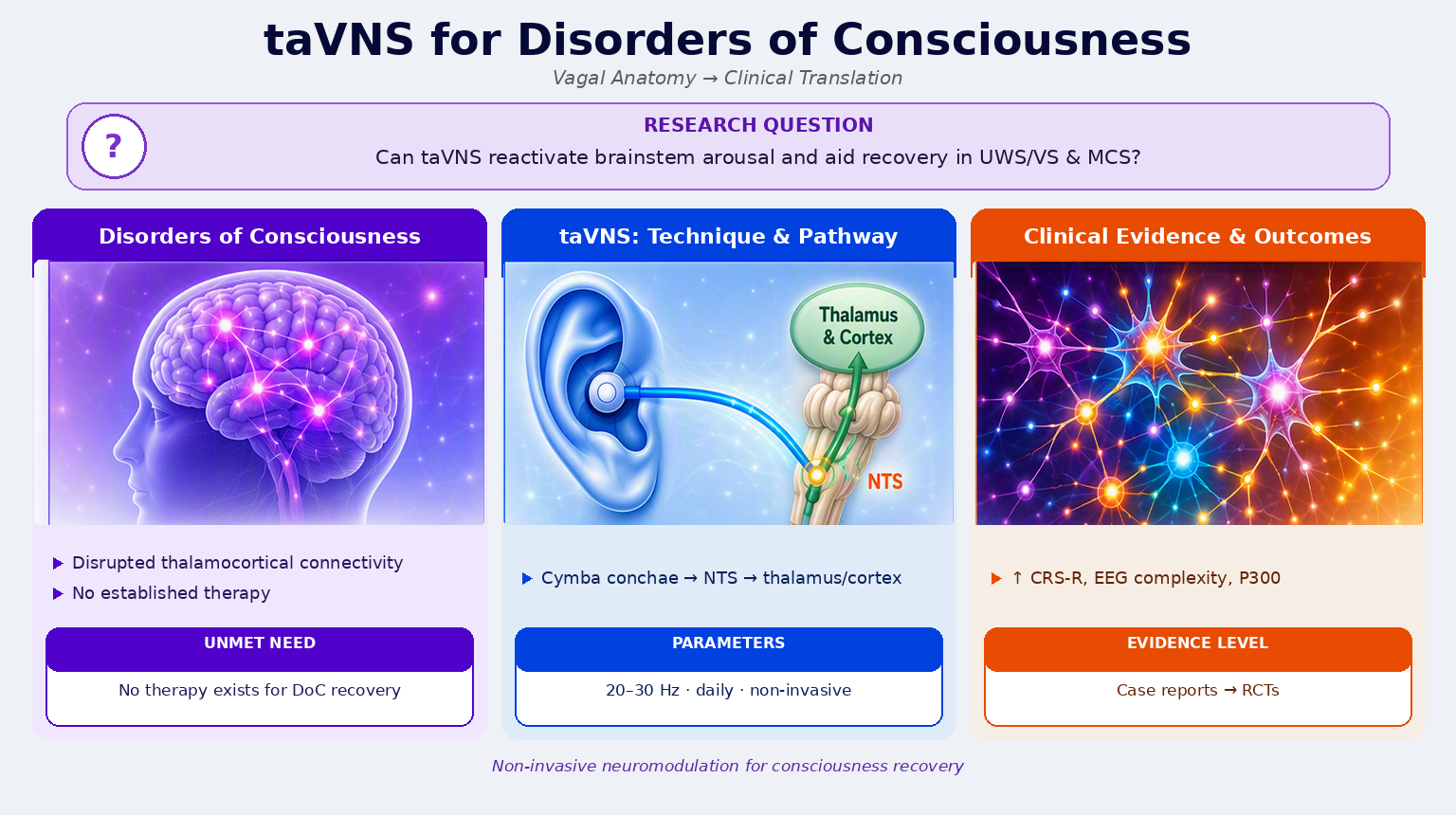
Awakening the Vagus: Transcutaneous Auricular Vagus Nerve Stimulation—A Narrative Review


Highlights
- taVNS has a potential neuromodulatory effect that can influence cortical and EEG reactivity, particularly in patients in a minimally conscious state.
- taVNS is a low-risk, easily implementable adjunct for a vulnerable population with few treatment options.
- Larger multicenter RCTs with standardized protocols are needed before considering routine clinical adoption of taVNS.
Abstract
1. Introduction
2. Methods
3. Anatomical and Functional Rationale
3.1. The Parasympathetic Nervous System
3.2. Structural and Functional Organization of the Vagus Nerve: Afferent and Efferent Pathways
4. Central Integration and Therapeutic Implications
Clinical Experience with taVNS Beyond Disorders of Consciousness
5. taVNS in Disorders of Consciousness
5.1. Translational Relevance for Disorders of Consciousness
5.2. Biological Mechanisms of taVNS in Disorders of Consciousness
Demonstrated Versus Proposed Mechanisms: Insights from Thalamic Stimulation Studies
5.3. The Clinical Role of taVNS in Disorders of Consciousness: Evidence from the Literature
6. Technical Aspects of taVNS
6.1. Invasive Versus Non-Invasive Vagus Nerve Stimulation
6.2. Technical Innovations in taVNS
7. Discussion
8. Conclusions
9. Future Directions
Author Contributions
Funding
Institutional Review Board Statement
Informed Consent Statement
Data Availability Statement
Acknowledgments
Conflicts of Interest
Abbreviations
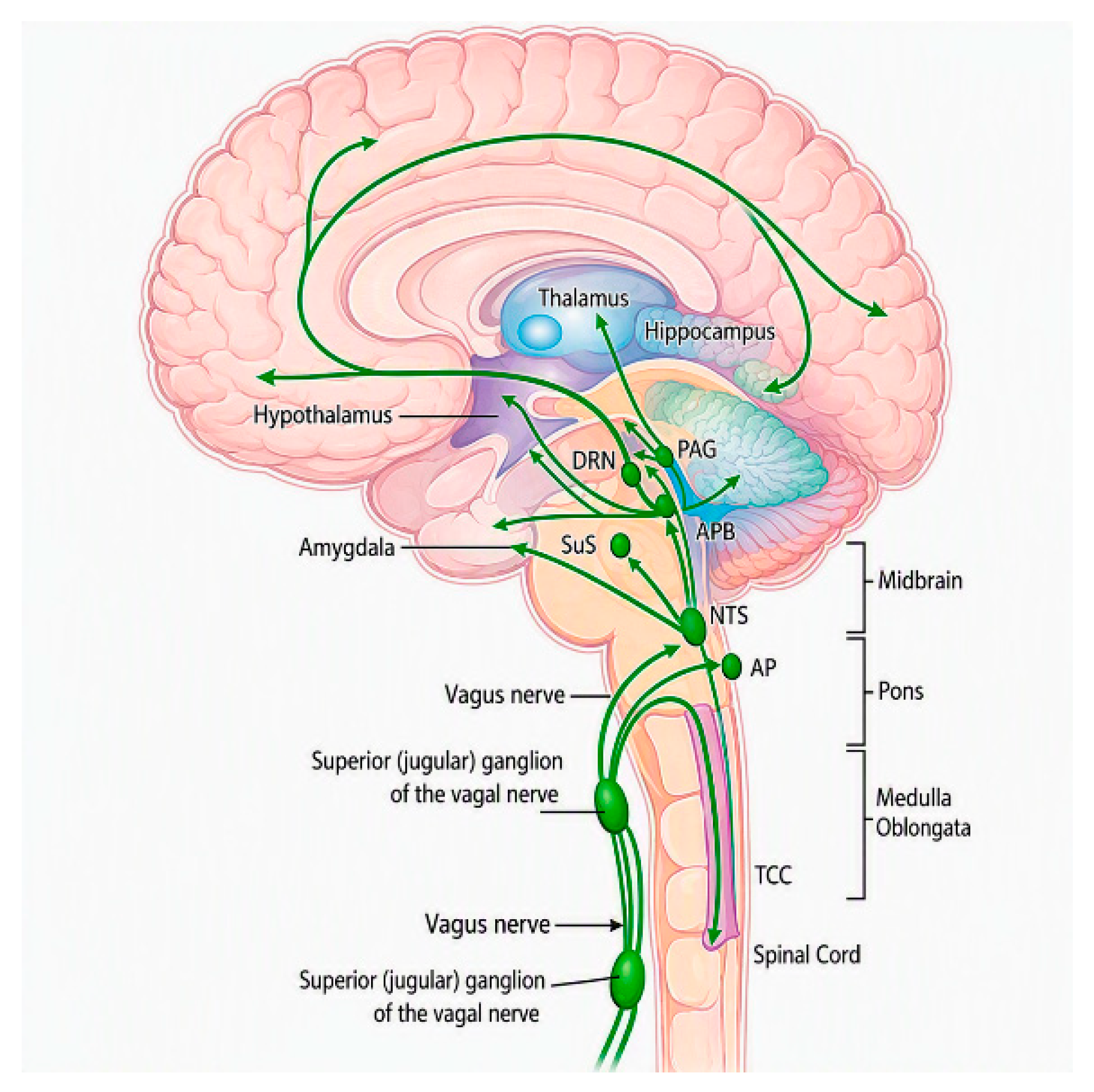
| ABVN | Auricular branch of the vagus nerve |
| AP | Area postrema |
| ARAS | Ascending reticular activating system |
| BAEP | Brainstem auditory evoked potential |
| BDNF | Brain-derived neurotrophic factor |
| CRS-R | Coma recovery scale–revised |
| DMN | Default mode network |
| DMNV | Dorsal motor nucleus of the vagus |
| DoC | Disorders of consciousness |
| DRN | Dorsal raphe nuclei/nucleus |
| EEG | Electroencephalography/electroencephalographic |
| FC | Functional connectivity |
| FDA | Food and drug administration |
| fMRI | Functional magnetic resonance imaging |
| GCS | Glasgow coma scale |
| HC | Healthy controls |
| HRV | Heart rate variability |
| IL-1β/IL-6 | Interleukin-1 beta/interleukin-6 (interleuchina-1 beta/interleuchin-6) |
| iVNS | Invasive vagus nerve stimulation |
| LC | Locus coeruleus |
| MCS | Minimally conscious state |
| NFL | Neurofilament light chain |
| NTS | Nucleus tractus solitarius |
| PAG | Periaqueductal gray |
| PB | Parabrachial nucleus |
| PNS | Parasympathetic nervous system |
| P-tau | Phosphorylated tau |
| QoL | Quality of life |
| RAVANS | Respiratory-gated/synchronized auricular vagal (afferent) nerve stimulation |
| RCT | Randomized controlled trial |
| SuS | Superior salivatory nucleus |
| SVM | Support vector machine |
| sVNS | Selective vagus nerve stimulation |
| TAVREC | Transcutaneous auricular vagal nerve stimulation for consciousness recovery |
| TCC | Trigeminocervical complex |
| TNF | Tumor necrosis factor |
| UWS/VS | Unresponsive wakefulness syndrome/vegetative state |
| VNS | Vagus nerve stimulation |
| taVNS | Transcutaneous auricular vagus nerve stimulation |
References
- Monti, M.M.; Laureys, S.; Owen, A.M. The vegetative state. BMJ 2010, 341, c3765. [Google Scholar] [CrossRef] [Scilit] [PubMed]
- Laureys, S. Tracking the recovery of consciousness from coma. J. Clin. Investig. 2006, 116, 1823–1825. [Google Scholar] [CrossRef] [Scilit] [PubMed]
- Ottaviani, M.M.; Macefield, V.G. Structure and Functions of the Vagus Nerve in Mammals. In Comprehensive Physiology; Prakash, Y.S., Ed.; Wiley: Hoboken, NJ, USA, 2022; pp. 3989–4037. [Google Scholar] [CrossRef] [Scilit] [PubMed]
- Ellrich, J. Transcutaneous auricular vagus nerve stimulation. J. Clin. Neurophysiol. 2019, 36, 437–442. [Google Scholar] [CrossRef] [Scilit] [PubMed]
- Badran, B.W.; Dowdle, L.T.; Mithoefer, O.J.; LaBate, N.T.; Coatsworth, J.; Brown, J.C.; DeVries, W.H.; Austelle, C.W.; McTeague, L.M.; George, M.S. Neurophysiologic effects of transcutaneous auricular vagus nerve stimulation (taVNS) via electrical stimulation of the tragus: A concurrent taVNS/fMRI study and review. Brain Stimul. 2018, 11, 492–500. [Google Scholar] [CrossRef] [Scilit] [PubMed]
- Wehrwein, E.A.; Orer, H.S.; Barman, S.M. Overview of the Anatomy, Physiology, and Pharmacology of the Autonomic Nervous System. In Comprehensive Physiology; Terjung, R., Ed.; Wiley: Hoboken, NJ, USA, 2016; pp. 1239–1278. [Google Scholar] [CrossRef] [Scilit] [PubMed]
- Berthoud, H.R.; Neuhuber, W.L. Functional and chemical anatomy of the afferent vagal system. Auton. Neurosci. 2000, 85, 1–17. [Google Scholar] [CrossRef] [Scilit] [PubMed]
- Prescott, S.L.; Liberles, S.D. Internal senses of the vagus nerve. Neuron 2022, 110, 579–599. [Google Scholar] [CrossRef] [Scilit] [PubMed]
- Sara, S.J. The locus coeruleus and noradrenergic modulation of cognition. Nat. Rev. Neurosci. 2009, 10, 211–223. [Google Scholar] [CrossRef] [Scilit] [PubMed]
- Hornung, J.P. The human raphe nuclei and the serotonergic system. J. Chem. Neuroanat. 2003, 26, 331–343. [Google Scholar] [CrossRef] [Scilit] [PubMed]
- Berthoud, H.R. The vagus nerve, food intake and obesity. Regul. Pept. 2008, 149, 15–25. [Google Scholar] [CrossRef] [Scilit] [PubMed]
- Tracey, K.J. The inflammatory reflex. Nature 2002, 420, 853–859. [Google Scholar] [CrossRef] [Scilit] [PubMed]
- Pavlov, V.A.; Tracey, K.J. Neural regulation of immunity: Molecular mechanisms and clinical translation. Nat. Neurosci. 2017, 20, 156–166. [Google Scholar] [CrossRef] [Scilit] [PubMed]
- Briand, M.M.; Gosseries, O.; Staumont, B.; Laureys, S.; Thibaut, A. Transcutaneous auricular vagal nerve stimulation and disorders of consciousness: A hypothesis for mechanisms of action. Front. Neurol. 2020, 11, 933. [Google Scholar] [CrossRef] [Scilit] [PubMed]
- Badran, B.W.; Yu, A.B.; Adair, D.; Mappin, G.; DeVries, W.H.; Jenkins, D.D.; George, M.S.; Bikson, M. Laboratory administration of transcutaneous auricular vagus nerve stimulation (taVNS): Technique, targeting, and considerations. J. Vis. Exp. 2019, 143, e58984. [Google Scholar] [CrossRef] [Scilit] [PubMed]
- Yuan, H.; Silberstein, S.D. Vagus nerve and vagus nerve stimulation, a comprehensive review: Part II. Headache 2016, 56, 259–266. [Google Scholar] [CrossRef] [Scilit] [PubMed]
- Giordano, F.; Zicca, A.; Barba, C.; Guerrini, R.; Genitori, L. Vagus nerve stimulation: Surgical technique of implantation and revision and related morbidity. Epilepsia 2017, 58, 85–90. [Google Scholar] [CrossRef] [Scilit] [PubMed]
- Rong, P.; Liu, A.; Zhang, J.; Wang, Y.; He, W.; Yang, A.; Li, L.; Ben, H.; Li, L.; Liu, H.; et al. Transcutaneous vagus nerve stimulation for refractory epilepsy: A randomized controlled trial. Clin. Sci. 2014, 127, 549–555. [Google Scholar] [CrossRef] [Scilit] [PubMed]
- Bauer, S.; Baier, H.; Baumgartner, C.; Bohlmann, K.; Fauser, S.; Graf, W.; Hillenbrand, B.; Hirsch, M.; Last, C.; Lerche, H.; et al. Transcutaneous vagus nerve stimulation (tVNS) for treatment of drug-resistant epilepsy: A randomized controlled trial. Epilepsia 2016, 57, e76–e80. [Google Scholar]
- Moeller, S.; Lücke, C.; Heinen, C.; Bewernick, B.H.; Aydin, M.; Lam, A.P.; Grömer, T.W.; Philipsen, A.; Müller, H.H.O. Vagus nerve stimulation as an adjunctive neurostimulation tool in treatment-resistant depression. J. Vis. Exp. 2019, 143, e58264. [Google Scholar] [CrossRef] [Scilit] [PubMed]
- Hein, E.; Nowak, M.; Kiess, O.; Biermann, T.; Bayerlein, K.; Kornhuber, J.; Kraus, T. Auricular transcutaneous electrical nerve stimulation in depressed patients: A randomized controlled pilot study. J. Neural Transm. 2013, 120, 821–827. [Google Scholar] [CrossRef] [Scilit] [PubMed]
- Rong, P.; Liu, J.; Wang, L.; Liu, R.; Fang, J.; Zhao, J.; Zhao, Y.; Wang, H.; Vangel, M.; Sun, S.; et al. Effect of transcutaneous auricular vagus nerve stimulation on major depressive disorder: A nonrandomized controlled pilot study. J. Affect. Disord. 2016, 195, 172–179. [Google Scholar] [CrossRef] [Scilit] [PubMed]
- Fang, J.; Rong, P.; Hong, Y.; Fan, Y.; Liu, J.; Wang, H.; Zhang, G.; Chen, X.; Shi, S.; Wang, L.; et al. Transcutaneous vagus nerve stimulation modulates default mode network in major depressive disorder. Biol. Psychiatry 2016, 79, 266–273. [Google Scholar] [CrossRef] [Scilit] [PubMed]
- Straube, A.; Ellrich, J.; Eren, O.; Blum, B.; Ruscheweyh, R. Treatment of chronic migraine with transcutaneous stimulation of the auricular branch of the vagal nerve (auricular t-VNS): A randomized, monocentric clinical trial. J. Headache Pain 2015, 16, 63. [Google Scholar] [CrossRef] [Scilit] [PubMed]
- Zhang, J.; Zhang, Y.; Zhao, J.; Sun, J.; Zhang, X. The role of transcutaneous auricular vagus nerve stimulation in chronic pain: From neurobiological mechanisms to clinical applications. Front. Pain Res. 2026, 7, 1733445. [Google Scholar] [CrossRef] [Scilit] [PubMed]
- Clancy, J.A.; Mary, D.A.; Witte, K.K.; Greenwood, J.P.; Deuchars, S.A.; Deuchars, J. Non-invasive vagus nerve stimulation in healthy humans reduces sympathetic nerve activity. Brain Stimul. 2014, 7, 871–877. [Google Scholar] [CrossRef] [Scilit] [PubMed]
- Stavrakis, S.; Humphrey, M.B.; Scherlag, B.J.; Hu, Y.; Jackman, W.M.; Nakagawa, H.; Lockwood, D.; Lazzara, R.; Po, S.S. Low-level transcutaneous electrical vagus nerve stimulation suppresses atrial fibrillation. J. Am. Coll. Cardiol. 2015, 65, 867–875. [Google Scholar] [CrossRef] [Scilit] [PubMed]
- Wang, M.H.; Wang, Y.X.; Xie, M.; Chen, L.Y.; He, M.F.; Lin, F.; Jiang, Z.L. Transcutaneous auricular vagus nerve stimulation with task-oriented training improves upper extremity function in patients with subacute stroke: A randomized clinical trial. Front. Neurosci. 2024, 18, 1346634. [Google Scholar] [CrossRef] [Scilit] [PubMed]
- Redgrave, J.N.; Moore, L.; Oyekunle, T.; Ebrahim, M.; Falidas, K.; Snowdon, N.; Ali, A.; Majid, A. Transcutaneous auricular vagus nerve stimulation with concurrent upper limb repetitive task practice for poststroke motor recovery: A pilot study. J. Stroke Cerebrovasc. Dis. 2018, 27, 1998–2005. [Google Scholar] [CrossRef] [Scilit] [PubMed]
- Giraudier, M.; Ventura-Bort, C.; Weymar, M. Effects of transcutaneous auricular vagus nerve stimulation on the P300: Do stimulation duration and stimulation type matter? Brain Sci. 2024, 14, 690. [Google Scholar] [CrossRef] [Scilit] [PubMed]
- O’Leary, O.F.; Ogbonnaya, E.S.; Felice, D.; Levone, B.R.; Conroy, L.C.; Fitzgerald, P.; Bravo, J.A.; Forsythe, P.; Bienenstock, J.; Dinan, T.G.; et al. The vagus nerve modulates BDNF expression and neurogenesis in the hippocampus. Eur. Neuropsychopharmacol. 2018, 28, 307–316. [Google Scholar] [CrossRef] [Scilit] [PubMed]
- Engineer, N.D.; Riley, J.R.; Seale, J.D.; Vrana, W.A.; Shetake, J.A.; Sudanagunta, S.P.; Borland, M.S.; Kilgard, M.P. Reversing pathological neural activity using targeted plasticity. Nature 2011, 470, 101–104. [Google Scholar] [CrossRef] [Scilit] [PubMed]
- Schiff, N.D.; Giacino, J.T.; Kalmar, K.; Victor, J.D.; Baker, K.; Gerber, M.; Fritz, B.; Eisenberg, B.; Biondi, T.; O’Connor, J.; et al. Behavioural improvements with thalamic stimulation after severe traumatic brain injury. Nature 2007, 448, 600–603. [Google Scholar] [CrossRef] [Scilit] [PubMed]
- Yamamoto, T.; Katayama, Y.; Kobayashi, K.; Oshima, H.; Fukaya, C.; Tsubokawa, T. Deep brain stimulation for the treatment of vegetative state. Eur. J. Neurosci. 2010, 32, 1145–1151. [Google Scholar] [CrossRef] [Scilit] [PubMed]
- Magrassi, L.; Maggioni, G.; Pistarini, C.; Di Perri, C.; Bastianello, S.; Zippo, A.G.; Iotti, G.A.; Biella, G.E.; Imberti, R. Results of a prospective study (CATS) on the effects of thalamic stimulation in minimally conscious and vegetative state patients. J. Neurosurg. 2016, 125, 972–981. [Google Scholar] [CrossRef] [Scilit] [PubMed]
- Chudy, D.; Deletis, V.; Almahariq, F.; Marčinković, P.; Škrlin, J.; Paradžik, V. Deep brain stimulation for the early treatment of the minimally conscious state and vegetative state: Experience in 14 patients. J. Neurosurg. 2018, 128, 1189–1198. [Google Scholar] [CrossRef] [Scilit] [PubMed]
- Chudy, D.; Deletis, V.; Paradžik, V.; Dubroja, I.; Marčinković, P.; Orešković, D.; Chudy, H.; Raguž, M. Deep brain stimulation in disorders of consciousness: 10 years of a single center experience. Sci. Rep. 2023, 13, 19491. [Google Scholar] [CrossRef] [Scilit] [PubMed]
- He, J.; Zhang, H.; Dang, Y.; Zhuang, Y.; Ge, Q.; Yang, Y.; Xu, L.; Xia, X.; Laureys, S.; Yu, S.; et al. Electrophysiological characteristics of CM-Pf in diagnosis and outcome of patients with disorders of consciousness. Brain Stimul. 2023, 16, 1522–1532. [Google Scholar] [CrossRef] [Scilit] [PubMed]
- Corazzol, M.; Lio, G.; Lefevre, A.; Deiana, G.; Tell, L.; André-Obadia, N.; Bourdillon, P.; Guenot, M.; Desmurget, M.; Luauté, J.; et al. Restoring consciousness with vagus nerve stimulation. Curr. Biol. 2017, 27, R994–R996. [Google Scholar] [CrossRef] [Scilit] [PubMed]
- Yu, Y.T.; Yang, Y.; Wang, L.B.; Fang, J.L.; Chen, Y.Y.; He, J.H.; Rong, P.J. Transcutaneous auricular vagus nerve stimulation in disorders of consciousness monitored by fMRI: The first case report. Brain Stimul. 2017, 10, 328–330. [Google Scholar] [CrossRef] [Scilit] [PubMed]
- Noé, E.; Ferri, J.; Colomer, C.; Moliner, B.; O’Valle, M.; Ugart, P.; Rodriguez, C.; Llorens, R. Feasibility, safety and efficacy of transauricular vagus nerve stimulation in a cohort of patients with disorders of consciousness. Brain Stimul. 2020, 13, 427–429. [Google Scholar] [CrossRef] [Scilit] [PubMed]
- Osińska Hakon, J.; Moghiseh, M.; Poulsen, I.; Øland, C.M.; Hansen, C.P.; Sabers, A. Transcutaneous vagus nerve stimulation in patients with severe traumatic brain injury: A feasibility trial. Neuromodulation 2020, 23, 859–864. [Google Scholar] [CrossRef] [Scilit] [PubMed]
- Osińska, A.; Rynkiewicz, A.; Binder, M.; Komendziński, T.; Borowicz, A.; Leszczyński, A. Non-invasive vagus nerve stimulation in treatment of disorders of consciousness: Longitudinal case study. Front. Neurosci. 2022, 16, 834507. [Google Scholar] [CrossRef] [Scilit] [PubMed]
- Zhou, Y.F.; Kang, J.W.; Xiong, Q.; Feng, Z.; Dong, X.Y. Transauricular vagus nerve stimulation for patients with disorders of consciousness: A randomized controlled clinical trial. Front. Neurol. 2023, 14, 1133893. [Google Scholar] [CrossRef] [Scilit] [PubMed]
- Zhou, Y.; Sun, Y.; He, P.; Xiong, Q.; Kang, J.; Tang, Y.; Feng, Z.; Dong, X. The efficacy and safety of transcutaneous auricular vagus nerve stimulation for patients with minimally conscious state: A sham-controlled randomized double-blind clinical trial. Front. Neurosci. 2023, 17, 1323079. [Google Scholar] [CrossRef] [Scilit] [PubMed]
- Li, Y.; Riganello, F.; Yu, J.; Vatrano, M.; Shen, M.; Cheng, L.; Hu, X.; Ni, C.; Wang, F.; Zheng, B.; et al. The autonomic response following taVNS predicts changes in level of consciousness in DoC patients. Sci. Rep. 2025, 15, 7317. [Google Scholar] [CrossRef] [Scilit] [PubMed]
- Zhou, L.Y.; Peng, L.J.; Liu, Y.F.; Wang, S.W.; Qiu, Y.; Chen, S.J.; Feng, M.M.; Liu, J.; Wu, S.S.; Luo, T.; et al. Transcutaneous auricular vagal nerve stimulation for consciousness recovery in patients with prolonged disorders of consciousness (TAVREC): Study protocol for a multicenter, triple-blind, randomized controlled trial in China. BMJ Open 2024, 14, e083888. [Google Scholar] [CrossRef] [Scilit] [PubMed]
- Cheng, L.; Sun, L.; Xu, L.; Zhao, F.; Liu, X.; Wang, A.; Di, H.; Cong, Y.S. Randomized trial of transcutaneous auricular vagus nerve stimulation on patients with disorders of consciousness: A study protocol. Front. Neurol. 2023, 14, 1116115. [Google Scholar] [CrossRef] [Scilit] [PubMed]
- Jiao, H.; Zhai, W.; Zhang, J.; Xu, L.; Geng, X.; Chen, X.; Yang, Y.; Wang, Y. Electroencephalographic characteristics of transcutaneous auricular vagus nerve stimulation for prolonged disorders of consciousness: A study protocol. Front. Neurosci. 2025, 19, 1539232. [Google Scholar] [CrossRef] [Scilit] [PubMed]
- Zhang, Q.; Luo, X.; Wang, X.H.; Li, J.Y.; Qiu, H.; Yang, D.D. Transcutaneous auricular vagus nerve stimulation for epilepsy. Seizure 2024, 119, 84–91. [Google Scholar] [CrossRef] [Scilit] [PubMed]
- Fisher, B.; DesMarteau, J.A.; Koontz, E.H.; Wilks, S.J.; Melamed, S.E. Responsive vagus nerve stimulation for drug-resistant epilepsy: A review of new features and practical guidance for advanced practice providers. Front. Neurol. 2021, 11, 610379. [Google Scholar] [CrossRef] [Scilit] [PubMed]
- Thompson, S.L.; O’Leary, G.H.; Austelle, C.W.; Gruber, E.; Kahn, A.T.; Manett, A.J.; Short, B.; Badran, B.W. A review of parameter settings for invasive and non-invasive vagus nerve stimulation applied in neurological and psychiatric disorders. Front. Neurosci. 2021, 15, 709436. [Google Scholar] [CrossRef] [Scilit] [PubMed]
- Garcia, R.G.; Sclocco, R.; Gabriel, A.; Valenza, G.; Napadow, V.; Barbieri, R. Effects of respiratory-gated auricular vagal nerve stimulation (RAVANS) on nonlinear heartbeat dynamics in hypertensive patients. In 2017 Computing in Cardiology (CinC); IEEE: Piscataway, NJ, USA, 2017; Volume 44, pp. 1–4. [Google Scholar]
- Garcia, R.G.; Cohen, J.E.; Stanford, A.D.; Gabriel, A.; Stowell, J.; Aizley, H.; Barbieri, R.; Gitlin, D.; Napadow, V.; Goldstein, J.M. Respiratory-gated auricular vagal afferent nerve stimulation modulates brain response to stress in major depression. J. Psychiatr. Res. 2021, 142, 188–197. [Google Scholar] [CrossRef] [Scilit] [PubMed]
- Fitchett, A.; Mastitskaya, S.; Aristovich, K. Selective neuromodulation of the vagus nerve. Front. Neurosci. 2021, 15, 685872. [Google Scholar] [CrossRef] [Scilit] [PubMed]
- Wang, L.; Gao, F.; Wang, Z.; Liang, F.; Dai, Y.; Wang, M.; Wu, J.; Chen, Y.; Yan, Q.; Wang, L. Transcutaneous auricular vagus nerve stimulation in the treatment of disorders of consciousness: Mechanisms and applications. Front. Neurosci. 2023, 17, 1286267. [Google Scholar] [CrossRef] [Scilit] [PubMed]
- Kim, A.Y.; Marduy, A.; de Melo, P.S.; Gianlorenco, A.C.; Kim, C.K.; Choi, H.; Song, J.J.; Fregni, F. Safety of transcutaneous auricular vagus nerve stimulation (taVNS): A systematic review and meta-analysis. Sci. Rep. 2022, 12, 22055. [Google Scholar] [CrossRef] [Scilit] [PubMed]
- Peuker, E.T.; Filler, T.J. The nerve supply of the human auricle. Clin. Anat. 2002, 15, 35–37. [Google Scholar] [CrossRef] [Scilit] [PubMed]
- Frangos, E.; Ellrich, J.; Komisaruk, B.R. Non-invasive access to the vagus nerve central projections via electrical stimulation of the external ear: fMRI evidence in humans. Brain Stimul. 2015, 8, 624–636. [Google Scholar] [CrossRef] [Scilit] [PubMed]
- Schnakers, C.; Vanhaudenhuyse, A.; Giacino, J.; Ventura, M.; Boly, M.; Majerus, S.; Moonen, G.; Laureys, S. Diagnostic accuracy of the vegetative and minimally conscious state: Clinical consensus versus standardized neurobehavioral assessment. BMC Neurol. 2009, 9, 35. [Google Scholar] [CrossRef] [Scilit] [PubMed]
- Giacino, J.T.; Katz, D.I.; Schiff, N.D.; Whyte, J.; Ashman, E.J.; Ashwal, S.; Barbano, R.; Hammond, F.M.; Laureys, S.; Ling, G.S.F.; et al. Practice guideline update recommendations summary: Disorders of consciousness: Report of the Guideline Development, Dissemination, and Implementation Subcommittee of the American Academy of Neurology; the American Congress of Rehabilitation Medicine; and the National Institute on Disability, Independent Living, and Rehabilitation Research. Neurology 2018, 91, 450–460. [Google Scholar] [PubMed]


| Clinical Condition | Key Studies | Study Type | Proposed Main Targets | Reported Clinical Effects | Main Limitations |
|---|---|---|---|---|---|
| Drug-resistant epilepsy | Rong 2014 [18]; Bauer 2016 [19] | RCTs | Brainstem–thalamocortical circuits | Reduced seizure frequency, improved QoL and EEG | Smaller effect vs. iVNS |
| Major depressive disorder | Moeller 2019 [20]; Hein 2013 [21]; Rong 2016 [22] | Randomized and non-randomized controlled pilot study | Limbic–prefrontal networks | Reduction in depressive symptoms | Placebo effects |
| Migraine/headache | Straube 2015 [24] | RCT | Trigeminovascular system | Reduced attack frequency and intensity | Short follow-up |
| Chronic pain | Various pilot studies, Zang 2026 [25] | Pilot trials | Descending pain pathways | Pain reduction | Small samples |
| Autonomic dysfunction | Clancy 2014 [26]; Stavrakis 2015 [27] | Physiological and clinical studies | Parasympathetic pathways | Increased HRV, reduced sympathetic tone | Surrogate endpoints |
| Stroke rehabilitation | Wang 2024 [28]; Redgrave 2018 [29] | Controlled trials | Motor cortex plasticity | Improved motor recovery | Small samples |
| Study | Population | Etiology/Time Since Injury | Study Design | Duration/Intervention | Main Outcomes | Safety |
|---|---|---|---|---|---|---|
| Corazzol et al., 2017 [39] | Single patient with chronic post-traumatic UWS | Traumatic (car accident); 15 years | Case report; invasive cervical VNS | Implanted VNS with long-term follow-up (several months) | Emergence of behavioral signs of consciousness; Increased thalamocortical metabolism and EEG connectivity | No adverse events |
| Yu et al., 2017 [40] | Single patients with UWS | Anoxic (cardiopulmonary arrest); 50 days | Case report | taVNS (twice daily for 30 min each in four consecutive weeks) | Transition to MCS; functional connectivity (FC) changes of the default mode network (DMN) at fMRI | Well tolerated |
| Noè et al., 2019 [41] | 14 Patients with MCS-, VS, UWS | Traumatic: 7; Anoxic: 4; Hemorrhagic: 3; 12.1 ± 6.4 months | Prospective observational study | Twice a day (five days per week), 4 weeks follow up | Five of the eight MCS patients at admission showed an improvement in the CRS-R during the duration of the study | Well tolerated |
| Hakon et al., 2020 [42] | 5 Patients with Diffuse Axonal Injury | Traumatic (diffuse axonal injury), all 5 pts; median 41 days (range 31–95) | Case series | 4 h daily for eight weeks | Three patients showed improvements (>3 points) in the CRS-R | Well tolerated |
| Osińska et al., 2022 [43] | Single Patient with UWS | Traumatic; 6 years | Longitudinal case study | 100 taVNS sessions (A single taVNS session lasted about 4 h) | Increase in CRS-R scores and EEG complexity (re-emergence of a second oscillatory peak in the alpha range) | Well tolerated; no major side effects |
| Zhou et al., 2023 [44] | 57 Patients with DoC (MCS, UWS) | Stroke 30/57 (53%); TBI 27/57 (47%); mean ≈ 121 days (≈4 months) | Randomized double blind controlled trial (28 active taVNS, 29 sham taVNS) | 30 min twice daily 6 days per week for 4 weeks; pulse width, 200 us; frequency, 20 Hz; intensity, 15 | CRS-R greater improvement in active group (not statistically significant) Better results in MCS | No significant adverse event |
| Zhou et al., 2023 [45] | 50 Patients with MCS | TBI 22/50 (44%); Non-TBI 28/50 (56%: stroke 24, HIE 4); median ≈ 40 days (range 26.5–86.5) | Randomized, sham-controlled trial (25 taVNS, 25 sham treatment) | 30 min, twice daily, 6 days per week, over a period of 4 week | Greater improvement in CRS-R/GCS in patients receiving active stimulation | No significant adverse events |
| Li et al., 2025 [46] | Patients with DoC (17 MCS; 19 UWS) | Mixed acquired brain injury (breakdown not reported) | Prospective randomized clinical trial | 10 min taVNS sessions with autonomic monitoring (total duration of the treatment not reported) | Autonomic responses (e.g., HRV changes) predicted improvement in level of consciousness | Well tolerated; no serious adverse events reported |
| Ongoing trials | ||||||
| Zhou et al., 2024 [47] ChiCTR2300073950 | Patients with prolonged DoC (multicenter); ongoing, actively recruiting | Mixed etiology (not restricted); pDoC, onset > 28 days | Multicenter, triple-blind, randomized controlled trial (study protocol; ongoing) | Repeated taVNS sessions 60 min two times per day for 4 weeks | Primary outcome: change in CRS-R scores; secondary outcomes: neurophysiological and functional measures | Safety to be evaluated; protocol reports expected good tolerability based on prior taVNS studies |
| Cheng et al., 2023 [48] ChiCTR2100045161 | 90 Patients with chronic DoC; intervention phase concluded | Mixed acquired brain injury (not restricted); onset > 28 days | Randomized controlled trial (sham taVNS or active taVNS) | Daily taVNS sessions 40 min per day, 5 days per week over a 40-day cycle | Primary outcomes: changes in standardized consciousness scales (CRS-R), Secondary outcomes: MRI, EEG, Phosphorylated tau (P-tau), and Neurofilament light chain (NFL) | |
| Jiao et al., 2025 [49] ITMCTR2024000734 | 50 patients with prolonged DOC; no explicit recruitment-status statement | Mixed acquired brain injury (not restricted); pDoC, onset > 28 days | Prospective, exploratory clinical trial | 2 sessions of 30 min per day, 5 days per week, for a total period of 4 weeks | CRS-R, EEG parameters |
| Study | Stimulation Site | Frequency | Pulse Width | Intensity | Session Duration | Treatment Period |
|---|---|---|---|---|---|---|
| Corazzol et al., 2017 [39] | Cervical vagus nerve (surgically implanted, left side) | 30 Hz | 500 μs | 0.25 mA initially, gradually increased to 1.5 mA | 30 s ON/5 min OFF (duty cycle) | 6 months |
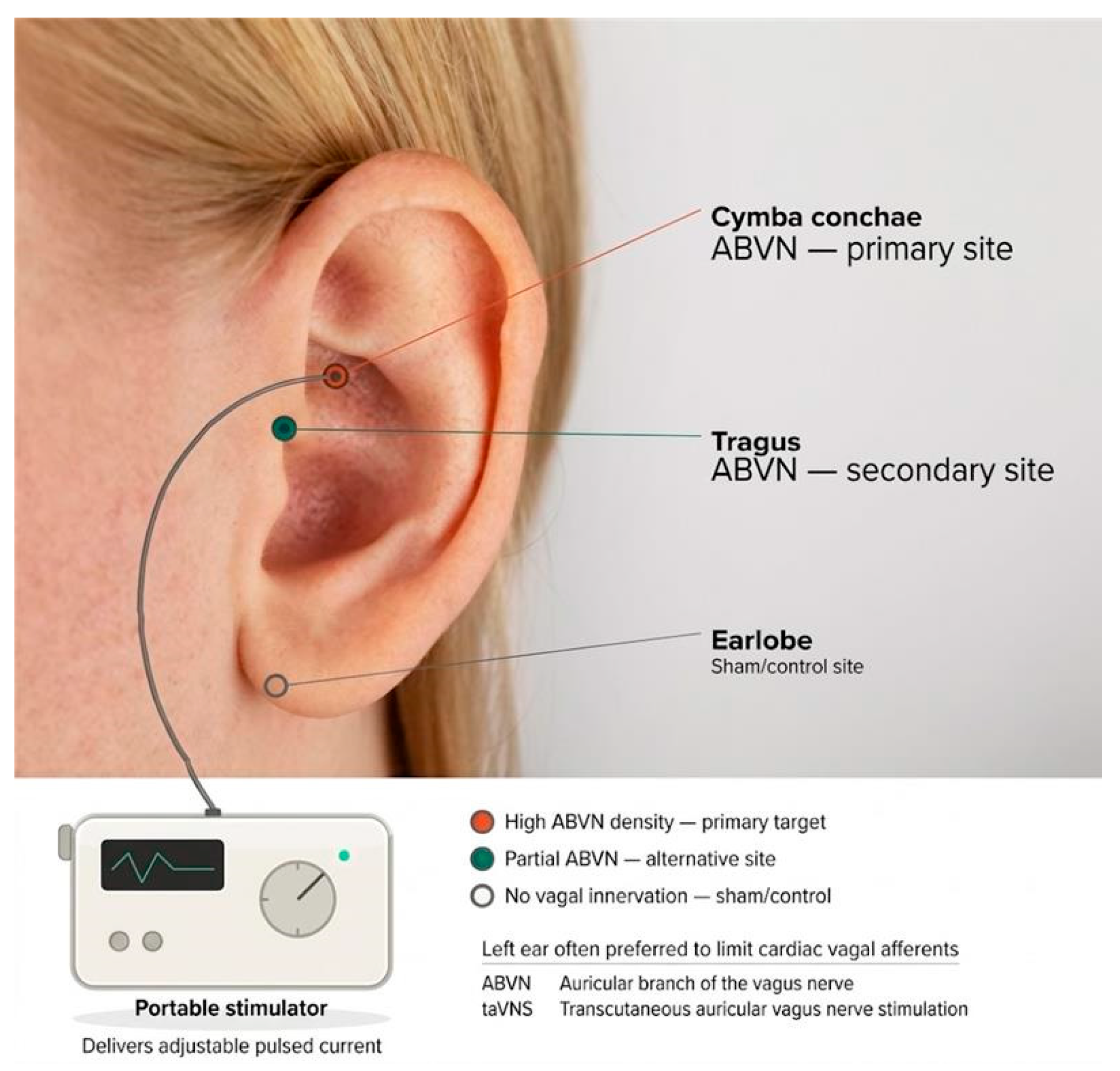
| Yu et al., 2017 [40] | Cymba conchae (bilateral) | 20 Hz | <1000 μs | 4–6 mA | 30 min, twice daily | 4 consecutive weeks |
| Noè et al., 2019 [41] | Left tragus | 20 Hz | 250 μs | 1.5 mA | 30 min, twice daily, 5 days/week | 4 weeks + 4-week follow-up |
| Hakon et al., 2020 [42] | Cymba conchae | 25 Hz | 250 μs | 0.5 mA (first 3 days), then 1 mA | 4 h daily (30 s ON/30 s OFF) | 8 weeks |
| Osińska et al., 2022 [43] | Cymba conchae (left ear) | 25 Hz | 250 μs (0.25 ms) | 0.2–1.5 mA (+0.1 mA/week) | 4 h/day (continuous, 30 s ON/30 s OFF) | 6 months (100+ sessions) |
| Zhou et al., 2023 [44] | Left outer ear (auricular branch) | 20 Hz | 200 μs | Gear 15 (device level) | 30 min, twice daily, 6 days/week | 4 weeks |
| Zhou et al., 2023 [45] | Cymba conchae (left ear) | 20 Hz | 200 μs | Gear 15–20, titrated via NCS-R | 30 min, twice daily, 6 days/week | 4 weeks + 8-week follow-up |
| Li et al., 2025 [46] | Cymba conchae | Alternating 4/20 Hz (3 s/7 s cycles) | 200 μs | NR | Single 10-min session | Single-session study (no multi-week treatment) |
| Ongoing trials | ||||||
| Zhou et al., 2024 [47] | NR (auricular) | 25 Hz | 300 μs | 1 mA | 60 min, twice daily (30 s ON/30 s OFF) | 4 weeks + 4-week follow-up |
| Cheng et al., 2023 [48] | Cymba conchae and inner tragus (left, or left + right) | Alternating 20 Hz (7 s)/4 Hz (3 s) cycles | 200 μs | NR (individually titrated) | 40 min/day, 5 days/week | 40-day cycle |
| Jiao et al., 2025 [49] | Cymba conchae and cavum conchae (bilateral) | Dense-sparse wave, 4/20 Hz | NR | ~1–1.5 mA | 30 min, 2 sessions/day, 5 days/week | 4 weeks |
Disclaimer/Publisher’s Note: The statements, opinions and data contained in all publications are solely those of the individual author(s) and contributor(s) and not of MDPI and/or the editor(s). MDPI and/or the editor(s) disclaim responsibility for any injury to people or property resulting from any ideas, methods, instructions or products referred to in the content. |
© 2026 by the authors. Licensee MDPI, Basel, Switzerland. This article is an open access article distributed under the terms and conditions of the Creative Commons Attribution (CC BY) license.
Share and Cite
Portincaso, L.; Santi, G.C.; Villa, N.; Pietro, D.A.D. Awakening the Vagus: Transcutaneous Auricular Vagus Nerve Stimulation—A Narrative Review. Brain Sci. 2026, 16, 979. https://doi.org/10.3390/brainsci16090979
Portincaso L, Santi GC, Villa N, Pietro DAD. Awakening the Vagus: Transcutaneous Auricular Vagus Nerve Stimulation—A Narrative Review. Brain Sciences. 2026; 16(9):979. https://doi.org/10.3390/brainsci16090979
Chicago/Turabian StylePortincaso, Lara, Gaia Chiara Santi, Nicole Villa, and Davide Antonio Di Pietro. 2026. "Awakening the Vagus: Transcutaneous Auricular Vagus Nerve Stimulation—A Narrative Review" Brain Sciences 16, no. 9: 979. https://doi.org/10.3390/brainsci16090979
APA StylePortincaso, L., Santi, G. C., Villa, N., & Pietro, D. A. D. (2026). Awakening the Vagus: Transcutaneous Auricular Vagus Nerve Stimulation—A Narrative Review. Brain Sciences, 16(9), 979. https://doi.org/10.3390/brainsci16090979