Corticomuscular Coherence in Post-Stroke Motor Function and Recovery

Highlights
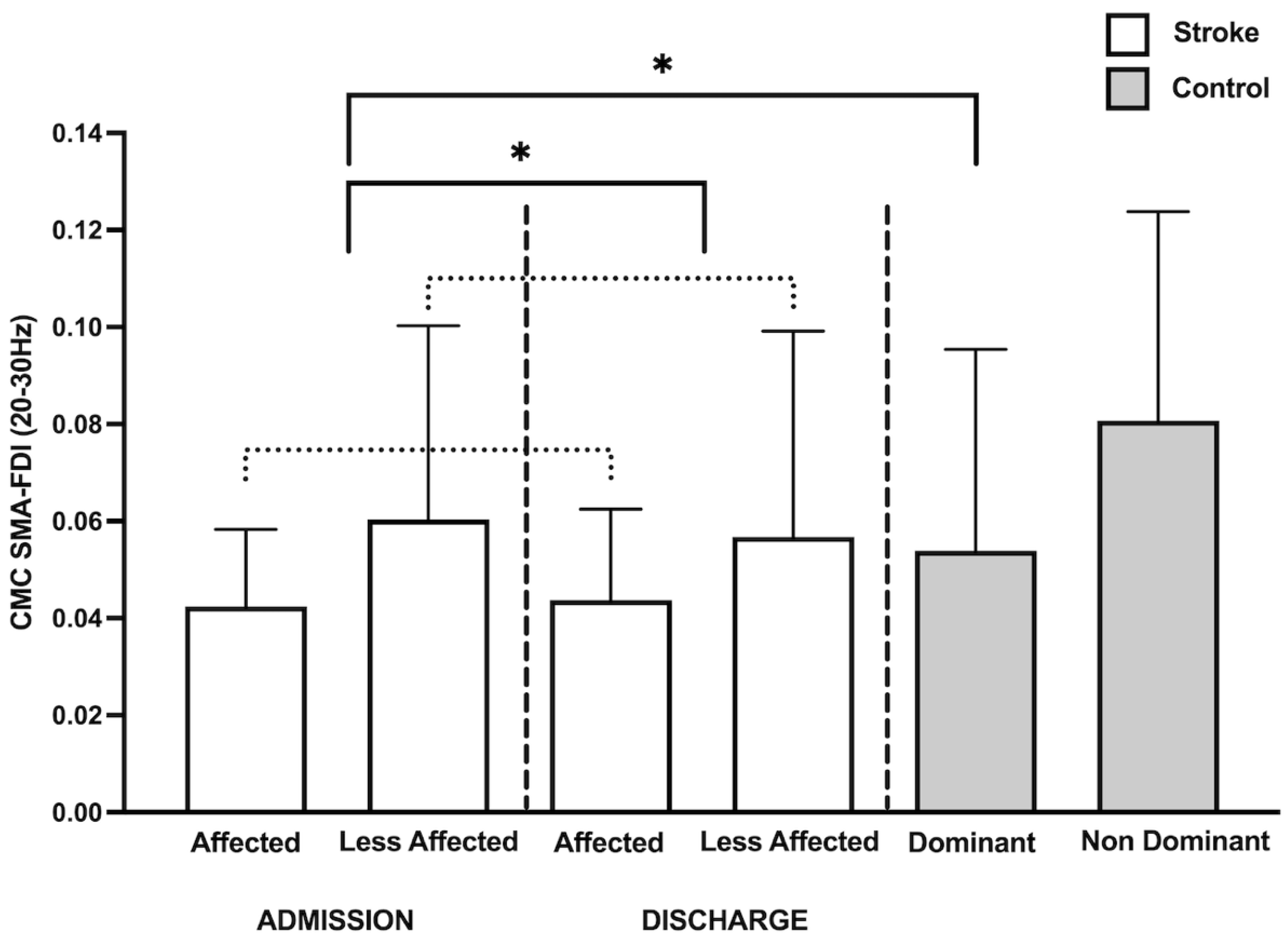
- Individuals with stroke demonstrated reduced brain–muscle functional connectivity (corticomuscular coherence) between the supplementary motor area (SMA) and affected first dorsal interosseous (FDI) muscle compared to neurotypical controls.
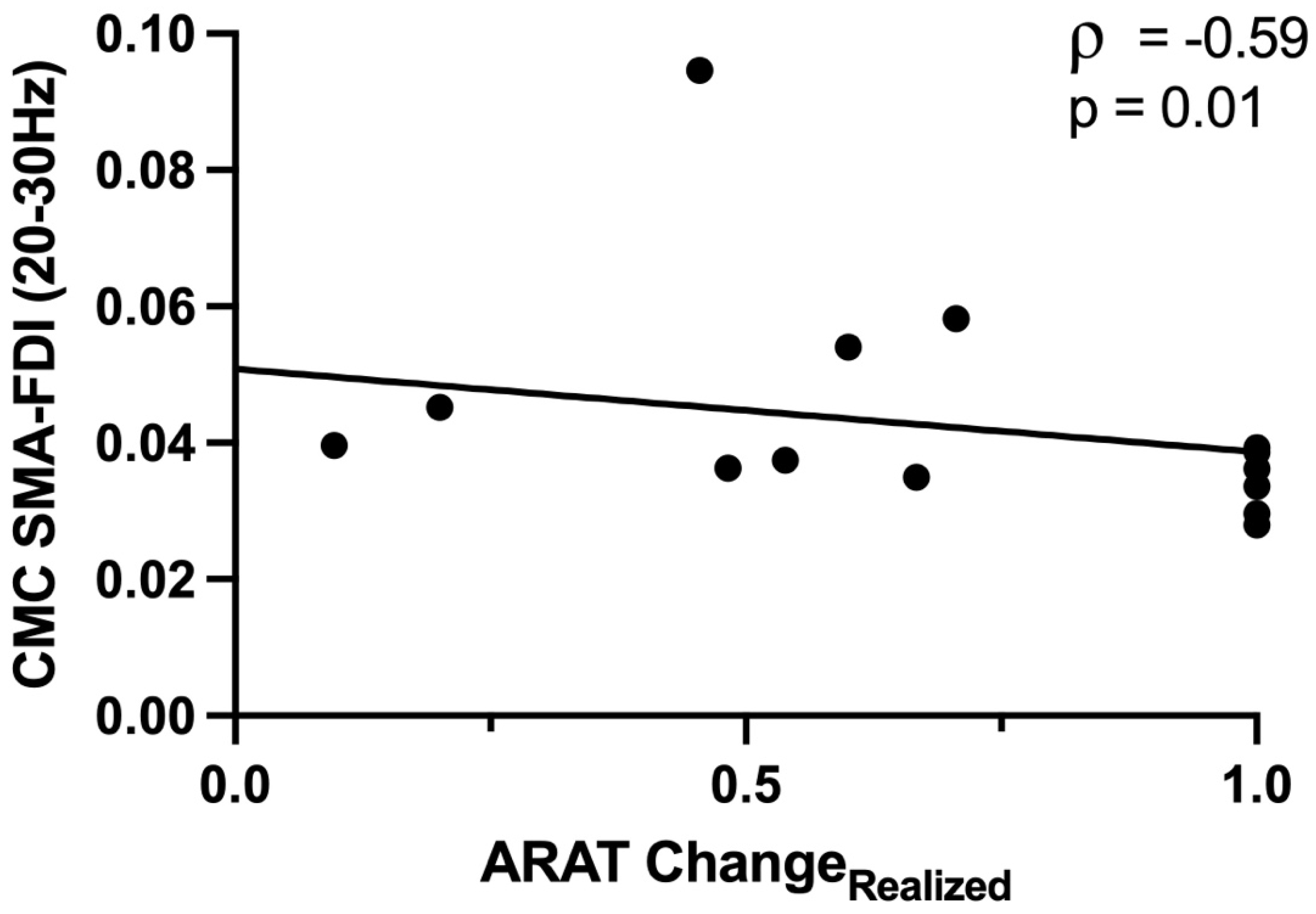
- Greater beta SMA-FDI connectivity at inpatient rehabilitation admission was associated with poorer motor recovery, although CMC did not significantly change during the inpatient rehabilitation stay.
- Beta SMA–FDI CMC may serve as a biomarker of neural injury and motor function early after stroke.
- The relationship between early CMC and motor recovery supports its potential prognostic value; however, the lack of change during inpatient rehabilitation highlights the need for longer-term longitudinal studies to clarify its utility as a biomarker of stroke recovery.
Abstract
1. Introduction
2. Methods
2.1. Participants
2.2. EEG and EMG Acquisition
2.3. EEG and EMG Preprocessing Steps and Measures
2.4. Structural Imaging and Injury Quantification
2.5. Statistical Analysis
3. Results
3.1. CMC Between-Group Differences Across Time
3.2. CMC Within-Group Differences over Time
3.3. CMC Differences Between Extremities
3.4. Affected Extremity CMC and Motor Recovery
3.5. Topographical Observations
4. Discussion
5. Conclusions
Author Contributions
Funding
Institutional Review Board Statement
Informed Consent Statement
Data Availability Statement
Acknowledgments
Conflicts of Interest
References
- Carrera, E.; Tononi, G. Diaschisis: Past, present, future. Brain 2014, 137, 2408–2422. [Google Scholar] [CrossRef] [Scilit]
- Siegel, J.S.; Ramsey, L.E.; Snyder, A.Z.; Metcalf, N.V.; Chacko, R.V.; Weinberger, K.; Baldassarre, A.; Hacker, C.D.; Shulman, G.L.; Corbetta, M. Disruptions of network connectivity predict impairment in multiple behavioral domains after stroke. Proc. Natl. Acad. Sci. USA 2016, 113, E4367–E4376. [Google Scholar] [CrossRef] [Scilit] [PubMed]
- Biswal, B.; Yetkin, F.Z.; Haughton, V.M.; Hyde, J.S. Functional connectivity in the motor cortex of resting human brain using echo-planar MRI. Magn. Reson. Med. 1995, 34, 537–541. [Google Scholar] [CrossRef] [Scilit] [PubMed]
- Carter, A.R.; Astafiev, S.V.; Lang, C.E.; Connor, L.T.; Rengachary, J.; Strube, M.J.; Pope, D.L.W.; Shulman, G.L.; Corbetta, M. Resting interhemispheric functional magnetic resonance imaging connectivity predicts performance after stroke. Ann. Neurol. 2010, 67, 365–375. [Google Scholar] [CrossRef] [Scilit] [PubMed]
- Park, C.H.; Chang, W.H.; Ohn, S.H.; Kim, S.T.; Bang, O.Y.; Pascual-Leone, A.; Kim, Y.-H. Longitudinal changes of resting-state functional connectivity during motor recovery after stroke. Stroke 2011, 42, 1357–1362. [Google Scholar] [CrossRef] [Scilit] [PubMed]
- Golestani, A.M.; Tymchuk, S.; Demchuk, A.; Goodyear, B.G.; VISION-2 Study Group. Longitudinal evaluation of resting-state FMRI after acute stroke with hemiparesis. Neurorehabilit. Neural Repair 2013, 27, 153–163. [Google Scholar] [CrossRef] [Scilit] [PubMed]
- Derosiere, G.; Duque, J. Tuning the Corticospinal System: How Distributed Brain Circuits Shape Human Actions. Neuroscientist 2020, 26, 359–379. [Google Scholar] [CrossRef] [Scilit] [PubMed]
- Lin, D.J.; Cloutier, A.M.; Erler, K.S.; Cassidy, J.M.; Snider, S.B.; Ranford, J.; Parlman, K.; Giatsidis, F.; Burke, J.F.; Schwamm, L.H.; et al. Corticospinal Tract Injury Estimated from Acute Stroke Imaging Predicts Upper Extremity Motor Recovery After Stroke. Stroke 2019, 50, 3569–3577. [Google Scholar] [CrossRef] [Scilit] [PubMed]
- Cassidy, J.M.; Tran, G.; Quinlan, E.B.; Cramer, S.C. Neuroimaging Identifies Patients Most Likely to Respond to a Restorative Stroke Therapy. Stroke 2018, 49, 433–438. [Google Scholar] [CrossRef] [Scilit] [PubMed]
- Boyd, L.A.; Hayward, K.S.; Ward, N.S.; Stinear, C.M.; Rosso, C.; Fisher, R.J.; Carter, A.R.; Leff, A.P.; Copland, D.A.; Carey, L.M.; et al. Biomarkers of stroke recovery: Consensus-based core recommendations from the Stroke Recovery and Rehabilitation Roundtable. Int. J. Stroke 2017, 12, 480–493. [Google Scholar] [CrossRef] [Scilit] [PubMed]
- Mima, T.; Hallett, M. Corticomuscular coherence: A review. J. Clin. Neurophysiol. 1999, 16, 501–511. [Google Scholar] [CrossRef] [Scilit] [PubMed]
- Mima, T.; Toma, K.; Koshy, B.; Hallett, M. Coherence between cortical and muscular activities after subcortical stroke. Stroke 2001, 32, 2597–2601. [Google Scholar] [CrossRef] [Scilit] [PubMed]
- Liu, J.; Sheng, Y.; Liu, H. Corticomuscular Coherence and Its Applications: A Review. Front. Hum. Neurosci. 2019, 13, 100. [Google Scholar] [CrossRef] [Scilit] [PubMed]
- Conway, B.A.; Halliday, D.M.; Farmer, S.F.; Shahani, U.; Maas, P.; I Weir, A.; Rosenberg, J.R. Synchronization between motor cortex and spinal motoneuronal pool during the performance of a maintained motor task in man. J. Physiol. 1995, 489, 917–924. [Google Scholar] [CrossRef] [Scilit] [PubMed]
- Baker, S.N. Oscillatory interactions between sensorimotor cortex and the periphery. Curr. Opin. Neurobiol. 2007, 17, 649–655. [Google Scholar] [CrossRef] [Scilit] [PubMed]
- Salenius, S.; Portin, K.; Kajola, M.; Salmelin, R.; Hari, R. Cortical control of human motoneuron firing during isometric contraction. J. Neurophysiol. 1997, 77, 3401–3405. [Google Scholar] [CrossRef] [Scilit] [PubMed]
- Ushiyama, J.; Katsu, M.; Masakado, Y.; Kimura, A.; Liu, M.; Ushiba, J. Muscle fatigue-induced enhancement of corticomuscular coherence following sustained submaximal isometric contraction of the tibialis anterior muscle. J. Appl. Physiol. 2011, 110, 1233–1240. [Google Scholar] [CrossRef] [Scilit] [PubMed]
- Kristeva, R.; Patino, L.; Omlor, W. Beta-range cortical motor spectral power and corticomuscular coherence as a mechanism for effective corticospinal interaction during steady-state motor output. Neuroimage 2007, 36, 785–792. [Google Scholar] [CrossRef] [Scilit] [PubMed]
- Witham, C.L.; Riddle, C.N.; Baker, M.R.; Baker, S.N. Contributions of descending and ascending pathways to corticomuscular coherence in humans. J. Physiol. 2011, 589, 3789–3800. [Google Scholar] [CrossRef] [Scilit] [PubMed]
- Hari, R.; Salenius, S. Rhythmical corticomotor communication. Neuroreport 1999, 10, R1–R10. [Google Scholar] [PubMed]
- James, L.M.; Halliday, D.M.; Stephens, J.A.; Farmer, S.F. On the development of human corticospinal oscillations: Age-related changes in EEG-EMG coherence and cumulant. Eur. J. Neurosci. 2008, 27, 3369–3379. [Google Scholar] [CrossRef] [Scilit] [PubMed]
- Graziadio, S.; Basu, A.; Tomasevic, L.; Zappasodi, F.; Tecchio, F.; Eyre, J.A. Developmental tuning and decay in senescence of oscillations linking the corticospinal system. J. Neurosci. 2010, 30, 3663–3674. [Google Scholar] [CrossRef] [Scilit] [PubMed]
- Beck, M.M.; Spedden, M.E.; Lundbye-Jensen, J. Reorganization of functional and directed corticomuscular connectivity during precision grip from childhood to adulthood. Sci. Rep. 2021, 11, 22870. [Google Scholar] [CrossRef] [Scilit] [PubMed]
- Omlor, W.; Patino, L.; Mendez-Balbuena, I.; Schulte-Mönting, J.; Kristeva, R. Corticospinal beta-range coherence is highly dependent on the pre-stationary motor state. J. Neurosci. 2011, 31, 8037–8045. [Google Scholar] [CrossRef] [Scilit] [PubMed]
- Lim, M.; Kim, J.S.; Kim, M.; Chung, C.K. Ascending beta oscillation from finger muscle to sensorimotor cortex contributes to enhanced steady-state isometric contraction in humans. Clin. Neurophysiol. 2014, 125, 2036–2045. [Google Scholar] [CrossRef] [Scilit] [PubMed]
- Kristeva-Feige, R.; Fritsch, C.; Timmer, J.; Lücking, C.H. Effects of attention and precision of exerted force on beta range EEG-EMG synchronization during a maintained motor contraction task. Clin. Neurophysiol. 2002, 113, 124–131. [Google Scholar] [CrossRef] [Scilit] [PubMed]
- Johnson, A.N.; Shinohara, M. Corticomuscular coherence with and without additional task in the elderly. J. Appl. Physiol. 2012, 112, 970–981. [Google Scholar] [CrossRef] [Scilit] [PubMed]
- Zheng, Y.; Peng, Y.; Xu, G.; Li, L.; Wang, J. Using Corticomuscular Coherence to Reflect Function Recovery of Paretic Upper Limb after Stroke: A Case Study. Front. Neurol. 2017, 8, 728. [Google Scholar] [CrossRef] [Scilit] [PubMed]
- Aikio, R.; Laaksonen, K.; Sairanen, V.; Parkkonen, E.; Elseoud, A.A.; Kujala, J.; Forss, N. CMC is more than a measure of corticospinal tract integrity in acute stroke patients. Neuroimage Clin. 2021, 32, 102818. [Google Scholar] [CrossRef] [Scilit] [PubMed]
- Krauth, R.; Schwertner, J.; Vogt, S.; Lindquist, S.; Sailer, M.; Sickert, A.; Lamprecht, J.; Perdikis, S.; Corbet, T.; Millán, J.d.R.; et al. Cortico-Muscular Coherence Is Reduced Acutely Post-stroke and Increases Bilaterally During Motor Recovery: A Pilot Study. Front. Neurol. 2019, 10, 126. [Google Scholar] [CrossRef] [Scilit] [PubMed]
- Larsen, L.H.; Zibrandtsen, I.C.; Wienecke, T.; Kjaer, T.W.; Christensen, M.S.; Nielsen, J.B.; Langberg, H. Corticomuscular coherence in the acute and subacute phase after stroke. Clin. Neurophysiol. 2017, 128, 2217–2226. [Google Scholar] [CrossRef] [Scilit] [PubMed]
- von Carlowitz-Ghori, K.; Bayraktaroglu, Z.; Hohlefeld, F.U.; Losch, F.; Curio, G.; Nikulin, V.V. Corticomuscular coherence in acute and chronic stroke. Clin. Neurophysiol. 2014, 125, 1182–1191. [Google Scholar] [CrossRef] [Scilit] [PubMed]
- Rossiter, H.E.; Eaves, C.; Davis, E.; Boudrias, M.-H.; Park, C.-H.; Farmer, S.; Barnes, G.; Litvak, V.; Ward, N.S. Changes in the location of cortico-muscular coherence following stroke. Neuroimage Clin. 2012, 2, 50–55. [Google Scholar] [CrossRef] [Scilit] [PubMed]
- Mark, J.I.; Riddle, J.; Gangwani, R.; Huang, B.; Fröhlich, F.; Cassidy, J.M. Cross-Frequency Coupling as a Biomarker for Early Stroke Recovery. Neurorehabilit. Neural Repair 2024, 38, 506–517. [Google Scholar] [CrossRef] [Scilit] [PubMed]
- Vaughn, R.M.; Gangwani, R.; Mark, J.I.; Fletcher, K.; Baratta, J.M.; Cassidy, J.M. Predictive utility of self-efficacy in early stroke rehabilitation. Top. Stroke Rehabil. 2025, 32, 362–370. [Google Scholar] [CrossRef] [Scilit] [PubMed]
- Gangwani, R.; Mark, J.I.; Huang, B.Y.; Cassidy, J.M. Associations between structural injury and task-based corticomuscular connectivity after stroke. Front. Neurol. 2025, 16, 1653349. [Google Scholar] [CrossRef] [Scilit] [PubMed]
- Fugl-Meyer, A.R.; Jääskö, L.; Leyman, I.; Olsson, S.; Steglind, S. The post-stroke hemiplegic patient. 1. a method for evaluation of physical performance. Scand. J. Rehabil. Med. 1975, 7, 13–31. [Google Scholar] [CrossRef] [Scilit] [PubMed]
- Lyle, R.C. A performance test for assessment of upper limb function in physical rehabilitation treatment and research. Int. J. Rehabil. Res. 1981, 4, 483–492. [Google Scholar] [CrossRef] [Scilit] [PubMed]
- Ye, Y.; Ma, L.; Yan, T.; Liu, H.; Wei, X.; Song, R. Kinetic measurements of hand motor impairments after mild to moderate stroke using grip control tasks. J. Neuroeng. Rehabil. 2014, 11, 84. [Google Scholar] [CrossRef] [Scilit] [PubMed]
- Oostenveld, R.; Fries, P.; Maris, E.; Schoffelen, J.M. FieldTrip: Open source software for advanced analysis of MEG, EEG, and invasive electrophysiological data. Comput. Intell. Neurosci. 2011, 2011, 156869. [Google Scholar] [CrossRef] [Scilit] [PubMed]
- Kuypers, H.G. Anatomy of the descending pathways. In Comprehensive Physiology; John Wiley & Sons, Inc.: Hoboken, NJ, USA, 1981; pp. 597–666. [Google Scholar]
- Porter, R.; Lemon, R. Corticospinal Function and Voluntary Movement; Oxford University Press: Oxford, UK, 1995. [Google Scholar]
- Fang, Y.; Daly, J.J.; Sun, J.; Hvorat, K.; Fredrickson, E.; Pundik, S.; Sahgal, V.; Yue, G.H. Functional corticomuscular connection during reaching is weakened following stroke. Clin. Neurophysiol. 2009, 120, 994–1002. [Google Scholar] [CrossRef] [Scilit] [PubMed]
- Nachev, P.; Kennard, C.; Husain, M. Functional role of the supplementary and pre-supplementary motor areas. Nat. Rev. Neurosci. 2008, 9, 856–869. [Google Scholar] [CrossRef] [Scilit] [PubMed]
- Quandt, F.; Bönstrup, M.; Schulz, R.; Timmermann, J.E.; Mund, M.; Wessel, M.J.; Hummel, F.C. The functional role of beta-oscillations in the supplementary motor area during reaching and grasping after stroke: A question of structural damage to the corticospinal tract. Hum. Brain Mapp. 2019, 40, 3091–3101. [Google Scholar] [CrossRef] [Scilit] [PubMed]
- Chen, S.; Entakli, J.; Bonnard, M.; Berton, E.; De Graaf, J.B. Functional corticospinal projections from human supplementary motor area revealed by corticomuscular coherence during precise grip force control. PLoS ONE 2013, 8, e60291. [Google Scholar] [CrossRef] [Scilit] [PubMed]
- Engel, A.K.; Fries, P. Beta-band oscillations—Signalling the status quo? Curr. Opin. Neurobiol. 2010, 20, 156–165. [Google Scholar] [CrossRef] [Scilit] [PubMed]
- Espenhahn, S.; Rossiter, H.E.; van Wijk, B.C.M.; Redman, N.; Rondina, J.M.; Diedrichsen, J.; Ward, N.S. Sensorimotor cortex beta oscillations reflect motor skill learning ability after stroke. Brain Commun. 2020, 2, fcaa161. [Google Scholar] [CrossRef] [Scilit] [PubMed]
- Bayram, M.B.; Siemionow, V.; Yue, G.H. Weakening of Corticomuscular Signal Coupling During Voluntary Motor Action in Aging. J. Gerontol. A Biol. Sci. Med. Sci. 2015, 70, 1037–1043. [Google Scholar] [CrossRef] [Scilit] [PubMed]
- Wagner, J.M.; Rhodes, J.A.; Patten, C. Reproducibility and minimal detectable change of three-dimensional kinematic analysis of reaching tasks in people with hemiparesis after stroke. Phys. Ther. 2008, 88, 652–663. [Google Scholar] [CrossRef] [Scilit] [PubMed]
- Simpson, L.A.; Eng, J.J. Functional recovery following stroke: Capturing changes in upper-extremity function. Neurorehabilit. Neural Repair 2013, 27, 240–250. [Google Scholar] [CrossRef] [Scilit] [PubMed]
- Elsner, B.; Hommel, B.; Mentschel, C.; Drzezgad, A.; Prinza, W.; Conradc, B.; Siebnerce, H. Linking actions and their perceivable consequences in the human brain. Neuroimage 2002, 17, 364–372. [Google Scholar] [CrossRef] [Scilit] [PubMed]
- Popescu, M.N.; Căpeț, C.; Beiu, C.; Berteanu, M. The Elias University Hospital Approach: A Visual Guide to Ultrasound-Guided Botulinum Toxin Injection in Spasticity: Part II—Proximal Upper Limb Muscles. Toxins 2025, 17, 276. [Google Scholar] [CrossRef] [Scilit] [PubMed]
- Dromerick, A.W.; Geed, S.; Barth, J.; Brady, K.; Giannetti, M.L.; Mitchell, A.; Edwardson, M.A.; Tan, M.T.; Zhou, Y.; Newport, E.L.; et al. Critical Period After Stroke Study (CPASS): A phase II clinical trial testing an optimal time for motor recovery after stroke in humans. Proc. Natl. Acad. Sci. USA 2021, 28, 118. [Google Scholar] [CrossRef] [Scilit] [PubMed]
- Jones, T.A.; Schallert, T. Overgrowth and pruning of dendrites in adult rats recovering from neocortical damage. Brain Res. 1992, 581, 156–160. [Google Scholar] [CrossRef] [Scilit] [PubMed]
- Schallert, T.; Jones, T.A. “Exuberant” neuronal growth after brain damage in adult rats: The essential role of behavioral experience. J. Neural Transplant. Plast. 1993, 4, 193–198. [Google Scholar] [CrossRef] [Scilit] [PubMed]
- Murphy, T.H.; Corbett, D. Plasticity during stroke recovery: From synapse to behaviour. Nat. Rev. Neurosci. 2009, 10, 861–872. [Google Scholar] [CrossRef] [Scilit] [PubMed]
- Kostka, J.; Niwald, M.; Guligowska, A.; Kostka, T.; Miller, E. Muscle power, contraction velocity and functional performance after stroke. Brain Behav. 2019, 9, e01243. [Google Scholar] [CrossRef] [Scilit] [PubMed]
- Beckwée, D.; Cuypers, L.; Lefeber, N.; De Keersmaecker, E.; Scheys, E.; Van Hees, W.; Perkisas, S.; De Raedt, S.; Kerckhofs, E.; Bautmans, I.; et al. Skeletal Muscle Changes in the First Three Months of Stroke Recovery: A Systematic Review. J. Rehabil. Med. 2022, 54, jrm00308. [Google Scholar] [CrossRef] [Scilit] [PubMed]
- Mani, S.; Mutha, P.K.; Przybyla, A.; Haaland, K.Y.; Good, D.C.; Sainburg, R.L. Contralesional motor deficits after unilateral stroke reflect hemisphere-specific control mechanisms. Brain 2013, 136, 1288–1303. [Google Scholar] [CrossRef] [Scilit] [PubMed]



| Descriptor | Sample Size | Mean (SD) Median [IQR] | Range |
|---|---|---|---|
| Sex Stroke | |||
| Female | 14 | - | - |
| Male Control Female Male | 16 8 9 | - | - |
| Race, Ethnicity Stroke | |||
| Black, non-Hispanic | 6 | - | - |
| White, non-Hispanic Control Black, non-Hispanic White, non-Hispanic Asian | 24 16 1 | - | - |
| Age (years) Stroke Control | 67 (9.8) 75.3 (13) | 51–85 48–95 | |
| Stroke Type | |||
| Hemorrhagic | 2 | - | - |
| Ischemic | 28 | - | - |
| Lesioned Hemisphere | |||
| Left | 12 | - | - |
| Right | 18 | - | - |
| Days Post-stroke to Enrollment | 10.4 (3.5) | 5–18 | |
| Length of IRF Stay | 15.5 (6.2) | 4–29 | |
| NIHSS (max = 42) | 3 [1–6.2] | 0–17 | |
| Lesion Volume (cc) | 19.9 (35.9) | 0.08–155.7 | |
| Percent Injury to CST | 58.3 (40.6) | 0–100 | |
| UEFM (max = 66) | |||
| Visit 1 | 40.9 (25.1) | 2–66 | |
| Visit 2 | 29 | 46.8 (23.6) | 4–66 |
| ARAT (max = 57) | |||
| Visit 1 | 33.0 (23.7) | 0–57 | |
| Visit 2 | 28 | 37.1 (24.1) | 0–57 |
| MoCA (max = 30) Stroke | |||
| Visit 1 | 28 | 22.3 (4.2) | 14–29 |
| Visit 2 | 29 | 23.9 (5.4) | 11–30 |
| Control | 25.8 (3.4) | 20–30 |
Disclaimer/Publisher’s Note: The statements, opinions and data contained in all publications are solely those of the individual author(s) and contributor(s) and not of MDPI and/or the editor(s). MDPI and/or the editor(s) disclaim responsibility for any injury to people or property resulting from any ideas, methods, instructions or products referred to in the content. |
© 2026 by the authors. Licensee MDPI, Basel, Switzerland. This article is an open access article distributed under the terms and conditions of the Creative Commons Attribution (CC BY) license.
Share and Cite
Gangwani, R.; Mark, J.I.; Zadrozny, S.; Cassidy, J.M. Corticomuscular Coherence in Post-Stroke Motor Function and Recovery. Brain Sci. 2026, 16, 689. https://doi.org/10.3390/brainsci16070689
Gangwani R, Mark JI, Zadrozny S, Cassidy JM. Corticomuscular Coherence in Post-Stroke Motor Function and Recovery. Brain Sciences. 2026; 16(7):689. https://doi.org/10.3390/brainsci16070689
Chicago/Turabian StyleGangwani, Rachana, Jasper I. Mark, Sabrina Zadrozny, and Jessica M. Cassidy. 2026. "Corticomuscular Coherence in Post-Stroke Motor Function and Recovery" Brain Sciences 16, no. 7: 689. https://doi.org/10.3390/brainsci16070689
APA StyleGangwani, R., Mark, J. I., Zadrozny, S., & Cassidy, J. M. (2026). Corticomuscular Coherence in Post-Stroke Motor Function and Recovery. Brain Sciences, 16(7), 689. https://doi.org/10.3390/brainsci16070689