Animate Categories Show Higher Cross-Duration Representational Selectivity in Ventral Occipitotemporal Cortex Under Brief Visual Input


Highlights
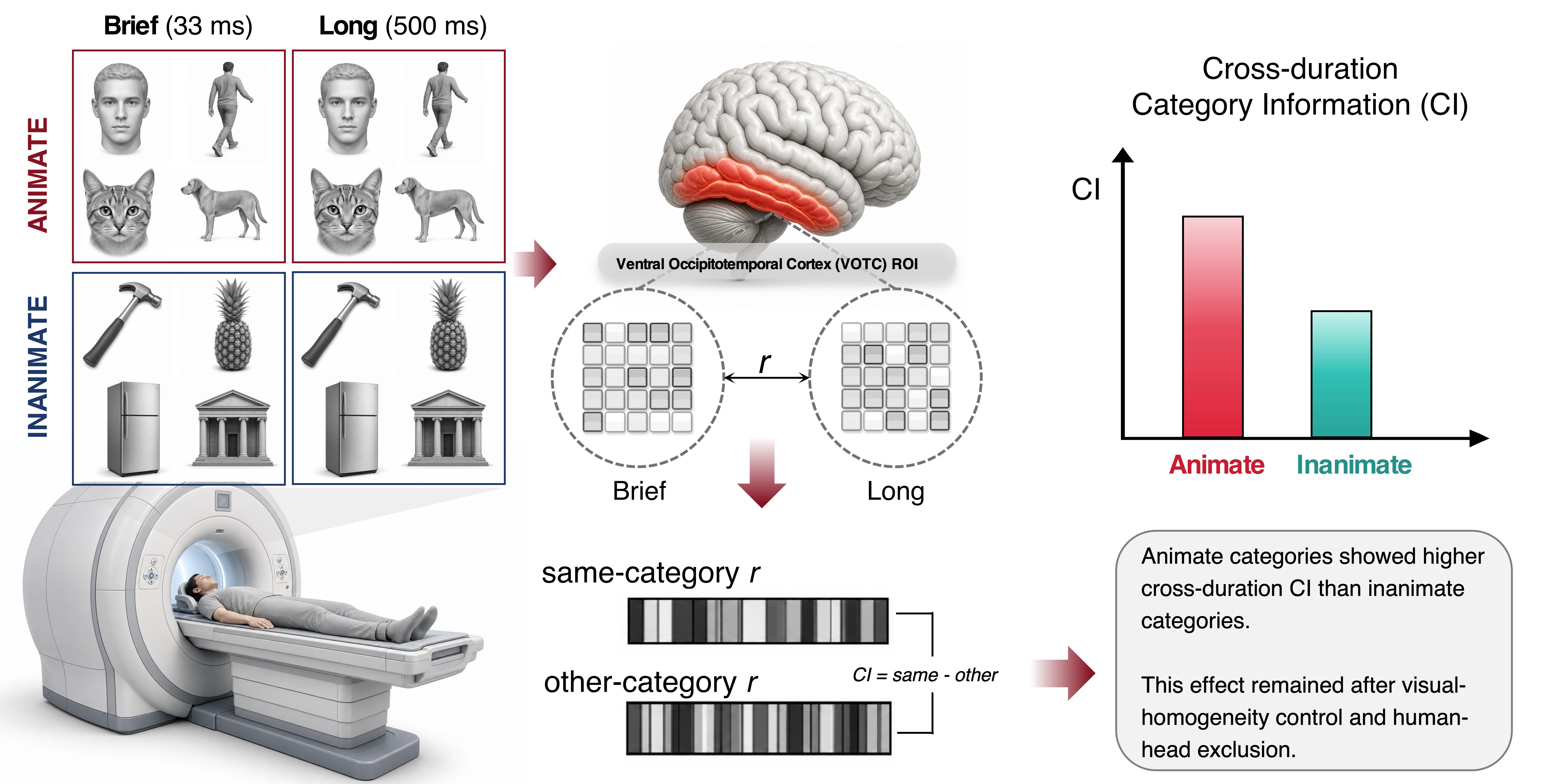
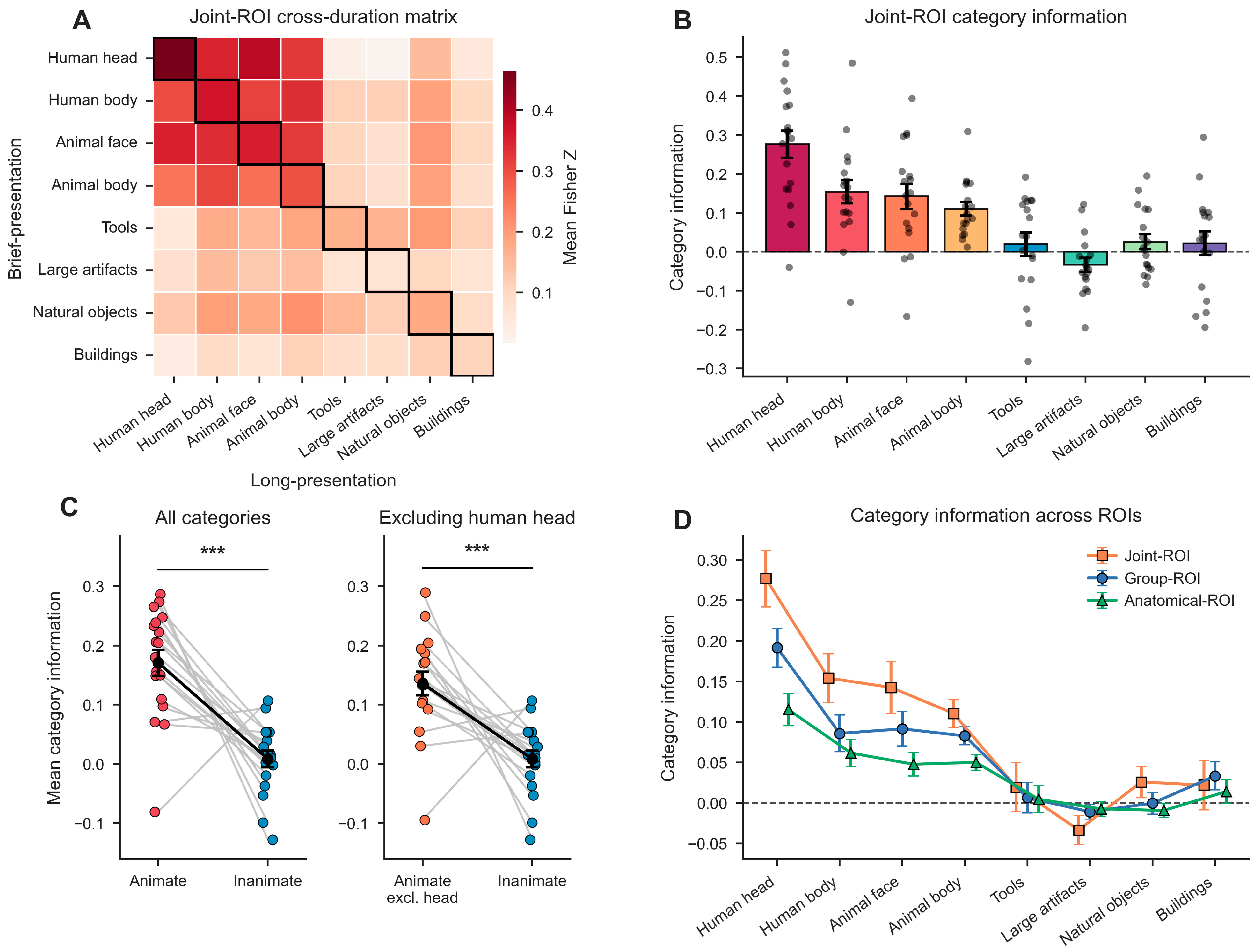
- In the ventral occipitotemporal cortex, animate categories showed higher cross-duration category information than inanimate categories, suggesting that brief-presentation patterns corresponded more selectively to same-category patterns under extended viewing.
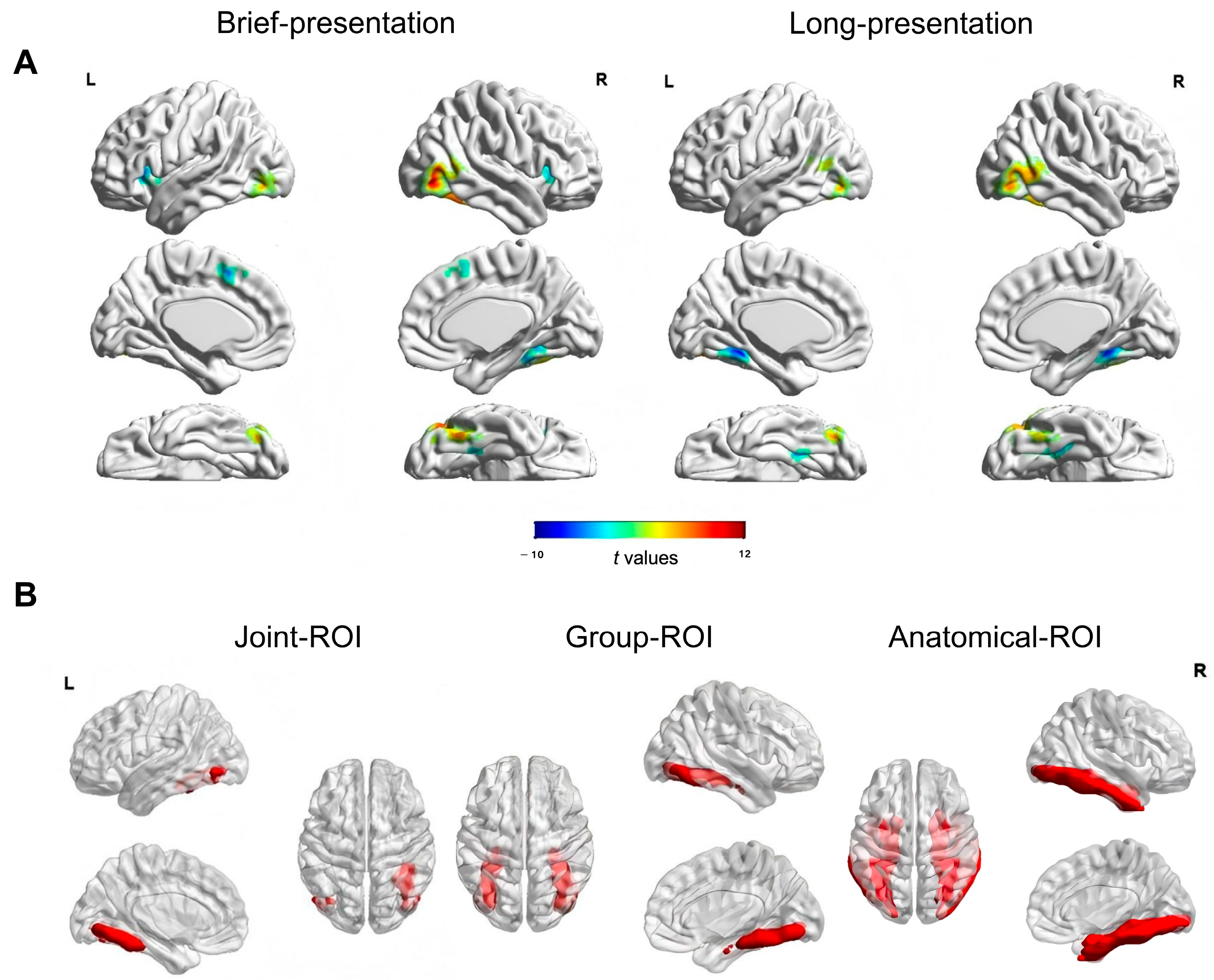
- This effect remained after excluding the human-head category and was consistent across ROI-definition strategies and robustness analyses, suggesting that it was not driven solely by human heads or by a particular ROI definition.
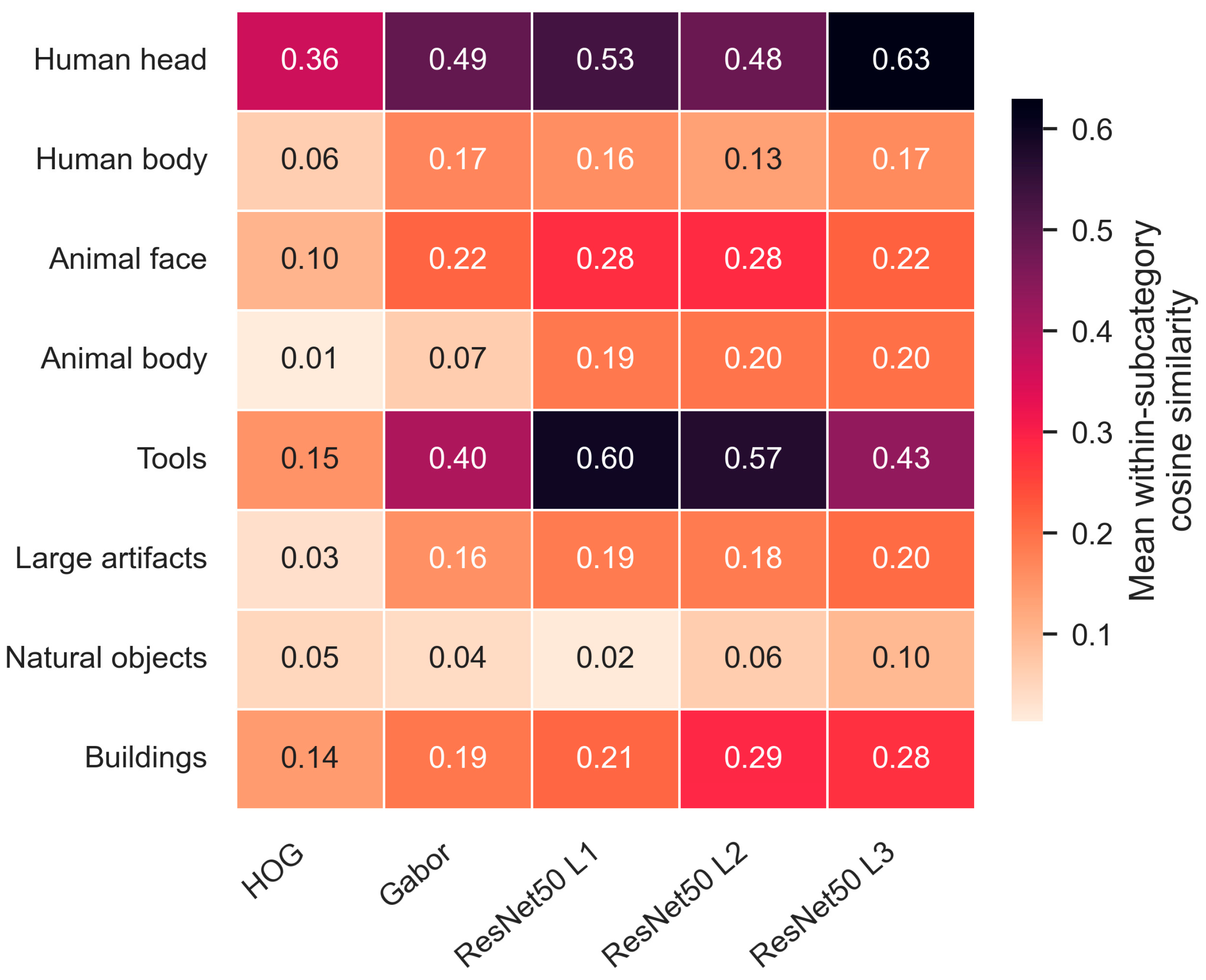
- Within-category visual homogeneity contributed to cross-duration category information, but the measured feature spaces did not fully account for the animate-category advantage.
- The advantage may reflect both animacy-related representational organization and visual-structural factors, providing a candidate representational account of animate-category processing under limited input.
Abstract
1. Introduction
2. Methods
2.1. Participants
2.2. Experimental Materials and Procedure
2.3. MRI Data Acquisition
2.4. fMRI Data Analysis
2.4.1. Preprocessing
2.4.2. Whole-Brain Analysis
2.4.3. Region-of-Interest (ROI) Definition
2.4.4. Cross-Duration MVPA
2.4.5. Stimulus-Level Visual Homogeneity Analysis
3. Results
3.1. Whole-Brain Analysis Results
3.2. ROI Pattern Analysis Results
3.3. Visual Homogeneity Analysis
4. Discussion
4.1. Cross-Duration Category Selectivity for Animate Categories
4.2. Contribution of Visual Homogeneity to Animate-Category Selectivity
4.3. Relationship to Behavioral Animal Advantages and Task Design
4.4. CI Measure, Presentation Duration, and Interpretive Boundaries
5. Conclusions
Supplementary Materials
Author Contributions
Funding
Institutional Review Board Statement
Informed Consent Statement
Data Availability Statement
Acknowledgments
Conflicts of Interest
References
- Eberhardt, S.; Cader, J.G.; Serre, T. How Deep Is the Feature Analysis Underlying Rapid Visual Categorization? In Proceedings of the Advances in Neural Information Processing Systems 29 (NIPS 2016); Curran Associates, Inc.: Red Hook, NY, USA; Brown University: Providence, RI, USA, 2016. [Google Scholar]
- Fabre-Thorpe, M. The Characteristics and Limits of Rapid Visual Categorization. Front. Psychol. 2011, 2, 243. [Google Scholar] [CrossRef] [PubMed]
- Potter, M.C. Recognition and Memory for Briefly Presented Scenes. Front. Psychol. 2012, 3, 20118. [Google Scholar] [CrossRef] [PubMed]
- Grill-Spector, K.; Kanwisher, N. Visual Recognition: As Soon as You Know It Is There, You Know What It Is. Psychol. Sci. 2005, 16, 152–160. [Google Scholar] [CrossRef] [PubMed]
- Rosch, E.; Mervis, C.B.; Gray, W.D.; Johnson, D.M.; Boyes-Braem, P. Basic Objects in Natural Categories. Cogn. Psychol. 1976, 8, 382–439. [Google Scholar] [CrossRef]
- Li, F.F.; VanRullen, R.; Koch, C.; Perona, P. Rapid Natural Scene Categorization in the near Absence of Attention. Proc. Natl. Acad. Sci. USA 2002, 99, 9596–9601. [Google Scholar] [CrossRef] [PubMed]
- Macé, M.J.-M.; Joubert, O.R.; Nespoulous, J.-L.; Fabre-Thorpe, M. The Time-Course of Visual Categorizations: You Spot the Animal Faster than the Bird. PLoS ONE 2009, 4, e5927. [Google Scholar] [CrossRef] [PubMed]
- Wu, C.-T.; Crouzet, S.M.; Thorpe, S.J.; Fabre-Thorpe, M. At 120 Msec You Can Spot the Animal but You Don’t Yet Know It’s a Dog. J. Cogn. Neurosci. 2015, 27, 141–149. [Google Scholar] [CrossRef] [PubMed]
- Bi, Y.; Wang, X.; Caramazza, A. Object Domain and Modality in the Ventral Visual Pathway. Trends Cogn. Sci. 2016, 20, 282–290. [Google Scholar] [CrossRef] [PubMed]
- Caramazza, A.; Mahon, B.Z. The Organization of Conceptual Knowledge: The Evidence from Category-Specific Semantic Deficits. Trends Cogn. Sci. 2003, 7, 354–361. [Google Scholar] [CrossRef] [PubMed]
- Caramazza, A.; Shelton, J.R. Domain-Specific Knowledge Systems in the Brain: The Animate-Inanimate Distinction. J. Cogn. Neurosci. 1998, 10, 1–34. [Google Scholar] [CrossRef] [PubMed]
- Mahon, B.Z.; Caramazza, A. Concepts and Categories: A Cognitive Neuropsychological Perspective. Annu. Rev. Psychol. 2009, 60, 27–51. [Google Scholar] [CrossRef] [PubMed]
- Altman, M.N.; Khislavsky, A.L.; Coverdale, M.E.; Gilger, J.W. Adaptive Attention: How Preference for Animacy Impacts Change Detection. Evol. Hum. Behav. 2016, 37, 303–314. [Google Scholar] [CrossRef]
- Drewes, J.; Trommershauser, J.; Gegenfurtner, K.R. Parallel Visual Search and Rapid Animal Detection in Natural Scenes. J. Vis. 2011, 11, 20. [Google Scholar] [CrossRef] [PubMed]
- Mack, M.; Palmeri, T. Unraveling Ultra-Rapid Categorization. J. Vis. 2011, 11, 832. [Google Scholar] [CrossRef]
- New, J.; Cosmides, L.; Tooby, J. Category-Specific Attention for Animals Reflects Ancestral Priorities, Not Expertise. Proc. Natl. Acad. Sci. USA 2007, 104, 16598–16603. [Google Scholar] [CrossRef] [PubMed]
- Haxby, J.V.; Gobbini, M.I.; Furey, M.L.; Ishai, A.; Schouten, J.L.; Pietrini, P. Distributed and Overlapping Representations of Faces and Objects in Ventral Temporal Cortex. Science 2001, 293, 2425–2430. [Google Scholar] [CrossRef] [PubMed]
- Ishai, A.; Ungerleider, L.G.; Martin, A.; Schouten, J.L.; Haxby, J.V. Distributed Representation of Objects in the Human Ventral Visual Pathway. Proc. Natl. Acad. Sci. USA 1999, 96, 9379–9384. [Google Scholar] [CrossRef] [PubMed]
- Kriegeskorte, N.; Mur, M.; Ruff, D.A.; Kiani, R.; Bodurka, J.; Esteky, H.; Tanaka, K.; Bandettini, P.A. Matching Categorical Object Representations in Inferior Temporal Cortex of Man and Monkey. Neuron 2008, 60, 1126–1141. [Google Scholar] [CrossRef] [PubMed]
- Naselaris, T.; Stansbury, D.E.; Gallant, J.L. Cortical Representation of Animate and Inanimate Objects in Complex Natural Scenes. J. Physiol.-Paris 2012, 106, 239–249. [Google Scholar] [CrossRef] [PubMed][Green Version]
- Kanwisher, N.; McDermott, J.; Chun, M.M. The Fusiform Face Area: A Module in Human Extrastriate Cortex Specialized for Face Perception. J. Neurosci. 1997, 17, 4302–4311. [Google Scholar] [CrossRef] [PubMed]
- Downing, P.E.; Jiang, Y.; Shuman, M.; Kanwisher, N. A Cortical Area Selective for Visual Processing of the Human Body. Science 2001, 293, 2470–2473. [Google Scholar] [CrossRef] [PubMed]
- Peelen, M.V.; Downing, P.E. Selectivity for the Human Body in the Fusiform Gyrus. J. Neurophysiol. 2005, 93, 603–608. [Google Scholar] [CrossRef] [PubMed]
- Chao, L.L.; Weisberg, J.; Martin, A. Experience-Dependent Modulation of Category-Related Cortical Activity. Cereb. Cortex 2002, 12, 545–551. [Google Scholar] [CrossRef] [PubMed]
- Epstein, R.; Kanwisher, N. A Cortical Representation of the Local Visual Environment. Nature 1998, 392, 598–601. [Google Scholar] [CrossRef] [PubMed]
- Proklova, D.; Kaiser, D.; Peelen, M.V. Disentangling Representations of Object Shape and Object Category in Human Visual Cortex: The Animate–Inanimate Distinction. J. Cogn. Neurosci. 2016, 28, 680–692. [Google Scholar] [CrossRef] [PubMed]
- Wiggett, A.J.; Pritchard, I.C.; Downing, P.E. Animate and Inanimate Objects in Human Visual Cortex: Evidence for Task-Independent Category Effects. Neuropsychologia 2009, 47, 3111–3117. [Google Scholar] [CrossRef] [PubMed]
- Bracci, S.; Ritchie, J.B.; Kalfas, I.; Op De Beeck, H.P. The Ventral Visual Pathway Represents Animal Appearance over Animacy, Unlike Human Behavior and Deep Neural Networks. J. Neurosci. 2019, 39, 6513–6525. [Google Scholar] [CrossRef] [PubMed]
- Carlson, T.; Tovar, D.A.; Alink, A.; Kriegeskorte, N. Representational Dynamics of Object Vision: The First 1000 Ms. J. Vis. 2013, 13, 1. [Google Scholar] [CrossRef] [PubMed]
- Clarke, A.; Tyler, L.K. Object-Specific Semantic Coding in Human Perirhinal Cortex. J. Neurosci. 2014, 34, 4766–4775. [Google Scholar] [CrossRef] [PubMed]
- Khaligh-Razavi, S.-M.; Cichy, R.M.; Pantazis, D.; Oliva, A. Tracking the Spatiotemporal Neural Dynamics of Real-World Object Size and Animacy in the Human Brain. J. Cogn. Neurosci. 2018, 30, 1559–1576. [Google Scholar] [CrossRef] [PubMed]
- De La Rosa, S.; Choudhery, R.N.; Chatziastros, A. Visual Object Detection, Categorization, and Identification Tasks Are Associated with Different Time Courses and Sensitivities. J. Exp. Psychol. Hum. Percept. Perform. 2011, 37, 38–47. [Google Scholar] [CrossRef] [PubMed]
- Connolly, A.C.; Guntupalli, J.S.; Gors, J.; Hanke, M.; Halchenko, Y.O.; Wu, Y.-C.; Abdi, H.; Haxby, J.V. The Representation of Biological Classes in the Human Brain. J. Neurosci. 2012, 32, 2608–2618. [Google Scholar] [CrossRef] [PubMed]
- Peelen, M.V.; Kastner, S. A Neural Basis for Real-World Visual Search in Human Occipitotemporal Cortex. Proc. Natl. Acad. Sci. USA 2011, 108, 12125–12130. [Google Scholar] [CrossRef] [PubMed]
- Rice, G.E.; Watson, D.M.; Hartley, T.; Andrews, T.J. Low-Level Image Properties of Visual Objects Predict Patterns of Neural Response across Category-Selective Regions of the Ventral Visual Pathway. J. Neurosci. 2014, 34, 8837–8844. [Google Scholar] [CrossRef] [PubMed]
- Bracci, S.; Op De Beeck, H. Dissociations and Associations between Shape and Category Representations in the Two Visual Pathways. J. Neurosci. 2016, 36, 432–444. [Google Scholar] [CrossRef] [PubMed]
- Jozwik, K.M.; Najarro, E.; Van Den Bosch, J.J.F.; Charest, I.; Cichy, R.M.; Kriegeskorte, N. Disentangling Five Dimensions of Animacy in Human Brain and Behaviour. Commun. Biol. 2022, 5, 1247. [Google Scholar] [CrossRef] [PubMed]
- Thorat, S.; Proklova, D.; Peelen, M.V. The Nature of the Animacy Organization in Human Ventral Temporal Cortex. eLife 2019, 8, e47142. [Google Scholar] [CrossRef] [PubMed]
- Johnstone, T.; Ores Walsh, K.S.; Greischar, L.L.; Alexander, A.L.; Fox, A.S.; Davidson, R.J.; Oakes, T.R. Motion Correction and the Use of Motion Covariates in Multiple-Subject fMRI Analysis. Hum. Brain Mapp. 2006, 27, 779–788. [Google Scholar] [CrossRef] [PubMed]
- Liu, B.; Wang, X.; Wang, X.; Li, Y.; Han, Y.; Lu, J.; Zhang, H.; Wang, X.; Bi, Y. Object Knowledge Representation in the Human Visual Cortex Requires a Connection with the Language System. PLoS Biol. 2025, 23, e3003161. [Google Scholar] [CrossRef] [PubMed]
- Willenbockel, V.; Sadr, J.; Fiset, D.; Horne, G.O.; Gosselin, F.; Tanaka, J.W. Controlling Low-Level Image Properties: The SHINE Toolbox. Behav. Res. Methods 2010, 42, 671–684. [Google Scholar] [CrossRef] [PubMed]
- Song, X.-W.; Dong, Z.-Y.; Long, X.-Y.; Li, S.-F.; Zuo, X.-N.; Zhu, C.-Z.; He, Y.; Yan, C.-G.; Zang, Y.-F. REST: A Toolkit for Resting-State Functional Magnetic Resonance Imaging Data Processing. PLoS ONE 2011, 6, e25031. [Google Scholar] [CrossRef] [PubMed]
- Peelen, M.V.; Wiggett, A.J.; Downing, P.E. Patterns of fMRI Activity Dissociate Overlapping Functional Brain Areas That Respond to Biological Motion. Neuron 2006, 49, 815–822. [Google Scholar] [CrossRef] [PubMed]
- Kaiser, D.; Häberle, G.; Cichy, R.M. Coherent Natural Scene Structure Facilitates the Extraction of Task-Relevant Object Information in Visual Cortex. NeuroImage 2021, 240, 118365. [Google Scholar] [CrossRef] [PubMed]
- Peelen, M.V.; Fei-Fei, L.; Kastner, S. Neural Mechanisms of Rapid Natural Scene Categorization in Human Visual Cortex. Nature 2009, 460, 94–97. [Google Scholar] [CrossRef] [PubMed]
- Dalal, N.; Triggs, B. Histograms of Oriented Gradients for Human Detection. In Proceedings of the 2005 IEEE Computer Society Conference on Computer Vision and Pattern Recognition (CVPR’05), June 2005; IEEE: New York, NY, USA, 2005; Volume 1, pp. 886–893. [Google Scholar]
- Daugman, J.G. Uncertainty Relation for Resolution in Space, Spatial Frequency, and Orientation Optimized by Two-Dimensional Visual Cortical Filters. J. Opt. Soc. Am. A JOSAA 1985, 2, 1160–1169. [Google Scholar] [CrossRef] [PubMed]
- Deng, J.; Dong, W.; Socher, R.; Li, L.-J.; Li, K.; Fei-Fei, L. ImageNet: A Large-Scale Hierarchical Image Database. In Proceedings of the 2009 IEEE Conference on Computer Vision and Pattern Recognition, June 2009; IEEE: New York, NY, USA, 2009; pp. 248–255. [Google Scholar]
- He, K.; Zhang, X.; Ren, S.; Sun, J. Deep Residual Learning for Image Recognition. In Proceedings of the 2016 IEEE Conference on Computer Vision and Pattern Recognition (CVPR), June 2016; IEEE: New York, NY, USA, 2016; pp. 770–778. [Google Scholar]
- Serre, T.; Oliva, A.; Poggio, T. A Feedforward Architecture Accounts for Rapid Categorization. Proc. Natl. Acad. Sci. USA 2007, 104, 6424–6429. [Google Scholar] [CrossRef] [PubMed]
- Lindsay, G.W. Convolutional Neural Networks as a Model of the Visual System: Past, Present, and Future. J. Cogn. Neurosci. 2021, 33, 2017–2031. [Google Scholar] [CrossRef] [PubMed]
- Xia, M.; Wang, J.; He, Y. BrainNet Viewer: A Network Visualization Tool for Human Brain Connectomics. PLoS ONE 2013, 8, e68910. [Google Scholar] [CrossRef] [PubMed]
- Capitani, E.; Laiacona, M.; Mahon, B.; Caramazza, A. What Are the Facts of Semantic Category-Specific Deficits? A Critical Review of the Clinical Evidence. Cogn. Neuropsychol. 2003, 20, 213–261. [Google Scholar] [CrossRef] [PubMed]
- Sha, L.; Haxby, J.V.; Abdi, H.; Guntupalli, J.S.; Oosterhof, N.N.; Halchenko, Y.O.; Connolly, A.C. The Animacy Continuum in the Human Ventral Vision Pathway. J. Cogn. Neurosci. 2015, 27, 665–678. [Google Scholar] [CrossRef] [PubMed]
- Hebart, M.N.; Contier, O.; Teichmann, L.; Rockter, A.H.; Zheng, C.Y.; Kidder, A.; Corriveau, A.; Vaziri-Pashkam, M.; Baker, C.I. THINGS-Data, a Multimodal Collection of Large-Scale Datasets for Investigating Object Representations in Human Brain and Behavior. eLife 2023, 12, e82580. [Google Scholar] [CrossRef] [PubMed]
- Logothetis, N.K.; Wandell, B.A. Interpreting the BOLD Signal. Annu. Rev. Physiol. 2004, 66, 735–769. [Google Scholar] [CrossRef] [PubMed]




| ROI | Analysis Set | df | t | p | Cohen’s dz | 95% CI |
|---|---|---|---|---|---|---|
| Joint-ROI | Full stimulus set | 17 | 4.871 | <0.001 | 1.148 | [0.092, 0.233] |
| Joint-ROI | Human-head excluded | 17 | 4.022 | <0.001 | 0.948 | [0.061, 0.194] |
| Group-ROI | Full stimulus set | 17 | 5.551 | <0.001 | 1.308 | [0.066, 0.146] |
| Group-ROI | Human-head excluded | 17 | 3.982 | <0.001 | 0.939 | [0.037, 0.120] |
| Anatomical-ROI | Full stimulus set | 17 | 4.295 | <0.001 | 1.012 | [0.035, 0.102] |
| Anatomical-ROI | Human-head excluded | 17 | 3.398 | 0.003 | 0.801 | [0.020, 0.085] |
| Analysis Set | Feature Space | Animate Mean | Inanimate Mean | 95% CI | p |
|---|---|---|---|---|---|
| Full stimulus set | HOG | 0.136 | 0.094 | [−0.079, 0.198] | 0.823 |
| Full stimulus set | Gabor | 0.236 | 0.197 | [−0.156, 0.240] | 0.667 |
| Full stimulus set | ResNet50 layer 1 | 0.290 | 0.253 | [−0.225, 0.276] | 0.779 |
| Full stimulus set | ResNet50 layer 2 | 0.274 | 0.277 | [−0.232, 0.211] | 0.973 |
| Full stimulus set | ResNet50 layer 3 | 0.303 | 0.253 | [−0.150, 0.287] | 0.718 |
| Human-head excluded | HOG | 0.060 | 0.094 | [−0.100, 0.031] | 0.425 |
| Human-head excluded | Gabor | 0.151 | 0.197 | [−0.196, 0.087] | 0.795 |
| Human-head excluded | ResNet50 layer 1 | 0.209 | 0.253 | [−0.285, 0.141] | 0.857 |
| Human-head excluded | ResNet50 layer 2 | 0.205 | 0.277 | [−0.275, 0.108] | 0.712 |
| Human-head excluded | ResNet50 layer 3 | 0.194 | 0.253 | [−0.184, 0.059] | 0.630 |
| Model | ROI | Analysis Set | Predictor | β | SE | t | p | 95% CI |
|---|---|---|---|---|---|---|---|---|
| Baseline | Joint-ROI | Full stimulus set | Animacy | 0.163 | 0.036 | 4.55 | <0.001 | [0.093, 0.233] |
| Joint-ROI | Human-head excluded | Animacy | 0.127 | 0.034 | 3.72 | <0.001 | [0.060, 0.195] | |
| Group-ROI | Full stimulus set | Animacy | 0.106 | 0.020 | 5.19 | <0.001 | [0.066, 0.146] | |
| Group-ROI | Human-head excluded | Animacy | 0.080 | 0.022 | 3.68 | <0.001 | [0.037, 0.122] | |
| Anatomical-ROI | Full stimulus set | Animacy | 0.068 | 0.017 | 4.02 | <0.001 | [0.035, 0.102] | |
| Anatomical-ROI | Human-head excluded | Animacy | 0.053 | 0.017 | 3.14 | 0.002 | [0.020, 0.086] | |
| Visual-control | Joint-ROI | Full stimulus set | Animacy | 0.154 | 0.035 | 4.36 | <0.001 | [0.085, 0.224] |
| Joint-ROI | Full stimulus set | Visual homogeneity PC1 | 0.035 | 0.010 | 3.53 | <0.001 | [0.016, 0.054] | |
| Joint-ROI | Human-head excluded | Animacy | 0.130 | 0.035 | 3.73 | <0.001 | [0.061, 0.198] | |
| Joint-ROI | Human-head excluded | Visual homogeneity PC1 | 0.006 | 0.016 | 0.38 | 0.700 | [−0.025, 0.038] | |
| Group-ROI | Full stimulus set | Animacy | 0.100 | 0.020 | 4.86 | <0.001 | [0.059, 0.140] | |
| Group-ROI | Full stimulus set | Visual homogeneity PC1 | 0.026 | 0.008 | 3.31 | <0.001 | [0.011, 0.042] | |
| Group-ROI | Human-head excluded | Animacy | 0.082 | 0.022 | 3.65 | <0.001 | [0.038, 0.125] | |
| Group-ROI | Human-head excluded | Visual homogeneity PC1 | 0.006 | 0.011 | 0.48 | 0.629 | [−0.017, 0.028] | |
| Anatomical-ROI | Full stimulus set | Animacy | 0.064 | 0.017 | 3.84 | <0.001 | [0.031, 0.097] | |
| Anatomical-ROI | Full stimulus set | Visual homogeneity PC1 | 0.016 | 0.006 | 2.82 | 0.005 | [0.005, 0.028] | |
| Anatomical-ROI | Human-head excluded | Animacy | 0.054 | 0.018 | 3.09 | 0.002 | [0.020, 0.089] | |
| Anatomical-ROI | Human-head excluded | Visual homogeneity PC1 | 0.005 | 0.009 | 0.56 | 0.575 | [−0.012, 0.022] |
Disclaimer/Publisher’s Note: The statements, opinions and data contained in all publications are solely those of the individual author(s) and contributor(s) and not of MDPI and/or the editor(s). MDPI and/or the editor(s) disclaim responsibility for any injury to people or property resulting from any ideas, methods, instructions or products referred to in the content. |
© 2026 by the authors. Licensee MDPI, Basel, Switzerland. This article is an open access article distributed under the terms and conditions of the Creative Commons Attribution (CC BY) license.
Share and Cite
Wang, Y.; Lu, X. Animate Categories Show Higher Cross-Duration Representational Selectivity in Ventral Occipitotemporal Cortex Under Brief Visual Input. Brain Sci. 2026, 16, 668. https://doi.org/10.3390/brainsci16070668
Wang Y, Lu X. Animate Categories Show Higher Cross-Duration Representational Selectivity in Ventral Occipitotemporal Cortex Under Brief Visual Input. Brain Sciences. 2026; 16(7):668. https://doi.org/10.3390/brainsci16070668
Chicago/Turabian StyleWang, Yuying, and Xueming Lu. 2026. "Animate Categories Show Higher Cross-Duration Representational Selectivity in Ventral Occipitotemporal Cortex Under Brief Visual Input" Brain Sciences 16, no. 7: 668. https://doi.org/10.3390/brainsci16070668
APA StyleWang, Y., & Lu, X. (2026). Animate Categories Show Higher Cross-Duration Representational Selectivity in Ventral Occipitotemporal Cortex Under Brief Visual Input. Brain Sciences, 16(7), 668. https://doi.org/10.3390/brainsci16070668