The Dual Facets of Emotion Perception in Adult Attachment Representations: A Systematic Review on Impathy and Empathy



Highlights
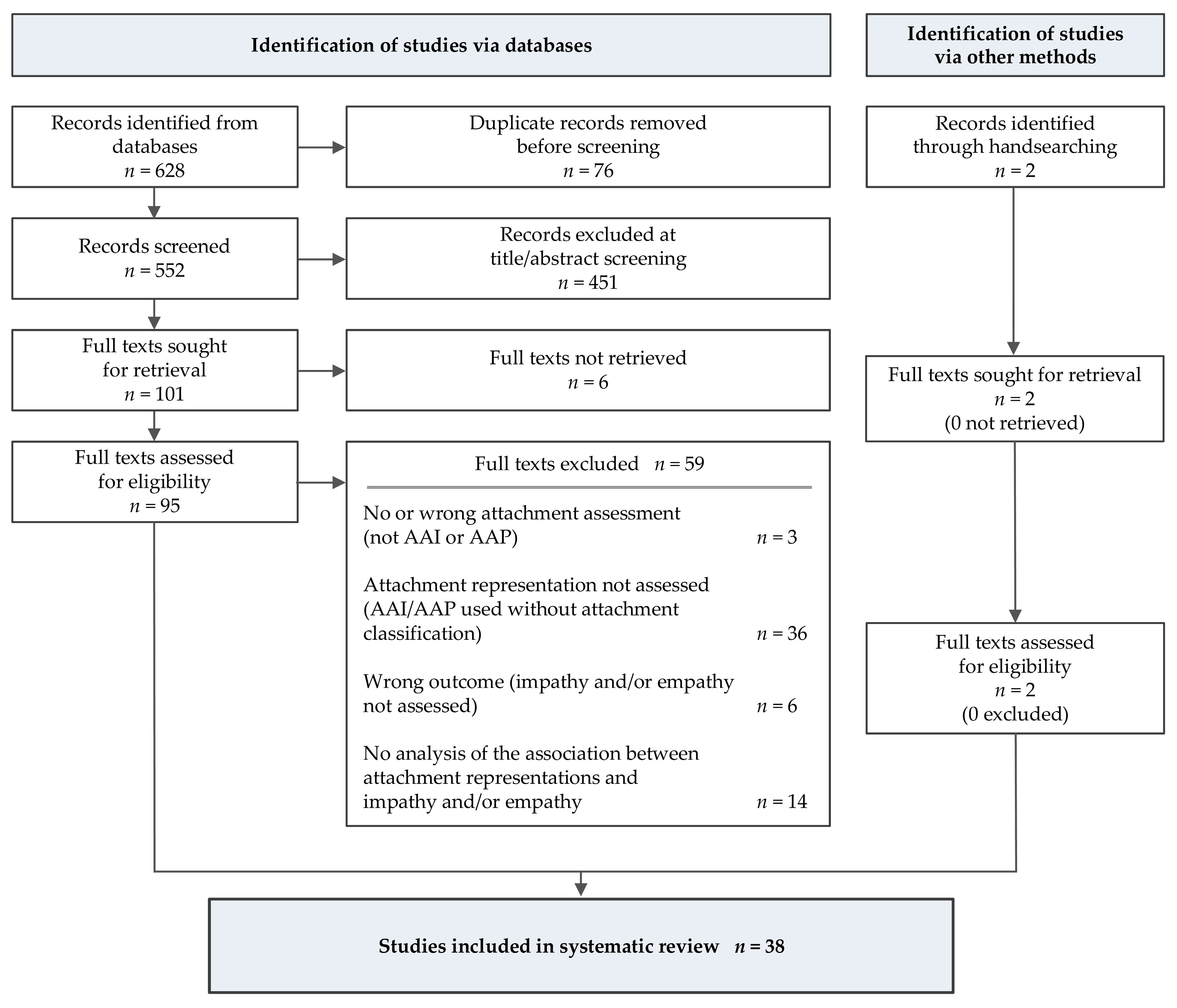
- Across 38 studies, attachment representations were systematically associated with intrapersonal and interpersonal emotion perception, with the strongest evidence for reflective functioning, the Impathy dimensions Perceiving and Understanding, and cognitive-empathic processes.
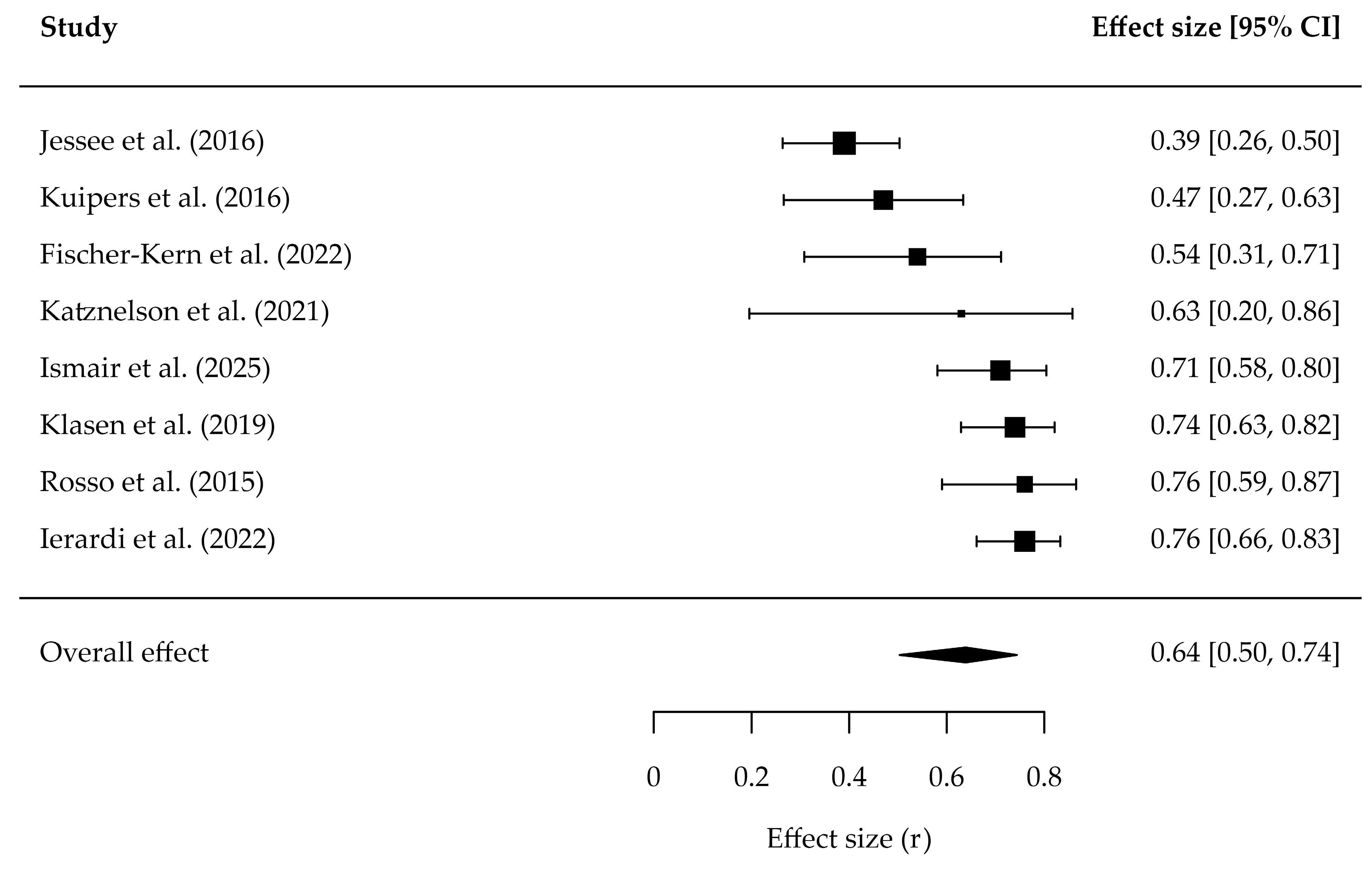
- A meta-analysis of eight studies showed a large positive association between secure attachment representations and reflective functioning (r = 0.64, 95% CI [0.50, 0.74]).
- The findings support the assumption that attachment-related differences in emotion perception may represent an important mechanism underlying intergenerational attachment transmission.
- Intrapersonal and interpersonal emotion perception may represent important attachment-sensitive targets for psychotherapy, prevention, and emotion-focused interventions.
Abstract
1. Introduction
1.1. Emotion Processing as a Transdiagnostic Core Mechanism
1.2. Attachment as a Foundation of Emotion Processing
1.3. Toward a Multidimensional Conceptualization of Emotion Processing
- (1)
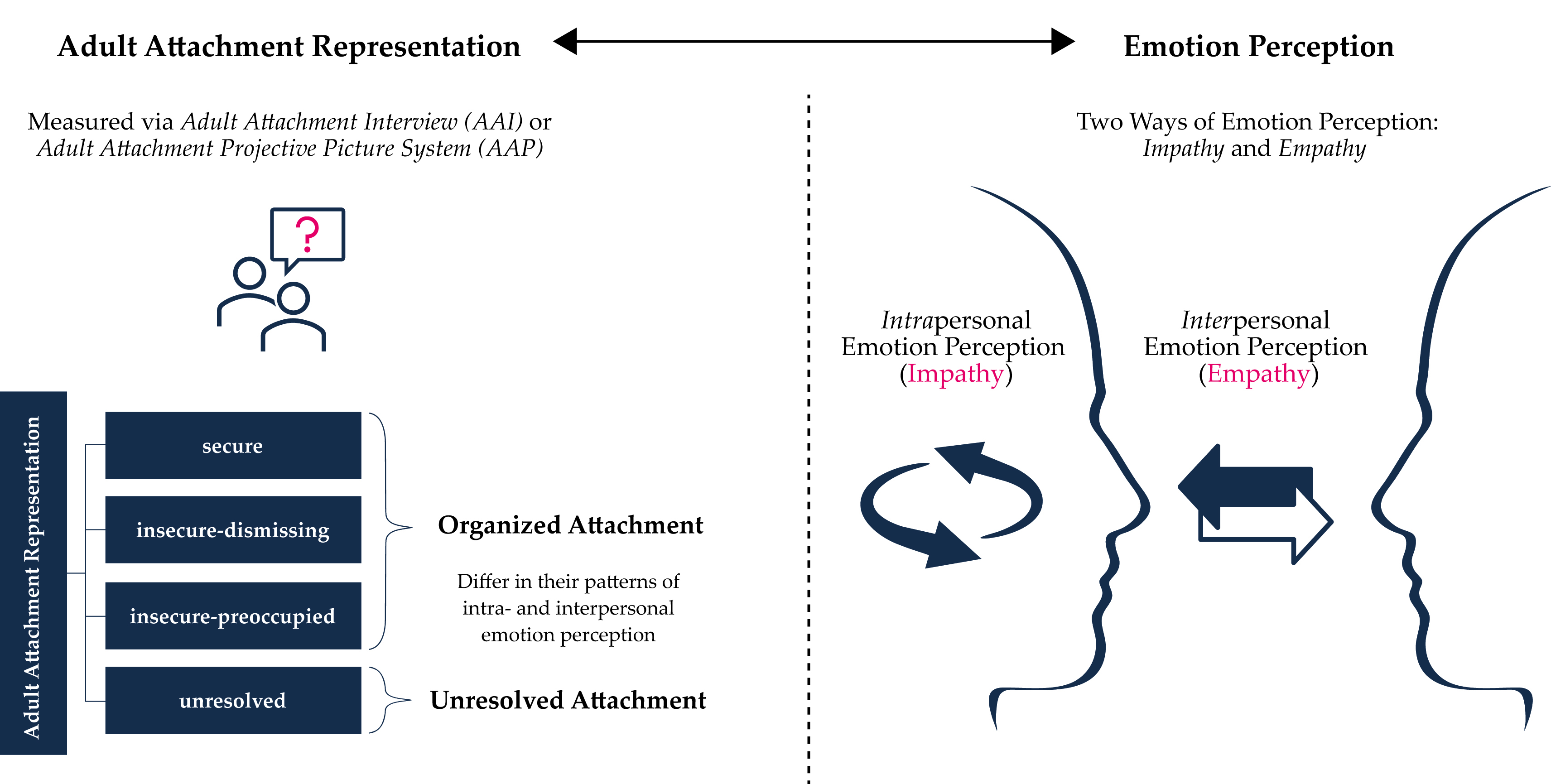
- Intrapersonal emotion perception (impathy), referring to the perception and understanding of one’s own emotional states and representing the self-related counterpart to empathy;
- (2)
- Interpersonal emotion perception (empathy), referring to the perception and understanding of others’ emotional states;
- (3)
- Emotion regulation, encompassing processes that modulate emotional responses;
- (4)
- Emotion expression, referring to the verbal and nonverbal communication of emotions across channels.
1.4. Intrapersonal Emotion Perception: Impathy
1.5. Interpersonal Emotion Perception: Empathy
1.6. Attachment Representations and Emotion Perception
1.7. Aim of the Present Review and Hypotheses
2. Materials and Methods
2.1. Search Strategy
- (1)
- Population (adults and adolescents);
- (2)
- Narrative-based attachment representations assessed via the Adult Attachment Interview (AAI) or Adult Attachment Projective Picture System (AAP);
- (3)
- Intra- and interpersonal emotion perception.
2.2. Eligibility Criteria
2.3. Quality Assessment of Included Studies
- (a)
- Representativeness of the attachment representation groups;
- (b)
- Selection of comparison groups;
- (c)
- Assessment of attachment representations using validated narrative attachment interviews (AAI or AAP);
- (d)
- Comparability of attachment groups;
- (e)
- Assessment of impathy and/or empathy outcomes.
2.4. Data Synthesis
- (1)
- Integrated self–other emotion perception;
- (2)
- Intrapersonal emotion perception;
- (3)
- Interpersonal emotion perception.
2.5. Meta-Analysis
2.6. Use of Generative Artificial Intelligence
3. Results
3.1. Study Selection
3.2. Study Characteristics
3.3. Quality Assessment
3.4. Conceptual Mapping of Emotion Perception Measures
3.5. Integrated Self–Other Emotion Perception (Reflective Functioning)
3.5.1. Narrative Synthesis
3.5.2. Meta-Analysis
3.6. Intrapersonal Emotion Perception (Impathy)
3.7. Interpersonal Emotion Perception (Empathy)
4. Discussion
4.1. Interpretation of Results
4.1.1. Integrated Self–Other Emotion Perception
4.1.2. Intrapersonal Emotion Perception (Impathy)
4.1.3. Interpersonal Emotion Perception (Empathy)
4.2. Theoretical Implications for Research of Emotion Processing and Attachment
4.2.1. Toward an Integrative Conceptualization of Empathy
- (1)
- Perceiving emotions in others;
- (2)
- Understanding others’ emotional and mental states;
- (3)
- Affective resonance with others’ emotions;
- (4)
- Maintaining a reflective meta-position characterized by self–other differentiation.
4.2.2. Emotion Perception and Intergenerational Attachment Transmission
4.3. Practical Implications for Psychotherapy, Prevention, and Emotion Coaching
4.3.1. Intervention Targets in Emotion Perception
4.3.2. Implications for Prevention
4.3.3. Implications for Assessment and Process Monitoring
4.4. Risk of Bias of Included Studies
4.5. Future Research Directions
5. Conclusions
Supplementary Materials
Author Contributions
Funding
Institutional Review Board Statement
Informed Consent Statement
Data Availability Statement
Acknowledgments
Conflicts of Interest
References
- George, J.M.; Dane, E. Affect, emotion, and decision making. Organ. Behav. Hum. Decis. Process. 2016, 136, 47–55. [Google Scholar] [CrossRef]
- Dolcos, F.; Denkova, E.; Iordan, A.D.; Shafer, A.T.; Fernandez, G.; Dolcos, S. Dissociating and linking divergent effects of emotion on cognition: Insights from current research and emerging directions. Front. Psychol. 2025, 16, 1483373. [Google Scholar] [CrossRef] [PubMed]
- Salazar Kämpf, M.; Adam, L.; Rohr, M.K.; Exner, C.; Wieck, C. A Meta-Analysis of the Relationship Between Emotion Regulation and Social Affect and Cognition. Clin. Psychol. Sci. 2023, 11, 1159–1189. [Google Scholar] [CrossRef]
- Pessoa, L. On the relationship between emotion and cognition. Nat. Rev. Neurosci. 2008, 9, 148–158. [Google Scholar] [CrossRef] [PubMed]
- Kret, M.E.; Ploeger, A. Emotion processing deficits: A liability spectrum providing insight into comorbidity of mental disorders. Neurosci. Biobehav. Rev. 2015, 52, 153–171. [Google Scholar] [CrossRef] [PubMed]
- Beauchaine, T.P.; Cicchetti, D. Emotion dysregulation and emerging psychopathology: A transdiagnostic, transdisciplinary perspective. Dev. Psychopathol. 2019, 31, 799–804. [Google Scholar] [CrossRef] [PubMed]
- McTeague, L.M.; Rosenberg, B.M.; Lopez, J.W.; Carreon, D.M.; Huemer, J.; Jiang, Y.; Chick, C.F.; Eickhoff, S.B.; Etkin, A. Identification of Common Neural Circuit Disruptions in Emotional Processing Across Psychiatric Disorders. Am. J. Psychiatry 2020, 177, 411–421. [Google Scholar] [CrossRef] [PubMed]
- Peng, W.; Liu, S.; Yi, J. Transdiagnostic and Disorder-Specific Neural Correlates of Emotion Processing in Major Depressive Disorder and Borderline Personality Disorder: Coordinate-Based and Image-Based Comparative Meta-Analyses. Biol. Psychiatry Cogn. Neurosci. Neuroimaging 2025, 10, 883–894. [Google Scholar] [CrossRef] [PubMed]
- Caspi, A.; Houts, R.M.; Belsky, D.W.; Goldman-Mellor, S.J.; Harrington, H.; Israel, S.; Meier, M.H.; Ramrakha, S.; Shalev, I.; Poulton, R.; et al. The p Factor: One General Psychopathology Factor in the Structure of Psychiatric Disorders? Clin. Psychol. Sci. 2014, 2, 119–137. [Google Scholar] [CrossRef] [PubMed]
- Kramer, U.; Timulak, L. The emotional underpinnings of personality pathology: Implications for psychotherapy. Clin. Psychol. Sci. Pract. 2022, 29, 275–286. [Google Scholar] [CrossRef]
- Schmahl, C.; Herpertz, S.C.; Bertsch, K.; Ende, G.; Flor, H.; Kirsch, P.; Lis, S.; Meyer-Lindenberg, A.; Rietschel, M.; Schneider, M.; et al. Mechanisms of disturbed emotion processing and social interaction in borderline personality disorder: State of knowledge and research agenda of the German Clinical Research Unit. Borderline Pers. Disord. Emot. Dysregulation 2014, 1, 12. [Google Scholar] [CrossRef] [PubMed]
- Brenning, K.; Soenens, B.; Vansteenkiste, M.; De Clercq, B.; Antrop, I. Emotion Regulation as a Transdiagnostic Risk Factor for (Non)Clinical Adolescents’ Internalizing and Externalizing Psychopathology: Investigating the Intervening Role of Psychological Need Experiences. Child Psychiatry Hum. Dev. 2022, 53, 124–136. [Google Scholar] [CrossRef] [PubMed]
- Romer, A.L.; Hariri, A.R.; Strauman, T.J. Regulatory focus and the p factor: Evidence for self-regulatory dysfunction as a transdiagnostic feature of general psychopathology. J. Psychiatr. Res. 2021, 137, 178–185. [Google Scholar] [CrossRef] [PubMed]
- Bowlby, J. Attachment and Loss: Vol. 1. Attachment; Basic Books: New York, NY, USA, 1969. [Google Scholar]
- Bowlby, J. Attachment and Loss: Vol. 2. Separation: Anxiety and Anger; Basic Books: New York, NY, USA, 1973. [Google Scholar]
- Bowlby, J. Attachment and Loss: Vol. 3. Sadness and Depression; Basic Books: New York, NY, USA, 1980. [Google Scholar]
- Bowlby, J. A Secure Base: Parent-Child Attachment and Healthy Human Development; Basic Books: New York, NY, USA, 1988. [Google Scholar]
- George, C.; Kaplan, N.; Main, M. The Adult Attachment Interview; University of California: Berkeley, CA, USA, 1985. [Google Scholar]
- Main, M.; Kaplan, N.; Cassidy, J. Security in Infancy, Childhood, and Adulthood: A Move to the Level of Representation. Monogr. Soc. Res. Child Dev. 1985, 50, 66–104. [Google Scholar] [CrossRef]
- George, C.; West, M. The Adult Attachment Projective Picture System: Attachment Theory and Assessment in Adults; Guilford Press: New York, NY, USA, 2012. [Google Scholar]
- Jacobvitz, D.; Curran, M.; Moller, N. Measurement of adult attachment: The place of self-report and interview methodologies. Attach. Hum. Dev. 2002, 4, 207–215. [Google Scholar] [CrossRef] [PubMed]
- Riem, M.M.E.; van Hoof, M.J.; Garrett, A.S.; Rombouts, S.; van der Wee, N.J.A.; van Ijzendoorn, M.H.; Vermeiren, R. General psychopathology factor and unresolved-disorganized attachment uniquely correlated to white matter integrity using diffusion tensor imaging. Behav. Brain Res. 2019, 359, 1–8. [Google Scholar] [CrossRef] [PubMed]
- Gander, M.; Lenhart, L.; Steiger, R.; Buchheim, A.; Mangesius, S.; Birkl, C.; Haid-Stecher, N.; Fuchs, M.; Libal, A.; Dabkowska-Mika, A.; et al. Attachment Trauma Is Associated with White Matter Fiber Microstructural Alterations in Adolescents with Anorexia Nervosa before and after Exposure to Psychotherapeutic and Nutritional Treatment. Brain Sci. 2023, 13, 798. [Google Scholar] [CrossRef] [PubMed]
- Gross, J.J. Emotion Regulation. In Handbook of Emotions, 3rd ed.; Lewis, M., Haviland-Jones, J.M., Feldman Barrett, L., Eds.; The Guilford Press: New York, NY, USA, 2008; pp. 497–513. [Google Scholar]
- Gross, J.J. The Extended Process Model of Emotion Regulation: Elaborations, Applications, and Future Directions. Psychol. Inq. 2015, 26, 130–137. [Google Scholar] [CrossRef]
- Petrova, K.; Gross, J.J. The Future of Emotion Regulation Research: Broadening Our Field of View. Affect. Sci. 2023, 4, 609–616. [Google Scholar] [CrossRef] [PubMed]
- Ekman, P.; Friesen, W.V.; Ancoli, S. Facial Signs of Emotional Experience. J. Pers. Soc. Psychol. 1980, 39, 1125–1134. [Google Scholar] [CrossRef]
- Ekman, P.; Friesen, W.V. A new pan-cultural facial expression of emotion. Motiv. Emot. 1986, 10, 159–168. [Google Scholar] [CrossRef]
- Frank, M.G.; Ekman, P. Not all smiles are created equal: The differences between enjoyment and nonenjoyment smiles. HUMOR 1993, 6, 9–26. [Google Scholar] [CrossRef]
- Cowen, A.S.; Keltner, D. What the face displays: Mapping 28 emotions conveyed by naturalistic expression. Am. Psychol. 2020, 75, 349–364. [Google Scholar] [CrossRef] [PubMed]
- Keltner, D.; Sauter, D.; Tracy, J.; Cowen, A. Emotional Expression: Advances in Basic Emotion Theory. J. Nonverbal Behav. 2019, 43, 133–160. [Google Scholar] [CrossRef] [PubMed]
- Decety, J.; Jackson, P.L. The functional architecture of human empathy. Behav. Cogn. Neurosci. Rev. 2004, 3, 71–100. [Google Scholar] [CrossRef] [PubMed]
- Kanske, P.; Böckler, A.; Trautwein, F.-M.; Parianen Lesemann, F.H.; Singer, T. Are strong empathizers better mentalizers? Evidence for independence and interaction between the routes of social cognition. Soc. Cogn. Affect. Neurosci. 2016, 11, 1383–1392. [Google Scholar] [CrossRef] [PubMed]
- Fatima, M.; Babu, N. Cognitive and Affective Empathy in Autism Spectrum Disorders: A Meta-analysis. Rev. J. Autism Dev. Disord. 2023, 11, 756–775. [Google Scholar] [CrossRef]
- Preece, D.A.; Mehta, A.; Petrova, K.; Sikka, P.; Pemberton, E.; Gross, J.J. Alexithymia profiles and depression, anxiety, and stress. J. Affect. Disord. 2024, 357, 116–125. [Google Scholar] [CrossRef] [PubMed]
- Maroti, D.; Lilliengren, P.; Bileviciute-Ljungar, I. The Relationship Between Alexithymia and Emotional Awareness: A Meta-Analytic Review of the Correlation Between TAS-20 and LEAS. Front. Psychol. 2018, 9, 453. [Google Scholar] [CrossRef] [PubMed]
- Kick, L.; Schleicher, D.; Ecker, A.; Kandsperger, S.; Brunner, R.; Jarvers, I. Alexithymia as a mediator between adverse childhood events and the development of psychopathology: A meta-analysis. Front. Psychiatry 2024, 15, 1412229. [Google Scholar] [CrossRef] [PubMed]
- Smidt, K.E.; Suvak, M.K. A brief, but nuanced, review of emotional granularity and emotion differentiation research. Curr. Opin. Psychol. 2015, 3, 48–51. [Google Scholar] [CrossRef]
- Eilert, D.W. Differenzielle Muster der Emotionsverarbeitung: Die Rolle von Bindungsrepräsentationen und Psychopathologie. Doctoral Thesis, Leopold-Franzens-Universität Innsbruck, Innsbruck, Austria, 2025. [Google Scholar]
- Eilert, D.W.; Buchheim, A. Attachment-Related Differences in Emotion Regulation in Adults: A Systematic Review on Attachment Representations. Brain Sci. 2023, 13, 884. [Google Scholar] [CrossRef] [PubMed]
- Neubrand, S. The Missing Construct: Impathy—Conceptualization, Operationalization, and Clinical Considerations. Doctoral Thesis, University of Basel, Basel, Switzerland, 2021. [Google Scholar]
- Neubrand, S.; Gaab, J. The missing construct: Impathy. Front. Psychol. 2022, 13, 726029. [Google Scholar] [CrossRef] [PubMed]
- Shamay-Tsoory, S.G. The Neural Bases for Empathy. Neuroscientist 2011, 17, 18–24. [Google Scholar] [CrossRef] [PubMed]
- Reniers, R.L.; Corcoran, R.; Drake, R.; Shryane, N.M.; Vollm, B.A. The QCAE: A Questionnaire of Cognitive and Affective Empathy. J. Pers. Assess. 2011, 93, 84–95. [Google Scholar] [CrossRef] [PubMed]
- Vachon, D.D.; Lynam, D.R. Fixing the Problem with Empathy: Development and Validation of the Affective and Cognitive Measure of Empathy. Assessment 2016, 23, 135–149. [Google Scholar] [CrossRef] [PubMed]
- Nummenmaa, L.; Hirvonen, J.; Parkkola, R.; Hietanen, J.K. Is emotional contagion special? An fMRI study on neural systems for affective and cognitive empathy. Neuroimage 2008, 43, 571–580. [Google Scholar] [CrossRef] [PubMed]
- Singer, T.; Lamm, C. The Social Neuroscience of Empathy. Ann. N. Y. Acad. Sci. 2009, 1156, 81–96. [Google Scholar] [CrossRef] [PubMed]
- Lamm, C.; Decety, J.; Singer, T. Meta-analytic evidence for common and distinct neural networks associated with directly experienced pain and empathy for pain. Neuroimage 2011, 54, 2492–2502. [Google Scholar] [CrossRef] [PubMed]
- Schurz, M.; Radua, J.; Aichhorn, M.; Richlan, F.; Perner, J. Fractionating theory of mind: A meta-analysis of functional brain imaging studies. Neurosci. Biobehav. Rev. 2014, 42, 9–34. [Google Scholar] [CrossRef] [PubMed]
- Khanjani, Z.; Mosanezhad jeddi, E.; Hekmati, I.; Khalilzade, S.; Etemadi nia, M.; Andalib, M.; Ashrafian, P. Comparison of Cognitive Empathy, Emotional Empathy, and Social Functioning in Different Age Groups. Aust. Psychol. 2020, 50, 80–85. [Google Scholar] [CrossRef]
- Salgado, R.M.; Pedrosa, R.; Bastos-Leite, A.J. Dysfunction of Empathy and Related Processes in Borderline Personality Disorder: A Systematic Review. Harv. Rev. Psychiatry 2020, 28, 238–254. [Google Scholar] [CrossRef] [PubMed]
- Ang, R.P.; Goh, D.H. Cyberbullying among adolescents: The role of affective and cognitive empathy, and gender. Child. Psychiatry Hum. Dev. 2010, 41, 387–397. [Google Scholar] [CrossRef] [PubMed]
- Fonagy, P.; Campbell, C.; Luyten, P. Attachment, Mentalizing and Trauma: Then (1992) and Now (2022). Brain Sci. 2023, 13, 459. [Google Scholar] [CrossRef] [PubMed]
- Taylor, G.J.; Bagby, R.M.; Kushner, S.C.; Benoit, D.; Atkinson, L. Alexithymia and adult attachment representations: Associations with the five-factor model of personality and perceived relationship adjustment. Compr. Psychiatry 2014, 55, 1258–1268. [Google Scholar] [CrossRef] [PubMed]
- Zhang, J.; Zhang, Y.; Mao, Y.; Wang, Y. The relationship between insecure attachment and alexithymia: A meta-analysis. Curr. Psychol. 2023, 43, 5804–5825. [Google Scholar] [CrossRef]
- Ferraro, I.K.; Taylor, A.M. Adult attachment styles and emotional regulation: The role of interoceptive awareness and alexithymia. Pers. Individ. Differ. 2021, 173, 110641. [Google Scholar] [CrossRef]
- Huang, M.; Wu, E.Z. The associations between self-compassion and adult attachment: A meta-analysis. J. Soc. Pers. Relatsh. 2024, 42, 681–713. [Google Scholar] [CrossRef]
- Yang, S.; Ren, Y.; Song, X.; Ge, J.; Peng, Y. Insecure Attachment and Depressive Symptoms among a Large Sample of Chinese Young Adults: The Mediating Role of Positive and Negative Self-Compassion. Behav. Sci. 2024, 14, 238. [Google Scholar] [CrossRef] [PubMed]
- Carbonneau, N.; Cantin, M.; Barbeau, K.; Lavigne, G.; Lussier, Y. Self-Compassion as a Mediator of the Relationship between Adult Women’s Attachment and Intuitive Eating. Nutrients 2021, 13, 3124. [Google Scholar] [CrossRef] [PubMed]
- Steele, H.; Steele, M.; Croft, C. Early attachment predicts emotion recognition at 6 and 11 years old. Attach. Hum. Dev. 2008, 10, 379–393. [Google Scholar] [CrossRef] [PubMed]
- Forslund, T.; Kenward, B.; Granqvist, P.; Gredeback, G.; Brocki, K.C. Diminished ability to identify facial emotional expressions in children with disorganized attachment representations. Dev. Sci. 2017, 20, e12465. [Google Scholar] [CrossRef]
- Gallistl, M.; Kungl, M.; Gabler, S.; Kanske, P.; Vrticka, P.; Engert, V. Attachment and inter-individual differences in empathy, compassion, and theory of mind abilities. Attach. Hum. Dev. 2024, 26, 350–365. [Google Scholar] [CrossRef] [PubMed]
- Messina, I.; Calvo, V.; Grecucci, A. Attachment orientations and emotion regulation: New insights from the study of interpersonal emotion regulation strategies. Res. Psychother. 2023, 26, e703. [Google Scholar] [CrossRef] [PubMed]
- Fonagy, P.; Steele, M.; Steele, H.; Moran, G.S.; Higgitt, A.C. The capacity for understanding mental states: The reflective self in parent and child and its significance for security of attachment. Infant. Ment. Health J. 1991, 12, 201–218. [Google Scholar] [CrossRef]
- Katznelson, H. Reflective functioning: A review. Clin. Psychol. Rev. 2014, 34, 107–117. [Google Scholar] [CrossRef] [PubMed]
- Page, M.J.; McKenzie, J.E.; Bossuyt, P.M.; Boutron, I.; Hoffmann, T.C.; Mulrow, C.D.; Shamseer, L.; Tetzlaff, J.M.; Akl, E.A.; Brennan, S.E.; et al. The PRISMA 2020 statement: An updated guideline for reporting systematic reviews. Syst. Rev. 2021, 10, 89. [Google Scholar] [CrossRef] [PubMed]
- Roisman, G.I.; Holland, A.; Fortuna, K.; Fraley, R.C.; Clausell, E.; Clarke, A. The Adult Attachment Interview and Self-Reports of Attachment Style: An Empirical Rapprochement. J. Pers. Soc. Psychol. 2007, 92, 678–697. [Google Scholar] [CrossRef] [PubMed]
- Wells, G.A.; Shea, B.; O’Connell, D.; Peterson, J.; Welch, V.; Losos, M.; Tugwell, P. The Newcastle-Ottawa Scale (NOS) for Assessing the Quality of Nonrandomised Studies in Meta-Analyses. Available online: http://www.ohri.ca/programs/clinical_epidemiology/oxford.asp (accessed on 6 April 2026).
- Barbasio, C.; Granieri, A. Emotion regulation and mental representation of attachment in patients with systemic lupus erythematosus: A study using the Adult Attachment Interview. J. Nerv. Ment. Dis. 2013, 201, 304–310. [Google Scholar] [CrossRef] [PubMed]
- Barone, L.; Pessa, E.; Bonfanti, D. Attaccamento, disturbi di personalità e abilità di mentalizzazione: Una ricerca empirica. Psicol. Clin. Dello Svilupp. 2007, 11, 307–324. [Google Scholar] [CrossRef]
- Bouchard, M.-A.; Target, M.; Lecours, S.; Fonagy, P.; Tremblay, L.-M.; Schachter, A.; Stein, H. Mentalization in adult attachment narratives: Reflective functioning, mental states, and affect elaboration compared. Psychoanal. Psychol. 2008, 25, 47–66. [Google Scholar] [CrossRef]
- Chevalier, V.; Simard, V.; Achim, J.; Burmester, P.; Beaulieu-Tremblay, T. Reflective Functioning in Children and Adolescents with and Without an Anxiety Disorder. Front. Psychol. 2021, 12, 698654. [Google Scholar] [CrossRef] [PubMed]
- Condino, V.; Giovanardi, G.; Vagni, M.; Lingiardi, V.; Pajardi, D.; Colli, A. Attachment, Trauma, and Mentalization in Intimate Partner Violence: A Preliminary Investigation. J. Interpers. Violence 2022, 37, NP9249–NP9276. [Google Scholar] [CrossRef] [PubMed]
- Dinzinger, A.; Ismair, S.; Brisch, K.H.; Sperl, W.; Deneault, A.A.; Nolte, T.; Hitzl, W.; Priewasser, B. Mentalizing in first-time fathers: Reflective functioning as a mediator between attachment representation and sensitivity. Attach. Hum. Dev. 2023, 25, 544–565. [Google Scholar] [CrossRef] [PubMed]
- Eilert, D.W.; de Punder, K.; Maerz, J.; Dose, J.; Gander, M.; Mensah, P.; Neubrand, S.; Hinterhölzl, J.; Buchheim, A. Impathy and Emotion Recognition: How Attachment Shapes Self- and Other-Focused Emotion Processing. Brain Sci. 2025, 15, 516. [Google Scholar] [CrossRef] [PubMed]
- Ensink, K.; Begin, M.; Martin-Gagnon, G.; Biberdzic, M.; Berthelot, N.; Normandin, L.; Fonagy, P.; Bernazzani, O.; Borelli, J.L. Post-traumatic-stress in the context of childhood maltreatment: Pathways from attachment through mentalizing during the transition to parenthood. Front. Psychol. 2023, 14, 919736. [Google Scholar] [CrossRef] [PubMed]
- Ensink, K.; Berthelot, N.; Bernazzani, O.; Normandin, L.; Fonagy, P. Another step closer to measuring the ghosts in the nursery: Preliminary validation of the Trauma Reflective Functioning Scale. Front. Psychol. 2014, 5, 1471. [Google Scholar] [CrossRef] [PubMed]
- Fischer-Kern, M.; Tmej, A.; Naderer, A.; Zimmermann, J.; Nolte, T. Failure to resolve loss and compromised mentalizing in female inpatients with major depressive disorder. Attach. Hum. Dev. 2022, 24, 503–524. [Google Scholar] [CrossRef] [PubMed]
- Fizke, E.; Buchheim, A.; Juen, F. Activation of the attachment system and mentalization in depressive and healthy individuals: An experimental control study. Psihologija 2013, 46, 161–176. [Google Scholar] [CrossRef]
- Fuchshuber, J.; Doering, S.; Schmitz-Riol, S.; Herpertz, J.; Buchheim, A.; Horz-Sagstetter, S.; Rentrop, M.; Fischer-Kern, M.; Buchheim, P.; Taylor, J.; et al. Emotion word repertoire in the adult attachment interview is linked to reduced suicide attempts in patients with borderline personality disorder. Heliyon 2024, 10, e36907. [Google Scholar] [CrossRef] [PubMed]
- Gander, M.; Buchheim, A.; Bock, A.; Steppan, M.; Sevecke, K.; Goth, K. Unresolved Attachment Mediates the Relationship Between Childhood Trauma and Impaired Personality Functioning in Adolescence. J. Pers. Disord. 2020, 34, 84–103. [Google Scholar] [CrossRef] [PubMed]
- Ierardi, E.; Albizzati, A.; Moioli, M.; Riva Crugnola, C. Psychopathological and Psychosocial Risk Profile, Styles of Interaction and Mentalization of Adolescent and Young Mother-Infant Dyads. Int. J. Environ. Res. Public. Health 2022, 19, 4737. [Google Scholar] [CrossRef] [PubMed]
- Ismair, S.; Dinzinger, A.; Markova, G.; Schropp, J.; Brisch, K.H.; Sperl, W.; Priewasser, B. One and one makes three-mothers’ and fathers’ attachment, mentalizing and parenting sensitivity. Front. Psychol. 2025, 16, 1582698. [Google Scholar] [CrossRef] [PubMed]
- Jessee, A.; Mangelsdorf, S.C.; Wong, M.S.; Schoppe-Sullivan, S.J.; Brown, G.L. Structure of reflective functioning and adult attachment scales: Overlap and distinctions. Attach. Hum. Dev. 2016, 18, 176–187. [Google Scholar] [CrossRef] [PubMed]
- Katznelson, H.; Daniel, S.I.F.; Poulsen, S.; Lunn, S.; Buhl-Nielsen, B.; Sjogren, J.M. Disturbances in the experiences of embodiment related to attachment, mentalization and self-objectification in anorexia nervosa. J. Eat. Disord. 2021, 9, 137. [Google Scholar] [CrossRef] [PubMed]
- Klasen, J.; Nolte, T.; Moller, H.; Taubner, S. Aversive Kindheitserfahrungen, Bindungsrepräsentationen und Mentalisierungsfähigkeit von Psychotherapeuten in Ausbildung. Z. Psychosom. Med. Psychother. 2019, 65, 353–371. [Google Scholar] [CrossRef] [PubMed]
- Krahé, C.; von Mohr, M.; Gentsch, A.; Guy, L.; Vari, C.; Nolte, T.; Fotopoulou, A. Sensitivity to CT-optimal, Affective Touch Depends on Adult Attachment Style. Sci. Rep. 2018, 8, 14544. [Google Scholar] [CrossRef] [PubMed]
- Kuipers, G.S.; van Loenhout, Z.; van der Ark, L.A.; Bekker, M.H. Attachment insecurity, mentalization and their relation to symptoms in eating disorder patients. Attach. Hum. Dev. 2016, 18, 250–272. [Google Scholar] [CrossRef] [PubMed]
- Kungl, M.T.; Gabler, S.; White, L.O.; Spangler, G.; Vrticka, P. Precursors and Effects of Self-reported Parental Reflective Functioning: Links to Parental Attachment Representations and Behavioral Sensitivity. Child. Psychiatry Hum. Dev. 2025, 56, 1598–1613. [Google Scholar] [CrossRef] [PubMed]
- Lenzi, D.; Trentini, C.; Pantano, P.; Macaluso, E.; Lenzi, G.L.; Ammaniti, M. Attachment models affect brain responses in areas related to emotions and empathy in nulliparous women. Hum. Brain Mapp. 2013, 34, 1399–1414. [Google Scholar] [CrossRef] [PubMed]
- MacBeth, A.; Gumley, A.; Schwannauer, M.; Fisher, R. Attachment states of mind, mentalization, and their correlates in a first-episode psychosis sample. Psychol. Psychother. 2011, 84, 42–57; discussion 98–110. [Google Scholar] [CrossRef] [PubMed]
- Nazzaro, M.P.; Boldrini, T.; Tanzilli, A.; Muzi, L.; Giovanardi, G.; Lingiardi, V. Does reflective functioning mediate the relationship between attachment and personality? Psychiatry Res. 2017, 256, 169–175. [Google Scholar] [CrossRef] [PubMed]
- Pace, C.S.; Cavanna, D.; Guiducci, V.; Bizzi, F. When parenting fails: Alexithymia and attachment states of mind in mothers of female patients with eating disorders. Front. Psychol. 2015, 6, 1145. [Google Scholar] [CrossRef] [PubMed][Green Version]
- Pace, C.S.; Guiducci, V.; Cavanna, D. A controlled study of attachment representations and emotion regulation in female adolescents with anorexia nervosa. Mediterr. J. Clin. Psychol. 2016, 4, 1187. [Google Scholar]
- Rosso, A.M. Ability Emotional Intelligence, Attachment Models, and Reflective Functioning. Front. Psychol. 2022, 13, 864446. [Google Scholar] [CrossRef] [PubMed]
- Rosso, A.M.; Viterbori, P.; Scopesi, A.M. Are maternal reflective functioning and attachment security associated with preadolescent mentalization? Front. Psychol. 2015, 6, 1134. [Google Scholar] [CrossRef] [PubMed]
- Sabbagh, R. Adult attachment and Wives’ Empathic Accuracy During Conflict Resolution. Doctoral Thesis, University of Toronto, Toronto, ON, Canada, 2006. [Google Scholar]
- Scheidt, C.E.; Waller, E.; Schnock, C.; Becker-Stoll, F.; Zimmermann, P.; Lücking, C.H.; Wirsching, M. Alexithymia and Attachment Representation in Idiopathic Spasmodic Torticollis. J. Nerv. Ment. Dis. 1999, 187, 47–52. [Google Scholar] [CrossRef] [PubMed]
- Subic-Wrana, C.; Beetz, A.; Wiltink, J.; Beutel, M.E. Aktuelles Bindungstrauma und retrospektiv erinnerte Kindheitstraumatisierung bei Patienten in psychosomatischer Akutbehandlung. Z. Psychosom. Med. Psychother. 2011, 57, 325–342. [Google Scholar] [CrossRef] [PubMed]
- Tanzilli, A.; Di Giuseppe, M.; Giovanardi, G.; Boldrini, T.; Caviglia, G.; Conversano, C.; Lingiardi, V. Mentalization, attachment, and defense mechanisms: A Psychodynamic Diagnostic Manual-2-oriented empirical investigation. Res. Psychother. 2021, 24, 531. [Google Scholar] [CrossRef] [PubMed]
- Taubner, S.; Fritsch, S.; Lück, M.; Vesterling, C.; Böhmann, J.; Stumpe, A. Mentalisierung und Bindungstransmission. Prax. Kinderpsychol. Kinderpsychiatr. 2014, 63, 699–722. [Google Scholar] [CrossRef] [PubMed]
- Taubner, S.; Zimmermann, L.; Ramberg, A.; Schroder, P. Mentalization Mediates the Relationship between Early Maltreatment and Potential for Violence in Adolescence. Psychopathology 2016, 49, 236–246. [Google Scholar] [CrossRef] [PubMed]
- Tmej, A.; Fischer-Kern, M.; Doering, S.; Alexopoulos, J.; Buchheim, A. Changes in Attachment Representation in Psychotherapy: Is Reflective Functioning the Crucial Factor? Z. Psychosom. Med. Psychother. 2018, 64, 222–236. [Google Scholar] [CrossRef] [PubMed]
- Zimmermann, P. Structure and functions of internal working models of attachment and their role for emotion regulation. Attach. Hum. Dev. 1999, 1, 291–306. [Google Scholar] [CrossRef] [PubMed]
- Lane, R.D.; Quinlan, D.M.; Schwartz, G.E.; Walker, P.A.; Zeitlin, S.B. The Levels of Emotional Awareness Scale: A Cognitive-Developmental Measure of Emotion. J. Pers. Assess. 1990, 55, 124–134. [Google Scholar] [CrossRef]
- Fonagy, P.; Target, M.; Steele, H.; Steele, M. Reflective Functioning Manual Version 5 for Application to Adult Attachment Interviews; University College London: London, UK, 1998. [Google Scholar]
- Bekker, M.H.; van Assen, M.A. A short form of the Autonomy Scale: Properties of the Autonomy-Connectedness Scale (ACS-30). J. Pers. Assess. 2006, 86, 51–60. [Google Scholar] [CrossRef]
- Gratz, K.L.; Roemer, L. Multidimensional Assessment of Emotion Regulation and Dysregulation: Development, Factor Structure, and Initial Validation of the Difficulties in Emotion Regulation Scale. J. Psychopathol. Behav. Assess. 2004, 26, 41–54. [Google Scholar] [CrossRef]
- Herpertz, J.; Taylor, J.; Allen, J.J.B.; Herpertz, S.; Opel, N.; Richter, M.; Subic-Wrana, C.; Dieris-Hirche, J.; Lane, R.D. Development and validation of a computer program for measuring emotional awareness in German-The geLEAS (German electronic Levels of Emotional Awareness Scale). Front. Psychiatry 2023, 14, 1129755. [Google Scholar] [CrossRef] [PubMed]
- Lecours, S.; Bouchard, M.A.; St-Amand, P.; Perry, J.C. Assessing verbal elaboration of affect in psychotherapy: A preliminary report and single case study. Psychother. Res. 2010, 10, 47–56. [Google Scholar] [CrossRef]
- Schandry, R. Heart beat perception and emotional experience. Psychophysiology 1981, 18, 483–488. [Google Scholar] [CrossRef] [PubMed]
- Haviland, M.G.; Louise Warren, W.; Riggs, M.L. An Observer Scale to Measure Alexithymia. Psychosomatics 2000, 41, 385–392. [Google Scholar] [CrossRef] [PubMed]
- Bagby, R.M.; Parker, J.D.A.; Taylor, G.J. The twenty-item Toronto Alexithymia scale—I. Item selection and cross-validation of the factor structure. J. Psychosom. Res. 1994, 38, 23–32. [Google Scholar] [CrossRef] [PubMed]
- Kanske, P.; Bockler, A.; Trautwein, F.M.; Singer, T. Dissecting the social brain: Introducing the EmpaToM to reveal distinct neural networks and brain-behavior relations for empathy and Theory of Mind. Neuroimage 2015, 122, 6–19. [Google Scholar] [CrossRef] [PubMed]
- Ickes, W. Empathic Accuracy. J. Pers. 1993, 61, 587–610. [Google Scholar] [CrossRef]
- Luyten, P.; Mayes, L.C.; Nijssens, L.; Fonagy, P. The parental reflective functioning questionnaire: Development and preliminary validation. PLoS ONE 2017, 12, e0176218. [Google Scholar] [CrossRef] [PubMed]
- Baron-Cohen, S.; Wheelwright, S.; Hill, J.; Raste, Y.; Plumb, I. The “Reading the Mind in the Eyes” Test Revised Version: A Study with Normal Adults, and Adults with Asperger Syndrome or High-functioning Autism. J. Child. Psychol. Psychiatry 2003, 42, 241–251. [Google Scholar] [CrossRef]
- Happé, F.G.E. An advanced test of theory of mind: Understanding of story characters’ thoughts and feelings by able autistic, mentally handicapped, and normal children and adults. J. Autism Dev. Disord. 1994, 24, 129–154. [Google Scholar] [CrossRef] [PubMed]
- Goth, K.; Birkholzer, M.; Schmeck, K. Assessment of Personality Functioning in Adolescents with the LoPF-Q 12-18 Self-Report Questionnaire. J. Pers. Assess. 2018, 100, 680–690. [Google Scholar] [CrossRef] [PubMed]
- Mayer, J.D.; Salovey, P.; Caruso, D.R.; Sitarenios, G. Measuring emotional intelligence with the MSCEIT V2.0. Emotion 2003, 3, 97–105. [Google Scholar] [CrossRef] [PubMed]
- Kivity, Y.; Levy, K.N.; Johnson, B.N.; Rosenstein, L.K.; LeBreton, J.M. Mentalizing in and out of awareness: A meta-analytic review of implicit and explicit mentalizing. Clin. Psychol. Rev. 2024, 108, 102395. [Google Scholar] [CrossRef] [PubMed]
- Mikulincer, M.; Shaver, P.R.; Pereg, D. Attachment Theory and Affect Regulation: The Dynamics, Development, and Cognitive Consequences of Attachment-Related Strategies. Motiv. Emot. 2003, 27, 77–102. [Google Scholar] [CrossRef]
- Morris, A.M.; Freeberg-Powell, E.; Verma, S.; Di Giuseppe, M.; Crespo, H.; Hoffman, L.; Rice, T. Attachment Classification, Emotion Regulation, and Defense Mechanisms: An Integrative Narrative Review. Healthcare 2025, 13, 3105. [Google Scholar] [CrossRef] [PubMed]
- Cassidy, J. Emotion Regulation: Influences of Attachment Relationships. Monogr. Soc. Res. Child. Dev. 1994, 59, 228–249. [Google Scholar] [CrossRef]
- Hakansson Eklund, J.; Summer Meranius, M. Toward a consensus on the nature of empathy: A review of reviews. Patient Educ. Couns. 2021, 104, 300–307. [Google Scholar] [CrossRef] [PubMed]
- Schurz, M.; Radua, J.; Tholen, M.G.; Maliske, L.; Margulies, D.S.; Mars, R.B.; Sallet, J.; Kanske, P. Toward a hierarchical model of social cognition: A neuroimaging meta-analysis and integrative review of empathy and theory of mind. Psychol. Bull. 2021, 147, 293–327. [Google Scholar] [CrossRef] [PubMed]
- Xu, P.; Peng, S.; Luo, Y.J.; Gong, G. Facial expression recognition: A meta-analytic review of theoretical models and neuroimaging evidence. Neurosci. Biobehav. Rev. 2021, 127, 820–836. [Google Scholar] [CrossRef] [PubMed]
- Soutschek, A.; Mattes, R.S. Causal role of temporo-parietal junction for social behavior: A meta-analysis. Brain Stimul. 2025, 18, 2028–2039. [Google Scholar] [CrossRef] [PubMed]
- Singer, T.; Klimecki, O. Empathy and Compassion. Curr. Biol. 2014, 24, R875–R878. [Google Scholar] [CrossRef] [PubMed]
- Van Ijzendoorn, M.H. Adult attachment representations, parental responsiveness, and infant attachment: A meta-analysis on the predictive validity of the Adult Attachment Interview. Psychol. Bull. 1995, 117, 387–403. [Google Scholar] [CrossRef] [PubMed]
- Verhage, M.L.; Schuengel, C.; Madigan, S.; Fearon, R.M.P.; Oosterman, M.; Cassibba, R.; Bakermans-Kranenburg, M.J.; van, I.M.H. Narrowing the transmission gap: A synthesis of three decades of research on intergenerational transmission of attachment. Psychol. Bull. 2016, 142, 337–366. [Google Scholar] [CrossRef] [PubMed]
- Buchheim, A.; Ziegenhain, U.; Kindler, H.; Waller, C.; Gundel, H.; Karabatsiakis, A.; Fegert, J. Identifying Risk and Resilience Factors in the Intergenerational Cycle of Maltreatment: Results from the TRANS-GEN Study Investigating the Effects of Maternal Attachment and Social Support on Child Attachment and Cardiovascular Stress Physiology. Front. Hum. Neurosci. 2022, 16, 890262. [Google Scholar] [CrossRef] [PubMed]
- Ainsworth, M.D.S.; Blehar, M.C.; Waters, E.; Wall, S. Patterns of Attachment: A Psychological Study of the Strange Situation; Lawrence Erlbaum: Oxford, UK, 1978. [Google Scholar]
- De Wolff, M.S.; van Ijzendoorn, M.H. Sensitivity and Attachment: A Meta-Analysis on Parental Antecedents of Infant Attachment. Child. Dev. 1997, 68, 571–591. [Google Scholar] [CrossRef]
- Meins, E.; Fernyhough, C.; Fradley, E.; Tuckey, M. Rethinking Maternal Sensitivity: Mothers’ Comments on Infants’ Mental Processes Predict Security of Attachment at 12 Months. J. Child. Psychol. Psychiatry 2001, 42, 637–648. [Google Scholar] [CrossRef]
- Oppenheim, D.; Koren-Karie, N.; Sagi, A. Mothers’ empathic understanding of their preschoolers’ internal experience: Relations with early attachment. Int. J. Behav. Dev. 2001, 25, 16–26. [Google Scholar] [CrossRef]
- Boldrini, T.; Pontillo, M.; Tanzilli, A.; Giovanardi, G.; Di Cicilia, G.; Salcuni, S.; Vicari, S.; Lingiardi, V. An attachment perspective on the risk for psychosis: Clinical correlates and the predictive value of attachment patterns and mentalization. Schizophr. Res. 2020, 222, 209–217. [Google Scholar] [CrossRef] [PubMed]
- Kuipers, G.S.; Hollander, S.D.; van der Ark, L.A.; Bekker, M.H.J. Recovery from eating disorder 1 year after start of treatment is related to better mentalization and strong reduction of sensitivity to others. Eat. Weight. Disord. 2017, 22, 535–547. [Google Scholar] [CrossRef] [PubMed]
- Pan, X.; Palermo, C.A.; Kaufman, M.L.; Bonanno, G.A.; Lebois, L.A.M. Empathy profiles in posttraumatic stress disorder: A person-centered approach to understanding emotion dysregulation and psychopathology. J. Affect. Disord. 2026, 410, 121951. [Google Scholar] [CrossRef] [PubMed]
- Petrocchi, N.; Ottaviani, C.; Cheli, S.; Matos, M.; Baldi, B.; Basran, J.K.; Gilbert, P. The impact of compassion-focused therapy on positive and negative mental health outcomes: Results of a series of meta-analyses. Clin. Psychol. 2024, 31, 230–247. [Google Scholar] [CrossRef]
- Page, M.J.; McKenzie, J.E.; Bossuyt, P.M.; Boutron, I.; Hoffmann, T.C.; Mulrow, C.D.; Shamseer, L.; Tetzlaff, J.M.; Akl, E.A.; Brennan, S.E.; et al. The PRISMA 2020 statement: An updated guideline for reporting systematic reviews. BMJ 2021, 372, n71. [Google Scholar] [CrossRef] [PubMed]



| PEO Component | Search Syntax (Keywords) |
|---|---|
| Population | (adult* OR adolescent*) |
| Exposure (narrative-based attachment-representation) | (“attachment representation” OR “attachment pattern*” OR “attachment classification*” OR aai OR aap OR “adult attachment interview” OR “adult attachment projective”) |
| Outcome 1 (impathy) | Core terms: impathy OR “introversive empath*” OR “intrapsychic empath*” OR “internal empath*” OR “self-empath*” OR “Impathy Inventory” Dimensions: interocept* OR “bodily awareness” OR “emotional awareness” OR “self-awareness” OR alexithymi* OR decenter* OR “self-distancing” OR “cognitive defusion” OR metacognit* OR “meta-position” OR “meta-level” OR accept* OR “self-acceptance” OR mindfulness OR “nonjudgmental” OR “self-understanding” OR “self-knowledge” OR “emotional clarity” OR “emotion* granularity” OR “emotion* differentiation” |
| Outcome 2 (empathy) | General concepts: empathy OR “affective empathy” OR empathiz* OR “cognitive empathy” OR “theory of mind” OR ToM OR “perspective taking” OR “emotion recognition” OR “social perception” OR “social cognition” OR mindreading OR “mind reading” OR “empathic accuracy” OR mentaliz* OR mentalisation Questionnaires: “Interpersonal Reactivity Index” OR IRI OR “Empathy Quotient” OR EQ OR “Balanced Emotional Empathy Scale” OR BEES OR “Questionnaire of Cognitive and Affective Empathy” OR QCAE OR “Toronto Empathy Questionnaire” OR TEQ OR „Affective and Cognitive Measure of Empathy” OR ACME OR “Hogan Empathy Scale” OR HES OR “Basic Empathy Scale” OR BES Performance tests: “Multifaceted Empathy Test” OR MET OR “Reading the Mind in the Eyes Test” OR RMET OR “Geneva Emotion Recognition Test” OR GERT OR DANVA OR TASIT OR MASC OR BLERT OR PONS OR READ-64 |
| PEO Component | Inclusion Criteria |
|---|---|
| Population | Adolescents (≥12 years) and adults from clinical and non-clinical population |
| Exposure | Narrative-based attachment representations assessed via AAI or AAP |
| Outcome | Constructs related to intrapersonal and/or interpersonal emotion perception |
| Study | Country | Sample Size | Population | Attachment Assessment | Emotion Perception Category |
|---|---|---|---|---|---|
| Barbasio and Granieri [69] | Italy | 40 | Clinical | AAI | Intrapersonal |
| Barone et al. [70] | Italy | 50 | Mixed | AAI | Interpersonal |
| Bouchard et al. [71] | UK, USA, Canada | 73 | Mixed | AAI | Integrated/Intrapersonal |
| Chevalier et al. [72] | Canada | 51 | Healthy | AAI | Integrated |
| Condino et al. [73] | Italy | 31 | Clinical | AAI | Integrated |
| Dinzinger et al. [74] | Austria | 40 | Healthy | AAI | Integrated |
| Eilert et al. [75] | Austria | 33 | Mixed | AAP | Intrapersonal/Interpersonal |
| Ensink et al. [76] | Canada | 100 | Clinical | AAI | Integrated |
| Ensink et al. [77] | Canada | 100 | Clinical | AAI | Integrated |
| Fischer–Kern et al. [78] | Austria | 97 | Mixed | AAI | Integrated |
| Fizke et al. [79] | Germany | 51 | Mixed | AAP | Interpersonal |
| Fuchshuber et al. [80] | Austria, Germany | 87 | Clinical | AAI | Integrated/Intrapersonal |
| Gallistl et al. [62] | Germany | 85 | Healthy | AAI | Interpersonal |
| Gander et al. [81] | Austria, Germany | 199 | Mixed | AAP | Intrapersonal/Interpersonal |
| Ierardi et al. [82] | Italy | 98 | Healthy | AAI | Integrated |
| Ismair et al. [83] | Austria, Germany | 80 | Healthy | AAI | Integrated |
| Jessee et al. [84] | USA | 194 | Healthy | AAI | Integrated |
| Katznelson et al. [85] | Denmark | 16 | Clinical | AAI | Integrated |
| Klasen et al. [86] | Germany | 90 | Healthy | AAI | Integrated |
| Krahé et al. [87] | UK | 44 | Healthy | AAI | Intrapersonal |
| Kuipers et al. [88] | The Netherlands | 71 | Mixed | AAI | Integrated/Intrapersonal |
| Kungl et al. [89] | Germany | 115 | Healthy | AAI | Interpersonal |
| Lenzi et al. [90] | Italy | 23 | Healthy | AAI | Integrated/Intra-/Interpersonal |
| MacBeth et al. [91] | UK | 34 | Clinical | AAI | Integrated |
| Nazzaro et al. [92] | Italy | 88 | Clinical | AAI | Integrated |
| Pace et al. [93] | Italy | 93 | Healthy | AAI | Intrapersonal |
| Pace et al. [94] | Italy | 50 | Mixed | AAI | Intrapersonal |
| Rosso [95] | Italy | 93 | Healthy | AAI | Intrapersonal/Interpersonal |
| Rosso et al. [96] | Italy | 41 | Healthy | AAI | Integrated |
| Sabbagh [97] | Canada | 39 | Healthy | AAI | Interpersonal |
| Scheidt et al. [98] | Germany | 40 | Clinical | AAI | Intrapersonal |
| Subic–Wrana et al. [99] | Germany | 45 | Clinical | AAP | Integrated |
| Tanzilli et al. [100] | Italy | 28 | Clinical | AAI | Integrated |
| Taubner et al. [101] | Germany | 53 | Healthy | AAP | Integrated |
| Taubner et al. [102] | Germany | 161 | Mixed | AAP | Integrated |
| Taylor et al. [54] | Canada | 97 | Healthy | AAI | Intrapersonal |
| Tmej et al. [103] | Austria | 63 | Clinical | AAI | Integrated |
| Zimmermann [104] | Germany | 43 | Healthy | AAI | Intrapersonal |
| Study | Selection (0–3) | Comparability (0–2) | Outcome (0–1) | Total Score (0–6) | Quality Rating |
|---|---|---|---|---|---|
| Barbasio and Granieri [69] | 3 | 0 | 1 | 4 | Moderate |
| Barone et al. [70] | 2 | 0 | 1 | 3 | Moderate |
| Bouchard et al. [71] | 2 | 2 | 1 | 5 | High |
| Chevalier et al. [72] | 2 | 0 | 1 | 3 | Moderate |
| Condino et al. [73] | 3 | 0 | 1 | 4 | Moderate |
| Dinzinger et al. [74] | 3 | 0 | 1 | 4 | Moderate |
| Eilert et al. [75] | 2 | 2 | 1 | 5 | High |
| Ensink et al. [76] | 3 | 0 | 1 | 4 | Moderate |
| Ensink et al. [77] | 3 | 0 | 1 | 4 | Moderate |
| Fischer–Kern et al. [78] | 2 | 1 | 1 | 4 | Moderate |
| Fizke et al. [79] | 2 | 0 | 1 | 3 | Moderate |
| Fuchshuber et al. [80] | 3 | 1 | 1 | 5 | High |
| Gallistl et al. [62] | 3 | 2 | 1 | 6 | High |
| Gander et al. [81] | 2 | 0 | 1 | 3 | Moderate |
| Ierardi et al. [82] | 3 | 0 | 1 | 4 | Moderate |
| Ismair et al. [83] | 3 | 0 | 1 | 4 | Moderate |
| Jessee et al. [84] | 3 | 0 | 1 | 4 | Moderate |
| Katznelson et al. [85] | 3 | 0 | 1 | 4 | Moderate |
| Klasen et al. [86] | 3 | 1 | 1 | 5 | High |
| Krahé et al. [87] | 3 | 1 | 1 | 5 | High |
| Kuipers et al. [88] | 2 | 0 | 1 | 3 | Moderate |
| Kungl et al. [89] | 3 | 2 | 1 | 6 | High |
| Lenzi et al. [90] | 2 | 0 | 1 | 3 | Moderate |
| MacBeth et al. [91] | 3 | 0 | 1 | 4 | Moderate |
| Nazzaro et al. [92] | 3 | 1 | 1 | 5 | High |
| Pace et al. [93] | 2 | 0 | 1 | 3 | Moderate |
| Pace et al. [94] | 3 | 0 | 1 | 4 | Moderate |
| Rosso [95] | 3 | 1 | 1 | 5 | High |
| Rosso et al. [96] | 3 | 0 | 1 | 4 | Moderate |
| Sabbagh [97] | 3 | 0 | 1 | 4 | Moderate |
| Scheidt et al. [98] | 1 | 0 | 1 | 2 | Low |
| Subic–Wran, et al. [99] | 3 | 0 | 1 | 4 | Moderate |
| Tanzilli et al. [100] | 3 | 0 | 1 | 4 | Moderate |
| Taubner et al. [101] | 3 | 0 | 1 | 4 | Moderate |
| Taubner et al. [102] | 2 | 1 | 1 | 4 | Moderate |
| Taylor et al. [54] | 3 | 0 | 1 | 4 | Moderate |
| Tmej et al. [103] | 3 | 0 | 1 | 4 | Moderate |
| Zimmermann [104] | 3 | 0 | 1 | 4 | Moderate |
| Measure | Method | Primary Classification | Emotion Perception Dimensions Captured | Brief Conceptual Note |
|---|---|---|---|---|
| Levels of Emotional Awareness Scale (LEAS) [105] | Performance-based | Integrated self–other emotion perception | Impathy: understanding; Empathy: cognitive empathy | Developmental measure of differentiated self- and other-related emotional representations |
| Reflective Functioning Scale (RFS) [106] | Observer-based | Integrated self–other emotion perception | Impathy: meta-position, understanding; Empathy: cognitive empathy (mentalization) | AAI-based reflective functioning measure integrating self- and other-related mental state processing |
| Autonomy-Connectedness Scale-30 (ACS-30) [107] | Self-report | Intrapersonal emotion perception | Impathy: perceiving (partial) | Broad self-awareness construct partially overlapping with Impathy |
| CT-optimal Touch Paradigm [87] | Performance-based | Intrapersonal emotion perception | Impathy: perceiving | Assesses affective perception of affiliative touch |
| Difficulties in Emotion Regulation Scale (DERS) [108] | Self-report | Intrapersonal emotion perception | Impathy: perceiving, accepting attitude, understanding | Includes non-acceptance of emotional responses |
| Emotion Word Repertoire (EWR) [109] | Observer-based | Intrapersonal emotion perception | Impathy: understanding | Language-based measure of differentiated emotional vocabulary |
| Grille de l’Élaboration Verbale de l’Affect (GEVA) [110] | Observer-based | Intrapersonal emotion perception | Impathy: accepting attitude, understanding; Empathy: cognitive empathy (partial) | Assesses affect elaboration and symbolic processing in attachment narratives |
| Heartbeat Perception Task [111] | Performance-based | Intrapersonal emotion perception | Impathy: perceiving | Measures interoceptive accuracy |
| Impathy Inventory [41] | Self-report | Intrapersonal emotion perception | Impathy: perceiving, meta-position, accepting attitude, understanding | Multidimensional process-specific Impathy measure |
| Mental States Rating System (MSRS) [71] | Observer-based | Intrapersonal emotion perception | Impathy: meta-position, understanding | Captures reflective versus defensive modes of mental processing |
| Observer Alexithymia Scale (OAS) [112] | Observer-based | Intrapersonal emotion perception | Impathy: perceiving, understanding deficits | Observer-rated alexithymia measure |
| Social Rejection Task [104] | Performance-based | Intrapersonal emotion perception | Impathy: perceiving, understanding | Assesses emotional responses to rejection scenarios |
| Toronto Alexithymia Scale (TAS-20) [113] | Self-report | Intrapersonal emotion perception | Impathy: perceiving, understanding deficits | Measures alexithymia-related deficits in emotional self-awareness |
| EmpaToM Task [114] | Performance-based | Interpersonal emotion perception | Empathy: cognitive empathy, affective empathy, empathic concern | Differentiates socio-cognitive and socio-affective processing |
| Empathic Accuracy Paradigm [115] | Performance-based | Interpersonal emotion perception | Empathy: cognitive empathy, perspective taking | Assesses accuracy of inferred mental states |
| Parental Reflective Functioning Questionnaire (PRFQ) [116] | Self-report | Interpersonal emotion perception | Empathy: cognitive empathy (parental mentalization) | Assesses mentalization of the child’s internal states |
| Reliable Emotional Action Decoding Test (READ-64-S) [75] | Performance-based | Interpersonal emotion perception | Empathy: cognitive empathy (emotion recognition) | Facial emotion recognition task |
| Reading the Mind in the Eyes Test (RMET) [117] | Performance-based | Interpersonal emotion perception | Empathy: cognitive empathy (emotion recognition) | Infers mental states from subtle facial cues |
| Strange Stories Test [118] | Performance-based | Interpersonal emotion perception | Empathy: cognitive empathy (Theory of Mind) | Advanced social inference task |
| Levels of Personality Functioning Questionnaire (LoPF-Q 12–18) [119] | Hybrid/ broader construct | Impathy: perceiving, understanding; Empathy: cognitive empathy (perspective taking) | Empathy and self-functioning embedded within broader personality functioning assessment | |
| Mayer–Salovey–Caruso Emotional Intelligence Test (MSCEIT) [120] | Performance-based | Hybrid/ broader construct | Impathy: understanding; Empathy: cognitive empathy (emotion recognition) | Emotional intelligence measure with non-self-referential emotional knowledge |
| Proposed Empathy Dimension | Functional Focus | Related Constructs | Measure Represented in the Present Review |
|---|---|---|---|
| Perceiving | Detecting emotional signals in others | Emotion recognition | READ-64-S, RMET, MSCEIT Perceiving Emotions branch |
| Understanding | Interpreting others’ emotional and mental states | ToM, perspective taking, mentalization, empathic accuracy, reflective functioning | Strange Stories Test, Empathic Accuracy Paradigm, PRFQ, RFS when other-related mentalization is assessed |
| Affective Resonance | Emotionally resonating with others’ affective states | Affective empathy, affective sharing, | EmpaToM affective empathy component |
| Meta-Position | Maintaining reflective self–other differentiation during empathic processing | Reflective awareness, self–other distinction | Partially implicated in reflective functioning paradigms |
Disclaimer/Publisher’s Note: The statements, opinions and data contained in all publications are solely those of the individual author(s) and contributor(s) and not of MDPI and/or the editor(s). MDPI and/or the editor(s) disclaim responsibility for any injury to people or property resulting from any ideas, methods, instructions or products referred to in the content. |
© 2026 by the authors. Licensee MDPI, Basel, Switzerland. This article is an open access article distributed under the terms and conditions of the Creative Commons Attribution (CC BY) license.
Share and Cite
Eilert, D.W.; Mensah, P.; Buchheim, A. The Dual Facets of Emotion Perception in Adult Attachment Representations: A Systematic Review on Impathy and Empathy. Brain Sci. 2026, 16, 651. https://doi.org/10.3390/brainsci16060651
Eilert DW, Mensah P, Buchheim A. The Dual Facets of Emotion Perception in Adult Attachment Representations: A Systematic Review on Impathy and Empathy. Brain Sciences. 2026; 16(6):651. https://doi.org/10.3390/brainsci16060651
Chicago/Turabian StyleEilert, Dirk W., Philipp Mensah, and Anna Buchheim. 2026. "The Dual Facets of Emotion Perception in Adult Attachment Representations: A Systematic Review on Impathy and Empathy" Brain Sciences 16, no. 6: 651. https://doi.org/10.3390/brainsci16060651
APA StyleEilert, D. W., Mensah, P., & Buchheim, A. (2026). The Dual Facets of Emotion Perception in Adult Attachment Representations: A Systematic Review on Impathy and Empathy. Brain Sciences, 16(6), 651. https://doi.org/10.3390/brainsci16060651