From Resistance to Redesign—The Emerging Logic of Hybrid Care in Treatment-Resistant Depression
 , , ,
, , , 
Highlights
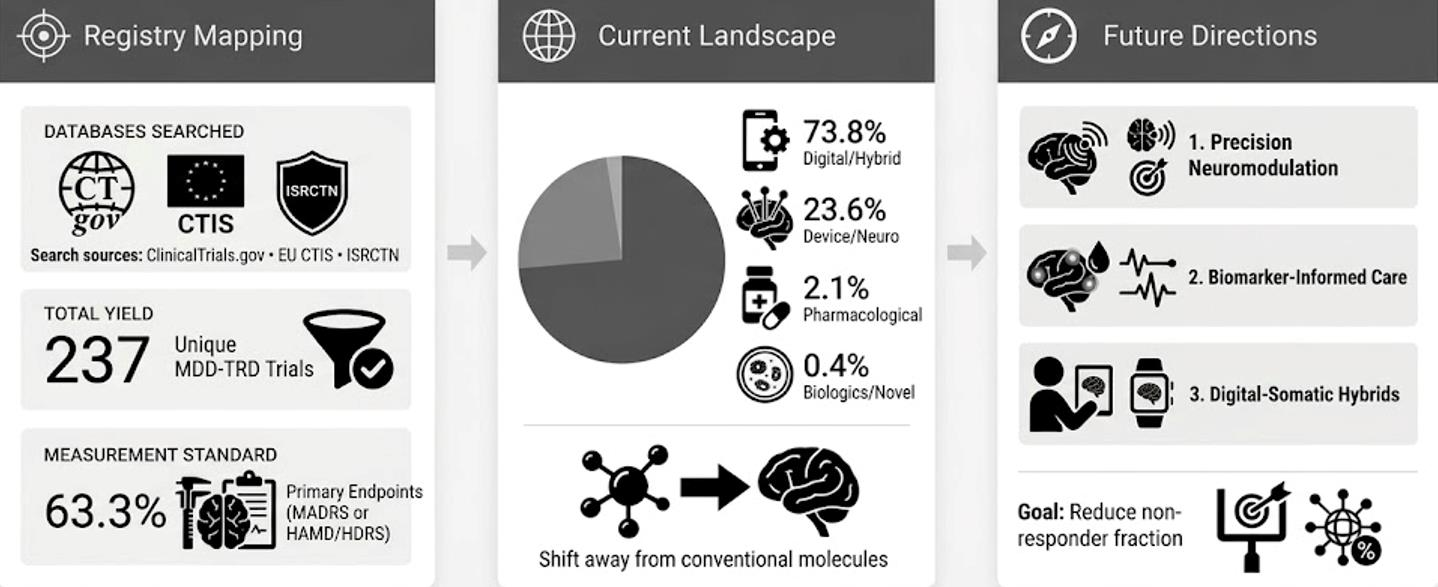
- The TRD trial landscape is dominated by device-based neuromodulation (48.1%) and pharmacological strategies with novel mechanisms (36.3%); biologic/novel agents (6.8%) and digital–hybrid programs (2.1%) form smaller strata.
- Trials are predominantly mid-phase with small-to-moderate sample sizes and heterogeneous endpoints, although 63.3% adopt standard clinician-rated scales.
- The TRD trial ecosystem is structured around two co-active developmental tracks—somatic neuromodulation and novel-mechanism pharmacology—with biologic/novel agents emerging and digital programs still marginal.
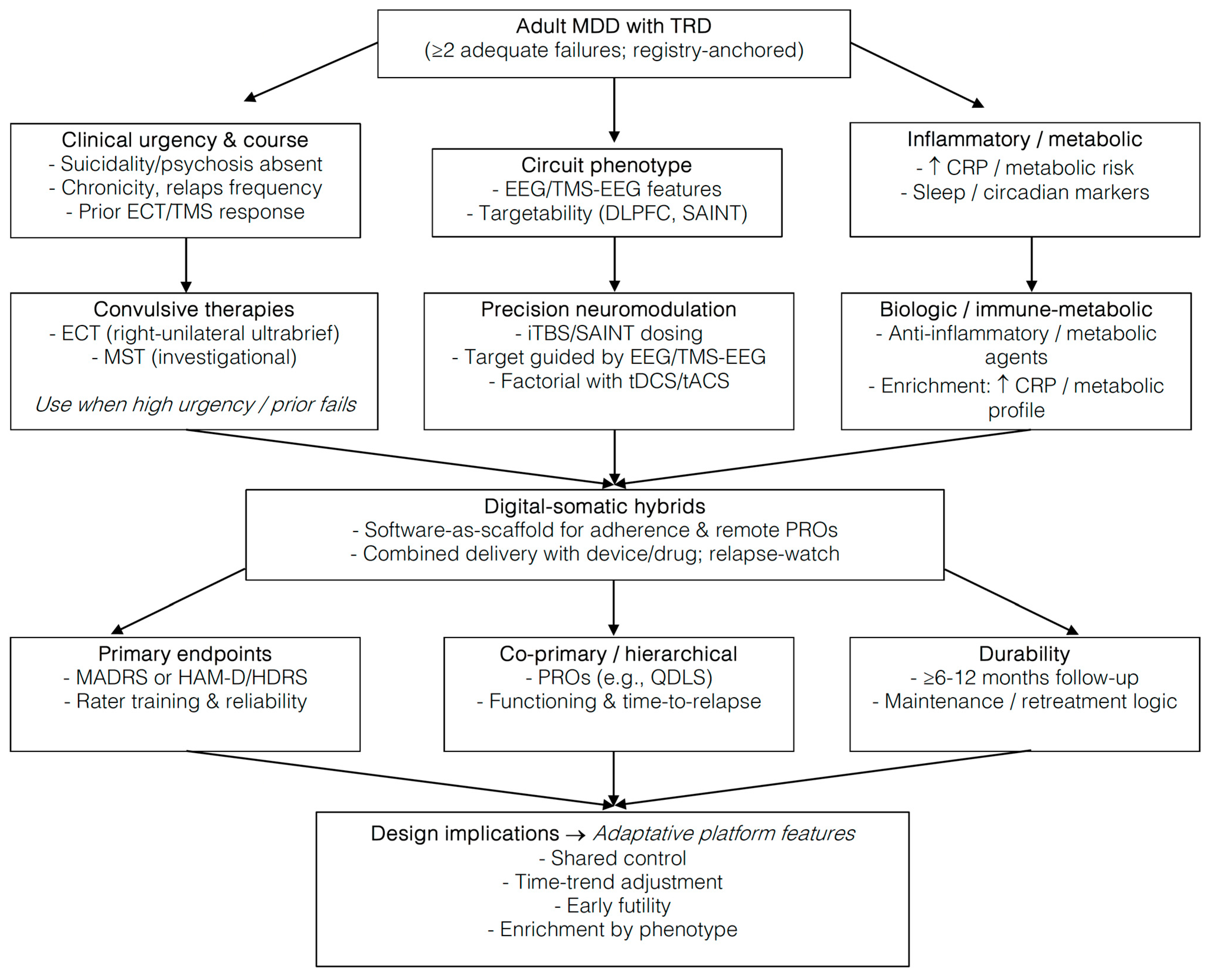
- Greater harmonization of clinician-rated endpoints with cognitive and functional measures, longer follow-up, and biomarker-informed stratification are needed.
Abstract
1. Introduction
2. Materials and Methods
2.1. Data Sources and Search Strategy
2.2. Eligibility Criteria
2.3. Study Selection, Deduplication, and Audit Trail
2.4. Operationalization of TRD Within Registries
2.5. Data Extraction and Variable Schema
2.6. Endpoint Harmonization
2.7. Sensitivity Safeguards and Exclusions
2.8. Analytic Frame
3. Results
4. Discussion
4.1. Non-Convulsive Neuromodulation in Context (rTMS/iTBS, tES, and Combinations)
4.2. Convulsive Approaches in Contemporary TRD (ECT with a Brief Note on MST)
4.3. Biologics/Novel Beyond Ketamine: What Psilocybin May Contribute and What It Might Not
4.4. Digital and Hybrid Interventions
4.5. Endpoints and Outcome Measurement: MADRS vs. HAMD and Why Harmonization Matters
4.6. Strengths and Limitations
4.7. Towards Stratified, Biomarker-Informed Care: An Emerging Direction
4.8. Clinical Gap and Unmet Need
5. Conclusions
Supplementary Materials
Author Contributions
Funding
Institutional Review Board Statement
Informed Consent Statement
Data Availability Statement
Acknowledgments
Conflicts of Interest
References
- McIntyre, R.S.; Alsuwaidan, M.; Baune, B.T.; Berk, M.; Demyttenaere, K.; Goldberg, J.F.; Gorwood, P.; Ho, R.; Kasper, S.; Kennedy, S.H.; et al. Treatment-resistant depression: Definition, prevalence, detection, management, and investigational interventions. World Psychiatry 2023, 22, 394–412. [Google Scholar] [CrossRef]
- Chrenek, C.; Duong, B.; Khullar, A.; McRee, C.; Thomas, R.; Swainson, J. Use of ketamine for treatment-resistant depression: Updated review of literature and practical applications to a community ketamine program in Edmonton, Alberta, Canada. Front. Psychiatry 2024, 14, 1283733. [Google Scholar] [CrossRef]
- Medeiros, G.C.; Demo, I.; Goes, F.S.; Zarate, C.A.; Gould, T.D. Personalized use of ketamine and esketamine for treatment-resistant depression. Transl. Psychiatry 2024, 14, 481. [Google Scholar] [CrossRef]
- Gambini, M.; Gurrieri, R.; Russomanno, G.; Cecchini, G.; Mucci, F.; Carbone, M.G.; Marazziti, D. Botulinum toxin: An unconventional tool for the treatment of depression? Brain Sci. 2025, 15, 971. [Google Scholar] [CrossRef]
- Trapp, N.T.; Purgianto, A.; Taylor, J.J.; Singh, M.K.; Oberman, L.M.; Mickey, B.J.; Youssef, N.A.; Solzbacher, D.; Zebley, B.; Cabrera, L.Y.; et al. Consensus review and considerations on TMS to treat depression. Clin. Neurophysiol. 2025, 170, 206–233. [Google Scholar] [CrossRef] [PubMed]
- Kishi, T.; Ikuta, T.; Sakuma, K.; Hatano, M.; Matsuda, Y.; Wilkening, J.; Goya-Maldonado, R.; Tik, M.; Williams, N.R.; Kito, S.; et al. Theta burst stimulation for depression: A systematic review and network and pairwise meta-analysis. Mol. Psychiatry 2024, 29, 3893–3899. [Google Scholar] [CrossRef] [PubMed]
- Tao, X.; Jing, Z.W.; Yuan, W.K.; Yun, G.H.; Fang, X.J.; Sheng, L.M. A meta-analysis comparing the effectiveness and safety of rTMS versus theta burst stimulation for treatment-resistant depression. Front. Psychiatry 2025, 15, 1504727. [Google Scholar] [CrossRef]
- Zhou, D.; Li, X.; Wei, S.; Yu, C.; Wang, D.; Li, Y.; Li, J.; Liu, J.; Li, S.; Zhuang, W.; et al. Transcranial direct current stimulation combined with repetitive transcranial magnetic stimulation for depression: A randomized clinical trial. JAMA Netw. Open 2024, 7, e2444306. [Google Scholar] [CrossRef]
- Deng, Z.D.; Robins, P.L.; Regenold, W.; Rohde, P.; Dannhauer, M.; Lisanby, S.H. How electroconvulsive therapy works in the treatment of depression: Is it the seizure, the electricity, or both? Neuropsychopharmacology 2024, 49, 150–162. [Google Scholar] [CrossRef] [PubMed]
- Anand, A.; Mathew, S.J.; Sanacora, G.; Murrough, J.W.; Goes, F.S.; Altinay, M.; Aloysi, A.S.; Asghar-Ali, A.A.; Barnett, B.S.; Chang, L.C.; et al. Ketamine versus ECT for nonpsychotic treatment-resistant major depression: A randomized non-inferiority trial. N. Engl. J. Med. 2023, 388, 2315–2325. [Google Scholar] [CrossRef]
- Karyotaki, E.; Efthimiou, O.; Miguel, C.; Bermpohl, F.M.G.; Furukawa, T.A.; Cuijpers, P.; Individual Patient Data Meta-Analyses for Depression (IPDMA-DE) Collaboration; Riper, H.; Patel, V.; Mira, A.; et al. Internet-based cognitive behavioral therapy for depression: A systematic review and individual patient data network meta-analysis. JAMA Psychiatry 2021, 78, 361–371, Erratum in JAMA Psychiatry 2024, 81, 320. https://doi.org/10.1001/jamapsychiatry.2023.5122. [Google Scholar] [CrossRef] [PubMed] [PubMed Central]
- Kambeitz-Ilankovic, L.; Rzayeva, U.; Völkel, L.; Wenzel, J.; Weiske, J.; Jessen, F.; Reininghaus, U.; Uhlhaas, P.J.; Alvarez-Jimenez, M.; Kambeitz, J. A systematic review of digital and face-to-face cognitive behavioral therapy for depression. npj Digit. Med. 2022, 5, 144. [Google Scholar] [CrossRef]
- Lam, R.W.; Kennedy, S.H.; Adams, C.; Bahji, A.; Beaulieu, S.; Bhat, V.; Blier, P.; Blumberger, D.M.; Brietzke, E.; Chakrabarty, T.; et al. CANMAT 2023 update of clinical guidelines for the management of major depressive disorder in adults. Can. J. Psychiatry 2024, 69, 641–687. [Google Scholar] [CrossRef]
- Blumberger, D.M.; Vila-Rodriguez, F.; Thorpe, K.E.; Feffer, K.; Noda, Y.; Giacobbe, P.; Knyahnytska, Y.; Kennedy, S.H.; Lam, R.W.; Daskalakis, Z.J.; et al. Effectiveness of theta burst versus high-frequency rTMS in depression (THREE-D): A randomized non-inferiority trial. Lancet 2018, 391, 1683–1692. [Google Scholar] [CrossRef]
- Rossi, S.; Antal, A.; Bestmann, S.; Bikson, M.; Brewer, C.; Brockmöller, J.; Carpenter, L.L.; Cincotta, M.; Chen, R.; Daskalakis, J.D.; et al. Safety and recommendations for TMS use in healthy subjects and patient populations, with updates on training, ethical and regulatory issues: Expert Guidelines. Clin. Neurophysiol. 2021, 132, 269–306. [Google Scholar] [CrossRef]
- Lefaucheur, J.P.; Aleman, A.; Baeken, C.; Benninger, D.H.; Brunelin, J.; Di Lazzaro, V.; Filipović, S.R.; Grefkes, C.; Hasan, A.; Hummel, F.C.; et al. Evidence-based guidelines on the therapeutic use of rTMS (2014–2018 update). Clin. Neurophysiol. 2020, 131, 474–528. [Google Scholar] [CrossRef]
- Cole, E.J.; Stimpson, K.H.; Bentzley, B.S.; Phillips, A.L.; Nejad, R.; Barmak, F.; Veerapal, C.; Khan, N.; Cherian, K.; Felber, E.; et al. Stanford neuromodulation therapy (SNT): A double-blind randomized controlled trial. Am. J. Psychiatry 2022, 179, 132–141. [Google Scholar] [CrossRef]
- van Rooij, S.J.H.; Arulpragasam, A.R.; McDonald, W.M.; Philip, N.S. Accelerated TMS—Moving quickly into the future of depression treatment. Neuropsychopharmacology 2024, 49, 128–137. [Google Scholar] [CrossRef] [PubMed]
- Ren, C.; Pagali, S.R.; Wang, Z.; Kung, S.; Boyapati, R.B.; Islam, K.; Li, J.W.; Shelton, K.M.; Waniger, A.; Rydberg, A.M.; et al. Transcranial electrical stimulation for major depressive disorder: A systematic review and meta-analysis. JAMA Netw. Open 2025, 8, e2516459. [Google Scholar] [CrossRef]
- Chen, M.; Yang, X.; Liu, C.; Li, J.; Wang, X.; Yang, C.; Hu, X.; Li, J.; Zhao, J.; Li, X.; et al. Comparative efficacy and cognitive function of magnetic seizure therapy vs electroconvulsive therapy for major depressive disorder: Systematic review and meta-analysis. Transl. Psychiatry 2021, 11, 437. [Google Scholar] [CrossRef] [PubMed]
- Cai, D.B.; Cao, X.L.; Zhong, B.L.; Xiang, Y.T. Comparison of efficacy and safety of magnetic seizure therapy vs modified electroconvulsive therapy for depression: Systematic review and meta-analysis. J. Pers. Med. 2023, 13, 449. [Google Scholar] [CrossRef] [PubMed]
- Goodwin, G.M.; Aaronson, S.T.; Alvarez, O.; Arden, P.C.; Baker, A.; Bennett, J.C.; Bird, C.; Blom, R.E.; Brennan, C.; Brusch, D.; et al. Single-dose psilocybin for a treatment-resistant episode of major depression: A phase 2b randomized trial. N. Engl. J. Med. 2022, 387, 1637–1648. [Google Scholar] [CrossRef] [PubMed]
- Madras, B.K. Psilocybin in treatment-resistant depression. N. Engl. J. Med. 2022, 387, 1708–1709. [Google Scholar] [CrossRef]
- Muthukumaraswamy, S.D.; Forsyth, A.; Lumley, T. Blinding and expectancy confounds in psychedelic randomized controlled trials. Expert Rev. Clin. Pharmacol. 2021, 14, 1133–1152. [Google Scholar] [CrossRef]
- Aday, J.S.; Johnson, M.W.; de Wit, H. Addressing blinding in classic psychedelic studies with low-dose active placebos. Int. J. Neuropsychopharmacol. 2025, 28, pyaf023. [Google Scholar] [CrossRef]
- Szigeti, B.; Heifets, B.D. Expectancy effects in psychedelic trials. Biol. Psychiatry Cogn. Neurosci. Neuroimaging 2024, 9, 512–521. [Google Scholar] [CrossRef]
- Goodwin, G.M.; Nowakowska, A.; Atli, M.; Dunlop, B.W.; Feifel, D.; Hellerstein, D.J.; Marwood, L.; Shabir, Z.; Mistry, S.; Stansfield, S.C.; et al. Results from a long-term observational follow-up study of a single dose of psilocybin for a treatment-resistant episode of major depressive disorder (COMP 004). J. Clin. Psychiatry 2025, 86, 24m15449. [Google Scholar] [CrossRef]
- Raison, C.L.; Sanacora, G.; Woolley, J.; Heinzerling, K.; Dunlop, B.W.; Brown, R.T.; Kakar, R.; Hassman, M.; Trivedi, R.P.; Robison, R.; et al. Single-dose psilocybin treatment for major depressive disorder: A randomized clinical trial. JAMA 2023, 330, 843–853. [Google Scholar] [CrossRef]
- Carhart-Harris, R.L.; Giribaldi, B.; Watts, R.; Baker-Jones, M.; Murphy-Beiner, A.; Murphy, R.; Martell, J.; Blemings, A.; Erritzoe, D.; Nutt, D.J. Trial of psilocybin versus escitalopram for depression. N. Engl. J. Med. 2021, 384, 1402–1411. [Google Scholar] [CrossRef]
- Erritzoe, D.; Barba, T.; Greenway, K.T.; Murphy, R.; Martell, J.; Giribaldi, B.; Timmermann, C.; Murphy-Beiner, A.; Jones, M.B.; Nutt, D.; et al. Effect of psilocybin versus escitalopram on depression symptom severity in patients with moderate-to-severe major depressive disorder: Observational 6-month follow-up of a phase 2 double-blind randomised controlled trial. EClinicalMedicine 2024, 76, 102799. [Google Scholar] [CrossRef] [PubMed]
- Metaxa, A.M.; Clarke, M. Efficacy of psilocybin for treating symptoms of depression: A systematic review and meta-analysis. BMJ 2024, 385, e078084. [Google Scholar] [CrossRef] [PubMed]
- Li, L.J.; Mo, Y.; Shi, Z.M.; Huang, X.B.; Ning, Y.P.; Wu, H.W.; Yang, X.H.; Zheng, W. Psilocybin for major depressive disorder: A systematic review. Front. Psychiatry 2024, 15, 1416420. [Google Scholar] [CrossRef]
- Perez, N.; Langlest, F.; Mallet, L.; De Pieri, M.; Sentissi, O.; Thorens, G.; Seragnoli, F.; Zullino, D.; Kirschner, M.; Kaiser, S.; et al. Psilocybin-assisted therapy for depression: A systematic review and dose–response meta-analysis of human studies. Eur. Neuropsychopharmacol. 2023, 76, 61–76. [Google Scholar] [CrossRef]
- Swieczkowski, D.; Kwaśny, A.; Pruc, M.; Gaca, Z.; Szarpak, Ł.; Cubała, W.J. Efficacy and safety of psilocybin in the treatment of major depressive disorder: A dose–response network meta-analysis of randomized placebo-controlled clinical trials. Psychiatry Res. 2025, 344, 116337. [Google Scholar] [CrossRef]
- Hieronymus, F.; López, E.; Werin Sjögren, H.; Lundberg, J. Control group outcomes in trials of psilocybin, SSRIs, or esketamine for depression: A meta-analysis. JAMA Netw. Open 2025, 8, e2524119. [Google Scholar] [CrossRef]
- Rosenström, T.H.; Saarni, S.E.; Saarni, S.I.; Tammilehto, J.; Stenberg, J.-H. Efficacy and effectiveness of therapist-guided internet versus face-to-face cognitive behavioural therapy for depression: A retrospective cohort study. Lancet Psychiatry 2025, 12, 189–197. [Google Scholar] [CrossRef]
- Nunes-Zlotkowski, K.F.; Shepherd, H.L.; Beatty, L.; Butow, P.; Shaw, J.M. Blended psychological therapy for the treatment of psychological disorders in adult patients: Systematic review and meta-analysis. Interact. J. Med. Res. 2024, 13, e49660. [Google Scholar] [CrossRef] [PubMed]
- Mathiasen, K.; Andersen, T.E.; Lichtenstein, M.B.; Ehlers, L.H.; Riper, H.; Kleiboer, A.; Roessler, K.K. The clinical effectiveness of blended cognitive behavioral therapy compared with face-to-face cognitive behavioral therapy for adult depression: Randomized controlled noninferiority trial. J. Med. Internet Res. 2022, 24, e36577. [Google Scholar] [CrossRef]
- Lipschitz, J.M.; Hoogendoorn, M.; Reger, G.M. The engagement problem: A review of engagement with digital mental health interventions and recommendations for a path forward. Curr. Treat. Options Psychiatry 2023, 10, 119–135. [Google Scholar] [CrossRef] [PubMed]
- Boucher, E.M.; Raiker, J.S. Engagement and retention in digital mental health interventions: A narrative review. BMC Digit. Health 2024, 2, 52. [Google Scholar] [CrossRef]
- Plessen, C.Y.; Panagiotopoulou, O.M.; Tong, L.; Cuijpers, P.; Karyotaki, E. Digital mental health interventions for the treatment of depression: A multiverse meta-analysis. J. Affect. Disord. 2025, 369, 1031–1044. [Google Scholar] [CrossRef] [PubMed]
- Chen, X.; Blumberger, D.M.; Yan, C.-G.; Downar, J.; Vila-Rodriguez, F.; Daskalakis, Z.J.; Kaster, T.S. Crosswalk between HRSD and MADRS outcomes for rTMS in patients with depression. BMJ Ment. Health 2025, 28, e301451. [Google Scholar] [CrossRef] [PubMed]
- Hengartner, M.P.; Jakobsen, J.C.; Sørensen, A.; Plöderl, M. Efficacy of new-generation antidepressants assessed with MADRS vs HAMD: Meta-analysis of randomized placebo-controlled trials. PLoS ONE 2020, 15, e0229381. [Google Scholar] [CrossRef]
- Mulsant, B.H.; Kastango, K.B.; Rosen, J.; Stone, R.A.; Mazumdar, S.; Pollock, B.G. Interrater reliability in clinical trials of depressive disorders. Am. J. Psychiatry 2002, 159, 1598–1608. [Google Scholar] [CrossRef]
- Rosen, J.; Miller, M.; Trivedi, M. Web-based training and rater reliability in multicenter depression trials. Psychiatr. Serv. 2008, 59, 1492–1494. [Google Scholar]
- Raison, C.L.; Rutherford, R.E.; Woolwine, B.J.; Shuo, C.; Schettler, P.; Drake, D.F.; Haroon, E.; Miller, A.H. A randomized controlled trial of the tumor necrosis factor antagonist infliximab for treatment-resistant depression: The role of baseline inflammatory biomarkers. JAMA Psychiatry 2013, 70, 31–41. [Google Scholar] [CrossRef]
- Watts, D.; Fernandes Pulice, R.; Reilly, J.; Brunoni, A.R.; Kapczinski, F.; Passos, I.C. Predicting treatment response using EEG in major depressive disorder: A machine-learning meta-analysis. Transl. Psychiatry 2022, 12, 332. [Google Scholar] [CrossRef] [PubMed]
- Farzan, F.; Cash, R.F.H.; Rajji, T.K.; Fitzgerald, P.B.; Daskalakis, Z.J. TMS–EEG biomarkers for psychiatry: Methodological readiness and clinical promise. Biol. Psychiatry Cogn. Neurosci. Neuroimaging 2024, 9, 451–463. [Google Scholar] [CrossRef]
- Bofill Roig, M.; Krotka, P.; Burman, C.-F.; Glimm, E.; Gold, S.M.; Hees, K.; Jacko, P.; Koenig, F.; Magirr, D.; Mesenbrink, P.; et al. On model-based time trend adjustments in platform trials with non-concurrent controls. BMC Med. Res. Methodol. 2022, 22, 228. [Google Scholar] [CrossRef]
- Tozzi, L.; Zhang, X.; Pines, A.; Olmsted, A.M.; Zhai, E.S.; Anene, E.T.; Chesnut, M.; Holt-Gosselin, B.; Chang, S.; Stetz, P.C.; et al. Personalized brain circuit scores identify clinically distinct biotypes in depression and anxiety. Nat. Med. 2024, 30, 2076–2087. [Google Scholar] [CrossRef]
- Freitag, M.M.; Zocholl, D.; Meyer, E.L.; Gold, S.M.; Roig, M.B.; De Smedt, H.; Posch, M.; König, F.; EU-PEARL MDD. Design considerations for a phase II platform trial in major depressive disorder. Pharm. Stat. 2025, 24, e70025. [Google Scholar] [CrossRef] [PubMed]


| Intervention Class | Yes (MADRS/HDRS as Primary) | No | Total | Yes (%) |
|---|---|---|---|---|
| Device-based neuromodulation | 73 | 41 | 114 | 64.0 |
| Pharmacological interventions † | 51 | 35 | 86 | 59.3 |
| Biologics/novel agents | 10 | 6 | 16 | 62.5 |
| Multimodal non-digital combinations | 9 | 2 | 11 | 81.8 |
| Digital–hybrid programs | 3 | 2 | 5 | 60.0 |
| Lifestyle interventions | 2 | 1 | 3 | 66.7 |
| Psychotherapy | 2 | 0 | 2 | 100.0 |
| Total (n = 237) | 150 | 87 | 237 | 63.3 |
| Intervention Class | Early Phase 1 | Phase 1 | Phase 1/2 | Phase 2 | Phase 2/3 | Phase 3 | Phase 4 | Not Specified | Total |
|---|---|---|---|---|---|---|---|---|---|
| Device-based neuromodulation | 0 (0.0%) | 3 (2.6%) | 3 (2.6%) | 1 (0.9%) | 2 (1.8%) | 5 (4.4%) | 4 (3.5%) | 96 (84.2%) | 114 (100.0%) |
| Pharmacological interventions † | 3 (3.5%) | 8 (9.3%) | 4 (4.7%) | 36 (41.9%) | 0 (0.0%) | 10 (11.6%) | 17 (19.8%) | 8 (9.3%) | 86 (100.0%) |
| Biologic/novel agents | 0 (0.0%) | 1 (6.2%) | 2 (12.5%) | 9 (56.2%) | 1 (6.2%) | 0 (0.0%) | 1 (6.2%) | 2 (12.5%) | 16 (100.0%) |
| Multimodal non-digital combinations | 0 (0.0%) | 0 (0.0%) | 0 (0.0%) | 2 (18.2%) | 0 (0.0%) | 0 (0.0%) | 3 (27.3%) | 6 (54.5%) | 11 (100.0%) |
| Digital–hybrid programs | 0 (0.0%) | 0 (0.0%) | 0 (0.0%) | 0 (0.0%) | 0 (0.0%) | 0 (0.0%) | 0 (0.0%) | 5 (100.0%) | 5 (100.0%) |
| Lifestyle interventions | 0 (0.0%) | 0 (0.0%) | 0 (0.0%) | 0 (0.0%) | 0 (0.0%) | 0 (0.0%) | 1 (33.3%) | 2 (66.7%) | 3 (100.0%) |
| Psychotherapy | 0 (0.0%) | 0 (0.0%) | 0 (0.0%) | 0 (0.0%) | 0 (0.0%) | 0 (0.0%) | 0 (0.0%) | 2 (100.0%) | 2 (100.0%) |
| Total (n = 237) | 3 (1.3%) | 12 (5.1%) | 9 (3.8%) | 48 (20.3%) | 3 (1.3%) | 15 (6.3%) | 26 (11.0%) | 121 (51.1%) | 237 (100.0%) |
Disclaimer/Publisher’s Note: The statements, opinions and data contained in all publications are solely those of the individual author(s) and contributor(s) and not of MDPI and/or the editor(s). MDPI and/or the editor(s) disclaim responsibility for any injury to people or property resulting from any ideas, methods, instructions or products referred to in the content. |
© 2026 by the authors. Licensee MDPI, Basel, Switzerland. This article is an open access article distributed under the terms and conditions of the Creative Commons Attribution (CC BY) license.
Share and Cite
Mucci, F.; Gurrieri, R.; Bouanani, S.; Gambini, M.; Russomanno, G.; Marazziti, D. From Resistance to Redesign—The Emerging Logic of Hybrid Care in Treatment-Resistant Depression. Brain Sci. 2026, 16, 612. https://doi.org/10.3390/brainsci16060612
Mucci F, Gurrieri R, Bouanani S, Gambini M, Russomanno G, Marazziti D. From Resistance to Redesign—The Emerging Logic of Hybrid Care in Treatment-Resistant Depression. Brain Sciences. 2026; 16(6):612. https://doi.org/10.3390/brainsci16060612
Chicago/Turabian StyleMucci, Federico, Riccardo Gurrieri, Siham Bouanani, Matteo Gambini, Gerardo Russomanno, and Donatella Marazziti. 2026. "From Resistance to Redesign—The Emerging Logic of Hybrid Care in Treatment-Resistant Depression" Brain Sciences 16, no. 6: 612. https://doi.org/10.3390/brainsci16060612
APA StyleMucci, F., Gurrieri, R., Bouanani, S., Gambini, M., Russomanno, G., & Marazziti, D. (2026). From Resistance to Redesign—The Emerging Logic of Hybrid Care in Treatment-Resistant Depression. Brain Sciences, 16(6), 612. https://doi.org/10.3390/brainsci16060612