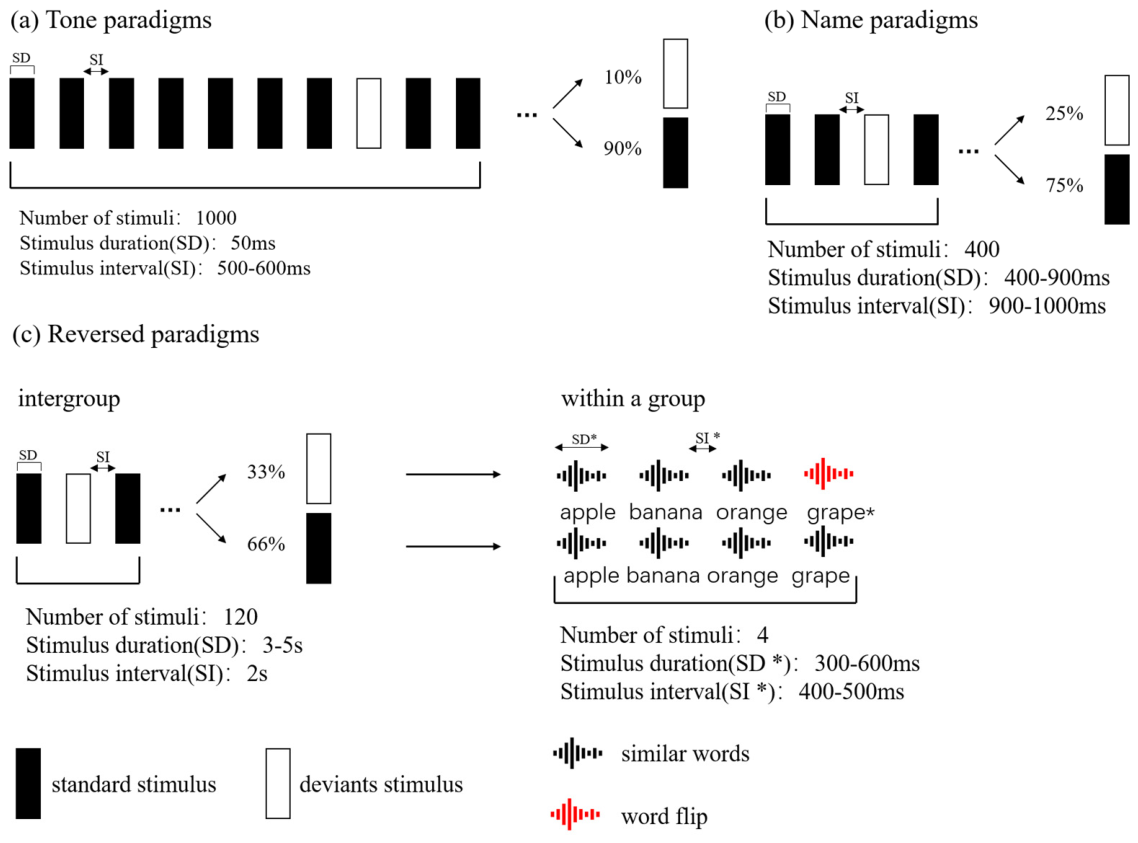
Enhanced Neural Responses to Self-Name Stimuli Relative to Tone and Reversed Speech Deviants in the Auditory Oddball Paradigm


Highlights
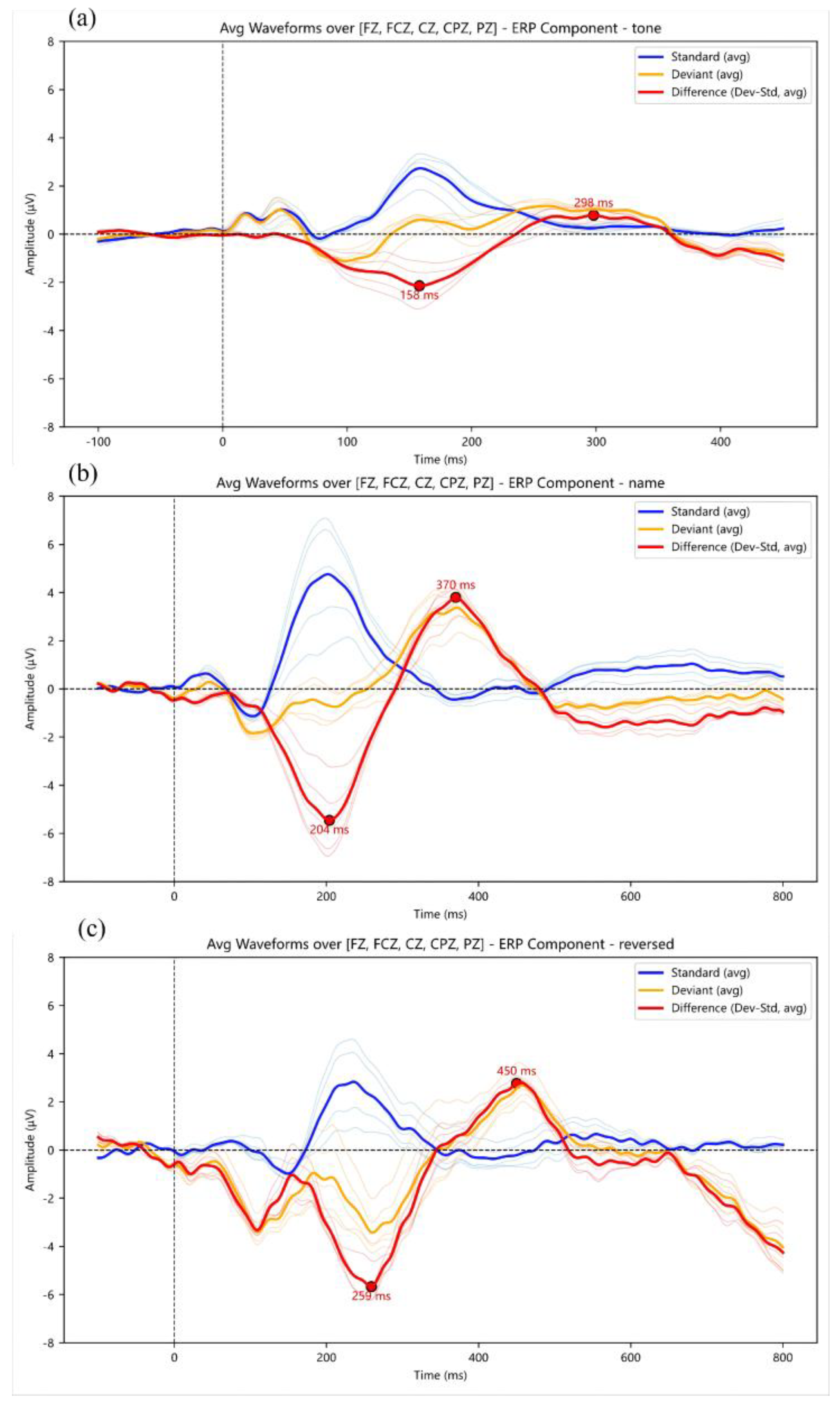
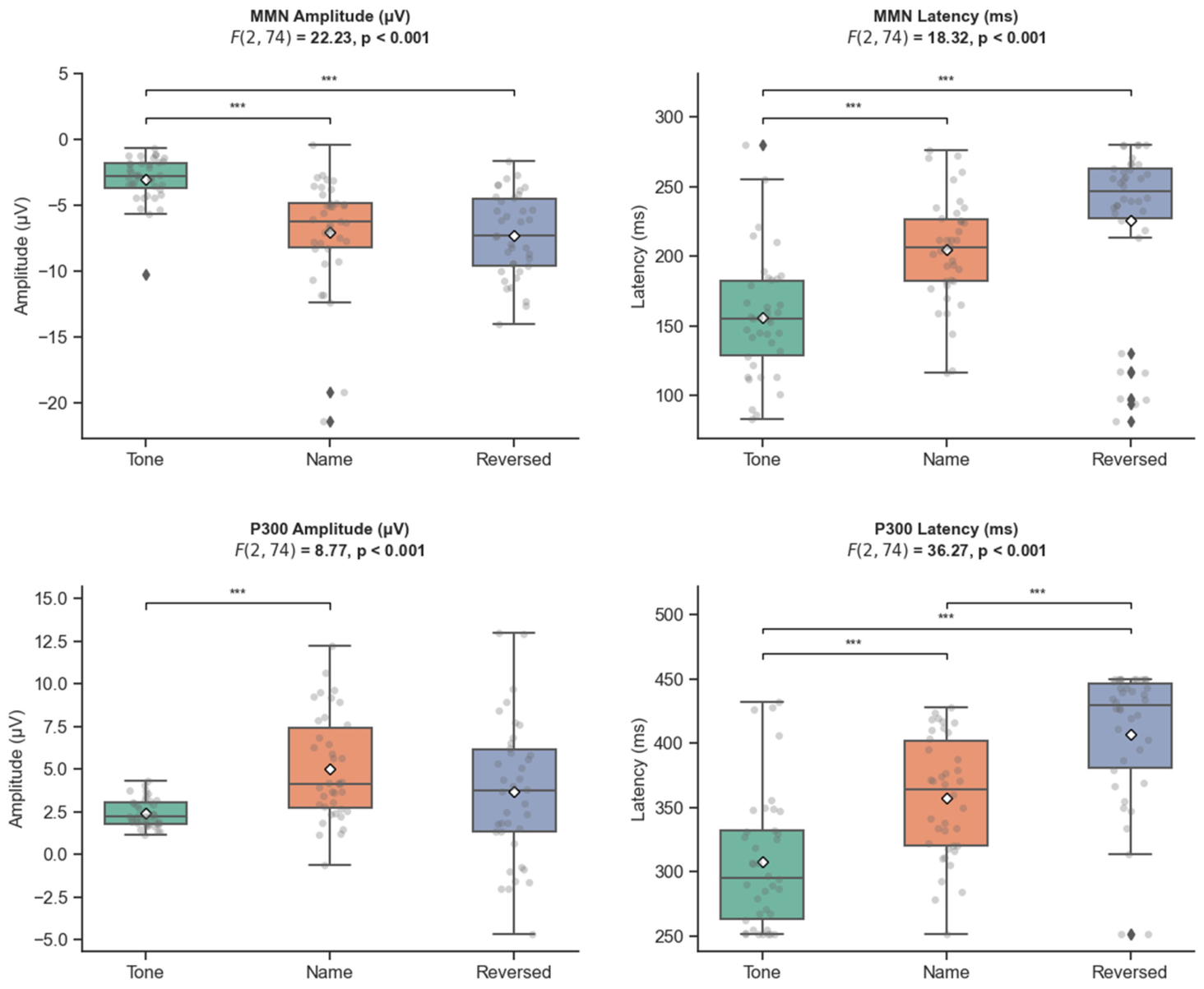
- Self-referential auditory stimuli (one’s own name) elicit significantly more robust neural signatures, including higher P300 amplitudes (3.95 μV), than simple tones (1.77 μV).
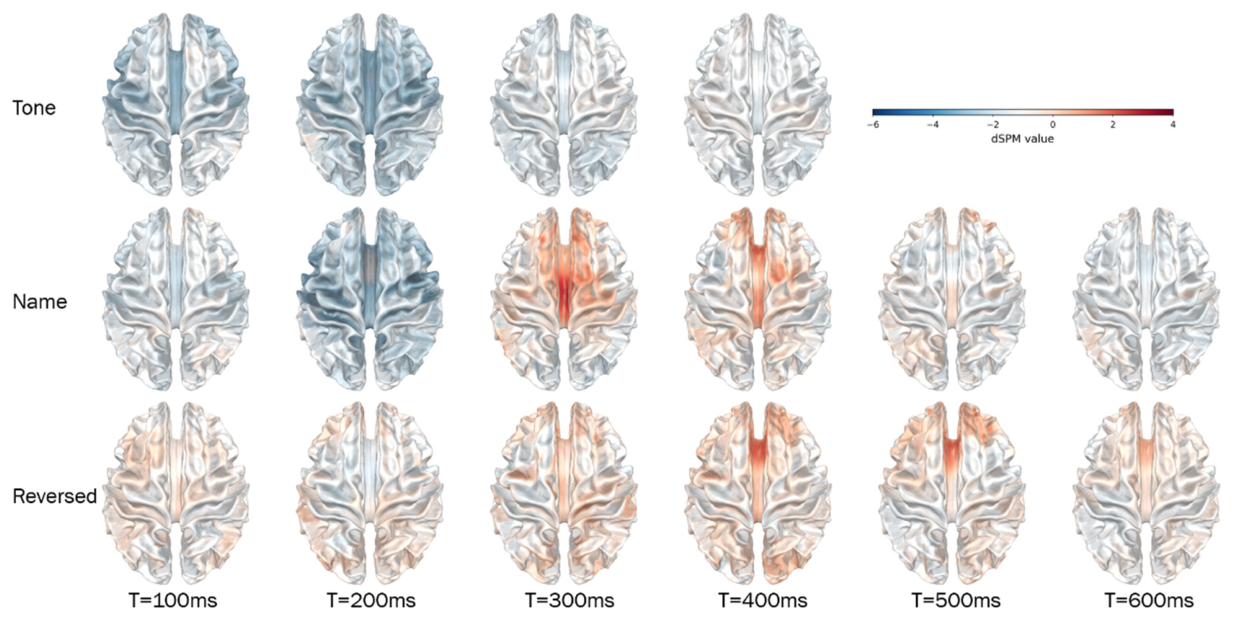
- Source-space analysis revealed that self-name processing recruits a distributed network encompassing salience-processing and self-referential regions, involving 12 significant clusters, whereas acoustic deviance is more localized.
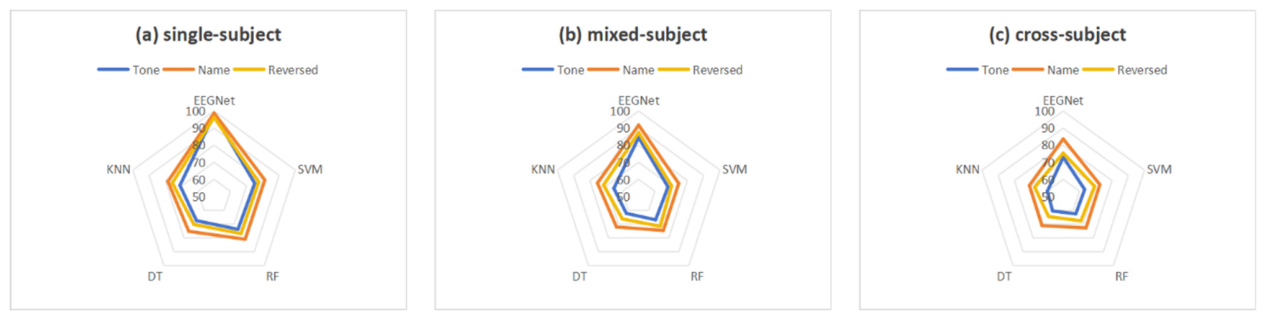
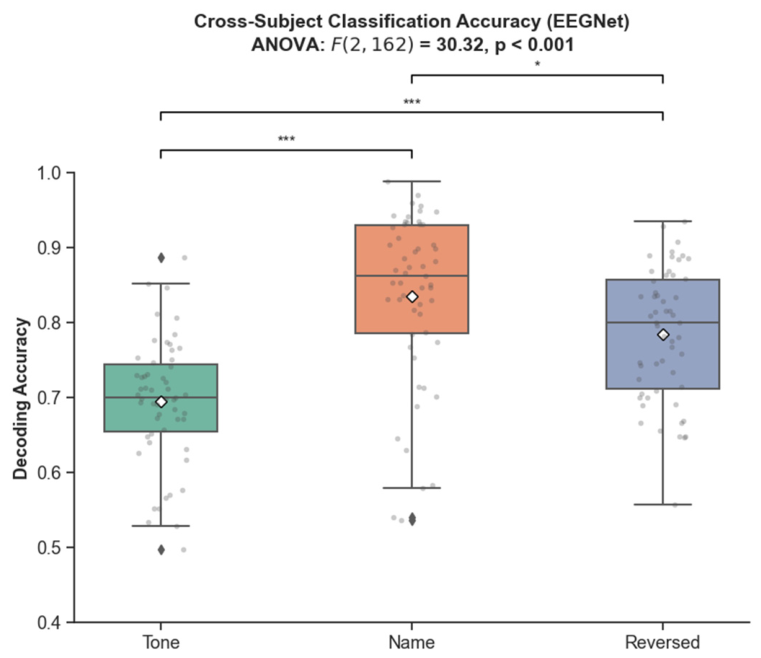
- The high neural discriminability of self-name responses (approx. 80% accuracy) suggests its potential utility for auditory paradigm design in BCI and clinical assessment research contexts, pending validation in target populations.
- These results offer a comparative framework for understanding how different dimensions of auditory relevance modulate neural processing, informing the design of effective paradigms for cognitive neuroscience.
Abstract
1. Introduction
2. Materials and Methods
2.1. Participants
2.2. Experimental Design and Stimuli
2.3. EEG Recording and Preprocessing
2.4. Feature Extraction
2.4.1. Time-Domain Features
2.4.2. Frequency-Domain Features
2.4.3. Nonlinear Features
2.5. Classification Analysis
2.5.1. Machine-Learning Models
2.5.2. Deep-Learning Model
2.5.3. EEGNet-Based Saliency Analysis
2.6. Source-Space Estimation
3. Results
3.1. ERP Results
3.2. Source-Space Results
3.3. Classification Results
3.4. EEGNet Saliency Topography
4. Discussion
5. Conclusions
Author Contributions
Funding
Institutional Review Board Statement
Informed Consent Statement
Data Availability Statement
Conflicts of Interest
Appendix A

| Paradigm | Cluster ID | Time Range (ms) | Vertices | p-Value | Primary Regions |
|---|---|---|---|---|---|
| Tone | 0 | 1.0–395.0 | 3889 | 0.0003 | superiorfrontal-lh: 278 (7.1%); precentral-lh: 256 (6.6%); superiorparietal-lh: 239 (6.1%); postcentral-lh: 202 (5.2%); rostralmiddlefrontal-lh: 201 (5.2%) |
| 1 | 5.0–450.0 | 3748 | 0.0003 | inferiorparietal-rh: 241 (6.4%); superiorfrontal-rh: 238 (6.4%); superiorparietal-rh: 229 (6.1%); precentral-rh: 220 (5.9%); rostralmiddlefrontal-rh: 197 (5.3%) | |
| 2 | 37.0–107.0 | 97 | 0.0180 | superiorparietal-lh: 50 (51.5%); lateraloccipital-lh: 26 (26.8%); inferiorparietal-lh: 21 (21.6%) | |
| 3 | 134.0–208.0 | 52 | 0.0233 | superiorparietal-rh: 40 (76.9%); inferiorparietal-rh: 12 (23.1%) | |
| 4 | 351.0–398.0 | 70 | 0.0410 | inferiorparietal-rh: 35 (50.0%); superiorparietal-rh: 35 (50.0%) | |
| 5 | 360.0–450.0 | 1920 | 0.0007 | precentral-lh: 159 (8.3%); superiortemporal-lh: 140 (7.3%); insula-lh: 118 (6.1%); postcentral-lh: 107 (5.6%); precuneus-lh: 100 (5.2%) | |
| 6 | 401.0–430.0 | 74 | 0.0350 | superiorparietal-rh: 74 (100.0%) | |
| Name | 0 | 322.0–397.0 | 61 | 0.0127 | lateralorbitofrontal-lh: 5 (8.2%); medialorbitofrontal-lh: 1 (1.6%) |
| 1 | 34.0–101.0 | 117 | 0.0167 | insula-lh: 64 (54.7%) parstriangularis-lh: 20 (17.1%); parsopercularis-lh: 11 (9.4%); superiortemporal-lh: 9 (7.7%); supramarginal-lh: 8 (6.8%) | |
| 2 | 49.0–118.0 | 69 | 0.0260 | supramarginal-rh: 43 (62.3%); postcentral-rh: 16 (23.2%); insula-rh: 9 (13.0%); precentral-rh: 1 (1.4%) | |
| 3 | 134.0–208.0 | 151 | 0.0083 | posteriorcingulate-lh: 48 (31.8%); caudalanteriorcingulate-lh: 7 (4.6%); isthmuscingulate-lh: 2 (1.3%) | |
| 4 | 60.0–114.0 | 120 | 0.0153 | posteriorcingulate-rh: 22 (18.3%); caudalanteriorcingulate-rh: 12 (10.0%); rostralanteriorcingulate-rh: 1 (0.8%) | |
| 5 | 111.0–270.0 | 1913 | 0.0003 | superiortemporal-rh: 128 (6.7%); precentral-rh: 117 (6.1%); precuneus-rh: 111 (5.8%); superiorparietal-rh: 106 (5.5%); supramarginal-rh: 101 (5.3%) | |
| 6 | 121.0–265.0 | 1974 | 0.0003 | precentral-lh: 211 (10.7%); postcentral-lh: 171 (8.7%); superiorfrontal-lh: 117 (5.9%); superiortemporal-lh: 111 (5.6%); precuneus-lh: 109 (5.5%) | |
| 7 | 151.0–249.0 | 30 | 0.0340 | inferiorparietal-rh: 30 (100.0%) | |
| 8 | 153.0–235.0 | 22 | 0.0367 | precentral-rh: 22 (100.0%) | |
| 9 | 630.0–764.0 | 44 | 0.0150 | precentral-lh: 21 (47.7%); parsopercularis-lh: 14 (31.8%); caudalmiddlefrontal-lh: 8 (18.2%); rostralmiddlefrontal-lh: 1 (2.3%) | |
| 10 | 630.0–706.0 | 70 | 0.0443 | insula-rh: 46 (65.7%); supramarginal-rh: 13 (18.6%); postcentral-rh: 7 (10.0%); superiortemporal-rh: 3(4.3%); precentral-rh: 1 (1.4%) | |
| 11 | 675.0–707.0 | 106 | 0.0170 | medialorbitofrontal-rh: 5 (4.7%); rostralanteriorcingulate-rh: 1 (0.9%) | |
| Reversed | 0 | 422.0–508.0 | 46 | 0.0137 | caudalanteriorcingulate-lh: 29 (63.0%); rostralanteriorcingulate-lh: 6 (13.0%); posteriorcingulate-lh: 3 (6.5%); superiorfrontal-lh: 2 (4.3%) |
| 1 | 724.0–800.0 | 58 | 0.0100 | none | |
| 2 | 730.0–800.0 | 41 | 0.0180 | posteriorcingulate-rh: 27 (65.9%); precuneus-rh: 14 (34.1%) | |
| 3 | 731.0–800.0 | 53 | 0.0037 | posteriorcingulate-lh: 22 (41.5%); isthmuscingulate-lh: 12 (22.6%); caudalanteriorcingulate-lh: 1 (1.9%) | |
| 4 | 733.0–808.0 | 120 | 0.0023 | posteriorcingulate-rh: 24 (20.0%); isthmuscingulate-rh: 16 (13.3%); caudalanteriorcingulate-rh: 2 (1.7%) | |
| 5 | 205.0–275.0 | 35 | 0.0283 | precentral-rh: 31 (88.6%); caudalmiddlefrontal-rh: 2 (5.7%); parsopercularis-rh: 2 (5.7%) |
References
- Näätänen, R.; Paavilainen, P.; Rinne, T.; Alho, K. The mismatch negativity (MMN) in basic research of central auditory processing: A review. Clin. Neurophysiol. 2007, 118, 2544–2590. [Google Scholar] [CrossRef] [Scilit]
- Polich, J. Updating P300: An integrative theory of P3a and P3b. Clin. Neurophysiol. 2007, 118, 2128–2148. [Google Scholar] [CrossRef] [Scilit]
- Garrido, M.I.; Kilner, J.M.; Stephan, K.E.; Friston, K.J. The mismatch negativity: A review of underlying mechanisms. Clin. Neurophysiol. 2009, 120, 453–463. [Google Scholar] [CrossRef] [Scilit] [PubMed]
- Doeller, C.F.; Opitz, B.; Mecklinger, A.; Krick, C.; Reith, W.; Schröger, E. Prefrontal cortex involvement in preattentive auditory deviance detection. NeuroImage 2003, 20, 1270–1282. [Google Scholar] [CrossRef] [Scilit] [PubMed]
- Opitz, B.; Rinne, T.; Mecklinger, A.; von Cramon, D.Y.; Schröger, E. Differential Contribution of Frontal and Temporal Cortices to Auditory Change Detection: fMRI and ERP Results. NeuroImage 2002, 15, 167–174. [Google Scholar] [CrossRef] [Scilit] [PubMed]
- Liu, Y.; Li, P.; Shu, H.; Zhang, Q.; Chen, L. Structure and meaning in Chinese: An ERP study of idioms. J. Neurolinguist. 2010, 23, 615–630. [Google Scholar] [CrossRef] [Scilit]
- Schnakers, C.; Perrin, F.; Schabus, M.; Majerus, S.; Ledoux, D.; Damas, P.; Boly, M.; Vanhaudenhuyse, A.; Bruno, M.A.; Moonen, G.; et al. Voluntary brain processing in disorders of consciousness. Neurology 2008, 71, 1614–1620. [Google Scholar] [CrossRef] [Scilit]
- Alexopoulos, T.; Muller, D.; Ric, F.; Marendaz, C. I, me, mine: Automatic attentional capture by self-related stimuli. Eur. J. Soc. Psychol. 2012, 42, 770–779. [Google Scholar] [CrossRef] [Scilit]
- Höller, Y.; Kronbichler, M.; Bergmann, J.; Crone, J.S.; Ladurner, G.; Golaszewski, S. EEG frequency analysis of responses to the own-name stimulus. Clin. Neurophysiol. 2011, 122, 99–106. [Google Scholar] [CrossRef] [Scilit]
- Näätänen, R.; Kujala, T.; Winkler, I. Auditory processing that leads to conscious perception: A unique window to central auditory processing opened by the mismatch negativity and related responses. Psychophysiology 2010, 48, 4–22. [Google Scholar] [CrossRef] [Scilit]
- Thornhill, D.E.; Van Petten, C. Lexical versus conceptual anticipation during sentence processing: Frontal positivity and N400 ERP components. Int. J. Psychophysiol. 2012, 83, 382–392. [Google Scholar] [CrossRef] [Scilit]
- Ueda, K.; Nakajima, Y.; Ellermeier, W.; Kattner, F. Intelligibility of locally time-reversed speech: A multilingual comparison. Sci. Rep. 2017, 7, 1782. [Google Scholar] [CrossRef] [Scilit]
- Leff, A.P.; Schofield, T.M.; Stephan, K.E.; Crinion, J.T.; Friston, K.J.; Price, C.J. The Cortical Dynamics of Intelligible Speech. J. Neurosci. 2008, 28, 13209–13215. [Google Scholar] [CrossRef] [Scilit]
- Qin, P.; Di, H.; Yan, X.; Yu, S.; Yu, D.; Laureys, S.; Weng, X. Mismatch negativity to the patient’s own name in chronic disorders of consciousness. Neurosci. Lett. 2008, 448, 24–28. [Google Scholar] [CrossRef] [Scilit] [PubMed]
- Ghani, U.; Signal, N.; Niazi, I.K.; Taylor, D. ERP based measures of cognitive workload: A review. Neurosci. Biobehav. Rev. 2020, 118, 18–26. [Google Scholar] [CrossRef] [Scilit]
- Hsu, Y.F.; Darriba, A.; Waszak, F. Attention modulates repetition effects in a context of low periodicity. Brain Res. 2021, 1767, 147559. [Google Scholar] [CrossRef] [Scilit]
- Orban, M.; Elsamanty, M.; Guo, K.; Zhang, S.; Yang, H. A Review of Brain Activity and EEG-Based Brain–Computer Interfaces for Rehabilitation Application. Bioengineering 2022, 9, 768. [Google Scholar] [CrossRef] [Scilit] [PubMed]
- Blankertz, B.; Lemm, S.; Treder, M.; Haufe, S.; Müller, K.-R. Single-trial analysis and classification of ERP components—A tutorial. NeuroImage 2011, 56, 814–825. [Google Scholar] [CrossRef] [Scilit] [PubMed]
- Gilmore, C.S.; Clementz, B.A.; Berg, P. Hemispheric differences in auditory oddball responses during monaural versus binaural stimulation. Int. J. Psychophysiol. 2009, 73, 326–333. [Google Scholar] [CrossRef] [Scilit]
- Qin, P.; Northoff, G. How is our self related to midline regions and the default-mode network? NeuroImage 2011, 57, 1221–1233. [Google Scholar] [CrossRef] [Scilit]
- Brown, A.; Pinto, D.; Burgart, K.; Zvilichovsky, Y.; Zion-Golumbic, E. Neurophysiological Evidence for Semantic Processing of Irrelevant Speech and Own-Name Detection in a Virtual Café. J. Neurosci. 2023, 43, 5045–5056. [Google Scholar] [CrossRef] [Scilit] [PubMed]
- Erlbeck, H.; Real, R.G.L.; Kotchoubey, B.; Mattia, D.; Bargak, J.; Kübler, A. Basic discriminative and semantic processing in patients in the vegetative and minimally conscious state. Int. J. Psychophysiol. 2017, 113, 8–16. [Google Scholar] [CrossRef] [Scilit]
- Holeckova, I.; Fischer, C.; Giard, M.-H.; Delpuech, C.; Morlet, D. Brain responses to a subject’s own name uttered by a familiar voice. Brain Res. 2006, 1082, 142–152. [Google Scholar] [CrossRef] [Scilit]
- Huang, F.; Wu, J.; Cheng, L.; Meng, Y. The Effects of Synonym and Antonym Relations on Visual Recognition of Chinese Compound Words: Based on Behavioral and ERP Experiments. Int. J. Psychophysiol. 2021, 168, S110. [Google Scholar] [CrossRef] [Scilit]
- Nijhof, A.D.; von Trott Zu Solz, J.; Catmur, C.; Bird, G. Equivalent own name bias in autism: An EEG study of the Attentional Blink. Cogn. Affect. Behav. Neurosci. 2022, 22, 625–639. [Google Scholar] [CrossRef] [Scilit]
- Roer, J.P.; Cowan, N. A preregistered replication and extension of the cocktail party phenomenon: One’s name captures attention, unexpected words do not. J. Exp. Psychol. Learn. Mem. Cogn. 2021, 47, 234–242. [Google Scholar] [CrossRef] [Scilit]
- Wu, H.; Wang, D.; Liu, Y.; Xie, M.; Zhou, L.; Wang, Y.; Cao, J.; Huang, Y.; Qiu, M.; Qin, P. Decoding subject’s own name in the primary auditory cortex. Hum. Brain Mapp. 2022, 44, 1985–1996. [Google Scholar] [CrossRef] [Scilit]
- Zhang, Y.; Xie, M.; Wang, Y.; Qin, P. Distinct Effects of Stimulus Repetition on Various Temporal Stages of Subject’s Own Name Processing. Brain Sci. 2022, 12, 411. [Google Scholar] [CrossRef] [Scilit]
- Bao, H.; Xie, M.; Huang, Y.; Liu, Y.; Lan, C.; Lin, Z.; Wang, Y.; Qin, P. Specificity in the processing of a subject’s own name. Soc. Cogn. Affect. Neurosci. 2023, 18, nsad066. [Google Scholar] [CrossRef] [Scilit] [PubMed]
- Tamura, K.; Mizuba, T.; Iramina, K. ERP and time-frequency analysis of the response to hearing subject’s own name. Int. J. Psychophysiol. 2014, 94, 151. [Google Scholar] [CrossRef] [Scilit]
- Wang, F.; Di, H.; Hu, X.; Jing, S.; Thibaut, A.; Di Perri, C.; Huang, W.; Nie, Y.; Schnakers, C.; Laureys, S. Cerebral response to subject’s own name showed high prognostic value in traumatic vegetative state. BMC Med. 2015, 13, 83. [Google Scholar] [CrossRef] [Scilit]
- Gramfort, A.; Luessi, M.; Larson, E.; Engemann, D.A.; Strohmeier, D.; Brodbeck, C.; Parkkonen, L.; Hämäläinen, M.S. MNE software for processing MEG and EEG data. NeuroImage 2014, 86, 446–460. [Google Scholar] [CrossRef] [Scilit]
- Liu, Y.; Huang, C.; Huang, X.; Chen, H.; Qin, P. Using the attribute amnesia paradigm to test the automatic memory advantage of person names. Psychon. Bull. Rev. 2021, 28, 2019–2026. [Google Scholar] [CrossRef] [Scilit]
- Guan, L.; Qi, M.; Li, H.; Hitchman, G.; Yang, J.; Liu, Y. Priming with threatening faces modulates the self-face advantage by enhancing the other-face processing rather than suppressing the self-face processing. Brain Res. 2015, 1608, 97–107. [Google Scholar] [CrossRef] [Scilit]
- Hervais-Adelman, A.G.; Carlyon, R.P.; Johnsrude, I.S.; Davis, M.H. Brain regions recruited for the effortful comprehension of noise-vocoded words. Lang. Cogn. Process. 2012, 27, 1145–1166. [Google Scholar] [CrossRef] [Scilit]
- Real, R.G.L.; Veser, S.; Erlbeck, H.; Risetti, M.; Vogel, D.; Müller, F.; Kotchoubey, B.; Mattia, D.; Kübler, A. Information processing in patients in vegetative and minimally conscious states. Clin. Neurophysiol. 2016, 127, 1395–1402. [Google Scholar] [CrossRef] [Scilit] [PubMed]
- Fan, X.; Han, S. Neural responses to one’s own name under mortality threat. Neuropsychologia 2018, 108, 32–41. [Google Scholar] [CrossRef] [Scilit] [PubMed]
- Honbolygó, F.; Zulauf, B.; Zavogianni, M.I.; Csépe, V. Investigating the neurocognitive background of speech perception with a fast multi-feature MMN paradigm. Biol. Futur. 2024, 75, 145–158. [Google Scholar] [CrossRef] [Scilit]
- Li, Y.; Peng, P.; Guo, T.; Lu, P.; Liu, X.; Chen, S.; Liu, L.; Guo, T. A Comparison Between the Oddball Paradigm and the Multi-Feature Paradigm: Evidence From an Event-Related Potential Study on Processing Mandarin Vowels and Tones. Eur. J. Neurosci. 2025, 62, e70212. [Google Scholar] [CrossRef] [Scilit]
- Fitzgerald, K.; Todd, J. Making Sense of Mismatch Negativity. Front. Psychiatry 2020, 11, 468. [Google Scholar] [CrossRef] [Scilit] [PubMed]
- Klimesch, W. EEG alpha and theta oscillations reflect cognitive and memory performance: A review and analysis. Brain Res. Rev. 1999, 29, 169–195. [Google Scholar] [CrossRef] [Scilit] [PubMed]
- Apps, M.A.; Tsakiris, M. The free-energy self: A predictive coding account of self-recognition. Neurosci. Biobehav. Rev. 2014, 41, 85–97. [Google Scholar] [CrossRef] [Scilit]
- Takasago, M.; Kunii, N.; Fujitani, S.; Ishishita, Y.; Tada, M.; Kirihara, K.; Komatsu, M.; Uka, T.; Shimada, S.; Nagata, K.; et al. Auditory prediction errors in sound frequency and duration generated different cortical activation patterns in the human brain: An ECoG study. Cereb. Cortex 2024, 34, bhae072. [Google Scholar] [CrossRef] [Scilit]
- Lau, Z.J.; Pham, T.; Chen, S.H.A.; Makowski, D. Brain entropy, fractal dimensions and predictability: A review of complexity measures for EEG in healthy and neuropsychiatric populations. Eur. J. Neurosci. 2022, 56, 5047–5069. [Google Scholar] [CrossRef] [Scilit]
- Carter, J.A.; Bidelman, G.M. Perceptual warping exposes categorical representations for speech in human brainstem responses. NeuroImage 2023, 269, 119899. [Google Scholar] [CrossRef] [Scilit]
- Saparbayeva, M.; Shomanov, A.; Lee, M.-H. A Novel Binary BCI Systems Based on Non-Oddball Auditory and Visual Paradigms; Springer: Cham, Switzerland, 2021; pp. 3–14. [Google Scholar]
- Lawhern, V.J.; Solon, A.J.; Waytowich, N.R.; Gordon, S.M.; Hung, C.P.; Lance, B.J. EEGNet: A Compact Convolutional Network for EEG-based Brain-Computer Interfaces. J. Neural Eng. 2018, 15, 056013. [Google Scholar] [CrossRef] [Scilit]
- Hauk, O.; Stenroos, M.; Treder, M.S. Towards an objective evaluation of EEG/MEG source estimation methods—The linear approach. NeuroImage 2022, 255, 119177. [Google Scholar] [CrossRef] [Scilit]
- Yazıcı, M.; Ulutaş, M.; Okuyan, M. Effect of EEG Electrode Numbers on Source Estimation in Motor Imagery. Brain Sci. 2025, 15, 685. [Google Scholar] [CrossRef] [Scilit] [PubMed]
- Deroche, M.L.D.; Wolfe, J.; Neumann, S.; Manning, J.; Towler, W.; Alemi, R.; Bien, A.G.; Koirala, N.; Hanna, L.; Henry, L.; et al. Auditory evoked response to an oddball paradigm in children wearing cochlear implants. Clin. Neurophysiol. 2023, 149, 133–145. [Google Scholar] [CrossRef] [Scilit] [PubMed]
- Jiang, C.G.; Wang, J.; Sun, Y.F.; Tan, S.P.; Percell, S.M.; Zhou, Z.H.; Pan, J.Q.; Hall, M.H.; Consortium, G. Unveiling distinct representations of P3a in schizophrenia through two-stimulus and three-stimulus auditory oddball paradigms. Schizophr. Res. 2025, 277, 159–168. [Google Scholar] [CrossRef] [Scilit]
- Boudewyn, M.A.; Luck, S.J.; Farrens, J.L.; Kappenman, E.S. How many trials does it take to get a significant ERP effect? It depends. Psychophysiology 2018, 55, e13049. [Google Scholar] [CrossRef] [Scilit] [PubMed]
- Pruvost-Robieux, E.; Benghanem, S.; Lauriers, C.D.; Llorens, A.; Gavaret, M. How can emotion and familiarity improve own-name oddball paradigms? Neurophysiol. Clin. 2025, 55, 103050. [Google Scholar] [CrossRef] [Scilit] [PubMed]
- Yang, Y.; An, X.; Chen, L.; Liu, S.; Zhao, X.; Ming, D. Study on the effect of nontarget types on name based auditory event-related potentials. In Proceedings of the 2020 42nd Annual International Conference of the IEEE Engineering in Medicine & Biology Society (EMBC); IEEE: New York, NY, USA, 2020; Volume 2020, pp. 3003–3006. [Google Scholar] [CrossRef] [Scilit]
- Northoff, G.; Heinzel, A.; de Greck, M.; Bermpohl, F.; Dobrowolny, H.; Panksepp, J. Self-referential processing in our brain--a meta-analysis of imaging studies on the self. Neuroimage 2006, 31, 440–457. [Google Scholar] [CrossRef] [Scilit] [PubMed]



| Paradigm | MMN_Latency | MMN_Amplitude | P300_Latency | P300_Amplitude |
|---|---|---|---|---|
| Tone | 158.0 | −2.30 | 310.0 | 1.77 |
| Name | 205.0 | −6.39 | 371.0 | 3.95 |
| Reversed | 259.0 | −5.67 | 450.0 | 2.55 |
Disclaimer/Publisher’s Note: The statements, opinions and data contained in all publications are solely those of the individual author(s) and contributor(s) and not of MDPI and/or the editor(s). MDPI and/or the editor(s) disclaim responsibility for any injury to people or property resulting from any ideas, methods, instructions or products referred to in the content. |
© 2026 by the authors. Licensee MDPI, Basel, Switzerland. This article is an open access article distributed under the terms and conditions of the Creative Commons Attribution (CC BY) license.
Share and Cite
Duan, F.; Cao, X.; Yan, Z.; Chen, J. Enhanced Neural Responses to Self-Name Stimuli Relative to Tone and Reversed Speech Deviants in the Auditory Oddball Paradigm. Brain Sci. 2026, 16, 608. https://doi.org/10.3390/brainsci16060608
Duan F, Cao X, Yan Z, Chen J. Enhanced Neural Responses to Self-Name Stimuli Relative to Tone and Reversed Speech Deviants in the Auditory Oddball Paradigm. Brain Sciences. 2026; 16(6):608. https://doi.org/10.3390/brainsci16060608
Chicago/Turabian StyleDuan, Fang, Xiongping Cao, Zheng Yan, and Jianming Chen. 2026. "Enhanced Neural Responses to Self-Name Stimuli Relative to Tone and Reversed Speech Deviants in the Auditory Oddball Paradigm" Brain Sciences 16, no. 6: 608. https://doi.org/10.3390/brainsci16060608
APA StyleDuan, F., Cao, X., Yan, Z., & Chen, J. (2026). Enhanced Neural Responses to Self-Name Stimuli Relative to Tone and Reversed Speech Deviants in the Auditory Oddball Paradigm. Brain Sciences, 16(6), 608. https://doi.org/10.3390/brainsci16060608