1. Introduction
The ability to represent and mentally transform the spatial locations of objects is essential for predicting object positions, interacting with moving objects, and planning goal-directed actions. Contemporary models of spatial cognition distinguish between two primary reference frames for representing object locations: egocentric representations, which encode objects’ positions relative to the observer’s body or viewpoint, and allocentric representations, which encode spatial relations among objects and environmental structures independent of the observer [
1,
2,
3,
4]. Egocentric representations are critical in contexts where performance requires continuous updating of spatial information relative to the self, including embodied tasks such as dentistry, teleoperation, and real-world activities, such as driving, dancing, and collaborative spatial tasks [
5,
6,
7,
8]. In contrast, allocentric representations encode spatial structure independently of the observer and play an important role in domains such as engineering, architectural design, and map-based navigation, where performance depends on stable, observer-independent representations of spatial layouts [
9,
10,
11]. Both egocentric and allocentric representations play a significant role in navigation, but serve different functions: allocentric coding supports stable mapping of spatial layouts, whereas egocentric coding enables continuous transformation of heading, position, and action-relevant vectors during movement, including path integration and goal-directed reorientation [
3,
4,
7,
12,
13].
Efficient spatial behavior requires not only maintaining egocentric and allocentric representations but also transforming spatial information within each reference frame as viewpoints or object configurations change. Behavioral studies investigating spatial transformations have often employed pointing-direction tasks that require participants to compute object locations using either egocentric or allocentric transformations [
7,
14,
15]. In egocentric pointing tasks, typically referred to as perspective-taking tasks, participants imagine adopting a different viewpoint within a spatial layout and then indicate the direction of a target object relative to that imagined perspective. In contrast, allocentric pointing tasks, often referred to as array-rotation tasks, require participants to mentally rotate the spatial configuration of objects while maintaining their own viewpoint fixed. Although both tasks involve spatial transformations, they differ in the reference frame that must be manipulated during the computation of object locations. In particular, performance differs systematically between these two types of spatial transformation. In egocentric perspective-taking tasks, pointing accuracy is typically higher for targets in front of the imagined viewpoint than for those behind it, producing a consistent front–back asymmetry in pointing errors. In contrast, allocentric array-rotation tasks generally do not exhibit this asymmetry [
7,
14,
15]. These behavioral differences suggest that egocentric and allocentric spatial transformations rely on partially distinct cognitive processes.
Neurobiological studies examining egocentric and allocentric spatial transformations, however, have produced mixed findings regarding the neural correlates of egocentric versus allocentric transformation. Early neuropsychological findings revealed that people with lesions in the right posterior cortex demonstrated impairments in allocentric transformations, whereas selective impairment in egocentric transformations was observed after damage to the left posterior cortex [
16,
17]. Similarly, subsequent neuroimaging studies suggested that distinct neural systems are engaged for different types of spatial transformation. For example, Committeri et al. [
18] reported largely distinct cortical systems associated with the two reference frames, such that egocentric spatial judgments preferentially engaged a dorsal parietal network (superior parietal lobule and intraparietal sulcus, extending into the precuneus), whereas allocentric judgments recruited a medial temporal–retrosplenial system, including the parahippocampal and retrosplenial cortex. Similarly, Zacks et al. [
19] compared imagined self-rotation with object-based mental rotation and reported different dominant regions for the two transformations: object-based transformations led to selective increases in right parietal cortex and decreases in left parietal cortex, whereas perspective transformations led to selective increases in left temporal cortex. Wraga et al. [
20] reported that imagined self-rotation and object rotation engage partially distinct neural systems, with object rotation leading to a spread of the BOLD signal from left premotor areas to the left primary motor cortex, while self-rotation activated the left supplementary motor area. Other studies, however, reported greater overlap between the neural systems supporting these transformations. Zaehle et al. [
21] showed that egocentric spatial processing requires a subsystem of the allocentric processing resources: Egocentric spatial relations are mediated by medial superior-posterior areas, whereas allocentric spatial coding additionally involves right parietal cortex, the ventral visual stream, and the hippocampal formation. Lambrey et al. [
22] reported that both viewpoint and array rotations engaged a common network including bilateral superior and inferior parietal cortex and the precuneus, with relatively small differences between the tasks, concluding that spatial transformations involve translation between egocentric and allocentric reference frames rather than relying on separate neural mechanisms. The authors interpret these findings as supporting a model in which the parieto-occipital sulcus/retrosplenial cortex mediates spatial updating through transformations between egocentric and allocentric reference frames. Computational models of spatial cognition propose that egocentric parietal and allocentric medial temporal representations are dynamically linked via transformations mediated by parietal and retrosplenial systems rather than implemented as independent processes [
23]. Taken together, neuroimaging findings provide no clear consensus regarding whether egocentric perspective transformations and allocentric array rotations rely on distinct neural mechanisms or are implemented within largely overlapping spatial transformation networks.
Complementing neuroimaging approaches, several event-related potential (ERP) studies have examined the temporal dynamics of spatial transformations during mental rotation tasks. These studies have consistently shown that increasing rotation angles is associated with reductions in ERP mean amplitude between approximately 400 and 800 ms after stimulus onset, most prominently over parieto-occipital electrode sites [
24,
25,
26,
27]. This ERP modulation has been interpreted as a neural correlate of the imagined rotation processes involved in allocentric spatial transformations [
28]. However, previous ERP studies have primarily focused on object-based mental rotation and allocentric transformations, leaving the neural dynamics of egocentric perspective transformations largely unexplored.
One way to understand whether these spatial transformations rely on similar or distinct neural mechanisms is to examine their temporal dynamics. While neuroimaging studies provide important information about the spatial localization of neural activity, they offer limited insight into the temporal sequence of processes involved in spatial transformations. ERPs, with their high temporal resolution, provide a complementary approach for examining the neural dynamics underlying egocentric and allocentric transformations. In contrast to object-based mental rotation, which can be performed as a holistic transformation of the array, egocentric perspective-taking involves at least two component processes: first, reorienting oneself to a new imagined heading, and second, determining the direction of a target object from that updated viewpoint. The first goal of the present study was therefore to test whether the self-reorientation component of perspective-taking shows rotation-related ERP modulation as a function of angular disparity. Behavioral studies demonstrate that response times in perspective-taking tasks increase systematically with rotation angle [
7,
29,
30], similar to that observed in classic object-rotation tasks, indicating that the self-reorientation process depends on the magnitude of the angular transformation. Based on this, we predicted that increasing the self-rotation angle would modulate ERP activity during perspective-taking in a manner comparable to that observed in allocentric spatial transformations. The second goal of this study was to examine neural processes associated with the directional judgment component of perspective-taking. Prior behavioral work has demonstrated systematic differences in error patterns between egocentric and allocentric pointing-direction tasks, particularly the front–back asymmetry observed in egocentric perspective-taking [
14,
31]. To determine whether these differences are reflected in neural dynamics, we compared ERP responses associated with front and back pointing directions across tasks.
2. Materials and Methods
2.1. Participants
Twenty participants (12 female, mean age = 23.5 years, range: 21–32 years) were recruited for the study. The study was approved by the National University of Singapore Department of Psychology Ethics Review Committee, and all participants provided informed consent prior to the experiment.
2.2. Materials
Each participant completed two computerized versions of the Pointing Direction Task (Array-Rotation and Perspective-Taking), designed to tap allocentric and egocentric spatial transformations, respectively. These two versions were revised versions of those used in ref. [
7], which were in turn adapted from the paper-and-pencil versions developed by Kozhevnikov and Hegarty [
15]. Each task version consisted of 72 trials.
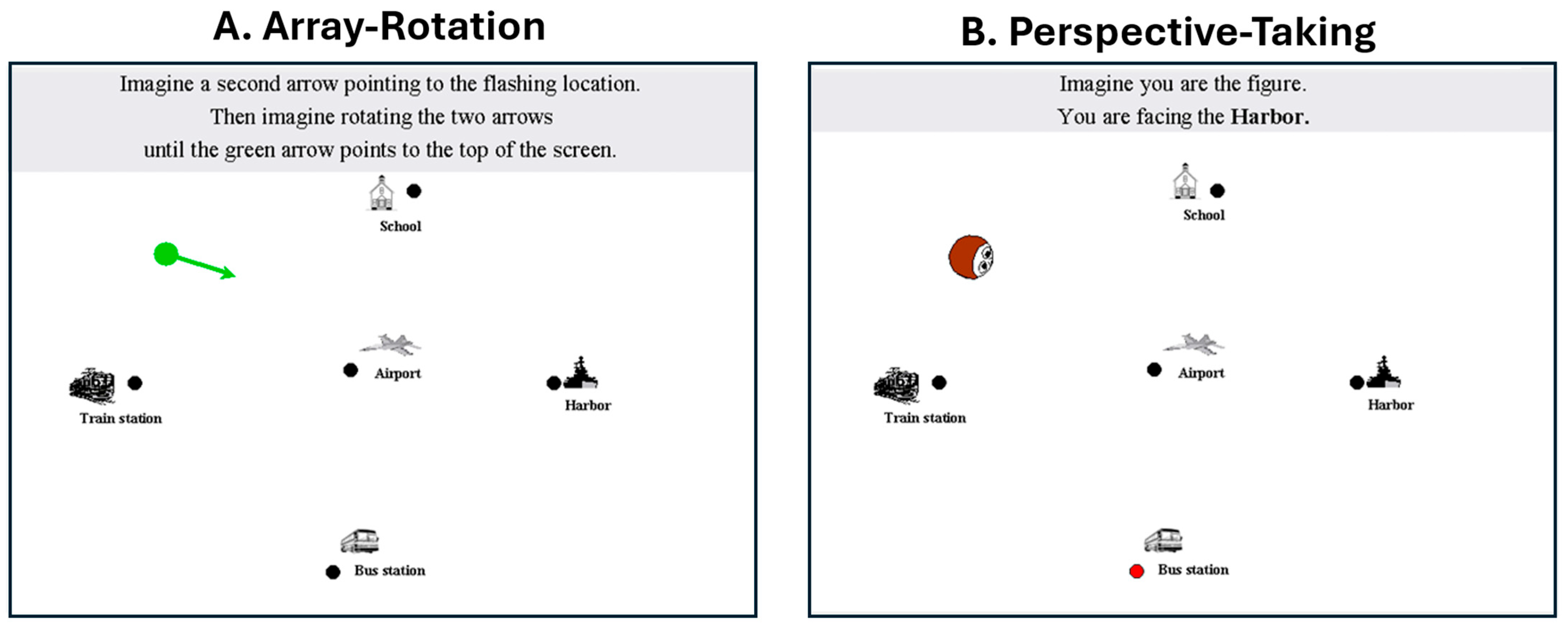
Each trial consisted of two stages. In the first stage (Stage 1), participants saw a picture of a layout of images that represent different locations (see
Figure 1A). The layout consisted of a starting location (for Array-Rotation, a green arrow with a circle base, and for Perspective-Taking, a picture of a character’s head) and five other locations (e.g., airport, school, etc.). All five locations were represented as black points, with each point labeled with the location name and a small pictogram. For each trial, the instructions were displayed at the top of the screen, and an array of response keys, with which participants were to indicate their responses, was displayed at the bottom of the screen. At this stage, for the Array-Rotation version of the task, participants simply had to look at the layout, while for the Perspective-Taking version, participants were to imagine taking the perspective of the character on the screen.
The start of the second stage (Stage 2, see
Figure 1B for perspective-taking) was marked by a change in color from black to red and the subsequent flashing of one of the five location points five seconds later. At this stage, for Array-Rotation, participants were to imagine a second arrow emerging from the base of the green arrow and pointing to the flashing location. Then participants were to imagine rotating the angle composed from these two arrows until the first arrow pointed vertically up (i.e., was aligned with the vertical axis of the computer screen). After the array rotation, participants were to indicate the pointing direction of the second arrow by clicking the corresponding response key. For Perspective-Taking, participants were to imagine pointing to the flashing location from their newly imagined perspective (the character on the screen) and click the response key corresponding to the pointing direction.
The imagined rotations varied from 100° to 260° (relative to the upright direction) in increments of 20°. Angles less than 100° and more than 260° were not used for imagined headings because previous research has shown that observers usually used strategies other than egocentric strategies for those angles (e.g., analytical strategies or tilting the head to ‘see’ the angle) [
15]. For all analyses, the same rotation angles in clockwise and counterclockwise directions (e.g., 100° and 260°) were averaged together as the same condition (100°). This approach is based on evidence that participants perform egocentric transformations along the shortest rotational path [
15]. Furthermore, for each of the 9 imagined rotations, all 8 of the cardinal and inter-cardinal pointing directions (0°/Front, 45°/Front-Right, 90°/Right, 135°/Back-Right, 180°/Back, 225°/Back-Left, 270°/Left, 315°/Front-Left) were used, resulting in 72 trials in each block of the task.
2.3. Procedure
All participants performed both versions of the Pointing Direction Task (Array-Rotation and Perspective-Taking). Participants always performed 2 consecutive blocks of each version, with the order counterbalanced across subjects. At the beginning of each block, the task instructions were explained to the participants and displayed on the computer screen. Moreover, the participants performed 6 practice trials, which were not analyzed, prior to the first Array-Rotation and Perspective-Taking blocks. EEG was recorded throughout the experiment.
2.4. EEG Data Acquisition and Analysis
EEG was recorded using a 256-channel HydroCel Geodesic Sensor Net (Electrical Geodesics, Inc., Eugene, OR, USA), and all electrodes were referenced to CZ during recording. Signals were continuously sampled at 250 Hz, amplified using the EGI NetAmps 300 amplifier (Electrical Geodesics, Inc.), and stored for offline analysis.
EEG data were processed using EEGLAB version 2019.1, a MATLAB toolbox [
32]. The EEG data were re-referenced to the average reference and band-pass filtered at 0.1–30 Hz. The signal was then cleaned of eye-blink artifacts using Independent Component Analysis [
33]. Segments contaminated by other artifacts were detected as amplitudes exceeding ±100 µV or activity below 0.5 µV that spanned over 100 ms (which was never observed) in any channel. Additional artifacts were removed through manual inspection.
The EEG was then segmented into 1100 ms long epochs starting 100 ms prior to the onset of Stage 1 and the onset of Stage 2. Each segment was averaged separately, and baseline correction was adjusted by subtracting the mean amplitude of the pre-stimulus period of each ERP from all the data points in the segment. Because the temporal and spatial distribution of potential ERP differences was not known a priori, a cluster-based non-parametric permutation approach was employed [
34], which allows statistical evaluation across electrodes and time points while controlling for multiple comparisons. For this analysis, electrodes were first grouped into nine scalp regions of interest based on anterior–posterior position and laterality, and permutation testing was then applied across scalp regions and time points.
2.5. Analysis of Effects of Required Angular Transformation
The EEG for 100° and 160° angle rotations was segmented separately for Array-Rotation and Perspective-Taking trials. The analysis was restricted to 100° and 160° to compare neural responses between conditions at angles that produce robust behavioral differentiation. These large-angle conditions were selected based on prior spatial transformation research showing that larger angular disparities reliably engage perspective-taking processes and produce substantial behavioral differentiation [
7,
15]. Given that performance varies gradually with angular disparity, a parametric analysis across all angles would address the effect of angle rather than the contrast between tasks. The selected angles, therefore, provide a controlled basis for comparing Perspective-Taking and Array-Rotation without additional variability from intermediate angles.
The segments were time-locked to the onset of the rotation task: for Array-Rotation, they were time-locked to the onset of Stage 2; for Perspective-Taking, they were time-locked to the onset of Stage 1. The temporal alignment was defined relative to the onset of the spatial transformation in each task, which occurs at Stage 1 in Perspective-Taking (adoption of the imagined viewpoint) and at Stage 2 in Array-Rotation (presentation of the rotated array).
To reduce the number of statistical comparisons and control for multiple comparisons, EEG electrodes were grouped into nine regions of interest based on scalp location, defined by the combination of anterior–posterior position (frontal, central, parieto-occipital) and laterality (left, midline, right), following Mudrik et al. [
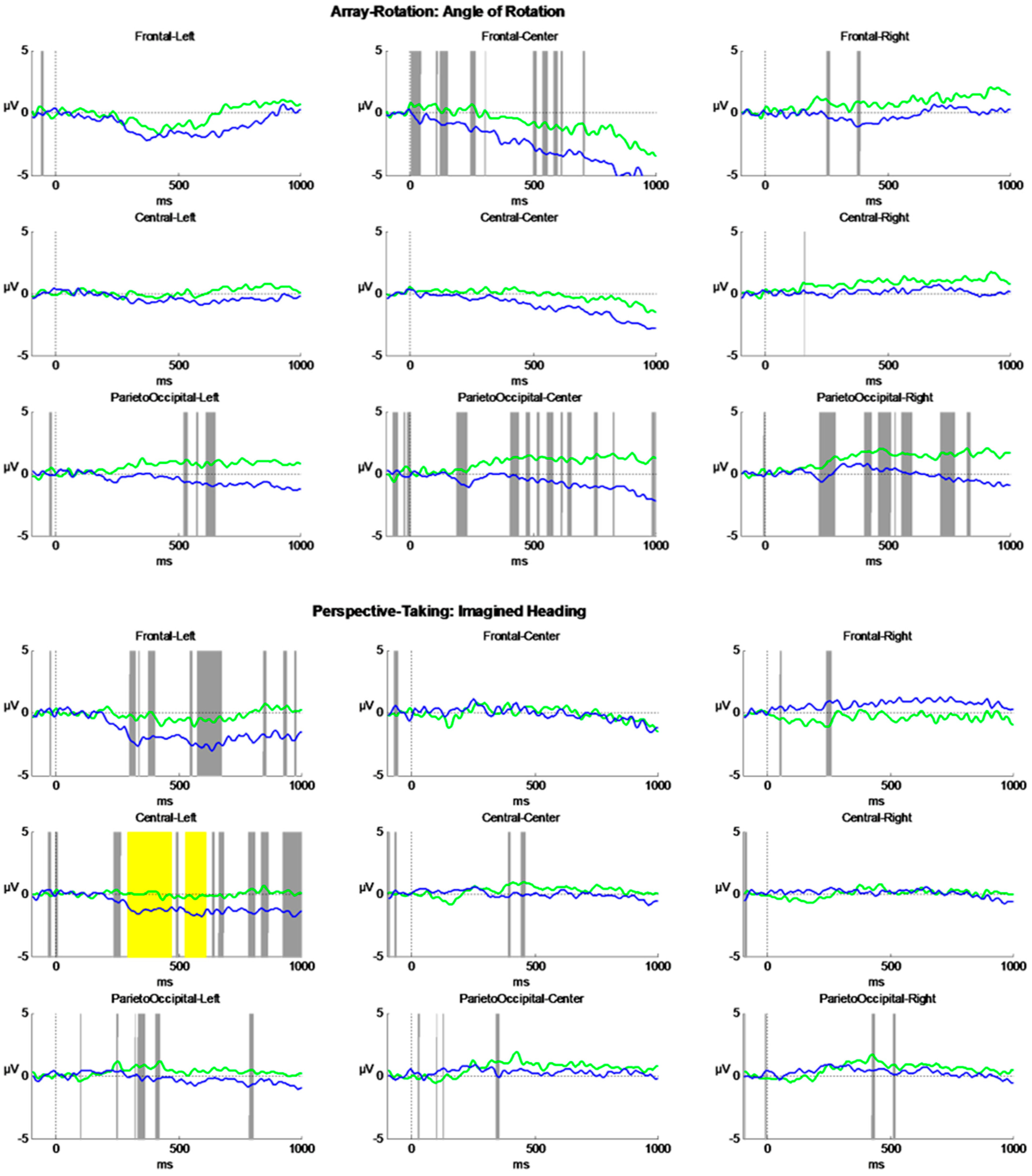
35]. Subsequently, to investigate the occurrence of imagined rotations in egocentric and allocentric transformations, we computed the mean activity during the 400–800 latency region, which was assessed in a 2 (Task: Array-Rotation/Perspective-Taking) × 9 (Location: Frontal-Left/Frontal-Center/Frontal-Right/Central-Left/Central-Center/Central-Right/Parieto-Occipital-Left/Parieto-Occipital-Center/Parieto-Occipital-Right) × 2 (Rotation: 100°/160°) repeated measures ANOVA. To investigate additional differences between allocentric and egocentric rotations, we used the cluster-based nonparametric permutation test described in ref. [
34], separately for the Array-Rotation and Perspective-Taking tasks using all 9 regions (for a complete explanation of the statistical procedures, see refs. [
34,
35]. Since previous studies on array rotations found that differences in the degree of rotation lead to differences in the mean ERP amplitudes at 400–800 ms latencies so that larger rotations lead to more negative amplitudes (e.g., [
24,
25]; see ref. [
28] for a review), we first compared the ERPs elicited by 100° and 160° rotations during this time period for both tasks. Subsequently, to explore additional differences between egocentric and allocentric rotations, we performed the same analysis using data points from the entire 1000 ms trial.
2.6. Analysis of Effects of Pointing Direction
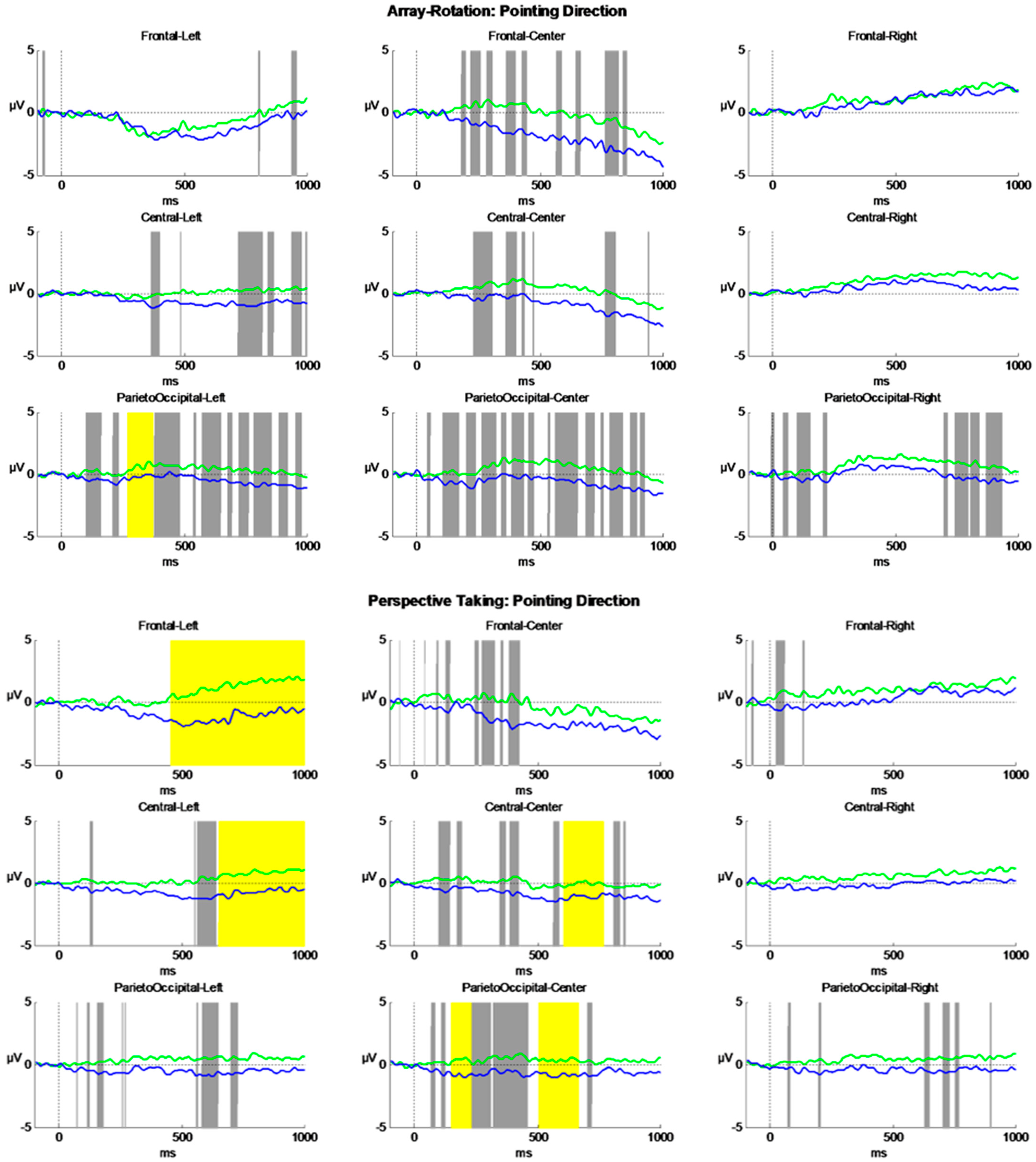
The EEG for front and back pointing directions was segmented separately for Array-Rotation and Perspective-Taking and time-locked to the onset of Stage 2. The same cluster-based nonparametric statistical permutation test used for the rotation analyses was applied to compare differences between front and back directions, separately for Array-Rotation and Perspective-Taking, across all 9 regions and the entire 1000 ms trials.
4. Discussion
The present study investigated the neural dynamics underlying egocentric perspective transformations and allocentric array rotations using event-related potentials. Although both tasks required participants to compute object directions following spatial transformations, the ERP results revealed differences in their neural dynamics.
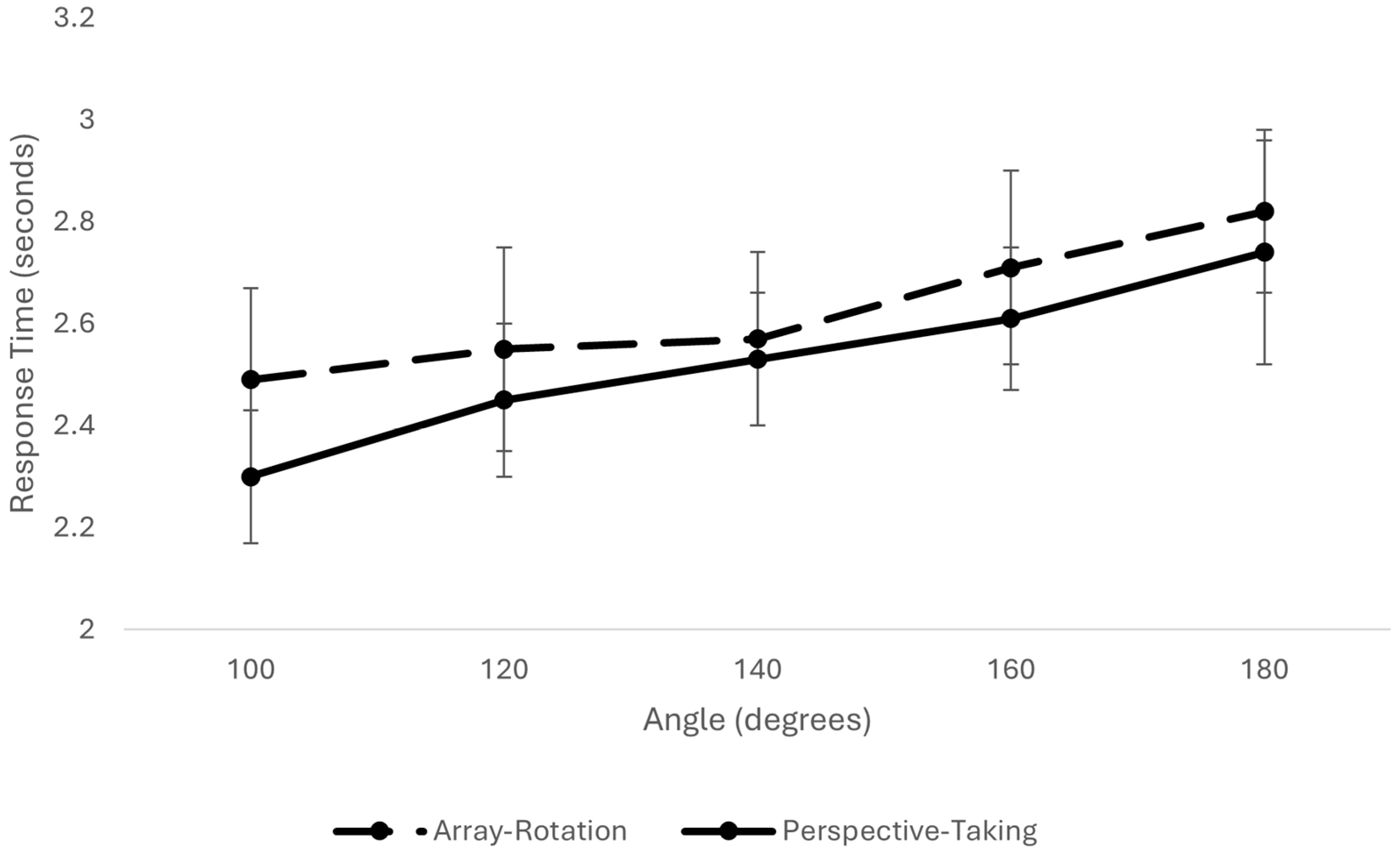
Specifically, the first goal of this study was to investigate and compare the ERP correlates of imagined mental rotations in egocentric and allocentric spatial transformations. Although the similarities in response times between Perspective-Taking and Array-Rotation tasks are suggestive of the utilization of imagined rotations during both tasks (e.g., [
7,
29,
30]), direct evidence for this hypothesis has thus far been lacking. The present results provide such evidence by showing that both types of spatial transformations elicited significant ERP differences between 100° and 160° rotations during the 400–800 ms latency period, with larger rotations producing more negative amplitudes. This is consistent with previous findings on allocentric transformations (e.g., [
24,
25,
27]), and indicates that egocentric transformations are also systematically modulated by rotation angle.
However, the spatial distribution of this effect differs markedly between the two tasks. Rotation-related activity in the Array-Rotation task was concentrated in parieto-occipital regions, consistent with previous ERP findings on object-based mental rotation and visual–spatial working memory processes (e.g., [
24,
25]). These findings are consistent with the interpretation that array rotation involves transforming the spatial representation of the object layout itself, requiring participants to mentally rotate the visual configuration of objects before computing the target direction. In contrast, Perspective-Taking did not show this posterior pattern; instead, rotation-related effects were localized to central and frontal regions, particularly over the left hemisphere, and the effect appeared to emerge earlier than in the array-rotation task. The absence of posterior ERP signatures during perspective-taking indicates that participants were not performing a rotation operation in visual–spatial working memory. Visual–spatial working memory is associated with sustained occipital–parietal activity and characteristic posterior ERP components; the lack of these signatures therefore suggests that, although both tasks involve rotation-related processing, egocentric perspective-taking is supported by a different, non-visual mechanism distinct from that underlying allocentric rotation processes. This interpretation is reflective of previous research (e.g., [
38]), which showed that early visual deprivation promotes the use of egocentric spatial representations in congenitally blind individuals, whereas individuals with prior visual experience were more inclined to use allocentric spatial representations.
Egocentric perspective-taking requires the observer to update their own orientation, and the mechanism uniquely compatible with prior research for achieving this computation is the internal simulation of the self-motion signals that accompany real movements of the head and body. During actual movement, these self-motion signals track changes in orientation, with vestibular signals related to head rotation, and proprioceptive and motor-related signals encoding changes in body orientation [
39,
40]. Consistent with this view, neuroimaging studies show that imagining body-based transformations engages motor planning regions, including the supplementary motor and premotor cortices [
41], while vestibular and body-related signals, engaging the temporo-parietal and insular cortices, contribute to the representation of body orientation in space [
42]. These data are consistent with the idea that egocentric transformations rely on simulated self-motion rather than on rotating visual layouts in visual working memory (see also Ref. [
43] for further review). In addition, evidence from spatial navigation research indicates that perspective-taking is closely related to path integration, the ability to track one’s position and orientation from self-motion cues. Individuals who perform better on perspective-taking tasks also perform better on blindfolded triangulation, indicating more accurate use of vestibular and proprioceptive signals, and show superior performance in wayfinding tasks that require continuous updating of orientation [
12]. Within this framework, the more central and frontal ERP distribution observed during perspective-taking is consistent with engagement of systems involved in simulated self-orientation and spatial updating, rather than with posterior visual–spatial mechanisms characteristic of allocentric object rotation. Thus, although both tasks show rotation-dependent modulation, the present results indicate that while allocentric transformations operate on visual object representations, egocentric perspective-taking may rely on updating of the observer-centered reference frame, supported by neural systems associated with self-motion and body-based spatial computations.
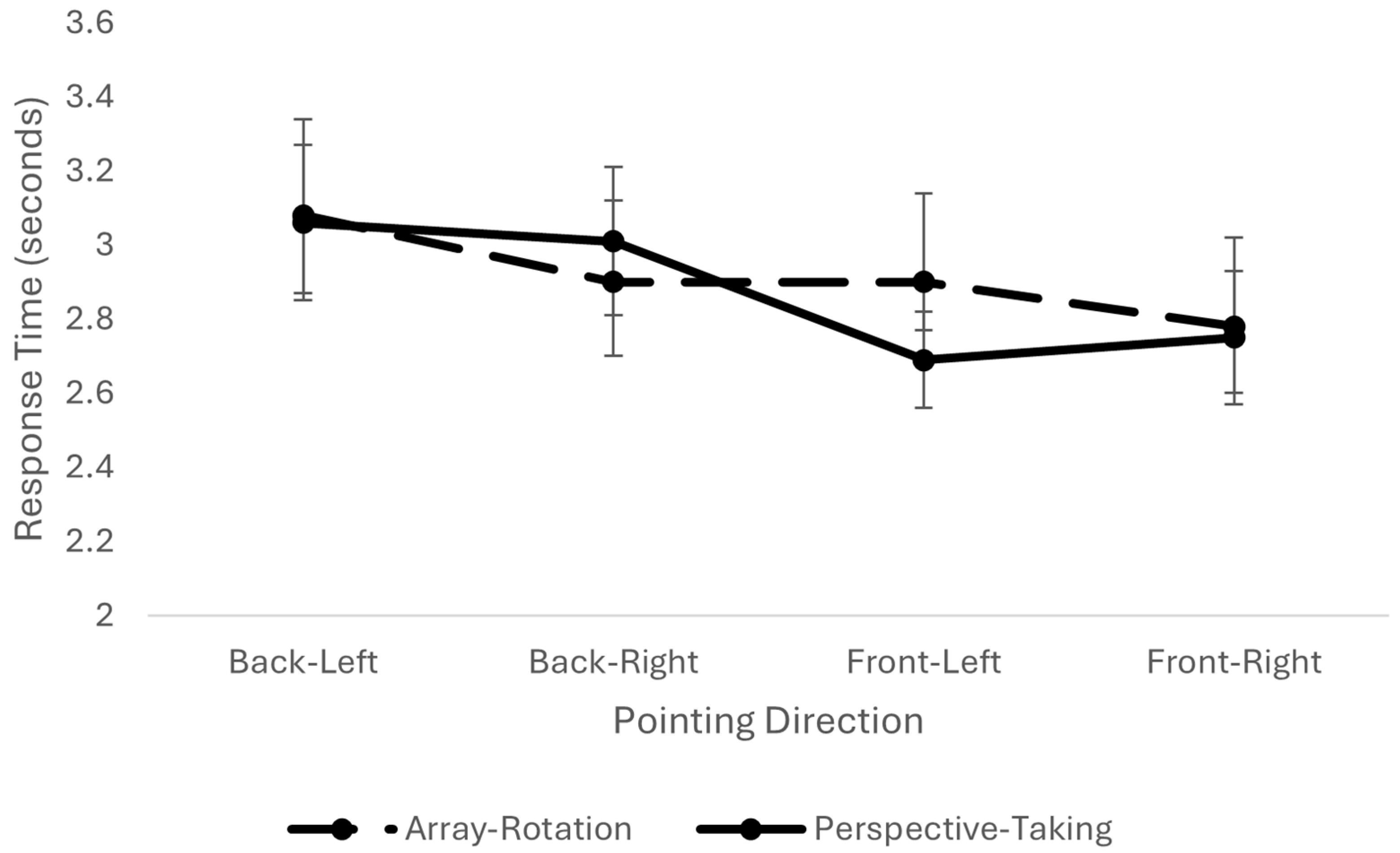
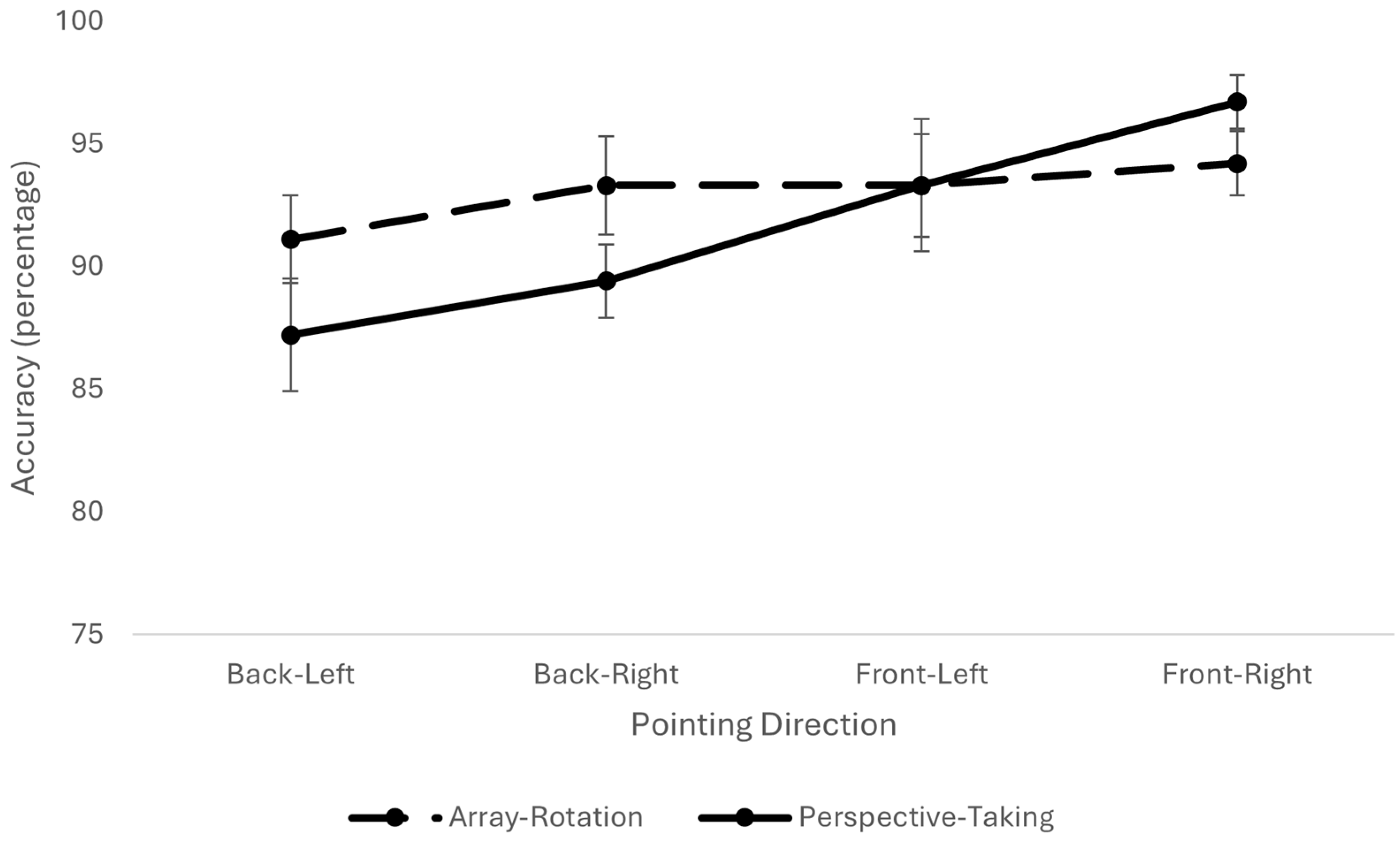
The second goal of this study was to compare ERP responses associated with pointing-direction computations under egocentric and allocentric task demands. Consistent with prior behavioral findings, egocentric perspective-taking produced clear differences between front and back pointing directions, reflected in more negative ERP amplitudes for front directions across multiple scalp regions and time windows. Importantly, a qualitatively similar but substantially weaker effect was also observed in the allocentric Array-Rotation condition, despite the absence of corresponding behavioral differences. A likely explanation for this pattern is that participants did not rely exclusively on allocentric transformations in the Array-Rotation task, but occasionally adopted egocentric strategies, as previously documented [
15]. Under this account, the residual front–back ERP differences observed in the allocentric condition reflect intermittent engagement of egocentric computations, which are not strong enough to influence overt performance but are detectable at the neural level.
Furthermore, the front–back asymmetry observed in the egocentric condition reflects a fundamental characteristic of egocentric encoding. In egocentric representations, spatial locations are defined relative to the body axes—front, back, left, and right—and positions behind the body are reliably processed less efficiently than those in front [
14,
31]. The broader and more pronounced ERP effects for back-pointing than front-pointing directions observed during perspective-taking are consistent with this inherent property of egocentric encoding. In contrast, allocentric transformations operate on object-to-object relations and do not depend on the observer’s orientation. Thus, they do not inherently require differential processing of front versus back directions, which explains the weaker, less clearly differentiated ERP pattern in the allocentric condition.
The distinctions between egocentric and allocentric transformations reported in this study are not only theoretically important but also have direct implications for real-world performance in tasks and professional activities—such as spatial navigation in unfamiliar environments, image-guided medical procedures, dentistry, and teleoperation—where the position and orientation of the body are critical. In such contexts, relying on egocentric, self-motion–based computations may place different demands on neural systems than allocentric, visually based transformations, and may be differentially vulnerable to fatigue, sensory degradation, or pathology. Understanding that these tasks draw on distinct computational operations, therefore, provides a framework for designing training protocols, interfaces, and assessment tools that are better aligned with the underlying mechanisms supporting body-centered spatial performance.
One limitation of the present study is the relatively small sample size, which reflects the strict inclusion criterion requiring participants to reliably exhibit the behavioral signature of egocentric processing. This constraint was essential to ensure that the perspective-taking condition was performed using the intended transformation strategy. Within this constrained sample, however, the effects were robust and consistently observed at both behavioral and ERP levels. At the same time, given the sample size, the present findings should be regarded as exploratory. Future studies with larger samples will be important for confirming the generality and reproducibility of these effects and for further characterization of the neural mechanisms underlying egocentric and allocentric spatial transformations. In addition, although the ERP measures used in the present study enabled characterization of the temporal dynamics distinguishing egocentric and allocentric transformations, they lack sufficient spatial resolution to directly evaluate the proposed involvement of embodied self-motion and motor simulation mechanisms in egocentric perspective-taking.
Despite its exploratory nature, the present study provides, to our knowledge, the first experimental dissociation of egocentric perspective-taking and allocentric transformation processes under controlled strategy conditions, revealing distinct temporal neural dynamics associated with these transformations. By combining strict criteria for isolating egocentric transformation strategies with temporally dissociable transformation stages, the present findings establish a foundation for future neuroscience research aimed at dissociating the computational and neural mechanisms underlying egocentric and allocentric transformations and examining their relationship to vestibular, proprioceptive, and motor simulation processes.