
Assessment of Adverse Events Using the Therapy–Disability–Neurology (TDN) Grading System in a Cohort of Aneurysmal Subarachnoid Hemorrhage Patients: A Single-Center Retrospective Cohort Study
 , , , ,
Highlights
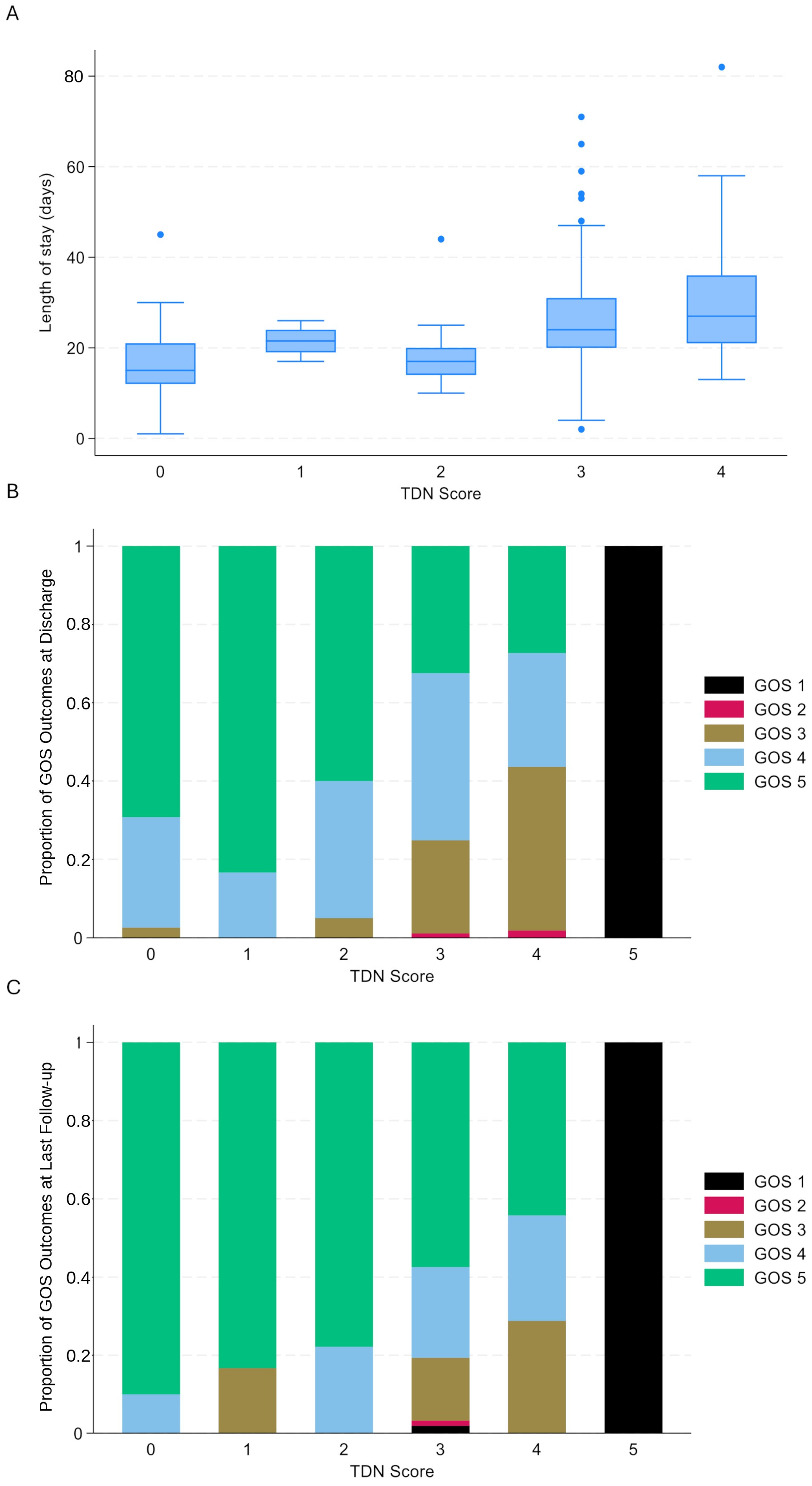
- The TDN grade significantly correlates with length of hospital stay and functional outcomes in aSAH patients treated surgically and/or endovascularly.
- Higher complication burden as captured by the TDN grade is associated with longer hospitalization and worse functional outcomes at discharge and long-term follow-up.
- The TDN grade can serve as a standardized prognostic tool in aSAH, extending its applicability beyond its original perioperative neurosurgical context.
- Comprehensive complication grading may support clinical decision-making, patient counseling, and resource planning in aSAH care.
Abstract
1. Introduction
2. Patients and Methods
2.1. Study Design and Population
2.2. Assessment of the TDN Grade
2.3. Outcome Variables
2.4. Statistical Analysis
3. Results
3.1. TDN Grade and Hospital Stay
3.2. TDN Grade and Functional Outcomes
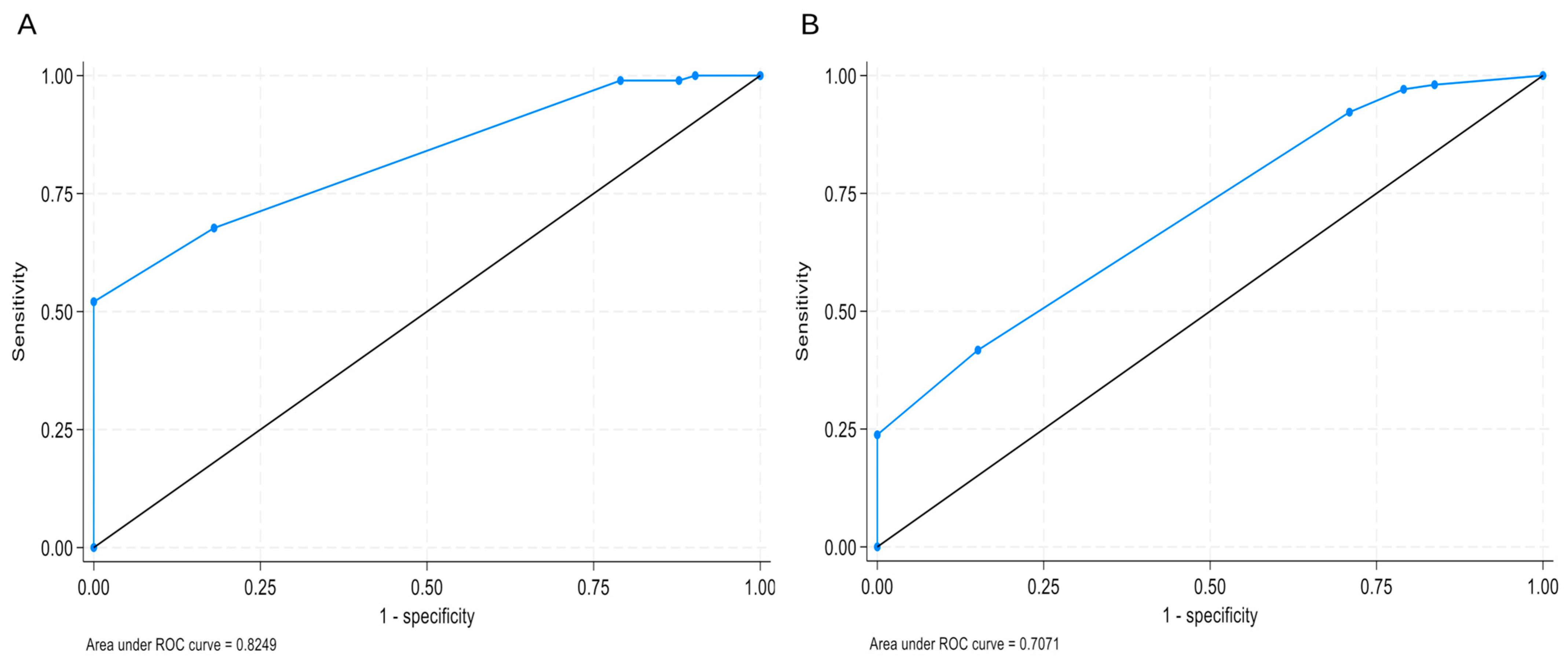
3.3. Discrimination of the TDN Grade for Poor Outcomes
3.4. TDN Grade and Employment Status
3.5. TDN Grade and Correlations with Initial SAH Severity Scores
4. Discussion
5. Conclusions
Supplementary Materials
Author Contributions
Funding
Institutional Review Board Statement
Informed Consent Statement
Data Availability Statement
Conflicts of Interest
Abbreviations
| AE | Adverse Event |
| SAH | Aneurysmal Subarachnoid Hemorrhage |
| AUC | Area Under the Curve |
| AUROC | Area Under the Receiver Operating Characteristic Curve |
| BNI | Barrow Neurological Institute |
| CI | Confidence Interval |
| CTA | Computed Tomography Angiography |
| DSA | Digital Subtraction Angiography |
| EVD | Extraventricular Drainage |
| GOS | Glasgow Outcome Scale |
| ICP | Intracranial Pressure |
| IQR | Interquartile Range |
| KPS | Karnofsky Performance Status |
| LOS | Length of Stay (Hospital) |
| MRA | Magnetic Resonance Angiography |
| mRS | Modified Rankin Scale |
| OR | Odds Ratio |
| SD | Standard Deviation |
| STROBE | Strengthening the Reporting of Observational Studies in Epidemiology |
| TDN | Therapy–Disability–Neurology (Grade) |
| WFNS | World Federation of Neurological Surgeons (Score) |
References
- Lawson, E.H.; Hall, B.L.; Louie, R.; Ettner, S.L.; Zingmond, D.S.; Han, L.; Rapp, M.; Ko, C.Y. Association between occurrence of a postoperative complication and readmission: Implications for quality improvement and cost savings. Ann. Surg. 2013, 258, 10–18. [Google Scholar] [CrossRef] [Scilit]
- Meyer, H.S.; Wagner, A.; Obermueller, T.; Negwer, C.; Wostrack, M.; Krieg, S.; Gempt, J.; Meyer, B. Assessment of the incidence and nature of adverse events and their association with human error in neurosurgery. A prospective observation. Brain Spine 2022, 2, 100853. [Google Scholar] [CrossRef] [Scilit]
- Clavien, P.A.; Barkun, J.; de Oliveira, M.L.; Vauthey, J.N.; Dindo, D.; Schulick, R.D.; de Santibañes, E.; Pekolj, J.; Slankamenac, K.; Bassi, C.; et al. The Clavien-Dindo classification of surgical complications: Five-year experience. Ann. Surg. 2009, 250, 187–196. [Google Scholar] [CrossRef] [Scilit]
- Sarnthein, J.; Stieglitz, L.H.; Clavien, P.A.; Regli, L. Neurosurgery outcomes and complications in a monocentric 7-year patient registry. Brain Spine 2022, 2, 100860. [Google Scholar] [CrossRef] [Scilit]
- Sebök, M.; Blum, P.; Sarnthein, J.; Fierstra, J.; Germans, M.R.; Serra, C.; Krayenbühl, N.; Regli, L.; Esposito, G. Validation of the Clavien-Dindo grading system of complications for microsurgical treatment of unruptured intracranial aneurysms. Neurosurg. Focus. 2021, 51, E10. [Google Scholar] [CrossRef] [Scilit]
- Drexler, R.; Ricklefs, F.L.; Pantel, T.; Göttsche, J.; Nitzschke, R.; Zöllner, C.; Westphal, M.; Dührsen, L. Association of the classification of intraoperative adverse events (ClassIntra) with complications and neurological outcome after neurosurgical procedures. Acta Neurochir. 2023, 165, 2555–2563. [Google Scholar] [CrossRef] [Scilit] [PubMed]
- Landriel Ibanez, F.A.; Hem, S.; Ajler, P.; Vecchi, E.; Ciraolo, C.; Baccanelli, M.; Tramontano, R.; Knezevich, F.; Carrizo, A. A new classification of complications in neurosurgery. World Neurosurg. 2011, 75, 709–715. [Google Scholar] [CrossRef] [Scilit] [PubMed]
- Terrapon, A.P.R.; Zattra, C.M.; Voglis, S.; Velz, J.; Vasella, F.; Akeret, K.; Held, U.; Schiavolin, S.; Bozinov, O.; Ferroli, P.; et al. Adverse Events in Neurosurgery: The Novel Therapy-Disability-Neurology Grade. Neurosurgery 2021, 89, 236–245. [Google Scholar] [CrossRef] [Scilit] [PubMed]
- Terrapon, A.P.R.; Kälin, V.; Zeitlberger, A.M.; Weller, J.; Kissling, C.; Neidert, N.; Mohme, M.; El-Garci, A.; Juratli, T.A.; Trong, P.D.; et al. International survey-based assessment of the reliability, validity, and interpretability of the TDN grade for neurosurgical adverse events. Sci. Rep. 2025, 15, 37600. [Google Scholar] [CrossRef] [Scilit]
- Nieuwkamp, D.J.; Setz, L.E.; Algra, A.; Linn, F.H.; de Rooij, N.K.; Rinkel, G.J. Changes in case fatality of aneurysmal subarachnoid haemorrhage over time, according to age, sex, and region: A meta-analysis. Lancet Neurol. 2009, 8, 635–642. [Google Scholar] [CrossRef] [Scilit]
- Al-Khindi, T.; Macdonald, R.L.; Schweizer, T.A. Cognitive and functional outcome after aneurysmal subarachnoid hemorrhage. Stroke 2010, 41, e519–e536. [Google Scholar] [CrossRef] [Scilit]
- Suarez, J.I.; Tarr, R.W.; Selman, W.R. Aneurysmal subarachnoid hemorrhage. N. Engl. J. Med. 2006, 354, 387–396. [Google Scholar] [CrossRef] [Scilit]
- Steiner, T.; Juvela, S.; Unterberg, A.; Jung, C.; Forsting, M.; Rinkel, G.; European Stroke Organization. European Stroke Organization guidelines for the management of intracranial aneurysms and subarachnoid haemorrhage. Cerebrovasc. Dis. 2013, 35, 93–112. [Google Scholar] [CrossRef] [Scilit]
- Schievink, W.I. Intracranial aneurysms. N. Engl. J. Med. 1997, 336, 28–40. [Google Scholar] [CrossRef] [Scilit]
- Eriksen, N.; Rostrup, E.; Fabricius, M.; Scheel, M.; Major, S.; Winkler, M.K.L.; Bohner, G.; Santos, E.; Sakowitz, O.W.; Kola, V.; et al. Early focal brain injury after subarachnoid hemorrhage correlates with spreading depolarizations. Neurology 2019, 92, e326–e341. [Google Scholar] [CrossRef] [Scilit]
- Claassen, J.; Carhuapoma, J.R.; Kreiter, K.T.; Du, E.Y.; Connolly, E.S.; Mayer, S.A. Global cerebral edema after subarachnoid hemorrhage: Frequency, predictors, and impact on outcome. Stroke 2002, 33, 1225–1232. [Google Scholar] [CrossRef] [Scilit] [PubMed]
- Connolly, E.S., Jr.; Rabinstein, A.A.; Carhuapoma, J.R.; Derdeyn, C.P.; Dion, J.; Higashida, R.T.; Hoh, B.L.; Kirkness, C.J.; Naidech, A.M.; Ogilvy, C.S.; et al. Guidelines for the management of aneurysmal subarachnoid hemorrhage: A guideline for healthcare professionals from the American Heart Association/American Stroke Association. Stroke 2012, 43, 1711–1737. [Google Scholar] [CrossRef] [Scilit]
- Dreier, J.P.; Lemale, C.L.; Kola, V.; Friedman, A.; Schoknecht, K. Spreading depolarization is not an epiphenomenon but the principal mechanism of the cytotoxic edema in various gray matter structures of the brain during stroke. Neuropharmacology 2018, 134, 189–207. [Google Scholar] [CrossRef] [Scilit] [PubMed]
- von Elm, E.; Altman, D.G.; Egger, M.; Pocock, S.J.; Gøtzsche, P.C.; Vandenbroucke, J.P.; STROBE Initiative. The Strengthening the Reporting of Observational Studies in Epidemiology (STROBE) statement: Guidelines for reporting observational studies. Epidemiology 2007, 18, 800–804. [Google Scholar] [CrossRef] [Scilit]
- Wartenberg, K.E.; Schmidt, J.M.; Claassen, J.; Temes, R.E.; Frontera, J.A.; Ostapkovich, N.; Parra, A.; Connolly, E.S.; Mayer, S.A. Impact of medical complications on outcome after subarachnoid hemorrhage. Crit. Care Med. 2006, 34, 617–623. [Google Scholar] [CrossRef] [Scilit] [PubMed]
- Solenski, N.J.; Haley, E.C., Jr.; Kassell, N.F.; Kongable, G.; Germanson, T.; Truskowski, L.; Torner, J.C. Medical complications of aneurysmal subarachnoid hemorrhage: A report of the multicenter, cooperative aneurysm study. Crit. Care Med. 1995, 23, 1007–1017. [Google Scholar] [CrossRef] [Scilit]
- Roos, Y.B.; de Haan, R.J.; Beenen, L.F.; Groen, R.J.; Albrecht, K.W.; Vermeulen, M. Complications and outcome in patients with aneurysmal subarachnoid haemorrhage: A prospective hospital based cohort study in the Netherlands. J. Neurol. Neurosurg. Psychiatry 2000, 68, 337–341. [Google Scholar] [CrossRef] [Scilit]
- Alaraj, A.; Hussein, A.E.; Esfahani, D.R.; Amin-Hanjani, S.; Aletich, V.A.; Charbel, F.T. Reducing length of stay in aneurysmal subarachnoid hemorrhage: A three year institutional experience. J. Clin. Neurosci. 2017, 42, 66–70. [Google Scholar] [CrossRef] [Scilit]
- Ridwan, S.; Urbach, H.; Greschus, S.; Hagen, J.V.; Esche, J.; Boström, A. Health Economic Aspects of Aneurysmal Subarachnoid Hemorrhage: Factors Determining First Year In-Hospital Treatment Expenses. J. Neurol. Surg. A Cent. Eur. Neurosurg. 2021, 82, 204–210. [Google Scholar] [CrossRef] [Scilit]
- Rivero-Arias, O.; Gray, A.; Wolstenholme, J. Burden of disease and costs of aneurysmal subarachnoid haemorrhage (aSAH) in the United Kingdom. Cost. Eff. Resour. Alloc. 2010, 8, 6. [Google Scholar] [CrossRef] [Scilit]
- Frontera, J.A.; Claassen, J.; Schmidt, J.M.; Wartenberg, K.E.; Temes, R.; Connolly, E.S., Jr.; Macdonald, R.L.; Mayer, S.A. Prediction of symptomatic vasospasm after subarachnoid hemorrhage: The modified fisher scale. Neurosurgery 2006, 59, 21–27. [Google Scholar] [CrossRef] [Scilit] [PubMed]
- Salary, M.; Quigley, M.R.; Wilberger, J.E., Jr. Relation among aneurysm size amount of subarachnoid blood clinical outcome. J. Neurosurg. 2007, 107, 13–17. [Google Scholar] [CrossRef] [Scilit] [PubMed]
- Hostettler, I.C.; Sebok, M.; Ambler, G.; Muroi, C.; Prommel, P.; Neidert, M.C.; Richter, J.K.; Pangalu, A.; Regli, L.; Germans, M.R. Validation and Optimization of Barrow Neurological Institute Score in Prediction of Adverse Events and Functional Outcome After Subarachnoid Hemorrhage—Creation of the HATCH (Hemorrhage, Age, Treatment, Clinical State, Hydrocephalus) Score. Neurosurgery 2020, 88, 96–105. [Google Scholar] [CrossRef] [Scilit]
- Witsch, J.; Frey, H.P.; Patel, S.; Park, S.; Lahiri, S.; Schmidt, J.M.; Agarwal, S.; Falo, M.C.; Velazquez, A.; Jaja, B.; et al. Prognostication of long-term outcomes after subarachnoid hemorrhage: The FRESH score. Ann. Neurol. 2016, 80, 46–58. [Google Scholar] [CrossRef] [Scilit] [PubMed]



| Variable | Overall Cohort (n = 355) | Surgical Aneurysm Treatment (n = 158) | Endovascular Aneurysm Treatment (n = 197) | p-Value |
|---|---|---|---|---|
| Age y, (mean, SD) | 57.2 (12.9) | 56.0 (12.1) | 58.0 (13.5) | 0.36 |
| Female sex, n (%) | 235 (66.2) | 101 (63.9) | 134 (68) | 0.38 |
| Smoker, n (%) | 91 (25.6) | 35 (22.2) | 56 (28.4) | 0.3 |
| Medical History | ||||
| - Hypertension, n (%) | 91 (25.6) | 34 (21.5) | 57 (28.9) | 0.06 |
| - Diabetes Mellitus, n (%) | 14 (3.9) | 7 (4.4) | 7 (3.6) | 0.58 |
| - On statin medication, n (%) | 21 (5.9) | 7 (4.4) | 14 (7.1) | 0.36 |
| - Aspirin, n (%) | 31 (8.7) | 10 (6.3) | 21 (10.7) | 0.27 |
| Aneurysm location, n (%) | <0.01 * | |||
| - Anterior circulation | 252 (71.0) | 124 (78.5) | 128 (65.0) | |
| - Posterior circulation | 104 (29.3) | 35 (22.2) | 69 (35.0) | |
| Mean Aneurysm size mm (SD) | 7.4 (4.5) | 7.3 (4.2) | 7.9 (5.3) | 0.30 |
| Multiple aneurysms, n (%) | 94 (26.5) | 46 (29.1) | 48 (24.4) | 0.60 |
| Rebleeding, n (%) | 22 (6.2) | 8 (5.1) | 14 (7.1) | 0.52 |
| Craniectomy, n (%) | 35 (9.9) | 21 (13.3) | 14 (7.1) | 0.048 |
| EVD insertion, n (%) | 246 (69.3) | 94 (59.5) | 152 (77.2) | <0.01 * |
| Shunt dependency, n (%) | 127 (35.8) | 54 (34.2) | 73 (37.1) | 0.62 |
| TDN grade, n (%) | 0.34 1 | |||
| - 0 | 39 (11.3) | 18 (11.4) | 21 (10.7) | |
| - 1 | 6 (1.7) | 3 (2) | 3 (1.6) | |
| - 2 | 18 (5.2) | 10 (6.7) | 8 (4.3) | |
| - 3 | 184 (53.5) | 80 (50.6) | 104 (52.5) | |
| - 4 | 49 (14.2) | 23 (14.6) | 26 (13.2) | |
| - 5 | 49 (14.2) | 18 (11.4) | 31 (15.6) | |
| LOS d, mean (SD) | 23.6 (11.8) | 24.5 (11.6) | 23.2 (12.6) | 0.32 |
| Mortality during hospitalization, n (%) | 51 (14.4) | 19 (12) | 32 (16.2) | 0.29 |
| Variable | Odds Ratio (95% CI) | p-Value |
|---|---|---|
| Sex | 0.95 (0.46–1.97) | 0.898 |
| Age (per year) | 1.04 (1.01–1.07) | 0.004 |
| WFNS (per point) | 2.973 (1.870–4.726) | <0.001 |
| Hunt & Hess (per point) | 2.961 (1.950–4.499) | <0.001 |
| Fisher Score (per point) | 4.593 (2.512–8.395) | <0.001 |
| BNI Score (per point) | 2.564 (1.619–4.059) | <0.001 |
| Diabetes Mellitus | 1.655 (0.758–3.614) | 0.218 |
| Hypertension | 1.885 (0.760–4.676) | 0.172 |
| Variable | Odds Ratio (95% CI) | p-Value |
|---|---|---|
| Age (per year) | 1.03 (1.01–1.06) | 0.019 |
| Sex (female) | 0.84 (0.42–1.68) | 0.620 |
| WFNS (per point) | 1.40 (1.14–1.73) | 0.001 |
| TDN grade (per point) | 5.76 (3.69–9.01) | <0.001 |
| Variable | N | TDN Overall rho | TDN Overall p-Value |
|---|---|---|---|
| Length of Stay 1 | 305 | 0.4 | <0.0001 |
| WFNS | 355 | 0.421 | <0.0001 |
| Hunt & Hess Score | 355 | 0.435 | <0.0001 |
| Fisher Score | 355 | 0.269 | <0.0001 |
| BNI Score | 355 | 0.176 | 0.0009 |
| KPS at Discharge | 355 | −0.572 | <0.0001 |
| GOS at Discharge | 355 | −0.559 | <0.0001 |
| KPS at Last Follow-up | 250 | −0.575 | <0.0001 |
| GOS at Last Follow-up | 250 | −0.582 | <0.0001 |
Disclaimer/Publisher’s Note: The statements, opinions and data contained in all publications are solely those of the individual author(s) and contributor(s) and not of MDPI and/or the editor(s). MDPI and/or the editor(s) disclaim responsibility for any injury to people or property resulting from any ideas, methods, instructions or products referred to in the content. |
© 2026 by the authors. Licensee MDPI, Basel, Switzerland. This article is an open access article distributed under the terms and conditions of the Creative Commons Attribution (CC BY) license.
Share and Cite
Kälin, V.; Terrapon, A.P.R.; Zeitlberger, A.M.; Ambler, G.; Maschke, S.; El-Garci, A.; Bonasia, S.; Bozinov, O.; Neidert, M.C.; Hostettler, I.C. Assessment of Adverse Events Using the Therapy–Disability–Neurology (TDN) Grading System in a Cohort of Aneurysmal Subarachnoid Hemorrhage Patients: A Single-Center Retrospective Cohort Study. Brain Sci. 2026, 16, 599. https://doi.org/10.3390/brainsci16060599
Kälin V, Terrapon APR, Zeitlberger AM, Ambler G, Maschke S, El-Garci A, Bonasia S, Bozinov O, Neidert MC, Hostettler IC. Assessment of Adverse Events Using the Therapy–Disability–Neurology (TDN) Grading System in a Cohort of Aneurysmal Subarachnoid Hemorrhage Patients: A Single-Center Retrospective Cohort Study. Brain Sciences. 2026; 16(6):599. https://doi.org/10.3390/brainsci16060599
Chicago/Turabian StyleKälin, Vincens, Alexis Paul Romain Terrapon, Anna Maria Zeitlberger, Gareth Ambler, Svenja Maschke, Ahmed El-Garci, Sara Bonasia, Oliver Bozinov, Marian Christoph Neidert, and Isabel Charlotte Hostettler. 2026. "Assessment of Adverse Events Using the Therapy–Disability–Neurology (TDN) Grading System in a Cohort of Aneurysmal Subarachnoid Hemorrhage Patients: A Single-Center Retrospective Cohort Study" Brain Sciences 16, no. 6: 599. https://doi.org/10.3390/brainsci16060599
APA StyleKälin, V., Terrapon, A. P. R., Zeitlberger, A. M., Ambler, G., Maschke, S., El-Garci, A., Bonasia, S., Bozinov, O., Neidert, M. C., & Hostettler, I. C. (2026). Assessment of Adverse Events Using the Therapy–Disability–Neurology (TDN) Grading System in a Cohort of Aneurysmal Subarachnoid Hemorrhage Patients: A Single-Center Retrospective Cohort Study. Brain Sciences, 16(6), 599. https://doi.org/10.3390/brainsci16060599