Spec-RWKV: A Spectrum-Guided Multi-Scale Recurrent Modeling Framework for Multi-Center Resting-State fMRI-Assisted Diagnosis

Highlights
- Spec-RWKV showed competitive diagnostic performance on ABIDE-I and ADHD-200, with relatively consistent results under leave-one-site-out evaluation and simulated TR perturbations.
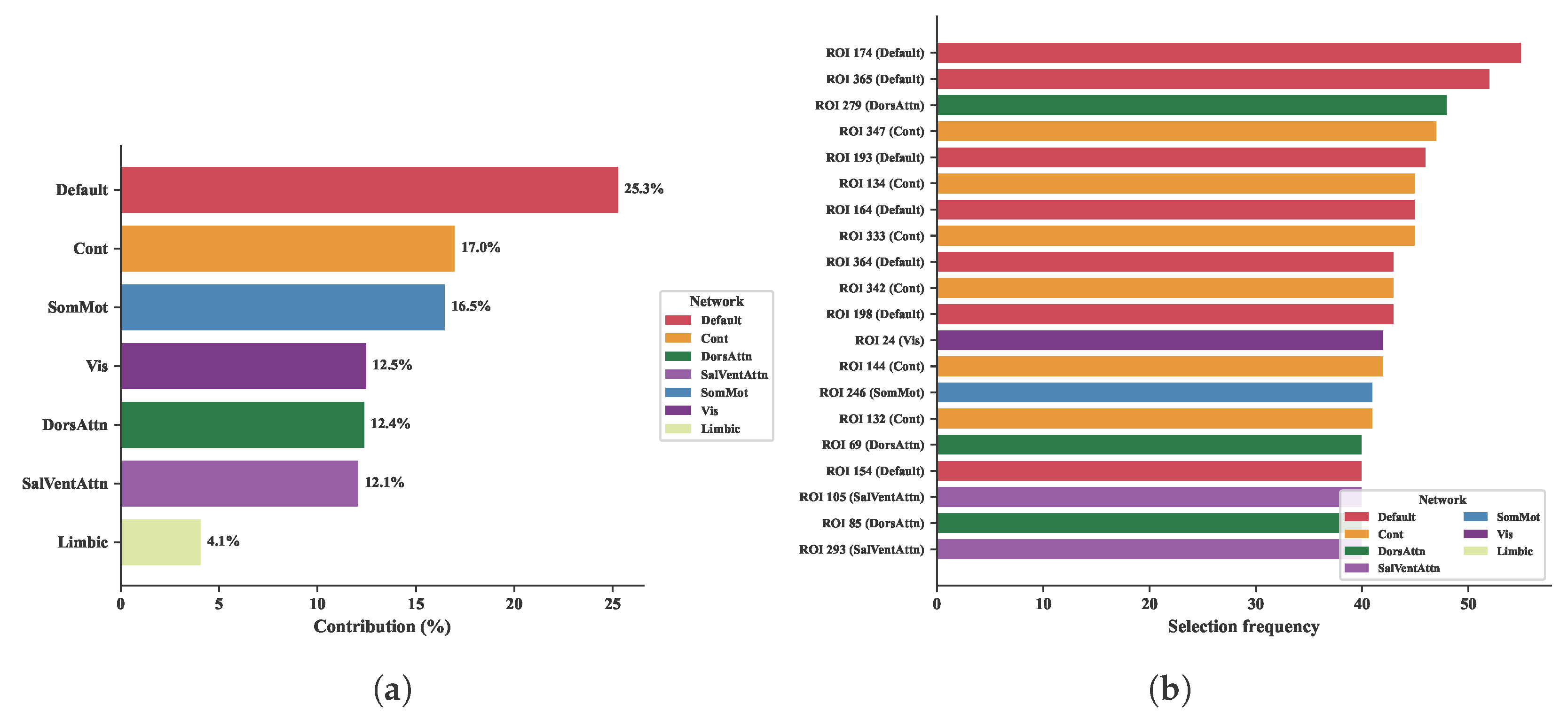
- Model-derived importance maps were concentrated in the default mode and frontoparietal networks, and ASD-related spectral differences were more evident in slower frequency bands.
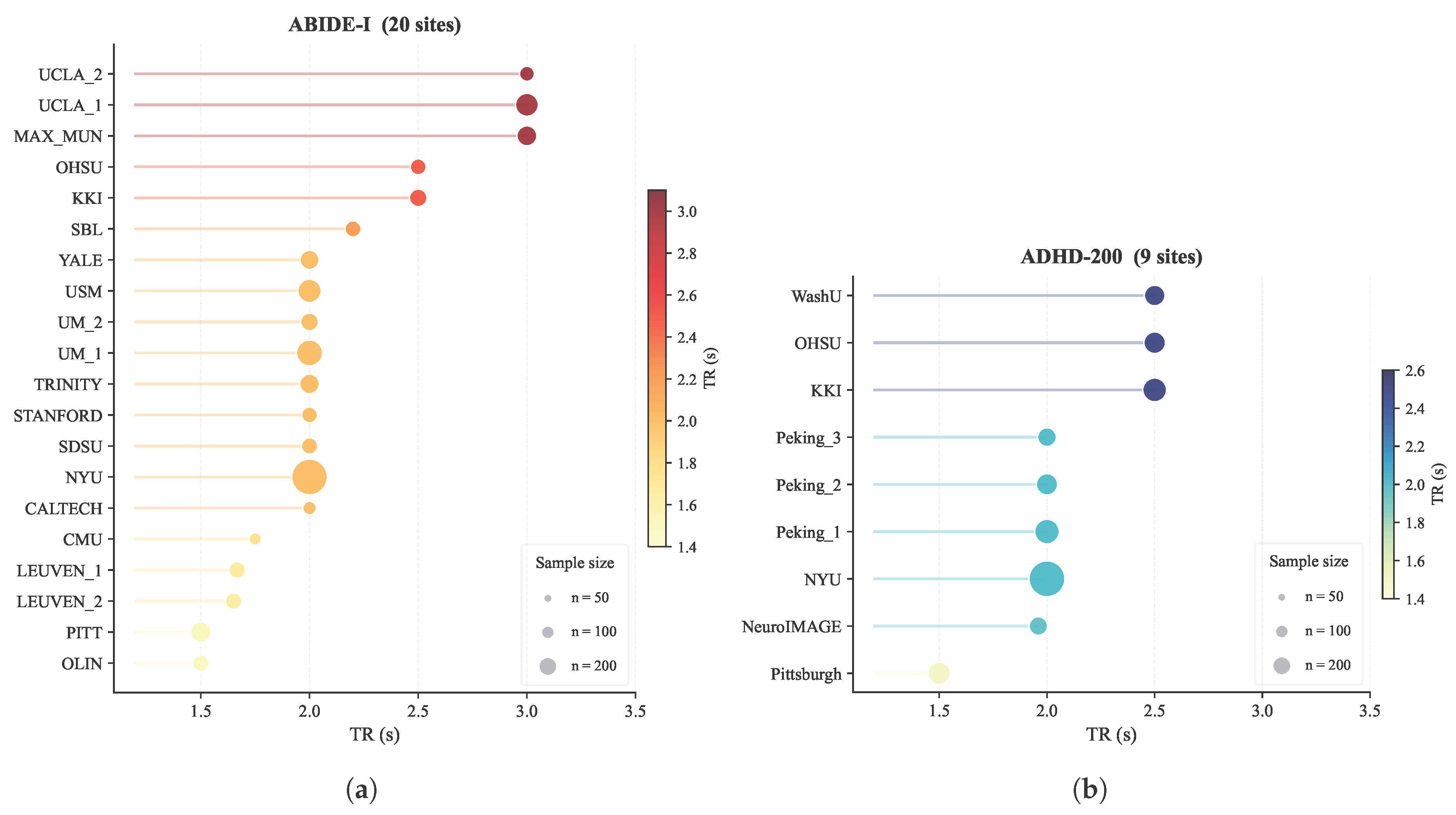
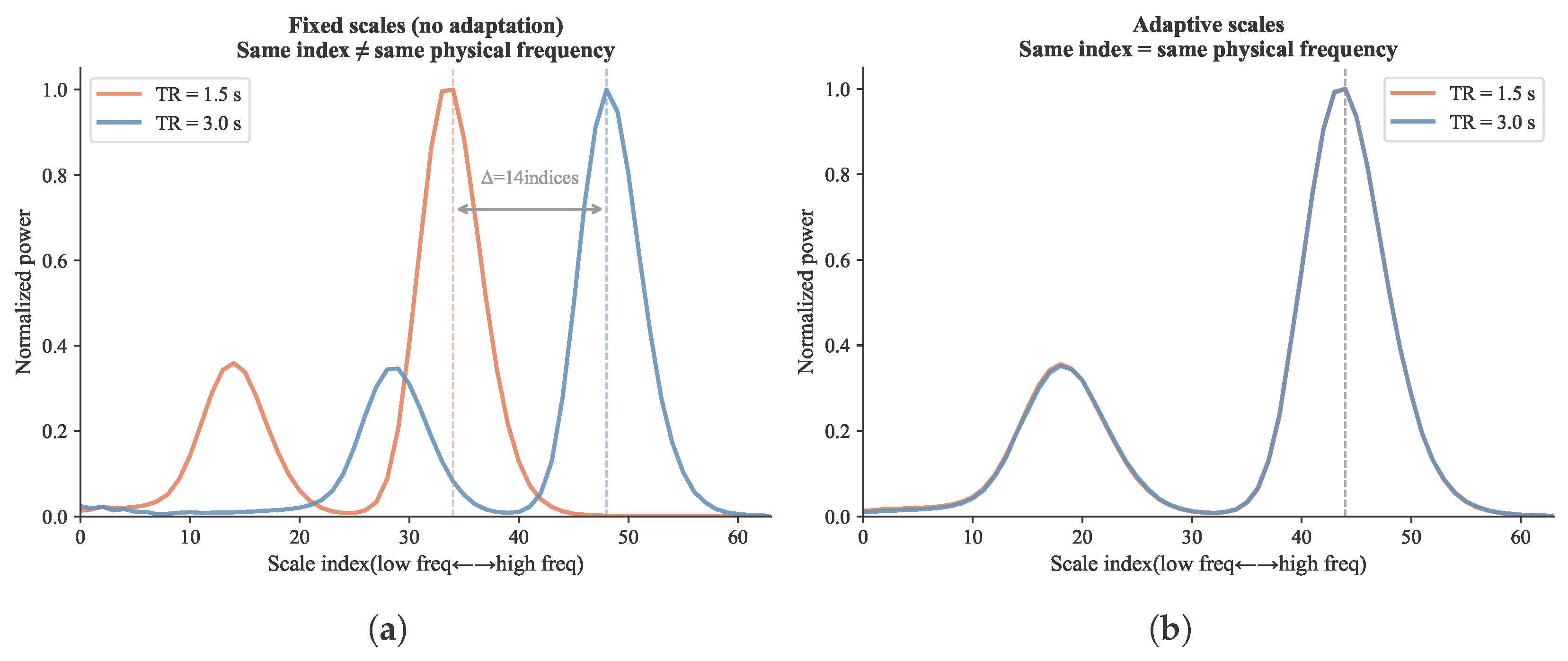
- Defining temporal dynamics in physical time may help make multi-site rs-fMRI modeling less sensitive to acquisition differences in TR.
- Joint temporal–spectral modeling could provide cross-site analyses with intermediate patterns that remain easier to inspect and interpret.
Abstract
1. Introduction
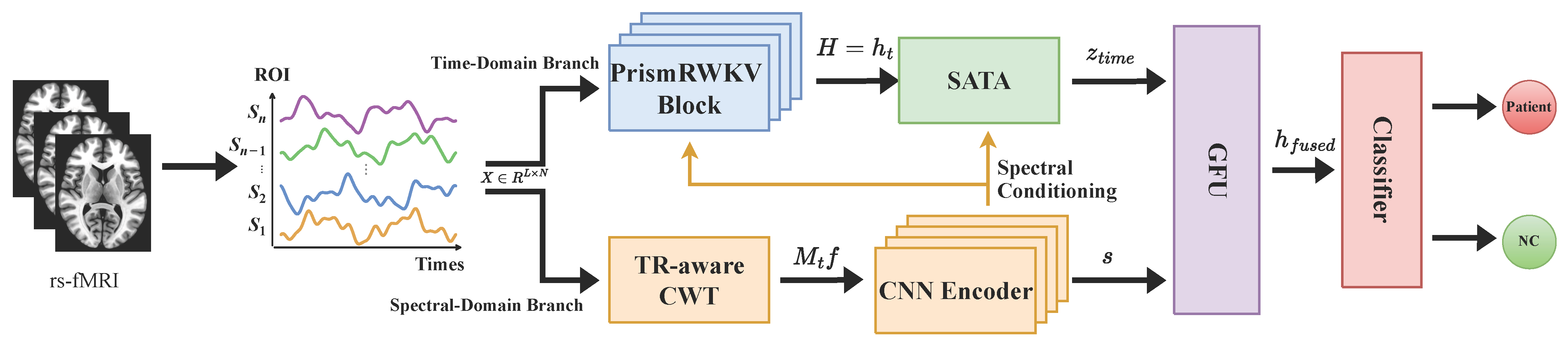
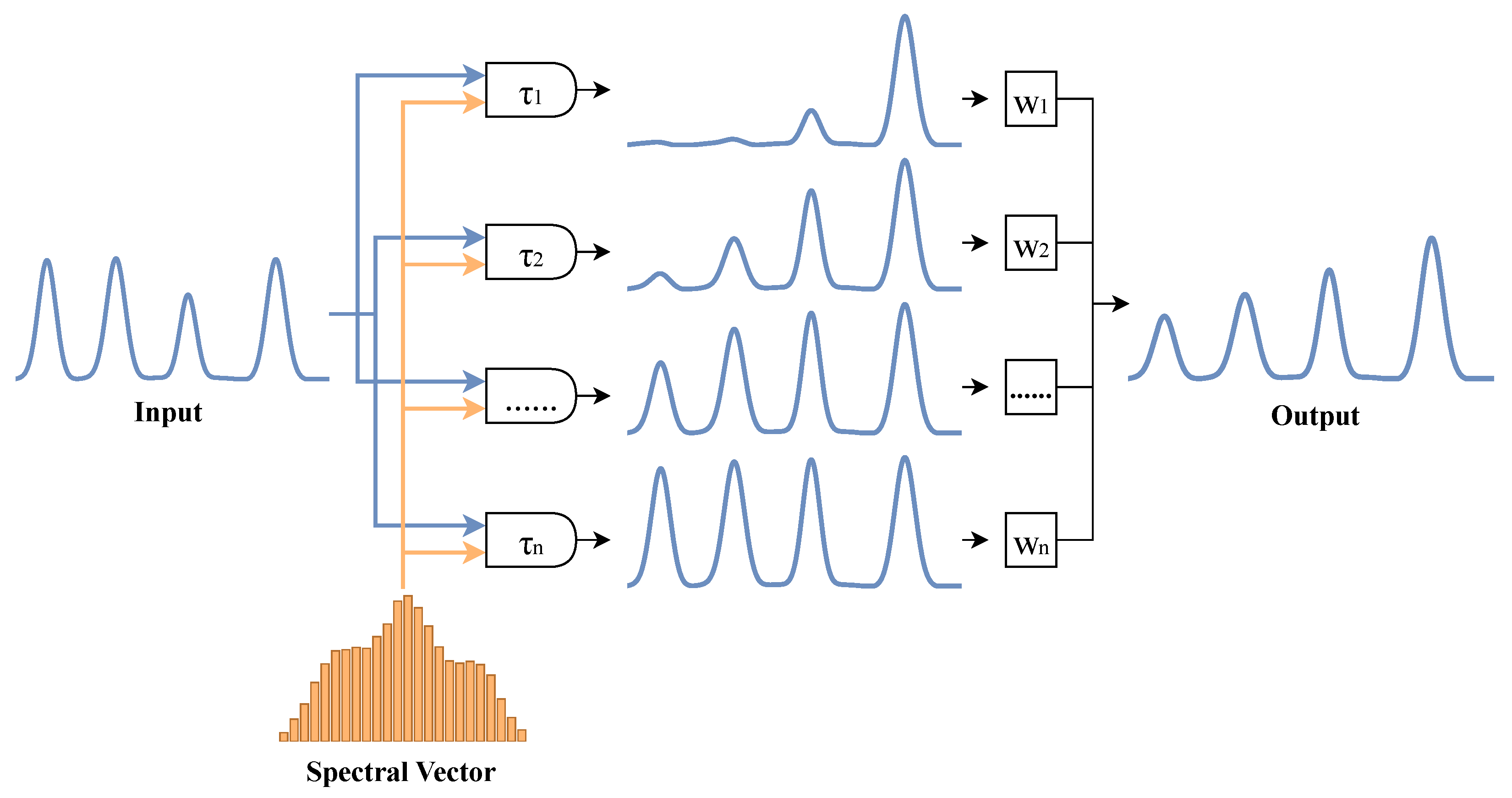
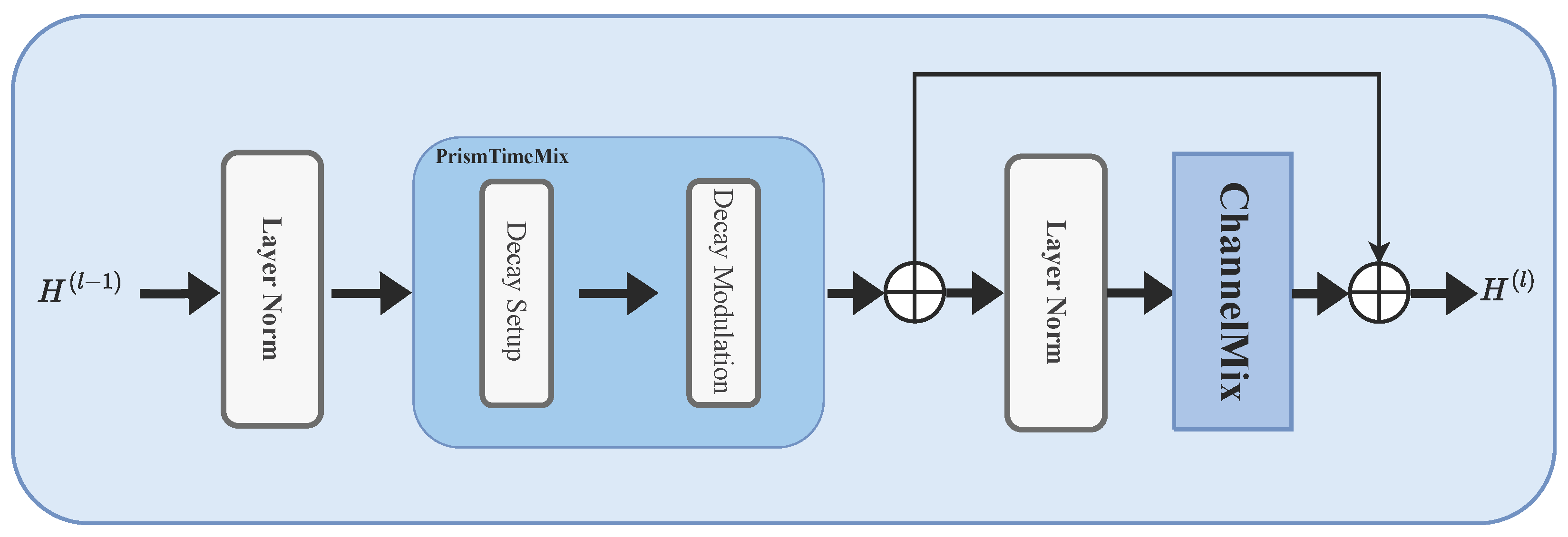
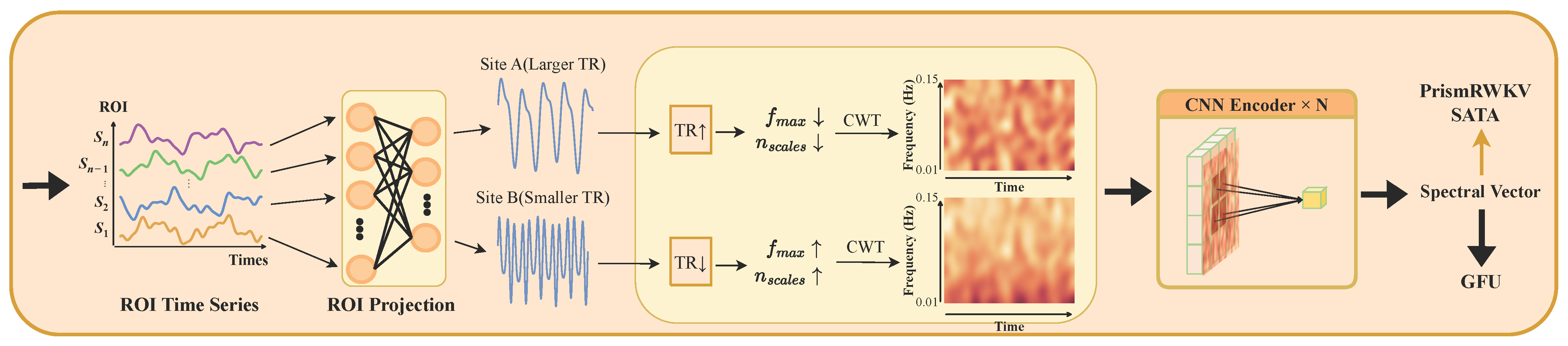
- We propose Spec-RWKV, a linear recurrent framework in which each temporal decay rate corresponds to a specific BOLD oscillatory band. The decay rates are defined as physical half-lives in seconds and converted to per-step values using each sample’s TR. This design embeds TR adaptation directly into the recurrent dynamics, ensuring that the model operates in consistent physical time units across sites with different TRs.
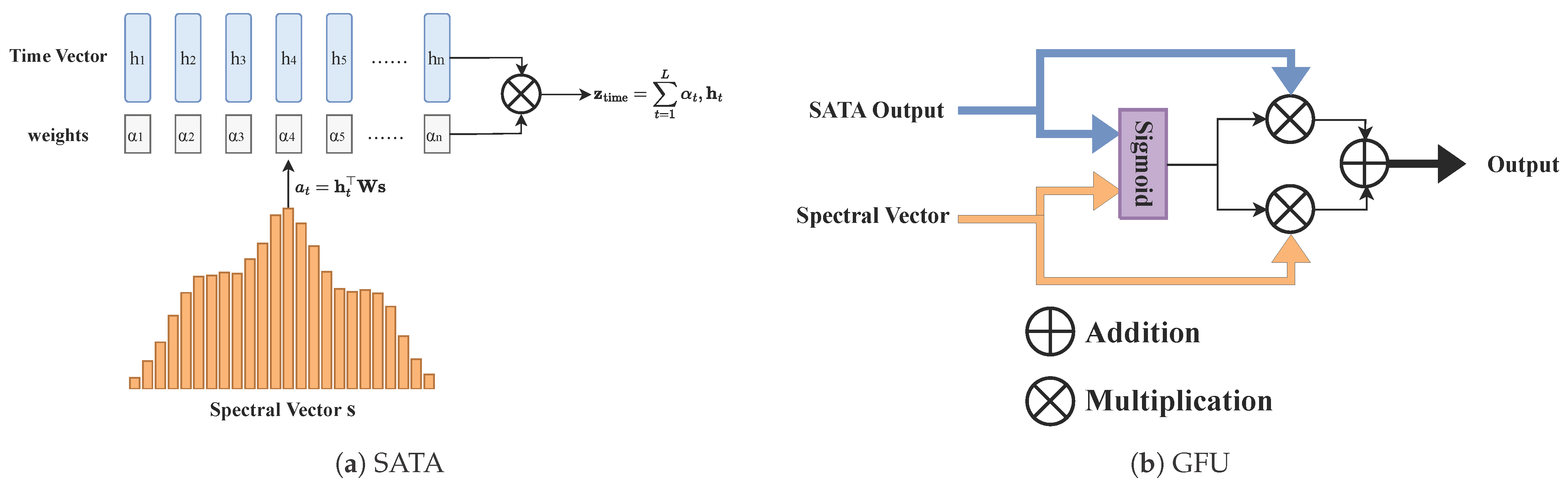
- We design a frequency-temporal coordination mechanism in which TR-adaptive spectral features serve two roles: aligning frequency-domain representations across sites, and guiding temporal aggregation weights. This creates a direct information flow from the spectral branch to the temporal branch.
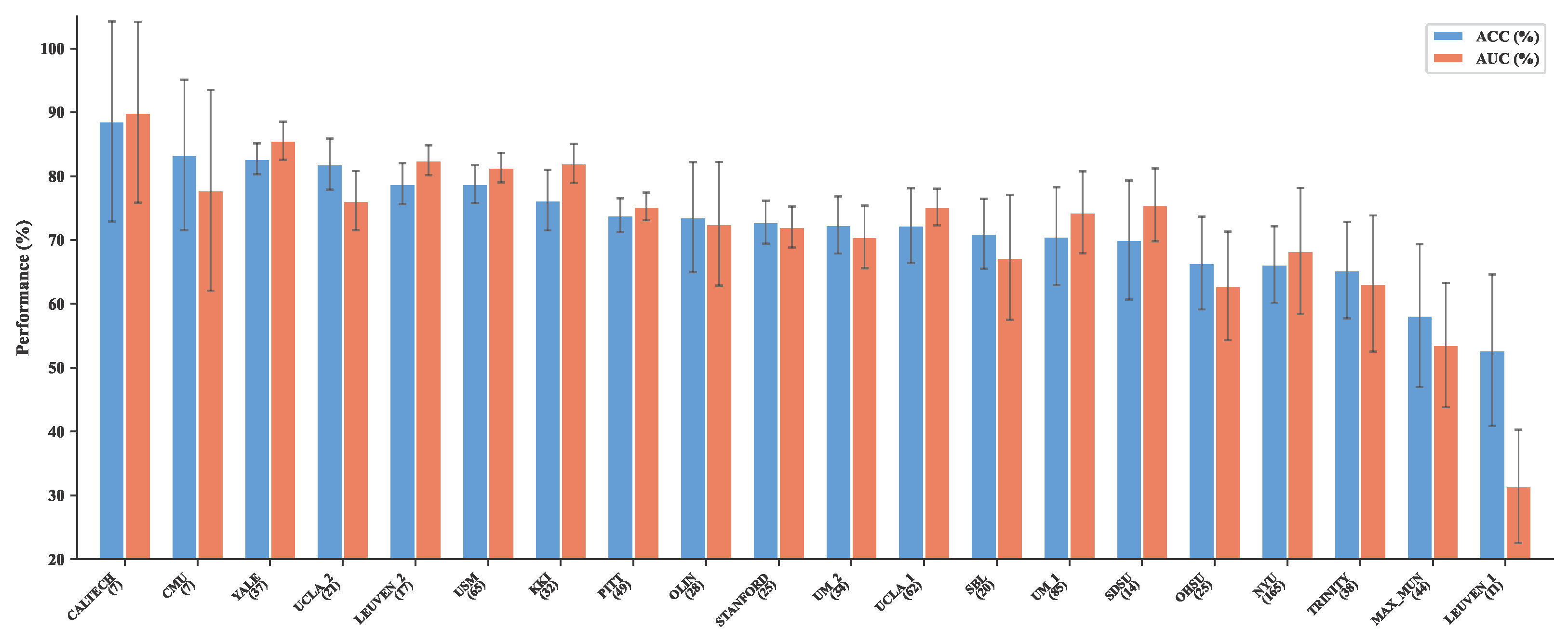
- On ABIDE-I and ADHD-200, Spec-RWKV achieves the area under the receiver operating characteristic curve (AUC) values of 75.86% and 76.31%, respectively. Under leave-one-site-out evaluation, it attains the best aggregate AUC on ABIDE-I and the best aggregate accuracy and AUC on ADHD-200 among the evaluated methods, indicating competitive cross-site robustness under this stricter setting.
2. Materials and Methods
2.1. Datasets
2.1.1. ABIDE-I
2.1.2. ADHD-200
2.2. Data Preprocessing
2.3. Spec-RWKV Framework
2.3.1. Overall Architecture
2.3.2. Temporal Backbone: RWKV Recurrent Attention and PrismTimeMix
2.3.3. Spectral Branch and Spectrum-Guided Temporal Aggregation
2.3.4. Training Objectives and Optimization Strategy
3. Results
3.1. Experimental Settings and Evaluation Metrics
3.1.1. Experimental Settings
3.1.2. Evaluation Metrics
3.2. Baseline Methods
3.3. Experimental Results
3.3.1. Comparison with Mainstream Methods
3.3.2. Per-Site Leave-One-Site-Out Performance
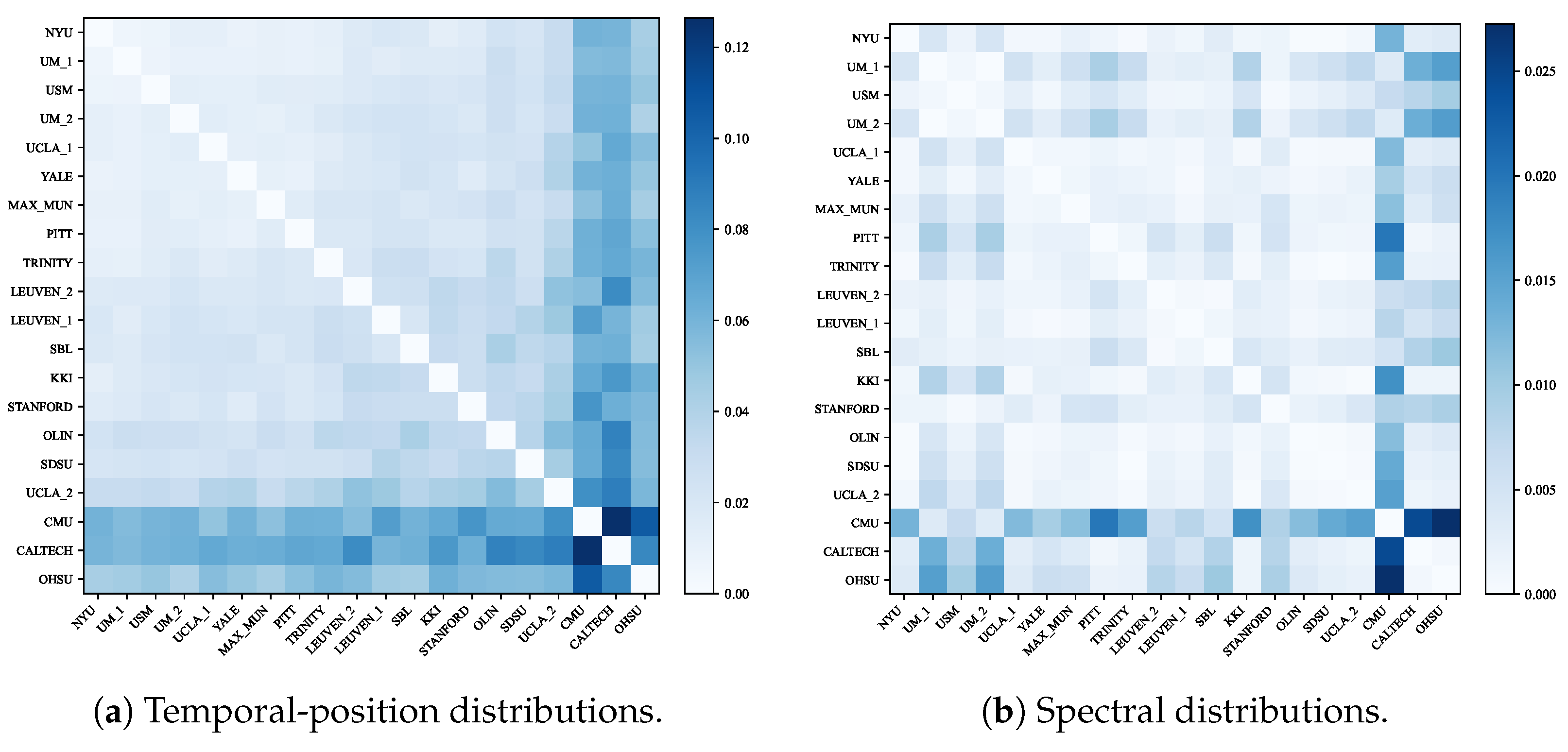
3.3.3. Site Prediction Analysis
3.3.4. TR Robustness Analysis
3.3.5. Ablation Studies
4. Discussion
4.1. Neurobiological Associations and Interpretability
4.2. Limitations and Future Directions
5. Conclusions
Author Contributions
Funding
Institutional Review Board Statement
Informed Consent Statement
Data Availability Statement
Acknowledgments
Conflicts of Interest
Appendix A. Additional Experimental Results
Appendix A.1. Per-Site Leave-One-Site-Out Performance

| Site | n | BA | AUC | Sensitivity | Specificity | Macro-F1 |
|---|---|---|---|---|---|---|
| CALTECH | 7 | 0.920 ± 0.110 | 0.900 ± 0.141 | 0.840 ± 0.219 | 1.000 ± 0.000 | 0.883 ± 0.160 |
| CMU | 7 | 0.838 ± 0.106 | 0.778 ± 0.157 | 0.867 ± 0.183 | 0.808 ± 0.248 | 0.836 ± 0.117 |
| KKI | 32 | 0.757 ± 0.027 | 0.820 ± 0.031 | 0.780 ± 0.130 | 0.733 ± 0.109 | 0.749 ± 0.042 |
| LEUVEN_1 | 11 | 0.564 ± 0.051 | 0.314 ± 0.089 | 0.700 ± 0.411 | 0.429 ± 0.404 | 0.458 ± 0.120 |
| LEUVEN_2 | 17 | 0.790 ± 0.037 | 0.825 ± 0.023 | 0.756 ± 0.145 | 0.825 ± 0.190 | 0.783 ± 0.036 |
| MAX_MUN | 44 | 0.596 ± 0.082 | 0.536 ± 0.097 | 0.533 ± 0.268 | 0.659 ± 0.210 | 0.560 ± 0.114 |
| NYU | 165 | 0.647 ± 0.084 | 0.683 ± 0.099 | 0.766 ± 0.177 | 0.528 ± 0.316 | 0.615 ± 0.143 |
| OHSU | 25 | 0.670 ± 0.069 | 0.628 ± 0.085 | 0.523 ± 0.280 | 0.817 ± 0.231 | 0.637 ± 0.102 |
| OLIN | 28 | 0.736 ± 0.086 | 0.726 ± 0.097 | 0.929 ± 0.101 | 0.543 ± 0.120 | 0.724 ± 0.091 |
| PITT | 49 | 0.739 ± 0.026 | 0.753 ± 0.022 | 0.744 ± 0.067 | 0.733 ± 0.048 | 0.738 ± 0.027 |
| SBL | 20 | 0.724 ± 0.056 | 0.673 ± 0.098 | 0.582 ± 0.104 | 0.867 ± 0.122 | 0.706 ± 0.056 |
| SDSU | 14 | 0.775 ± 0.056 | 0.755 ± 0.057 | 0.600 ± 0.158 | 0.950 ± 0.112 | 0.690 ± 0.084 |
| STANFORD | 25 | 0.735 ± 0.034 | 0.721 ± 0.032 | 0.569 ± 0.140 | 0.900 ± 0.149 | 0.718 ± 0.040 |
| TRINITY | 38 | 0.651 ± 0.099 | 0.632 ± 0.107 | 0.667 ± 0.218 | 0.635 ± 0.378 | 0.610 ± 0.151 |
| UCLA_1 | 62 | 0.742 ± 0.050 | 0.752 ± 0.029 | 0.840 ± 0.063 | 0.643 ± 0.107 | 0.721 ± 0.058 |
| UCLA_2 | 21 | 0.816 ± 0.039 | 0.762 ± 0.046 | 0.760 ± 0.055 | 0.873 ± 0.081 | 0.817 ± 0.040 |
| UM_1 | 85 | 0.713 ± 0.056 | 0.744 ± 0.064 | 0.681 ± 0.199 | 0.746 ± 0.170 | 0.694 ± 0.071 |
| UM_2 | 34 | 0.718 ± 0.065 | 0.705 ± 0.049 | 0.743 ± 0.164 | 0.692 ± 0.255 | 0.701 ± 0.054 |
| USM | 65 | 0.776 ± 0.030 | 0.813 ± 0.023 | 0.733 ± 0.109 | 0.820 ± 0.086 | 0.773 ± 0.029 |
| YALE | 37 | 0.827 ± 0.024 | 0.856 ± 0.030 | 0.833 ± 0.039 | 0.821 ± 0.047 | 0.827 ± 0.024 |
| Site | n | BA | AUC | Sensitivity | Specificity | Macro-F1 |
|---|---|---|---|---|---|---|
| NYU | 179 | 0.550 ± 0.029 | 0.617 ± 0.043 | 0.476 ± 0.034 | 0.624 ± 0.049 | 0.532 ± 0.020 |
| Peking_1 | 78 | 0.691 ± 0.065 | 0.696 ± 0.062 | 0.634 ± 0.058 | 0.748 ± 0.079 | 0.678 ± 0.071 |
| Peking_2 | 56 | 0.666 ± 0.070 | 0.682 ± 0.059 | 0.606 ± 0.098 | 0.725 ± 0.070 | 0.653 ± 0.080 |
| Peking_3 | 40 | 0.646 ± 0.079 | 0.671 ± 0.074 | 0.586 ± 0.106 | 0.706 ± 0.119 | 0.631 ± 0.076 |
| OHSU | 57 | 0.658 ± 0.053 | 0.683 ± 0.055 | 0.605 ± 0.092 | 0.710 ± 0.096 | 0.652 ± 0.060 |
| KKI | 72 | 0.781 ± 0.046 | 0.754 ± 0.074 | 0.746 ± 0.060 | 0.817 ± 0.066 | 0.781 ± 0.051 |
| NeuroIMAGE | 39 | 0.747 ± 0.065 | 0.735 ± 0.091 | 0.706 ± 0.120 | 0.789 ± 0.094 | 0.743 ± 0.080 |
Appendix A.2. Per-Site Cross-Site Consistency


References
- Fox, M.D.; Raichle, M.E. Spontaneous Fluctuations in Brain Activity Observed with Functional Magnetic Resonance Imaging. Nat. Rev. Neurosci. 2007, 8, 700–711. [Google Scholar] [CrossRef]
- Arbabshirani, M.R.; Plis, S.; Sui, J.; Calhoun, V.D. Single Subject Prediction of Brain Disorders in Neuroimaging: Promises and Pitfalls. NeuroImage 2017, 145, 137–165. [Google Scholar] [CrossRef] [PubMed]
- Di Martino, A.; Yan, C.G.; Li, Q.; Denio, E.; Castellanos, F.X.; Alaerts, K.; Anderson, J.S.; Assaf, M.; Bookheimer, S.Y.; Dapretto, M.; et al. The Autism Brain Imaging Data Exchange: Towards a Large-Scale Evaluation of the Intrinsic Brain Architecture in Autism. Mol. Psychiatry 2014, 19, 659–667. [Google Scholar] [CrossRef] [PubMed]
- Milham, M.P.; Fair, D.; Mennes, M.; Mostofsky, S.H. The ADHD-200 Consortium: A Model to Advance the Translational Potential of Neuroimaging in Clinical Neuroscience. Front. Syst. Neurosci. 2012, 6, 62. [Google Scholar] [CrossRef] [PubMed]
- Yu, M.; Linn, K.A.; Cook, P.A.; Phillips, M.L.; McInnis, M.; Fava, M.; Trivedi, M.H.; Weissman, M.M.; Shinohara, R.T.; Sheline, Y.I. Statistical Harmonization Corrects Site Effects in Functional Connectivity Measurements from Multi-Site fMRI Data. Hum. Brain Mapp. 2018, 39, 4213–4227. [Google Scholar] [CrossRef]
- Geirhos, R.; Jacobsen, J.H.; Michaelis, C.; Zemel, R.; Brendel, W.; Bethge, M.; Wichmann, F.A. Shortcut Learning in Deep Neural Networks. Nat. Mach. Intell. 2020, 2, 665–673. [Google Scholar] [CrossRef]
- Almuqhim, F.; Saeed, F. Overcoming Site Variability in Multisite fMRI Studies: An Autoencoder Framework for Enhanced Generalizability of Machine Learning Models. Neuroinformatics 2025, 23, 46. [Google Scholar] [CrossRef]
- Cordes, D.; Nandy, R.R.; Schafer, S.; Wager, T.D. Characterization and Reduction of Cardiac- and Respiratory-Induced Noise as a Function of the Sampling Rate (TR) in fMRI. NeuroImage 2014, 89, 314–330. [Google Scholar] [CrossRef]
- Huotari, N.; Raitamaa, L.; Helakari, H.; Kananen, J.; Raatikainen, V.; Rasila, A.; Tuovinen, T.; Kantola, J.; Borchardt, V.; Kiviniemi, V.J.; et al. Sampling Rate Effects on Resting State fMRI Metrics. Front. Neurosci. 2019, 13, 279. [Google Scholar] [CrossRef]
- Lurie, D.J.; Kessler, D.; Bassett, D.S.; Betzel, R.F.; Breakspear, M.; Kheilholz, S.; Kucyi, A.; Liège, S.; Lindquist, M.A.; McIntosh, A.R.; et al. Questions and controversies in the study of time-varying functional connectivity in resting fMRI. Netw. Neurosci. 2020, 4, 30–69. [Google Scholar] [CrossRef]
- Bedel, H.A.; Sivgin, I.; Dalmaz, O.; Dar, S.U.H.; Çukur, T. BolT: Fused Window Transformers for fMRI Time Series Analysis. Med. Image Anal. 2023, 88, 102841. [Google Scholar] [CrossRef] [PubMed]
- Han, K.; Yang, Y.; Huang, Z.; Kan, X.; Guo, Y.; Yang, Y.; He, L.; Zhan, L.; Sun, Y.; Wang, W.; et al. BrainODE: Dynamic Brain Signal Analysis via Graph-Aided Neural Ordinary Differential Equations. In Proceedings of the 2024 IEEE EMBS International Conference on Biomedical and Health Informatics (BHI), Houston, TX, USA, 10–13 November 2024. [Google Scholar] [CrossRef]
- Pal, S.; Luong, V.; Lee, H.; Dan, T.; Wu, G.; Davidson, R.; Kim, W.H.; Singh, V. MnemoDyn: Learning Resting State Dynamics from 40K FMRI Sequences. In Proceedings of the Fourteenth International Conference on Learning Representations, Singapore, 24–28 April 2025. [Google Scholar]
- Liu, Y.; Zhao, Q.; Zhao, L.; Liu, Y.; Li, X. Modeling Temporal Dependencies in Brain Functional Connectivity to Identify Autism Spectrum Disorders Based on Heterogeneous Rs-fMRI Data. Exp. Neurobiol. 2025, 34, 77–86. [Google Scholar] [CrossRef] [PubMed]
- Xu, J.; He, K.; Tang, Y.; Li, W.; Lan, M.; Dong, X.; Ke, Y.; Feng, M. BrainPrompt: Multi-Level Brain Prompt Enhancement for Neurological Condition Identification. In Proceedings of the Medical Image Computing and Computer Assisted Intervention—MICCAI 2025; Gee, J.C., Alexander, D.C., Hong, J., Iglesias, J.E., Sudre, C.H., Venkataraman, A., Golland, P., Kim, J.H., Park, J., Eds.; Springer: Cham, Switzerland, 2026; pp. 172–182. [Google Scholar] [CrossRef]
- Peng, B.; Alcaide, E.; Anthony, Q.; Albalak, A.; Arcadinho, S.; Biderman, S.; Cao, H.; Cheng, X.; Chung, M.; Derczynski, L.; et al. RWKV: Reinventing RNNs for the Transformer Era. In Proceedings of the Findings of the Association for Computational Linguistics: EMNLP 2023, Singapore, 6–10 December 2023. [Google Scholar] [CrossRef]
- Raimondo, L.; Oliveira, ĺ.A.F.; Heij, J.; Priovoulos, N.; Kundu, P.; Leoni, R.F.; van der Zwaag, W. Advances in Resting State fMRI Acquisitions for Functional Connectomics. NeuroImage 2021, 243, 118503. [Google Scholar] [CrossRef] [PubMed]
- Schaefer, A.; Kong, R.; Gordon, E.M.; Laumann, T.O.; Zuo, X.N.; Holmes, A.J.; Eickhoff, S.B.; Yeo, B.T. Local-Global Parcellation of the Human Cerebral Cortex from Intrinsic Functional Connectivity MRI. Cereb. Cortex 2018, 28, 3095–3114. [Google Scholar] [CrossRef]
- Tzourio-Mazoyer, N.; Landeau, B.; Papathanassiou, D.; Crivello, F.; Etard, O.; Delcroix, N.; Mazoyer, B.; Joliot, M. Automated Anatomical Labeling of Activations in SPM Using a Macroscopic Anatomical Parcellation of the MNI MRI Single-Subject Brain. NeuroImage 2002, 15, 273–289. [Google Scholar] [CrossRef]
- Yeo, B.T.; Krienen, F.M.; Sepulcre, J.; Sabuncu, M.R.; Lashkari, D.; Hollinshead, M.; Roffman, J.L.; Smoller, J.W.; Zöllei, L.; Polimeni, J.R.; et al. The Organization of the Human Cerebral Cortex Estimated by Intrinsic Functional Connectivity. J. Neurophysiol. 2011, 106, 1125–1165. [Google Scholar] [CrossRef]
- Chang, C.; Glover, G.H. Time–Frequency Dynamics of Resting-State Brain Connectivity Measured with fMRI. NeuroImage 2010, 50, 81–98. [Google Scholar] [CrossRef]
- Torrence, C.; Compo, G.P. A Practical Guide to Wavelet Analysis. Bull. Am. Meteorol. Soc. 1998, 79, 61–78. [Google Scholar] [CrossRef]
- Ridnik, T.; Ben-Baruch, E.; Zamir, N.; Noy, A.; Friedman, I.; Protter, M.; Zelnik-Manor, L. Asymmetric Loss For Multi-Label Classification. In Proceedings of the 2021 IEEE/CVF International Conference on Computer Vision (ICCV), Montreal, QC, Canada, 10–17 October 2021. [Google Scholar] [CrossRef]
- Smith, L.N.; Topin, N. Super-Convergence: Very Fast Training of Neural Networks Using Large Learning Rates. In Proceedings of the Artificial Intelligence and Machine Learning for Multi-Domain Operations Applications; SPIE: Cergy-Pontoise, France, 2019; Volume 11006, pp. 369–386. [Google Scholar] [CrossRef]
- Hochreiter, S.; Schmidhuber, J. Long Short-Term Memory. Neural Comput. 1997, 9, 1735–1780. [Google Scholar] [CrossRef]
- Kawahara, J.; Brown, C.J.; Miller, S.P.; Booth, B.G.; Chau, V.; Grunau, R.E.; Zwicker, J.G.; Hamarneh, G. BrainNetCNN: Convolutional Neural Networks for Brain Networks; towards predicting neurodevelopment. NeuroImage 2017, 146, 1038–1049. [Google Scholar] [CrossRef]
- Wang, Y.; Long, H.; Zhou, Q.; Bo, T.; Zheng, J. PLSNet: Position-Aware GCN-Based Autism Spectrum Disorder Diagnosis via FC Learning and ROIs Sifting. Comput. Biol. Med. 2023, 163, 107184. [Google Scholar] [CrossRef]
- Liu, M.; Zhang, H.; Shi, F.; Shen, D. Hierarchical Graph Convolutional Network Built by Multiscale Atlases for Brain Disorder Diagnosis Using Functional Connectivity. IEEE Trans. Neural Netw. Learn. Syst. 2024, 35, 15182–15194. [Google Scholar] [CrossRef]
- Liu, Z.; Lin, Y.; Cao, Y.; Hu, H.; Wei, Y.; Zhang, Z.; Lin, S.; Guo, B. Swin Transformer: Hierarchical Vision Transformer Using Shifted Windows. In Proceedings of the 2021 IEEE/CVF International Conference on Computer Vision (ICCV), Montreal, QC, Canada, 10–17 October 2021. [Google Scholar] [CrossRef]
- Dong, W.; Li, Y.; Zeng, W.; Chen, L.; Yan, H.; Siok, W.T.; Wang, N. STARFormer: A Novel Spatio-Temporal Aggregation Reorganization Transformer of FMRI for Brain Disorder Diagnosis. Neural Netw. 2025, 192, 107927. [Google Scholar] [CrossRef] [PubMed]
- Bannadabhavi, A.; Lee, S.; Deng, W.; Ying, R.; Li, X. Community-Aware Transformer for Autism Prediction in fMRI Connectome. In Proceedings of the Medical Image Computing and Computer Assisted Intervention—MICCAI 2023: 26th International Conference, Vancouver, BC, Canada, 8–12 October 2023; Proceedings, Part VIII; Springer: Berlin/Heidelberg, Germany, 2023; pp. 287–297. [Google Scholar] [CrossRef]
- Kennedy, D.P.; Redcay, E.; Courchesne, E. Failing to Deactivate: Resting Functional Abnormalities in Autism. Proc. Natl. Acad. Sci. USA 2006, 103, 8275–8280. [Google Scholar] [CrossRef] [PubMed]
- Monk, C.S.; Peltier, S.J.; Wiggins, J.L.; Weng, S.J.; Carrasco, M.; Risi, S.; Lord, C. Abnormalities of Intrinsic Functional Connectivity in Autism Spectrum Disorders. NeuroImage 2009, 47, 764–772. [Google Scholar] [CrossRef] [PubMed]
- Abbott, A.E.; Linke, A.C.; Nair, A.; Jahedi, A.; Alba, L.A.; Keown, C.L.; Fishman, I.; Müller, R.A. Repetitive Behaviors in Autism Are Linked to Imbalance of Corticostriatal Connectivity: A Functional Connectivity MRI Study. Soc. Cogn. Affect. Neurosci. 2018, 13, 32–42. [Google Scholar] [CrossRef]
- Attanasio, M.; Mazza, M.; Le Donne, I.; Nigri, A.; Valenti, M. Salience Network in Autism: Preliminary Results on Functional Connectivity Analysis in Resting State. Eur. Arch. Psychiatry Clin. Neurosci. 2025, 275, 2479–2492. [Google Scholar] [CrossRef]
- Zheng, X.; Wang, X.; Song, R.; Tian, J.; Yang, L. Executive Function, Limbic Circuit Dynamics and Repetitive and Restricted Behaviors in Children with Autism Spectrum Disorder. Front. Neurosci. 2025, 18, 1508077. [Google Scholar] [CrossRef]
- Xia, M.; Wang, J.; He, Y. BrainNet Viewer: A Network Visualization Tool for Human Brain Connectomics. PLoS ONE 2013, 8, e68910. [Google Scholar] [CrossRef]
- Zuo, X.N.; Di Martino, A.; Kelly, C.; Shehzad, Z.E.; Gee, D.G.; Klein, D.F.; Castellanos, F.X.; Biswal, B.B.; Milham, M.P. The Oscillating Brain: Complex and Reliable. NeuroImage 2010, 49, 1432–1445. [Google Scholar] [CrossRef]






| Site | Subjects | ASD | Controls | TR (s) |
|---|---|---|---|---|
| NYU | 172 | 74 | 98 | 2.0 |
| UM_1 | 86 | 34 | 52 | 2.0 |
| USM | 67 | 43 | 24 | 2.0 |
| UCLA_1 | 64 | 37 | 27 | 3.0 |
| PITT | 50 | 24 | 26 | 1.5 |
| MAX_MUN | 46 | 19 | 27 | 3.0 |
| TRINITY | 44 | 19 | 25 | 2.0 |
| YALE | 41 | 22 | 19 | 2.0 |
| UM_2 | 34 | 13 | 21 | 2.0 |
| KKI | 33 | 12 | 21 | 2.5 |
| OLIN | 28 | 14 | 14 | 1.5 |
| LEUVEN_1 | 28 | 14 | 14 | ∼1.667 |
| LEUVEN_2 | 28 | 12 | 16 | ∼1.651 |
| SDSU | 27 | 8 | 19 | 2.0 |
| SBL | 26 | 12 | 14 | 2.2 |
| STANFORD | 25 | 12 | 13 | 2.0 |
| OHSU | 25 | 12 | 13 | 2.5 |
| UCLA_2 | 21 | 11 | 10 | 3.0 |
| CALTECH | 15 | 5 | 10 | 2.0 |
| CMU | 11 | 6 | 5 | 1.5/2.0 |
| Total | 871 | 403 | 468 |
| Site | Subjects | ADHD | Controls | TR (s) |
|---|---|---|---|---|
| NYU | 179 | 91 | 88 | 2.0 |
| Peking_1 | 78 | 20 | 58 | 2.0 |
| Peking_2 | 56 | 33 | 23 | 2.0 |
| Peking_3 | 40 | 18 | 22 | 2.0 |
| KKI | 72 | 18 | 54 | 2.5 |
| Pittsburgh | 63 | 0 | 63 | 1.5 |
| OHSU | 57 | 22 | 35 | 2.5 |
| NeuroIMAGE | 39 | 17 | 22 | 1.96 |
| WashU | 51 | 0 | 51 | 2.5 |
| Total | 635 | 219 | 416 |
| Method | ABIDE-I (871 Subjects, 20 Sites) | ADHD-200 (635 Subjects, 9 Sites) | ||||||
|---|---|---|---|---|---|---|---|---|
| ACC (%) | Prec. (%) | Rec. (%) | AUC (%) | ACC (%) | Prec. (%) | Rec. (%) | AUC (%) | |
| SVM | 65.43 ± 4.53 | 65.16 ± 4.50 | 63.43 ± 4.57 | 71.13 ± 6.26 | 65.45 ± 8.19 | 65.55 ± 5.68 | 79.61 ± 7.18 | 57.61 ± 6.94 |
| LSTM | 54.14 ± 5.63 | 56.66 ± 5.04 | 58.91 ± 7.52 | 55.46 ± 7.27 | 58.58 ± 4.67 | 66.39 ± 3.26 | 74.68 ± 5.62 | 52.36 ± 7.10 |
| CNN-LSTM | 52.11 ± 5.25 | 54.56 ± 4.56 | 62.10 ± 7.65 | 52.26 ± 7.26 | 53.32 ± 6.07 | 65.00 ± 4.66 | 62.14 ± 8.75 | 50.09 ± 7.65 |
| AttnLSTM | 71.86 ± 3.09 | 72.64 ± 4.46 | 74.38 ± 6.38 | 74.15 ± 3.42 | 71.34 ± 3.22 | 74.63 ± 3.46 | 78.13 ± 5.19 | 71.81 ± 3.57 |
| BrainNetCNN | 62.75 ± 6.45 | 68.22 ± 8.65 | 54.54 ± 22.48 | 71.20 ± 6.15 | 62.42 ± 5.11 | 69.07 ± 3.73 | 78.15 ± 8.78 | 60.08 ± 6.12 |
| PLSNet | 72.55 ± 2.73 | 71.50 ± 4.80 | 68.14 ± 8.19 | 75.11 ± 3.56 | 70.58 ± 3.11 | 71.86 ± 2.62 | 72.92 ± 4.81 | 75.40 ± 2.73 |
| MAHGCN | 73.12 ± 3.63 | 71.05 ± 5.38 | 72.02 ± 4.14 | 72.07 ± 3.03 | 70.76 ± 4.63 | 69.95 ± 3.38 | 71.08 ± 2.14 | 74.25 ± 3.41 |
| SwinT | 69.83 ± 4.62 | 60.68 ± 7.55 | 68.34 ± 6.49 | 74.21 ± 4.18 | 68.49 ± 4.69 | 65.32 ± 4.41 | 66.37 ± 9.63 | 73.92 ± 4.63 |
| BolT | 71.28 ± 4.62 | 69.85 ± 4.94 | 71.32 ± 4.35 | 75.14 ± 3.44 | 69.63 ± 4.63 | 68.60 ± 5.19 | 76.56 ± 5.79 | 72.56 ± 5.02 |
| STARFormer | 71.81 ± 4.06 | 72.48 ± 4.91 | 83.25 ± 6.55 | 74.34 ± 5.90 | 71.51 ± 5.69 | 72.90 ± 5.06 | 73.74 ± 3.13 | 74.02 ± 9.01 |
| Com-BrainTF | 72.81 ± 4.49 | 70.58 ± 4.59 | 78.37 ± 4.70 | 73.86 ± 3.08 | 68.88 ± 2.73 | 67.42 ± 4.18 | 72.97 ± 3.82 | 73.47 ± 3.74 |
| BrainPrompt | 72.53 ± 3.78 | 73.85 ± 4.70 | 75.61 ± 6.55 | 74.92 ± 3.64 | 72.12 ± 3.49 | 76.24 ± 3.58 | 79.70 ± 5.87 | 72.45 ± 3.81 |
| Spec-RWKV | 73.27 ± 4.18 | 74.97 ± 6.70 | 77.04 ± 6.41 | 75.86 ± 5.64 | 72.87 ± 2.46 | 74.64 ± 2.08 | 70.18 ± 3.17 | 76.31 ± 2.51 |
| Method | ABIDE-I (871 Subjects, 20 Sites) | ADHD-200 (635 Subjects, 9 Sites) | ||||||
|---|---|---|---|---|---|---|---|---|
| ACC (%) | Prec. (%) | Rec. (%) | AUC (%) | ACC (%) | Prec. (%) | Rec. (%) | AUC (%) | |
| SVM | 63.74 ± 3.99 | 52.35 ± 7.18 | 63.60 ± 6.35 | 69.90 ± 4.53 | 57.96 ± 2.60 | 56.96 ± 5.16 | 57.82 ± 5.16 | 59.40 ± 4.52 |
| LSTM | 64.77 ± 4.12 | 62.12 ± 9.73 | 63.17 ± 7.24 | 68.84 ± 3.77 | 62.10 ± 3.84 | 60.69 ± 4.17 | 58.66 ± 6.06 | 64.24 ± 5.40 |
| CNN-LSTM | 64.49 ± 5.70 | 57.31 ± 9.40 | 64.79 ± 7.57 | 71.40 ± 5.41 | 63.58 ± 5.82 | 58.24 ± 9.33 | 61.68 ± 7.44 | 60.37 ± 5.29 |
| AttnLSTM | 72.56 ± 3.28 | 71.89 ± 4.12 | 75.62 ± 5.61 | 74.68 ± 3.35 | 73.29 ± 3.14 | 68.90 ± 3.85 | 69.43 ± 4.93 | 76.52 ± 3.22 |
| BrainNetCNN | 65.31 ± 4.09 | 60.90 ± 8.56 | 62.88 ± 4.40 | 70.68 ± 5.51 | 61.77 ± 3.78 | 60.11 ± 4.52 | 60.63 ± 7.91 | 60.77 ± 4.01 |
| PLSNet | 71.96 ± 3.38 | 69.87 ± 3.47 | 75.69 ± 3.57 | 74.43 ± 3.12 | 70.53 ± 3.14 | 71.81 ± 2.03 | 72.97 ± 4.86 | 75.45 ± 2.78 |
| MAHGCN | 71.31 ± 3.52 | 69.40 ± 3.27 | 70.09 ± 3.93 | 71.11 ± 2.97 | 69.69 ± 2.49 | 71.36 ± 3.28 | 70.19 ± 4.23 | 71.86 ± 3.31 |
| SwinT | 65.69 ± 4.45 | 58.92 ± 7.45 | 60.53 ± 0.53 | 72.64 ± 4.07 | 66.50 ± 4.60 | 62.64 ± 4.23 | 65.22 ± 9.22 | 66.29 ± 4.45 |
| BolT | 69.41 ± 2.15 | 68.52 ± 4.07 | 66.49 ± 4.22 | 73.30 ± 3.51 | 67.66 ± 3.46 | 68.15 ± 4.05 | 68.36 ± 5.01 | 69.83 ± 3.74 |
| STARFormer | 73.11 ± 2.89 | 72.96 ± 2.19 | 78.31 ± 3.47 | 74.01 ± 2.79 | 72.92 ± 2.40 | 72.59 ± 2.02 | 73.12 ± 3.23 | 76.39 ± 2.45 |
| Com-BrainTF | 70.56 ± 4.42 | 68.53 ± 4.41 | 77.21 ± 4.25 | 75.37 ± 2.96 | 66.87 ± 2.60 | 69.74 ± 4.10 | 70.73 ± 3.59 | 72.06 ± 3.51 |
| BrainPrompt | 73.38 ± 3.52 | 72.78 ± 3.85 | 76.84 ± 5.42 | 75.47 ± 3.18 | 73.99 ± 3.26 | 70.03 ± 3.72 | 70.57 ± 5.15 | 77.70 ± 3.08 |
| Spec-RWKV | 75.19 ± 2.93 | 73.96 ± 2.13 | 79.27 ± 3.42 | 75.91 ± 2.85 | 74.98 ± 2.36 | 74.81 ± 2.04 | 75.31 ± 3.19 | 78.47 ± 2.50 |
| Method | ABIDE-I (20 Sites) | ADHD-200 (9 Sites) | ||||||
|---|---|---|---|---|---|---|---|---|
| ACC (%) | Prec. (%) | Rec. (%) | AUC (%) | ACC (%) | Prec. (%) | Rec. (%) | AUC (%) | |
| SVM | 60.65 ± 9.29 | 62.27 ± 10.98 | 73.26 ± 17.85 | 65.49 ± 10.26 | 56.33 ± 7.22 | 60.85 ± 10.44 | 70.97 ± 15.74 | 57.18 ± 6.80 |
| BrainNetCNN | 62.73 ± 10.86 | 66.48 ± 18.22 | 65.57 ± 23.91 | 69.68 ± 11.97 | 52.77 ± 9.24 | 59.41 ± 11.08 | 60.86 ± 19.86 | 53.97 ± 5.20 |
| SwinT | 63.74 ± 14.32 | 58.59 ± 17.41 | 69.61 ± 10.61 | 69.75 ± 13.91 | 52.74 ± 6.65 | 55.09 ± 10.72 | 54.56 ± 10.42 | 53.41 ± 6.58 |
| BolT | 67.39 ± 10.58 | 68.13 ± 12.68 | 76.51 ± 18.09 | 70.24 ± 12.64 | 55.31 ± 7.94 | 60.35 ± 12.19 | 64.07 ± 15.64 | 58.51 ± 6.08 |
| PLSNet | 69.84 ± 13.28 | 69.44 ± 13.45 | 86.04 ± 14.10 | 71.44 ± 13.00 | 56.00 ± 4.49 | 63.23 ± 7.79 | 61.09 ± 14.07 | 60.79 ± 4.24 |
| STARFormer | 70.87 ± 12.80 | 72.58 ± 12.18 | 89.05 ± 13.99 | 71.06 ± 12.68 | 57.91 ± 8.90 | 63.83 ± 9.78 | 61.19 ± 12.70 | 61.63 ± 5.97 |
| AttnLSTM | 71.38 ± 10.42 | 75.14 ± 11.38 | 74.86 ± 14.17 | 73.52 ± 10.65 | 60.42 ± 9.12 | 69.87 ± 10.24 | 63.71 ± 13.56 | 64.38 ± 7.89 |
| BrainPrompt | 72.05 ± 9.86 | 76.82 ± 10.24 | 75.43 ± 13.52 | 74.63 ± 9.87 | 61.70 ± 8.74 | 71.19 ± 9.56 | 65.03 ± 12.84 | 65.84 ± 7.23 |
| Spec-RWKV | 72.78 ± 8.52 | 79.05 ± 7.53 | 72.22 ± 11.43 | 75.86 ± 9.21 | 65.70 ± 8.58 | 69.94 ± 8.12 | 60.26 ± 9.71 | 67.13 ± 5.57 |
| Method | BA Mean | BA Std | 95% CI | AUC Mean | AUC Std | 95% CI | IQR |
|---|---|---|---|---|---|---|---|
| Spec-RWKV | 0.7366 | 0.0843 | [0.697, 0.776] | 0.7186 | 0.1274 | [0.659, 0.778] | 0.078 |
| BolT | 0.6661 | 0.0959 | [0.621, 0.711] | 0.7424 | 0.1211 | [0.686, 0.799] | 0.120 |
| BrainPrompt | 0.6892 | 0.1086 | [0.637, 0.741] | 0.7156 | 0.1124 | [0.662, 0.769] | 0.128 |
| BrainNetCNN | 0.6331 | 0.0761 | [0.598, 0.669] | 0.6968 | 0.1065 | [0.647, 0.747] | 0.103 |
| AttnLSTM | 0.6438 | 0.1012 | [0.596, 0.691] | 0.6724 | 0.1385 | [0.607, 0.738] | 0.122 |
| SVM | 0.5990 | 0.1083 | [0.548, 0.650] | 0.6549 | 0.1017 | [0.607, 0.703] | 0.099 |
| Method | Dim. | Site BA | Chance | BA/Chance | p-Value |
|---|---|---|---|---|---|
| AttnLSTM | 256 | 0.0823 | 0.05 | 1.65× | 0.0010 |
| Spec-RWKV | 256 | 0.1238 | 0.05 | 2.48× | 0.005 |
| BolT | 2400 | 0.2158 | 0.05 | 4.32× | 0.005 |
| BrainPrompt | 256 | 0.3412 | 0.05 | 6.82× | 0.005 |
| Simulated TR | Spec-RWKV AUC | BrainPrompt AUC | AttnLSTM AUC |
|---|---|---|---|
| 1.5 s | 0.9716 | 0.9178 | 0.9356 |
| 2.0 s | 0.9787 | 0.9135 | 0.9382 |
| 2.5 s | 0.9815 | 0.9087 | 0.9408 |
| 3.0 s | 0.9829 | 0.8996 | 0.9271 |
| 4.0 s | 0.9817 | 0.9124 | 0.9098 |
| Configuration | ABIDE-I | ADHD-200 | ||||||
|---|---|---|---|---|---|---|---|---|
| ACC (%) | Prec. (%) | Rec. (%) | AUC (%) | ACC (%) | Prec. (%) | Rec. (%) | AUC (%) | |
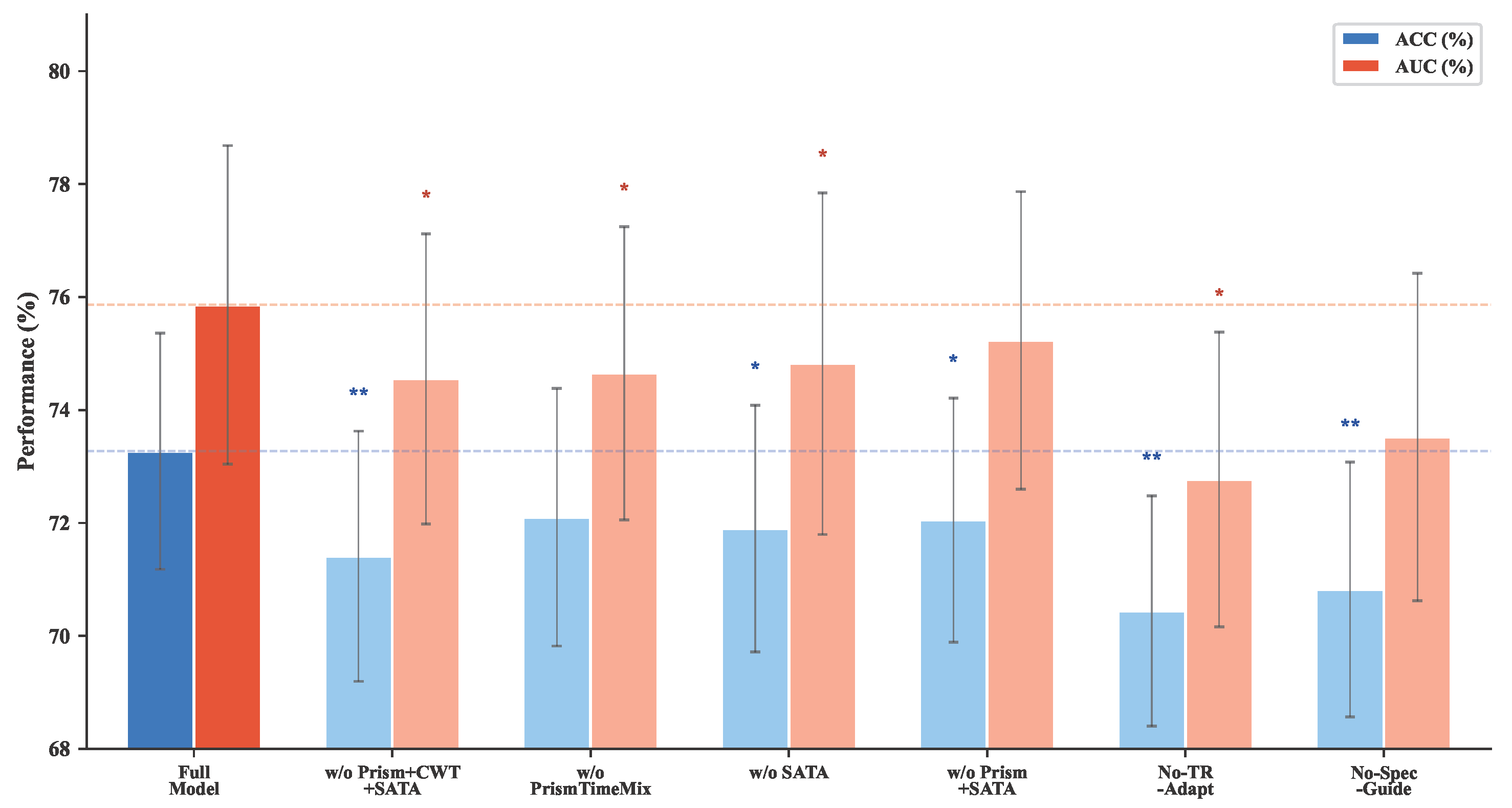
| Full Model | 73.27 ± 4.18 | 74.97 ± 6.70 | 77.04 ± 6.41 | 75.86 ± 5.64 | 72.87 ± 2.46 | 74.64 ± 2.08 | 70.18 ± 3.17 | 76.31 ± 2.51 |
| w/o Prism+CWT+SATA | 71.41 ± 4.43 | 73.95 ± 6.85 | 74.15 ± 7.17 | 74.55 ± 5.14 | 65.85 ± 3.49 | 69.20 ± 4.49 | 71.03 ± 9.87 | 66.37 ± 4.89 |
| w/o PrismTimeMix | 72.10 ± 4.56 | 74.09 ± 5.67 | 74.80 ± 6.56 | 74.65 ± 5.19 | 66.51 ± 3.60 | 69.53 ± 3.69 | 72.28 ± 10.06 | 67.17 ± 4.30 |
| w/o SATA | 71.90 ± 4.37 | 74.93 ± 6.15 | 73.12 ± 6.10 | 74.82 ± 6.05 | 65.02 ± 3.12 | 69.66 ± 4.45 | 66.00 ± 12.08 | 66.57 ± 3.70 |
| w/o Prism+SATA | 72.05 ± 4.32 | 73.40 ± 6.18 | 76.74 ± 6.36 | 75.23 ± 5.27 | 65.35 ± 3.34 | 68.79 ± 4.05 | 69.70 ± 11.18 | 66.38 ± 4.61 |
| No-TR-Adapt | 71.56 ± 3.45 | 72.13 ± 4.82 | 75.68 ± 7.12 | 73.92 ± 3.71 | 71.36 ± 3.01 | 72.11 ± 4.23 | 68.86 ± 8.64 | 74.79 ± 3.39 |
| No-Spec-Guide | 70.89 ± 3.56 | 71.56 ± 4.95 | 74.21 ± 7.34 | 72.78 ± 3.83 | 70.51 ± 3.10 | 70.83 ± 4.35 | 67.69 ± 8.91 | 72.99 ± 3.50 |
| Comparison | Metric | Δ (pp) | t-Statistic | p-Value | Sig. |
|---|---|---|---|---|---|
| w/o Prism + CWT + SATA | ACC | +1.86 | 2.993 | 0.004 | ** |
| AUC | +1.31 | 2.112 | 0.040 | * | |
| Recall | +2.89 | 2.183 | 0.034 | * | |
| w/o PrismTimeMix | ACC | +1.17 | 1.998 | 0.051 | |
| AUC | +1.21 | 2.064 | 0.044 | * | |
| Recall | +2.24 | 2.147 | 0.037 | * | |
| w/o SATA | ACC | +1.38 | 2.604 | 0.012 | * |
| AUC | +1.04 | 2.231 | 0.030 | * | |
| Recall | +3.92 | 2.876 | 0.006 | ** | |
| w/o Prism + SATA | ACC | +1.22 | 2.366 | 0.022 | * |
| AUC | +0.63 | 1.048 | 0.300 | ||
| Recall | +0.30 | 0.429 | 0.670 | ||
| No-TR-Adapt | ACC | +1.71 | 3.866 | 0.004 | ** |
| AUC | +1.94 | 2.508 | 0.033 | * | |
| Recall | +1.36 | 1.469 | 0.176 | ||
| No-Spec-Guide | ACC | +2.38 | 3.386 | 0.008 | ** |
| AUC | +3.08 | 1.619 | 0.140 | ||
| Recall | +2.83 | 1.160 | 0.276 |
Disclaimer/Publisher’s Note: The statements, opinions and data contained in all publications are solely those of the individual author(s) and contributor(s) and not of MDPI and/or the editor(s). MDPI and/or the editor(s) disclaim responsibility for any injury to people or property resulting from any ideas, methods, instructions or products referred to in the content. |
© 2026 by the authors. Licensee MDPI, Basel, Switzerland. This article is an open access article distributed under the terms and conditions of the Creative Commons Attribution (CC BY) license.
Share and Cite
Peng, S.; Xu, Q. Spec-RWKV: A Spectrum-Guided Multi-Scale Recurrent Modeling Framework for Multi-Center Resting-State fMRI-Assisted Diagnosis. Brain Sci. 2026, 16, 455. https://doi.org/10.3390/brainsci16050455
Peng S, Xu Q. Spec-RWKV: A Spectrum-Guided Multi-Scale Recurrent Modeling Framework for Multi-Center Resting-State fMRI-Assisted Diagnosis. Brain Sciences. 2026; 16(5):455. https://doi.org/10.3390/brainsci16050455
Chicago/Turabian StylePeng, Sihang, and Qi Xu. 2026. "Spec-RWKV: A Spectrum-Guided Multi-Scale Recurrent Modeling Framework for Multi-Center Resting-State fMRI-Assisted Diagnosis" Brain Sciences 16, no. 5: 455. https://doi.org/10.3390/brainsci16050455
APA StylePeng, S., & Xu, Q. (2026). Spec-RWKV: A Spectrum-Guided Multi-Scale Recurrent Modeling Framework for Multi-Center Resting-State fMRI-Assisted Diagnosis. Brain Sciences, 16(5), 455. https://doi.org/10.3390/brainsci16050455