Structural and Connectivity Alterations of the Premotor Cortex in Autistic Children: Implications for Affective Motor Impairments

Highlights
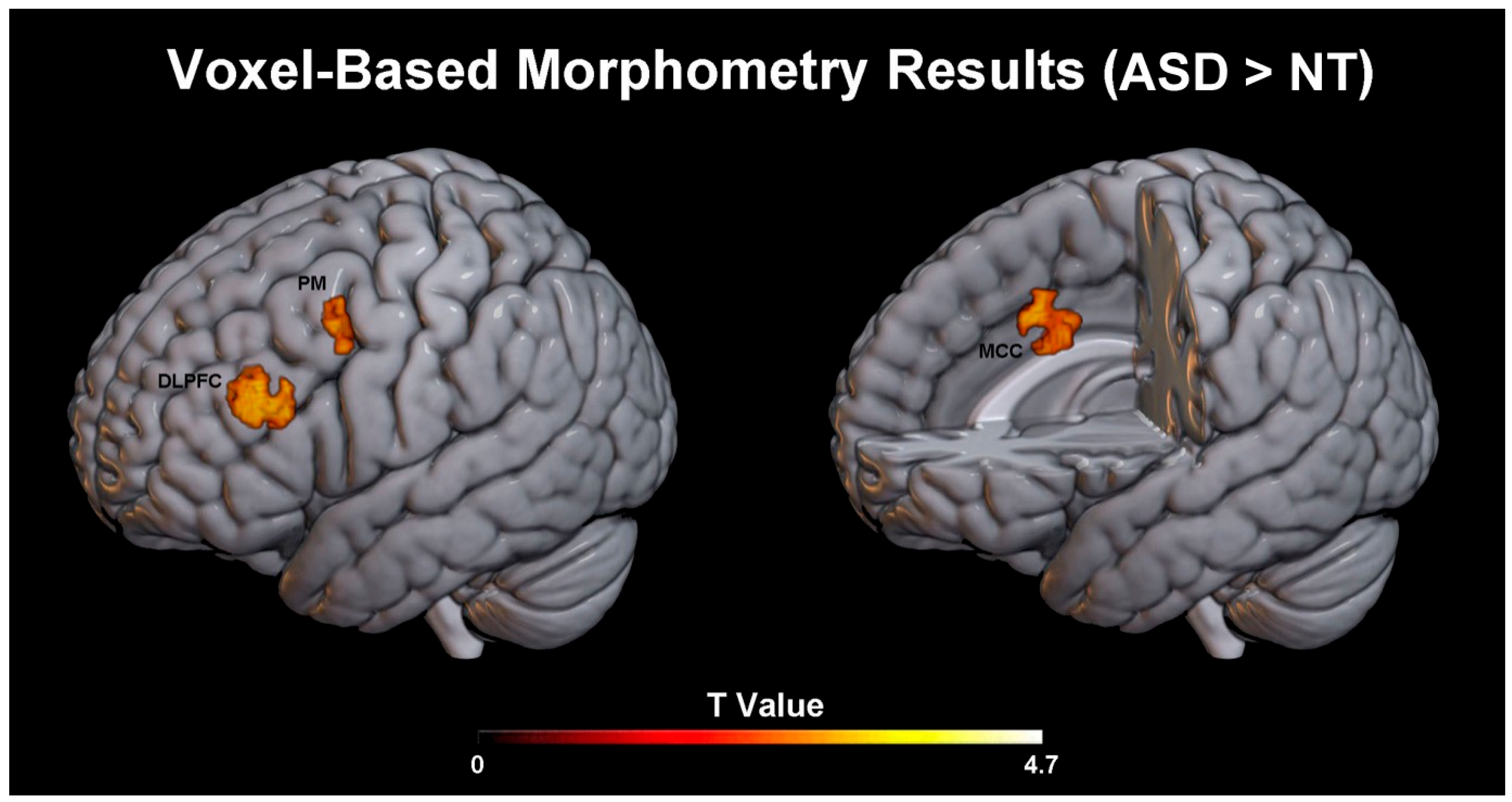
- Children with autism spectrum disorder (ASD) showed increased grey-matter volume in the premotor cortex (PM), dorsolateral prefrontal cortex (DLPFC), and middle cingulate cortex (MCC), with no differences in the dorso-central insula (DCI).
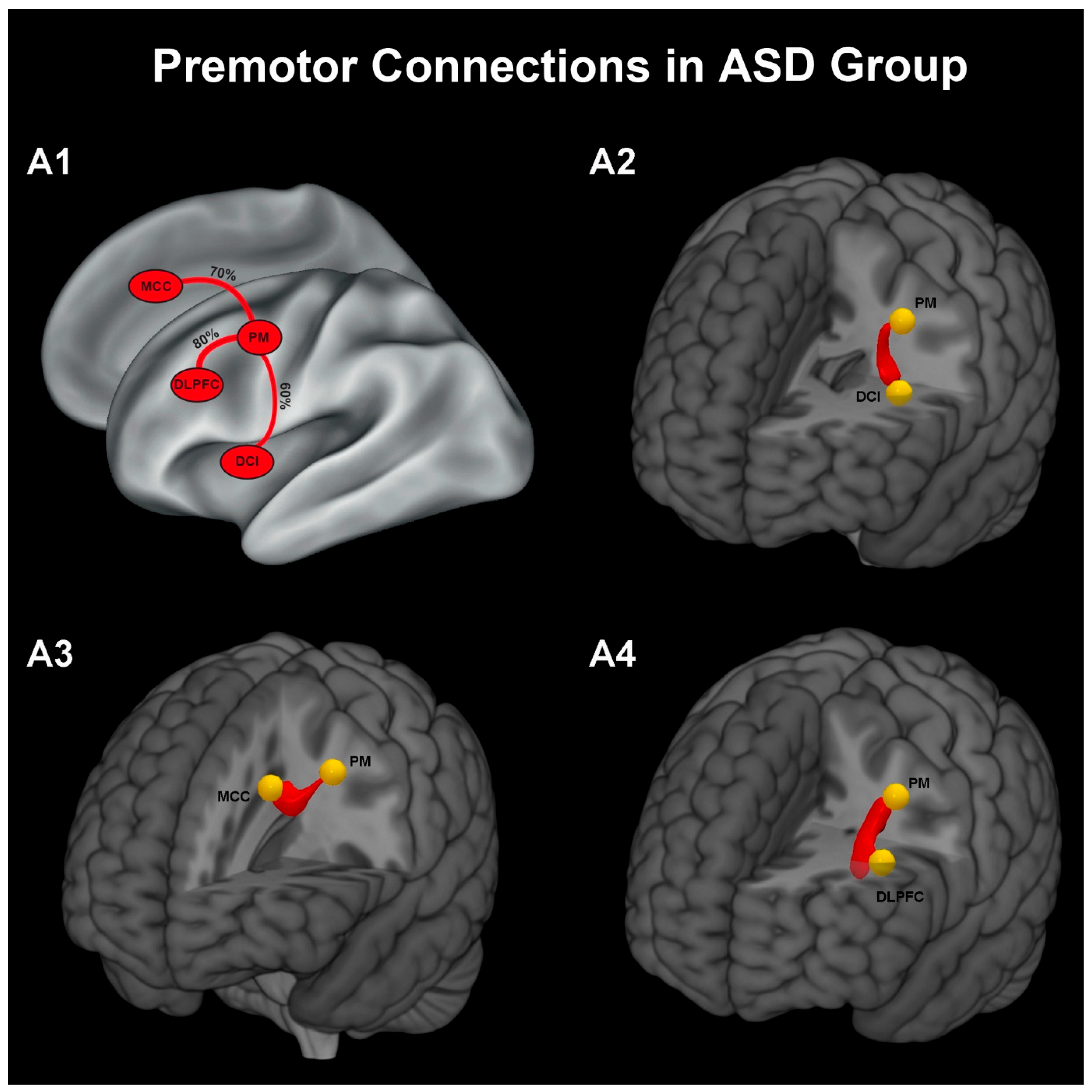
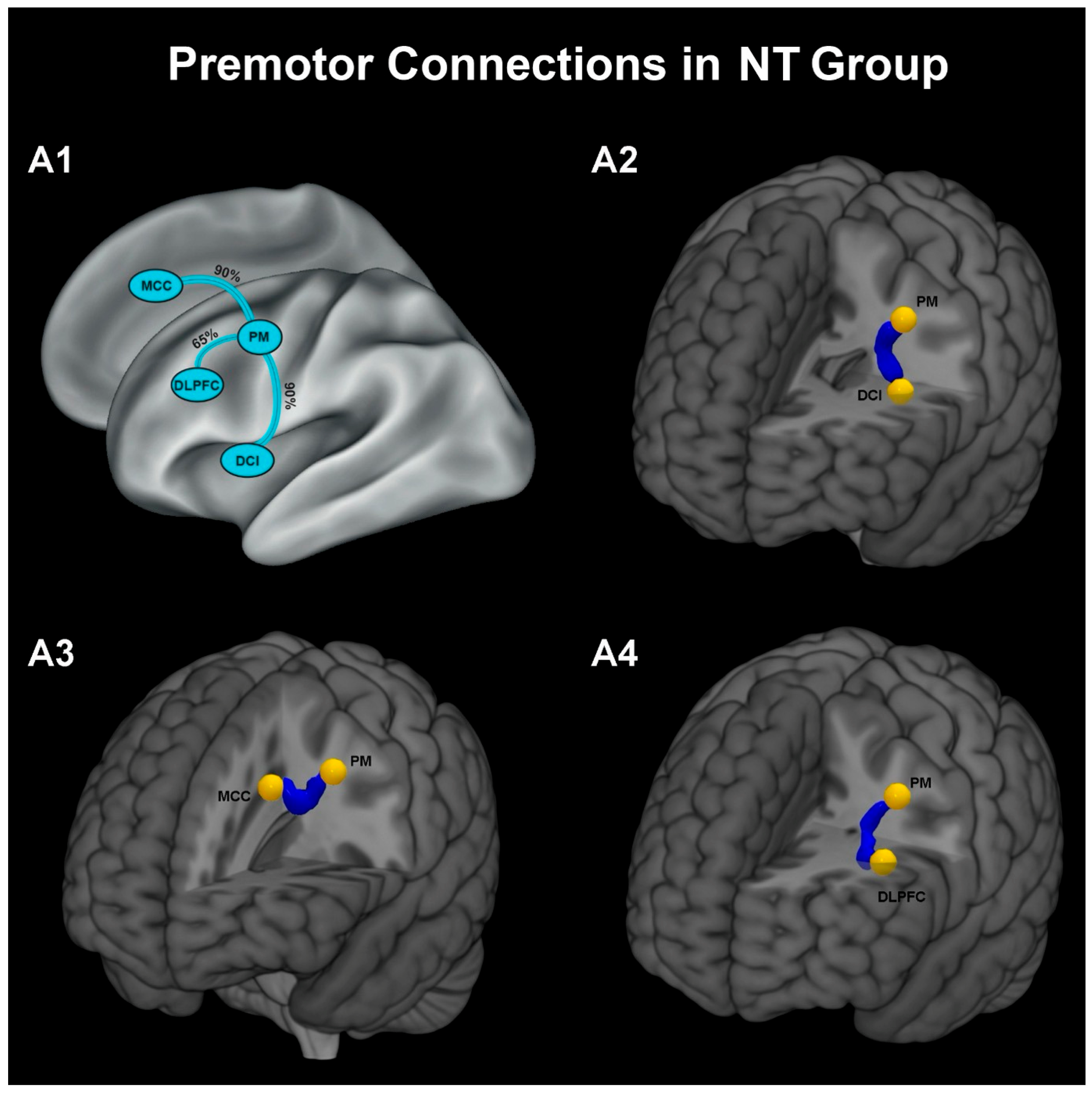
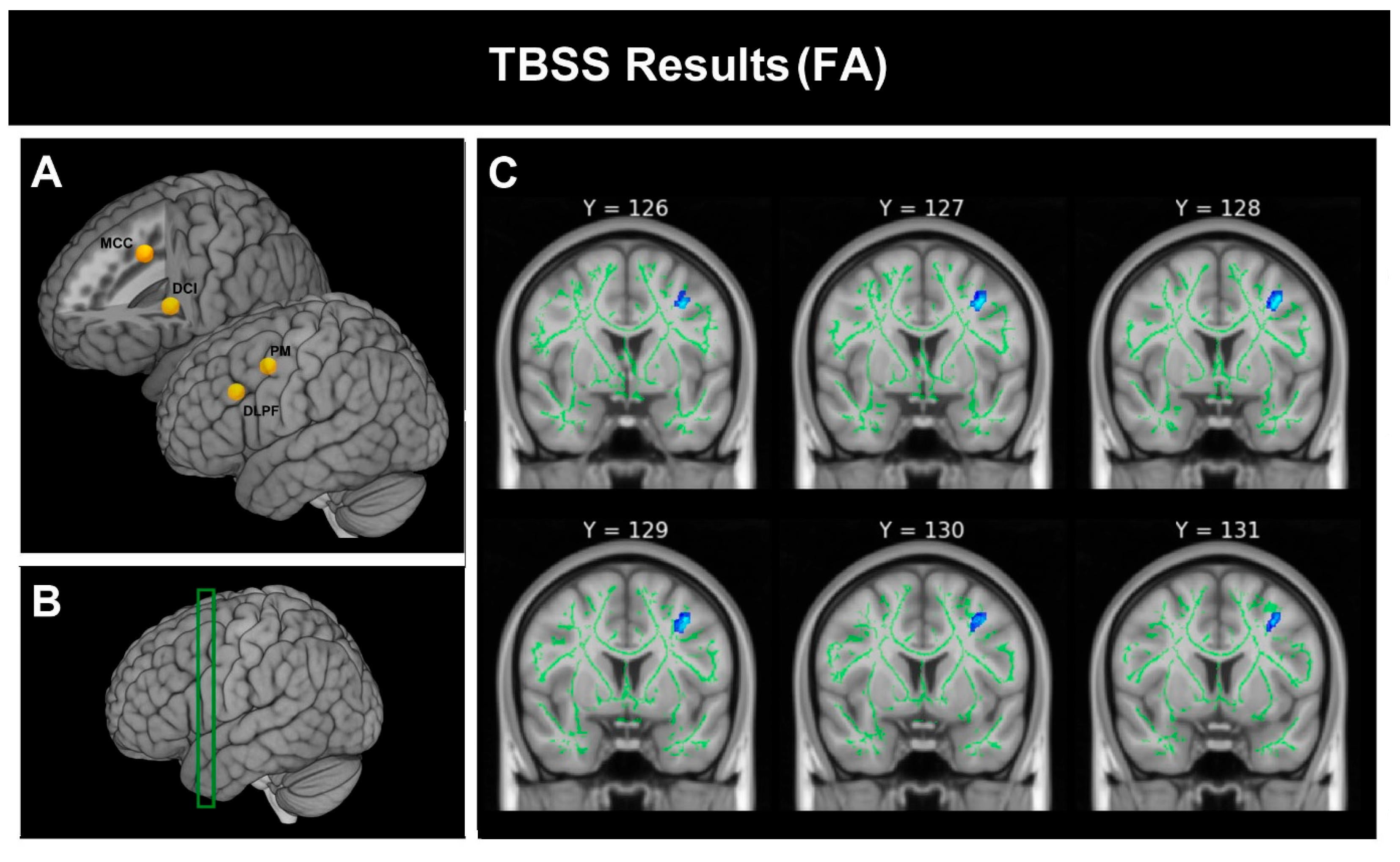
- Diffusion imaging revealed white-matter microstructural alterations and atypical tract organization in premotor-related pathways connecting the PM with the DLPFC, MCC, and DCI in ASD.
- The results indicate atypical structural and connectivity development within the Vitality Forms network in children with ASD.
- These neural alterations may underlie differences in processing affective components of action during social interactions in ASD.
Abstract
1. Introduction
2. Methods
2.1. Participants
2.2. Data Processing and Neuroimaging Approach
2.3. Voxel-Based Morphometry (VBM)
2.4. A Priori VF Network Mask (Explicit ROI Mask)
2.5. Tract-Based Spatial Statistics (TBSS)
2.6. VF Network White-Matter ROI Mask (Skeleton-Constrained)
2.7. Statistical Inference
2.8. Correlation Analysis
2.9. Probabilistic Tractography
3. Results
3.1. VBM Results
3.2. TBSS Results
3.3. Results of Correlation Analysis
3.4. Results of Probabilistic Tractography
4. Discussion
4.1. Grey-Matter Alterations Within Frontal and Cingulate Regions
4.2. Premotor White-Matter Microstructure and Clinical Severity
4.3. Network-Level Connectivity Patterns
5. Limitations and Future Directions
6. Conclusions
Supplementary Materials
Author Contributions
Funding
Institutional Review Board Statement
Informed Consent Statement
Data Availability Statement
Conflicts of Interest
References
- Stern, D.N. The Interpersonal World of the Infant: A View from Psychoanalysis and Developmental Psychology; Basic Books: New York, NY, USA, 1985. [Google Scholar]
- Stern, D.N. Forms of Vitality: Exploring Dynamic Experience in Psychology, the Arts, Psychotherapy, and Development; Oxford University Press: Oxford, UK, 2010. [Google Scholar]
- Di Cesare, G.; Di Dio, C.; Marchi, M.; Rizzolatti, G. Expressing our internal states and understanding those of others. Proc. Natl. Acad. Sci. USA 2015, 112, 10331–10335. [Google Scholar] [CrossRef]
- Di Cesare, G.; Marchi, M.; Lombardi, G.; Gerbella, M.; Sciutti, A.; Rizzolatti, G. The middle cingulate cortex and dorso-central insula: A mirror circuit encoding observation and execution of vitality forms. Proc. Natl. Acad. Sci. USA 2021, 118, e2111358118. [Google Scholar] [CrossRef]
- Di Cesare, G.; Koush, Y.; Zeidman, P.; Sciutti, A.; Friston, K.; Rizzolatti, G. Bridging feeling and motion: Insula–premotor dynamics in the processing of action vitality forms. Proc. Natl. Acad. Sci. USA 2025, 122, e2514139122. [Google Scholar] [CrossRef]
- Di Cesare, G.; Pinardi, C.; Carapelli, C.; Caruana, F.; Marchi, M.; Gerbella, M.; Rizzolatti, G. Insula connections with the parieto-frontal circuit for generating arm actions in humans and macaque monkeys. Cereb. Cortex 2019, 29, 2140–2147. [Google Scholar] [CrossRef] [PubMed]
- Di Cesare, G.; Sparaci, L.; Pelosi, A.; Mazzone, L.; Giovagnoli, G.; Menghini, D.; Ruffaldi, E.; Vicari, S. Differences in action style recognition in children with autism spectrum disorders. Front. Psychol. 2017, 8, 1456. [Google Scholar] [CrossRef] [PubMed]
- Cuccio, V.; Tambuscio, F.; Leonardi, E.; Famà, F.I.; Carrozza, C.; Aiello, S.; Campisi, A.; Minutoli, R.; Chila, R.; Marino, F. Recognition of Action Vitality Forms is Linked to Social Communication Traits in Autism. J. Autism Dev. Disord. 2025, 1–10. [Google Scholar] [CrossRef]
- Di Cesare, G.; Bruschetta, R.; Vitale, A.; Pelosi, A.; Leonardi, E.; Famà, F.I.; Mastrogiuseppe, M.; Carrozza, C.; Aiello, S.; Campisi, A. Exploring divergent kinematics in autism across social and non-social vitality forms. Sci. Rep. 2024, 14, 24164. [Google Scholar] [CrossRef] [PubMed]
- Di Martino, A.; Yan, C.-G.; Li, Q.; Denio, E.; Castellanos, F.X.; Alaerts, K.; Anderson, J.S.; Assaf, M.; Bookheimer, S.Y.; Dapretto, M.; et al. The autism brain imaging data exchange: Towards a large-scale evaluation of the intrinsic brain architecture in autism. Mol. Psychiatry 2014, 19, 659–667. [Google Scholar] [CrossRef]
- Di Martino, A.; O’Connor, D.; Chen, B.; Alaerts, K.; Anderson, J.S.; Assaf, M.; Balsters, J.H.; Baxter, L.; Beggiato, A.; Bernaerts, S.; et al. Enhancing studies of the connectome in autism using the autism brain imaging data exchange II. Sci. Data 2017, 4, 170010. [Google Scholar] [CrossRef]
- Di Cesare, G.; Lombardi, G.; Zeidman, P.; Urgen, B.A.; Sciutti, A.; Friston, K.J.; Rizzolatti, G. Two distinct networks for encoding goals and forms of action: An effective connectivity study. Proc. Natl. Acad. Sci. USA 2024, 121, e2402282121. [Google Scholar] [CrossRef]
- Wood-Downie, H.; Wong, B.; Kovshoff, H.; Cortese, S.; Hadwin, J.A. Research Review: A systematic review and meta-analysis of sex/gender differences in social interaction and communication in autistic and nonautistic children and adolescents. J. Child. Psychol. Psychiatry Allied Discip. 2021, 62, 922–936. [Google Scholar] [CrossRef]
- Napolitano, A.; Schiavi, S.; La Rosa, P.; Rossi-Espagnet, M.C.; Petrillo, S.; Bottino, F.; Tagliente, E.; Longo, D.; Lupi, E.; Casula, G.; et al. Sex differences in autism spectrum disorder: Diagnostic, neurobiological, and behavioral features. Front. Psychiatry 2022, 13, 889636. [Google Scholar] [CrossRef]
- Lord, C.; Rutter, M.; Goode, S.; Heemsbergen, J.; Jordan, H.; Mawhood, L.; Schopler, E. Austism diagnostic observation schedule: A standardized observation of communicative and social behavior. J. Autism Dev. Disord. 1989, 19, 185–212. [Google Scholar] [CrossRef] [PubMed]
- Lord, C.; Rutter, M.; Le Couteur, A. Autism Diagnostic Interview-Revised: A revised version of a diagnostic interview for caregivers of individuals with possible pervasive developmental disorders. J. Autism Dev. Disord. 1994, 24, 659–685. [Google Scholar] [CrossRef] [PubMed]
- Rutter, M.; Le Couteur, A.; Lord, C. Autism diagnostic interview-revised. Am. J. Ment. Retard. 2003, 29, 30. [Google Scholar] [CrossRef]
- Lord, C.; Rutter, M.; DiLavore, P.C.; Risi, S.; Gotham, K.; Bishop, S. Autism Diagnostic Observation Schedule (ADOS-2), 2nd ed.; Western Psychological Services: Torrance, CA, USA, 2012. [Google Scholar]
- Gotham, K.; Pickles, A.; Lord, C. Standardizing ADOS scores for a measure of severity in autism spectrum disorders. J. Autism Dev. Disord. 2009, 39, 693–705. [Google Scholar] [CrossRef]
- Ashburner, J.; Friston, K.J. Voxel-based morphometry—The methods. NeuroImage 2000, 11, 805–821. [Google Scholar] [CrossRef]
- Ashburner, J.; Friston, K.J. Unified segmentation. NeuroImage 2005, 26, 839–851. [Google Scholar] [CrossRef]
- Wilke, M.; Holland, S.K.; Altaye, M.; Gaser, C. Template-O-Matic: A toolbox for creating customised pediatric templates. NeuroImage 2008, 41, 903–913. [Google Scholar] [CrossRef]
- Ashburner, J.; Friston, K.J. Diffeomorphic registration using geodesic shooting and Gauss–Newton optimisation. NeuroImage 2011, 55, 954–967. [Google Scholar] [CrossRef]
- Andersson, J.L.R.; Sotiropoulos, S.N. An integrated approach to correction for off-resonance effects and subject movement in diffusion MR imaging. NeuroImage 2016, 125, 1063–1078. [Google Scholar] [CrossRef] [PubMed]
- Andersson, J.L.R.; Graham, M.S.; Zsoldos, E.; Sotiropoulos, S.N. Incorporating outlier detection and replacement into a non-parametric framework for movement and distortion correction of diffusion MR images. NeuroImage 2016, 141, 556–572. [Google Scholar] [CrossRef]
- Smith, S.M.; Jenkinson, M.; Johansen-Berg, H.; Rueckert, D.; Nichols, T.E.; Mackay, C.E.; Watkins, K.E.; Ciccarelli, O.; Cader, M.Z.; Matthews, P.M.; et al. Tract-based spatial statistics: Voxelwise analysis of multi-subject diffusion data. NeuroImage 2006, 31, 1487–1505. [Google Scholar] [CrossRef]
- Behrens, T.E.J.; Woolrich, M.W.; Jenkinson, M.; Johansen-Berg, H.; Nunes, R.G.; Clare, S.; Matthews, P.M.; Brady, J.M.; Smith, S.M. Characterization and propagation of uncertainty in diffusion-weighted MR imaging. Magn. Reson. Med. 2003, 50, 1077–1088. [Google Scholar] [CrossRef]
- Behrens, T.E.J.; Johansen-Berg, H.; Jbabdi, S.; Rushworth, M.F.S.; Woolrich, M.W. Probabilistic diffusion tractography with multiple fibre orientations: What can we gain? NeuroImage 2007, 34, 144–155. [Google Scholar] [CrossRef] [PubMed]
- Jbabdi, S.; Behrens, T.E.J.; Smith, S.M. Crossing fibres in tract-based spatial statistics. NeuroImage 2010, 49, 249–256. [Google Scholar] [CrossRef] [PubMed]
- Smith, S.M.; Nichols, T.E. Threshold-free cluster enhancement: Addressing problems of smoothing, threshold dependence and localisation in cluster inference. NeuroImage 2009, 44, 83–98. [Google Scholar] [CrossRef]
- Winkler, A.M.; Ridgway, G.R.; Webster, M.A.; Smith, S.M.; Nichols, T.E. Permutation inference for the general linear model. NeuroImage 2014, 92, 381–397. [Google Scholar] [CrossRef] [PubMed]
- Schumann, C.M.; Bloss, C.S.; Barnes, C.C.; Wideman, G.M.; Carper, R.A.; Akshoomoff, N.; Pierce, K.; Hagler, D.; Schork, N.; Lord, C.; et al. Longitudinal magnetic resonance imaging study of cortical development through early childhood in autism. J. Neurosci. 2010, 30, 4419–4427. [Google Scholar] [CrossRef]
- Redcay, E.; Courchesne, E. When is the brain enlarged in autism? A meta-analysis of all brain size reports. Biol. Psychiatry 2005, 58, 1–9. [Google Scholar] [CrossRef]
- Courchesne, E.; Karns, C.M.; Davis, H.R.; Ziccardi, R.; Carper, R.A.; Tigue, Z.D.; Chisum, H.J.; Moses, P.; Pierce, K.; Lord, C.; et al. Unusual brain growth patterns in early life in patients with autistic disorder: An MRI study. Neurology 2001, 57, 245–254. [Google Scholar] [PubMed]
- Liu, S.; Zeng, D.; Yi, C.; Zhu, M. Neurocognitive mechanisms underlying autism spectrum disorders: A literature review. Front. Psychiatry 2025, 16, 1633658. [Google Scholar] [CrossRef]
- Hazlett, H.C.; Gu, H.; Munsell, B.C.; Kim, S.H.; Styner, M.; Wolff, J.J.; Elison, J.T.; Swanson, M.R.; Zhu, H.; Botteron, K.N.; et al. Early brain development in infants at high risk for autism spectrum disorder. Nature 2017, 542, 348–351. [Google Scholar] [CrossRef] [PubMed]
- Di Dio, C.; Di Cesare, G.; Higuchi, S.; Roberts, N.; Vogt, S.; Rizzolatti, G. The neural correlates of velocity processing during the observation of a biological effector in the parietal and premotor cortex. Neuroimage 2013, 64, 425–436. [Google Scholar]
- Cieslik, E.C.; Zilles, K.; Caspers, S.; Roski, C.; Kellermann, T.S.; Jakobs, O.; Langner, R.; Laird, A.R.; Fox, P.T.; Eickhoff, S.B. Is there “one” DLPFC in cognitive action control? Evidence for heterogeneity from co-activation-based parcellation. Cereb. Cortex 2013, 23, 2677–2689. [Google Scholar]
- Caminiti, R.; Johnson, P.B.; Galli, C.; Ferraina, S.; Burnod, Y. Making arm movements within different parts of space: The premotor and motor cortical representation of a coordinate system for reaching to visual targets. J. Neurosci. 1991, 11, 1182–1197. [Google Scholar] [CrossRef]
- Moran, D.W.; Schwartz, A.B. Motor cortical representation of speed and direction during reaching. J. Neurophysiol. 1999, 82, 2676–2692. [Google Scholar] [CrossRef]
- Fu, Q.G.; Suarez, J.I.; Ebner, T.J. Neuronal specification of direction and distance during reaching movements in the superior precentral premotor area and primary motor cortex of monkeys. J. Neurophysiol. 1993, 70, 2097–2116. [Google Scholar] [CrossRef]
- Churchland, M.M.; Byron, M.Y.; Ryu, S.I.; Santhanam, G.; Shenoy, K.V. Neural variability in premotor cortex provides a signature of motor preparation. J. Neurosci. 2006, 26, 3697–3712. [Google Scholar] [CrossRef]
- Messier, J.; Kalaska, J.F. Covariation of primate dorsal premotor cell activity with direction and amplitude during a memorized-delay reaching task. J. Neurophysiol. 2000, 84, 152–165. [Google Scholar] [CrossRef] [PubMed]
- Riehle, A.; Requin, J. The predictive value for performance speed of preparatory changes in neuronal activity of the monkey motor and premotor cortex. Behav. Brain Res. 1993, 53, 35–49. [Google Scholar] [CrossRef]
- Churchland, M.M.; Santhanam, G.; Shenoy, K.V. Preparatory activity in premotor and motor cortex reflects the speed of the upcoming reach. J. Neurophysiol. 2006, 96, 3130–3146. [Google Scholar] [CrossRef] [PubMed]
- Kilroy, E.; Gerbella, M.; Cao, L.; Molfese, P.; Butera, C.; Harrison, L.; Jayashankar, A.; Rizzolatti, G.; Aziz-Zadeh, L. Specific tractography differences in autism compared to developmental coordination disorder. Sci. Rep. 2022, 12, 19246. [Google Scholar] [CrossRef] [PubMed]
- Rochat, M.J.; Veroni, V.; Bruschweiler-Stern, N.; Pieraccini, C.; Bonnet-Brilhault, F.; Barthélémy, C.; Malvy, J.; Sinigaglia, C.; Stern, D.N.; Rizzolatti, G. Impaired vitality form recognition in autism. Neuropsychologia 2013, 51, 1918–1924. [Google Scholar] [CrossRef] [PubMed]
- Casartelli, L.; Federici, A.; Fumagalli, L.; Cesareo, A.; Nicoli, M.; Ronconi, L.; Vitale, A.; Molteni, M.; Rizzolatti, G.; Sinigaglia, C. Neurotypical individuals fail to understand action vitality form in children with autism spectrum disorder. Proc. Natl. Acad. Sci. USA 2020, 117, 27712–27718. [Google Scholar] [CrossRef]




| ASD Children | NT Children | |||
|---|---|---|---|---|
| T1 Sample (n = 30) | dMRI Subset (n = 20) | T1 Sample (n = 30) | dMRI Subset (n = 20) | |
| Age (years) | 8.74 ± 1.58 | 8.82 ± 1.47 | 8.50 ± 1.26 | 8.76 ± 1.15 |
| Sex | Male | Male | Male | Male |
| Full-scale IQ | 103 ± 19 | 103 ± 18 | 118 ± 14 | 119 ± 14 |
| NYU | 57% | 45% | 60% | 55% |
| SDU | 30% | 40% | 27% | 35% |
| Trinity | 13% | 15% | 13% | 10% |
| ADOS-2 SA | 11.35 ± 4.12 | 11.82 ± 4.53 | n.a. | n.a. |
| ADOS-2 Severity | 8.08 ± 1.74 | 8.12 ± 1.90 | n.a. | n.a. |
| ADOS-2 Total | 15.27 ± 5.01 | 15.60 ± 5.44 | n.a. | n.a. |
| ADI-R RSI | 17.43 ± 5.62 | 17.15 ± 5.53 | n.a. | n.a. |
| Region | Peak MNI (x y z) | kE (Voxels) | T | p_FWE |
|---|---|---|---|---|
| PM | −38 4 45 | 208 | 4.82 | 0.008 |
| DLPFC | −48 33 26 | 390 | 4.56 | 0.013 |
| MCC | −3 15 40 | 390 | 4.41 | 0.017 |
| Metric | Region | Direction | #Skeleton Voxels | p_FWE (TFCE) |
|---|---|---|---|---|
| FA | PM WM | NT > ASD | 97 | <0.05 |
| AD (L1) | PM WM | NT > ASD | 125 | <0.05 |
| F1 | PM WM | NT > ASD | 112 | <0.05 |
| RD | PM WM | ASD > NT | 98 | <0.05 |
Disclaimer/Publisher’s Note: The statements, opinions and data contained in all publications are solely those of the individual author(s) and contributor(s) and not of MDPI and/or the editor(s). MDPI and/or the editor(s) disclaim responsibility for any injury to people or property resulting from any ideas, methods, instructions or products referred to in the content. |
© 2026 by the authors. Licensee MDPI, Basel, Switzerland. This article is an open access article distributed under the terms and conditions of the Creative Commons Attribution (CC BY) license.
Share and Cite
Carapelli, C.; Gerbella, M.; Tambuscio, F.; Di Cesare, G. Structural and Connectivity Alterations of the Premotor Cortex in Autistic Children: Implications for Affective Motor Impairments. Brain Sci. 2026, 16, 446. https://doi.org/10.3390/brainsci16050446
Carapelli C, Gerbella M, Tambuscio F, Di Cesare G. Structural and Connectivity Alterations of the Premotor Cortex in Autistic Children: Implications for Affective Motor Impairments. Brain Sciences. 2026; 16(5):446. https://doi.org/10.3390/brainsci16050446
Chicago/Turabian StyleCarapelli, Cecilia, Marzio Gerbella, Francesca Tambuscio, and Giuseppe Di Cesare. 2026. "Structural and Connectivity Alterations of the Premotor Cortex in Autistic Children: Implications for Affective Motor Impairments" Brain Sciences 16, no. 5: 446. https://doi.org/10.3390/brainsci16050446
APA StyleCarapelli, C., Gerbella, M., Tambuscio, F., & Di Cesare, G. (2026). Structural and Connectivity Alterations of the Premotor Cortex in Autistic Children: Implications for Affective Motor Impairments. Brain Sciences, 16(5), 446. https://doi.org/10.3390/brainsci16050446