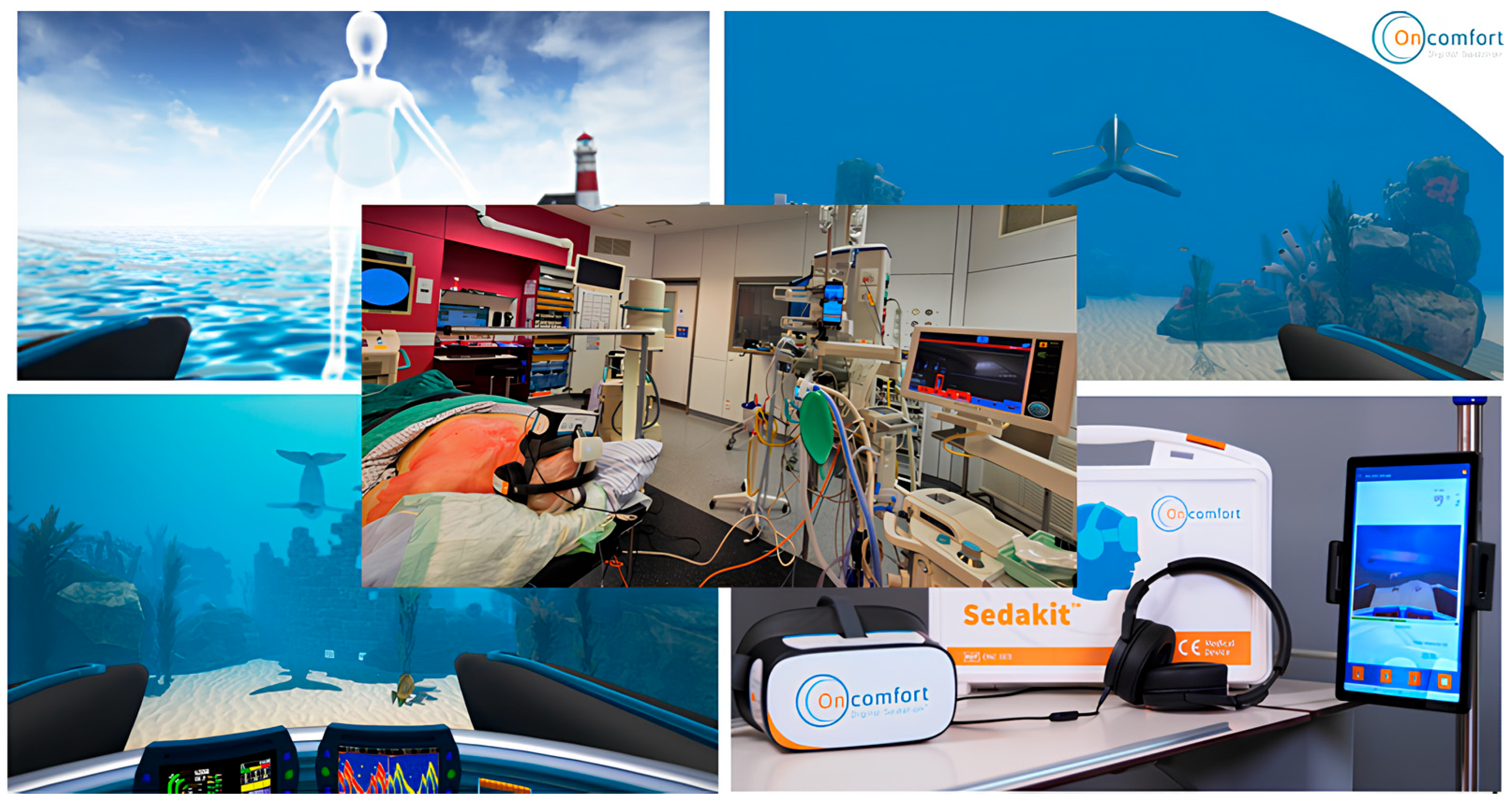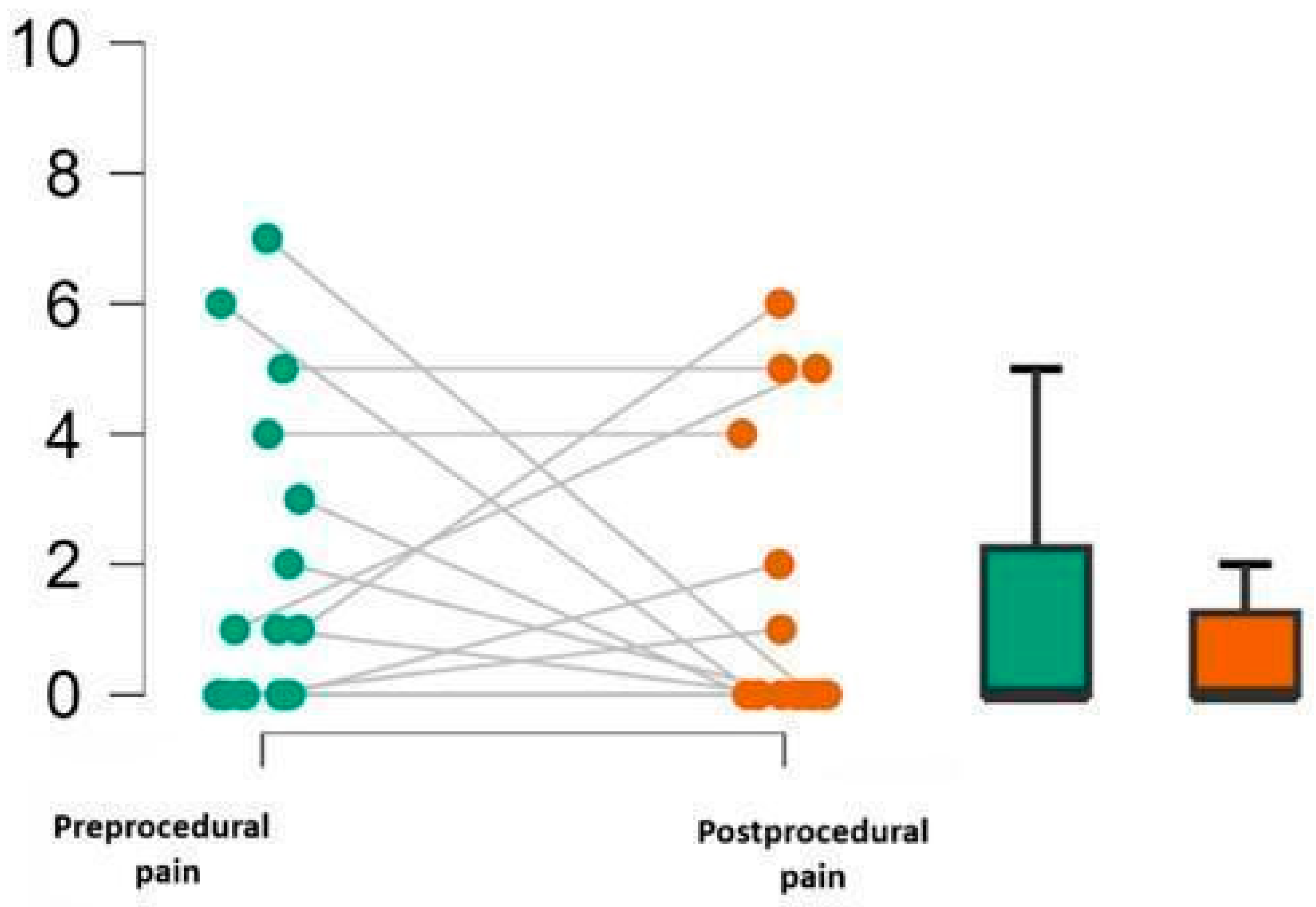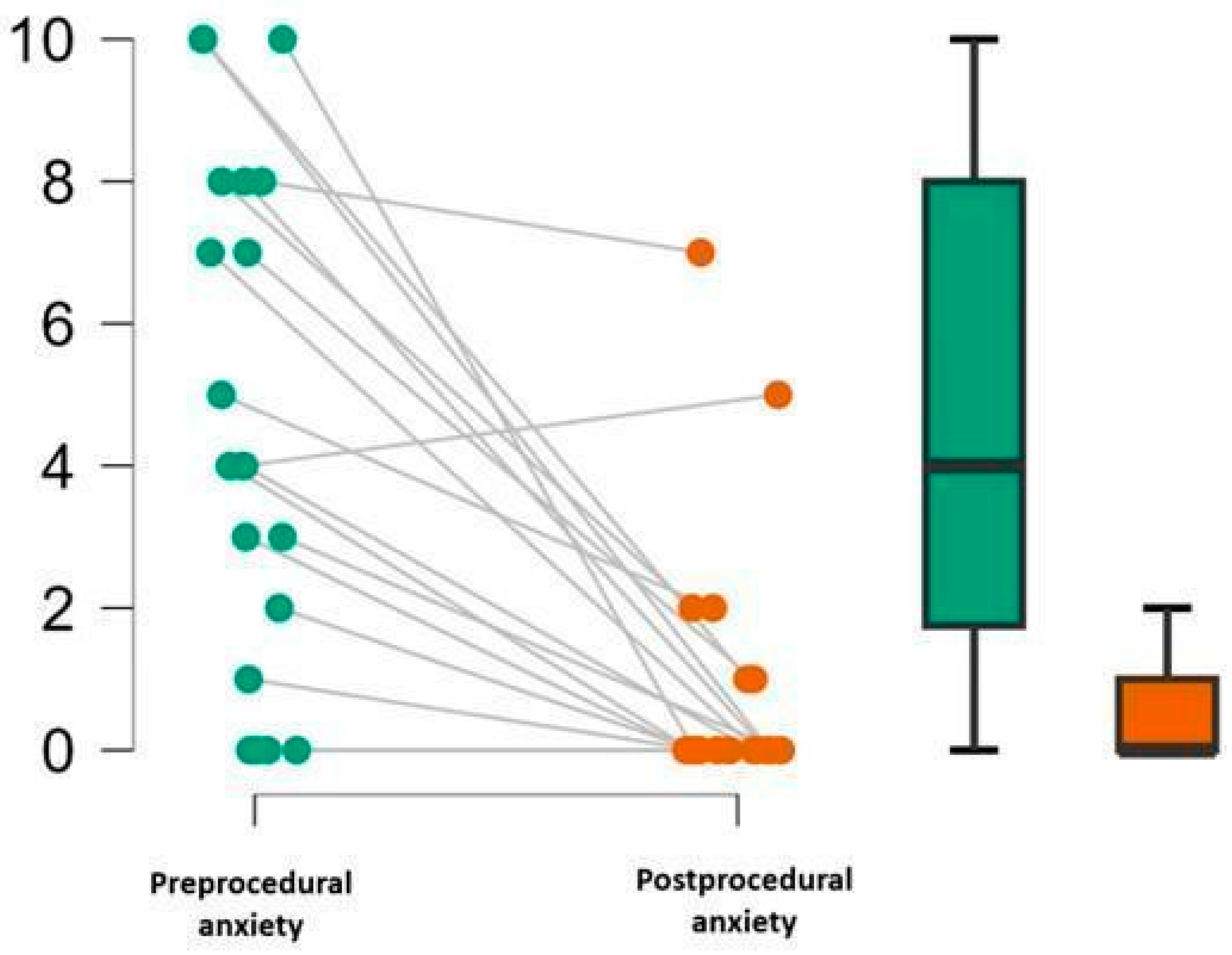
Effects of Virtual Reality Hypnosis on Pain and Anxiety in Oncology Patients During Port-a-Catheter Placement Procedure: A Pilot Study
 , , , , and
Abstract
1. Introduction
2. Materials and Methods
2.1. Population
2.2. Procedure
2.3. Intervention
2.4. Data Collection Tools
- -
- Trait measures (pre-procedural questionnaires):
- -
- Pre-procedural questions: prior experience with hypnosis or VR was assessed with yes/no questions, and demographic characteristics (age, biological sex) were gathered from patients’ files.
- -
- VRH State Measures
2.5. Statistical Analyses
3. Results
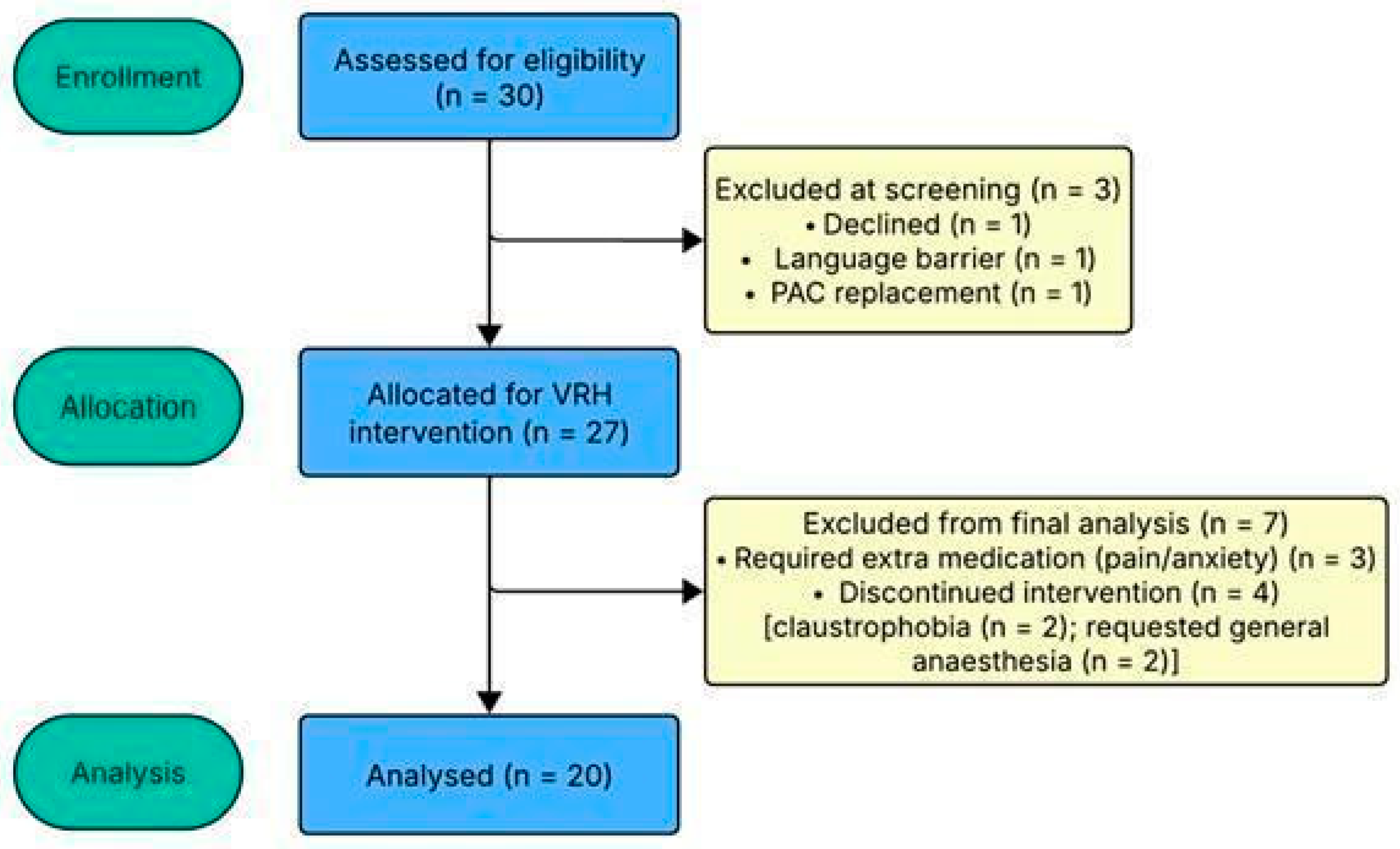
3.1. Participant Flow
3.2. Correlation Testing
4. Discussion
5. Limitations
6. Conclusions
Supplementary Materials
Author Contributions
Funding
Institutional Review Board Statement
Informed Consent Statement
Data Availability Statement
Conflicts of Interest
References
- Sugawara, S.; Sone, M.; Sakamoto, N.; Sofue, K.; Hashimoto, K.; Arai, Y.; Tokue, H.; Takigawa, M.; Mimura, H.; Yamanishi, T.; et al. Guidelines for Central Venous Port Placement and Management (Abridged Translation of the Japanese Version). Interv. Radiol. 2023, 8, 105–117. [Google Scholar] [CrossRef]
- Ivziku, D.; Gualandi, R.; Pesce, F.; De Benedictis, A.; Tartaglini, D. Adult oncology patients’ experiences of living with a central venous catheter: A systematic review and meta-synthesis. Support. Care Cancer Off. J. Multinatl. Assoc. 2022, 30, 3773–3791. [Google Scholar] [CrossRef] [PubMed]
- Baagil, H.; Baagil, H.; Gerbershagen, M.U. Preoperative Anxiety Impact on Anesthetic and Analgesic Use. Medicina 2023, 59, 2069. [Google Scholar] [CrossRef] [PubMed]
- Janatolmakan, M.; Awys, L.; Khatony, A. Cancer patients’ experience with implanted venous ports: A qualitative descriptive study. J. Vasc. Nurs. Off. Publ. Soc. Peripher. Vasc. Nurs. 2024, 42, 74–79. [Google Scholar] [CrossRef] [PubMed]
- Shebl, M.A.; Toraih, E.; Shebl, M.; Tolba, A.M.; Ahmed, P.; Banga, H.S.; Orz, M.; Tammam, M.; Saadalla, K.; Elsayed, M.; et al. Preoperative anxiety and its impact on surgical outcomes: A systematic review and meta-analysis. J. Clin. Transl. Sci. 2025, 9, e33. [Google Scholar] [CrossRef]
- Segerstrom, S.C.; Miller, G.E. Psychological stress and the human immune system: A meta-analytic study of 30 years of inquiry. Psychol. Bull. 2004, 130, 601–630. [Google Scholar] [CrossRef]
- Zengin, S.; Kabul, S.; Al, B.; Sarcan, E.; Doğan, M.; Yildirim, C. Effects of music therapy on pain and anxiety in patients undergoing port catheter placement procedure. Complement. Ther. Med. 2013, 21, 689–696. [Google Scholar] [CrossRef]
- Chen, Y.K.; Soens, M.A.; Kovacheva, V.P. Less stress, better success: A scoping review on the effects of anxiety on anesthetic and analgesic consumption. J. Anesth. 2022, 36, 532–553. [Google Scholar] [CrossRef]
- Masaud, K.; Galvin, A.D.; De Loughry, G.; Meachair, A.O.; Galea, S.; Shorten, G. Preoperative psychological factors influence analgesic consumption and self-reported pain intensity following breast cancer surgery. BMC Anesthesiol. 2024, 24, 239. [Google Scholar] [CrossRef]
- Lutgendorf, S.K.; Lamkin, D.M.; DeGeest, K.; Anderson, B.; Dao, M.; McGinn, S.; Zimmerman, B.; Maiseri, H.; Sood, A.K.; Lubaroff, D.M. Depressed and anxious mood and T-cell cytokine expressing populations in ovarian cancer patients. Brain Behav. Immun. 2008, 22, 890–900. [Google Scholar] [CrossRef]
- Duan, W.; Gu, H.; Luo, Y.; Li, W. Management of Venous Access Port to Overcome Kinesiophobia of Patients with Malignant Tumors: A Review. Med. Sci. Monit. Int. Med. J. Exp. Clin. Res. 2024, 30, e943181. [Google Scholar] [CrossRef]
- Li, C.; Lin, Y.; Xiao, X.; Guo, X.; Fei, J.; Lu, Y.; Zhao, J.; Zhang, L. Development and validation of a risk prediction model for kinesiophobia in postoperative lung cancer patients: An interpretable machine learning algorithm study. Sci. Rep. 2025, 15, 19412. [Google Scholar] [CrossRef]
- Sharif-Nia, H.; Nazari, R.; Hajihosseini, F.; Froelicher, E.S.; Osborne, J.W.; Taebbi, S.; Nowrozi, P. The relationship of fear of pain, pain anxiety, and fear-avoidance beliefs with perceived stress in surgical patients with postoperative kinesiophobia. BMC Psychol. 2025, 13, 420. [Google Scholar] [CrossRef] [PubMed]
- Breen, S.J.; Baravelli, C.M.; Schofield, P.E.; Jefford, M.; Yates, P.M.; Aranda, S.K. Is symptom burden a predictor of anxiety and depression in patients with cancer about to commence chemotherapy? Med. J. Aust. 2009, 190, S99–S104. [Google Scholar] [CrossRef] [PubMed]
- Traeger, L.; Greer, J.A.; Fernandez-Robles, C.; Temel, J.S.; Pirl, W.F. Evidence-based treatment of anxiety in patients with cancer. J. Clin. Oncol. Off. J. Am. Soc. Clin. Oncol. 2012, 30, 1197–1205. [Google Scholar] [CrossRef] [PubMed]
- Alorfi, N.M. Pharmacological Methods of Pain Management: Narrative Review of Medication Used. Int. J. Gen. Med. 2023, 16, 3247–3256. [Google Scholar] [CrossRef]
- Elkins, G.R.; Barabasz, A.F.; Council, J.R.; Spiegel, D. Advancing research and practice: The revised APA Division 30 definition of hypnosis. Int. J. Clin. Exp. Hypn. 2015, 63, 1–9. [Google Scholar] [CrossRef]
- Acunzo, D.J.; Terhune, D.B. A Critical Review of Standardized Measures of Hypnotic Suggestibility. Int. J. Clin. Exp. Hypn. 2021, 69, 50–71. [Google Scholar] [CrossRef]
- Sterkers, N.; Chabrol, J.L.; De Troyer, J.; Bonijol, D.; Darmon, J.C.; Donnez, O. Hypnosis as adjunct therapy to conscious sedation for venous access device implantation in breast cancer: A pilot study. J. Vasc. Access 2018, 19, 382–386. [Google Scholar] [CrossRef]
- Hoslin, L.; Motamed, C.; Maurice-Szamburski, A.; Legoupil, C.; Pons, S.; Bordenave, L. Impact of hypnosis on patient experience after venous access port implantation. Anaesth. Crit. Care Pain Med. 2019, 38, 609–613. [Google Scholar] [CrossRef]
- Monolo, D.; Barisone, M.; Cordio, G.; Della Sanità, M.; Airoldi, C.; Radrizzani, D.; Bassi, E.; Molin, A.D.; Gallione, C. The use of hypnotic communication in PICC placement: Randomized controlled trial study. Am. J. Clin. Hypn. 2024, 66, 249–261. [Google Scholar] [CrossRef]
- Walter, N.; Leyva, M.T.; Hinterberger, T.; Rupp, M.; Loew, T.; Lambert-Delgado, A.; Mena, A.E.C. Hypnosis as a non-pharmacological intervention for invasive medical procedures—A systematic review and meta-analytic update. J. Psychosom. Res. 2025, 192, 112117. [Google Scholar] [CrossRef] [PubMed]
- Moss, D.; Willmarth, E. Hypnosis, anesthesia, pain management, and preparation for medical procedures. Ann. Palliat. Med. 2019, 8, 498–503. [Google Scholar] [CrossRef] [PubMed]
- Khalid, A.; Mohajer-Bastami, A.; Khamise, A.; Pouwels, S.; Moin, S.; Araamuthan, V.; Khalid, A.; Ahmed, A.; Ahmad, S. Evaluating Psychological Interventions for Pain, Recovery, and Outcomes in Surgical and Medical Care. Cureus 2025, 17, e88097. [Google Scholar] [CrossRef]
- Tellegen, A.; Atkinson, G. Openness to absorbing and self-altering experiences (“absorption”), a trait related to hypnotic susceptibility. J. Abnorm. Psychol. 1974, 83, 268–277. [Google Scholar] [CrossRef]
- Hilgard, E.R. The problem of divided consciousness: A neodissociation interpretation. Ann. N. Y. Acad. Sci. 1977, 296, 48–59. [Google Scholar] [CrossRef] [PubMed]
- Jamieson, G.A.; Burgess, A.P. Hypnotic induction is followed by state-like changes in the organization of EEG functional connectivity in the theta and beta frequency bands in high-hypnotically susceptible individuals. Front. Hum. Neurosci. 2014, 8, 528. [Google Scholar] [CrossRef]
- Woody, E.; Sadler, P. What Can a Hypnotic Induction Do? Am. J. Clin. Hypn. 2016, 59, 138–154. [Google Scholar] [CrossRef]
- Rainville, P.; Streff, A.; Chen, J.I.; Houzé, B.; Desmarteaux, C.; Piché, M. HYPNOTIC AUTOMATICITY IN THE BRAIN AT REST: An Arterial Spin Labelling Study. Int. J. Clin. Exp. Hypn. 2019, 67, 512–542. [Google Scholar] [CrossRef]
- Vanhaudenhuyse, A.; Ledoux, D.; Gosseries, O.; Demertzi, A.; Laureys, S.; Faymonville, M.E. CAN SUBJECTIVE RATINGS OF ABSORPTION, DISSOCIATION, AND TIME PERCEPTION DURING “NEUTRAL HYPNOSIS” PREDICT HYPNOTIZABILITY?: An exploratory study. Int. J. Clin. Exp. Hypn. 2019, 67, 28–38. [Google Scholar] [CrossRef]
- Hilgard, E.R. A neodissociation interpretation of pain reduction in hypnosis. Psychol. Rev. 1973, 80, 396–411. [Google Scholar] [CrossRef] [PubMed]
- Miller, M.E.; Bowers, K.S. Hypnotic analgesia: Dissociated experience or dissociated control? J. Abnorm. Psychol. 1993, 102, 29–38. [Google Scholar] [CrossRef] [PubMed]
- Bob, P. Pain, dissociation and subliminal self-representations. Conscious. Cogn. 2008, 17, 355–369. [Google Scholar] [CrossRef] [PubMed]
- Lynn, S.J. Automaticity and hypnosis: A sociocognitive account. Int. J. Clin. Exp. Hypn. 1997, 45, 239–250. [Google Scholar] [CrossRef]
- Polito, V.; Barnier, A.J.; Connors, M.H. Hypnotic clever hands: Agency and automatic responding. J. Exp. Psychol. Gen. 2018, 147, 815–828. [Google Scholar] [CrossRef]
- Cardeña, E.; Spiegel, D. Suggestibility, absorption, and dissociation: An integrative model of hypnosis. In Human Suggestibility: Advances in Theory, Research and Application; Schumaker, J.F., Ed.; Routledge: Abingdon-on-Thames, UK, 1991; pp. 93–107. [Google Scholar]
- Laborde, S.; Heuer, S.; Mosley, E. Effects of a Brief Hypnosis Relaxation Induction on Subjective Psychological States, Cardiac Vagal Activity, and Breathing Frequency. Int. J. Clin. Exp. Hypn. 2018, 66, 386–403. [Google Scholar] [CrossRef]
- De Benedittis, G. Hypnotic Modulation of Autonomic Nervous System (ANS) Activity. Brain Sci. 2024, 14, 249. [Google Scholar] [CrossRef]
- Abbas, J.R.; O’Connor, A.; Ganapathy, E.; Isba, R.; Payton, A.; McGrath, B.; Tolley, N.; Bruce, I.A. What is Virtual Reality? A healthcare-focused systematic review of definitions. Health Policy Technol. 2023, 12, 100741. [Google Scholar] [CrossRef]
- İbek, E.; Çınar, D. Effects of virtual reality application on pain, anxiety, and vital signs due to port catheter needle insertion: Randomized controlled study. Eur. J. Oncol. Nurs. Off. J. Eur. Oncol. Nurs. Soc. 2025, 74, 102750. [Google Scholar] [CrossRef]
- Ioannou, A.; Papastavrou, E.; Avraamides, M.N.; Charalambous, A. Virtual Reality and Symptoms Management of Anxiety, Depression, Fatigue, and Pain: A Systematic Review. SAGE Open Nurs. 2020, 6, 2377960820936163. [Google Scholar] [CrossRef]
- Viderman, D.; Tapinova, K.; Dossov, M.; Seitenov, S.; Abdildin, Y.G. Virtual reality for pain management: An umbrella review. Front. Med. 2023, 10, 1203670. [Google Scholar] [CrossRef] [PubMed]
- Menekli, T.; Yaprak, B.; Doğan, R. The Effect of Virtual Reality Distraction Intervention on Pain, Anxiety, and Vital Signs of Oncology Patients Undergoing Port Catheter Implantation: A Randomized Controlled Study. Pain Manag. Nurs. Off. J. Am. Soc. Pain Manag. Nurses 2022, 23, 585–590. [Google Scholar] [CrossRef] [PubMed]
- Heck, M.; Wagener, A.; Simon, J. The Sense of Presence: Validation of a New Presence Questionnaire [Poster Presentation]; Belgian Association for Psychological Sciences: Ghent, Belgium, 2021. [Google Scholar] [CrossRef]
- Michaux, R.; Stassart, C.; Wagener, A. Does the Need for Control Hinder Sense of Presence in Virtual Reality? Psychol. Belg. 2025, 65, 104–113. [Google Scholar] [CrossRef]
- Witmer, B.G.; Singer, M.J. Measuring presence in virtual environments: A presence questionnaire. Presence Teleoperat. Virt. Environ. 1998, 7, 225–240. [Google Scholar] [CrossRef]
- Rózsa, S.; Hargitai, R.; Láng, A.; Osváth, A.; Hupuczi, E.; Tamás, I.; Kállai, J. Measuring Immersion, Involvement, and Attention Focusing Tendencies in the Mediated Environment: The Applicability of the Immersive Tendencies Questionnaire. Front. Psychol. 2022, 13, 931955. [Google Scholar] [CrossRef] [PubMed]
- Kennedy, R.S.; Fowlkes, J.E.; Berbaum, K.S.; Lilienthal, M.G. Use of a motion sickness history questionnaire for prediction of simulator sickness. Aviat. Space Environ. Med. 1992, 63, 588–593. [Google Scholar]
- Bouchard, S.; Robillard, G.; Renaud, P. Simulator Sickness Questionnaire—French Revision (SSQ) [Database record]. APA PsycTests 2007. [Google Scholar] [CrossRef]
- Eccleston, C.; Crombez, G. Pain demands attention: A cognitive–affective model of the interruptive function of pain. Psychol. Bull. 1999, 125, 356–366. [Google Scholar] [CrossRef]
- Hilgard, E.R. Divided Consciousness: Multiple Controls in Human Thought and Action; Wiley: Hoboken, NJ, USA, 1977. [Google Scholar]
- Wiechman, S.A.; Jensen, M.P.; Sharar, S.R.; Barber, J.K.; Soltani, M.; Patterson, D.R. The Impact of Virtual Reality Hypnosis on Pain and Anxiety Caused by Trauma: Lessons Learned from a Clinical Trial. Int. J. Clin. Exp. Hypn. 2022, 70, 156–173. [Google Scholar] [CrossRef]
- Coulibaly, I.; Cardelli, L.S.; Duflos, C.; Moulis, L.; Mandoorah, B.; Nicoleau, J.; Placide, L.; Massin, F.; Pasquié, J.L.; Granier, M. Virtual Reality Hypnosis in the Electrophysiology Lab: When Human Treatments Are Better than Virtual Ones. J. Clin. Med. 2022, 11, 3913. [Google Scholar] [CrossRef]
- Rousseaux, F.; Dardenne, N.; Massion, P.B.; Ledoux, D.; Bicego, A.; Donneau, A.F.; Faymonville, M.E.; Nyssen, A.S.; Vanhaudenhuyse, A. Virtual reality and hypnosis for anxiety and pain management in intensive care units: A prospective randomised trial among cardiac surgery patients. Eur. J. Anaesthesiol. 2022, 39, 58–66. [Google Scholar] [CrossRef] [PubMed]
- van den Berg, S.; Hoogeveen, M.O.; van Winden, T.M.S.; Chegary, M.; Genco, M.S.; Jonkman, N.H. Virtual reality hypnosis for needle-related procedural pain and fear management in children: A non-inferiority randomized trial. Eur. J. Pediatr. 2023, 182, 4421–4430. [Google Scholar] [CrossRef]
- Steinkraus, K.C.; Feldmann, H.; Hunold, L.S.; Graf, S.; Dörr-Harim, C.; Nasir, N.; Michalski, C.W.; Hüttner, F.J. Impact of virtual reality hypnosedation on perioperative pain and anxiety in port implantation under local anesthesia: A randomized controlled pilot trial (VIP Trial). Perioper. Med. 2024, 13, 101. [Google Scholar] [CrossRef] [PubMed]
- Carella, M.; Bicego, A.; Beck, F.; Malta, C.; Ardizzone, L.; Bonhomme, V.L.; Vanhaudenhuyse, A. Influence of virtual reality with or without hypnosis on patient-related experience and functional recovery in outpatient foot surgery with regional anesthesia: A randomized controlled trial. Reg. Anesth. Pain Med. 2025, rapm-2025-106678. [Google Scholar] [CrossRef] [PubMed]
- Carella, M.; Beck, F.; Quoilin, C.; Azongmo, M.M.; Loheac, A.; Bonhomme, V.L.; Vanhaudenhuyse, A. Effect of virtual reality hypnosis on intraoperative sedation needs and functional recovery in knee arthroplasty: A prospective randomized clinical trial. Reg. Anesth. Pain Med. 2025, 50, 383–389. [Google Scholar] [CrossRef]
- Squara, F.; Bateau, J.; Scarlatti, D.; Bun, S.S.; Moceri, P.; Ferrari, E. Virtual Reality for the Management of Pain and Anxiety in Patients Undergoing Implantation of Pacemaker or Implantable Cardioverter Defibrillator: A Randomized Study. J. Med. Syst. 2024, 48, 28. [Google Scholar] [CrossRef]
- Lachkar, S.; Gervereau, D.; Lanquetuit, M.; Thiberville, L.; Pradier, H.M.; Roger, M.; Bota, S.; Guisier, F.; Salaün, M. Hypnosis associated with 3D immersive virtual reality technology during bronchoscopy under local anesthesia. J. Thorac. Dis. 2022, 14, 3205–3210. [Google Scholar] [CrossRef]
- Spielberger, C.D. Manual for the State-Trait-Anxiety Inventory: STAI (Form Y); Consulting Psychologists Press: Palo Alto, CA, USA, 1983. [Google Scholar]
- Carlson, E.B.; Putnam, F.W.; Ross, C.A.; Torem, M.; Coons, P.; Dill, D.L.; Loewenstein, R.J.; Braun, B.G. Validity of the Dissociative Experiences Scale in screening for multiple personality disorder: A multicenter study. Am. J. Psychiatry 1993, 150, 1030–1036. [Google Scholar] [CrossRef]
- Bender, R.; Lange, S. Adjusting for multiple testing—When and how? J. Clin. Epidemiol. 2001, 54, 343–349. [Google Scholar] [CrossRef]
- Rothman, K.J. No adjustments are needed for multiple comparisons. Epidemiology 1990, 1, 43–46. [Google Scholar] [CrossRef]
- Funder, D.C.; Ozer, D.J. Evaluating effect size in psychological research: Sense and nonsense. Adv. Methods Pract. Psychol. Sci. 2019, 2, 156–168. [Google Scholar] [CrossRef]
- Zieliński, G. Getting to Know Pain Effect Sizes-Guidelines for Effect Size and Sample Size in Global Pain Research. Arch. Phys. Med. Rehabil. 2026. [Google Scholar] [CrossRef] [PubMed]
- JASP Team. JASP; Version 0.95.3; Computer Software; JASP Team: Amsterdam, The Netherlands, 2025. [Google Scholar]
- Patterson, D.R.; Jensen, M.P. Hypnosis and clinical pain. Psychol. Bull. 2003, 129, 495–521. [Google Scholar] [CrossRef] [PubMed]
- Schönbrodt, F.D.; Perugini, M. At what sample size do correlations stabilize? J. Res. Personal. 2013, 47, 609–612. [Google Scholar] [CrossRef]
- Mott, T. Spiegel, Herbert & Spiegel, David (2004). Trance and Treatment: Clinical Uses of Hypnosis (2nd Edition). Washington, DC: American Psychiatric Publishing. xxvii+ 545 Pages, $52.00. Am. J. Clin. Hypn. 2004, 47, 129–131. [Google Scholar] [CrossRef]
- Eysenck, M.W.; Derakshan, N.; Santos, R.; Calvo, M.G. Anxiety and cognitive performance: Attentional control theory. Emotion 2007, 7, 336–353. [Google Scholar] [CrossRef]
- Moran, T.P. Anxiety and working memory capacity: A meta-analysis and narrative review. Psychol. Bull. 2016, 142, 831–864. [Google Scholar] [CrossRef]
- McGeown, W.J.; Mazzoni, G.; Vannucci, M.; Venneri, A. Structural and functional correlates of hypnotic depth and suggestibility. Psychiatry Res. 2015, 231, 151–159. [Google Scholar] [CrossRef]
- Mouheb, Y.; Cleeremans, A.; Faymonville, M.E.; Vanhaudenhuyse, A. Hypnosis in the self-regulation of feeling states. Int. Rev. Neurobiol. 2025, 184, 199–233. [Google Scholar] [CrossRef]
- Rebenitsch, L.; Owen, C. Review on cybersickness in applications and visual displays. Virtual Real. 2016, 20, 101–125. [Google Scholar] [CrossRef]
- Nichols, S.; Haldane, C.; Wilson, J.R. Measurement of presence and its consequences in virtual environments. Int. J. Hum. Comput. Stud. 2000, 52, 471–491. [Google Scholar] [CrossRef]
- Weech, S.; Kenny, S.; Barnett-Cowan, M. Presence and Cybersickness in Virtual Reality Are Negatively Related: A Review. Front. Psychol. 2019, 10, 158. [Google Scholar] [CrossRef] [PubMed]
- Véronneau, J.; Chevestrier-Lefeuvre, A.; Fournier, V.; Laurin, A.; Caron-Trahan, R.; Landry, M.; Guiné, J.; Dubey-Harispe, O.; Godin, N.; Moulay, I.; et al. Combining Virtual Reality and Hypnosis? A User Experience Study in Patients with Multiple Myeloma Following Stem Cell Transplantation. J. Patient Exp. 2025, 12, 23743735251393915. [Google Scholar] [CrossRef] [PubMed]
- Sacau, A.; Laarni, J.; Hartmann, T. Influence of individual factors on presence. Comput. Hum. Behav. 2008, 24, 2255–2273. [Google Scholar] [CrossRef]
- Weibel, D.; Wissmath, B.; Mast, F.W. Immersion in mediated environments: The role of personality traits. Cyberpsychol. Behav. Soc. Netw. 2010, 13, 251–256. [Google Scholar] [CrossRef] [PubMed]
- Gibson, S.J.; Helme, R.D. Age-related differences in pain perception and report. Clin. Geriatr. Med. 2001, 17, 433–456. [Google Scholar] [CrossRef] [PubMed]
- Lautenbacher, S.; Peters, J.H.; Heesen, M.; Scheel, J.; Kunz, M. Age changes in pain perception: A systematic-review and meta-analysis of age effects on pain and tolerance thresholds. Neurosci. Biobehav. Rev. 2017, 75, 104–113. [Google Scholar] [CrossRef]
- Altemus, M.; Sarvaiya, N.; Neill Epperson, C. Sex differences in anxiety and depression clinical perspectives. Front. Neuroendocrinol. 2014, 35, 320–330. [Google Scholar] [CrossRef]
- McLean, C.P.; Asnaani, A.; Litz, B.T.; Hofmann, S.G. Gender differences in anxiety disorders: Prevalence, course of illness, comorbidity and burden of illness. J. Psychiatr. Res. 2011, 45, 1027–1035. [Google Scholar] [CrossRef]
- Thabane, L.; Ma, J.; Chu, R.; Cheng, J.; Ismaila, A.; Rios, L.P.; Robson, R.; Thabane, M.; Giangregorio, L.; Goldsmith, C.H. A tutorial on pilot studies: The what, why and how. BMC Med. Res. Methodol. 2010, 10, 1. [Google Scholar] [CrossRef]
- Eldridge, S.M.; Chan, C.L.; Campbell, M.J.; Bond, C.M.; Hopewell, S.; Thabane, L.; Lancaster, G.A. CONSORT 2010 statement: Extension to randomised pilot and feasibility trials. BMJ 2016, 355, i5239. [Google Scholar] [CrossRef]
- Roche, S.M.; McConkey, K.M. Absorption: Nature, assessment, and correlates. J. Personal. Soc. Psychol. 1990, 59, 91–101. [Google Scholar] [CrossRef]
- Yan, Y.; López-Alcalde, J.; Stallings, E.; Jimenez Tejero, E.; Witt, C.M.; Barth, J. Patient motivation as a predictor of digital health intervention effects: A meta-epidemiological study of cancer trials. PLoS ONE 2024, 19, e0306772. [Google Scholar] [CrossRef]




| Characteristic | Effective Sample Completing VRH (N = 20) |
|---|---|
| Age, Years | |
| Mean ± SD | 68.5 ± 8.5 |
| Range | 56–82 |
| Sex, n (%) | |
| Female | 15 (75.0%) |
| Male | 5 (25.0%) |
Disclaimer/Publisher’s Note: The statements, opinions and data contained in all publications are solely those of the individual author(s) and contributor(s) and not of MDPI and/or the editor(s). MDPI and/or the editor(s) disclaim responsibility for any injury to people or property resulting from any ideas, methods, instructions or products referred to in the content. |
© 2026 by the authors. Licensee MDPI, Basel, Switzerland. This article is an open access article distributed under the terms and conditions of the Creative Commons Attribution (CC BY) license.
Share and Cite
Mouheb, Y.; Louras, M.; Maillart, J.-F.; Gosseries, O.; Charry, C.; Bicego, A.; Vanhaudenhuyse, A. Effects of Virtual Reality Hypnosis on Pain and Anxiety in Oncology Patients During Port-a-Catheter Placement Procedure: A Pilot Study. Brain Sci. 2026, 16, 384. https://doi.org/10.3390/brainsci16040384
Mouheb Y, Louras M, Maillart J-F, Gosseries O, Charry C, Bicego A, Vanhaudenhuyse A. Effects of Virtual Reality Hypnosis on Pain and Anxiety in Oncology Patients During Port-a-Catheter Placement Procedure: A Pilot Study. Brain Sciences. 2026; 16(4):384. https://doi.org/10.3390/brainsci16040384
Chicago/Turabian StyleMouheb, Yanis, Mélanie Louras, Jean-François Maillart, Olivia Gosseries, Claudia Charry, Aminata Bicego, and Audrey Vanhaudenhuyse. 2026. "Effects of Virtual Reality Hypnosis on Pain and Anxiety in Oncology Patients During Port-a-Catheter Placement Procedure: A Pilot Study" Brain Sciences 16, no. 4: 384. https://doi.org/10.3390/brainsci16040384
APA StyleMouheb, Y., Louras, M., Maillart, J.-F., Gosseries, O., Charry, C., Bicego, A., & Vanhaudenhuyse, A. (2026). Effects of Virtual Reality Hypnosis on Pain and Anxiety in Oncology Patients During Port-a-Catheter Placement Procedure: A Pilot Study. Brain Sciences, 16(4), 384. https://doi.org/10.3390/brainsci16040384