Article

Distinct Gut Microbiome Characteristics Associated with Mental Health Symptoms of Healthy Adults


1
Department of Nutritional Sciences, University of Georgia, Athens, GA 30602, USA
2
Kelly Products Inc., Covington, GA 30014, USA
3
Department of Animal and Dairy Science, University of Georgia, Athens, GA 30602, USA
4
Regenerative Bioscience Center, University of Georgia, Athens, GA 30602, USA
*
Authors to whom correspondence should be addressed.
Brain Sci. 2026, 16(4), 382; https://doi.org/10.3390/brainsci16040382
Submission received: 30 January 2026 / Revised: 19 March 2026 / Accepted: 27 March 2026 / Published: 31 March 2026
(This article belongs to the Section Neuropharmacology and Neuropathology)

Highlights

What are the main findings?
  • Healthy adults self-reporting stress, anxiety, depression, or sleep problems exhibited distinct gut microbiome communities relative to asymptomatic participants, including significant differences in α-diversity and β-diversity metrics.
  • Differential abundance testing (ANCOM-BC) and supervised machine learning (random forest) identified symptom-associated microbial taxa, with partially overlapping features across methods, suggesting candidate taxa that may be associated with symptom groups.
What are the implications of the main findings?
  • These exploratory findings suggest that self-reported mental health symptoms in healthy adults may be associated with detectable differences in gut microbial composition. The identified taxa represent candidates for further investigation in larger, prospectively designed cohorts.

Abstract

Background/Objectives: Mental health conditions, including stress, anxiety, depression, and sleep problems, represent a significant health concern globally. Mounting evidence suggests a link between mental health and the gut microbiome via the gut–brain axis. However, discrepancies in human microbiome data exist due to the heterogeneity in study design and analytical approaches. Thus, this study aimed to explore the gut microbial characteristics associated with self-reported mental health symptoms using multiple analytical methods. Methods: A total of 44 healthy adults, defined as individuals without any major chronic medical conditions, were assessed for mental health symptoms using self-reported questionnaire data. To evaluate gut microbial characteristics, stool samples were collected at six time points over 28 days and underwent 16S rRNA gene sequencing. Differential abundance was assessed via ANCOM-BC, and a random forest classifier was implemented to rank features important for the classification of mental health symptoms. Participants who did not report anxiety, stress, depression, or sleep problems served as the reference group for microbiome comparisons. Results: The proportion of participants with self-reported mental health symptoms was 11.4% (stress), 27.3% (depression), 31.8% (anxiety), and 15.9% (sleep problems). Participants reporting mental health symptoms showed differences in gut microbiome composition compared to asymptomatic participants, including variation in alpha- and beta-diversity. Differential analysis identified specific taxa with higher or lower relative abundance in participants reporting specific mental health symptoms. Random forest feature ranking identified partially overlapping taxa across methods, suggesting candidate associations warranting further investigation. Conclusions: These exploratory findings suggest that self-reported mental health symptoms in otherwise healthy adults are associated with differences in the gut microbiome. The taxa identified in this study represent candidates for validation in larger, independent cohorts.

1. Introduction

Mental health conditions continue to be a significant health concern affecting over one billion individuals globally [1]. Anxiety and depression are the most prevalent of mental disorders, and it is estimated that one in four people will experience a mental disorder in their lifetime [2]. Stress and sleep problems are closely related to mental disorders but are conceptually distinct. These may occur as symptoms within diagnosed psychiatric conditions, as prodromal features, or as independent risk factors that increase vulnerability to and drivers that may exacerbate disease progression [3,4,5,6,7]. Unlike anxiety and depressive disorders, which have established diagnostic criteria (e.g., DSM-5), stress and sleep problems as assessed in population studies typically reflect self-reported experiences rather than clinical diagnoses.
While various biological, social, and psychological factors may contribute to the risk of mental health issues [8,9], rapid advancements in technology, economic pressures, and lifestyle changes have further exacerbated these challenges in modern society. The age-standardized prevalence rates of mental disorders are predicted to increase consistently through 2050 [10]. Mental disorders impose profound effects on patients and their families. Severe cases are associated with shorter life expectancy and suicide [1], underscoring the medical and financial burden for the public. Currently, psychological and pharmacological drugs are common treatment options [11]. However, these interventions are often discontinued due to adverse effects or limited effectiveness [11,12], highlighting the need for a deeper understanding of the biological factors associated with mental health, including the role of the gut microbiome.
In recent years, the association between the gut microbiome and mental health has gained significant interest [13,14]. This involves the bidirectional communication between the gut and the brain through the gut–brain axis, which includes multiple signaling pathways such as microbial short-chain fatty acids (SCFAs), inflammatory cytokines, neuroendocrine signaling, and neurotransmitter production [15]. These processes are ultimately driven by the composition and structure of the gut microbial community. 16S rRNA gene sequencing enables characterization of this community at the taxonomic level, capturing shifts in microbial diversity, richness, and the relative abundance of specific taxa [16]. Dysregulation of these pathways has been associated with stress reactivity [17], circadian disturbance [18], and abnormal mood regulation [15], which are closely related to mental health outcomes. However, human microbiome studies are highly challenging to reproduce, and discrepancies in findings remain a major issue [19], due to various compounding factors such as study design, analytical objectives, technical approaches, and reporting [19,20]. This underscores the need for multiple analytical methods to generate more robust data to better understand the association of the gut microbiome with mental health.
By using multiple analytical approaches, including ANCOM-BC and a Random Forest classifier, this study aimed to contribute to the growing body of literature exploring the microbial characteristics in individuals with mental health symptoms, including stress, anxiety, depression, and sleep problems. Our findings may contribute to the identification of candidate microbial taxa associated with self-reported mental health symptoms, which could inform hypothesis generation for future mechanistic and interventional studies.

2. Materials and Methods

2.1. Study Participants

Forty-four adults (≥18 years) of both sexes were recruited by Kelly Products Inc. (Covington, GA, USA) and enrolled following informed consent. Enrollment eligibility was defined by the absence of major chronic medical conditions (e.g., diabetes, cancer, cardiovascular disease, specific allergies), absence of use of antibiotics, anti-inflammatory, or gastrointestinal medications within the previous two months, and a body mass index (BMI) between 18.5 and 29.9 kg/m2. Exclusion criteria included pregnancy. This definition does not imply the absence of all health concerns, including subclinical or self-perceived mental health symptoms, which were variables of interest. Participants attended an enrollment visit with a trained research staff member for training in the proper use of the Automated Self-Administered 24 h Dietary Assessment Tool (ASA24; National Cancer Institute, Bethesda, MD, USA) and sample collection kits. The study was conducted in compliance with ethical guidelines, and all procedures were approved by the Sterling Institutional Review Board (#11402).

2.2. Participant Health and Psychosocial Assessment

Participant health, psychosocial status, and relevant covariates were assessed using a structured, self-administered questionnaire. Psychosocial and sleep-related variables were assessed through direct self-report items embedded within the medical history section, including binary (yes/no) responses indicating a history or current presence of stress, anxiety, depression, and sleep problems. Dietary intake was assessed using ASA24, which was filled out by participants for 12 days (4 weekend days and 8 nonconsecutive weekdays) on days 1, 3, 5, 7, 10, 12, 14, 17, 19, 21, 24, and 26.

2.3. Stool Sample Collection and Microbiome Profiling

Stool samples were self-collected at six regular intervals over 28 days using OMNIgene-GUT kits (DNA Genotek, Ottawa, ON, Canada). The collected samples were kept at room temperature until they were returned to KPI headquarters for storage at −80 °C. DNA was extracted from fecal samples following the protocol described in Welch et al. [21] with the following modifications. We used 350 mg of sample placed in 2 mL Lysing Matrix E tubes (MP Biomedicals LLC, Irvine, CA, USA), which were homogenized for 10 min at full speed using QIAGEN vortex adapter (QIAGEN, Venlo, The Netherlands) to disrupt the cells. Enzymatic inhibition was achieved using InhibitEX Buffer (QIAGEN, Venlo, The Netherlands), and DNA elution and purification were carried out using a spin column and a series of specialized buffers according to the manufacturer’s specifications (QIAamp Fast DNA Stool Mini Kit; QIAGEN, Venlo, The Netherlands). DNA concentration and purity in the resulting eluate were assessed fluorometrically using the Qubit 4 Fluorometer (Thermo Fischer Scientific; Waltham, MA, USA). Samples with a minimum volume of 100 μL and 10 ng/μL of DNA were stored at −20 °C until further analysis.

2.4. 16S rRNA Gene Sequencing

Following DNA extraction, library preparation and 16S ribosomal ribonucleic acid (rRNA) gene sequencing were performed. The library preparation step included polymerase chain reaction (PCR) amplification using the forward primer S-D-Bact-0341-b-S-17 (5′-CCTACGGGNGGCWGCAG-3′) and reverse primer S-D-Bact-0785-a-A-21 (5′-GACTACHVGGGTATCTAATCC-3′) [22] followed by a PCR clean-up using AMPure XP beads (Beckman Coulter Life Sciences, Indianapolis, IN, USA). A second PCR was performed to attach Illumina’s indices and sequencing adapters (Nextera XT Index Kit; Illumina Inc., San Diego, CA, USA), followed by another PCR clean-up step using AMPure XP beads. Finally, the library was quantified using the Qubit 4 Fluorometer (Thermo Fischer Scientific; Waltham, MA, USA). Paired-end sequencing was performed on the Illumina MiSeq instrument using a 2 × 300 bp configuration (MiSeq v3 reagent kit; Illumina Inc., San Diego, CA, USA) targeting the V3-V4 hypervariable region of the 16S rRNA gene. A well-characterized bacteriophage PhiX genome (PhiX Control v3 Library; Illumina Inc., San Diego, CA, USA) was used as a control for the sequencing runs.

2.5. Bioinformatics Analysis

Sequencing analysis was done using QIIME2 version 2024.5 [23]. Raw reads were demultiplexed and quality-filtered using the q2-demux plugin, followed by denoising using DADA2 [24] implemented within QIIME2. Due to the low quality of the reverse reads, we only analyzed forward reads. No trimming was implemented, and we used all the default parameters. All amplicon sequence variants (ASVs) were aligned with MAFFT [25] via the q2-alignment plugin and then used to construct a phylogeny using fasttree2 [26] via the q2-phylogeny plugin. α-diversity metrics (Shannon index, observed features, and Faith’s Phylogenetic Diversity) [26,27] and β-diversity metrics (weighted UniFrac [28], unweighted UniFrac [29], and Bray–Curtis dissimilarity) were estimated using the q2-diversity plugin. Taxonomy was assigned to ASVs using the q2-feature-classifier plugin [30], classify-sklearn naïve Bayes taxonomy classifier against the green genes 2 database (version 2022.10) [31]. Differential abundance analysis was performed using the ANCOM-BC2 package (version 2.12.0) implemented in R (version 4.5.1) [32]. The model included the mental health symptom as the primary fixed effect, with sex, age, and BMI included as covariates. Multiple testing correction was applied using the Benjamini–Hochberg false discovery rate (FDR) procedure, and results are reported as adjusted q-values. Taxa with q < 0.05 were considered differentially abundant. Analyses were conducted using a prevalence filter of 10% (prv_cut = 0.10) and no library size filtering (lib_cut = 0), with pseudo-count sensitivity analysis enabled.
We implemented a subject-level nested cross-validation framework to evaluate the predictive performance of gut microbiome taxa using a Random Forest classifier in Python (v 3.9.19), with data processing performed in pandas (v2.2.2) and NumPy (v1.26.4). The input feature table (taxa count table) was parsed to retain only microbial taxa features. The outcome variable (e.g., Anxiety, Stress, Depression, or Sleep problems) was encoded as a binary categorical variable. To prevent data leakage arising from repeated measures within participants, internal validation of the random forest classifier employed grouped k-fold cross-validation (k = 5), with participant ID as the grouping variable using GroupKFold (scikit-learn v1.4.2). This ensured that all samples from a given participant were assigned exclusively to either the training or test fold within each iteration. Model development included hyperparameter tuning via RandomizedSearchCV within an inner GroupKFold. The RandomForestClassifier was optimized over standard parameters (e.g., number of trees, tree depth, and feature subsampling). Classification performance was assessed using the mean area under the receiver operating characteristic curve (AUC), sensitivity, and specificity across folds. Given the small sample size (n = 44 participants), the random forest analysis is presented as an exploratory feature-ranking exercise rather than as evidence of a validated classifier. The trained Random Forest classifiers were externally validated using an independent cohort (n = 108) to assess generalizability. Predicted class labels and class probabilities were generated for each participant, and performance was evaluated using accuracy, sensitivity, specificity, and AUC.

2.6. Statistics

For α-diversity measurements, we aggregated the values at the participant level across time points and performed Kruskal–Wallis. Significance was assigned as * p < 0.05.
For β-diversity, we performed a stratified PERMANOVA using the adonis2 function implemented in the vegan R package. The outcome of interest was specified as the main predictor in the model, and statistical significance was assessed using permutation testing (n = 999) constrained with the participant identifier specified as the stratification variable.

3. Results

3.1. Descriptive Statistics

A total of 44 healthy participants with a mean age of 38.55 (SD 15.7) years were recruited. The characteristics of the participants are shown in Table 1.
No significant differences between sexes were found in terms of age (p = 0.9810; Unpaired t-test (two-tailed) with Welch’s correction) and BMI (p = 0.6390; Unpaired t-test (two-tailed) with Welch’s correction; Figure S1). Approximately 79.5% of the participants were female, and 81.9% were white. The proportion of participants with self-reported mental symptoms was 11.4%, 27.3%, 31.8% and 15.9%, for stress, depression, anxiety, and sleep problems, respectively. The intake of macronutrients, fiber, choline, and sodium was assessed due to their known interplay with the gut microbiome [33,34]. The daily intake of nutrients was comparable to the U.S. adult averages.

3.2. Participants with Self-Reported Mental Health Symptoms Show Significant Changes in Alpha Diversity

The gut microbiome of participants was analyzed to determine differences in α-diversity across self-reported mental health symptoms (Table 2). Participants with self-reported stress exhibited changes in α-diversity across all three metrics assessed, with decreased Shannon’s index (p = 0.009; Kruskal–Wallis), observed features (p = 0.058; Kruskal–Wallis), and Faith PD (p = 0.047; Kruskal–Wallis). Participants with anxiety had lower α-diversity, shown by a significant reduction in Shannon’s index (p = 0.0470; Kruskal–Wallis) and a lower number of observed features (p = 0.05; Kruskal–Wallis) compared to those without self-reported anxiety. In contrast, participants with depression and sleep problems did not show significant differences in Shannon’s index, observed features, and Faith PD.
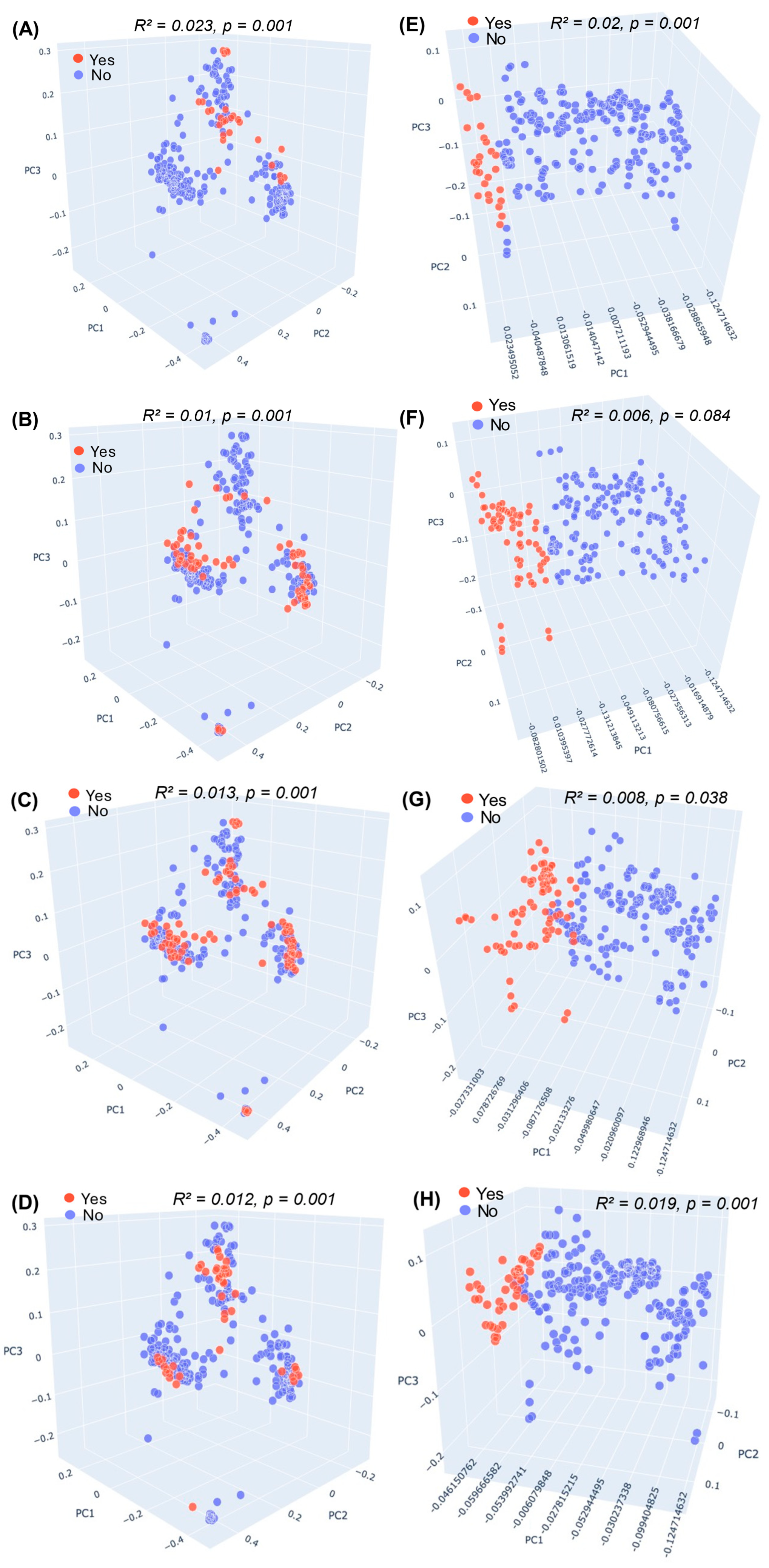
To assess β-diversity, we calculated Bray–Curtis and weighted UniFrac distance matrices and observed that participants reporting mental health symptoms harbored gut microbial communities that differed from those of participants without symptoms (Figure 1; p < 0.05). Using Bray–Curtis distances, β-diversity differed significantly between groups for stress (p = 0.001, R2 = 0.023), anxiety (p = 0.001, R2 = 0.01), depression (p = 0.001, R2 = 0.03), and sleep problems (p = 0.002, R2 = 0.012) (Figure 1A–D). Using weighted UniFrac distances, between-group differences were significant for stress (p = 0.001, R2 = 0.02), anxiety (p = 0.038, R2 = 0.008), and sleep problems (p = 0.001, R2 = 0.019), whereas the association for depression did not reach statistical significance (p = 0.084, R2 = 0.006) (Figure 1E–H).

3.3. Participants with Self-Reported Stress Show Significant Microbial Alterations and Distinct Gut Microbiome Features

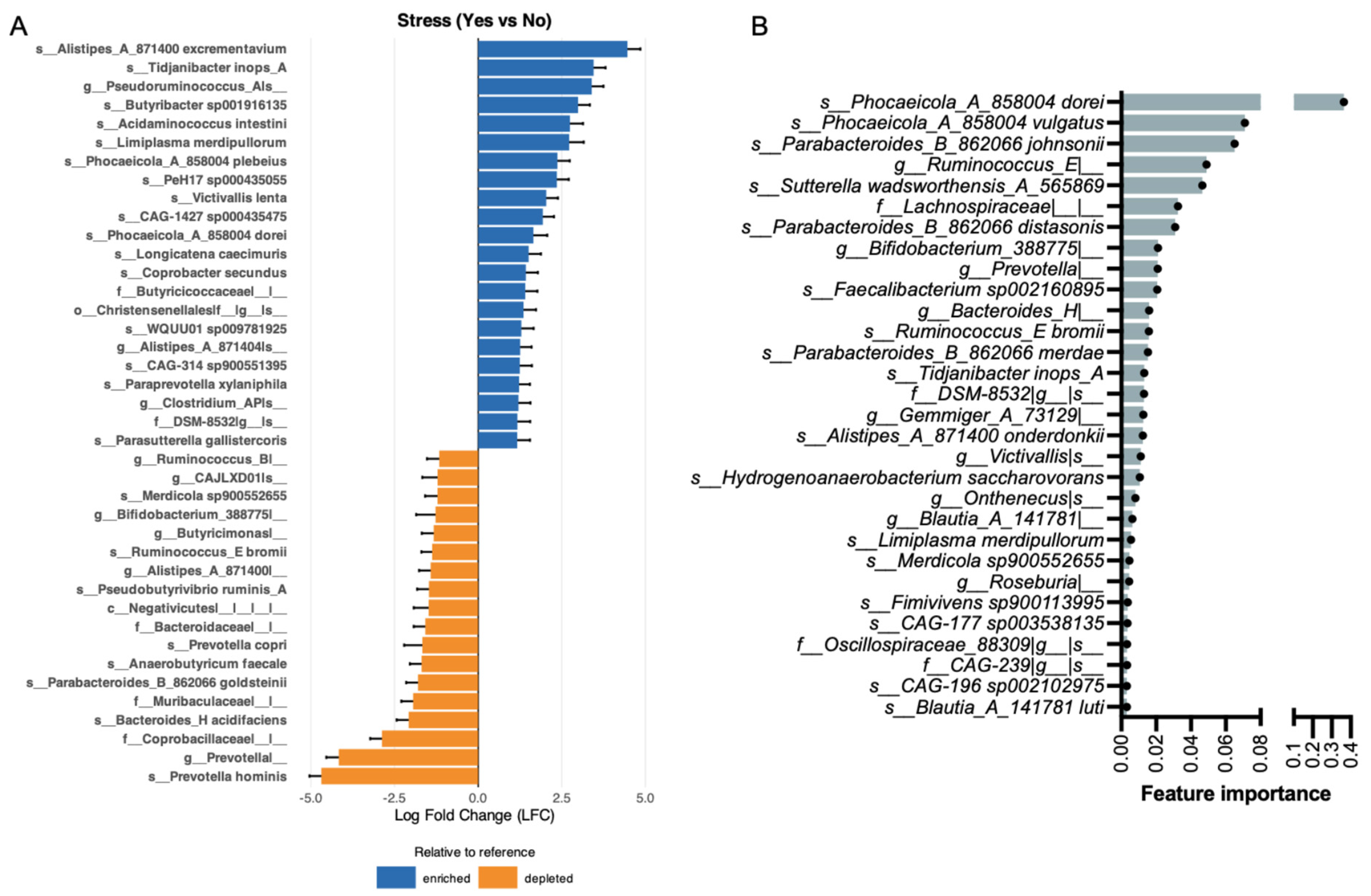
ANCOM-BC analysis identified 138 taxa as differentially abundant between participants reporting and not reporting stress (q < 0.05) (Figure 2A shows the top 40). Among the top enriched taxa were s__Alistipes_A_871400 excrementavium (logFC = 4.46, q = 5.54 × 10⁻¹⁹), s__Tidjanibacter inops_A (logFC = 3.45, q = 2.52 × 10⁻¹³), g__Pseudoruminococcus_A|s__(logFC = 3.40, q = 1.13 × 10⁻¹³). Among the top depleted taxa were s__Prevotella hominis (logFC = −4.69, q = 2.01 × 10⁻²⁶), g__Prevotella|__ (logFC = −4.17, q = 4.27 × 10−44), and f__Coprobacillaceae|__|__ (logFC = −2.88, q = 1.35 × 10⁻¹⁷).
To identify gut microbiome features associated with stress, a random forest classifier was applied to taxa-only microbiome features to discriminate stress status (n = 262 samples from 44 subjects). The model achieved an out-of-fold ROC-AUC of 0.672, indicating modest ability to distinguish between participants with and without self-reported stress. Overall accuracy was high (0.882), largely driven by strong specificity (0.970), whereas sensitivity was low (0.172) (Table S1), reflecting limited ability to correctly identify stressed individuals. Balanced accuracy was 0.571, and F1 scores were 0.590 (macro) and 0.859 (weighted), further highlighting class imbalance in predictive performance. Feature importance analysis, based on the mean decrease in Gini impurity, identified a subset of microbial taxa contributing to model discrimination (Figure 2B). The top ranked features were s__Phocaeicola_A_858004 dorei, s__Phocaeicola_A_858004 vulgatus and s__Parabacteroides_B_862066 johnsonii. Overlapping taxa across methods include the species Phocaeicola A 858004 dorei, Limiplasma merdipullorum, Tidjanibacter inops_A, and Ruminococcus_E bromii and the genus Prevotella.

3.4. Participants with Self-Reported Anxiety Display Distinct Microbial Shifts and Anxiety-Related Gut Microbiome-Associated Taxa

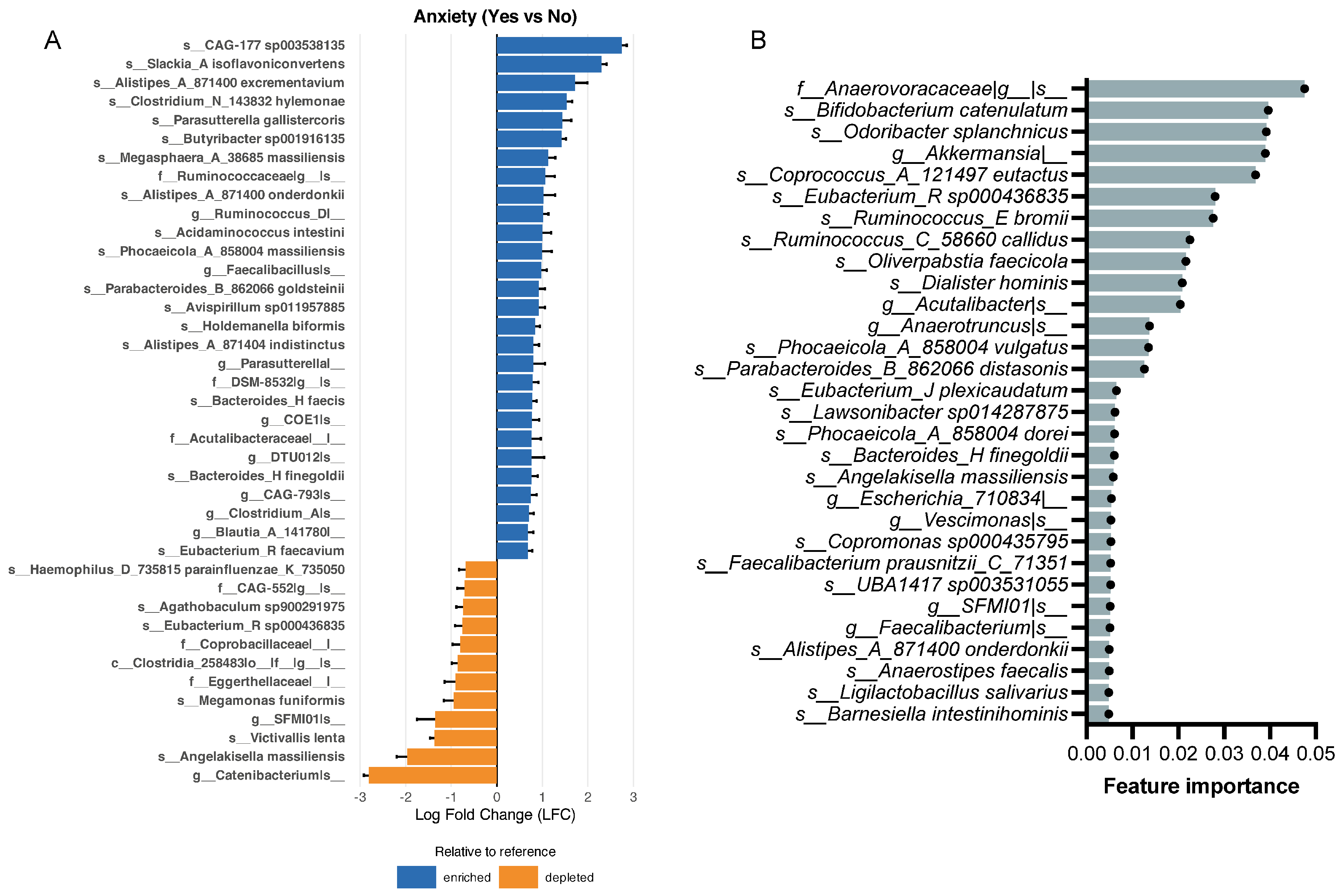
Using the ANCOM-BC method, we identified 181 taxa as differentially abundant between participants reporting and not reporting anxiety (Figure 3A shows the top 40 taxa). Among the top enriched taxa, s__CAG-177 sp003538135 (logFC = 2.74, q = 3.10 × 10⁻³⁰), s__Slackia_A isoflavoniconvertens (logFC = 2.97, q = 9.02 × 10⁻²⁵), and s__Alistipes_A_871400 excrementavium (logFC = 1.72, q = 1.79 × 10⁻¹²) were found. Among the top depleted taxa, g__Catenibacterium|s__ (logFC = −2.81, q = 1.32 × 10⁻²⁶), s__Angelakisella massiliensis (logFC = −1.96, q = 7.83 × 10⁻²³), and s__Victivallis lenta (logFC = −1.36, q = 4.10 × 10⁻¹⁸) were found.
To identify gut microbiome features associated with anxiety, a random forest classifier was applied to taxa-only microbiome features to discriminate anxiety status. The classifier exhibited limited predictive performance, with an out-of-fold ROC-AUC of 0.467. Overall accuracy was 0.611, with a balanced accuracy of 0.479, reflecting poor discrimination between groups. Model performance was characterized by high specificity (0.838) but very low sensitivity (0.120) (Table S1), indicating a strong bias toward correctly identifying non-anxious individuals while failing to detect anxiety cases. A subset of top-ranked microbial taxa contributing to model discrimination included f__Anaerovoracacea, s__Bifidobacterium catenulatum, and s__Odoribacter splanchnicus (Figure 3B). Importantly, several of the taxa identified among the top features for classification overlapped with taxa detected as differentially abundant by ANCOM-BC. The most significant commonality between the groups was the species Angelakisella massiliensis, Eubacterium R sp000436835, Bacteroides H finegoldii, and Alistipes A 871400 onderdonkii, and the genus SFMI01.

3.5. Participants with Self-Reported Depression Exhibit Selective Microbial Changes

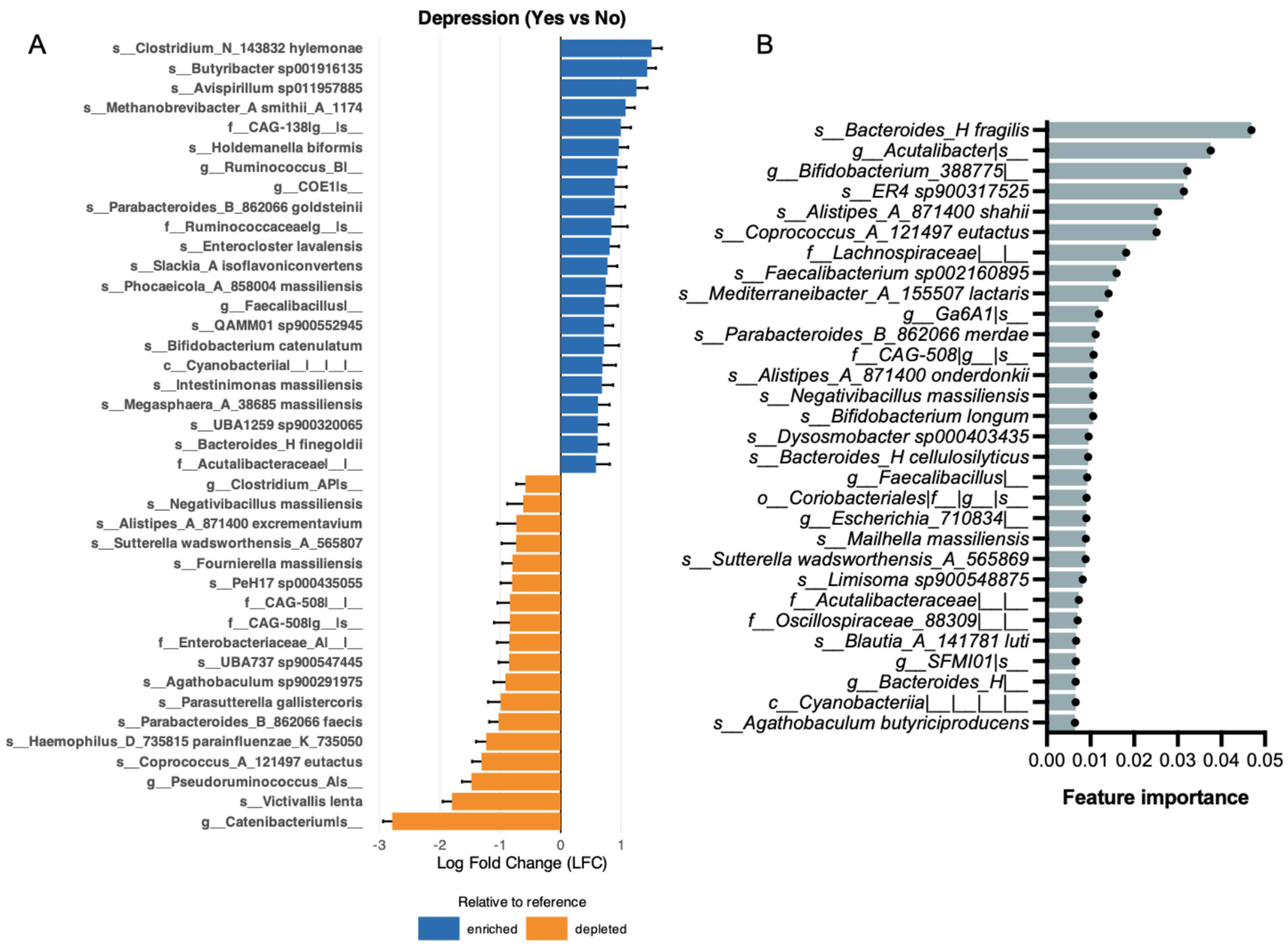
ANCOM-BC analysis revealed 149 taxa as differentially abundant between participants reporting and not reporting depression (Figure 4A shows the top 40). Among the top enriched taxa, we found s__Clostridium_N_143832 hylemonae (logFC = 1.50, q = 7.72 × 10⁻¹³), s__Butyribacter sp001916135 (logFC = 1.43, q = 1.83 × 10⁻¹⁵), and s__Avispirillum sp011957885 (logFC = 1.25, q = 1.38 × 10⁻¹¹). Among the top depleted taxa, we found g__Catenibacterium|s__(logFC = −2.79, q = 5.65 × 10⁻²²), s__Victivallis lenta (logFC = −1.80, q = 1.61 × 10⁻¹⁶) and g__Pseudoruminococcus_A|s__ (logFC = −1.48, q = 3.99 × 10⁻¹³).
To identify gut microbiome features associated with depression, a Random Forest classifier was trained using taxa-only microbiome features (1083 taxa) to classify depression status. The model performed showed poor predictive performance, with an out-of-fold ROC-AUC of 0.394. Overall accuracy was 0.714, but balanced accuracy remained low (0.540), reflecting limited discriminatory capacity. The model exhibited high specificity (0.926) but low sensitivity (0.153) (Table S1), indicating a strong bias toward correctly identifying non-depressed individuals while failing to detect depression cases. Correspondingly, F1 scores were modest (macro F1 = 0.526; weighted F1 = 0.660). Feature importance analysis, derived from the mean decrease in Gini impurity (Figure 4B) shows the top-ranked taxa as s__Bacteroides_H fragilis, g__Acutalibacter, and g__Bifidobacterium_388775. The random forest classifier identified some of the same taxa as ANCOM-BC. The taxa that were consistently identified across both methods were the class Cyanobacteriia, the family CAG-508, the genera COE1 and Faecalibacillus, and the species Coprococcus A 121497 eutactus and Bifidobacterium catenulatum.

3.6. Participants with Self-Reported Sleep Problems Demonstrate Microbial Shifts and Distinct Gut Microbiome Signatures

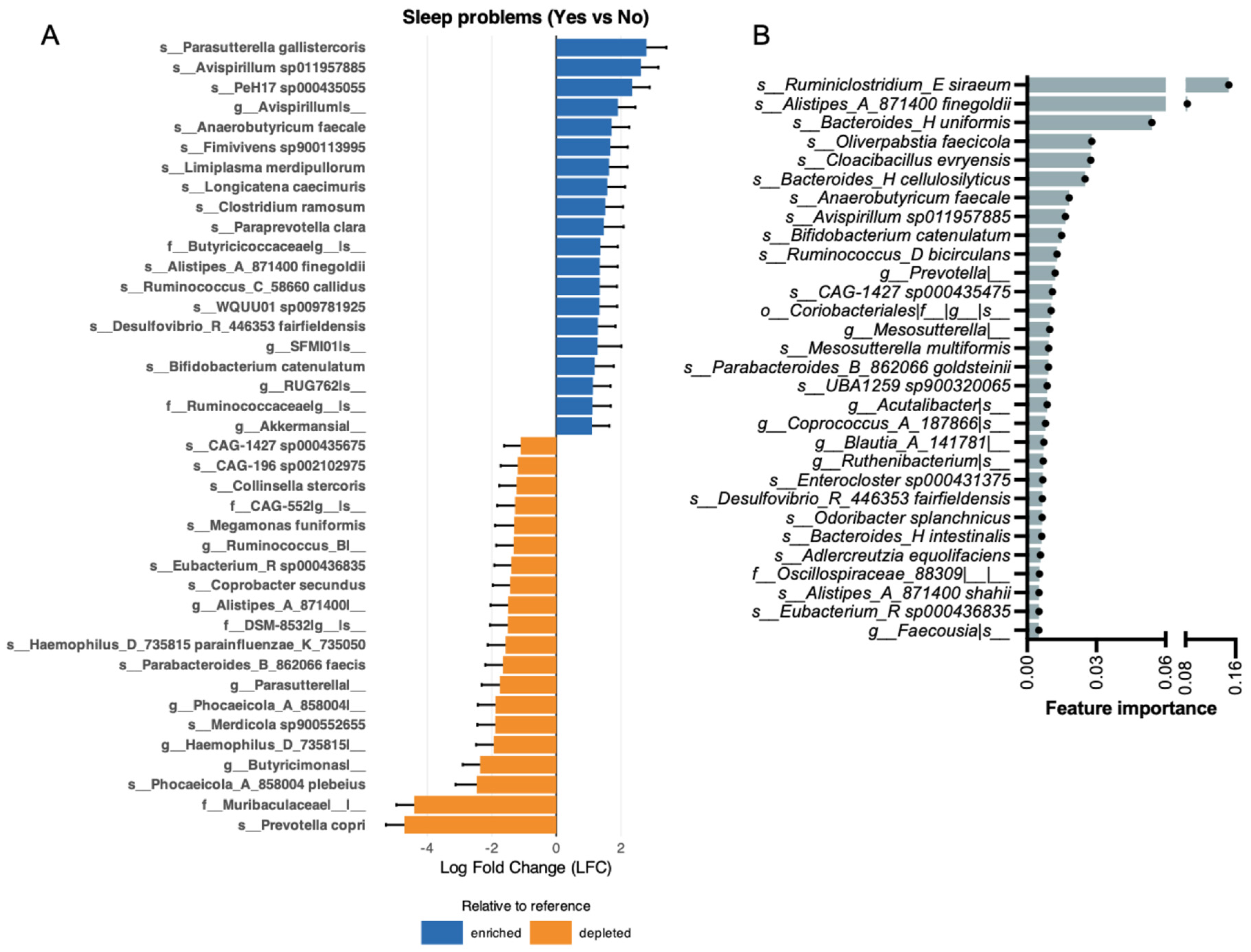
ANCOM-BC analysis revealed 67 taxa as differentially abundant between participants reporting and not reporting sleep problems (Figure 5A shows the top 40). Among the top enriched we found s__Parasutterella gallistercoris (logFC = 2.79, q = 3.91 × 10⁻⁹), s__Avispirillum sp011957885 (logFC = 2.62, q = 5.50 × 10⁻⁸), and s__PeH17 sp000435055 (logFC = 2.35, q = 7.52 × 10⁻⁷). Among the top depleted taxa, we found s__Prevotella copri (logFC = −4.71, q = 3.32 × 10⁻¹⁶), f__Muribaculaceae|__|__ (logFC = −4.40, q = 8.88 × 10⁻¹²), and s__Phocaeicola_A_858004 plebeius (logFC = −2.46, q = 2.21 × 10⁻⁹).
To identify gut microbiome features associated with sleep problems, a random forest classifier was applied. The model demonstrated modest predictive performance, with an out-of-fold ROC-AUC of 0.611. Overall accuracy was 0.782, while balanced accuracy was lower (0.524), reflecting uneven performance across classes. Like other outcomes, the model exhibited high specificity (0.905) but low sensitivity (0.143) (Table S1), indicating strong performance in identifying individuals without sleep problems but poor detection of affected individuals. F1 scores were moderate (macro F1 = 0.524; weighted F1 = 0.762). Feature importance analysis, calculated using the mean decrease in Gini, identified a subset of taxa with relatively greater contributions to classification (Figure 5B). The top-ranked features are s__Ruminiclostridium_E siraeum, s__Alistipes_A_871400 finegoldii, and s__Bacteroides_H uniformis. The random forest classifier identified some of the same top taxa as ANCOM-BC. The top taxa that were consistently identified across methods were the species Alistipes A 871400 finegoldii, Anaerobutyricum faecale, Avispirillum sp011957885, Bifidobacterium catenulatum, Desulfovibrio R 446353 fairfieldensis, and Eubacterium R sp000436835.

3.7. External Validation of Random Forest Classifiers Using an Independent Cohort

The trained Random Forest classifiers were externally validated using an independent cohort to assess generalizability. The validation cohort consisted of 108 independent subjects (Table S2). Contrary to the study cohort, the validation cohort included obese individuals and subjects with chronic diseases, as these were not excluded.
In the independent validation cohort, classifier performance demonstrated high specificity but markedly reduced sensitivity across all outcomes, indicating limited ability to correctly identify symptomatic individuals (Table S3). The stress classifier achieved an overall accuracy of 0.75, with specificity (0.769) but low sensitivity (0.30), suggesting that most non-stress participants were correctly classified, while most stress cases were missed. A similar pattern was observed for anxiety (accuracy = 0.731; specificity = 1; sensitivity = 0) and depression (accuracy = 0.815; specificity = 1; sensitivity = 0). The sleep problems classifier showed accuracy of 0.852, with specificity of 1 and sensitivity of 0. Collectively, these findings indicate that, although the models retained strong performance in identifying non-symptomatic individuals, they demonstrated poor sensitivity and limited generalizability for detecting symptomatic participants in the external validation cohort.

4. Discussion

The current study aimed to determine the distinct gut microbiome characteristics of participants with self-reported mental health symptoms, including stress, anxiety, depression, and sleep problems, in a cohort of 44 adults. By integrating compositional differential abundance testing (ANCOM-BC) with supervised machine learning (Random Forest classifier), we identified candidate microbial taxa whose abundance differed between symptomatic and asymptomatic participants. Our findings reinforce the concept of a gut–brain axis in mental health and suggest that even subclinical, self-perceived symptoms in otherwise healthy individuals are linked to measurable shifts in gut microbial community structure and composition. These observations align with contemporary models of the microbiota–gut–brain axis, which emphasize the complex integration of neural, immune, endocrine, and metabolic pathways in mediating behavioral and psychological outcomes [35].
Across all symptom categories, we observed significant shifts in overall microbial community structure (β-diversity, Figure 1) supporting the hypothesis that even subclinical psychological symptoms are associated with measurable gut microbial alterations. Although the PERMANOVA R2 values were modest, small effect sizes are common in multifactorial traits within heterogeneous human populations and do not preclude biological relevance [19]. These findings align with established models of bidirectional gut–brain communication [15]. Notably, reductions in alpha diversity were observed in participants reporting stress (Shannon index and Faith’s PD) and anxiety (Shannon index) (Table 2), consistent with prior studies linking reduced microbial diversity to depression [14,36], anxiety [12,36], stress [37], and sleep problems [38,39]. Interestingly, results in the literature remain inconsistent [15]. Notably, a systematic review reported that most studies do not identify significant links between α- and β-diversity measures and psychological stress [37]. Moreover, while alterations in microbial composition and diversity are highly relevant to mental health conditions, a decrease in diversity may not necessarily translate to negative outcomes, especially if beneficial taxa are increased [15,40]. Further studies are required to clarify the role of microbial diversity and its reliability as a biomarker for mental health conditions.
Differential abundance analysis using ANCOM-BC revealed several taxa became enriched or depleted across symptom groups (Figure 2, Figure 3, Figure 4 and Figure 5), many of which converged on shared functional themes. Several depleted taxa across anxiety, depression, and stress belong to the well-characterized short-chain fatty acid (SCFA)-producing clades, including Coprococcus, Eubacterium, and Faecalibacterium. Decreased levels of microbiota-derived butyrate have been implicated in the pathogenesis of neuropsychological conditions [41,42]. Butyrate can enter systemic circulation and cross the blood–brain barrier to act directly on the brain or indirectly signal through the vagus nerve to maintain brain-derived neurotrophic factor levels [43,44] potentially improving depressive symptoms [17]. Reduced butyrate levels in individuals with depression are frequently reported [41], and its supplementation has demonstrated anti-inflammatory and neuroprotective effects [45]. In the gut, butyrate facilitates intestinal barrier integrity by upregulating tight junction proteins and reducing inflammation, thereby preventing pathogen infiltration [46]. Our findings on the alterations of butyrate-producing taxa are consistent with the hypothesis that microbial metabolites such as butyrate may contribute to gut–brain signaling relevant to symptom expression. However, because sequencing-based taxonomic inference does not directly measure metabolite production, functional validation is required to substantiate this mechanism.
Implementation of random forest classifiers identified gut microbiome features associated with each mental health symptom (Figure 2, Figure 3, Figure 4 and Figure 5). The use of complementary analytical approaches revealed specific taxa that consistently emerged as top features linked to each symptom group. Together, our results demonstrate distinct alterations in the abundance and diversity of gut microbiota in participants with mental health symptoms, underscoring the potential importance of gut microbiota in mental health.
Among taxa depleted in participants with anxiety, Eubacterium R sp000436835 is consistent with prior reports linking the Eubacterium genus to anxiety and depression, as members of this genus are well-characterized SCFA producers whose reduction may compromise gut barrier integrity and neuroimmune signaling [47,48,49]. Alistipes A 871400 onderdonkii, identified by both methods, belongs to a genus increasingly implicated in gut–brain axis signaling [50]. Although Alistipes onderdonkii itself is a relatively recently described species [51], its specific role in anxiety warrants further investigation. Angelakisella massiliensis was among the top depleted taxa by ANCOM-BC and was independently identified by the random forest classifier, yet its role in the gut–brain axis has not been previously reported, representing a novel candidate for future investigation. Victivallis lenta, a syntrophic hydrogen-producing anaerobe [52], was similarly depleted in both anxiety and depression groups, although its functional relevance to the gut–brain axis remains poorly understood. Among enriched taxa, Slackia A isoflavoniconvertens, a species involved in polyphenol and isoflavone metabolism [53], is of interest given emerging links between microbial polyphenol metabolism and neuroprotective signaling [54], though its direct relevance to anxiety has not been established. Odoribacter splanchnicus, a top-ranked random forest feature, is a known butyrate producer whose depletion has been associated with inflammatory bowel conditions [55], suggesting a plausible though unconfirmed link to anxiety via metabolite-mediated pathways. Collectively, the anxiety-associated taxa identified in our cohort converge on a pattern of depleted SCFA-producing and fiber-fermenting microbes, consistent with the hypothesis that reduced microbial metabolite production may contribute to disrupted gut–brain signaling in anxiety. Given the modest discriminatory performance of the random forest classifier, however, these associations should be interpreted as hypothesis-generating and require validation in larger, clinically characterized cohorts.
The identification of Coprococcus A 121497 eutactus as an overlapping taxon across both methods is consistent with one of the most replicated findings in gut–brain axis research. Coprococcus species are prominent butyrate producers, and their depletion has been linked to depression in multiple large-scale cohorts [41,42]. Reduced butyrate availability may impair intestinal barrier function and promote systemic inflammation, both of which are implicated in the pathophysiology of depression [41,45]. Bacteroides H fragilis, the top-ranked random forest feature, has been linked to depression via multiple proposed mechanisms, including tryptophan metabolism, modulation of inflammatory signaling, and GABA production [56]; however, given considerable strain-level functional heterogeneity, its role may be context-dependent. Bifidobacterium 388775, also a top-ranked random forest feature, belongs to a genus with well-established beneficial roles in gut homeostasis. Its depletion has been implicated in the pathogenesis of depression [57], consistent with its functions in acetate production, mucosal barrier maintenance, and cross-feeding interactions with butyrate-producing bacteria [58,59,60]. The depletion of Catenibacterium and Victivallis lenta in depressed participants mirrors findings from the anxiety group, suggesting shared microbial signatures across these comorbid conditions. Victivallis lenta is a syntrophic, hydrogen-producing anaerobe [48] whose functional role in gut–brain communication has not been well characterized, representing a candidate for further investigation. The enrichment of Butyribacter sp001916135 in depressed participants is notable given that this genus is typically associated with butyrate production. Its enrichment may reflect compensatory shifts in the microbial community in response to the depletion of other SCFA producers, or it may indicate context-dependent functional roles that differ from genus-level assumptions. Clostridium N 143832 hylemonae, the most significantly enriched species by ANCOM-BC, belongs to a genus with diverse metabolic capabilities, including bile acid transformation [61] which may influence the gut–brain axis via bile acid receptor signaling [62]. However, the specific functional contribution of this species to depressive symptomatology remains unexplored.
Stress-associated alterations overlapped partially with depression- and anxiety-related taxa, which is not surprising since stress and mental disorders have a compounding effect on one another [3,5]. The most prominent finding was the marked depletion of Prevotella and Prevotella hominis, ranking among the most significantly altered taxa across all symptom categories in our study. Prevotella is a key fiber-fermenting genus associated with plant-rich diets and SCFA production, particularly propionate and succinate [63]. Its depletion in stressed participants is consistent with reports linking reduced Prevotella abundance to psychological distress and Western dietary patterns [64,65], and may reflect diet–microbiome interactions that are modulated by stress-related behavioral changes. The Coprobacillaceae family was also significantly depleted in stressed participants. Members of Coprobacillaceae, including Coprococcus species, are well-characterized butyrate producers whose depletion has been consistently associated with depression and anxiety [42,43,44], reinforcing the convergence of stress- and mood-related microbial alterations on SCFA-producing taxa. Among the most significantly enriched taxa were Alistipes A 871400 excrementavium and Tidjanibacter inops A. The genus Alistipes has been increasingly implicated in gut–brain axis signaling [50] with certain species linked to stress and fatigue conditions. However, A. excrementavium itself remains poorly characterized in the context of mental health. Tidjanibacter inops A, identified by both ANCOM-BC and as an overlapping taxon with the random forest classifier, is a relatively recently described organism [50] with limited functional annotation, representing a novel candidate warranting further investigation. Feature importance analysis identified Phocaeicola A dorei and Phocaeicola A vulgatus as the two top-ranked features, both also identified by ANCOM-BC, with P. dorei identified as an overlapping taxon across methods. The co-identification of these two closely related species suggests species-specific metabolic divergence within this genus. Existing evidence highlights probiotic effects of P. dorei, with healthy individuals displaying higher abundance of this taxon compared to patients with depression [66] and anti-inflammatory roles via the attenuation of lipopolysaccharide production. This is further supported by studies reporting differential metabolic associations, with P. vulgatus positively correlated with butyrate synthesis pathway and P. dorei negatively correlated with propionate degradation, potentially modulating the gut–brain axis via distinct metabolic and neuro-inflammatory mechanisms [67]. Additional overlapping taxa across both methods included Limiplasma merdipullorum, Ruminococcus E bromii, and the genus Prevotella, further supporting the robustness of the stress-associated microbial signatures identified in this study. Collectively, the stress-associated microbial profile was characterized by a broad depletion of fiber-fermenting and SCFA-producing taxa, coupled with enrichment of taxa whose functional roles in the gut–brain axis are still being elucidated. These findings are consistent with the hypothesis that stress may disrupt microbial metabolite production and gut homeostasis, potentially contributing to the well-documented bidirectional relationship between stress and gastrointestinal function.
Sleep problems were characterized by depletion of Prevotella copri, a dominant member of the human gut microbiome associated with plant-rich diets, complex carbohydrate fermentation, and SCFA production [68]. Its pronounced depletion in participants with sleep problems parallels Prevotella depletion observed in the stress group and may reflect shared dietary or lifestyle alterations that accompany both conditions. Muribaculaceae was also markedly depleted. This family, a prominent mucin-degrading and SCFA-producing clade particularly well characterized in murine models [69], has been linked to circadian disruption and metabolic perturbation in animal studies [70]. However, its relevance in human sleep–microbiome interactions requires further investigation. Phocaeicola A plebeius was also significantly depleted, consistent with the broader pattern of reduced fiber-fermenting taxa in participants with sleep problems. Among the most significantly enriched taxa were Parasutterella gallistercoris and Avispirillum sp011957885. Parasutterella has been increasingly recognized as a core member of the human gut microbiome, with potential roles in bile acid metabolism and succinate production [71]. Altered Parasutterella abundance has been reported in metabolic and inflammatory conditions [72], although its specific role in sleep regulation has not been established. Avispirillum sp011957885 was also enriched in the depression group, suggesting potential overlap in sleep- and mood-related microbial features. Feature importance analysis identified Ruminiclostridium E siraeum, Alistipes A 871400 finegoldii, and Bacteroides H uniformis as the top-ranked taxa. Several taxa were consistently identified across both methods, including Alistipes A finegoldii, Anaerobutyricum faecale, Avispirillum sp011957885, Bifidobacterium catenulatum, Desulfovibrio R fairfieldensis, and Eubacterium R sp000436835, lending additional confidence to their association with sleep problems. Alistipes A finegoldii, identified by both ANCOM-BC and the random forest classifier, is notable given the frequent observation of altered Alistipes levels in sleep–microbiome studies [73] with a recent study reporting increased abundance of A. finegoldii in children with low sleep efficiency [74]. Many Alistipes spp. are capable of tryptophan metabolism and indole production, potentially influencing serotonin and melatonin pathways central to circadian regulation [75]. Dysregulation of tryptophan metabolism toward the kynurenine pathway during sleep disruption has been associated with neuroinflammatory processes, providing a plausible mechanistic framework. Ruminiclostridium E siraeum, the top-ranked random forest feature, has been implicated in mood and sleep regulation in prior studies [76]. Bacteroides H uniformis, the third-ranked random forest feature, is a versatile carbohydrate-degrading species with immunomodulatory properties [77]. While Bacteroides species often appear to have positive associations with sleep [78], species-level duality has been reported [79,80], suggesting context-dependent effects. The convergence of SCFA-producing taxa (Anaerobutyricum faecale, Eubacterium R sp000436835) among the overlapping features further supports the theme of altered fermentative capacity in participants with sleep problems. Collectively, the sleep-associated microbial profile was characterized by pronounced depletion of fiber-fermenting taxa—most notably Prevotella copri and Muribaculaceae—coupled with enrichment of taxa involved in tryptophan and bile acid metabolism. These findings are consistent with emerging models linking microbial metabolite production to circadian regulation and sleep quality, although causal directionality cannot be established from the present cross-sectional design.
Random Forest classifiers were applied here as an exploratory feature-ranking tool rather than as validated diagnostic models. Importance scores partially overlapped with ANCOM-BC findings across symptom groups, providing convergent support for candidate taxa. Internal cross-validated performance, estimated using grouped k-fold cross-validation (GroupKFold, k = 5) with participant ID as the grouping variable to prevent within-participant data leakage, was modest across all outcomes. AUC ranged from 0.394 (depression) to 0.672 (stress), and balanced accuracy ranged from 0.479 (anxiety) to 0.571 (stress). Overall accuracy was numerically higher (0.611–0.882) but was driven by strong specificity and consistently low sensitivity, reflecting a strong bias toward the majority non-symptomatic class rather than genuine discriminatory capacity. External validation in an independent cohort (n = 108; Table S2) confirmed limited generalizability across all classifiers (Table S3). The stress classifier achieved an accuracy of 0.75 (specificity = 0.769; sensitivity = 0.30), while the anxiety, depression, and sleep classifiers showed high specificity (0.841–1.00) with near-zero sensitivity (0–0.10), indicating that symptomatic individuals were largely undetected in the external cohort. Reduced performance upon external validation is common in microbiome-based machine learning studies and reflects well-documented challenges in model transportability [81,82,83]. Contributing factors include cohort heterogeneity—the validation cohort included obese participants and individuals with chronic diseases excluded from the discovery cohort—as well as class imbalance and symptom prevalence differences between cohorts. Models trained on imbalanced data may implicitly learn prevalence-dependent decision boundaries [84] that deteriorate when applied to populations with different base rates. Collectively, these findings reinforce the interpretation of the random forest results as a hypothesis-generating feature-ranking exercise and highlight the distinction between identifying statistically significant microbial correlates and developing clinically actionable diagnostic tools.
Several limitations warrant consideration. Firstly, the study cohort sample size (n = 44) was modest, which may limit the generalizability of findings and the statistical power to detect subtle associations. Secondly, mental health status was assessed via binary self-report rather than validated clinical scales (e.g., PHQ-9, GAD-7), and may not capture symptom severity. Thirdly, while we adjusted for key covariates (sex, age, BMI), residual confounding from diet, lifestyle, supplement use, and sociodemographic factors cannot be excluded. Fourthly, although participant-level cross-validation was used to prevent within-participant data leakage in the random forest analysis, external validation on an independent dataset yielded low sensitivity. Accordingly, the random forest results should be interpreted as an exploratory feature-ranking exercise. Furthermore, taxonomic profiling does not directly capture microbial function or metabolite production, and causal inference cannot be established in this observational framework.
The study also possesses notable strengths. We used ANCOM-BC, which explicitly accounts for the compositional structure of microbiome sequencing data and corrects for sampling fraction bias, yielding unbiased log-fold change estimates and improved false discovery rate control compared with methods based on relative abundances or rarefaction [32,85]. To further strengthen inference, ANCOM-BC results were complemented with a Random Forest classifier, enabling identification of taxa that were statistically significant and highly predictive, thereby increasing robustness and biological interpretability in this high-dimensional dataset [86]. The convergence of findings across both analytical approaches allows for more confident identification of symptom-associated microbial features. Furthermore, this study incorporated multiple time points for gut microbiome sample collection. As the gut microbial community can shift rapidly—often within days—particularly in response to dietary intake [87,88], studies relying on a single time point may inadequately capture the dynamic nature of microbial communities. While the majority of gut microbiome research is limited to a single time point [88], the current study collected fecal samples at six different time points from each individual throughout 28 days.

5. Conclusions

Our results demonstrate that self-reported stress, anxiety, depression, and sleep problems are associated with distinct yet partially overlapping alterations in gut microbial composition. These alterations converge on functional themes involving SCFA-production, tryptophan metabolism, and inflammatory signaling, highlighting the role of the gut microbiome within the gut–brain axis to influence mental health. While external validation underscores current limitations in predictive generalizability, the convergence of compositional and machine learning approaches strengthens evidence for symptom-associated microbial signatures. Future investigations should incorporate larger, diverse cohorts and focus on mechanistic validation to better clarify the causality of the gut microbiome in neuropsychiatric health.

Supplementary Materials

The following supporting information can be downloaded at https://www.mdpi.com/article/10.3390/brainsci16040382/s1: Figure S1: No Significant differences between sexes in age and BMI; Table S1: Random forest classification performance using participant-level grouped cross-validation; Table S2: Demographic and clinical characteristics of the validation cohort; Table S3: Validation cohort performance metrics of supervised machine learning classifiers for predicting self-reported mental health outcomes from microbial features. ancombc2_results.xlsx: File containing all differentially abundant taxa by symptom.

Author Contributions

Conceptualization, H.J.P., V.V.L.-F. and F.D.W.; methodology, K.Z., M.E., C.B.W. and V.V.L.-F.; software, V.V.L.-F.; validation, C.B.W., K.Z., V.V.L.-F. and F.D.W.; formal analysis, S.L. and V.V.L.-F.; investigation, C.B.W., K.Z., M.E. and V.V.L.-F.; resources, F.D.W.; data curation, V.V.L.-F.; writing—original draft preparation, S.L. and V.V.L.-F.; writing—review and editing, S.L., C.B.W., H.J.P., V.V.L.-F. and F.D.W.; visualization, S.L. and V.V.L.-F.; supervision, H.J.P., V.V.L.-F. and F.D.W.; project administration, C.B.W., K.Z., V.V.L.-F. and FDW; funding acquisition, H.J.P., V.V.L.-F. and F.D.W. All authors have read and agreed to the published version of the manuscript.

Funding

This research was partly supported by the Georgia Experimental Agricultural Station (HATCH #GEO001002).

Institutional Review Board Statement

The study was conducted in accordance with the Declaration of Helsinki, and all procedures involving human participants were reviewed and approved by the Sterling Institutional Review Board (approval number #11402, 12 December 2023).

Informed Consent Statement

Informed consent was obtained from all subjects involved in the study.

Data Availability Statement

The data presented in this study are available from the corresponding authors upon reasonable request with appropriate safeguards (e.g., data-use agreement and IRB-compliant conditions). The data are not publicly available because the associated dataset includes human participant questionnaire responses and associated metadata linked to microbiome profiles, collected under IRB oversight.

Conflicts of Interest

Authors Christina B. Welch, Karen Zinka, Michael Evans and Valery V. Lozada-Fernandez were employed by Kelly Products Inc. The remaining authors declare that the research was conducted in the absence of any commercial or financial relationships that could be construed as a potential conflict of interest.

Abbreviations

The following abbreviations are used in this manuscript:
RDARecommended Dietary Allowance
BMIBody mass index
ANCOM-BCAnalysis of Compositions of Microbiomes with Bias Correction
SCFAShort-chain fatty acids
PCRPolymerase chain reaction
QIIME2Quantitative Insights Into Microbial Ecology 2 (bioinformatics platform)
GABAGamma-aminobutyric acid
ASA24Automated Self-Administered 24 h Dietary Assessment Tool
KcalKilocalorie(s) (unit of energy)
16S16S ribosomal RNA gene (bacterial marker for amplicon sequencing)
ASVAmplicon sequence variant
PCoAPrincipal coordinate analysis
PERMANOVAPermutational multivariate analysis of variance
RFCRandom Forest classifier
SDStandard deviation
IL-8Interleukin-8
AUCArea under the curve
LogFCLogarithmic fold change
FDRFalse discovery rate

References

  1. World Health Organization. World Mental Health Today: Latest Data; Licence: CC BY-NC-SA 3.0 IGO; World Health Organization: Geneva, Switzerland, 2025. [Google Scholar]
  2. COVID-19 Mental Disorders Collaborators. Global prevalence and burden of depressive and anxiety disorders in 204 countries and territories in 2020 due to the COVID-19 pandemic. Lancet 2021, 398, 1700–1712. [CrossRef]
  3. Alwhaibi, M.; Al Aloola, N.A. Associations between Stress, Anxiety, Depression and Sleep Quality among Healthcare Students. J. Clin. Med. 2023, 12, 4340. [Google Scholar] [CrossRef]
  4. Merrill, R.M. Mental Health Conditions According to Stress and Sleep Disorders. Int. J. Environ. Res. Public Health 2022, 19, 7957. [Google Scholar] [CrossRef]
  5. Madison, A.; Kiecolt-Glaser, J.K. Stress, depression, diet, and the gut microbiota: Human–bacteria interactions at the core of psychoneuroimmunology and nutrition. Curr. Opin. Behav. Sci. 2019, 28, 105–110. [Google Scholar] [CrossRef] [PubMed]
  6. Hammen, C. Stress and depression. Annu. Rev. Clin. Psychol. 2005, 1, 293–319. [Google Scholar] [CrossRef]
  7. Baglioni, C.; Battagliese, G.; Feige, B.; Spiegelhalder, K.; Nissen, C.; Voderholzer, U.; Lombardo, C.; Riemann, D. Insomnia as a predictor of depression: A meta-analytic evaluation of longitudinal epidemiological studies. J. Affect. Disord. 2011, 135, 10–19. [Google Scholar] [CrossRef]
  8. Mofatteh, M. Risk factors associated with stress, anxiety, and depression among university undergraduate students. AIMS Public Health 2021, 8, 36–65. [Google Scholar] [CrossRef]
  9. Blanco, C.; Rubio, J.; Wall, M.; Wang, S.; Jiu, C.J.; Kendler, K.S. Risk factors for anxiety disorders: Common and specific effects in a national sample. Depress. Anxiety 2014, 31, 756–764. [Google Scholar] [CrossRef] [PubMed]
  10. Liu, W.; Zhang, Y.; Chen, J.; Li, X.; Huang, Y.; Zhao, F.; Chen, F.; Qu, P.; Li, Y. Global burden and trends of major mental disorders in individuals under 24 years of age from 1990 to 2021, with projections to 2050: Insights from the Global Burden of Disease Study 2021. Front. Public Health 2025, 13, 1635801. [Google Scholar] [CrossRef]
  11. Asher, G.N.; Gerkin, J.; Gaynes, B.N. Complementary Therapies for Mental Health Disorders. Med. Clin. N. Am. 2017, 101, 847–864. [Google Scholar] [CrossRef] [PubMed]
  12. Xiong, R.G.; Li, J.; Cheng, J.; Zhou, D.D.; Wu, S.X.; Huang, S.Y.; Saimaiti, A.; Yang, Z.J.; Gan, R.Y.; Li, H.B. The Role of Gut Microbiota in Anxiety, Depression, and Other Mental Disorders as Well as the Protective Effects of Dietary Components. Nutrients 2023, 15, 3258. [Google Scholar] [CrossRef]
  13. Delgadillo, D.R.; Borelli, J.L.; Mayer, E.A.; Labus, J.S.; Cross, M.P.; Pressman, S.D. Biological, environmental, and psychological stress and the human gut microbiome in healthy adults. Sci. Rep. 2025, 15, 362. [Google Scholar] [CrossRef]
  14. Radjabzadeh, D.; Bosch, J.A.; Uitterlinden, A.G.; Zwinderman, A.H.; Ikram, M.A.; van Meurs, J.B.J.; Luik, A.I.; Nieuwdorp, M.; Lok, A.; van Duijn, C.M.; et al. Gut microbiome-wide association study of depressive symptoms. Nat. Commun. 2022, 13, 7128. [Google Scholar] [CrossRef]
  15. Kamath, S.; Sokolenko, E.; Clark, S.R.; Cross, C.B.; Scott, J.; Wardill, H.R.; Margolis, K.G.; Forsythe, P.; Burnet, P.W.J.; Dinan, T.G.; et al. Distinguishing the causative, correlative and bidirectional roles of the gut microbiota in mental health. Nat. Ment. Health 2025, 3, 1137–1151. [Google Scholar] [CrossRef]
  16. Knight, R.; Vrbanac, A.; Taylor, B.C.; Aksenov, A.; Callewaert, C.; Debelius, J.; Gonzalez, A.; Kosciolek, T.; McCall, L.I.; McDonald, D.; et al. Best practices for analysing microbiomes. Nat. Rev. Microbiol. 2018, 16, 410–422. [Google Scholar] [CrossRef] [PubMed]
  17. Suda, K.; Matsuda, K. How Microbes Affect Depression: Underlying Mechanisms via the Gut–Brain Axis and the Modulating Role of Probiotics. Int. J. Mol. Sci. 2022, 23, 1172. [Google Scholar] [CrossRef] [PubMed]
  18. Li, Y.; Hao, Y.; Fan, F.; Zhang, B. The Role of Microbiome in Insomnia, Circadian Disturbance and Depression. Front. Psychiatry 2018, 9, 669. [Google Scholar] [CrossRef]
  19. McGuinness, A.J.; Davis, J.A.; Dawson, S.L.; Loughman, A.; Collier, F.; O’Hely, M.; Simpson, C.A.; Green, J.; Marx, W.; Hair, C.; et al. A systematic review of gut microbiota composition in observational studies of major depressive disorder, bipolar disorder and schizophrenia. Mol. Psychiatry 2022, 27, 1920–1935. [Google Scholar] [CrossRef]
  20. Kleine Bardenhorst, S.; Berger, T.; Klawonn, F.; Vital, M.; Karch, A.; Rübsamen, N. Data Analysis Strategies for Microbiome Studies in Human Populations—A Systematic Review of Current Practice. mSystems 2021, 6, e01154-20. [Google Scholar] [CrossRef]
  21. Welch, C.B.; Lourenco, J.M.; Davis, D.B.; Krause, T.R.; Carmichael, M.N.; Rothrock, M.J.; Pringle, T.D.; Callaway, T.R. The impact of feed efficiency selection on the ruminal, cecal, and fecal microbiomes of Angus steers from a commercial feedlot. J. Anim. Sci. 2020, 98, skaa230. [Google Scholar] [CrossRef] [PubMed]
  22. Klindworth, A.; Pruesse, E.; Schweer, T.; Peplies, J.; Quast, C.; Horn, M.; Glöckner, F.O. Evaluation of general 16S ribosomal RNA gene PCR primers for classical and next-generation sequencing-based diversity studies. Nucleic Acids Res. 2013, 41, e1. [Google Scholar] [CrossRef] [PubMed]
  23. Bolyen, E.; Rideout, J.R.; Dillon, M.R.; Bokulich, N.A.; Abnet, C.C.; Al-Ghalith, G.A.; Alexander, H.; Alm, E.J.; Arumugam, M.; Asnicar, F.; et al. Reproducible, interactive, scalable and extensible microbiome data science using QIIME 2. Nat. Biotechnol. 2019, 37, 852–857. [Google Scholar] [CrossRef] [PubMed]
  24. Callahan, B.J.; McMurdie, P.J.; Rosen, M.J.; Han, A.W.; Johnson, A.J.; Holmes, S.P. DADA2: High-resolution sample inference from Illumina amplicon data. Nat. Methods 2016, 13, 581–583. [Google Scholar] [CrossRef]
  25. Katoh, K.; Misawa, K.; Kuma, K.; Miyata, T. MAFFT: A novel method for rapid multiple sequence alignment based on fast Fourier transform. Nucleic Acids Res. 2002, 30, 3059–3066. [Google Scholar] [CrossRef]
  26. Price, M.N.; Dehal, P.S.; Arkin, A.P. FastTree 2—Approximately maximum-likelihood trees for large alignments. PLoS ONE 2010, 5, e9490. [Google Scholar] [CrossRef] [PubMed]
  27. Faith, D.P. The Role of the Phylogenetic Diversity Measure, PD, in Bio-Informatics: Getting the Definition Right. Evol. Bioinform. 2006, 2, 277–283. [Google Scholar] [CrossRef]
  28. Lozupone, C.A.; Hamady, M.; Kelley, S.T.; Knight, R. Quantitative and qualitative beta diversity measures lead to different insights into factors that structure microbial communities. Appl. Environ. Microbiol. 2007, 73, 1576–1585. [Google Scholar] [CrossRef]
  29. Lozupone, C.; Knight, R. UniFrac: A new phylogenetic method for comparing microbial communities. Appl. Environ. Microbiol. 2005, 71, 8228–8235. [Google Scholar] [CrossRef]
  30. Bokulich, N.A.; Kaehler, B.D.; Rideout, J.R.; Dillon, M.; Bolyen, E.; Knight, R.; Huttley, G.A.; Gregory Caporaso, J. Optimizing taxonomic classification of marker-gene amplicon sequences with QIIME 2’s q2-feature-classifier plugin. Microbiome 2018, 6, 90. [Google Scholar] [CrossRef]
  31. McDonald, D.; Jiang, Y.; Balaban, M.; Cantrell, K.; Zhu, Q.; Gonzalez, A.; Morton, J.T.; Nicolaou, G.; Parks, D.H.; Karst, S.M.; et al. Greengenes2 unifies microbial data in a single reference tree. Nat. Biotechnol. 2024, 42, 715–718. [Google Scholar] [CrossRef]
  32. Lin, H.; Peddada, S.D. Analysis of compositions of microbiomes with bias correction. Nat. Commun. 2020, 11, 3514. [Google Scholar] [CrossRef] [PubMed]
  33. Nouri, Z.; Zhang, X.Y.; Khakisahneh, S.; Degen, A.A.; Wang, D.H. The microbiota-gut-kidney axis mediates host osmoregulation in a small desert mammal. npj Biofilms Microbiomes 2022, 8, 16. [Google Scholar] [CrossRef] [PubMed]
  34. Ross, F.C.; Patangia, D.; Grimaud, G.; Lavelle, A.; Dempsey, E.M.; Ross, R.P.; Stanton, C. The interplay between diet and the gut microbiome: Implications for health and disease. Nat. Rev. Microbiol. 2024, 22, 671–686. [Google Scholar] [CrossRef] [PubMed]
  35. Luo, F.; Liu, L.; Guo, M.; Liang, J.; Chen, L.; Shi, X.; Liu, H.; Cheng, Y.; Du, Y. Deciphering and Targeting the ESR2–miR-10a-5p–BDNF Axis in the Prefrontal Cortex: Advancing Postpartum Depression Understanding and Therapeutics. Research 2024, 7, 0537. [Google Scholar] [CrossRef]
  36. Nikolova, V.L.; Smith, M.R.B.; Hall, L.J.; Cleare, A.J.; Stone, J.M.; Young, A.H. Perturbations in Gut Microbiota Composition in Psychiatric Disorders: A Review and Meta-analysis. JAMA Psychiatry 2021, 78, 1343–1354. [Google Scholar] [CrossRef]
  37. Ma, L.; Yan, Y.; Webb, R.J.; Li, Y.; Mehrabani, S.; Xin, B.; Sun, X.; Wang, Y.; Mazidi, M. Psychological Stress and Gut Microbiota Composition: A Systematic Review of Human Studies. Neuropsychobiology 2023, 82, 247–262. [Google Scholar] [CrossRef]
  38. Wankhede, N.L.; Kale, M.B.; Kyada, A.; Rehka, M.M.; Chaudhary, K.; Naidu, K.S.; Rahangdale, S.; Shende, P.V.; Taksande, B.G.; Khalid, M.; et al. Sleep deprivation-induced shifts in gut microbiota: Implications for neurological disorders. Neuroscience 2025, 565, 99–116. [Google Scholar] [CrossRef]
  39. Smith, R.P.; Easson, C.; Lyle, S.M.; Kapoor, R.; Donnelly, C.P.; Davidson, E.J.; Parikh, E.; Lopez, J.V.; Tartar, J.L. Gut microbiome diversity is associated with sleep physiology in humans. PLoS ONE 2019, 14, e0222394. [Google Scholar] [CrossRef]
  40. Carlson, A.L.; Xia, K.; Azcarate-Peril, M.A.; Goldman, B.D.; Ahn, M.; Styner, M.A.; Thompson, A.L.; Geng, X.; Gilmore, J.H.; Knickmeyer, R.C. Infant Gut Microbiome Associated with Cognitive Development. Biol. Psychiatry 2018, 83, 148–159. [Google Scholar] [CrossRef]
  41. Valles-Colomer, M.; Falony, G.; Darzi, Y.; Tigchelaar, E.F.; Wang, J.; Tito, R.Y.; Schiweck, C.; Kurilshikov, A.; Joossens, M.; Wijmenga, C.; et al. The neuroactive potential of the human gut microbiota in quality of life and depression. Nat. Microbiol. 2019, 4, 623–632. [Google Scholar] [CrossRef]
  42. Notting, F.; Pirovano, W.; Sybesma, W.; Kort, R. The butyrate-producing and spore-forming bacterial genus Coprococcus as a potential biomarker for neurological disorders. Gut Microbiome 2023, 4, e16. [Google Scholar] [CrossRef] [PubMed]
  43. Stilling, R.M.; van de Wouw, M.; Clarke, G.; Stanton, C.; Dinan, T.G.; Cryan, J.F. The neuropharmacology of butyrate: The bread and butter of the microbiota-gut-brain axis? Neurochem. Int. 2016, 99, 110–132. [Google Scholar] [CrossRef]
  44. Cheng, J.; Hu, H.; Ju, Y.; Liu, J.; Wang, M.; Liu, B.; Zhang, Y. Gut microbiota-derived short-chain fatty acids and depression: Deep insight into biological mechanisms and potential applications. Gen. Psychiatry 2024, 37, e101374. [Google Scholar] [CrossRef]
  45. de Cássia Ávila Alpino, G.; Pereira-Sol, G.A.; Dias, M.d.M.E.; de Aguiar, A.S.; do Carmo Gouveia Peluzio, M. Beneficial effects of butyrate on brain functions: A view of epigenetic. Crit. Rev. Food Sci. Nutr. 2024, 64, 3961–3970. [Google Scholar] [CrossRef]
  46. Louis, P.; Hold, G.L.; Flint, H.J. The gut microbiota, bacterial metabolites and colorectal cancer. Nat. Rev. Microbiol. 2014, 12, 661–672. [Google Scholar] [CrossRef]
  47. Butler, M.I.; Kittel-Schneider, S.; Wagner-Skacel, J.; Mörkl, S.; Clarke, G. The Gut Microbiome in Anxiety Disorders. Curr. Psychiatry Rep. 2025, 27, 347–361. [Google Scholar] [CrossRef]
  48. Brushett, S.; Gacesa, R.; Vich Vila, A.; Brandao Gois, M.F.; Andreu-Sanchez, S.; Swarte, J.C.; Klaassen, M.A.Y.; Collij, V.; Sinha, T.; Bolte, L.A.; et al. Gut feelings: The relations between depression, anxiety, psychotropic drugs and the gut microbiome. Gut Microbes 2023, 15, 2281360. [Google Scholar] [CrossRef]
  49. Chen, Y.H.; Bai, J.; Wu, D.; Yu, S.F.; Qiang, X.L.; Bai, H.; Wang, H.N.; Peng, Z.W. Association between fecal microbiota and generalized anxiety disorder: Severity and early treatment response. J. Affect. Disord. 2019, 259, 56–66. [Google Scholar] [CrossRef]
  50. Parker, B.J.; Wearsch, P.A.; Veloo, A.C.M.; Rodriguez-Palacios, A. The Genus Alistipes: Gut Bacteria with Emerging Implications to Inflammation, Cancer, and Mental Health. Front. Immunol. 2020, 11, 906. [Google Scholar] [CrossRef] [PubMed]
  51. Jin, W.; Li, B.; Wang, L.; Zhu, L.; Chai, S.; Hou, R. The causal association between gut microbiota and postpartum depression: A two-sample Mendelian randomization study. Front. Microbiol. 2024, 15, 1415237. [Google Scholar] [CrossRef] [PubMed]
  52. Wylensek, D.; Hitch, T.C.A.; Riedel, T.; Afrizal, A.; Kumar, N.; Wortmann, E.; Liu, T.; Devendran, S.; Lesker, T.R.; Hernández, S.B.; et al. A collection of bacterial isolates from the pig intestine reveals functional and taxonomic diversity. Nat. Commun. 2020, 11, 6389. [Google Scholar] [CrossRef]
  53. Matthies, A.; Loh, G.; Blaut, M.; Braune, A. Daidzein and genistein are converted to equol and 5-hydroxy-equol by human intestinal Slackia isoflavoniconvertens in gnotobiotic rats. J. Nutr. 2012, 142, 40–46. [Google Scholar] [CrossRef]
  54. Rosenfeld, C.S. Effects of Phytoestrogens on the Developing Brain, Gut Microbiota, and Risk for Neurobehavioral Disorders. Front. Nutr. 2019, 6, 142. [Google Scholar] [CrossRef] [PubMed]
  55. Li, J.; Xu, J.; Guo, X.; Xu, H.; Huang, C.; Nie, Y.; Zhou, Y. Odoribacter splanchnicus—A Next-Generation Probiotic Candidate. Microorganisms 2025, 13, 815. [Google Scholar] [CrossRef] [PubMed]
  56. Zhang, Y.; Fan, Q.; Hou, Y.; Zhang, X.; Yin, Z.; Cai, X.; Wei, W.; Wang, J.; He, D.; Wang, G.; et al. Bacteroides species differentially modulate depression-like behavior via gut-brain metabolic signaling. Brain Behav. Immun. 2022, 102, 11–22. [Google Scholar] [CrossRef] [PubMed]
  57. Aizawa, E.; Tsuji, H.; Asahara, T.; Takahashi, T.; Teraishi, T.; Yoshida, S.; Ota, M.; Koga, N.; Hattori, K.; Kunugi, H. Possible association of Bifidobacterium and Lactobacillus in the gut microbiota of patients with major depressive disorder. J. Affect. Disord. 2016, 202, 254–257. [Google Scholar] [CrossRef]
  58. De Vuyst, L.; Leroy, F. Cross-feeding between bifidobacteria and butyrate-producing colon bacteria explains bifdobacterial competitiveness, butyrate production, and gas production. Int. J. Food Microbiol. 2011, 149, 73–80. [Google Scholar] [CrossRef]
  59. Fukuda, S.; Toh, H.; Hase, K.; Oshima, K.; Nakanishi, Y.; Yoshimura, K.; Tobe, T.; Clarke, J.M.; Topping, D.L.; Suzuki, T.; et al. Bifidobacteria can protect from enteropathogenic infection through production of acetate. Nature 2011, 469, 543–547. [Google Scholar] [CrossRef]
  60. Yang, C.; Fujita, Y.; Ren, Q.; Ma, M.; Dong, C.; Hashimoto, K. Bifidobacterium in the gut microbiota confer resilience to chronic social defeat stress in mice. Sci. Rep. 2017, 7, 45942. [Google Scholar] [CrossRef]
  61. Ridlon, J.M.; Kang, D.J.; Hylemon, P.B. Isolation and characterization of a bile acid inducible 7alpha-dehydroxylating operon in Clostridium hylemonae TN271. Anaerobe 2010, 16, 137–146. [Google Scholar] [CrossRef]
  62. Stanimirov, B.; Đanić, M.; Pavlović, N.; Zaklan, D.; Lazarević, S.; Mikov, M.; Stankov, K. Gut–Brain Axis and Bile Acid Signaling: Linking Microbial Metabolism to Brain Function and Metabolic Regulation. Int. J. Mol. Sci. 2025, 26, 12167. [Google Scholar] [CrossRef]
  63. Chen, T.; Long, W.; Zhang, C.; Liu, S.; Zhao, L.; Hamaker, B.R. Fiber-utilizing capacity varies in Prevotella- versus Bacteroides-dominated gut microbiota. Sci. Rep. 2017, 7, 2594. [Google Scholar] [CrossRef]
  64. Tett, A.; Pasolli, E.; Masetti, G.; Ercolini, D.; Segata, N. Prevotella diversity, niches and interactions with the human host. Nat. Rev. Microbiol. 2021, 19, 585–599. [Google Scholar] [CrossRef]
  65. Prasoodanan, P.K.V.; Sharma, A.K.; Mahajan, S.; Dhakan, D.B.; Maji, A.; Scaria, J.; Sharma, V.K. Western and non-western gut microbiomes reveal new roles of Prevotella in carbohydrate metabolism and mouth–gut axis. npj Biofilms Microbiomes 2021, 7, 77. [Google Scholar] [CrossRef]
  66. Park, S.; Li, C.; Wu, X.; Zhang, T. Gut Microbiota Alterations and Their Functional Differences in Depression According to Enterotypes in Asian Individuals. Int. J. Mol. Sci. 2023, 24, 13329. [Google Scholar] [CrossRef]
  67. Maki, K.A.; Wallen, G.R.; Bastiaanssen, T.F.S.; Hsu, L.Y.; Valencia, M.E.; Ramchandani, V.A.; Schwandt, M.L.; Diazgranados, N.; Cryan, J.F.; Momenan, R.; et al. The gut-brain axis in individuals with alcohol use disorder: An exploratory study of associations among clinical symptoms, brain morphometry, and the gut microbiome. Alcohol. Clin. Exp. Res. 2024, 48, 1261–1277. [Google Scholar] [CrossRef] [PubMed]
  68. Abdelsalam, N.A.; Hegazy, S.M.; Aziz, R.K. The curious case of Prevotella copri. Gut Microbes 2023, 15, 2249152. [Google Scholar] [CrossRef] [PubMed]
  69. Zhu, Y.; Chen, B.; Zhang, X.; Akbar, M.T.; Wu, T.; Zhang, Y.; Zhi, L.; Shen, Q. Exploration of the Muribaculaceae Family in the Gut Microbiota: Diversity, Metabolism, and Function. Nutrients 2024, 16, 2660. [Google Scholar] [CrossRef] [PubMed]
  70. Cheng, L.; Wang, X.; Wang, Q.; Yin, K.; Wang, B.; Wu, B.; Xu, P.; Qiu, H.; Ge, W.; Sun, J.; et al. Circadian rhythm disturbance impairs intestinal mucus barrier and immune microenvironment via sebacic acid-mediated gut dysbiosis. Microbiol. Res. 2026, 303, 128375. [Google Scholar] [CrossRef]
  71. Ju, T.; Kong, J.Y.; Stothard, P.; Willing, B.P. Defining the role of Parasutterella, a previously uncharacterized member of the core gut microbiota. ISME J. 2019, 13, 1520–1534. [Google Scholar] [CrossRef]
  72. Chen, Y.J.; Wu, H.; Wu, S.D.; Lu, N.; Wang, Y.T.; Liu, H.N.; Dong, L.; Liu, T.T.; Shen, X.Z. Parasutterella, in association with irritable bowel syndrome and intestinal chronic inflammation. J. Gastroenterol. Hepatol. 2018, 33, 1844–1852. [Google Scholar] [CrossRef]
  73. Seong, H.J.; Baek, Y.; Lee, S.; Jin, H.J. Gut microbiome and metabolic pathways linked to sleep quality. Front. Microbiol. 2024, 15, 1418773. [Google Scholar] [CrossRef]
  74. Mao, C.; Xi, C.; Du, R.; Chen, W.; Song, N.; Qian, Y.; Tian, X. Characteristics of gut flora in children who go to bed early versus late. Sci. Rep. 2024, 14, 23256. [Google Scholar] [CrossRef]
  75. Gao, K.; Mu, C.L.; Farzi, A.; Zhu, W.Y. Tryptophan Metabolism: A Link Between the Gut Microbiota and Brain. Adv. Nutr. 2020, 11, 709–723. [Google Scholar] [CrossRef] [PubMed]
  76. Li, Y.; Zhang, B.; Zhou, Y.; Wang, D.; Liu, X.; Li, L.; Wang, T.; Zhang, Y.; Jiang, M.; Tang, H.; et al. Gut Microbiota Changes and Their Relationship with Inflammation in Patients with Acute and Chronic Insomnia. Nat. Sci. Sleep 2020, 12, 895–905. [Google Scholar] [CrossRef] [PubMed]
  77. Benitez-Paez, A.; Gomez Del Pulgar, E.M.; Sanz, Y. The Glycolytic Versatility of Bacteroides uniformis CECT 7771 and Its Genome Response to Oligo and Polysaccharides. Front. Cell. Infect. Microbiol. 2017, 7, 383. [Google Scholar] [CrossRef] [PubMed]
  78. Wexler, H.M. Bacteroides: The good, the bad, and the nitty-gritty. Clin. Microbiol. Rev. 2007, 20, 593–621. [Google Scholar] [CrossRef]
  79. Knudsen, J.K.; Bundgaard-Nielsen, C.; Hjerrild, S.; Nielsen, R.E.; Leutscher, P.; Sørensen, S. Gut microbiota variations in patients diagnosed with major depressive disorder—A systematic review. Brain Behav. 2021, 11, e02177. [Google Scholar] [CrossRef]
  80. Wang, Z.; Chen, W.H.; Li, S.X.; He, Z.M.; Zhu, W.L.; Ji, Y.B.; Wang, Z.; Zhu, X.M.; Yuan, K.; Bao, Y.P.; et al. Gut microbiota modulates the inflammatory response and cognitive impairment induced by sleep deprivation. Mol. Psychiatry 2021, 26, 6277–6292. [Google Scholar] [CrossRef]
  81. Pasolli, E.; Truong, D.T.; Malik, F.; Waldron, L.; Segata, N. Machine Learning Meta-analysis of Large Metagenomic Datasets: Tools and Biological Insights. PLoS Comput. Biol. 2016, 12, e1004977. [Google Scholar] [CrossRef]
  82. Topçuoğlu, B.D.; Lesniak, N.A.; Ruffin, M.T.t.; Wiens, J.; Schloss, P.D. A Framework for Effective Application of Machine Learning to Microbiome-Based Classification Problems. mBio 2020, 11, e00434-20. [Google Scholar] [CrossRef] [PubMed]
  83. Wirbel, J.; Pyl, P.T.; Kartal, E.; Zych, K.; Kashani, A.; Milanese, A.; Fleck, J.S.; Voigt, A.Y.; Palleja, A.; Ponnudurai, R.; et al. Meta-analysis of fecal metagenomes reveals global microbial signatures that are specific for colorectal cancer. Nat. Med. 2019, 25, 679–689. [Google Scholar] [CrossRef] [PubMed]
  84. Van Calster, B.; McLernon, D.J.; van Smeden, M.; Wynants, L.; Steyerberg, E.W.; on behalf of Topic Group ‘Evaluating Diagnostic Tests and Prediction Models’ of the STRATOS Initiative. Calibration: The Achilles heel of predictive analytics. BMC Med. 2019, 17, 230. [Google Scholar] [CrossRef]
  85. Nearing, J.T.; Douglas, G.M.; Comeau, A.M.; Langille, M.G.I. Denoising the Denoisers: An independent evaluation of microbiome sequence error-correction approaches. PeerJ 2018, 6, e5364. [Google Scholar] [CrossRef]
  86. Knights, D.; Costello, E.K.; Knight, R. Supervised classification of human microbiota. FEMS Microbiol. Rev. 2011, 35, 343–359. [Google Scholar] [CrossRef]
  87. David, L.A.; Maurice, C.F.; Carmody, R.N.; Gootenberg, D.B.; Button, J.E.; Wolfe, B.E.; Ling, A.V.; Devlin, A.S.; Varma, Y.; Fischbach, M.A.; et al. Diet rapidly and reproducibly alters the human gut microbiome. Nature 2014, 505, 559–563. [Google Scholar] [CrossRef]
  88. Schlomann, B.H.; Parthasarathy, R. Timescales of gut microbiome dynamics. Curr. Opin. Microbiol. 2019, 50, 56–63. [Google Scholar] [CrossRef]
Figure 1. Significant changes in gut microbiota composition between participants with and without self-reported mental health symptoms. PCoA plots of Bray–Curtis distances illustrate significant differences in the gut microbiome of participants with and without self-reported (A) stress, (B) depression, (C) anxiety, and (D) sleep problems. PCoA plots of Weighted UniFrac distances illustrate differences in the gut microbiome of participants with and without self-reported (E) stress, (F) depression, (G) anxiety, and (H) sleep problems at days 0, 3, 7, 14, 21, and 28. Samples colored red correspond to participants with self-reported conditions, whereas samples colored in blue correspond to normal participants. R2 and p values shown are for stratified PERMANOVA.
Brainsci 16 00382 g001
Figure 2. Gut microbiome features associated with stress. (A) Differentially abundant taxa identified by ANCOM-BC with Stress as the primary fixed effect and adjustment for sex, age, and BMI. Log fold changes (LFC) represent bias-corrected differences in log abundance (Yes vs. No). Error bars denote Wald 95% confidence intervals (β ± 1.96 × SE). Significance was assessed using Wald tests with Benjamini–Hochberg FDR correction; taxa with q ≤ 0.05 were considered significant. (B) Bar plot of the top 30 most important microbial features for classifying participants by stress status. A nested subject-level cross-validated Random Forest model was trained on taxa-level abundance data, and feature importance was computed using mean decrease in Gini. Bars are ordered by decreasing importance, indicating each feature’s relative contribution to classification performance.
Brainsci 16 00382 g002
Figure 3. Gut microbiome features associated with anxiety. (A) Differentially abundant taxa identified by ANCOM-BC with Anxiety as the primary fixed effect and adjustment for sex, age, and BMI. Log fold changes (LFC) represent bias-corrected differences in log abundance (Yes vs. No). Error bars denote Wald 95% confidence intervals (β ± 1.96 × SE). Significance was assessed using Wald tests with Benjamini–Hochberg FDR correction; taxa with q ≤ 0.05 were considered significant. (B) Bar plot showing the top 30 most important features to classify participants by anxiety. A nested subject-level cross-validated Random Forest model was trained on taxa-level abundance data, and feature importance was computed using mean decrease in Gini.
Brainsci 16 00382 g003
Figure 4. Gut microbiome features associated with depression. (A) Differentially abundant taxa identified by ANCOM-BC with Depression as the primary fixed effect and adjustment for sex, age, and BMI. Log fold changes (LFC) represent bias-corrected differences in log abundance (Yes vs. No). Error bars denote Wald 95% confidence intervals (β ± 1.96 × SE). Significance was assessed using Wald tests with Benjamini–Hochberg FDR correction; taxa with q ≤ 0.05 were considered significant. (B) Bar plot showing the top 30 features to classify participants by depression. A nested subject-level cross-validated Random Forest model was trained on taxa-level abundance data, and feature importance was computed using mean decrease in Gini.
Brainsci 16 00382 g004
Figure 5. Gut microbiome features associated with sleep problems. (A) Differentially abundant taxa identified by ANCOM-BC with sleep problems as the primary fixed effect and adjustment for sex, age, and BMI. Log fold changes (LFC) represent bias-corrected differences in log abundance (Yes vs. No). Error bars denote Wald 95% confidence intervals (β ± 1.96 × SE). Significance was assessed using Wald tests with Benjamini–Hochberg FDR correction; taxa with q ≤ 0.05 were considered significant. (B) Bar plot showing the top 30 most important features to classify participants by sleep problems. A nested subject-level cross-validated Random Forest model was trained on taxa-level abundance data, and feature importance was computed using mean decrease in Gini.
Brainsci 16 00382 g005
Table 1. Study participants’ characteristics. Summary of the distribution of sex, age, BMI, race, and self-reported mental health symptoms within the study cohort. Mean (SD) daily dietary intake values are provided for energy, macronutrients, fiber, sodium, and choline. Data reported as mean ± standard deviation.
Variable
Sexn (%)
   Male9 (20.5)
   Female35 (79.5)
Age, Mean (SD)38.5 (15.7)
BMI, Mean (SD)24.3 (2.95)
Racen (%)
   White36 (81.9)
   Black3 (6.8)
   Hispanic3 (6.8)
   Asian2 (4.5)
Mental Health Symptomsn (%)
   Stress5 (11.4)
   Depression12 (27.3)
   Anxiety14 (31.8)
   Sleep Problems7 (15.9)
Dietary IntakeMean (SD)
   Energy (Kcal)1911.9 (519.3)
   Protein (g)78.3 (25.8)
   Total Fat (g)85.2 (26.7)
   Carbohydrates (g)200.5 (66)
   Fiber (g)17.8 (7.5)
   Choline (mg)328.3 (133)
   Sodium (mg)3238.6 (964.6)
Table 2. Associations between self-reported mental health symptoms and gut microbial alpha diversity metrics. Shannon’s Index, observed features, and Faith’s PD are compared between participants with and without self-reported anxiety, depression, stress, and sleep problems. Values are presented as group means, with corresponding p-values indicating the significance of between-group differences assessed using the Kruskal–Wallis test.
Symptom Shannon’s IndexObserved FeaturesFaith’s PD
StressYes7.089252.43317.44
No7.226319.41321.281
p0.0090.0580.047
DepressionYes7.47298.37521.96
No7.551317.92220.33
p0.63060.4150.256
AnxietyYes7.372280.78619.838
No7.667332.30621.332
p0.0470.050.266
Sleep ProblemsYes7.445293.6818.654
No7.469327.3321.657
p0.4470.35070.2809
Disclaimer/Publisher’s Note: The statements, opinions and data contained in all publications are solely those of the individual author(s) and contributor(s) and not of MDPI and/or the editor(s). MDPI and/or the editor(s) disclaim responsibility for any injury to people or property resulting from any ideas, methods, instructions or products referred to in the content.