Article

A Multi-Atlas Dynamic Connectivity Transformer Fused with 4D Spatiotemporal Modeling for Autism Spectrum Disorder Recognition


1
School of Mechanical and Power Engineering, Harbin University of Science and Technology, Harbin 150080, China
2
Second Clinical Medical College, Shanxi University of Chinese Medicine, Jinzhong 030619, China
*
Author to whom correspondence should be addressed.
Brain Sci. 2026, 16(4), 378; https://doi.org/10.3390/brainsci16040378

Submission received: 7 February 2026 / Revised: 15 March 2026 / Accepted: 26 March 2026 / Published: 30 March 2026

Abstract

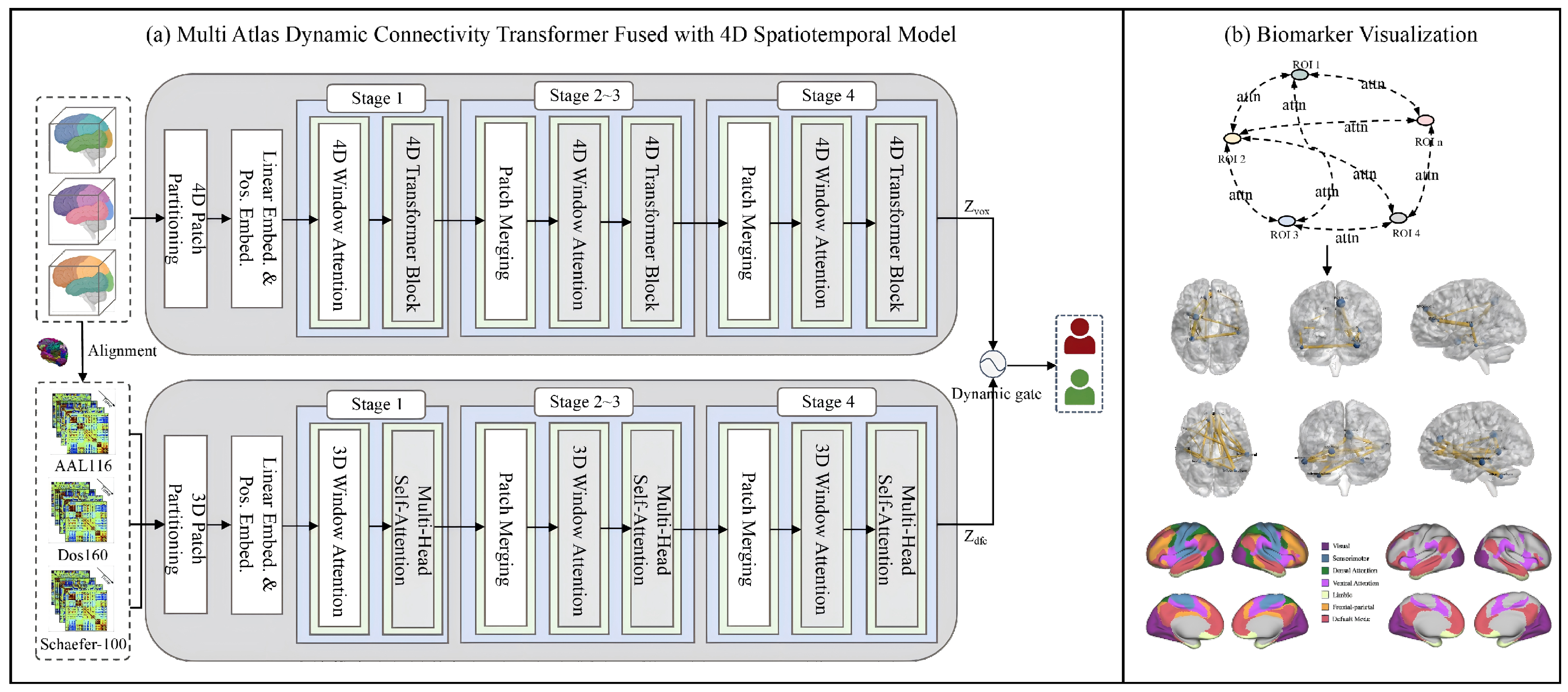
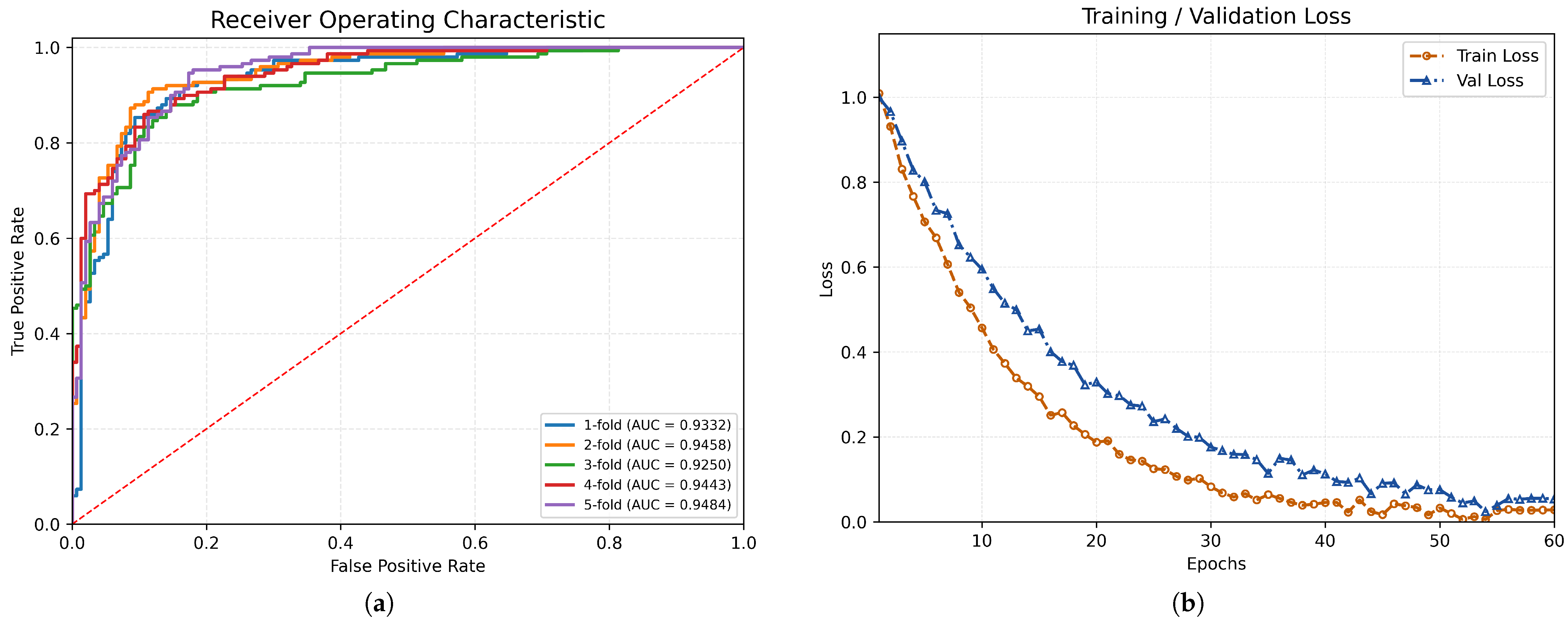
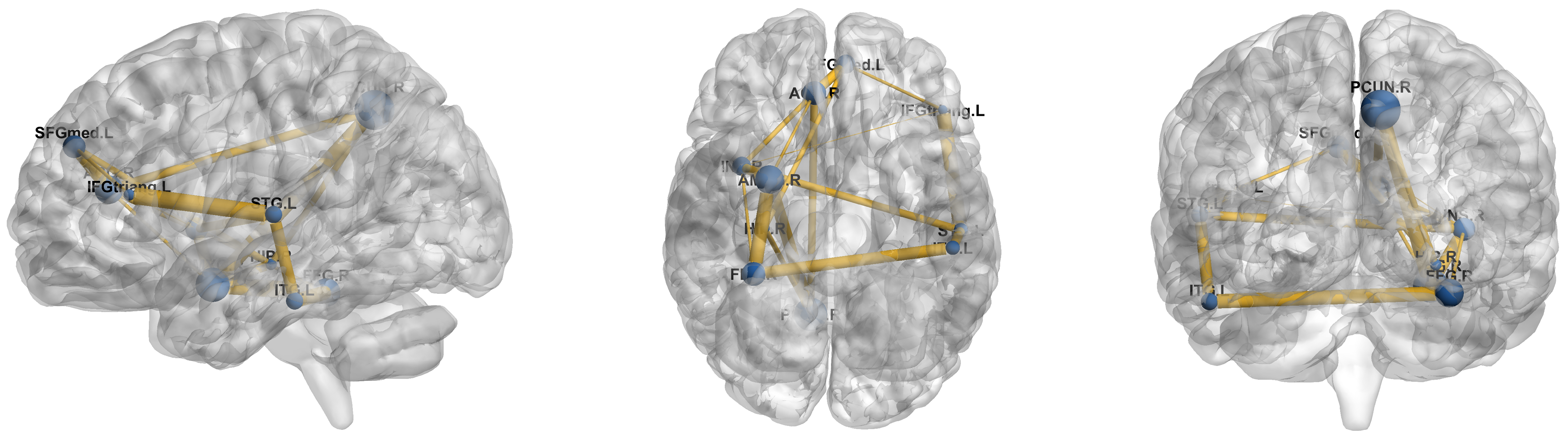
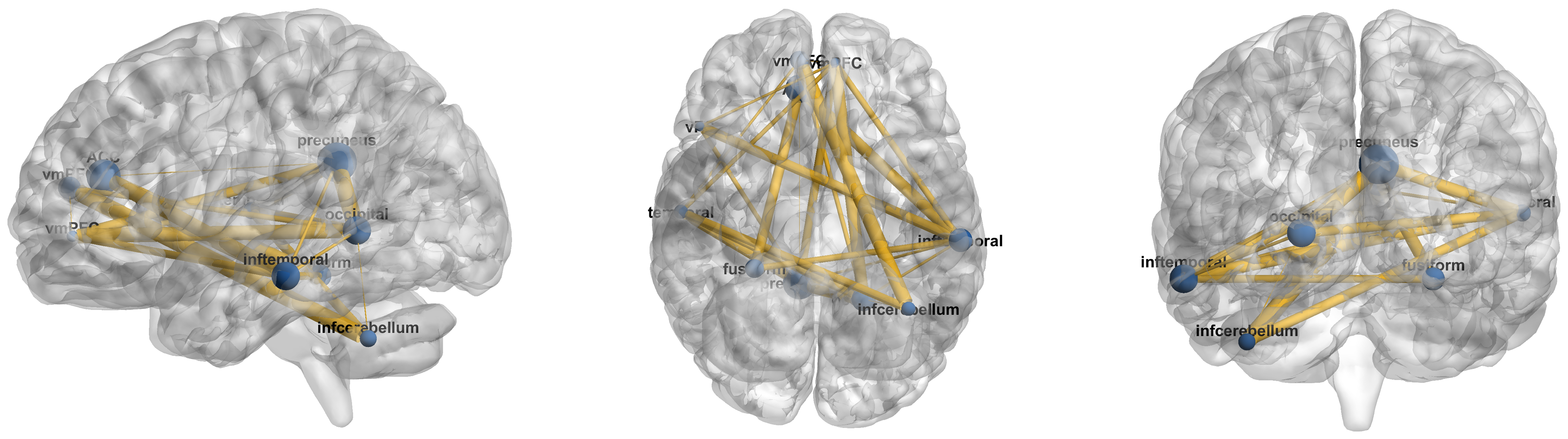
Background: The recognition of autism spectrum disorder (ASD) has been a challenge due to the heterogeneity in symptoms and complex variations in brain function. Resting-state functional magnetic resonance imaging (rs-fMRI) has become instrumental in studying these disorders by accessing underlying abnormal neural activity and connectivity. Recently, deep learning approaches have shifted the analysis of brain networks by capturing spatiotemporal information from fMRI sequences. Nonetheless, most existing studies are limited by relying on a single representational scale, typically restricting analysis to either voxel-level spatiotemporal patterns or static connectivity matrices. Additionally, the dynamic reconfiguration of functional coupling and its variations across different anatomical parcellations are often ignored, which obscures neurobiologically meaningful dynamics. Methods: In this regard, we propose a multi-atlas dynamic connectivity transformer fused with 4D spatiotemporal modeling for ASD recognition (MADCT-4D). Specifically, the framework comprises two complementary branches. The 4D spatiotemporal branch encodes raw rs-fMRI volumes to learn hierarchical representations of evolving neural activity, while the dynamic-connectivity branch models time-resolved functional connectivity sequences constructed from multiple atlases, enabling the network to capture dynamic reconfiguration at the connectome level under different parcellation granularities. Moreover, we perform late fusion by combining the branch-specific decision scores with a learnable gate, allowing the model to adaptively weight voxel-level dynamics and multi-atlas connectivity evidence for each subject. Results: Extensive experiments on the publicly available ABIDE dataset demonstrate that the proposed method achieves 90.2% accuracy for ASD recognition, outperforming multiple competitive baselines. Conclusions: The proposed framework yields interpretable biomarkers based on learned dynamic connectivity patterns that are consistent with altered functional coupling in ASD.
Keywords: autism spectrum disorder (ASD); resting-state functional magnetic resonance imaging (rs-fMRI); dynamic functional connectivity (dFC); multi-scale; biomarker autism spectrum disorder (ASD); resting-state functional magnetic resonance imaging (rs-fMRI); dynamic functional connectivity (dFC); multi-scale; biomarker