The Production of Clitics in Serbian Speakers with Stroke Aphasia

Highlights
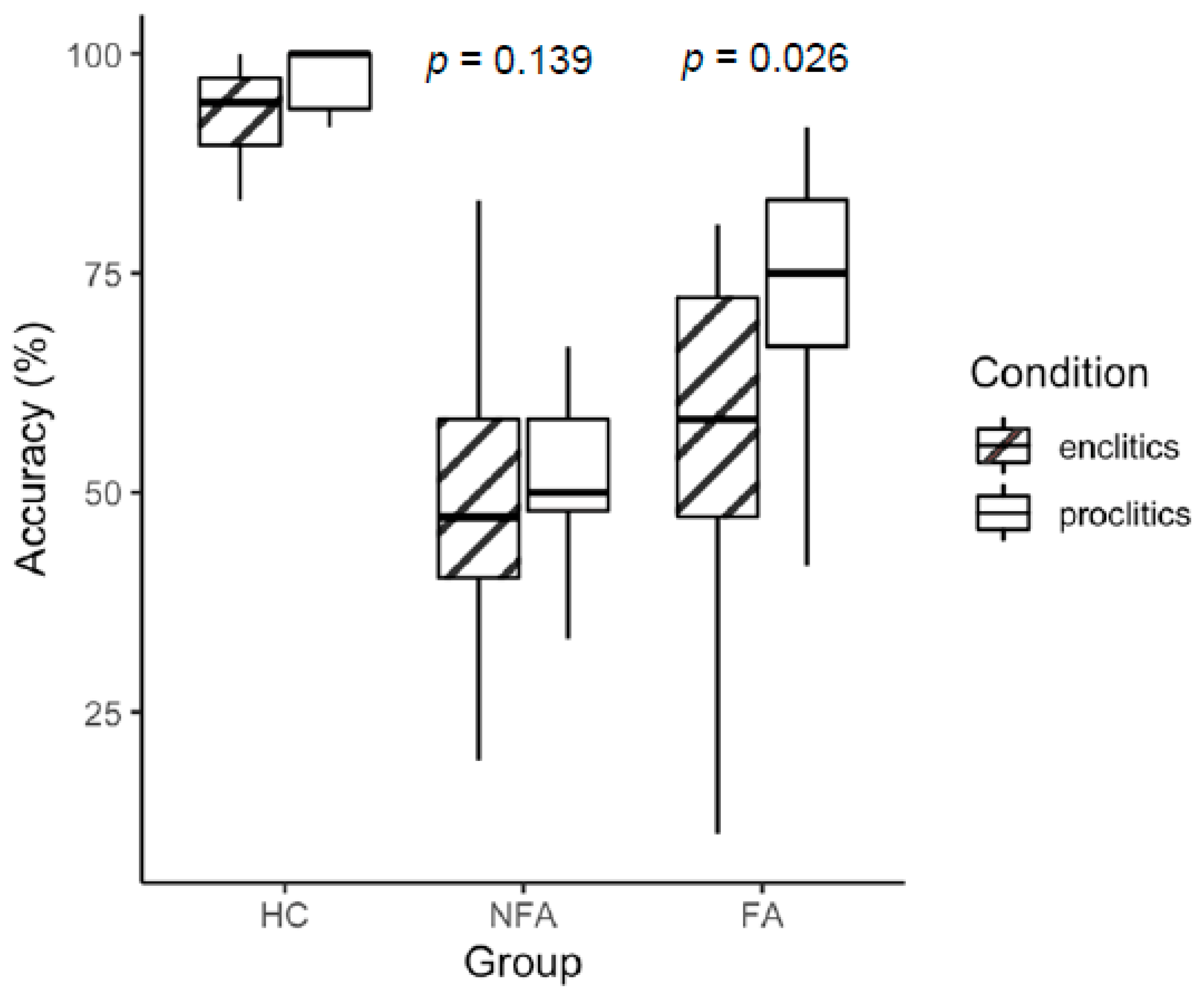
- Nonfluent aphasia was associated with impaired production of both enclitics and proclitics, whereas fluent aphasia showed a selective advantage for proclitics.
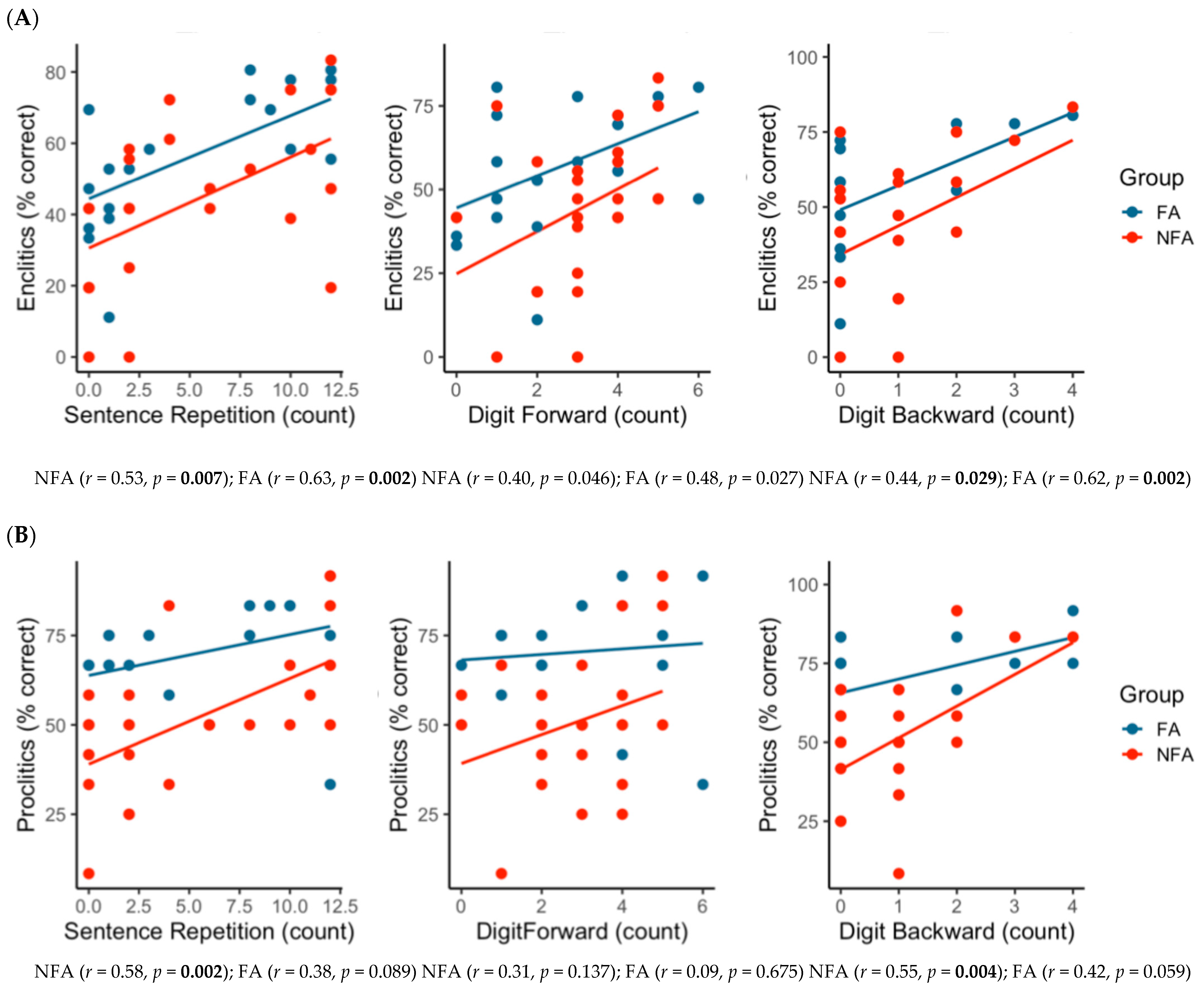
- Clitic production was differentially related to working memory and sentence repetition across clitic and aphasia types, with broader associations in nonfluent aphasia.
- Serbian clitic production may provide a sensitive linguistic marker for distinguishing aphasia profiles.
- Interventions targeting sentence-level planning and working memory may enhance clitic production, particularly in nonfluent aphasia.
Abstract
1. Introduction
2. Materials and Methods
2.1. Participants
2.2. Materials and Procedure
2.2.1. Serbian Clitic Production (SCP) Test
2.2.2. Procedure
2.2.3. Cognitive Measures
2.3. Data Analysis
3. Results
3.1. Patterns of Clitic Production Impairment
3.2. Correlations Between Enclitic Production and Cognitive Measures
3.3. Correlations Between Proclitic Production and Cognitive Measures
4. Discussion
4.1. Differential Impairments of Enclitic and Proclitic Production Across Aphasia Groups
4.2. Role of Verbal and Working Memory in Clitic Production Across Aphasia Groups
4.3. Clinical Implications of Clitic Production in Aphasia
4.4. Limitations
5. Conclusions
Supplementary Materials
Author Contributions
Funding
Institutional Review Board Statement
Informed Consent Statement
Data Availability Statement
Acknowledgments
Conflicts of Interest
Appendix A
| No | Clitic Responses |
| Enclitics | |
| 1 | Mačka je popila mleko. Mleka nema više. Zašto nema više mleka? (ciljani odgovor: ga, je–Mleka nema više zato što ga je popila mačka.) |
| 2 | Kuvarica je nezadovoljna. Kuvarici je zagoreo ručak. Zašto je kuvarica nezadovoljna? (ciljani odgovor: joj, je –Kuvarica je nezadovoljna zato što joj je zagoreo ručak.) |
| 3 | Mačka je ogrebala dečaka. Dečak place. Zašto dečak place? (ciljani odgovor: ga, je–Dečak plače zato što ga je mačka ogrebala.) |
| 4 | Vetar je polomio Markov kišobran. Marko je mokar. Zašto je Marko mokar? (ciljani odgovor: mu, je– Zato što mu je polomljen kišobran./Zato što mu je vetar polomio kišobran.) |
| 5 | Veliki talasi su zapljuskivali obalu. Obali se nije moglo prići. Zašto se nije moglo prići obali? (ciljani odgovor: su, je–Obali se nije moglo prići zato što su je zapljuskivali veliki talasi.) |
| 6 | Policajac je kaznio vozača. Vozač je besan. Zašto je vozač besan? (ciljani odgovor: ga, je–Vozač je besan zato što ga je kaznio policajac.) |
| 7 | Marko je oprao auto. Njegov auto se sija. Zašto se Markov auto sija? (ciljani odgovor: ga, je–Auto se sija zato što ga je Marko oprao.) |
| 8 | Deca su pojela sve bombone. Bombona više nema u kući. Zašto više nema bombona. (ciljani odgovor: su, ih–Bombona više nema zato što su ih deca pojela.) |
| 9 | Lepa devojka je namignula mladiću. Mladić je zadovoljan. Zašto je mladić zadovoljan? (ciljani odgovor: mu, je–Mladić je zadovoljan zato što mu je namignula lepa devojka.) |
| 10 | Mama je oprala Sarinu jaknu. Sare ne može da ide napolje. Zašto Sara ne može da ide napolje? (ciljani odgovor: joj, je–Sara ne može da ide napolje zato što joj je mama oprala jaknu.) |
| 11 | Petru je jutros pozlilo. Petar nije došao na posao. Zašto Petar nije došao na posao? (ciljani odgovor: mu, je–Petar nije došao na posao zato što mu je pozlilo.) |
| 12 | Ana se razbolela. Ona nije otišla u školu. Zašto Ana nije otišla u školu? (ciljani odgovor: se–Ana nije otišla u školu zato što se razbolela.) |
| 13 | Glumac je veoma srećan. Dobiće ulogu u novom filmu. Zašto je glumac srećan? (ciljani odgovor: će–Glumac je srećan zato što će dobiti ulogu u novom filmu.) |
| 14 | Prodavac nije Milutinu vratio kusur. Milutin je besan. Zašto je Milutin besan? (ciljani odgovor: mu–Milutin je besan zato što mu prodavac nije vratio kusur.) |
| 15 | Majina kosa je neuredna. Ona je uzela češalj. Šta će Maja uraditi češljem? (ciljani odgovor: će se–Maja će se očešljati/počešljaće se/očešljaće se) |
| 16 | Jovan i Miloš sutra putuju na more. Njima ce mama spakovati stvari. Šta će mama uraditi za Jovana i Miloša? (ciljani odgovor: će, im–Mama će im spakovati stvari./Spakovaće im stvari./Spremiće im stvari.) |
| 17 | Luku i Nokolu bole kolena. Oni ne mogu da trče. Zašto Luka i Nikola ne mogu da trče? (ciljani odgovor: ih–Luka i Nikola ne mogu da trče zato što ih bole kolena.) |
| 18 | Katarina nije mogla da spava. Katarinu je boleo zub. Zašto katarina nije mogla da spava? (ciljani odgovor: ju, je–Katarina nije mogla da spava zato što ju je boleo zub.) |
| Proclitics | |
| 19 | Mama je rekla Jeleni: Jelena dođi! Šta je mama rekla Jeleni? (ciljani odgovor: da, Mama je rekla Jeleni da dođe.) |
| 20 | Jovana ne ide na more. Jovana je tužna. Zašto je Jovana tužna? (ciljani odgovor: jer, zato što–Jovana je tužna jer ne ide na more.) |
| 21 | Sara je juče kupila olovku. Danas je kupila knjigu. Šta je sve Sara kupila? (ciljani odgovor: i–Sara je kupila olovku i knjigu.) |
| 22 | Milena ima crni šešir. Ivana ima plavi šešir. Koje je boje Milenin, a koje Ivanin šešir? (ciljani odgovor: a–Milenin šešir je crne, a Ivanin plave boje.) |
| 23 | Učiteljica je rekla da će dobiti minus svaki učenik koji ne donese bojice ili flomastere. Saša je dobio minus. Zašto je Saša dobio minus? (ciljani odgovor: ni–Saša je dobio minus zato što nije doneo (ni) bojice ni flomastere.) |
| 24 | Nina ide na rođendan kod drugarice. Ona će obući bele pantalone ili crvenu haljinu. Šta će Nina obući? (ciljani odgovor: ili–Nina će obući bele pantalone ili crvenu haljinu.) |
| 25 | Losos je vrsta ribe. Njegovo stanište je Atlantski ocean. Gde živi losos? (ciljani odgovor: u–Losos živi u Atlantskom okeanu, u okeanu, u moru.) |
| 26 | Učenici su u učionici. Njihove stolice su drvene. Na čemu sede učenici? (ciljani odgovor: na-Učenici sede na drvenim stolicama.) |
| 27 | Golub je u sobi. Prozor je otvoren. Kuda je golub uleteo u sobu? (ciljani odgovor: kroz–Golub je uleteo u sobu kroz prozor.) |
| 28 | Marija i Marko su bili u školi. Došli su kuci i odmaraju se. Odakle su došli Marija i Marko? (ciljani odgovor: iz–Marija i Marko su došli iz škole). |
| 29 | Nikola je otišao na aerodrom. Odatle je otputovao u Moskvu. Odakle je poleteo avion? (ciljani odgovor: sa–Avion je poleteo sa aerodroma.) |
| 30 | Milica je otišla da izvadi zub. Gde je otišla Milica? (ciljani odgovor: kod–Milica je otišla kod zubara/stomatologa) |
References
- Selkirk, E. Sentence prosody: Intonation, stress, and phrasing. Handb. Phonol. Theory 1995, 1, 550–569. [Google Scholar]
- Selkirk, E. The prosodic structure of function words. In Signal to Syntax; Psychology Press: Brighton and Hove, UK, 2014; pp. 187–213. [Google Scholar]
- Aikhenvald, A.Y. 2 Typological parameters for the study of clitics, with special reference to Tariana. In Word: A Cross-Linguistic Typology; Cambridge University Press: Cambridge, UK, 2003; p. 42. [Google Scholar]
- Kayne, R.S. Romance clitics, verb movement, and PRO. Linguist. Inq. 1991, 22, 647–686. [Google Scholar]
- Sadock, J.M. Autolexical Syntax; University of Chicago Press: Chicago, IL, USA, 1983. [Google Scholar]
- Zwicky, A.M. Clitics and particles. Language 1985, 61, 283–305. [Google Scholar] [CrossRef] [Scilit]
- Schwarze, C. I pronomi clitici. In Enciclopedia dell’Italiano; Simone, R., Ed.; Treccani: Rome, Italy, 2010; Volume II, pp. 213–219. [Google Scholar]
- De Cat, C. French subject clitics are not agreement markers. Lingua 2005, 115, 1195–1219. [Google Scholar] [CrossRef] [Scilit]
- Miller, P.H.; Sag, I.A. French clitic movement without clitics or movement. Nat. Lang. Linguist. Theory 1997, 15, 573–639. [Google Scholar] [CrossRef] [Scilit]
- Piper, P.; Antonić, I.; Ružić, V.; Tanasić, S.; Popović, L.; Tošović, B. Syntax of the Modern Serbian Language: A Simple Sentence; Institute for Serbian Language: Belgrade and Novi Sad, Serbia; SANU: Belgrade, Serbia; Beogradska Knjiga: Belgrade, Serbia; Matica Srpska: Novi Sad, Serbia, 2005. [Google Scholar]
- Spencer, A.; Luís, A.R. Clitics: An Introduction; Cambridge University Press: Cambridge, UK, 2012. [Google Scholar]
- Božović, Đ. Clitic Clusters in Languages of the Balkan. Doctoral Dissertation, University of Belgrade, Belgrade, Serbia, 2021. Available online: https://nardus.mpn.gov.rs/handle/123456789/18928 (accessed on 8 March 2026).
- Stanojčić, Ž.; Popović, L. Grammar of the Serbian Language: For Gymnaziums and High Schools; Textbook Institute: Belgrade, Serbia, 2014. [Google Scholar]
- Subotić, L.; Sredojević, D.; Bjelaković, I. Phonetics and Phonology (Electronic Resource): Orthoepic and Orthographic Norm of the Standard Serbian Language; Faculty of Philosophy: Novi Sad, Serbia, 2012; Available online: https://digitalna.ff.uns.ac.rs/sadrzaj/2012/978-86-6065-109-1 (accessed on 8 March 2026).
- Chinellato, P. Syntactic Impairments in Nonfluent Aphasia: A Linguistic Analysis of Dialectal and Italian Agrammatism. Doctoral Dissertation, University of Padua, Padova, Italy, 2004. [Google Scholar]
- Lonzi, L.; Luzzatti, C. Relevance of adverb distribution for the analysis of sentence representation in agrammatic patients. Brain Lang. 1993, 45, 306–317. [Google Scholar] [CrossRef] [Scilit]
- Miceli, G. Grammatical Deficits in Aphasia. In Handbook of Clinical and Experimental Neuropsychology; Psychology Press: Brighton and Hove, UK, 2020; pp. 245–272. [Google Scholar]
- Rossi, E. Clitic Production in Italian Agrammatism. Doctoral Dissertation, University of Groningen, Groningen, The Netherlands, 2007. [Google Scholar]
- Reznik, M.; Dubrovsky, S.; Maldonado, S. Agrammatism in Spanish: A case study. Brain Lang. 1995, 51, 355–368. [Google Scholar] [CrossRef] [Scilit]
- Escobar, L.; Gavarró, A. The acquisition of clitics and strong pronouns in Catalan. In Clitics in Phonology, Morphology and Syntax; John Benjamins Publishing Company: Amsterdam, The Netherlands, 2008; pp. 161–180. [Google Scholar]
- Sanchez–Alonso, S.; Martinez–Ferreriro, S.; Bastiaanse, R. Clitics in Spanish agrammatic aphasia: A study of the production of unaccusative, reflexive and object clitics. In Discourse Anaphora and Anaphor Resolution Colloquium; Springer: Berlin/Heidelberg, Germany, 2011; pp. 184–197. [Google Scholar]
- Martínez-Ferreiro, S.; Ishkhanyan, B.; Rosell-Clari, V.; Boye, K. Prepositions and pronouns in connected discourse of individuals with aphasia. Clin. Linguist. Phon. 2019, 33, 497–517. [Google Scholar] [CrossRef] [Scilit] [PubMed]
- Martínez-Ferreiro, S.; Reyes, A.F.; Bastiaanse, R. Overcoming discourse-linking difficulties in aphasia: The case of clitic pronouns. Clin. Linguist. Phon. 2017, 31, 459–477. [Google Scholar] [CrossRef] [Scilit]
- Reyes, A.F.; Bastiaanse, R. When object clitisation and climbing happen alone, and when they dance cheek to cheek: Selective impairment in Spanish agrammatism. Stem-Spraak-En Taalpathologie 2013, 18, 149–152. [Google Scholar]
- Martínez-Ferreiro, S.; Bastiaanse, R. Time reference in Spanish and Catalan non-fluent aphasia. Lingua 2013, 137, 88–105. [Google Scholar] [CrossRef] [Scilit]
- Nerantzini, M. Direct Object Clitics in Greek Agrammatic Production. A Single Case Study. Master’s Thesis, University of Groningen, Groningen, The Netherlands, 2008. [Google Scholar]
- Nerantzini, M.; Papadopoulou, D.; Varlokosta, S. Clitics in Greek aphasia: Evidence from production and grammaticality judgment. Procedia-Soc. Behav. Sci. 2010, 6, 178–179. [Google Scholar] [CrossRef] [Scilit]
- Stavrakaki, S.; Kouvava, S. Functional categories in agrammatism: Evidence from Greek. Brain Lang. 2003, 86, 129–141. [Google Scholar] [CrossRef] [Scilit] [PubMed]
- Martínez-Ferreiro, S.; Halupka-Rešetar, S.; Perovic, A. Clinical Linguistics in Bosnian/Croatian/Montenegrin/Serbian (BCMS): Down syndrome, Specific Language Impairment and aphasia. In Studies in Language and Mind: Selected Papers from the 3rd Worskhop in Psycholinguistic, Linguistic and Clinical Linguistic Research; Faculty of Philosophy: Novi Sad, Serbia, 2016; Volume 3. [Google Scholar]
- Martínez-Ferreiro, S.; Halupka-Rešetar, S. Verbal Deficits in Aphasia: Evidence from Native Speakers of Serbian. Annu. Rev. Fac. Philos. God. Filoz. Fak. 2014, 39. [Google Scholar]
- Sekerina, I.A. Slavic psycholinguistics in the 21st century. J. Slav. Linguist. 2017, 25, 463–487. [Google Scholar] [CrossRef] [Scilit]
- Rashmi, J.; John, S.; Krishna, V.; Krishnan, G. Interventional research on morphosyntactic deficits in agrammatic aphasia: A narrative review. Appl. Neuropsychol. Adult 2025, 23, 1–6. [Google Scholar] [CrossRef] [Scilit]
- Vuković, M. (Ed.) Treatment of Aphasia, 3rd ed.; College-Hill Press: London, UK, 2019; Available online: https://hdl.handle.net/21.15107/rcub_rfasper_3092 (accessed on 8 March 2026). (In Serbian)
- Beeson, P.M.; Bayles, K.A.; Rubens, A.B.; Kaszniak, A.W. Memory impairment and executive control in individuals with stroke-induced aphasia. Brain Lang. 1993, 45, 253–275. [Google Scholar] [CrossRef] [Scilit]
- Francis, D.; Clark, N.; Humphreys, G. The treatment of an auditory working memory deficit and the implications for sentence comprehension abilities in mild “receptive” aphasia. Aphasiology 2003, 17, 723–750. [Google Scholar] [CrossRef] [Scilit]
- Martin, N.; Ayala, J. Measurements of auditory-verbal STM span in aphasia: Effects of item, task, and lexical impairment. Brain Lang. 2004, 89, 464–483. [Google Scholar] [CrossRef] [Scilit]
- Vuković, M.; Simić, L.; Lana, J.R. The assessment of clitic production in serbian speakers. TEME 2025, 49, 475−494. [Google Scholar] [CrossRef] [Scilit]
- Kaplan, E.; Goodglass, H.; Weintraub, S. Boston Naming Test. Available online: https://psycnet.apa.org/doiLanding?doi=10.1037%2Ft27208-000 (accessed on 8 March 2026).
- Vuković, M.; Rajić, L.J.; Milovanović, T.; Douglas, N.F. Evaluation of reliability and validity of the Boston diagnostic aphasia examination (BDAE-2) in a Serbian population. J. Commun. Disord. 2025, 115, 106526. [Google Scholar] [CrossRef] [Scilit] [PubMed]
- Wechsler, D. A standardized memory scale for clinical use. J. Psychol. 1945, 19, 87–95. [Google Scholar] [CrossRef] [Scilit]
- Gonthier, C. An easy way to improve scoring of memory span tasks: The edit distance, beyond “correct recall in the correct serial position”. Behav. Res. Methods 2023, 55, 2021–2036. [Google Scholar] [CrossRef] [Scilit]
- Ballard, K.J.; Azizi, L.; Duffy, J.R.; McNeil, M.R.; Halaki, M.; O’Dwyer, N.; Layfield, C.; Scholl, D.I.; Vogel, A.P.; Robin, D.A. A predictive model for diagnosing stroke-related apraxia of speech. Neuropsychologia 2016, 81, 129–139. [Google Scholar] [CrossRef] [Scilit]
- Duffy, J.R. Motor Speech Disorders E-Book: Motor Speech Disorders E-Book; Elsevier Health Sciences: Amsterdam, The Netherlands, 2019. [Google Scholar]
- Caplan, D.; Waters, G.S. Verbal working memory and sentence comprehension. Behav. Brain Sci. 1999, 22, 77–94. [Google Scholar] [CrossRef] [Scilit]
- Goodglass, H. Understanding Aphasia; Academic Press: Cambridge, MA, USA, 1993. [Google Scholar]
- Murray, L.L. Attention and other cognitive deficits in aphasia: Presence and relation to language and communication measures. Am. J. Speech-Lang. Pathol. 2012, 21, S51–S65. [Google Scholar] [CrossRef] [Scilit]
- Despić, M. Suspended morphology in Serbian: Clitics vs. affixes. Glossa A J. Gen. Linguist. 2017, 2, 12. [Google Scholar]
- Niemi, J.; Laine, M. Lexical, inflectional, and clitic morphology: Evidence from an agrammatic aphasic individual. In Perspectives on Agrammatism; Psychology Press: Brighton and Hove, UK, 2012; pp. 106–119. [Google Scholar]
- Aphasia, C.P. Chapter Twelve Clitic Production in Greek Aphasia: A single case study. Michaela Nerantzini. Curr. Trends Greek Linguist. 2012, 292–312. [Google Scholar]
- Thompson, C.K.; Mack, J.E. Grammatical impairments in PPA. Aphasiology 2014, 28, 1018–1037. [Google Scholar] [CrossRef] [Scilit]
- Thompson, C.K.; Kielar, A.; Fix, S. Morphological aspects of agrammatic aphasia. In Perspectives on Agrammatism; Psychology Press: Brighton and Hove, UK, 2012; pp. 75–105. [Google Scholar]
- Lukic, S.; Fan, Z.; García, A.M.; Welch, A.E.; Ratnasiri, B.M.; Wilson, S.M.; Henry, M.L.; Vonk, J.; Deleon, J.; Miller, B.L.; et al. Discriminating nonfluent/agrammatic and logopenic PPA variants with automatically extracted morphosyntactic measures from connected speech. Cortex 2024, 173, 34–48. [Google Scholar] [CrossRef] [Scilit]
- Kolk, H.; Heeschen, C. Agrammatism, paragrammatism and the management of language. Lang. Cogn. Process. 1992, 7, 89–129. [Google Scholar] [CrossRef] [Scilit]
- Matchin, W.; den Ouden, D.B.; Basilakos, A.; Stark, B.C.; Fridriksson, J.; Hickok, G. Grammatical parallelism in aphasia: A lesion-symptom mapping study. Neurobiol. Lang. 2023, 4, 550–574. [Google Scholar] [CrossRef] [Scilit]
- Rezaii, N.; Mahowald, K.; Ryskin, R.; Dickerson, B.; Gibson, E. A syntax–lexicon trade-off in language production. Proc. Natl. Acad. Sci. USA 2022, 119, e2120203119. [Google Scholar] [CrossRef] [Scilit] [PubMed]
- Fyndanis, V.; Arcara, G.; Christidou, P.; Caplan, D. Morphosyntactic production and verbal working memory: Evidence from Greek aphasia and healthy aging. J. Speech Lang. Hear. Res. 2018, 61, 1171–1187. [Google Scholar] [CrossRef] [Scilit]
- Szöllősi, I.; Fenyvesi, E.; Yang, S.Y.; Marton, K. Verbal and nonverbal cognitive control functions in post-stroke nonfluent aphasia. Aphasiology 2025, 1–29. [Google Scholar] [CrossRef] [Scilit]
- Edwards, S. Grammar and fluent aphasia. In Clinical Linguistics; John Benjamins Publishing Company: Amsterdam, The Netherlands, 2011; pp. 249–266. [Google Scholar]
- Laures-Gore, J.; Marshall, R.S.; Verner, E. Performance of individuals with left hemisphere stroke and aphasia and individuals with right brain damage on forward and backward digit span tasks. Aphasiology 2011, 25, 43–56. [Google Scholar] [CrossRef] [Scilit]
- Vecchi, T.; Cornoldi, C. Passive storage and active manipulation in visuo-spatial working memory: Further evidence from the study of age differences. Eur. J. Cogn. Psychol. 1999, 11, 391–406. [Google Scholar] [CrossRef] [Scilit]
- Diedrichs, V.A.; Jewell, C.C.; Harnish, S.M. A scoping review of the relationship between nonlinguistic cognitive factors and aphasia treatment response. Top. Lang. Disord. 2022, 42, 212–235. [Google Scholar] [CrossRef] [Scilit]
- Faroqi-Shah, Y. A comparison of two theoretically driven treatments for verb inflection deficits in aphasia. Neuropsychologia 2008, 46, 3088–3100. [Google Scholar] [CrossRef] [Scilit]
- Dashti, F.; Asadi, M.; Yadegari, F. The effect of morphosemantic treatment on verb-tense inflection in Persian-speaking patients with agrammatism: A case report. Middle East J. Rehabil. Health Stud. 2018, 5, e80072. [Google Scholar] [CrossRef] [Scilit]
- Dashti, F.; Asadi, M.; Yadegari, F. Morphosemantic treatment of inflection of verb tense in Persian-speaking aphasic patients with agrammatism: A single-subject study. Aphasiology 2023, 37, 288–306. [Google Scholar] [CrossRef] [Scilit]
- Bastiaanse, R.; Hurkmans, J.; Links, P. The training of verb production in Broca’s aphasia: A multiple-baseline across-behaviours study. Aphasiology 2006, 20, 298–311. [Google Scholar] [CrossRef] [Scilit]
- Valinejad, V.; Mehri, A.; Khatoonabadi, A.; Darzi, A.; Barbieri, E.; Shekari, E.; Zare Sadeghi, A.; Shati, M.; Habibi, S.A.; Almasi-Dooghaee, M. Treatment of verb tense inflection and sentence production in Persian individuals with agrammatism. Appl. Neuropsychol. Adult 2025, 32, 1612–1626. [Google Scholar] [CrossRef] [Scilit] [PubMed]
- Shahmahmood Toktam, M.; Zahra, S.; AliPasha, M.; Ali, M.; Shahin, N. Cognitive and language intervention in primary language impairment: Studying the effectiveness of working memory training and direct language intervention on expansion of grammar and working memory capacities. Child Lang. Teach. Ther. 2018, 34, 235–268. [Google Scholar] [CrossRef] [Scilit]
- Gavarró, A.; Torrens, V.; Wexler, K. Object clitic omission: Two language types. Lang. Acquis. 2010, 17, 192–219. [Google Scholar] [CrossRef] [Scilit]
- Tsakali, V.; Wexler, K. Why children omit clitics in some languages but not in others: New evidence from Greek. LOT Occas. Ser. 2004, 3, 493–504. [Google Scholar]
- Varlokosta, S.; Belletti, A.; Costa, J.; Friedmann, N.; Gavarró, A.; Grohmann, K.K.; Guasti, M.T.; Tuller, L.; Lobo, M.; Anđelković, D.; et al. A cross-linguistic study of the acquisition of clitic and pronoun production. Lang. Acquis. 2016, 23, 1–26. [Google Scholar] [CrossRef] [Scilit]



| HC | NFA | FA | p-Values | |
|---|---|---|---|---|
| N | 54 | 25 | 21 | |
| Age (number of years) | 52.9 (17.9) | 61.5 (8.2) | 57.4 (11.8) | 0.074 |
| Education (number of years) | 14.1 (2.0) | 13.8 (2.7) | 13.2 (2.4) | 0.278 |
| Sex, n (%) female | 33 (61%) | 9 (43%) | 5 (16%) | 0.003 |
| Post-onset of stroke (months) | --- | 10.4 (5.0) | 11 (5.9) | 0.728 |
| Severity of aphasia | --- | 303 (79.4) | 332 (111.0) | 0.304 |
| Digit Span Forwards | 7.0 (1.2) NFA,FA | 2.7 (1.8) | 2.9 (1.4) | <0.001 |
| Digit Span Backwards | 5.3 (1.3) NFA,FA | 1.1 (1.4) | 0.9 (1.0) | <0.001 |
| Digit Span (total count) | 12.3 (2.2) NFA,FA | 3.7 (2.8) | 3.8 (2.1) | <0.001 |
| Sentence Repetition | 11.9 (0.3) NFA,FA | 5.6 (4.9) | 5.0 (4.5) | <0.001 |
| The Boston Diagnostic Aphasia Examination (BDAE) tests | ||||
| Fluency | --- | 8.16 (2.81) | 13.9 (2.19) | <0.001 |
| Word discrimination (max 72) | --- | 69.7 (3.66) | 61.2 (15.8) | 0.012 |
| Word-picture matching (max 10) | --- | 8.44 (2.48) | 8.81 (1.94) | 0.582 |
| Responsive naming (max 30) | --- | 19.2 (7.16) | 18.7 (6.51) | 0.797 |
| Visual Confrontation naming (max 105) | --- | 64 (19.2) | 57.4 (21.1) | 0.269 |
| Animal naming (60 s) | --- | 1.64 (1.41) | 4.05 (1.88) | <0.001 |
| Cookie Theft Picture (number of words) | --- | 9 (3.19) | 17.2 (5.85) | <0.001 |
| Scenarios | Question | Response | |
|---|---|---|---|
| Enclitics (N = 18, 6 each) | |||
| Reflexive pronoun (PRON): yourself/se | Sara se razbolela. Ona nije otišla u školu. | Zašto Sara nije otišla u školu? | Ona/Sara se PRON razbolela./Razbolela se PRON. |
| Auxiliary verb (AUX): want/će | Glumac će biti veoma zadovoljan. Dobiće ulogu u novom filmu. | Zašto je glumac srećan? | Zato što će AUX dobiti novu ulogu./Glumac će AUX dobiti novu ulogu. |
| Clitic Pronoun-Auxiliary (PRON-AUX): It is/ga je | Mačka je popila mleko. Mleka nema više. | Zašto nema više mleka? | Popila ga je PRON-AUX mačka./Mleka nema više zato što ga je PRON-AUX popila mačka. |
| Proclitics (N = 12, 6 each) | |||
| Prepositions (PREP): from/iz | Marija i Marko se odmaraju. Oni su skoro došli iz škole. | Odakle su došli Marija i Marko? | Marija i Marko su došli iz PREP škole. |
| Conjunctions (CONJ): or/ili | Nina ide na rođendan kod drugarice. Ona će obući bele pantalone ili crvenu haljinu. | Šta će Nina obući? | Bele pantalone ili CONJ crvenu haljinu. |
| Group | Clitic Types | Mean (SD) | Range |
|---|---|---|---|
| HC | enclitic | 93.0 (5.81) | 77–100 |
| NFA | enclitic | 43.3 (22.3) | 0–83 |
| FA | enclitic | 57.5 (18.7) | 11–80 |
| HC | proclitic | 97.0 (4.47) | 83–100 |
| NFA | proclitic | 51.0 (18.7) | 8–91 |
| FA | proclitic | 70.2 (15.0) | 33–91 |
Disclaimer/Publisher’s Note: The statements, opinions and data contained in all publications are solely those of the individual author(s) and contributor(s) and not of MDPI and/or the editor(s). MDPI and/or the editor(s) disclaim responsibility for any injury to people or property resulting from any ideas, methods, instructions or products referred to in the content. |
© 2026 by the authors. Licensee MDPI, Basel, Switzerland. This article is an open access article distributed under the terms and conditions of the Creative Commons Attribution (CC BY) license.
Share and Cite
Vukovic, M.; Lukic, S. The Production of Clitics in Serbian Speakers with Stroke Aphasia. Brain Sci. 2026, 16, 324. https://doi.org/10.3390/brainsci16030324
Vukovic M, Lukic S. The Production of Clitics in Serbian Speakers with Stroke Aphasia. Brain Sciences. 2026; 16(3):324. https://doi.org/10.3390/brainsci16030324
Chicago/Turabian StyleVukovic, Mile, and Sladjana Lukic. 2026. "The Production of Clitics in Serbian Speakers with Stroke Aphasia" Brain Sciences 16, no. 3: 324. https://doi.org/10.3390/brainsci16030324
APA StyleVukovic, M., & Lukic, S. (2026). The Production of Clitics in Serbian Speakers with Stroke Aphasia. Brain Sciences, 16(3), 324. https://doi.org/10.3390/brainsci16030324