Engineering Pareidolia: Mental Imagery, Perceptual Scaffolding, and Visual Creativity


Highlights
- Engineered pareidolia can be framed as a form of externally scaffolded mental imagery, in which minimal stimulus constraints elicit stable, template-based completion.
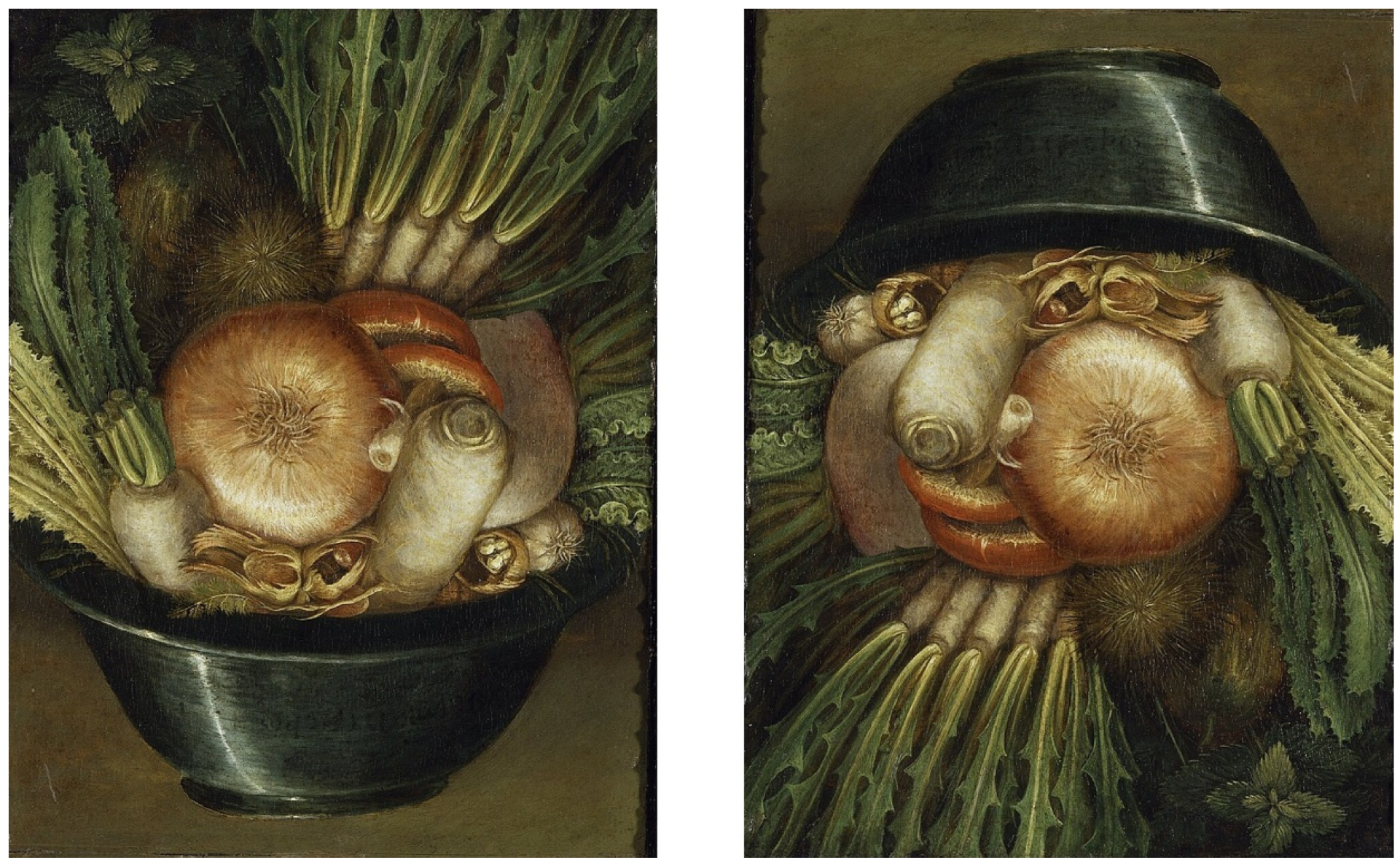
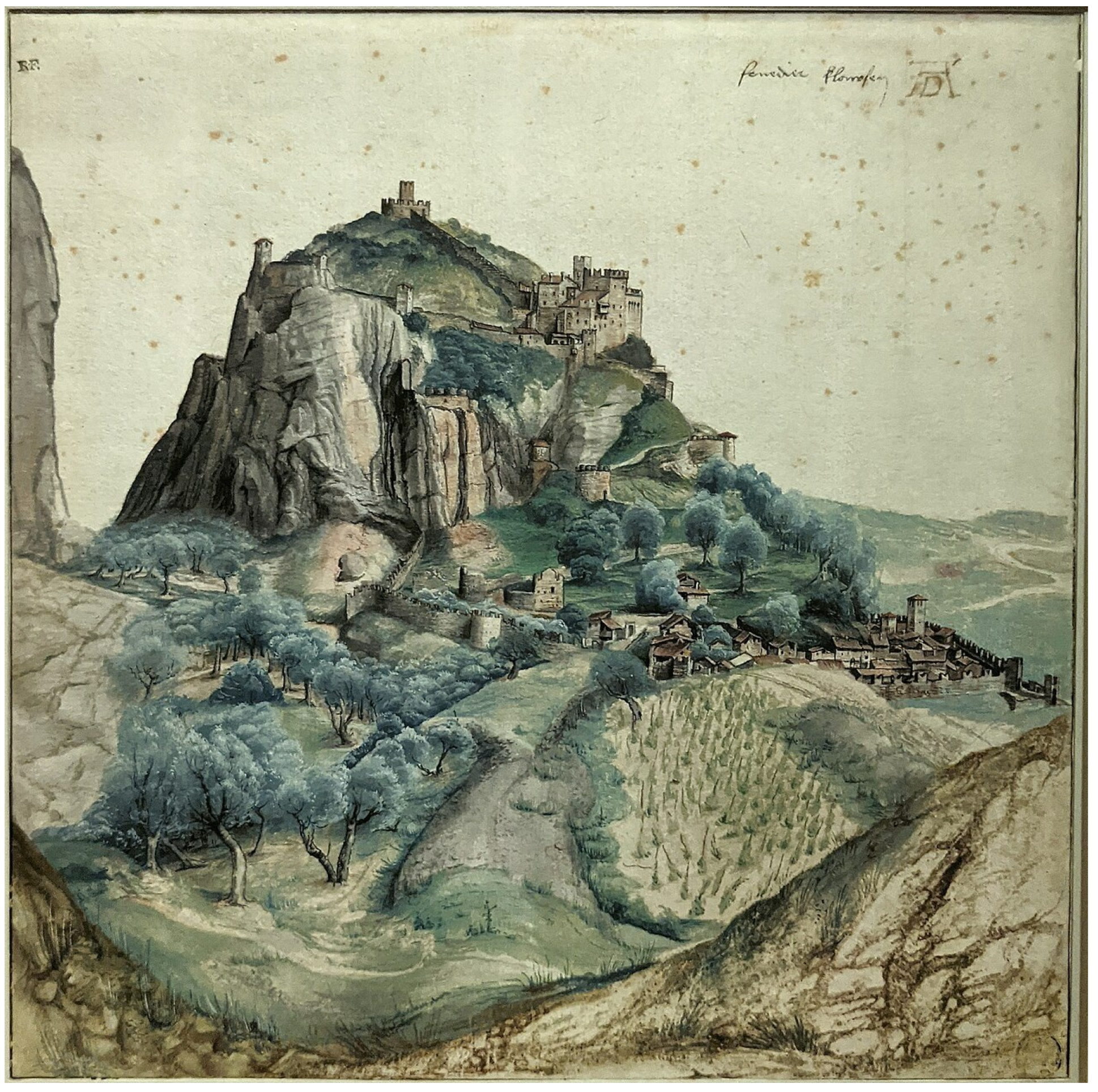
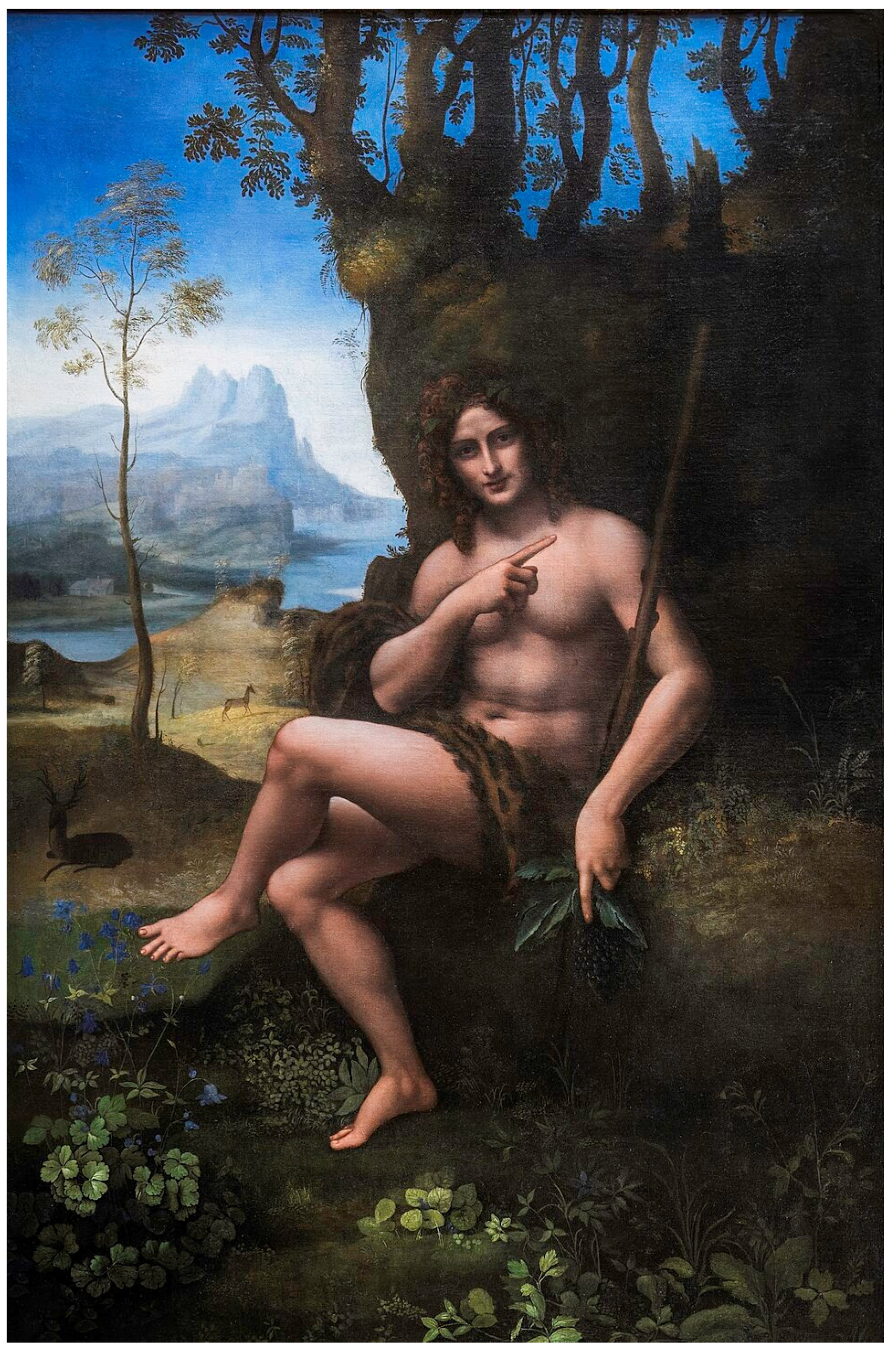
- Art-historical exemplars (Arcimboldo; Dürer; Leonardo) illustrate distinct “design regimes” through which sparse cues can reliably trigger face-like completion via top-down inference.
- Engineered pareidolia may offer tractable paradigms to quantify creative perception (detection thresholds, robustness to perturbation, inter-observer reproducibility) and relate it to neural signatures.
- The framework could help bridge neuroaesthetics with clinically quantifiable pareidolia in Lewy body disease, informing models of altered precision/priors under uncertainty.
Abstract
1. Introduction
2. Defining “Externally Scaffolded Mental Imagery” (ESMI)
2.1. Operational Definition (Necessary and Sufficient Features)
2.2. Terminology Standardization
- Template = stored category model (e.g., face schema).
- Completion = top-down filling-in that supplies missing structure.
- Attractor = a stable interpretive state toward which perception converges under ambiguity (dynamical systems framing).
3. Why Pareidolia, Specifically, as a Bridge to Creativity?
4. Predictive Processing: Which Version Is Assumed?
5. Engineered Pareidolia as “Predictive Engineering”
- Cue validity (what minimal features are sufficient to recruit a template);
- Attentional gating (what must be ignored or disengaged for the latent percept to emerge);
- Attractor competition (how strongly a dominant reading suppresses a latent reading).
6. Three Art-Historical Regimes of Engineered Pareidolia
6.1. Arcimboldo: Hierarchical Composite Faces
6.2. Dürer: Embedded Faces and Attentional Release
6.3. Leonardo: Engineered Pareidolia as “Cryptic Dialogue” Under Controlled Viewing
7. Creativity Bridge: From Divergent Thinking to Divergent Perception
8. Testable Paradigms and Feasibility Details
8.1. Pareidolia Creation Task (Designer-Side)
8.2. Pareidolia Detection Threshold Task (Viewer-Side)
8.3. Linking to Clinical Pareidolia (DLB)
9. Cultural Functions (Concrete Examples)
10. Clinical Resonance: Benign Completion vs. Hallucination
11. Conclusions and Outlook
Funding
Institutional Review Board Statement
Informed Consent Statement
Data Availability Statement
Conflicts of Interest
References
- Kosslyn, S.M.; Ganis, G.; Thompson, W.L. Neural foundations of imagery. Nat. Rev. Neurosci. 2001, 2, 635–642. [Google Scholar] [CrossRef]
- Pearson, J.; Naselaris, T.; Holmes, E.A.; Kosslyn, S.M. Mental imagery: Functional mechanisms and clinical applications. Trends Cogn. Sci. 2015, 19, 590–602. [Google Scholar] [CrossRef]
- Dijkstra, N.; Bosch, S.E.; van Gerven, M.A.J. Shared neural mechanisms of visual perception and imagery. Trends Cogn. Sci. 2019, 23, 423–434. [Google Scholar] [CrossRef] [PubMed]
- Koenig-Robert, R.; Pearson, J. Why do imagery and perception look and feel so different? Philos. Trans. R. Soc. B 2021, 376, 20190703. [Google Scholar] [CrossRef] [PubMed]
- Zeman, A.; Dewar, M.; Della Sala, S. Lives without imagery—Congenital aphantasia. Cortex 2015, 73, 378–380. [Google Scholar] [CrossRef] [PubMed]
- Marks, D.F. Visual imagery differences in the recall of pictures. Br. J. Psychol. 1973, 64, 17–24. [Google Scholar] [CrossRef]
- Wardle, S.G.; Taubert, J.; Teichmann, L.; Baker, C.I. Rapid and dynamic processing of face pareidolia in the human brain. Nat. Commun. 2020, 11, 4518. [Google Scholar] [CrossRef]
- Uchiyama, M.; Nishio, Y.; Yokoi, K.; Hirayama, K.; Imamura, T.; Shimomura, T.; Mori, E. Pareidolias: Complex visual illusions in dementia with Lewy bodies. Brain 2012, 135, 2458–2469. [Google Scholar] [CrossRef]
- Yokoi, K.; Nishio, Y.; Uchiyama, M.; Shimomura, T.; Iizuka, O.; Mori, E. Hallucinators find meaning in noises: Pareidolic illusions in dementia with Lewy bodies. Neuropsychologia 2014, 56, 245–254. [Google Scholar] [CrossRef]
- Mamiya, Y.; Nishio, Y.; Watanabe, H.; Yokoi, K.; Uchiyama, M.; Baba, T.; Iizuka, O.; Kanno, S.; Kamimura, N.; Kazui, H.; et al. The Pareidolia Test: A simple neuropsychological test measuring visual hallucination-like illusions. PLoS ONE 2016, 11, e0154713. [Google Scholar] [CrossRef]
- Zarkali, A.; Adams, R.A.; Psarras, S.; Leyland, L.-A.; Rees, G.; Weil, R.S. Increased weighting on prior knowledge in Lewy body–associated visual hallucinations. Brain Commun. 2019, 1, fcz007. [Google Scholar] [CrossRef]
- Corlett, P.R.; Horga, G.; Fletcher, P.C.; Alderson-Day, B.; Schmack, K.; Powers, A.R. Hallucinations and strong priors. Trends Cogn. Sci. 2019, 23, 114–127. [Google Scholar] [CrossRef]
- Sterzer, P.; Adams, R.A.; Fletcher, P.; Frith, C.; Lawrie, S.M.; Muckli, L.; Petrovic, P.; Uhlhaas, P.; Voss, M.; Corlett, P.R. The predictive coding account of psychosis. Biol. Psychiatry 2018, 84, 634–643. [Google Scholar] [CrossRef] [PubMed]
- Clark, A.; Chalmers, D. The Extended Mind. Analysis 1998, 58, 7–19. [Google Scholar] [CrossRef]
- Hutchins, E. Cognition in the Wild; MIT Press: Cambridge, MA, USA, 1995. [Google Scholar]
- Kirsh, D.; Maglio, P. Perceptive Actions in Tetris. In Proceedings of the AAAI Spring Symposium on Control of Selective Perception, Palo Alto, CA, USA, 25–27 March 1992. [Google Scholar]
- Fan, J.E.; Bainbridge, W.A.; Chamberlain, R.; Wammes, J.D. Drawing as a versatile cognitive tool. Nat. Rev. Psychol. 2023, 2, 556–568. [Google Scholar] [CrossRef] [PubMed]
- Kanwisher, N.; McDermott, J.; Chun, M.M. The fusiform face area: A module in human extrastriate cortex specialized for face perception. J. Neurosci. 1997, 17, 4302–4311. [Google Scholar] [CrossRef]
- Haxby, J.V.; Hoffman, E.A.; Gobbini, M.I. The distributed human neural system for face perception. Trends Cogn. Sci. 2000, 4, 223–233. [Google Scholar] [CrossRef]
- Jakobsen, K.V.; Hunter, B.K.; Simpson, E.A. Pareidolic faces receive prioritized attention in a dot-probe paradigm. Atten. Percept. Psychophys. 2023, 85, 1106–1126. [Google Scholar] [CrossRef]
- Balas, B. Face pareidolia is sensitive to spectral power and orientation energy. Iperception 2025, 16, 20416695251395442. [Google Scholar] [CrossRef] [PubMed]
- Bellemare-Pepin, A.; Harel, Y.; O’bYrne, J.; Mageau, G.; Dietrich, A.; Jerbi, K. Processing visual ambiguity in fractal patterns: Pareidolia as a sign of creativity. iScience 2022, 25, 105103. [Google Scholar] [CrossRef]
- Diana, L.; Frei, M.; Chesham, A.; de Jong, D.; Chiffi, K.; Nyffeler, T.; Bassetti, C.L.; Goebel, N.; Eberhard-Moscicka, A.K.; Müri, R.M. A divergent approach to pareidolias—Exploring creativity in a novel way. Psychol. Aesthet. Creat. Arts 2021, 15, 313–323. [Google Scholar] [CrossRef]
- Navon, D. Forest before trees: The precedence of global features in visual perception. Cogn. Psychol. 1977, 9, 353–383. [Google Scholar] [CrossRef]
- Caharel, S.; d’Arripe, O.; Ramon, M.; Rossion, B. Early holistic face-like processing of Arcimboldo paintings: Evidence from the N170 ERP component. Int. J. Psychophysiol. 2013, 90, 157–164. [Google Scholar] [CrossRef] [PubMed]
- Meng, M.; Tong, F. Can attention selectively bias bistable perception? J. Vis. 2004, 4, 539–551. [Google Scholar] [CrossRef] [PubMed]
- Weilnhammer, V.; Stuke, H.; Hesselmann, G.; Sterzer, P.; Schmack, K. A predictive coding account of bistable perception. PLoS Comput. Biol. 2017, 13, e1005536. [Google Scholar] [CrossRef] [PubMed]
- Demas, A. Pareidolia in a Leonardo da Vinci painting. Lancet Neurol. 2026, 25, 228–229. [Google Scholar] [CrossRef]
- Torrance, E.P. Torrance Tests of Creative Thinking; Personnel Press: Princeton, NJ, USA, 1966. [Google Scholar]
- Dietrich, A. The cognitive neuroscience of creativity. Psychon. Bull. Rev. 2004, 11, 1011–1026. [Google Scholar] [CrossRef]
- Beaty, R.E.; Silvia, P.J.; Nusbaum, E.C.; Jauk, E.; Benedek, M. The roles of associative and executive processes in creative cognition. Mem. Cogn. 2014, 42, 1186–1197. [Google Scholar] [CrossRef]
- Harris, J.C. Arcimboldo’s Vertumnus: A portrait of Rudolf II. Arch. Gen. Psychiatry 2011, 68, 442–443. [Google Scholar] [CrossRef]
- Palmisano, A.; Chiarantoni, G.; Bossi, F.; Conti, A.; D’eLia, V.; Tagliente, S.; Nitsche, M.A.; Rivolta, D. Face pareidolia is enhanced by 40 Hz transcranial alternating current stimulation. Sci. Rep. 2023, 13, 2035. [Google Scholar] [CrossRef]


Disclaimer/Publisher’s Note: The statements, opinions and data contained in all publications are solely those of the individual author(s) and contributor(s) and not of MDPI and/or the editor(s). MDPI and/or the editor(s) disclaim responsibility for any injury to people or property resulting from any ideas, methods, instructions or products referred to in the content. |
© 2026 by the author. Licensee MDPI, Basel, Switzerland. This article is an open access article distributed under the terms and conditions of the Creative Commons Attribution (CC BY) license.
Share and Cite
Demas, A. Engineering Pareidolia: Mental Imagery, Perceptual Scaffolding, and Visual Creativity. Brain Sci. 2026, 16, 321. https://doi.org/10.3390/brainsci16030321
Demas A. Engineering Pareidolia: Mental Imagery, Perceptual Scaffolding, and Visual Creativity. Brain Sciences. 2026; 16(3):321. https://doi.org/10.3390/brainsci16030321
Chicago/Turabian StyleDemas, Alexis. 2026. "Engineering Pareidolia: Mental Imagery, Perceptual Scaffolding, and Visual Creativity" Brain Sciences 16, no. 3: 321. https://doi.org/10.3390/brainsci16030321
APA StyleDemas, A. (2026). Engineering Pareidolia: Mental Imagery, Perceptual Scaffolding, and Visual Creativity. Brain Sciences, 16(3), 321. https://doi.org/10.3390/brainsci16030321