


Sensory Reactivity in Children Referred for Autism Evaluation: Associations with Autism Symptoms and Adaptive Skills


Highlights
- Sensory differences are evident across developmental conditions.
- Sensory differences predict adaptive functioning in children with and without autism in clinically referred populations.
- Understanding sensory differences across developmental conditions has implications for differential diagnosis.
- Results highlight the importance of examining sensory behaviors in children with diverse clinical profiles.
Abstract
1. Introduction
2. Methods
2.1. Participants
2.2. Procedure at the Time of Autism Evaluation
2.3. Procedure for Archival Data Analysis
2.4. Measures
2.4.1. Sensory Profile-2 (SP-2)
2.4.2. Autism Diagnostic Observation Schedule-2 (ADOS-2)
2.4.3. Vineland-II/Vineland-3
2.5. Statistical Approach
3. Results
3.1. Group Differences in Sensory Profiles
3.2. Correlations
3.3. Regression
4. Discussion
5. Conclusions
Supplementary Materials
Author Contributions
Funding
Institutional Review Board Statement
Informed Consent Statement
Data Availability Statement
Acknowledgments
Conflicts of Interest
References
- Association, A.P. Diagnostic and Statistical Manual of Mental Disorders, 5th ed.; American Psychiatric Publishing: Arlington, VA, USA, 2013. [Google Scholar]
- Baranek, G.T.; Watson, L.R.; Boyd, B.A.; Poe, M.D.; David, F.J.; McGuire, L. Hyporesponsiveness to social and nonsocial sensory stimuli in children with autism, children with developmental delays, and typically developing children. Dev. Psychopathol. 2013, 25, 307–320. [Google Scholar] [CrossRef]
- DeBoth, K.K.; Reynolds, S. A systematic review of sensory-based autism subtypes. Res. Autism Spectr. Disord. 2017, 36, 44–56. [Google Scholar] [CrossRef]
- Kadlaskar, G.; Seidl, A.; Tager-Flusberg, H.; Nelson, C.A.; Keehn, B. Atypical response to caregiver touch in infants at high risk for autism spectrum disorder. J. Autism Dev. Disord. 2019, 49, 2946–2955. [Google Scholar] [CrossRef] [PubMed]
- Kirby, A.V.; Bilder, D.A.; Wiggins, L.D.; Hughes, M.M.; Davis, J.; Hall-Lande, J.A.; Lee, L.C.; McMahon, W.M.; Bakian, A.V. Sensory features in autism: Findings from a large population-based surveillance system. Autism Res. 2022, 15, 751–760. [Google Scholar] [CrossRef]
- Dunn, W. The impact of sensory processing abilities on the daily lives of young children and their families: A conceptual model. Infants Young Child. 1997, 9, 23–35. [Google Scholar] [CrossRef]
- Dunn, W. The sensations of everyday life: Empirical, theoretical, and pragmatic considerations. Am. J. Occup. Ther. 2001, 55, 608–620. [Google Scholar] [CrossRef]
- Gentil-Gutiérrez, A.; Cuesta-Gómez, J.L.; Rodríguez-Fernández, P.; González-Bernal, J.J. Implication of the Sensory Environment in Children with Autism Spectrum Disorder: Perspectives from School. Int. J. Environ. Res. Public Health 2021, 18, 7670. [Google Scholar] [CrossRef]
- Brockevelt, B.L.; Nissen, R.; Schweinle, W.E.; Kurtz, E.; Larson, K.J. A comparison of the Sensory Profile scores of children with autism and an age-and gender-matched sample. South Dak. Med. 2013, 66, 459. [Google Scholar]
- Candy, C.; Ryan, D.; Milne, E.; Dickinson, A. Dissociation between subjective sensory reactivity and visual perceptual sensitivity in autistic and non-autistic adults: A brief report. Brain Behav. 2025, 15, e70865. [Google Scholar] [CrossRef]
- Crane, L.; Goddard, L.; Pring, L. Sensory processing in adults with autism spectrum disorders. Autism 2009, 13, 215–228. [Google Scholar] [CrossRef]
- Simpson, K.; Adams, D.; Alston-Knox, C.; Heussler, H.S.; Keen, D. Exploring the sensory profiles of children on the autism spectrum using the Short Sensory Profile-2 (SSP-2). J. Autism Dev. Disord. 2019, 49, 2069–2079. [Google Scholar] [CrossRef]
- Tomchek, S.D.; Dunn, W. Sensory processing in children with and without autism: A comparative study using the short sensory profile. Am. J. Occup. Ther. 2007, 61, 190–200. [Google Scholar] [CrossRef]
- Baranek, G.T.; David, F.J.; Poe, M.D.; Stone, W.L.; Watson, L.R. Sensory Experiences Questionnaire: Discriminating sensory features in young children with autism, developmental delays, and typical development. J. Child Psychol. Psychiatry 2006, 47, 591–601. [Google Scholar] [CrossRef]
- Burns, C.O.; Dixon, D.R.; Novack, M.; Granpeesheh, D. A systematic review of assessments for sensory processing abnormalities in autism spectrum disorder. Rev. J. Autism Dev. Disord. 2017, 4, 209–224. [Google Scholar] [CrossRef]
- Kadlaskar, G.; Bergmann, S.; McNally Keehn, R.; Seidl, A.; Keehn, B. Electrophysiological measures of tactile and auditory processing in children with autism spectrum disorder. Front. Hum. Neurosci. 2021, 15, 729270. [Google Scholar] [CrossRef] [PubMed]
- Kadlaskar, G.; Seidl, A.; Tager-Flusberg, H.; Nelson, C.A.; Keehn, B. Caregiver touch-speech communication and infant responses in 12-month-olds at high risk for autism spectrum disorder. J. Autism Dev. Disord. 2020, 50, 1064–1072. [Google Scholar] [CrossRef] [PubMed]
- Marco, E.J.; Hinkley, L.B.; Hill, S.S.; Nagarajan, S.S. Sensory processing in autism: A review of neurophysiologic findings. Pediatr. Res. 2011, 69, 48–54. [Google Scholar] [CrossRef] [PubMed]
- Kabakov, S.A.; Surgent, O.J.; Skaletski, E.C.; Sideris, J.; Ausderau, K.K.; Travers, B.G. Application of Sensory Subtypes: Understanding Core Autism Features, Adaptive Behaviors, and Motor Skills in Autistic Children. J. Autism Dev. Disord. 2025, 1–13. [Google Scholar] [CrossRef]
- Kadlaskar, G.; Mao, P.-H.; Iosif, A.-M.; Amaral, D.; Wu Nordahl, C.; Miller, M. Patterns of sensory processing in young children with autism: Differences in autism characteristics, adaptive skills, and attentional problems. Autism 2023, 27, 723–736. [Google Scholar] [CrossRef]
- Barmak, E.; Baş, B. Investigation of the Relationship Between Sensory Processing Skills and Language Development in Children With Developmental Language Disorders. Brain Behav. 2024, 14, e70105. [Google Scholar] [CrossRef]
- Jurek, L.; Duchier, A.; Gauld, C.; Hénault, L.; Giroudon, C.; Fourneret, P.; Cortese, S.; Nourredine, M. Sensory Processing in Individuals With Attention-Deficit/Hyperactivity Disorder Compared With Control Populations: A Systematic Review and Meta-analysis. J. Am. Acad. Child Adolesc. Psychiatry 2025, 64, 1132–1147. [Google Scholar] [CrossRef]
- Keating, J.; Purcell, C.; Gerson, S.A.; Vanderwert, R.E.; Jones, C.R. Exploring the presence and impact of sensory differences in children with Developmental Coordination Disorder. Res. Dev. Disabil. 2024, 148, 104714. [Google Scholar] [CrossRef] [PubMed]
- Watson, L.; Patten, E.; Baranek, G.T.; Poe, M.; Boyd, B.A.; Freuler, A.; Lorenzi, J. Differential associations between sensory response patterns and language, social, and communication measures in children with autism or other developmental disabilities. J. Speech Lang. Hear. Res. 2011, 54, 1562–1576. [Google Scholar] [CrossRef]
- Rutter, M.; LeCouteur, A.; Lord, C. Autism diagnostic interview revised. In Manual; Western Psychological Services: Los Angeles, CA, USA, 2003. [Google Scholar]
- Sparrow, S.S.; Cicchetti, D.V.; Saulnier, C.A. Vineland Adaptive Behavior Scales. In (Vineland-3) Manual, 3rd ed.; Pearson: San Antonio, TX, USA, 2016. [Google Scholar]
- Sparrow, S.S. Vineland adaptive behavior scales. In Encyclopedia of Clinical Neuropsychology; Springer: Berlin/Heidelberg, Germany, 2011; pp. 2618–2621. [Google Scholar]
- Dunn, W. Sensory Profile 2; Psych Corporation: Bloomington, MN, USA, 2014. [Google Scholar]
- Bowers, L.; Huisingh, R.; LoGiudice, C. Tasks of Problem Solving: Elementary; LinguiSystems: East Moline, IL, USA, 2005. [Google Scholar]
- Dunn, L.M.; Dunn, L.M. Peabody Picture Vocabulary Test; Pearson: Bloomington, MN, USA, 1965. [Google Scholar]
- Mullen, E.M. Mullen Scales of Early Learning; AGS: Circle Pines, MN, USA, 1995. [Google Scholar]
- Semel, E.M.; Wiig, E.H.; Secord, W. Clinical Evaluation of Language Fundamentals; Pearson: Bloomington, MN, USA, 2003. [Google Scholar]
- Wechsler, D. Wechsler Intelligence Scale for Children; Pearson Assessments US: San Antonio, TX, USA, 1949. [Google Scholar]
- Williams, K.T. Expressive vocabulary test second edition (EVT™ 2). J. Am. Acad. Child Adolesc. Psychiatry 1997, 42, 864–872. [Google Scholar]
- Lord, C.; Rutter, M.; DiLavore, P.; Risi, S.; Gotham, K.; Bishop, S. Autism Diagnostic Observation Schedule, (ADOS-2) Modules 1-4; Western Psychological Corporation: Los Angeles, CA, USA, 2015. [Google Scholar]
- Farmer, C.; Adedipe, D.; Bal, V.H.; Chlebowski, C.; Thurm, A. Concordance of the Vineland Adaptive Behavior Scales, second and third editions. J. Intellect. Disabil. Res. 2020, 64, 18–26. [Google Scholar] [CrossRef]
- Ben-Sasson, A.; Hen, L.; Fluss, R.; Cermak, S.A.; Engel-Yeger, B.; Gal, E. A meta-analysis of sensory modulation symptoms in individuals with autism spectrum disorders. J. Autism Dev. Disord. 2009, 39, 1–11. [Google Scholar] [CrossRef] [PubMed]
- Brandes-Aitken, A.; Powers, R.; Wren, J.; Chu, R.; Shapiro, K.A.; Steele, M.; Mukherjee, P.; Marco, E.J. Sensory processing subtypes relate to distinct emotional and behavioral phenotypes in a mixed neurodevelopmental cohort. Sci. Rep. 2024, 14, 29326. [Google Scholar] [CrossRef]
- Gigliotti, F.; Giovannone, F.; Belli, A.; Sogos, C. Atypical sensory processing in neurodevelopmental disorders: Clinical phenotypes in preschool-aged children. Children 2024, 11, 875. [Google Scholar] [CrossRef]
- Ringold, S.M.; McGuire, R.W.; Jayashankar, A.; Kilroy, E.; Butera, C.D.; Harrison, L.; Cermak, S.A.; Aziz-Zadeh, L. Sensory modulation in children with developmental coordination disorder compared to autism spectrum disorder and typically developing children. Brain Sci. 2022, 12, 1171. [Google Scholar] [CrossRef]
- McCormick, C.; Hepburn, S.; Young, G.S.; Rogers, S.J. Sensory symptoms in children with autism spectrum disorder, other developmental disorders and typical development: A longitudinal study. Autism 2016, 20, 572–579. [Google Scholar] [CrossRef]
- Kadlaskar, G.; McNally Keehn, R.; Rozniarek, R.; Fujii, N.P.; Keehn, B. Tactile hypo-responsivity in autism: Examining potential for diagnostic relevance. JCPP Adv. 2025, e70039. [Google Scholar] [CrossRef]
- Ghanizadeh, A. Sensory processing problems in children with ADHD, a systematic review. Psychiatry Investig. 2010, 8, 89. [Google Scholar] [CrossRef]
- Shulman, C.; Peretz-Bornstein, Y.; Kagya, S.; Shalom, D.B. Sensory Subgroups in Autism: The Role of Cognitive Abilities. J. Autism Dev. Disord. 2026, 1–20. [Google Scholar] [CrossRef] [PubMed]
- MacLennan, K.; Roach, L.; Tavassoli, T. The Relationship Between Sensory Reactivity Differences and Anxiety Subtypes in Autistic Children. Autism Res. 2020, 13, 785–795. [Google Scholar] [CrossRef]
- Sung, Y.S.; Lin, C.Y.; Chu, S.Y.; Lin, L.Y. Emotion Dysregulation Mediates the Relationship Between Sensory Processing and Behavior Problems in Young Children with Autism Spectrum Disorder: A Preliminary Study. J. Autism Dev. Disord. 2024, 54, 738–748. [Google Scholar] [CrossRef]
- Dellapiazza, F.; Vernhet, C.; Blanc, N.; Miot, S.; Schmidt, R.; Baghdadli, A. Links between sensory processing, adaptive behaviours, and attention in children with autism spectrum disorder: A systematic review. Psychiatry Res. 2018, 270, 78–88. [Google Scholar] [CrossRef] [PubMed]
- Williams, K.L.; Kirby, A.V.; Watson, L.R.; Sideris, J.; Bulluck, J.; Baranek, G.T. Sensory features as predictors of adaptive behaviors: A comparative longitudinal study of children with autism spectrum disorder and other developmental disabilities. Res. Dev. Disabil. 2018, 81, 103–112. [Google Scholar] [CrossRef] [PubMed]
- Worthley, E.; Grzadzinski, R.; Zwaigenbaum, L.; Dager, S.R.; Estes, A.M.; Hazlett, H.C.; Schultz, R.T.; Piven, J.; Wolff, J.J. Sensory Profiles in Relation to Later Adaptive Functioning Among Toddlers at High-Familial Likelihood for Autism. J. Autism Dev. Disord. 2024, 54, 2183–2197. [Google Scholar] [CrossRef]
- Moerman, F.; Warreyn, P.; Noens, I.; Steyaert, J.; van Esch, L.; de Vries, L.; Madarevic, M.; Segers, J.; Van Lierde, T.; TIARA-team. Exploring cascading effects of sensory processing on language skills and social-communicative difficulties through play in young children at elevated likelihood for autism. Infancy 2025, 30, e12625. [Google Scholar] [CrossRef]
- Feldman, J.I.; Raj, S.; Bowman, S.M.; Santapuram, P.; Golden, A.J.; Daly, C.; Dunham, K.; Suzman, E.; Augustine, A.E.; Garla, V.; et al. Sensory Responsiveness Is Linked with Communication in Infant Siblings of Children with and Without Autism. J. Speech Lang. Hear. Res. 2021, 64, 1964–1976. [Google Scholar] [CrossRef]

| Autism (n = 121) | Non-Autism (n = 117) | Statistic | p-Value | |
|---|---|---|---|---|
| Age, mean (SD) | 7.01 (2.92) | 8.56 (3.06) | t(236) = 3.98 | <0.001 ** |
| Gender, n (%) | X2(1) = 1.74 | 0.18 | ||
| Female | 17 (14%) | 24 (21%) | ||
| Male | 104 (86%) | 93 (79%) | ||
| ADOS-2 Modules a | X2(3) = 50.28 | <0.001 ** | ||
| Module 1 | 37 (32.2%) | 2 (1.9%) | ||
| Module 2 | 32 (27.8%) | 17 (16.3%) | ||
| Module 3 | 46 (40%) | 79 (76.0%) | ||
| Module 4 | - | 6 (5.8%) | ||
| ADOS-2, mean (SD) a | ||||
| Comparison Score | 7.88 (1.62) | 2.41 (2.04) | t(217) = −22.02 | <0.001 ** |
| Vineland-II mean (SD) | ||||
| n = 81 | 30 | 51 | ||
| Communication | 68.50 (16.76) | 77.06 (11.27) | t(79) = 2.74 | 0.01 * |
| Daily Living Skills | 76.17 (13.51) | 81.47 (13.54) | t(79) = 1.70 | 0.09 |
| Socialization | 69.07 (10.92) | 71.16 (11.42) | t(79) = 0.80 | 0.42 |
| Vineland-3 mean (SD) b | ||||
| n = 156 | 90 | 66 | ||
| Communication | 63.74 (20.90) | 73.36 (15.16) | t(154) = 3.17 | 0.00 ** |
| Daily Living Skills | 74.08 (13.29) | 81.29 (12.00) | t(153) = 3.47 | <0.001 ** |
| Socialization | 61.18 (15.96) | 73.27 (14.32) | t(154) = 4.88 | <0.001 ** |
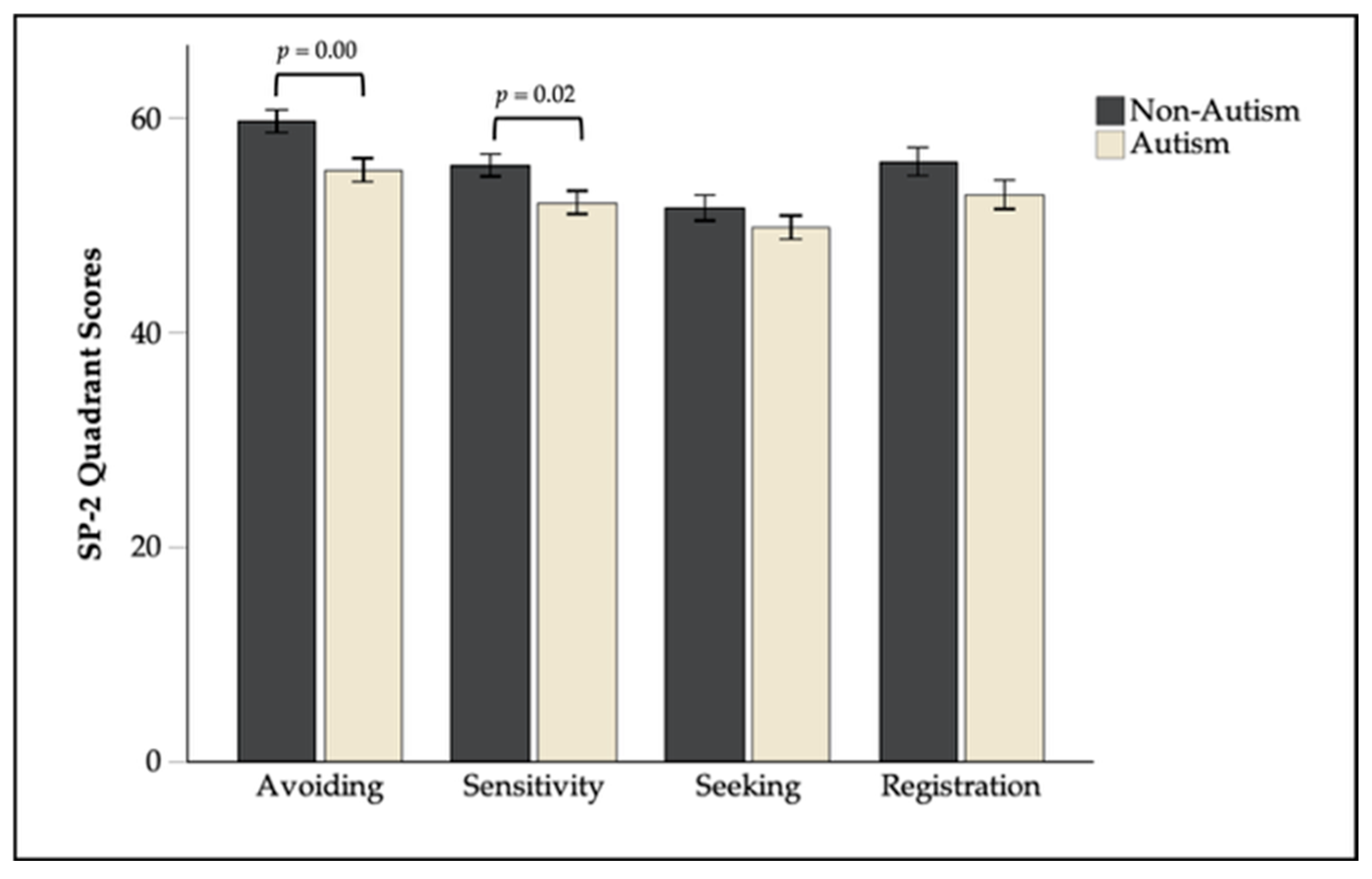
| Autism | Non-Autism | t | p | Cohen’ d | |||
|---|---|---|---|---|---|---|---|
| M | SD | M | SD | ||||
| Avoiding | 55.15 | 12.16 | 59.69 | 11.60 | 2.95 | 0.00 ** | 0.38 |
| Sensitivity | 52.14 | 11.62 | 55.62 | 11.35 | 2.34 | 0.02 * | 0.30 |
| Seeking | 49.80 | 12.27 | 51.66 | 12.78 | 1.14 | 0.25 | 0.15 |
| Registration | 52.85 | 14.39 | 55.93 | 14.11 | 1.67 | 0.10 | 0.22 |
| Seeking | Avoiding | Sensitivity | Registration | |
|---|---|---|---|---|
| ADOS-2 comparison score # (n = 219) | −0.04 | −0.18 ** | −0.12 | −0.10 |
| Vineland-II ^ (n = 81) | ||||
| Communication | 0.01 | 0.17 | 0.11 | 0.00 |
| Daily Living Skills | −0.15 | 0.10 | −0.03 | −0.25 * |
| Socialization | −0.05 | 0.05 | −0.07 | −0.17 |
| Vineland-3 # (n = 156) | ||||
| Communication | −0.06 | −0.06 | −0.21 ** | −0.18 * |
| Daily Living Skills | −0.18 * | −0.14 | −0.34 ** | −0.029 ** |
| Socialization | −0.23 ** | −0.32 ** | −0.36 ** | −0.34 ** |
| Predictor | B | SE B | β | t | p | |
|---|---|---|---|---|---|---|
| ADOS-2 comparison score (n = 219) a | Seeking | 0.01 | 0.02 | 0.03 | 0.48 | 0.63 |
| Avoiding | −0.02 | 0.02 | −0.08 | −1.26 | 0.21 | |
| Sensitivity | 0.01 | 0.02 | 0.02 | 0.29 | 0.77 | |
| Registration | 0.00 | 0.01 | 0.01 | 0.30 | 0.82 | |
| Age | 0.06 | 0.05 | 0.06 | 1.37 | 0.17 | |
| Dx status | 5.51 | 0.26 | 0.89 | 21.23 | <0.001 ** | |
| Vineland-II (n = 81) | ||||||
| Communication b | Seeking | −0.21 | 0.18 | −0.18 | −1.17 | 0.25 |
| Avoiding | 0.36 | 0.22 | 0.28 | 1.61 | 0.11 | |
| Sensitivity | 0.12 | 0.24 | 0.09 | 0.49 | 0.63 | |
| Registration | −0.16 | 0.17 | −0.14 | −0.94 | 0.35 | |
| Age | −0.91 | 0.61 | −0.19 | −0.19 | 0.14 | |
| Dx status | −9.43 | 3.41 | −0.33 | −2.77 | 0.00 ** | |
| Daily Living Skills c | Seeking | −0.18 | 0.17 | −0.16 | −1.05 | 0.30 |
| Avoiding | 0.40 | 0.21 | 0.32 | 1.93 | 0.06 | |
| Sensitivity | 0.14 | 0.22 | 0.10 | 0.61 | 0.55 | |
| Registration | −0.51 | 0.16 | −0.46 | −3.15 | 0.00 ** | |
| Age | 0.19 | 0.58 | 0.04 | 0.32 | 0.75 | |
| Dx status | −5.12 | 3.20 | −0.18 | −1.60 | 0.11 | |
| Socialization d | Seeking | −0.02 | 0.15 | −0.03 | −0.16 | 0.88 |
| Avoiding | 0.30 | 0.18 | 0.30 | 1.66 | 0.10 | |
| Sensitivity | −0.11 | 0.20 | −0.11 | −0.58 | 0.57 | |
| Registration | −0.24 | 0.14 | −0.27 | −1.72 | 0.09 | |
| Age | −0.28 | 0.51 | −0.08 | −0.56 | 0.58 | |
| Dx status | −2.72 | 2.81 | −0.12 | −0.97 | 0.34 | |
| Vineland-3 (n = 156) | ||||||
| Communication e | Seeking | 0.34 | 0.16 | 0.23 | 2.09 | 0.04 |
| Avoiding | 0.25 | 0.18 | 0.16 | 1.44 | 0.15 | |
| Sensitivity | −0.61 | 0.20 | −0.38 | −3.02 | 0.00 ** | |
| Registration | −0.24 | 0.16 | −0.19 | −1.53 | 0.13 | |
| Age | 0.76 | 0.51 | 0.12 | 1.50 | 0.14 | |
| Dx status | −9.25 | 2.99 | −0.24 | −3.09 | 0.00 ** | |
| Daily Living Skills f | Seeking | 0.31 | 0.10 | 0.30 | 3.06 | 0.00 ** |
| Avoiding | 0.16 | 0.11 | 0.14 | 1.42 | 0.16 | |
| Sensitivity | −0.66 | 0.13 | −0.59 | −5.20 | <0.001 ** | |
| Registration | −0.15 | 0.10 | −0.17 | −1.57 | 0.12 | |
| Age | 0.88 | 0.32 | 0.21 | 2.78 | 0.00 ** | |
| Dx status | −7.21 | 1.89 | −0.27 | −3.82 | <0.001 ** | |
| Socialization g | Seeking | 0.16 | 0.12 | 0.13 | 1.34 | 0.18 |
| Avoiding | −0.23 | 0.13 | −0.18 | −1.78 | 0.08 | |
| Sensitivity | −0.40 | 0.15 | −0.30 | −2.69 | 0.00 ** | |
| Registration | −0.14 | 0.12 | −0.13 | −1.19 | 0.24 | |
| Age | −0.49 | 0.37 | −0.09 | −1.32 | 0.19 | |
| Dx status | −14.62 | 2.22 | −0.44 | −6.59 | <0.001 ** |
Disclaimer/Publisher’s Note: The statements, opinions and data contained in all publications are solely those of the individual author(s) and contributor(s) and not of MDPI and/or the editor(s). MDPI and/or the editor(s) disclaim responsibility for any injury to people or property resulting from any ideas, methods, instructions or products referred to in the content. |
© 2026 by the authors. Licensee MDPI, Basel, Switzerland. This article is an open access article distributed under the terms and conditions of the Creative Commons Attribution (CC BY) license.
Share and Cite
Kadlaskar, G.; King, S.E.; Stewart, J.R. Sensory Reactivity in Children Referred for Autism Evaluation: Associations with Autism Symptoms and Adaptive Skills. Brain Sci. 2026, 16, 310. https://doi.org/10.3390/brainsci16030310
Kadlaskar G, King SE, Stewart JR. Sensory Reactivity in Children Referred for Autism Evaluation: Associations with Autism Symptoms and Adaptive Skills. Brain Sciences. 2026; 16(3):310. https://doi.org/10.3390/brainsci16030310
Chicago/Turabian StyleKadlaskar, Girija, Stephanie E. King, and Jessica R. Stewart. 2026. "Sensory Reactivity in Children Referred for Autism Evaluation: Associations with Autism Symptoms and Adaptive Skills" Brain Sciences 16, no. 3: 310. https://doi.org/10.3390/brainsci16030310
APA StyleKadlaskar, G., King, S. E., & Stewart, J. R. (2026). Sensory Reactivity in Children Referred for Autism Evaluation: Associations with Autism Symptoms and Adaptive Skills. Brain Sciences, 16(3), 310. https://doi.org/10.3390/brainsci16030310

