No Association Between Hypnotizability and Basal Ganglia Morphometry
 and
and 
Highlights
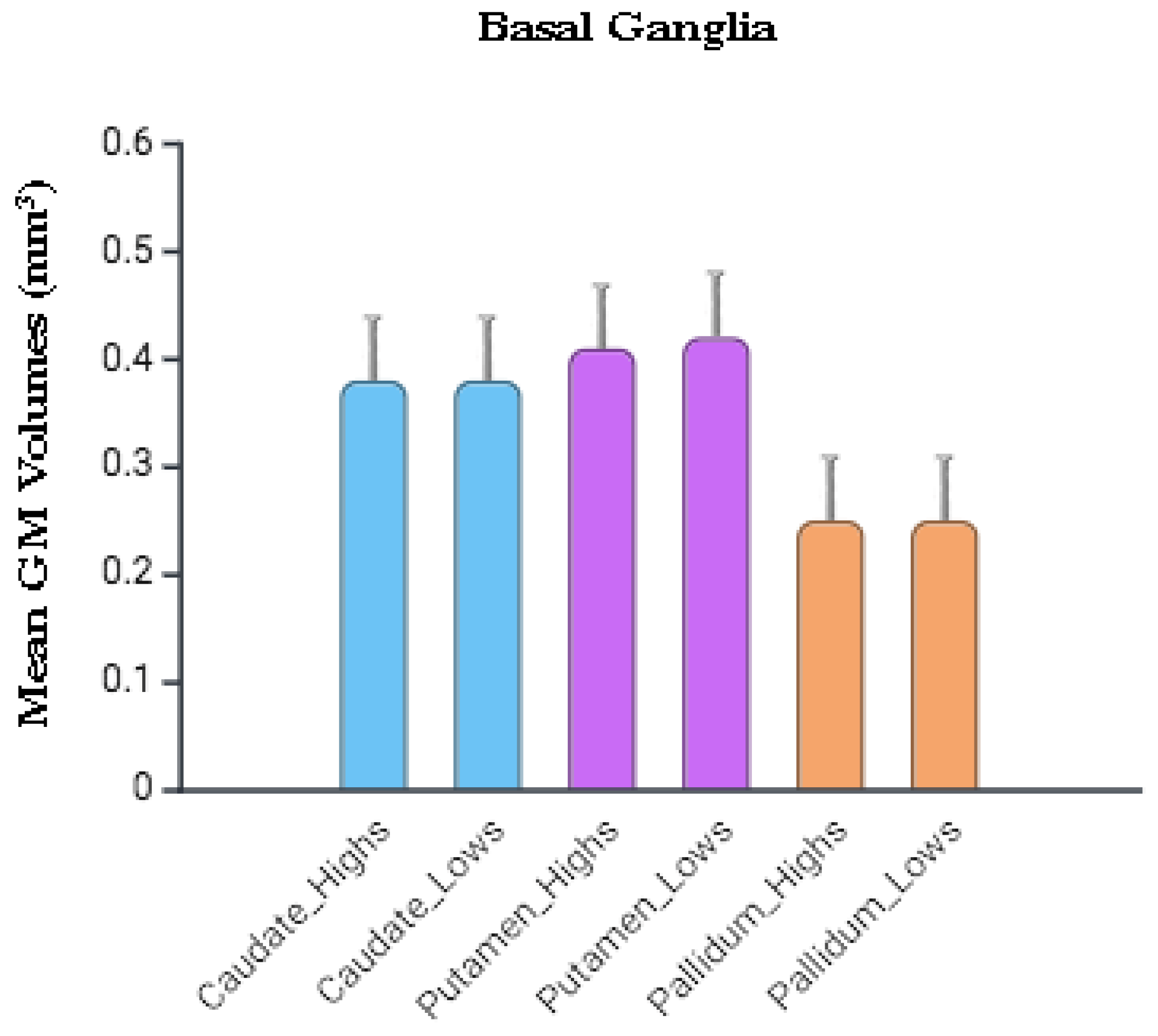
- Hypnotizability does not display basal ganglia (BG) structural variations.
- This is at variance with the reported variations in cerebellum and insula.
- BG do not contribute to the insula/cerebellum-related behavioral differences.
- Negative findings clarify hypnotizability-related physiological mechanisms.
Abstract
1. Introduction
2. Methods
2.1. Participants
Hypnotic Assessment
2.2. Image Acquisition
2.3. Image Processing
2.4. Basal Ganglia Masking
2.5. Statistical Analysis
3. Results
4. Discussion
4.1. Sensorimotor Domain
4.2. Cognitive–Emotional Domain
5. Conclusions
Supplementary Materials
Author Contributions
Funding
Institutional Review Board Statement
Informed Consent Statement
Data Availability Statement
Conflicts of Interest
References
- Elkins, G.R.; Barabasz, A.F.; Council, J.R.; Spiegel, D. Advancing research and practice: The revised APA Division 30 definition of hypnosis. Int. J. Clin. Exp. Hypn. 2015, 63, 1–9. [Google Scholar] [CrossRef]
- Santarcangelo, E.L.; Scattina, E. Complementing the Latest APA Definition of Hypnosis: Sensory-Motor and Vascular Peculiarities Involved in Hypnotizability. Int. J. Clin. Exp. Hypn. 2016, 64, 318–330. [Google Scholar] [CrossRef]
- De Pascalis, V.; Bellusci, A.; Russo, P.M. Italian norms for the Stanford Hypnotic Susceptibility Scale, Form C. Int. J. Clin. Exp. Hypn. 2000, 48, 315–323. [Google Scholar] [CrossRef]
- Barnier, A.J.; Terhune, D.B.; Polito, V.; Woody, E.Z. A componential approach to individual differences in hypnotizability. Psychol. Conscious. Theory Res. Pract. 2021, 9, 130–140. [Google Scholar] [CrossRef]
- Santarcangelo, E.L. Physiological correlates of hypnotizability. In The Routledge International Handbook of Clinical Hypnosis; Linden, J.H., De Benedittis, G., Sugarman, L.I., Varga, K., Eds.; Taylor & Francis: New York, NY, USA; London, UK, 2024; pp. 313–330. [Google Scholar]
- Cruz-Sanabria, F.; Faraguna, U.; Panu, C.; Tommasi, L.; Bruno, S.; Bazzani, A.; Sebastiani, L.; Santarcangelo, E.L. Hypnotizability-related risky experience and behavior. Neurosci. Lett. 2024, 821, 137625. [Google Scholar] [CrossRef] [PubMed]
- Zelič, Ž.; Giusti, G.; Santarcangelo, E.L. Emotion regulation: The role of hypnotizability and interoception. Conscious. Cogn. 2025, 131, 103856. [Google Scholar] [CrossRef]
- Llera, A.; Wolfers, T.; Mulders, P.; Beckmann, C.F. Inter-individual differences in human brain structure and morphology link to variation in demographics and behavior. eLife 2019, 8, e44443. [Google Scholar] [CrossRef]
- Cojan, Y.; Piguet, C.; Vuilleumier, P. What makes your brain suggestible? Hypnotizability is associated with differential brain activity during attention outside hypnosis. NeuroImage 2015, 117, 367–374. [Google Scholar] [CrossRef]
- Huber, A.; Lui, F.; Duzzi, D.; Pagnoni, G.; Porro, C.A. Structural and functional cerebral correlates of hypnotic suggestibility. PLoS ONE 2014, 9, e93187. [Google Scholar] [CrossRef]
- Picerni, E.; Santarcangelo, E.L.; Laricchiuta, D.; Cutuli, D.; Petrosini, L.; Spalletta, G.; Piras, F. Cerebellar Structural Variations in Subjects with Different Hypnotizability. Cerebellum 2019, 18, 109–118. [Google Scholar] [CrossRef] [PubMed]
- Sadiq, A.; Funk, A.T.; Waugh, J.L. The striatal compartments, striosome and matrix, are embedded in largely distinct resting-state functional networks. Front. Neural Circuits 2025, 19, 1514937. [Google Scholar] [CrossRef] [PubMed]
- Laricchiuta, D.; Petrosini, L.; Piras, F.; Macci, E.; Cutulim, D.; Chiapponi, C.; Cerasa, A.; Picerni, E.; Caltagirone, C.; Girardi, P.; et al. Linking novelty seeking and harm avoidance personality traits to cerebellar volumes. Hum. Brain Mapp. 2014, 35, 285–296. [Google Scholar] [CrossRef]
- Picerni, E.; Petrosini, L.; Piras, F.; Laricchiuta, D.; Cutuli, D.; Chiapponi, C.; Fagioli, S.; Girardi, P.; Caltagirone, C.; Spalletta, G. New evidence for the cerebellar involvement in personality traits. Front. Behav. Neurosci. 2013, 7, 133. [Google Scholar] [CrossRef]
- Bocci, T.; Barloscio, D.; Parenti, L.; Sartucci, F.; Carli, G.; Santarcangelo, E.L. High Hypnotizability Impairs the Cerebellar Control of Pain. Cerebellum 2017, 16, 55–61. [Google Scholar] [CrossRef] [PubMed]
- Milardi, D.; Arrigo, A.; Anastasi, G.; Cacciola, A.; Marino, S.; Mormina, E.; Calamuneri, A.; Bruschetta, D.; Cutroneo, G.; Trimarchi, F.; et al. Extensive Direct Subcortical Cerebellum-Basal Ganglia Connections in Human Brain as Revealed by Constrained Spherical Deconvolution Tractography. Front. Neuroanat. 2016, 10, 29. [Google Scholar] [CrossRef]
- Yoshida, J.; Oñate, M.; Khatami, L.; Vera, J.; Nadim, F.; Khodakhah, K. Cerebellar Contributions to the Basal Ganglia Influence Motor Coordination, Reward Processing, and Movement Vigor. J. Neurosci. 2022, 42, 8406–8415. [Google Scholar] [CrossRef]
- Bostan, C.; Strick, P.L. The basal ganglia and the cerebellum: Nodes in an integrated network. Nat. Rev. Neurosci. 2018, 19, 338–350. [Google Scholar] [CrossRef]
- Washburn, S.; Oñate, M.; Yoshida, J.; Vera, J.; Bhuvanasundaram, R.; Khatami, L.; Nadim, F.; Khodakhah, K. The cerebellum directly modulates the substantia nigra dopaminergic activity. Nat. Neurosci. 2024, 27, 497–513. [Google Scholar] [CrossRef]
- Lee, J.L.; Casamento-Moran, A.; Bastian, A.J.; Cullen, K.E.; Chib, V.S. Striatal and cerebellar interactions during reward-based motor performance. Proc. Natl. Acad. Sci. USA 2025, 122, e2503373122. [Google Scholar] [CrossRef]
- Zhang, J.; Wu, X.; Si, Y.; Liu, Y.; Wang, X.; Geng, Y.; Chang, Q.; Jiang, X.; Zhang, H. Abnormal caudate nucleus activity in patients with depressive disorder: Meta-analysis of task-based functional magnetic resonance imaging studies with behavioral domain. Psychiatry Res. Neuroimaging 2024, 338, 111769. [Google Scholar] [CrossRef] [PubMed]
- Manto, M.; Adamaszek, M.; Apps, R.; Carlson, E.; Guarque-Chabrera, J.; Heleven, E.; Kakei, S.; Khodakhah, K.; Kuo, S.-H.; Lin, C.-Y.R.; et al. Consensus Paper: Cerebellum and Reward. Cerebellum 2024, 23, 2169–2192. [Google Scholar] [CrossRef]
- Centonze, D.; Rossi, S.; De Bartolo, P.; De Chiara, V.; Foti, F.; Musella, A.; Mataluni, G.; Rossi, S.; Bernardi, G.; Koch, G.; et al. Adaptations of glutamatergic synapses in the striatum contribute to recovery from cerebellar damage. Eur. J. Neurosci. 2008, 27, 2188–2196. [Google Scholar] [CrossRef]
- Oldfield, R.C. The assessment and analysis of handedness: The Edinburgh inventory. Neuropsychol. Engl. 1971, 9, 97–113. [Google Scholar] [CrossRef]
- Folstein, M.F.; Folstein, S.E.; McHugh, P.R.B. Mini-mental state. A practical method for grading the cognitive state of patients for the clinician. J. Psychiatr. Res. Engl. 1975, 12, 189–198. [Google Scholar] [CrossRef] [PubMed]
- Carlesimo, G.A.; Caltagirone, C.; Gainotti, G. The Mental Deterioration Battery: Normative data, diagnostic reliability and qualitative analyses of cognitive impairment. The Group for the Standardization of the Mental Deterioration Battery. Eur. Neurol. 1996, 36, 378–384. [Google Scholar] [CrossRef]
- McKhann, G.M.; Knopman, D.S.; Chertkow, H.; Hyman, B.T.; Jack, C.R.J.; Kawas, C.H.; Klunk, W.E.; Koroshetz, W.J.; Manly, J.J.; Mayeux, R.; et al. The diagnosis of dementia due to Alzheimer’s disease: Recommendations from the National Institute on Aging-Alzheimer’s association workgroups on diagnostic guidelines for Alzheimer’s disease. Alzheimers Dement. 2011, 7, 263–269. [Google Scholar] [CrossRef]
- Weitzenhoffer, A.M.; Hilgard, E.R. Stanford Hypnotic Susceptibility Scales, Forms A & B; Consulting Psychologists Press: Palo Alto, CA, USA, 1959. [Google Scholar]
- Hoeft, F.; Gabrieli, J.D.E.; Whitfield-Gabrieli, S.; Haas, B.W.; Bammer, R.; Menon, V.; Spiegel, D. Functional brain basis of hypnotizability. JAMA Psychiatry 2012, 69, 1064–1072. [Google Scholar] [CrossRef]
- Horton, J.E.; Crawford, H.J.; Harrington, G.; Downs, J.H. Increased anterior corpus callosum size associated positively with hypnotizability and the ability to control pain. Brain 2004, 127, 1741–1747. [Google Scholar] [CrossRef]
- Ashburner, J.; Friston, K.J. Unified Segmentation. NeuroImage 2005, 26, 839–851. [Google Scholar] [CrossRef] [PubMed]
- Wiest-Daessle, N.; Prima, S.; Coupe, P.; Morrissey, S.P.; Barillot, C. Rician noise removal by non-local means filtering for low signal-to-noise ratio MRI: Applications to DT-MRI. In Proceedings of the International Conference on Medical Image Computing and Computer-assisted Intervention, New York, NY, USA, 6–10 September 2008; Volume 11, pp. 171–179. [Google Scholar]
- Ashburner, J. A fast diffeomorphic image registration algorithm. NeuroImage 2007, 38, 95–113. [Google Scholar] [CrossRef] [PubMed]
- Tzourio-Mazoyer, N.; Landeau, B.; Papathanassiou, D.; Crivello, F.; Etard, O.; Delcroix, N.; Tzourio-Mazoyer, B.; Joliot, M. Automated anatomical labeling of activations in SPM using a macroscopic anatomical parcellation of the MNI MRI single-subject brain. NeuroImage 2002, 15, 273–289. [Google Scholar] [CrossRef] [PubMed]
- Vassilopoulou, K.; Papathanasiou, M.; Michopoulos, I.; Boufidou, F.; Oulis, P.; Kelekis, N.; Rizos, E.; Nikolaou, C.; Pantelis, C.; Velakoulis, D.; et al. A magnetic resonance imaging study of hippocampal, amygdala and subgenual prefrontal cortex volumes in major depression subtypes: Melancholic versus psychotic depression. J. Affect. Disord. 2013, 146, 197–204. [Google Scholar] [CrossRef]
- Santarcangelo, E.L.; Zelič, Ž. Updating the physiology of hypnotizability: Cerebellum and insula. Int. Rev. Neurobiol. 2025, 184, 29–57. [Google Scholar] [CrossRef] [PubMed]
- Acunzo, D.J.; Oakley, D.A.; Terhune, D.B. The neurochemistry of hypnotic suggestion. Am. J. Clin. Hypn. 2021, 63, 355–371. [Google Scholar] [CrossRef]
- Hoffman, J.W.; Benson, H.; Arns, P.A.; Stainbrook, G.L.; Landsberg, G.L.; Young, J.B.; Gill, A. Reduced sympathetic nervous system responsivity associated with the relaxation response. Science 1982, 215, 190–192. [Google Scholar] [CrossRef]
- Naish, P.L.N. Hypnosis, Free Will, and Consciousness. Int. J. Clin. Exp. Hypn. 2024, 72, 385–396. [Google Scholar] [CrossRef]
- Adamaszek, M.; D’aGata, F.; Ferrucci, R.; Habas, C.; Keulen, S.; Kirkby, K.C.; Leggio, M.; Mariën, P.; Molinari, M.; Moulton, E.; et al. Consensus Paper: Cerebellum and Emotion. Cerebellum 2017, 16, 552–576. [Google Scholar] [CrossRef]
- Ruggiero, F.; Dini, M.; Cortese, F.; Vergari, M.; Nigro, M.; Poletti, B.; Priori, A.; Ferrucci, R. Anodal Transcranial Direct Current Stimulation over the Cerebellum Enhances Sadness Recognition in Parkinson’s Disease Patients: A Pilot Study. Cerebellum 2022, 21, 234–243. [Google Scholar] [CrossRef]
- Mack, J.; Marsh, L. Parkinson’s Disease: Cognitive Impairment. Focus Am. Psychiatr. Publ. 2017, 15, 42–54. [Google Scholar] [CrossRef] [PubMed]
- Wickramasekera, I.E. Somatization. Concepts, data, and predictions from the high-risk model of threat perception. J. Nerv. Ment. Dis. 1995, 183, 15–23. [Google Scholar] [CrossRef]
- Zhang, R.; Deng, H.; Xiao, X. The Insular Cortex: An Interface Between Sensation, Emotion and Cognition. Neurosci. Bull. 2024, 40, 1763–1773. [Google Scholar] [CrossRef]
- Tellegen, A.; Atkinson, G. Openness to absorbing and self-altering experiences (“absorption”), a trait related to hypnotic susceptibility. J. Abnorm. Psychol. 1974, 83, 268–277. [Google Scholar] [CrossRef] [PubMed]
- Terhune, D.B.; Cardeña, E.; Lindgren, M. Dissociative tendencies and individual differences in high hypnotic suggestibility. Cogn. Neuropsychiatry 2011, 16, 113–135. [Google Scholar] [CrossRef] [PubMed]
- Giusti, G.; Santarcangelo, E.L. Nitric Oxide in the Hypnotizability-Related Interoception: A Scoping Review. Int. J. Clin. Exp. Hypn. 2025, 73, 156–174. [Google Scholar] [CrossRef] [PubMed]

Disclaimer/Publisher’s Note: The statements, opinions and data contained in all publications are solely those of the individual author(s) and contributor(s) and not of MDPI and/or the editor(s). MDPI and/or the editor(s) disclaim responsibility for any injury to people or property resulting from any ideas, methods, instructions or products referred to in the content. |
© 2026 by the authors. Licensee MDPI, Basel, Switzerland. This article is an open access article distributed under the terms and conditions of the Creative Commons Attribution (CC BY) license.
Share and Cite
Picerni, E.; Piras, F.; Laricchiuta, D.; Cutuli, D.; Petrosini, L.; Santarcangelo, E.L. No Association Between Hypnotizability and Basal Ganglia Morphometry. Brain Sci. 2026, 16, 287. https://doi.org/10.3390/brainsci16030287
Picerni E, Piras F, Laricchiuta D, Cutuli D, Petrosini L, Santarcangelo EL. No Association Between Hypnotizability and Basal Ganglia Morphometry. Brain Sciences. 2026; 16(3):287. https://doi.org/10.3390/brainsci16030287
Chicago/Turabian StylePicerni, Eleonora, Fabrizio Piras, Daniela Laricchiuta, Debora Cutuli, Laura Petrosini, and Enrica Laura Santarcangelo. 2026. "No Association Between Hypnotizability and Basal Ganglia Morphometry" Brain Sciences 16, no. 3: 287. https://doi.org/10.3390/brainsci16030287
APA StylePicerni, E., Piras, F., Laricchiuta, D., Cutuli, D., Petrosini, L., & Santarcangelo, E. L. (2026). No Association Between Hypnotizability and Basal Ganglia Morphometry. Brain Sciences, 16(3), 287. https://doi.org/10.3390/brainsci16030287