Behavioral and Event-Related Potential Study of Emotion Concept Activation in Young Adults with High Versus Low Alexithymia Traits

Highlights
- Clear emotion concepts improved facial expression identification accuracy in both high- and low-alexithymia groups.
- The high-alexithymia group showed reduced N400 amplitudes under top-down processing conditions, indicating impaired deliberate activation of emotion concepts.
- This study provides direct electrophysiological evidence linking alexithymia to a deficit in the top-down conceptual processing of emotions.
- The findings suggest that therapeutic interventions targeting emotion concept activation could be beneficial for individuals with alexithymia and related affective disorders.
Abstract
1. Introduction
2. Methods
2.1. Participants
2.2. Stimuli and Design
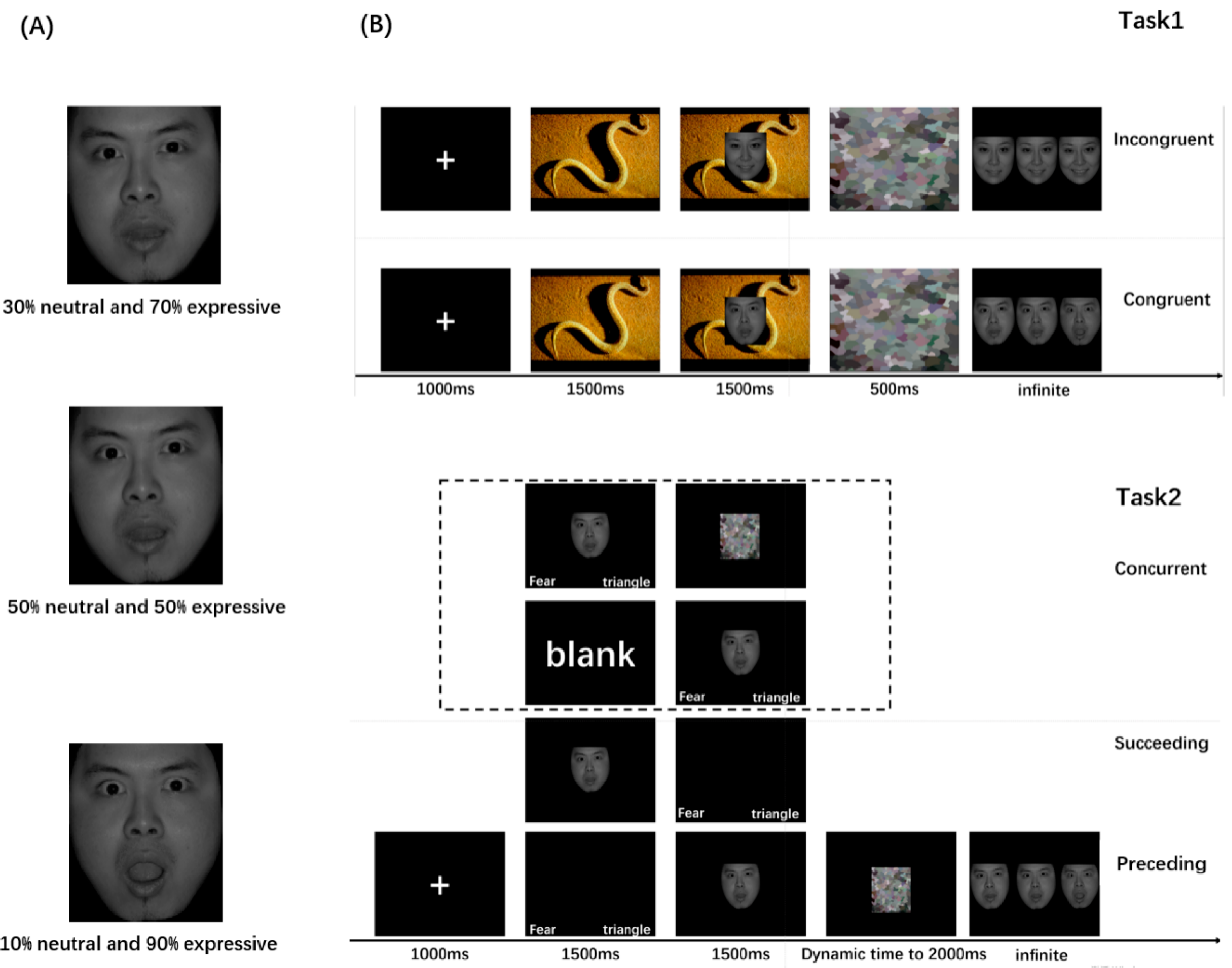
2.2.1. Task 1
2.2.2. Task 2
2.3. Electrophysiological Recording and Data Analysis
2.3.1. Electrophysiological Recording
2.3.2. Event-Related Potential
2.3.3. Statistical Analysis
3. Results
3.1. Task 1
3.1.1. Bias Score
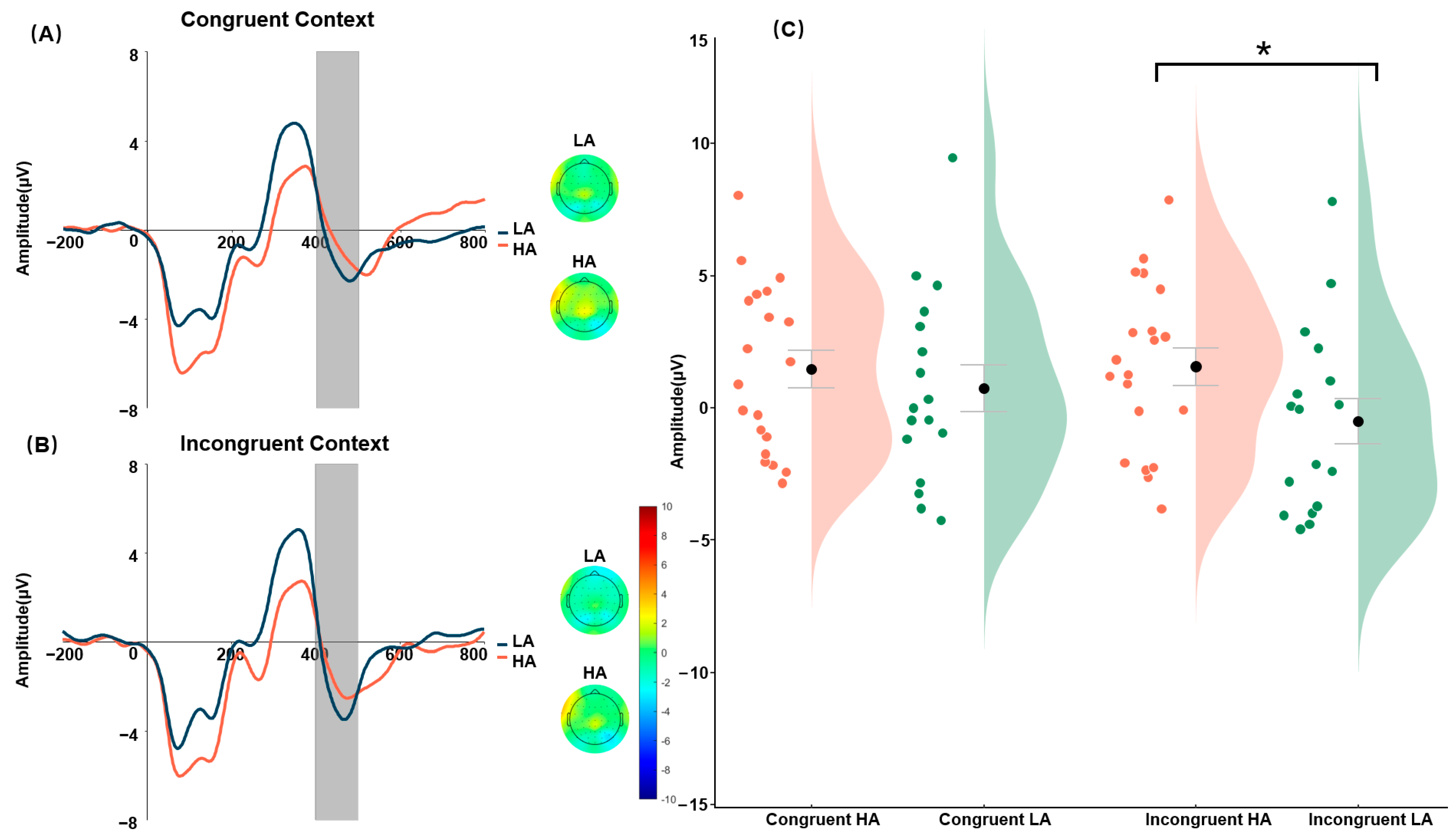
3.1.2. N400 Amplitude
3.2. Task 2
3.2.1. Bias Score
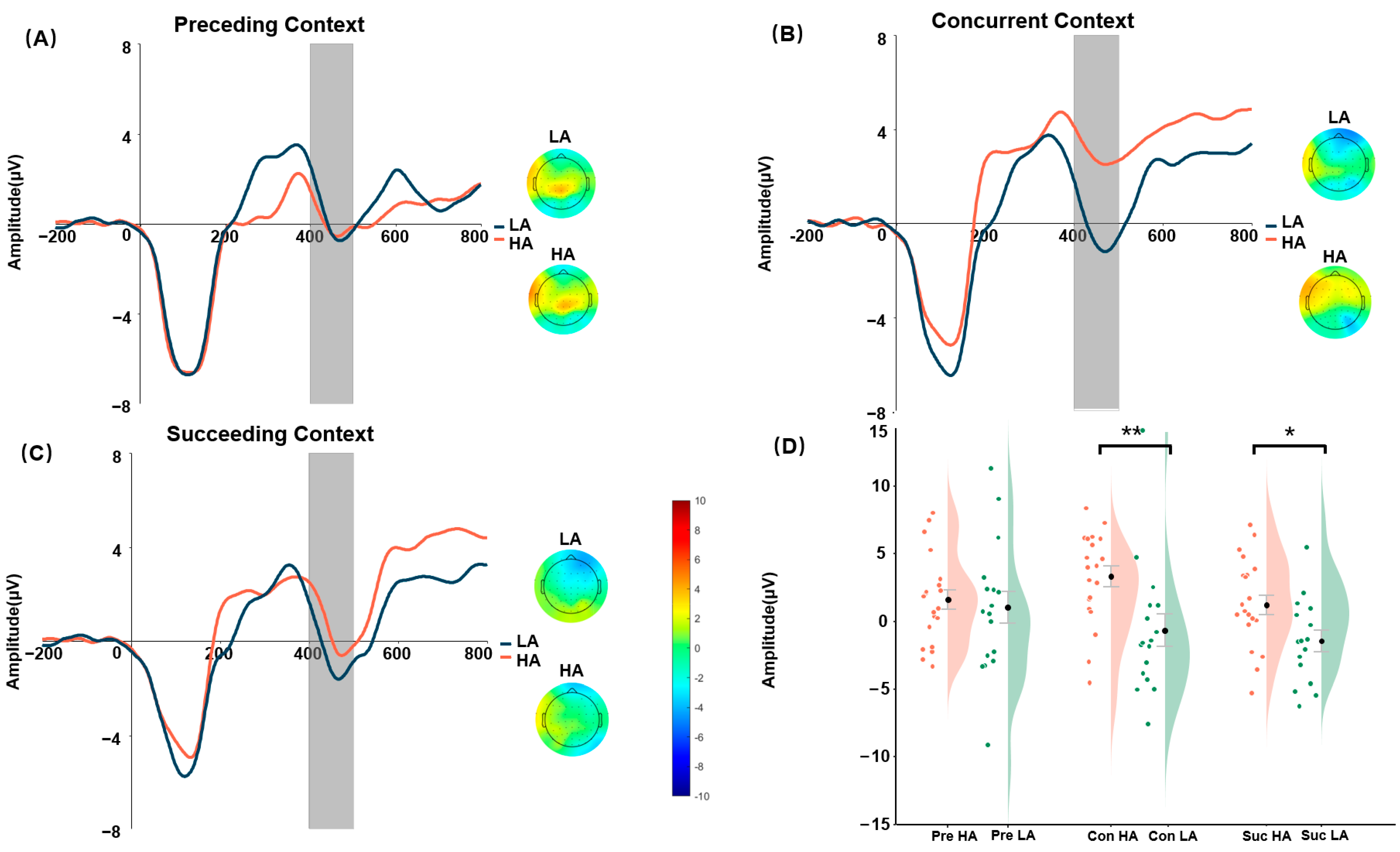
3.2.2. N400 Amplitude
4. Discussion
5. Limitation
6. Conclusions
Author Contributions
Funding
Institutional Review Board Statement
Informed Consent Statement
Data Availability Statement
Acknowledgments
Conflicts of Interest
Abbreviations
| ERP | Event-related potentials. |
| CES-D | Chinese version of the Center for Epidemiological Studies Depression Scale. |
| GAD-7 | Generalized Anxiety Disorder 7-Item Questionnaire. |
| HA | High alexithymia. |
| LA | Low alexithymia. |
| TAS-20 | 20-Item Toronto Alexithymia Scale. |
References
- Taylor, G.J. Alexithymia: Concept, measurement and implications for treatment. Am. J. Psychiatry 1984, 141, 725–732. [Google Scholar] [CrossRef] [PubMed]
- Berthoz, S.; Pouga, L.; Wessa, M. Alexithymia from the Social Neuroscience Perspective. In The Oxford Handbook of Social Neuroscience; Decety, J., Cacioppo, J.T., Eds.; Oxford University Press: Oxford, UK, 2011; pp. 907–934. [Google Scholar]
- Bordalo, F.; Carvalho, I.P. The role of alexithymia as a risk factor for self-harm among adolescents in depression—A systematic review. J. Affect. Disord. 2022, 297, 130–144. [Google Scholar] [CrossRef] [PubMed]
- van der Cruijsen, R.; Murphy, J.; Bird, G. Alexithymic traits can explain the association between puberty and symptoms of depression and anxiety in adolescent females. PLoS ONE 2019, 14, e0210519. [Google Scholar] [CrossRef]
- Chalah, M.A.; Ayache, S.S. Alexithymia in multiple sclerosis: A systematic review of literature. Neuropsychologia 2017, 104, 31–47. [Google Scholar] [CrossRef]
- Hui, C. The Relationship between Alexithymia and Emotional Symptoms: Mediating Effects of Boredom Proneness. Chin. J. Clin. Psychol. 2016, 24, 648–651. [Google Scholar] [CrossRef]
- Kealy, D.; Ogrodniczuk, J.S.; Rice, S.M.; Oliffe, J.L. Alexithymia, suicidal ideation and health-risk behaviours: A survey of Canadian men. Int. J. Psychiatry Clin. Pract. 2018, 22, 77–79. [Google Scholar] [CrossRef]
- Dorard, G.; Bungener, C.; Phan, O.; Edel, Y.; Corcos, M.; Berthoz, S. Is alexithymia related to cannabis use disorder? Results from a case-control study in outpatient adolescent cannabis abusers. J. Psychosom. Res. 2017, 95, 74–80. [Google Scholar] [CrossRef]
- Schimmenti, A.; Passanisi, A.; Caretti, V.; La Marca, L.; Granieri, A.; Iacolino, C.; Gervasi, A.M.; Maganuco, N.R.; Billieux, J. Traumatic experiences, alexithymia, and Internet addiction symptoms among late adolescents: A moderated mediation analysis. Addict. Behav. 2017, 64, 314–320. [Google Scholar] [CrossRef] [PubMed]
- Pepe, A.; Ornaghi, V.; Belacchi, C.; Farina, E. Alexithymia as a Risk Factor for Social Indifference: A Quantitative Study with a Large Sample of Female Adolescents. Sch. Ment. Health 2023, 15, 540–551. [Google Scholar] [CrossRef]
- Iannattone, S.; Miscioscia, M.; Raffagnato, A.; Gatta, M. The Role of Alexithymia in Social Withdrawal during Adolescence: A Case-Control Study. Children 2021, 8, 165. [Google Scholar] [CrossRef]
- Wingbermühle, E.; Theunissen, H.; Verhoeven, W.; Kessels, R.; Egger, J. The neurocognition of alexithymia: Evidence from neuropsychological and neuroimaging studies. Acta Neuropsychiatr. 2012, 24, 67–80. [Google Scholar] [CrossRef]
- Moriguchi, Y.; Komaki, G. Neuroimaging studies of alexithymia: Physical, affective, and social perspectives. Biopsychosoc. Med. 2013, 7, 8. [Google Scholar] [CrossRef]
- Motomura, Y.; Fukuzaki, A.; Eto, S.; Hirabayashi, N.; Gondo, M.; Izuno, S.; Togao, O.; Yamashita, K.; Kikuchi, K.; Sudo, N.; et al. Alexithymia characteristics are associated with salience network activity in healthy participants: An arterial spin labeling study. J. Physiol. Anthropol. 2023, 42, 18. [Google Scholar] [CrossRef] [PubMed]
- Velde, J.; Servaas, M.; Goerlich, K.; Bruggeman, R.; Horton, P.; Costafreda, S.; Aleman, A. Neural correlates of alexithymia: A meta-analysis of emotion processing studies. Neurosci. Biobehav. Rev. 2013, 37, 1774–1785. [Google Scholar] [CrossRef] [PubMed]
- Xu, P.; Opmeer, E.; Tol, M.; Goerlich, K.; Aleman, A. Structure of the alexithymic brain: A parametric coordinate-based meta-analysis. Neurosci. Biobehav. Rev. 2018, 87, 50–55. [Google Scholar] [CrossRef]
- Montolio, M.; Visser, M.; Zareba, M. Socio-emotional difficulties observed in alexithymia reflect altered interactions of the semantic and monoaminergic neuromodulatory brain networks. bioRxiv 2025. [Google Scholar] [CrossRef]
- Barrett, L.F. Are Emotions Natural Kinds? Perspect. Psychol. Sci. 2006, 1, 28–58. [Google Scholar] [CrossRef]
- Russell, J.A. Is there universal recognition of emotion from facial expression? A review of the cross-cultural studies. Psychol. Bull. 1994, 115, 102–112. [Google Scholar] [CrossRef] [PubMed]
- Barrett, L.F. Solving the emotion paradox: Categorization and the experience of emotion. Personal. Soc. Psychol. Rev. Off. J. Soc. Personal. Soc. Psychol. Inc 2006, 10, 20–46. [Google Scholar] [CrossRef]
- Barrett, L.F. Variety is the spice of life: A psychological construction approach to understanding variability in emotion. Cogn. Emot. 2009, 23, 1284–1306. [Google Scholar] [CrossRef]
- Barrett, L.F. The theory of constructed emotion: An active inference account of interoception and categorization. Soc. Cogn. Affect. Neurosci. 2017, 12, 1–23. [Google Scholar] [CrossRef]
- Wilson-Mendenhall, C.D.; Barrett, L.F.; Simmons, W.K.; Barsalou, L.W. Grounding emotion in situated conceptualization. Neuropsychologia 2011, 49, 1105–1127. [Google Scholar] [CrossRef] [PubMed]
- Russell, J.A. Core affect and the psychological construction of emotion. Psychol. Rev. 2003, 110, 145–172. [Google Scholar] [CrossRef]
- Hoemann, K.; Barrett, L.F. Concepts dissolve artificial boundaries in the study of emotion and cognition, uniting body, brain, and mind. Cogn. Emot. 2018, 33, 67–76. [Google Scholar] [CrossRef] [PubMed]
- Hoemann, K.; Xu, F.; Barrett, L. Emotion words, emotion concepts, and emotional development in children: A constructionist hypothesis. Dev. Psychol. 2019, 55, 1830–1849. [Google Scholar] [CrossRef]
- Keltner, D.; Brooks, J.; Cowen, A. Semantic Space Theory: Data-Driven Insights Into Basic Emotions. Curr. Dir. Psychol. Sci. 2023, 32, 242–249. [Google Scholar] [CrossRef]
- Saxe, R.; Houlihan, S.D. Formalizing emotion concepts within a Bayesian model of theory of mind. Curr. Opin. Psychol. 2017, 17, 15–21. [Google Scholar] [CrossRef]
- Hoemann, K.; Lee, Y.; Kuppens, P.; Gendron, M.; Boyd, R. Emotional Granularity is Associated with Daily Experiential Diversity. Affect. Sci. 2022, 4, 291–306. [Google Scholar] [CrossRef]
- Ozomaro, B.; Wein, P.; Miller, S.; Ospina, L.; Goodman, M.; Torous, J.; Kimhy, D. Emotional granularity in health and psychopathology: A scoping review. J. Psychiatr. Res. 2025, 190, 277–295. [Google Scholar] [CrossRef]
- Hobson, H.; Brewer, R.; Catmur, C.; Bird, G. The Role of Language in Alexithymia: Moving Towards a Multiroute Model of Alexithymia. Emot. Rev. 2019, 11, 247–261. [Google Scholar] [CrossRef]
- Lee, K.S.; Murphy, J.; Catmur, C.; Bird, G.; Hobson, H. Furthering the language hypothesis of alexithymia: An integrated review and meta-analysis. Neurosci. Biobehav. Rev. 2022, 141, 104864. [Google Scholar] [CrossRef]
- Lindquist, K.A.; Barrett, L.F.; Bliss-Moreau, E.; Russell, J.A. Language and the perception of emotion. Emotion 2006, 6, 125–138. [Google Scholar] [CrossRef] [PubMed]
- Souter, N.E.; Lindquist, K.A.; Jefferies, E. Impaired emotion perception and categorization in semantic aphasia. Neuropsychologia 2021, 162, 108052. [Google Scholar] [CrossRef] [PubMed]
- Fugate, J.M.B.; Gendron, M.; Nakashima, S.F.; Barrett, L.F. Emotion words: Adding face value. Emotion 2018, 18, 693–706. [Google Scholar] [CrossRef]
- Lindquist, K.A.; Gendron, M. What’s in a Word? Language Constructs Emotion Perception. Emot. Rev. 2013, 5, 66–71. [Google Scholar] [CrossRef]
- Gendron, M.; Lindquist, K.A.; Barsalou, L.; Barrett, L.F. Emotion words shape emotion percepts. Emotion 2012, 12, 314–325. [Google Scholar] [CrossRef] [PubMed]
- Tugade, M.M.; Fredrickson, B.L.; Barrett, L.F. Psychological resilience and positive emotional granularity: Examining the benefits of positive emotions on coping and health. J. Personal. 2004, 72, 1161–1190. [Google Scholar] [CrossRef]
- Tan, T.Y.; Wachsmuth, L.; Tugade, M. Emotional Nuance: Examining Positive Emotional Granularity and Well-Being. Front. Psychol. 2022, 13, 715966. [Google Scholar] [CrossRef]
- Laszlo, S.; Federmeier, K. The N400 as a snapshot of interactive processing: Evidence from regression analyses of orthographic neighbor and lexical associate effects. Psychophysiology 2011, 48, 176–186. [Google Scholar] [CrossRef]
- Hodapp, A.; Rabovsky, M. The N400 ERP component reflects an error-based implicit learning signal during language comprehension. Eur. J. Neurosci. 2021, 54, 7125–7140. [Google Scholar] [CrossRef]
- Yu, L.; Xu, Q.; Cao, F.; Liu, J.; Zheng, J.; Yang, Y.; Zhang, L. Emotional violation of faces, emojis, and words: Evidence from N400. Biol. Psychol. 2022, 173, 108405. [Google Scholar] [CrossRef] [PubMed]
- Tang, M.; Chen, B.; Zhao, X.; Zhao, L. Processing network emojis in Chinese sentence context: An ERP study. Neurosci. Lett. 2020, 722, 134815. [Google Scholar] [CrossRef]
- Stróżak, P.; Abedzadeh, D.; Curran, T. Separating the FN400 and N400 potentials across recognition memory experiments. Brain Res. 2016, 1635, 41–60. [Google Scholar] [CrossRef]
- Voss, J.; Federmeier, K. FN400 potentials are functionally identical to N400 potentials and reflect semantic processing during recognition testing. Psychophysiology 2011, 48, 532–546. [Google Scholar] [CrossRef]
- Wang, Z.; Chen, M.; Goerlich, K.; Aleman, A.; Xu, P.; Luo, Y. Deficient auditory emotion processing but intact emotional multisensory integration in alexithymia. Psychophysiology 2021, 58, e13806. [Google Scholar] [CrossRef] [PubMed]
- Jardin, E.; Allen, P.; Levant, R.; Lien, M.-C.; McCurdy, E.; Villalba, A.; Mallik, P.; Houston, J.; Gerdes, Z. Event-related brain potentials reveal differences in emotional processing in alexithymia. J. Cogn. Psychol. 2019, 31, 619–633. [Google Scholar] [CrossRef]
- Wang, Z.; Goerlich, K.; Xu, P.; Luo, Y.; Aleman, A. Perceptive and affective impairments in emotive eye-region processing in alexithymia. Soc. Cogn. Affect. Neurosci. 2022, 17, 912–922. [Google Scholar] [CrossRef] [PubMed]
- Walker, S.; O’Connor, D.; Schaefer, A. Brain potentials to emotional pictures are modulated by alexithymia during emotion regulation. Cogn. Affect. Behav. Neurosci. 2011, 11, 463–475. [Google Scholar] [CrossRef]
- Zhang, L.; Ye, R.; Yu, F.; Cao, Z.; Zhu, C.; Cai, Z.; Hu, P.; Pu, H.; Wang, K. How Does Emotional Context Modulate Response Inhibition in Alexithymia: Electrophysiological Evidence from an ERP Study. PLoS ONE 2012, 7, e51110. [Google Scholar] [CrossRef]
- Zhu, X.; Yi, J.; Yao, S.; Ryder, A.G.; Taylor, G.J.; Bagby, R.M. Cross-cultural validation of a Chinese translation of the 20-item Toronto Alexithymia Scale. Compr. Psychiatry 2007, 48, 489–496. [Google Scholar] [CrossRef]
- Bagby, R.M.; Parker, J.D.; Taylor, G.J. The twenty-item Toronto Alexithymia Scale--I. Item selection and cross-validation of the factor structure. J. Psychosom. Res. 1994, 38, 23–32. [Google Scholar] [CrossRef]
- Ling, Y.; Zeng, Y.; Yuan, H.; Zhong, M. Cross-cultural validation of the 20-item Toronto Alexithymia Scale in Chinese adolescents. J. Psychiatr. Ment. Health Nurs. 2016, 23, 179–187. [Google Scholar] [CrossRef] [PubMed]
- Pei, J.; Wang, X.; Ma, T.; Du, Y.; Dou, X. Alexithymia in a Chinese Patient with Chronic Pain and Associated Factors: A Cross-Sectional Study. Pain Manag. Nurs. Off. J. Am. Soc. Pain Manag. Nurses 2023, 24, 1–6. [Google Scholar] [CrossRef]
- Liu, Z.; He, S.; Hou, C. The effect of alexithymia on depression: Evidence from meta-analysis. Front. Psychol. 2025, 16, 1465286. [Google Scholar] [CrossRef]
- Leweke, F.; Leichsenring, F.; Kruse, J.; Hermes, S. Is Alexithymia Associated with Specific Mental Disorders. Psychopathology 2011, 45, 22–28. [Google Scholar] [CrossRef]
- Lenzo, V.; Barberis, N.; Cannavò, M.; Filastro, A.; Verrastro, V.; Quattropani, M. The relationship between alexithymia, defense mechanisms, eating disorders, anxiety and depression. Riv. Di Psichiatr. 2021, 55, 24–30. [Google Scholar] [CrossRef]
- Jiang, C.; Sun, J.; Lv, Y.; Hu, S.; Cheng, W.; Zhao, X.; Zheng, Y.; Wu, X.; Lv, L. The Chinese version of the 8-item Center for Epidemiologic Studies Depression Scale: Longitudinal psychometric syntheses with 10-year cohort multi-center evidence in an adult sample. Gen. Hosp. Psychiatry 2024, 91, 204–211. [Google Scholar] [CrossRef]
- Spitzer, R.L.; Kroenke, K.; Williams, J.B.; Löwe, B. A brief measure for assessing generalized anxiety disorder: The GAD-7. Arch. Intern. Med. 2006, 166, 1092–1097. [Google Scholar] [CrossRef]
- Goerlich, K. The Multifaceted Nature of Alexithymia—A Neuroscientific Perspective. Front. Psychol. 2018, 9, 1614. [Google Scholar] [CrossRef] [PubMed]
- Ni, Y.; Fang, S. Does the Chinese version of 20-item Toronto alexithymia scale (TAS-20-C) measure alexithymia in Chinese young adolescents? Evidence from confirmatory factor analysis, network analysis, and latent profile analysis. BMC Psychol. 2025, 13, 687. [Google Scholar] [CrossRef] [PubMed]
- Preece, D.; Becerra, R.; Robinson, K.; Dandy, J. Assessing Alexithymia: Psychometric Properties and Factorial Invariance of the 20-Item Toronto Alexithymia Scale in Nonclinical and Psychiatric Samples. J. Psychopathol. Behav. Assess. 2017, 40, 276–287. [Google Scholar] [CrossRef]
- Kooiman, C.; Spinhoven, P.; Spinhoven, P.; Trijsburg, R. The assessment of alexithymia: A critical review of the literature and a psychometric study of the Toronto Alexithymia Scale-20. J. Psychosom. Res. 2002, 53, 1083–1090. [Google Scholar] [CrossRef]
- Ścigała, D.; Zdankiewicz-Ścigała, E.; Bedyńska, S.; Kokoszka, A. Psychometric Properties and Configural Invariance of the Polish—Language Version of the 20-Item Toronto Alexithymia Scale in Non-clinical and Alcohol Addict Persons. Front. Psychol. 2020, 11, 1241. [Google Scholar] [CrossRef]
- Carnovale, M.; Taylor, G.; Parker, J.; Sanches, M.; Bagby, R. A bifactor analysis of the 20-item Toronto Alexithymia Scale: Further support for a general alexithymia factor. Psychol. Assess. 2021, 33, 619. [Google Scholar] [CrossRef]
- Bagby, R.; Parker, J.; Taylor, G. Twenty-five years with the 20-item Toronto Alexithymia Scale. J. Psychosom. Res. 2020, 131, 109940. [Google Scholar] [CrossRef]
- Wang, Y.; Luo, Y.J. Standardization and Assessment of College Students’ Facial Expression of Emotion. Chin. J. Clin. Psychol. 2005, 13, 396–398. [Google Scholar] [CrossRef]
- Gong, X.; Huang, Y.X.; Wang, Y.; Luo, Y.J. Revision of the Chinese Facial Affective Picture System. Chin. Ment. Health J. 2011, 25, 40–46. [Google Scholar]
- Hoemann, K.; Hartley, L.; Watanabe, A.; Solana Leon, E.; Katsumi, Y.; Barrett, L.F.; Quigley, K.S. The N400 indexes acquisition of novel emotion concepts via conceptual combination. Psychophysiology 2021, 58, e13727. [Google Scholar] [CrossRef]
- West, W.C.; Holcomb, P.J. Event-related potentials during discourse-level semantic integration of complex pictures. Brain Res. Cogn. Brain Res. 2002, 13, 363–375. [Google Scholar] [CrossRef]
- Yu, L.; Wang, W.; Li, Z.; Ren, Y.; Liu, J.; Jiao, L.; Xu, Q. Alexithymia modulates emotion concept activation during facial expression processing. Cereb. Cortex 2024, 34, bhae071. [Google Scholar] [CrossRef] [PubMed]
- Bates, D.; Machler, M.; Bolker, B.; Walker, S. Fitting Linear Mixed-Effects Models Using lme4. J. Stat. Softw. 2014, 67, 1–48. [Google Scholar] [CrossRef]
- Luke, S. Evaluating significance in linear mixed-effects models in R. Behav. Res. Methods 2016, 49, 1494–1502. [Google Scholar] [CrossRef]
- McNeish, D. Small Sample Methods for Multilevel Modeling: A Colloquial Elucidation of REML and the Kenward-Roger Correction. Multivar. Behav. Res. 2017, 52, 661–670. [Google Scholar] [CrossRef]
- Barr, D. Random effects structure for testing interactions in linear mixed-effects models. Front. Psychol. 2013, 4, 328. [Google Scholar] [CrossRef]
- Barrett, L.F.; Satpute, A.B. Historical pitfalls and new directions in the neuroscience of emotion. Neurosci. Lett. 2019, 693, 9–18. [Google Scholar] [CrossRef]
- Huang, S.; Pollak, S.D.; Xie, W. Conceptual knowledge increasingly supports emotion understanding as perceptual contribution declines with age. Nat. Commun. 2025, 16, 6838. [Google Scholar] [CrossRef] [PubMed]
- Aldunate, N.; López, V.; Bosman, C. Early Influence of Affective Context on Emotion Perception: EPN or Early-N400? Front. Neurosci. 2018, 12, 708. [Google Scholar] [CrossRef]
- Proverbio, A.; Camporeale, E.; Brusa, A. Multimodal Recognition of Emotions in Music and Facial Expressions. Front. Hum. Neurosci. 2020, 14, 32. [Google Scholar] [CrossRef]
- Bucci, W. Symptoms and symbols: A multiple code theory of Somatization. Psychoanal. Inq. 1997, 17, 151–172. [Google Scholar] [CrossRef]
- Lindquist, K.A. The role of language in emotion: Existing evidence and future directions. Curr. Opin. Psychol. 2017, 17, 135–139. [Google Scholar] [CrossRef]
- Touroutoglou, A.; Lindquist, K.A.; Dickerson, B.C.; Barrett, L.F. Intrinsic connectivity in the human brain does not reveal networks for ‘basic’ emotions. Soc. Cogn. Affect. Neurosci. 2015, 10, 1257–1265. [Google Scholar] [CrossRef] [PubMed]
- Barrett, L.F.; Satpute, A.B. Large-scale brain networks in affective and social neuroscience: Towards an integrative functional architecture of the brain. Curr. Opin. Neurobiol. 2013, 23, 361–372. [Google Scholar] [CrossRef]
- Kleckner, I.R.; Zhang, J.; Touroutoglou, A.; Chanes, L.; Xia, C.; Simmons, W.K.; Quigley, K.S.; Dickerson, B.C.; Barrett, L.F. Evidence for a Large-Scale Brain System Supporting Allostasis and Interoception in Humans. Nat. Hum. Behav. 2017, 1, 0069. [Google Scholar] [CrossRef]
- Nummenmaa, L.; Saarimaki, H.; Glerean, E.; Gotsopoulos, A.; Jaaskelainen, I.P.; Hari, R.; Sams, M. Emotional speech synchronizes brains across listeners and engages large-scale dynamic brain networks. NeuroImage 2014, 102, 498–509. [Google Scholar] [CrossRef]
- Touroutoglou, A.; Hollenbeck, M.; Dickerson, B.C.; Feldman Barrett, L. Dissociable large-scale networks anchored in the right anterior insula subserve affective experience and attention. NeuroImage 2012, 60, 1947–1958. [Google Scholar] [CrossRef]
- Wilson-Mendenhall, C.D.; Barrett, L.F.; Barsalou, L.W. Variety in emotional life: Within-category typicality of emotional experiences is associated with neural activity in large-scale brain networks. Soc. Cogn. Affect. Neurosci. 2015, 10, 62–71. [Google Scholar] [CrossRef]
- Oosterwijk, S.; Lindquist, K.A.; Anderson, E.; Dautoff, R.; Moriguchi, Y.; Barrett, L.F. States of mind: Emotions, body feelings, and thoughts share distributed neural networks. NeuroImage 2012, 62, 2110–2128. [Google Scholar] [CrossRef]
- Bechara, A. The role of emotion in decision-making: Evidence from neurological patients with orbitofrontal damage. Brain Cogn. 2004, 55, 30–40. [Google Scholar] [CrossRef]
- Gündel, H.; López-Sala, A.; Ceballos-Baumann, A.O.; Deus, J.; Cardoner, N.; Marten-Mittag, B.; Soriano-Mas, C.; Pujol, J. Alexithymia correlates with the size of the right anterior cingulate. Psychosom. Med. 2004, 66, 132–140. [Google Scholar] [CrossRef] [PubMed]
- Kano, M.; Fukudo, S. The alexithymic brain: The neural pathways linking alexithymia to physical disorders. Biopsychosoc. Med. 2013, 7, 1. [Google Scholar] [CrossRef] [PubMed]
- Goerlich-Dobre, K.S.; Votinov, M.; Habel, U.; Pripfl, J.; Lamm, C. Neuroanatomical profiles of alexithymia dimensions and subtypes. Hum. Brain Mapp. 2015, 36, 3805–3818. [Google Scholar] [CrossRef]
- Grabe, H.; Wittfeld, K.; Hegenscheid, K.; Hosten, N.; Lotze, M.; Janowitz, D.; Völzke, H.; John, U.; Barnow, S.; Freyberger, H. Alexithymia and brain gray matter volumes in a general population sample. Hum. Brain Mapp. 2014, 35, 5932–5945. [Google Scholar] [CrossRef] [PubMed]
- Benbrika, S.; Doidy, F.; Carluer, L.; Mondou, A.; Buhour, M.-S.; Eustache, F.; Viader, F.; Desgranges, B. Alexithymia in Amyotrophic Lateral Sclerosis and Its Neural Correlates. Front. Neurol. 2018, 9, 566. [Google Scholar] [CrossRef] [PubMed]
- Demers, L.; Schreiner, M.W.; Hunt, R.; Mueller, B.; Klimes-Dougan, B.; Thomas, K.; Cullen, K. Alexithymia is associated with neural reactivity to masked emotional faces in adolescents who self-harm. J. Affect. Disord. 2019, 249, 253–261. [Google Scholar] [CrossRef] [PubMed]
- Chmiel, J.; Wiażewicz-Wójtowicz, P.; Stępień-Słodkowska, M. Neural Correlates of Alexithymia Based on Electroencephalogram (EEG)—A Mechanistic Review. J. Clin. Med. 2025, 14, 1895. [Google Scholar] [CrossRef]



| Variables | HA | LA | t | p | Cronbach’s α |
|---|---|---|---|---|---|
| Age | 18.57 (0.75) | 18.31 (0.60) | 0.02 | 0.984 | - |
| CES-D | 5.52 (3.39) | 4.93 (3.25) | 0.53 | 0.599 | 0.85 |
| GAD-7 | 7.76 (1.22) | 7.38 (0.81) | 1.16 | 0.254 | 0.83 |
| TAS-20 | 67.60 (5.68) | 42.81 (10.29) | 8.85 | <0.001 | 0.89 |
| Task 1 Bias Score Mean (SE) | ||||
| Context | Group Mean | |||
| Congruent | Incongruent | |||
| HA | 0.095 (0.019) | −0.001 (0.028) | 0.047 (0.022) | |
| LA | 0.065 (0.017) | −0.001 (0.023) | 0.032 (0.019) | |
| Context Mean | 0.080 (0.020) | −0.001 (0.025) | ||
| Task 2 Bias Score Mean (SE) | ||||
| Context | Group Mean | |||
| Preceding | Concurrent | Succeeding | ||
| HA | 0.020 (0.026) | −0.013 (0.022) | −0.112 (0.025) | −0.035 (0.020) |
| LA | 0.036 (0.020) | −0.027 (0.029) | −0.051 (0.035) | −0.014 (0.026) |
| Context Mean | 0.028 (0.023) | −0.020 (0.024) | −0.082 (0.029) | |
| Task 1 N400 Amplitude Mean (SE) | ||||
| Context | ||||
| Congruent | Incongruent | |||
| HA | 1.62 (0.91) | 1.62 (0.59) | ||
| LA | 0.95 (1.08) | −0.61 (1.04) | ||
| Task 2 N400 Amplitude Mean (SE) | ||||
| Context | ||||
| Preceding | Concurrent | Succeeding | ||
| HA | 2.70 (0.97) | 3.21 (0.89) | 1.02 (0.84) | |
| LA | 1.82 (1.19) | −1.43 (1.04) | −1.73 (0.80) | |
Disclaimer/Publisher’s Note: The statements, opinions and data contained in all publications are solely those of the individual author(s) and contributor(s) and not of MDPI and/or the editor(s). MDPI and/or the editor(s) disclaim responsibility for any injury to people or property resulting from any ideas, methods, instructions or products referred to in the content. |
© 2026 by the authors. Licensee MDPI, Basel, Switzerland. This article is an open access article distributed under the terms and conditions of the Creative Commons Attribution (CC BY) license.
Share and Cite
Jia, J.; Zhang, M.; He, X.; Chen, Z.; Wang, X. Behavioral and Event-Related Potential Study of Emotion Concept Activation in Young Adults with High Versus Low Alexithymia Traits. Brain Sci. 2026, 16, 264. https://doi.org/10.3390/brainsci16030264
Jia J, Zhang M, He X, Chen Z, Wang X. Behavioral and Event-Related Potential Study of Emotion Concept Activation in Young Adults with High Versus Low Alexithymia Traits. Brain Sciences. 2026; 16(3):264. https://doi.org/10.3390/brainsci16030264
Chicago/Turabian StyleJia, Jiafeng, Minggang Zhang, Xiaoying He, Zeming Chen, and Xiaochun Wang. 2026. "Behavioral and Event-Related Potential Study of Emotion Concept Activation in Young Adults with High Versus Low Alexithymia Traits" Brain Sciences 16, no. 3: 264. https://doi.org/10.3390/brainsci16030264
APA StyleJia, J., Zhang, M., He, X., Chen, Z., & Wang, X. (2026). Behavioral and Event-Related Potential Study of Emotion Concept Activation in Young Adults with High Versus Low Alexithymia Traits. Brain Sciences, 16(3), 264. https://doi.org/10.3390/brainsci16030264