Exploring the Role of TSPO-PET Imaging Among MRI-Negative Patients with Temporal Lobe Epilepsy: From the Perspective of Heterogeneity
 , , ,
, , ,
Highlights
- TSPO-PET/MRI with [18F] DPA-714 revealed marked inter-individual heterogeneity in neuroinflammatory distribution among temporal lobe epilepsy patients.
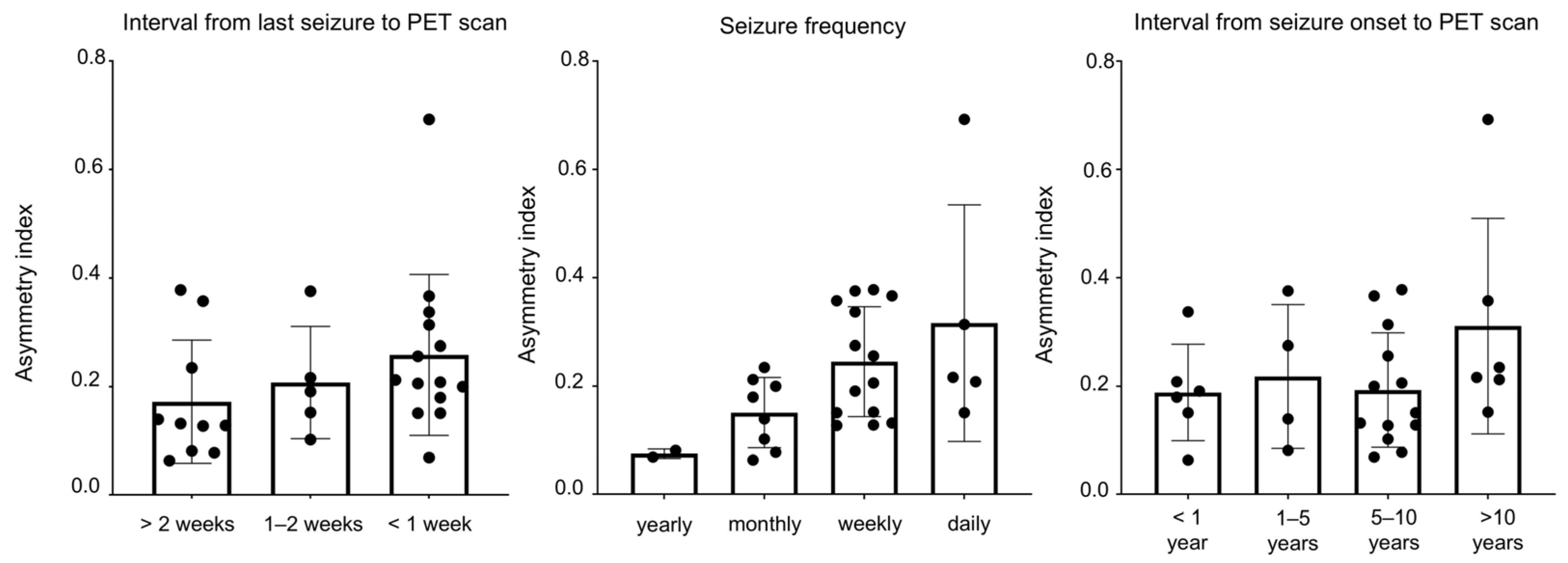
- Elevated TSPO uptake and asymmetry index were significantly associated with seizure frequency and the interval between the last seizure and PET imaging.
- TSPO-PET may serve as a sensitive tool for localizing epileptogenic foci, particularly in MRI-negative temporal lobe epilepsy.
- Clinical seizure-related factors like scanning timing should be considered when interpreting TSPO-PET signals, as they may contribute to variability in neuroinflammatory imaging patterns.
Abstract
1. Introduction
2. Materials and Methods
2.1. Participants and Inclusion Criteria
2.2. TSPO PET/MRI Protocol
2.3. Visual Reading and Quantitative Analysis of TSPO Imaging
2.4. DNA Extraction and Single Nucleotide Polymorphism Genotyping
2.5. Stereo-EEG Electrode Implantation and Recording
2.6. Immunohistochemistry
2.7. Statistical Analysis
3. Results
3.1. Clinical, MRI and VEEG Characteristics of Study Population
3.2. Visual and Quantitative Assessment of [18F] DPA-714 Imaging
3.3. Quantitative Analysis of Asymmetric [18F] DPA-714 Uptake
3.4. Clinical Factors Related to Heterogeneity
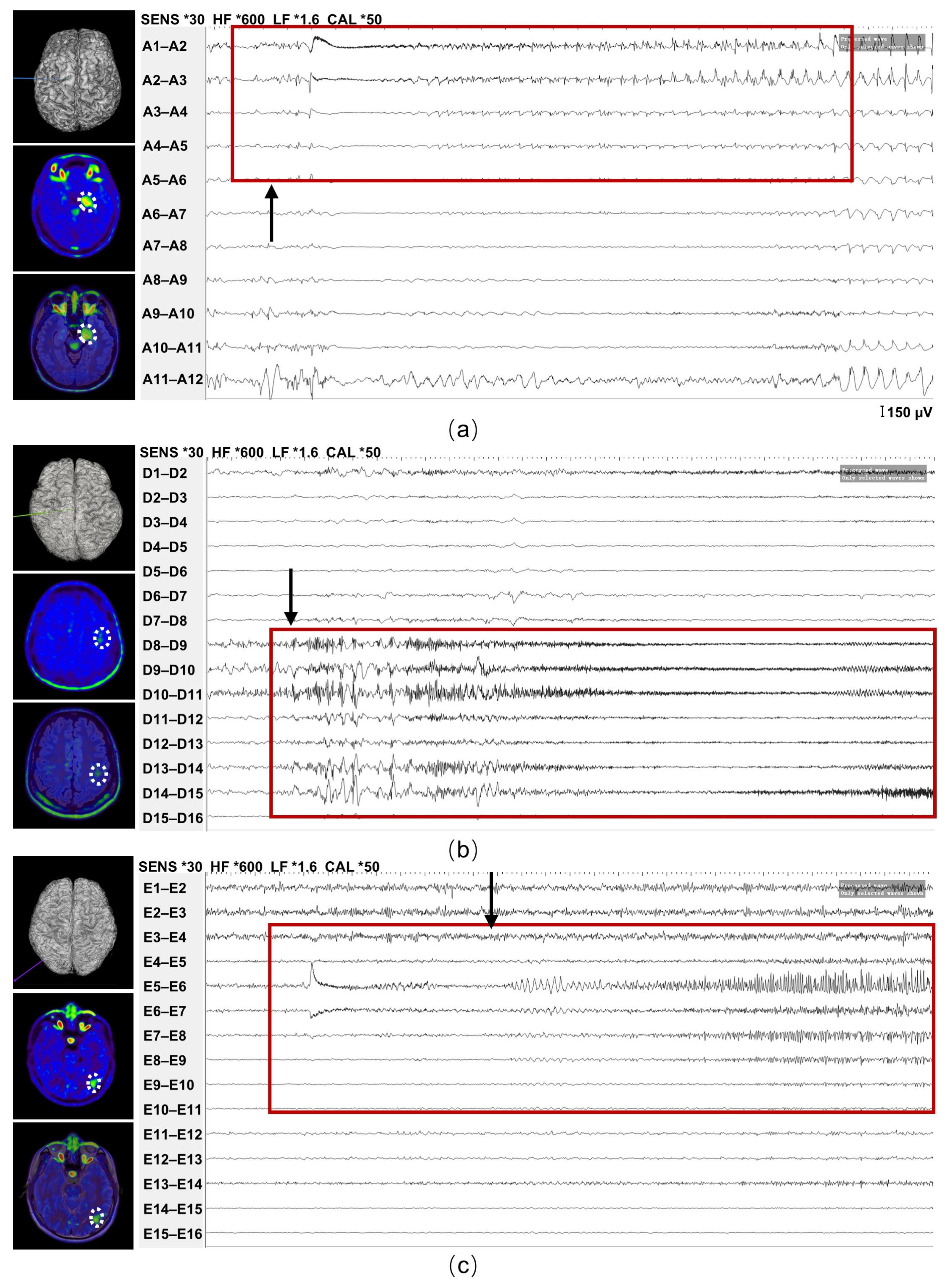
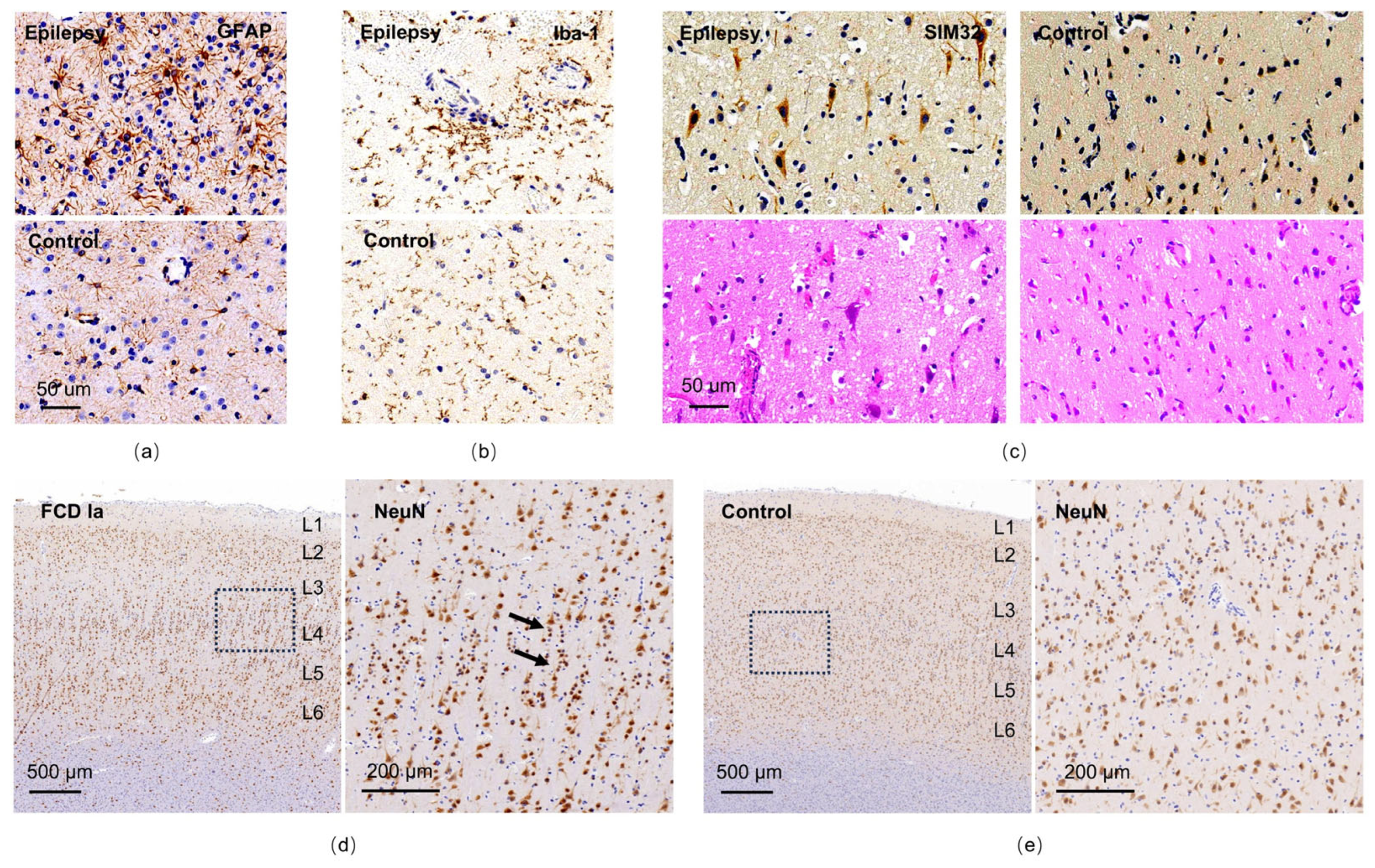
3.5. Heterogeneity Revealed by Electrophysiological and Histopathological Examinations
4. Discussion
5. Conclusions
Supplementary Materials
Author Contributions
Funding
Institutional Review Board Statement
Informed Consent Statement
Data Availability Statement
Acknowledgments
Conflicts of Interest
Abbreviations
| EEG | Electroencephalography |
| FDG-PET | Fluorodeoxyglucose positron emission tomography |
| FCD | Focal cortical dysplasia |
| GFAP | Glial fibrillary acidic protein |
| HABs | High-affinity binders |
| IBA-1 | Ionized calcium-binding adaptor molecule 1 |
| IQR | Interquartile range |
| LABs | Low-affinity binders |
| MABs | Medium-affinity binders |
| MRI | Magnetic resonance imaging |
| NeuN | Neuron-specific nuclear binding protein |
| OR | Odds ratio |
| PET/MRI | Positron emission tomography/Magnetic resonance imaging |
| SEEG | Stereoelectroencephalography |
| SMI-32 | Non-phosphorylated neurofilament-H |
| SNP | Single nucleotide polymorphism |
| SUV | Standardized uptake value |
| TLE | Temporal lobe epilepsy |
| TSPO | Translocator protein (18 kDa) |
| VEEG | Video-electroencephalography |
References
- Thijs, R.D.; Surges, R.; O’Brien, T.J.; Sander, J.W. Epilepsy in adults. Lancet 2019, 393, 689–701. [Google Scholar] [CrossRef] [Scilit]
- GBD 2016 Epilepsy Collaborators. Global, regional, and national burden of epilepsy, 1990-2016: A systematic analysis for the Global Burden of Disease Study 2016. Lancet Neurol. 2019, 18, 357–375. [Google Scholar] [CrossRef] [Scilit]
- Kwan, P.; Schachter, S.C.; Brodie, M.J. Drug-resistant epilepsy. N. Engl. J. Med. 2011, 365, 919–926. [Google Scholar] [CrossRef] [Scilit] [PubMed]
- Kalilani, L.; Sun, X.; Pelgrims, B.; Noack-Rink, M.; Villanueva, V. The epidemiology of drug-resistant epilepsy: A systematic review and meta-analysis. Epilepsia 2018, 59, 2179–2193. [Google Scholar] [CrossRef] [Scilit]
- Téllez-Zenteno, J.F.; Hernández-Ronquillo, L. A review of the epidemiology of temporal lobe epilepsy. Epilepsy Res. Treat. 2012, 2012, 630853. [Google Scholar] [CrossRef] [Scilit] [PubMed]
- Wiebe, S.; Blume, W.T.; Girvin, J.P.; Eliasziw, M. A randomized, controlled trial of surgery for temporal-lobe epilepsy. N. Engl. J. Med. 2001, 345, 311–318. [Google Scholar] [CrossRef] [Scilit]
- Vakharia, V.N.; Duncan, J.S.; Witt, J.A.; Elger, C.E.; Staba, R.; Engel, J., Jr. Getting the best outcomes from epilepsy surgery. Ann. Neurol. 2018, 83, 676–690. [Google Scholar] [CrossRef] [Scilit]
- Kumar, A.; Chugani, H.T. The Role of Radionuclide Imaging in Epilepsy, Part 1: Sporadic Temporal and Extratemporal Lobe Epilepsy. J. Nucl. Med. 2013, 54, 1775–1781. [Google Scholar] [CrossRef] [Scilit]
- Sarikaya, I. PET studies in epilepsy. Am. J. Nucl. Med. Mol. Imaging 2015, 5, 416–430. [Google Scholar] [PubMed]
- de Laat, N.N.; Tolboom, N.; Leijten, F.S.S. Optimal timing of interictal FDG-PET for epilepsy surgery: A systematic review on time since last seizure. Epilepsia Open 2022, 7, 512–517. [Google Scholar] [CrossRef] [Scilit]
- Desai, A.; Bekelis, K.; Thadani, V.M.; Roberts, D.W.; Jobst, B.C.; Duhaime, A.C.; Gilbert, K.; Darcey, T.M.; Studholme, C.; Siegel, A. Interictal PET and ictal subtraction SPECT: Sensitivity in the detection of seizure foci in patients with medically intractable epilepsy. Epilepsia 2013, 54, 341–350. [Google Scholar] [CrossRef] [Scilit] [PubMed]
- Vezzani, A.; Balosso, S.; Ravizza, T. Neuroinflammatory pathways as treatment targets and biomarkers in epilepsy. Nat. Rev. Neurol. 2019, 15, 459–472. [Google Scholar] [CrossRef] [Scilit]
- Ravizza, T.; Noé, F.; Zardoni, D.; Vaghi, V.; Sifringer, M.; Vezzani, A. Interleukin Converting Enzyme inhibition impairs kindling epileptogenesis in rats by blocking astrocytic IL-1beta production. Neurobiol. Dis. 2008, 31, 327–333. [Google Scholar] [CrossRef] [Scilit]
- Sano, F.; Shigetomi, E.; Shinozaki, Y.; Tsuzukiyama, H.; Saito, K.; Mikoshiba, K.; Horiuchi, H.; Cheung, D.L.; Nabekura, J.; Sugita, K.; et al. Reactive astrocyte-driven epileptogenesis is induced by microglia initially activated following status epilepticus. JCI Insight 2021, 6, e135391. [Google Scholar] [CrossRef] [Scilit]
- Chen, M.K.; Guilarte, T.R. Translocator protein 18 kDa (TSPO): Molecular sensor of brain injury and repair. Pharmacol. Ther. 2008, 118, 1–17. [Google Scholar] [CrossRef] [Scilit]
- Bertoglio, D.; Amhaoul, H.; Goossens, J.; Ali, I.; Jonckers, E.; Bijnens, T.; Siano, M.; Wyffels, L.; Verhaeghe, J.; Van der Linden, A.; et al. TSPO PET upregulation predicts epileptic phenotype at disease onset independently from chronic TSPO expression in a rat model of temporal lobe epilepsy. NeuroImage Clin. 2021, 31, 102701. [Google Scholar] [CrossRef] [Scilit]
- Hirvonen, J.; Kreisl, W.C.; Fujita, M.; Dustin, I.; Khan, O.; Appel, S.; Zhang, Y.; Morse, C.; Pike, V.W.; Innis, R.B.; et al. Increased in vivo expression of an inflammatory marker in temporal lobe epilepsy. J. Nucl. Med. 2012, 53, 234–240. [Google Scholar] [CrossRef] [Scilit] [PubMed]
- Gershen, L.D.; Zanotti-Fregonara, P.; Dustin, I.H.; Liow, J.S.; Hirvonen, J.; Kreisl, W.C.; Jenko, K.J.; Inati, S.K.; Fujita, M.; Morse, C.L.; et al. Neuroinflammation in Temporal Lobe Epilepsy Measured Using Positron Emission Tomographic Imaging of Translocator Protein. JAMA Neurol. 2015, 72, 882–888. [Google Scholar] [CrossRef] [Scilit] [PubMed]
- Dickstein, L.P.; Liow, J.S.; Austermuehle, A.; Zoghbi, S.; Inati, S.K.; Zaghloul, K.; Zanotti-Fregonara, P.; Theodore, W.H. Neuroinflammation in neocortical epilepsy measured by PET imaging of translocator protein. Epilepsia 2019, 60, 1248–1254. [Google Scholar] [CrossRef] [Scilit]
- Kagitani-Shimono, K.; Kato, H.; Kuwayama, R.; Tominaga, K.; Nabatame, S.; Kishima, H.; Hatazawa, J.; Taniike, M. Clinical evaluation of neuroinflammation in child-onset focal epilepsy: A translocator protein PET study. J. Neuroinflammation 2021, 18, 8. [Google Scholar] [CrossRef] [Scilit]
- Mahmud, M.; Wade, C.; Jawad, S.; Hadi, Z.; Otoul, C.; Kaminski, R.M.; Muglia, P.; Kadiu, I.; Rabiner, E.; Maguire, P.; et al. Translocator protein PET imaging in temporal lobe epilepsy: A reliable test-retest study using asymmetry index. Front. Neuroimaging 2023, 2, 1142463. [Google Scholar] [CrossRef] [Scilit]
- Scheffer, I.E.; Berkovic, S.; Capovilla, G.; Connolly, M.B.; French, J.; Guilhoto, L.; Hirsch, E.; Jain, S.; Mathern, G.W.; Moshé, S.L.; et al. ILAE classification of the epilepsies: Position paper of the ILAE Commission for Classification and Terminology. Epilepsia 2017, 58, 512–521. [Google Scholar] [CrossRef] [Scilit]
- Blair, R.D. Temporal lobe epilepsy semiology. Epilepsy Res. Treat. 2012, 2012, 751510. [Google Scholar] [CrossRef] [Scilit]
- Zhang, M.; Qian, X.H.; Hu, J.; Zhang, Y.; Lin, X.; Hai, W.; Shi, K.; Jiang, X.; Li, Y.; Tang, H.-D.; et al. Integrating TSPO PET imaging and transcriptomics to unveil the role of neuroinflammation and amyloid-β deposition in Alzheimer’s disease. Eur. J. Nucl. Med. Mol. Imaging 2024, 51, 455–467. [Google Scholar] [CrossRef] [Scilit] [PubMed]
- Wang, J.; Ge, J.; Jin, L.; Deng, B.; Tang, W.; Yu, H.; Zhang, X.; Liu, X.; Xue, L.; Zuo, C.; et al. Characterization of neuroinflammation pattern in anti-LGI1 encephalitis based on TSPO PET and symptom clustering analysis. Eur. J. Nucl. Med. Mol. Imaging 2023, 50, 2394–2408. [Google Scholar] [CrossRef] [Scilit]
- Matsubara, K.; Ibaraki, M.; Shidahara, M.; Kinoshita, T. Alzheimer’s Disease Neuroimaging I. Iterative framework for image registration and partial volume correction in brain positron emission tomography. Radiol. Phys. Technol. 2020, 13, 348–357. [Google Scholar] [CrossRef] [Scilit]
- Owen, D.R.; Yeo, A.J.; Gunn, R.N.; Song, K.; Wadsworth, G.; Lewis, A.; Rhodes, C.; Pulford, D.J.; Bennacef, I.; Parker, C.A.; et al. An 18-kDa translocator protein (TSPO) polymorphism explains differences in binding affinity of the PET radioligand PBR28. J. Cereb. Blood Flow. Metab. 2012, 32, 1–5. [Google Scholar] [CrossRef] [Scilit]
- Catani, M.; Jones, D.K.; Donato, R.; Ffytche, D.H. Occipito-temporal connections in the human brain. Brain 2003, 126, 2093–2107. [Google Scholar] [CrossRef] [Scilit]
- Blümcke, I.; Thom, M.; Aronica, E.; Armstrong, D.D.; Vinters, H.V.; Palmini, A.; Jacques, T.S.; Avanzini, G.; Barkovich, A.J.; Battaglia, G.; et al. The clinicopathologic spectrum of focal cortical dysplasias: A consensus classification proposed by an ad hoc Task Force of the ILAE Diagnostic Methods Commission. Epilepsia 2011, 52, 158–174. [Google Scholar] [CrossRef] [Scilit] [PubMed]
- Sheng, J.; Liu, S.; Qin, H.; Li, B.; Zhang, X. Drug-Resistant Epilepsy and Surgery. Curr. Neuropharmacol. 2018, 16, 17–28. [Google Scholar] [CrossRef] [Scilit] [PubMed]
- Wang, Z.I.; Alexopoulos, A.V.; Jones, S.E.; Jaisani, Z.; Najm, I.M.; Prayson, R.A. The pathology of magnetic-resonance-imaging-negative epilepsy. Mod. Pathol. 2013, 26, 1051–1058. [Google Scholar] [CrossRef] [Scilit] [PubMed]
- Jeha, L.E.; Najm, I.; Bingaman, W.; Dinner, D.; Widdess-Walsh, P.; Lüders, H. Surgical outcome and prognostic factors of frontal lobe epilepsy surgery. Brain 2007, 130, 574–584. [Google Scholar] [CrossRef] [Scilit]
- Urbach, H.; Scheiwe, C.; Shah, M.J.; Nakagawa, J.M.; Heers, M.; San Antonio-Arce, M.V.; Altenmueller, D.-M.; Schulze-Bonhage, A.; Huppertz, H.-J. Diagnostic Accuracy of Epilepsy-dedicated MRI with Post-processing. Clin. Neuroradiol. 2023, 33, 709–719. [Google Scholar] [CrossRef] [Scilit]
- Brackhan, M.; Bascuñana, P.; Ross, T.L.; Bengel, F.M.; Bankstahl, J.P.; Bankstahl, M. [18F]GE180 positron emission tomographic imaging indicates a potential double-hit insult in the intrahippocampal kainate mouse model of temporal lobe epilepsy. Epilepsia 2018, 59, 617–626. [Google Scholar] [CrossRef] [Scilit]
- Brackhan, M.; Bascuñana, P.; Postema, J.M.; Ross, T.L.; Bengel, F.M.; Bankstahl, M.; Bankstahl, J.P. Serial Quantitative TSPO-Targeted PET Reveals Peak Microglial Activation up to 2 Weeks After an Epileptogenic Brain Insult. J. Nucl. Med. 2016, 57, 1302–1308. [Google Scholar] [CrossRef] [Scilit] [PubMed]
- Leng, F.; Edison, P. Neuroinflammation and microglial activation in Alzheimer disease: Where do we go from here? Nat. Rev. Neurol. 2021, 17, 157–172. [Google Scholar] [CrossRef] [Scilit]
- Vezzani, A.; French, J.; Bartfai, T.; Baram, T.Z. The role of inflammation in epilepsy. Nat. Rev. Neurol. 2011, 7, 31–40. [Google Scholar] [CrossRef] [Scilit]
- Wang, Y.; Chen, Y.; Xu, S.; Wu, X. Refining seizure foci localization: The potential of TSPO-PET. Acta Epileptol. 2025, 7, 41. [Google Scholar] [CrossRef] [Scilit] [PubMed]
- D’Egidio, F.; Castelli, V.; d’Angelo, M.; Ammannito, F.; Quintiliani, M.; Cimini, A. Brain incoming call from glia during neuroinflammation: Roles of extracellular vesicles. Neurobiol. Dis. 2024, 201, 106663. [Google Scholar] [CrossRef] [Scilit]



| Factor | TSPO-PET/MRI Outcome | |
|---|---|---|
| OR (95% CI) | p Value | |
| Interval from last seizure to PET scan | 6.712 (1.163–38.726) | 0.033 |
| Seizure frequency | 7.994 (1.05–60.842) | 0.045 |
| Interval from seizure onset to PET scan | 2.808 (0.688–11.463) | 0.15 |
Disclaimer/Publisher’s Note: The statements, opinions and data contained in all publications are solely those of the individual author(s) and contributor(s) and not of MDPI and/or the editor(s). MDPI and/or the editor(s) disclaim responsibility for any injury to people or property resulting from any ideas, methods, instructions or products referred to in the content. |
© 2026 by the authors. Licensee MDPI, Basel, Switzerland. This article is an open access article distributed under the terms and conditions of the Creative Commons Attribution (CC BY) license.
Share and Cite
Chen, Y.; Wang, J.; Xu, S.; Wang, Q.; Mei, S.; Lu, J.; Wang, Y.; Lin, H.; Wu, D.; Chen, L.; et al. Exploring the Role of TSPO-PET Imaging Among MRI-Negative Patients with Temporal Lobe Epilepsy: From the Perspective of Heterogeneity. Brain Sci. 2026, 16, 246. https://doi.org/10.3390/brainsci16020246
Chen Y, Wang J, Xu S, Wang Q, Mei S, Lu J, Wang Y, Lin H, Wu D, Chen L, et al. Exploring the Role of TSPO-PET Imaging Among MRI-Negative Patients with Temporal Lobe Epilepsy: From the Perspective of Heterogeneity. Brain Sciences. 2026; 16(2):246. https://doi.org/10.3390/brainsci16020246
Chicago/Turabian StyleChen, Yuncan, Jing Wang, Shimin Xu, Qinyue Wang, Shuhao Mei, Jiaying Lu, Yiqiao Wang, Huamei Lin, Dongyan Wu, Liang Chen, and et al. 2026. "Exploring the Role of TSPO-PET Imaging Among MRI-Negative Patients with Temporal Lobe Epilepsy: From the Perspective of Heterogeneity" Brain Sciences 16, no. 2: 246. https://doi.org/10.3390/brainsci16020246
APA StyleChen, Y., Wang, J., Xu, S., Wang, Q., Mei, S., Lu, J., Wang, Y., Lin, H., Wu, D., Chen, L., Zuo, C., Guan, Y., Ge, J., & Wu, X. (2026). Exploring the Role of TSPO-PET Imaging Among MRI-Negative Patients with Temporal Lobe Epilepsy: From the Perspective of Heterogeneity. Brain Sciences, 16(2), 246. https://doi.org/10.3390/brainsci16020246