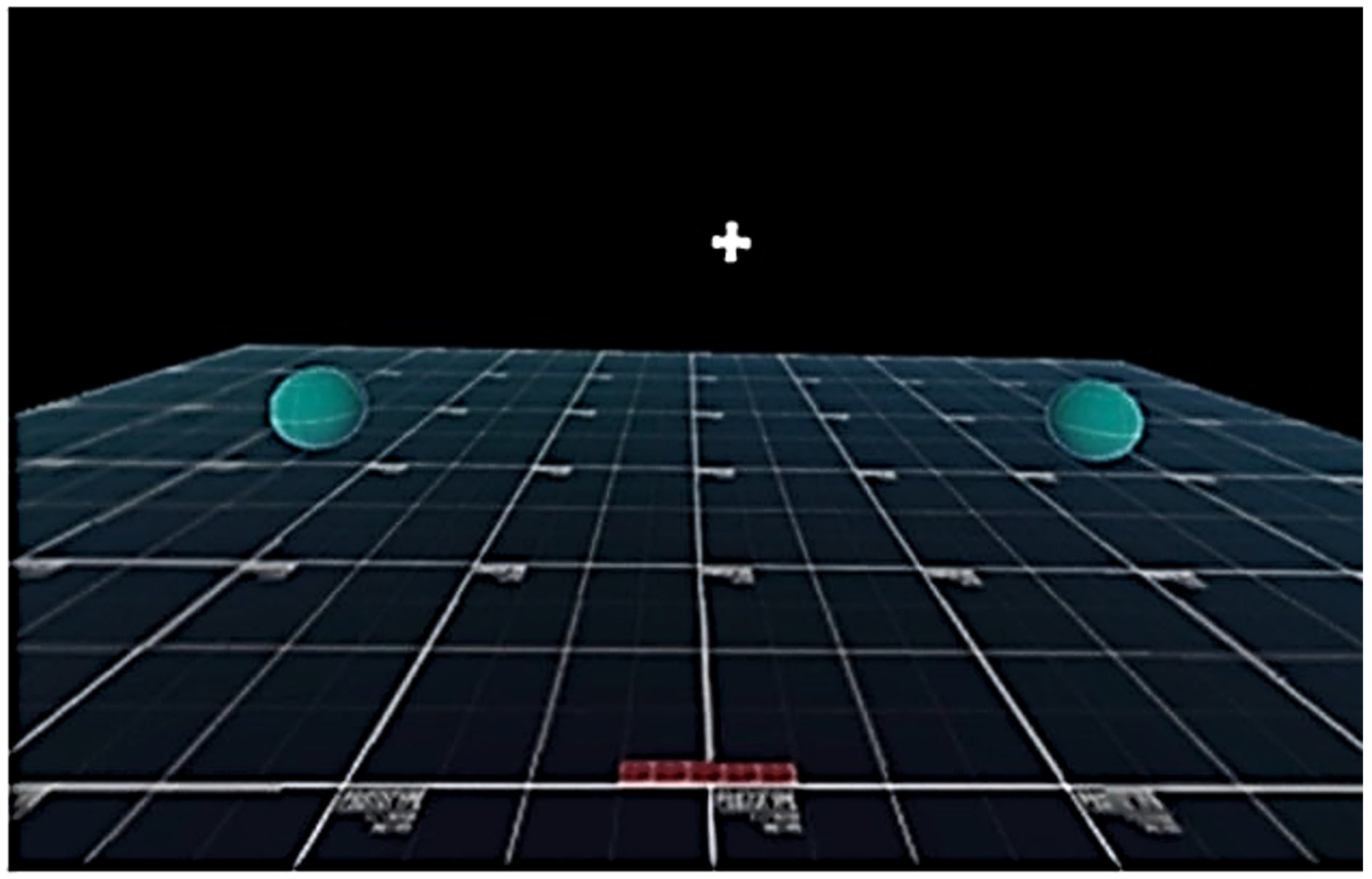
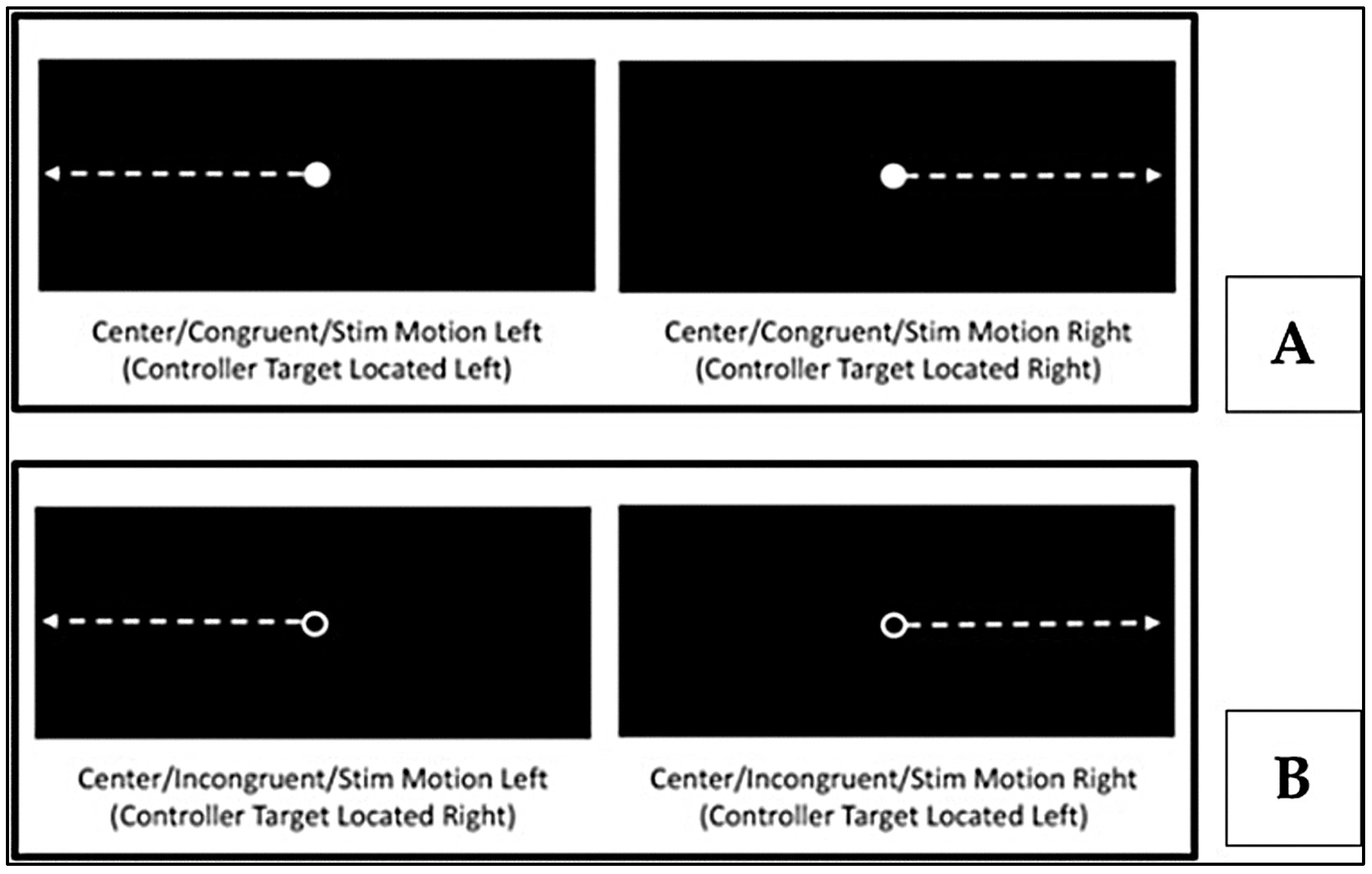
Intraindividual Variability in Perceptual-Motor Performance Measured with Virtual Reality Among Military Veterans

 ,
, 
 , , , , , and
Abstract
1. Introduction
2. Materials and Methods
2.1. Study Design
2.2. Participants
2.3. Survey Instruments
2.4. Virtual Reality
2.5. Statistical Analysis
2.6. Use of Artificial Intelligence
3. Results
- Most high-ranking predictors were related to mean neck and step RT; arm parameters were less frequently involved.
- IIV metrics emerged as prominent indicators of mental health issues and concussion history.
- Incongruent trials and LT values were especially discriminative.
4. Discussion
Limitations
5. Conclusions
Clinical Implications
Author Contributions
Funding
Institutional Review Board Statement
Informed Consent Statement
Data Availability Statement
Acknowledgments
Conflicts of Interest
Abbreviations
| PTSD | Post-traumatic stress disorder |
| RT | Reaction or RT |
| LT | Perceptual LT |
| MT | Movement time |
| VR | Virtual reality |
| IIV | Intraindividual variability |
| ROC | Receiver Operating Characteristic |
| AUC | Area Under the Curve |
| mTBI | Mild traumatic brain injury |
| dMRI | Diffusion Magnetic Resonance Imaging |
| fMRI | Functional Magnetic Resonance Imaging |
| MRS | Magnetic resonance spectroscopy |
| VSPP | Veterans’ Suicide Prevention Project |
| GAD-7 | General Anxiety Disorder—7 |
| PHQ-9 | Patient Health Questionnaire—9 |
| PHQ-9 Q9 | Patient Health Questionnaire—9, Question 9 |
| (=) | Equal variances assumed |
| (≠) | Equal variances not assumed |
| 95% CI | 95% Confidence Interval |
References
- Davis, G.A.; Patricios, J.; Schneider, K.J.; Iverson, G.L.; Silverberg, N.D. Definition of sport-related concussion: The 6th International Conference on Concussion in Sport. Br. J. Sports Med. 2023, 57, 617–618. [Google Scholar] [CrossRef] [PubMed]
- Holtkamp, M.D.; Grimes, J.; Ling, G. Concussion in the military: An evidence-base review of mTBI in U.S. military personnel focused on posttraumatic headache. Curr. Pain. Headache Rep. 2016, 20, 37. [Google Scholar] [CrossRef] [PubMed]
- Lavoie, G.; Bolduc, M.; Sicard, V.; Lepore, F.; Ellemberg, D. Running and thinking: Unmasking the lingering effects of sports concussions through complex dual-task testing. Sports 2025, 13, 144. [Google Scholar] [CrossRef] [PubMed]
- World Health Organization. Mental Disorders. Available online: https://www.who.int/news-room/fact-sheets/detail/mental-disorders (accessed on 12 January 2026).
- Bruce, S.L.; Cooper, M.R.; Farmer, C.; Folsom, A.; Fulton, M.; Haskins, J.; Knight, C.; Moore, C.M.; Shollenbarger, A.; Wade, R.; et al. The relationship between concussion and combat history and mental health and suicide ideation among United States military veterans—A pilot study. Brain Sci. 2025, 15, 234. [Google Scholar] [CrossRef] [PubMed]
- Broglio, S.P.; Register-Mihalik, J.K.; Guskiewicz, K.M.; Leddy, J.J.; Merriman, A.; Valovich McLeod, T.C. National Athletic Trainers’ Association bridge statement: Management of sport-related concussion. J. Athl. Train. 2024, 59, 225–242. [Google Scholar] [CrossRef]
- Chrisman, S.P.D.; Whelan, B.M.; Zatzick, D.F.; Hilt, R.J.; Wang, J.; Marcynyszyn, L.A.; Rivara, F.P.; McCarty, C.A. Prevalence and risk factors for depression, anxiety and suicidal ideation in youth with persistent post-concussive symptoms (PPCS). Brain Inj. 2021, 35, 1637–1644. [Google Scholar] [CrossRef]
- Rice, S.M.; Parker, A.G.; Rosenbaum, S.; Bailey, A.; Mawren, D.; Purcell, R. Sport-related concussion and mental health outcomes in elite athletes: A systematic review. Sport. Med. 2018, 48, 447–465. [Google Scholar] [CrossRef]
- Fisher, L.B.; Bomyea, J.; Thomas, G.; Cheung, J.C.; He, F.; Jain, S.; Flashman, L.A.; Andaluz, N.; Coimbra, R.; George, M.S.; et al. Contributions of posttraumatic stress disorder (PTSD) and mild TBI (mTBI) history to suicidality in the INTRuST consortium. Brain Inj. 2020, 34, 1339–1349. [Google Scholar] [CrossRef]
- Skopp, N.A.; Trofimovich, L.; Grimes, J.; Oetjen-Gerdes, L.; Gahm, G.A. Relations between suicide and traumatic brain injury, psychiatric diagnoses, and relationship problems, active component, U.S. Armed Forces, 2001–2009. MSMR (U.S. Army Cent. Health Promot. Prev. Med. Exec. Commun. Div.) 2012, 19, 7–11. [Google Scholar]
- Bruce, S.L.; Wilkerson, G.B. Whole-body reactive agility metrics to identify football players with a core and lower extremity injury risk. Front. Sports Act. Living 2021, 3, 733567. [Google Scholar] [CrossRef]
- Gallagher, V.T.; Murthy, P.; Stocks, J.; Vesci, B.; Colegrove, D.; Mjaanes, J.; Chen, Y.; Breiter, H.; LaBella, C.; Herrold, A.A.; et al. Differential change in oculomotor performance among female collegiate soccer players versus non-contact athletes from pre- to post-season. Neurotrauma Rep. 2020, 1, 169–180. [Google Scholar] [CrossRef] [PubMed]
- Lempke, L.B.; Howell, D.R.; Eckner, J.T.; Lynall, R.C. Examination of reaction time deficits following concussion: A systematic review and meta-analysis. Sports Med. 2020, 50, 1341–1359. [Google Scholar] [CrossRef]
- Wilkerson, G.B.; Lansey, J.C.; Noblett, C.N.; Sarris, C.E. Test-retest reliability of immersive virtual reality measures of perceptual-motor performance. Percept. Mot. Ski. 2023, 130, 2484–2504. [Google Scholar] [CrossRef]
- Hillary, F.G.; Grafman, J.H. Injured brains and adaptive networks: The benefits and costs of hyperconnectivity. Trends Cogn. Sci. 2017, 21, 385–401. [Google Scholar] [CrossRef]
- Wilkerson, G.B.; Nabhan, D.C.; Prusmack, C.J.; Moreau, W.J. Detection of persisting concussion effects on neuromechanical responsiveness. Med. Sci. Sports Exerc. 2018, 50, 1750–1756. [Google Scholar] [CrossRef]
- Howell, D.; Osternig, L.; Van Donkelaar, P.; Mayr, U.; Chou, L.-S. Effects of concussion on attention and executive function in adolescents. Med. Sci. Sports Exerc. 2013, 45, 1030–1037. [Google Scholar] [CrossRef] [PubMed]
- Mayer, A.R.; Stephenson, D.D.; Wertz, C.J.; Dodd, A.B.; Shaff, N.A.; Ling, J.M.; Park, G.; Oglesbee, S.J.; Wasserott, B.C.; Meier, T.B.; et al. Proactive inhibition deficits with normal perfusion after pediatric mild traumatic brain injury. Hum. Brain Mapp. 2019, 40, 5370–5381. [Google Scholar] [CrossRef]
- Giza, C.C.; Hovda, D.A. The new neurometabolic cascade of concussion. Neurosurgery 2014, 75, S24–S33. [Google Scholar] [CrossRef]
- Danielli, E.; Simard, N.; DeMatteo, C.A.; Kumbhare, D.; Ulmer, S.; Noseworthy, M.D. A review of brain regions and associated post-concussion symptoms. Front. Neurol. 2023, 14, 1136367. [Google Scholar] [CrossRef]
- Kenney, L. Sensory-Motor and Perceptual-Motor Skills: What’s the Difference? Available online: https://www.lynnekenney.com/post/sensory-motor-and-perceptual-motor-skills-what-s-the-difference (accessed on 31 July 2025).
- Lindsay, A.R.; Byington, T. Perceptual Motor Development: Connecting the Brain & the Body. Available online: https://extension.unr.edu/neap/pub.aspx?PubID=2928&utm_source=publications&utm_medium=pub-download&utm_campaign=pub-link-clicks&utm_content=2928 (accessed on 31 July 2025).
- Avedesian, J.M.; McPherson, A.L.; Diekfuss, J.A.; Barber Foss, K.D.; Hogg, J.A.; Zuleger, T.M.; Dufek, J.S.; Myer, G.D. Visual–spatial attentional performance identifies lower extremity injury risk in adolescent athletes. Clin. J. Sport. Med. 2022, 32, 574–579. [Google Scholar] [CrossRef] [PubMed]
- Wilkerson, G.B.; Wynn, K.R.; Dill, P.W.; Acocello, S.; Carlson, L.M.; Hogg, J. Concussion history and virtual reality metrics predict core or lower extremity injury occurrence among high school athletes. Front. Sports Act. Living 2024, 6, 1374772. [Google Scholar] [CrossRef]
- Wilkerson, G.B.; Colston, M.; Hogg, J.; Carlson, L.; Acocello, S. Perceptual decision efficiency is modifiable and associated with decreased musculoskeletal injury risk among female college soccer players. Brain Sci. 2025, 15, 721. [Google Scholar] [CrossRef] [PubMed]
- Wilkerson, G.B.; Colston, M.A.; Acocello, S.N.; Hogg, J.A.; Carlson, L.M. Subtle impairments of perceptual-motor function and well-being are detectable among military cadets and college athletes with self-reported history of concussion. Front. Sports Act. Living 2023, 5, 1046572. [Google Scholar] [CrossRef]
- Wilkerson, G.B.; Fleming, L.R.; Adams, V.P.; Petty, R.J.; Carlson, L.M.; Hogg, J.A.; Acocello, S.N. Assessment and training of perceptual-motor function: Performance of college wrestlers associated with history of concussion. Brain Sci. 2024, 14, 68. [Google Scholar] [CrossRef] [PubMed]
- Wilkerson, G.B.; Nabhan, D.C.; Perry, T.S. A novel approach to assessment of perceptual-motor efficiency and training-induced improvement in the performance capabilities of elite athletes. Front. Sports Act. Living 2021, 3, 729729. [Google Scholar] [CrossRef]
- Howard, M.C. A meta-analysis and systematic literature review of virtual reality rehabilitation programs. Comput. Human. Behav. 2017, 70, 317–327. [Google Scholar] [CrossRef]
- Santos, F.V.; Yamaguchi, F.; Buckley, T.A.; Caccese, J.B. Virtual reality in concussion management: From lab to clinic. J. Clin. Transl. Sci. 2020, 5, 148–154. [Google Scholar] [CrossRef]
- Sorg, S.F.; Merritt, V.C.; Clark, A.L.; Werhane, M.L.; Holiday, K.A.; Schiehser, D.M.; Bondi, M.; Delano-Wood, L. Elevated intra-individual variability in executive functions and associations with white matter microstructure in veterans with mild traumatic brain injury. J. Int. Neuropsychol. Soc. 2020, 27, 305–314. [Google Scholar] [CrossRef]
- Costa, A.S.; Dogan, I.; Schulz, J.B.; Reetz, K. Going beyond the mean: Intraindividual variability of cognitive performance in prodromal and early neurodegenerative disorders. Clin. Neuropsychol. 2019, 33, 369–389. [Google Scholar] [CrossRef]
- Schretlen, D.J.; Munro, C.A.; Anthony, J.C.; Pearlson, G.D. Examining the range of normal intraindividual variability in neuropsychological test performance. J. Int. Neuropsychol. Soc. 2003, 9, 864–870. [Google Scholar] [CrossRef] [PubMed]
- Lew, H.L.M.D.P.; Thomander, D.P.; Chew, K.T.L.M.D.; Bleiberg, J.P. Review of sports-related concussion: Potential for application in military settings. J. Rehabil. Res. Dev. 2007, 44, 963–974. [Google Scholar] [CrossRef] [PubMed]
- Peskind, E.R.; Brody, D.; Cernak, I.; McKee, A.; Ruff, R.L. Military- and sports-related mild traumatic brain injury: Clinical presentation, management, and long-term consequences. J. Clin. Psychiatry 2013, 74, 180–188. [Google Scholar] [CrossRef] [PubMed]
- Walker, D.; Qureshi, A.W.; Marchant, D.; Bahrami Balani, A. Developing a simple risk metric for the effect of sport-related concussion and physical pain on mental health. PLoS ONE 2023, 18, e0292751. [Google Scholar] [CrossRef]
- Fralick, M.; Sy, E.; Hassan, A.; Burke, M.J.; Mostofsky, E.; Karsies, T. Association of concussion with the risk of suicide: A systematic review and meta-analysis. JAMA Neurol. 2019, 76, 144–151. [Google Scholar] [CrossRef]
- Brenner, L.A.; Forster, J.E.; Gradus, J.L.; Hostetter, T.A.; Hoffmire, C.A.; Walsh, C.G.; Larson, M.J.; Stearns-Yoder, K.A.; Adams, R.S. Associations of military-related traumatic brain injury with new-onset mental health conditions and suicide risk. JAMA Netw. Open 2023, 6, e2326296. [Google Scholar] [CrossRef]
- Wilkerson, G.B.; Colston, M.A.; Acocello, S.N.; Hogg, J.A.; Carlson, L.M.; Lunt, E.N.; Palk, A.R.; Smith, H.N. Introspective ratings of biopsychosocial status are associated with sport-related injuries. J. Athl. Train. 2026, 60. [Google Scholar] [CrossRef]
- Spitzer, R.L.; Kroenke, K.; Williams, J.B.W.; Löwe, B. A brief measure for assessing Generalized Anxiety Disorder: The GAD-7. Arch. Intern. Med. 2006, 166, 1092–1097. [Google Scholar] [CrossRef]
- Kroenke, K.; Spitzer, R.L.; Williams, J.B. The PHQ-9: Validity of a brief depression severity measure. J. Gen. Intern. Med. 2001, 16, 606–613. [Google Scholar] [CrossRef]
- Kim, S.; Lee, H.K.; Lee, K. Which PHQ-9 items can effectively screen for suicide? Machine learning approaches. Int. J. Environ. Res. Public Health 2021, 18, 3339. [Google Scholar] [CrossRef]
- Goulet-Pelletier, J.-C.; Cousineau, D. A review of effect sizes and their confidence intervals, Part I: The Cohen’s d family. Quant. Method. Psychol. 2018, 14, 242–265. [Google Scholar] [CrossRef]
- Salgado, J.F. Transforming the Area under the Normal Curve (AUC) into Cohen’s d, Pearson’s rpb, odds ratio, and natural log odds ratio: Two conversion tables. Eur. J. Psychol. Appl. Leg. Context 2018, 10, 35–47. [Google Scholar] [CrossRef]
- Lininger, M.; Riemann, B.L. Statistical primer for athletic trainers: Using confidence intervals and effect sizes to evaluate clinical meaningfulness. J. Athl. Train. 2016, 51, 1045–1048. [Google Scholar] [CrossRef]
- Çorbacıoğlu, Ş.K.; Aksel, G. Receiver Operating Characteristic curve analysis in diagnostic accuracy studies: A guide to interpreting the Area Under the Curve value. Turk. J. Emerg. Med. 2023, 23, 195–198. [Google Scholar] [CrossRef] [PubMed]
- Sawilowsky, S.S. New effect size rules of thumb. J. Mod. Appl. Stat. Methods 2009, 8, 597–599. [Google Scholar] [CrossRef]
- Filliben, J.J.; Heckert, A. Hedges’ g. Available online: https://www.itl.nist.gov/div898/software/dataplot/refman2/auxillar/hedgeg.htm#:~:text=with%20denoting%20the%20Gamma%20function,the%20control%20sample%20standard%20deviation (accessed on 18 January 2026).
- Escolas, S.M.; Luton, M.; Ferdosi, H.; Chavez, B.D.; Engel, S.D. Traumatic brain injuries: Unreported and untreated in an army population. Mil. Med. 2020, 185, 154–160. [Google Scholar] [CrossRef] [PubMed]
- Kennedy, J.E.; Warren, J.B.; Lu, L.H.-J.; Lawrence, C.Y.; Reid, M.W. Symptomatic recovery from concussion in military service members with and without associated bodily injuries. Neurotrauma Rep. 2024, 5, 800–812. [Google Scholar] [CrossRef]
- Donoho, C.J.; Bonanno, G.A.; Porter, B.; Kearney, L.; Powell, T.M. A decade of war: Prospective trajectories of posttraumatic stress disorder symptoms among deployed US military personnel and the influence of combat exposure. Am. J. Epidemiol. 2017, 186, 1310–1318. [Google Scholar] [CrossRef] [PubMed]
- Rivera, A.C.; LeardMann, C.A.; Rull, R.P.; Cooper, A.; Warner, S.; Faix, D.; Deagle, E.; Neff, R.; Caserta, R.; Adler, A.B.; et al. Combat exposure and behavioral health in U.S. Army Special Forces. PLoS ONE 2022, 17, e0270515. [Google Scholar] [CrossRef]
- Cheever, K.M.; King, J.; Guan, J.; Gliedit, J.; Broglio, S.; Pasquina, P.F.; Hazzard, J.B., Jr.; Clugston, J.R.; Feigenbaum, L.A.; Miles, C.M. The interaction between neck pain and known determinates of delayed return to play among NCAA student-athletes: A CARE consortium study. Brain Inj. 2025, 39, 1262–1267. [Google Scholar] [CrossRef]
- Patricios, J.S.; Schneider, K.J.; Dvorak, J.; Ahmed, O.H.; Blauwet, C.; Cantu, R.C.; Davis, G.A.; Echemendia, R.J.; Makdissi, M.; McNamee, M. Consensus statement on concussion in sport: The 6th International Conference on Concussion in Sport–Amsterdam, October 2022. Br. J. Sports Med. 2023, 57, 695–711. [Google Scholar] [CrossRef]
- Miao, I.Y.; Gifford, K.; Kerr, Z.Y.; Cole, W.R.; Guskiewicz, K.M.; McCrea, M.A.; Brett, B.L. Intraindividual variability, subjective cognitive difficulties, and head injury history in former collegiate athletes. Clin. Neuropsychol. 2025, 39, 2274–2294. [Google Scholar] [CrossRef]
- Churchill, N.W.; Hutchison, M.G.; Graham, S.J.; Schweizer, T.A. Connectomic markers of symptom sexfordverity in sport-related concussion: Whole-brain analysis of resting-state fMRI. Neuroimage Clin. 2018, 18, 518–526. [Google Scholar] [CrossRef] [PubMed]
- Ledreux, A.; Pryhoda, M.K.; Gorgens, K.; Shelburne, K.; Gilmore, A.; Linseman, D.A.; Fleming, H.; Koza, L.A.; Campbell, J.; Wolff, A.; et al. Assessment of long-term effects of sports-related concussions: Biological mechanisms and exosomal biomarkers. Front. Neurosci. 2020, 14, 761. [Google Scholar] [CrossRef] [PubMed]
- Baracchini, G.; Mišić, B.; Setton, R.; Mwilambwe-Tshilobo, L.; Girn, M.; Nomi, J.S.; Uddin, L.Q.; Turner, G.R.; Spreng, R.N. Inter-regional BOLD signal variability is an organizational feature of functional brain networks. Neuroimage 2021, 237, 118149. [Google Scholar] [CrossRef] [PubMed]
- Uddin, L.Q. Cognitive and behavioural flexibility: Neural mechanisms and clinical considerations. Nat. Rev. Neurosci. 2021, 22, 167–179. [Google Scholar] [CrossRef]
- Teel, E.; Gay, M.; Johnson, B.; Slobounov, S. Determining sensitivity/specificity of virtual reality-based neuropsychological tool for detecting residual abnormalities following sport-related concussion. Neuropsychology 2016, 30, 474–483. [Google Scholar] [CrossRef]
- Kime, P. Suicide Rates Surged Among Post-9/11 Veterans even as Deaths Remained Steady in the General Population, Study Finds. 2023. Available online: https://www.military.com/daily-news/2023/08/28/suicide-rates-surged-among-post-9-11-veterans-even-deaths-remained-steady-general-population-study.html (accessed on 20 January 2026).
- VA Suicide Prevention Office of Mental Health and Suicide Prevention. 2023 National Veteran Suicide Prevention Annual Report; US Department of Veterans Affairs: Washington, DC, USA, 2023.



| Mean ±SD | Males (n = 22) | Females (n = 7) |
|---|---|---|
| Height (cm) | 172.72 ±14.81 | 178.49 ±6.93 |
| Weight (kg) | 100.37 ±19.45 | 72.69 ±15.69 |
| BMI | 25.06 ±7.99 | 31.44 ±5.31 |
| Time in Service (years) | 12.40 ±7.52 | 14.13 ±12.13 |
| Number Correct Targets | Number Incorrect Targets | |
|---|---|---|
| Mean (±SD) | 35.59 ±7.05 | 4.96 ±7.24 |
| Maximum Number of Responses | 40 | 20 |
| Minimum Number of Responses | 20 | 0 |
| n a | Mean | Standard Deviation | ||
|---|---|---|---|---|
| Pair 1 | VR b Correct Overall Average Neck RT c | 9 | 1.43 | 0.392 |
| VR Incorrect Overall Average Neck RT | 2.10 | 0.957 | ||
| Pair 2 | VR Correct Overall Average Arms RT | 9 | 1.60 | 0.314 |
| VR Incorrect Overall Average Arms RT | 2.12 | 0.618 | ||
| Pair 3 | VR Correct Overall Average Steps RT | 9 | 1.71 | 0.386 |
| VR Incorrect Overall Average Steps RT | 2.52 | 1.46 | ||
| Pair 4 | VR Correct Overall Average Neck LT d | 9 | 0.524 | 0.115 |
| VR Incorrect Overall Average Neck LT | 0.541 | 0.305 | ||
| Pair 5 | VR Correct Overall Average Arms LT | 9 | 0.477 | 0.166 |
| VR Incorrect Overall Average Arms LT | 0.625 | 0.278 | ||
| Pair 6 | VR Correct Overall Average Steps LT | 9 | 0.563 | 0.114 |
| VR Incorrect Overall Average Steps LT | 0.581 | 0.264 | ||
| Pair 7 | VR Correct Overall IIV e Neck RT | 7 | 0.324 | 0.182 |
| VR Incorrect Overall IIV Neck RT | 0.451 | 0.554 | ||
| Pair 8 | VR Correct Overall IIV Arms RT | 7 | 0.323 | 0.096 |
| VR Incorrect Overall IIV Arms RT | 0.576 | 0.472 | ||
| Pair 9 | VR Correct Overall IIV Steps RT | 7 | 0.344 | 0.136 |
| VR Incorrect Overall IIV Steps RT | 1.19 | 1.04 | ||
| Pair 10 | VR Correct Overall IIV Neck LT | 7 | 0.137 | 0.047 |
| VR Incorrect Overall IIV Neck LT | 0.164 | 0.131 | ||
| Pair 11 | VR Correct Overall IIV Arms LT | 6 | 0.196 | 0.070 |
| VR Incorrect Overall IIV Arms LT | 0.222 | 0.201 | ||
| Pair 12 | VR Correct Overall IIV Steps LT | 6 | 0.153 | 0.053 |
| VR Incorrect Overall IIV Steps LT | 0.101 | 0.064 |
| Mean | Standard Deviation | 95% CI a of the Difference | t | df b | p-Value (2-Sided) c | Hedges g Effect Size | ||
|---|---|---|---|---|---|---|---|---|
| Pair 1 | VR Correct Overall Average Neck RT d—VR Incorrect Overall Average Neck RT | −0.677 | 1.04 | −1.478, 0.123 | −1.95 | 8 | 0.087 | 1.15 |
| Pair 2 | VR Correct Overall Average Arms RT—VR Incorrect Overall Average Arms RT | −0.525 | 0.75 | −1.10, 0.055 | −2.09 | 8 | 0.070 | 0.836 |
| Pair 3 | VR Correct Overall Average Steps RT—VR Incorrect Overall Average Steps RT | −0.809 | 1.55 | −2.00, 0.382 | −1.57 | 8 | 0.156 | 1.72 |
| Pair 4 | VR Correct Overall Average Neck LT e—VR Incorrect Overall Average Neck LT | −0.018 | 0.238 | −0.201, 0.165 | −0.22 | 8 | 0.829 | 0.264 |
| Pair 5 | VR Correct Overall Average Arms LT—VR Incorrect Overall Average Arms LT | −0.149 | 0.172 | −0.281, −0.017 | −2.60 | 8 | 0.032 | 0.190 |
| Pair 6 | VR Correct Overall Average Steps LT—VR Incorrect Overall Average Steps LT | −0.018 | 0.193 | −0.167, 0.130 | −0.29 | 8 | 0.783 | 0.214 |
| Pair 7 | VR Correct Overall IIV f Neck RT—VR Incorrect Overall IIV Neck RT | −0.127 | 0.608 | −0.689, 0.436 | −0.55 | 6 | 0.602 | 0.700 |
| Pair 8 | VR Correct Overall IIV Arms RT—VR Incorrect Overall IIV Arms RT | −0.253 | 0.470 | −0.689, 0.182 | −1.43 | 6 | 0.204 | 0.541 |
| Pair 9 | VR Correct Overall IIV Steps RT—VR Incorrect Overall IIV Steps RT | −0.848 | 1.04 | −1.81, 0.112 | −2.16 | 6 | 0.074 | 1.19 |
| Pair 10 | VR Correct Overall IIV Neck LT—VR Incorrect Overall IIV Neck LT | −0.027 | 0.111 | −0.130, 0.075 | −0.65 | 6 | 0.541 | 0.128 |
| Pair 11 | VR Correct Overall IIV Arms LT—VR Incorrect Overall IIV Arms LT | −0.026 | 0.208 | −0.244, 0.192 | −0.31 | 5 | 0.770 | 0.247 |
| Pair 12 | VR Correct Overall IIV Steps LT—VR Incorrect Overall IIV Steps LT | 0.052 | 0.066 | −0.017, 0.121 | 1.94 | 5 | 0.110 | 0.078 |
| Univariable Analyses | |||||||||
|---|---|---|---|---|---|---|---|---|---|
| Rank | Predictor Variable | Virtual Reality Variables | Area | t | df | Mean Difference | 95% CI g | Hedges g | p-Value h |
| 1 | Multiple Concussion History (9/20) a | Incongruent Average Neck RT c (=) d | 0.944 | 5.55 | 27.0 | 0.42 | 0.26, 0.57 | 2.18 | ≤0.001 |
| 2 | Concussion History (19/10) a | Incongruent Average Neck RT (≠) e | 0.937 | 5.13 | 26.2 | 0.35 | 0.21, 0.48 | 2.10 | ≤0.001 |
| 3 | Concussion History | Overall Average Neck RT (=) | 0.932 | 3.84 | 27.0 | 0.32 | 0.15, 0.49 | 2.05 | 0.001 |
| 4 | Multiple Concussion History | Overall Average Neck RT (=) | 0.928 | 4.56 | 27.0 | 0.37 | 0.20, 0.53 | 1.42 | ≤0.001 |
| 5 | Multiple Concussion History | Overall Average Steps RT (=) | 0.872 | 4.31 | 27.0 | 0.40 | 0.21, 0.59 | 1.56 | ≤0.001 |
| 6 | Concussion History | Congruent Average Neck RT (≠) | 0.858 | 3.64 | 26.3 | 0.30 | 0.13, 0.46 | 1.47 | 0.001 |
| 7 | Multiple Concussion History | Overall IIV Steps RT (=) | 0.856 | 4.06 | 27.0 | 0.43 | 0.21, 0.65 | 1.46 | ≤0.001 |
| 8 | Concussion History | Overall Average Steps RT (=) | 0.853 | 3.35 | 27.0 | 0.33 | 0.13, 0.53 | 1.44 | 0.002 |
| 9 | Multiple Concussion History | Congruent Average Steps RT (=) | 0.850 | 3.63 | 27.0 | 0.39 | 0.17, 0.61 | 1.42 | 0.001 |
| 10 | Concussion History | Congruent Average Steps RT (=) | 0.847 | 3.09 | 27.0 | 0.34 | 0.11, 0.56 | 1.41 | 0.005 |
| 11 | Multiple Concussion History | Overall IIV Steps LT f (≠) | 0.844 | 2.08 | 8.50 | 0.13 | 0.01, 0.27 | 1.30 | 0.069 |
| 12 | Multiple Concussion History | Incongruent IIV Steps LT (=) | 0.839 | 3.64 | 27.0 | 0.12 | 0.05, 0.19 | 1.36 | 0.001 |
| 13 | Concussion History | Overall IIV Steps LT (=) | 0.837 | 2.10 | 27.0 | 0.09 | 0.00, 0.19 | 1.35 | 0.045 |
| 14 | Concussion History | Incongruent IIV Arms RT (≠) | 0.832 | 3.97 | 24.2 | 0.19 | 0.09, 0.29 | 1.32 | 0.001 |
| 15 | Multiple Concussion History | Incongruent Average Arms RT (=) | 0.828 | 3.56 | 27.0 | 0.40 | 0.17, 0.63 | 1.30 | 0.001 |
| 16 | Multiple Concussion History | Incongruent IIV Steps RT (=) | 0.828 | 3.50 | 27.0 | 0.53 | 0.22, 0.83 | 1.30 | 0.002 |
| 17 | Multiple Concussion History | Overall IIV Arms RT (=) | 0.828 | 3.69 | 27.0 | 0.19 | 0.08, 0.29 | 1.30 | 0.001 |
| 18 | Concussion History | Congruent IIV Arms RT (=) | 0.821 | 1.60 | 27.0 | 0.10 | 0.03, 0.23 | 1.26 | 0.121 |
| 19 | Concussion History | Overall IIV Arms RT (=) | 0.821 | 2.25 | 27.0 | 0.27 | 0.02, 0.51 | 1.26 | 0.033 |
| 20 | Concussion History | Overall IIV Neck LT (=) | 0.821 | 1.99 | 27.0 | 0.09 | 0.00, 0.19 | 1.26 | 0.057 |
| 21 | Suicide Ideation b (5/24) a | Incongruent IIV Arms RT (=) | 0.817 | 2.52 | 27.0 | 0.21 | 0.04, 0.37 | 1.24 | 0.018 |
| 22 | Multiple Concussion History | Incongruent IIV Arms RT (≠) | 0.811 | 3.01 | 9.70 | 0.23 | 0.06, 0.40 | 1.15 | 0.014 |
| 23 | Multiple Concussion History | Incongruent IIV Neck LT (=) | 0.811 | 3.23 | 27.0 | 0.10 | 0.04, 0.16 | 1.21 | 0.003 |
| 24 | Multiple Concussion History | Overall IIV Arms LT (≠) | 0.811 | 2.50 | 10.0 | 0.10 | 0.01, 0.18 | 1.15 | 0.032 |
| 25 | Multiple Concussion History | Overall Average Arms RT (=) | 0.806 | 3.23 | 27.0 | 0.36 | 0.13, 0.59 | 1.19 | 0.003 |
| Multi-Variable Analysis | |||||||||
|---|---|---|---|---|---|---|---|---|---|
| Rank | Predictor Variable | Virtual Reality Variables | Area | t | df | Mean Difference | 95% CI i | Hedges g | p-Value j |
| 1 | Both Multiple Concussion History and Depression (8/21) a | Incongruent IIV d Steps LT e (=) f | 0.950 | 4.67 | 27.0 | 0.15 | 0.08, 0.21 | 2.26 | ≤0.001 |
| 2 | Both Multiple Concussion History and Depression | Incongruent IIV Neck LT (=) | 0.936 | 4.24 | 27.0 | 0.12 | 0.06, 0.18 | 2.09 | ≤0.001 |
| 3 | Both Multiple Concussion History and Combat (4/25) a | Incongruent IIV Neck LT (=) | 0.935 | 3.82 | 27.0 | 0.15 | 0.07, 0.23 | 2.08 | 0.001 |
| 4 | Both Multiple Concussion History and Combat | Incongruent IIV Steps LT (≠) g | 0.924 | 2.21 | 3.1 | 0.18 | 0.07, 0.44 | 1.50 | 0.110 |
| 5 | Both Concussion History and Suicide Ideation b (4/25) a | Incongruent IIV Arms RT h (=) | 0.924 | 3.18 | 27.0 | 0.27 | 0.10, 0.45 | 1.97 | 0.004 |
| 6 | Both Multiple Concussion History and Depression | Overall IIV Steps LT (≠) | 0.921 | 2.26 | 7.3 | 0.15 | 0.01, 0.30 | 1.79 | 0.057 |
| 7 | Both Multiple Concussion History and Suicide Ideation (3/26) a | Incongruent IIV Arms RT (=) | 0.917 | 3.04 | 27.0 | 0.30 | 0.10, 0.50 | 1.90 | 0.005 |
| 8 | Both Multiple Concussion History and Suicide Ideation | Incongruent IIV Steps RT (=) | 0.917 | 2.59 | 27.0 | 0.64 | 0.13, 1.14 | 1.90 | 0.015 |
| 9 | Both Multiple Concussion History and Anxiety (4/25) a | Overall IIV Steps LT (=) | 0.913 | 1.25 | 27.0 | 0.08 | 0.05, 0.21 | 1.87 | 0.221 |
| 10 | Either Combat or Depression (4/25) a | Incongruent IIV Neck LT (=) | 0.913 | 1.94 | 27.0 | 0.09 | 0.01, 0.18 | 1.87 | 0.063 |
| 11 | Both Multiple Concussion History and Suicide Ideation | Overall IIV Steps RT (=) | 0.903 | 2.17 | 27.0 | 0.41 | 0.02, 0.80 | 1.79 | 0.039 |
| 12 | Either Combat or Anxiety (4/25) a | Incongruent IIV Neck LT (=) | 0.903 | 1.43 | 27.0 | 0.07 | 0.03, 0.16 | 1.79 | 0.165 |
| 13 | Either Concussion History or PTSD c (6/23) a | Overall IIV Neck RT (≠) | 0.897 | 4.97 | 25.5 | 0.26 | 0.15, 0.36 | 1.74 | ≤0.001 |
| 14 | Both Multiple Concussion History and Anxiety | Incongruent IIV Steps LT (=) | 0.891 | 1.72 | 27.0 | 0.09 | 0.02, 0.20 | 1.69 | 0.097 |
| 15 | Both Concussion History and Depression | Overall IIV Steps LT (=) | 0.890 | 2.83 | 27.0 | 0.11 | 0.03, 0.20 | 1.69 | 0.009 |
| 16 | Either Concussion History or PTSD | Incongruent Average Neck RT (=) | 0.889 | 2.71 | 27.0 | 0.30 | 0.07, 0.53 | 1.68 | 0.011 |
| 17 | Either Concussion History or PTSD | Incongruent IIV Steps RT (≠) | 0.889 | 4.50 | 24.3 | 0.44 | 0.24, 0.64 | 1.67 | 0.000 |
| 18 | Either Concussion History or Suicide Ideation (9/20) a | Incongruent Average Neck RT (=) | 0.882 | 3.52 | 27.0 | 0.32 | 0.13, 0.51 | 1.63 | 0.002 |
| 19 | Either Concussion History or Suicide Ideation | Incongruent Average Steps RT (=) | 0.882 | 1.57 | 27.0 | 0.27 | 0.08, 0.62 | 1.63 | 0.128 |
| 20 | Both Multiple Concussion History and Depression | Incongruent Average Neck RT (=) | 0.879 | 3.97 | 27.0 | 0.36 | 0.17, 0.55 | 1.61 | 0.000 |
| 21 | Both Multiple Concussion History and Suicide Ideation | Incongruent Average Arms RT (=) | 0.875 | 1.61 | 27.0 | 0.32 | 0.09, 0.72 | 1.58 | 0.119 |
| 22 | Both Multiple Concussion History and Suicide Ideation | Incongruent IIV Steps LT (=) | 0.875 | 1.45 | 27.0 | 0.09 | 0.04, 0.21 | 1.58 | 0.158 |
| 23 | Both Multiple Concussion History and Suicide Ideation | Overall IIV Arms RT (=) | 0.875 | 2.47 | 27.0 | 0.21 | 0.04, 0.38 | 1.58 | 0.020 |
| 24 | Both Concussion History and Depression | Incongruent Average Neck RT (=) | 0.874 | 3.58 | 27.0 | 0.30 | 0.13, 0.47 | 1.57 | 0.001 |
| 25 | Either Combat or Depression | Incongruent Average Steps LT (=) | 0.870 | 1.84 | 27.0 | 0.12 | 0.01, 0.25 | 1.55 | 0.077 |
| AUC Value | Interpretation |
|---|---|
| ≥0.9 | Excellent |
| 0.8 to <0.9 | Considerable |
| 0.7 to <0.8 | Fair |
| 0.6 to <0.7 | Poor |
| 0.5 to <0.6 | Fail |
| Effect Size | Strength of Association |
|---|---|
| 0.20 | Small Effect |
| 0.50 | Medium Effect |
| 0.80 | Large Effect |
Disclaimer/Publisher’s Note: The statements, opinions and data contained in all publications are solely those of the individual author(s) and contributor(s) and not of MDPI and/or the editor(s). MDPI and/or the editor(s) disclaim responsibility for any injury to people or property resulting from any ideas, methods, instructions or products referred to in the content. |
© 2026 by the authors. Licensee MDPI, Basel, Switzerland. This article is an open access article distributed under the terms and conditions of the Creative Commons Attribution (CC BY) license.
Share and Cite
Bruce, S.L.; Cooper, M.; Farmer, C.; Folsom, A.; Fulton, M.; Haskins, J.; Knight, C.; Moore, C.M.; Mullins, J.A.; Shollenbarger, A.; et al. Intraindividual Variability in Perceptual-Motor Performance Measured with Virtual Reality Among Military Veterans. Brain Sci. 2026, 16, 185. https://doi.org/10.3390/brainsci16020185
Bruce SL, Cooper M, Farmer C, Folsom A, Fulton M, Haskins J, Knight C, Moore CM, Mullins JA, Shollenbarger A, et al. Intraindividual Variability in Perceptual-Motor Performance Measured with Virtual Reality Among Military Veterans. Brain Sciences. 2026; 16(2):185. https://doi.org/10.3390/brainsci16020185
Chicago/Turabian StyleBruce, Scott L., Michael Cooper, Carly Farmer, Audrey Folsom, Melanie Fulton, Jana Haskins, Cheryl Knight, Carlitta M. Moore, Johnathon A. Mullins, Amy Shollenbarger, and et al. 2026. "Intraindividual Variability in Perceptual-Motor Performance Measured with Virtual Reality Among Military Veterans" Brain Sciences 16, no. 2: 185. https://doi.org/10.3390/brainsci16020185
APA StyleBruce, S. L., Cooper, M., Farmer, C., Folsom, A., Fulton, M., Haskins, J., Knight, C., Moore, C. M., Mullins, J. A., Shollenbarger, A., Wade, R., Walz, S., Wellborn, R., Wilkins, R., & Youngman, K. (2026). Intraindividual Variability in Perceptual-Motor Performance Measured with Virtual Reality Among Military Veterans. Brain Sciences, 16(2), 185. https://doi.org/10.3390/brainsci16020185