Exploring the Effects of a Computerized Naming Intervention Combined with Cerebellar tDCS in Cantonese-Speaking Individuals with Aphasia


Abstract
1. Introduction
2. Methods
2.1. Participants
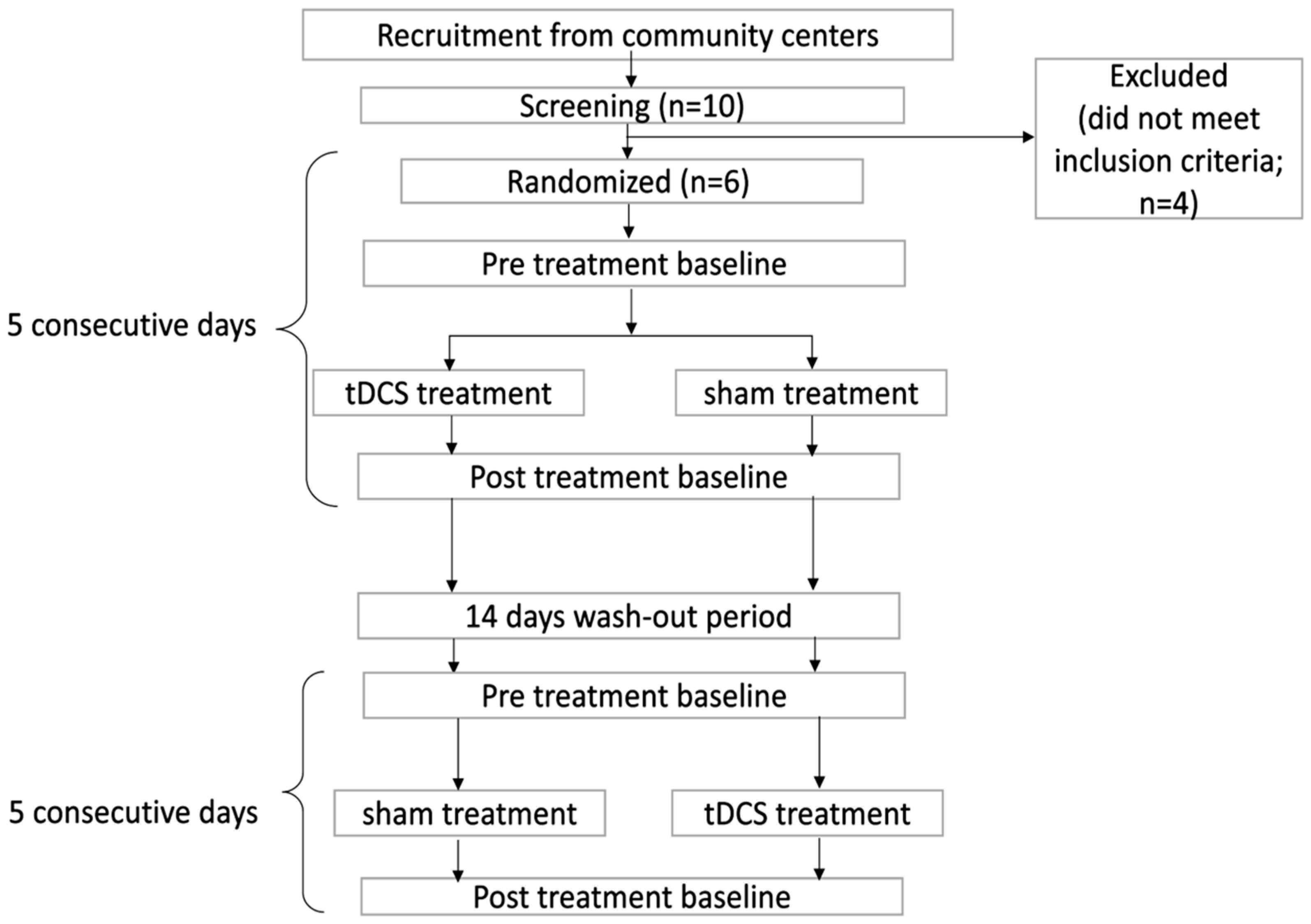
2.2. Study Design and Outcome Measures
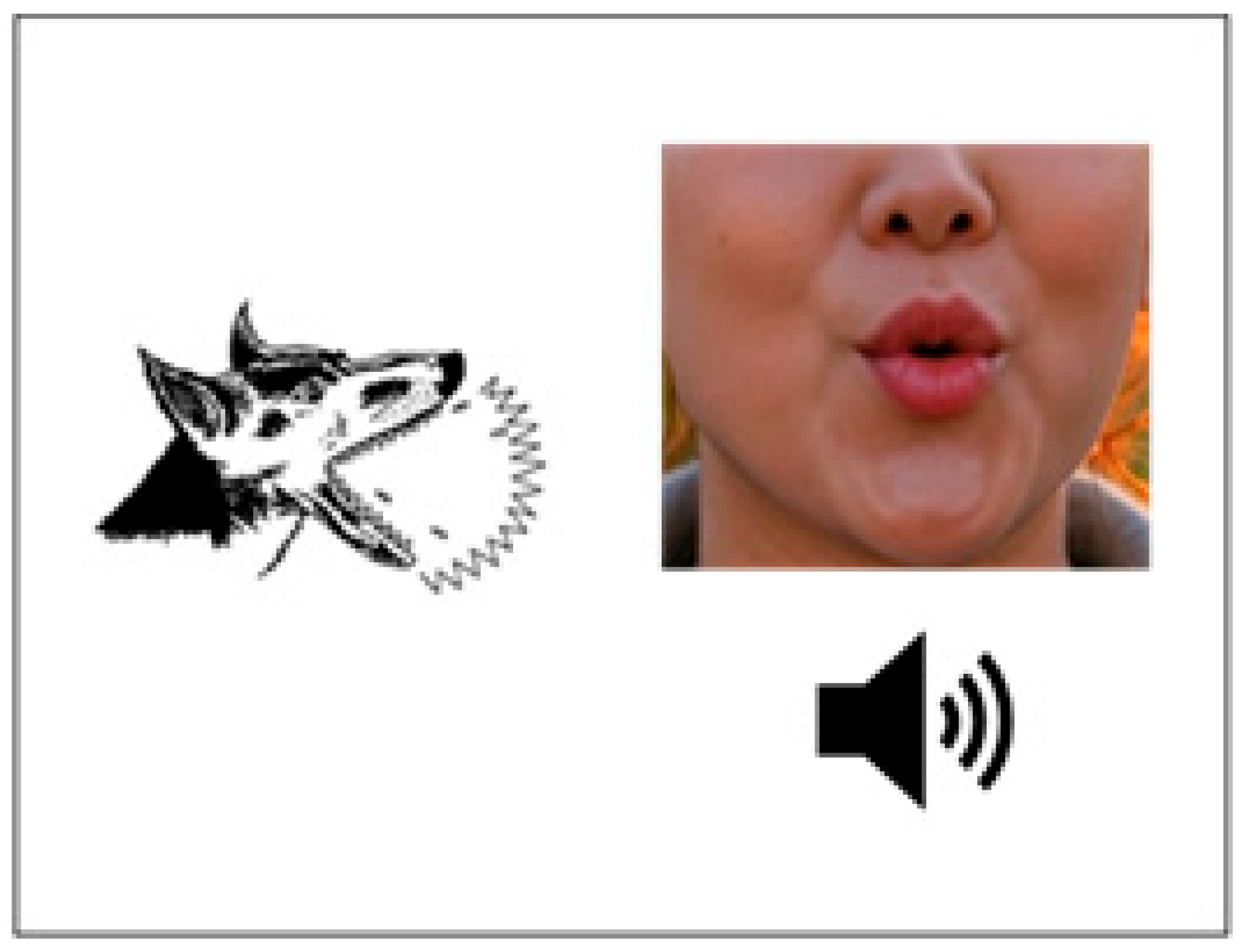
2.3. Computerized Naming Treatment
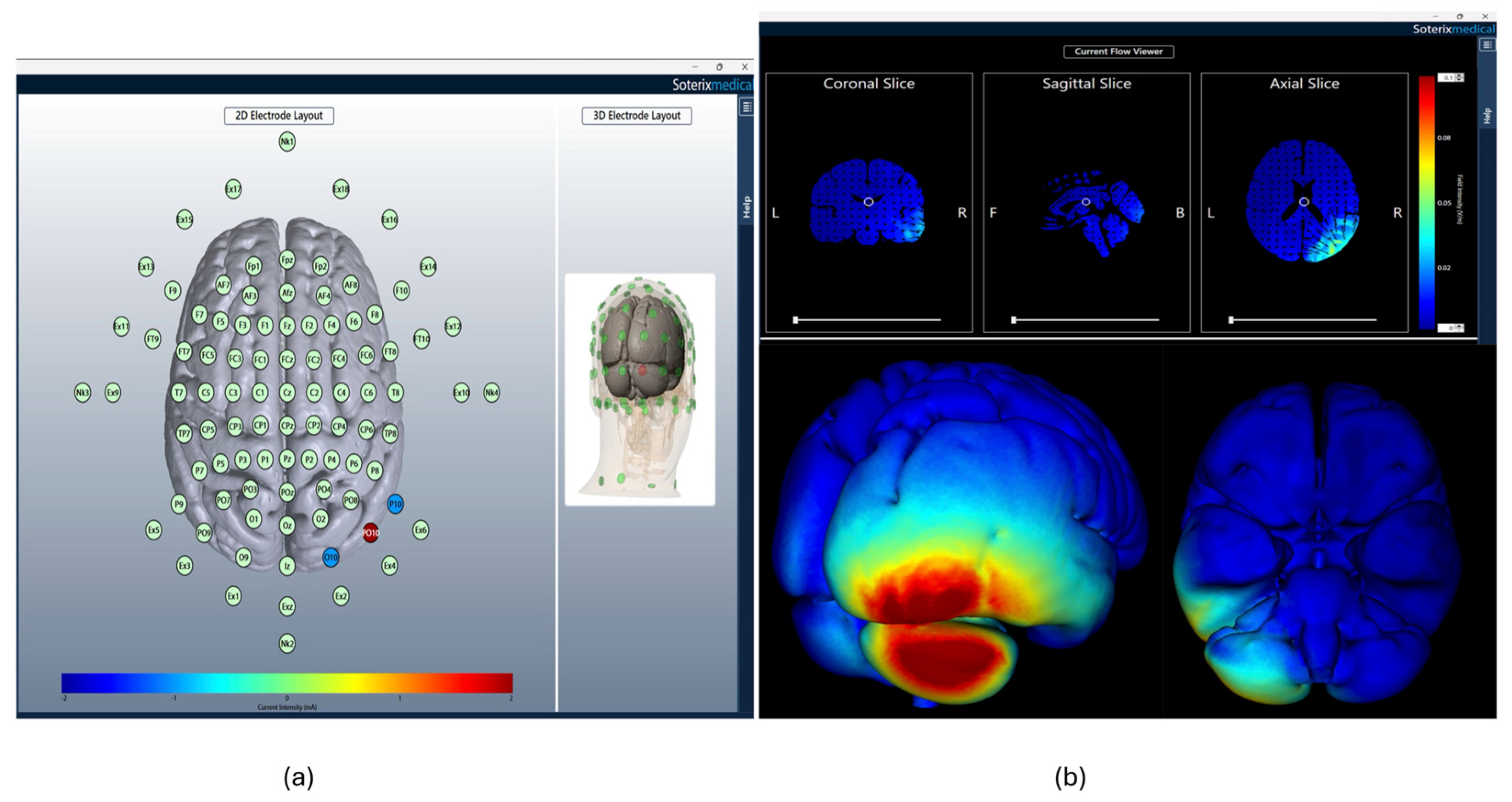
2.4. tDCS Protocol
2.5. Data Analysis
3. Results
3.1. Group Effect on Treatment Type (Real Versus Sham)
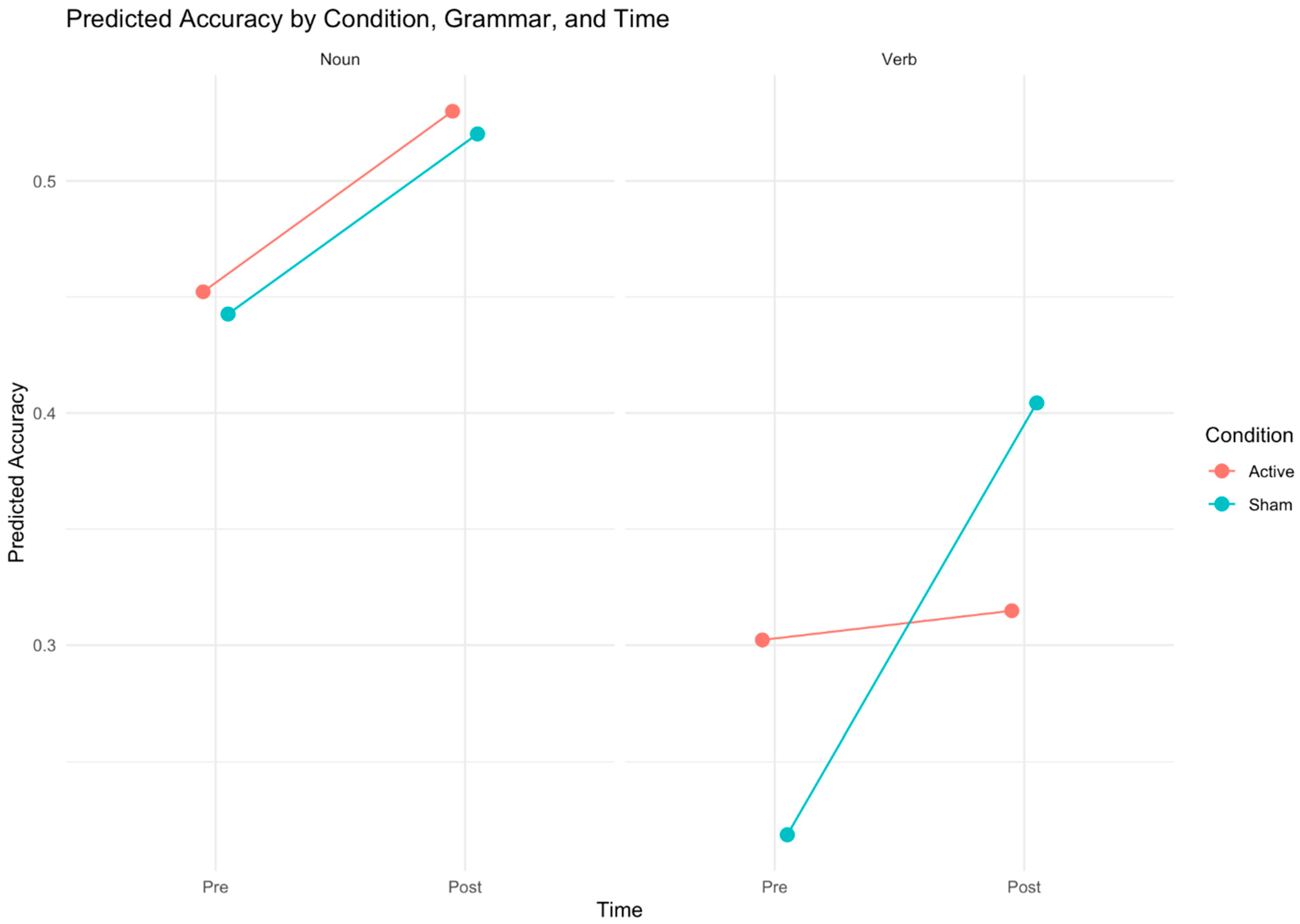
3.1.1. Accuracy
3.1.2. Reaction Times
3.1.3. Order Effects
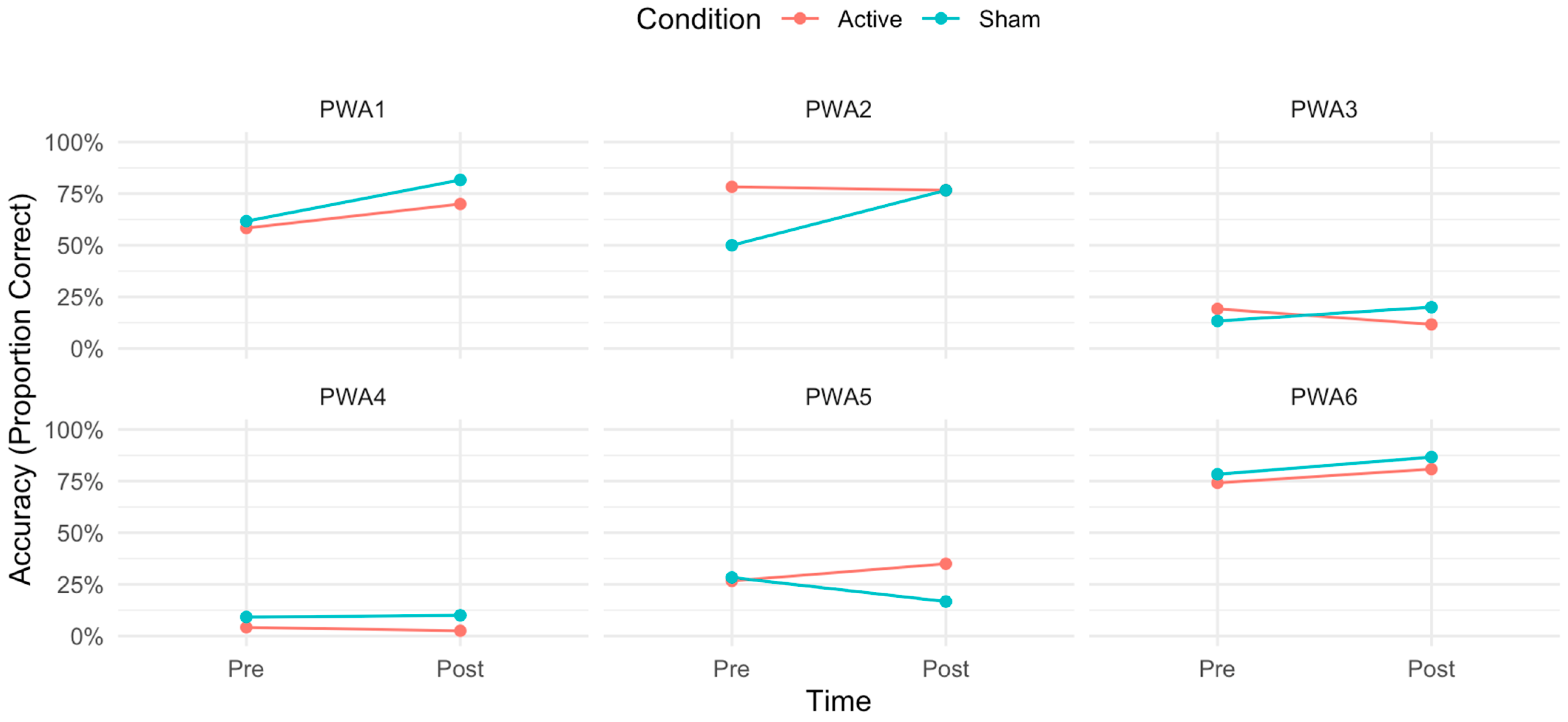
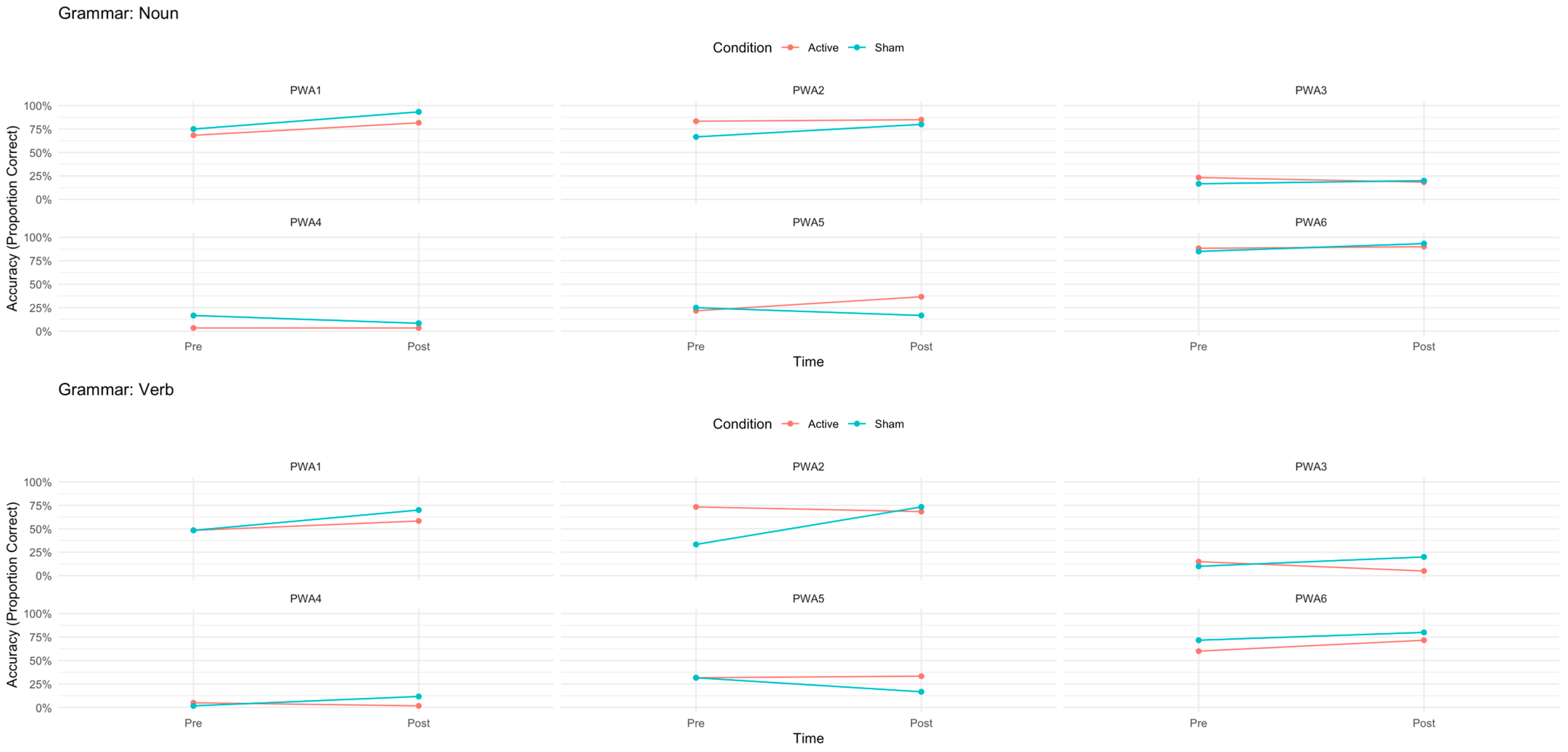
3.2. Individual Variability
3.3. Adverse Effects
3.4. Carryover Effects
4. Discussion
4.1. Individual Variability
4.2. Behavioral Intervention Effects
4.3. Limitations and Future Directions
5. Conclusions
Author Contributions
Funding
Institutional Review Board Statement
Informed Consent Statement
Data Availability Statement
Acknowledgments
Conflicts of Interest
Abbreviations
| tDCS | Transcranial Direct-Current Stimulation |
| A-tDCS | Anodal Transcranial Direct-Current Stimulation |
| C-tDCS | Cathodal Transcranial Direct-Current Stimulation |
| S-tDCS | Sham Transcranial Direct-Current Stimulation |
| HD-tDCS | High-Definition Transcranial Direct-Current Stimulation |
| PWA | Persons/People with Aphasia |
| ASHA-FACS | American Speech–Language–Hearing Association Functional Assessment of Communication Skills |
| OANB | Object and Action Naming Battery |
| Q-CAB | Quick Cantonese Aphasia Battery |
| CSF | Cerebrospinal Fluid |
| MRI | Magnetic Resonance Imaging |
| RT | Reaction times |
| GLMM | Generalized Linear Mixed-Effects Model |
| LME | Linear Mixed-Effects Model |
References
- Flowers, H.L.; Skoretz, S.A.; Silver, F.L.; Rochon, E.; Fang, J.; Flamand-Roze, C.; Martino, R. Poststroke Aphasia Frequency, Recovery, and Outcomes: A Systematic Review and Meta-Analysis. Arch. Phys. Med. Rehabil. 2016, 97, 2188–2201.e8. [Google Scholar] [CrossRef]
- Hilari, K.; Needle, J.J.; Harrison, K.L. What Are the Important Factors in Health-Related Quality of Life for People With Aphasia? A Systematic Review. Arch. Phys. Med. Rehabil. 2012, 93, S86–S95.e4. [Google Scholar] [CrossRef]
- Brady, M.C.; Kelly, H.; Godwin, J.; Enderby, P.; Campbell, P. Speech and Language Therapy for Aphasia Following Stroke. Cochrane Database Syst. Rev. 2016, 2016, CD000425. [Google Scholar] [CrossRef]
- Brady, M.C.; Mills, C.; Prag Øra, H.; Novaes, N.; Becker, F.; Constantinidou, F.; Flöel, A.; Sunnerhagen, K.S.; Isaksen, J.; Jagoe, C.; et al. European Stroke Organisation (ESO) Guideline on Aphasia Rehabilitation. Eur. Stroke J. 2025, 10, 1189–1220. [Google Scholar] [CrossRef]
- Lazar, R.M.; Minzer, B.; Antoniello, D.; Festa, J.R.; Krakauer, J.W.; Marshall, R.S. Improvement in Aphasia Scores After Stroke Is Well Predicted by Initial Severity. Stroke 2010, 41, 1485–1488. [Google Scholar] [CrossRef]
- Fridriksson, J.; Hillis, A.E. Current Approaches to the Treatment of Post-Stroke Aphasia. J. Stroke 2021, 23, 183–201. [Google Scholar] [CrossRef] [PubMed]
- Breining, B.L.; Sebastian, R. Neuromodulation in Post-Stroke Aphasia Treatment. Curr. Phys. Med. Rehabil. Rep. 2020, 8, 44–56. [Google Scholar] [CrossRef] [PubMed]
- Meinzer, M.; Lindenberg, R.; Sieg, M.M.; Nachtigall, L.; Ulm, L.; Flöel, A. Transcranial Direct Current Stimulation of the Primary Motor Cortex Improves Word-Retrieval in Older Adults. Front. Aging Neurosci. 2014, 6, 253. [Google Scholar] [CrossRef] [PubMed]
- Elsner, B.; Kugler, J.; Mehrholz, J. Transcranial Direct Current Stimulation (TDCS) for Improving Aphasia after Stroke: A Systematic Review with Network Meta-Analysis of Randomized Controlled Trials. J. Neuroeng. Rehabil. 2020, 17, 88. [Google Scholar] [CrossRef]
- Bakhtiar, M.; Carthery-Goulart, M.T.; Kong, A.P.-H. Neuromodulation of Impaired Spoken Discourse. In Spoken Discourse Impairments in the Neurogenic Populations; Springer International Publishing: Cham, Switzerland, 2023; pp. 285–304. [Google Scholar]
- Nitsche, M.A.; Paulus, W. Excitability Changes Induced in the Human Motor Cortex by Weak Transcranial Direct Current Stimulation. J. Physiol. 2000, 527, 633–639. [Google Scholar] [CrossRef]
- Paulus, W. Chapter 26 Transcranial Direct Current Stimulation (tDCS). Suppl. Clin. Neurophysiol. 2003, 56, 249–254. [Google Scholar]
- Roche, N.; Geiger, M.; Bussel, B. Mechanisms Underlying Transcranial Direct Current Stimulation in Rehabilitation. Ann. Phys. Rehabil. Med. 2015, 58, 214–219. [Google Scholar] [CrossRef]
- Elsner, B.; Kugler, J.; Pohl, M.; Mehrholz, J. Transcranial Direct Current Stimulation (TDCS) for Improving Aphasia in Adults with Aphasia after Stroke. Cochrane Database Syst. Rev. 2019, 2019, CD009760. [Google Scholar] [CrossRef] [PubMed]
- Datta, A.; Baker, J.M.; Bikson, M.; Fridriksson, J. Individualized Model Predicts Brain Current Flow during Transcranial Direct-Current Stimulation Treatment in Responsive Stroke Patient. Brain Stimul. 2011, 4, 169–174. [Google Scholar] [CrossRef] [PubMed]
- Minjoli, S.; Saturnino, G.B.; Blicher, J.U.; Stagg, C.J.; Siebner, H.R.; Antunes, A.; Thielscher, A. The Impact of Large Structural Brain Changes in Chronic Stroke Patients on the Electric Field Caused by Transcranial Brain Stimulation. Neuroimage Clin. 2017, 15, 106–117. [Google Scholar] [CrossRef]
- Evans, C.; Johnstone, A.; Zich, C.; Lee, J.S.A.; Ward, N.S.; Bestmann, S. The Impact of Brain Lesions on TDCS-Induced Electric Fields. Sci. Rep. 2023, 13, 19430. [Google Scholar] [CrossRef]
- Liu, Q.; Liu, Y.; Zhang, Y. Effects of Cerebellar Non-Invasive Stimulation on Neurorehabilitation in Stroke Patients: An Updated Systematic Review. Biomedicines 2024, 12, 1348. [Google Scholar] [CrossRef]
- Li, H.-Y.; Zhang, Z.-J.; Li, J.; Xiong, T.; He, W.-C.; Zhu, N. Effects of Cerebellar Transcranial Direct Current Stimulation in Patients with Stroke: A Systematic Review. Cerebellum 2022, 22, 973–984. [Google Scholar] [CrossRef] [PubMed]
- Desmond, J.E.; Fiez, J.A. Neuroimaging Studies of the Cerebellum: Language, Learning and Memory. Trends Cogn. Sci. 1998, 2, 355–362. [Google Scholar] [CrossRef]
- Schmahmann, J.D. The Cerebellum and Cognition. Neurosci. Lett. 2019, 688, 62–75. [Google Scholar] [CrossRef]
- Stoodley, C.J. The Cerebellum and Cognition: Evidence from Functional Imaging Studies. Cerebellum 2012, 11, 352–365. [Google Scholar] [CrossRef]
- Buckner, R.L. The Cerebellum and Cognitive Function: 25 Years of Insight from Anatomy and Neuroimaging. Neuron 2013, 80, 807–815. [Google Scholar] [CrossRef] [PubMed]
- Turkeltaub, P.E.; Swears, M.K.; D’Mello, A.M.; Stoodley, C.J. Cerebellar TDCS as a Novel Treatment for Aphasia? Evidence from Behavioral and Resting-State Functional Connectivity Data in Healthy Adults. Restor. Neurol. Neurosci. 2016, 34, 491–505. [Google Scholar] [CrossRef] [PubMed]
- Sebastian, R.; Saxena, S.; Tsapkini, K.; Faria, A.V.; Long, C.; Wright, A.; Davis, C.; Tippett, D.C.; Mourdoukoutas, A.P.; Bikson, M.; et al. Cerebellar TDCS: A Novel Approach to Augment Language Treatment Post-Stroke. Front. Hum. Neurosci. 2017, 10, 695. [Google Scholar] [CrossRef]
- DeMarco, A.T.; Dvorak, E.; Lacey, E.; Stoodley, C.J.; Turkeltaub, P.E. An Exploratory Study of Cerebellar Transcranial Direct Current Stimulation in Individuals With Chronic Stroke Aphasia. Cogn. Behav. Neurol. 2021, 34, 96–106. [Google Scholar] [CrossRef]
- Marangolo, P.; Fiori, V.; Caltagirone, C.; Pisano, F.; Priori, A. Transcranial Cerebellar Direct Current Stimulation Enhances Verb Generation but Not Verb Naming in Poststroke Aphasia. J. Cogn. Neurosci. 2018, 30, 188–199. [Google Scholar] [CrossRef]
- Sebastian, R.; Kim, J.H.; Brenowitz, R.; Tippett, D.C.; Desmond, J.E.; Celnik, P.A.; Hillis, A.E. Cerebellar Neuromodulation Improves Naming in Post-Stroke Aphasia. Brain Commun. 2020, 2, fcaa179. [Google Scholar] [CrossRef] [PubMed]
- Kim, J.H.; Cust, S.; Lammers, B.; Sheppard, S.M.; Keator, L.M.; Tippett, D.C.; Hillis, A.E.; Sebastian, R. Cerebellar TDCS Enhances Functional Communication Skills in Chronic Aphasia. Aphasiology 2024, 38, 1895–1915. [Google Scholar] [CrossRef]
- Zheng, Z.S.; Wang, J.; Lee, S.; Wang, K.X.-L.; Zhang, B.; Howard, M.; Rosario, E.; Schnakers, C. Cerebellar Transcranial Direct Current Stimulation Improves Quality of Life in Individuals with Chronic Poststroke Aphasia. Sci. Rep. 2025, 15, 6898. [Google Scholar] [CrossRef]
- Coemans, S.; Struys, E.; Tsapkini, K.; Paquier, P.; Vandenborre, D.; Keulen, S. Case Report: The Effects of Cerebellar TDCS in Bilingual Post-Stroke Aphasia. Front. Hum. Neurosci. 2023, 17, 1173178. [Google Scholar] [CrossRef]
- Coemans, S.; Struys, E.; Tsapkini, K.; de Aguiar, V.; Engelborghs, S.; Bier, J.-C.; Paquier, P.; Keulen, S. Modulating Language and Executive Functions in Bilingual Aphasia with Cerebellar TDCS: A Case Series. Brain Lang. 2025, 269, 105617. [Google Scholar] [CrossRef] [PubMed]
- Fridriksson, J.; Baker, J.M.; Whiteside, J.; Eoute, D.; Moser, D.; Vesselinov, R.; Rorden, C. Treating Visual Speech Perception to Improve Speech Production in Nonfluent Aphasia. Stroke 2009, 40, 853–858. [Google Scholar] [CrossRef]
- Fridriksson, J.; Richardson, J.D.; Baker, J.M.; Rorden, C. Transcranial Direct Current Stimulation Improves Naming Reaction Time in Fluent Aphasia. Stroke 2011, 42, 819–821. [Google Scholar] [CrossRef]
- Fridriksson, J.; Rorden, C.; Elm, J.; Sen, S.; George, M.S.; Bonilha, L. Transcranial Direct Current Stimulation vs Sham Stimulation to Treat Aphasia After Stroke. JAMA Neurol. 2018, 75, 1470. [Google Scholar] [CrossRef]
- Richardson, J.; Datta, A.; Dmochowski, J.; Parra, L.C.; Fridriksson, J. Feasibility of Using High-Definition Transcranial Direct Current Stimulation (HD-TDCS) to Enhance Treatment Outcomes in Persons with Aphasia. NeuroRehabilitation 2015, 36, 115–126. [Google Scholar] [CrossRef]
- Coemans, S.; De Aguiar, V.; Paquier, P.; Tsapkini, K.; Engelborghs, S.; Struys, E.; Keulen, S. Effects of Cerebellar Transcranial Direct Current Stimulation in Bilingual Logopenic Primary Progressive Aphasia. J. Alzheimers Dis. Rep. 2024, 8, 1253–1273. [Google Scholar] [CrossRef] [PubMed]
- Yiu, E.M.-L. Linguistic Assessment of Chinese-Speaking Aphasics: Development of a Cantonese Aphasia Battery. J. Neurolinguist. 1992, 7, 379–424. [Google Scholar] [CrossRef]
- Masterson, J.; Druks, J. Description of a Set of 164 Nouns and 102 Verbs Matched for Printed Word Frequency, Familiarity and Age of Acquisition. J. Neurolinguist. 1988, 11, 331–354. [Google Scholar] [CrossRef]
- Druks, J.M.J. An Object and Action Naming Battery; Psychology Press: Hove, UK, 2000. [Google Scholar]
- Forster, K.I.; Forster, J.C. A Windows Display Program with Millisecond Accuracy. Behav. Res. Methods Instrum. Comput. 2003, 35, 116–124. [Google Scholar] [CrossRef]
- Momenian, M.; Bakhtiar, M.; Chan, Y.K.; Cheung, S.L.; Weekes, B.S. Picture Naming in Bilingual and Monolingual Chinese Speakers: Capturing Similarity and Variability. Behav. Res. Methods 2021, 53, 1677–1688. [Google Scholar] [CrossRef] [PubMed]
- Wong, D.L.; Baker, C.M. Pain in Children: Comparison of Assessment Scales. Pediatr. Nurs. 1988, 14, 9–17. [Google Scholar]
- R Core Team. A Language and Environment for Statistical Computing; R Foundation for Statistical Computing: Vienna, Austria, 2023. [Google Scholar]
- Baayen, R.H.; Davidson, D.J.; Bates, D.M. Mixed-Effects Modeling with Crossed Random Effects for Subjects and Items. J. Mem. Lang. 2008, 59, 390–412. [Google Scholar] [CrossRef]
- Barr, D.J.; Levy, R.; Scheepers, C.; Tily, H.J. Random Effects Structure for Confirmatory Hypothesis Testing: Keep It Maximal. J. Mem. Lang. 2013, 68, 255–278. [Google Scholar] [CrossRef] [PubMed]
- Ammann, C.; Lindquist, M.A.; Celnik, P.A. Response Variability of Different Anodal Transcranial Direct Current Stimulation Intensities across Multiple Sessions. Brain Stimul. 2017, 10, 757–763. [Google Scholar] [CrossRef]
- Pellegrini, M.; Zoghi, M.; Jaberzadeh, S. The Effects of Transcranial Direct Current Stimulation on Corticospinal and Cortico-Cortical Excitability and Response Variability: Conventional versus High-Definition Montages. Neurosci. Res. 2021, 166, 12–25. [Google Scholar] [CrossRef] [PubMed]
- Bongaerts, F.L.P.; Schutter, D.J.L.G.; Klaus, J. Cerebellar TDCS Does Not Modulate Language Processing Performance in Healthy Individuals. Neuropsychologia 2022, 169, 108206. [Google Scholar] [CrossRef] [PubMed]
- Opitz, A.; Paulus, W.; Will, S.; Antunes, A.; Thielscher, A. Determinants of the Electric Field during Transcranial Direct Current Stimulation. Neuroimage 2015, 109, 140–150. [Google Scholar] [CrossRef]
- Pope, P.A.; Miall, R.C. Task-Specific Facilitation of Cognition by Cathodal Transcranial Direct Current Stimulation of the Cerebellum. Brain Stimul. 2012, 5, 84–94. [Google Scholar] [CrossRef]
- Oldrati, V.; Schutter, D.J.L.G. Targeting the Human Cerebellum with Transcranial Direct Current Stimulation to Modulate Behavior: A Meta-Analysis. Cerebellum 2018, 17, 228–236. [Google Scholar] [CrossRef]
- Woods, A.J.; Antal, A.; Bikson, M.; Boggio, P.S.; Brunoni, A.R.; Celnik, P.; Cohen, L.G.; Fregni, F.; Herrmann, C.S.; Kappenman, E.S.; et al. A Technical Guide to TDCS, and Related Non-Invasive Brain Stimulation Tools. Clin. Neurophysiol. 2016, 127, 1031–1048. [Google Scholar] [CrossRef]
- Papageorgiou, G.; Kasselimis, D.; Angelopoulou, G.; Laskaris, N.; Tsolakopoulos, D.; Velonakis, G.; Tountopoulou, A.; Vassilopoulou, S.; Potagas, C. Investigating Aphasia Recovery: Demographic and Clinical Factors. Brain Sci. 2023, 14, 7. [Google Scholar] [CrossRef] [PubMed]
- Vigliocco, G.; Vinson, D.P.; Druks, J.; Barber, H.; Cappa, S.F. Nouns and Verbs in the Brain: A Review of Behavioural, Electrophysiological, Neuropsychological and Imaging Studies. Neurosci. Biobehav. Rev. 2011, 35, 407–426. [Google Scholar] [CrossRef] [PubMed]



| ID | Stimulation Order | Age | Sex | Post-Stroke Time (Months) | Lesion Location | Q-CAB (Aphasia Severity) | Naming Screening Accuracy (%) |
|---|---|---|---|---|---|---|---|
| PWA1 | tDCS first | 78 | F | 42 | Left putamen | 5.71 (moderate) | 58.33 |
| PWA2 | Sham first | 64 | M | 40 | External capsule and temporoparietal lobe | 5.51 (moderate) | 60.00 |
| PWA3 | Sham first | 69 | M | 23 | Left putamen | 5.40 (moderate) | 10.84 |
| PWA4 | Sham first | 65 | M | 63 | Left putamen | 4.04 (severe) | 15.00 |
| PWA5 | tDCS first | 53 | F | 53 | Non-specified left-hemispheric | 5.01 (moderate) | 33.30 |
| PWA6 | tDCS first | 69 | M | 57 | Non-specified left-hemispheric | 6.71 (moderate) | 73.00 |
| Fixed Effects | Estimate | Std_Error | z_Value | p_Value | CI_Lower | CI_Upper |
| (Intercept) | −0.192 | 0.719 | −0.267 | 0.790 | −1.602 | 1.218 |
| Condition: Sham vs. Active | −0.039 | 0.194 | −0.200 | 0.842 | −0.419 | 0.342 |
| Grammar: Verb vs. Noun | −0.645 | 0.248 | −2.604 | 0.009 | −1.130 | −0.159 |
| Time: Post vs. Pre | 0.312 | 0.195 | 1.600 | 0.110 | −0.070 | 0.694 |
| Condition Sham:Grammar Verb | −0.398 | 0.277 | −1.436 | 0.151 | −0.940 | 0.145 |
| Condition Sham:Time Post | 0.000 | 0.275 | −0.002 | 0.999 | −0.540 | 0.539 |
| Grammar Verb:Time Post | −0.253 | 0.276 | −0.917 | 0.359 | −0.794 | 0.288 |
| Condition Sham:Grammar Verb:Time Post | 0.827 | 0.391 | 2.114 | 0.035 | 0.060 | 1.594 |
| Random Effects | Variance | Std_Dev | ||||
| Item (Intercept) | 0.8 | 0.9 | ||||
| Subject (Intercept) | 1.7 | 1.3 |
| Fixed Effects | Estimate | Std_Error | t_Value | DF | p_Value | CI_Lower | CI_Upper |
| (Intercept) | 1783.379 | 102.220 | 17.447 | 9.813 | 0.000 | 1583.032 | 1983.726 |
| Grammar (Verb vs. Noun) | 402.597 | 100.458 | 4.008 | 278.948 | 0.000 | 205.703 | 599.491 |
| Time (Post vs. Pre) | 112.646 | 81.510 | 1.382 | 1186.256 | 0.167 | −47.110 | 272.402 |
| Grammar: Verb: Time Post | −284.289 | 123.433 | −2.303 | 1192.987 | 0.021 | −526.213 | −42.365 |
| Random Effects | Variance | Std_Dev | |||||
| Item (Intercept) | 52,433 | 229 | |||||
| Subject (Intercept) | 32,476 | 180 | |||||
| Residual | 1,182,568 | 1087 |
Disclaimer/Publisher’s Note: The statements, opinions and data contained in all publications are solely those of the individual author(s) and contributor(s) and not of MDPI and/or the editor(s). MDPI and/or the editor(s) disclaim responsibility for any injury to people or property resulting from any ideas, methods, instructions or products referred to in the content. |
© 2026 by the authors. Licensee MDPI, Basel, Switzerland. This article is an open access article distributed under the terms and conditions of the Creative Commons Attribution (CC BY) license.
Share and Cite
Carthery-Goulart, M.T.; Chu, A.; Kong, A.P.-H.; Bakhtiar, M. Exploring the Effects of a Computerized Naming Intervention Combined with Cerebellar tDCS in Cantonese-Speaking Individuals with Aphasia. Brain Sci. 2026, 16, 137. https://doi.org/10.3390/brainsci16020137
Carthery-Goulart MT, Chu A, Kong AP-H, Bakhtiar M. Exploring the Effects of a Computerized Naming Intervention Combined with Cerebellar tDCS in Cantonese-Speaking Individuals with Aphasia. Brain Sciences. 2026; 16(2):137. https://doi.org/10.3390/brainsci16020137
Chicago/Turabian StyleCarthery-Goulart, Maria Teresa, Ada Chu, Anthony Pak-Hin Kong, and Mehdi Bakhtiar. 2026. "Exploring the Effects of a Computerized Naming Intervention Combined with Cerebellar tDCS in Cantonese-Speaking Individuals with Aphasia" Brain Sciences 16, no. 2: 137. https://doi.org/10.3390/brainsci16020137
APA StyleCarthery-Goulart, M. T., Chu, A., Kong, A. P.-H., & Bakhtiar, M. (2026). Exploring the Effects of a Computerized Naming Intervention Combined with Cerebellar tDCS in Cantonese-Speaking Individuals with Aphasia. Brain Sciences, 16(2), 137. https://doi.org/10.3390/brainsci16020137