“Prideful Apathy”: A Phenomenological-Psychopathological Study of Emotion Engagement and Regulation Tasks


Abstract
1. Introduction
1.1. Reflexivity Statement: Towards a Cognitive Anthropology of Experimental Cognitive Psychology
1.2. How It Feels to Perform a Cognitive-Affective Task
2. Materials and Methods
2.1. Participants
2.2. Ethical Considerations
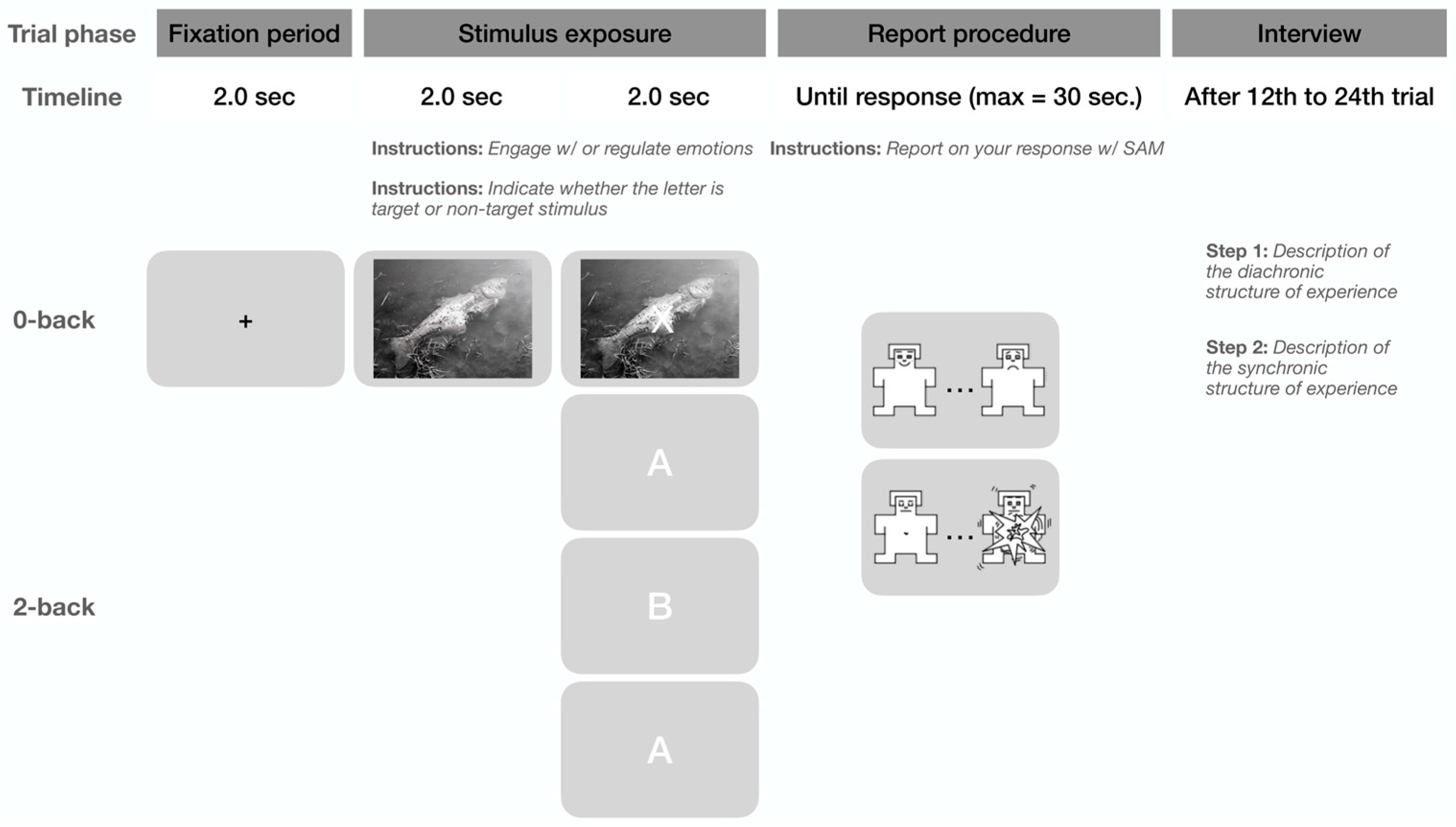
2.3. Protocol
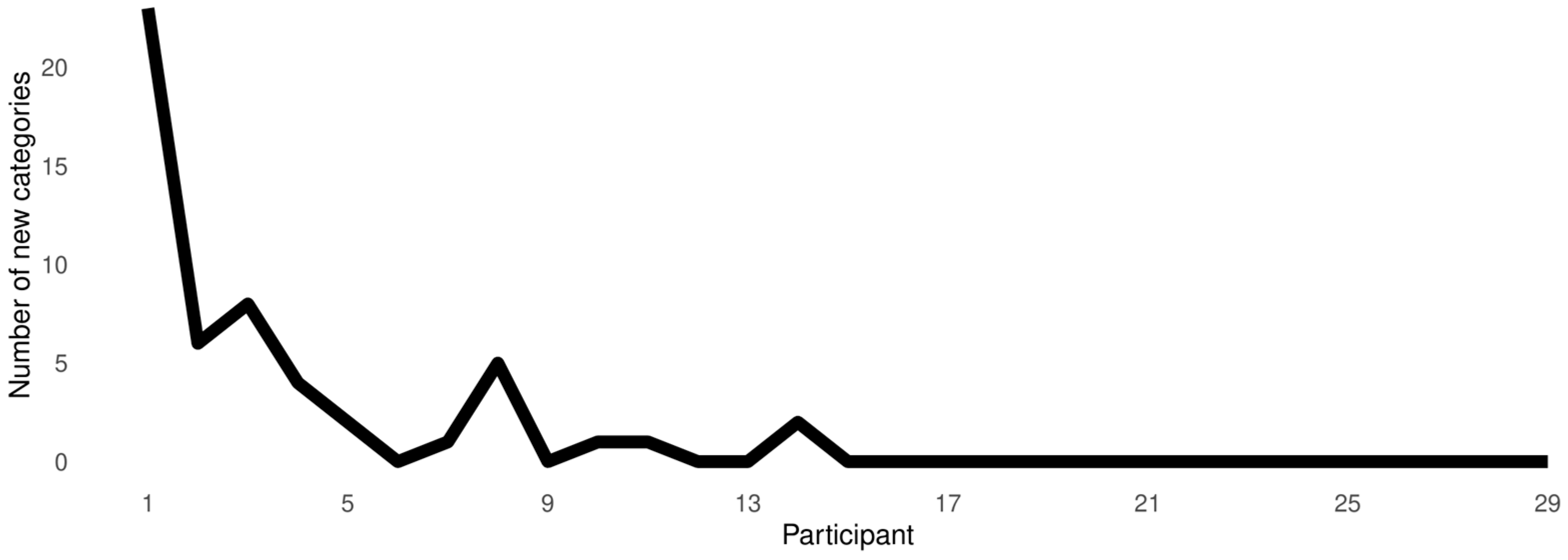
2.4. Analysis
3. Results
The emotional task was the more important one yes. It said so in the instructions. […] I perceived it as primary. It took over a larger part of my field of experience. I also found it more challenging.(EmReg-P-14-T-04)
The cognitive task was the more important. I think because it was more difficult.(EmReg-P-20-T-03)
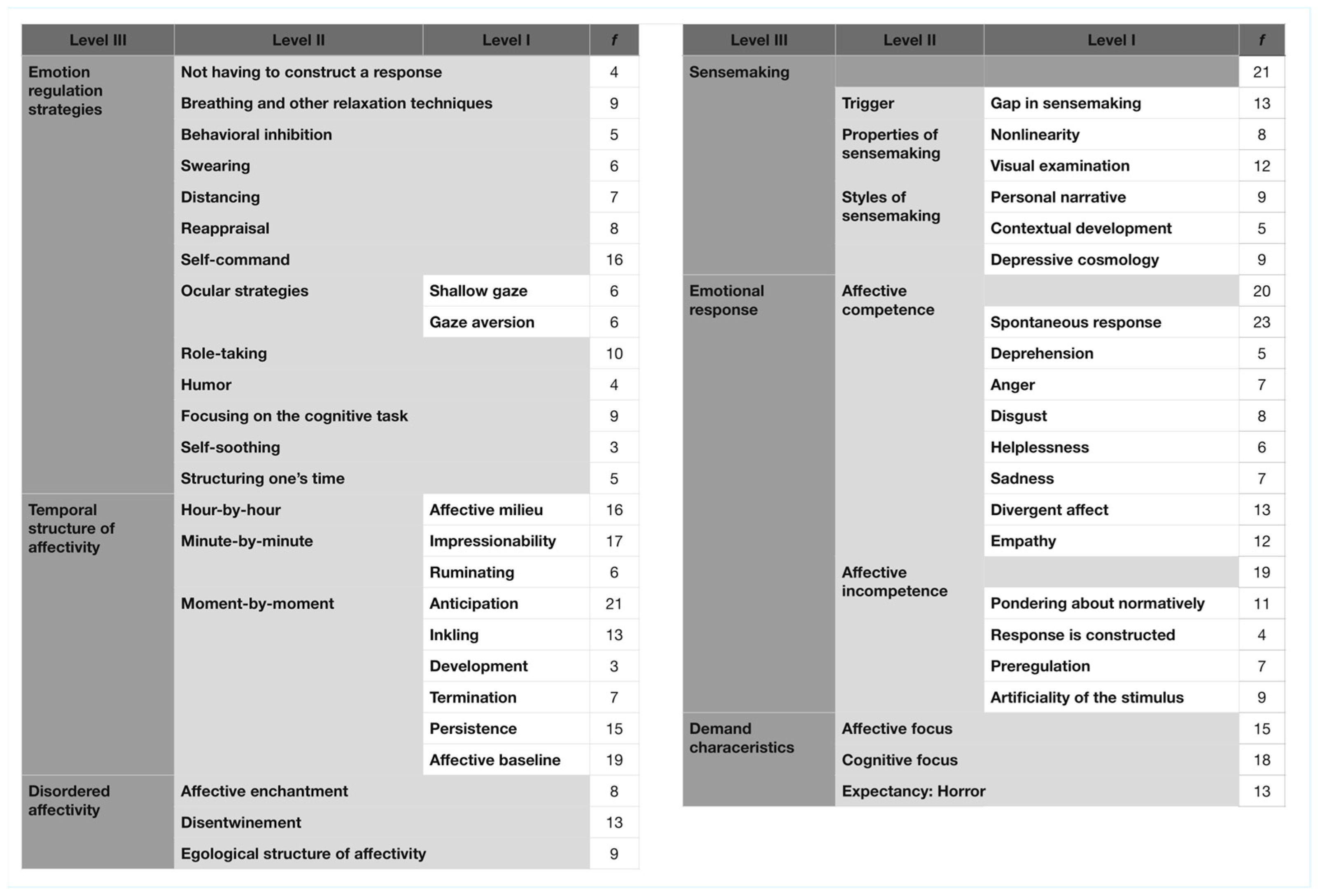
3.1. Emotional Response
I did not experience [the stimulus] that intensely. It reminded me of a scene in a movie. It helped me not get too immersed in it. […] It wasn’t as shocking. There is some blood but whatever.(EmReg-P-14-T-02)
There is a rational blockage. I am able to use it from time to time. I can rationally stop what would otherwise happen on its own. […] It is difficult for me to describe it really. I am simply preventing myself from feeling this ahead of time.(EmReg-P-26-T-04)
When I saw the slashed up face. The pain is already in the image. It is a human pain. The human life is directly visually connected with me.(EmReg-P-25-T-02)
I did not really feel it all that much. So much was going on that it is difficult to parse out what even was the impact of the image. […] It was a very small emotional experience. […] And it went away quickly. […] It was more of a stirring of an emotion. […] Not a lot was going on inside of me.(EmReg-P-17-T-01)
I feel a sense of sorrow. Empathy towards someone. I feel helpless. […] The anger was in my heart. […] Anger rouses me. There is this anxiety to it. Sadness makes me apathetic. I feel helpless.(EmReg-P-25-T-01)
There was this boy with a damaged eye. It was pretty interesting. I noticed this detail. There is a tear in his other eye. It was interesting to me how I was able to notice these details.(EmReg-P-16-T-04)
3.2. Constructing an Emotional Response
There is a sense of quote-unquote being filled up by these rational contents and the feeling of bodily connections. There was this linear growth of contents. […] I can feel a gradient of what I can imagine. The hand on the image being my hand. How I would have felt like with a hand like that. It is very clear when I start to look at it where it will go. And with every moment that I stay in that, it is becoming more full and complete. As if I go inside of that feeling […] there is this feeling that will become fulfilled: “It will happen, it will happen. Your heart will start racing, your breath will become less rhythmic. You will feel how it is pushing you inwards.” As if this anticipated state is slowly being fulfilled. And when it is suddenly interrupted, there is this awareness: “Aha, this would have continued on and on and on if I had more time.(EmReg-P-03-T-01)
I see it and then I have this thought: “Oh, damn. This is basically something else than what you initially thought.” And then it builds up: “You messed it up!” And then, there comes this feeling of guilt. I remember that moment really well. […] It was as if my mind and the screen froze.(EmReg-P-12-T-02)
It’s just another bad thing, you know. Another bad thing among the endless bad things that I had seen in my life.(EmReg-P-26-T-01)
It really helps me that I don’t have very intense emotions, and if I imagined having them. […] Even when I’m sometimes in phases where I have more […] intense feelings, it wouldn’t work for me to live in this way for longer.(EmReg-P-17-T-02)
I feel that humans are basically corrupted animals. I feel more sorry for the deer and animals than for people. It’s really hard for me because I see that they are hungry […] Many animals are alone, homeless, living in their own filth, because humans don’t take care of them.(EmReg-P-13-T-01)
We react unconsciously. […] How should I say, non-subjective… So that pure emotion relates to an immediate imprint that the image leaves. Yes, that’s the unconscious.(EmReg-P-25-T-02)
3.3. Disordered Affectivity
3.3.1. Affective Enchantment
I am not looking at the image. The image forces me to look at it. […] It is like the image enchants [Slo. “zacoprati”] you. It keeps you in. […] I don’t do anything. […] It pulls me in. I belong to it. […] I am not doing this consciously. Something simply vibrates.(EmReg-P-01-T-03)
It dragged me away. I felt like it pulled me into this emotional vortex. I started to get dizzy. […] There is this overall feeling of loss of control.(EmReg-P-16-T-03)
The most annoying are those images that stay with me. They are potentially real. Bad things that can happen in your life. […] Damn, a car crash. This is worrying. I am actually involved in circumstances where these things can happen. And to it stays with you for a while.(EmReg-P-18-T-01)
I looked at the image entirely without a filter. […] There was a flow of associations that I was creating. And it created a response. […] But then I stopped looking at the image so intensely. I placed a filter on my mind. […] I did not want to immerse myself in the images more than necessary. I am very susceptible to this. To let myself go too much. I know that I have the power to regulate myself. How much of this emotional content can I dose? […] I had been in situations where I was looking at horror movies and I couldn’t finish watching a scene. […] These things tend to follow me for a while.(EmReg-30-T-01)
There is this childish aspect to it all. […] When a child goes out on the street, they are looking at the sky and it starts to rain, they will say: “Wow, it’s raining!” We lose this as adults. We no longer experience wonder at everyday things.(EmReg-P-29-T-02)
I felt a bit anxious. […] For example, when I was washing the dishes, these images […] like those memories. When you remember those images. […] It had something to do with that task. Like something was happening in my brain, like something confused me internally, and I know the system, like how to pull myself together, but it was like I got thrown out of it. And then I had to somehow get myself back together. […] It feels like it was somehow connected to that task itself.(EmReg-P-10-T-04-02)
I’ve kind of developed these little routines for myself. Like, if I’m holding something in my hand, or have something tangible on my body that I can touch. Because sometimes I’d start having these thoughts where I’d just begin rambling philosophically, like, what if this cup isn’t even real? And then I’d get completely confused. Like, what if I’m already like that, and it’s all just imagined stuff, some kind of hologram.(EmReg-P-10-T-04-02)
3.3.2. Disintwinement
I feel separate from the rest of the environment and other people. […] My reactions can be appropriate, but I still feel very far. Like there is water between me and the world. There is an expanse that I feel between here and there. […] [The task] was at a distance. It was so far way that even if it was really intense, it wouldn’t have dragged me with it.(EmReg-P-08-T-01)
I felt like I was sunk in my head. […] It felt like I was farther away from the world.(EmReg-P-19-T-03)
There is no feeling of emotions. […] I feel flat. There is nothing. […] It feels like there is empty space in front of me. Something empty. I feel like there is nothing there. […] Where the screen is located, it feels like my whole reality is monochrome. […] I cannot discern what I am feeling, what I am thinking.(EmReg-P-12-T-01)
If I compare it to situations where I felt like I was in control, I knew what the next steps are. I knew what I have to do. I trusted in my ability to know how to follow these steps. Whereas now, when I felt like I had lost control, I knew what would follow, but I was not able to really pay attention to the next step. Everything was moving so quickly and in consequence, I did not have as much faith in myself to respond correctly to the task.(EmReg-P-14-T-03)
If I were too open to these things that are around us, you can just cry for 24 h every day. And so, I had to invent strategies for how to become completely numb.(EmReg-P-05-T-01)
There are these two completely different worlds. In the rational world everything has its “why” and “because.” Everything can be logically explained. Everything can be analyzed. Everything can be put into its place, everything has its own allotted slot. Everything can be ordered using information and intellect. In my emotional world, it is not like that. In a way, things are more chaotic. I have difficulties controlling this world. That is the difference. This world is irrational and it is very intense.(EmReg-P-05-T-01)
3.4. Timing of Emotional Response
My muscles were more tense. I had to invest a lot more energy into being focused. And at the same time, because of that, I feel I didn’t do quite as well on the task. […] I am sitting in a different way. I am kind of unrelaxed. […] My gaze keeps wandering. I had to actively direct it. I needed to keep focusing my mind on one thing.(EmReg-P-07-T-01)
It is the initial phase of crying. When you feel like you are about to start crying.(EmReg-P-05-T-01)
It wasn’t completely gone. […] [During the report period] I can feel it how I felt them then, or at least I can remember how I felt a few seconds ago. […] Sad images never truly went away.(EmReg-P-15-T-01)
If I am completely honest, I am experiencing the emotions now. So, they come with a delay. […] Before, my experience was very rational. There was this experience of analysis. […] Now, after this delay, I really feel hurt.(EmReg-P-05-T-01)
3.5. Emotion Regulation Strategies
I put myself into this state of prideful apathy. Where this will not hurt me. […] The apathy is a sense of hardness. I am creating this hard aura. It is tough, unyielding. It will protect me. There is this initial burst of emotion. I move past that. And then the aura remains solid. I look at the image. There is a corpse there. It does not matter whether it is a real body or a mannequin. No matter what, my response will be apathy. Prideful apathy in which I cannot get hurt.(EmReg-P-20-T-01)
I learned how to do this in psychotherapy. […] I tried to find different ways that would be useful for me. It was a very technical thing for me. Something that would help me get over these feelings.(EmReg-P-10-T-03)
4. Discussion
Limitations and Future Directions
5. Conclusions
Supplementary Materials
Author Contributions
Funding
Institutional Review Board Statement
Informed Consent Statement
Data Availability Statement
Acknowledgments
Conflicts of Interest
References
- Calkins, S.D. Commentary: Conceptual and Methodological Challenges to the Study of Emotion Regulation and Psychopathology. J. Psychopathol. Behav. Assess. 2010, 32, 92–95. [Google Scholar] [CrossRef] [Scilit]
- Gross, J.J.; Thompson, R.A. Emotion Regulation: Conceptual Foundations. In Handbook of Emotion Regulation; The Guilford Press: New York, NY, USA, 2007; pp. 3–24. [Google Scholar]
- Gross, J.J. The Emerging Field of Emotion Regulation: An Integrative Review. Rev. Gen. Psychol. 1998, 2, 271–299. [Google Scholar] [CrossRef]
- Gross, J.J. Emotion regulation: Current status and future prospects. Psychol. Inq. 2015, 26, 1–26. [Google Scholar] [CrossRef] [Scilit]
- Aldao, A.; Nolen-Hoeksema, S.; Schweizer, S. Emotion-regulation strategies across psychopathology: A meta-analytic review. Clin. Psychol. Rev. 2010, 30, 217–237. [Google Scholar] [CrossRef] [Scilit] [PubMed]
- Aldao, A.; Nolen-Hoeksema, S. Specificity of cognitive emotion regulation strategies: A transdiagnostic examination. Behav. Res. Ther. 2010, 48, 974–983. [Google Scholar] [CrossRef] [Scilit] [PubMed]
- Appleton, A.A.; Loucks, E.B.; Buka, S.L.; Kubzansky, L.D. Divergent Associations of Antecedent- and Response-Focused Emotion Regulation Strategies with Midlife Cardiovascular Disease Risk. Ann. Behav. Med. 2014, 48, 246–255. [Google Scholar] [CrossRef] [Scilit]
- Kobylińska, D.; Karwowska, D. How automatic activation of emotion regulation influences experiencing negative emotions. Front. Psychol. 2015, 6, 1628. [Google Scholar]
- Conklin, L.R.; Cassiello-Robbins, C.; Brake, C.A.; Sauer-Zavala, S.; Farchione, T.J.; Ciraulo, D.A.; Barlow, D.H. Relationships Among Adaptive and Maladaptive Emotion Regulation Strategies and Psychopathology During the Treatment of Comorbid Anxiety and Alcohol Use Disorders. Behav. Res. Ther. 2015, 73, 124–130. [Google Scholar] [CrossRef] [Scilit]
- Izard, C.; Stark, K.; Trentacosta, C.; Schultz, D. Beyond Emotion Regulation: Emotion Utilization and Adaptive Functioning. Child. Dev. Perspect. 2008, 2, 156–163. [Google Scholar] [CrossRef] [Scilit]
- Van der Kolk, B.A. The Body Keeps the Score: Mind, Brain and Body in the Transformation of Trauma; Penguin Books: London, UK, 2015; 540 p. [Google Scholar]
- Dörfel, D.; Lamke, J.P.; Hummel, F.; Wagner, U.; Erk, S.; Walter, H. Common and differential neural networks of emotion regulation by Detachment, Reinterpretation, Distraction, and Expressive Suppression: A comparative fMRI investigation. NeuroImage 2014, 101, 298–309. [Google Scholar] [CrossRef] [Scilit]
- Webb, T.L.; Miles, E.; Sheeran, P. Dealing with feeling: A meta-analysis of the effectiveness of strategies derived from the process model of emotion regulation. Psychol. Bull. 2012, 138, 775–808. [Google Scholar] [CrossRef] [Scilit]
- Aldao, A.; Gee, D.G.; De Los Reyes, A.; Seager, I. Emotion regulation as a transdiagnostic factor in the development of internalizing and externalizing psychopathology: Current and future directions. Dev. Psychopathol. 2016, 28, 927–946. [Google Scholar] [CrossRef] [Scilit]
- Aslan, I.H.; Dorey, L.; Grant, J.E.; Chamberlain, S.R. Emotion regulation across psychiatric disorders. CNS Spectr. 2024, 29, 215–220. [Google Scholar] [CrossRef] [Scilit]
- Blay, M.; Duarte, M.; Dessouli, M.A.; Durpoix, A.; Rüfenacht, E.; Weibel, S.; Speranza, M.; Perroud, N. Proposition of a transdiagnostic processual approach of emotion dysregulation based on core triggers and interpersonal styles. Front. Psychiatry 2024, 15, 1260138. [Google Scholar] [CrossRef] [Scilit]
- Fernandez, K.C.; Jazaieri, H.; Gross, J.J. Emotion Regulation: A Transdiagnostic Perspective on a New RDoC Domain. Cogn. Ther. Res. 2016, 40, 426–440. [Google Scholar] [CrossRef] [Scilit] [PubMed]
- Colmenero-Navarrete, L.; García-Sancho, E.; Salguero, J.M. Relationship Between Emotion Regulation and Suicide Ideation and Attempt in Adults and Adolescents: A Systematic Review. Arch. Suicide Res. 2022, 26, 1702–1735. [Google Scholar] [CrossRef] [Scilit] [PubMed]
- Easdale-Cheele, T.; Parlatini, V.; Cortese, S.; Bellato, A. A Narrative Review of the Efficacy of Interventions for Emotional Dysregulation, and Underlying Bio–Psycho–Social Factors. Brain Sci. 2024, 14, 453. [Google Scholar] [CrossRef] [Scilit]
- Nutt, D.; De Miguel, B.G.; Davies, S.J.C. Chapter 5.1 Phenomenology of anxiety disorders. In Handbook of Behavioral Neuroscience [Internet]; Elsevier: Amsterdam, The Netherlands, 2008; pp. 365–393. Available online: https://linkinghub.elsevier.com/retrieve/pii/S1569733907000173 (accessed on 27 November 2024).
- Cambridge Textbook of Neuroscience for Psychiatrists; Lynall, M.E., Jones, P.B., Stahl, S.M., Eds.; Cambridge University Press: Cambridge, UK; New York, NY, USA, 2024; 598p. [Google Scholar]
- Nolen-Hoeksema, S. Responses to depression and their effects on the duration of depressive episodes. J. Abnorm. Psychol. 1991, 100, 569–582. [Google Scholar] [CrossRef]
- Nolen-Hoeksema, S. The role of rumination in depressive disorders and mixed anxiety/depressive symptoms. J. Abnorm. Psychol. 2000, 109, 504–511. [Google Scholar] [CrossRef]
- Nolen-hoeksema, S.; Morrow, J. Effects of rumination and distraction on naturally occurring depressed mood. Cogn. Emot. 1993, 7, 561–570. [Google Scholar] [CrossRef] [Scilit]
- Chu, S.A.; Tadayonnejad, R.; Corlier, J.; Wilson, A.C.; Leuchter, A.F. Rumination: Relationships with repetitive transcranial magnetic stimulation treatment of major depressive disorder. Brain Stimulat. 2021, 14, 1693. [Google Scholar] [CrossRef] [Scilit]
- Chu, S.A.; Tadayonnejad, R.; Corlier, J.; Wilson, A.C.; Citrenbaum, C.; Leuchter, A.F. Rumination symptoms in treatment-resistant major depressive disorder, and outcomes of repetitive Transcranial Magnetic Stimulation (rTMS) treatment. Transl. Psychiatry 2023, 13, 293. [Google Scholar] [CrossRef] [Scilit]
- Cisler, J.M.; Olatunji, B.O.; Feldner, M.T.; Forsyth, J.P. Emotion Regulation and the Anxiety Disorders: An Integrative Review. J. Psychopathol. Behav. Assess. 2010, 32, 68–82. [Google Scholar] [CrossRef] [Scilit]
- Rodrigues, A.R.; Castro, D.; Cardoso, J.; Ferreira, F.; Serrão, C.; Coelho, C.M.; Meira, L.; Ferreira, T.B. A network approach to emotion regulation and symptom activation in depression and anxiety. Front. Public Health 2024, 12, 1362148. [Google Scholar] [CrossRef] [Scilit]
- Laddis, A. The Pathogenesis and Treatment of Emotion Dysregulation in Borderline Personality Disorder. Sci. World J. 2015, 2015, 179276. [Google Scholar] [CrossRef] [Scilit] [PubMed]
- D’Aurizio, G.; Di Stefano, R.; Socci, V.; Rossi, A.; Barlattani, T.; Pacitti, F.; Rossi, R. The role of emotional instability in borderline personality disorder: A systematic review. Ann. Gen. Psychiatry 2023, 22, 9. [Google Scholar] [CrossRef] [Scilit]
- Stanghellini, G.; Rosfort, R. Borderline Depression a Desperate Vitality. J. Conscious Stud. 2013, 20, 7–8. [Google Scholar]
- Gross, J.J.; John, O.P. Individual differences in two emotion regulation processes: Implications for affect, relationships, and well-being. J. Pers. Soc. Psychol. 2003, 85, 348–362. [Google Scholar] [CrossRef] [Scilit] [PubMed]
- Kelley, N.J.; Glazer, J.E.; Pornpattananangkul, N.; Nusslock, R. Reappraisal and suppression emotion-regulation tendencies differentially predict reward-responsivity and psychological well-being. Biol. Psychol. 2019, 140, 35–47. [Google Scholar] [CrossRef] [Scilit] [PubMed]
- Gratz, K.L.; Tull, M.T. A clinically useful conceptualization of emotion regulation grounded in functional contextualism and evolutionary theory. World Psychiatry Off. J. World Psychiatr. Assoc. WPA 2022, 21, 460–461. [Google Scholar] [CrossRef] [Scilit]
- Preece, D.A.; Mehta, A.; Petrova, K.; Sikka, P.; Bjureberg, J.; Becerra, R.; Gross, J.J. Alexithymia and emotion regulation. J. Affect. Disord. 2023, 324, 232–238. [Google Scholar] [CrossRef] [Scilit]
- Dan-Glauser, E.S.; Scherer, K.R. The Geneva affective picture database (GAPED): A new 730-picture database focusing on valence and normative significance. Behav. Res. Methods 2011, 43, 468–477. [Google Scholar] [CrossRef] [Scilit]
- Kurdi, B.; Lozano, S.; Banaji, M.R. Introducing the Open Affective Standardized Image Set (OASIS). Behav. Res. Methods 2017, 49, 457–470. [Google Scholar] [CrossRef] [Scilit]
- Libkuman, T.M.; Otani, H.; Kern, R.; Viger, S.G.; Novak, N. Multidimensional normative ratings for the International Affective Picture System. Behav. Res. Methods 2007, 39, 326–334. [Google Scholar] [CrossRef] [Scilit]
- Russell, J.A. A circumplex model of affect. J. Pers. Soc. Psychol. 1980, 39, 1161–1178. [Google Scholar] [CrossRef] [Scilit]
- Fernández-Aguilar, L.; Navarro-Bravo, B.; Ricarte, J.; Ros, L.; Latorre, J.M. How effective are films in inducing positive and negative emotional states? A meta-analysis. PLoS ONE 2019, 14, e0225040. [Google Scholar] [CrossRef] [Scilit]
- Gross, J.J.; Levenson, R.W. Emotion elicitation using films. Cogn. Emot. 1995, 9, 87–108. [Google Scholar] [CrossRef] [Scilit]
- Maffei, A.; Angrilli, A. E-MOVIE—Experimental MOVies for Induction of Emotions in neuroscience: An innovative film database with normative data and sex differences. Greco A, editor. PLoS ONE 2019, 14, e0223124. [Google Scholar] [CrossRef] [Scilit] [PubMed]
- Romeo, Z.; Fusina, F.; Semenzato, L.; Bonato, M.; Angrilli, A.; Spironelli, C. Comparison of Slides and Video Clips as Different Methods for Inducing Emotions: An Electroencephalographic Alpha Modulation Study. Front. Hum. Neurosci. 2022, 16, 901422. Available online: https://www.frontiersin.org/journals/human-neuroscience/articles/10.3389/fnhum.2022.901422/full (accessed on 7 April 2025). [CrossRef] [Scilit] [PubMed]
- Luck, S.J. An Introduction to the Event-Related Potential Technique, 2nd ed.; The MIT Press: Cambridge, MA, USA, 2014; 406p. [Google Scholar]
- Hajcak, G.; MacNamara, A.; Olvet, D.M. Event-related potentials, emotion, and emotion regulation: An integrative review. Dev. Neuropsychol. 2010, 35, 129–155. [Google Scholar] [CrossRef] [Scilit]
- Moran, T.P.; Jendrusina, A.A.; Moser, J.S. The psychometric properties of the late positive potential during emotion processing and regulation. Brain Res. 2013, 1516, 66–75. [Google Scholar] [CrossRef] [Scilit]
- Smith, E.E.; Reznik, S.J.; Stewart, J.L.; Allen, J.J.B. Assessing and conceptualizing frontal EEG asymmetry: An updated primer on recording, processing, analyzing, and interpreting frontal alpha asymmetry. Int. J. Psychophysiol. 2017, 111, 98–114. [Google Scholar] [CrossRef] [Scilit]
- Biró, B.; Cserjési, R.; Kocsel, N.; Galambos, A.; Gecse, K.; Kovács, L.N.; Baksa, D.; Dobos, D.; Juhász, G.; Kökönyei, G. Unveiling the Role of Theory of Mind: Neural Response to Emotional Stimuli in Context. Affect. Sci. 2025, 6, 340–355. [Google Scholar] [CrossRef] [Scilit] [PubMed]
- Kassam, K.S.; Markey, A.R.; Cherkassky, V.L.; Loewenstein, G.; Just, M.A. Identifying Emotions on the Basis of Neural Activation. PLoS ONE 2013, 8, e66032. [Google Scholar] [CrossRef] [Scilit]
- Kołodziej, A.; Magnuski, M.; Ruban, A.; Brzezicka, A. No relationship between frontal alpha asymmetry and depressive disorders in a multiverse analysis of five studies. eLife 2021, 10, e60595. [Google Scholar] [CrossRef] [Scilit] [PubMed]
- Nikolin, S.; Chand, N.; Martin, D.; Rushby, J.; Loo, C.K.; Boonstra, T.W. Little evidence for a reduced late positive potential to unpleasant stimuli in major depressive disorder. Neuroimage Rep. 2022, 2, 100077. [Google Scholar] [CrossRef] [Scilit]
- Berkovich-Ohana, A.; Dor-Ziderman, Y.; Trautwein, F.M.; Schweitzer, Y.; Nave, O.; Fulder, S.; Ataria, Y. The Hitchhiker’s Guide to Neurophenomenology—The Case of Studying Self Boundaries With Meditators. Front. Psychol. 2020, 11, 1680. [Google Scholar] [CrossRef] [Scilit]
- Froese, T.; Gould, C.; Seth, A.K. Validating and calibrating first-and second-person methods in the science of consciousness. J. Conscious Stud. 2011, 18, 38. [Google Scholar]
- Gallagher, S. Phenomenology and Experimental Design Toward a Phenomenologically Enlightened Experimental Science. J. Conscious Stud. 2003, 10, 85–99. [Google Scholar]
- Varela, F.J. Neurophenomenology: A methodological remedy for the hard problem. J. Conscious Stud. 1996, 3, 330–349. [Google Scholar]
- Lutz, A. Toward a neurophenomenology as an account of generative passages: A first empirical case study. Phenomenol. Cogn. Sci. 2002, 1, 133–167. [Google Scholar] [CrossRef] [Scilit]
- Oblak, A.; Slana Ozimič, A.; Repovš, G.; Kordeš, U. What Individuals Experience During Visuo-Spatial Working Memory Task Performance: An Exploratory Phenomenological Study. Front. Psychol. 2022, 13, 811712. [Google Scholar] [CrossRef] [Scilit]
- Oblak, A.; Dragan, O.; Slana Ozimič, A.; Kordeš, U.; Purg, N.; Bon, J.; Repovš, G. What is it like to do a visuo-spatial working memory task: A qualitative phenomenological study of the visual span task. Conscious Cogn. 2024, 118, 103628. [Google Scholar] [CrossRef] [Scilit]
- Slana Ozimič, A.; Oblak, A.; Kordeš, U.; Purg, N.; Bon, J.; Repovš, G. The diversity of strategies used in working memory for colors, orientations, and positions: A quantitative approach to a first-person inquiry. Cogn. Sci. 2023, 47, e13333. [Google Scholar]
- Laybourn, S.; Frenzel, A.C.; Constant, M.; Liesefeld, H.R. Unintended emotions in the laboratory: Emotions incidentally induced by a standard visual working memory task relate to task performance. J. Exp. Psychol. Gen. 2022, 151, 1591–1605. [Google Scholar] [CrossRef] [Scilit]
- Hurlburt, R.T.; Alderson-Day, B.; Kühn, S.; Fernyhough, C. Exploring the ecological validity of thinking on demand: Neural correlates of elicited vs. spontaneously occurring inner speech. PLoS ONE 2016, 11, e0147932. [Google Scholar] [CrossRef] [Scilit]
- Nelson, J. Using conceptual depth criteria: Addressing the challenge of reaching saturation in qualitative research. Qual. Res. 2017, 17, 554–570. [Google Scholar] [CrossRef] [Scilit]
- Owen, G.S.; Freyenhagen, F.; Hotopf, M.; Martin, W. Temporal inabilities and decision-making capacity in depression. Phenomenol. Cogn. Sci. 2015, 14, 163–182. [Google Scholar] [CrossRef] [Scilit]
- Yang, H.; Van Vugt, M. “Sticky” thinking disrupts decision making for individuals with a tendency toward worry and depression. Emotion 2025, 25, 997–1010. [Google Scholar] [CrossRef] [Scilit]
- Rogiers, R.; Van Parys, H.; Baeken, C.; Van Den Abbeele, D.; Remue, J.; De Raedt, R.; Lemmens, G.M.D. Treatment experiences during a cognitive behaviour therapy group intervention targeting repetitive negative thinking: A qualitative study. Psychol. Psychother. Theory Res. Pract. 2022, 95, 447–466. [Google Scholar] [CrossRef] [Scilit] [PubMed]
- Chalmers, D. In The Blackwell Companion to Consciousness; Velmans, M., Schneider, S., Eds.; The Hard Problem of Consciousness. Wiley-Blackwell: Chichester, UK, 2008; pp. 32–42. [Google Scholar]
- Varela, F. In Naturalizing Phenomenology; Petitot, J., Varela, F.J., Pacoud, B., Roy, J.M., Eds.; The specious present: A neurophenomenology of time consciousness. Stanford University Press: Redwood City, CA, USA, 1999; pp. 266–314. [Google Scholar]
- Vörös, S. Podobe Neupodobljivega: (Nevro)Znanost, Fenomenologija, Mistika; KUD Logos: Ljubljana, Slovenia, 2016. [Google Scholar]
- Bitbol, M.; Part, I. In Surprise at the Intersection of Phenomenology and Linguistics; Depraz, N., Celle, A., Eds.; The temporality of surprise: A dynamic process opening up possibilities: 1. Neurophenomenology of surprise. John Benjamins: Groningen, The Netherlands, 2019. [Google Scholar]
- Lifshitz, M.; Sheiner, E.; Kirmayer, L.J. Cultural Neurophenomenology of Psychedelic Thought [Internet]; Christoff, K., Fox, K.C.R., Eds.; Oxford University Press: Oxford, UK, 2018; Volume 1, Available online: https://academic.oup.com/edited-volume/38694/chapter/336056718 (accessed on 1 May 2023).
- Timmermann, C.; Roseman, L.; Schartner, M.; Milliere, R.; Williams, L.T.J.; Erritzoe, D.; Muthukumaraswamy, S.; Ashton, M.; Bendrioua, A.; Kaur, O.; et al. Neural correlates of the DMT experience assessed with multivariate EEG. Sci. Rep. 2019, 9, 16324. [Google Scholar] [CrossRef] [Scilit]
- Petrač, P. Povezave Med Fiziološkimi in Doživljajskimi Korelati Reševanja Računskih Nalog. Master’s Thesis, Univerza v Ljubljani, Pedagoška Fakulteta, Ljubljana, Slovenia, 2022. Available online: https://repozitorij.uni-lj.si/IzpisGradiva.php?id=142424 (accessed on 29 December 2025).
- Oblak, A. Visual Representation in the Wild: Empirical Phenomenological Investigation of Visual-spatial Working Memory in a Naturalistic Setting. Constr. Found. 2020, 15, 238–250. [Google Scholar]
- Purg, N.; Starc, M.; Slana Ozimič, A.; Kraljič, A.; Matkovič, A.; Repovš, G. Neural Evidence for Different Types of Position Coding Strategies in Spatial Working Memory. Front. Hum. Neurosci. 2022, 16, 821545. [Google Scholar] [CrossRef] [Scilit]
- Perellón-Alfonso, R.; Oblak, A.; Kuclar, M.; Škrlj, B.; Pileckyte, I.; Škodlar, B.; Pregelj, P.; Abellaneda-Pérez, K.; Bartrés-Faz, D.; Repovš, G.; et al. Dense attention network identifies EEG abnormalities during working memory performance of patients with schizophrenia. Front. Psychiatry 2023, 14, 1205119. [Google Scholar] [CrossRef] [Scilit]
- Oblak, A. Participatory Sense-making as Consensual Validation of Phenomenal Data. Interdiscip Descr. Complex Syst. 2021, 19, 470–492. [Google Scholar] [CrossRef] [Scilit]
- Oblak, A.; Milotić, D.; Škodlar, B.; Bon, J. Phenomenology and Temporality in Psychopathology: Calibrating Qualitative Phenomenological Methods According to the Timescale of Subjective Reports. J. Conscious Stud. 2024, 31, 144–170. [Google Scholar] [CrossRef] [Scilit]
- Slana Ozimič, A.; Purg Suljič, N.; Oblak, A.; Bon, J.; Strle, T.; Repovš, G. Bridging Behavioural, Neural, and First-Person Insights into Working Memory Strategies: A Multi-Level Framework. Ars. Humanit. 2025, 19, 125–144. [Google Scholar] [CrossRef] [Scilit]
- Černe, J.; Kordeš, U. Deconstructing Accurate and Inaccurate Recall in the DRM Paradigm: A Phenomenological and Behavioral Exploration. Constr. Found. 2023, 19, 38–59. [Google Scholar]
- Froese, T.; Gould, C.; Seth, A.K. Re-viewing from Within: A Commentary on First- and Second-Person Methods in the Science of Consciousness. Constr. Found. 2011, 6, 264–269. [Google Scholar]
- Hurlburt, R.T. Investigating Pristine Inner Experience: Moments of Truth; Cambridge University Press: New York, NY, USA, 2011; 457p. [Google Scholar]
- Petitmengin, C. Describing one’s subjective experience in the second person: An interview method for the science of consciousness. Phenomenol. Cogn. Sci. 2006, 5, 229–269. [Google Scholar] [CrossRef] [Scilit]
- Petitmengin, C. Micro-phenomenology as coming into contact with experience: Subtilisation, surprises, and liberation. In Practicing Embodied Thinking in Research and Learning; Routledge: Abingdon, UK, 2024. [Google Scholar]
- Valenzuela-Moguillansky, C.; Vásquez-Rosati, A. An Analysis Procedure for the Micro-Phenomenological Interview. Constr. Found. 2019, 14, 123–145. [Google Scholar]
- Petitmengin, C.; Lachaux, J.P. Microcognitive science: Bridging experiential and neuronal microdynamics. Front. Hum. Neurosci. 2013, 7, 617. [Google Scholar] [CrossRef] [Scilit]
- Charmaz, K. Constructing Grounded Theory, 2nd ed.; Sage: Thousand Oaks, CA, USA; London, UK, 2014; 388p. [Google Scholar]
- von Glasersfeld, E. Radical Constructivism: A Way of Knowing and Learning. Reprint; Routledge Falmer: London, UK, 2002; 213p, (Studies in mathematics education series). [Google Scholar]
- Husserl, E. Ideas: General Introduction to Pure Phenomenology; Routledge: London, UK; New York, NY, USA, 2012; 376p, (Routledge classics). [Google Scholar]
- Sartre, J.P. Being and Nothingness: An Essay in Phenomenological Ontology; Routledge: Abingdon, Oxon, UK, 2020. [Google Scholar]
- Heidegger, M.; Stambaugh, J.; Schmidt, D.J. Being and Time; State University of New York Press: Albany, NY, USA, 2010; 482p, (SUNY series in contemporary continental philosophy). [Google Scholar]
- Taylor, J.J.; Williams, N.R.; George, M.S. Beyond Neural Cubism: Promoting a Multidimensional View of Brain Disorders by Enhancing the Integration of Neurology and Psychiatry in Education. Acad. Med. 2015, 90, 581–586. [Google Scholar] [CrossRef] [Scilit] [PubMed]
- De Haan, S. Enactive Psychiatry [Internet], 1st ed.; Cambridge University Press: Cambridge, UK, 2020; Available online: https://www.cambridge.org/core/product/identifier/9781108685214/type/book (accessed on 1 May 2023).
- Parnas, J. The RDoC program: Psychiatry without psyche? World Psychiatry 2014, 13, 46–47. [Google Scholar] [CrossRef] [Scilit] [PubMed]
- Levitt, H.M.; Bamberg, M.; Creswell, J.W.; Frost, D.M.; Josselson, R.; Suárez-Orozco, C. Journal article reporting standards for qualitative primary, qualitative meta-analytic, and mixed methods research in psychology: The APA Publications and Communications Board task force report. Am. Psychol. 2018, 73, 26–46. [Google Scholar] [CrossRef] [Scilit]
- Oblak, A.; Golob, K.; Rigler, S.; Repovš, G.; Bon, J.; Jamnik, K. Vibing Out with the Task: A Qualitative Phenomenological Study of Emotion Engagement and Regulation Tasks [Internet]; OSF: Charlottesville, VA, USA, 2025; Available online: https://osf.io/dnhau_v1 (accessed on 20 September 2025).
- LeDoux, J.E.; Damasio, A.R. Emotions and Feelings. In Principles of Neural Science, 5th ed.; McGraw-Hill: New York, NY, USA, 2012; pp. 1079–1094. [Google Scholar]
- Sandberg, J.; Tsoukas, H. Sensemaking Reconsidered: Towards a broader understanding through phenomenology. Organ. Theory 2020, 1, 263178771987993. [Google Scholar] [CrossRef] [Scilit]
- Leahy, R.L. Introduction: Emotional Schemas and Emotional Schema Therapy. Int. J. Cogn. Ther. 2019, 12, 1–4. [Google Scholar] [CrossRef] [Scilit]
- Leahy, R.L. Emotional Schemas. Cogn. Behav. Pract. 2022, 29, 575–580. [Google Scholar] [CrossRef] [Scilit]
- Depraz, N. The rainbow of emotions: At the crossroads of neurobiology and phenomenology. Cont. Philos. Rev. 2008, 41, 237–259. [Google Scholar] [CrossRef] [Scilit]
- Steinbock, A.J. (Ed.) Phenomenology and Perspectives on the Heart [Internet]; Springer International Publishing: Cham, Switzerland, 2022; Available online: https://link.springer.com/10.1007/978-3-030-91928-3 (accessed on 20 September 2024).
- Miyahara, K.; Niikawa, T.; Hamada, H.T.; Nishida, S. Developing a short-term phenomenological training program: A report of methodological lessons. New Ideas Psychol. 2020, 58, 100780. [Google Scholar] [CrossRef] [Scilit]
- Bradley, M.M.; Lang, P.J. Measuring emotion: The self-assessment manikin and the semantic differential. J. Behav. Ther. Exp. Psychiatry 1994, 25, 49–59. [Google Scholar] [CrossRef] [Scilit]
- Peirce, J.W. PsychoPy—Psychophysics software in Python. J. Neurosci. Methods 2007, 162, 8–13. [Google Scholar] [CrossRef] [Scilit]
- Flick, U. An Introduction to Qualitative Analysis, 4th ed.; Sage Publications Ltd.: London, UK, 2009. [Google Scholar]
- Oliveira, G. Developing a codebook for qualitative data analysis: Insights from a study on learning transfer between university and the workplace. Int. J. Res. Method Educ. 2023, 46, 300–312. [Google Scholar] [CrossRef] [Scilit]
- Fusch, P.; Ness, L. Are We There Yet? Data Saturation in Qualitative Research. Qual. Rep. 2015, 8, 1408–1416. [Google Scholar] [CrossRef] [Scilit]
- Murchison, J.M. Ethnography Essentials: Designing, Conducting, and Presenting Your Research, 1st ed.; Jossey-Bass: San Francisco, CA, USA, 2010; 242p, (Research methods for the social sciences). [Google Scholar]
- Orne, M.T. On the social psychology of the psychological experiment: With particular reference to demand characteristics and their implications. Am. Psychol. 1962, 17, 776–783. [Google Scholar] [CrossRef] [Scilit]
- Varela, F.J.; Thompson, E.; Rosch, E. The Embodied Mind: Cognitive Science and Human Experience, Revised Edition; MIT Press: Cambridge, MA, USA; London, UK, 2016; 322p. [Google Scholar]
- Thompson, E. Mind in Life: Biology, Phenomenology, and the Sciences of Mind; First Harvard University Press paperback edition; The Belknap Press of Harvard University: Cambridge, MA, USA, 2010. [Google Scholar]
- Messas, G.; Tamelini, M.; Mancini, M.; Stanghellini, G. New Perspectives in Phenomenological Psychopathology: Its Use in Psychiatric Treatment. Front. Psychiatry 2018, 9, 466. [Google Scholar] [CrossRef] [Scilit] [PubMed]
- Smith, A.C.; Ralph, B.C.W.; Smilek, D.; Wammes, J.D. The relation between trait flow and engagement, understanding, and grades in undergraduate lectures. Br. J. Educ. Psychol. 2023, 93, 742–757. [Google Scholar] [CrossRef] [Scilit] [PubMed]
- Xie, K.; Heddy, B.C.; Vongkulluksn, V.W. Examining engagement in context using experience-sampling method with mobile technology. Contemp. Educ. Psychol. 2019, 59, 101788. [Google Scholar] [CrossRef] [Scilit]
- Jaspers, K. General Psychopathology, Johns Hopkins paperbacks ed.; Johns Hopkins University Press: Baltimore, MD, USA, 1997; 2p. [Google Scholar]
- Oblak, A.; Holnthaner, A.; Bon, J.; Bon, N.G.; Škodlar, B.; Dobnik, S.Č.; Bon, J. Inhabiting a Wounded World: A Qualitative Phenomenology of Ecological Anxiety [Internet]. PsyArXiv 2025. Available online: https://osf.io/k5f32_v1 (accessed on 15 June 2025).
- Medeiros, S.; Crempien, C.; Vásquez-Rosati, A.; Duarte, J.; Andreu, C.; Langer, Á.I.; Ibaceta, M.; Silva, J.R.; Cosmelli, D. Assessing Subjective Processes and Vulnerability in Mindfulness-based Interventions: A Mixed methods Exploratory Study. Constr. Found. 2021, 16, 203–220. [Google Scholar]
- Hamilton, J.P.; Gotlib, I.H. Neural Substrates of Increased Memory Sensitivity for Negative Stimuli in Major Depression. Biol. Psychiatry 2008, 63, 1155–1162. [Google Scholar] [CrossRef] [Scilit]
- Masuyama, A.; Kaise, Y.; Sakano, Y.; Mochizuki, S. The interference of negative emotional stimuli on context processing in mildly depressed undergraduates. Cogent Psychol. 2018, 5, 1424681. [Google Scholar] [CrossRef] [Scilit]
- Park, C.; Rosenblat, J.D.; Lee, Y.; Pan, Z.; Cao, B.; Iacobucci, M.; McIntyre, R.S. The neural systems of emotion regulation and abnormalities in major depressive disorder. Behav. Brain Res. 2019, 367, 181–188. [Google Scholar] [CrossRef] [Scilit]
- Amir, N.; Freshman, M.; Ramsey, B.; Neary, E.; Brigidi, B. Thought–action fusion in individuals with OCD symptoms. Behav. Res. Ther. 2001, 39, 765–776. [Google Scholar] [CrossRef] [Scilit]
- Einstein, D.A.; Menzies, R.G. Role of magical thinking in obsessive-compulsive symptoms in an undergraduate sample. Depress. Anxiety 2004, 19, 174–179. [Google Scholar] [CrossRef] [Scilit]
- Yorulmaz, O.; Inozu, M.; Gültepe, B. The role of magical thinking in Obsessive-Compulsive Disorder symptoms and cognitions in an analogue sample. J. Behav. Ther. Exp. Psychiatry 2011, 42, 198–203. [Google Scholar] [CrossRef] [Scilit] [PubMed]
- Abramowitz, J.S.; Whiteside, S.; Lynam, D.; Kalsy, S. Is thought–action fusion specific to obsessive–compulsive disorder?: A mediating role of negative affect. Behav. Res. Ther. 2003, 41, 1069–1079. [Google Scholar] [CrossRef] [Scilit]
- Berenbaum, H.; Boden, M.T.; Baker, J.P. Emotional salience, emotional awareness, peculiar beliefs, and magical thinking. Emotion 2009, 9, 197–205. [Google Scholar] [CrossRef] [Scilit]
- Piaget, J. The Language and Thought of the Child, 3rd ed.; reprinted; Routledge Classics: London, UK; New York, NY, USA, 2010; 294p. [Google Scholar]
- Gregory, R.J.; Mustata, G.T. Magical thinking in narratives of adolescent cutters. J. Adolesc. 2012, 35, 1045–1051. [Google Scholar] [CrossRef] [Scilit]
- Di Giuseppe, M.; Lo Buglio, G.; Cerasti, E.; Boldrini, T.; Conversano, C.; Lingiardi, V.; Tanzilli, A. Defense mechanisms in individuals with depressive and anxiety symptoms: A network analysis. Front. Psychol. 2024, 15, 1465164. [Google Scholar] [CrossRef] [Scilit] [PubMed]
- Fuchs, T. Melancholia as a Desynchronization: Towards a Psychopathology of Interpersonal Time. Psychopathology 2001, 34, 179–186. [Google Scholar] [CrossRef] [Scilit] [PubMed]
- Fuchs, T. Temporality and psychopathology. Phenomenol. Cogn. Sci. 2013, 12, 75–104. [Google Scholar] [CrossRef] [Scilit]
- Fuchs, T. Intercorporeality and Interaffectivity [Internet]; Oxford University Press: Oxford, UK, 2017; Volume 1, Available online: https://academic.oup.com/book/3962/chapter/145564258 (accessed on 1 May 2023).
- Stanghellini, G.; Mancini, M. The Therapeutic Interview in Mental Health: A Values-Based and Person-Centered Approach [Internet], 1st ed.; Cambridge University Press: Cambridge, UK, 2017; Available online: https://www.cambridge.org/core/product/identifier/9781316181973/type/book (accessed on 1 May 2023).
- Ratcliffe, M. Feelings of Being: Phenomenology, Psychiatry and the Sense of Reality; Oxford University Press: Oxford, UK; New York, NY, USA, 2008; 309p, (International perspectives in philosophy and psychiatry). [Google Scholar]
- Branco, D.; Gonçalves, Ó.F.; Badia, S.B.I. A Systematic Review of International Affective Picture System (IAPS) around the World. Sensors 2023, 23, 3866. [Google Scholar] [CrossRef] [Scilit]
- Arnold, M.B. Emotion and Personality. 1: Psychological Aspects; Columbia Univ. Pr: New York, NY, USA, 1969. [Google Scholar]
- Smith, C.A.; Lazarus, R.S. Appraisal components, core relational themes, and the emotions. Cogn. Emot. 1993, 7, 233–269. [Google Scholar] [CrossRef] [Scilit]
- Domaradzka, E.; Fajkowska, M. Cognitive Emotion Regulation Strategies in Anxiety and Depression Understood as Types of Personality. Front. Psychol. 2018, 9, 856. [Google Scholar] [CrossRef] [Scilit]
- Scherer, K.R.; Costa, M.; Ricci-Bitti, P.; Ryser, V.A. Appraisal Bias and Emotion Dispositions Are Risk Factors for Depression and Generalized Anxiety: Empirical Evidence. Front. Psychol. 2022, 13, 857419. [Google Scholar] [CrossRef] [Scilit] [PubMed]
- Grupe, D.W.; Nitschke, J.B. Uncertainty and anticipation in anxiety: An integrated neurobiological and psychological perspective. Nat. Rev. Neurosci. 2013, 14, 488–501. [Google Scholar] [CrossRef] [Scilit] [PubMed]
- Smith, A.R.; Jones, E.L.; Subar, A.R.; Do, Q.B.; Kircanski, K.; Leibenluft, E.; Brotman, M.A.; Pine, D.S.; Silk, J.S. The role of anxiety and gender in anticipation and avoidance of naturalistic anxiety-provoking experiences during adolescence: An ecological momentary assessment study. JCPP Adv. 2022, 2, e12084. [Google Scholar] [CrossRef] [Scilit]
- MacLeod, A.K.; Byrne, A. Anxiety, depression, and the anticipation of future positive and negative experiences. J. Abnorm. Psychol. 1996, 105, 286–289. [Google Scholar] [CrossRef] [PubMed]
- Huijser, S.; Verkaik, M.; Van Vugt, M.K.; Taatgen, N.A. Captivated by thought: “Sticky” thinking leaves traces of perceptual decoupling in task-evoked pupil size. Faber, M, Ed. PLoS ONE 2020, 15, e0243532. [Google Scholar] [CrossRef] [Scilit]
- Joormann, J.; Levens, S.M.; Gotlib, I.H. Sticky Thoughts: Depression and Rumination Are Associated With Difficulties Manipulating Emotional Material in Working Memory. Psychol. Sci. 2011, 22, 979–983. [Google Scholar] [CrossRef] [Scilit]
- Dienes, Z.; Lush, P. The Role of Phenomenological Control in Experience. Curr. Dir. Psychol. Sci. 2023, 32, 145–151. [Google Scholar] [CrossRef] [Scilit]
- Lush, P.; Dienes, Z.; Seth, A. Expectancies and the Generation of Perceptual Experience. In Expected Experiences [Internet], 1st ed.; Routledge: New York, NY, USA, 2023; pp. 47–75. Available online: https://www.taylorfrancis.com/books/9781003084082/chapters/10.4324/9781003084082-4 (accessed on 7 April 2025).
- Lush, P.; Scott, R.B.; Seth, A.K.; Dienes, Z. The Phenomenological Control Scale: Measuring the Capacity for Creating Illusory Nonvolition, Hallucination and Delusion. Collabra. Psychol. 2021, 7, 29542. [Google Scholar] [CrossRef] [Scilit]
- Lush, P. Demand Characteristics Confound the Rubber Hand Illusion. Vazire, S, Holcombe, A, Eds. Collabra. Psychol. 2020, 6, 22. [Google Scholar] [CrossRef] [Scilit]
- Lush, P.; Dienes, Z.; Seth, A.; Scott, R.B. Trait Phenomenological Control Predicts Visually Evoked Auditory Response [Internet]. PsyArXiv 2021. Available online: https://osf.io/x9eud (accessed on 20 January 2025).
- Lush, P.; Seth, A.; Dienes, Z.; Scott, R.B. Trait Phenomenological Control in Top-Down and Bottom-Up Effects: ASMR, Visually Evoked Auditory Response and the Müller-Lyer Illusion [Internet]. PsyArXiv 2022. Available online: https://osf.io/hw4y9 (accessed on 20 January 2025).
- Imaizumi, S.; Suzuki, K. The Japanese Version of the Phenomenological Control Scale [Internet]. PsyArXiv 2024. Available online: https://osf.io/6kfnh (accessed on 20 January 2025).
- Raine, A. The SPQ: A Scale for the Assessment of Schizotypal Personality Based on DSM-III-R Criteria. Schizophr. Bull. 1991, 17, 555–564. [Google Scholar] [CrossRef] [Scilit] [PubMed]
- Anticevic, A.; Repovs, G.; Barch, D.M. Emotion effects on attention, amygdala activation, and functional connectivity in schizophrenia. Schizophr. Bull. 2012, 38, 967–980. [Google Scholar] [CrossRef] [Scilit]
- Fuchs, T. The Phenomenology of Affectivity [Internet]; Fulford, K.W.M., Davies, M., Gipps, R.G.T., Graham, G., Sadler, J.Z., Stanghellini, G., Thornton, T., Eds.; Oxford University Press: Oxford, UK, 2013; Volume 1, Available online: https://academic.oup.com/edited-volume/38679/chapter/335910072 (accessed on 7 April 2025).
- Clore, G.L.; Gasper, K.; Garvin, E. Affect as information. In Handbook of Affect and Social Cognition; Lawrence Erlbaum Associates Publishers: Mahwah, NJ, USA, 2001; pp. 121–144. [Google Scholar]
- Gallagher, S. Enactivist Interventions; Oxford University Press: Oxford, UK, 2017; Volume 1. [Google Scholar] [CrossRef] [Scilit]
- Storbeck, J.; Clore, G.L. The affective regulation of cognitive priming. Emotion 2008, 8, 208–215. [Google Scholar] [CrossRef] [Scilit]


Disclaimer/Publisher’s Note: The statements, opinions and data contained in all publications are solely those of the individual author(s) and contributor(s) and not of MDPI and/or the editor(s). MDPI and/or the editor(s) disclaim responsibility for any injury to people or property resulting from any ideas, methods, instructions or products referred to in the content. |
© 2026 by the authors. Licensee MDPI, Basel, Switzerland. This article is an open access article distributed under the terms and conditions of the Creative Commons Attribution (CC BY) license.
Share and Cite
Oblak, A.; Rigler, S.; Korošec Hudnik, L.; Bon, J. “Prideful Apathy”: A Phenomenological-Psychopathological Study of Emotion Engagement and Regulation Tasks. Brain Sci. 2026, 16, 80. https://doi.org/10.3390/brainsci16010080
Oblak A, Rigler S, Korošec Hudnik L, Bon J. “Prideful Apathy”: A Phenomenological-Psychopathological Study of Emotion Engagement and Regulation Tasks. Brain Sciences. 2026; 16(1):80. https://doi.org/10.3390/brainsci16010080
Chicago/Turabian StyleOblak, Aleš, Sara Rigler, Liam Korošec Hudnik, and Jurij Bon. 2026. "“Prideful Apathy”: A Phenomenological-Psychopathological Study of Emotion Engagement and Regulation Tasks" Brain Sciences 16, no. 1: 80. https://doi.org/10.3390/brainsci16010080
APA StyleOblak, A., Rigler, S., Korošec Hudnik, L., & Bon, J. (2026). “Prideful Apathy”: A Phenomenological-Psychopathological Study of Emotion Engagement and Regulation Tasks. Brain Sciences, 16(1), 80. https://doi.org/10.3390/brainsci16010080