Does Emotional Working Memory Training Ameliorate Anxiety and Depression? A Meta-Analytic Review


Abstract
1. Introduction
2. Methods
2.1. Protocol Registration
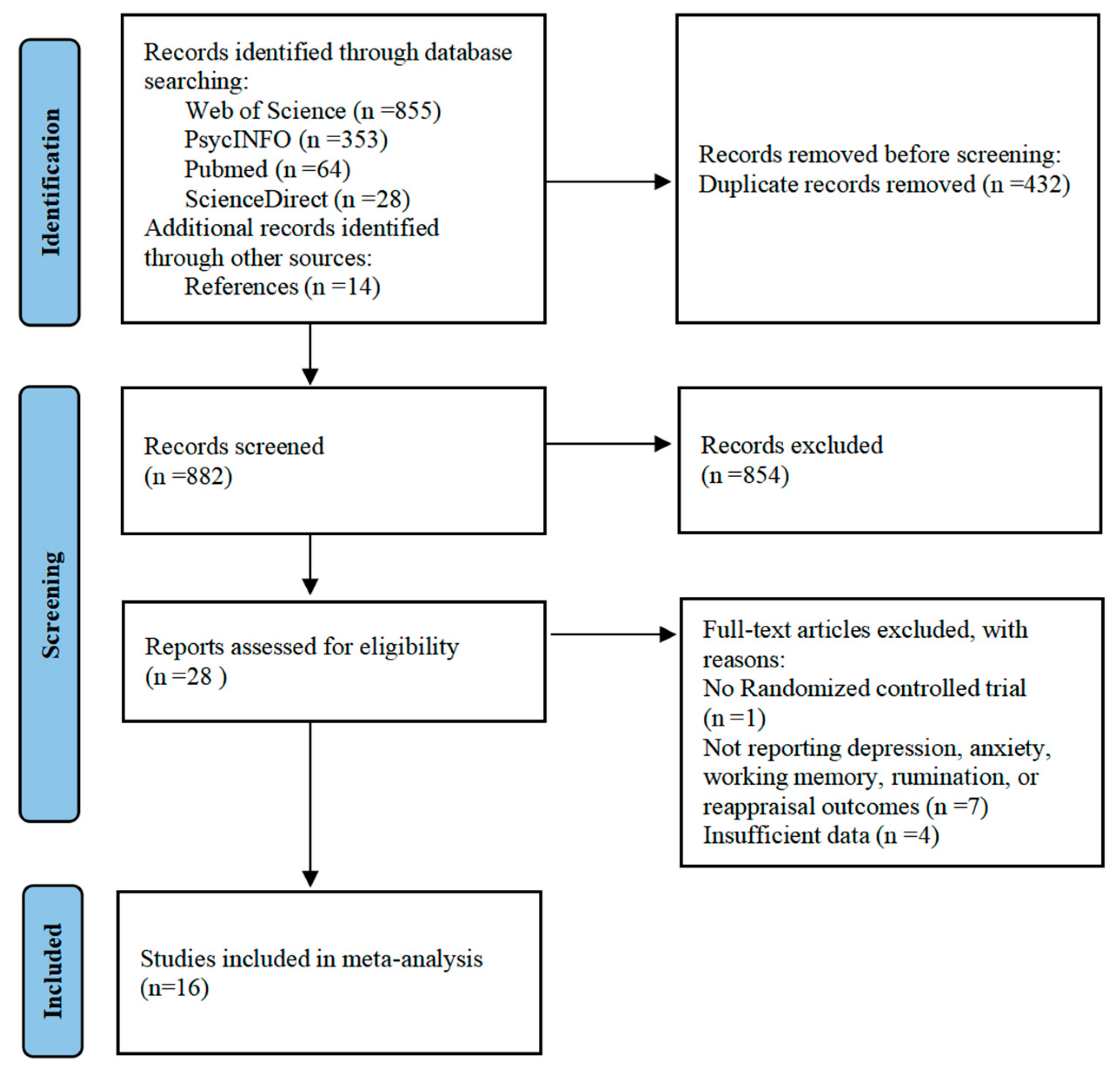
2.2. Literature Search
2.3. Criteria for Inclusion and Exclusion
2.4. Data Collection
2.5. Study Quality Evaluation
2.6. Statistical Analysis
2.7. Transparency and Openness
3. Results
3.1. Characteristics of Included Studies
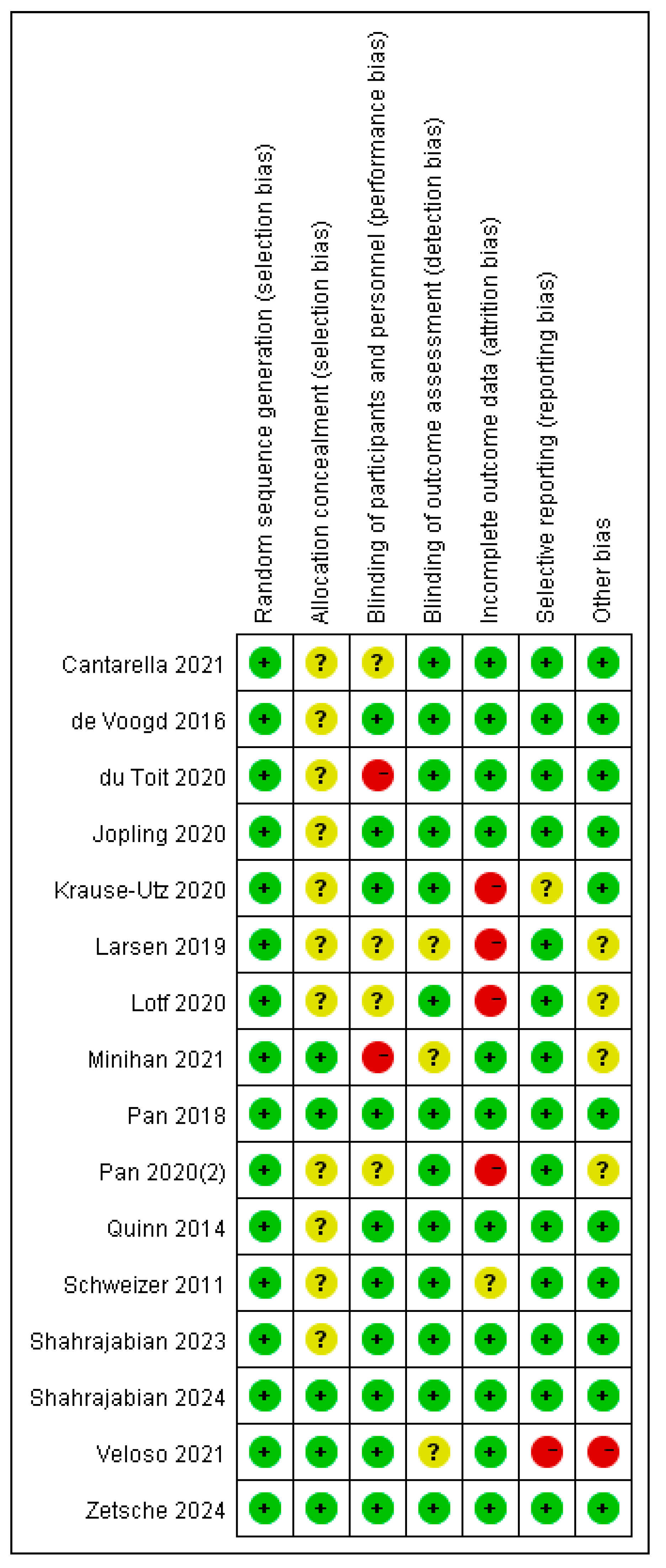
3.2. Study Quality
3.3. Outcomes
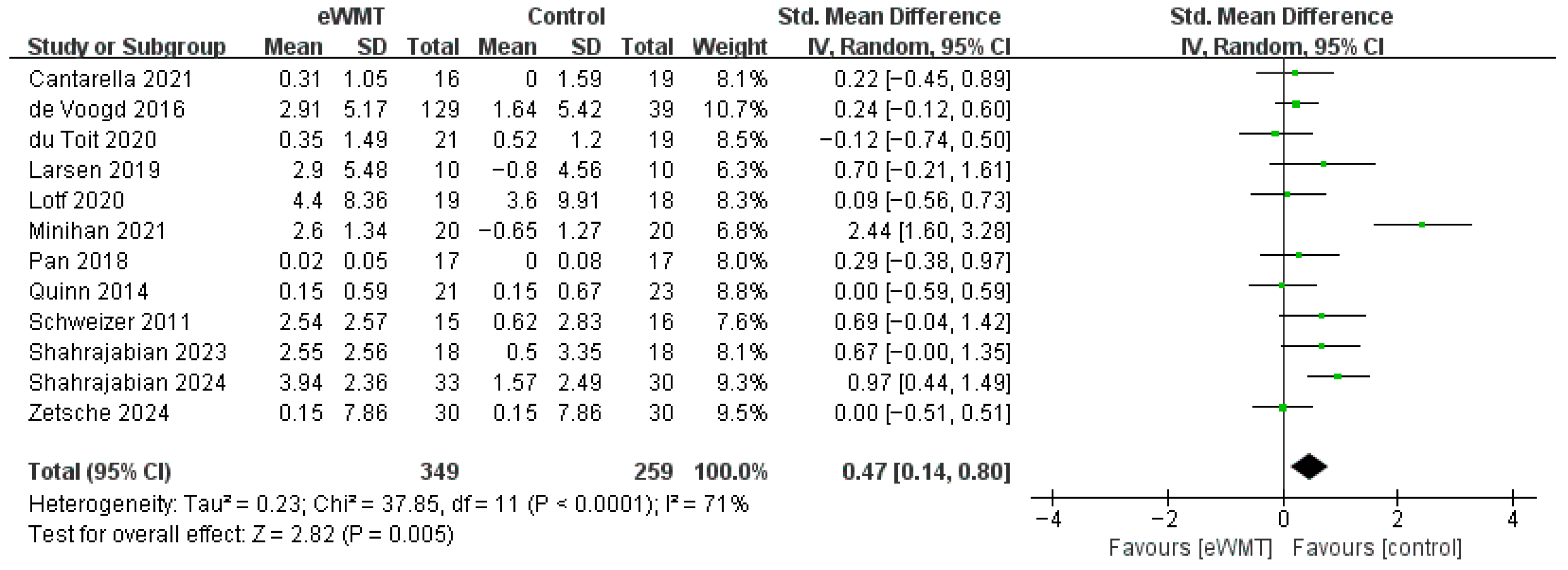
3.3.1. Working Memory Capacity
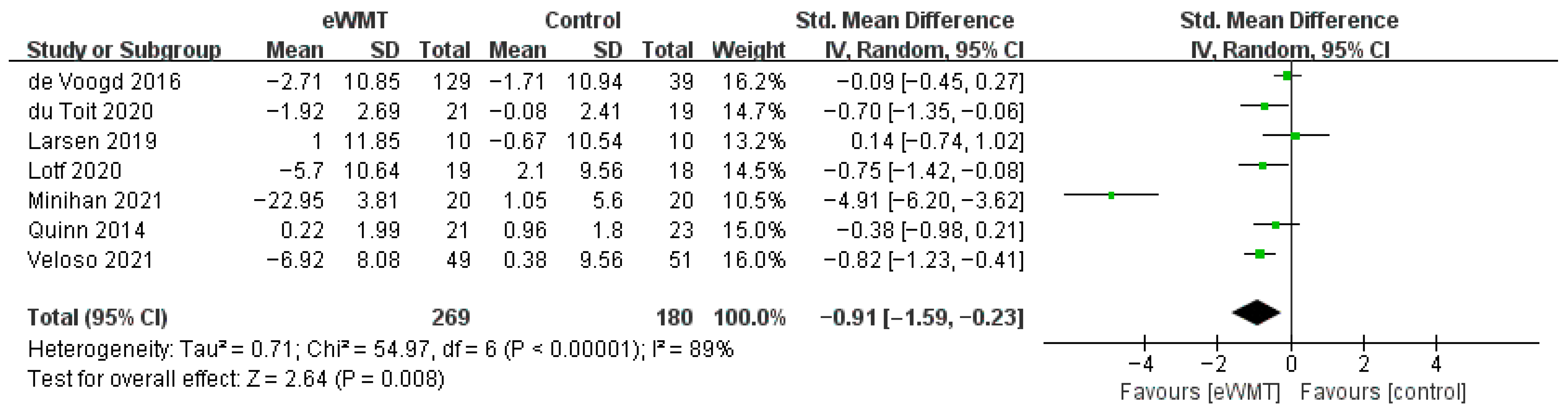
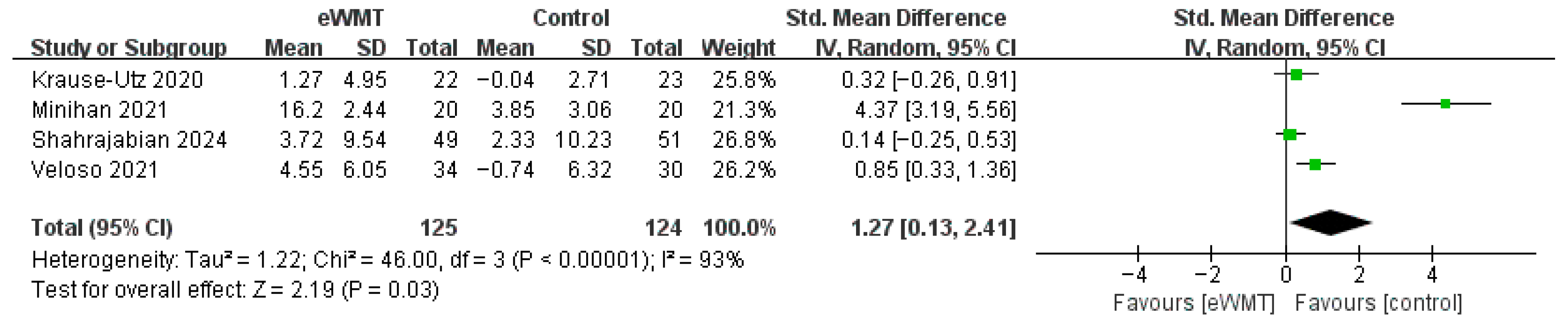
3.3.2. Anxiety
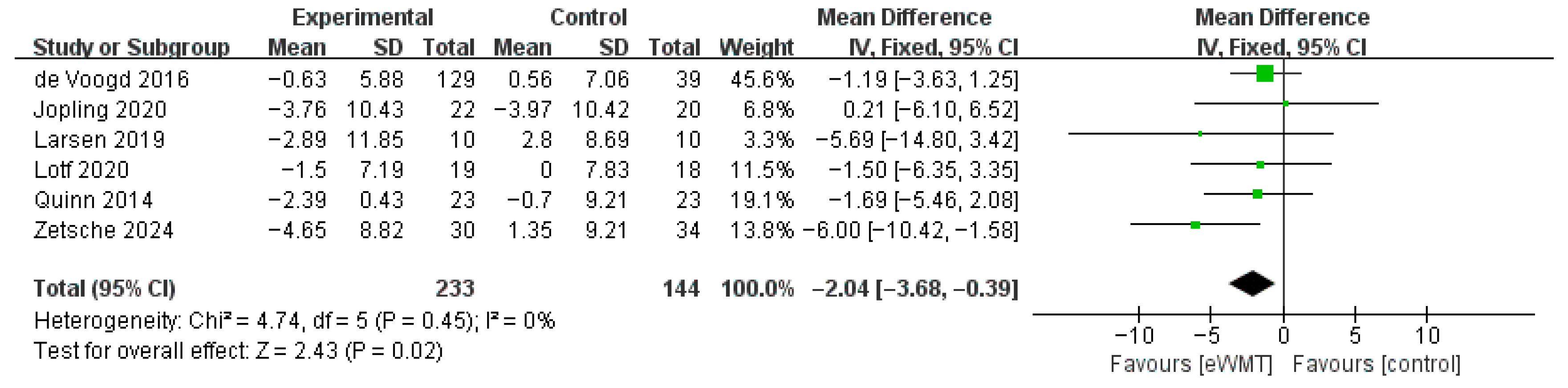
3.3.3. Depression
3.3.4. Rumination
3.3.5. Reappraisal
3.4. Publication Bias
4. Discussion
5. Limitations
6. Conclusions
Supplementary Materials
Author Contributions
Funding
Data Availability Statement
Conflicts of Interest
References
- World Health Organization. Depression and Other Common Mental Disorders: Global Health Estimates; World Health Organization: Geneva, Switzerland, 2017; p. 24.
- Patel, V.; Chisholm, D.; Parikh, R.; Charlson, F.J.; Degenhardt, L.; Dua, T.; Ferrari, A.J.; Hyman, S.; Laxminarayan, R.; Levin, C. Addressing the burden of mental, neurological, and substance use disorders: Key messages from Disease Control Priorities. Lancet 2016, 387, 1672–1685. [Google Scholar] [CrossRef]
- Baxter, A.J.; Vos, T.; Scott, K.M.; Ferrari, A.J.; Whiteford, H.A. The global burden of anxiety disorders in 2010. Psychol. Med. 2014, 44, 2363–2374. [Google Scholar] [CrossRef] [PubMed]
- Li, W.; Zhao, Z.; Chen, D.; Peng, Y.; Lu, Z. Prevalence and associated factors of depression and anxiety symptoms among college students: A systematic review and meta-analysis. J. Child Psychol. Psychiatry 2022, 63, 1222–1230. [Google Scholar] [CrossRef]
- Koster, E.H.; Hoorelbeke, K.; Onraedt, T.; Owens, M.; Derakshan, N. Cognitive control interventions for depression: A systematic review of findings from training studies. Clin. Psychol. Rev. 2017, 53, 79–92. [Google Scholar] [CrossRef] [PubMed]
- Beloe, P.; Derakshan, N. Adaptive working memory training can reduce anxiety and depression vulnerability in adolescents. Dev. Sci. 2020, 23, e12831. [Google Scholar] [CrossRef]
- Joormann, J.; Yoon, K.L.; Zetsche, U. Cognitive inhibition in depression. Appl. Prev. Psychol. 2007, 12, 128–139. [Google Scholar] [CrossRef]
- Baune, B.T.; Fuhr, M.; Air, T.; Hering, C. Neuropsychological functioning in adolescents and young adults with major depressive disorder—A review. Psychiatry Res. 2014, 218, 261–271. [Google Scholar] [CrossRef]
- Siemer, M. Mood-congruent cognitions constitute mood experience. Emotion 2005, 5, 296. [Google Scholar] [CrossRef]
- Ouimet, A.J.; Gawronski, B.; Dozois, D.J. Cognitive vulnerability to anxiety: A review and an integrative model. Clin. Psychol. Rev. 2009, 29, 459–470. [Google Scholar] [CrossRef]
- Joormann, J.; Tanovic, E. Cognitive vulnerability to depression: Examining cognitive control and emotion regulation. Curr. Opin. Psychol. 2015, 4, 86–92. [Google Scholar] [CrossRef]
- Joormann, J.; Siemer, M. Emotion regulation in mood disorders. Handb. Emot. Regul. 2014, 2, 413–427. [Google Scholar]
- Braver, T.S. The variable nature of cognitive control: A dual mechanisms framework. Trends Cogn. Sci. 2012, 16, 106–113. [Google Scholar] [CrossRef]
- Miyake, A.; Friedman, N.P. The nature and organization of individual differences in executive functions: Four general conclusions. Curr. Dir. Psychol. Sci. 2012, 21, 8–14. [Google Scholar] [CrossRef] [PubMed]
- Nolen-Hoeksema, S.; Wisco, B.E.; Lyubomirsky, S. Rethinking rumination. Perspect. Psychol. Sci. 2008, 3, 400–424. [Google Scholar] [CrossRef]
- Amstadter, A. Emotion regulation and anxiety disorders. J. Anxiety Disord. 2008, 22, 211–221. [Google Scholar] [CrossRef]
- Joormann, J.; Stanton, C.H. Examining emotion regulation in depression: A review and future directions. Behav. Res. Ther. 2016, 86, 35–49. [Google Scholar] [CrossRef] [PubMed]
- Hofmann, S.G.; Heering, S.; Sawyer, A.T.; Asnaani, A. How to handle anxiety: The effects of reappraisal, acceptance, and suppression strategies on anxious arousal. Behav. Res. Ther. 2009, 47, 389–394. [Google Scholar] [CrossRef] [PubMed]
- Diestel, S.; Schmidt, K.-H. The moderating role of cognitive control deficits in the link from emotional dissonance to burnout symptoms and absenteeism. J. Occup. Health Psychol. 2011, 16, 313. [Google Scholar] [CrossRef]
- Cantarella, A.; Borella, E.; Carretti, B.; Kliegel, M.; Mammarella, N.; Fairfield, B.; De Beni, R. The influence of training task stimuli on transfer effects of working memory training in aging. Psychol. Française 2021, 66, 157–171. [Google Scholar] [CrossRef]
- Shaw, S.B.; Nicholson, A.A.; Ros, T.; Harricharan, S.; Terpou, B.; Densmore, M.; Theberge, J.; Frewen, P.; Lanius, R.A. Increased top-down control of emotions during symptom provocation working memory tasks following a RCT of alpha-down neurofeedback in PTSD. Neuroimage Clin. 2023, 37, 103313. [Google Scholar] [CrossRef]
- Smits, F.M.; Geuze, E.; de Kort, G.J.; Kouwer, K.; Geerlings, L.; van Honk, J.; Schutter, D. Effects of Multisession Transcranial Direct Current Stimulation on Stress Regulation and Emotional Working Memory: A Randomized Controlled Trial in Healthy Military Personnel. Neuromodulation 2023, 26, 817–828. [Google Scholar] [CrossRef] [PubMed]
- Baddeley, A. Working memory. Science 1992, 255, 556–559. [Google Scholar] [CrossRef]
- Pan, D.-N.; Wang, D.; Li, X.-B. Cognitive and emotional benefits of emotional dual dimension n-back training based on an APP. Acta Psychol. Sin. 2018, 50, 1105. [Google Scholar] [CrossRef]
- Thornton, K.E.; Carmody, D.P. Efficacy of traumatic brain injury rehabilitation: Interventions of QEEG-guided biofeedback, computers, strategies, and medications. Appl. Psychophysiol. Biofeedback 2008, 33, 101–124. [Google Scholar] [CrossRef]
- Peng, W.; Luo, W.; Zhou, R. HRV evidence for the improvement of emotion regulation in university students with depression tendency by working memory training. Acta Psychol. Sin. 2019, 51, 648–661. [Google Scholar] [CrossRef]
- Iacoviello, B.M.; Wu, G.; Alvarez, E.; Huryk, K.; Collins, K.A.; Murrough, J.W.; Iosifescu, D.V.; Charney, D.S. Cognitive-emotional training as an intervention for major depressive disorder. Depress Anxiety 2014, 31, 699–706. [Google Scholar] [CrossRef]
- Pan, D.-N.; Hoid, D.; Wang, X.-B.; Jia, Z.; Li, X. When expanding training from working memory to emotional working memory: Not only improving explicit emotion regulation but also implicit negative control for anxious individuals. Psychol. Med. 2020, 52, 675–684. [Google Scholar] [CrossRef] [PubMed]
- Schweizer, S.; Grahn, J.; Hampshire, A.; Mobbs, D.; Dalgleish, T. Training the emotional brain: Improving affective control through emotional working memory training. J. Neurosci. 2013, 33, 5301–5311. [Google Scholar] [CrossRef]
- Etkin, A.; Buchel, C.; Gross, J.J. The neural bases of emotion regulation. Nat. Rev. Neurosci. 2015, 16, 693–700. [Google Scholar] [CrossRef] [PubMed]
- Levens, S.M.; Gotlib, I.H. Updating positive and negative stimuli in working memory in depression. J. Exp. Psychol. Gen. 2010, 139, 654. [Google Scholar] [CrossRef]
- Minihan, S.; Samimi, Z.; Schweizer, S. The effectiveness of affective compared to neutral working memory training in university students with test anxiety. Behav. Res. Ther. 2021, 147, 103974. [Google Scholar] [CrossRef]
- Melby-Lervåg, M.; Redick, T.S.; Hulme, C. Working memory training does not improve performance on measures of intelligence or other measures of “far transfer” evidence from a meta-analytic review. Perspect. Psychol. Sci. 2016, 11, 512–534. [Google Scholar] [CrossRef]
- Wollesen, B.; Wildbredt, A.; van Schooten, K.S.; Lim, M.L.; Delbaere, K. The effects of cognitive-motor training interventions on executive functions in older people: A systematic review and meta-analysis. Eur. Rev. Aging Phys. Act. 2020, 17, 9. [Google Scholar] [CrossRef]
- Teixeira-Santos, A.C.; Moreira, C.S.; Magalhaes, R.; Magalhães, C.; Pereira, D.R.; Leite, J.; Carvalho, S.; Sampaio, A. Reviewing working memory training gains in healthy older adults: A meta-analytic review of transfer for cognitive outcomes. Neurosci. Biobehav. Rev. 2019, 103, 163–177. [Google Scholar] [CrossRef]
- Wang, Y.-F.; Bian, W.; Wei, J.; Hu, S. Anxiety-reducing effects of working memory training: A systematic review and meta-analysis. J. Affect. Disord. 2023, 331, 269–278. [Google Scholar] [CrossRef] [PubMed]
- Melby-Lervåg, M.; Hulme, C. Is working memory training effective? A meta-analytic review. Dev. Psychol. 2013, 49, 270. [Google Scholar] [CrossRef] [PubMed]
- Sala, G.; Aksayli, N.D.; Tatlidil, K.S.; Gondo, Y.; Gobet, F. Working memory training does not enhance older adults’ cognitive skills: A comprehensive meta-analysis. Intelligence 2019, 77, 101386. [Google Scholar] [CrossRef]
- Basharpoor, S.; Zakibakhsh Mohammadi, N.; Heidari, F.; Azarkolah, A.; Vicario, C.M.; Salehinejad, M.A. Emotional working memory training improves cognitive inhibitory abilities in individuals with borderline personality trait: A randomized parallel-group trial. J. Affect. Disord. 2022, 319, 181–188. [Google Scholar] [CrossRef]
- Cumpston, M.; Li, T.; Page, M.; Chandler, J.; Welch, V.; Higgins, J.P.; Thomas, J. Updated guidance for trusted systematic reviews: A new edition of the Cochrane Handbook for Systematic Reviews of Interventions. Cochrane Database Syst. Rev. 2019, 10, ED000142. [Google Scholar] [CrossRef] [PubMed]
- Borenstein, M.; Hedges, L.V.; Higgins, J.P.; Rothstein, H.R. Introduction to Meta-Analysis; John Wiley & Sons: Hoboken, NJ, USA, 2021. [Google Scholar]
- Leone de voogd, E.; Wiers, R.W.; Zwitser, R.J.; Salemink, E. Emotional working memory training as an online intervention for adolescent anxiety and depression: A randomised controlled trial. Aust. J. Psychol. 2016, 68, 228–238. [Google Scholar] [CrossRef] [PubMed]
- du Toit, S.A.; Kade, S.A.; Danielson, C.T.; Schweizer, S.; Han, J.; Torok, M.; Wong, Q.J.J. The effect of emotional working memory training on emotional and cognitive outcomes in individuals with elevated social anxiety. J. Affect. Disord. 2020, 261, 76–83. [Google Scholar] [CrossRef]
- Jopling, E.; Gotlib, I.H.; LeMoult, J. Effects of working memory training on cognitive, affective, and biological responses to stress in major depression: A novel cognitive bias modification protocol. J. Affect. Disord. 2020, 265, 45–51. [Google Scholar] [CrossRef] [PubMed]
- Krause-Utz, A.; Walther, J.-C.; Schweizer, S.; Lis, S.; Hampshire, A.; Schmahl, C.; Bohus, M. Effectiveness of an Emotional Working Memory Training in Borderline Personality Disorder: A Proof-of-Principle Study. Psychother. Psychosom. 2020, 89, 122–124. [Google Scholar] [CrossRef] [PubMed]
- Larsen, S.E.; Lotfi, S.; Bennett, K.P.; Larson, C.L.; Dean-Bernhoft, C.; Lee, H.-J. A pilot randomized trial of a dual n-back emotional working memory training program for veterans with elevated PTSD symptoms. Psychiatry Res. 2019, 275, 261–268. [Google Scholar] [CrossRef]
- Lotfi, S.; Ward, R.T.; Ayazi, M.; Bennett, K.P.; Larson, C.L.; Lee, H.-J. The Effects of Emotional Working Memory Training on Worry Symptoms and Error-Related Negativity of Individuals with High Trait Anxiety: A Randomized Controlled Study. Cogn. Ther. Res. 2020, 45, 969–985. [Google Scholar] [CrossRef]
- Quinn, M.E.; Keil, D.C.; Utke, S.; Joormann, J. Trait Rumination Moderates the Effect of Executive Control Training. J. Exp. Psychopathol. 2014, 5, 289–301. [Google Scholar] [CrossRef]
- Schweizer, S.; Hampshire, A.; Dalgleish, T. Extending brain-training to the affective domain: Increasing cognitive and affective executive control through emotional working memory training. PLoS ONE 2011, 6, e24372. [Google Scholar] [CrossRef]
- Shahrajabian, F.; Hasani, J.; Griffiths, M.D.; Aruguete, M.; Chashmi, S.J.E. Effects of emotional working memory training on problematic internet use, inhibition, attention, and working memory among young problematic internet users: A randomized control study. Addict. Behav. 2023, 141, 107659. [Google Scholar] [CrossRef] [PubMed]
- Shahrajabian, F.; Hasani, J.; Hodgins, D.; Griffiths, M.D. Emotional Working Memory Training Treatment for Young Adult Problem Online Sports Bettors: A Preliminary Randomized Controlled Trial. J. Gambl. Stud. 2024, 40, 2209–2235. [Google Scholar] [CrossRef] [PubMed]
- Veloso, G.C.; Ty, W.E.G. The Effects of Emotional Working Memory Training on Trait Anxiety. Front. Psychol. 2021, 11, 549623. [Google Scholar] [CrossRef]
- Zetsche, U.; Neumann, P.; Bürkner, P.-C.; Renneberg, B.; Koster, E.H.W.; Hoorelbeke, K. Computerized cognitive control training to reduce rumination in major depression: A randomized controlled trial. Behav. Res. Ther. 2024, 177, 104521. [Google Scholar] [CrossRef] [PubMed]
- Kane, M.J.; Engle, R.W. Working-memory capacity and the control of attention: The contributions of goal neglect, response competition, and task set to Stroop interference. J. Exp. Psychol. Gen. 2003, 132, 47. [Google Scholar] [CrossRef] [PubMed]
- Redick, T.S.; Calvo, A.; Gay, C.E.; Engle, R.W. Working memory capacity and go/no-go task performance: Selective effects of updating, maintenance, and inhibition. J. Exp. Psychol. Learn. Mem. Cogn. 2011, 37, 308. [Google Scholar] [CrossRef]
- Klingberg, T.; Fernell, E.; Olesen, P.J.; Johnson, M.; Gustafsson, P.; Dahlström, K.; Gillberg, C.G.; Forssberg, H.; Westerberg, H. Computerized training of working memory in children with ADHD-a randomized, controlled trial. J. Am. Acad. Child Adolesc. Psychiatry 2005, 44, 177–186. [Google Scholar] [CrossRef]
- Beck, A.T.; Rush, A.J.; Shaw, B.F.; Emery, G.; DeRubeis, R.J.; Hollon, S.D. Cognitive Therapy of Depression; Guilford Publications: New York, NY, USA, 2024. [Google Scholar]
- Jaeggi, S.M.; Buschkuehl, M.; Jonides, J.; Perrig, W.J. Improving fluid intelligence with training on working memory. Proc. Natl. Acad. Sci. USA 2008, 105, 6829–6833. [Google Scholar] [CrossRef]
- Zawadzki, M.J. Rumination is independently associated with poor psychological health: Comparing emotion regulation strategies. Psychol. Health 2015, 30, 1146–1163. [Google Scholar] [CrossRef]
- Onraedt, T.; Koster, E.H. Training working memory to reduce rumination. PLoS ONE 2014, 9, e90632. [Google Scholar] [CrossRef]
- Gross, J.J. Emotion Regulation: Current Status and Future Prospects. Psychol. Inq. 2015, 26, 1–26. [Google Scholar] [CrossRef]
- Altemus, M.; Sarvaiya, N.; Epperson, C.N. Sex differences in anxiety and depression clinical perspectives. Front. Neuroendocrinol. 2014, 35, 320–330. [Google Scholar] [CrossRef]
- Mak, A.K.; Hu, Z.-G.; Zhang, J.X.; Xiao, Z.; Lee, T.M. Sex-related differences in neural activity during emotion regulation. Neuropsychologia 2009, 47, 2900–2908. [Google Scholar] [CrossRef] [PubMed]
- Hill, A.C.; Laird, A.R.; Robinson, J.L. Gender differences in working memory networks: A BrainMap meta-analysis. Biol. Psychol. 2014, 102, 18–29. [Google Scholar] [CrossRef] [PubMed]
- Page, M.J.; McKenzie, J.E.; Bossuyt, P.M.; Boutron, I.; Hoffmann, T.C.; Mulrow, C.D.; Shamseer, L.; Tetzlaff, J.M.; Akl, E.A.; Brennan, S.E.; et al. The PRISMA 2020 statement: An updated guideline for reporting systematic reviews. BMJ 2021, 372, n71. [Google Scholar] [CrossRef] [PubMed]



| First Author and Publication Year | Country | Population | Sample Size (n) | Age, Years | Female (%) | Emotional Working Memory Training Paradigm | Training Duration | Training Environment | Control Condition | Working Memory Task | Emotional Task |
|---|---|---|---|---|---|---|---|---|---|---|---|
| Cantarella 2021 [20] | Italy | Healthy older adults | 35 | 68.79 | 80.00 | Criterion task: the Matrix task | 8 times, 4 × 60 min each wk for 2 wk | Online | Active control | Forward and backward Corsi Span task | n.a. |
| de Voogd 2016 [42] | The Netherlands | High school adolescents in the Netherlands | 168 | 14.35 | 60.12 | Emotional N-back WMT | 8 times, 2 × 15 min each wk for 4 wk | Online | Active control | Self ordered pointing task | Children’s Depression Inventory, Screen for Child Anxiety Related Emotional Disorders, Perseverative Thinking Questionnaire |
| du Toit 2020 [43] | Sydney | Adults with elevated social anxiety | 40 | 22.95 | 87.50 | Affective dual n-back task | 6 times, 6 × 10 min each wk for 1 wk | Online | Active control | Digit span backward task | Peak anxiety rating scale |
| Jopling 2020 [44] | Canada | Participants with major depressive disorder | 58 | 29.17 | 68.97 | Affective version of the Sternberg task | 6 times, 6 × 15–20 min each wk for 1 wk | Online | Active control | n.a. | Beck Depression Inventory, Second Edition Ruminative Responses Scale |
| Krause-Utz 2020 [45] | USA | Patients of Department of Psychosomatic Medicine and Psychotherapy | 45 | 32.43 | 100 | Affective dual n-back task | 20 times, 7 × 20–30 min each wk for 3 wk | Online | Active control | n.a. | n.a. |
| Larsen 2019 [46] | USA | Veterans with elevated PTSD symptoms | 20 | 52.79 | 25.00 | Adaptive dual n-Back | 15 times, 4 × 20 min each wk for 4 wk | Online | Active control | Operation span task | Depression Anxiety and Stress Scale |
| Lotf 2020 [47] | USA | Students from university of Wisconsin-Milwaukee and the surrounding Milwaukee area | 37 | 23.79 | 75.68 | Emotional N-back WMT | 9 times, 5 × 20–25 min each wk for 2 wk | Online | Active control | Operation span task | Depression Anxiety and Stress Scale Penn State Worry Questionnaire |
| Minihan 2021 [32] | Wales | University students | 40 | 20.55 | 50.00 | Affective dual n-back task | 20 times, 7 × 30–45 min each wk for 3 wk | Offline | Passive control | Backward version of the digit span task. | Test Anxiety Inventory |
| Pan 2018 [24] | China | Healthy university students from Beijing | 33 | 20.57 | 48.48 | Dual dimension n-back training based on smartphone app | 5 times, 1 × 30 min each wk for 1 wk | Online | Active control | Backward version of the digit span task | n.a. |
| Pan 2020 [28] | China | University students in Beijing China with trait anxiety | 65 | 21.94 | 73.85 | Dual dimension n-back training application | 21 times, 7 × 40 min each wk for 3 wk | Online | Active control | n.a. | Depression Anxiety and Stress Scale |
| Quinn 2014 [48] | USA | Undergraduate students | 44 | 19.26 | 40.91 | N-back task | 1 time | offline | Active control | n.a. | n.a. |
| Schweizer 2011 [49] | UK | Undergraduate students | 31 | 25 | 64.52 | Dual n-back training task | 20 times, 7 × 20–30 min each wk for 3 wk | Online | Active control | Forward digit span test | n.a. |
| Shahrajabian 2023 [50] | Iran | High school and university students | 36 | 20.27 | 69.44 | Affective dual n-back task | 20 times, 3 × 30–45 min each wk for 7 wk | Online | Active control | Wechsler digit span test | n.a. |
| Shahrajabian 2024 [51] | Iran | Young adult with problem online sports bettors | 64 | 34 | 30 | Affective dual n-back task | 20 times, 3 × 30–45 min each wk for 7 wk | Online | Active control | Wechsler digit span test | Cognitive emotion regulation questionnaire |
| Veloso 2021 [52] | Australia | Undergraduate students | 100 | 27.41 | 51.00 | Emotional dual n-Back WMT | 20 times, 7 × 20 min each wk for 3 wk | Online | Passive control | Operation span task | Spielberger State-Trait Anxiety Inventory |
| Zetsche 2024 [53] | Germany | Participants with major depressive disorder | 65 | 31 | 34 | Adaptive emotional n-back task | 10 times, 5 × 30–45 min each wk for 2 wk | Online | Passive control | Working memory selection task | Center for Epidemiological Studies Depression Scale, Ruminative Responses Scale—Short Form |
| Subgroup | No. Studies | Sample Sizes | SMD [95% CI] | Statistical Method | p Value | Heterogeneity (I2) |
|---|---|---|---|---|---|---|
| Number of sessions | ||||||
| Long-term training | 5 (4) | 190 (150) | 1.73 [0.51, 2.94] (0.80 [0.47, 1.13]) | SMD (IV, random, 95%CI) | 0.005 (<0.001) | 92% (0%) |
| Short-term training | 7 | 419 | 0.02 [−0.02, 0.07] | SMD (IV, fixed, 95%CI) | 0.37 | 0% |
| Training time | ||||||
| Large training dose | 3 (2) | 111 (71) | 1.09 [−0.14, 2.32] (0.44 [−0.03, 0.92]) | SMD (IV, random, 95%CI) | 0.08 (0.07) | 89% (0%) |
| Small training dose | 9 | 503 | 0.29 [0.10, 0.47] | SMD (IV, fixed, 95%CI) | 0.03 | 39% |
| Training frequency | ||||||
| High training frequency | 7 (6) | 285 (245) | 0.35 [0.11, 0.58] (0.32 [0.08, 0.57]) | SMD (IV, fixed, 95%CI) | 0.004 (0.01) | 48% (54%) |
| Low training frequency | 5 | 303 | 0.29 [0.04, 0.54] | SMD (IV, fixed, 95%CI) | 0.02 | 0% |
| subject type | ||||||
| Clinical population | 4 | 183 | 0.37 [−0.19, 0.93] | SMD (IV, random, 95%CI) | 0.20 | 70% |
| General population | 8 (7) | 425 (385) | 0.53 [0.09, 0.97] (0.28 [0.06,0.49]) | SMD (IV, random, 95%CI) | 0.02 (0.01) | 75% (0%) |
Disclaimer/Publisher’s Note: The statements, opinions and data contained in all publications are solely those of the individual author(s) and contributor(s) and not of MDPI and/or the editor(s). MDPI and/or the editor(s) disclaim responsibility for any injury to people or property resulting from any ideas, methods, instructions or products referred to in the content. |
© 2025 by the authors. Licensee MDPI, Basel, Switzerland. This article is an open access article distributed under the terms and conditions of the Creative Commons Attribution (CC BY) license.
Share and Cite
Ou, J.; Mou, H.; Zhou, T.; Wang, Y. Does Emotional Working Memory Training Ameliorate Anxiety and Depression? A Meta-Analytic Review. Brain Sci. 2026, 16, 30. https://doi.org/10.3390/brainsci16010030
Ou J, Mou H, Zhou T, Wang Y. Does Emotional Working Memory Training Ameliorate Anxiety and Depression? A Meta-Analytic Review. Brain Sciences. 2026; 16(1):30. https://doi.org/10.3390/brainsci16010030
Chicago/Turabian StyleOu, Jiehang, Hong Mou, Ting Zhou, and Yingying Wang. 2026. "Does Emotional Working Memory Training Ameliorate Anxiety and Depression? A Meta-Analytic Review" Brain Sciences 16, no. 1: 30. https://doi.org/10.3390/brainsci16010030
APA StyleOu, J., Mou, H., Zhou, T., & Wang, Y. (2026). Does Emotional Working Memory Training Ameliorate Anxiety and Depression? A Meta-Analytic Review. Brain Sciences, 16(1), 30. https://doi.org/10.3390/brainsci16010030