Gaze-Speech Coordination During Narration in Autism Spectrum Disorder and First-Degree Relatives
 ,
,
Abstract
1. Introduction
1.1. Gaze-Speech Temporal Coordination
1.2. Gaze-Speech Content Coordination
1.3. Gaze-Speech Coordination in First-Degree Relatives
1.4. The Current Study
2. Materials and Methods
2.1. Participants
2.2. Procedures
2.3. Existing Data Processing
2.3.1. Transcription
2.3.2. Alignment
2.3.3. Gaze Processing
2.4. Narrative Quality
2.5. New Data Processing
2.5.1. Narrative Coding
2.5.2. Gaze Coding
2.5.3. Pragmatic Language Ability
2.6. Data Analysis
2.6.1. Gaze-Speech Coordination: Diagonal Cross Recurrence Profiles (DCRP) Analysis
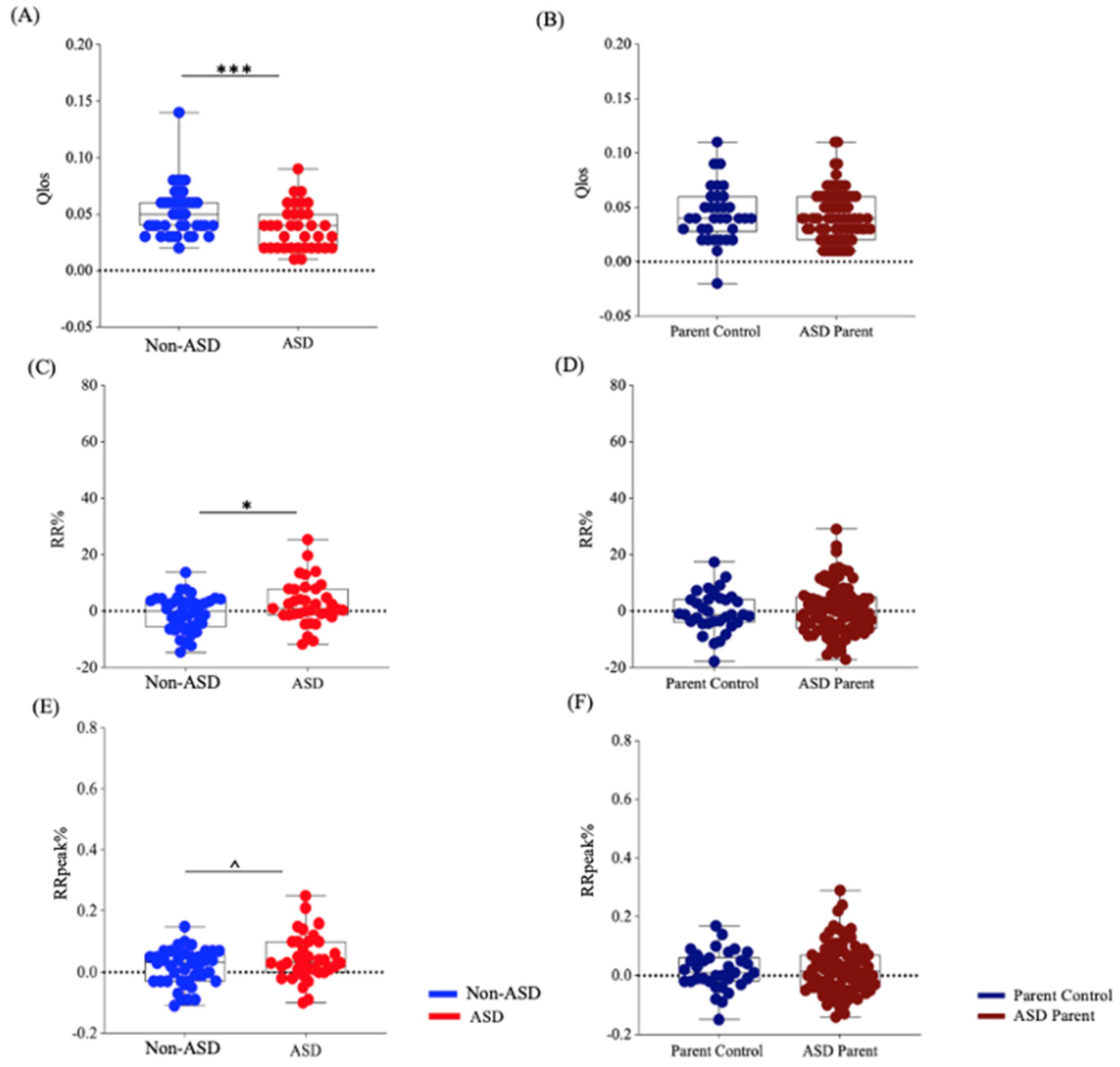
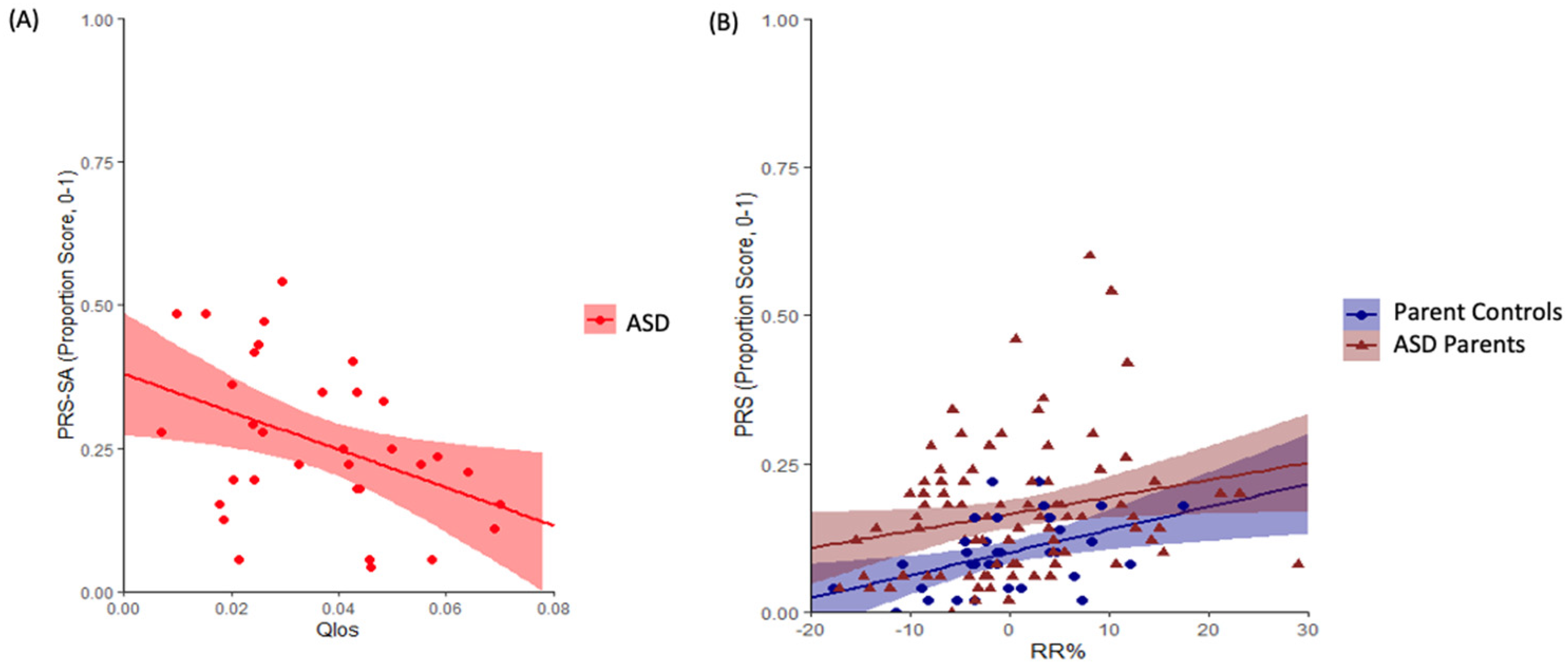
- Recurrence rate (RR): Recurrence rate quantifies the proportion of recurrence/correspondence between two time series (i.e., gaze focus and narrative content examining the same story component/visual stimuli). In the current study, a higher RR indicates greater consistency between gaze focus and speech content, representing greater gaze-speech content coordination.
- Recurrence rate peak (RRpeak): Recurrence rate peak measures the highest proportion of correspondence between gaze and speech during narration. A higher RRpeak represents a greater maximum amount of coordination across different time lags between time series, which refers to the greatest level of content coordination or consistency between gaze and speech across narration in the current study.
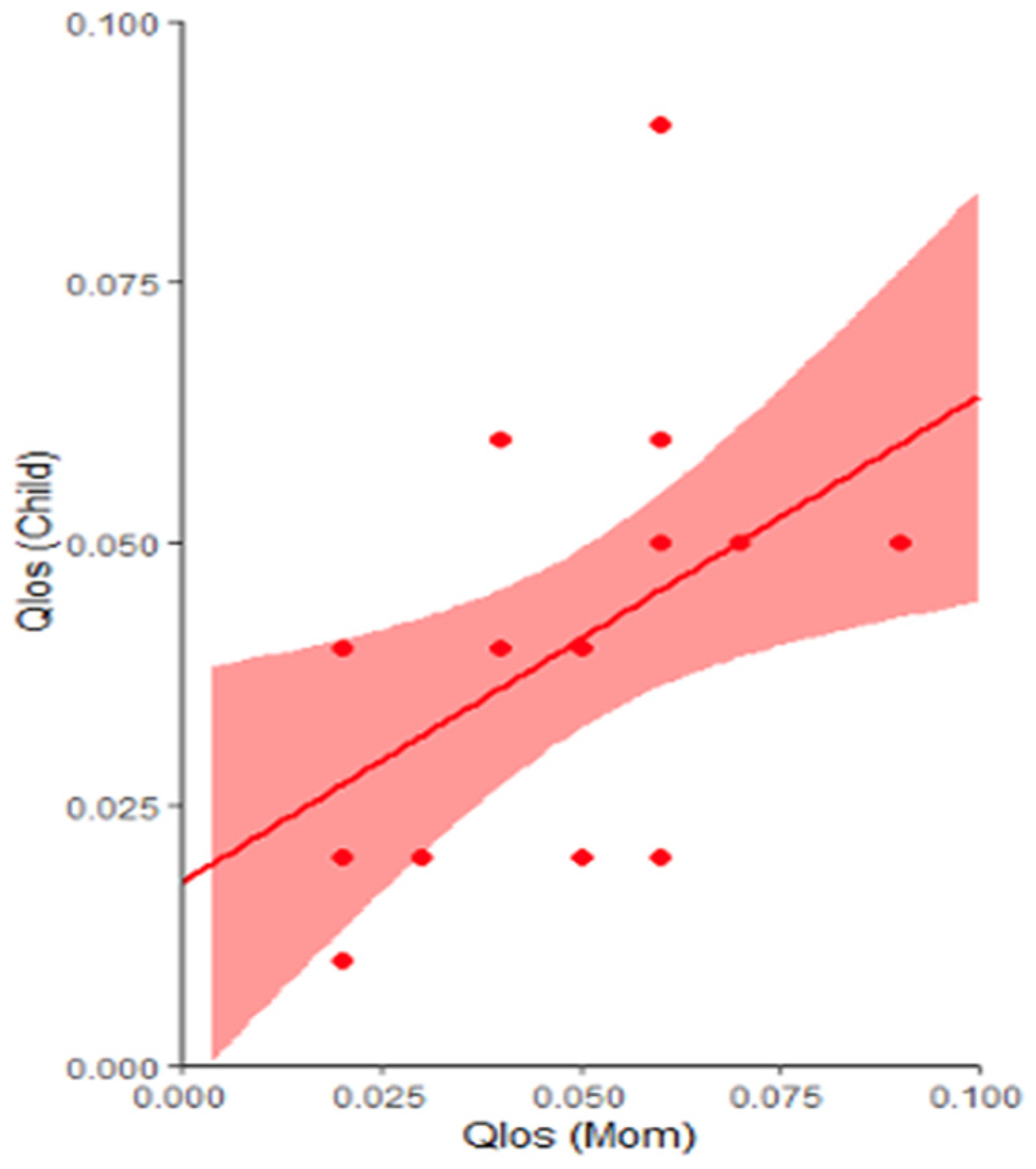
- Qlos: Qlos measures the extent to which one behavioral time series leads the other, i.e., gaze leads speech on the same story components in time. A higher Qlos represents a greater temporal lead of gaze over speech, or a higher average extent of gaze-speech temporal coordination across narration.
2.6.2. Sham Data Samples
2.6.3. Group Comparisons
2.6.4. Correlations
2.7. GenAI Use
3. Results
3.1. Group Comparisons
3.2. Correlations with ASD Symptom Severity
3.3. Correlations with Narrative Quality
3.4. Correlations with Pragmatic Language Ability
3.5. Mother-Child Correlations
4. Discussion
5. Conclusions
Supplementary Materials
Author Contributions
Funding
Institutional Review Board Statement
Informed Consent Statement
Data Availability Statement
Acknowledgments
Conflicts of Interest
Abbreviations
| ADI-R | Autism Diagnostic Interview—Revised |
| ADOS-2 | Autism Diagnostic Observation Schedule, Second Edition |
| AOIs | Areas of Interest |
| ASD | Autism Spectrum Disorder |
| BAP | Broad Autism Phenotype |
| DCRP | Diagonal Cross Recurrence Profiles |
| ELAN | EUDICO Linguistic Annotator |
| FSIQ | Full-Scale Intelligence Quotient |
| IQ | Intelligence Quotient |
| LOS | Gray Line of Synchrony |
| PIQ | Performance Intelligence Quotient |
| PRS | Pragmatic Rating Scale |
| PRS-SA | Pragmatic Rating Scale—School Age |
| RAN | Rapid Automatized Naming |
| RR | Recurrence Rate |
| RRBs | Restricted and Repetitive Behaviors |
| RRpeak | Recurrence Rate Peak |
| SALT | Systematic Analysis of Language Transcripts |
| STS | Superior Temporal Sulcus |
| VIQ | Verbal Intelligence Quotient |
| WAIS | Wechsler Adult Intelligence Scale—Third or Fourth Editions |
| WASI | Wechsler Abbreviated Scale of Intelligence |
| WISC-IV | Wechsler Intelligence Scale for Children—Fourth Edition |
References
- Levinson, S.C.; Holler, J. The origin of human multi-modal communication. Philos. Trans. R. Soc. B Biol. Sci. 2014, 369, 20130302. [Google Scholar] [CrossRef] [PubMed]
- de Marchena, A.; Eigsti, I.M. Conversational gestures in autism spectrum disorders: Asynchrony but not decreased frequency. Autism Res. 2010, 3, 311–322. [Google Scholar] [CrossRef] [PubMed]
- Parladé, M.V.; Iverson, J.M. The development of coordinated communication in infants at heightened risk for autism spectrum disorder. J. Autism Dev. Disord. 2015, 45, 2218–2234. [Google Scholar] [CrossRef] [PubMed]
- American Psychiatric Association. Diagnostic and Statistical Manual of Mental Disorders (DSM-5®); American Psychiatric Pub: Washington, DC, USA, 2013. [Google Scholar]
- Nayar, K.; Gordon, P.C.; Martin, G.E.; Hogan, A.L.; La Valle, C.; McKinney, W.; Lee, M.; Norton, E.S.; Losh, M. Links between looking and speaking in autism and first-degree relatives: Insights into the expression of genetic liability to autism. Mol. Autism 2018, 9, 51. [Google Scholar] [CrossRef]
- Gordon, P.C.; Hoedemaker, R.S. Effective scheduling of looking and talking during rapid automatized naming. J. Exp. Psychol. Hum. Percept. Perform. 2016, 42, 742–760. [Google Scholar] [CrossRef]
- Griffin, Z.M.; Bock, K. What the eyes say about speaking. Psychol. Sci. 2000, 11, 274–279. [Google Scholar] [CrossRef] [PubMed]
- Lee, M.; Nayar, K.; Maltman, N.; Hamburger, D.; Martin, G.E.; Gordon, P.C.; Losh, M. Understanding social communication differences in autism spectrum disorder and first-degree relatives: A study of looking and speaking. J. Autism Dev. Disord. 2020, 50, 2128–2141. [Google Scholar] [CrossRef] [PubMed]
- Meyer, A.S.; Roelofs, A.; Levelt, W.J. Word length effects in object naming: The role of a response criterion. J. Mem. Lang. 2003, 48, 131–147. [Google Scholar] [CrossRef]
- Miyake, A.; Friedman, N.P. The Nature and Organization of Individual Differences in Executive Functions: Four General Conclusions. Curr. Dir. Psychol. Sci. 2012, 21, 8–14. [Google Scholar] [CrossRef]
- van der Meulen, F. Coordination of eye gaze and speech in sentence production. Trends Linguist. Stud. Monogr. 2003, 152, 39–64. [Google Scholar]
- Griffin, Z.M.; Oppenheimer, D.M. Speakers gaze at objects while preparing intentionally inaccurate labels for them. J. Exp. Psychology. Learn. Mem. Cogn. 2006, 32, 943–948. [Google Scholar] [CrossRef]
- Bolton, P.; Macdonald, H.; Pickles, A.; Rios, P.; Goode, S.; Crowson, M.; Bailey, A.; Rutter, M. A case-control family history study of autism. J. Child Psychol. Psychiatry Allied Discip. 1994, 35, 877–900. [Google Scholar] [CrossRef]
- Landa, R.; Folstein, S.E.; Isaacs, C. Spontaneous narrative-discourse performance of parents of autistic individuals. J. Speech Hear. Res. 1991, 34, 1339–1345. [Google Scholar] [CrossRef]
- Landa, R.; Piven, J.; Wzorek, M.M.; Gayle, J.O.; Chase, G.A.; Folstein, S.E. Social language use in parents of autistic individuals. Psychol. Med. 1992, 22, 245–254. [Google Scholar] [CrossRef]
- Piven, J.; Palmer, P.; Jacobi, D.; Childress, D.; Arndt, S. Broader autism phenotype: Evidence from a family history study of multiple-incidence autism families. Am. J. Psychiatry 1997, 154, 185–190. [Google Scholar] [CrossRef]
- Bruner, J. Actual Minds, Possible Worlds; Harvard University Press: Cambridge, MA, USA, 1986. [Google Scholar]
- Bruner, J. Acts of Meaning; Harvard University Press: Cambridge, MA, USA, 1990. [Google Scholar]
- Gibson, J.J.; Pick, A.D. Perception of another person’s looking behavior. Am. J. Psychol. 1963, 76, 386–394. [Google Scholar]
- Goldin-Meadow, S. The role of gesture in communication and thinking. Trends Cogn. Sci. 1999, 3, 419–429. [Google Scholar] [CrossRef]
- Crais, E.R.; Watson, L.R.; Baranek, G.T. Use of gesture development in profiling children’s prelinguistic communication skills. Am. J. Speech Lang. Pathol. 2009, 18, 95–108. [Google Scholar] [CrossRef] [PubMed]
- Stone, W.L.; Ousley, O.Y.; Yoder, P.J.; Hogan, K.L.; Hepburn, S.L. Nonverbal communication in two-and three-year-old children with autism. J. Autism Dev. Disord. 1997, 27, 677–696. [Google Scholar] [CrossRef] [PubMed]
- Hull, J.V.; Dokovna, L.B.; Jacokes, Z.J.; Torgerson, C.M.; Irimia, A.; Van Horn, J.D. Resting-state functional connectivity in autism spectrum disorders: A review. Front. Psychiatry 2017, 7, 205. [Google Scholar] [CrossRef] [PubMed]
- Rane, P.; Cochran, D.; Hodge, S.M.; Haselgrove, C.; Kennedy, D.N.; Frazier, J.A. Connectivity in autism: A review of MRI connectivity studies. Harv. Rev. Psychiatry 2015, 23, 223–244. [Google Scholar] [CrossRef]
- Parlade, M.V.; Messinger, D.S.; Delgado, C.E.; Kaiser, M.Y.; Van Hecke, A.V.; Mundy, P.C. Anticipatory smiling: Linking early affective communication and social outcome. Infant Behav. Dev. 2009, 32, 33–43. [Google Scholar] [CrossRef]
- Rowe, M.L.; Goldin-Meadow, S. Early gesture selectively predicts later language learning. Dev. Sci. 2009, 12, 182–187. [Google Scholar] [CrossRef]
- Senzaki, S.; Masuda, T.; Ishii, K. When is perception top-down and when is it not? Culture, narrative, and attention. Cogn. Sci. 2014, 38, 1493–1506. [Google Scholar] [CrossRef]
- Denckla, M.B.; Rudel, R.G. Rapid “automatized” naming of pictured objects, colors, letters, and numbers by normal children. Cortex 1974, 10, 186–202. [Google Scholar] [CrossRef] [PubMed]
- Levelt, W.J.M.; Roelofs, A.; Meyer, A.S. A theory of lexical access in speech production. Behav. Brain Sci. 1999, 22, 1–38. [Google Scholar] [CrossRef] [PubMed]
- Meyer, A.S.; Sleiderink, A.M.; Levelt, W.J. Viewing and naming objects: Eye movements during noun phrase production. Cognition 1998, 66, B25–B33. [Google Scholar] [CrossRef] [PubMed]
- Smith, M.; Wheeldon, L. High level processing scope in spoken sentence production. Cognition 1999, 73, 205–246. [Google Scholar] [CrossRef] [PubMed]
- Norton, E.S.; Wolf, M. Rapid automatized naming (RAN) and reading fluency: Implications for understanding and treatment of reading disabilities. Annu. Rev. Psychol. 2012, 63, 427–452. [Google Scholar] [CrossRef]
- Kane, M.J.; Engle, R.W. Working-memory capacity and the control of attention: The contributions of goal neglect, response competition, and task set to Stroop interference. J. Exp. Psychol. Gen. 2003, 132, 47–70. [Google Scholar] [CrossRef]
- Meyer, A.S.; Wheeldon, L.; van der Meulen, F.; Konopka, A. Effects of speech rate and practice on the allocation of visual attention in multiple object naming. Front. Psychol. 2012, 3, 39. [Google Scholar] [CrossRef]
- Wühr, P.; Frings, C. A case for inhibition: Visual attention suppresses the processing of irrelevant objects. J. Exp. Psychol. Gen. 2008, 137, 116–130. [Google Scholar] [CrossRef]
- Wühr, P.; Waszak, F. Object-based attentional selection can modulate the Stroop effect. Mem. Cogn. 2003, 31, 983–994. [Google Scholar] [CrossRef]
- Engle, R.W. Working memory capacity as executive attention. Curr. Dir. Psychol. Sci. 2002, 11, 19–23. [Google Scholar] [CrossRef]
- Di Michele, V.; Mazza, M.; Cerbo, R.; Roncone, R.; Casacchia, M. Deficits in pragmatic conversation as manifestation of genetic liability in autism. Clin. Neuropsychiatry 2007, 4, 144–151. [Google Scholar]
- Losh, M.; Childress, D.; Lam, K.; Piven, J. Defining key features of the broad autism phenotype: A comparison across parents of multiple- and single-incidence autism families. Am. J. Med. Genet. Part B Neuropsychiatry Genet. Off. Publ. Int. Soc. Psychiatry Genet. 2008, 147B, 424–433. [Google Scholar] [CrossRef] [PubMed]
- Miller, M.; Young, G.S.; Hutman, T.; Johnson, S.; Schwichtenberg, A.J.; Ozonoff, S. Early pragmatic language difficulties in siblings of children with autism: Implications for DSM-5 social communication disorder? J. Child Psychol. Psychiatry 2015, 56, 774–781. [Google Scholar] [CrossRef] [PubMed]
- Patel, S.P.; Cole, J.; Lau, J.C.Y.; Fragnito, G.; Losh, M. Verbal entrainment in autism spectrum disorder and first-degree relatives. Sci. Rep. 2022, 12, 11496. [Google Scholar] [CrossRef] [PubMed]
- Patel, S.P.; Landau, E.; Martin, G.E.; Rayburn, C.; Elahi, S.; Fragnito, G.; Losh, M. A profile of prosodic speech differences in individuals with autism spectrum disorder and first-degree relatives. J. Commun. Disord. 2023, 102, 106313. [Google Scholar] [CrossRef]
- Patel, S.P.; Nayar, K.; Martin, G.E.; Franich, K.; Crawford, S.; Diehl, J.J.; Losh, M. An acoustic characterization of prosodic differences in autism spectrum disorder and first-degree relatives. J. Autism Dev. Disord. 2020, 50, 3032–3045. [Google Scholar] [CrossRef]
- Hogan-Brown, A.L.; Hoedemaker, R.S.; Gordon, P.C.; Losh, M. Eye-voice span during rapid automatized naming: Evidence of reduced automaticity in individuals with autism spectrum disorder and their siblings. J. Neurodev. Disord. 2014, 6, 33. [Google Scholar] [CrossRef]
- Lord, C.; Rutter, M.; DiLavore, P.; Risi, S.; Gotham, K.; Bishop, S. Autism Diagnostic Observation Schedule—2nd Edition (ADOS-2); Western Psychological Corporation: Los Angeles, CA, USA, 2012. [Google Scholar]
- Lord, C.; Rutter, M.; Le Couteur, A. Autism Diagnostic Interview-Revised: A revised version of a diagnostic interview for caregivers of individuals with possible pervasive developmental disorders. J. Autism Dev. Disord. 1994, 24, 659–685. [Google Scholar] [CrossRef]
- Hus, V.; Gotham, K.; Lord, C. Standardizing ADOS domain scores: Separating severity of social affect and restricted and repetitive behaviors. J. Autism Dev. Disord. 2014, 44, 2400–2412. [Google Scholar] [CrossRef]
- Hurley, R.S.; Losh, M.; Parlier, M.; Reznick, J.S.; Piven, J. The Broad Autism Phenotype Questionnaire. J. Autism Dev. Disord. 2007, 37, 1679–1690. [Google Scholar] [CrossRef]
- Sasson, N.J.; Nowlin, R.B.; E Pinkham, A. Social cognition, social skill, and the broad autism phenotype. Autism 2012, 17, 655–667. [Google Scholar] [CrossRef]
- Wechsler, D. Wechsler Intelligence Scale for Children; Psychological Corporation: San Antonio, TX, USA, 1991. [Google Scholar]
- Wechsler, D. Wechsler Adult Intelligence Scale; The Psychological Corporation: San Antonio, TX, USA, 1997. [Google Scholar]
- Wechsler, D. Wechsler Abbreviated Scale of Intelligence (WASI); Pearson: London, UK, 1999. [Google Scholar]
- Mayer, M. Frog, Where Are You? Penguin: New York, NY, USA, 1969. [Google Scholar]
- Relating Events in Narrative: A Crosslinguistic Developmental Study; Berman, R.A., Slobin, D.I., Eds.; Psychology Press: Hove, UK, 2013. [Google Scholar]
- Reilly, J. “Frog, where are you?” narratives in children with specific language impairment, early focal brain injury, and Williams syndrome. Brain Lang. 2004, 88, 229–247. [Google Scholar] [CrossRef]
- Miles, S.; Chapman, R.S. Narrative content as described by individuals with Down syndrome and typically developing children. J. Speech Lang. Hear. Res. 2002, 45, 175–189. [Google Scholar] [CrossRef]
- Nayar, K.; Landau, E.; Martin, G.E.; Stevens, C.J.; Xing, J.; Sophia, P.; Guilfoyle, J.; Gordon, P.C.; Losh, M. Narrative ability in autism and first-degree relatives. J. Autism Dev. Disord. 2024, 55, 3822–3837. [Google Scholar] [CrossRef]
- Landau, E.; Nayar, K.; Martin, G.E.; Stevens, C.; Xing, J.; Guilfoyle, J.; Lau, J.C.Y.; Losh, M. Context effects: Discourse structure influences narrative ability in autism and first-degree relatives. Front. Psychiatry 2025, 16, 1588429. [Google Scholar] [CrossRef] [PubMed]
- Miller, J.; Iglesias, A. Systematic Analysis of Language Transcripts (SALT), Research version; Salt Software, LLC: Middleton, WI, USA, 2008. [Google Scholar]
- Wittenburg, P.; Brugman, H.; Russel, A.; Klassmann, A.; Sloetjes, H. ELAN: A professional framework for multimodality research. In Proceedings of the 5th International Conference on Language Resources and Evaluation (LREC 2006), Genoa, Italy, 22–28 May 2006; pp. 1556–1559. [Google Scholar]
- Boersma, P.; Weenink, D. Praat: Doing Phonetics by Computer, version 6.0.29; University of Amsterdam: Amsterdam, The Netherlands, 2017. [Google Scholar]
- Rosenfelder, I. Forced Alignment & Vowel Extraction (FAVE): An Online Suite for Automatic Vowel Analysis; University of Pennsylvania Linguistics Lab: Philadelphia, PA, USA, 2013. [Google Scholar]
- Landa, R. (Kennedy Kreiger Institute, Baltimore, MD, USA). Pragmatic rating scale for school-age children. Unpublished manuscript, 2011.
- Landa, R. Pragmatic rating scale. In Encyclopedia of Autism Spectrum Disorders; Springer: Berlin/Heidelberg, Germany, 2013; pp. 2327–2331. [Google Scholar]
- Klusek, J.; Losh, M.; Martin, G.E. Sex differences and within-family associations in the broad autism phenotype. Autism 2014, 18, 106–116. [Google Scholar] [CrossRef] [PubMed]
- Losh, M.; Klusek, J.; Martin, G.E.; Sideris, J.; Parlier, M.; Piven, J. Defining genetically meaningful language and personality traits in relatives of individuals with fragile X syndrome and relatives of individuals with autism. Am. J. Med. Genet. Part B Neuropsychiatry Genet. 2012, 159, 660–668. [Google Scholar]
- Coco, M.I.; Dale, R. Cross-recurrence quantification analysis of categorical and continuous time series: An R package. Front. Psychol. 2014, 5, 510. [Google Scholar] [CrossRef]
- Dale, R.; Warlaumont, A.S.; Richardson, D.C. Nominal cross recurrence as a generalized lag sequential analysis for behavioral streams. Int. J. Bifurc. Chaos 2011, 21, 1153–1161. [Google Scholar] [CrossRef]
- Wallot, S.; Leonardi, G. Analyzing Multivariate Dynamics Using Cross-Recurrence Quantification Analysis (CRQA), Diagonal-Cross-Recurrence Profiles (DCRP), and Multidimensional Recurrence Quantification Analysis (MdRQA)—A Tutorial in R. Front. Psychol. 2018, 9, 2232. [Google Scholar] [CrossRef]
- Bernieri, F.; Reznick, J.; Rosenthal, R. Synchrony, pseudosynchrony, and dissynchrony: Measuring the entrainment process in mother-infant interactions. J. Personal. Soc. Psychol. 1988, 54, 243. [Google Scholar] [CrossRef]
- Duran, N.D.; Fusaroli, R. Conversing with a devil’s advocate: Interpersonal coordination in deception and disagreement. PLoS ONE 2017, 12, e0178140. [Google Scholar] [CrossRef]
- Bates, E. Language and Context: The Acquisition of Pragmatics; Academic Press: New York, NY, USA, 1976. [Google Scholar]
- Benjamini, Y.; Hochberg, Y. Controlling the False Discovery Rate: A Practical and Powerful Approach to Multiple Testing. J. R. Stat. Soc. Ser. B (Stat. Methodol.) 1995, 57, 289–300. [Google Scholar] [CrossRef]
- Nayar, K.; Shic, F.; Winston, M.; Losh, M. A constellation of eye-tracking measures reveals social attention differences in ASD and the broad autism phenotype. Mol. Autism 2022, 13, 18. [Google Scholar] [CrossRef]
- Cohen, J. Statistical Power Analysis for the Behavioral Sciences, 2nd ed.; Lawrence Erlbaum Associates: Mahwah, NJ, USA, 1988. [Google Scholar]
- Nayar, K.; Sealock, J.M.; Maltman, N.; Bush, L.; Cook, E.H.; Davis, L.K.; Losh, M. Elevated polygenic burden for autism spectrum disorder is associated with the broad autism phenotype in mothers of individuals with autism spectrum disorder. Biol. Psychiatry 2021, 89, 476–485. [Google Scholar] [CrossRef]
- Pellicano, E.; Burr, D. When the world becomes “too real”: A Bayesian explanation of autistic perception. Trends Cogn. Sci. 2012, 16, 504–510. [Google Scholar] [CrossRef]
- Laugeson, E.A.; Frankel, F.; Gantman, A.; Dillon, A.R.; Mogil, C. Evidence-based social skills training for adolescents with autism spectrum disorders: The UCLA PEERS program. J. Autism Dev. Disord. 2012, 42, 1025–1036. [Google Scholar] [CrossRef]
- Binder, J.R.; Desai, R.H.; Graves, W.W.; Conant, L.L. Where is the semantic system? A critical review and meta-analysis of 120 functional neuroimaging studies. Cereb. Cortex 2009, 19, 2767–2796. [Google Scholar] [CrossRef]
- Redcay, E. The superior temporal sulcus performs a common function for social and speech perception: Implications for the emergence of autism. Neurosci. Biobehav. Rev. 2008, 32, 123–142. [Google Scholar] [CrossRef] [PubMed]
- Hickok, G.; Poeppel, D. The cortical organization of speech processing. Nat. Rev. Neurosci. 2007, 8, 393–402. [Google Scholar] [CrossRef]
- Corbetta, M.; Shulman, G.L. Control of goal-directed and stimulus-driven attention in the brain. Nat. Rev. Neurosci. 2002, 3, 201–215. [Google Scholar] [CrossRef] [PubMed]
- Salmelin, R.; Hari, R.; Lounasmaa, O.V.; Sams, M. Dynamics of brain activation during picture naming. Nature 1994, 368, 463–465. [Google Scholar] [CrossRef]
- Kennedy, D.P.; Courchesne, E. The intrinsic functional organization of the brain is altered in autism. J. Neurosci. 2008, 28, 788–796. [Google Scholar] [CrossRef]
- Liu, J.; Yao, L.; Zhang, W.; Xiao, Y.; Liu, L.; Gao, X.; Gong, Q. Gray matter abnormalities in pediatric autism spectrum disorder: A meta-analysis with signed differential mapping. Eur. Child Adolesc. Psychiatry 2017, 26, 933–945. [Google Scholar] [CrossRef]
- Zilbovicius, M.; Boddaert, N.; Belin, P.; Poline, J.B.; Remy, P.; Mangin, J.F.; Brunelle, F.; Samson, Y.; Régis, J. Temporal lobe dysfunction in childhood autism: A PET study. Am. J. Psychiatry 2006, 163, 1109–1117. [Google Scholar] [CrossRef]
- Zhan, L.; Gao, Y.; Huang, L.; Zhang, H.; Huang, G.; Wang, Y.; Sun, J.; Xie, Z.; Li, M.; Jia, X.; et al. Brain functional connectivity alterations of Wernicke’s area in individuals with autism spectrum conditions in multi-frequency bands: A mega-analysis. Heliyon 2024, 10, e26198. [Google Scholar] [CrossRef]
- Uddin, L.Q.; Supekar, K.; Menon, V. Reconceptualizing functional brain connectivity in autism from a developmental perspective. Front. Hum. Neurosci. 2013, 7, 458. [Google Scholar] [CrossRef]
- Mirenda, P.L.; Donnellan, A.M.; Yoder, D.E. Gaze behavior: A new look at an old problem. J. Autism Dev. Disord. 1983, 13, 397–409. [Google Scholar] [CrossRef] [PubMed]
- Turkstra, L.S. Looking while listening and speaking: Eye-to-face gaze in adolescents with and without traumatic brain injury. J. Speech Lang. Hear. Res. JSLHR 2005, 48, 1429–1441. [Google Scholar] [CrossRef] [PubMed]



| ASD | Non-ASD | ASD Parents | Parent Controls | |
|---|---|---|---|---|
| M (SD) | M (SD) | M (SD) | M (SD) | |
| N (M/F) a | 35 (29/6) | 41 (20/21) | 90 (32/58) | 34 (17/17) |
| Age (years) b | 18.79 (7.54) | 18.70 (5.23) | 45.59 (8.4) | 41.39 (10.04) |
| FSIQ a,b | 106.51 (13.42) | 117.59 (12.93) | 109.76 (11.87) | 117.03 (11.96) |
| VIQ a,b | 107.31 (14.88) | 119.05 (12.39) | 107.97 (12.09) | 114.13 (13.06) |
| PIQ a,b | 104.40 (16.36) | 113.21 (14.72) | 109.34 (11.76) | 115.90 (11.97) |
Disclaimer/Publisher’s Note: The statements, opinions and data contained in all publications are solely those of the individual author(s) and contributor(s) and not of MDPI and/or the editor(s). MDPI and/or the editor(s) disclaim responsibility for any injury to people or property resulting from any ideas, methods, instructions or products referred to in the content. |
© 2026 by the authors. Licensee MDPI, Basel, Switzerland. This article is an open access article distributed under the terms and conditions of the Creative Commons Attribution (CC BY) license.
Share and Cite
Xing, J.; Lau, J.C.Y.; Nayar, K.; Landau, E.; Kumareswaran, M.; Grabowecky, M.; Losh, M. Gaze-Speech Coordination During Narration in Autism Spectrum Disorder and First-Degree Relatives. Brain Sci. 2026, 16, 107. https://doi.org/10.3390/brainsci16010107
Xing J, Lau JCY, Nayar K, Landau E, Kumareswaran M, Grabowecky M, Losh M. Gaze-Speech Coordination During Narration in Autism Spectrum Disorder and First-Degree Relatives. Brain Sciences. 2026; 16(1):107. https://doi.org/10.3390/brainsci16010107
Chicago/Turabian StyleXing, Jiayin, Joseph C. Y. Lau, Kritika Nayar, Emily Landau, Mitra Kumareswaran, Marcia Grabowecky, and Molly Losh. 2026. "Gaze-Speech Coordination During Narration in Autism Spectrum Disorder and First-Degree Relatives" Brain Sciences 16, no. 1: 107. https://doi.org/10.3390/brainsci16010107
APA StyleXing, J., Lau, J. C. Y., Nayar, K., Landau, E., Kumareswaran, M., Grabowecky, M., & Losh, M. (2026). Gaze-Speech Coordination During Narration in Autism Spectrum Disorder and First-Degree Relatives. Brain Sciences, 16(1), 107. https://doi.org/10.3390/brainsci16010107