


Resting-State EEG Power and Aperiodic Activity in Individuals with Mild Cognitive Impairment and Cognitively Healthy Controls
 , , and
Abstract
1. Introduction
2. Materials and Methods
2.1. Participants
2.2. EEG Acquisition and Processing
2.3. Cognitive Measures
2.4. Statistical Analyses
3. Results
3.1. Demographics and Cognitive Measures
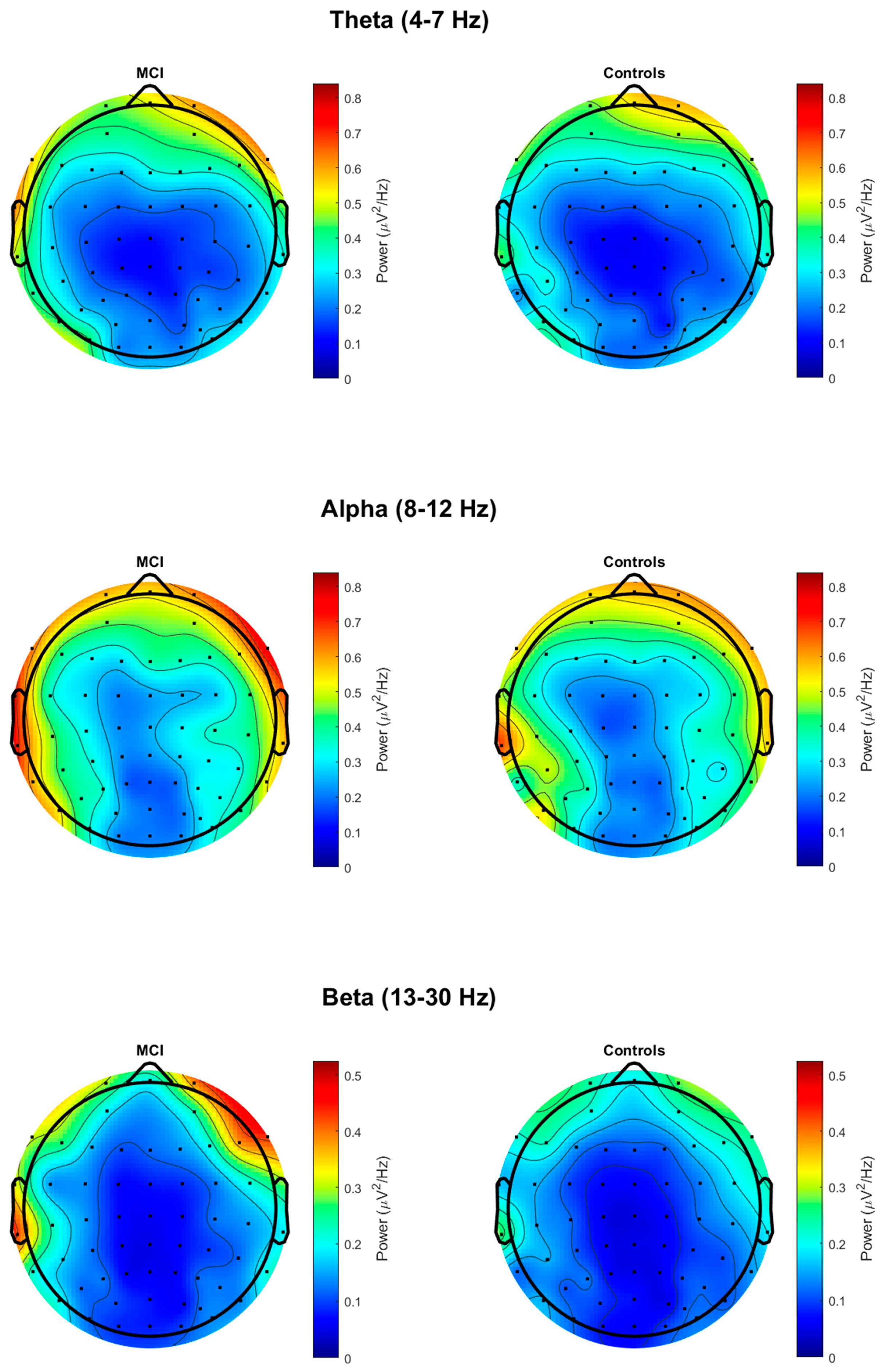
3.2. Resting-State EEG Group Differences
3.3. Associations Between Resting-State EEG Measures and Cognitive Measures
3.3.1. Correlations with 1/f-Adjusted Power and Cognitive Measures
3.3.2. Correlations with 1/f Slope and Cognitive Measures
4. Discussion
5. Conclusions
Supplementary Materials
Author Contributions
Funding
Institutional Review Board Statement
Informed Consent Statement
Data Availability Statement
Acknowledgments
Conflicts of Interest
Abbreviations
| MCI | Mild cognitive impairment |
| AD | Alzheimer’s disease |
| EEG | Electroencephalography |
| MMSE | Mini-Mental Status Examination |
| MoCA | Montreal Cognitive Assessment |
| TMT-A | Trail Making Test-A |
| TMT-B | Trail Making Test-B |
| BNT | Boston Naming Test |
| COWAT | Controlled Oral Word Association Test |
| LM | Logical memory |
References
- Petersen, R.C. Mild Cognitive Impairment. N. Engl. J. Med. 2011, 364, 2227–2234. [Google Scholar] [CrossRef]
- Petersen, R.C.; Roberts, R.O.; Knopman, D.S.; Boeve, B.F.; Geda, Y.E.; Ivnik, R.J.; Smith, G.E.; Jack, C.R., Jr. Mild Cognitive Impairment: Ten Years Later. Arch. Neurol. 2009, 66, 1447–1455. [Google Scholar] [CrossRef]
- Petersen, R.C.; Lopez, O.; Armstrong, M.J.; Getchius, T.S.; Ganguli, M.; Gloss, D.; Gronseth, G.S.; Marson, D.; Pringsheim, T.; Day, G.S. Practice Guideline Update Summary: Mild Cognitive Impairment: Report of the Guideline Development, Dissemination, and Implementation Subcommittee of the American Academy of Neurology. Neurology 2018, 90, 126–135. [Google Scholar] [CrossRef]
- Salari, N.; Lotfi, F.; Abdolmaleki, A.; Heidarian, P.; Rasoulpoor, S.; Fazeli, J.; Najafi, H.; Mohammadi, M. The Global Prevalence of Mild Cognitive Impairment in Geriatric Population with Emphasis on Influential Factors: A Systematic Review and Meta-Analysis. BMC Geriatr. 2025, 25, 313. [Google Scholar] [CrossRef]
- Gu, D.; Andreev, K.; Dupre, M.E. Major Trends in Population Growth Around the World. China CDC Wkly. 2021, 3, 604–613. [Google Scholar] [CrossRef]
- Jack, C.R.; Knopman, D.S.; Jagust, W.J.; Petersen, R.C.; Weiner, M.W.; Aisen, P.S.; Shaw, L.M.; Vemuri, P.; Wiste, H.J.; Weigand, S.D.; et al. Update on Hypothetical Model of Alzheimer’s Disease Biomarkers. Lancet Neurol. 2013, 12, 207–216. [Google Scholar] [CrossRef]
- Gu, L.; Zhang, Z. Exploring Potential Electrophysiological Biomarkers in Mild Cognitive Impairment: A Systematic Review and Meta-Analysis of Event-Related Potential Studies. J. Alzheimer’s Dis. 2017, 58, 1283–1292. [Google Scholar] [CrossRef]
- Morrison, C.; Rabipour, S.; Taler, V.; Sheppard, C.; Knoefel, F. Visual Event-Related Potentials in Mild Cognitive Impairment and Alzheimer’s Disease: A Literature Review. Curr. Alzheimer Res. 2019, 16, 67–89. [Google Scholar] [CrossRef]
- Paitel, E.R.; Samii, M.R.; Nielson, K.A. A Systematic Review of Cognitive Event-Related Potentials in Mild Cognitive Impairment and Alzheimer’s Disease. Behav. Brain Res. 2021, 396, 112904. [Google Scholar] [CrossRef]
- Tarawneh, H.Y.; Mulders, W.H.A.M.; Sohrabi, H.R.; Martins, R.N.; Jayakody, D.M.P. Investigating Auditory Electrophysiological Measures of Participants with Mild Cognitive Impairment and Alzheimer’s Disease: A Systematic Review and Meta-Analysis of Event-Related Potential Studies. J. Alzheimer’s Dis. 2021, 84, 419–448. [Google Scholar] [CrossRef]
- Yang, S.; Bornot, J.M.S.; Wong-Lin, K.; Prasad, G. M/EEG-Based Bio-Markers to Predict the MCI and Alzheimer’s Disease: A Review from the ML Perspective. IEEE Trans. Biomed. Eng. 2019, 66, 2924–2935. [Google Scholar] [CrossRef]
- Babiloni, C.; Arakaki, X.; Azami, H.; Bennys, K.; Blinowska, K.; Bonanni, L.; Bujan, A.; Carrillo, M.C.; Cichocki, A.; de Frutos-Lucas, J. Measures of Resting State EEG Rhythms for Clinical Trials in Alzheimer’s Disease: Recommendations of an Expert Panel. Alzheimers Dement. 2021, 17, 1528–1553. [Google Scholar] [CrossRef]
- Babiloni, C.; Vecchio, F.; Lizio, R.; Ferri, R.; Rodriguez, G.; Marzano, N.; Frisoni, G.B.; Rossini, P.M. Resting State Cortical Rhythms in Mild Cognitive Impairment and Alzheimer’s Disease: Electroencephalographic Evidence. J. Alzheimers Dis. 2011, 26, 201–214. [Google Scholar] [CrossRef]
- Babiloni, C.; Binetti, G.; Cassetta, E.; Cerboneschi, D.; Dal Forno, G.; Del Percio, C.; Ferreri, F.; Ferri, R.; Lanuzza, B.; Miniussi, C.; et al. Mapping Distributed Sources of Cortical Rhythms in Mild Alzheimer’s Disease. A Multicentric EEG Study. NeuroImage 2004, 22, 57–67. [Google Scholar] [CrossRef]
- Babiloni, C.; Lizio, R.; Vecchio, F.; Frisoni, G.B.; Pievani, M.; Geroldi, C.; Claudia, F.; Ferri, R.; Lanuzza, B.; Rossini, P.M. Reactivity of Cortical Alpha Rhythms to Eye Opening in Mild Cognitive Impairment and Alzheimer’s Disease: An EEG Study. J. Alzheimers Dis. 2010, 22, 1047–1064. [Google Scholar] [CrossRef]
- Huang, C.; Wahlund, L.-O.; Dierks, T.; Julin, P.; Winblad, B.; Jelic, V. Discrimination of Alzheimer’s Disease and Mild Cognitive Impairment by Equivalent EEG Sources: A Cross-Sectional and Longitudinal Study. Clin. Neurophysiol. 2000, 111, 1961–1967. [Google Scholar] [CrossRef]
- Jeong, J. EEG Dynamics in Patients with Alzheimer’s Disease. Clin. Neurophysiol. 2004, 115, 1490–1505. [Google Scholar] [CrossRef]
- Meghdadi, A.H.; Stevanović Karić, M.; McConnell, M.; Rupp, G.; Richard, C.; Hamilton, J.; Salat, D.; Berka, C. Resting State EEG Biomarkers of Cognitive Decline Associated with Alzheimer’s Disease and Mild Cognitive Impairment. PLoS ONE 2021, 16, e0244180. [Google Scholar] [CrossRef]
- Musaeus, C.S.; Engedal, K.; Høgh, P.; Jelic, V.; Mørup, M.; Naik, M.; Oeksengaard, A.-R.; Snaedal, J.; Wahlund, L.-O.; Waldemar, G.; et al. EEG Theta Power Is an Early Marker of Cognitive Decline in Dementia Due to Alzheimer’s Disease. J. Alzheimers Dis. 2018, 64, 1359–1371. [Google Scholar] [CrossRef]
- Ponomareva, N.V.; Selesneva, N.D.; Jarikov, G.A. EEG Alterations in Subjects at High Familial Risk for Alzheimer’s Disease. Neuropsychobiology 2003, 48, 152–159. [Google Scholar] [CrossRef]
- Stam, C.J.; Montez, T.; Jones, B.; Rombouts, S.; Van Der Made, Y.; Pijnenburg, Y.A.; Scheltens, P. Disturbed Fluctuations of Resting State EEG Synchronization in Alzheimer’s Disease. Clin. Neurophysiol. 2005, 116, 708–715. [Google Scholar] [CrossRef]
- Del Percio, C.; Lopez, S.; Noce, G.; Lizio, R.; Tucci, F.; Soricelli, A.; Ferri, R.; Nobili, F.; Arnaldi, D.; Famà, F.; et al. What a Single Electroencephalographic (EEG) Channel Can Tell Us About Alzheimer’s Disease Patients with Mild Cognitive Impairment. Clin. EEG Neurosci. 2023, 54, 21–35. [Google Scholar] [CrossRef]
- Meghdadi, A.H.; Salat, D.; Hamilton, J.; Hong, Y.; Boeve, B.F.; Louis, E.K.S.; Verma, A.; Berka, C. EEG and ERP Biosignatures of Mild Cognitive Impairment for Longitudinal Monitoring of Early Cognitive Decline in Alzheimer’s Disease. PLoS ONE 2024, 19, e0308137. [Google Scholar] [CrossRef]
- Tomasello, L.; Carlucci, L.; Laganà, A.; Galletta, S.; Marinelli, C.V.; Raffaele, M.; Zoccolotti, P. Neuropsychological Evaluation and Quantitative EEG in Patients with Frontotemporal Dementia, Alzheimer’s Disease, and Mild Cognitive Impairment. Brain Sci. 2023, 13, 930. [Google Scholar] [CrossRef]
- Wang, J.; Sun, T.; Zhang, Y.; Yu, X.; Wang, H. Distinct Effects of the Apolipoprotein E Ε4 Genotype on Associations Between Delayed Recall Performance and Resting-State Electroencephalography Theta Power in Elderly People Without Dementia. Front. Aging Neurosci. 2022, 14, 830149. [Google Scholar] [CrossRef]
- Fröhlich, S.; Kutz, D.F.; Müller, K.; Voelcker-Rehage, C. Characteristics of Resting State EEG Power in 80+-Year-Olds of Different Cognitive Status. Front. Aging Neurosci. 2021, 13, 675689. [Google Scholar] [CrossRef]
- Kim, S.-E.; Shin, C.; Yim, J.; Seo, K.; Ryu, H.; Choi, H.; Park, J.; Min, B.-K. Resting-State Electroencephalographic Characteristics Related to Mild Cognitive Impairments. Front. Psychiatry 2023, 14, 1231861. [Google Scholar] [CrossRef]
- Walters, K.F.; Shukla, R.; Kumar, V.; Schueren, S.; Yadav, H.; Schilaty, N.D.; Jain, S. Resting-State EEG Power Spectral Density Analysis Between Healthy and Cognitively Impaired Subjects. Brain Sci. 2025, 15, 173. [Google Scholar] [CrossRef]
- Kałamała, P.; Gyurkovics, M.; Bowie, D.C.; Clements, G.M.; Low, K.A.; Dolcos, F.; Fabiani, M.; Gratton, G. Event-Induced Modulation of Aperiodic Background EEG: Attention-Dependent and Age-Related Shifts in E:I Balance, and Their Consequences for Behavior. Imaging Neurosci. 2024, 2, 1–18. [Google Scholar] [CrossRef]
- Voytek, B.; Kramer, M.A.; Case, J.; Lepage, K.Q.; Tempesta, Z.R.; Knight, R.T.; Gazzaley, A. Age-Related Changes in 1/f Neural Electrophysiological Noise. J. Neurosci. 2015, 35, 13257–13265. [Google Scholar] [CrossRef]
- He, B.J. Scale-Free Brain Activity: Past, Present, and Future. Trends Cogn. Sci. 2014, 18, 480–487. [Google Scholar] [CrossRef]
- Ouyang, G.; Hildebrandt, A.; Schmitz, F.; Herrmann, C.S. Decomposing Alpha and 1/f Brain Activities Reveals Their Differential Associations with Cognitive Processing Speed. NeuroImage 2020, 205, 116304. [Google Scholar] [CrossRef]
- Li, M.; Wang, Y.; Chen, Y.; Dubois, A.E.E.; Jia, G.; Wu, Q.; Bringas-Vega, M.L.; Dumas, G.; Valdes-Sosab, P.A. Aperiodic and Periodic EEG Component Lifespan Trajectories: Monotonic Decrease versus Growth-Then-Decline. bioRxiv 2025. [Google Scholar] [CrossRef]
- Cesnaite, E.; Steinfath, P.; Jamshidi Idaji, M.; Stephani, T.; Kumral, D.; Haufe, S.; Sander, C.; Hensch, T.; Hegerl, U.; Riedel-Heller, S.; et al. Alterations in Rhythmic and Non-Rhythmic Resting-State EEG Activity and Their Link to Cognition in Older Age. NeuroImage 2023, 268, 119810. [Google Scholar] [CrossRef]
- Clements, G.M.; Bowie, D.C.; Gyurkovics, M.; Low, K.A.; Fabiani, M.; Gratton, G. Spontaneous Alpha and Theta Oscillations Are Related to Complementary Aspects of Cognitive Control in Younger and Older Adults. Front. Hum. Neurosci. 2021, 15, 621620. [Google Scholar] [CrossRef]
- Dave, S.; Brothers, T.A.; Swaab, T.Y. 1/f Neural Noise and Electrophysiological Indices of Contextual Prediction in Aging. Brain Res. 2018, 1691, 34–43. [Google Scholar] [CrossRef]
- Merkin, A.; Sghirripa, S.; Graetz, L.; Smith, A.E.; Hordacre, B.; Harris, R.; Pitcher, J.; Semmler, J.; Rogasch, N.C.; Goldsworthy, M. Do Age-Related Differences in Aperiodic Neural Activity Explain Differences in Resting EEG Alpha? Neurobiol. Aging 2023, 121, 78–87. [Google Scholar] [CrossRef]
- Aggarwal, S.; Ray, S. Slope of the Power Spectral Density Flattens at Low Frequencies (<150 Hz) with Healthy Aging but Also Steepens at Higher Frequency (>200 Hz) in Human Electroencephalogram. Cereb. Cortex Commun. 2023, 4, tgad011. [Google Scholar] [CrossRef]
- Azami, H.; Zrenner, C.; Brooks, H.; Zomorrodi, R.; Blumberger, D.M.; Fischer, C.E.; Flint, A.; Herrmann, N.; Kumar, S.; Lanctôt, K.; et al. Beta to Theta Power Ratio in EEG Periodic Components as a Potential Biomarker in Mild Cognitive Impairment and Alzheimer’s Dementia. Alzheimers Res. Ther. 2023, 15, 133. [Google Scholar] [CrossRef]
- Rosenblum, Y.; Shiner, T.; Bregman, N.; Giladi, N.; Maidan, I.; Fahoum, F.; Mirelman, A. Decreased Aperiodic Neural Activity in Parkinson’s Disease and Dementia with Lewy Bodies. J. Neurol. 2023, 270, 3958–3969. [Google Scholar] [CrossRef]
- Wan, W.; Gao, Z.; Zhang, Q.; Gu, Z.; Chang, C.; Peng, C.-K.; Cui, X. Resting State EEG Complexity as a Predictor of Cognitive Performance. Phys. Stat. Mech. Its Appl. 2023, 624, 128952. [Google Scholar] [CrossRef]
- Stacey, J.E.; Crook-Rumsey, M.; Sumich, A.; Howard, C.J.; Crawford, T.; Livne, K.; Lenzoni, S.; Badham, S. Age Differences in Resting State EEG and Their Relation to Eye Movements and Cognitive Performance. Neuropsychologia 2021, 157, 107887. [Google Scholar] [CrossRef]
- Vlahou, E.L.; Thurm, F.; Kolassa, I.-T.; Schlee, W. Resting-State Slow Wave Power, Healthy Aging and Cognitive Performance. Sci. Rep. 2014, 4, 5101. [Google Scholar] [CrossRef]
- Finnigan, S.; Robertson, I.H. Resting EEG Theta Power Correlates with Cognitive Performance in Healthy Older Adults. Psychophysiology 2011, 48, 1083–1087. [Google Scholar] [CrossRef]
- Perez, V.; Garrido-Chaves, R.; Zapater-Fajarí, M.; Pulopulos, M.M.; Hidalgo, V.; Salvador, A. EEG Markers and Subjective Memory Complaints in Young and Older People. Int. J. Psychophysiol. 2022, 182, 23–31. [Google Scholar] [CrossRef]
- Babiloni, C.; Ferri, R.; Binetti, G.; Cassarino, A.; Dal Forno, G.; Ercolani, M.; Ferreri, F.; Frisoni, G.B.; Lanuzza, B.; Miniussi, C. Fronto-Parietal Coupling of Brain Rhythms in Mild Cognitive Impairment: A Multicentric EEG Study. Brain Res. Bull. 2006, 69, 63–73. [Google Scholar] [CrossRef]
- Babiloni, C.; Frisoni, G.B.; Vecchio, F.; Lizio, R.; Pievani, M.; Cristina, G.; Fracassi, C.; Vernieri, F.; Rodriguez, G.; Nobili, F. Stability of Clinical Condition in Mild Cognitive Impairment Is Related to Cortical Sources of Alpha Rhythms: An Electroencephalographic Study. Hum. Brain Mapp. 2011, 32, 1916–1931. [Google Scholar] [CrossRef]
- Kaiser, A.K.; Doppelmayr, M.; Iglseder, B. EEG Beta 2 Power as Surrogate Marker for Memory Impairment: A Pilot Study. Int. Psychogeriatr. 2017, 29, 1515–1523. [Google Scholar] [CrossRef]
- Cavanagh, J.F.; Frank, M.J. Frontal Theta as a Mechanism for Cognitive Control. Trends Cogn. Sci. 2014, 18, 414–421. [Google Scholar] [CrossRef]
- Cooper, P.S.; Wong, A.S.W.; Fulham, W.R.; Thienel, R.; Mansfield, E.; Michie, P.T.; Karayanidis, F. Theta Frontoparietal Connectivity Associated with Proactive and Reactive Cognitive Control Processes. NeuroImage 2015, 108, 354–363. [Google Scholar] [CrossRef]
- Cooper, P.S.; Karayanidis, F.; McKewen, M.; McLellan-Hall, S.; Wong, A.S.W.; Skippen, P.; Cavanagh, J.F. Frontal Theta Predicts Specific Cognitive Control-Induced Behavioural Changes beyond General Reaction Time Slowing. NeuroImage 2019, 189, 130–140. [Google Scholar] [CrossRef]
- Eisma, J.; Rawls, E.; Long, S.; Mach, R.; Lamm, C. Frontal Midline Theta Differentiates Separate Cognitive Control Strategies While Still Generalizing the Need for Cognitive Control. Sci. Rep. 2021, 11, 14641. [Google Scholar] [CrossRef]
- Klimesch, W.; Schimke, H.; Schwaiger, J. Episodic and Semantic Memory: An Analysis in the EEG Theta and Alpha Band. Electroencephalogr. Clin. Neurophysiol. 1994, 91, 428–441. [Google Scholar] [CrossRef]
- Klimesch, W.; Doppelmayr, M.; Pachinger, T.; Russegger, H. Event-Related Desynchronization in the Alpha Band and the Processing of Semantic Information. Cogn. Brain Res. 1997, 6, 83–94. [Google Scholar] [CrossRef]
- Maguire, M.J.; Brier, M.R.; Ferree, T.C. EEG Theta and Alpha Responses Reveal Qualitative Differences in Processing Taxonomic versus Thematic Semantic Relationships. Brain Lang. 2010, 114, 16–25. [Google Scholar] [CrossRef] [PubMed]
- Zioga, I.; Kenett, Y.N.; Giannopoulos, A.; Luft, C.D.B. The Role of Alpha Oscillations in Free- and Goal-Directed Semantic Associations. Hum. Brain Mapp. 2024, 45, e26770. [Google Scholar] [CrossRef] [PubMed]
- Fleck, J.I.; Kuti, J.; Brown, J.; Mahon, J.R.; Gayda-Chelder, C. Frontal-Posterior Coherence and Cognitive Function in Older Adults. Int. J. Psychophysiol. 2016, 110, 217–230. [Google Scholar] [CrossRef]
- Hanouneh, S.; Amin, H.U.; Saad, N.M.; Malik, A.S. EEG Power and Functional Connectivity Correlates with Semantic Long-Term Memory Retrieval. IEEE Access 2018, 6, 8695–8703. [Google Scholar] [CrossRef]
- Nyhus, E. Brain Networks Related to Beta Oscillatory Activity during Episodic Memory Retrieval. J. Cogn. Neurosci. 2018, 30, 174–187. [Google Scholar] [CrossRef]
- Almeida, O.P.; Almeida, S.A. Short Versions of the Geriatric Depression Scale: A Study of Their Validity for the Diagnosis of a Major Depressive Episode According to ICD-10 and DSM-IV. Int. J. Geriatr. Psychiatry 1999, 14, 858–865. [Google Scholar] [CrossRef]
- Beck, A.T.; Steer, R.A.; Brown, G. Beck Depression Inventory–II. Psychol. Assess. 1996, 1, 210. [Google Scholar]
- Petersen, R.C.; Doody, R.; Kurz, A.; Mohs, R.C.; Morris, J.C.; Rabins, P.V.; Ritchie, K.; Rossor, M.; Thal, L.; Winblad, B. Current Concepts in Mild Cognitive Impairment. Arch. Neurol. 2001, 58, 1985–1992. [Google Scholar] [CrossRef] [PubMed]
- Wechsler, D., III. WMS-III Administration and Scoring Manual; The Psychological Corporation: San Antonio, TX, USA, 1997. [Google Scholar]
- Morris, J.C. The Clinical Dementia Rating (CDR): Current Version and Scoring Rules. Neurology 1993, 43, 2412–2414. [Google Scholar] [CrossRef]
- Nasreddine, Z.S.; Phillips, N.A.; Bédirian, V.; Charbonneau, S.; Whitehead, V.; Collin, I.; Cummings, J.L.; Chertkow, H. The Montreal Cognitive Assessment, MoCA: A Brief Screening Tool for Mild Cognitive Impairment. J. Am. Geriatr. Soc. 2005, 53, 695–699. [Google Scholar] [CrossRef] [PubMed]
- Semlitsch, H.V.; Anderer, P.; Schuster, P.; Presslich, O. A Solution for Reliable and Valid Reduction of Ocular Artifacts, Applied to the P300 ERP. Psychophysiology 1986, 23, 695–703. [Google Scholar] [CrossRef]
- Delorme, A.; Makeig, S. EEGLAB: An Open Source Toolbox for Analysis of Single-Trial EEG Dynamics Including Independent Component Analysis. J. Neurosci. Methods 2004, 134, 9–21. [Google Scholar] [CrossRef]
- Oostenveld, R.; Fries, P.; Maris, E.; Schoffelen, J.-M. FieldTrip: Open Source Software for Advanced Analysis of MEG, EEG, and Invasive Electrophysiological Data. Comput. Intell. Neurosci. 2010, 2011, e156869. [Google Scholar] [CrossRef]
- Kałamała, P.; Gyurkovics, M.; Clements, G.; Low, K.; Gratton, G.; Fabiani, M.; Chen, T. How to Improve the Reliability of Aperiodic Parameter Estimates in M/EEG: A Method Comparison and Recommendations for Best Practices. bioRxiv 2025. [Google Scholar] [CrossRef]
- Miller, K.J.; Sorensen, L.B.; Ojemann, J.G.; Nijs, M. den. Power-Law Scaling in the Brain Surface Electric Potential. PLoS Comput. Biol. 2009, 5, e1000609. [Google Scholar] [CrossRef] [PubMed]
- Pertermann, M.; Mückschel, M.; Adelhöfer, N.; Ziemssen, T.; Beste, C. On the Interrelation of 1/f Neural Noise and Norepinephrine System Activity during Motor Response Inhibition. J. Neurophysiol. 2019, 121, 1633–1643. [Google Scholar] [CrossRef]
- Haegens, S.; Cousijn, H.; Wallis, G.; Harrison, P.J.; Nobre, A.C. Inter- and Intra-Individual Variability in Alpha Peak Frequency. NeuroImage 2014, 92, 46–55. [Google Scholar] [CrossRef]
- Folstein, M.F.; Folstein, S.E.; McHugh, P.R. “Mini-Mental State”: A Practical Method for Grading the Cognitive State of Patients for the Clinician. J. Psychiatr. Res. 1975, 12, 189–198. [Google Scholar] [CrossRef]
- Fasnacht, J.S.; Wueest, A.S.; Berres, M.; Thomann, A.E.; Krumm, S.; Gutbrod, K.; Steiner, L.A.; Goettel, N.; Monsch, A.U. Conversion between the Montreal Cognitive Assessment and the Mini-Mental Status Examination. J. Am. Geriatr. Soc. 2023, 71, 869–879. [Google Scholar] [CrossRef] [PubMed]
- Reitan, R.M. Validity of the Trail Making Test as an Indicator of Organic Brain Damage. Percept. Mot. Skills 1958, 8, 271–276. [Google Scholar] [CrossRef]
- Kaplan, E.; Goodglass, H.; Weintraub, S. Boston Naming Test; Elsevier: Amsterdam, The Netherlands, 1983. [Google Scholar]
- Benton, A.L.; Hamsher, d.S.K.; Sivan, A.B. Controlled Oral Word Association Test; American Psychological Association: Washington, DC, USA, 1983. [Google Scholar] [CrossRef]
- Barry, R.J.; Clarke, A.R.; Johnstone, S.J.; Magee, C.A.; Rushby, J.A. EEG Differences between Eyes-Closed and Eyes-Open Resting Conditions. Clin. Neurophysiol. 2007, 118, 2765–2773. [Google Scholar] [CrossRef] [PubMed]
- Barry, R.J.; De Blasio, F.M. EEG Differences between Eyes-Closed and Eyes-Open Resting Remain in Healthy Ageing. Biol. Psychol. 2017, 129, 293–304. [Google Scholar] [CrossRef]
- Polich, J. On the Relationship between EEG and P300: Individual Differences, Aging, and Ultradian Rhythms. Int. J. Psychophysiol. 1997, 26, 299–317. [Google Scholar] [CrossRef] [PubMed]
- Kavcic, V.; Zalar, B.; Giordani, B. The Relationship between Baseline EEG Spectra Power and Memory Performance in Older African Americans Endorsing Cognitive Concerns in a Community Setting. Int. J. Psychophysiol. 2016, 109, 116–123. [Google Scholar] [CrossRef]
- Požar, R.; Kero, K.; Martin, T.; Giordani, B.; Kavcic, V. Task Aftereffect Reorganization of Resting State Functional Brain Networks in Healthy Aging and Mild Cognitive Impairment. Front. Aging Neurosci. 2023, 14, 1061254. [Google Scholar] [CrossRef]
- Požar, R.; Giordani, B.; Kavcic, V. Pre vs Post-Task Modulation of Resting State EEG Functional Connectivity and Network Topology. Alzheimers Dement. 2022, 18, e066926. [Google Scholar] [CrossRef]
- Lydon, E.A.; Nguyen, L.T.; Shende, S.A.; Chiang, H.-S.; Spence, J.S.; Mudar, R.A. EEG Theta and Alpha Oscillations in Early versus Late Mild Cognitive Impairment during a Semantic Go/NoGo Task. Behav. Brain Res. 2022, 416, 113539. [Google Scholar] [CrossRef] [PubMed]
- Nguyen, L.T.; Mudar, R.A.; Chiang, H.-S.; Schneider, J.M.; Maguire, M.J.; Kraut, M.A.; Hart, J. Theta and Alpha Alterations in Amnestic Mild Cognitive Impairment in Semantic Go/NoGo Tasks. Front. Aging Neurosci. 2017, 9, 160. [Google Scholar] [CrossRef]
- Nguyen, L.T.; Marini, F.; Zacharczuk, L.; Llano, D.A.; Mudar, R.A. Theta and Alpha Band Oscillations during Value-Directed Strategic Processing. Behav. Brain Res. 2019, 367, 210–214. [Google Scholar] [CrossRef]
- Shende, S.A.; Jones, S.E.; Mudar, R.A. Alpha and Theta Oscillations on a Visual Strategic Processing Task in Age-Related Hearing Loss. Front. Neurosci. 2024, 18, 1382613. [Google Scholar] [CrossRef] [PubMed]
- Brickman, A.M.; Paul, R.H.; Cohen, R.A.; Williams, L.M.; MacGregor, K.L.; Jefferson, A.L.; Tate, D.F.; Gunstad, J.; Gordon, E. Category and Letter Verbal Fluency across the Adult Lifespan: Relationship to EEG Theta Power. Arch. Clin. Neuropsychol. 2005, 20, 561–573. [Google Scholar] [CrossRef]
- Hatta, K.; Kishi, Y.; Wada, K.; Takeuchi, T.; Taira, T.; Uemura, K.; Ogawa, A.; Takahashi, K.; Sato, A.; Shirakawa, M.; et al. Suvorexant for Reduction of Delirium in Older Adults After Hospitalization: A Randomized Clinical Trial. JAMA Netw. Open 2024, 7, e2427691. [Google Scholar] [CrossRef] [PubMed]
- McCarrey, A.C.; An, Y.; Kitner-Triolo, M.H.; Ferrucci, L.; Resnick, S.M. Sex Differences in Cognitive Trajectories in Clinically Normal Older Adults. Psychol. Aging 2016, 31, 166–175. [Google Scholar] [CrossRef]
- McKeown, D.J.; Roberts, E.; Finley, A.J.; Kelley, N.J.; Keage, H.A.D.; Schinazi, V.R.; Baumann, O.; Moustafa, A.A.; Angus, D.J. Lower Aperiodic EEG Activity Is Associated with Reduced Verbal Fluency Performance across Adulthood. Neurobiol. Aging 2025, 151, 29–41. [Google Scholar] [CrossRef]
- Gao, R.; Peterson, E.J.; Voytek, B. Inferring Synaptic Excitation/Inhibition Balance from Field Potentials. NeuroImage 2017, 158, 70–78. [Google Scholar] [CrossRef] [PubMed]
- Scaduto, P.; Lauterborn, J.C.; Cox, C.D.; Fracassi, A.; Zeppillo, T.; Gutierrez, B.A.; Keene, C.D.; Crane, P.K.; Mukherjee, S.; Russell, W.K.; et al. Functional Excitatory to Inhibitory Synaptic Imbalance and Loss of Cognitive Performance in People with Alzheimer’s Disease Neuropathologic Change. Acta Neuropathol. 2023, 145, 303–324. [Google Scholar] [CrossRef]
- Tanaka, H.; Nakamura, Y.; Sato, K.; Fujimoto, A. Inhibitory and Excitatory Imbalance in Neurodegenerative Diseases. Neurol. Lett. 2025, 4, 86–91. [Google Scholar] [CrossRef]
- van Nifterick, A.M.; Mulder, D.; Duineveld, D.J.; Diachenko, M.; Scheltens, P.; Stam, C.J.; van Kesteren, R.E.; Linkenkaer-Hansen, K.; Hillebrand, A.; Gouw, A.A. Resting-State Oscillations Reveal Disturbed Excitation–Inhibition Ratio in Alzheimer’s Disease Patients. Sci. Rep. 2023, 13, 7419. [Google Scholar] [CrossRef] [PubMed]

| MCI | Controls | p-Value | |
|---|---|---|---|
| Demographics | |||
| Total N | 19 | 19 | -- |
| Age (yrs) | 68.84 (7.28) | 69.58 (6.75) | 0.748 |
| Education (yrs) | 17.21 (1.51) | 16.58 (2.57) | 0.363 |
| Sex | 8 F/11 M | 16 F/3 M | 0.019 * |
| Cognitive Measures | |||
| MMSE | 28.05 (1.47) | -- | -- |
| MoCA | 23.53 (2.99) | 28.11 (1.29) | <0.001 * |
| LM: Immediate | 10.53 (1.84) | 17.14 (1.69) | <0.001 * |
| LM: Delayed | 8.63 (2.19) | 16.14 (1.91) | <0.001 * |
| TMT-A (S)s.) | 29.74 (9.25) | 26.32 (7.14) | 0.211 |
| TMT-B (S)s.) | 76.37 (27.24) | 65.79 (14.60) | 0.147 |
| BNT | 27.24 (2.37) | 28.47(1.12) | 0.050 * |
| COWAT: Letter Fluency | 41.47 (8.10) | 52.00 (7.96) | <0.001 * |
| COWAT: Category Fluency | 20.16 (6.82) | 22.32 (5.15) | 0.279 |
| MCI | Controls | Main Effect of Group | |
|---|---|---|---|
| Absolute Power | |||
| Theta (fronto-central) | 0.2106 (0.2032) | 0.1882 (0.1770) | F(1, 36) = 0.12; p = 0.726 |
| Alpha (parietal) | 0.2136 (0.2641) | 0.2142 (0.2797) | F(1, 36) = 0.00; p = 0.995 |
| Beta (parietal) | 0.0601 (0.0513) | 0.0554 (0.0550) | F(1, 36) = 0.07; p = 0.793 |
| 1/f-Adjusted Power | |||
| Theta (fronto-central) | −0.0347 (0.0476) | −0.0552 (0.0844) | F(1, 36) = 0.81; p = 0.373 |
| Alpha (parietal) | 0.0135 (0.0533) | −0.0056 (0.0629) | F(1, 36) = 0.97; p = 0.332 |
| Beta (parietal) | 0.0003 (0.0009) | −0.0002 (0.0020) | F(1, 36) = 0.89; p = 0.353 |
| 1/f Slope | |||
| Fronto-central | −0.0464 (0.0405) | −0.0621 (0.0611) | F(1, 36) = 0.83; p = 0.368 |
| Parietal | −0.0384 (0.0408) | −0.0564 (0.0663) | F(1, 36) = 0.96; p = 0.333 |
| MCI | Controls | |
|---|---|---|
| 1/f-Adjusted Power: Theta (Fronto-Central) | ||
| TMT-B | r(17) = −0.22, p = 0.361 | r(17) = −0.17, p = 0.478 |
| COWAT: Letter Fluency | r(17) = 0.04, p = 0.864 | r(17) = −0.48, p = 0.036 * |
| 1/f-Adjusted Power: Alpha (Parietal) | ||
| BNT | r(17) = 0.06, p = 0.818 | r(17) = 0.11, p = 0.665 |
| COWAT: Category Fluency | r(17) = −0.17, p = 0.495 | r(17) = −0.11, p = 0.641 |
| 1/f-Adjusted Power: Beta (Parietal) | ||
| MMSE/MoCA 1 | r(17) = −0.09, p = 0.709 | r(17) = 0.46, p = 0.048 * |
| LM: Delayed | r(17) = 0.12, p = 0.620 | r(17) = 0.45, p = 0.051 |
| MCI | Controls | |
|---|---|---|
| 1/f Slope: Fronto-Central | ||
| TMT-B | r(17) = −0.08, p = 0.750 | r(17) = −0.02, p = 0.920 |
| COWAT: Letter Fluency | r(17) = 0.11, p = 0.650 | r(17) = −0.63, p = 0.004 * |
| 1/f Slope: Parietal | ||
| BNT | r(17) = 0.22, p = 0.375 | r(17) = −0.29, p = 0.236 |
| COWAT: Category Fluency | r(17) = −0.10, p = 0.687 | r(17) = −0.31, p = 0.189 |
| MMSE/MoCA 1 | r(17) = 0.17, p = 0.481 | r(17) = 0.21, p = 0.385 |
| LM: Delayed | r(17) = 0.20, p = 0.402 | r(17) = 0.16, p = 0.509 |
Disclaimer/Publisher’s Note: The statements, opinions and data contained in all publications are solely those of the individual author(s) and contributor(s) and not of MDPI and/or the editor(s). MDPI and/or the editor(s) disclaim responsibility for any injury to people or property resulting from any ideas, methods, instructions or products referred to in the content. |
© 2025 by the authors. Licensee MDPI, Basel, Switzerland. This article is an open access article distributed under the terms and conditions of the Creative Commons Attribution (CC BY) license (https://creativecommons.org/licenses/by/4.0/).
Share and Cite
Warren, T.S.; Shende, S.A.; Ashrafi, J.; Clements, G.M.; Mudar, R.A. Resting-State EEG Power and Aperiodic Activity in Individuals with Mild Cognitive Impairment and Cognitively Healthy Controls. Brain Sci. 2025, 15, 1305. https://doi.org/10.3390/brainsci15121305
Warren TS, Shende SA, Ashrafi J, Clements GM, Mudar RA. Resting-State EEG Power and Aperiodic Activity in Individuals with Mild Cognitive Impairment and Cognitively Healthy Controls. Brain Sciences. 2025; 15(12):1305. https://doi.org/10.3390/brainsci15121305
Chicago/Turabian StyleWarren, Teresa S., Shraddha A. Shende, Jaya Ashrafi, Grace M. Clements, and Raksha A. Mudar. 2025. "Resting-State EEG Power and Aperiodic Activity in Individuals with Mild Cognitive Impairment and Cognitively Healthy Controls" Brain Sciences 15, no. 12: 1305. https://doi.org/10.3390/brainsci15121305
APA StyleWarren, T. S., Shende, S. A., Ashrafi, J., Clements, G. M., & Mudar, R. A. (2025). Resting-State EEG Power and Aperiodic Activity in Individuals with Mild Cognitive Impairment and Cognitively Healthy Controls. Brain Sciences, 15(12), 1305. https://doi.org/10.3390/brainsci15121305

