

Charting Early Brain Plasticity in Radiological Training: Functional Brain Reorganization During Early Radiological Expertise Acquisition

 ,
,
Abstract
1. Introduction
2. Materials and Methods
2.1. Subjects
2.2. Experimental Procedure
2.3. Behavioral Test
2.4. Behavioral Data Analysis
2.5. MRI Data Acquisition
2.6. MRI Data Analysis
2.6.1. MRI Data Preprocessing
2.6.2. Feature Extraction
Generation of Voxel-Wise Regional Homogeneity Map
Generation of Region-Wise Regional Homogeneity Map
2.6.3. Feature Selection
- 1.
- The resulting beta maps were standardized to a 0–1 range using mean–variance normalization across all ReHo features.
- 2.
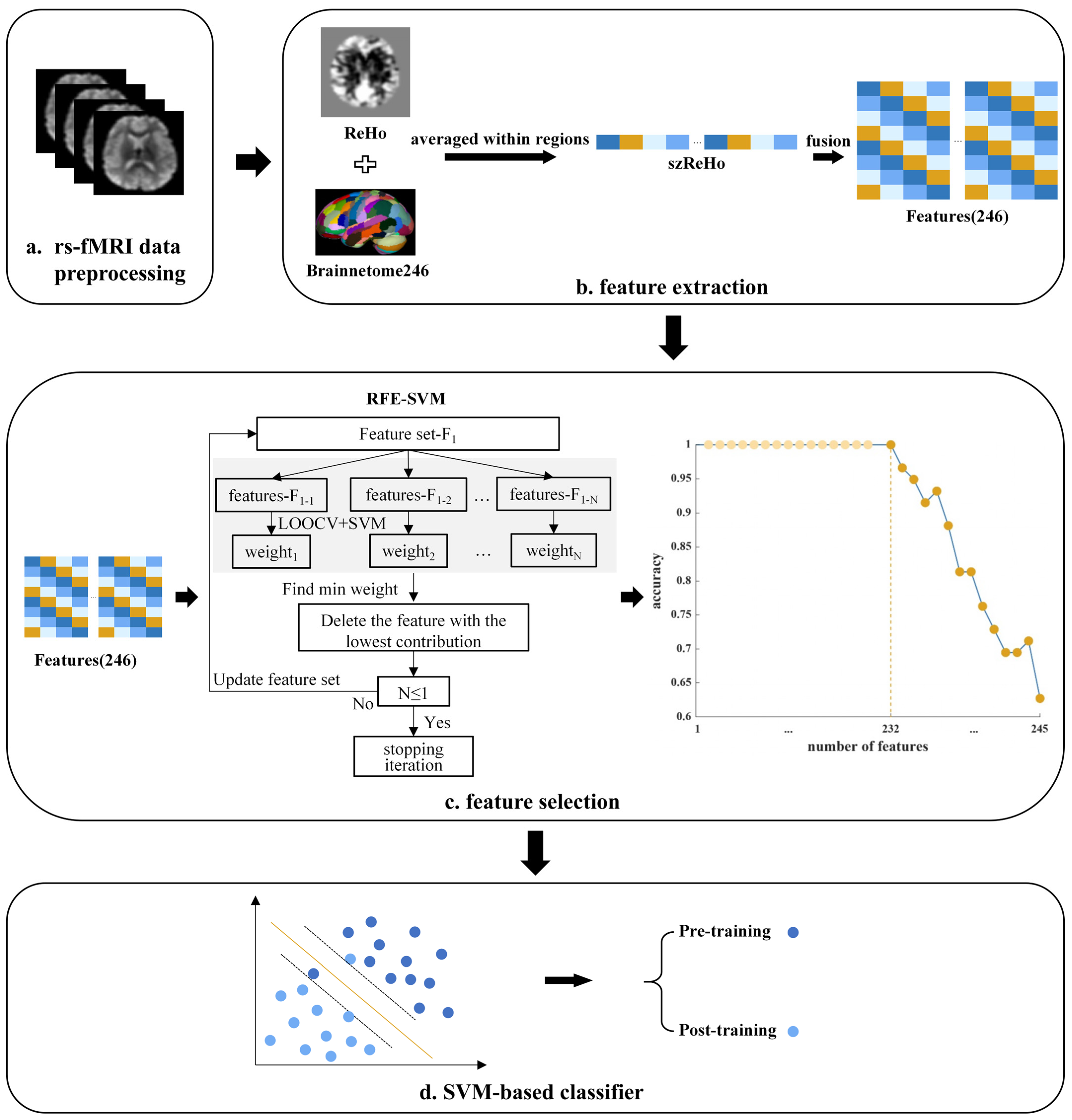
- RFE was then used to assess feature importance via the classifier and progressively eliminate features contributing the least to classification accuracy, reducing feature dimensionality. Our implementation of RFE followed these steps:
- a.
- Input all ReHo feature data and class labels as training samples, train the SVM classifier, and evaluate the model’s classification accuracy using leave-one-out cross-validation (LOOCV);
- b.
- Sequentially extract the feature weights from the SVM model, rank the features based on the absolute values of their weights, and determine their contribution to classification accuracy;
- c.
- Remove the feature with the smallest weight (i.e., the feature ranked last), representing the feature with the least contribution to classification accuracy; and
- d.
- Continue iterating until any additional feature removal leads to a drop in classification accuracy.
2.6.4. Support Vector Machine Classifier
2.6.5. Training the Classifier and Evaluating Its Performance
2.7. Correlation Analysis
3. Results
3.1. Results of Behavior Data Analysis
3.2. Results of Mri Data Feature Selection
3.3. Results of Classifier Performance
3.4. Results of Correlation Between Behavioral and Mri Data Changes
4. Discussion
4.1. Neural Networks Supporting Visual Processing in Radiological Training
4.2. Neural Networks Supporting Semantic Processing in Radiological Training
4.3. Neural Networks Supporting Memory in Radiological Training
4.4. Neural Networks Supporting Attention in Radiological Training
4.5. Neural Networks Supporting Decision-Making in Radiological Training
4.6. An Integrated Account of Early Radiological Expertise
4.7. Future Directions: Brain-Based Targeting to Enhance Radiology Training
4.8. Limitations
5. Conclusions
Author Contributions
Funding
Institutional Review Board Statement
Informed Consent Statement
Data Availability Statement
Conflicts of Interest
References
- Rourke, L.; Cruikshank, L.C.; Shapke, L.; Singhal, A. A neural marker of medical visual expertise: Implications for training. Adv. Health Sci. Educ. 2016, 21, 953–966. [Google Scholar] [CrossRef]
- Waite, S.; Grigorian, A.; Alexander, R.G.; Macknik, S.L.; Carrasco, M.; Heeger, D.J.; Martinez-Conde, S. Analysis of perceptual expertise in radiology–current knowledge and a new perspective. Front. Hum. Neurosci. 2019, 13, 213. [Google Scholar]
- Chen, W.; David, H.D.; Mccusker, M.W.; Frank, G.; Howe, P.; Etsuro, I. Perceptual training to improve hip fracture identification in conventional radiographs. PLoS ONE 2017, 12, e0189192. [Google Scholar] [CrossRef] [PubMed]
- Harel, A.; Kravitz, D.; Baker, C.I. Beyond perceptual expertise: Revisiting the neural substrates of expert object recognition. Front. Hum. Neurosci. 2013, 7, 885. [Google Scholar] [CrossRef] [PubMed]
- Karni, A.; Sagi, D. The time course of learning a visual skill. Nature 1993, 365, 250–252. [Google Scholar] [CrossRef]
- Zatorre, R.J.; Fields, R.D.; Johansen-Berg, H. Plasticity in gray and white: Neuroimaging changes in brain structure during learning. Nat. Neurosci. 2012, 15, 528–536. [Google Scholar] [CrossRef]
- Kundel, H.L.; Nodine, C.F.; Conant, E.F.; Weinstein, S.P. Holistic component of image perception in mammogram interpretation: Gaze-tracking study. Radiology 2007, 242, 396–402. [Google Scholar] [CrossRef]
- Ganesan, A.; Alakhras, M.; Brennan, P.C.; Mello-Thoms, C. A review of factors influencing radiologists’ visual search behaviour. J. Med. Imaging Radiat. Oncol. 2018, 62, 747–757. [Google Scholar] [CrossRef]
- Binder, J.R.; Desai, R.H.; Graves, W.W.; Conant, L.L. Where is the semantic system? A critical review and meta-analysis of 120 functional neuroimaging studies. Cereb. Cortex 2009, 19, 2767–2796. [Google Scholar] [CrossRef]
- Gobet, F.; Simon, H.A. Expert chess memory: Revisiting the chunking hypothesis. Memory 1998, 6, 225–255. [Google Scholar] [CrossRef]
- Corbetta, M.; Patel, G.; Shulman, G.L. The reorienting system of the human brain: From environment to theory of mind. Neuron 2008, 58, 306–324. [Google Scholar] [CrossRef] [PubMed]
- Ernst, M.; Paulus, M.P. Neurobiology of decision making: A selective review from a neurocognitive and clinical perspective. Biol. Psychiatry 2005, 58, 597–604. [Google Scholar] [CrossRef]
- Chang, Y. Reorganization and plastic changes of the human brain associated with skill learning and expertise. Front. Hum. Neurosci. 2014, 8, 35. [Google Scholar] [CrossRef] [PubMed]
- Ouellette, D.J.; Van Staalduinen, E.; Hussaini, S.H.; Govindarajan, S.T.; Stefancin, P.; Hsu, D.-L.; Duong, T.Q. Functional, anatomical and diffusion tensor MRI study of radiology expertise. PLoS ONE 2020, 15, e0231900. [Google Scholar] [CrossRef] [PubMed]
- Haller, S.; Radue, E.W. What is different about a radiologist’s brain? Radiology 2005, 236, 983–989. [Google Scholar] [CrossRef]
- Harley, E.M.; Pope, W.B.; Villablanca, J.P.; Mumford, J.; Suh, R.; Mazziotta, J.C.; Enzmann, D.; Engel, S.A. Engagement of Fusiform Cortex and Disengagement of Lateral Occipital Cortex in the Acquisition of Radiological Expertise. Cereb. Cortex 2009, 19, 2746–2754. [Google Scholar] [CrossRef]
- Bilalic, M.; Grottenthaler, T.; Nägele, T.; Lindig, T. The Faces in Radiological Images: Fusiform Face Area Supports Radiological Expertise. Cereb. Cortex 2016, 26, 1004–1014. [Google Scholar] [CrossRef]
- Wu, J.; Wang, J.; Georgiadis, J.R.; Cera, N.; Liang, J.; Shi, G.; Chen, C.; Dong, M. Expertise, brain plasticity, and resting state. Psychoradiology 2024, 4, kkae020. [Google Scholar] [CrossRef]
- Canario, E.; Chen, D.; Biswal, B. A review of resting-state fMRI and its use to examine psychiatric disorders. Psychoradiology 2021, 1, 42–53. [Google Scholar] [CrossRef]
- Miall, R.C.; Robertson, E.M. Functional imaging: Is the resting brain resting? Curr. Biol. 2006, 16, R998–R1000. [Google Scholar] [CrossRef]
- Albert, N.B.; Robertson, E.M.; Miall, R.C. The resting human brain and motor learning. Curr. Biol. 2009, 19, 1023–1027. [Google Scholar] [CrossRef]
- Dong, M.; Qin, W.; Zhao, L.; Yang, X.; Yuan, K.; Zeng, F.; Sun, J.; Yu, D.; von Deneen, K.M.; Liang, F. Expertise modulates local regional homogeneity of spontaneous brain activity in the resting brain: An fMRI study using the model of skilled acupuncturists. Hum. Brain Mapp. 2014, 35, 1074–1084. [Google Scholar] [CrossRef]
- Zuo, X.-N.; Xing, X.-X. Test-retest reliabilities of resting-state FMRI measurements in human brain functional connectomics: A systems neuroscience perspective. Neurosci. Biobehav. Rev. 2014, 45, 100–118. [Google Scholar] [CrossRef]
- Lv, H.; Wang, Z.; Tong, E.; Williams, L.M.; Zaharchuk, G.; Zeineh, M.; Goldstein-Piekarski, A.N.; Ball, T.M.; Liao, C.; Wintermark, M. Resting-state functional MRI: Everything that nonexperts have always wanted to know. Am. J. Neuroradiol. 2018, 39, 1390–1399. [Google Scholar] [CrossRef]
- Zang, Y.; Jiang, T.; Lu, Y.; He, Y.; Tian, L. Regional homogeneity approach to fMRI data analysis. Neuroimage 2004, 22, 394–400. [Google Scholar] [CrossRef] [PubMed]
- Oldfield, R.C. The assessment and analysis of handedness: The Edinburgh inventory. Neuropsychologia 1971, 9, 97–113. [Google Scholar] [CrossRef]
- Dong, M.; Zhang, P.; Chai, W.; Zhang, X.; Chen, B.T.; Wang, H.; Wu, J.; Chen, C.; Niu, Y.; Liang, J. Early stage of radiological expertise modulates resting-state local coherence in the inferior temporal lobe. Psychoradiology 2022, 2, 199–206. [Google Scholar] [CrossRef]
- Wang, Y.; Jin, C.; Yin, Z.; Wang, H.; Ji, M.; Dong, M.; Liang, J. Visual experience modulates whole-brain connectivity dynamics: A resting-state fMRI study using the model of radiologists. Hum. Brain Mapp. 2021, 42, 4538–4554. [Google Scholar] [CrossRef] [PubMed]
- Chakraborty, D.P. Analysis of location specific observer performance data: Validated extensions of the jackknife free-response (JAFROC) method. Acad. Radiol. 2006, 13, 1187–1193. [Google Scholar] [CrossRef] [PubMed]
- Hasler, B.P.; Forbes, E.E.; Franzen, P.L. Time-of-day differences and short-term stability of the neural response to monetary reward: A pilot study. Psychiatry Res. Neuroimaging 2014, 224, 22–27. [Google Scholar] [CrossRef] [PubMed]
- Yan, C.; Zang, Y. DPARSF: A MATLAB toolbox for” pipeline” data analysis of resting-state fMRI. Front. Syst. Neurosci. 2010, 4, 1377. [Google Scholar] [CrossRef] [PubMed]
- Biswal, B.; Zerrin Yetkin, F.; Haughton, V.M.; Hyde, J.S. Functional connectivity in the motor cortex of resting human brain using echo-planar MRI. Magn. Reson. Med. 1995, 34, 537–541. [Google Scholar] [CrossRef]
- Power, J.D.; Barnes, K.A.; Snyder, A.Z.; Schlaggar, B.L.; Petersen, S.E. Spurious but systematic cor-relations in functional connectivity MRI networks arise from subject motion. NeuroImage 2012, 59, 2142–2154. [Google Scholar] [CrossRef] [PubMed]
- Haxby, J.V.; Gobbini, M.I.; Furey, M.L.; Ishai, A.; Schouten, J.L.; Pietrini, P. Distributed and overlapping representations of faces and objects in ventral temporal cortex. Science 2001, 293, 2425–2430. [Google Scholar] [CrossRef]
- Song, X.-W.; Dong, Z.-Y.; Long, X.-Y.; Li, S.-F.; Zuo, X.-N.; Zhu, C.-Z.; He, Y.; Yan, C.-G.; Zang, Y.-F. REST: A toolkit for resting-state functional magnetic resonance imaging data processing. PLoS ONE 2011, 6, e25031. [Google Scholar] [CrossRef]
- Fan, L.; Li, H.; Zhuo, J.; Zhang, Y.; Wang, J.; Chen, L.; Yang, Z.; Chu, C.; Xie, S.; Laird, A.R. The human brainnetome atlas: A new brain atlas based on connectional architecture. Cereb. Cortex 2016, 26, 3508–3526. [Google Scholar] [CrossRef]
- Yu, L.; Liu, H. Feature selection for high-dimensional data: A fast correlation-based filter solution. In Proceedings of the 20th International Conference on Machine Learning (ICML-2003), Washington, DC, USA, 21–24 August 2003; pp. 856–863. [Google Scholar]
- Guyon, I.; Weston, J.; Barnhill, S.; Vapnik, V. Gene selection for cancer classification using support vector machines. Mach. Learn. 2002, 46, 389–422. [Google Scholar] [CrossRef]
- Hearst, M.A.; Dumais, S.T.; Osuna, E.; Platt, J.; Scholkopf, B. Support vector machines. IEEE Intell. Syst. Their Appl. 1998, 13, 18–28. [Google Scholar] [CrossRef]
- Rasmussen, P.M.; Madsen, K.H.; Lund, T.E.; Hansen, L.K. Visualization of nonlinear kernel models in neuroimaging by sensitivity maps. NeuroImage 2011, 55, 1120–1131. [Google Scholar] [CrossRef] [PubMed]
- Chang, C.-C.; Lin, C.-J. LIBSVM: A library for support vector machines. ACM Trans. Intell. Syst. Technol. 2011, 2, 1–27. [Google Scholar] [CrossRef]
- Harel, A.; Gilaie-Dotan, S.; Malach, R.; Bentin, S. Top-down engagement modulates the neural expressions of visual expertise. Cereb. Cortex 2010, 20, 2304–2318. [Google Scholar] [CrossRef]
- Duan, X.; Long, Z.; Chen, H.; Liang, D.; Qiu, L.; Huang, X.; Liu, T.C.-Y.; Gong, Q. Functional organization of intrinsic connectivity networks in Chinese-chess experts. Brain Res. 2014, 1558, 33–43. [Google Scholar] [CrossRef]
- Wong, Y.K.; Gauthier, I. A multimodal neural network recruited by expertise with musical notation. J. Cogn. Neurosci. 2010, 22, 695–713. [Google Scholar] [CrossRef]
- Grill-Spector, K.; Malach, R. The human visual cortex. Annu. Rev. Neurosci 2004, 27, 649–677. [Google Scholar] [CrossRef]
- DiCarlo, J.J.; Zoccolan, D.; Rust, N.C. How does the brain solve visual object recognition? Neuron 2012, 73, 415–434. [Google Scholar] [CrossRef]
- Usrey, W.M.; Alitto, H.J. Visual functions of the thalamus. Annu. Rev. Vis. Sci. 2015, 1, 351–371. [Google Scholar] [CrossRef] [PubMed]
- Stilla, R.; Hanna, R.; Hu, X.; Mariola, E.; Deshpande, G.; Sathian, K. Neural processing underlying tactile microspatial discrimination in the blind: A functional magnetic resonance imaging study. J. Vis. 2008, 8, 13. [Google Scholar] [CrossRef]
- Li, W.; Piëch, V.; Gilbert, C.D. Contour saliency in primary visual cortex. Neuron 2006, 50, 951–962. [Google Scholar] [CrossRef] [PubMed]
- Schoups, A.; Vogels, R.; Qian, N.; Orban, G. Practising orientation identification improves orientation coding in V1 neurons. Nature 2001, 412, 549–553. [Google Scholar] [CrossRef]
- Sowden, P.T.; Rose, D.; Davies, I.R. Perceptual learning of luminance contrast detection: Specific for spatial frequency and retinal location but not orientation. Vis. Res. 2002, 42, 1249–1258. [Google Scholar] [CrossRef] [PubMed]
- Yamada, Y.; Kashimori, Y. Neural mechanism of dynamic responses of neurons in inferior temporal cortex in face perception. Cogn. Neurodyn. 2013, 7, 23–38. [Google Scholar] [CrossRef]
- Conway, B.R. The organization and operation of inferior temporal cortex. Annu. Rev. Vis. Sci. 2018, 4, 381–402. [Google Scholar] [CrossRef]
- Morita, J.; Miwa, K.; Kitasaka, T.; Mori, K.; Suenaga, Y.; Iwano, S.; Ikeda, M.; Ishigaki, T. Interactions of perceptual and conceptual processing: Expertise in medical image diagnosis. Int. J. Hum. Comput. Stud. 2008, 66, 370–390. [Google Scholar] [CrossRef]
- Raufaste, E.; Eyrolle, H.; Mariné, C. Pertinence generation in radiological diagnosis: Spreading activation and the nature of expertise. Cogn. Sci. 1998, 22, 517–546. [Google Scholar] [CrossRef]
- Protzner, A.B.; Hargreaves, I.S.; Campbell, J.A.; Myers-Stewart, K.; Van Hees, S.; Goodyear, B.G.; Sargious, P.; Pexman, P.M. This is your brain on Scrabble: Neural correlates of visual word recognition in competitive Scrabble players as measured during task and resting-state. Cortex 2016, 75, 204–219. [Google Scholar] [CrossRef] [PubMed]
- Ouellette, D.J.; Hsu, D.-L.; Stefancin, P.; Duong, T.Q. Cortical thickness and functional connectivity changes in Chinese chess experts. PLoS ONE 2020, 15, e0239822. [Google Scholar] [CrossRef]
- Petrides, M. On the evolution of polysensory superior temporal sulcus and middle temporal gyrus: A key component of the semantic system in the human brain. J. Comp. Neurol. 2023, 531, 1987–1995. [Google Scholar] [CrossRef] [PubMed]
- Ralph, M.A.L.; Jefferies, E.; Patterson, K.; Rogers, T.T. The neural and computational bases of semantic cognition. Nat. Rev. Neurosci. 2017, 18, 42–55. [Google Scholar] [CrossRef]
- Yi, H.G.; Leonard, M.K.; Chang, E.F. The encoding of speech sounds in the superior temporal gyrus. Neuron 2019, 102, 1096–1110. [Google Scholar] [CrossRef]
- Hagoort, P.; Indefrey, P.; Brown, C.; Herzog, H.; Steinmetz, H.; Seitz, R.J. The neural circuitry involved in the reading of German words and pseudowords: A PET study. J. Cogn. Neurosci. 1999, 11, 383–398. [Google Scholar] [CrossRef]
- MacSweeney, M.; Woll, B.; Campbell, R.; McGuire, P.K.; David, A.S.; Williams, S.C.; Suckling, J.; Calvert, G.A.; Brammer, M.J. Neural systems underlying British Sign Language and audio-visual English processing in native users. Brain 2002, 125, 1583–1593. [Google Scholar] [CrossRef] [PubMed]
- O’Hare, A.J.; Dien, J.; Waterson, L.D.; Savage, C.R. Activation of the posterior cingulate by semantic priming: A co-registered ERP/fMRI study. Brain Res. 2008, 1189, 97–114. [Google Scholar] [CrossRef] [PubMed]
- Campitelli, G.; Gobet, F.; Head, K.; Buckley, M.; Parker, A. Brain localization of memory chunks in chessplayers. Int. J. Neurosci. 2007, 117, 1641–1659. [Google Scholar] [CrossRef] [PubMed]
- Gauthier, I.; Skudlarski, P.; Gore, J.C.; Anderson, A.W. Expertise for cars and birds recruits brain areas involved in face recognition. Nat. Neurosci. 2000, 3, 191–197. [Google Scholar] [CrossRef]
- Chase, W.G.; Simon, H.A. Perception in chess. Cogn. Psychol. 1973, 4, 55–81. [Google Scholar] [CrossRef]
- Van Strien, N.; Cappaert, N.; Witter, M. The anatomy of memory: An interactive overview of the parahippocampal–hippocampal network. Nat. Rev. Neurosci. 2009, 10, 272–282. [Google Scholar] [CrossRef]
- Schon, K.; Hasselmo, M.E.; LoPresti, M.L.; Tricarico, M.D.; Stern, C.E. Persistence of parahippocampal representation in the absence of stimulus input enhances long-term encoding: A functional magnetic resonance imaging study of subsequent memory after a delayed match-to-sample task. J. Neurosci. 2004, 24, 11088–11097. [Google Scholar] [CrossRef]
- Düzel, E.; Habib, R.; Rotte, M.; Guderian, S.; Tulving, E.; Heinze, H.-J. Human hippocampal and parahippocampal activity during visual associative recognition memory for spatial and nonspatial stimulus configurations. J. Neurosci. 2003, 23, 9439–9444. [Google Scholar] [CrossRef]
- Kilpatrick, L.; Cahill, L. Amygdala modulation of parahippocampal and frontal regions during emotionally influenced memory storage. Neuroimage 2003, 20, 2091–2099. [Google Scholar] [CrossRef]
- Åhs, F.; Palmquist, Å.M.; Pissiota, A.; Appel, L.; Frans, Ö.; Liberzon, I.; Furmark, T.; Fredrikson, M. Arousal modulation of memory and amygdala-parahippocampal connectivity: A PET-psychophysiology study in specific phobia. Psychophysiology 2011, 48, 1463–1469. [Google Scholar] [CrossRef]
- Carrigan, A.J.; Curby, K.M.; Moerel, D.; Rich, A.N. Exploring the effect of context and expertise on attention: Is attention shifted by information in medical images? Atten. Percept. Psychophys. 2019, 81, 1283–1296. [Google Scholar] [CrossRef] [PubMed]
- Fox, M.D.; Corbetta, M.; Snyder, A.Z.; Vincent, J.L.; Raichle, M.E. Spontaneous neuronal activity distinguishes human dorsal and ventral attention systems. Proc. Natl. Acad. Sci. USA 2006, 103, 10046–10051. [Google Scholar] [CrossRef] [PubMed]
- Donovan, T.; Litchfield, D. Looking for cancer: Expertise related differences in searching and decision making. Appl. Cogn. Psychol. 2013, 27, 43–49. [Google Scholar] [CrossRef]
- Lee, D.; Rushworth, M.F.; Walton, M.E.; Watanabe, M.; Sakagami, M. Functional specialization of the primate frontal cortex during decision making. J. Neurosci. 2007, 27, 8170–8173. [Google Scholar] [CrossRef]
- Bush, G.; Vogt, B.A.; Holmes, J.; Dale, A.M.; Greve, D.; Jenike, M.A.; Rosen, B.R. Dorsal anterior cingulate cortex: A role in reward-based decision making. Proc. Natl. Acad. Sci. USA 2002, 99, 523–528. [Google Scholar] [CrossRef]
- Botvinick, M.M.; Cohen, J.D.; Carter, C.S. Conflict monitoring and anterior cingulate cortex: An update. Trends Cogn. Sci. 2004, 8, 539–546. [Google Scholar] [CrossRef] [PubMed]



| Functions | Brain Regions | Pre Training (Mean ± SD) | Post Training (Mean ± SD) | Cohen’s d | |
|---|---|---|---|---|---|
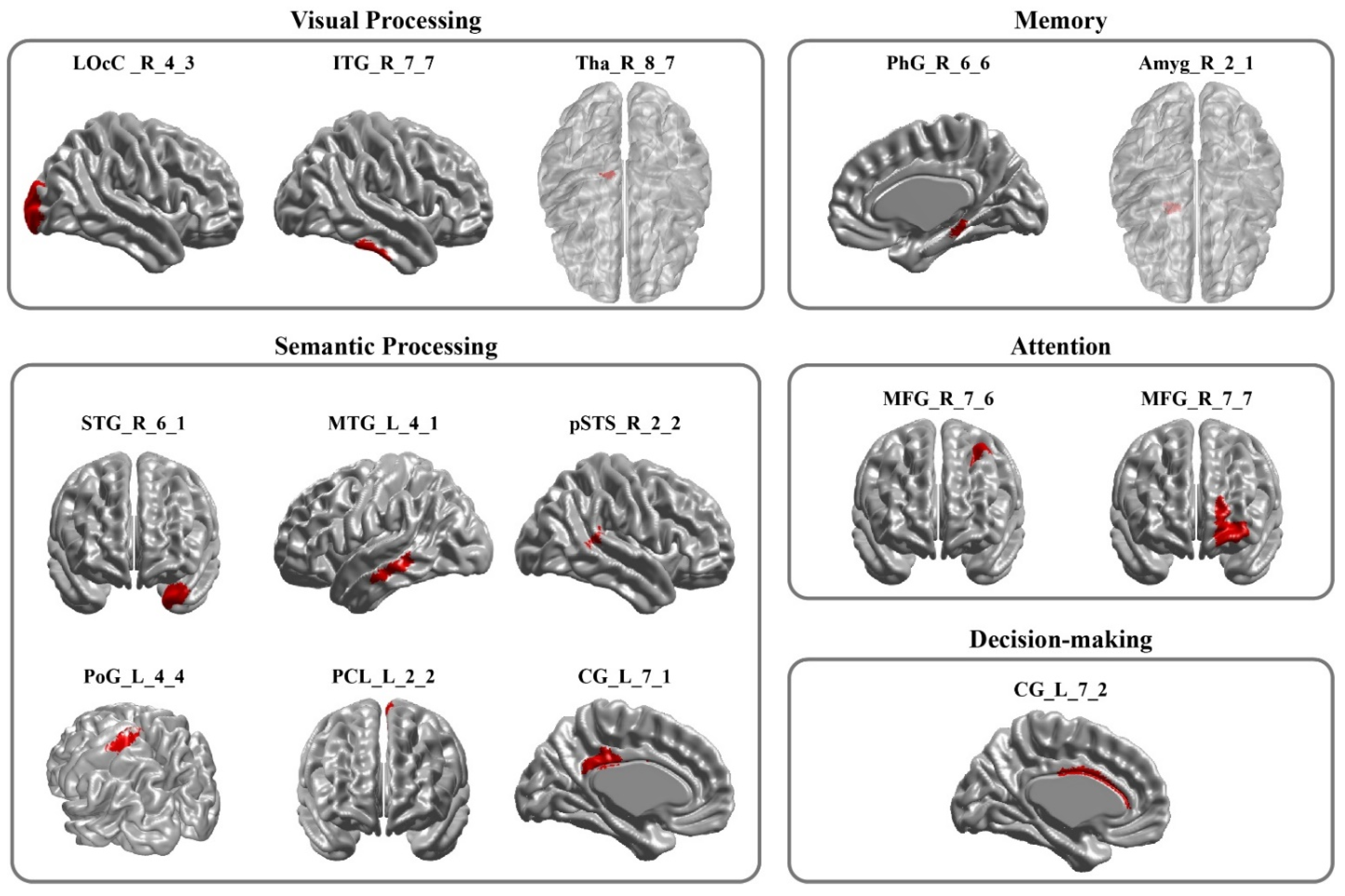
| Visual processing | right ITG | ITG_R_7_7 | −0.55 ± 0.48 | −0.40 ± 0.39 | 0.34 |
| right LOcC | LOcC _R_4_3 | 0.55 ± 0.37 | 0.39 ± 0.40 | −0.42 | |
| right Tha | Tha_R_8_7 | −0.61 ± 0.34 | −0.76 ± 0.31 | −0.46 | |
| Semantic processing | left MTG | MTG_L_4_1 | 0.43 ± 0.21 | 0.34 ± 0.20 | −0.44 |
| right STG | STG_R_6_1 | −0.61 ± 0.17 | −0.65 ± 0.23 | −0.20 | |
| right pSTS | pSTS_R_2_2 | 0.28 ± 0.24 | 0.23 ± 0.32 | −0.18 | |
| left PCL | PCL_L_2_2 | 0.25 ± 0.38 | 0.24 ± 0.32 | −0.03 | |
| left PoG | PoG_L_4_4 | 0.65 ± 0.32 | 0.51 ± 0.32 | −0.44 | |
| left posterior CG | CG_L_7_1 | 0.80 ± 0.29 | 0.65 ± 0.32 | −0.49 | |
| Memory | right PhG | PhG_R_6_6 | −0.63 ± 0.37 | −0.42 ± 0.30 | 0.62 |
| right Amyg | Amyg_R_2_1 | −0.87 ± 0.23 | −0.78 ± 0.23 | 0.39 | |
| Attention | right MFG | MFG_R_7_6 | 0.49 ± 0.31 | 0.39 ± 0.28 | −0.34 |
| MFG_R_7_7 | 0.26 ± 0.38 | 0.12 ± 0.37 | −0.37 | ||
| Decision-making | left anterior CG | CG_L_7_2 | −0.25 ± 0.35 | −0.34 ± 0.33 | −0.26 |
Disclaimer/Publisher’s Note: The statements, opinions and data contained in all publications are solely those of the individual author(s) and contributor(s) and not of MDPI and/or the editor(s). MDPI and/or the editor(s) disclaim responsibility for any injury to people or property resulting from any ideas, methods, instructions or products referred to in the content. |
© 2025 by the authors. Licensee MDPI, Basel, Switzerland. This article is an open access article distributed under the terms and conditions of the Creative Commons Attribution (CC BY) license (https://creativecommons.org/licenses/by/4.0/).
Share and Cite
Chai, W.; Bai, Y.; Wu, J.; Wang, H.; Liang, J.; Xie, X.; Jin, C.; Dong, M. Charting Early Brain Plasticity in Radiological Training: Functional Brain Reorganization During Early Radiological Expertise Acquisition. Brain Sci. 2025, 15, 1279. https://doi.org/10.3390/brainsci15121279
Chai W, Bai Y, Wu J, Wang H, Liang J, Xie X, Jin C, Dong M. Charting Early Brain Plasticity in Radiological Training: Functional Brain Reorganization During Early Radiological Expertise Acquisition. Brain Sciences. 2025; 15(12):1279. https://doi.org/10.3390/brainsci15121279
Chicago/Turabian StyleChai, Weilu, Yuxin Bai, Jia Wu, Hongmei Wang, Jimin Liang, Xuemei Xie, Chenwang Jin, and Minghao Dong. 2025. "Charting Early Brain Plasticity in Radiological Training: Functional Brain Reorganization During Early Radiological Expertise Acquisition" Brain Sciences 15, no. 12: 1279. https://doi.org/10.3390/brainsci15121279
APA StyleChai, W., Bai, Y., Wu, J., Wang, H., Liang, J., Xie, X., Jin, C., & Dong, M. (2025). Charting Early Brain Plasticity in Radiological Training: Functional Brain Reorganization During Early Radiological Expertise Acquisition. Brain Sciences, 15(12), 1279. https://doi.org/10.3390/brainsci15121279