Review

The Enigma That Is ROHHAD Syndrome: Challenges and Future Strategies

by
Katherine Hawton
1,2,*,
Dinesh Giri
1,2,
Elizabeth Crowne
1,2,
Rosemary Greenwood
1,2,3 and
Julian Hamilton-Shield
1,4
1
Bristol Royal Hospital for Children, University Hospitals Bristol and Weston NHS Foundation Trust, Bristol BS2 8BJ, UK
2
Translational Health Sciences, University of Bristol, Bristol BS8 1QU, UK
3
York Trials Unit, Health Sciences, University of York, York YO10 5DD, UK
4
NIHR Biomedical Research Centre (Diet and Physical Activity Theme), University of Bristol, Bristol BS2 8BJ, UK
*
Author to whom correspondence should be addressed.
Brain Sci. 2024, 14(11), 1046; https://doi.org/10.3390/brainsci14111046

Submission received: 29 August 2024 / Revised: 6 October 2024 / Accepted: 14 October 2024 / Published: 23 October 2024
(This article belongs to the Special Issue Challenges and Future Trends of Neuroendocrinology-Related Diseases)

Abstract

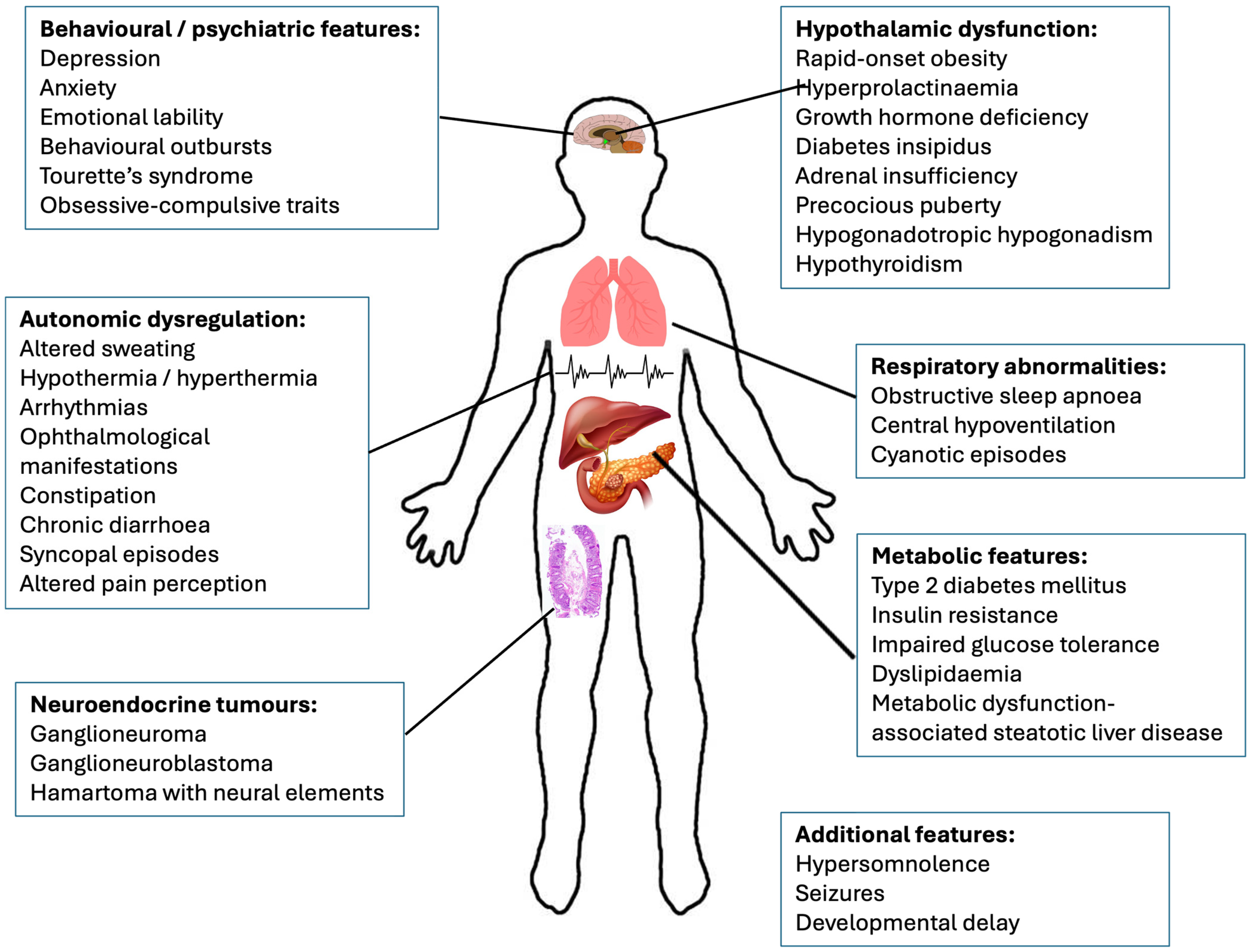
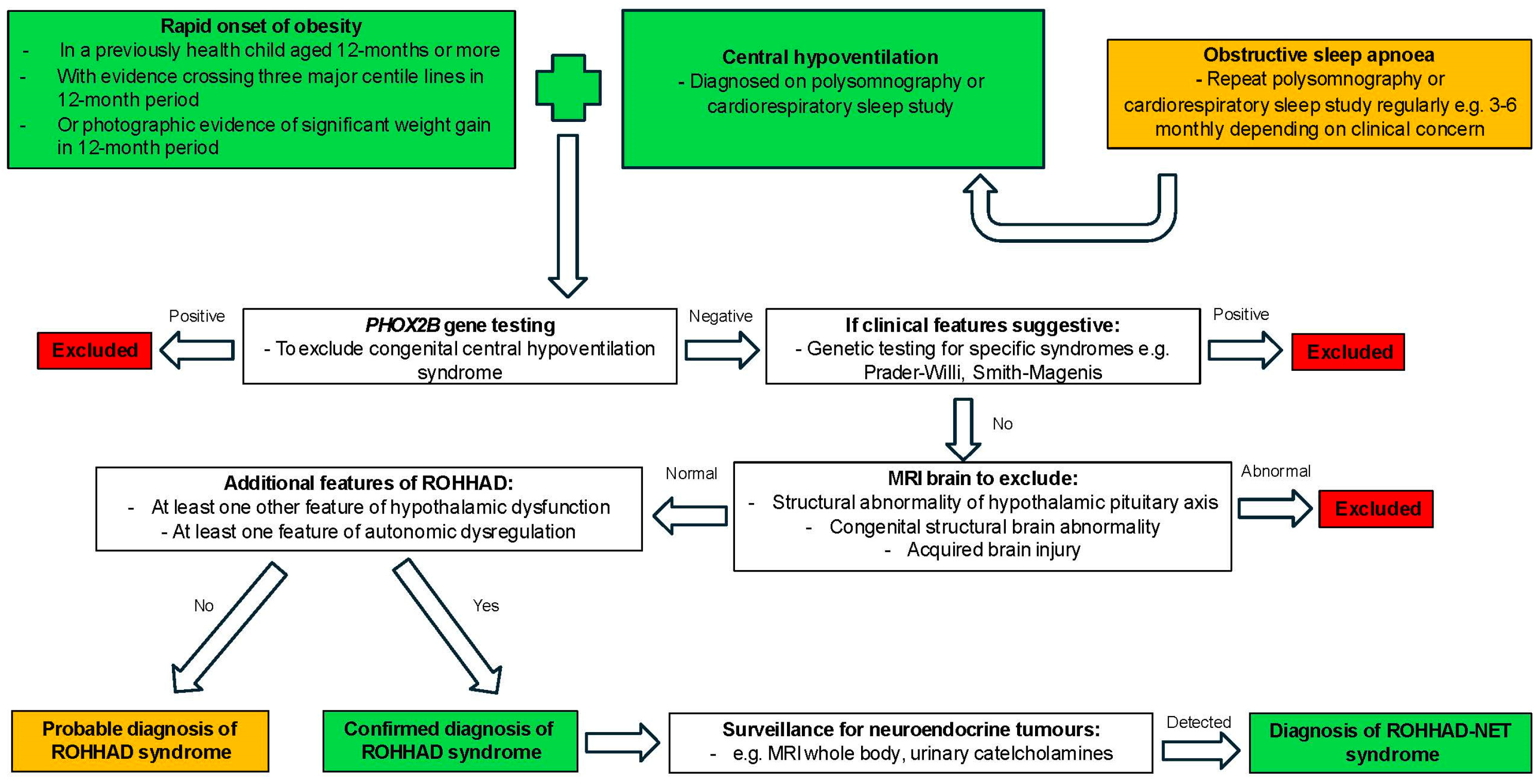
Rapid-onset obesity with hypoventilation, hypothalamic dysfunction, and autonomic dysregulation (ROHHAD) is a rare syndrome presenting in early childhood associated with a high risk of mortality between 50 and 60%. It is characterised by rapid, early onset of obesity between 1.5–7 years, along with central hypoventilation and hypothalamic dysfunction, such as central hypothyroidism, hyperprolactinemia, disorders of sodium and water balance, growth hormone deficiency, adrenocortical insufficiency, or disorders of puberty and features of autonomic dysregulation. Up to half of cases have neural crest tumours, most commonly ganglioneuromas or ganglioneuroblastomas. The incidence of ROHHAD syndrome in any population is unknown. Currently, there is no specific diagnostic or genetic biomarker for ROHHAD, and diagnosis is based on clinical signs and symptoms, which is often challenging, and consequently may be delayed or unrecognised. Early diagnosis is important, as without intervention, ROHHAD is associated with high morbidity and mortality. Aetiology remains unclear; an autoimmune origin has been postulated, with immunosuppressive agents being used with variable benefit. With no cure, multidisciplinary management is largely supportive. Therefore, there are many unanswered questions in ROHHAD syndrome. In this review article, we outline the challenges posed by ROHHAD syndrome, including aetiology, genetics, diagnosis, screening, management, and prognosis. We present research priorities to tackle these issues to improve outcomes.
Keywords: ROHHAD; obesity; hypoventilation; hypothalamic; autonomic ROHHAD; obesity; hypoventilation; hypothalamic; autonomic