


Inattention, Impulsivity, and Hyperactivity among Individuals with Self-Reported Impaired Wound Healing


Abstract
1. Introduction
2. Materials and Methods
3. Results
4. Discussion
5. Conclusions
Author Contributions
Funding
Institutional Review Board Statement
Informed Consent Statement
Data Availability Statement
Conflicts of Interest
References
- Hamza, C.A.; Willoughby, T.; Heffer, T. Impulsivity and nonsuicidal self-injury: A review and meta-analysis. Clin. Psychol. Rev. 2015, 38, 13–24. [Google Scholar] [CrossRef] [Scilit] [PubMed]
- Lalloo, R.; Sheiham, A. Risk factors for childhood major and minor head and other injuries in a nationally representative sample. Injury 2003, 34, 261–266. [Google Scholar] [CrossRef] [Scilit]
- Lalloo, R.; Sheiham, A.; Nazroo, J. Behavioural characteristics and accidents: Findings from the Health Survey for England, 1997. Accid. Anal. Prev. 2002, 35, 661–667. [Google Scholar] [CrossRef] [Scilit]
- Glania, T.; Lialiaris, T.; Tripsianis, G.; Papadakis, N.; Constandinidis, T.C. Is psychopathology related to children’s unintentional injury? Int. J. Adolesc. Med. Health 2010, 22, 567–574. [Google Scholar] [CrossRef] [Scilit] [PubMed]
- Gayton, W.F.; Bailey, C.; Wagner, A.; Hardesty, V.A. Relationship between Childhood Hyperactivity and Accident Proneness. Percept. Mot. Ski. 1986, 63, 801–802. [Google Scholar] [CrossRef] [Scilit] [PubMed]
- Thompson, A.L.; Molina, B.S.; Pelham, W., Jr.; Gnagy, E.M. Risky driving in adolescents and young adults with childhood ADHD. J. Pediat. Psychol. 2007, 32, 745–759. [Google Scholar] [CrossRef] [Scilit]
- Pless, I.B.; Taylor, H.G.; Arsenault, L. The Relationship Between Vigilance Deficits and Traffic Injuries Involving Children. Pediatrics 1995, 95, 219–224. [Google Scholar] [CrossRef] [Scilit]
- Connolly, A.; Fielding, J.; Papadopoulos, N.; McGinley, J.; Murphy, A.; Rinehart, N.J. Factors associated with accidental injuries in children with ADHD–combined type: More than a motor problem? J. Atten. Disord. 2019, 23, 1320–1330. [Google Scholar] [CrossRef] [Scilit]
- Verster, J.C.; Bekker, E.M.; De Roos, M.; Minova, A.; Eijken, E.J.E.; Kooij, J.J.S.; Buitelaar, J.K.; Kenemans, J.L.; Verbaten, M.N.; Olivier, B.; et al. Methylphenidate significantly improves driving ability of adults with attention-deficit hyperactivity disorder: A randomized crossover trial. J. Psychopharmacol. 2008, 22, 230–239. [Google Scholar] [CrossRef] [Scilit]
- Fischer, M.; Barkley, R.A.; Smallish, L.; Fletcher, K. Hyperactive children as young adults: Driving abilities, safe driving behavior, and adverse driving outcomes. Accid. Anal. Prev. 2007, 39, 94–105. [Google Scholar] [CrossRef] [Scilit]
- Barkley, R.A.; Murphy, K.R.; Kwasnik, D. Motor Vehicle Driving Competencies and Risks in Teens and Young Adults with Attention Deficit Hyperactivity Disorder. Pediatrics 1996, 98, 1089–1095. [Google Scholar] [CrossRef] [Scilit] [PubMed]
- Aduen, P.A.; Kofler, M.J.; Sarver, D.E.; Wells, E.; Soto, E.F.; Cox, D.J. ADHD, depression, and motor vehicle crashes: A prospective cohort study of continuously-monitored, real-world driving. J. Psychiatr. Res. 2018, 101, 42–49. [Google Scholar] [CrossRef] [Scilit] [PubMed]
- Kaya, A.; Taner, Y.; Guclu, B.; Taner, E.; Kaya, Y.; Bahcivan, H.G.; Benli, I.T. Trauma and Adult Attention Deficit Hyperactivity Disorder. J. Int. Med. Res. 2008, 36, 9–16. [Google Scholar] [CrossRef] [Scilit] [PubMed]
- El Farouki, K.; Lagarde, E.; Orriols, L.; Bouvard, M.-P.; Contrand, B.; Galera, C. The Increased Risk of Road Crashes in Attention Deficit Hyperactivity Disorder (ADHD) Adult Drivers: Driven by Distraction? Results from a Responsibility Case-Control Study. PLoS ONE 2014, 9, e115002. [Google Scholar] [CrossRef] [Scilit] [PubMed]
- Narad, M.; Garner, A.A.; Brassell, A.A.; Saxby, D.; Antonini, T.N.; O’Brien, K.M.; Tamm, L.; Matthews, G.; Epstein, J.N. Impact of Distraction on the Driving Performance of Adolescents with and without Attention-Deficit/Hyperactivity Disorder. JAMA Pediatr. 2013, 167, 933–938. [Google Scholar] [CrossRef] [Scilit]
- Kittel-Schneider, S.; Wolff, S.; Queiser, K.; Wessendorf, L.; Meier, A.M.; Verdenhalven, M.; Brunkhorst-Kanaan, N.; Grimm, O.; McNeill, R.; Grabow, S.; et al. Prevalence of ADHD in Accident Victims: Results of the PRADA Study. J. Clin. Med. 2019, 8, 1643. [Google Scholar] [CrossRef] [Scilit]
- Bartoli, F.; Callovini, T.; Cavaleri, D.; Cioni, R.M.; Bachi, B.; Calabrese, A.; Moretti, F.; Canestro, A.; Morreale, M.; Nasti, C.; et al. Clinical correlates of comorbid attention deficit hyperactivity disorder in adults suffering from bipolar disorder: A meta-analysis. Aust. N. Z. J. Psychiatry, 2022; in press. [CrossRef] [Scilit]
- Pan, P.-Y.; Bölte, S. The association between ADHD and physical health: A co-twin control study. Sci. Rep. 2020, 10, 22388. [Google Scholar] [CrossRef] [Scilit]
- van der Schans, J.; Çiçek, R.; de Vries, T.W.; Hak, E.; Hoekstra, P.J. Association of atopic diseases and attention-deficit/hyperactivity disorder: A systematic review and meta-analyses. Neurosci. Biobehav. Rev. 2017, 74, 139–148. [Google Scholar] [CrossRef] [Scilit]
- Cortese, S.; Sun, S.; Zhang, J.; Sharma, E.; Chang, Z.; Kuja-Halkola, R.; Almqvist, C.; Larsson, H.; Faraone, S.V. Association between attention deficit hyperactivity disorder and asthma: A systematic review and meta-analysis and a Swedish population-based study. Lancet Psychiatry 2018, 5, 717–726. [Google Scholar] [CrossRef] [Scilit]
- Prehn-Kristensen, A.; Zimmermann, A.; Tittmann, L.; Lieb, W.; Schreiber, S.; Baving, L.; Fischer, A. Reduced microbiome alpha diversity in young patients with ADHD. PLoS ONE 2018, 13, e0200728. [Google Scholar] [CrossRef] [Scilit] [PubMed]
- Herpertz-Dahlmann, B.; Seitz, J.; Baines, J. Food matters: How the microbiome and gut–brain interaction might impact the development and course of anorexia nervosa. Eur. Child Adolesc. Psychiatry 2017, 26, 1031–1041. [Google Scholar] [CrossRef] [Scilit] [PubMed]
- Rieder, R.; Wisniewski, P.J.; Alderman, B.L.; Campbell, S.C. Microbes and mental health: A review. Brain Behav. Immun. 2017, 66, 9–17. [Google Scholar] [CrossRef] [Scilit] [PubMed]
- Santocchi, E.; Guiducci, L.; Fulceri, F.; Billeci, L.; Buzzigoli, E.; Apicella, F.; Calderoni, S.; Grossi, E.; Morales, M.A.; Muratori, F. Gut to brain interaction in Autism Spectrum Disorders: A randomized controlled trial on the role of probiotics on clinical, biochemical and neurophysiological parameters. BMC Psychiatry 2016, 16, 183. [Google Scholar] [CrossRef] [Scilit]
- Sfera, A.; Osorio, C.; Inderias, L.A.; Parker, V.; Price, A.I.; Cummings, M. The Obesity–Impulsivity Axis: Potential Metabolic Interventions in Chronic Psychiatric Patients. Front. Psychiatry 2017, 8, 20. [Google Scholar] [CrossRef] [Scilit]
- Wallace, C.J.K.; Milev, R. The effects of probiotics on depressive symptoms in humans: A systematic review. Ann. Gen. Psychiatry 2017, 16, 14. [Google Scholar] [CrossRef] [Scilit]
- Balikji, J.; Hoogbergen, M.M.; Garssen, J.; Verster, J.C. The Association of Irritable Bowel Complaints and Perceived Immune Fitness among Individuals That Report Impaired Wound Healing: Supportive Evidence for the Gut–Brain–Skin Axis. Gastroenterol. Insights 2021, 12, 423–432. [Google Scholar] [CrossRef] [Scilit]
- Salem, I.; Ramser, A.; Isham, N.; Ghannoum, M.A. The Gut Microbiome as a Major Regulator of the Gut-Skin Axis. Front. Microbiol. 2018, 9, 1459. [Google Scholar] [CrossRef] [Scilit]
- Balikji, J.; Hoogbergen, M.M.; Garssen, J.; Verster, J.C. Self-Reported Impaired Wound Healing in Young Adults and Their Susceptibility to Experiencing Immune-Related Complaints. J. Clin. Med. 2022, 11, 980. [Google Scholar] [CrossRef] [Scilit]
- Cortese, S.; Moreira-Maia, C.R.; Fleur, D.S.; Morcillo-Peñalver, C.; Rohde, L.A.; Faraone, S.V. Association Between ADHD and Obesity: A Systematic Review and Meta-Analysis. Am. J. Psychiatry 2016, 173, 34–43. [Google Scholar] [CrossRef] [Scilit]
- Sen, C.K.; Gordillo, G.M.; Roy, S.; Kirsner, R.; Lambert, L.; Hunt, T.K.; Gottrup, F.; Gurtner, G.C.; Longaker, M.T. Human skin wounds: A major and snowballing threat to public health and the economy. Wound Repair Regen. 2009, 17, 763–771. [Google Scholar] [CrossRef] [Scilit] [PubMed]
- Erfurt-Berge, C.; Ronicke, M.; Richter-Schmidinger, T.; Walther, F.; Renner, R. Quality of life assessment in family members of patients with chronic wounds. Eur. J. Dermatol. 2019, 29, 484–489. [Google Scholar] [CrossRef] [Scilit] [PubMed]
- Balikji, J.; Hoogbergen, M.M.; Garssen, J.; Verster, J.C. Mental Resilience, Mood, and Quality of Life in Young Adults with Self-Reported Impaired Wound Healing. Int. J. Environ. Res. Public Health 2022, 19, 2542. [Google Scholar] [CrossRef] [Scilit] [PubMed]
- Green, J.; Jester, R. Health-related quality of life and chronic venous leg ulceration: Part 1. Br. J. Community Nurs. 2009, 14, S12–S17. [Google Scholar] [CrossRef] [Scilit]
- Nogueira, G.S.; Zanin, C.R.; Miyazaki, M.C.O.S.; De Godoy, J.M.P. Venous Leg Ulcers and Emotional Consequences. Int. J. Low. Extremity Wounds 2009, 8, 194–196. [Google Scholar] [CrossRef] [Scilit]
- Wiechman, S.; Kalpakjian, C.Z.; Johnson, K.L. Measuring depression in adults with burn injury: A systematic review. J. Burn Care Res. 2016, 37, e415–e426. [Google Scholar] [CrossRef] [Scilit]
- Zhou, K.; Jia, P. Depressive symptoms in patients with wounds: A cross-sectional study. Wound Repair Regen. 2016, 24, 1059–1065. [Google Scholar] [CrossRef] [Scilit]
- Herber, O.R.; Schnepp, W.; Rieger, M.A. A systematic review on the impact of leg ulceration on patients’ quality of life. Health Qual. Life Outcomes 2007, 5, 44. [Google Scholar] [CrossRef] [Scilit]
- Poerio, G.L.; Totterdell, P.; Miles, E. Mind-wandering and negative mood: Does one thing really lead to another? Conscious. Cogn. 2013, 22, 1412–1421. [Google Scholar] [CrossRef] [Scilit]
- Otten, L.; De Kruijff, D.; Mackus, M.; Garssen, J.; Verster, J. Attention deficit hyperactivity disorder (ADHD) and the dietary intake of fiber and fat. Eur. Neuropsychopharmacol. 2016, 26, S726. [Google Scholar] [CrossRef] [Scilit]
- Kooij, J.S.; Boonstra, A.M.; Swinkels, S.; Bekker, E.M.; de Noord, I.; Buitelaar, J.K. Reliability, Validity, and Utility of Instruments for Self-Report and Informant Report Concerning Symptoms of ADHD in Adult Patients. J. Atten. Disord. 2008, 11, 445–458. [Google Scholar] [CrossRef] [Scilit] [PubMed]
- American Psychiatric Association. Diagnostic and Statistical Manual of Mental Disorders, 5th ed.; American Psychiatric Association: Arlington, VA, USA, 2013. [Google Scholar] [CrossRef] [Scilit]
- Lantman, M.V.S.; Mackus, M.; Otten, L.S.; de Kruijff, D.; van de Loo, A.J.; Kraneveld, A.D.; Garssen, J.; Verster, J.C. Mental resilience, perceived immune functioning, and health. J. Multidiscip. Healthc. 2017, 10, 107–112. [Google Scholar] [CrossRef] [Scilit] [PubMed]
- Wilod Versprille, L.J.F.; van de Loo, A.J.A.E.; Mackus, M.; Arnoldy, L.; Sulzer, T.A.L.; Vermeulen, S.A.; Abdulahad, S.; Huls, H.; Baars, T.; Scholey, A.; et al. Development and Validation of the Immune Status Questionnaire (ISQ). Int. J. Environ. Res. Public Health 2019, 16, 4743. [Google Scholar] [CrossRef] [Scilit] [PubMed]
- Brunkhorst-Kanaan, N.; Libutzki, B.; Reif, A.; Larsson, H.; McNeill, R.V.; Kittel-Schneider, S. ADHD and accidents over the life span—A systematic review. Neurosci. Biobehav. Rev. 2021, 125, 582–591. [Google Scholar] [CrossRef] [Scilit]
- Firouzabadi, F.D.; Ramezanpour, S.; Firouzabadi, M.D.; Yousem, I.J.; Puts, N.A.J.; Yousem, D.M. Neuroimaging in Attention-Deficit/Hyperactivity Disorder: Recent Advances. Am. J. Roentgenol. 2022, 218, 321–332. [Google Scholar] [CrossRef] [Scilit]

| Control Group (N = 575) | IWH Group (N = 198) | p-Value | |
|---|---|---|---|
| Sex (m/f) (%) | 40.7/59.3 | 29.7/70.3 | 0.008 * |
| Age | 21.6 (2.7) | 21.0 (2.4) | 0.008 * |
| BMI (kg/m2) | 22.2 (2.9) | 22.2 (2.6) | 0.897 |
| Alcohol consumption (% yes) | 81.6% | 82.2% | 0.693 |
| Number of drinks per week 1 | 7.3 (8.7) | 8.7 (12.4) | 0.079 |
| Smoking (% yes) | 12.6% | 12.6% | 0.233 |
| Perceived immune fitness | 7.8 (1.2) | 7.5 (1.2) | <0.001 * |
| Reduced immune fitness (%) | 21.9% | 34.9% | 0.002 * |
| Diagnosed ADHD (%) | 3.0% | 4.5% | 0.359 |
| Control Group | IWH Group | p-Value | |
|---|---|---|---|
| ADHD Rating Scale overall score | 14.2 (6.8) | 16.8 (7.4) | <0.001 * |
| Attention deficit subscale | 1.3 (1.6) | 1.8 (2.1) | 0.001 * |
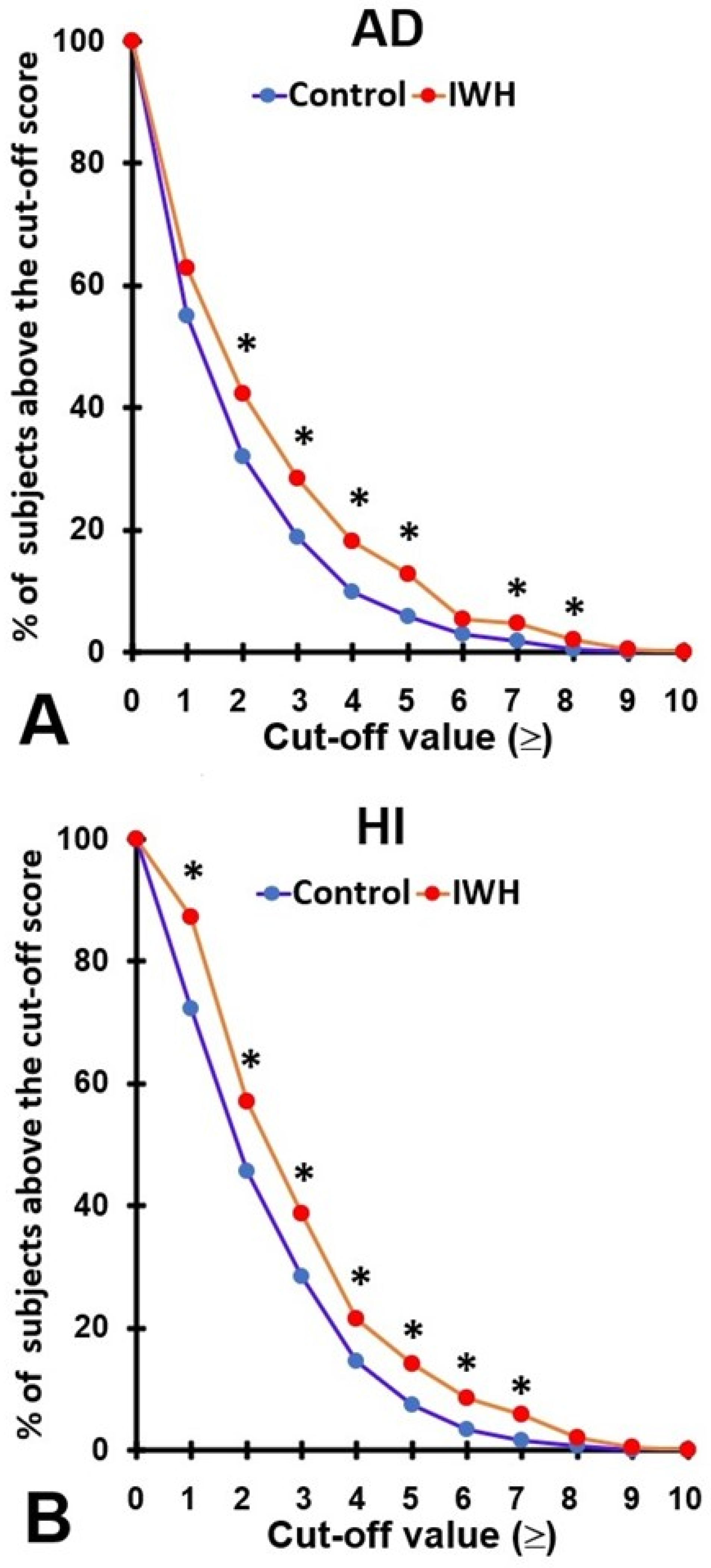
| AD% ≥ 4, Kooij et al. [41] | 9.9% | 18.2% | 0.003 * |
| AD% ≥ 5, DSM-5 [42] | 5.8% | 12.8% | 0.002 * |
| Hyperactivity, impulsivity subscale | 1.7 (1.7) | 2.4 (2.0) | <0.001 * |
| HI% ≥ 4, Kooij et al. [41] | 14.6% | 21.5% | 0.028 * |
| HI% ≥ 5, DSM-5 [42] | 7.4% | 14.0% | 0.007 * |
Publisher’s Note: MDPI stays neutral with regard to jurisdictional claims in published maps and institutional affiliations. |
© 2022 by the authors. Licensee MDPI, Basel, Switzerland. This article is an open access article distributed under the terms and conditions of the Creative Commons Attribution (CC BY) license (https://creativecommons.org/licenses/by/4.0/).
Share and Cite
Balikji, J.; Hoogbergen, M.M.; Garssen, J.; Verster, J.C. Inattention, Impulsivity, and Hyperactivity among Individuals with Self-Reported Impaired Wound Healing. Brain Sci. 2022, 12, 961. https://doi.org/10.3390/brainsci12080961
Balikji J, Hoogbergen MM, Garssen J, Verster JC. Inattention, Impulsivity, and Hyperactivity among Individuals with Self-Reported Impaired Wound Healing. Brain Sciences. 2022; 12(8):961. https://doi.org/10.3390/brainsci12080961
Chicago/Turabian StyleBalikji, Jessica, Maarten M. Hoogbergen, Johan Garssen, and Joris C. Verster. 2022. "Inattention, Impulsivity, and Hyperactivity among Individuals with Self-Reported Impaired Wound Healing" Brain Sciences 12, no. 8: 961. https://doi.org/10.3390/brainsci12080961
APA StyleBalikji, J., Hoogbergen, M. M., Garssen, J., & Verster, J. C. (2022). Inattention, Impulsivity, and Hyperactivity among Individuals with Self-Reported Impaired Wound Healing. Brain Sciences, 12(8), 961. https://doi.org/10.3390/brainsci12080961

