Article

Cognitive and Affective Theory of Mind across Adulthood
by
Simona Raimo
1,*,†,
Maria Cropano
2,†,
María Dolores Roldán-Tapia
3,
Lidia Ammendola
2,
Daniela Malangone
2 and
Gabriella Santangelo
2
1
Department of Medical and Surgical Sciences, “Magna Graecia” University of Catanzaro, 88100 Catanzaro, Italy
2
Department of Psychology, University of Campania “Luigi Vanvitelli”, 81100 Caserta, Italy
3
Department of Psychology, University of Almería, 04120 Almería, Spain
*
Author to whom correspondence should be addressed.
These authors contributed equally to this work.
Brain Sci. 2022, 12(7), 899; https://doi.org/10.3390/brainsci12070899

Submission received: 20 May 2022 / Revised: 25 June 2022 / Accepted: 6 July 2022 / Published: 9 July 2022
(This article belongs to the Special Issue Healthy Cognitive Aging and the Prevention of Dementia)

Abstract

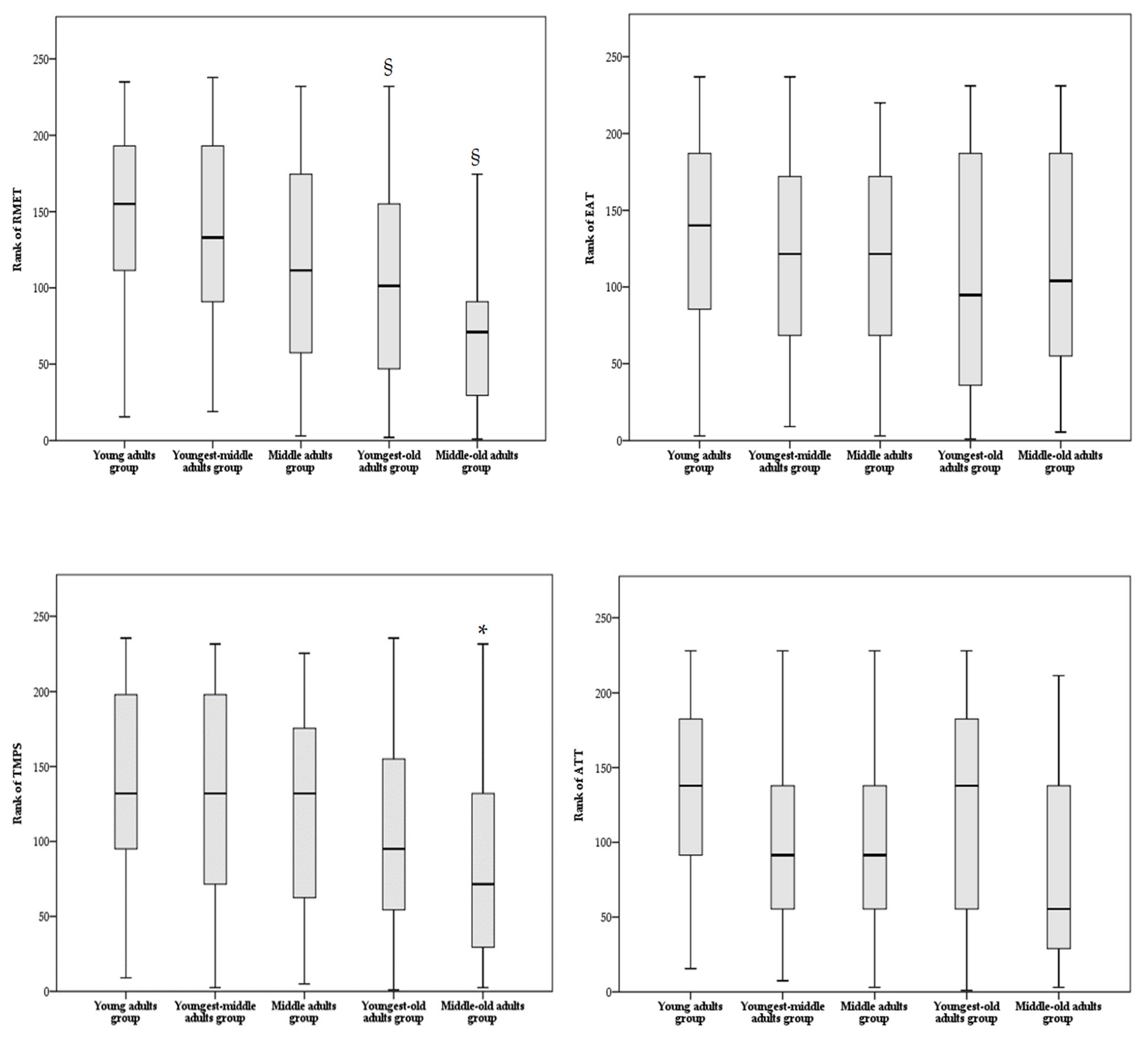
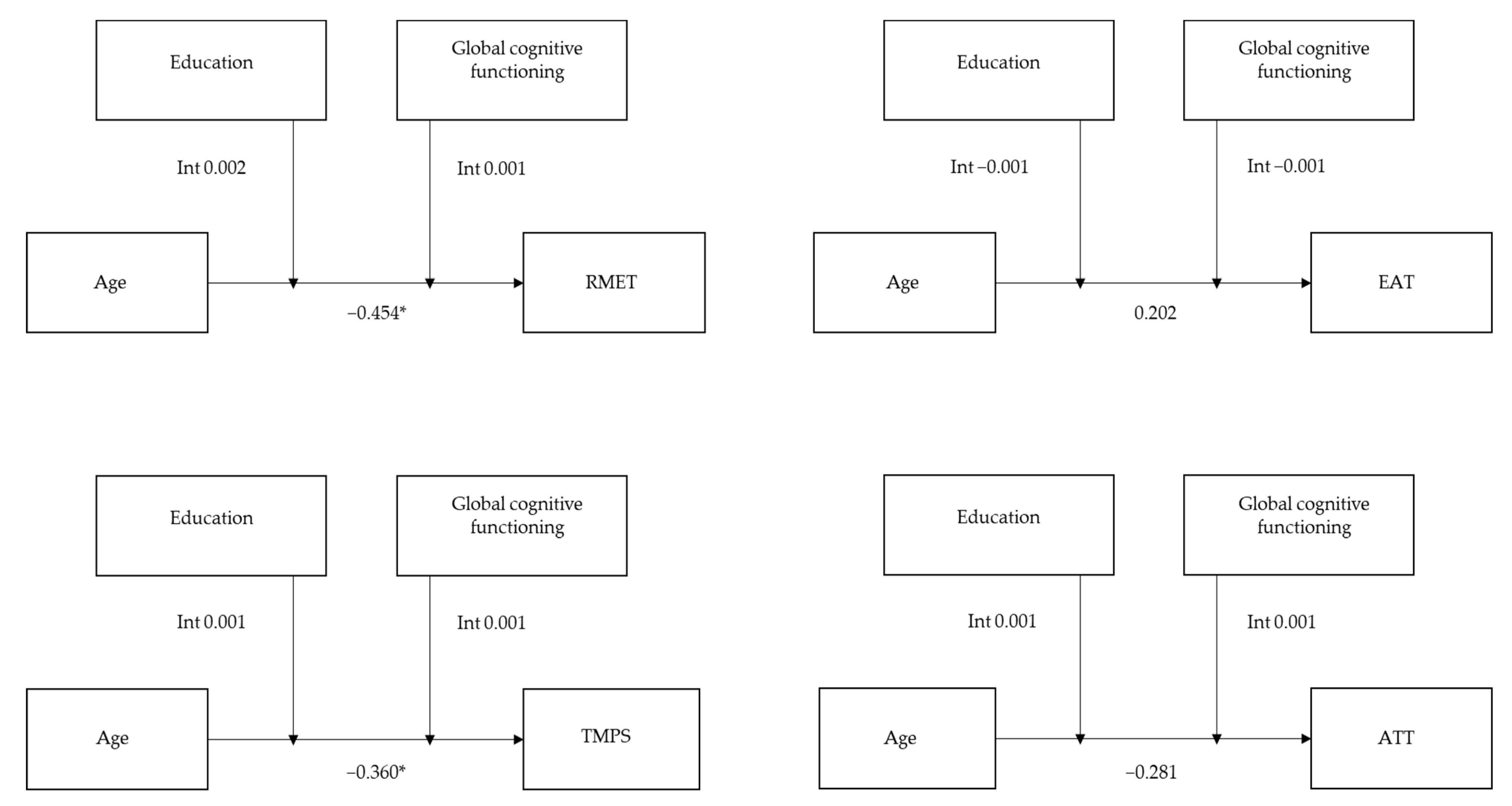
Background: Theory of mind (ToM) is a fundamental aspect of social cognition. Previous studies on age-related changes in mentalizing processes have provided conflicting results. This study aims to investigate the age-related changes in the cognitive and affective components of ToM throughout adulthood. Methods: Two hundred and thirty-eight healthy participants divided into five age groups (18–40 years old; 41–50 years old; 51–60 years old; 61–70 years; 71–80 years old) underwent tasks assessing the cognitive (ToM Picture Sequencing Task, TMPS, and the Advanced Test of ToM, ATT) and affective (Reading the Mind in the Eyes Task, RMET, and the Emotion Attribution Task, EAT) components of ToM, in both verbal and nonverbal modality. Results: Regarding affective ToM, both the youngest- and middle-old adult groups (61 to 80 years) performed worse than the young and youngest-middle adult groups (18 to 50 years) in the RMET, but no significant differences were found in the EAT. Regarding cognitive ToM, the middle-old adult group (71 to 80 years) performed worse than the young adult group (18 to 40 years) only in the TMPS, but no significant differences were found in the ATT. Conclusion: Rather than a general decline in ToM, our results provide evidence regarding selective changes in ToM in older adults, further confirming the dissociation of cognitive and affective ToM.
Keywords: cognitive theory of mind; affective theory of mind; social cognition; aging; adulthood cognitive theory of mind; affective theory of mind; social cognition; aging; adulthood