


The Contribution of Psychological Factors to Inter-Individual Variability in Conditioned Pain Modulation Is Limited in Young Healthy Subjects

Abstract
1. Introduction
2. Materials and Methods
2.1. Pooled Data
2.2. Statistical Models
3. Results
3.1. Main Effects and Interactions
3.2. Analysis of Explained Variance
4. Discussion
- (i)
- Psychological factors, such as depression, anxiety or pain catastrophizing, do not significantly predict the CPM effect when different CPM paradigms are pooled.
- (ii)
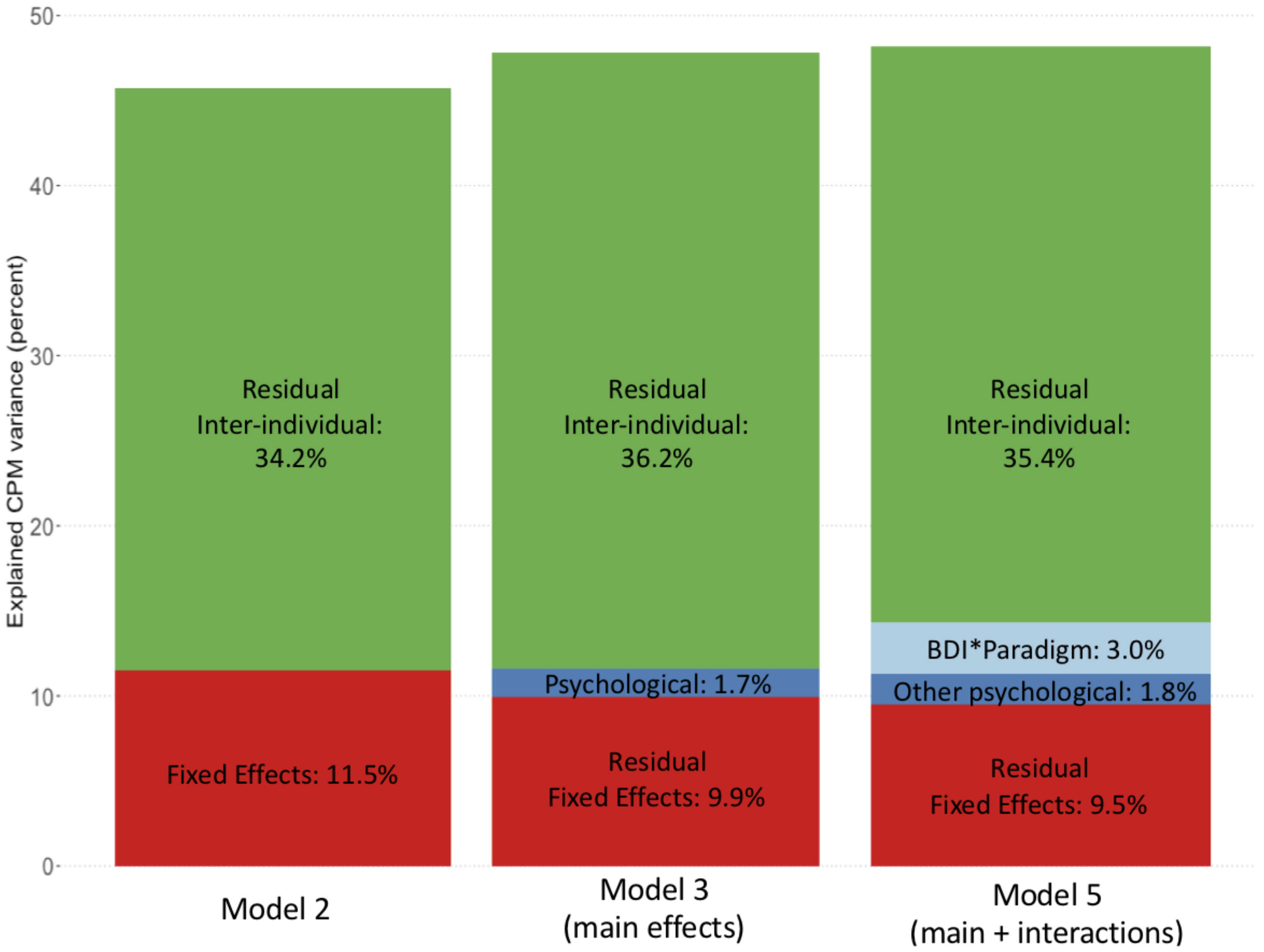
- Depression can explain some amount of inter-individual CPM variance dependent on the CPM paradigm. However, this contribution remains small (3.0%) when compared to the residual inter-individual variance (35.4%).
4.1. Future Directions
4.2. Strengths and Limitations
5. Conclusions
Supplementary Materials
Author Contributions
Funding
Institutional Review Board Statement
Informed Consent Statement
Data Availability Statement
Acknowledgments
Conflicts of Interest
References
- Yarnitsky, D. Conditioned pain modulation (the diffuse noxious inhibitory control-like effect): Its relevance for acute and chronic pain states. Curr. Opin. Anaesthesiol. 2010, 23, 611–615. [Google Scholar] [CrossRef] [Scilit] [PubMed]
- Kennedy, D.L.; Kemp, H.I.; Ridout, D.; Yarnitsky, D.; Rice, A.S.C. Reliability of conditioned pain modulation: A systematic review. Pain 2016, 157, 2410–2419. [Google Scholar] [CrossRef] [Scilit] [PubMed]
- Nir, R.-R.; Yarnitsky, D. Conditioned Pain Modulation. Curr. Opin. Support. Palliat. Care 2015, 9, 131–137. [Google Scholar] [CrossRef] [Scilit]
- Yarnitsky, D.; Crispel, Y.; Eisenberg, E.; Granovsky, Y.; Ben-Nun, A.; Sprecher, E.; Best, L.-A.; Granot, M. Prediction of chronic post-operative pain: Pre-operative DNIC testing identifies patients at risk. Pain 2008, 138, 22–28. [Google Scholar] [CrossRef] [Scilit]
- Staud, R.; Robinson, M.E.; Vierck, C.J.; Price, D.D. Diffuse noxious inhibitory controls (DNIC) attenuate temporal summation of second pain in normal males but not in normal females or fibromyalgia patients. Pain 2003, 101, 167–174. [Google Scholar] [CrossRef] [Scilit]
- Riley, L.; King, C.D.; Wong, F.; Fillingim, R.B.; Mauderli, A.P. Lack of endogenous modulation and reduced decay of prolonged heat pain in older adults. Pain 2010, 150, 153–160. [Google Scholar] [CrossRef] [Scilit]
- Graven-Nielsen, T.; Izumi, M.; Petersen, K.K.; Arendt-Nielsen, L. User-independent assessment of conditioning pain modulation by cuff pressure algometry. Eur. J. Pain 2017, 21, 552–561. [Google Scholar] [CrossRef] [Scilit]
- Oono, Y.; Wang, K.; Svensson, P.; Arendt-Nielsen, L. Conditioned Pain Modulation Evoked by Different Intensities of Mechanical Stimuli Applied to the Craniofacial Region in Healthy Men and Women. J. Orofac. Pain 2011, 25, 364–375. [Google Scholar]
- Graeff, P.; Itter, A.; Wach, K.; Ruscheweyh, R. Inter-individual differences explain more variance in conditioned pain modulation than age, sex and conditioning stimulus intensity combined. Brain Sci. 2021, 11, 1186. [Google Scholar] [CrossRef] [Scilit]
- Defrin, R.; Schreiber, S.; Ginzburg, K. Paradoxical Pain Perception in Posttraumatic Stress Disorder: The Unique Role of Anxiety and Dissociation. J. Pain 2015, 16, 961–970. [Google Scholar] [CrossRef] [Scilit]
- Klauenberg, S.; Maier, C.; Assion, H.-J.; Hoffmann, A.; Krumova, E.K.; Magerl, W.; Scherens, A.; Treede, R.-D.; Juckel, G. Depression and changed pain perception: Hints for a central disinhibition mechanism. Pain 2008, 140, 332–343. [Google Scholar] [CrossRef] [Scilit]
- Campbell, C.M.; Kronfli, T.; Buenaver, L.F.; Smith, M.T.; Haythornthwaite, J.A.; Edwards, R.R. Situational vs. dispositional measurement of catastrophizing: Associations. J. Pain 2011, 11, 443–453. [Google Scholar] [CrossRef] [Scilit]
- Iliffe, S.; Swift, C.; Carmaciu, C.E.; Stuck, A.; Harari, D.; Kharicha, K.; Gillman, G. The relationship between pain intensity and severity and depression in older people: Exploratory study. BMC Fam. Pract. 2009, 10, 54. [Google Scholar] [CrossRef] [Scilit]
- Horn-Hofmann, C.; Priebe, J.A.; Schaller, J.; Görlitz, R.; Lautenbacher, S. Lack of predictive power of trait fear and anxiety for conditioned pain modulation (CPM). Exp. Brain Res. 2016, 234, 3649–3658. [Google Scholar] [CrossRef] [Scilit]
- Varallo, G.; Giusti, E.M.; Scarpina, F.; Cattivelli, R.; Capodaglio, P.; Castelnuovo, G. The association of kinesiophobia and pain catastrophizing with pain-related disability and pain intensity in obesity and chronic lower-back pain. Brain Sci. 2021, 11, 11. [Google Scholar] [CrossRef] [Scilit]
- Lewis, G.N.; Rice, D.A.; McNair, P.J. Conditioned Pain Modulation in Populations with Chronic Pain: A Systematic Review and Meta-Analysis. J. Pain 2012, 13, 936–944. [Google Scholar] [CrossRef] [Scilit]
- Nahman-Averbuch, H.; Nir, R.R.; Sprecher, E.; Yarnitsky, D. Psychological factors and conditioned pain modulation: A meta-analysis. Clin. J. Pain 2016, 32, 541–554. [Google Scholar] [CrossRef] [Scilit]
- Beck, A.T.; Ward, C.H.; Mendelson, M.; Mock, J.; Erbaugh, J. An Inventory for Measuring Depression. Arch. Gen. Psychiatry 1961, 4, 561–571. [Google Scholar] [CrossRef] [Scilit]
- Spielberger, C. Manual for the State-Trait Anxiety Inventory (STAI); Consulting Psychologists Press: Palo Alto, CA, USA, 1983. [Google Scholar]
- Michael, J.L.S.; Scott, R.B.; Jayne, P. The Pain Catastrophizing Scale_Development and validation. Psychol. Assess. 1995, 7, 524–532. [Google Scholar]
- R Core Team. R: A Language and Environment for Statistical Computing; R Foundation for Statistical Computing: Vienna, Austria, 2020. [Google Scholar]
- Bates, D.; Maechler, M.; Bolker, B.; Walker, S. Fitting Linear Mixed-Effects Models Using lme4. J. Stat. Softw. 2015, 67, 1–48. [Google Scholar] [CrossRef] [Scilit]
- Fox, J.; Weisberg, S. An {R} Companion to Applied Regression, 3rd ed.; Sage: Thousand Oaks, CA, USA, 2019. [Google Scholar]
- Bartón, K. MuMIn: Multi-Model Inference. 2020. Available online: https://cran.r-project.org/web/packages/MuMIn/index.html (accessed on 1 January 2020).
- Grömping, U. Relative Importance for Linear Regression in R: The Package relaimpo. J. Stat. Softw. 2006, 17, 1–27. [Google Scholar] [CrossRef] [Scilit]
- Thompson, T.; Correll, C.U.; Gallop, K.; Vancampfort, D.; Stubbs, B. Is Pain Perception Altered in People with Depression? A Systematic Review and Meta-Analysis of Experimental Pain Research. J. Pain 2016, 17, 1257–1272. [Google Scholar] [CrossRef] [Scilit]
- Ruscheweyh, R.; Albers, C.; Kreusch, A.; Sommer, J.; Marziniak, M. The effect of catastrophizing self-statements on pain perception and the nociceptive flexor reflex (RIII reflex). Clin. J. Pain 2013, 29, 725–732. [Google Scholar] [CrossRef] [Scilit]
- Rhudy, J.L.; Williams, A.E.; McCabe, K.M.; Nguyên, M.A.T.V.; Rambo, P. Affective modulation of nociception at spinal and supraspinal levels. Psychophysiology 2005, 42, 579–587. [Google Scholar] [CrossRef] [Scilit]
- Hubbard, C.S.; Ornitz, E.; Gaspar, J.X.; Smith, S.; Amin, J.; Labus, J.S.; Kilpatrick, L.A.; Rhudy, J.L.; Mayer, E.A.; Naliboff, B.D. Modulation of nociceptive and acoustic startle responses to an unpredictable threat in men and women. Pain 2011, 152, 1632–1640. [Google Scholar] [CrossRef] [Scilit]
- Nakagawa, S.; Schielzeth, H. A general and simple method for obtaining R2 from generalized linear mixed-effects models. Methods Ecol. E 2013, 4, 133–142. [Google Scholar] [CrossRef] [Scilit]
- Nakagawa, S.; Johnson, P.C.D.; Schielzeth, H. The coefficient of determination R2 and intra-class correlation coefficient from generalized linear mixed-effects models revisited and expanded. J. R. Soc. Interface 2017, 14, 20170213. [Google Scholar] [CrossRef] [Scilit]
- Ruscheweyh, R.; Weinges, F.; Schiffer, M.; Bäumler, M.; Feller, M.; Krafft, S.; Straube, A.; Sommer, J.; Marziniak, M. Control over spinal nociception as quantified by the nociceptive flexor reflex (RIII reflex) can be achieved under feedback of the RIII reflex. Eur. J. Pain 2015, 19, 480–489. [Google Scholar] [CrossRef] [Scilit]
- Ruscheweyh, R.; Bäumler, M.; Feller, M.; Krafft, S.; Sommer, J.; Straube, A. Learned control over spinal nociception reduces supraspinal nociception as quantified by late somatosensory evoked potentials. Pain 2015, 156, 2505–2513. [Google Scholar] [CrossRef] [Scilit] [PubMed]
- Adams, G.; Harrison, R.; Gandhi, W.; van Reekum, C.M.; Salomons, T.V. Intrinsic attention to pain is associated with a pronociceptive phenotype. Pain Rep. 2021, 6, e934. [Google Scholar] [CrossRef] [Scilit] [PubMed]
- Nilsen, K.B.; Christiansen, S.E.; Holmen, L.B.; Sand, T. The effect of a mental stressor on conditioned pain modulation in healthy subjects. Scand. J. Pain 2012, 3, 142–148. [Google Scholar] [CrossRef] [Scilit]
- Cormier, S.; Mathieu, P.; Rainville, P. Expectations Modulate Heterotopic Noxious Counter-Stimulation Analgesia. J. Pain 2013, 14, 114–125. [Google Scholar] [CrossRef] [Scilit]
- Lindstedt, F.; Berrebi, J.; Greayer, E.; Lonsdorf, T.B.; Schalling, M.; Ingvar, M.; Kosek, E. Conditioned pain modulation is associated with common Polymorphisms in the serotonin transporter gene. PLoS ONE 2011, 6, e18252. [Google Scholar] [CrossRef] [Scilit]
- Potvin, S.; Larouche, A.; Normand, E.; De Souza, J.B.; Gaumond, I.; Grignon, S.; Marchand, S. DRD3 Ser9Gly Polymorphism Is Related to Thermal Pain Perception and Modulation in Chronic Widespread Pain Patients and Healthy Controls. J. Pain 2009, 10, 969–975. [Google Scholar] [CrossRef] [Scilit]
- Ibancos-Losada, M.D.R.; Osuna-Pérez, M.C.; Castellote-Caballero, M.Y.; Díaz-Fernández, Á. Conditioned pain modulation effectiveness: An experimental study comparing test paradigms and analyzing potential predictors in a healthy population. Brain Sci. 2020, 10, 599. [Google Scholar] [CrossRef] [Scilit]
- Chalaye, P.; Devoize, L.; Lafrenaye, S.; Dallel, R.; Marchand, S. Cardiovascular influences on conditioned pain modulation. Pain 2013, 154, 1377–1382. [Google Scholar] [CrossRef] [Scilit]
- Giusti, E.M.; Manna, C.; Varallo, G.; Cattivelli, R.; Manzoni, G.M.; Gabrielli, S.; D’amario, F.; Lacerenza, M.; Castelnuovo, G. The predictive role of executive functions and psychological factors on chronic pain after orthopaedic surgery: A longitudinal cohort study. Brain Sci. 2020, 10, 685. [Google Scholar] [CrossRef] [Scilit]
- Glombiewski, J.A.; Hartwich-Tersek, J.; Rief, W. Depression in Chronic Back Pain Patients: Prediction of Pain Intensity and Pain Disability in Cognitive-Behavioral Treatment. Psychosomatics 2010, 51, 130–136. [Google Scholar] [CrossRef]
- Edwards, R.R.; Bingham, C.O.; Bathon, J.; Haythornthwaite, J.A. Catastrophizing and pain in arthritis, fibromyalgia, and other rheumatic diseases. Arthritis Care Res. 2006, 55, 325–332. [Google Scholar] [CrossRef] [Scilit]

| Predictor | Estimate | p-Value |
|---|---|---|
| CSTEMP | 1.35 | 0.085 |
| AGE | −0.07 | 0.840 |
| SEX | 1.35 | 0.817 |
| BDI | −0.14 | 0.861 |
| STAI TRAIT | −0.08 | 0.821 |
| PCS | −0.30 | 0.289 |
| PARADIGM 1 | 3.43 | 0.753 |
| PARADIGM 2 | 5.05 | 0.442 |
| Model | Predictor | Estimate | p-Value |
|---|---|---|---|
| MODEL 2 | CSTemp | 1.54 | 0.001 |
| Age | 0.26 | 0.546 | |
| Sex | −1.86 | 0.700 | |
| Paradigm | −8.47 | 0.085 | |
| Repeat | −3.07 | 0.190 | |
| MODEL 3 | CSTemp | 1.55 | 0.002 |
| Age | 0.19 | 0.679 | |
| Sex | −1.57 | 0.755 | |
| BDI | −0.48 | 0.599 | |
| STAI Trait | 0.02 | 0.965 | |
| PCS | 0.00 | 0.999 | |
| Paradigm | −7.60 | 0.197 | |
| Repeat | −3.04 | 0.195 |
Publisher’s Note: MDPI stays neutral with regard to jurisdictional claims in published maps and institutional affiliations. |
© 2022 by the authors. Licensee MDPI, Basel, Switzerland. This article is an open access article distributed under the terms and conditions of the Creative Commons Attribution (CC BY) license (https://creativecommons.org/licenses/by/4.0/).
Share and Cite
Graeff, P.; Stacheneder, R.; Alt, L.; Ruscheweyh, R. The Contribution of Psychological Factors to Inter-Individual Variability in Conditioned Pain Modulation Is Limited in Young Healthy Subjects. Brain Sci. 2022, 12, 623. https://doi.org/10.3390/brainsci12050623
Graeff P, Stacheneder R, Alt L, Ruscheweyh R. The Contribution of Psychological Factors to Inter-Individual Variability in Conditioned Pain Modulation Is Limited in Young Healthy Subjects. Brain Sciences. 2022; 12(5):623. https://doi.org/10.3390/brainsci12050623
Chicago/Turabian StyleGraeff, Philipp, Regina Stacheneder, Laura Alt, and Ruth Ruscheweyh. 2022. "The Contribution of Psychological Factors to Inter-Individual Variability in Conditioned Pain Modulation Is Limited in Young Healthy Subjects" Brain Sciences 12, no. 5: 623. https://doi.org/10.3390/brainsci12050623
APA StyleGraeff, P., Stacheneder, R., Alt, L., & Ruscheweyh, R. (2022). The Contribution of Psychological Factors to Inter-Individual Variability in Conditioned Pain Modulation Is Limited in Young Healthy Subjects. Brain Sciences, 12(5), 623. https://doi.org/10.3390/brainsci12050623

