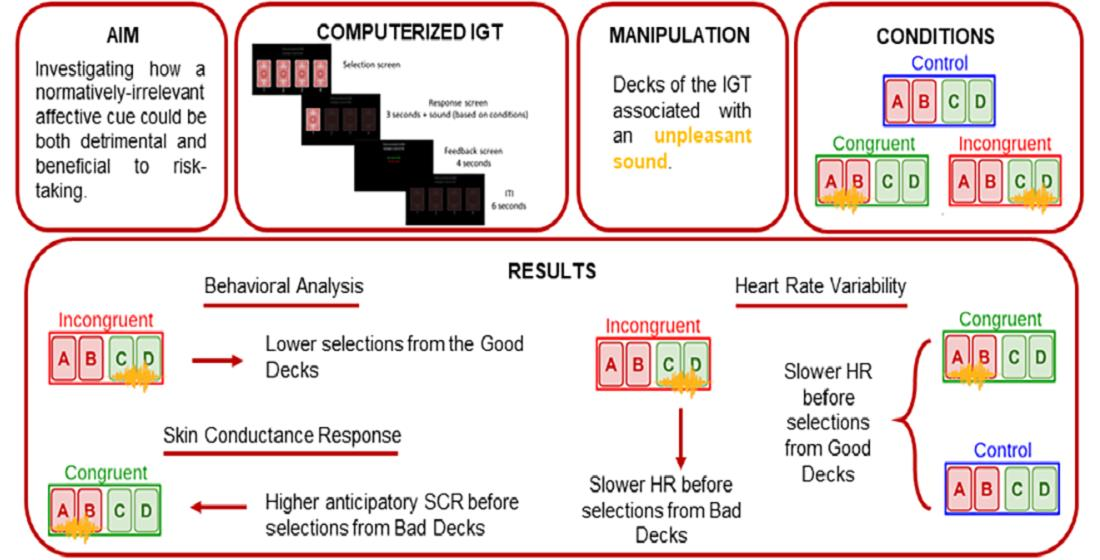
Normatively Irrelevant Affective Cues Affect Risk-Taking under Uncertainty: Insights from the Iowa Gambling Task (IGT), Skin Conductance Response, and Heart Rate Variability


Abstract
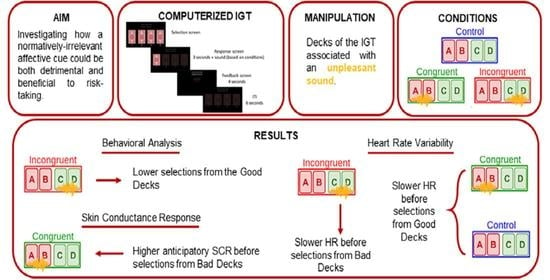
Share and Cite
Priolo, G.; D’Alessandro, M.; Bizzego, A.; Bonini, N. Normatively Irrelevant Affective Cues Affect Risk-Taking under Uncertainty: Insights from the Iowa Gambling Task (IGT), Skin Conductance Response, and Heart Rate Variability. Brain Sci. 2021, 11, 336. https://doi.org/10.3390/brainsci11030336
Priolo G, D’Alessandro M, Bizzego A, Bonini N. Normatively Irrelevant Affective Cues Affect Risk-Taking under Uncertainty: Insights from the Iowa Gambling Task (IGT), Skin Conductance Response, and Heart Rate Variability. Brain Sciences. 2021; 11(3):336. https://doi.org/10.3390/brainsci11030336
Chicago/Turabian StylePriolo, Giulia, Marco D’Alessandro, Andrea Bizzego, and Nicolao Bonini. 2021. "Normatively Irrelevant Affective Cues Affect Risk-Taking under Uncertainty: Insights from the Iowa Gambling Task (IGT), Skin Conductance Response, and Heart Rate Variability" Brain Sciences 11, no. 3: 336. https://doi.org/10.3390/brainsci11030336
APA StylePriolo, G., D’Alessandro, M., Bizzego, A., & Bonini, N. (2021). Normatively Irrelevant Affective Cues Affect Risk-Taking under Uncertainty: Insights from the Iowa Gambling Task (IGT), Skin Conductance Response, and Heart Rate Variability. Brain Sciences, 11(3), 336. https://doi.org/10.3390/brainsci11030336