Featured Application
The electroadsorptive removal of gaseous pollutants is a novel air pollution control technique, based on the effect of an electric field applied to an adsorbent material.
Abstract
Adsorption is a consequence of surface energy distribution, and the existence of electrostatic bonding suggests that the presence of an external electric field may affect adsorbate/adsorbent interactions. Nevertheless, this aspect has been poorly studied in the literature, except under non-thermal plasma or corona discharge conditions. After having demonstrated in our previous work that the adsorption kinetics of gaseous organic compounds can be enhanced by the presence of an external applied electric field, in this study, we focus on the influence of the electric field on adsorbent and adsorptive interactions. By using a commercially available activated carbon cloth, in addition to increasing the adsorbent mass transfer coefficient by virtue of the increasing intensity of the applied electric field, the results suggest that adsorbent morphology is only influenced by the formation of new surface functional groups. Moreover, enhanced adsorption kinetics and capacity may result from the electrohydrodynamic force induced by the movement of charged and neutral particles towards the adsorbent, as confirmed by the reversibility of the process. Such enhancement results in a negligible increase, of about 3%, in adsorption capacity (i.e., from 91 mmol m−2 Pa−1 for only adsorption to 94 mmol m−2 Pa−1 in the presence of the applied electric field), but also in a dramatic doubling of adsorption kinetics (i.e., from 0.09 min−1 for only adsorption to 0.19 min−1 in the presence of the applied electric field). In reality, the application of an electric field to an activated carbon cloth leads to faster adsorption kinetics, without substantially altering its adsorption capacity.
1. Introduction
The application of an electric field to separate particles from a gaseous stream is generally known as electrostatic precipitation, and it is a widely adopted technique for removing particulate matter from industrial emissions. Electrostatic precipitators (ESPs) are based on Coulombic attractions between charged particles and a collecting plate. That gives the principle of operation: a discharge electrode gives the particles an electrical charge, and they are forced to pass through an electric field. Afterward, particles are deflected by the electric field to the collector electrode [1,2]. As an electric field is formed from the application of an electric potential difference to the ESP discharge electrodes, the strength of this electric field is a critical factor in ESP performance.
The adsorption process is a conventional technique for removing pollutants from a fluid stream. Many adsorptive materials are used for air pollution control; for instance, activated carbon has the ability to reduce ozone, selected volatile organic compounds (VOCs), and other pollutants over long periods [3], as well as zeolites, alumina, silica gel, and clay. The adsorption process, over an appropriate media, is considered to be effective for a low concentration of pollutants; however, they are merely transferred from the gaseous to the solid phase, instead of being destroyed.
Different definitions exist for the word “adsorption”, all based on different aspects of the same process: from a thermodynamic approach to a macroscopic perspective. However, these differences are subtle and arise from the peculiarity of the attraction forces. Molecules, from a fluid phase, tend to adhere to the surface of a solid because of the creation of a low potential energy region near the solid surface and to increase the molecular density close to the surface, compared to the counterpart in the bulk phase [4]. Table 1 reports the terminology adopted for describing the adsorption process.
Table 1.
Terms related to the adsorption process.
In our previous work, we investigated the possibility of coupling such process with the photocatalytic process in order to remove nitrogen oxides (NOx) [5] and volatile organic compounds (VOCs) [6], by using different support materials [7], focusing on the feasibility and on the efficiency of such novel hybrid process. Moreover, in a previous study [8], we demonstrated how it is possible to enhance the removal of gaseous volatile organic compounds (VOCs) in a batch reactor, by the application of an electric field to a technical adsorbent, and how this enhancement is related to the VOC characteristic and the electric field strength.
In light of the previous findings, in this study, the effects of the electric field on the adsorbent and the adsorbate have been investigated. To the best of the authors’ knowledge, this is the first comprehensive study about the application of the electroadsorptive effect for the removal of gaseous pollutants and, jointly with our previous work, it provides a thorough overview of the relevant phenomena occurring within this combined process.
1.1. Electrosorption
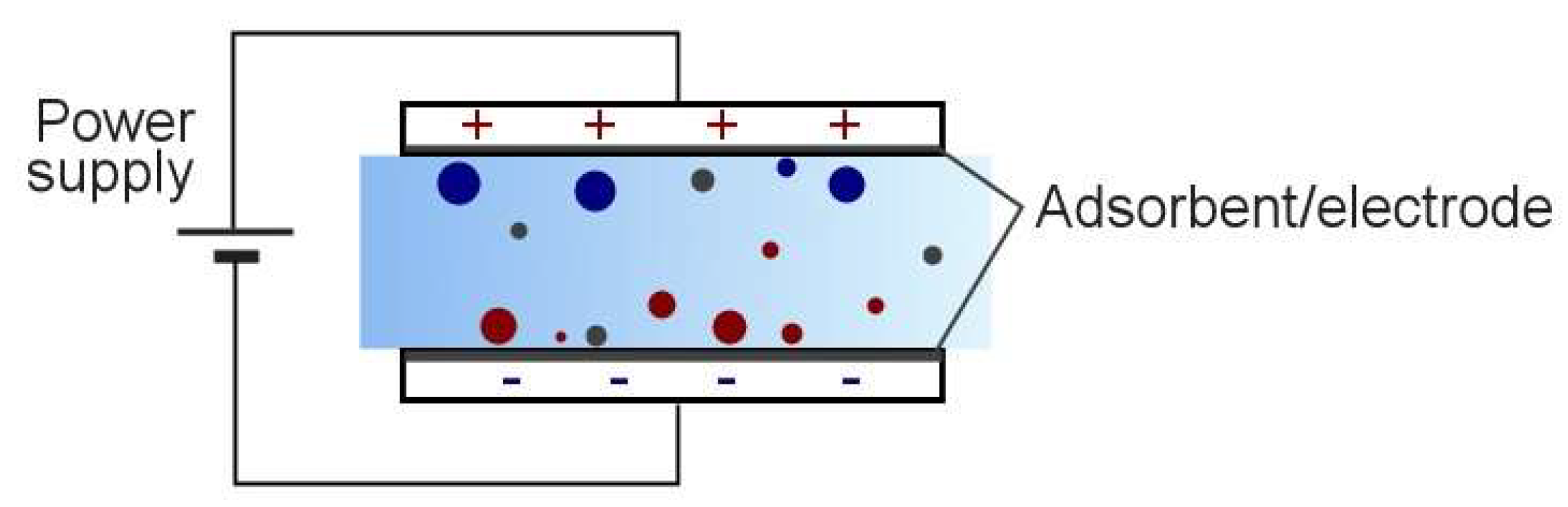
In 1989 Grevillot defined “electrosorption” as the reversible adsorption, or the reversible retention, of ions, molecules, and particles from a liquid phase on or near an electronic conducting surface as a function of the electric potential difference between the surface and the liquid [9]. From this first definition, which was related only to liquid–solid adsorption, Su and Hatton broadened the definition to all those phenomena in which this surface-binding process is promoted, or aided, by the presence of an electrical field [10]. However, while this definition seems to cover every scenario in which a polarization of a conductive substrate (due to an application of an electrical current) induces an attraction of oppositely charged species to the surface, literature research highlights that this process is mainly used in capacitive and pseudocapacitive deionization for separation [11,12,13,14], and energy storage [15,16]. Other reported applications are for the removal of dangerous contaminants, such as organic ions and heavy metals, or enhanced liquid chromatography sensing techniques [17]. The scope of the electrosorption process is, therefore, closely linked to the presence of a liquid phase and a solid phase. A schematic representation of such process is reported in Figure 1.
Figure 1.
Schematic of the electrosorption process.
Difference between electrosorption and adsorption from the gas phase is well described by Gileadi [18], Bockris [19], and Chue [20]. Table 2 briefly reports these differences. However, this term has never been used to define the phenomenon in the gas phase. The main reason is that the air is not electrically conductive and the species in the electrodes are barely adsorbed and not solvated. However, in case of a weakly-ionized plasma, the charged species in the air gap between the electrodes can conduct electricity, and the electric field may displace the molecules previously adsorbed.
Table 2.
Differences between gas-phase adsorption and electrosorption.
1.2. Electroadsorptive Effect
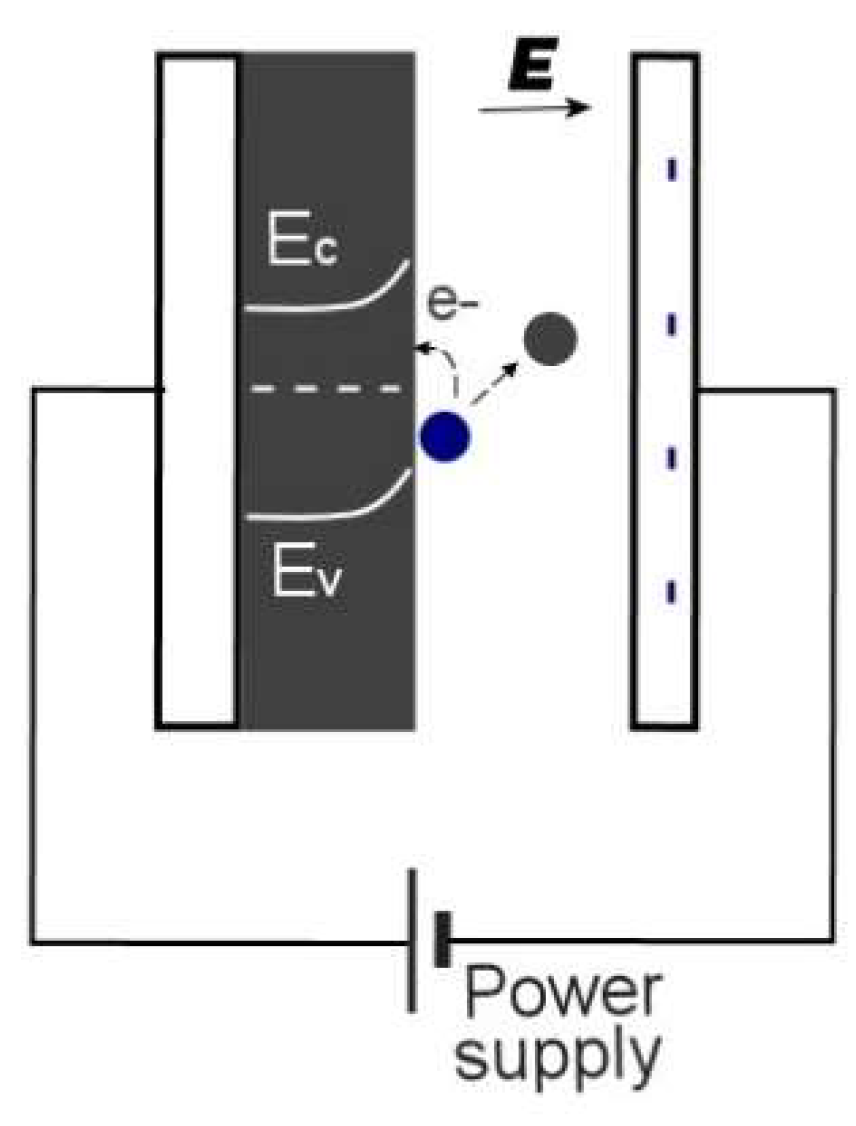
The electroadsorptive effect consists of applying an external electric field to the sensitive layer of a semiconductor gas sensor, in order to alter its sensing behavior [21].
When an electronegative molecule approaches the surface of a thin metal conductor, the free electrons are attracted from the solid surface. A fortiori, if dealing with a semiconductor (such as activated carbon), which has a lower number of available displaced charges, the thickness of the layer involved by the electrostatic attraction will be larger, and the electrical conductivity will be lower. This change in the electrical performance of the semiconductor is the fundamental operation of the metal oxides (MOS) gas sensors. If the described system is placed between an electric field, induced, for instance, by applying a voltage between two electrodes, the field may force the electrons towards (or away from) the (semi)conductor surface, decreasing (or increasing) the adsorption of certain gaseous species [21] (Figure 2). The application of this idea in gas sensing applications was firstly described by Wolkenstein [22] in 1960 but, until now, no application of the same principle regarding pollution control technology has been reported.
Figure 2.
Schematic diagram of the electroadsorptive effect. Adapted from [21].
1.3. Gas-Phase Corona Reactions
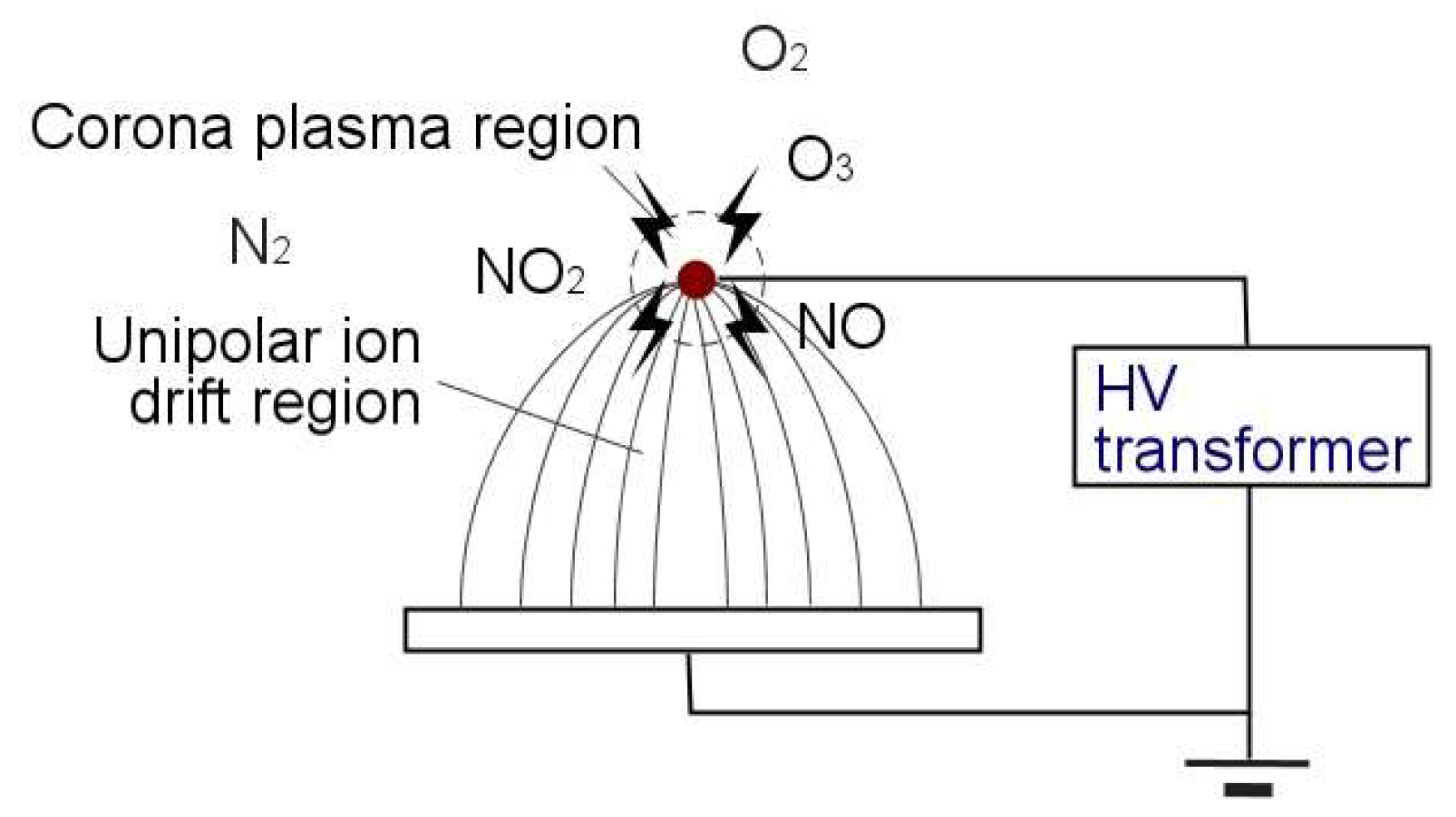
Air can be considered a mixture of nitrogen (N2), oxygen (O2), and water (H2O). When air is electrically overstressed, electron-impact dissociation reactions of the background gases initiate the production of N and O atoms [23,24]:
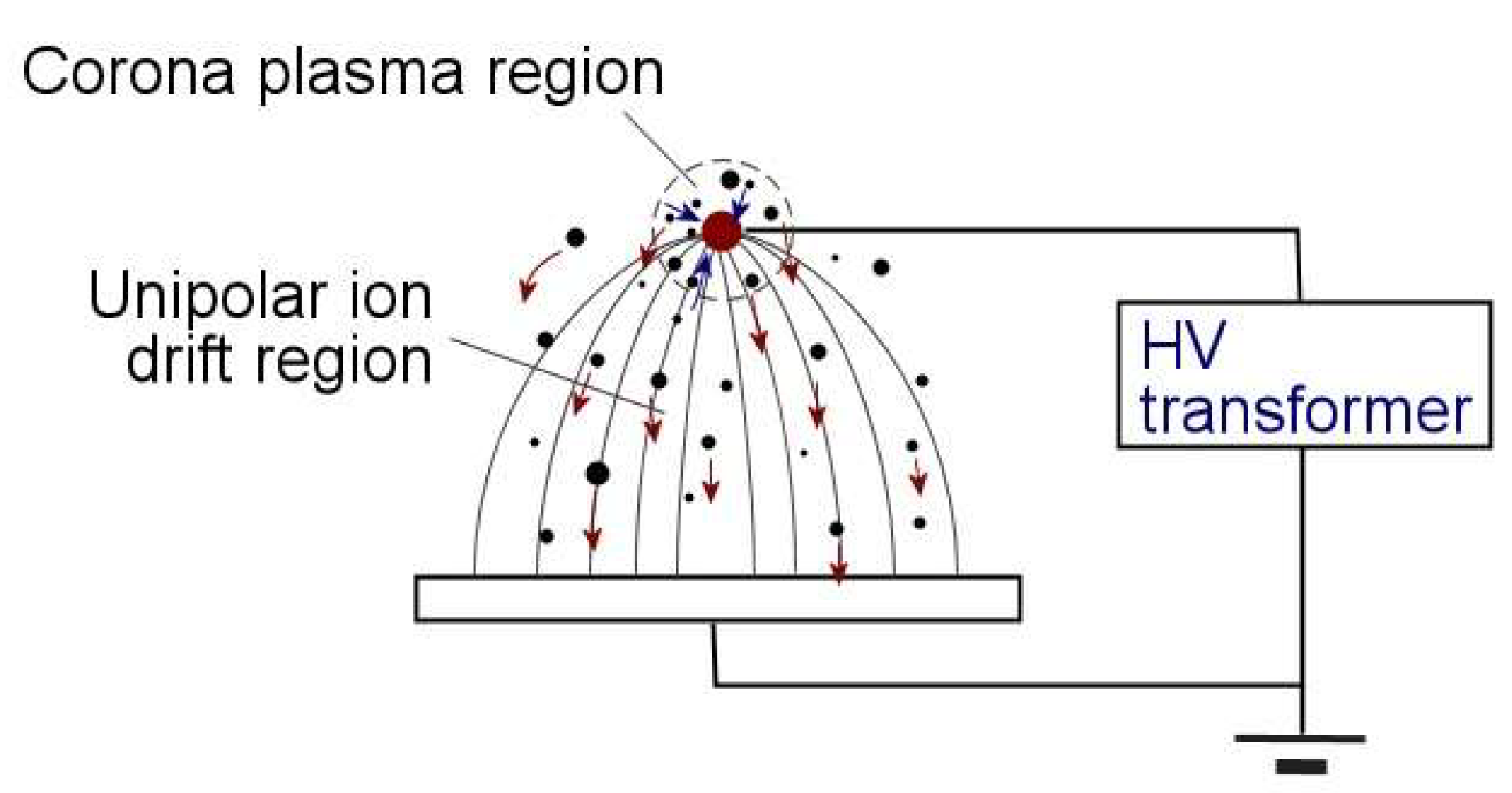
Electron-impact reactions mainly take place close to the discharge electrode, in the corona plasma region. However, produced radicals may be transported outside of the corona plasma region. Then, the atoms can combine into O2, N2, or O3, or form nitrogen oxides. Additionally, the presence of water vapor leads to the formation of H and OH radicals:
which can lead to the formation of HNO2, HNO3, HO2, and H2O2. A schematic description of the process is reported in Figure 3.
Figure 3.
Schematic of the production of by-products by corona discharge.
NO2 can be adsorbed on the activated carbon surface through different mechanisms: physisorption, chemisorption, and chemical reduction; however, when NO2 is adsorbed on carbonaceous materials, a significant amount of NO can be released [25]. The adsorbed species, once the adsorbent has been leached with ultrapure water, are analyzed and quantified, by liquid ionic chromatography. In the washing liquor, nitrates and nitrites have been found [8]. Ozone, in low concentrations, can be effectively removed by activated carbon [7], and the ozonation of activated carbon is reported as a technique for modifying its surface functional groups.
1.4. Electrohydrodynamic Effect
The creation of electric wind due to electrohydrodynamic force is a known effect due to the charged/neutral particles interaction in electrically charged fluids. Electric wind occurs during the DC corona and dielectric barrier discharge. The electrohydrodynamic (EHD) phenomena, within a pair of asymmetrical electrodes having a potential difference of the order of few of kilovolts, was first studied by Brown in 1928 [26]. However, while the efficiency of such devices for creating air flow is a few unit percents, the EHD devices’ interest is mainly in the absence of moving parts and for their potential for miniaturization. Numerical modeling of the electro-induced flow by a filamentary discharge electrode on a plate is a topic that has already been discussed in the literature [26,27,28].
The gaseous ions, formed in the corona discharge area, are accelerated by the electric field, resulting in a drag force of the bulk fluid and producing an ionic wind, which also includes neutral molecules (Figure 4). For the sake of simplicity, only three generic charged particles will be considered: electrons, positive ions, and negative ions.
Figure 4.
Schematic of the generation of ionic wind by corona discharge.
The EHD flow generated by the positive corona discharge is described by the Poisson’s equation, in which the electric field intensity, , and the electric potential V are related according to the Equation (1):
In which q is the space charge density (C m−3) and is the vacuum permittivity.
The electron density is then computed by solving the drift-diffusion equation for the electron density (Equation (2)), using the local field approximation (Equation (3)), in order to relate the mean electron energy to the reduced electric field [29].
The EHD force acting on the neutral gas can be approximated, according to the Boeuf’ approach [30], by the following equation:
In which Ni is the i-charged species density and e0 is the elementary charge, towards the same direction of the electric field.
When charged molecules, generated in the corona plasma region, are accelerated by the electric field and gain kinetic energy, due to their collision with other neutral species, their momentum is transferred to the adjacent molecules, resulting in a bulk gas flow.
In particular, according to Boeuf [30], electric wind velocity increases with the square root of both the electrode gap and the discharge current, according to Equation (5):
where d is the electrode gap, I is the discharge current, μ is the ion mobility, and D is a constant. This simplified equation is valid for the hypothesis that the cross-section area of the corona discharge and the gas density are constant.
The discharge current is then evaluated as follows [2]:
where V is the applied voltage, V0 is the onset voltage, and C a constant dependent on the electrode geometry and ion mobility. The corona onset voltage is the lowest voltage at which continuous corona occurs, and it is described by the Peek’s law. Equation (6) highlights that the discharge current increases in a quadratic manner with the applied voltage. The wire electrode thickness also affects the electric wind velocity. Debien [31] showed that by decreasing the wire radius it is possible to attenuate the presence of micro-discharges on the wire and induce an increase in the maximum electric wind velocity.
1.5. Adsorbent Modification
Few authors have suggested the possibility to enhance the adsorbability of activated carbon by surface modification. Alongside traditional methods of modification, dielectric barrier discharge [32,33] and ozonation [34,35] have been used introduce functional groups on the surface. The surface of carbonaceous materials, reacting with O3, may obtain many oxygen-functional groups, such as -OH, -CHO, and -COOH, CO. These groups are characterized by a high polarity, which involves a higher adsorption capacity of polar adsorbates. Deitz [36] studied the adsorption rate of water vapor by ozone-treated activated carbon, and he attributed the enhanced kinetic to the formation of highly-polar sites on the carbon, although the BET area decreased.
Few examples are reported in the literature where an electric field is applied to a carbonaceous adsorbent material and they have been reported in Table 3. It is interesting to note that the main purposes of these studies is different, just as the main results are sometimes contradictory, and a direct explanation of the phenomenon has not been produced yet. For these reasons, this chapter will mainly focus on providing more information on the possible physical phenomena that might occur.
Table 3.
Summary of publications in which an electric field has been applied to a carbonaceous adsorbent material.
2. Materials and Methods
2.1. Materials
A commercially available activated carbon cloth, provided by Purification Products Limited, was used for the tests. Its characteristics are reported in Table 4. Methyl Ethyl Ketone (MEK) is of lab-grade purity, and it was purchased from Carlo Erba reagents S.A.S.
Table 4.
Activated carbon fiber clothes characteristics.
2.2. Test Apparatus
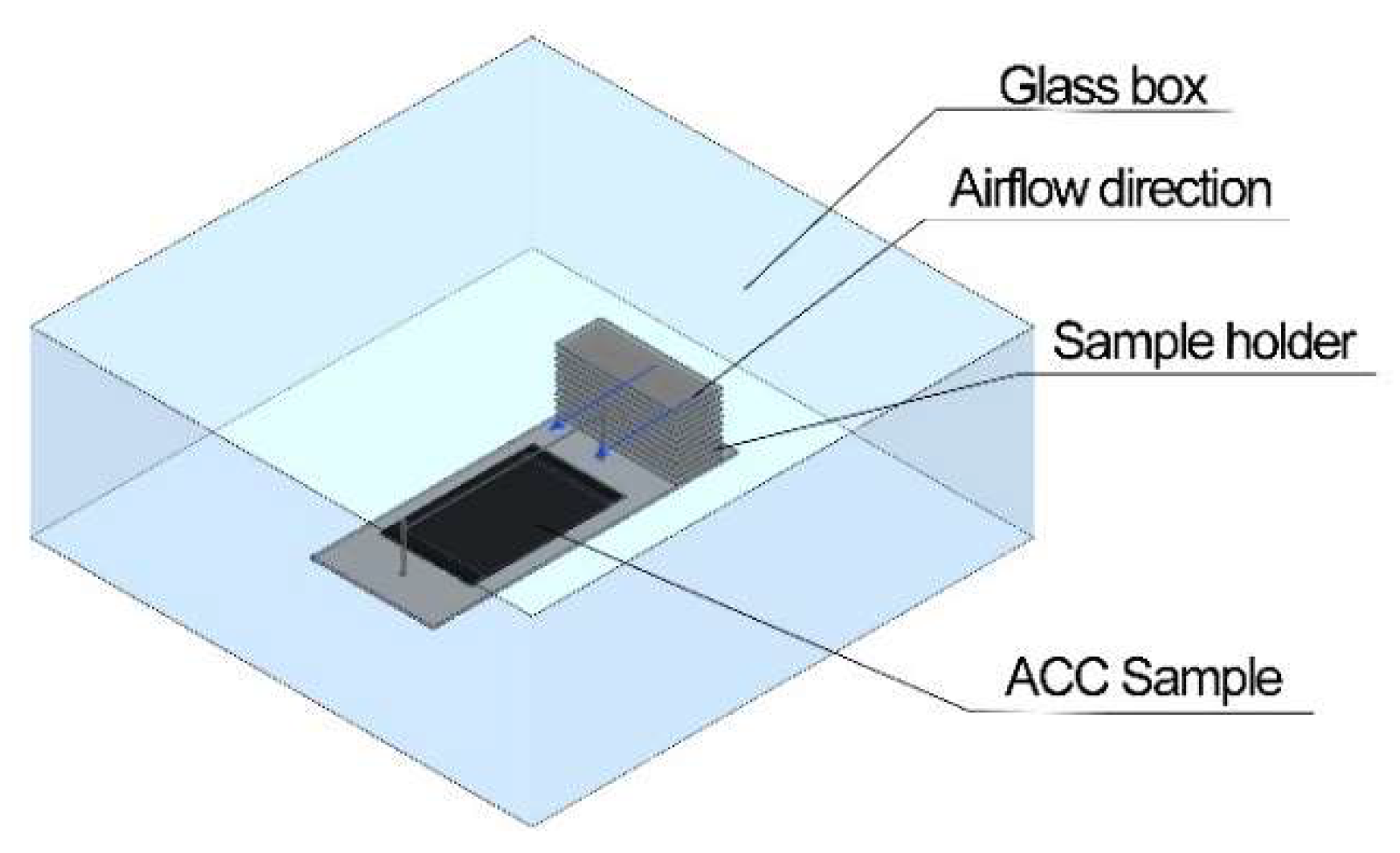
The test apparatus has been described in our previous work [8]. Briefly, it consists of a sample holder, on which the specimens take place, inside a 33 cm × 33 cm × 12 cm box with borosilicate glass walls (Figure 5). A fan (placed behind the deflector plates) induces a parallel air flux to the sample. To a thin (180 µm diameter) tungsten wire electrode (discharge electrode) is applied a positive potential, whereas the opposite electrode (the ACC sample) is earthed by two grounded connections at both ends.
Figure 5.
Schematic representation of the reactor.
Inside the glass box, temperature and relative humidity are monitored (R.H. = 50 ± 4% T = 20 ± 2 °C) through a SHT21 (Sensirion, Switzerland) sensor.
Air velocity measurements were conducted using a hot wire anemometer (Wind Sensor Rev P by Modern Devices, Providence, RI, USA) and a wire mesh instead of the sample. The anemometer was placed under the wire mesh, in order to measure the ionic wind intensity towards the sample, depending on the applied electric field and the fan speed.
2.3. O3, VOC, CO2, CO Concentration Measurements
MEK, CO2, CO, and water vapor concentrations were determined by an automatic photoacoustic transducer system (Brüel and Kjaer Multi-gas Monitor Type 1302, Nærum, Denmark) equipped with UA0982, UA0984, UA0987, and SB0527 filters, in order to determine concentrations of VOC, CO2, CO, and water vapor. To monitor the ozone concentration, a UV Photometric Ozone Monitor (API Ozone Monitor Model 450, San Diego, CA, USA) was used.
Adsorption kinetic from the batch test was fitted by using a pseudo-first order rate equation [43,44], using a nonlinear least square method, with a Levenberg-Marquardt algorithm. The amount of adsorbed MEK at a specific time is described by the following equation:
where is the amount of adsorbed MEK at the equilibrium, while the constant is an overall mass transfer coefficient.
Na et al. [45] used the partition coefficient (PC), as introduced by Szulejko et al. [46], to evaluate the adsorption capacity between different materials (or conditions) as a performance metric.
2.4. Electrical Impedance Measurement
Microporous carbons are capacitors, so they are used to store electrical energy when coupled with electrolytes. For this reason, a classical impedance meter is usually not convenient for measuring resistance (except if it has a very high internal impedance) because the capacitor is charging during the measurement. The I-V curves of the ACC were acquired in AC mode, by a Reference 3000 (Gamry, Warminster, PA, USA) potentiostat, in the 105–101 Hz range, with 100 mV RMS. Measurements were taken at room conditions (temperature equal to 27 °C and relative humidity equal to 70%), in the air, by directly attaching the electrodes on Hoffman clamps at both ends of a 2 × 3 cm ACC sample.
2.5. SEM and EDX Analysis
Sample morphology was investigated by Scanning Electron Microscopy (SEM), using a ZEISS 1530 SEM, equipped with a Schottky emitter, with two different secondary electrons (SE) detectors (the in-lens and the Everhart-Thornley), operating at ten keV, coupled with an energy dispersive microanalysis (EDX).
2.6. Boehm Titration
The Boehm titration [47] is a technique that allows quantifying acidic or basic functional groups on the surface of activated carbons. This method is supported by the existence of oxygen surface groups having different acidities that can be neutralized by bases having different strengths, like NaHCO3 (pKa = 6.4), Na2CO3 (pKa = 10.2), and NaOH (pKa = 15.7). In ascending order of strength, NaHCO3 neutralizes only the carboxylic groups; Na2CO3 neutralizes the lactonic and carboxylic groups; and NaOH neutralizes the phenolic, lactonic, and carboxylic groups.
Two samples of activated carbon cloth (ACC) were exposed for one hour in the apparatus previously described, with an applied potential of, respectively, 3 kV and 7 kV. The method adopted follows the procedure described by Kim et al. [48]. Briefly, each sample was divided into smaller pieces, and two of these (weighing approximately 60 mg) were weighted and placed in a flask with a 10 mL of an alkali solution (0.1 M, CARLO ERBA Reagents, Milan, Italy). Then, the flasks were sealed and sonicated for 10 min, and an aliquot of 10 mL of the sample solution was taken and titrated using 0.1 M HCl (CARLO ERBA Reagents, Milan, Italy).
2.7. Raman Spectroscopy
The Raman spectra were obtained with an integrated confocal micro-Raman system with a LabRam Aramis (Horiba Jobin Yvon, France) 460 mm spectrometer equipped with a confocal microscope. The light source was a laser emitting green light diode at 532 nm with 50 mW power. Data were smoothed (with a Savitzky-Golay method, 15 points, cubic interpolant) and the baseline (approximated with a cubic polynomial) subtracted and normalized.
2.8. FTIR Analysis
Fourier Transform Infrared Spectrometry (FTIR) is a technique to obtain structure information of a molecule, due to the specific molecular vibrational spectrum. Infrared spectra were collected at room temperature with a GX1 Perkin Elmer spectrophotometer (Perkin Elmer, Waltham, MA, USA), coupled with Autoimage microscope and U_ATR accessory (SensIR Technologies, Danbury CT, USA) for measurements in total attenuated reflectance. Acquired spectra were elaborated with Spectrum 5.3 (Perkin Elmer, Waltham, MA, USA).
3. Results
3.1. Enhanced Removal of VOC
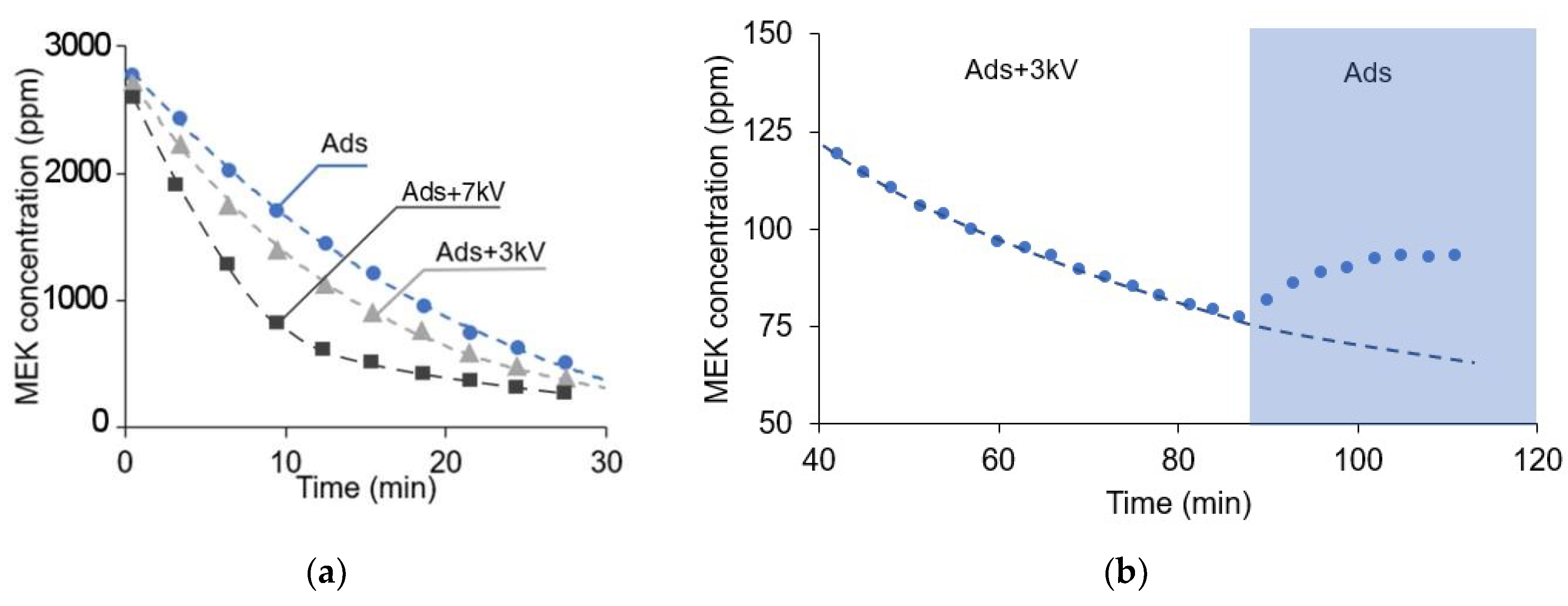
As reported in our previous work [8], and as shown in Figure 6a, the application of an external electric field to an ACC enhances the MEK removal. In a test with the electric field, after 90 min, the applied potential was switched off, and the rise of the MEK concentration was noticed (Figure 6b). Similar behavior was found for the water vapor concentration.
Figure 6.
(a) Methyl Ethyl Ketone concentration in the absence and presence of the electric field. (b) MEK concentration in the test where the electric field was first switched on and then off.
Fitted values of the Equation (7), relatively to the batch adsorption tests, are reported in Table 5.
Table 5.
Results of the experimental batch adsorption kinetic data fitting.
It is possible to observe that, with increasing the applied potential, it is not possible to clearly appreciate the difference of the amount of MEK adsorbed at the equilibrium (qe), as well as the change of the partition coefficient (PC) because of the entity of the increase is of a few unit percent, in the same order of the experimental variability. However, this difference is appreciable when the electric field is switched off, as reported in Figure 6b, and it corresponds to an enhancement of 3.3% for the PC value, which implies an enhancement in adsorption affinity and adsorption ability [45]. Jointly with a slight increase of the adsorption capacity, it is possible to appreciate a tremendous increase of the mass transfer coefficient (K), doubling for the sample under the electric field. The amounts of MEK adsorbate at the equilibrium, normalized on weight, are comparable with the one found in the literature [49,50] if it is considered that the activated carbon amount in the present composite is approximately 44%.
3.2. SEM Morphology
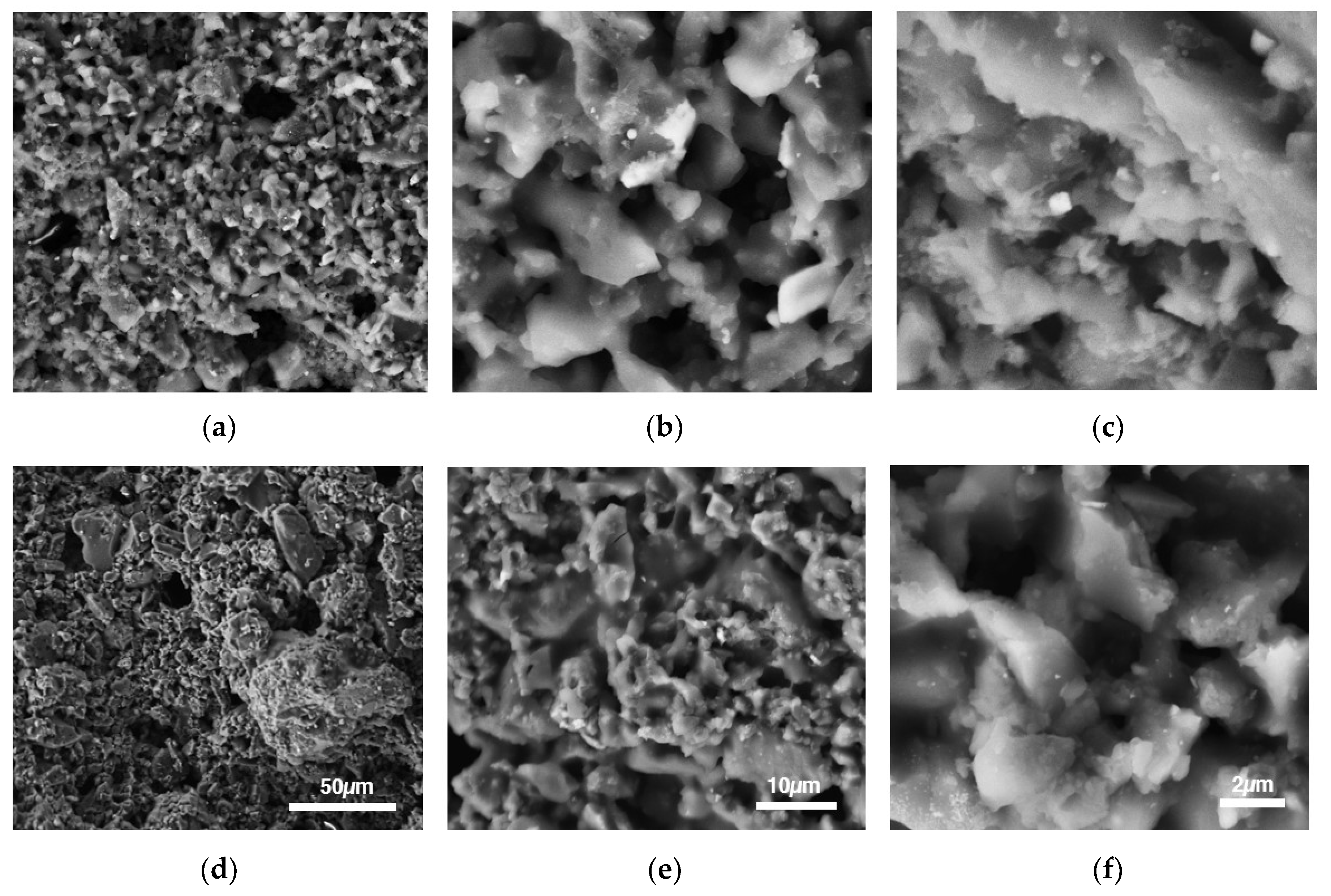
The SEM pictures of the untreated and treated ACC are shown in Figure 7. It is possible to observe that the surface roughness of the ACC after the application of the electric field at 7 kV for 3 h it is similar to the one before.
Figure 7.
Scanning electron microscopy (SEM) pictures of the ACC before (a–c) and after (d–f) the application of 7 kV for 3 h at different magnification.
Kodama [33] reported that the DBD treatment etched the activated carbon: while the total surface area decreased, a small increase in macropores was observed; on the contrary, for Srinivasan et al. [51] functionalization does not affect the morphological properties of the activated carbon but it only increases the amount of functional groups on the surface. This is in accordance with our results, where it is difficult to distinguish a clear difference in the observable morphology between the activated carbon sample before and after the application of the electric potential to the discharge electrode.
3.3. Boehm Titration
The oxygenated functional groups present on the surface of the ACC are involved in acid-base balance. The data in Table 6, obtained with the Boehm titration method for the determination of the total content of the surface acidic groups, indicate that the virgin ACC does not contain an appreciable amount of carboxyl and lactonic groups, while their amount increases when the applied potential increases. The number of phenolic functional groups constitutes about half of the total amount of all oxygenated functional groups; carboxyls and lactones are only found in the treated samples.
Table 6.
Functional groups determined by titration.
3.4. Electrical Impedance Measurement
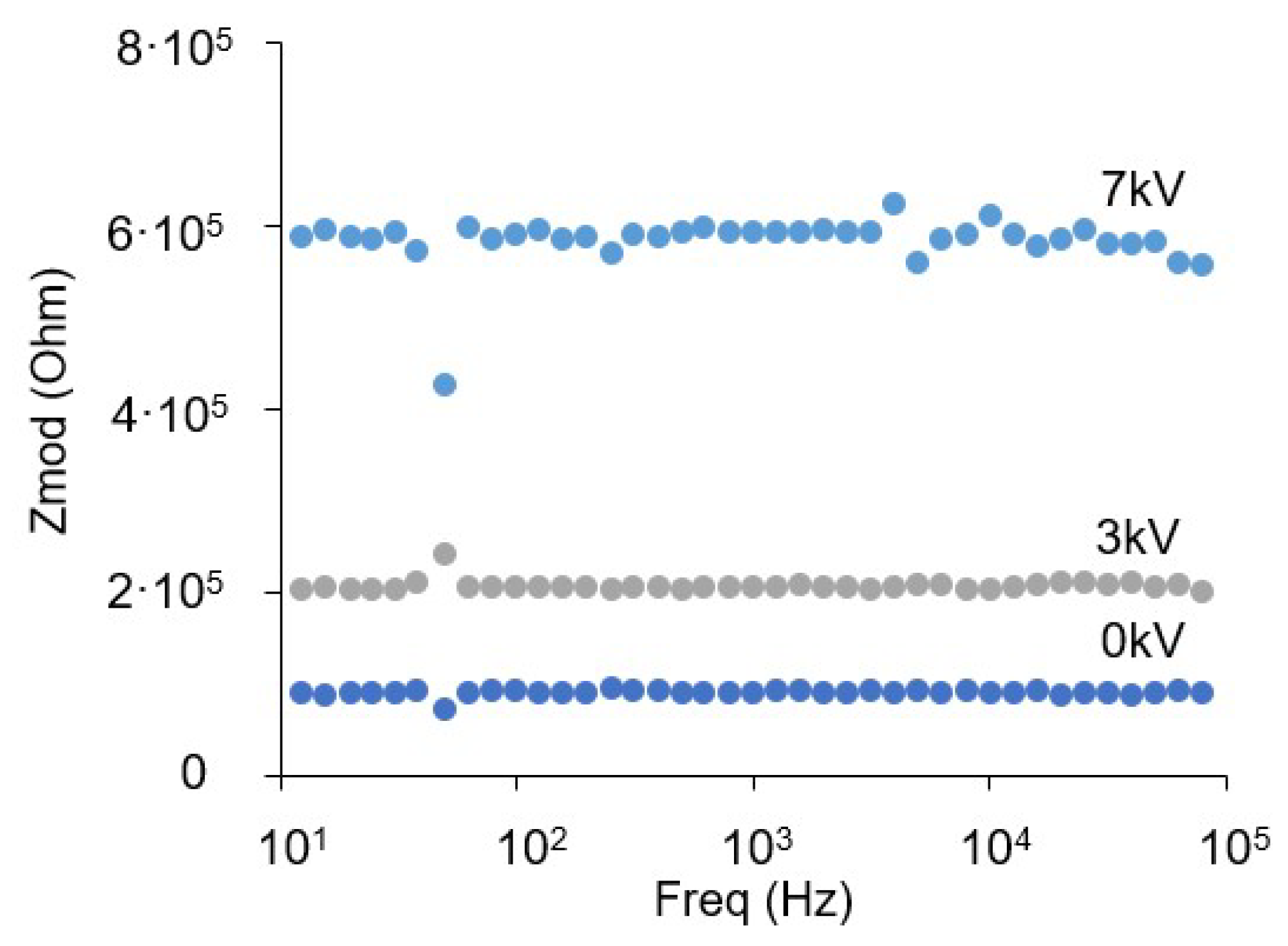
The module of the complex impedance, measured at different frequencies, is reported in Figure 8.
Figure 8.
Impedance module vs. frequency for the ACC samples, under different applied potentials (0 kV, 3 kV, and 7 kV).
All ACC samples show only a resistive behavior in the 10–10,000 Hz range. The outlier at 50 Hz is due to the interference with the electric line. Treated samples exhibit a purely resistive behavior and an increase of the electrical resistivity from 9.77 kΩcm to 24.0 kΩcm for the 3 kV-treated sample and 62.7 kΩcm for the 7 kV-treated sample. This change can be attributable to the formation of functional groups that alter the electron mobility in the carbon structure.
3.5. FTIR Analysis
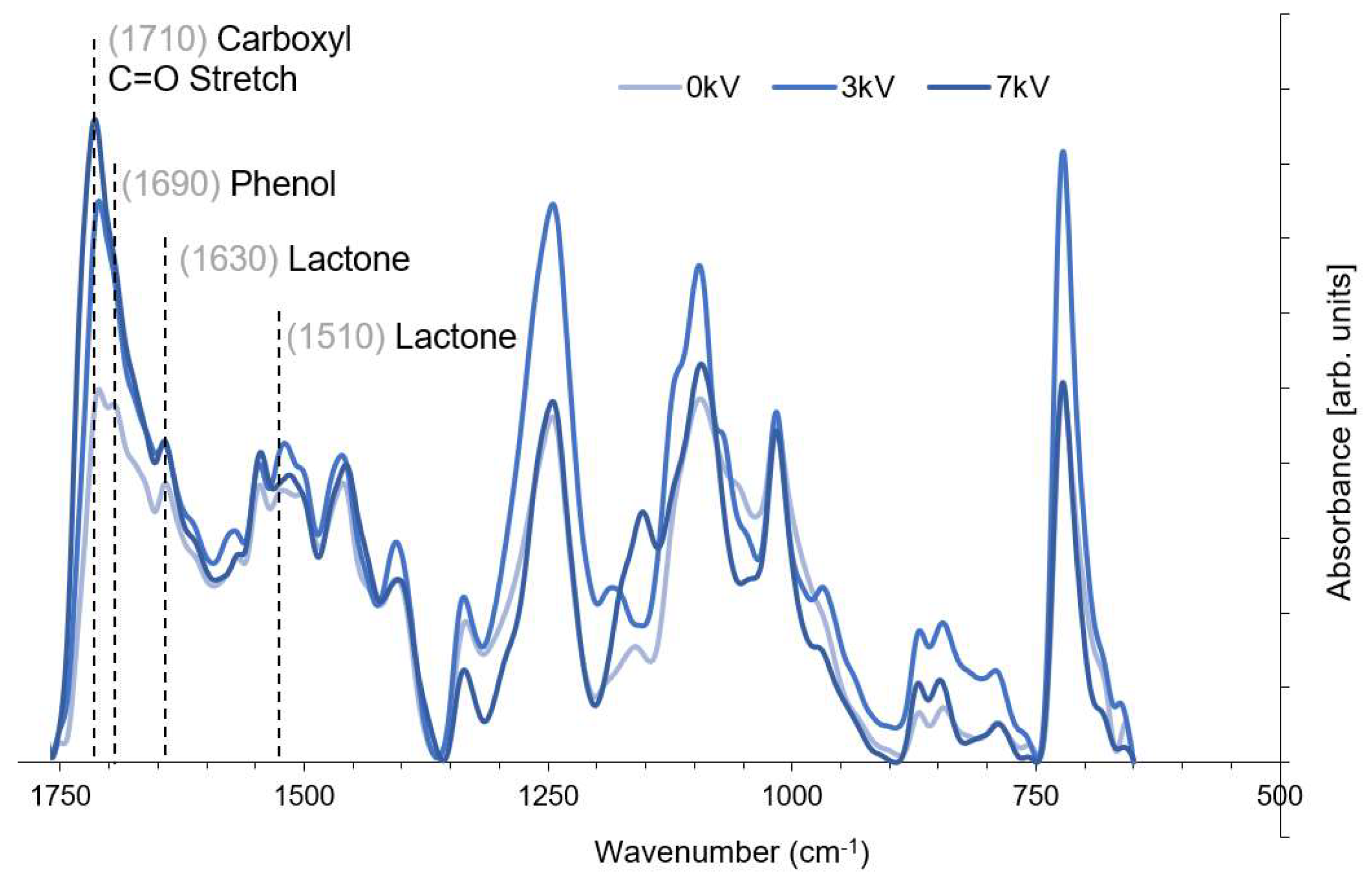
As some functional groups can be detected by FTIR spectroscopy, FTIR spectra of the synthesized ACC are presented in Figure 9. The spectra were acquired in the 500–3000 nm interval, but only the 500–1750 nm region has been reported.
Figure 9.
Fourier Transform Infrared Spectrometry (FTIR) spectra of the ACC samples, under different applied potentials (0 kV, 3 kV, and 7 kV).
Barkauskas and Dervinyte [52], investigated a batch of 20 different activated carbons in order to correlate the number of functional groups determined by Boehm titration with the peaks in the FTIR reflectance spectra. By comparing the obtained spectra with their results and with the available literature, it is possible to identify several peaks, which can be correlated with the acidic group, previously determined by Boehm titration. The peak at 1710 cm−1 is generally linked to a carboxylic C=O stretch, and it has been found to increase with the electric field intensity, as well as other smaller peaks at 1690 cm−1, due to the phenolic groups and at 1630 and 1510 cm−1 due to lactone functional groups [52].
3.6. Raman Spectroscopy
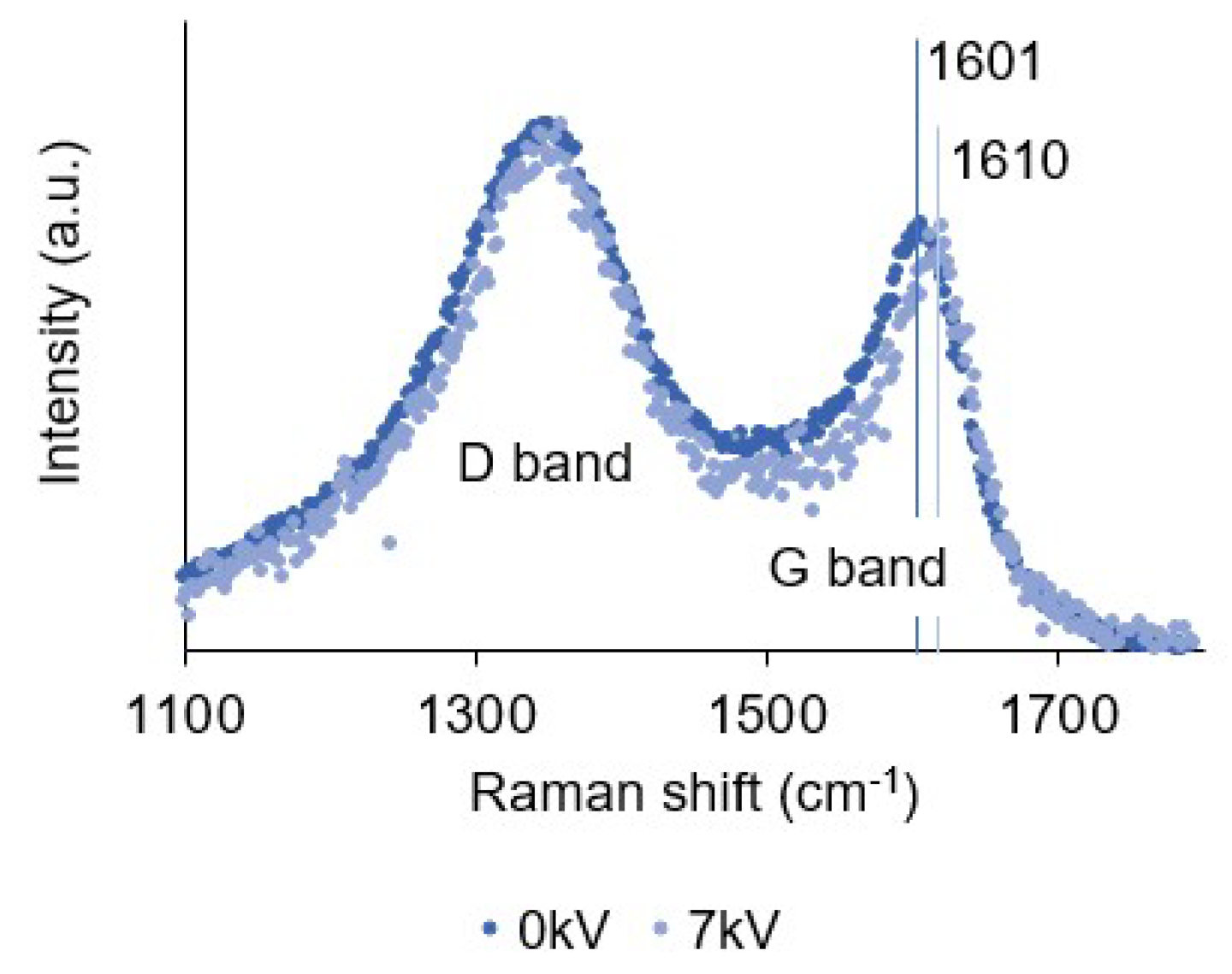
Two main bands at ~1600 cm−1 and ~1350 cm−1 are reported in Figure 10 and they are attributed to the G and D band of the carbon structure, respectively. In particular, Ferrari and Robertson suggested that the G and D peaks are due to sp2 vibration. In particular, the G-band is due to the bond stretching of all pairs of sp2 atoms, while the D-band is attributed to the of sp2 breathing modes of atoms in rings [53]. The sample subjected to the electric field shows a shift of the G-band. A similar result was observed by Lota et al., who exposed an activated carbon to ozone [54]. This trend may be explained by the loss of C bonded in rings and the formation of chains due to the incorporation of oxygen and nitrogen atoms, which is consistent with the previous FTIR and Bohem titration results.
Figure 10.
Raman spectra of the ACC samples, with and without the applied electric field.
Results of the peak fitting with Lorentzian functions are reported in Table 7. The intensities ratio (ID/IG) of the D and G bands, characteristics of carbonaceous materials, is an important parameter to estimate the structural disorder of carbon sheets. The intensity ratios of the analyzed samples are 3.40 and 3.32, respectively. The lower ID/IG ratio of the treated ACC may suggest the amorphization of the carbon, as reported in the three-stage model reported by Ferrari and Robertson [53].
Table 7.
Results of the peak fitting with Lorentzian function.
3.7. EDX Analysis
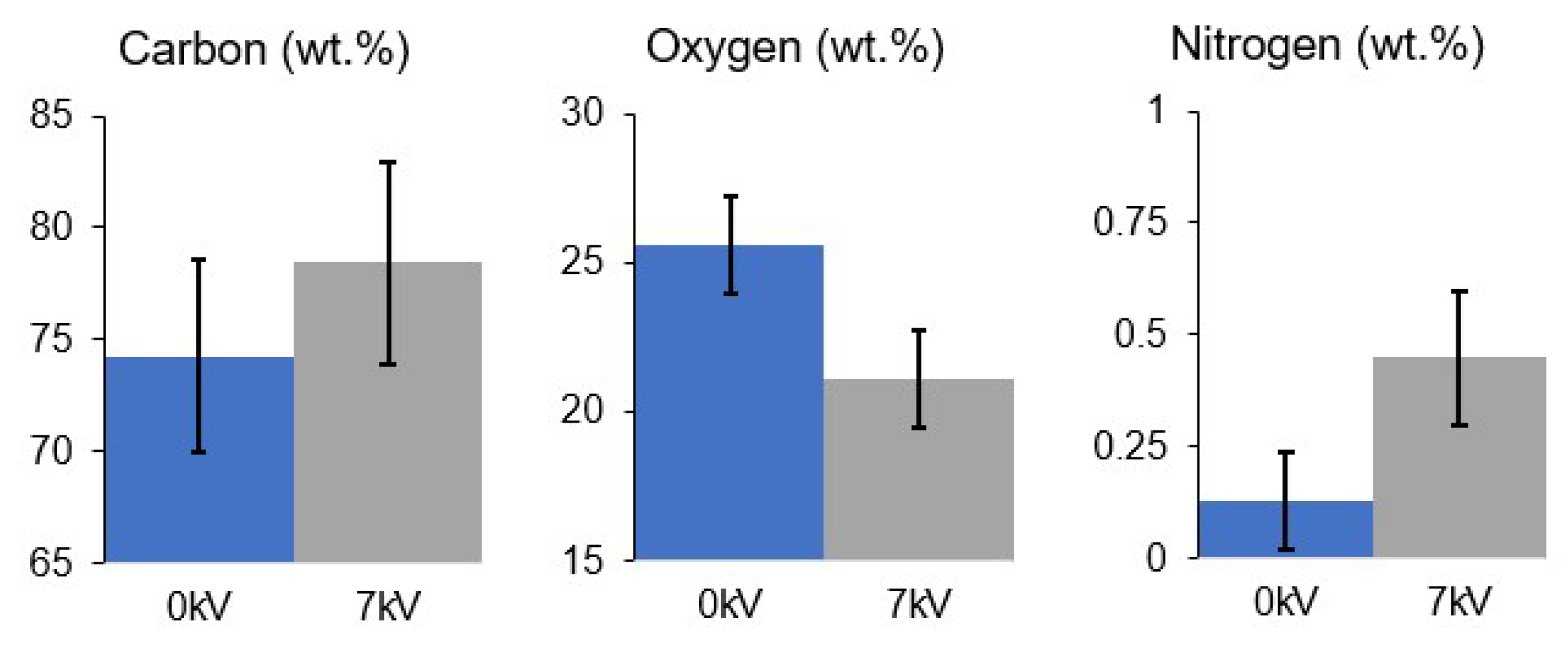
Figure 11 shows the results of the EDX analysis for ACC samples before and after the process. It is possible to notice a slight increase of the nitrogen, probably due to the synthesis of nitrates from NO2 adsorbed and hydrolyzed, due to the humidity present in the sample. This circumstance is consistent with the amount of nitrogen-containing species leached from ultrapure water, reported in our previous studies [5,8]. However, it is probable that some gaseous species will be degassed during the SEM-EDX operation procedure.
Figure 11.
Energy dispersive microanalysis (EDX) results for the ACC before and after the treatment.
3.8. Effect of the Ionic Wind
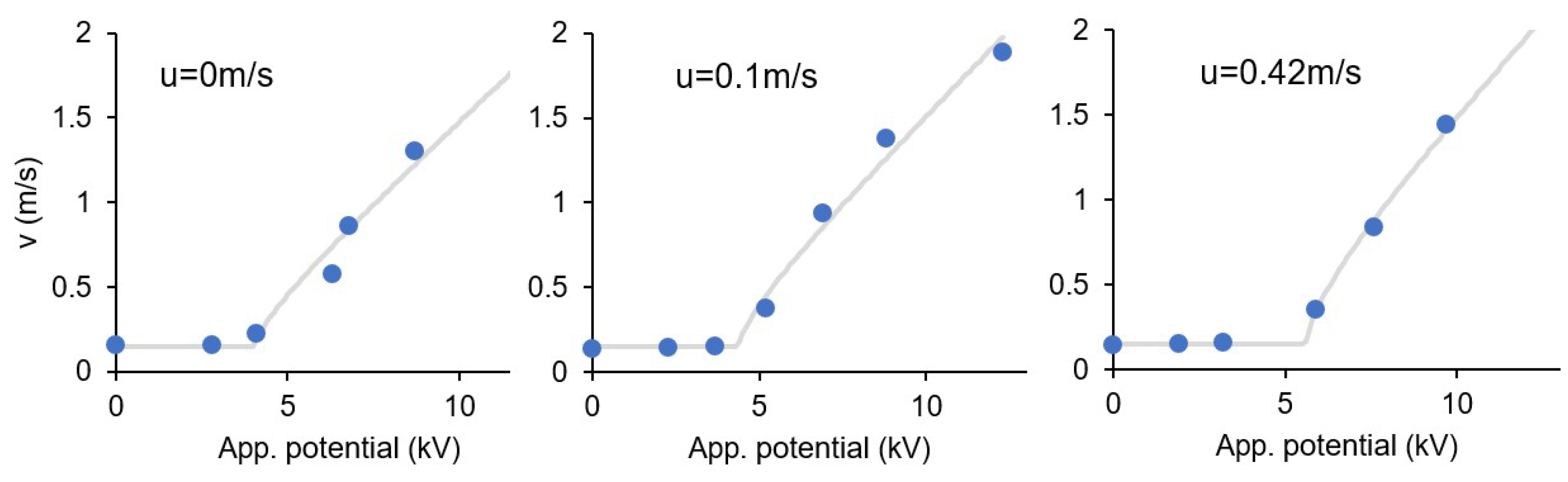
Horizontal air velocity(u) was modified by varying the voltage applied to the fan. The vertical component (v) of the air velocity was measured, just below the point where the sample is placed, by using a hot wire anemometer and a metal mesh instead of the sample. By varying both the fan speed and the applied potential, measurements were taken. Experimental values are represented by the blue dots in Figure 12.
Figure 12.
Experimental (blue dots) and fitted values (grey lines).
With the fan switched off, or with a low speed, the experimental values of v follow the equation proposed by Boeuf (Equation (5)). By merging Equation (5) with Equation (6), it is possible to obtain Equation (8), which has been used to fit the experimental data:
where α, the pre-square root factor, considers all the constants, and it depends on the electrode geometry, the ion mobility, and the electrode gap. V0 is the corona onset voltage.
It is possible to observe how the component of the vertical speed depends on the intensity of the potential applied to the discharge electrode, but also on the speed of the fan. Values obtained from the data fitting procedure are reported in Table 8. Two trends are observable: a slight increase in the value of α and V0, the corona onset voltage, with increasing the horizontal air velocity. The latter one, in particular, increases by about 2 kV for an increase of the airspeed of 0.4 m/s.
Table 8.
Values of the fitted parameters from Equation (7).
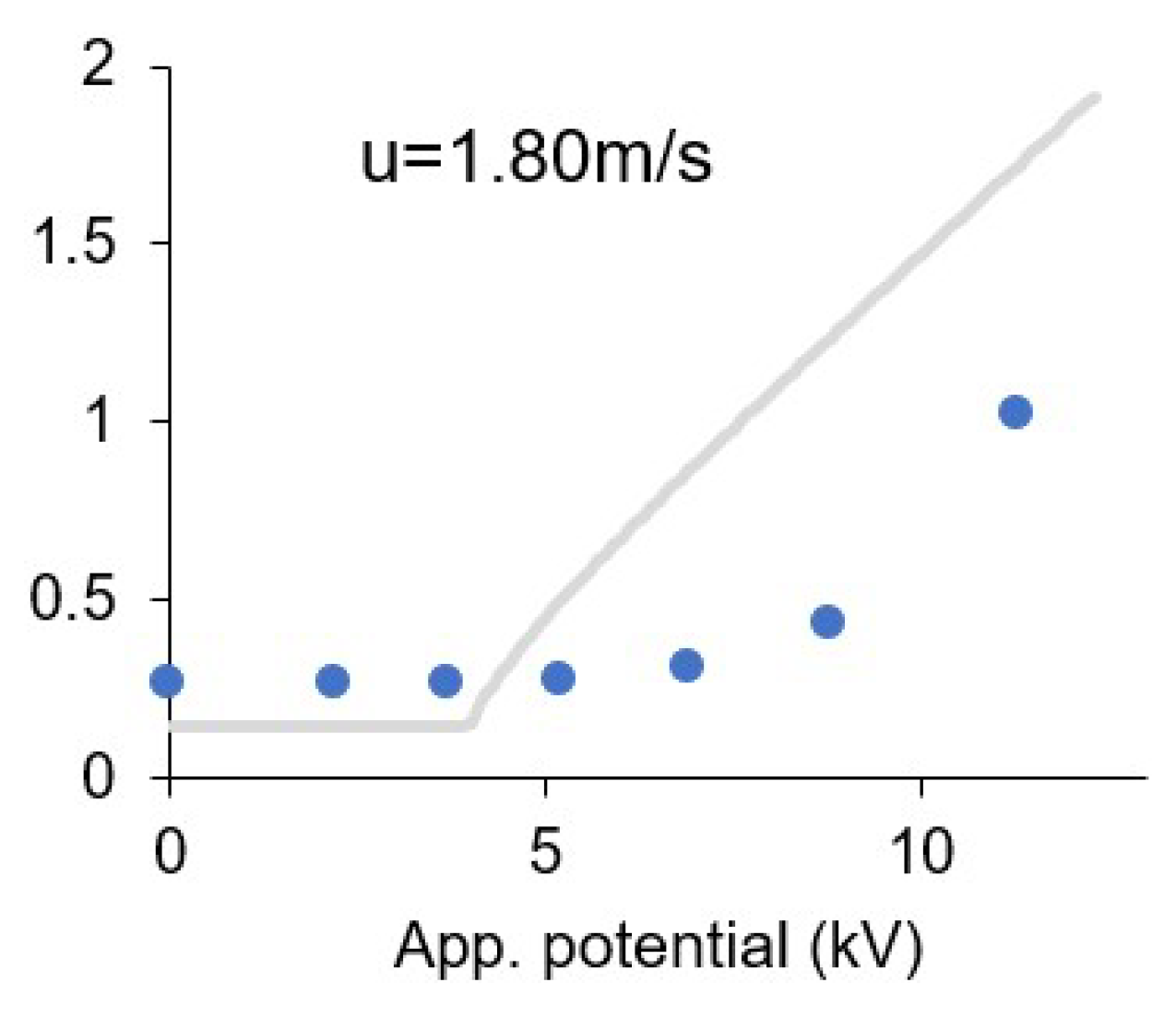
When the horizontal air velocity exceeds the 0.42 m/s, the transition between laminar and turbulent flow takes place. For flow over a flat plate, it is reported that transition occurs when Reynolds number should exceed 50,000. In the present case, the transition occurs earlier, at 11,200, because of the superficial irregularities presented by the metal grid. Similar behavior is expected to be present with the ACC, because of its high surface roughness. This aspect is also observed experimentally by the experimental points at a lower potential than the corona onset voltage (V < V0), which possess a higher vertical velocity, a priori the ionic wind formation, due to the turbulence eddy. In Figure 13 are reported the experimental data, at u = 1.80 m/s, and, on the background, the fit at u = 0, to highlight this difference.
Figure 13.
Comparison between the experimental data at u = 1.8 m/s (blue dots) and the fit at u = 0 (grey line).
4. Discussion
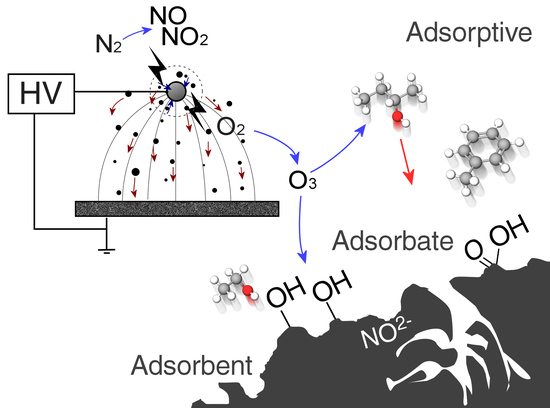
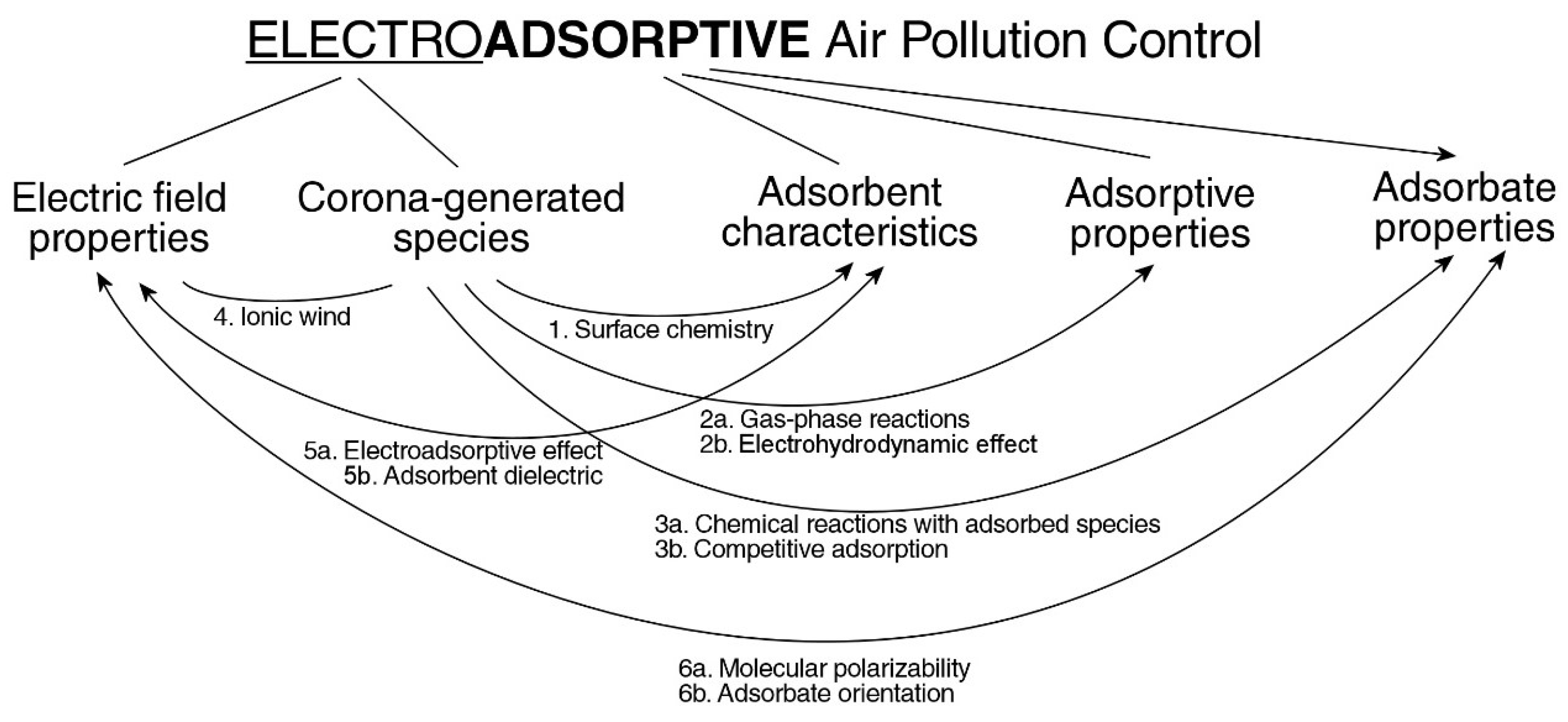
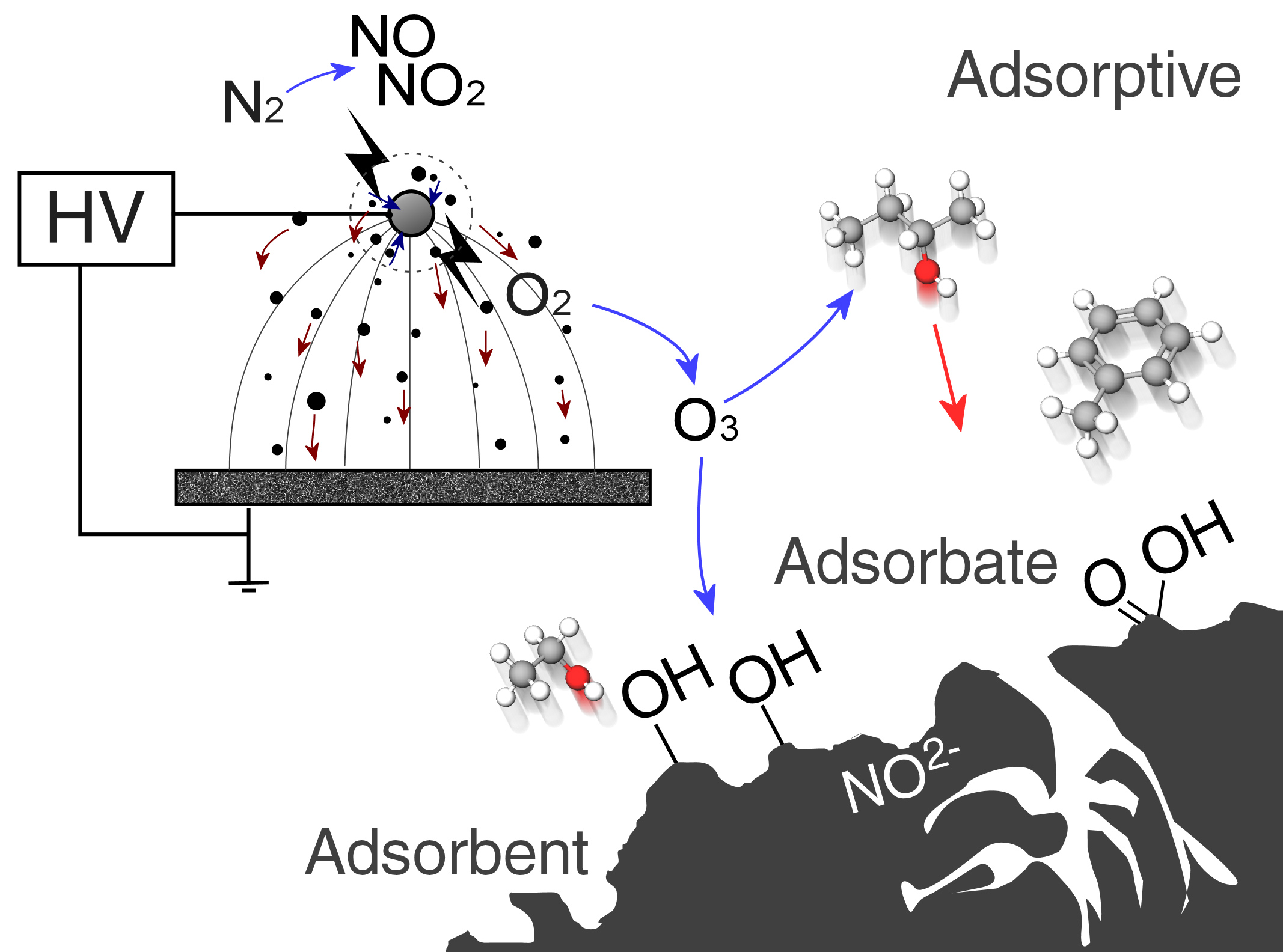
The IUPAC definition of “adsorption” is “an increase in the concentration of a dissolved substance at the interface of a condensed and a gaseous phase due to the operation of surface forces” [55]. For this reason, it is difficult to think that an alteration of the distribution of the surface charges of the adsorbent, due to the application of an external electric field, may not affect the adsorption process. Moreover, the generation of active species and radicals in the electrically stressed region may result in an alteration of the adsorbent morphology. These observations have repercussions on both the electric field characteristic and the adsorption process. The electric field, resulting from the applied potential, affects the adsorbent, the adsorptive, and the adsorbate, and the adsorbent and the adsorbate affect the electric field. Moreover, the presence of active species, produced by the corona discharge, may play a predominant role in the overall chemistry of the process. A schematic representation of the processes occurring is reported in Figure 14.
Figure 14.
Diagram of the processes interacting within the electroadsorptive air pollution control technique.
4.1. Surface Chemistry
The corona discharge produces ozone, a pollutant whose production must be reduced with an adequate adsorbent material. The destruction of O3 by activated carbon is a process that takes place on a molecular scale, with the opening of carbon rings in carboxylic and other functional groups [51]. O3 in the gaseous phase can initiate other chemical reactions, for example, with NO to produce NO2, which can be adsorbed more effectively [5,7,25]. Moreover, once the species are adsorbed on the ACC, they can incur a further reaction with the active species in the gas phase, and the resulting products may stay adsorbed or be released into the bulk gas.
Ozone plays an essential role in the functionalization of activated carbon. Raman and FTIR spectroscopy indicate, respectively, the loss of carbon bound in rings with the formation of functional groups. Carboxylic, lactone, and phenolic groups were quantified by Boehm titration. This capacity does not change the overall morphology of the activated carbon, only its surface chemistry, increasing the number of acid functional groups and making the adsorption of polar compounds more favorable. The functionalized adsorbent surface may result in a lower affinity for a specific nonpolar adsorbate. Moreover, the generation of NOx, with their subsequent adsorption on the ACC, may, as a consequence, decrease the capacity of the adsorbent [8].
The superficial alteration also has repercussions for the distribution of free charges, which are more limited, increasing the material electrical resistivity.
The application of an electric field to an ACC results in a displacement of the ACC surface charges, which may lead to a higher (or lower) adsorbate-adsorbent bond strength and a more pronounced variation of the ACC electrical conductivity due to the reduced charge mobility [21]. Moreover, the adsorption of certain species by the ACC affects the alteration of the electric characteristic of the adsorbent, which affects, in turn, the electric field intensity.
4.2. Electrohydrodynamic Effect
The migration of the positively charged molecules and particles toward the collecting electrode results in an ionic wind, in which neutral molecules are involved as well. In this study, the ionic wind has been considered to be the primary process involved in the enhanced adsorption of VOC in the presence of an electric field. However, this phenomenon takes place only if the applied voltage to the corona is greater than the onset voltage, and it is dependent on the air velocity perpendicular to the electric field.
Considering a flow described by the Navier–Stokes equations, the presence of the electric field induces an additional transport term proportional to the ion mobility in the electric field. This contribution results in enhanced mass transport of the gas molecules toward the adsorbent, which is comprehensive of all the charged species (neutral and charged). It is experimentally observable by measuring the ionic wind toward the sample as a function of the applied electric potential.
4.3. Molecular Polarizability
In the previously considered EHD transport, ionic species were taken into account. However, if a steady electric field is applied to neutral molecules, such as the adsorptive, a redistribution of the charges in the molecule may induce a net electric dipole moment, which is proportional to the electric field intensity, for low magnitudes [56]. The so-charged molecule is then transported, by the electric field, toward the ACC.
Since only the first layer of adsorbed molecules is in contact with the adsorbent, and the other layers are in contact with other adsorbates molecules only, a general assumption is that the evaporation-condensation properties of the molecules in the second and higher adsorbed layers are the same as if the adsorbate would be in the liquid state. Since van der Walls forces are characterized by a short range of action, they are almost depleted after the first adsorbed layer, so all the other layers are bonded mainly by cohesion forces between the molecules. These forces, having an electrostatic nature, can be altered by the presence of an external electric field, favoring or inhibiting the adsorption. The correlation previously found [8] suggests that VOCs having the lower specific heat of fusion are positively affected by the electric field, probably because of the stronger induced electrostatic force. The adsorbate dipole, induced by the electric field, may be attracted or repelled by the electric field distribution between the adsorbent and the discharge electrode. This aspect may inhibit or enhance the adsorption capacity of different adsorbates [57].
5. Conclusions
In this study, a non-uniform electric field has been applied to an adsorbent material, to study the enhanced adsorption ability versus a target gaseous pollutant. Among all the considered phenomena that may occur within the combined process, the interactions have been classified into three groups: electric-field/adsorptive, electric-field/adsorbate, and electric-field/adsorbent. The first group has been already evaluated in our previous work, concluding that the electric field positively affects the adsorption kinetics, depending on the VOC characteristic. The last two aspects were investigated in the current study; results suggest that the adsorbent is, as well, affected by the electric field, in particular, by the active species generated in the corona region. Moreover, the ionic wind plays an important role in the mass transport of the adsorptive toward the active sites of the adsorbent, leading to a higher amount of gas adsorbed. This aspect is highlighted in Figure 6b, where it is possible to appreciate the reversibility and the instantaneousness of the process once the electric field disappears.
Further studies are intended to better explain the underlying phenomena by using tailored nanostructured carbonaceous materials [58,59] with different investigation techniques.
Author Contributions
Conceptualization, M.P. and G.F.; Data curation, M.P.; Funding acquisition, M.L.R.; Investigation, M.P.; Methodology, M.P.; Project administration, G.F. and M.L.R.; Resources, G.F.; Supervision, G.F. and M.L.R.; Validation, M.P.; Visualization, M.P.; Writing—original draft, M.P.; Writing—review &and editing, G.F. and M.L.R.
Funding
This research received no external funding.
Acknowledgments
We would like to thank Tiziano Bellezze for the electrical impedance measurements and Carla Conti for the FTIR analysis.
Conflicts of Interest
The authors declare no conflict of interest.
References
- Parker, K.R. Applied Electrostatic Precipitation; Springer: Dordrecht, The Netherlands, 1996; ISBN 9789400915534. [Google Scholar]
- Mizuno, A. Electrostatic precipitation. IEEE Trans. Dielectr. Electr. Insul. 2000, 7, 615–624. [Google Scholar] [CrossRef]
- Metts, T.A.; Batterman, S.A. Effect of VOC loading on the ozone removal efficiency of activated carbon filters. Chemosphere 2006, 62, 34–44. [Google Scholar] [CrossRef] [PubMed]
- Ruthven, D.M. Adsorption, Fundamentals. Kirk-Othmer Encycl. Chem. Technol. 2001, 1, 582–617. [Google Scholar] [CrossRef]
- Fava, G.; Pierpaoli, M. A hybrid photocatalytic-electrostatic reactor for nitrogen oxides removal. Am. J. Environ. Eng. Sci. 2015, 2, 7–13. [Google Scholar]
- Fava, G.; Pierpaoli, M. Volatile Organic Compounds Removal in a Hybrid Photocatalytic-Electrostatic Reactor. Am. J. Environ. Eng. Sci. 2015, 2, 14–17. [Google Scholar]
- Pierpaoli, M.; Giosuè, C.; Ruello, M.L.; Fava, G. Appraisal of a hybrid air cleaning process. Environ. Sci. Pollut. Res. 2017, 24, 12638–12645. [Google Scholar] [CrossRef] [PubMed]
- Pierpaoli, M.; Ruello, M.; Fava, G. Enhanced Adsorption of Organic Compounds over an Activated Carbon Cloth by an External-Applied Electric Field. MDPI Environments 2017, 4, 33. [Google Scholar] [CrossRef]
- Grevillot, G. Separation Processes Based on Electrosorption Phenomena. In Adsorption: Science and Technology; Rodrigues, A.E., LeVan, M.D., Tondeur, D., Eds.; NATO ASI Series (Series E: Applied Sciences); Springer: Dordrecht, the Netherlands, 1989; Volume 158. [Google Scholar]
- Su, X.; Hatton, T.A. Electrosorption. In Kirk-Othmer Encyclopedia of Chemical Technology; John Wiley & Sons, Inc.: Hoboken, NJ, USA, 2016; pp. 1–11. [Google Scholar]
- Oren, Y. Capacitive deionization (CDI) for desalination and water treatment—Past, present and future (a review). Desalination 2008, 228, 10–29. [Google Scholar] [CrossRef]
- Porada, S.; Zhao, R.; van der Wal, A.; Presser, V.; Biesheuvel, P.M. Review on the science and technology of water desalination by capacitive deionization. Prog. Mater. Sci. 2013, 58, 1388–1442. [Google Scholar] [CrossRef]
- Li, H.; Zou, L.; Pan, L.; Sun, Z. Novel Graphene-Like Electrodes for Capacitive Deionization. Environ. Sci. Technol. 2010, 44, 8692–8697. [Google Scholar] [CrossRef]
- Tsouris, C.; Mayes, R.; Kiggans, J.; Sharma, K.; Yiacoumi, S.; DePaoli, D.; Dai, S. Mesoporous Carbon for Capacitive Deionization of Saline Water. Environ. Sci. Technol. 2011, 45, 10243–10249. [Google Scholar] [CrossRef] [PubMed]
- Lota, G.; Fic, K.; Frackowiak, E. Carbon nanotubes and their composites in electrochemical applications. Energy Environ. Sci. 2011, 4, 1592. [Google Scholar] [CrossRef]
- Frackowiak, E.; Abbas, Q.; Béguin, F. Carbon/carbon supercapacitors. J. Energy Chem. 2013, 22, 226–240. [Google Scholar] [CrossRef]
- Ponton, L.M.; Porter, M.D. High-speed electrochemically modulated liquid chromatography. Anal. Chem. 2004, 76, 5823–5828. [Google Scholar] [CrossRef] [PubMed]
- Gileadi, E. Electrosorption; Springer US: Boston, MA, USA, 2002; ISBN 1468417312. [Google Scholar]
- Bockris, J.O. Modern Aspects of Electrochemistry No. 4; Springer US: Boston, MA, USA, 1966; ISBN 9781468409130. [Google Scholar]
- Chue, K.T.; Grévillot, G.; Tondeur, D. Electrosorption an Activated Carbon Bed. Stud. Surf. Sci. Catal. 1993, 80, 97–104. [Google Scholar] [CrossRef]
- Doll, T. Advanced Gas Sensing—The Electroadsorptive Effect and Related Techniques; Doll, T., Ed.; Springer US: Boston, MA, USA, 2003; Volume 6, ISBN 978-1-4020-7433-2. [Google Scholar]
- Wolkenstein, T. The Electron Theory of Catalysis on Semiconductors. Adv. Catal. 1960, 12, 189–264. [Google Scholar] [CrossRef]
- Peek, F.W. Dielectric Phenomena in High Voltage Engineering; McGraw-Hill Book Company, Inc.: New York, NY, USA, 1915. [Google Scholar]
- Strobel, M.; Jones, V.; Lyons, C.S.; Ulsh, M.; Kushner, M.J.; Dorai, R.; Branch, M.C. A Comparison of Corona-Treated and Flame-Treated Polypropylene Films. Plasmas Polym. 2003, 8, 61–95. [Google Scholar] [CrossRef]
- Zhang, W.-J.; Bagreev, A.; Rasouli, F. Reaction of NO2 with Activated Carbon at Ambient Temperature. Ind. Eng. Chem. Res. 2008, 47, 4358–4362. [Google Scholar] [CrossRef]
- Cagnoni, D.; Agostini, F.; Christen, T.; Parolini, N.; Stevanović, I.; De Falco, C. Multiphysics simulation of corona discharge induced ionic wind. J. Appl. Phys. 2013, 114, 1–24. [Google Scholar] [CrossRef]
- Jewell-Larsen, N.E.; Karpov, S.V.; Krichtafovitch, I.A.; Jayanty, V.; Hsu, C.P.; Mamishev, A.V. Modeling of corona-induced electrohydrodynamic flow with COMSOL multiphysics. Proceedings ESA Annual Meeting on Electrostatics, Minneapolis, Minnesota, 17–19 June 2008. [Google Scholar]
- Adamiak, K. Numerical models in simulating wire-plate electrostatic precipitators: A review. J. Electrost. 2013, 71, 673–680. [Google Scholar] [CrossRef]
- Bouazza, M.R.; Yanallah, K.; Pontiga, F.; Chen, J.H. A simplified formulation of wire-plate corona discharge in air: Application to the ion wind simulation. J. Electrostat. 2018, 92, 54–65. [Google Scholar] [CrossRef]
- Boeuf, J.P.; Pitchford, L.C. Electrohydrodynamic force and aerodynamic flow acceleration in surface dielectric barrier discharge. J. Appl. Phys. 2005, 97, 103307. [Google Scholar] [CrossRef]
- Debien, A.; Benard, N.; Moreau, E. Streamer inhibition for improving force and electric wind produced by DBD actuators. J. Phys. D. Appl. Phys. 2012, 45. [Google Scholar] [CrossRef]
- Lee, D.; Hee, S.; Paek, K.; Ju, W. Adsorbability enhancement of activated carbon by dielectric barrier discharge plasma treatment. Surf. Coat. Technol. 2005, 200, 2277–2282. [Google Scholar] [CrossRef]
- Kodama, S.; Habaki, H.; Sekiguchi, H.; Kawasaki, J. Surface modification of adsorbents by dielectric barrier discharge. Thin Solid Films 2002, 407, 151–155. [Google Scholar] [CrossRef]
- Chiang, H.L.; Chiang, P.C.; Huang, C.P. Ozonation of activated carbon and its effects on the adsorption of VOCs exemplified by methylethylketone and benzene. Chemosphere 2002, 47, 267–275. [Google Scholar] [CrossRef]
- Chiang, H.L.; Huang, C.P.; Chiang, P.C. The surface characteristics of activated carbon as affected by ozone and alkaline treatment. Chemosphere 2002, 47, 257–265. [Google Scholar] [CrossRef]
- Deitz, V.R. The rates of adsorption and desorption of water vapor from air flows through activated carbons. Carbon N. Y. 1991, 29, 569–573. [Google Scholar] [CrossRef]
- Qu, G.-Z.; Li, J.; Li, G.-F.; Wu, Y.; Lu, N. DBD regeneration of GAC loaded with acid orange 7. Asia-Pac. J. Chem. Eng. 2009, 4, 649–653. [Google Scholar] [CrossRef]
- Wu, Z.; Cong, Y.; Zhou, M.; Tan, T. p-Nitrophenol abatement by the combination of electrocatalysis and activated carbon. Chem. Eng. J. 2005, 106, 83–90. [Google Scholar] [CrossRef]
- Ma, S.; Yao, J.; Gao, L.; Ma, X.; Zhao, Y. Experimental study on removals of SO2 and NOX using adsorption of activated carbon/microwave desorption. J. Air Waste Manag. Assoc. 2012, 62, 1012–1021. [Google Scholar] [CrossRef]
- Shi, S.; Hwang, J.-Y.; Li, X.; Sun, X.; Lee, B.I. Enhanced hydrogen sorption on carbonaceous sorbents under electric field. Int. J. Hydrogen Energy 2010, 35, 629–631. [Google Scholar] [CrossRef]
- Cab, C.; Medina-Esquivel, R.; Acosta, C.; Mendez-Gamboa, J.; Peñuñuri, F.; Tapia, A. Influence of Electric Field in the Adsorption of Atomic Hydrogen on Graphene. Adv. Condens. Matter Phys. 2015, 2015, 1–9. [Google Scholar] [CrossRef]
- Finamore, N.K.; Liu, C.; Mohanty, P.; Moore, D.T.; Landskron, K. Electric Field Swing Adsorption for Carbon Capture Applications. 2011. Available online: https://www.arpa-e.energy.gov/sites/default/files/documents/files/CO2_Workshop_Lehigh.pdf (accessed on 18 March 2019).
- Ho, Y.S.; McKay, G. A comparison of chemisorption kinetic models applied to pollutant removal on various sorbents. Process Saf. Environ. Prot. 1998, 76, 332–340. [Google Scholar] [CrossRef]
- Lagergren, S. Zur theorie der sogenannten adsorption geloster stoffe (About the theory of so-called adsorption of soluble substances). K. Sven. Vetenskapsakademiens. Handlingar 1898, 24, 1–39. [Google Scholar]
- Na, C.-J.; Yoo, M.-J.; Tsang, D.C.W.; Kim, H.W.; Kim, K.-H. High-performance materials for effective sorptive removal of formaldehyde in air. J. Hazard. Mater. 2019, 366, 452–465. [Google Scholar] [CrossRef]
- Raza, N.; Kim, K.H.; Agbe, H.; Kailasa, S.K.; Szulejko, J.E.; Brown, R.J.C. Recent advances in titania-based composites for photocatalytic degradation of indoor volatile organic compounds. Asian J. Atmos. Environ. 2017, 11, 217–234. [Google Scholar] [CrossRef]
- Boehm, H.-P.; Diehl, E.; Heck, W.; Sappok, R. Surface Oxides of Carbon. Angew. Chem. Int. Ed. Engl. 1964, 3, 669–677. [Google Scholar] [CrossRef]
- Kim, Y.S.; Yang, S.J.; Lim, H.J.; Kim, T.; Park, C.R. A simple method for determining the neutralization point in Boehm titration regardless of the CO2 effect. Carbon N. Y. 2012, 50, 3315–3323. [Google Scholar] [CrossRef]
- You, J.H.; Chiang, H.L.; Chiang, P.C. Comparison of adsorption characteristics for VOCs on activated carbon and oxidized activated carbon. Environ. Prog. 1994, 13, 31–36. [Google Scholar] [CrossRef]
- Lee, S.-W.; Cheon, J.-K.; Park, H.-J.; Lee, M.-G. Adsorption characteristics of binary vapors among acetone, MEK, benzene, and toluene. Korean J. Chem. Eng. 2008, 25, 1154–1159. [Google Scholar] [CrossRef]
- Srinivasan, N.R.; Shankar, P.A.; Bandyopadhyaya, R. Plasma treated activated carbon impregnated with silver nanoparticles for improved antibacterial effect in water disinfection. Carbon N. Y. 2013, 57, 1–10. [Google Scholar] [CrossRef]
- Barkauskas, J.; Dervinyte, M. An investigation of the functional groups on the surface of activated carbons. J. Serbian Chem. Soc. 2004, 69, 363–375. [Google Scholar] [CrossRef]
- Ferrari, A.C.; Robertson, J.; Ferrari, O.; Robertson, J.O.H.N. Raman spectroscopy of amorphous, nanostructured, diamond-like carbon, and nanodiamond. Philos. Trans. A Math. Phys. Eng. Sci. 2004, 15, 2477–2512. [Google Scholar] [CrossRef]
- Lota, G.; Krawczyk, P.; Lota, K.; Sierczyńska, A.; Kolanowski, Ł.; Baraniak, M.; Buchwald, T. The application of activated carbon modified by ozone treatment for energy storage. J. Solid State Electrochem. 2016, 20, 2857–2864. [Google Scholar] [CrossRef]
- McNaught, A.D.; Wilkinson, A. IUPAC. Compendium of Chemical Terminology, 2nd ed. (the “Gold Book”), 2nd ed.; Blackwell Scientific Publications: Oxford, UK, 1997; ISBN 0-9678550-9-8. [Google Scholar]
- Bogaard, M.P.; Orr, B.J. Electric Dipole Polarizabilities of Atoms and Molecules. MTP Int. Rev. Sci. Phys. Chem. 1975, 2, 149–194. [Google Scholar]
- Oura, K.; Katayama, M.; Zotov, A.V.; Lifshits, V.G.; Saranin, A.A. Surface Science; Advanced Texts in Physics; Springer Berlin Heidelberg: Berlin/Heidelberg, Germany, 2003; ISBN 978-3-642-05606-2. [Google Scholar]
- Pierpaoli, M.; Lewkowicz, A.; Ficek, M.; Ruello, M.L.; Bogdanowicz, R. Preparation and characterization of TiO2/carbon nanowall composite on a transparent substrate. Photonics Lett. Pol. 2018, 10, 54–56. [Google Scholar] [CrossRef]
- Pierpaoli, M.; Ficek, M.; Rycewicz, M.; Sawczak, M.; Karczewski, J.; Ruello, M.; Bogdanowicz, R. Tailoring Electro/Optical Properties of Transparent Boron-Doped Carbon Nanowalls Grown on Quartz. Materials 2019, 12, 547. [Google Scholar] [CrossRef]
© 2019 by the authors. Licensee MDPI, Basel, Switzerland. This article is an open access article distributed under the terms and conditions of the Creative Commons Attribution (CC BY) license (http://creativecommons.org/licenses/by/4.0/).