Article

Optimization of Split Transmitter-Receiver Digital Nonlinearity Compensation in Bi-Directional Raman Unrepeatered System

1
Wuhan National Laboratory for Optoelectronics, Huazhong University of Science and Technology, Wuhan 430074, China
2
Department of Computer Science, Central China Normal University, Wuhan 430079, China
*
Author to whom correspondence should be addressed.
Appl. Sci. 2018, 8(6), 972; https://doi.org/10.3390/app8060972
Submission received: 7 May 2018 / Revised: 7 June 2018 / Accepted: 8 June 2018 / Published: 13 June 2018
(This article belongs to the Special Issue DSP for Next Generation Fibre Communication Systems)

Abstract

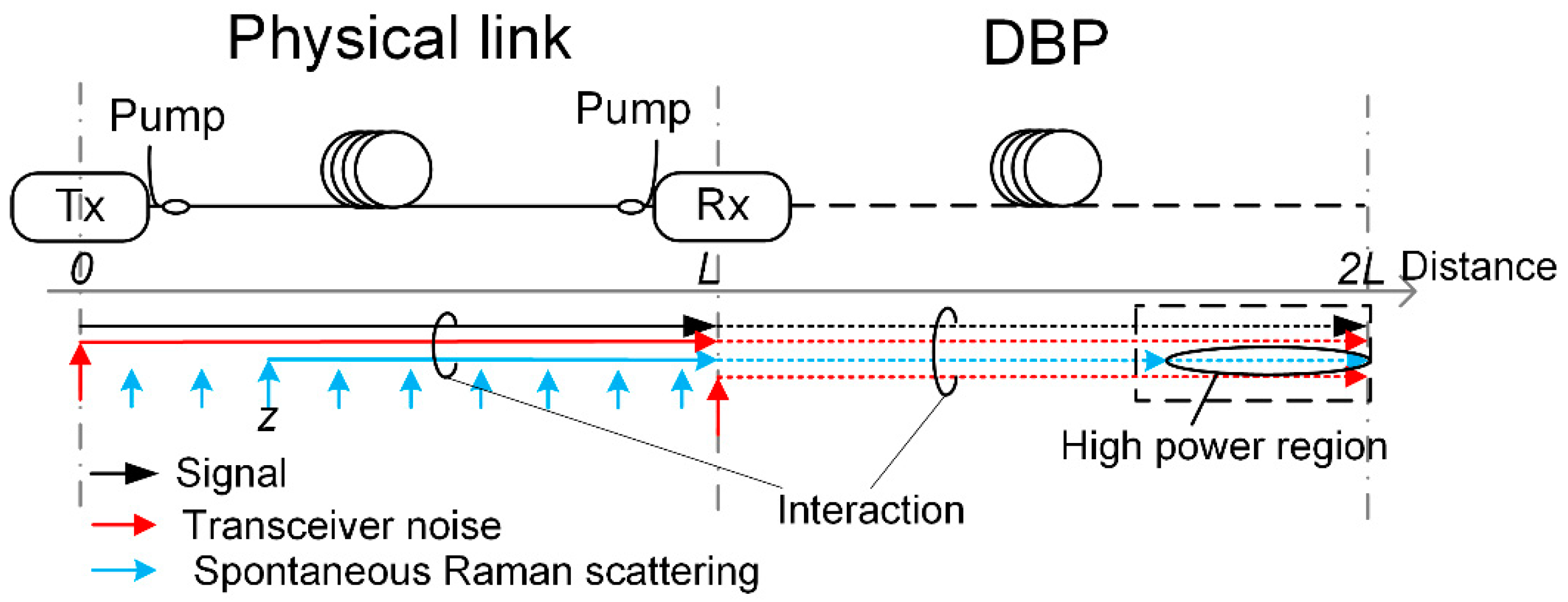
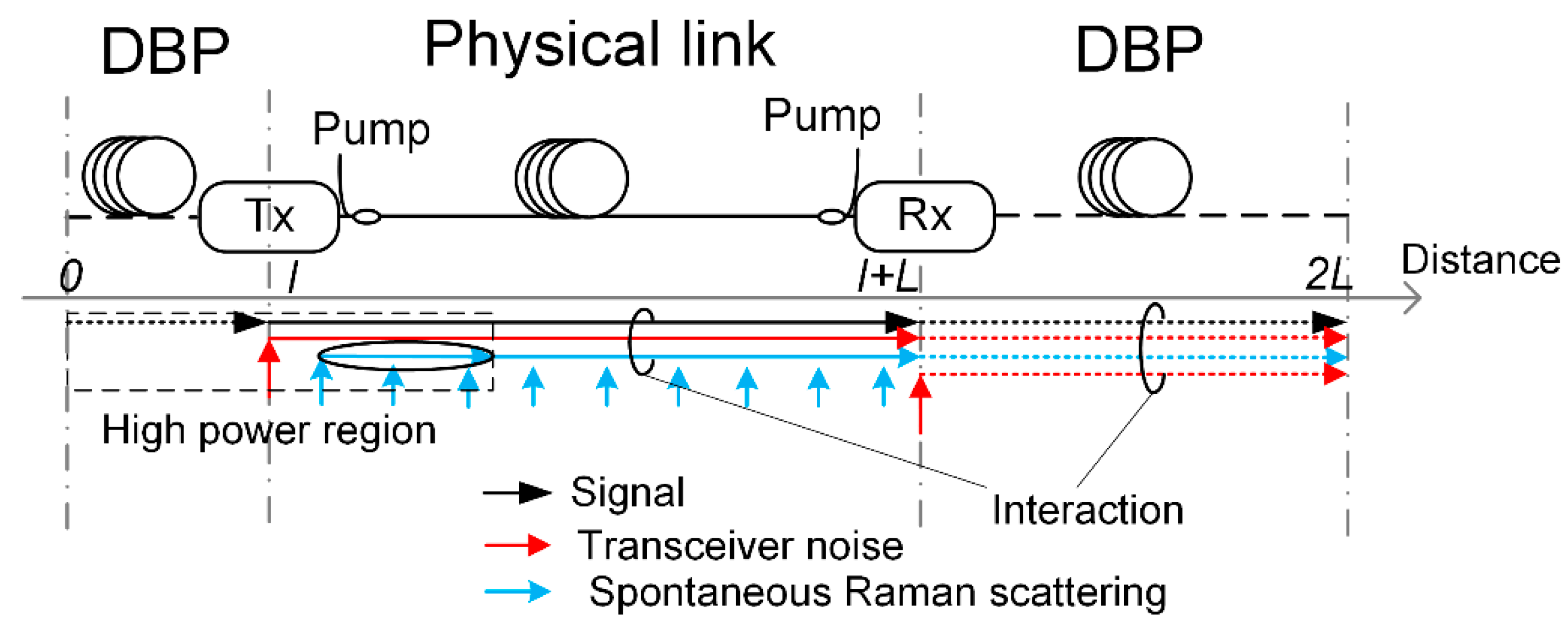
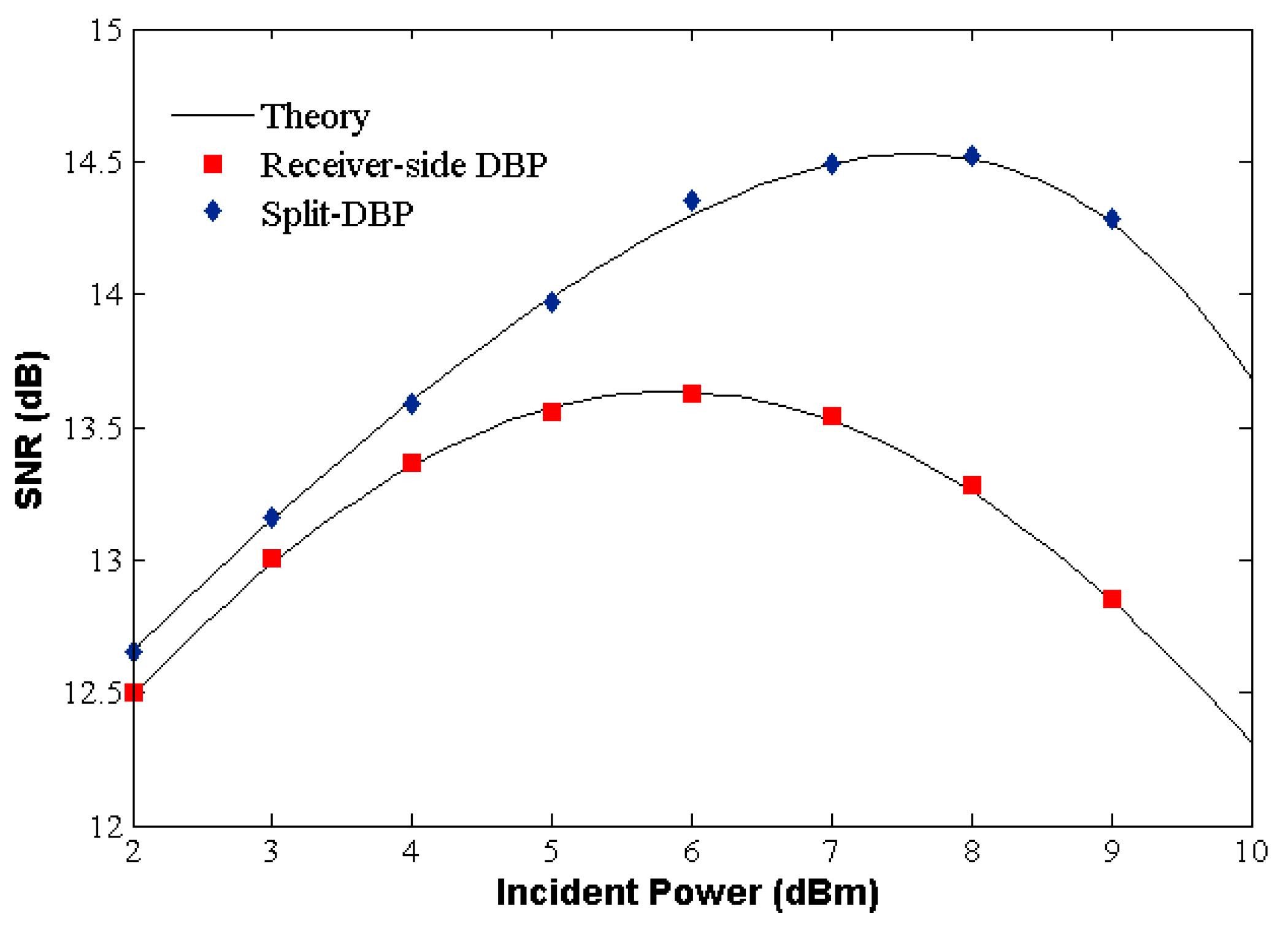
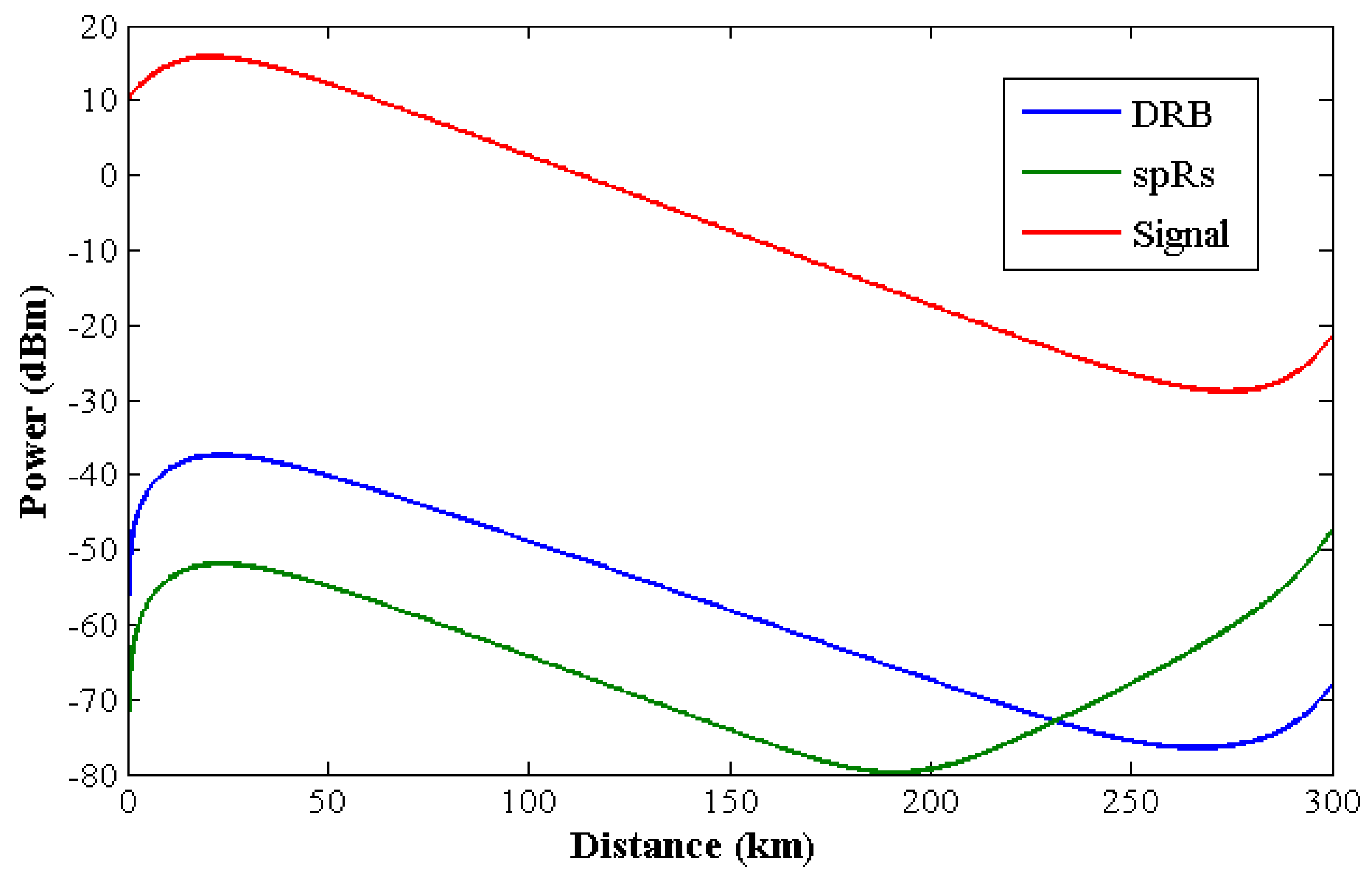
A theoretical model of the nonlinear signal-to-noise interaction (NSNI) in a bi-directional Raman amplified system with receiver-side digital back-propagation (DBP) or split-DBP is given, which is helpful for the design of such a system. In the proposed model, the distributed Raman gain and the spontaneous Raman scattering are taken into account. The results of the theoretical calculation are compared with the results of transmission simulations, which indicates that the theoretical model matches well with the results of simulations when the pre-compensation length is less than 100 km. For the cases of pre-compensation lengths more than 100 km, the theoretical model has an error of less than 0.1 dB compared with the simulations. By using the theoretical model, the efficiency of the split-DBP is analyzed, and the results are compared with transmission simulations. Both the results of theoretical calculation and simulations show that the split-DBP can effectively mitigate the NSNI in such a system. By adopting split-DBP, with an appropriate pre-compensation length, the signal-to-noise ratio (SNR) of the signal increases by about 1 dB. In addition, the impact of the double Rayleigh scattering (DRB) is also analyzed using the proposed model, and the results show that DRB has little impact on the system.
Keywords: optical fiber communications; digital back-propagation; Raman amplification; nonlinear signal-to-noise interaction; nonlinearity mitigation optical fiber communications; digital back-propagation; Raman amplification; nonlinear signal-to-noise interaction; nonlinearity mitigation